DEMOTIC CHARACTERS (continued 4)
Reading edition
As already noted, the clan organization is maternal, and the clanmother is the central figure of the group; but the executive power resides in her brothers in the order of seniority—i. e., while the personal arrangement of the group is maternal, the appellate administration is fraternal. So far as could be ascertained, the form of government is clearly discriminable from that commonly styled avuncular; for, in the first place, the minor administration accompanying the control of property invests the elderwomen with exceptional legislative and judicative powers, while, in the second place, there are no old men (by reason of the militant habit), so that the reverence for age so assiduously cultivated in primitive life extends to matrons much more than to men. Classed with respect to major administration, therefore, the clan may be regarded as an informal adelphiarchy (ἀδελφὁς and ἄρχος) or adelphocracy (αδελφὁς and κρατὁς). It has none of the elements of the patriarchy, since male lineage is not recognized, and can not be classed as a matriarchy, since the clanmother is administratively subordinate to her brothers; while the avuncular functions are apparently inchoate and indirect, i. e., exercised only through or in conjunction with the clanmother. In short, the clan is ordinated or regimented in ostensible accordance with physical power, though the real faculty is confused (after the fashion of primitive thinking generally) with mystical faculties, imputed largely on magical grounds but partly on grounds of age-reverence, etc. Now, when two or more clans combine, the basis on which the common chiefship is determined is similar to that determining the clan leadership; at the outset three factors enter, viz., (1) the seniority of the clans in the accepted tribal mythology, (2) the prowess of the respective clan leaders (always weighed in conjunction with the shamanistic potency of their consorts), and (3) the numerical strength of the respective clans; but practically, so far as can be judged from all available information, the choice really reflects physical force, since in case of doubt the strongest and bravest man becomes the eldest by virtue of his strength and bravery, while the strongest clan finds fair ground for claiming seniority in the very fact of its strength. Naturally disputes arise in the adjustment of the several relations; and in the actual analysis in council, the dispute is commonly reduced to a contest between gods and men, i. e., between the claims for mystical and magical potencies on the one hand and the claims of brawn and bone on the other hand, so that strength wins, unless omens or prodigies turn the scale—which happens often enough to keep the subjective and the objective elements in fairly equal balance. Sometimes the contests are quickly settled; again they last for months, during which the tribe struggles under its weight of Cerberus heads; and repeatedly the disputes have ended in the annihilation of clans, or even in the tribal fissions attested by the recorded and traditional history of the Serian family.
The chiefship once determined, the leader bends all energies toward maintaining the position by which he is dignified and his clan exalted. He recognizes his responsibility for the welfare of the tribe—not only for success in battle and food-getting, but for stilling storms at sea, protecting the aguajes from the drought-demons, and securing all other benefits, both physical and magical; he must be aggressive yet cautious on the warpath, fleet and enduring in retreat, indomitable in the chase, bold but not reckless on the balsa, and above all panoplied and favored by the shadowy potencies of air and earth and waters; he must be the local and lowly Admirable Crichton, and his never-neglected watchword must be noblesse oblige. His practical devices for maintaining prestige are many and diverse; it is commonly the chief who carries the symbolic weapon, the counterfeit cartridge, the imitation machete, or other charm against alien power; it is usually he who wears the white man’s hat or random garment in lieu of the deer or lion mask of earlier days; and during recent years his most-prized fetish, and one which practically insures the support of his fellows, is a written certificate of his chiefship from Señor Encinas, or, still better, from El Gobernador at Hermosillo. Yet he is a throneless and even homeless potentate, sojourning, like the rest of his fellows, in such jacales as his two or three or four wives may erect, wandering with season and sisterly whim, chased often by rumors of invasion or by fearsome dreams, and restrained by convention even from chiding his own children in his wives’ jacales save through the intercession of female relatives.
In 1894 the head chief was reported to be on Tiburon; the putative chief of the rancheria at Costa Rica was the taciturn giant known as El Mudo (plate XIX); while Mashém (or Juan Estorga) was the head of one of the Pelican clans.
ADOPTION
One of the more important factors in demotic development among primitive peoples (probably second only to interclan marriage in extending sympathy and unifying law) is adoption; and special efforts were made to obtain data relating to the subject. Direct inquiries were futile, the responses indicating that the entire subject is foreign to the thought of the tribe; but three sporadic and measurably incongruous examples of quasi adoption are worthy of record.
The most specific case is that of Lieutenant Hardy, who visited Isla Tiburon in 1826, and was fortunate in gaining the confidence of the tribe through successful medical treatment of the wife of the chief. On his second landing he was greeted with many expressions of gratitude, which were especially exuberant on the part of the daughter of the family (always a personage in Seri custom), who insisted on painting his face. He specifies:
Not wishing to deny her the indulgence of this innocent frolic, I quietly suffered her to proceed. She mixed up part of a cake of blue color, which resembles ultramarine (and of which I have a specimen), in a small shell; in another, a white color, obtained by ground talc, and in a third was mixed a color obtained from the red flint-stone of the class which I before stated was to be found on Seal Island, and resembled cinnabar. With the assistance of a pointed stick the tender artist formed perpendicular narrow stripes down my cheeks and nose, at such distances apart as to admit of an equally narrow white line between them. With equal delicacy and skill the tops and bottoms of the white lines were finished off with a white spot. If the cartilage of my nose at the nostrils had been perforated so as to admit a small, round, white bone, five inches in length, tapering off at both ends and rigged something like a cross-jack yard, I might have been mistaken for a native of the island. As soon as the operation was finished, the whole party set up a roar of merry laughter, and called me “Hermano, Capitan Tiburow,” being the very limited extent of their knowledge of Spanish.317
While the lieutenant attached no significance to the painting, the procedure would seem to have been a ceremonial adoption, such as might, for example, be used in connection with a confederate clan. The description of the painting is sufficiently explicit to identify the totem with that of the Turtle clan, represented by the clanmother and the daughter of the clan at Costa Rica in 1894 (plates XVIII and XXIV); but it is noteworthy that the salutation with which the ceremony terminated, and which may be rendered “Captain-Brother of the Sharks”, would seem to identify the totem with the shark rather than the turtle.318
The second case of adoption (if so it may be styled) was that of Señor Encinas, after his bloodiest battle, in which nearly all of the Seri warriors were left on the field. In this case there was no ceremony, or at least none remembered by the beneficiary; he was merely informed by a delegation of aged dames that thenceforth he would be regarded as a stronger and more invulnerable chief (shaman) than any member of the tribe, and hence as the tribal leader.
The third instance is still less definite, though it seems to be trustworthy. There is a widespread tradition throughout Sonora that in the course of a brush between a band of Papago hunters and a marauding bunch of Seri warriors in the mountains southeast of Cieneguilla twenty-five or thirty years ago, a Papago maiden was captured and carried off to Tiburon; and that for some years thereafter—i. e., until the Papago had taken ample blood-vengeance—the intertribal animosity was exceptionally bitter. No wholly satisfactory basis for the traditions could be found among the Papago, though some of the silences of the old men were suggestive; nor was the tradition fully credited by Señor Encinas, despite its deep lodgment in the minds of some of his yeomanry. When Mashém was interrogated on different occasions, he merely shook his head in stolid silence; but when the device was adopted of inquiring the number of Papago children brought into the tribe through this woman, he responded promptly with a snort of scorn, and followed this with the explanation that she never had children, and could not because she was an alien slave. The explanation was corroborated by clanmother Juana Maria and other matrons, with sundry expressions of contemptuous disapproval of the inquiry and scorn of the very idea that aliens could fructify within the tribe. Later, the ice being broken, Mashém intimated that the woman had recently died of old age and its consequences—doubtless as an outcast. On the whole, the direct testimony would seem to substantiate the tradition, and to supplement it with the short and simple annals of a spouseless and childless life (incredible of other tribes, but consistent with the customs of the Seri), endured for many years and ending at last in unpitied death.
Collectively the cases seem to define a germ, rather than a mature custom, of adoption. In the first case a benefactor (by means regarded as magical) was formally inducted into the reigning family; in the second case the conquering hero (through what were again regarded as magical means) was less formally recognized and venerated, even worshiped, as an all-powerful shaman; while in the third case a representative of the doughtiest alien tribe was enslaved, probably with motives akin to those expressed in the carrying of chargeless guns, the making of imitation machetes, and other fetishistic devices. Except in the first instance there is no indication of consistent custom; but since the entire history of the tribe clearly contradicts regulated adoption of aliens (and indeed affords no other example), it must be inferred that any such custom is intratribal rather than intertribal.
MARRIAGE
The most striking and significant social facts discovered among the Seri relate to marriage customs.
As noted repeatedly elsewhere, the tribal population is preponderantly feminine, so that polygyny naturally prevails; the number of wives reaches three or possibly four, averaging about two, though the younger warriors commonly have but one, and there are always a number of spouseless (widowed) dames but no single men of marriageable age. So far as could be ascertained, no special formalities attend the taking of supernumerary wives, who are usually widowed sisters of the first spouse; it seems to be practically a family affair, governed by considerations of convenience rather than established regulations—an irregularity combining with other facts to suggest that polygyny is incidental, and perhaps of comparatively recent origin.
The primary mating of the Seri is attended by observances so elaborate as to show that marriage is one of the profoundest sacraments of the tribe, penetrating the innermost recesses of tribal thought, and interwoven with the essential fibers of tribal existence. Few if any other peoples devote such anxious care to their mating as do the Seri;319 and among no other known tribe or folk is the moral aspect of conjugal union so rigorously guarded by collective action and individual devotion.
The initial movement toward formal marriage seems to be somewhat indefinite (or perhaps, rather, spontaneous); according to Mashém it may be made either by the prospective groom or else by his father, though not directly by the maiden or her kinswomen. In any event the prerequisites for the union are provisionally determined in the suitor’s family; these relate to the suitability of age, the propriety of the clan relation, etc.; for no stripling may seriously contemplate matrimony until he has entered manhood (apparently corresponding with the warrior class), nor can he mate in his own totem, though all other clans of the tribe are apparently open to him; while the maiden must have passed (apparently by a considerable time) her puberty feast. In any event, too, the proposal is formally conveyed by the elderwoman of the suitor’s family to the maiden’s clanmother, when it is duly pondered, first by this dame and her daughter matrons; and later (if the proposal is entertained) it is deliberated and discussed at length by the matrons of the two clans involved, who commonly hold repeated councils for the purpose. At an undetermined stage and to an undetermined degree the maiden herself is consulted; certainly she holds the power of veto, ostensible if not actual. Pending the deliberations the maiden receives special consideration and enjoys various dignities; if circumstances favor, her kinswomen erect a jacal for her; and even if circumstances are adverse, she is outfitted with a pelican robe of six or eight pelts and other matronly requisites. When all parties concerned are eventually satisfied a probationary marriage is arranged, and the groom leaves his clan and attaches himself to that of the bride. Two essential conditions—one of material character and the other moral—are involved in this probationary union; in the first place, the groom must become the provider for, and the protector of, the entire family of the bride, including the dependent children and such cripples and invalids as may be tolerated by the tribe—i. e., he must display and exercise skill in turtle-fishing, strength in the chase, subtlety in warfare, and all other physical qualities of competent manhood. This relation, with the attendant obligations, holds for a year, i. e., a round of the seasons. During the same period the groom shares the jacal and sleeping robe provided for the prospective matron by her kinswomen, not as privileged spouse, but merely as a protecting companion; and throughout this probationary term he is compelled to maintain continence—i. e., he must display the most indubitable proofs of moral force. During this period the always dignified position occupied by the daughter of the family culminates; she is the observed of all observers, the subject of gossip among matrons and warriors alike, the recipient of frequent tokens from designing sisters with an eye to shares of her spouse’s spoils, and the receiver of material supplies measuring the competence of the would-be husband; through his energy she is enabled to dispense largess with lavish hand, and thus to dignify her clan and honor her spouse in the most effective way known to primitive life; and at the same time she enjoys the immeasurable moral stimulus of realizing that she is the arbiter of the fate of a man who becomes warrior or outcast at her bidding, and through him of the future of two clans—i. e., she is raised to a responsibility in both personal and tribal affairs which, albeit temporary, is hardly lower than that of the warrior-chief. In tribal theory the moral test measures the character of the man; in very fact, it at the same time both measures and makes the character of the woman. Among other privileges bestowed on the bride during the probationary period are those of receiving the most intimate attentions from the clanfellows of the groom; and these are noteworthy as suggestions of a vestigial polyandry or adelphogamy. At the close of the year the probation ends in a feast provided by the probationer, who thereupon enters the bride’s jacal as a perpetual guest of unlimited personal privileges (subject to tribal custom); while the bride passes from a half-wanton heyday into the duller routine of matronly existence.
These details were elicited at Costa Rica in 1894 through methodical inquiries made in connection with the linguistic collection. This collection was made with the cooperation of Señor Alvemar-Leon as Spanish-English interpreter, together with Mashém and (commonly) the clanmother known as Juana Maria. Usually quite a group of Seri matrons with two or three warriors were gathered about, and to these Mashém frequently appealed for advice and verification, while they constantly expressed approval or disapproval of questions and replies, as gathered through Mashém’s words and mien, in such manner as to afford a fair index of their habitual thought—e. g., when the Seri vernacular for “twins” was obtained and the inquiry was extended (by normal association of ideas) to the term for “triplets”, Mashém collapsed into moody silence while the rest of the group decamped incontinently with horror-stricken countenances—thereby suggesting cautious subsequent inquiry, and the discovery that triplets are deemed evil monsters and their production a capital crime. It was in one of the earlier conferences that the first intimations concerning the unusual marital customs were incidentally brought out; the Caucasian interpreter and bystanders were diverted by the naive reference to the moral test, but their expressions were hastily checked lest the native informants might be startled and rendered secretive; then, during two later conferences, when Mashém and several matrons were freely participating in the proceedings, the line of inquiry was so turned as to touch on various aspects of the marriage custom and bring out all essential features; so that much confidence is reposed in the accuracy of the details.320 The confidence in the verity of the customs was such as not to be impaired seriously by the fact that no records of coincident moral tests were known in the voluminous literature of marriage and its concomitants; nor was it shaken by the still weightier fact that none of the experienced ethnologists to whom inquiries were addressed during ensuing months were acquainted with parallel customs—indeed the only shadow of corroboration thus obtained came in the form of references to the widespread requirement of continence in war and ceremonies, and to an affectation of self-restraint for a moon on the part of Zuñi grooms noted by Frank Hamilton Cushing. Accordingly the facts were announced in a preliminary paper,321 and were shown to stand in such relation to the marital customs of other aboriginal tribes as practically to demonstrate their validity, and at the same time to locate the Seri customs on a lower plane of cultural development than any hitherto definitely recognized.
Happily, subsequent researches have resulted in the discovery of records corroborative of the primitive customs observed by the Seri, and also of the assignment of serial place to these customs. The most specific record is that of John Giles (or Gyles), who spent his youth as a captive among the northeastern Algonquian Indians (probably the Maliseet or some closely related Abnaki tribe), from August 2, 1689, to June 28, 1698. Referring to the marital customs of the tribe, he observed:
If parents have a daughter marriageable, they seek a husband for her who is a good hunter. If she has been educated to make monoodah (Indian bags), birch dishes, to lace snowshoes, make Indian shoes, string wampum belts, sew birch canoes, and boil the kettle, she is esteemed a lady of fine accomplishments. If the man sought out for her husband have a gun and ammunition, a canoe, a spear, a hatchet, a monoodah, a crooked knife, looking-glass and paint, a pipe, tobacco, and knot-bowl to toss a kind of dice in, he is accounted a gentleman of a plentiful fortune. Whatever the new married man procures the first year belongs to his wife’s parents. If the young pair have a child within a year and nine months, they are thought to be very forward and libidinous persons.322
This record is of peculiar interest in that it definitely specifies a custom corresponding with the material test of the Seri, and unmistakably implies the existence, at least in vestigial or sentimental form, of a custom corresponding with the moral test of Seriland; and it is particularly noteworthy as coming from a remote tribe occupying a distant part of the continent.
A somewhat less specific corroboration is found in Lawson’s account of the Carolina tribes. He observes:
When any young Indian has a mind for such a girl to his wife, he, or some one for him, goes to the young woman’s parents, if living; if not, to her nearest relations, where they make offers of the match betwixt the couple. The relations reply, they will consider of it; which serves for a sufficient answer, till there be a second meeting about the marriage, which is generally brought into debate before all the relations, that are old people, on both sides, and sometimes the king, with all his great men, give their opinions therein. If it be agreed on, and the young woman approve thereof, for these savages never give their children in marriage without their own consent, the man pays so much for his wife; and the handsomer she is the greater price she bears. Now, it often happens that the man has not so much of their money ready as he is to pay for his wife; but if they know him to be a good hunter, and that he can raise the sum agreed for, in some few moons, or any little time they agree, she shall go along with him as betrothed, but he is not to have any knowledge of her till the utmost payment is discharged; all which is punctually observed. Thus they lie together under one covering for several months, and the woman remains the same as she was when she first came to him.323
This record also is peculiarly pertinent, partly in that it practically corroborates the Seri testimony, but chiefly in that it indicates definite transition toward a higher culture-plane in which the primitive material test is at least partially replaced by a commutation in goods or their equivalents.
On reducing the marital customs of the Seri to conventional terms, the more prominent features are found to be (1) strict clan exogamy and (2) absolute tribal endogamy, together with (3) theoretical or constructive monogamy, coupled with (4) vague traces of polyandry, and (5) an apparently superficial polygyny, as well as (6) total absence of purchase or capture of either spouse.
On reviewing the customs in the light of their influence on the everyday life of the tribe, certain features stand out conspicuously: (1) Perhaps the most striking feature is the collective character of the function; for while the movement originates in personal inclination on the part of the suitor and is shaped by personal inclination on the part of the maiden, all manifestations of inclination are open and public (at least to the elders of the two clans involved), while the personal sentiments on both sides are completely subordinated to the public interests of clans and tribe as weighed and decided by the matronly lawgivers and adelphiarchal administratives. Thus neither man nor maid mates for thonself, but both love and move in the tribal interests and along the lines laid down by the tribal leaders. (2) As a corollary or a complement (according to the viewpoint) to the collectivity of the mating, the next most striking feature is the formal or legal aspect of the union; for the entire affair, from inception to consummation, is rigorously regulated by precedents and usages handed down from an immemorial past. Thus the roots of young affection are not destroyed but rather cultivated, though the burgeoning vine and the outreaching tendrils are trained to a social structure shaped in ages gone and kept in the olden form by unbroken tradition. (3) A collateral feature of the customs is the necessary reaction of the requirements on individual character of both groom and bride; for the would-be warrior-spouse is compelled to display high qualities of physical and moral manhood on pain of ostracism and outlawry, so that his passions of ambition and affection are at once stimulated to the highest degree, while the maiden’s pride of blood and possession and her sense of regnant responsibility are fostered to the utmost. The brief preliminary courtship and the long probationary mating mark an era of intensification in two lives at their most impressionable stage; and if there be aught in the simple yet puissant law of conjugal conation—that law whose motive underlies the world’s song and story and all the pulsing progress of mankind as the inspiration of most men’s work and most women’s hopes—the vital intensity of this era passes down the line of blood-descent to the betterment of later generations. (4) Another collateral feature is the necessary reaction on clan and tribe; for not only does the individual character-making raise the average physique and morale of the group, but the carefully studied restraint of excessive individuality serves to strengthen still further the tribal bonds and to lift still higher the racial bar against aliens. The blackest crime in the Seri calendar is the toleration of alien blood; and no more effective device could be found for keeping alive the race-sense on which this canon depends than that virtually sacramental surveillance of sexual intimacy which Seri usage requires.324
On scanning the conventional classifications of human marriage in the light of the Seri customs, it becomes clear that these customs define a plane not hitherto recognized observationally. For convenience, this plane and the mode of marriage defining it may, in special allusion to the correlative race-sense, be styled ethnogamy; and the more systematic characters of this mode and plane of marriage may be outlined briefly:
1. The most conspicuous character of ethnogamic union, as manifested in the type tribe, is its absolute confinement to the consanguineal group. The breach of this limitation is hardly conceivable in the minds of the group, since aliens are not classed as human, nor even dignified as animals of the kinds deified in their lowly faith, but contemned as unclean and loathsome monsters; yet the infraction has a sort of theoretical place at the head of their calendar as an utterly intolerable crime. In respect to this character, ethnogamy corresponds fairly with the endogamy of McLennan, Spencer, and others, i. e., with the tribal endogamy of Powell.
2. A hardly less conspicuous character of ethnogamic union is the formality, or legality, accompanying and reflecting the collective nature of the function. In this respect ethnogamy is the direct antithesis of that hypothetical promiscuity postulated by Morgan and adopted by Spencer, Lubbock, Tylor, and others; and the customs of the type tribe go farther, perhaps, than any other example in verifying the alternative assumption of Westermarck that the course of conjugal development is rather from monogamy toward promiscuity than in the reverse direction.
3. A noteworthy character of ethnogamic union is the absence of capture of either bride or groom. Any semblance of capture would indeed be wholly incongruous with the rigid confinement of union to members of the group: it would also be incongruous with the exceeding formality and necessary amicability of both preliminary and concomitant arrangements.
4. Another noteworthy character is the total absence of purchase on either part. Although a material condition attends the union, it is essentially a test of character, and is applied in such wise as to dignify the feminine element rather than to degrade it like barbaric wife-purchase; while any semblance of purchase would be incongruous with the economic condition of a tribe practically destitute of accumulated property or even of thrift-sense.
5. A significant character of ethnogamic union, as exemplified in the type tribe, is the ceremonial or constructive monogamy. While there are obscure (and presumptively vestigial) traces of polyandry or adelphogamy, and while an informal polygyny is practiced by the chiefs and older warriors, the formal matings are between one man and one woman, and appear to be permanent.
Now, on comparing these characters with those revealed in the marital customs of other tribes and peoples, they are found to betoken a notably provincial and primitive culture-stage. Perhaps the nearest American approach to the Seri customs is found among certain California aborigines, notably the Yurok and Patawat tribes, who recognize the institution of “half-marriage”;325 but here the material test of Seriland is replaced by purchase, while no trace of the moral test is found (even as among the Carolina Indians, according to Lawson); moreover, while these tribes discourage alien connections, they are not absolutely eschewed and reprobated as among the Seri. Other notably primitive customs, like those so fully described by Spencer and Gillen, have been found among the Australian aborigines;326 but even here a part only of the marriages are regulated by amicable convention, while others are effected by (1) charm, (2) capture, and (3) elopement; and these collateral devices imply intertribal relations of a kind incongruous with the ethnogamic habit and utterly repugnant to the ethnogamic instinct. In both cases, accordingly, the marital customs clearly imply (and actually accompany) a much more highly differentiated socialry and economy than that of the Seri. The same is true of that vestigial custom of the Scottish clans known as handfasting, which is, moreover, a direct antithesis of the Seri custom in that it carries a warrant for, rather than an abridgment of, conjugal prerogatives; and the same might be said also of various South American, African, and southeastern Asian customs.
Certain representative North American customs have already been seriated in connection with the Seri customs, and their relations are of sufficient significance to warrant recapitulation. The series begins with the maternally organized and practically propertyless Seri. Next stand the Zuñi, with an essentially maternal organization, the vestigial moral test of the groom noted by Cushing, and a concomitant material test verging on purchase; so, too, monogamy persists, while the function remains largely collective, and is regulated by the elders, though the bride enjoys special prerogatives; and the fierce tribal endogamy is relaxed, though clan exogamy is enforced. Measurably similar to those of the Zuñi are the marital customs of the peaceful Tarahumari tribe of northern Mexico and the once warlike Seneca tribe of northeastern United States, although among both of these more cosmopolitan peoples the regulations are less closely similar to the Seri customs than are those of the Pueblo tribe named. Next in order of marital differentiation stand the Kwakiutl and Salish tribes of British Columbia, in which the social organization has practically passed into the paternal stage; here the laws of monogamy, clan exogamy, and tribal endogamy are materially relaxed, the moral test is lost among the Kwakiutl and reduced to a curious vestige among the Salish, while the material test is commuted into the making of expensive presents. Still more remote from the initial stage is the marriage of the paternally organized Omaha, among whom tribal endogamy is prevalent but not absolute, while polygyny is customary; among whom the moral test seems wholly obsolete, while the material test is completely replaced by purchase (or at least by the interchange of expensive presents); and among whom, concordantly, the feminine privileges are few and the females are practically degraded to the rank of property of male kindred or spouses. These several customs fall into a natural order or series definitely coordinated with the esthetic, the industrial or economic, and the general institutional or social conditions of the respective tribes; and it is noteworthy that they mark successive stages in that passage from the mechanical to the spontaneous which characterizes demotic activity.327
In brief, ethnogamy, as exemplified by the type tribe, accompanies that strictly maternal organization which marks the lowest known stage of social development; it accompanies also a rudimentary esthetic condition in which decorative symbols are restricted to the expression of maternal relation; it accompanies, in like manner, an inchoate economic condition characterized by absence of property and thrift-sense; while its most essential concomitant is extratribal antipathy too bitter to permit toleration of alien blood, or even of alien presence save under the constraint of superior force.
MORTUARY CUSTOMS
The prevailing opinion among the better informed Caucasian neighbors of the Seri is that the tribesmen display an inhuman indifference to their dead; and this opinion is one of the factors—combining with current notions as to cannibalism and arrow-poisoning and beastlike toothing in battle—involved in the widespread feeling that the tribesmen are to be accounted as mongrel and uncanny monsters rather than human beings.
The opinion that the Seri neglect their dead on occasion would seem to rest on a considerable body of evidence; Mendoza’s record of the numberless neglected corpses of warriors polluting the air and poisoning the streams of Cerro Prieto in 1757 would seem to be unusual only in its fulness; and Señor Encinas, albeit so conservative as to repudiate the reputed anthropophagy and to recognize better qualities among the folk than any contemporary, declares that they are utterly negligent of their dead, save that when the bodies lie near rancherias heaps of brambles are thrown over them to bar—and thus to lessen the disturbance from—prowling coyotes. Quite indubitable, too, is the specific testimony of vaqueros to the effect that Seri raiders overtaken by the Draconian penalty of the frontier merely lie where they fall, even when this is well within reach of the tribesmen, Don Andrés Noriega’s verification of his boast (ante, p. 113) being an instance in point. On the other hand stands the conspicuous fact (unknown to the frontiersman) that well-marked cemeteries adjoin some of the rancherias of interior Seriland. The sum of the somewhat discrepant evidence accords with a characteristically unsatisfactory statement by Mashém, to the effect that the mourning ceremonies are important only in connection with women—i. e., matrons—because “the woman is just like the family” (“la muger es como la familia”); and this intimation, in turn, is corroborated by the single known instance of inhumation in Seriland, as well as by certain indirect indications connected with the scatophagic customs (ante, p. 213). On the whole it seems certain that the mortuary ceremonies attain their highest development in connection with females, the recognized blood-bearers and legislators of the tribe.
The special dignification of females in respect to funerary rites is without precise parallel among other American aborigines, so far as is known, but is not without analogues in the shape of (presumptive) vestiges of a former magnification of matrons in the mortuary customs of certain tribes. The vestiges are especially clear among the Iroquoian Indians, whose aboriginal socialry coincided with that of the Seri at various points; witness the following passage from the Onondaga mourning ritual, as collected and translated by Hewitt:
Now, moreover, again, another thing, indeed, our voices come forth to utter; and is it not that that we say, that far yonder the Hoyaner [chief of highest grade] who labored for us so well is falling away as falls a tree? So, moreover, it is these things that he bears away with him—this file of mat-carriers, warriors all, visible and present here; also this file of those who customarily dance the corn-dances [the women]—they go prosperously. And alas! How utterly calamitous is that thing that occurs when the body of this woman falls! For, verily, far yonder in the length of the file will the file of our grandchildren be removed! These our grandchildren who run hither and thither in sport, these our grandchildren who by creeping drag themselves about in the dust, these our grandchildren whose bodies are slung to cradle-boards, and even those of them whose faces are looking hitherward as they come under the ground.328
The identifiable cemeteries of Seriland are few and small—much less populous than might be expected of a tribe numbering several hundreds for centuries, and able to maintain well-worn trails threading all parts of their rugged domain. Three graves were noted near the abandoned rancheria at Pozo Escalante; one was observed near a jacal skeleton at Barranca Salina; five or six were made out doubtfully on a low spur adjacent to Punta Antigualla; another was found near the rancheria midway thence to Punta Ygnacio; still another was doubtfully identified hard by a ruinous jacal just where the foothills of Sierra Seri descend to the plain stretching toward Punta Miguel; and this distribution may be deemed representative. A scant half-dozen perceptible graves were observed near the considerable rancheria of Punta Narragansett, which was numerously inhabited during the Dewey surveys of 1873; one was found adjoining the old jacal near Campo Navidad; but none were discovered in connection with the extensive rancheria on Rada Ballena. The largest known cemetery occupies the triangular point of shrub-dotted plain pushing out toward the site of the old rancheria at the base of Punta Tormenta; it comprises perhaps a score of evidently ancient graves, while two newer ones were found on the pebble bar beyond the jacales. When near the pebbly beaches the graves are marked by heaps of pebbles and small cobbles, commonly about the size of those used as hupfs, these cairns being 3 or 4 feet long, two-thirds as wide, and seldom over 12 or 15 inches in height; and most of the cairns are accompanied and enlarged by piles (ranging from a peck to a bushel) of the scatophagic shells already noted. The graves remote from pebbly beaches are marked by heaps of cholla stems and branches, rudely thatched with miscellaneous brambles roughly pinned together by okatilla stems, the shocks being sometimes nearly as high and broad as the jacales. A few of the scatophagic shells were found about the bramble-marked graves at Pozo Escalante, and a single one at Barranca Salina. In general the association of cemeteries and rancherias, or of graves and jacales, indicates that habitations are usually abandoned for a time when a death occurs within or near them.
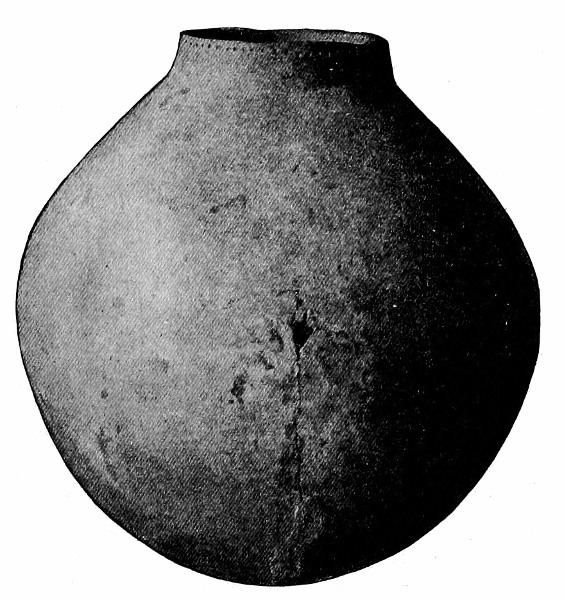
Fig. 39—Mortuary olla.
The most conspicuous cairn seen in Seriland was well within Tiburon. It stands on the southern side of a little rock-butte about a mile and a half east-southeast of Tinaja Anita, south of the main arroyo, and near where the trail from the tinaja bifurcates toward Arroyo Carrizal and Punta Narragansett, respectively. It is shadowed by a notably large and widespreading paloverde, and is in the form of a cone estimated at 7 feet in height and 18 or 20 feet across the base. The materials, at least on the surface, are rounded pebbles and cobbles, possibly from the adjacent arroyos, though more probably from the beaches, of which the nearest is miles away. It was not determined to be mortuary.329
On the death of the matron, a grave is scooped out by means of shells a few yards from her jacal, preference being given to relatively elevated or commanding points. The excavation is about 30 inches (90 cm.) in depth; within it is placed first the pelican-skin robe of the deceased, so arranged as to fold over the body; then the corpse, dressed in the ordinary costume of life, is compressed into small compass by closely flexing the knees and bringing them against the thorax, extending the arms around and along the lower limbs so that hands and feet are together, and bending the head forward on the chest; when it is deposited in the receptacle in such manner as to lie on the left side, facing northward. Near the face is laid a dish of baked clay or a large shell filled with food, and beside it a small olla of water (an actual example is shown in figure 39), while the hupf, awls, hairbrush, olla-ring, and other domestic paraphernalia are placed near the hands. Next the personal fetishes and votive symbols (in the form of puppets or dolls such as those shown in figure 40 a and b) of the dead mother are slipped beneath the face, and her paint-cup, with a plentiful supply of paint, is added; the poor personal possessions, in the form of shell-beads and miscellaneous trinketry, are then heaped over the face and shoulders, and these are covered with the superfluous garments and miscellaneous property of the deceased. Finally the pelican-pelt bedding is folded over the body, and two turtle-shells are laid over all as a kind of coffin, when the grave is carefully filled, and the ground so smoothed as to leave no mark of the burial. During subsequent hours the stones for the cairn or the cholla-joints and other brambles for the brush-heap are piled over the spot, while the scatophagic shells are added at intervals apparently for weeks or months and perhaps for years after the burial.
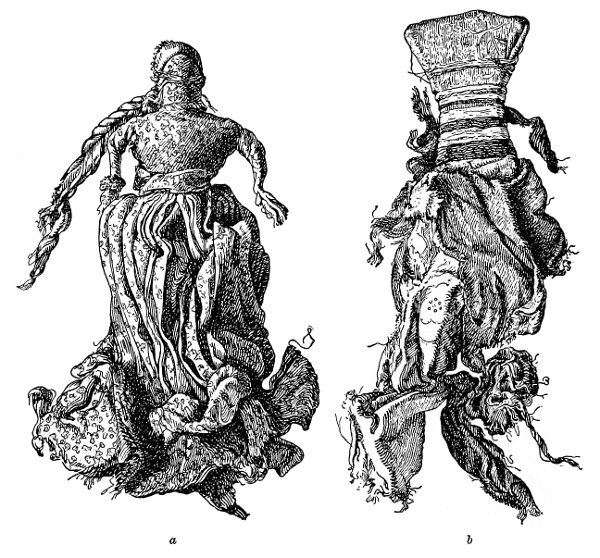
Fig. 40—Woman’s fetishes.
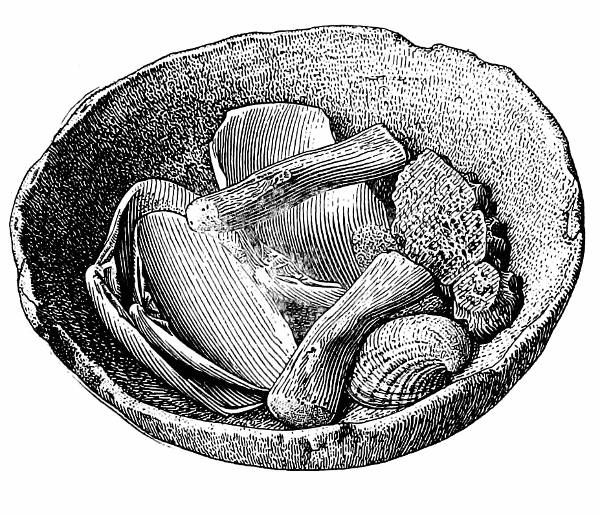
Fig. 41—Food for the long journey.
The mortuary food is carefully selected for appropriate qualities (i. e., for “strength” in the notion of the mourners). It comprises portions of turtle-flippers, and, if practicable, a chunk of charred plastron—the food substance especially associated with long and hard journeys—with a few fresh mollusks, and, judging from a single good example as well as from analogy, one or two scatophagic shells. The remains of a funerary feast are illustrated in figures 41 and 42, the latter being the scatophagic receptacle utilized apparently in the absence of the customary Noah’s ark. It may be significant that this shell is perforated at the apex, evidently by long wave-wear before utilization, and that the accompanying olla bears marks of having been broken, then repaired, and afterward perforated, as illustrated in the photo-mechanical reproduction (figure 39); for these features perhaps express that idea of “killing” mortuary sacrifices, ostensibly to fit them to the condition of the deceased, though really (in subconscious practicality) to protect the sepulcher from predation.330
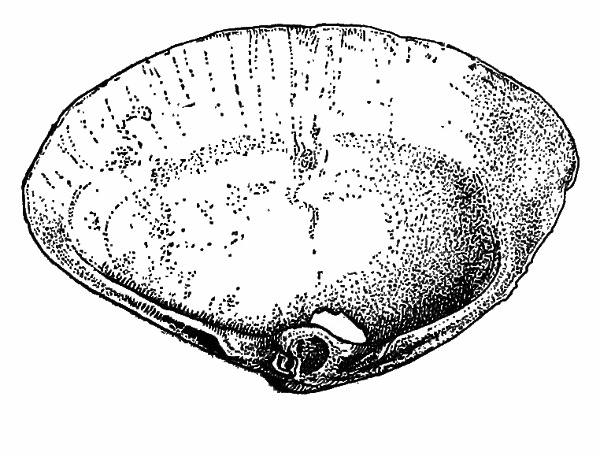
Fig. 42—Mortuary Cup.
Soon after the death (immediately after the burial, so nearly as could be ascertained) there is an apparently ceremonial mourning, in which the matrons of the clan, and, at least to some extent, the warriors also, participate. The mourners wail loudly, throw earth and ashes or ordure on their heads, and beat and bruise (but apparently avoid scarifying) their breasts, faces, and arms. This is continued, culminating daily about the hour of interment, for several days—unless the rancheria is sooner abandoned, in which case the period of formal mourning is shortened.
In addition to the formal mourning of matrons there is a custom of nocturnal wailing after the death of warriors in battle, and, apparently, also, following the death of matrons or nubile maidens, which attracts the notice of frontier rancheros and vaqueros. According to their accounts the first note of lamentation may be sounded at any hour of the night by any of the group to which the deceased belonged; it is successively taken up by other members of the party until all voices are united in a resounding chorus of inarticulate moans, wails, shriller cries, and wild howls, likened by the auditors to the blood-bellowing of cattle; if other groups of the tribesmen are within hearing, they, too, take up the cry, so that the lamentation may extend to the entire tribe and echo throughout practically all Seriland at the same moment. The fierce howling and attendant excitement may rise so high in the group in which the wailing begins that all seem bereft of customary caution; and sometimes they suddenly seize ollas and weapons, and decamp incontinently, perhaps scattering widely and racing for miles before settling again for sleep or watchful guard.
The ideas of the folk concerning death and concerning the relations between the living and the dead are largely esoteric, and are, moreover, veiled by the nonequivalence of Seri expressions with the terms of alien languages.
At least an inchoate belief in a life beyond the grave was intimated by Mashém and his companions at Costa Rica, and their circumspection of speech and mien indicated a strong veneration for, or dread of, the manes; though the specific expressions were connected with deceased matrons, who alone seemed to be prominent in the minds of the clan-mates. So far as could be gathered the belief seems to be that the dead find their way back to the primordial underworld, whence Earth and Beings were brought up by Pelican and Turtle (or Shark) respectively, and are liable to return by night with mischievous intent.
The direct expressions of the Seri informants are fully corroborated by the association of things in interior Seriland. The burial of water and food, of the personal fetishes and votive objects, and of the highly prized face-paint belonging to the dead matron, attests anticipation of a post-mortuary journey; while the temporary abandonment of jacales and rancherias and the nocturnal fears and flights alike betoken dread of sepulchral visitants. The most suggestive of the associations, i. e., between the scatophagic stores and the sepulchers, awaits full explanation.
Serial Place of Seri Socialry
In the conventional seriation of social development four stages are clearly recognizable, viz.: (1) Savagery, in which the social organization is based on blood kinship reckoned in the female line; (2) barbarism, in which the basis of organization is actual or assumed consanguinity reckoned in the male line; (3) civilization, in which the laws are based on property-right, primarily territorial; and (4) enlightenment, in which the organization is constitutional and rests on the recognition of equal human rights to life, liberty, and the pursuit of happiness. Now, in terms of this seriation of general culture-stages, the place of the Seri tribe is clear. Reckoning consanguinity wholly in the maternal line, as they do, they belong in the initial stage of savagery. Accordingly they pertain to the lower or more primitive of the two great stages represented by the American aborigines.
A still more refined seriation may be effected through conspection of the several lines of activital development—the esthetic and industrial, and especially the sophic or fiducial, as well as the strictly social; for these lines are most intimately intertwined. Thus, in the Old World, the transition from maternal to patriarchal organization was accompanied, and evidently superinduced, by the development of zooculture into extensive herding; in different districts of the New World, a parallel transition attended the development of agriculture to a phase involving the protection of acequias and fields by armed men; while throughout primitive life, laws are formulated and enforced chiefly through appeals to the superphysical or mythologic. Now, review of the Seri esthetic indicates that the decorative concepts and activities are in large measure inchoate and are practically confined to a single manifestation, i. e., the delineation of totemic symbols primarily denoting zoic tutelaries and incidentally connoting the blood-carriers of clans consecrated to these beast-gods; so that the esthetic motives and devices of the tribe are essentially zoosematic. In like manner a considerable part of the technic of the tribe is zoomimic, as already shown, while even the most highly developed industrial activities occupy the biotic borderland of mechanical chance rather than the characteristic demotic realm of intellectual design. So, too, the faith of the folk is exclusively and overweeningly zootheistic, to the extent that every motion, every thought, every organized action, every law, every ceremony, is shaped with reference to mystical potencies vaguely conceived as a pantheon of maleficent beast-gods; and it is this dark and hopeless faith that gives character to the tribal esthetic and technic. Concordantly the faith finds reflection in the very elements of the social organization; the matron is the blood-carrier and the lawgiver not in and for herself but as the vicarious and visible exponent of an ever-immanent beast-god—the clan tutelary; her appeals to her brothers for administrative aid are precisely parallel to her intuitive passage from zoomimicry into the field of mechanical chance defined by protolithic implements; and the appeal, like the execution of the law either by herself or by her brothers, is controlled and regulated in absolute deference to the zoic pantheon. Thus, the inchoate tribal laws, expressed in habitual lines of action and modes of thought, are by no means conscious products of human wisdom, but are confidently imputed to a superhuman wisdom on the part of myth-magnified beasts of a mystical olden time; and, similarly, the power of executing these laws is by no means cognized as conscious human faculty, but is faithfully imputed to supernal potencies of mythical monsters. Essentially, therefore, the tribal law is putatively zoocratic; and the social organization may justly be classed as a putative zoocracy.
To prevent possible confusion, it may be desirable to note specifically that the Seri government is not matriarchal in any proper sense. As pointed out elsewhere, matriarchy is not (at least among the American aborigines) an antecedent of patriarchy, but a correlative of that form of government; and it would be especially erroneous and misleading to designate as matriarchal a tribe like the Seri, whose chiefs and subchiefs (i. e., appellate clan-administratives) are invariably masculine. Neither would it be just, despite the dominance of matrons in legislative and judicative matters, to regard the tribal government as a gyneocracy, such as have been noted in various parts of North America—e. g., in Sonora, according to a current tradition as to the origin of the name of the province, and among the Pomo Indians of California, according to Cronise as interpreted by Powers;331 for the actual control is exercised by the warrior brothers, while the ideal control is vested in that zoic pantheon of which the matrons are putative mouthpieces. Physically and practically the Seri government is an adelphiarchy, as already indicated; but in the minds of the tribesmen themselves it is an inchoate theocracy putatively headed by a pantheon of animate monsters, whose prelates are personified in the painted clanmothers.
Summarily, then, the Seri are zoosematic in esthetic, zoomimic in technic, zootheistic in faith, and putatively zoocratic in government, while even the Seri tongue is so largely mimetic or onomatopoetic in form as to accord with the industries and institutions; and in view of the intimate interrelations between the several lines of activity, it would seem preferable to determine the culture-status from the coincident testimony of all the lines, but feasible to measure it in terms of any one or more of these activital lines.
Now, on comparing the characteristics of the Seri with those of other known tribes of North America, many resemblances and a few differences are found; and practically all of the more conspicuous differences extend in the same direction—i. e., they combine to indicate an exceptionally primitive, or lowly, or zoic, plane for the simple savages of Seriland. Thus, few tribes are so poor in esthetic as the Seri, and in none other are the esthetic devices so clearly and so exclusively zoic; few if any other known tribes so clearly exemplify zoomimic culture; none other so well represents protolithic culture, and no other known tribe is so completely devoid of mechanical devices reflecting higher culture; in general socialry no other known tribe better, or indeed so well, exemplifies zoocracy, while in such special features as those of ethnogamic mating, ceremonial scatophagy, and mortuary magnification of the blood-carriers, the folk mark the most primitive known phase of cultural advancement; and although language and faith yield less definite measure, their testimony is coincident with that of the other lines of activity. Accordingly the Seri must be assigned to the initial place in the scale of cultural development represented by the American aborigines, and hence to the lowest recognized phase of savagery.
Two or three corollaries of this placement are noteworthy: (1) In most of the researches concerning human development conducted by the anthropologists of the world, attention has been given chiefly or wholly to the somatic or biotic characters of Homo sapiens; but while various physical features of the Seri suggest bestial affinities (as has been pointed out in an earlier chapter), it is especially significant that the nearest and clearest indications of bestial relationship are found in the psychical features of the lowly folk—for zoic faith in its multifarious manifestations is but a reflection of burgeoning yet still bestial mind.
(2) While human independence of environment culminates in socialry, the interdependence of activital lines so well revealed in lowest savagery demonstrates that institutions and all government necessarily reflect environment; and, at the same time, that the progressive emancipation from environment signalized in the higher culture-grades measures the conquest of Nature through industrial activity—for both the productive work and the attendant exercise cumulatively elevate sapient Man above mindless Nature.
(3) An adjunct of progress in every stage of development, as indicated with especial clearness in the earliest stages, is the annulment or curtailment of both physical and formal law, and the substitution of cumulatively growing volition: the development of the esthetic passes from the intuitive toward the ratiocinative, that of the industrial from the instinctive toward the inventive, and that of the social from the merely reflective to the vigorously constructive; with every pulse of progress the subservience to blind chance and imaginative figment diminishes; and with each increment of sound confidence the ability to surmount physical obstruction and to dispense with primitive formality is cumulatively augmented.
Language
The bases for definite knowledge of the Seri tongue are the five vocabularies described on other pages (13, 95, 97, 102, and 107).
The earliest of these vocabularies, comprising eleven terms, was collected in Hermosillo in 1850 by Señor Lavandera, presumably from the tribal outlaw Kolusio, and transmitted to Señor Ramirez for discussion. This pioneer vocabulary is superseded by those of later date.
The second Seri word-collection was made by Commissioner Bartlett at Hermosillo in 1852; it was obtained from Kolusio, and comprises some two hundred words.
The third vocabulary was obtained at Hermosillo during or about 1860, doubtless from Kolusio, by Señor Tenochio; it comprises about one hundred terms; it was discussed and published by Señor Pimentel, and served as a basis for the first scientific classification of the tribe and their collinguals.
The fourth Seri vocabulary was that obtained by M Pinart at Hermosillo in 1879, almost certainly from Kolusio; it comprises over six hundred words, with a few short phrases.
The latest word-collection is the Bureau (or McGee) vocabulary, obtained on the Seri frontier in 1894 through Mashém, subchief of the tribe; it comprises some three hundred vocables with a few short phrases, accompanied by explanatory notes.
The several collections are entirely independent: Lavandera’s record was made in Spanish, at the request of Ramirez; Bartlett was not aware of the earlier record, and wrote in English; Tenochio knew nothing of Bartlett’s work, was probably not aware of Lavandera’s, and wrote in Spanish; Pinart, though French in blood and mother-tongue, was fully conversant with Spanish, in which his record was made, and apparently knew nothing of the earlier vocabularies; while the Bureau recorder had not seen any of the earlier records and had shadowy knowledge of the existence of two of them only at the time of making his own.
Naturally the several vocabularies overlap to a considerable extent, and thus afford means of verification. Those of Bartlett, Tenochio, and Pinart, all obtained from the same informant, are notably consistent, despite the diversity in language on the part of the recorders; and their correspondence with the Bureau vocabulary is hardly less close (except for the comparative absence of terms for alien concepts in the latter record) than their agreement among each other. Accordingly, the linguistic collections, although far less full than would be desirable, are fairly satisfactory so far as vocables are concerned; but unhappily the few short phrases in the Pinart and Bureau collections are quite too meager to elucidate the grammatic structure of the language.
The aggregate number of vocables in the several records is some seven hundred. Of these over 97 per cent are apparently distinctive, presenting no resemblance whatever to any other known tongue. The remaining eighteen or twenty terms reveal resemblances to Aryan, Piman, Cochimi, or other alien languages; but of these the majority express Caucasian concepts, familiar enough to the outlaw informant, Kolusio, though generally unfamiliar to Mashém and to other actual inhabitants of Seriland.
A critical census brings out six vocables presenting phonetic correspondences with those of one or more Yuman dialects, viz., the terms for tongue, tooth, eye, head, blood, and wood or tree. Now, examination of these terms indicates that the first two probably, and the third and fourth possibly, are associative demonstratives rather of mechanical than of vocalic character—e. g., the terms for tooth and tongue are merely directive sounds accompanying the exhibition of the organs, so that while the terms may not be onomatopoetic in ordinary sense, they are instinctively mimetic or directive, in such wise as to indicate that they may well have arisen spontaneously and independently among different primitive peoples; also that they might easily pass from tribe to tribe as an adjunct of gesture-speech. The term for blood is still more decidedly mimetic of the sound of the vital fluid gashing from a severed artery, or of normal pulsation, so that it, too, must be classed as a term of spontaneous development. The Seri term for wood or tree has an apparent analogue, with somewhat different meaning, in the Cochimi alone; but since the knifeless Seri made practically no use of wood in their aboriginal condition, and since the early Jesuit records show that they sometimes transnavigated the gulf and came in contact with the wood-using Cochimi, it seems fair to assume that material and word were borrowed together. A similar suggestion arises in connection with the term for dog; although the Seri have lived from time immemorial in that initial stage of cotoleration with the coyote in which the adult animals are permitted to scavenger the rancherias, they were without domestic dogs until these animals were introduced into northwestern Mexico by the Spaniards, when they apparently absorbed the animal and its name at once from their eastern neighbors of the Piman stock—presumably the Opata, or possibly the Papago, with both of whom the Seri converts and spies were in frequent contact during the Jesuits’ régime at Opodepe, Populo, and Pitic.
In weighing the linguistic relations, it is to be remembered that the Seri are distinctive in practically every somatic and demotic character, that they are bitterly antipathetic to aliens, and that their race-sense is perhaps the strongest known. It is also to be remembered that they are zoosematic in esthetic, largely zoomimic in their primitive industries, putatively zoocratic in government, and overweeningly zootheistic in belief; that nearly all observers and recorders of their characteristics have been impressed by both the distinctiveness and the primitiveness of their speech; that this speech abounds in associative demonstratives and instinctive onomatopes to exceptional degree; that they class themselves as much more nearly akin to their bestial associates than to any alien tribe or people; and hence that their speech is necessarily zooglossic in considerable, if not unequaled, measure. It is to be remembered, too, that the law of activital coincidences finds fullest exemplification in lowest culture, as has been already shown, and as the zooglossic character of the Seri speech would imply; so that a considerable proportion of fortuitous resemblances might be anticipated. Finally, it is to be remembered that despite the extreme provinciality connected with their unparalleled race-sense, the folk have been in known contact with Caucasian and Amerind aliens for nearly four centuries, and have been steadily, albeit with exceeding slowness, absorbing alien activities and activital products.
In the light of the history and condition of the Seri, a summary of their vocabulary is of much interest. It is as follows:
Known vocables 700±
Distinctive terms 682±
Terms shared with other tongues 18±
Terms connoting Caucasian concepts 11±
Onomatopes and associative demonstratives 5±
Term shared With the Cochimi 1
Term borrowed from the Piman 1
Total 18±
Total 700±
On weighing this tabulation, in which no allowance is made for coincidences, it becomes evident that the Seri tongue is essentially discrete. The tabulation, accordingly, justifies and establishes the classifications of Pimentel and Orozco y Berra, under which the Seri, with their collinguals, are erected into a distinct linguistic stock.
Pending further research and the completion of the linguistic collections, it is deemed inexpedient to publish the Seri vocabulary in full, though the material has been compared, analyzed, and arranged systematically as was practicable by Mr J. N. B. Hewitt; and his comparative tables and discussions, which comprise all the terms suggesting affinity with Yuman and other aboriginal languages, are appended. His morphologic analyses and comparisons are especially noteworthy in that they demonstrate that the Seri language is essentially different in structural relations—or in its genius—from the Yuman tongues of neighboring territory.
COMPARATIVE LEXICOLOGY [By J. N. B. Hewitt]
Serian Material
A. Seri vocabulary, McGee, W J, entered in Powell’s Introduction to the Study of Indian Languages, second edition, in November, 1894.
B. Seri vocabulary, Bartlett, J. R., printed blank (180 terms), January 1, 1852.
C. Seri vocabulary, Pinart, A. L., MS. (16½ pp.), April, 1879.
D. Seri vocabulary, Tenochio, D. A., copied by Pimentel, Lenguas Indígenas de México, t. II, Mexico, 1875.
Yuman Material
I. Cochimi vocabulary, Gabb, W. M., printed blank (211 terms), April, 1867.
II. Cochimi vocabulary, Bartlett, J. R., printed blank (200 terms), English and Spanish, subsequent to June, 1852.
III. Cochimi terms in Clavijero, F. J., Historia de la Antigua ó Baja California, 1852.
IV. Cochimi vocabulary and texts in Buschmann, J. C. E., Die Spuren der Aztekischen Sprache, Berlin, 1859.
1. Avesupai vocabulary, Stevenson, Mrs T. E., MS., Oct., 1885.
2. Tonto vocabulary, White, J. B., and Loew, Oscar, MS., 1873-1875.
3. Cocopa vocabulary, Heintzelman, S. P., and Peabody, E. T., printed blank (180 terms).
4. Maricopa vocabulary, Bartlett, J. R., printed blank (180 terms).
5. Maricopa vocabulary, Ten Kate, Dr Herman, MS., May, 1888.
6. Mohave vocabulary, Loew, Oscar, printed in Report on United States Geological Surveys west of the One-Hundredth Meridian, Lieut. G. M. Wheeler in charge, vol. VII.
7. Mohave vocabulary, Mowry, Sylvester, and Gibbs, Geo., printed blank (180 terms), 1863.
8. Hummockhave vocabulary, Heintzelman, S. P., printed blank (180 terms).
9. Mohave vocabulary, Corbusier, W. H., entered in Powell’s Introduction, second edition, in 1885.
10. Hualapai vocabulary, Loew, Oscar, in Report on United States Geological Surveys west of the One-Hundredth Meridian, Lieut. G. M. Wheeler in charge, vol. VII.
11. Hualapai vocabulary, Renshawe, J. H., and Gilbert, G. K., entered in Powell’s Introduction, first edition, 2 copies, in 1878.
12. Kutchan vocabulary, Whipple, in Schoolcraft, Historical and Statistical Information Respecting the History, Condition, and Prospects of the Indians of the United States, pt. II, 118-121.
13. Kutchan vocabulary, Gabb, W. M., printed blank (211 terms), 1867.
14. Diegueño vocabulary, Loew, Oscar, in Report on United States Geological Surveys west of the One-Hundredth Meridian, Lieut. G. M. Wheeler in charge, vol. VII.
15. Diegueño vocabulary, Bartlett, J. R., printed blank (180 terms).
16. Diegueño vocabulary, Mowry, Sylvester, printed blank (180 terms), 1856.
17. H’taäm vocabulary, Gabb, W. M., printed blank (211 terms), 1867.
18. Yavapai vocabulary, Corbusier, W. H., entered in Powell’s Introduction, first edition, in 1873-1875.
19. Yavapai vocabulary, Gatschet, A. S., MS., 1883.
20. M’mat vocabulary, Helmsing, J. S., printed blank (211 terms), 1876.
21. Santa Catalina vocabulary, Henshaw, H. W., entered in Powell’s Introduction, second edition, in 1884.
22. Tulkepaya vocabulary, Ten Kate, Herman, in Gatschet, Der Yuma-Sprachstamm, Zeitschrift für Ethnologie, Band XVIII, 1886.
23. Kiliwee vocabulary, Gabb, W. M., printed blank (211 terms), 1867.
24. Diegueño vocabulary, Bartlett, J. R. (Los Angeles), printed blank (180 terms).
24a. Diegueño vocabulary, Henshaw, H. W., entered in Powell’s Introduction, second edition, in 1884.
25. Santa Isabella vocabulary, Henshaw, H. W., entered in Powell’s Introduction, second edition, in 1893.
26. Hawi Rancheria vocabulary,
27. Mesa Grande vocabulary,
General Discussion
The members of a group of languages called Yuman are spoken in a region comprising a part of the peninsula of Lower California, the southern extreme of California, and the western portion of Arizona. In this group of languages ethnologists have hitherto included that spoken by the Seri Indians and their congeners. But the inclusion of this language rests apparently upon evidence drawn from data insufficient in extent and largely imperfect and doubtful in character. In the following pages this evidence is examined, and the conclusion is reached that it does not warrant the inclusion of the Seri tongue in the Yuman group. The same is true with regard to the Waïkuri (Guaicuri) language, which has been erroneously, it would seem, included in the Yuman stock; for, judging from present available data, it should remain independent until further research shall decide whether it constitutes a stock in itself or belongs to some other stock.
Moreover, it appears that the principle has been disregarded which requires that, in making lexic comparisons to determine the fact and degree of relationship between one language and another, those vocables having admittedly a common linguistic tradition be carefully and systematically studied before they are juxtaposed to those other terms whose kinship with them is still matter for ascertainment. So comparative lists have been prepared in accordance with this principle.
Now, one of the most important things revealed by the study of language is that the course of anthropic linguistic development has been from the use of polysematic demonstratives, or what are called pronominative elements by Professor McGee, toward the evolution and differentiation of parts of speech. These vocables, which occur in all languages, are of prime importance in linguistic research because they are chiefly vestigial in character. Presumptively embodying the indefinite thought-clusters of the anthropoid stage in glottic evolution, they project into the speech of the present (the anthropic stage) an outline or epitome of that earlier pronominative plane of thought and speech development. These pronominative elements represent a complex of ideas, comprising person, place, direction, number, time, mode, gender, sex, and case (or relation). In the Iroquoian tongue the pronominative prefix ra-, “he”, signifies “one person of the anthropic gender, male sex, singular number, nominative case, there, now”. Professor McGee in The “Beginnings of Mathematics,” speaking of the paramount egoistic basis of the thought of primitive men, well says: “They act and think in terms of a dominant personality, always reducible to the Ego, and an Ego drawn so large as to stand for person, place, time, mode of action, and perhaps for raison d’être—it is Self, Here, Now, Thus, and Because.”
Now, there are in nature actions, bodies, properties, and qualities requiring definite expression to give clearness and concision to speech, and this need gradually led to the development and use of conceptual expressions resulting in gradual restriction of the multiplication of, and diminution in the number of, pronominative elements. Speech became specific rather than monophrastic and indefinite, and sought to express individual concepts by terms of definite meaning rather than by phrases involving a plurality of concepts and indefiniteness. The monophrasm or pronominative element expressive of several individual ideas is resolved not by a division of the body of the element, but rather by the addition of elements denotive (though primarily connotive) of action, which had been previously wholly or in part symbolized by the pronominative element, or in part inferred from the situation.
Thus it may be seen that these pronominative elements, miscalled pronouns, are not substitutes for nouns, but that the converse statement is the truer one. These elements have been classed together as forming a part of speech in the same category with the noun and the verb; but it has been seen that the pronominative is not at all a part of speech, involving semantically within itself the distinct concepts of several so-called parts of speech. To make this plain, take from the highly differentiated English tongue the following sentences: “I will give you to her. What can it be? The elk is one of the most timid animals that walk.” In the first, I, you, and her respectively show the relation of the three persons indicated, not only to the act of giving but also to the act of speaking, a function that does not belong to nouns; without change of form they express what is called person, number, case, and sex. And it would be extremely difficult, if not absolutely impossible, to supply the nouns for which what in the second and that in the third are substitutes; for in the last, not even a noun and a conjunction will answer. Such in part are the concepts for which the pronominative elements stand and which give them such great vitality.
Along with these pronominative elements go the numerals, which were primarily the products of a process of cancellation of common factors from original expressions connoting the required number; and so when once the abbreviated expressions became usual there was no disposition to displace them, and increasing use making them more definite, rendered them more and more permanent. This in brief is the chief cause of the obstinate persistency of numerals in all known languages. An examination of the accompanying lists of number-names will greatly aid in understanding what is meant. The late Professor Whitney, when discussing these elements in the Aryan or Indo-European family, uses the following instructive language:
“When, however, we seek for words which are clearly and palpably identical in all or nearly all the branches of the family, we have to resort to certain special classes, as the numerals and the pronouns. The reason of this it is not difficult to point out. For a large portion of the objects, acts, and states, of the names for which our languages are composed, it is comparatively easy to find new designations. They offer numerous salient points for the names-giving faculty to seize upon; the characteristic qualities, the analogies with other things, which suggest and call forth synonymous or nearly synonymous titles, are many. * * * But for the numerals and the pronouns our languages have never shown any disposition to create a synonymy. It was, as we may truly say, no easy task for the linguistic faculty to arrive at a suitable sign for the ideas they convey; and when the sign was once found, it maintained itself thenceforth in use everywhere, without danger of replacement by any other of later coinage. Hence, all the Indo-European nations, however widely they may be separated and however discordant in manners and civilization, count with the same words and use the same personal pronouns in individual address—the same, with the exception, of course, of the changes which phonetic corruption has wrought upon their forms.”332
And it is on account of the great vitality and persistency of these two groups of vocables that the pronominative elements and the numerals have been given first place in the comparison between the Seri and the Yuman tongues to determine relationship or want of relationship between the two languages.
Comparative Lists of Serian and Yuman Pronouns
In the pronominal lists the eight pronominatives I, we, thou, ye, he, they, that, and this are compared. The comparison reveals no satisfactory evidence of relationship between the two tongues represented therein. In the list headed “Thou”, there is, it is true, a vague resemblance between some of the examples cited; but this is the extent of the agreement among the pronominative elements.
Along with these pronominal lists comparative tables of fifty conceptual terms have also been made. The vocables have been subjected to a discriminating analysis which fails to show any trustworthy evidence of genetic relationship between the Seri and the Yuman languages. These tables will be found at the end of the numeral lists.
The comparative pronominal lists follow:
SERIAN
I We Thou Ye
B. ive óve me move
C. eve, ivve ove me movve
D. ibe, i, in
YUMAN
I. ya e-é ba me-é
II. bu kélballa mu mugutí
2. nyaa mági maa yamakámvi
4. n’yep b’dowwaánge man n’yátches
5. enyip mateshehámk mainye hanyís
7. inyeeippa mahinye
8. ainyapi ainyepi howanye inak
9. inyétc inyétcabĭtc mantc mantcawitc
6. iniepa huatcva manya
10. anyáa maa
12. n’yat mantz
13. nyet nyetchelechaml manya koonyemitch
14. inyau ikhin nyau vuyau-khumau
24. n’ya n’yawaâp ma n’yawaâp
16. enyahpah n’yeahpah mahpah
17. nyat nawot mat manyawapa
19. nyät, nía mät mad
20. n’ñép mañ mandchequedíc
22. nyá nyaä´ mätche
23. nyapa panyapa m’apa pamaba
15. n’yàpa n’yawa m’apa m’awa
SERIAN
He They That This
B. imk’ move (for imkove) imke ipké
C. imki imkove imki
D. itam itam
YUMAN
I. kwumba k’hu
II. ugutá ugultí ugutá yamú
2. ma bémi, maniûsi owá bémi, n’wagi
4. v’dán awatches abányim b’dan
5. sewaínye hanyís wedaín sewaín
6. huványa hoványe vitanya
7. mánya paichsama kuucha, “What do you say?” n’yaveoh
8. howanméeme nayew howai howanmiimi
9. huvatce iuyéteawĭntc nyanya viçanya
10. nyuée viyáa
12. habuitzk
13. abilkoowan sakewauk nyasl badam
14. itcham kitchámuyú pú piyáa
15. pu pu-wîiptch pu-witch p’yà
16. memuchu nepte
17. nyip nyeep kooacha mop
19. net íet, iät iät, íet
20. abáñ s’tubáñ s’tubáñ cezáñ, vedáñ
22. yetháha nihátchewa
23. ẖápa pachawit nyepat miẖi
24. maîs mawápa púaisis piyaís
Vocabulary Lists of Serian Numerals
The following comparative table of Serial numerals represents all the accessible number-names in existing records of Serian linguistic material. M Pinart records two lists of number-names from “one” to “ten”, and says of the first list, “Quando se cuenta seguido”, for counting consecutively.
It will be of interest to note the fact that the forms of the digit “eight”, in the vocabularies of Professor McGee and Mr Bartlett, with the latter’s “eighteen”, differ wholly from the elements representing “eight” in their terms for “eighty”. The term employed by them is recorded by M Pinart in his second list and also by Sr Pimentel. Another peculiarity to be noted in the vocabulary of Mr Bartlett is the fact that for the numbers “thirteen” and “eighteen” he writes the same form. The latter is evidently miswritten, as the two are composed of identical elements. The explanation of this seems to be that in the former there is a subaudition of the element “ten”, and in the latter of the element “fifteen”.
It is equally instructive to mark the fact that the terms denoting “two, three, four, five” retain or preserve their fuller forms in their multiples, as in “twenty, thirty, forty, and fifty”.
The lists follow:
McGee Pinart Bartlett Pimentel (citing Tenochio)
1. tó‘χun tokχom tashsho tohom taso, tujon
2. ghá‘kom kaχ´kum kookχ´ kahom kokjl, kujom
3. pháum p’χ´ao kapχ´a phraom kupjtku
4. sâ´hkūm shoχ´kum kshuχ´kŭă scochhom {kosojkl {kosojhl
5. kwáetūm kuaotom kooχtom huavat’hom kouton
6. náhpsūk napshoχ´ imapkasho napk’schoch snapkashroj
7. káhkwūū kaχkχue tomkaχkue kachqhue tomkujkcui
8. páhkwūū p’χakχue kshoχolka phraque osrojoskum
9. ksókhŭnt soχanthe ksovikanlχ´ sohántl ksobbejoaul
10. khóhnŭtl χonalχ´ kanlχ´ honachtl taul
11. tantasóque
12. tanchltoque
13. tanchtaphraqhue
14. [tanchltascochhom]333
15. tanchlhuavat’hom
16. tanchlischnapk’schoch
17. tanchltumkachqhue
18. tanchlphraqhue
19. tanchlsóvihantlqhue
20. ŭntçkō´k kanlχ´kookχ´ eanslkoch taul jaukl
30. ŭntçkō´pka eans’lkapka
40. ŭntçksō´k eans’lscoch
50. ŭntçkóitum eanslkovat’hom
60. ŭntçěsnŭpkŭ´schōp eansly’schnapk’schoch
70. ŭntçtŭngŭ`kwŭ´k eansltumkachqhue
80. ŭ´ntçkuschohotkŭm eanslhschoholchkom
90. ŭntçksegŭnt eanslsovikakt’l
100. ŭntçgŭntl hiantlkantl taul taul
200. ŭnz-ŭ´ntç-kō´k
300. ŭnz-ŭntç-kŏ´pka
400. ŭnz-ŭntç-kŭkschō´k
500. ŭnz-ŭntç-kóitum
600. ŭnz-ŭntç-ŭsnŭpkŭ´schos
700. ŭnz-ŭntç-diŭnkwŭŭk
1000. ŭnz-untç kŭ´nz
Vocabulary Lists of Yuman Numerals
Kiliwee (23) Cochimi (I) Cochimi (III) Cochimi (IVa) Laymon (IVb)
1. mesig 1. chaqui 1. tepeeg 1. tejueg (in 5 tejuep) dujvenidi, dujuenidi 1. tejoe
2. ẖooak 2. kooak 2. goguó 2. goguò 2. gowac, kawam, kamoe=”the other”
3. ẖamiak 3. kabiak 3. combió 3. kombio, kambiec, combiec, cambiec 3. kamioec
4. mnok = “(fingers) down” 4. ic̲h̲kyum- kooak 4. magacubuguá 4. magacubuguà 4. nauwi
5. sol chepam 5. nyaki-vampai 5. naganná tejueg ignimel= “una mano entera”334 5. naganna- tejuep=“one hand” 5. hwipey
6. m’sig-eleepai 6. ic̲h̲kyum-kabiak 6. kamioec kawam= “two three”
7. ẖooak-eleepai 7. chaquera-vampai
8. ẖamiak-eleepai 8. nyaki-vam-ivapai
9. m’sigk-tkmat 9. quac̲h̲era-vampai
10. chepam-mesig 10. nyavani-chaqui; no contamos mas adelante.” 10. naganna-iñimbal-demuejeg=all the fingers”
11. mesigk-malha.
12. ẖooak-malha
15. naganna-iñimbal-demuejeg agannapa=“all fingers, foot”
20. chepamẖooak 20. naganna-agannapa-inimbal-demuejeg= “fingers, toes, all”
30. chepamẖoomiak
40. chepam-misnok
50. mesig quinquedit-sol-chepam
60. chepamme-sig quinqueditme-sigelepaip
70. chepam mesig quinqueditẖooak-elepaip, etc.
Mohave (6) Hualapai (10) Tonto or Gohun (2) Diegueño (14)
1. aséentik sitik sisi, shiti khink
2. havik hovak uake óak
3. hamok hamok moke hamok
4. tchungbabk hobá hôba tchibabk
5. harabk hatábuk satabé selkhakai
6. siyinta tasbek geshbé niugushbai
7. viiga hoágeshbek hoageshbe niokhoak
8. muugá hamúgeshbek mogeshbe niokhamuk
9. paaya halathúig halseye nitchibab
10. aráabá vuáruk uave selghiamát
11. aséentik nitauk sitigiálaga uave-shiti niekhin
12. havik nitauk hovaktiálik uave-uake niekhvabgushbaib
20. ará-bavik-takavuts-havík vavahovak uake-uave selghhoák
30. arábavik-takavuts-hamók vavahamok moke-uave
40. hōba-uave
50. satabe-uave
Comparative Lists of Serian and Yuman Numerals
ONE
Serian
A. tó`χun, stem to`χ-
B. tohom, stem toh-, or toχ-
C. tokχom, stem tokχ-, tashsho, stem tash-
D. taso, stem tas-, tujon, stem tuχ-, “first”
Yuman
I. chaqui, chaχ´-, or χaχ´-
II. dopí
24. h’in
25. h`in, ě`hĭnk`
14. khink
23. mesig, -sig (?)
7. sayto
9. seto
12. aiséntic, sin
27. sin
6. aséentik
15. shen
5. shendíb
20. shéntic
4. ashentik
17. shin
16. asshin, shin
3. shitti
13. sin
26. ěssin
8. issintaich
2. sisi
19. sísi
1. sita
22. sité
18. síti
10. sitik
21. ĕsítika
11. sitta
III. tejueg, tepeeg
IV. tejoe, tejueg, tejuep, dujuenidi, dujvenidi
In examining the Serian column, it is apparent that the several forms for the numeral “one” are homogeneous, their varying outlines being due to the language of the collector, and especially to the alphabet employed by him. An apparently aberrant form is the tashsho (C) and taso for tashsho (D). The stem of the digit is presumptively to`χ- or tokχ-; and tash- is related to tokχ- in the same manner as duchess is to duke in the English tongue.
The Yuman column is more extensive than the Serian, representing as it does several well-marked dialects. It will be seen that the Diegueño terms for the digit “one” collected by Mr Bartlett (15) and Lieutenant Mowry (16) are evidently from a common stem, while that recorded by Dr Loew (14) is as clearly from a different one. But the Diegueño term (24) obtained by Bartlett near Los Angeles is apparently a modified form of the one obtained by Dr Loew. The two forms (25) obtained by Mr Henshaw at Mesa Grande confirm this view. While these forms apparently differ wholly from the remainder of the Yuman list, yet it seems safe to connect them with the Cochimi digit (I) collected by Dr Gabb. On the other hand, the Cochimi of Bartlett (II) introduces another term which appears to be kin to the Laymon (III, IV). The remainder of this list presents modified forms of a single vocable, which appears to have been a demonstrative. Compare these with Mohave asě´ntěnte, “an other”, and sěnta, “the other one”; also with the Yavapai sĭ´temi, “an other”, and with děspě-bĭka, “other, the other one”.
TWO
Serian
A. ghá`kum, gha`k-
B. kahom, kah- or kaχ-
C. kaχ´kum, kaχk., kookχ´, kookχ´
D. kokjl, kokχ-, kujom, kuχ-
Yuman
II. goguo
III. goguó
IV. gowac (Laymon); kawam; kamoe,=“the other”
22. guwáke
7. habeeka
4. habíck
15. habíck
20. jubíc (j as in Spanish)
6. havik
12a. havick
9. havíka
21. hawáka
12b. hawick
13. hawik
18. hěwáki
5. χawík
23. ẖooak
10. hovak
3. howōck
17. howok
16. ẖowuk
8. howwaich
19. huáka
1. huwaka
24. h’wach
11a. hwaga
25. kawŭ´k
26. kawŭ´k
14. óak
2. uake
11b. wága
I. kooak
The Serian examples of the digit “two” are of such phonetic character as to warrant the inference that they are derivatives from a single phrasm of demonstrative origin, the differences in their orthography being due chiefly to the language and training of the collectors and to the difference in the alphabets employed. There is evidently phonetic and sematic relationship between the stem of this digit and the -kak in such demonstrative elements as ish-kak, “here (where I am), now, then”; ikχ´-kaka, “near”; imk-ahaka for imk-kaka, “there where he, she, is, they are”; akki-kak, “whither? to-where? whence?“; toχ´-kaka, “far, distant, far off”; and also with iki in akki-iki, “where?”. In these examples the affix akki- has an interrogative force. The meaning of -kak is that of contiguity or proximity to the Here, the Self.
Now, the fuller Yuman list presents several forms seemingly closely accordant, phonetically at least, with the Serian terms, but these being merely divergent representatives of the distinctively Yuman term which does not accord with the Serian form, are of no avail to prove relationship. The available material pertaining to this group supplies but scant data for ascertaining the derivation of the Yuman digit. But, in addition to the connection of the Laymon gowac, with kawam, “the other”, it may be that it is permissible to compare here owá (2), “that” in Tonto, the Mohave huvá-nya (6), “he, that”, the Hummockhave howa-nméeme (8), “he”, and howai (8), “that”, the Mohave huva-tce (9), “he”, the Kutchan habu-itzk (12), “he”, the Kiliwi hapa (23), “he”, and other terms, which suggest its origin. From the foregoing explanations, there appears to be no lexic relationship between the Serian and the Yuman digits denoting “two”.
THREE
Serian
A. pháum, phá-
B. phraom, phra- or phχa-
C. p´χ´ao, p´χa-, kapχ´a, kapχ-
D. kupjtku, kupχ-
Yuman
IV. cambiec, combiec
II. combió
III. combió
I. kabiak
IV. {kambiec, kamioec, kombiec} (Laymon)
23. ẖamiak
4. hamóck
24. hamock
15. hamôk
6. hamok
25. hamō´k
26. hamō´k
10. hamok
7. hamoka
9. hamóka
3. hamoke
12. hamóok
21. hamúka
22. hamúke
18. hěmúki
14. hamok
17. ẖomook
8. homuck
16. hummoke
1. humuga
20. jamóc (j as in Spanish)
5. χamú´k
11. (ha)moga
2. moke
19. móki
13. mook
The Serian forms of the name for the digit “three” are evidently derivatives from a single term. This vocable appears to be emahk, “one-half” (McGee), found also in the name for the middle finger as given by both Professor McGee and M Pinart, the former writing ŭnulte-mŭ´ka`p, and the latter inol´l´emakkap, “middle finger”. In the Iroquoian languages also, “three” is etymologically “the middle one”, i. e., the middle finger, a signification arising from the primitive method of using the fingers as counters in numeration. The middle finger is the third one counting from either side of the hand. The form kapχ´a (C) of M Pinart apparently retains almost unchanged its primitive phonetic outline.
The Yuman list of the dialectic forms of the digit “three” is full and is evidently composed of derivatives from a single source. This parent stem seems to be the attributive hami, “tall, long”, of the Mohave vocabulary. The form hamiak signifies “it is long, tall”, and is an appropriate name for the middle finger of the hand. The Kiliwee ẖamiak, “three”, still preserves unchanged the phonetic integrity of its component elements. These etymologies fail to develop any lexic relationship between the Serian and the Yuman terms.
FOUR
Serian
A. sâ´hkŭm, sâ´hk-
B. scochhom, scochh-
C. shoχ´kum, shoχ´-, ksuχ´kŭă, ksuχk-
D. kosojkl, kosoχk-, kosojhl, kosoχh-
Yuman
8. chaimpap´k
12. chapóp
24. chepap
7. choompapa
13. ch´pap
17. ch´pop
4. chumpáp
15. chumpáp
16. chupop
20. chuumpáp
3. s´pap
5. styumpáp
26. tcăpáp
14. tchibabk
6. tchungbabk
9. tcimpápa
2. hôba
10. hobá
11. hoopbá
1. hópa
18. hopá
19. hópa
21. hopá
22. hupá
I. ic̲h̲kyum-kooak, (= iχ´kium-kuak)
II. maga-cubuguá
III. maga-cubuguá
23. mnox (?), “(fingers) closed, lying together”
IV. nauwi (Laymon)
The Serian examples of the digit “four” are evidently mere variants of a common original, the derivation and signification of which the meager linguistic material at hand seems not to supply. In no manner do these forms accord with those of the Yuman list below, thus barring any inference of relationship.
The Yuman list presents apparently only three different terms for the digit “four”. Without the means of obtaining even a partially accurate view of the historical development of such a form as the Mohave chaimpap´k (8), it is nevertheless instructive to compare it with the Cochimi ic̲h̲kyum-kooak (I), the literal meaning of which is “two repeated”. This apparently gives a clew to both the derivation and signification of the Mohave term. The initial chiam- is seemingly a modified form of the prefix ic̲h̲kyum-, signifying “repeated, again, iterated”. If this identification be correct, as it certainly seems to be, then the final -pap´k is the duplicated form of the numeral “two”, the variants of the stem of which are as follows: hub-, hob-, hav-, and hab-. This chaim- changes to cha-, che-, choom-, chu-, chuum-, styum-, tcim-, tchi-, ch’-, s’-, and tchung-, while pap’k appears as pop, pap, and papa. The next stem is that of the Tonto hôba (2), which is apparently cognate with the verb hobam, “to set, lie down”, like the sun and moon, referring to the fact that when the fingers are “all lying down” the count is “four”. The following six terms are apparently cognate with this Tonto form. The Cochimi (I) has already been mentioned. Its final kooak is the numeral “two”, and the prefix, as explained above, signifies “repeated, again, iterated”. The next two forms (II) and (III) are apparently composed of the iterative, or rather additive, prefix maga-, “added, over”, and a form of the Cochimi numeral “two”, goguò. The Kiliwi mnok signifies “lying together, closed”, as the fingers, thus approximating in sense the Tonto hôba, above.
FIVE
Serian
A. kwáetūm, kwáe-tūm
B. huavat’hom, kova-t`hom
C. kuaotom, kuao-tom, kooχtom, kooχ-tom
D. kouton, kou-ton
Yuman
8. hairrap’k
6. harabk
22. herápe
18. hěrä´pi
10. hatábuk
11. hûtápa
2. satabé
IV. hwipey (Laymon)
II. muguacogüi
III. naganná tejueg ignimel=“one whole hand”
IV. naganna tejuep=“one hand”
I. nyakivampai
9. çarhápa
7. tharrapa
4. saráp
5. saráp
13. sarap
15. saráp
17. sarap
24. sarap
20. saaráp
16. sarrap
14. selkhakai
12. seráp
21. seräpa
19. sarápi
23. sol-chepam
3. s’rap
The several forms of the Serian numeral “five” appear to be derivatives from a common original. There seems to be no doubt that it is a compound expression, meaning “one full, complete (hand)”. The final -tūm, -t’hom, -tom, and -ton are evidently forms of tó`χun, tohom, tokχom, meaning “one”, while the initial kwáe-, huava-, (kova- in “fifty”), kooχ-, and kou- are apparently derived from the term kov’, occurring in ishshaχ´ kov’, “full, complete moon”.
In the Yuman list, however, there are several different stems employed to designate the digit “five”. The forms sarap, seráp, harabk, and hairrap’k are clearly variants of a single original. Its literal signification, however, is not so evident, but from the data at hand the inference is warranted that it signifies “entire, whole, complete”. In the Mohave of Dr Corbusier hi-sal koçar̃ápa signifies “the whole hand”, and “fingers”, koçar̃ápa being also written kothar̃ápa. Now, hi-sal means “his hand”, and koçar̃ápa or kothar̃ápa would soon lose its initial ko-, from the wear to which it is subjected. In hatábuk, hûtápa, and satabé a new stem is to be recognized; it signifies “to grasp”, or rather “grasps”, and is found in aauwa sataba, “fire-tongs”, in which, aauwa means “fire” and sataba “to hold, take hold”. The reference here is to the clasped hand as signifying the digit “five”, because in counting the fingers are bent down upon the palm of the hand, the result being a closed or clasped hand. Now, in selkh-akai and sol-chepam, a form of the usual säl, “hand”, occurs, and -akai and -chepam have presumptively a signification semantically equivalent to koçar̃apa and sataba in the preceding Yuman examples, but the meagerness of the material at hand prevents the setting forth of the data necessary to prove this conjecture; yet it may be stated that if the term “hand” is a constituent element of the name for the digit “five”, it is because of the fact that the fingers and the thumb thereof are in number “five”, so that “the entire hand, the whole hand, the complete hand”, may become the name for the digit “five”. Hence, when the word hand is an element of the name thereof, as it is in the present instance, it is presumptively certain that some word like “entire, complete, whole, clasped, bent down”, must form the other element of the compound. The Cochimi (II) muguacogüi is seemingly a combination of mugua for the cognate humuga, “three”, and cogüi for goguó, “two”. And the Cochimi (I) nyakivampai is a compound of gi-nyak, “hand” [mi-nyak, foot], and some element denoting the completion of the count of the digits of one hand, -i-vampai or vampai. The Cochimi (III) and (IV) are self-explanatory, naganna, signifying “hand”, while Laymon (IV) is not explainable from the accessible data. These analyses fail to show genetic relationship between the two lists, in so far as the digit “five” is concerned.
SIX
Serian
A. nahpsūk
B. napk’schoch
C. napshoχ´, imapkasho
D. snapkashroj
Yuman
2. geshbe
3. hamhoke
13. hoomahook
17. hoomahook
15. humhôck
16. humhoke
12. humhóok
24. humhock
4. humhóque
20. joumjóc (j as in Spanish)
5. χemχúk
I. ic̲h̲kyum-kabiak
IV. kamioec kawam=2×3
8. maike-sin-kenaich
23. m´sig-eleepai
14. niu-gushbai
25. kumhōk
26. kŭmhok
7. seeinta
9. siínta
6. siyinta
18. dě-spé
10. ta-sbe-k
19. tě-shbé
21. te-shpě´-k
22. te-zpé
11. tû-spě´
1. tü-rspe
The given forms of the Serian digit “six” are evidently mere variants of a common original, which seems quite naturally to have been composed of the stem -apka of the numeral “three”, and of both a prefix and a suffix. The prefixes, for there are two, are, to judge from the one in imapkasho, demonstrative in character. It may be compared with im- in imk´, “he”; imke, “that”; imkove, “they”; imki, “that”, in which it appears to be a directive prefix. And the initial n- and sn- may be cognate in origin. But the final -sūk, -’schoch, -shoχ´, -sho, and -shroj, according to the audition or otosis of the collector, must mean “repeated, doubled, again”, etc., or an equivalent. Hence, the Seri number “six” would be literally “three repeated”.
In the Yuman column at least eight different elements are involved in the formation of the digit “six” in the several dialects of the group. The digits “two” and “three” compose the larger portion of the forms, resulting in such outlines as hamhoke, hoomahook, humhoke, humhóque, χemχúk, kumhok. Hamok (10), “three”, is a characteristic form of this digit, and ẖooak (23), habick (4), and kuáka (19), óak (14), uake (2), are characteristic outlines of the digit “two”. Compare these two lists. The final -k; of the numeral “three” is elided in composition, as it is merely a predicative element, as has been indicated in discussing the Yuman digit “three”; hence, ham- or hum-, symbolizing “three”, with the suffixion of such forms as ẖooak, huáka, or uake, “two”, readily becomes humnhoke or hamhoke, literally “two threes”. In such forms as geshbe (2), despé (18), and niugushbai (14) there occurs a common element -shbe, -spé, or -shbai, which evidently signifies “added, over, plus”, just as -eleepai does in m´sig-eleepai (23), “six”, literally “one added, one more than”. The ge- or -g- in (2) is evidently the final g of the Kiliwi form of the numeral one, mesig, m´sig, which may have at one time been the digit “one” in the Tonto (2); so that geshbe or g-eshbe stands for an earlier měsig-eshbe, “six”, literally “one added (to five)”. The term de-spé is evidently a contracted form of siínta-spe, “one added”, as the other similar forms show. Compare ta-sbe-k (10) and siínta, (9) and siyinta (6), in the last two of which the suffix is wanting or at least overlooked by the collector. In ic̲h̲kyum-kabiak (I) the digit kabiak, “three”, occurs, so that ic̲h̲kyum, must mean “repeated, again, iterated”, just as it was shown in the remarks on the digit four. Now, the form maike-sin-kenaich is, perhaps, an ordinal and not a cardinal. The initial maike- signifies “more, over, added, plus”, the final -kenaich is the doubtful part, and the middle portion -sin- is a contracted form of sinta, siínta, “one”, as may be seen in the list of the Yuman forms of the digit “one”. One other form remains to be considered. The Diegueño (14) of Dr Loew has niu-gu-shbai (the syllabication is the writer’s, showing the elements of the combination). An examination of the digits “seven”, “eight”, and “nine” reveals the fact that the initial niu- has the value of “added, over, plus, in addition to”, five. But it has been seen that the ending -shbaí has a like signification. The only reasonable explanation of this anomaly is that like the Tonto (2) g-eshbe, it owes its origin to the term represented by the Kiliwi měsig; and, moreover, it seems to be a dialectic loan-word. If the term geshbe (2) was adopted as meaning six, supplanting, it may be, an earlier form like hamhoke, the force of analogy, to assimilate this to the other forms, namely, of “seven”, “eight”, and “nine”, would affix the regular dialectic prefix niu- (or nio-). These explanations and analyses of the diverse forms of the numeral “six” reveal no relationship between the Serian and the Yuman groups.
SEVEN
Serian
A. kahkwūū
B. kachqhue
C. kaχkχue, tomkaχkue
D. tomkujkeui
Yuman
22. hawake-zpé
18. hěwakě-spé
10. hoáge-shbe-k
2. hoage-shbe
19. huáké-shpë
11. hwag-spě, hwagû-spě
1. waka-spe
23. ẖooak-eleepai
8. maik-kewikenaich
14. nio-khoak
20. paajkék
13. pahkae
17. pahkai
5. paχkyèk
21. pakai
24. pakai
3. pakha
16. parkai
4. patchkieque
12. pathcayé
I. chaquera-vampai
7. bee-eeka
9. víka
6. viiga
It is evident that the forms of the Serian digit “seven” are variants from a common source, and it is equally apparent that the numeral “two” is the basis for the term. The several examples of this numeral are ghá`kum, kahom, kaχ´kum, kookχ´, in which the final -um, or -om appears to be a suffix; in the term for “twenty” Professor MeGee writes ŭntçkō´k; in which the final kō´k is the term denoting “two”, and in which the final -um or -om is wanting, which probably indicates that it is a flexion. Now, it is seen that this numeral “seven” terminates in the syllable -wūū, -ue, and -ui, in direct contrast with, the termination of the digit “two”. The material at hand is too limited to determine whether this final syllable should be -wūū, -ue, -ui, or -kwūū, -kue, -kui. It apparently signifies “added, over, plus”, or some equivalent term. To attain economy of utterance the term denoting “five” was omitted from the original statement, “two added to five”, as the expression of the number seven, and so “two added” became the name of the number “seven”. An initial tom, tum, tŭn, or diŭn occurs in the names for 7, 17, 70, and 700. An evident derivative from the name for “hand”, it denotes “five”. It is a cognate of ŭnt in ksókhŭnt “nine”, literally “four-five”, and also with tanchl in Mr Bartlett’s numbers 12-19; the correct form for “seven”, it would seem, should have been tan`l kaχkue, etc., “five-two-added-on”; its initial t is identical with thet in t-aul (t-anl?), “ten”. The difference in the endings of this prefix—the difference between an m and an n—may easily be explained. In the several vocabularies it is seen that one collector fancied he heard an m sound, while another, equally careful, heard an n sound. The fact appears to be that it is an obscure nasal sound, which may readily be taken either for an m sound or an n sound by the heteroglot. In Bartlett’s list of numerals tan-tasó-que signifies “eleven”, wherein tasó- is the numeral “one”, as given by both M Pinart and Sr Tenochio, tan- the prefix under discussion, and -que the suffix mentioned above, which was regarded as signifying “added, more, plus”.
The first eight terms of the Yuman list are clearly modified forms of a single original combination, which is apparently still retained nearly unchanged in the Yavapai (18) of Corbusier, hěwakě-spé. The signification and function of the final -spé have been discussed in the remarks on the probable derivations and meanings of the Yuman names for “six”. The given conceptual element is evidently the term hěwakě-, “two”. And -spé, as has been ascertained, signifying “added, more, plus”, etc., the expression literally means “two added”, i. e., to five, which is here understood, but unnecessary, since “two added” has acquired the meaning “seven”, originally expressed by the entire proposition. The Kiliwee (23) term ẖooak-eleepai, “seven”, has literally the same meaning as the terms last under discussion. It will be seen that the conceptual element is the term ẖooak;, “two”, which is only another form of hěwakě, treated above. Now, it is mathematically certain that if “two” be an element of the concept “seven”, it must be added to some preceding number that will produce the result sought, and this number is of course five. So it is presumptively certain that the element -eleepai must mean “added, laid onto, superadded, subjoined”. The Hummockhave (8) maik-kewik-enaich is composed of the conceptual element kewik, “two”, the prefix maik- meaning “more, over”, and the suffix -enaich (or -kenaich), which seems to be an ordinal or distributive flexion. So that “two over, added”, is here likewise the expression for the numeral “seven”. The next form, the Diegueño (14) of Dr Loew is another example of the use of the numeral “two” with different flexions, to express the number “seven”. An examination of this Diegueño list of numerals shows that in such a form as nio-khoak, “seven”, the initial nio- is a prefix signifying “added, in addition to”, etc., while the khoak is a form of the numeral “two”. The next ten forms, while apparently derivative from a common source, are difficult of explanation from the material at hand. The same may be said of the last four, three of which are evidently cognate and are very probably shortened forms of the original represented by the first group in the list. Take, for example, a form like (22) hawake-zpé, and drop the final -zpé, as is done in some of the terms in the “eight” list, and also the initial ha-, and the result is a form wake, which in the dialects (6) and (9) would become viiga, víka, which is the form of the digit “two” in these dialects. The form (7) bee-eeka is also merely the digit “two” of this dialect without any index to show that it is not “two” rather than “seven”. The same thing is to be noticed in the Serian lists, in which the form for thirteen is in all respects the same as that for the numeral “eighteen”, both apparently meaning merely “three added”.