DEMOTIC CHARACTERS (continued 2)
Reading edition
BUREAU OF AMERICAN ETHNOLOGY SEVENTEENTH ANNUAL REPORT PL. XXVIII
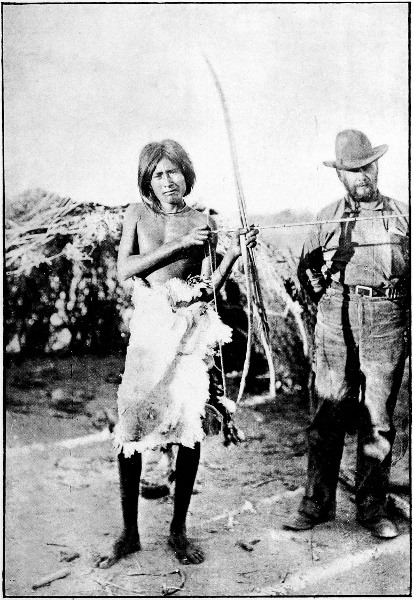
SERI ARCHER AT REST
The Seri archery habit is in every way consistent with the general habits of the tribe, alike in the chase and in warfare, in which the tribesmen, actuated by the fierce blood-craze common to carnivores, either leap on their prey with purpling eyes and gnashing teeth, or beat quick and stealthy retreat; and it is especially significant in the light thrown on the bow as a device for swift and vigorous rather than accurate offense, an apparatus for lengthening the arm still more than does the harpoon, and at the same time strengthening and intensifying its stroke. The quick-changing attitudes of half hurling are equally suggestive of the use of the atlatl, and support Cushing’s hypothesis278 that the bow was derived from the corded throwing-stick. While the critical posture of Seri archery is unique in degree if not in kind in the western hemisphere, so far as is known, an approximation to it (illustrated in fig. 22) has been observed in Central Africa.279 On the whole the Seri mode of using the bow, like its crude form and rude finish, indicates that it is a relatively new and ill-developed artifact, possibly accultural though more probably joined indigenously with the archaic arrow to beget a highly effective device for food-getting as well as for warfare; while the genetic stages are still displayed not only in the homologies between arrow and harpoon, but by the common functions of both arrow and bow with the fire-sticks.
Concordantly, as indicated by the use of the archery apparatus, the individual taking of large game is effected either by stealthy stalking or by patient ambuscade ended by a sudden rush; when, if the chase is successful, the quarry is rent and consumed as at the finish of the semiceremonial collective chase. The fleet but wary antelope, the pugnacious peccary, the wandering puma and jaguar, and the mountain sheep of the rocky fastnesses, are among the favorite objects of this style of chase; while the larger land birds and some of the water-fowl are taken in similar fashion.
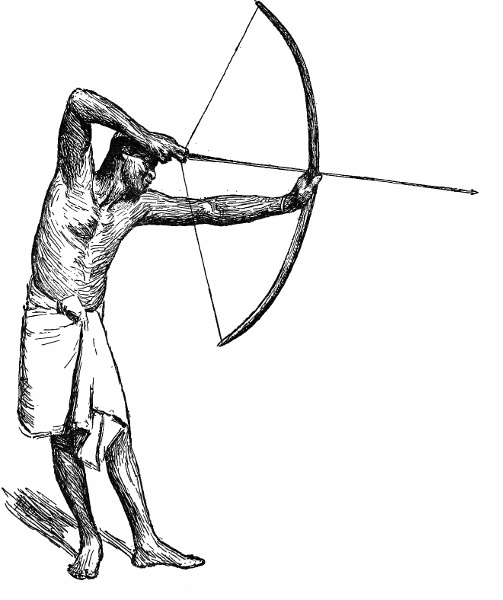
Fig. 22—African archery posture.
The smaller land game comprises a tortoise or two, all the local snakes and lizards, and a good many insects, besides various birds, including hawks and owls, as well as the eaters of seeds and insects. The crow and vulture are also classed as edible, though they are rare in Seriland, probably because of the effective scavengering of the province by its human residents. It is a significant fact that the smaller rodents, especially the long-tail nocturnal squirrel, are excluded from the Seri menu by a rigidly observed tabu of undiscovered meaning. A general consequence of this tabu is readily observed on entering Seriland; there is a notable rarity of the serpents, the high-colored and swift efts, and the logy lizards and dull phrynosomas so abundant in neighboring deserts, as well as of song birds and their nests; and this dearth is coupled with a still more notable abundance of the rodents, which have increased and multiplied throughout Seriland so abundantly that their burrows honeycomb hundreds of square miles of territory. A special consequence of the tabu is found in the fact that the myriad squirrel tunnels have rendered much of the territory impassable for horses and nearly so for pedestrians, and have thereby served to repel invaders and enable the jealous tribesmen to protect their principality against the hated alien. Seriland and the Seri are remarkable for illustrations of the interdependence between a primitive folk and their environment; but none of the relations are more striking than that exemplified by the timid nocturnal rodent, which, protected by a faith, has not only risen to the leading place in the local fauna, but has rewarded its protectors by protecting their territory for centuries.
BUREAU OF AMERICAN ETHNOLOGY SEVENTEENTH ANNUAL REPORT PL. XXIX
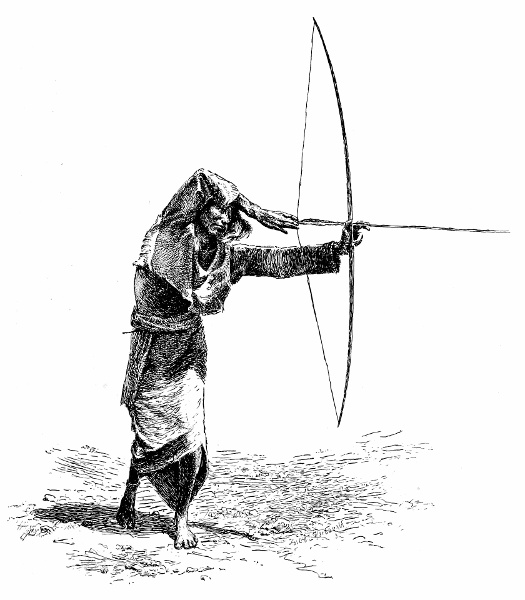
SERI ARCHER AT ATTENTION
In both the collective and the strategic chase, constant advantage is taken of weakness and incapacity, whether temporary or permanent, of the prospective quarry; so that diseased and wounded as well as sluggish and stupid animals are eliminated. The effect of this policy on the fauna is undoubtedly to extinguish the less capable species and to stimulate and improve the more capable; i. e., the presence of the human factor merely intensifies the bitter struggle for existence in which the subhuman things of this desert province are engaged. At the same time, the entrance of the human folk into the struggle characteristic of subhuman species serves to bar them from one of the most helpful ways to the advancement of their kind—i. e., the way leading through cotoleration with animals to perfected zooculture. The most avidly sought weaklings in the Seri chase are the helpless young, and the heavily gravid dams which are pursued and rent to fragments with a horrid fury doubtless reflecting the practical certainty of capture and the exceptionally succulent tidbits afforded by the fetal flesh; naturally the cruel custom reacts on habitual thought in such wise that the very sight of pregnancy or travail or newborn helplessness awakens slumbering blood-thirst and impels to ferocious slaughter. To such custom and deep-planted mental habit may be ascribed some of the most shocking barbarities in the history of Seri rapine, tragedies too terrible for repetition save in bated breath of survivors, yet explaining the utter horror in which the Seri marauder is held on his own frontier. At the same time the hunting custom and the mental habit explain the blindness of the Seri to the rudiments of zooculture, and clarify their intolerance of all animal associates, save the sly coyote that habitually hides its travail and suckling in the wilderness, and perhaps the deified pelican.280
Parallel to the chase of the larger land game is the hunting of horses and other imported stock; for the animals are regarded in no other light than that of easy quarry. The horses of the Seri frontier, like those of wild ranges generally, are strongly gregarious, and the herds are well regimented under recognized leaders, so that the chase of their kind is necessarily collective on the part of both hunters and game; and the favorite method is for a considerable group of either warriors or women to surround the entire herd, or a band cut out from it, “mill” them (i. e., set them running in a gradually contracting circle) and occasionally dash on an animal, promising by reason of exceptional fatness or gravidness. The warrior’s customary clutch is by the mane or foretop with one hand and the muzzle with the other, with his weight thrown largely on the neck, when a quick wrench throws the animal, and, if all goes well, breaks its neck;281 while the huntress commonly aims to stun the animal with a blow from her hupf. In either case the disposition of the carcass is similar to that of other large quarry, save that thought is given to the danger of ensuing attack by vaqueros; so that it is customary to consume at once only the blood and pluck, and if time permits the paunch and intestines with their contents, and then to rend the remainder into quarters, which warriors or even women shoulder and rush toward their stronghold. Burros (which, next to the green turtle, afford the favorite Seri food) and horned cattle are commonly stalked and slain, or, at least, wounded with arrows, so that it is commonly the stragglers that are picked off; though sometimes several animals are either milled or rushed, and thrown by a strong wrench on the horns or stunned with a blow of war-club or hupf, as conditions may demand. Straggling swine and wandering dogs are occasionally ambushed or stalked and transfixed with arrows, torn hurriedly into fragments, or shouldered and carried off struggling, as exigency may require; while sheep and goats are practically barred from the entire Seri frontier because of their utter helplessness in the face of so hardy huntsmen.
BUREAU OF AMERICAN ETHNOLOGY SEVENTEENTH ANNUAL REPORT PL. XXX
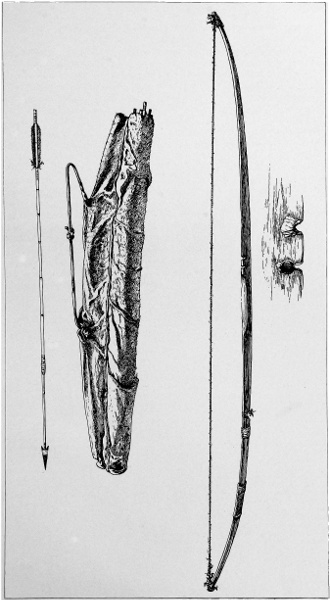
SERI BOW, ARROW, AND QUIVER
The quantity of stock consumed by the Seri varies greatly with the policy of rancheros and vaqueros. At different times during the last two and a half centuries it has been estimated that the chief portion of the subsistence of the tribe was derived from stolen stock, and it is probable that during the early period of the Encinas régime this estimate was fair; but under the Draconian rule of a Seri head for each head of slaughtered stock, the consumption is reduced to a few dozen head annually, including superannuated, crippled, and diseased animals unable to keep up with the herds, those bogged in Playa Noriega and other basins during freshets, the stallions and bulls slain in strife for leadership of their bands, and the festering or semimummied carcasses gladly turned over by idle rancheros on the chance visits of Seri bands to the frontier (such as the specimen in the photograph reproduced in figure 23).
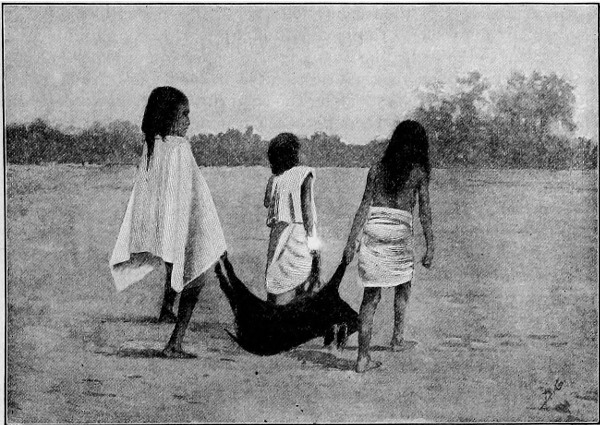
Fig. 23—Desiccated pork.
No special devices have been developed in connection with the chase for stock, nor has material progress been made in acquiring Caucasian devices. There are, indeed, indications of a disposition to use knives in severing the tough integuments and tendons of horses and kine, although the tendency has not yet resulted (as elsewhere noted, ante, pp. 152*-154*) in the development of a knife-sense; and although boys on the frontier play at roping dogs, no effort to use the riata or any form of rope is made in the actual chase. As naively explained by Mashém amid approving grunts from his clan-mates, they have no time for ropes or knives when hungry.
A quantitatively unimportant yet by no means negligible fraction of the normal diet of Seriland is vegetal; and while the sources of vegetal food are many and diverse, the chief constituent is a single product characteristic of American deserts, viz., the tuna, or prickly pear.
All of the cacti of the region yield tunas in considerable quantity. The pitahaya is perhaps the most abundant producer, and its name is often given to the fruit; the huge saguaro affords an enormous annual yield, and the still more gigantic saguesa is even more prolific, especially in its immense forests along the eastern base of Sierra Seri; the cina adds materially to the aggregate product, while the nopal, or common prickly pear, contributes a quota acquiring importance from the facility with which it may be harvested. The fruits of all these cacti are sometimes classed as sweet tunas, in contradistinction from the sour tunas yielded in great abundance by the cholla and consumed with avidity by stock, though seldom eaten by men. The edible tunas average about the size of lemons, and resemble figs save that their skin is beset with prickles. The portion eaten is a luscious pulp, filled with minute seeds like those of the fig save that they are too hard for mastication or digestion, its flavor ranging from the sickly sweet of the overcultivated fig to a pleasant acidity. While occasional tunas may be found at any time during the year, the normal harvest occurs about midsummer, or shortly before the July-August humid season, and lasts for several weeks. During the height of the season the clans withdraw from the coast and give undivided attention to the collection and consumption of the fruits, gorging them in such quantities that, according to the testimony of the vaqueros, they are fattened beyond recognition. Commonly the tunas are eaten just as they are gathered, and the families and larger bands move about from pitahaya to pitahaya and from valley to valley in a slovenly chase of this natural harvest, until waning supply and cloying appetite drive them back to the severer chase of turtle and pelican. The fruit is not cooked, and never preserved save in the noisome way of nature, and is rarely transported in quantities or over distances of industrial importance; yet the product may have some connection with the basketry of the tribe. The devices for collecting the fruits, especially from the lofty saguaro and saguesa, are mere improvisations of harpoon shafts, paloblanco branches, or chance cane-stalks carried primarily for arrow-making or balsa construction. There is no such well-studied and semiceremonial apparatus for tuna gathering as, for example, the Papago device made from the ribs of the dead saguaro in accordance with traditional formula.
Perhaps second in importance among the vegetal constituents of Seri diet is the mesquite bean, which is gathered in random fashion whenever a well-loaded tree is found and other conditions favor. The woody beans and still woodier pods are roughly pulverized by pounding with the hupf on any convenient stone used as an ahst (metate or mortar), or, if suitable stones are not at hand, they are carried in baskets or improvised bags to the nearest shore or other place at which stones may be found. The half-ground grist is winnowed in the ordinary way of tossing in a basket; and the grinding and winnowing continue alternately until a fairly uniform bean meal is obtained. So far as was actually observed this is eaten raw, either dry in small pinches or, more commonly, stirred in water to form a thin atole; but expressions at Costa Rica indicated that the meal is sometimes stirred in boiling water or pot-liquor, and thus partially cooked, in times of rest and plenty.
Other vegetal products used as food comprise a variety of seeds collected from sedges and grasses growing about the mud-flats of Laguna La Cruz and other portions of the province, as well as the seeds and nuts of the scant shrubbery of shores and mountains; while a local seaweed or kelp is eaten in small quantity, apparently as a condiment, and is sometimes carried on journeys even as far as Costa Rica, where specimens were obtained in 1894.
It is of interest to note that one of the most distinctive constituents of the Sonoran flora, and one intimately connected with human life in the great neighboring province of Papagueria, is of negligible rarity in Seriland; this is the visnaga (Echinocactus, probably of two or three species), the thorniest of the cacti and the only one containing consumable pulp and sap. This peculiar plant is of no small interest in itself as a striking example of the inverse relation between protective devices of chemical sort (culminating in acrid, offensive, or toxic juices) and the mechanical armaments so characteristic of desert plants;282 it is of still deeper interest economically as the sole source of water over broad expanses of the desert, and one to which hundreds of pioneers and travelers have been indebted for their lives; and it is of interest, too, as a factor of Papago faith, in which the visnaga ranks among the richer guerdons of the rain gods. Throughout most of Papagueria this cactus is fairly abundant; usually there are several specimens to the square mile of suitable soil (it is not found in playas or on the ruggeder sierras), so that it is always within reach of the sagacious traveler; but it diminishes in abundance toward the borders of Seriland, and not more than a dozen examples were found in the portions of that province traversed by the 1895 expedition. Its rare occurrence, chiefly in the form of wounded and dwarfed specimens, seems to indicate that its original range comprised all Seriland; while its dearth suggests destruction nearly to the verge of extinction by improvident generations better armed with their hupfs and harpoons and shell-cups than the subhuman beasts against whom the plant is so well protected.
Aside from the universally used hupf and ahst (which may be regarded as differentiated implements or tools), the only special device used in connection with vegetal food is the basket, or, rather, basketry tray (illustrated in figure 24). This ware is of the widespread coil type so characteristic of southwestern tribes. The coil is a wisp of stems and splints of a fibrous yet spongy shrub, apparently torote; and the woof consists of paloblanco (?) splints deftly intertwined by aid of an awl. The construction is fairly neat and remarkably uniform; the coiled wisps vary somewhat in size, both intentionally and inadvertently, ranging from an average of three-eighths of an inch toward the bottoms of the larger specimens to half that diameter in the smaller specimens and toward the margins of the larger. The initial coil starts in an indefinite knot, rather than a button, at the center; and the spiral is continuous throughout, the final coil being quite deftly worked out to a single splint smoothly stitched to the next lower spiral with the woof splints. The ware is practically water-tight, remarkably strong and resilient, and quite durable in the dry climate of Seriland. Ordinarily the basket is abandoned when the bottom decays or breaks, but an ancient specimen obtained on Isla Tiburon was roughly rebottomed with a patch of sealskin attached by means of sinew. The baskets are notably uniform in shape, though the size varies from 8 or 9 inches to fully 17 inches in diameter.
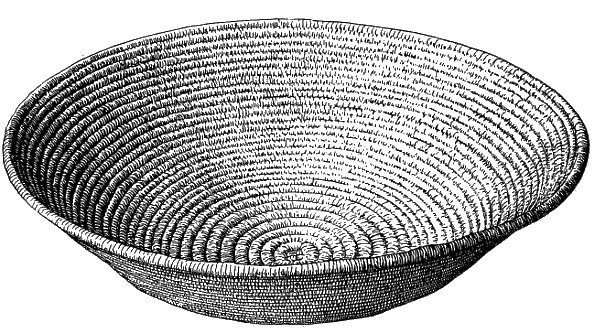
Fig. 24—Seri basket.
The most striking feature of the Seri basketry, as of the pottery, is extreme lightness in proportion to capacity, a quality due to the spongy character of the torote coil and to the thinness of the splints used in the woof. The inside dimensions, weight, and dry-measure capacity (filled to the level of the brim with rice) of two typical specimens approaching extremes in size are indicated in the accompanying table. As noted elsewhere, the ware is absolutely without decorative devices in weave, paint, or form; it is baldly utilitarian, a model of economy in material and in the balance between structure and function, approaching in this respect the thin-walled canteen-olla, the graceful balsa, and the light but effective harpoon. The structural correspondence of the ware to a widespread type and its limited use among the tribe suggest an accultural origin for the Seri basketry; but the delicate adjustment of means to ends in the manufacture and the strictly local character of the material quite as strongly suggest an indigenous development.
Museum No. Diameter Depth Weight Capacity
174528 38 cm. (15 in.) 9.5 cm. (3¾ in.) 482g. (17oz.) 6.25 l. (6.6 qt.)
174528a 23 cm. (9 in.) 5.0cm. (2 in.) 142 g. (5oz.) 1 l. (1.06 qt.)
It is impossible to portray justly the food habits of the Seri without some reference to a systematic scatophagy, which seems to possess fiducial as well as economic features. In its simplest aspect this custom is connected with the tuna harvests; the fruits are eaten in enormous quantity, and are imperfectly digested, the hard-coated seeds especially passing through the system unchanged; the feces containing these seeds are preserved with some care, and after the harvest is passed the hoard (desiccated, of course, in the dry climate) is ground between hupf and ahst, and winnowed in baskets precisely as are the mesquite beans; and the product is then eaten either dry or in the form of atole like the mesquite meal. In superficial view this food factor is the precise homologue of the “second harvest” of the California Indians as described by Clavigero, Baegert,283 and others; but it gains importance, among the Seri at least, as the sole method of storing or preserving food-supplies, and hence as the germ of industrial economy out of which a feeble thrift-sense may be regarded as emerging. And the rise of thrift in Seriland, like esthetic and industrial beginnings generally, is shaped by faith and attendant ceremony; for the doubly consumed food is credited with intensified powers and virtues, and held to be specially potent in the relief of hunger and in giving endurance for the hard warpath or prolonged chase; it is—and makes—very strong (“mucho fuerte”), in the laconic and confident explanation of Mashém. Incongruous as the custom is to higher culture, it finds natural suggestion in the everyday habits of the tribe, who are wonted not only to the eating of animal entrails in raw and uncleaned condition, but especially to the relief of the sharpest pangs of hunger by means of the soft structures and their semiassimilated contents—an association of much influence in primitive thought. Concordantly with the custom and the faith grown out of it, the excreta in general take a prominent place in the Seri mind; the use of urine in ablution, etc., is little understood and may be passed over; but all bony feces—and it may be noted that the “sign” of the Seri more resembles that of wolves or snake-eating swine than that of men—following gorges of large quarry are customarily located and kept in mind for recourse in time of ensuing shortage, when the mass is ground on the ahst and reconsumed; and even the ordinary discharge is preserved during the seasons of less reliable food-supply.
There is an obscure connection between this curious and repulsive food custom of the Seri and the mortuary customs of the tribe, which was not detected until the opportunity for personal inquiry had gone by. About the rancherias on Isla Tiburon, and especially about the extensive house-group at the base of Punta Tormenta, there are burial places marked by cairns of cobbles, or by heaps of thorny brambles where cobbles are not accessible; and most of these cairns and bramble-piles are supplemented by hoards of desiccated feces carefully stored in shells, usually of Arca (a typical specimen is illustrated in figure 25). The hoards range from 50 to 500 shells in quantity, and there were fully a score of them at Punta Tormenta alone. About the newer rancherias, as at Rada Ballena, where there are no cemeteries, the hoards are simply piled about small clumps of shrubbery. The meaning of the association of the dietetic residua and death in the Seri mind is not wholly clear; yet the connection between the “strong food” for the warpath and the mystical food for the manes in the long journey to the hereafter is close enough to give some inkling of the meaning.284
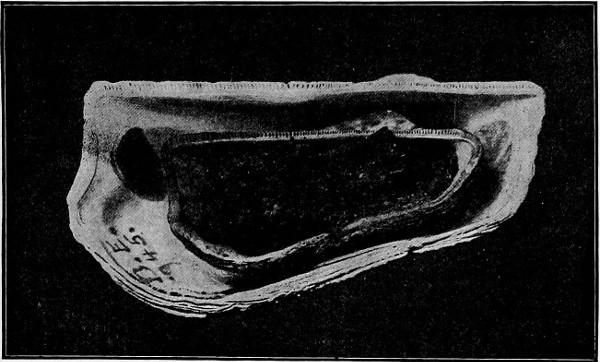
Fig. 25—Scatophagic supplies.
In recapitulating the food supplies of the Seri it is not without interest to estimate roughly the relative quantities of the several constituents consumed; and the proportions maybe made the more readily comprehensible by expression in absolute terms. As a basis for the quantitative estimate, it may be assumed that the average Seri, living, as he does, a vigorous outdoor life, consuming, as he does, a diet of less average nutrition than the selected and cooked foods of higher culture, and attaining, as he does, an exceptional stature and strength, eats something more than the average ration; so that his ration of solid food may be lumped at 2.75 pounds (about 1,250 grams) daily, or 1,000 pounds (about 455 kilograms) yearly. The aggregate diet of the tribe may be estimated also by assuming the population to comprise 300 full eaters, besides, say, 50 nurslings negligible in the computation; so that the annual consumption of the tribe may be reckoned at 300,000 pounds (136,000 kilograms), or 150 tons, of solid food. Accordingly the several constituents may be estimated, as shown in the accompanying table, in percentages of the total, in pounds aggregate and apiece for the eaters, and (so far as practicable) in units both aggregate and apiece; the weights of units being roughly averaged at 100 pounds (45 kilograms) for turtles, 12½ pounds (5.6 kilograms) for large land game, 450 pounds (about 200 kilograms) for stock, and 2 ounces (56.7 grams) for tunas.
Estimated annual dietary of the Seri tribe
Constituents Per cent Quantity Units
Aggregate Apiece Aggregate Apiece
Pounds Pounds
Turtles 25 75,000 250 750 2½
Pelicans 5 15,000 50 1,200 4
Other water-fowl and eggs 8 24,000 80
Fish 15 45,000 150
Shellfish (except turtles) 10 30,000 100
Large land game 7 21,000 70 200 ⅔
Other land game 8 24,000 80
Stock 6 18,000 60 40 2/15
Tunas 9 27,000 90 216,000 720
Other vegetals 5 15,000 50
Miscellaneous 2 6,000 20
Total 100 300,000 1,000
Of course the constituents vary with temporary conditions; during “The Time of the Big Fish”, practically all other sources of food were neglected until the providential supply was exhausted; during the decades of main subsistence on stolen stock it is probable that the consumption of other constituents, perhaps excepting the tunas, was proportionately reduced; and it is not improbable that during the warfare between Seri and Tepoka, described by Hardy, the consumption of turtles was materially diminished. Judging from the direct and indirect data and from general analogies, the least variable constituent is the cactus fruit, which probably fails but rarely and is so easily harvested as practically to supplant all other supplies during its season of a month or more. At the best, too, the quantitative estimates are nothing more than necessarily arbitrary approximations, based on incomplete inquiries and observations;285 yet they are better than no estimates at all, and appear to form a fairly trustworthy basis for consideration of the Seri food habits.
On reviewing the constituents it would appear that the Seri must be regarded as essentially a maritime people, in that about two-thirds of their food is derived from the sea; also that they must be deemed essentially carnivorous, since fully five-sixths of their diet (84 per cent plus a share of the miscellaneous—chiefly scatophagous—category) is animal. The tabulation does not show the relative proportions of the several constituents cooked and eaten raw, but the best available data indicate that fully three-fourths of the ordinary dietary, both animal and vegetal, is ingested in raw condition, and that the greater part of the remaining fourth is imperfectly cooked.
In recapitulating the devices for food-getting, it is found that nearly all of the more distinctive artifacts and crafts are either directly or indirectly connected with that primary activity of living things, food-conquest. Foremost among the distinctive artifacts of the Seri, in its relation to daily life and in its technical perfection, is the canteen-olla; probably second in importance, and also in technical perfection, is the balsa—whose functions, however, extend beyond simple food-getting; next comes the crude and simple, yet economically perfected, turtle-harpoon, with its variants in the form of arrow (with a function in warfare as well as in food-getting) and fire-drill; while the light basket-tray, although capable of carrying ten to twenty-five times its own weight, is perhaps the least perfect technically of the artifacts directly connected with sustentation. And it should be noted that the prevailing tools—hupf, ahst, multifunctional shell, and awl of mandible or bone or tooth—have either an immediate or a secondary connection with food-getting.
NAVIGATION
At first sight Seriland seems an abnormal habitat for a primitive people, since its land area is cleft in twain by a stormy strait—a strait whose terrors to the few Caucasian navigators who have reached its swirling currents are indicated by their appellations, “El Canal Peligroso de San Miguel”286 and “El Infiernillo”; for such a stretch of troubled water is commonly a more serious bar to travel than any moderate land expanse. This intuitive notion of the effectiveness of a water barrier, and the correlative feeling of the incongruity of a land barrier insuperable for centuries, is well illustrated by prevailing opinion throughout northwestern Mexico; for it is commonly supposed in Sonora and neighboring states that Seriland is conterminous with Isla Tiburon, i. e., that the mainland portion of the province (including Sierra Seri with its flanking footslopes) lies beyond the diabolic channel. Yet longer scrutiny shows that the superficial impression merely mirrors Caucasian thought and fails to touch the essential conditions, especially as they are reflected in the primitive minds of the local tribe; and careful study of the habits and history of the Seri shows that the dangerous strait has been a potent factor in preserving tribal existence and perpetuating tribal integrity. Naturally the factor operates through navigation; for it is by means of this art that the tribesmen are able to avoid or to repel the rare invaders of either mainland or insular portions of their province, the overland pioneers from the east being stopped by the strait and the maritime explorers from south and west being unable to maintain themselves long about the stormy shores and never outfitted for pushing far toward the mainland retreats and strongholds; while by means of their light and simple craft the Seri were able to retreat or to advance across the strait as readily as over the adjacent lands to which they were wonted by the experience of generations. In their minds, indeed, El Infiernillo is the nucleus of their province. So the Seri were among the lowliest learners of that lesson of highest statecraft, that lands are not divided but united by intervening sea; and their ill-formulated and provincial notions are of much significance in their bearing on autochthonous habits and habitats.
The water-craft of which the Seri make so good use is a balsa, made of three bundles of carrizal or cane lashed together alongside, measuring barely 4 feet abeam, 1½ feet in depth, and some 30 feet in length over all. A fine specimen (except for a slight injury at one end) is shown in plan and profile in plate XXXI. It was obtained near Boca Infierno in 1895, partly towed and partly paddled thence to Embarcadero Andrade, wagoned laboriously across Desierto Encinas and on to Hermosillo, conveyed in an iron-sheathed box on two gondolas of the narrow-gage Ferrocarril de Sonora to the international frontier, and finally freighted to the United States National Museum, where (in the Mall just outside the building) the photographs reproduced in the plate were taken.
The manufacture of the balsa has never been seen by Caucasian eyes, but the processes are safely inferred from the structure, whose testimony is corroborated in part by Mashém’s imperfect descriptions. The first step is the gathering of the carrizal from one of the patches growing about the three or four permanent fresh waters of Seriland, the canes being carefully selected for straightness, symmetry, and uniformity in size; these are then denuded of leaves and tassels, tied in bundles of convenient size (one seen on Tiburon contained 40 or 50 canes), and carried to the shore. In actual construction the canes are laid butt to butt, but overlapping 2 or 3 feet, the overlap being shifted this way and that with successive additions, so that the aggregate length of overlapping in the bundle reaches 10 or 12 feet—i. e., the full length of the body of the finished craft. The growing bundle is wrapped from time to time with lashings of mesquite root or maguey fiber, and kept in cylindrical form by constant rolling and by means of the lashing; though the cord used for the purpose is so slender as to do little more than serve the purposes of manufacture (only stray shreds of the interior cording could be found in an old and abandoned balsa on Punta Antigualla). As the bundle approaches the requisite size, the building process changes; the butts of the successively added stalks are thrust obliquely into the interstices extending beyond the butts of earlier-used canes, and the stems are slightly bent to bring them into parallelism with their fellows; and this interweaving process is continued with increasing care until, when the bundle is completed, there are no visible butts (all being pushed into the interior of the bundle), while the only visible tips are those projecting to form the tapering extremities. The finished bundle is then secured by a spiral winding of slender cord. Two other bundles are next made, the three being entirely similar, so far as is known; then the three are joined by a lashing of slender cord like that used for the separate bundles, which is twined alternately above and below the central bundle in such manner as to hold the three in an approximate plane save toward the extremities, where the lashing is much firmer and the tapering tips of the bundles are brought into a triangular position, i. e., the position of smallest compass. The cordage is of either mesquite root or maguey fiber, the former being the more common, so far as observed (doubtless by reason of the dearth of the latter plant); it is notably uniform in twist and size, though surprisingly slender for the purpose, barely three-sixteenths of an inch, or 5 mm., in diameter, and limited in quantity.287 The only tools or implements used in the manufacture (and repair), so far as is known, are light wooden marlinspikes, two of which are illustrated in figure 26; these are used in working the cane-butts into the bundles. In collecting the canes the tassels are broken off and the leaves stripped by the unaided hands, while the stalks are broken off usually below the secondary roots in the downward taper, and the rootlets and loose ends are removed either with the hands or by fire.
BUREAU OF AMERICAN ETHNOLOGY SEVENTEENTH ANNUAL REPORT PL. XXXI
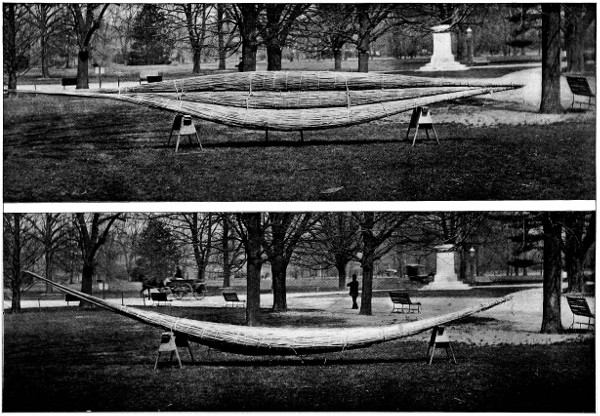
SERI BALSA IN THE NATIONAL MUSEUM

Fig. 26—Seri marlinspikes.
The finished balsa is notably light and buoyant. The Boca Infierno specimen was estimated to weigh about 250 pounds (113 kilograms) when thoroughly dry, and little more than 300 pounds (126 kilograms) when completely wet; so that it could easily be picked up by three or four, or even by two, strong men and carried ashore to be hidden in the fog-shrubbery skirting the coast. The craft floated high with one man aboard, rode better with two, carried three without much difficulty even in a fairly heavy sea, and would safely bear four adults aggregating 600 pounds (272 kilograms) in moderate water. The most striking features of the craft afloat are its graceful movement and its perfect adaptation to variable seas and loads. The lines are symmetric and of great delicacy, as indicated even by the photographs out of its element; the reed-bundles are yielding, partly by resilience and partly in the way of set, so that the body of the craft curves to fit the weight and distribution of the load and to meet the impact of swells and breakers. In smooth water a lightly laden balsa may appear heavy and logy, but with a heavier load and stronger sea each tapering end rises strongly and then recurves slightly in a Hogarthian line graceful as the neck of a swan, while the whole craft skims the waves or glides sinuously over their crests in a lightsome way, recalling the easy movement of gull or petrel. A suggestion of its effect is shown in figure 27, a composite drawn largely from photographs; another suggestion is shown, in figure 28, reproduced in facsimile from a drawing by the artist of the U. S. S. Narragansett in 1873,288 the only known picture of the craft antecedent to the 1895 expedition.
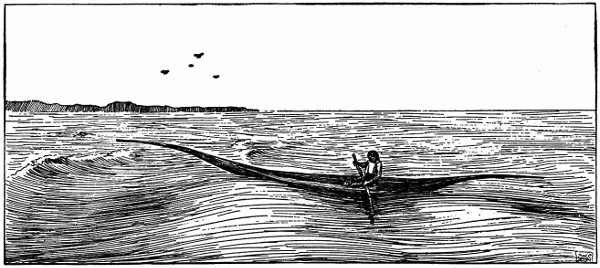
Fig. 27—The balsa afloat.
Almost equally striking features of the balsa are its efficiency and safety under the severe local conditions. Carrying twice its weight of (chiefly) living freight, it breasts gales and rides breakers and stems tiderips that would crush a canoe, swamp a skiff, or capsize a yawl; while if caught in currents or surf and cast ashore it is seldom wrecked, but drops lightly on beach or rocks, to be pushed uninjured by the broken wave-tips beyond the reach of pounding rollers, even if it is not at once caught up by its passengers and carried to complete safety. The strength of the craft is amazing, especially in view of the slenderness of the cords used in construction; in fact, the outer layers of canes are so ingeniously interlocked by the insertion of their butts into interstices that each bundle holds itself together with slight aid from the exterior cording, while even the bundles themselves are held in proper relative position by the secure terminal tying rather than by the intertwined cording of the body of the craft. And the entire construction exemplifies the compartment principle to perfection; a slight injury may affect but a single joint of one out of several thousand canes, while even a severe fall on sharp rocks seldom injures more than a few score canes, and these in a few joints only. The most objectionable feature of the balsa lies in the fact that it affords little protection from the wet. The water rises freely through the reed bundles to a height depending on the load, and not only the spray but the whitecaps and combers as well dash freely over the unprotected body of the craft; but this defect is of little consequence to the hardy and nearly nude navigators, or to their scanty and practically uninjurable freight.
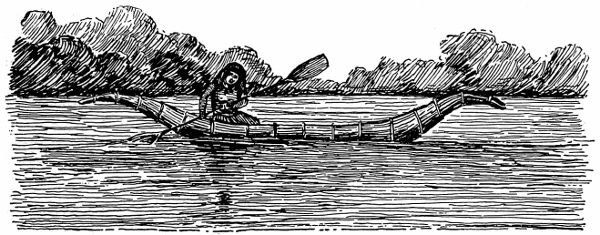
Fig. 28—Seri balsa as seen by Narragansett party.
The gracefulness and efficiency of the balsa itself stand in strong contrast with the crude methods of propulsion. According to Mashém, the craft is commonly propelled by either one or two women lying prone on the reeds and paddling either with bare hands or with large shells held in the hands; according to Hardy, the harpoon main shaft is used by turtle fishermen for paddling (and probably for poling, also); according to the Dewey picture (figure 28), the vessel is driven by a woman with a double-end paddle like that used in connection with the conventional canoe; while the expedition of 1895 found on Isla Tiburon four or five paddles rudely wrought from flotsam boards and barrel-staves, and partly hafted with rough sticks 3 or 4 feet long, but partly without handles and evidently designed to be grasped directly, like the shells of Mashém’s descriptions. No trace of oars, rowlocks, sculls, rudders, or masts were found, and there is nothing to indicate the faintest notion of sails and sailing. On the whole there is no trace of well differentiated propelling devices—i. e., the craft is perfected only as a static device and not at all as a dynamic mechanism.
Despite their poverty in propelling devices, the Seri navigate their waters successfully and extensively. Perhaps the commonest function of the craft is that exercised in connection with the turtle fishery, though its chief office as a factor of general industrial economy is that of bridging El Infiernillo at the will of the roving clans. It is by means of this craft, also, that the semiceremonial pelican feasts on Tiburon are consummated; it is by the same means that Isla Patos, Isla Turner, Roca Foca, and other insulated sources of food-supply are habitually reached; and both Mashém’s accounts and the Jesuits’ records indicate that occasional voyages are pushed to San Esteban, San Lorenzo, Angel de la Guarda, and even to the Baja California coast.
Concordantly with the tribal customs, little freight is carried. The traveling family transport their poor possessions to the shore, bring out the balsa from its hiding place in the thick and thorny fog-shrubbery, launch it, lade it with a filled olla and the weapons of a man and implements of a woman, besides any chance food and clothing, and embark lightly to enjoy the semirepose of drifting before the breeze—until the rising gale brings labor still more arduous than that of scouring the spall-strewn slopes or sandy stretches of their hard motherland. Commonly the terminus of the trip is fixed largely by the chance of wind and tide; and when it is reached the party carry the craft inshore, conceal it shrewdly, and then take up their birdskin bed and walk forth in search of fresh water and meat. The successful fishing trips of course end in orgies of gorging, and when the voyage is the climax of a foray to the mainland frontier for stock-stealing, the quarters and paunches and heads hastily thrown aboard at the mainland side of the strait are carried to the rancherias for consumption at leisure; and this has happened so often that equine hoofs and bovine bones are common constituents of the middens on Tiburon.
Although measurably similar to Central American and South American types of water-craft, the Seri balsa is a notably distinct type for its region. The California natives, as well as those of the mainland of Mexico south of Rio Yaqui, used rafts made either of palm trunks or of other logs lashed alongside rather than balsas; while the far-traveling tribes used either sails or well-differentiated paddles for propulsion.
Briefly, the Seri balsa is remarkable for perfect adaptation to those needs of its makers shaped by their distinctive environment. It seems to approach the ideal of industrial economy—the acme of practicality—in the adjustment of materials and forces to the ends of a lowly culture; and, like the olla and harpoon and arrow, it affords an impressive example of the adjustment of artifacts to environment through the intervention of budding intelligence. Yet the chief significance of the craft would seem to reside in its vestigial character as a survival of that orarian stage in the course of human development in which men lived alongshore and adjusted themselves to maritime conditions rather than to terrestrial environments; a stage evidently but barely passed by the Seri, since they still subsist mainly on sea food, still retain their suggestive navigation, and still view their stormy straits and bays as the nucleus and noblest portion of their province.
HABITATIONS
Among the Seri, as among primitive folk generally, the habitation reflects local conditions, especially climate and building materials. Now, Seriland is a subtropical yet arid tract, where rain rarely falls, frost seldom forms, and snow is known only as a fleeting mantle on generally distant mountains, so that there is little need for protection from cold and wet; at the same time the district is too desert to yield serviceable building material other than rock, which the lowly folk have not learned to manipulate. Moreover, the tribesmen and their families are perpetual fugitives (their movements being too erratic and aimless to put them in the class of nomads); they are too accustomed to wandering and too unaccustomed to long resting at particular spots to have a home-sense, save for their motherland as a whole; and, just as they rely on their own physical hardihood for preservation against the elements, so they depend on their combined fleetness and prowess for preservation against enemies. Accordingly, the Seri habitation is not a permanent abode, still less a domicile for weaklings or a shrine for household lares and penates, not at all a castle of proprietary sanctity, and least of all a home; it is rather a time-serving lair than a house in ordinary meaning.
Despite the poverty of the material and the squalor of the structure, certain features of the Seri jacal are notably uniform and conventional. In size and form it recalls the passing “prairie schooner”, or covered wagon; it is some 10 or 12 feet long, half as wide measured on the ground, and about 4½ feet high, with one end (the front) open to the full width and height, and the other nearly or quite closed. The conventional structural features comprise the upright bows and horizontal tie-sticks forming the framework. The bows are made of okatilla stems (Fouquiera splendens) roughly denuded of their thorns; each is formed by thrusting the butts of two such stems (or more if they are slender) into the ground at the requisite distance apart, bending the tops together into an overlap of a yard or two, and securing them partly by intertwisting, partly by any convenient lashing; and about five or six such bows suffice for a jacal (the appearance of the bows is fairly represented by the ruin shown in plate VII). Next come the tie-sticks, which consist of any convenient material (okatilla stems, cane-stalks, paloblanco branches, mesquite roots, saguaro ribs, etc.), and are lashed to the butts by means of withes, splints, or fiber wisps, at a height of some 4 feet above the ground, or about where the walls merge into the roof. With the placing of these sticks the conventional part of the building process may be said to end; for up to this point the process is a collective one and the materials are essentially uniform, while thereafter the completion of the work depends largely on individual or family caprice, and the materials are selected at random. Moreover, the framework is fairly permanent, usually surviving a number of occupancies extending over months or years, and outlasting an equal number of outer coverings; so that all habitable Seriland is dotted sparsely with jacal skeletons, sometimes retaining fragments of walls or roof, but oftener entirely denuded.
The conversion of the framework into a habitable jacal is effected by piling around and over it any convenient shrubbery, by which it is made a sort of bower; sometimes the conversion is aided by the attachment of additional tie-sticks both above and below the main horizontal pieces, as illustrated in the upper figure of plate IX; sometimes, too, the material of walls and roof is carefully selected and interwoven with such pains as to form a rude thatch, as in the chief jacal at Rada Ballena (the upper figure in plate VI); but more commonly the covering is collected at random and is laid so loosely that it is held in place only by gravity and wind pressure, and may be dislodged by a change of wind. Ordinarily the walls are thicker and denser than the roofs, which are supplemented in time of occupancy by haunches of venison, remnantal quarters of cattle and horses, half-eaten turtles, hides and pelts, as well as bird-skin robes, thrown on the bows partly to keep them out of reach of coyotes and partly to afford shade. Most of the jacales about the old rancheria at Punta Tormenta (abandoned at “The Time of the Big Fish”), which may be regarded as the center of the turtle industry, are irregularly clapboarded with turtle-shells and with sheets of a local sponge, as illustrated in plate VII. This sponge abounds in the bight of Rada Ballena, where at high water it spreads over the silty bottom in a slimy sheet, and at low water with off-shore gales is left by the waters to dry into a light and fairly tenacious mat, which is gathered in sheets for bedding as well as for house-making material (a specimen of the sponge—probably Chalina—is shown on larger scale in plate VIII). On the frontier the jacales may be modified by the introduction of sawed or riven lumber, as illustrated by some of the-structures at Costa Rica (shown in plate XI); but even here there is a strong disposition to adhere to the customary form, and especially to the conventional framework, as indicated by the example in plate X.
While the jacales are not consistently oriented, they reveal a primary preference for facing away from the prevailing wind and toward the nearest sea, with a secondary preference for southern and eastern exposures—the former preference being easily explained, since a gale from the front quickly strips walls and roof and scatters the materials afar. No definite order is observed in the placement of the several jacales in the larger rancherias; apparently the first is located at the choice of the leading elderwoman, and the others are clustered about it at the common convenience. Usually the several jacales are entirely separate; but at Punta Tormenta, Punta Narragansett, and still more notably at Rada Ballena, individual huts were found either extended to double length or joined obliquely in such wise as to show two fronts (as illustrated in plate VI). The conventional frameworks appear to be common tribal property, at least to the extent that an abandoned skeleton may be preempted by any comer; while the addition of walls and roof appears to afford a prescriptive proprietary right to the elderwoman and family by whom the work is done—though the right seems to hold only during occupancy, or until the temporary covering is dislodged.
BUREAU OF AMERICAN ETHNOLOGY SEVENTEENTH ANNUAL REPORT PL. XXXII
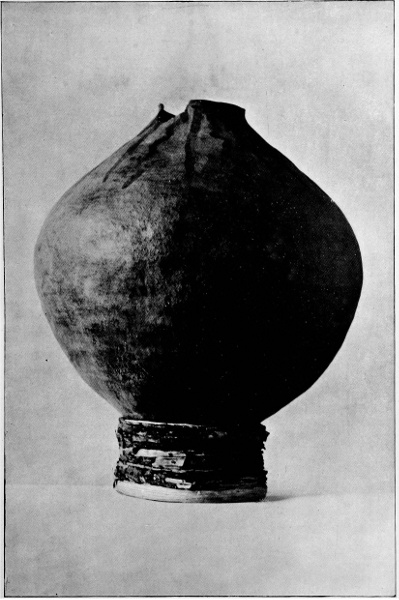
PAINTED OLLA, WITH OLLA RING
The jacales are without semblance of furnishing, beyond an occasional ahst and a few loose pebbles used as hupfs; though the nooks behind the bows and tie-sticks sometimes serve as places of concealment for paint-cups, awls, hair bobbins, and other domestic trifles. There is no floor but earth, and this remains in natural condition, except for trampling and wearing into wallows, recalling those of fowls and swine, which afford a rough measure of the periods of occupancy; there is no fireplace—indeed, fires are rarely made in the jacales, nor for that matter frequently anywhere; and there are no fixed places for bedding, water ollas, or other portable possessions, none of which are left behind when the householders are abroad.
Little is known of the actual process of jacal building, especially in Seriland proper; but the observations of Señor Encinas and his vaqueros on the frontier corroborate Mashém’s statements that the houses are built by (and belong to) the matrons; that several women customarily cooperate in the collection of the okatilla and erection of the framework; that the only tools used in the processes are hupfs and miscellaneous sticks; and that the placing and fitting of the beams and tie sticks are accompanied by a chant, usually led by the eldest matron of the group. The same informants support the ready inference from the structure that the shrubbery and other material forming walls and roofs are gathered and placed from time to time by the women occupying the jacales.
The Seri building chant is suggestive. Neither Señor Encinas nor Mashém regarded it as religious or even ritualistic, but merely as a work-song designed (in the naive notion of the latter) to make the task lighter; and it seems probable that the local interpretation is correct. If so, the simple chant at once offers rational explanation for its own existence, and opens the way to explanation of the elaborate building rituals of more advanced tribes. The work-song is a common device in many lowly activities, ranging from those of children at play to those of sailors at the windlass, and undoubtedly serves a useful purpose in guiding, coordinating, and concentrating effort; to some extent the vocal accompaniment to the manual or bodily action apparently expresses that normal interrelation of functions manifested by secondary sense-effects (as when the sense of smell is intensified by exercise of the organs of taste), or, in another direction, by the habit of the youthful penman who shapes his letters by aid of lingual and facial contortion; yet it is a characteristic of primitive life—one doubtless due to the interrelations of psycho-physical functions—to not only employ but to greatly exalt vocal formulas associated with manual activities, so that words, and eventually the Word, acquires a mystical or talismanic or sacred significance pervading all lower culture—indeed the savage shaman is unable to work his marvels without mumbled incantations ending in some formulated and well-understood utterance, and his practice persists in the meaningless mummery and culminating “presto” of modern jugglery. So, viewed in the light of psycho-physical causes and prevalent customs connected with vocal formulas, it would seem probable that the conventional features of the Seri jacales are crystallized in the tribal lore quite as effectually through the associated work-chants as through direct memory of the forms and structures themselves. And the simple runes chanted in unison by Seri matrons engaged in bending and lashing their okatilla house-bows apparently define a nascent stage in the development of the elaborate fiducial house-building ceremonies characteristic of various higher tribes; for the spontaneous vocal accompaniment tends naturally to run into ritual under that law of the development of myth or fable which explains so many of the customs and notions of primitive peoples.289
APPARELING
Slightly as they have been affected by three centuries of sporadic contact with higher culture, the Seri reveal many marks of acculturation; and the most conspicuous of these are connected with clothing, especially on the frontier, where women and even warriors habitually wear a livery of subserviency in the form of cast-off Caucasian rags (as illustrated in most of the photographs taken at Costa Rica). Even in the depths of Seriland the native fabrics are largely replaced by white men’s stuffs, obtained by barter, beggary, and robbery; yet it is easy to distinguish the harlequin veneer of borrowed trappings from the few fixed types of covering that seem characteristic.
The most distinctive piece of apparel is a kilt, extending from waist to knees, worn alike by men and women and the larger children. Aboriginally it was either a birdskin robe or a rectangle of coarse textile fabric, secured at the waist by a hair-cord belt; acculturally it is usually a rectangle of manta (coarse sheeting) or other stuff, preferably cotton or linen but sometimes woolen, fastened either by tucking in the corners or by a belt of cord. Good specimens of the accultural cloth kilt worn by men and larger boys are illustrated in plates XVI and XIX; the birdskin kilt (put on for the purpose) is illustrated in plate XVIII, while the aboriginal fabric is fairly represented in plate XXIX. Although ordinarily worn as a kilt, the same article (temporarily replaced by an improvised substitute) serves other purposes at the convenience of the wearer; in the chase for tunas and for moving game it becomes a bag or pack-sheet; in case of cold rain it is shifted to the shoulders or the exposed side; during the siesta, it is elevated on a shrub and a stick to serve as a canopy; at sleeping time generally it forms (especially when of birdskin) a bed, i. e., a combined mattress and coverlet; and in attack or defense the pelican skin is at once standard, buckler, and waving capa to confuse quarry or enemy after the manner of the toreador’s cloak.
An almost equally distinctive garment is a short shirt or wammus, with long sleeves, worn by men and women but not by children; ordinarily it covers the thorax, missing connection with the kilt by a few inches, and so affording ventilation and space for suckling the teeming offspring. Unlike the kilt, it is an actual garment, fitted with sleeves and fastened in front with hair-cord strings. Although the Seri wammus corresponds fairly with a Yaqui garment, it seems practically certain that it is of local aboriginal design, and that it was made primitively of haircloth or native textiles (as illustrated in plate XXIX) and worn rather ceremoniously; but latterly it is made of manta and is worn habitually (at least by the women and on the frontier), though cast aside in preparation for any special task or effort—i. e., it is not connected with pudency-sense, save to a slight degree in the younger women. The form, function, and prevalence of the wammus are illustrated by the group shown in plate XIII, in which nearly all of the thirty-odd adults wear the garment.
These two articles constitute the ordinary wearing apparel of the Seri, though they are commonly supplemented (especially when both are of manta) by a pelican-skin robe, which is habitually carried to serve as bed or mackintosh, according to the chance of journey and weather, or as a shield in sudden warfare. No head-covering is used, save in the ceremonial masquerade, when the heads of animals are worn as masks,290 or in aping Caucasian customs, especially on expeditions for barter (as illustrated in plate XII). Loose trousers of Mexican pattern are sometimes put on at frontier points, but are discarded in Seriland proper, save by Mashém, who maintains prestige partly by this borrowed badge of Caucasian superiority. Leggings and moccasins are eschewed, naturally enough, since they would afford little protection from the sharp spalls and savage thorns of the district, and would give lodgment for the barbed spines inevitably gathered in rapid chase or flight over cactus-dotted stretches; and the only foot-covering seen (save Mashém’s boots) was a single sandal made from the rough skin of a turtle-flipper, apparently for ceremonial rather than practical use. Of all the party at Costa Rica in 1894 subchief Mashém was the only one who wore Caucasian apparel with any air of comfort and fitness; yet even he, with hat and shirt, boots and breeches, and loose bandana about his neck in cowboy style (plate XVII), did not feel fully dressed without the slender hair-cord necklace of his kin in its wonted place. On the frontier improvised fig-leaves were sometimes put on the children of less than a dozen years (as illustrated by the standing infant shown in plate XIV, who was thus dressed hastily for her picture); and a common garb of the smaller children at Costa Rica, as they played about the rancheria or wandered in directions away from the white man’s rancho, was limited to a cincture of hair cord or snake skin, or perhaps of agave fiber, under which an improvised kilt might be tucked on the Caucasian’s approach.
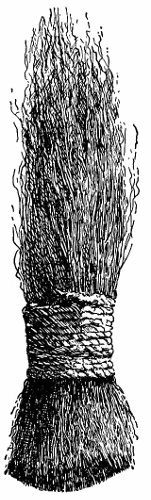
Fig. 29—Seri hairbrush.
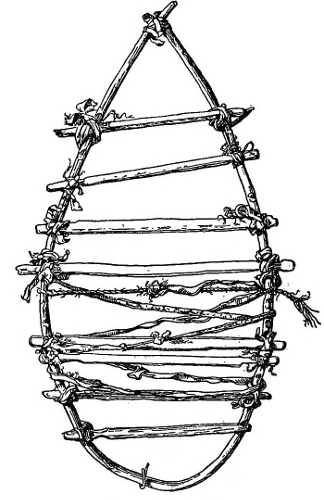
Fig. 30—Seri cradle.
In addition to the individual apparel, each clan, or at least the elderwoman or her fraternal executive, accumulates some surplus material as opportunity offers, and this serves as family bedding until occasion arises for converting it to other uses. Of late the prevailing materials are pelican skins, lightly dressed and joined into robes by sinew stitching; deerskins, dried or partially dressed; cormorant skins, treated like those of the pelican; seal skins, usually fragmentary; peccary skins, apparently dried without dressing, together with skins of rabbits, mountain sheep, antelope, etc., usually tattered or torn into fragments. Commonly the hides and pelts are nearly or quite in natural condition, retaining the hair, fur, or feathers. The dressing is apparently limited to scratching and gnawing away superfluous flesh, followed by some rubbing and greasing; tanning is apparently unknown. By far the most abundant of the collective possessions are the pelican-skin robes, which form the sole article of recognized barter with aliens. The aggregate stock accumulated at any time is but meager, never too much to be borne on the heads and backs of the clan in case of unexpected decamping.
BUREAU OF AMERICAN ETHNOLOGY SEVENTEENTH ANNUAL REPORT PL. XXXIII
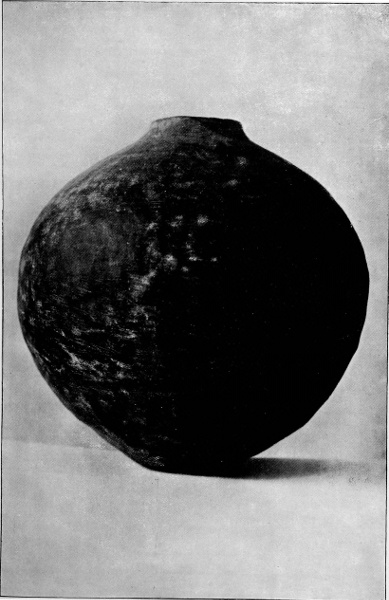
PLAIN OLLA

Fig. 31—Hair spindle.
Aside from the painting paraphernalia, there is but a single conspicuous toilet article; this is a hairbrush made of yucca fiber bound into cylindrical form, as illustrated in figure 29. This article is in frequent use; both women and men give much attention to brushing their own long and luxurious locks and cultivating the hair and scalps of their children, the process being regarded as not only directly useful but in some measure sacramental. Ordinarily the hair is parted in the middle and brushed straight, the tresses being permitted to wander at will and never braided or bound or restrained by fillets save in imitation of Caucasian customs on the frontier; though in certain ceremonies the pelage is gathered in a lofty knot on the top-head.291
The Seri cradle is merely a bow of paloblanco or other switch with rude cross-sticks lashed on, as shown in figure 30. On this is laid a small pelican-skin robe, with a quantity of pelican down for a diaper, and perhaps a few pelican feathers attached as plumes to wave over the occupant’s face; though on the frontier these primitive devices are largely replaced by rags.
Among the important appurtenances of Seri life are the cords used for belts and necklaces, as well as for the attachment of ceremonial headdresses, for converting the kilts into bags, and for numberless minor purposes. The finest of these are made from human hair; and for this purpose the combings are carefully kept, twisted into strands, and wound on thorns or sticks in slender bobbins, such as that illustrated in figure 31. When the accumulation suffices the strands are doubled or quadrupled, as shown in figures 32 and 33, and the cords are either applied to immediate use or added to the matron’s meager store against emergency demands. The cordage used for other purposes than appareling is commonly made from fiber extracted either from the roots of the mesquite or the stipes of the agave; usually it is well twisted and notably uniform in size and texture; an inferior example appears in figure 34. The manes and tails of horses and other stock are also converted into cordage, of which the chief known application is in toy riatas. It is of no small significance that the most highly prized cordage material is human hair, and that its chief uses are connected with the person; that the next in order of diminishing preciousness is that derived from the fibrous plants, which is used in balsa-making, bowstrings, harpoon cords, etc., as well as in the native fabrics; and that the least prized material is that derived from imported animals, which is largely limited in its utilization to youthful imitation of Caucasian industries; for the association of material with function reflects a distinctive feature of primitive thought, akin to that displayed in somewhat higher culture as synecdochic magic, the doctrine of signatures, etc.
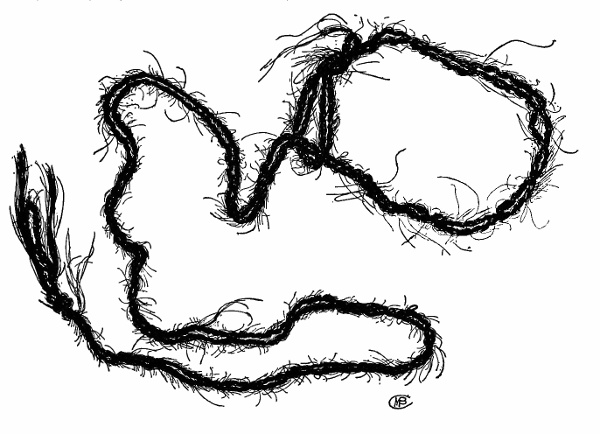
Fig. 32—Human-hair cord.
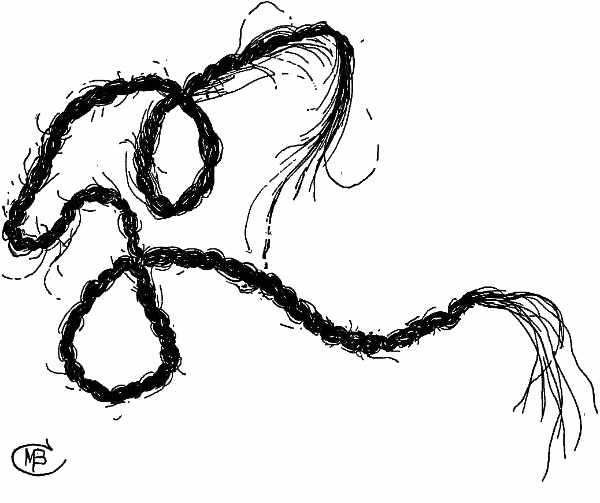
Fig. 33—Horsehair cord.
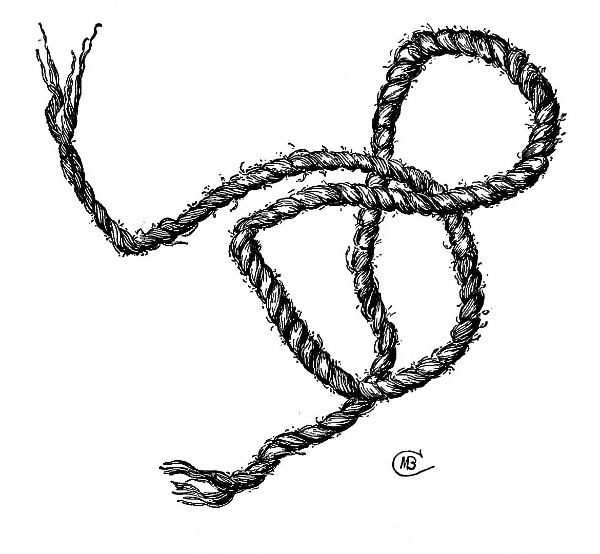
Fig. 34—Mesquite-fiber rope.
Partly because of that decadence of aboriginal devices correlated with acculturation, partly by reason of imperfect observation, practically nothing is known of Seri spinning and weaving, and little of Seri sewing. The religiously-guarded hair-combings are twisted in the fingers and wound on stick-bobbins without aid of mechanical appliances; and, so far as has been observed, the final making of hair cords is merely a continuation of the strictly manual process. The agave stipes and mesquite roots are alleged by vaqueros to be retted in convenient lagoons and barrancas (a statement corroborated by the finding of half a dozen sections of mesquite root soaking in a lagoon near Punta Antigualla by the 1895 expedition), and then hatcheled with the hupf or the edge of a shell; when the fibers are gathered in slender wisps or loosely wound coils, both of which were among the possessions of the Seri matrons at Costa Rica in 1894. So far as could be ascertained, the final processes parallel those of hair-cord making, i. e., the fibers are patiently sorted into strands, sized in the fingers and twisted by rolling on the thigh, the strands being subsequently combined in similar fashion.292 Neither the weaving nor the woven fabrics of the Seri have ever been seen by technologic students so far as known, though the fabrics are shown in Von Bayer’s photographs and have been described by various observers. According to Señor Encinas, they resemble coarse bagging, and are woven or netted quite plainly. The ordinary sewing material is sinew, used in connection with a bone awl (a good example of which is illustrated in figure 35), a fish spine or bone, a cactus thorn, or either the mandible of a water-bird or a hard-wood skewer shaped after this natural needle (figure 36 a and b). Sometimes hair or vegetal fiber is substituted for the sinew; and for certain purposes an agave thorn, with the fibers naturally attached, serves for needle and thread.
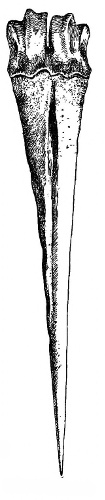
Fig. 35—Bone awl.
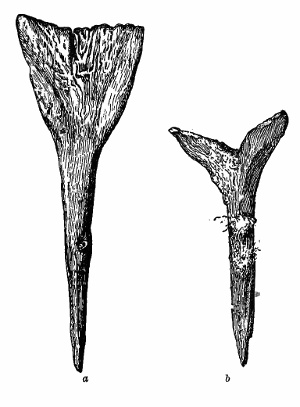
Fig. 36—Wooden awls.
Summarily, the customary apparel of Seri men and women may be regarded as limited to three articles—(1) a kilt, normally of coarse textile fabric, which is made a prime necessity by a well-developed pudency; (2) a short wammus, also normally of coarse textile fabric, which is apparently regarded as a convenience and luxury rather than a necessity; and (3) a robe, normally of pelican skin, sometimes substituted for either or both of the other articles, but ordinarily used as bedding or as a buckler. The most valued of these articles is the robe, which in the absence of the others replaces the kilt; yet pudency demands the habitual use of some form of kilt, while both wammus and robe are held so far superfluous that they may be laid aside or bartered or otherwise dispensed with whenever occasion arises.
On considering the special functions and probable genesis of the Seri appareling, the student is impressed by the absence of the breech-clout, except perhaps in temporary improvisations—though the absence of this widespread article of primitive costumery need awaken little surprise in view of the environment, and especially of the abounding barbs of Seriland, which render all appareling of doubtful value save for the protection of tissues softened by habitual covering. The prevailing thorniness of the habitat renders the free-flowing and easily removable apron the most serviceable protection for the exposed vitals of the pubic region; and this device, a common one in thorny habitats generally, grades naturally into the short skirt or kilt; while it would well accord with the maritime habit and habitual thought of the Seri to apply the tough and densely feathered skin of the pelican to the purpose. This suggestion as to the nascent covering of the tribe consists with the tribal faith, in which the Ancient of Pelicans ranks as the creative deity, while its modern representative is esteemed a protective tutelary possessing talismanic powers against cold, wet, bestial claw and fang, alien arrows, and all other evils; so that the use of this feathered pelt as a shield against spiny shrubbery, sharp-leaved sedges, and barb-thorned cacti is quite in harmony with Seri philosophy. Accordingly it seems clear that the pelican-skin kilt was autochthonous among the Seri, and that it was the original form of tribal appareling; and it is of no small significance that the type persists in actual use as well as in suggestive vestigial forms, such as pelican-down swaddling for infants, pelican-feather plumes on cradle nets, etc.
The passage from the pelican-skin kilt to the garment of textile fabric under the slow processes of primitive thought may not be traced confidently, though a strong suggestion arises in the Seri hair-cult (a Samsonian faith not without parallel in far higher culture) under which mystical powers and talismanic virtues are imputed to the human pelage. It is in connection with this cult that the Seri locks are so attentively cultivated and so assiduously preserved and consecrated to more intimate personal uses in belts, necklaces, and the like; and although the connecting links have not been found, it is thoroughly in accord with Seri thought to assume that in earlier times the hair necklaces were expanded into rudimentary apparel in connection with pelican-skin shields, and after the conquest of vegetal fibers into more finished garments probably woven partly of hair and worn in such wise as to supplement the natural pelage in the protection of back, shoulders, chest, and arms. If the indication of the tribal cult be valid, it would appear that the wammus was the second piece of apparel in order of genesis, though the first to be made of artificial fabric; and it is noteworthy that the suggestion is supported by the form of the short and free-flowing garment underlying the flowing tresses of warriors and matrons, as well as the vestigial use of human-hair cords for neckbands and fastening strings; while its antiquity in comparison with the textile kilt is indicated by the fact that it is a finished artifact, evidently fitted to its functions by generations of adjustment.
The step from the making of the wammus to the substitution of artificial fabrics for the pelican-skin kilt was an easy and natural one; and it need only be noted that the transition is still incomplete, since the feathered pelt is unquestioningly substituted for the fabric whenever occasion demands, yet that the kilt in some form must be much more archaic than the wammus, since it is correlated with the pudency sense,293 while the complete garment is not so correlated save in slight and incipient degree.
Accordingly the three articles of apparel may be seriated genetically as (1) the pelican-skin robe, used long as a kilt, and only lately relegated to emergency use and bedding; (2) the well-differentiated wammus of textile fabric with hair-cord fastenings; and (3) the textile kilt, with or without a hair-cord belt. And the three artifacts are local and presumptively—indeed manifestly—autochthonous, and exemplify the interdependence of artifacts and environment no less strikingly than the Seri balsa or basket or jacal.
TOOLS AND THEIR USES
In advanced culture tools are finished products, made and used in accordance with preconceived designs or established arts for the production of commodities; in primal life (as well exemplified by Seri handicraft) tools are mere by-products incidental to the largely instinctive activities directed toward the maintenance of life. Accordingly, the tools of advanced culture form the nucleus of industries, while the designless tools of the prime cluster about the outskirts of industrial activities; i. e., in developed industries the tool is a primary factor, while in nascent industries it is but a collateral.
The tools of any primitive tribe may be defined as appliances used primarily in the production of implements and utensils, and incidentally in preparing food, making habitations, manufacturing apparel, building vehicles or vessels, etc.—in short, the appliances used in producing devices for the maintenance of active life. The definition emphasizes both the dearth and the undifferentiated character of Seri tools; for the appliances used in the production of devices are exceedingly few, and are commonly employed also in food-getting or in other vital industries.
Perhaps the most conspicuous general fact in connection with Seri tools and their uses is the prevalence of natural objects employed either (1) in ways suggested by natural functions or (2) in ways determined by the convenience of users; the former grading into artificial devices shaped in similitude of natural objects and employed in ways suggested by natural functions.
Prominent among the natural objects employed in natural ways are mandibles of birds, used in piercing pelts and fabrics; fish spines and bones, also used as piercers; thorns of cacti and mimosas, used in similar ways: teeth and horns of game animals, used in rending their own tissues, and afterward in miscellaneous industrial processes; together with cane splints, used for incising. Frequently the employment of such objects is mere improvisation; yet, so far as could be ascertained through direct observation at Costa Rica, through Mashém’s incomplete accounts, and through inquiries from residents on the frontier, even the improvisations are made in accordance with regular custom firmly fixed by associations—quite in the way, indeed, of primitive life generally, and of the physiologic and psychic processes from which primitive custom is so largely borrowed. With these objects may be grouped the turtle-shells and pelican-pelts used as shields against alien and animal enemies or as protectors against the elements; and the Seri sages would class with them, the deer-head masks and deer-hoof rattles worn in the dance to at once symbolize and invoke strength and swiftness. One of the most striking among the artificial devices of symbolic motive is the piercer, or awl, of wood or bone, shaped in imitation of the avian mandible; yet still more significant in a vestigial way (provided the most probable inference as to genesis be valid) is the hard-wood foreshaft of arrow and harpoon, shaped and used in trenchant symbolism of the deadly tooth.
There are two conspicuous classes of natural objects employed in ways determined largely by the convenience of the users, viz., (a) marine shells and (b) beach pebbles.
The marine shells applied industrially comprise the prevailing local genera, Cardium, Mactra, Arca, Chama, and others. They are used ordinarily as drinking-cups, dishes, dippers, receptacles for fats and face-paints, and as small utensils generally; and they are used nearly as commonly for scraping skins, severing animal and plant tissues, digging graves and waterholes, propelling balsas, and especially for scraping reeds and sticks and okatilla stems in the manufacture of arrows, harpoons, bows, balsas, and jacal-frames—indeed, the seashell is the Seri familiar, the ever-present handmate and helper, the homologue of the Anglo-Saxon Jack with his hundred word-compounds, a half-personified reflex of habitual action and thought. Ordinarily—always, so far as is known—the shells are used in the natural state, i. e., either in the condition of capture and opening for the removal of the animal, or in the condition of finding on the beach. For certain purposes the fresh and sharp-edged shell is doubtless preferable, and for others the well-worn specimen (like the paint-cup illustrated in plate XXVII) is chosen; but everything indicates that the need for smoothed shells is met by selecting wave-worn specimens, and nothing indicates that the value of the appliance is deemed to be enhanced by wear of use—in fact, the abundance of abandoned shells about the rancherias and camp sites, and over all Seriland for that matter, indicates that the objects are discarded as easily as they are found along the prolific shores.
Next to the shells, the most abundant industrial appliances of the Seri are beach pebbles or cobbles. They are used for crushing shell and bone, for rending the skins of larger animals, for severing tendons and splintering bones, as well as for grinding or crushing seeds, uprooting canes, chopping trees and branches, driving stakes, and for the multifarious minor purposes connected with the manufacture of arrows and balsas and jacales; they are also the favorite women’s weapons in warfare and the chase, and are sometimes used in similar wise by the warriors. The material for these appliances paves half the shores of Seriland, and is available in shiploads; and its use not only illustrates Seri handicraft in several significant aspects, but illumines one of the more obscure stages in the technologic development of mankind.
The cobble-stone implements of the Seri range from pebbles to bowlders, and there is a corresponding range in function from light hand-implements at one end of the series to unwieldy anvils and metates at the other end. The intermediate sizes are not infrequently utilized, and are customarily used interchangeably, the smaller of any two used in conjunction serving as the hand implement and the larger as the anvil or metate; yet there is a fairly definite clustering of the objects about two types, a larger and more stationary class, and a smaller and more portable one.
The Seri designation for the larger stone implement is that applied to rock generally, viz., ahst (the vowel broad, as in “father”); and it seems probable that the term is onomatopoetic, or mimetic of the sound produced in the use of the implement as a metate, and that its application to rocks generally is secondary. The designation applied to the smaller implement is hupf or kupf (the initial sound explosive, combining the phonetic values of h and k; the vowel nearly as in “put”, or like “oo” in “took”); the term is clearly an onomatope, imitating the sound of the blow delivered on flesh, on a mass of partially crushed mesquite beans, etc.—indeed, both the word and the sound of the blow seem to connote food or eating, while regular pounding with the implement (either in ordinary use or by special design) is a gathering signal. So far as ascertained, the term is not extended to other objects save potential implements in the form of suitable pebbles; but it is significant that there is no distinction in speech—nor in thought, so far as could be ascertained—between the natural pebble and the wear-shaped implement.294 The local terms ahst and hupf are explicit and specific, and without precise equivalents in other known tongues; moreover, the objects designated are too inchoate in development and hence too protean in function to be appropriately denoted by the designations of implements pertaining to more differentiated culture (mortar, metate, pestle, muller, mano, etc.). Accordingly it seems desirable to retain the Seri designations.295
BUREAU OF AMERICAN ETHNOLOGY SEVENTEENTH ANNUAL REPORT PL. XXXIV
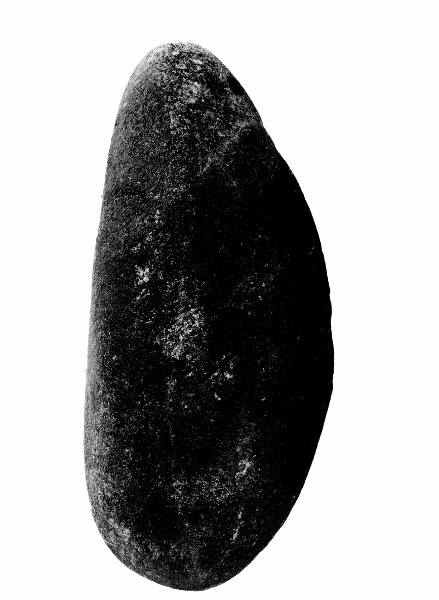
THE HELIOTYPE PRINTING CO., BOSTON
DOMESTIC ANVIL, SIDE
BUREAU OF AMERICAN ETHNOLOGY SEVENTEENTH ANNUAL REPORT PL. XXXV
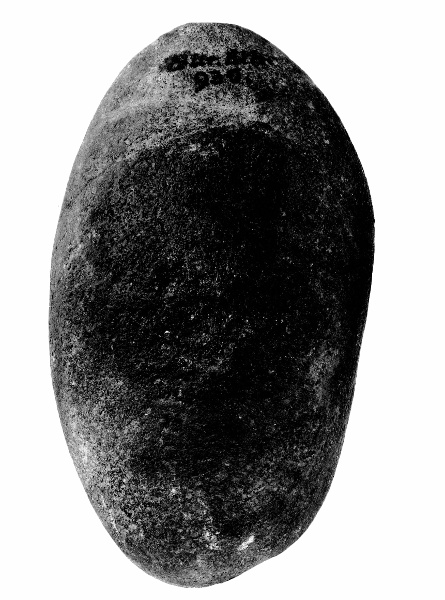
THE HELIOTYPE PRINTING CO., BOSTON
DOMESTIC ANVIL, TOP
BUREAU OF AMERICAN ETHNOLOGY SEVENTEENTH ANNUAL REPORT PL. XXXVI
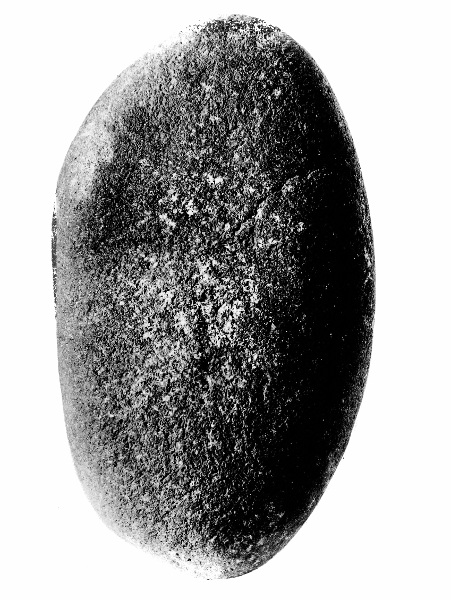
THE HELIOTYPE PRINTING CO., BOSTON
DOMESTIC ANVIL, BOTTOM
A typical specimen of intermediate size, used commonly as an ahst, but susceptible of employment as a hupf, is illustrated (natural size) in plates XXXV and XXXVI.296 It is a hard, tough, hornblende-granite or greenstone, with a few structure-lines brought out by weathering and wave-wearing. Its weight is 4 pounds 10 ounces (2.10 kilograms); its form and surface are entirely natural, save for slight battering shown on the two principal faces and still less conspicuous bruises along one edge (as imperfectly shown toward the left of plate XXXV). The specimen was found in a jacal (illustrated in plate VI) on Rada Ballena, within a few hours after abandonment, in the position in which it was hastily left by the last users; it was smeared with blood and fat (which still remain, as is shown in plate XXXV) and bits of flesh, and bore bloody finger prints of two sizes—those of a man and those of a woman or large child; beside it lay the hupf depicted in plate XLII. In its last use the unwieldly cobble served as an ahst, but the markings on the edge record use also as a hand implement.
A functionally similar implement is illustrated in plate XXXVII (on reduced scale; maximum length 8¼ inches=21.0 cm.). It is of tough but slightly vesicular and pulverulent volcanic tuff, pinkish-buff in color, and weighs 4 pounds 1 ounce (1.84 kilograms). The form and surface are almost wholly natural, save for slight battering about the larger end and severer battering, with the dislodgment of a flake, about the thinner end; yet the faces are smeared with blood and grease and flecked with turtle debris, and bear a few marks of hupf blows, as is shown in the reproduction. This specimen was found at a temporary camp of a small party on Punta Miguel, where it had been used in breaking up a turtle—the camp having been abandoned so precipitately that a considerable part of the quarry, with this hupf, the ahst illustrated in plate LIV, the turtle-harpoon shown in figure 20, the half-made fire, and the fire-sticks used in kindling it, were left behind. The specimen is a good example of the cobbles carried into portions of the territory lacking the material (the camp at which it was found was on the great sandspit forming the eastern barrier of Boca Infierno, several miles from the nearest pebbly shore); it is of less specific gravity than the average rocks of the region, and looks still lighter by reason of its color and texture. Similar cobbles abound along the eastern coast of Tiburon, being derived from the immense volcanic masses of Sierra Kunkaak.
About the more permanent rancherias and on many abandoned sites lie ahsts usually too heavy for convenient transportation. In the habitable jacales such stones form regular household appurtenances, without which the menage is deemed incomplete; though the implement is commonly kicked about at random, often buried in debris (perhaps to be completely lost, and brought to light only by geologic changes, as demonstrated by the shell-heap of Punta Antigualla), and pressed into service only in case of need. An exceptionally well-worn specimen of the kind is illustrated in plate XXXVIII (scale one-half linear; maximum width measured on base, 9¼ inches=23.5 cm.). The material is a hard, ferruginous, almost jaspery quartzite, somewhat obscurely laminated. It weighs 10 pounds 11 ounces (4.85 kilograms). It is a natural slab, evidently from a talus rather than the shore, its native locus being probably the western slope of Sierra Seri. The edges and apex are formed by natural fractures; the most-used face (that shown in the plate) is a natural structure plane; the obverse side is partly a similar plane, partly irregular; while the base is an irregular fracture, evidently due to accident after the specimen had been long in use, though the fracture occurred years or decades ago, as indicated by the weathering of the surfaces. The entire face of the slab is worn and more or less polished by use as a metate, the wear culminating toward the center of the base (evidently the center of the original slab), where the hollowing reaches some three-sixteenths of an inch (5 mm.); yet even in the depths of the incipient basin the polished surface is broken by irregular pitting of a sort indicating occasional use as an anvil. The edges are quite unworn, but the smoother portion of the obverse is worn and polished like the face, though to a less degree. The specimen was found at a recently occupied jacal, midway between Punta Antigualla and Punta Ygnacio; it lay in the position of use, though half concealed by a cholla thrown over it, with the hupf shown in plate LVI; it was soaked with fat and smeared with the debris and intestinal contents of a turtle, as partly shown in the illustration.
BUREAU OF AMERICAN ETHNOLOGY SEVENTEENTH ANNUAL REPORT PL. XXXVII
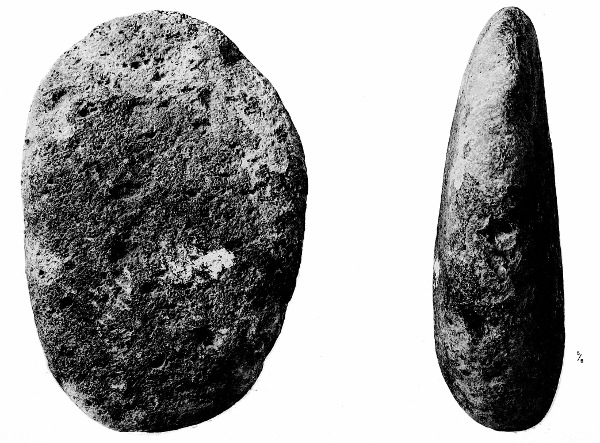
THE HELIOTYPE PRINTING CO., BOSTON
DOMESTIC ANVIL (REDUCED), TOP AND SIDE
BUREAU OF AMERICAN ETHNOLOGY SEVENTEENTH ANNUAL REPORT PL. XXXVIII
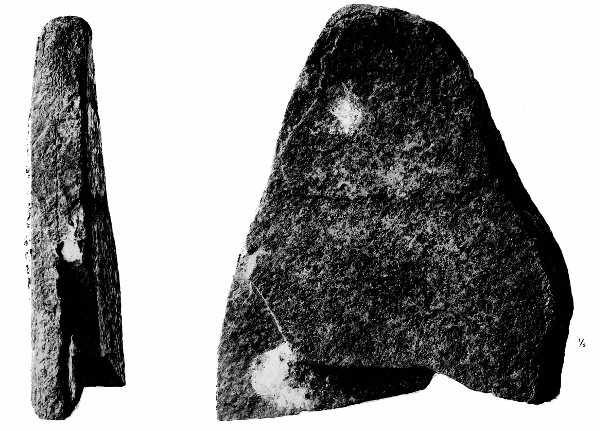
THE HELIOTYPE PRINTING CO., BOSTON
METATE (REDUCED), EDGE AND TOP
The largest ahst seen in Seriland is illustrated in plates XXXIX and XL, on a scale of one-third linear (its maximum length being 15⅜ inches=39.5 cm.); it is a dark, fine-grained silicious schist or quartzite, quite obscurely laminated; it weighs 33 pounds 8 ounces (15.20 kilograms). It is a natural slab, probably washed from a talus and slightly wave-worn; it might have come originally from either the southwestern flanks of Sierra Seri or the more southerly half of Sierra Kunkaak—certainly hundreds of similar slabs strew the eastern shore of Bahia Kunkaak, while the western shore, especially about Punta Narragansett, would yield thousands. Its artificial features (aside from miscellaneous battering) are limited to grinding of the two faces defined by structure planes. The principal face is abraded into an oblong or spoon-shape basin, about 8 inches (20 cm.) long, 5 inches (16 cm.) broad, and fully three-fourths of an inch (2 cm.) deep, the basin penetrating two or three laminæ of the slab in such wise as to produce the annular markings faintly shown in plate XXXIX; the obverse is slightly rubbed and ground and somewhat battered, like the face of the preceding specimen; and both sides are flecked with a fine but dark flour-like substance (doubtless derived from grinding mesquite beans, etc.) forced into the texture of the stone by the grinding process. The entire slab is greasy and blood-stained, while battered spots about the edges and angles of the principal face record considerable use as an anvil for breaking up quarry—indeed, shreds of turtle flesh and bits of intestinal debris still lodge in some of the interstices. The specimen was taken from the old rancheria at the base of Punta Tormenta, where it had apparently been in desultory use for generations.
A sort of connecting link between ahst and hupf is afforded by elongate beach pebbles, such as that illustrated in plate XLI, which lay beside the large ahst last described, and which bears a few inconspicuous marks of use in slight battering at both ends, with a few shreds of turtle flesh about the blunter extremity (at the right on the plate). The specimen is shown natural size; it is of pinkish-gray trachyte (?), and weighs 1 pound 12 ounces (0.79 kilograms). It is noteworthy chiefly as an illustration of the Seri mode of seizing and using hand-implements (a mode repeatedly observed at Costa Rica in 1894); the pebble comfortably fits the Caucasian hand, held hammerwise; it is intuitively grasped in this way, and when so seized and used with an outward swing forms an effective implement for bone-crushing, etc., the natural striking-point being near the free end; but the centripetally moving Seri invariably seizes the specimen in such manner that the free end is directed inward, while the thumb laps over the grasped end, when the strokes are directed downward and inward, the striking-point being the extreme tip of the free end. A similar specimen is illustrated in plate XLII. It is of tough and homogeneous hornblende-granite, somewhat shorter and broader than its homologue, but of exactly the same weight; it, too, is battered at the ends, but is otherwise quite natural in form. It was collected at Rada Ballena in conjunction with the ahst illustrated in plate XXXV; and like that specimen it is soaked with blood and fat, and bore shreds of flesh when found. Both these elongate cobbles are of interest as representatives of a somewhat aberrant type; for the favorite form of hupf is shorter and thicker, as shown by the prevailing shapes, both in use and lying about the jacales—indeed, the elongate form is seldom used on the coast and never carried into the interior.
A typical hupf is illustrated in plate XLIII. The specimen is of fine-grained, dense, and massive quartzite, its homogeneity being interrupted only by a thin seam of infiltrated silica and by an obscure structure-plane brought out by weathering toward the thinner end. Its weight is 1 pound 14 ounces (0.85 kilogram). In general form and surface the specimen is an absolutely natural pebble, such as may be found in thousands along the shores of Seriland. Its artificial features are limited to slight battering about the edges, especially at the thinner end; partial polishing of the lateral edges by repeated handling (as imperfectly shown in the edge view); very perceptible polishing of both faces by use as a grinder; some fire-blackening on both sides; semisaturation with grease and blood; and the flecks of red face-paint shown in the reproduction. The specimen was obtained at Costa Rica after some days’ observation of its use. The chief observed functions of this implement were as follows: (1) Skinning the leg of a partially consumed horse; this was done by means of centripetal (i. e., downward and inward) blows, so directed that the thinner end fell obliquely on the tissue, bruising and tearing it with considerable rapidity. (2) Severing tough tendons already sawed nearly through by rubbing over the edge of an ahst, the hupf in this case being in the hands of a coadjutor and used in rather random strokes whenever the tissue seemed particularly refractory. (3) Knocking off the parboiled hoof of a horse to give access to the coffinbone. (4) Crushing and splintering bones to facilitate sucking of the marrow. (5) Grinding mesquite beans; the process being begun by vertical blows with the end of the implement on a heap of the pods resting on an ahst, continued by blows with the side, and finished by kneading and rubbing motions similar to those of grinding on a metate. (6) Pounding shelled corn mixed with slack lime, in a ludicrously futile attempt to imitate Mexican cookery. (7) Chopping trees; in this case the implement was grasped in the centripetal manner and used in pounding and bruising the wood at the point of greatest bending under the pull of a coadjutor. (8) Cleaving and breaking wood for fuel. (9) Dethorning okatilla stems, by sweeping centripetal strokes delivered adzwise from top toward butt of a bunch of stems lying on the ground. (10) Severing a stout hair cord; in this use it was grasped between the knees of a matron squatting on the ground, while the cord was held in both hands and sawed to and fro over the use-roughened thinner end. (11) Supporting a kettle (shown in plate X) as one of the fire-stones used in frontier mimicry of the Papago custom. (12) Triturating face-paint by pounding and kneading; in one case the specimen served as a hand implement, while in another case it took the place of the ahst, the ocher lump itself being struck and rubbed against it. (13) Beating a troop of dogs from a pile of bedding in a jacal; in this use the implement was held in the customary manner and used in swift centripetal blows, the matron relying on her own swiftness and reach and not at all on projection to come within reach of her moving targets; the blows usually landed well astern, and were so vicious and vigorous as to have killed the agile brutes had they chanced to fall squarely—indeed, one blow temporarily paralyzed a large cur, which escaped only by running on its fore feet and dragging its hind quarters. In most of these uses the specimen was employed in conjunction with an improvised ahst in the form of a stone carried from the rancho. Several of the processes, notably those of tissue-tearing and dog-beating, were executed with a vigor and swiftness quite distinct from the sluggish lounging of the ordinary daytide and, indeed, partaking of the fierce exaltation normal to the Seri chase. When not in use the implement usually lay just within the open end of the owner’s jacal, though it was often displaced and sometimes kicked about the patio for hours. It was one of perhaps a dozen similar implements brought across the desert from the coast by as many matrons. All were regarded as personal belongings pertaining to the custodians about as definitely as articles of apparel, though rather freely loaned, especially in the owner’s clan. The specimen was purchased from the possessor, who parted from it rather reluctantly, though with the tacit approval of her clanswomen, at a rate implying considerable appreciation of real or supposed value. Three or four other matrons declined to barter their hupfs, either arbitrarily or on the plea that they were a long way from the source of supply.
BUREAU OF AMERICAN ETHNOLOGY SEVENTEENTH ANNUAL REPORT PL. XXXIX
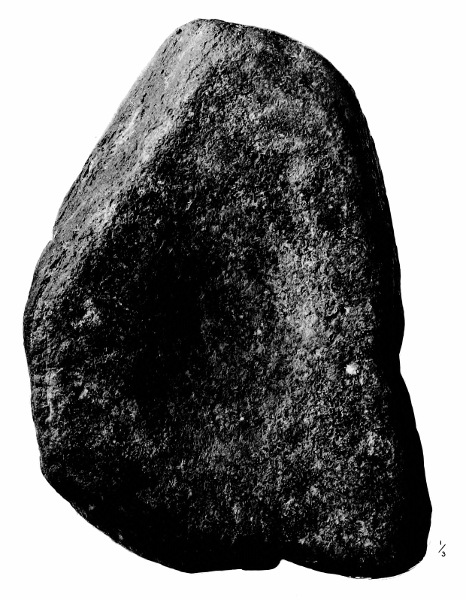
THE HELIOTYPE PRINTING CO., BOSTON
LONG-USED METATE (REDUCED), TOP
BUREAU OF AMERICAN ETHNOLOGY SEVENTEENTH ANNUAL REPORT PL. XL
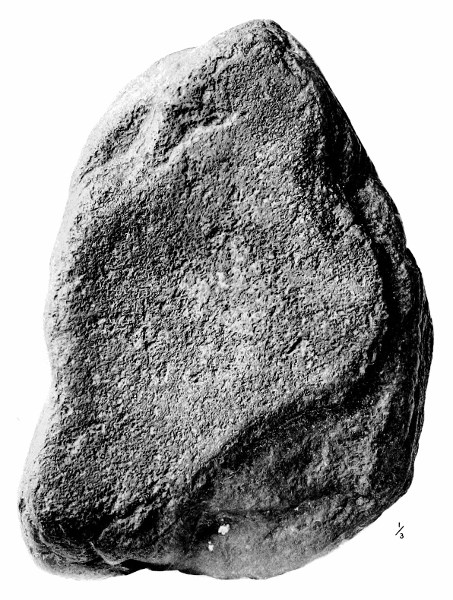
THE HELIOTYPE PRINTING CO., BOSTON
LONG-USED METATE (REDUCED), BOTTOM
A common variety of hupf is illustrated in plate XLIV. It is of pinkish, slaty tuff of rather low specific gravity, somewhat vesicular and pulverulent, though moderately hard and tough. It weighs 17 ounces (0.48 kilogram). In form and surface it is essentially a wave-worn pebble, doubtless derived originally from the volcanic deposits of Sierra Kunkaak. Its artificial markings are limited to slight battering about the edges, especially at the thinner end (as shown in the edge view); slight rubbing, striation, and semipolishing of the smoother face (shown in the plate); a few grease spots and a stain showing use in crushing sappy vegetal matter, also on this face; and an inconspicuous fire-mark on the obverse. It was found in a recently abandoned jacal near Campo Navidad. It is one of the three tuff specimens among those collected, one of a dozen or two seen; perhaps 10 per cent of the implements observed in Seriland are of this material, and it is significant that this ratio is several times larger than the proportion of tuff pebbles to the entire paving of the beaches, so that the material seems to be a preferred one. The preference was indeed discovered at Costa Rica in 1894, where two or three of the more highly prized hupfs were of this material, and where vague intimations were obtained that it is especially favored for meal-making, doubtless by reason of the association of color and texture—associations that mean much to the primitive mind, perhaps in suggesting that the grinding is easier when done by a soft implement. An economic reason for the preference is easily found in the lower specific gravity, and hence the greater portability of a hupf of ordinary size, of this material; but there is nothing to indicate that this economic factor is weighed or even apperceived by the Seri.
A typical pebble bearing slight marks of use is illustrated in plate XLV. It is of fine-grained pinkish sandstone, probably tuffaceous, and is fairly hard and quite tough; it weighs 1 pound 9 ounces (0.71 kilogram). It is wholly natural in form and surface save for slight battering or pecking on the face illustrated, and for a few stains of grease and abundant marks of fire. It was found in a fire still burning (and abandoned within a half-hour, as indicated by other signs) two or three miles inland from Punta Granita on the Seri trail toward Aguaje Parilla, whither it had evidently been carried from the coast.
A fairly common material for both hupfs and ahsts is highly vesicular basalt grading into pumice stone, the material corresponding fairly with a favorite metate material among the Mexicans. The rock was not certainly traced to its source, but seems to come from the northern part of Sierra Kunkaak. A typical hupf of this material is shown in plate XLVI; it weighs 1 pound 13 ounces (0.82 kilogram). It is wholly natural in every respect save for slight grinding and subpolishing, with some filling of interstices, on both faces. From the slight wear of this specimen, together with the absence of battering, and from similar features presented by others of the class, it maybe inferred that implements of this material are habitually used only for grinding—for which purpose they are admirably adapted. The specimen emphasizes the importance of the hupf in Seri thought, for it was one of a small series of mortuary sacrifices from a tomb at Pozo Escalante (ante, p. 290).
Throughout the surveys of Seriland, constant search was made for cutting implements of stone; and the nearest approach to success was exemplified by the specimen illustrated in plate XLVII. It is of bluish-gray volcanic rock (not specifically identified) of close texture and decided toughness and hardness; it weighs 10 ounces (0.28 kilogram). In greater part its form and surface are natural, but a projecting portion brought out by weathering on one side is split off, presumably by intention, and the fractured surface thus produced is partly smoothed by rubbing, probably in use, though possibly by design. The edges are more or less battered, especially at the ends, and several rude flakes have been knocked off, evidently at random and presumably in ordinary use as an ahst. The smoother face is wholly natural. The specimen was picked up in a jacal at Rada Ballena, but bore no marks of recent use.
BUREAU OF AMERICAN ETHNOLOGY SEVENTEENTH ANNUAL REPORT PL. XLI
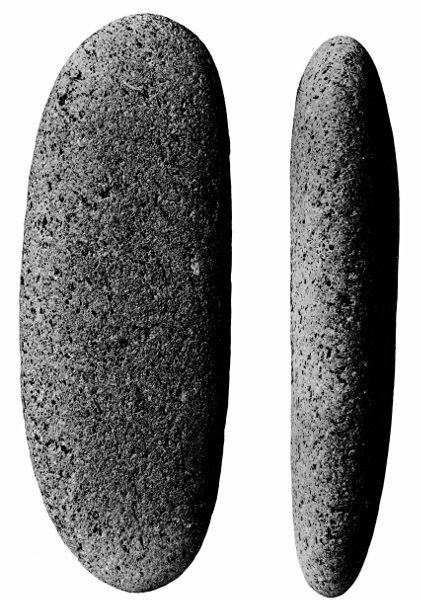
NATURAL PEBBLE BEARING SLIGHT MARKS OF USE
BUREAU OF AMERICAN ETHNOLOGY SEVENTEENTH ANNUAL REPORT PL. XLII
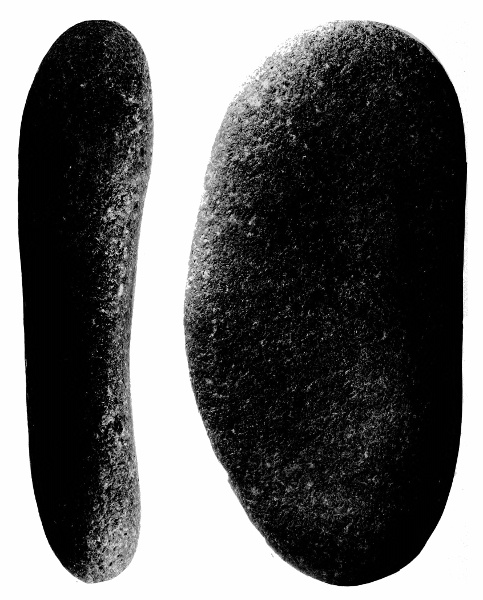
THE HELIOTYPE PRINTING CO., BOSTON
NATURAL PEBBLE USED AS BONE-CRUSHER
A tuff implement of suggestively ax-like form is shown in plate XLVIII; it is firmer and less pulverulent but more vesicular than most implements of its class; it weighs but 7 ounces (0.20 kilogram). The specimen was picked up in a ruinous jacal, which had evidently been occupied temporarily within a fortnight, on the summit of the great shell-mound forming Punta Antigualla. The somewhat indefinite texture and color render it difficult to distinguish between natural and artificial features; but careful examination indicates that it is wholly natural in form and in nine-tenths of the surface, and that the ax-like shape expresses nothing more than accidents of structure and wave-work. This interpretation is practically established by the slight battering along the edges and about the smaller end, as illustrated in the edge view; for this wear of use, which has produced a distinctive surface, is practically absent from the notches which give the ax-like effect. Besides the battering, the only artificial marks are ancient fire-stains on one of the faces. On the whole it is clear that the artificial appearance catching the eye at first glance is purely fortuitous, and that the specimen is but a natural pebble very slightly modified by ordinary use.
A suggestive specimen is illustrated in plate XLIX; it is of purplish-gray granitoid rock, of decided toughness and considerable hardness, and weighs 12½ ounces (0.35 kilogram). The surface and general form indicate that it is a natural pebble entirely without marks of artificial use; but the regular curvature of the principal face (the shape is that of a segment of a cylinder rounded toward the ends) suggests artificial shaping, while it was found far in the interior, near Barranca Salina, whither it must have been carried from the coast. It may possibly be a fragment of a pestle subsequently wave-worn; but all the probabilities are that it is wholly natural, and that its suggestive features are fortuitous.