DEMOTIC CHARACTERS (continued 3)
Reading edition
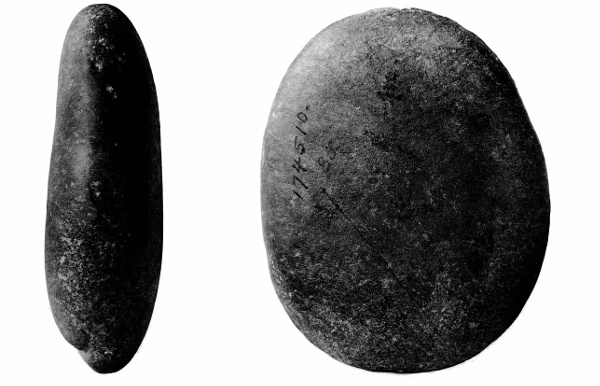
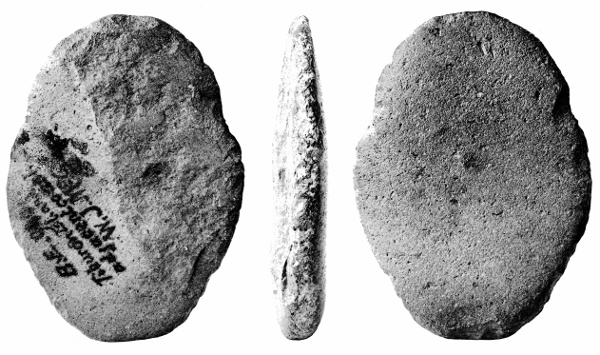
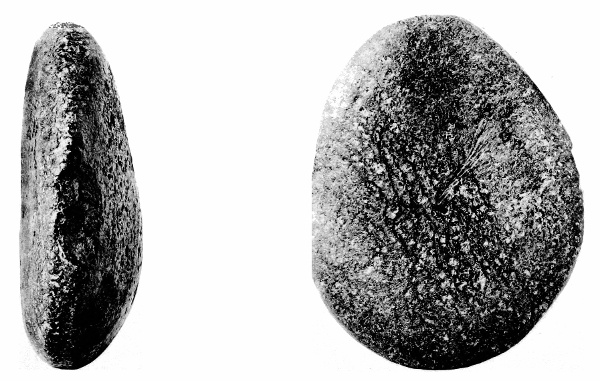
The constant search for chipped or flaked tools which was extended over nearly all Seriland seldom met the slightest reward; but the specimen shown in plate L was deemed of some interest in connection with the search. It is of hard and tough greenstone, showing obscure and irregular structure lines, though nearly homogeneous in texture; it weighs 10 ounces (0.28 kilogram). It is primarily a natural pebble with form and surface reflecting structure and texture in connection with wave-action. Its artificial features are limited to the usual slight battering of the smaller end, still less conspicuous battering or grinding of the margin about the larger end, slight but suggestive chipping of the thinner edge, inconspicuous hand-wear and polish on the principal face, and a few obscure scratches or striæ on the same face, as illustrated in the plate. The position and character of the flake-fractures, which are fairly shown in the edge view, indicate that they were made while the pebble was in use as a bruising or cutting tool, a use at once suggested to the Caucasian mind by the form of the pebble; yet it is noteworthy that its thin edge displays less battering than either end of the object and no more than the opposite and thicker edge, while it is still more significant that the specimen was apparently discarded immediately on the modification of form by the spalling—a modification greatly increasing its efficiency, as all habitual users of chipped stone tools would realize. The specimen is one of a large number of examples showing that whenever a hupf is broken in use it is regarded as ruined, and is immediately thrown away. This particular specimen is archaic; it was found in the cliff-face of the great shell-heap at Punta Antigualla, embedded in a tiny stratum of ashes and charcoal (some of which still adheres, as shown in the black flecking at the outer end of the striæ), associated with scorched clam-shells, typical Seri potsherds, etc., some 40 feet beneath the surface.
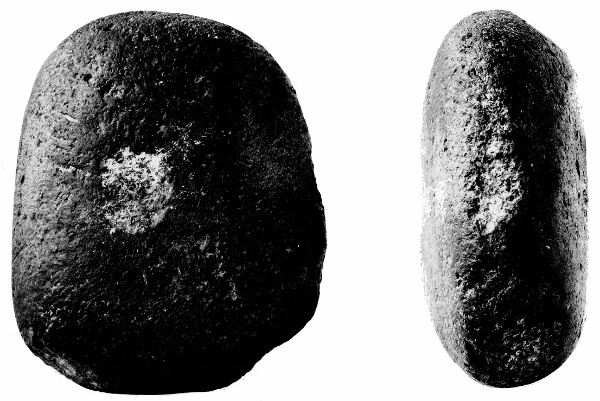
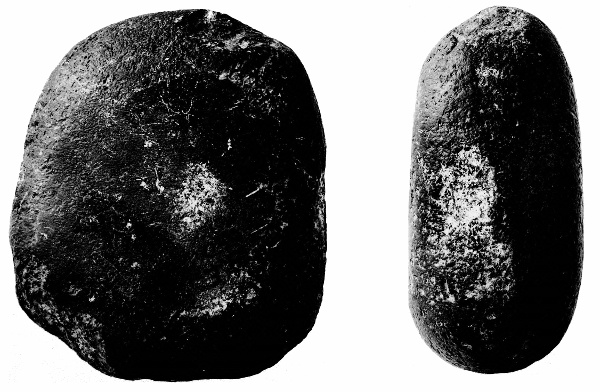
While the great majority of the hupfs are mere pebbles bearing slight trace of artificial wear, as illustrated by the foregoing examples, others bear traces of use so extended as to more or less completely artificialize the surface. A typical long-used hupf is depicted in plates LI and LII. It is a tough and hard quartzite, dark gray or brown in color, massive and homogeneous in texture; it weighs 2 pounds 4 ounces (1.02 kilograms). In general form it is a typical wave-worn pebble of its material, and might be duplicated in thousands along the shores of Bahia Kunkaak and El Infiernillo; but fully a third of its surface has been more or less modified by use. The flatter face (plate LI) is smeared with blood, grease, and charcoal, which have been ground into the stone by friction of the hand of the user in such manner as to form a kind of skin or veneer; portions of the face bear a subpolish, due probably to the hand-rubbing in use; near the center there is a rough pit about an eighth of an inch (3 mm.) deep, evidently produced by pecking or battering with metal, while three or four neighboring scratches penetrating the veneer appear to record ill-directed strokes of a rather sharp metal point. In the light of observed customs it may be inferred that this pitting was produced by use of the implement as an anvil or ahst in sharpening a harpoon-point and fitting it into its foreshaft. The thinner edge (shown in plate LI; that toward the right in the face view on the same plate) displays considerable battering of the kind characteristic of Seri hupfs in general; it is smoked and fire-stained, as shown, while the lower rounded corner is worn away by battering to a depth of probably one-fourth inch (5 mm.). The obverse face reveals more clearly the battering about both corners and edges, including the dislodgment of a flake toward the narrower end; but its most conspicuous feature is a broad subpolished facet (rounding slightly toward the thinner edge) produced by grinding on a flat-surface ahst. This face, too, exhibits fire-staining, while the surface beyond the facet—and to a slight extent the facet itself—is veneered like the other face. There are a few scratches on this side also, as well as a slight pitting due to contact with metal. The thicker edge (plate LII) displays considerable battering, especially a recent pitting near the middle evidently due to use as an anvil held between the knees for sharpening a harpoon point by rude hammering. The specimen was one of a score of implements lying about the interior of the principal jacal in the great rancheria at the base of Punta Tormenta (illustrated in plate VII).
BUREAU OF AMERICAN ETHNOLOGY SEVENTEENTH ANNUAL REPORT PL. XLIII
THE HELIOTYPE PRINTING CO., BOSTON
LITTLE-WORN PEBBLE USED FOR ALL DOMESTIC PURPOSES
BUREAU OF AMERICAN ETHNOLOGY SEVENTEENTH ANNUAL REPORT PL. XLIV
THE HELIOTYPE PRINTING CO., BOSTON
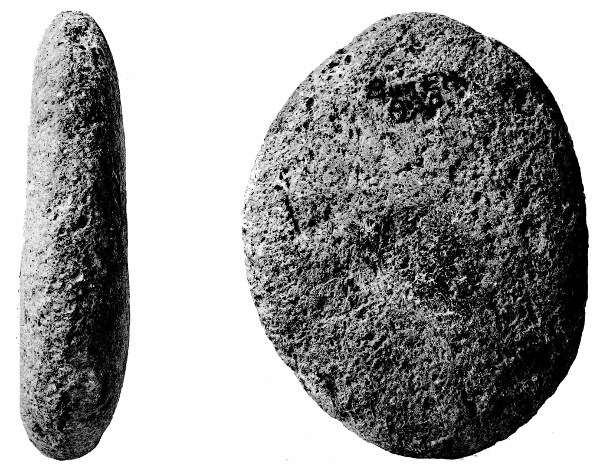
NATURAL PEBBLE USED AS CRUSHER AND GRINDER
A related specimen, though of somewhat aberrant form, is illustrated in plate LIII. It is of peculiarly tough and quite hard greenstone and weighs 2 pounds 1 ounce (0.93 kilogram). Somewhat less than half of the surface is that of a wave-worn pebble; the remainder is either battered out of all semblance to wave-work, or thumb-worn by long-continued use. The object well illustrates the choice of the most prominently projecting portion of the hand-implement as the point of percussion, and consequently the concentrated wear on such portions whereby the object is gradually reduced to better-rounded and more symmetric form. This specimen displays some minor flaking, apparently connected with the battering and regarded by the user as subordinate to the general wear. It was found at Punta Tormenta, concealed in the wall of a jacal, as if preserved for special use.
One of the best-known examples of a use-perfected hupf is illustrated in plate LIV. It is of coarse-grained but massive and homogeneous granite, similar to that forming Punta Blanca, Punta Granita, and, indeed, much of the eastern coast of Bahia Kunkaak. It weighs 1 pound 10 ounces (0.74 kilogram). In general form it is just such a pebble as is produced from this material by wave-wear, and might be duplicated along the shores in numbers. The artificial surfaces comprise (1) both ends, which are battered in the usual manner; (2) both lateral edges, of which one is slightly battered and worn, while the other is somewhat battered and also notched, evidently by a chance blow and the dislodgment of a flake; (3) both faces, which are flattened by grinding, while one of them (that shown in the plate) is slightly pitted, evidently by metal-working; so that the natural surface is restricted to small areas about the corners. The implement was found at the camp site on Punta Miguel, already noted (page 189), whence a group of five Seri were frightened by the approach of the 1895 expedition; it was covered with blood and shreds of turtle flesh, and is still saturated with grease. Moreover, it is quite confidently identified (not only by form and material, but especially by the fortuitous notch) as a hupf seen repeatedly at Costa Rica in 1894; it was the property of a matron of the Pelican clan (whose portrait appears in plate XXII), who was observed to use it for various industrial purposes, and who refused to part with it for any consideration.
A still more beautiful example of Seri stone art is depicted in plate LV. It is of the same homogeneous and coarse-grained granite as the last specimen, and closely approaches it in dimensions; it is slightly longer and broader, but somewhat thinner, and weighs 1 pound 11 ounces (0.77 kilogram); and, except for the absence of the accidental notch, its artificial features are still more closely similar. The ends are slightly battered, as illustrated in the end view at the right of the plate; the edges are similarly worn, but to a less extent; while both sides have been symmetrically faceted by use in grinding, the facets being straight in the longitudinal direction but slightly curved in the transverse direction, in the shape of the Mexican mano. The specimen displays well-marked color distinctions between the artificially worn and the natural surfaces, the former being gray and the latter weathered to yellowish or pinkish-brown; these colors show that something like two-thirds of the surface is artificial and the intervening third natural; and the natural portion corresponds in every respect, not only in form but in condition of surface, with the granite cobbles of Seriland’s stormy shores. Unfortunately the color distinctions, with the limits of faceting and other artificial modifications, are obscure in the photomechanical reproduction; they are indicated more clearly in the outline drawing oversheet. The specimen is partially saturated with fat, and bears an ocher stain attesting use in the preparation of face-paint. It was found carefully wrapped in a parcel with the shell paint-cup illustrated in plate XXVII, a curlew mandible, two or three hawk feathers, and a tuft of pelican down (the whole evidently forming the fetish or medicine-bag of a shamanistic elderwoman), in an out-of-the-way nook in the wall of an abandoned jacal at Punta Narragansett.
A somewhat asymmetric though otherwise typical hupf is illustrated in natural colors in plate LVI. It is of andesite, and may have come originally either from the extensive volcanics of southern Sierra Seri or central Sierra Kunkaak; it weighs 1 pound 15 ounces (0.88 kilogram). The general form is that of a wave-worn cobble, and fully one-third of the surface retains the natural character save for slight smoothing through hand friction in use. The chief artificial modification is the faceting of both sides in nearly plain and approximately parallel faces, the maximum thickness of material removed from each side, estimated from the curvature of the adjacent natural surface, being perhaps three-sixteenths of an inch (5 millimeters); in addition, both ends are battered in the usual fashion, while the thinner and more projecting edge is battered still more extensively, in a way at once subserving convenient use and tending to increase the symmetry of form. One of the facets is quite smooth; the other (that on the right in the plate) is slightly pitted, as if by use in metal-working. The specimen is somewhat greasy—the normal condition of the hupf—and bears conspicuous records of its latest uses; both faces (more especially the pitted one) are stained with sap from green vegetal substance (probably immature mesquite pods), while one face is brilliantly marked with ocher in such manner as to indicate that a lump of face-paint was partially pulverized by grinding on the slightly rough surface. It was found, together with the ahst illustrated in plate XXXVIII, in the rear of a recently occupied jacal midway between Punta Antigualla and Punta Ygnacio, cached beneath a thorny cholla cactus uprooted and dragged thither for the purpose. The trail and other signs indicated that the jacal had been occupied for a few days and up to within twenty-four hours by a family group of six or seven persons; that it was vacated suddenly at or about the time of arrival of the party of five whose trail was followed by the 1895 expedition from Punta Antigualla to Punta Miguel (where they were interrupted in the midst of a meal and frightened to Tiburon); and that the larger party fled toward the rocky fastnesses of southern Sierra Seri.
BUREAU OF AMERICAN ETHNOLOGY SEVENTEENTH ANNUAL REPORT PL. XLV
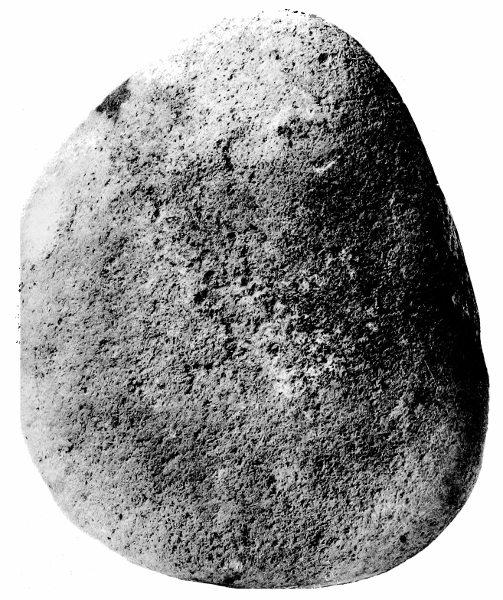
NATURAL PEBBLE SLIGHTLY USED AS HAMMER AND ANVIL
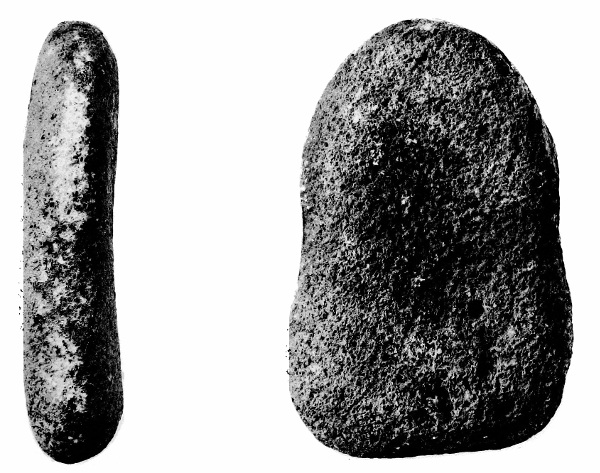
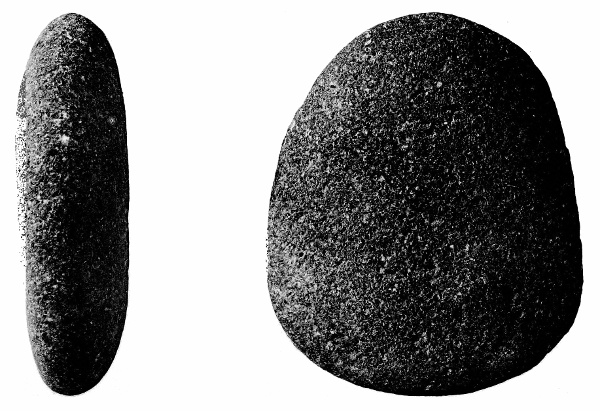
Of the foregoing hupfs several are aberrant, and serve merely to illustrate the prevailing directions of departure from the optimum form and size of implements. Six of the specimens may be deemed typical; they are as follows:
Plate No. Locality Material Weight Condition
Lb. Ozs.
XLIII Costa Rica Quartzite 1 14 (0.85 kg.) Nearly natural.
XLIV Campo Navidad Tuff 1 1 (.48 kg.) Four-fifths natural.
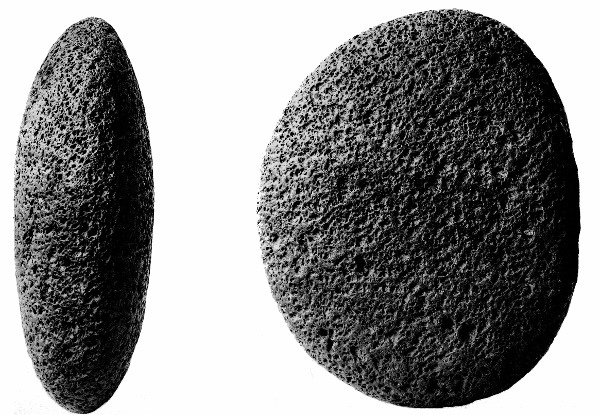
XLVI Pozo Escalante Vesicular lava. 1 13 (.82 kg.) Nearly natural.
LIV Punta Miguel Granite 1 10 (.74 kg.) One-fifth natural.
LV Punta Narragansett do 1 11 (.77 kg.) One-fourth natural.
LVI South point Sierra Seri. Andesite 1 15 (.88 kg.) One-third natural.
From these specimens a type of Seri hand implement may easily be formulated: it is a wave-worn pebble or cobble of (1) granite, quartzite, or other tough and hard rock, (2) tuff, or other light and pulverulent rock, or (3) vesicular lava; it is of flattened ovoid form, or of biscuit shape; it weighs a trifle under 2 pounds (about 0.85 kilogram); originally the form and surface are wholly natural, but through the chance of use it is modified (a) by a battering of the ends and more projecting edges, and (b) by grinding and consequent truncation of the sides; though initially a natural pebble, chosen nearly at random from the beach, it eventually becomes personal property, acquires fetishistic import, and is buried with the owner at her death.
The ahsts and the heavier cobbles used alternatively as ahsts and hupfs are too fortuitous for reduction to type; while the protean pebbles utilized in emergency, and commonly discarded after a single use, are too numerous and too various for convenient or useful grouping.
There is a distinctive type of Seri stone artifacts represented by a single category of objects, viz., chipped arrowpoints. Several of the literary descriptions of the folk—particularly those based on secondhand information, and far-traveled rumor—credit the Seri with habitual use of stone-tipped arrows,297 and it is the current fashion among both Mexican and Indian residents of Sonora to ascribe to the Seri any shapely arrowpoint picked up from plain or valley; yet the observations among the tribesmen and in their haunts disclose but slight basis for classing the Seri with the aboriginal arrow-makers of America.
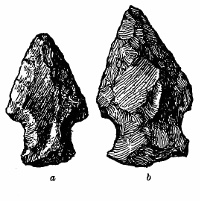
Fig. 37—Seri arrowpoints.
Among the 60 Seri (including 17 or 18 warriors) at Costa Rica in 1894, three bows and four quivers of arrows were observed, besides a number of stray arrows, chiefly in the hands of striplings. The arrows seen numbered some 60 or 70, including perhaps 20 “poisoned” specimens; nearly half of them were tipped with hoop-iron, as illustrated in plate XXX, while about as many more were fitted only with the customary foreshafts (usually sharpened and hardened by charring), and the small remainder had evidently lost iron tips in use; there was not a single stone-tipped arrow in the rancheria. Moreover, when the usually incisive and confident Mashém was asked for the Seri term for stone arrowpoint he was taken aback, and was unable to answer until after lengthy conference with other members of the tribe—his manner and that of his mates clearly indicating ignorance of such a term rather than the desire to conceal information so frequently manifested in connection with esoteric matters; and the term finally obtained (ahst-ahk, connoting stone and arrow) is the same as that used to denote the arrowpoint of hoop-iron. The most reasonable inference from the various facts is that whatsoever might have been the customs of their ancestors, the modern Seri are not accustomed to stone arrow-making.
The 1895 expedition was slightly more successful in the search for Seri arrows. About midway between the abandoned Rancho Libertad and Barranca Salina, an ancient Seri site was found to yield hundreds of typical potsherds, half a dozen shells such as those used for utensils, the fragments of a hupf evidently shattered by use as a fire-stone, and the small rudely chipped arrowpoint shown in figure 37a; and among the numerous relics found on a knoll overlooking Pozo Escalante (including two jacal frames, two or three graves, an ahst, several shells and discarded hupfs, a broken fictile figurine, etc.), was the still ruder arrowpoint represented in figure 37b (both figures are natural size). The specimens are nearly identical in material—a jet-black slaty rock with a few lighter flecks interspersed, weathering gray on long exposure (as is shown by the partly natural surface of the larger point); similar rock abounds in several easterly spurs of Sierra Seri. The smaller specimen was evidently finished and used; its features indicate fairly skilful chipping, though its general form is crude—in addition to the asymmetric shouldering, the entire point is curved laterally in such manner as to interfere with accurate archery. The larger specimen is still more strongly curved laterally, and the chipping is childishly crude; while the rough surface, clumsy tang, and unfinished air indicate that it was never used even to the extent of shafting. It is possible that the specimens may have been imported by aliens, but the probabilities are strong that they were manufactured by the Seri. No other arrowpoints and no chips or spalls suggesting stone arrow-making were found in all Seriland, though the entire party of twelve were on constant lookout for them for a month. The natural inference from these facts is that the ancestral Seri, like their descendants, were not habitual stone arrow-makers.
BUREAU OF AMERICAN ETHNOLOGY SEVENTEENTH ANNUAL REPORT PL. XLVI
THE HELIOTYPE PRINTING CO., BOSTON
NATURAL PEBBLE SLIGHTLY USED AS GRINDER
BUREAU OF AMERICAN ETHNOLOGY SEVENTEENTH ANNUAL REPORT PL. XLVII
THE HELIOTYPE PRINTING CO., BOSTON
NATURAL PEBBLE SLIGHTLY USED AS DOMESTIC IMPLEMENT
There is a final category of Seri artifacts which would be classed as distinctive by Caucasians on the basis of material, though they are combined with the stone artifacts by the tribesmen; it comprises arrowpoints of hoop-iron or other metal, harpoon-points of nails, spikes, or wire, awls of like materials, and other metallic adjuncts to ordinary implements. The use of iron is of course post-Columbian, and its ordinary sources are wreckage and stealage. The date of introduction is unknown, and probably goes back to the days of Cortés and Mendoza; certainly the value of metal was so well understood in 1709 that when Padre Salvatierra’s bilander was beached in Seriland the tribesmen at once began to break her up for the nails (ante, page 67); yet the metal is wrought cold and only with hupf and ahst like the local materials, and is habitually regarded and designated as a stone. By reason of the primitive methods of working, the metals are of course available only when in small pieces or slender shapes. There is a tradition among the vaqueros of the frontier that a quantity of hoop-iron designed for use in making casks was carried away from a rancheria in the vicinity of Bacuachito during a raid in the seventies, and that this stock has ever since served to supply the Seri with material for their arrowpoints; but it is probable that the chief supply is derived from the flotsam swept into the natural drift trap of Bahia Kunkaak by prevailing winds and tidal currents, and cast up on the long sandspit of Punta Tormenta after every storm. A surprising quantity and variety of wreckage was found on this point, and thence down the coast to Punta Narragansett, by the 1895 expedition: staves and heads of casks broken up after beaching, a telegraph pole crossbar which had evidently brought in a cargo of large wire, and a piece of door-frame with heavy strap-iron hinges attached with screws, were among the troves of the tribesmen within a few weeks; and it was noted that while even the hinge screws and the tacks attaching tags to the cask-heads had been extracted by breaking up the wood, the roughly forged hinges of 2 by ⅜-inch wrought iron had been abandoned after a tentative battering with cobbles, and lay among the refuse stones about the jacales.
A rough census of the stone implements of Seriland is not without interest, even though it be no more than an approximation. Some 20 or 25 habitable and recently inhabited jacales were visited, with about twice as many more in various stages of ruin, fully two-thirds of these being on the island; and at least an equal number of camps or other houseless sites were noted. About these 150 jacales and sites there were, say, 50 ahsts, ranging from nearly natural bowlders to the comparatively well-wrought specimen illustrated in plate XXXIX, and an equal number of cobbles used interchangeably as ahsts and hupfs; there were also 200 or 300 pebbles bearing traces of use as hupfs, of which about a third were worn so decidedly as to attest repeated if not regular use; while no flaked or spalled implements were observed save the two doubtful examples illustrated in plates XLVII and L, and only two chipped arrowpoints. It may be assumed that the sites visited and the artifacts observed comprise from a tenth to a fifth of those of all Seriland, in addition to, say, 75 finished hupfs habitually carried by Seri matrons in their wanderings; and it may be assumed also that 50 or 100 metallic harpoon-points and several hundred hoop-iron arrowpoints are habitually carried by the warriors and their spouses.
The most impressive fact brought out by this census is the practical absence of stone artifacts wrought by flaking or chipping in accordance with preconceived design; excepting the exceedingly rare arrowpoints there are none of these. And the assemblage of wrought stones demonstrates not merely that the Seri are practically without flaked or chipped implements, but that they eschew and discard stones edged by fracture whether naturally or through accident of use.
Summarily, the Seri artifacts of inorganic material fall into three groups, viz.: (I) The large and characteristic one comprising regularly-used hupfs and ahsts, with their little-used and discarded representatives; (II) the small and aberrant group represented by chipped arrowpoints, and (III) the considerable group comprising the cold-wrought metal points for arrows and harpoons and awls—though it is to be remembered that the Seri themselves combine the second and third of these groups.
I. On reviewing the artifacts of the larger group it becomes clear (1) that they immediately reflect environment, in that they are characteristic natural objects of the territory; (2) that they come into use as implements through chance demands met by hasty selection from the abundant material; (3) that the great majority of the objects so employed are discarded after a use or two; (4) that when the object proves especially serviceable, and other conditions favor, it is retained to meet later needs; (5) that the retained objects are gradually modified in form and surface by repeated use; (6) that if the modification diminishes the serviceability of the object in the notion of the user (e. g., by such fracture as to produce sharp edges), it is discarded; (7) that if the modification enhances the serviceability of the specimen in the mind of the user it is the more sedulously preserved; and (8) that through the instinctive desire for perservation, coupled with the thaumaturgic cast of primitive thinking, the object acquires at once an artificialized form and a fetishistic as well as a utilitarian function. The significant feature of the development is the total absence of foresight or design, save in so far as the concepts are fiducial rather than technical or directly industrial.
BUREAU OF AMERICAN ETHNOLOGY SEVENTEENTH ANNUAL REPORT PL. XLVIII
THE HELIOTYPE PRINTING CO., BOSTON
NATURAL PEBBLE SLIGHTLY WORN BY USE
BUREAU OF AMERICAN ETHNOLOGY SEVENTEENTH ANNUAL REPORT PL. XLIX
THE HELIOTYPE PRINTING CO., BOSTON
NATURAL PEBBLE CONSIDERABLY WORN IN USE AS GRINDER
II. On reviewing the almost insignificantly small group of chipped stone artifacts, it seems clear that while the material is local the design is so incongruous with custom and characteristic thought as to raise the presumption that stone-chipping is an alien and imperfectly assimilated craft. The conspicuous and significant feature of the chipped stone artifact is the shapement in accordance with preconceived design.
III. On reviewing the arbitrarily separated group of metallic artifacts it is found clear (1) that the material is foreign; (2) that it is avidly sought and sedulously saved and utilized; (3) that it is wrought only by the crude methods used for fashioning the most primitive of implements and tools; and (4) that it is used chiefly as a substitute for organic substances employed in symbolic imitation of the natural organs and functions of animals. The significant features of the use of iron artifacts are (a) the absence of either alien or specialized designs, and (b) the mimicry of bestial characters as conceived in primitive philosophy.
Classed by material and motive jointly, the three groups are diverse in important respects: The first is local in material, local in motive; the second is local in material, foreign in design; the third is foreign in material, local in motive.
On recapitulating the several phases of Seri handicraft, the devices are found to fall into genetic classes of such sort as to illumine certain notable stages of primitive technic.
The initial class comprises teeth, beaks and mandibles, claws, hoofs, and horns, used in imitation or symbolic mimicry of either actual or imputed function of animals, chiefly those to which the organs pertain, together with vegetal spines and stalks or splints, used similarly under the zootheistic imputation of animal powers to plants; also carapaces and pelts, used as shields combining actual and symbolic protective functions. While this class of devices is well displayed by the Seri, it is by no means peculiar to them; clear vestiges of the devices have been noted among many Amerind tribes. Now the essential basis of the industrial motive has been recognized by all profounder students in zootheism, animism, or hylozoism—indeed, the industrial stage is but the reflex and expression of the zootheistic or hylozoic plane in the development of philosophy; while both the devices and the cultural stage which they represent have already been outlined by the late Frank Hamilton Cushing, on the basis of surviving vestiges and prehistoric relics, and characterized as “prelithic”.298 Cushing’s designation for the initial stage of technic has the merit of euphony, and of suggesting the serial place of the stage in industrial development; but since it denotes a most important class of artifacts only by exclusion and negation it would seem desirable to supplement it by a positive term. The class of devices (considered in both material and functional aspects) and the cultural stage in general might appropriately be styled hylozoic, though it would seem preferable to emphasize the actual objective basis of the class and stage by a specific designation—and for this purpose the term zoomimetic (from ζω̢̃ον, τὁ and μιμητικὁς), or its simplified equivalent, zoomimic, would seem acceptable.
A transitional series of devices is represented by awls of wood or iron fashioned in imitation of mandibles or claws, by wooden foreshafts shaped in symbolic mimicry of teeth, and by other vicarious replacements of material in devices of zoomimic motive; but this series may be regarded as constituting a subclass, or as a connecting link between classes rather than a major class of devices. Yet the subclass is of great significance as a mile-mark of progress in nature-conquest, and as the germ of that industrial revolution consummated as tribesmen grew into reliance on their own acumen and strength and skill rather than on the capricious favor of beast-gods.
BUREAU OF AMERICAN ETHNOLOGY SEVENTEENTH ANNUAL REPORT PL. L
THE HELIOTYPE PRINTING CO., BOSTON
NATURAL PEBBLE CONSIDERABLY WORN AS CUTTER AND GRINDER
The next major class of devices comprises shells and cobbles and bowlders picked up at random to meet emergency needs, wielded in ways determined by emergency adjustment of means to ends, and sometimes retained and reused under the budding instinct of fitness, though never shaped by design. The devices of this class are best exemplified by the tool-shells and by the hupfs and ahsts of the Seri matrons, partly because of the practical absence of higher artifacts from their territory; yet the class is by no means confined to this notably primitive, folk: the greater part of the implements used by the California Indians and a large part of those used by every other known Amerind tribe in aboriginal condition consist of shore cobbles, river pebbles, talus bowlders, or other natural stones of form and size convenient for emergency use; and (despite the fact that such objects are often ignored by observers, for the prosaic reason that they represent no familiar or trenchant class), there is no lack of evidence that they are or have been in habitual use among all primitive peoples. Although zootheistic or sortilegic motives doubtless play an undetermined rôle in the selection of the objects, and although wonted zoomimic movements doubtless affect the initial processes, the essential distinction from zoomimic artifacts resides in the selection and use of natural objects through a mechanical chance tending to inspire volitional exercise rather than through a fiducial rule tending to paralyze volitional effort; while the class is no less trenchantly separable from those of higher grade by the absence of preconceived models or technical designs. The class of devices and the culture-stage which they represent have already been outlined and defined as protolithic.299
A transitional series of devices allied to the Seri hupf on the one hand and to the chipped artifact on the other hand is frequently found among the aborigines of California and other native tribes; it is typified by a cobble or other natural piece of stone cleft (first by accident of use and later by design) in such wise as to afford an edged tool. This subclass of artifacts is religiously eschewed by the Seri; but it is of much interest as an illustration of the way in which artificialization proceeds, and of the exceeding slowness of primitive progress.
The third great class of devices defined by technologic development comprises stones chipped, flaked, battered, ground, or otherwise wrought in accordance with preconceived designs, together with cold-forged native metal, horn, bone, wood, and other substances wrought in accordance with preconceived models and direct motives. Among the Seri this class of devices is represented only by the rare arrowpoints of chipped stone, which seem to be accultural and largely fetishistic; but the class is abundantly represented by the artifacts of most of the Amerind tribes. The class and the cultural stage have already been outlined under the term technolithic.300
A transitional series of devices intervenes between stone artifacts and artifacts of smelted metal; it is represented by malleable native metals (chiefly copper, silver, meteoric iron, and gold), originally wrought cold, after the manner of stone, though heating under the hammer in such wise as to prepare the way for forging, fusing, and founding. These devices and the processes with which they are correlated are not represented among the Seri; indeed, the crude use of iron by the tribe would seem to lie on a lower plane in industrial development than even the arrowpoint-chipping, in that the artifacts, though of foreign material, are wrought largely in accordance with zoomimic motives.
The fourth major class of devices, comprising the multifarious artifacts of smelted and alloyed metal, was barely represented in aboriginal America; only a few of the more advanced tribes had attained the threshold of metallurgy, and even among these the crude metal working remained hieratic or esthetic, and did not displace the prevalent stone craft.
Briefly, the several stages in the development of tools and implements may be seriated as follows:
Stages Typical materials Typical products Essential ideas
1. Zoomimic Bestial organs Awls, spears, harpoons, arrows. Zootheistic faith.
A. Transitional Symbolized organs Piercing and tearing implements. Faith + craft.
2. Protolithic Natural stones Hammers and grinders— hupfs and ahsts. Mechanical chance.
B. Transitional Cleft stones Grinders and cutters Chance + craft.
3. Technolithic Artificialized stones. Chipped, battered, and polished implements. Designed shapement by molar action.
C. Transitional Malleable native metals. Copper celts, gold ornaments, etc. Designed shapement by molar action + chance heating.
4. Metal Smelted ores Steel tools, etc. Shapement by molar and molecular action.
BUREAU OF AMERICAN ETHNOLOGY SEVENTEENTH ANNUAL REPORT PL. LI
THE HELIOTYPE PRINTING CO., BOSTON
NATURAL PEBBLE CONSIDERABLY USED AS HAMMER, GRINDER, AND ANVIL (TOP AND EDGE)
BUREAU OF AMERICAN ETHNOLOGY SEVENTEENTH ANNUAL REPORT PL. LII
THE HELIOTYPE PRINTING CO., BOSTON
NATURAL PEBBLE CONSIDERABLY USED AS HAMMER, GRINDER, AND ANVIL (BOTTOM AND EDGE)
It is to be realized that the successive stages represent characteristic phases of normal and continuous growth, and hence that their relations are intimate and complex. The fundamental factor of the growth is intellectual advancement, and hence in actual life each stage is at once the germ and the foundation for the next higher; each stage is characterized by a type or a cognate series of types, yet each commonly contains a few forms prophetic of the next stage and many forms vestigial of the earlier stages; so that the stages are to be likened unto successive generations of organisms, or (still more appropriately) to the successive phases of ovum, larva, pupa, and imago in the ontogeny of the insect rather than to the arbitrary classes of pigeonhole arrangements. The complex relations conceived to exist among the stages can be indicated more clearly by diagraphic representation than by typographic arrangement, and such a representation is introduced as figure 38. The successive curves in the diagram express the rhythmic character of progress and the cumulative value of its interrelated factors, as well as the dominance of successive types until gradually sapped and absorbed (though not immediately or completely annihilated) by higher types reflecting a strengthened mentality.
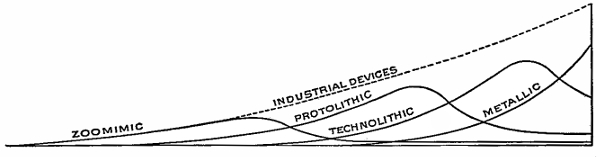
Fig. 38—Diagrammatic outline of industrial development.
The place of the normal pacific industries of the Seri in this genetic classification of human technic is definite. The Seri craft combines the features of the zoomimic and protolithic stages more completely than that of any other known folk, and in such wise as to reveal the relations between these stages and that next higher in the series with unparalleled clearness; their craft also displays an aberrant (and hence presumptively accultural) feature pertaining to the technolithic stage; and in so far as their craftsmen use the material typical of the age of metal they degrade it to the transitional substage between dominant zoomimicry and designless stone-using.
Viewed in the general light of their pacific industries, the Seri are, accordingly, among the most primitive of known tribes; their technic is in harmony with their esthetic, and also with their somatic and tribal characteristics, in attesting a lowly plane of development; while their industries, like their other demotic features, are essentially autochthonous.
WARFARE
Something is known of Seri warfare through the history of the centuries since 1540, and especially through the bloody episodes of the Encinas régime and the occasional outbreaks of the last decade or two. The available data clearly indicate that the warfare of the tribe complements their pacific industries in every essential respect.
As befits their primitive character, warfare has played an important role in the history of the folk, forming, indeed, one of the chief factors in determining the course of tribal development. There is no means of estimating the losses suffered and occasioned in warfare with the neighboring tribes during either prehistoric or historic times; but the indications are that they were much greater than the losses connected with Caucasian contact. Neither is it practicable to estimate reliably the fatalities attending the interminable conflicts with the Spanish invaders and their descendants, though it is safe to say that the Seri losses in strife against Spaniards and Mexicans aggregate many hundred, and that the correlative loss on the part of their enemies reaches several score, if not some hundred, lives. Few if any other aboriginal tribes of America have had so sanguinary a history as the Seri, and none other has at once so long and so bloody a record.
According to the consistent accounts of several survivors of conflict with the Seri, their chief weapons are arrows, stones, and clubs—though several survivors manifest greater fear of the throttling hands and rending teeth of the savage warriors than of all their artificial weapons combined. A striking feature of the recitals, indeed, is the rarity of reference to weapons; the ambushes or surrounds or chance meetings, with their disastrous or happy consequences, are commonly described with considerable detail; the carbines or rifles, the machetes and knives, or the deftly thrown riatas employed by the rancheros or vaqueros are mentioned with full appreciation of their serviceability; but the ordinary expressions concerning the despised yet dreaded Seri are precisely those employed in recounting conflicts with carnivorous beasts. When Andrés Noriega’s kinswoman proudly related how he alone once overawed and routed an attacking party of 30 Seri warriors, she duly mentioned the carbine ready for use in his hands and the six-shooter and machete in his belt; but nothing was said of the Seri weapons. When a distinguished sportsman citizen of Caborca, the local authority on the Seri, sought to dissuade the 1895 expedition from visiting Tiburon, he was repetitively and cumulatively emphatic in his oracular forecast, “Ils vont vous tuer! Ils vont vous tuer!! Ils vont vous tuer!!!”—yet he made but passing reference to “poisoned” arrows, and none to other weapons, in the general implication that invaders of the tribal territory were torn limb from limb and strewn over the rocks and deserts of Seriland. When Jesus Omada, of Bacuachito, boasted his Seri scars, he indeed emphasized the arrow-mark on his breast, but only as a prelude and foil to the far ghastlier record of his teeth-torn arm. When Robinson and his companion were butchered on Tiburon in 1894, the bloody work was effected chiefly by means of a borrowed Winchester; and neither the account of the survivors nor that of the actors made mention of native weapons—save the stones with which the second victim was finished according to the local version. In short, most of the casual expressions and fuller recitals alike indicate that while the Seri are famous fighters their weapons—except the much-dreaded “poisoned” arrows—are incidents rather than essentials to savage assaults, and that their prowess rests primarily on bodily the strength and swiftness.
BUREAU OF AMERICAN ETHNOLOGY SEVENTEENTH ANNUAL REPORT PL. LIII
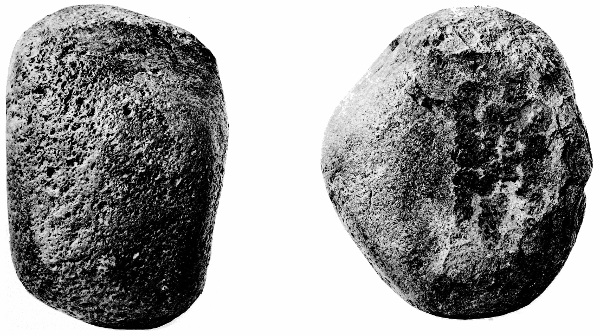
THE HELIOTYPE PRINTING CO., BOSTON
HAMMER AND GRINDER
BUREAU OF AMERICAN ETHNOLOGY SEVENTEENTH ANNUAL REPORT PL. LIV
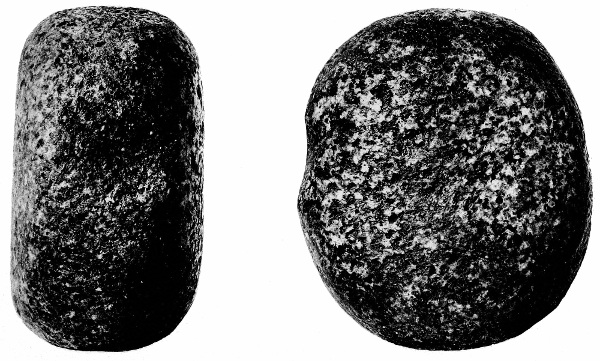
THE HELIOTYPE PRINTING CO., BOSTON
IMPLEMENT SHAPED BY USE
The stones used in battle, as described by the survivors and as intimated by Mashém, are cobbles as large as a fist, i. e., hupfs of typical form and size. So far as is known they are never hurled, slung, nor projected in any other manner, nor are they hafted or attached to cords after widespread aboriginal customs; they are merely held in the hand, as in the slaughter of quarry. Hardy made note of a war-club—“They use likewise a sort of wooden mallet called Macána, for close quarters in war”;301 but nothing of the kind was found at Costa Rica in 1894, and no woodwork suggesting such use was found in the depths of Seriland in 1895.
The most conspicuous and doubtless the most effective war weapon is the arrow projected from the bow in the unusual if not unique fashion already noted (ante, p. 201). There is nothing to indicate that the Seri are especially effective archers; the facts (1) that a large part of the arrows are pointless, save for the hard-wood foreshafts; (2) that stone arrowpoints are not habitually used; and (3) that comparatively slight reference is made to the use of arrows in records and recitals of Seri battles, tend on the contrary to indicate inferior ability in archery. And in the course of the explorations by the 1895 expedition it was noted that the feral fowls and animals of Seriland—pelican, gull, snipe, curlew, cormorant, coyote, hare, bura, mountain sheep, peccary, etc.—displayed little fear of human figures at distances exceeding 75 yards, and seldom stirred until the stranger approached within 50 or 60 yards; whence it may be assumed that these distances fairly indicate the ordinary range of Seri arrows. The few accounts of conflicts in which arrows are mentioned prove, however, that those missiles are discharged with great rapidity and in considerable numbers during the brief interval to which the fighting is customarily limited.
The most notorious feature of the Seri warfare, and that of deepest interest to students, is the reputed use of poisoned arrows. The scattered literature of the tribe, from the days of Coronado onward, abounds in references to this custom; the Jesuit authorities give somewhat varied yet fairly consistent descriptions of the preparation and the effects of these arrows; Hardy added his testimony as to the character of the poison; General Stone gave directly corroborative evidence; haciendero Encinas gives witness to the effects of the envenomed missiles on his own stock; while Mashém recounted to the 1894 expedition the various uses of the “poisoned” arrows and highly extolled their potency, though he was noncommittal—save in casual allusions—as to the details of the poisoning. A part of the arrows acquired by this expedition and now preserved in the National Museum were professedly poisoned; they are easily distinguished by a thin varnish of gummy and greasy substance over the iron tips and wooden foreshafts, and especially about the attachments of mesquite gum and sinew. According to Mashém’s asseverations, such arrows are habitually used in war save when the supply is exhausted by continued demand; they are also used occasionally in hunting, especially for deer and lions (i. e., the swiftest and fiercest game of the region); and the use of the poisoned missile does not destroy the meat of the animal, though the portion immediately about the wound is “thrown away”. Two of the treated arrows brought back from Costa Rica were submitted to Dr S. Weir Mitchell some months afterward for examination, and for identification of any poisonous matter found on them; but no poison was detected. On the whole, the data concerning the reputed arrow poisoning are less definite than might be desired; yet they are sufficient to suggest the nature of the custom with considerable clearness.
In any consideration of Seri customs it is to be realized that the folk are notably primitive in thought, and hence deeply steeped in that overweening mysticism which, dominates all lowly folk—that they still cling to zoomimic motives in their simple handicraft, and are still wholly within zootheism in their lowly faith. In the light of this realization the numerous consistent records of the preparation of the poison are easily interpreted, and are found to be fully in accord with the prevailing motives of the tribe; and the interpretation serves to explain the somewhat discrepant accounts of the effects of the poison, effects ranging from nil to horrible sepsis. According to the more circumstantial recipes, the first constituent of the poison is a portion of lung, preferably human—a selection readily explained by pristine philosophy, in which the breath is life, and the lungs at once the seat and the symbol of vitality. Naturally the fleshly symbol is from a dead body; and just as the lung denotes vitality in life, so (in primitive thought) it denotes an emphasized, as it were an incarnated, antithesis of vitality in death. Next, as the recipes continue, this death-symbol is exposed to the most potent agencies of death—to the bites of maddened rattlesnakes, to the stings of irritated scorpions, to the venomed trailings of harried centipedes. Then the deadly creatures are themselves killed, and the fanged heads of the serpents, the stinging tails of the scorpions, and the fiery feet of the centipedes, together with portions of redolent ordure from the grave-cairns, and other symbols of death and decay are crushed and macerated with the mass in a wizard’s brew, grewsome beyond the emasculated and degraded witch’s broth of medieval times. Finally, the grisly mess is allowed to simmer in a stinkpot302 shell under the fierce desert sun until its ripeness and putrid potency are attested by the rank fetor of death; when it is ready for its ruthless use. Thus the entire recipe is thaumaturgic in concept, necromantic in detail; it represents merely the malevolent machinations of the medicine man seeking success by spells and enchantments; it stands for no rational system of thought or practice, but pertains wholly to the plane of shamanism and sorcery. So interpreted the recipe is readily understood; the several witnesses who have independently obtained it are justified, and Mashém’s details and unwilling intimations are made clear—especially if the sacrificed flesh about the wound in deer or lion be deemed an oblation, such as primitive folk are given to making.
BUREAU OF AMERICAN ETHNOLOGY SEVENTEENTH ANNUAL REPORT PL. LV
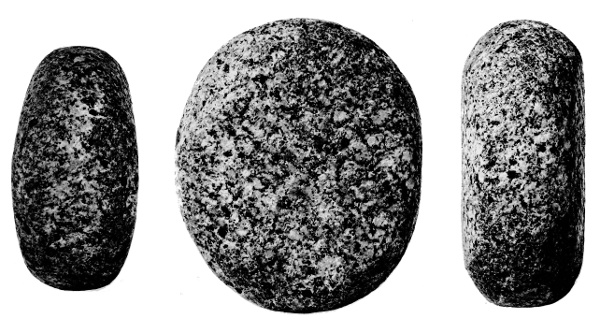
THE HELIOTYPE PRINTING CO., BOSTON
IMPLEMENT PERFECTED BY USE
While thus the motive of the medicine-man in compounding his loathsome mess is wholly necromantic, serious consequences of its use must occasionally supervene; and though these may be incidental so far as the philosophy is concerned, they may tend reflexly toward the perpetuation of the custom. In the course of the preparation of the charm-poison, and especially in the final ripening process, morbific germs and ptomaines must be developed; these may retain their virulence up to the time of use, particularly when a batch of poison is prepared for a special occasion and the arrows are used while the application is still fresh; and in such cases the wound might initiate septicemia of the sort described in Castañeda’s early narrative and still more clearly displayed by Señor Encinas’ saddle-horse (ante, p. 112). Naturally the incidentally zymotic varnish frequently fails of effect, and can hardly be expected to remain morbific long enough to be detected in laboratory experiments; yet it is probable, as attested by Mashém’s guarded expressions, that the occasionally terrible results of such poisoning are within the ken of the Seri shamans.
It is noteworthy that the various early accounts of the Seri arrow-poisoning are strikingly consistent, though sufficiently diverse to attest independence in origin; it is also noteworthy that several of the accounts are given hesitatingly and half qualifiedly, with alternative references (obviously hypothetical) to vegetal sources of poison. Thus the author of “Rudo Ensayo” qualified a characteristic (though brief) account of the preparation of the poison by adding: “But this is mere guesswork, and no doubt the main ingredient is some root.”303 So, too, Hardy described the compounding of the brew in much detail, adding the significant statement that “when the whole mass is in a high state of corruption the old women take the arrows and pass their points through it”; yet he could not resist the alternative hypothesis, and added: “Others again say that the poison is obtained from the juice of the yerba de la flécha (arrow-wort).”304 Bartlett “was told that the Ceris tip their arrows with poison; but how it was effected I [he] could not learn,” and so he contented himself with quoting Hardy’s account.305 Stone gave the recipe in fairly similar terms, adding that the morbific mass is hung up “to putrefy in a bag, and in the drippings of this bag they soak their arrowheads”; and he gave a characteristic account of the effect of a wound from a poisoned arrow on a human subject (ante, p. 100). Pajeken independently attested the virulence of the poison, and described the consequences of a slight wound suffered by his horse (ante, p. 101), while Pimentel gave independent corroboration, and Orozco y Berra added the further information that the proverbially deadly poison is fortified “by superstitious practices” (ante, p. 103). Bancroft gave currency to the customary recipe, and also to the complementary hypothesis that the “magot” may be the source of the poison; while Dewey merely mentioned the reputed use of poisoned arrows. Like their predecessors, the vaqueros of today are familiar with the tradition of a necromantic brew; but many of them—like Don Jesus Omada, of Bacuachito, and Don Ramon Noriega, of Pozo Noriega—display a much more lively interest in the local yerba mala, or yerba de flécha, of which they stand in such mortal dread that they can hardly be induced to approach a clump of it, and which they conceive must add the final crux to the brew. This plant was described in “Rudo Ensayo”: “Mago, in the Opata language, is a small tree, very green, luxuriant, and beautiful to the eye; but it contains a deadly juice which flows upon making a slight incision in the bark. The natives rub their arrows with it, and for this reason they call it arrow-grass; but at present they use very little.”306 Elsewhere the anonymous author mentions the use of (presumably) this poison by the Jova, and describes it as “so deadly that it kills not only the wounded person, but also him who undertakes the cure by sucking the wound, as is customary with all the Indians”; the description implying that the infection is irremediable.307 Yet he apparently discriminated this poison from that of the Seri, for which another plant known as caramatraca is an infallible remedy. On the whole it seems probable that the yerba mala (Sebastiano bilocularis?), or yerba de flécha, or mago, or magot, yielded or formed the standard arrow-poison of the Opata and perhaps of other Indians, and that the ill-repute of the shrub survived and spread throughout Mexicanized Sonora in such frequent repetition and common belief as to affect the ideas of residents and travelers alike; but it seems equally probable that the magic-inspired brew of the Seri is entirely distinct.308
BUREAU OF AMERICAN ETHNOLOGY SEVENTEENTH ANNUAL REPORT PL. LVI
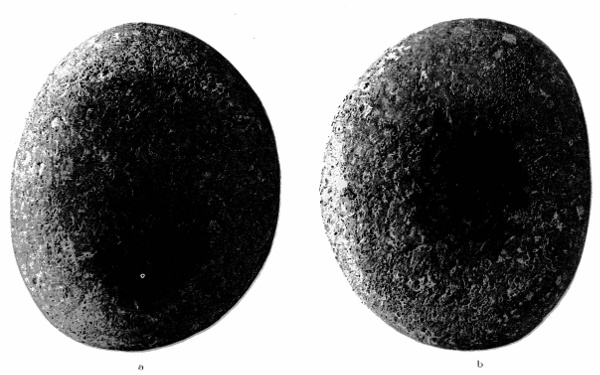
PERFECTED IMPLEMENT FOUND IN USE
As suggested by widespread primitive customs, and as illustrated specifically by the arrow-charming, the warfare of the Seri is largely sortilegic, this feature being but an extension and magnification of a corresponding feature of their hunting customs. The economic object of the chase is, of course, the flesh of the quarry; but the hunt normally begins with invocatory or other fiducial ceremonies, culminates in a feast opened with oblations, and ends in the use of horns or hoofs, teeth or bones, mane or tail, as talisman-trophies—primarily pledges of fealty to the favorable potencies, only secondarily symbols of success. The observances illumine the ever-present esoteric object of the chase, which is to gain the favor or overcome the power of the beast-god represented by the animal hunted; in general, this is sought to be effected through mimetic movements, or symbolic objects, associated with that animal-kind, and the retained charm-trophy is valued as a symbol of the placation or outwitting of a particular deity. Similarly, the Seri warrior strives for the supposed deific symbols of the enemy—the scalp or headdress or arrow of the alien tribesman, the fire-breathing and echo-waking (as well as death-dealing) wand of the Caucasian; and the Papago arrows, Yaqui scalps, and white man’s firearms are sought avidly, treasured as fetishes, and often carried conspicuously as badges of borrowed prowess.309 So the Seri are never without alien insignia in the form of weapons. The day before the 1895 expedition entered their stronghold, a band of warriors and women were frightened from a freshly slaughtered cow by a party of vaqueros so suddenly that their arms were left behind—and these included a heavy Springfield “remodeled” rifle, lacking not only ammunition but breechblock and firing pin; while Don Andrés Noriega, of Costa Rica, and L. K. Thompson, of Hermosillo, described a rifle of modern make captured similarly two years before, which was in good working order and charged with a counterfeit cartridge ingeniously fashioned from raw buckskin in imitation of a center-fire brass shell and loaded with a polished stone bullet.310 The finders opined that the rifles were carried to bluff the enemy, and even that the counterfeit cartridge was designed to do deadly execution; but it would better accord with Seri customs, and with the law of piratical acculturation which they typify,311 to infer that the weapons were regarded rather as symbols of mystical potencies than as simple scarecrows. Of related import were two or three pseudomachetes made from rust-pitted cask hoops, reported by the majordomo and several vaqueros at Costa Rica; and of still greater significance was a machete picked up in a just-abandoned jacal by Don Ygnacio Lozania—veteran of the Andrade expedition and the Encinas conquest—which was laboriously rasped and scraped out of paloblanco wood, colored in imitation of iron blade and mahogany handle by means of face-paints, and even furnished with “eyes” replacing the handle-rivets, in the form of embedded iron scales. Some of the Seri are familiar with the normal use of firearms, as was demonstrated by the Robinson and other episodes, and many of them modernly make some use of machetes or other knives, as shown by various rudely whittled wooden artifacts; yet the burden of proof indicates that the chief use of the Caucasian’s weapons in the heat of actual warfare is shamanistic and symbolic. This interpretation is, in fact, practically established by the experience of the frontier; for the vaqueros and local soldiery have little fear of the ill-understood firearms and clumsily handled machetes occasionally seen in Seri hands, though they dread unspeakably the necromantic arrows and flesh-rending teeth with which the agile foes are credited.
The mystical potency ascribed to Caucasian firearms and cutlery by the zoomimic tribesmen is of interest as a reflection of motives and methods pervading the entire range of their activities; at the same time it suggests the genesis of the aberrant technolithic craft displayed in arrow-chipping. The information obtained from Mashém and his mates concerning chipped arrowpoints implied that the process was hieratic and little understood by the body of the tribe, its place in the tribal knowledge, indeed, being similar to that of the brewing of the arrow “poison”, which is the special work of shamans; and this information, comporting as it does with the rarity of the chipped points and the crudeness of the work, strongly supports the inference that the stone arrow-making of the Seri was originally a fetishistic mimicry of alien devices—a plane, indeed, above which the craft has hardly risen even in recent decades.
While the Seri are devoid of military tactics in the strict sense of the term, they have certain customs of warfare which seem to be scrupulously observed. These customs are closely akin to those followed in hunting the larger land animals—indeed, the warfare of the tribe is merely an intensified counterpart of their chase.
The favorite tactical device of the warriors, as indicated by the great majority of their battles, is the ambuscade, laid and sprung either with or without the aid of decoys (usually aged women). Sometimes a considerable body act in concert under a prearranged plan; more commonly a few warriors only are involved at the outset, though these may be joined as the crisis approaches by companions lurking behind rocks and shrubs to be either on hand at the finish or in the way of ready flight, according to the turn of the battle-tide; and it is probable that the greater part of the ambuscades prove stillborn by reason of the oozing courage of leaders and the shirking of their supporters if the prospective victims present a bold front, or if the final omens are otherwise adverse. The ambuscade, with its flying contingent, grades into the device of stalking a stationary or slowly moving enemy, the stealthy approach terminating either in covert attack at close range or in sudden rush by a superior force. The theory, or rather the instinctive plan, of the campaign is to seek advantage in both position and numbers, to keep under cover until the instant of attack, to have sure and ample lines of retreat, and in every way to minimize individual risk.
There is a widespread notion toward the Seri frontier that the savages are given to sorties and surprises by night; but both specific testimony and the records indicate, when carefully analyzed, that this tactical device is much less common in practice than in repute, and is not, indeed, characteristic of the tribe. A few known battles began in attacks by night; but the war parties, like the hunting and fishing parties (save in the semiceremonial pelican pilgrimages), display decided preference for daylight in their forays—indeed, there are various indications that the folk are much more timid and oppressed with superstitious fears by night than by day.
In rare cases small parties of aliens have been half openly surrounded and done to death by considerably larger parties of the savage folk; but this method, too, is incongruous with the fixed habits of the tribe and with the deep-planted instinct of avoiding personal exposure.
A considerable number of the long list of homicides charged against the Seri, and marking the beginning of many of their battles, were individual rather than collective, the consummation of inimical impulse sometimes treacherously concealed for favorable opportunity, as in the pitiful case of Fray Crisóstomo Gil, and othertimes rising explosively beyond the feeble control of the untrained mind; for the impulse of enmity toward aliens is an ever-present possession—or obsession—of the tribe, and a reflection of that race-sense which is their most distinctive attribute.
Of open warfare and face-to-face fighting there is hardly a germ among the Seri. When themselves ambushed or surrounded, some of their stouter warriors have in a few instances faced the foe for a few minutes at a time, as is shown by the annals of Cerro Prieto; yet this accidental attitude but betokens the play of chance rather than the plan of choice. Concordantly, the folk avoid the method of warfare (so common among other Amerind tribes as to be properly considered characteristic) involving open duel between chiefs and other warriors; they seem to be devoid of that sense of fairness in fighting which finds expression in the duel; and despite the individual advantages growing out of gigantic stature, immense strength, and superior swiftness, they habitually seek to combine in numbers against panicked or baffled enemies, just as their hunters throw themselves mercilessly on surrounded quarry. Of open boldness or confident prowess no trace appears; and the body of facts seems to justify the prevailing Sonoran opinion that the warfare of the Seri is treacherous and cowardly in design, craven and cruel in execution.
Once begun, the conduct of the fray by the Seri fighters is fairly uniform; the warriors either discharge clouds of arrows from their coigns of vantage, or rush to brain their victims with stones, or to break their necks and limbs and crush in their chests, as in the slaughtering of quarry; and according to the tale of the occasional survivors—Señor Pascual Encinas and his son Manuel, Don Ygnacio Lozania, Don Andrés Noriega, Don Jesus Omada of Bacuachito, and Don Ramon Noriega of Pozo Noriega, are among the survivors and informants; also the sturdy Papago fighters, Mariana, Anton, Miguel, and Anton Castillo (whose sister died of dread while he was on the 1895 expedition)—the rushing warriors are transfigured with frenzy; their eyes blaze purple and green, their teeth glisten through snarling lips, their hair half rises in bristling mane, while their huge chests swell and their lithe limbs quiver in a fury sudden and blind and overpowering as that of springing puma or charging peccary. Of the successful assaults the ghastly end is rarely recorded, though whispered large in the lore of Sonora; in the unsuccessful assaults recounted by survivors the blood-frenzy burned but briefly and died swiftly as the disappointed warriors skulked silently behind rocks and shrubs, or fled across the sands with inconceivable fleetness. These details of battle precisely parallel the details of butchery of beastly quarry, as recounted by local observers and corroborated by Mashém’s recitals.
So far as can be ascertained the parallelism between frenzied battling and furious butchery in the chase affords the chief basis for the firm Sonoran belief that the similarity extends one step farther, and that the human victims are rent and consumed, like the beasts. There is a lamentable lack of data concerning the alleged anthropophagy of the Seri; on the one hand there is the deep-seated local opinion, generally growing stronger as the tribal territory is approached, and agreeing so well with the hunting customs, the thaumaturgic arrow-poisoning, the zoomimic handicraft, and zootheistic faith, and especially with the pervading fetish-piracy of the folk, that its validity would seem inherently probable; on the other hand, there is not only a dearth of specific positive testimony, but haciendero Encinas (best informed among Caucasians concerning Seri customs) and several of his yeomen reject the prevailing belief, while Mashém consistently repudiated the custom, both in general and in particular, and in ceremonial as well as in economic aspects, whenever and in whatever way the subject was approached during his intercourse with the 1894 expedition. On the whole, the much-mooted question of Seri cannibalism must be left open pending further inquiry, with some preponderance of evidence against the existence of the custom.
The war-frenzy of the Seri fighters is significant in its parallelism with the blood-craze of the chase, and even more so in its analogy with the warpath customs and ceremonies of most Amerind tribes and many other primitive peoples. In typical tribes the warpath custom is a most distinctive one, standing for an abnormal state of mind and an unaccustomed habit of body, perhaps to the extent of an extreme exaltation or obsession akin to intoxication, in which the ordinary ideas of justice and humanity are inhibited; among most tribes the condition is sought voluntarily and deliberately when occasion is thought to demand, and is superinduced by fasts and vigils, exciting songs and ceremonies, and related means; while among certain tribes the aid of symbolic “medicines”, which may be actual intoxicants, is invoked. Thus the savage on the warpath is a different being from the same man in times of peace; viewed from his own standpoint, he is possessed of an alien and violent demon, usually that of a fantastic and furious beast-god whose rage he must symbolize and enact; viewed from the standpoint of higher culture, he is a raving and ruthless maniac whose craze is none the less complete by reason of its voluntary origin. The warpath frenzy is one of the fundamental, even if little understood, facts of primitive life, and the character of the savage tribe can not properly be weighed without appreciation of it. Now, the Seri blood-craze seems measurably distinct in two ways: in the first place, it expresses a more profound and bitter enmity toward aliens than is found among most savage tribes—i. e., it is instinctive and persistent in exceptional degree; in the second place, it is more spontaneous and explosive in its culmination when conditions favor than among tribesmen who induce the condition by elaborate preparation—i. e., it is dependent on the swift-changing hazard of warfare in exceptional measure; so that the Seri frenzy is at once more instinctive and more fortuitous, or in general terms more inchoate, than the corresponding condition among most of their contemporaries. Accordingly the war customs, like several other features of the tribe, seem to afford a connecting link between the habits normal to carnivorous beasts and the well-organized war customs of somewhat higher culture-grades; and thus they contribute toward outlining the course of human development through some of its darker stages.
Conformably with their poverty in offensive devices, the Seri are exceedingly poor in devices for defense. It is an impressive fact that a restricted motherland which has been successfully protected against invasion for nearly four centuries of history should be destitute of earthworks, fortifications, barricades, palisades, or other protective structures; yet no such structures exist on any of the natural lines of approach, and none are known anywhere in Seriland save in a single spot—Tinaja Trinchera—where there are a few walls of loose-laid stone, so unlike anything else in Seriland and so like the structures characteristic of Papagueria as to strongly indicate (if not to demonstrate) invasion and temporary occupancy by aliens. The jacales are not fortified in the slightest degree, unless the turtle-shells with which they are sometimes shingled be regarded as armor; even the most ancient rancherias are absolutely devoid of contravallations of earth, stone, or other material; and both the structures themselves and the expressions of the folk concerning them indicate that the jacales are not regarded as fortresses or places of refuge against enemies, but only as comfortable lodges for use in times of peace. Nor are walls like those of the borderland Tinaja Trinchera known in the interior of the tribal territory—e. g., the similarly conditioned Tinaja Anita, which differs only in the greater abundance and permanence of the water-supply, is entirely devoid of artificial structures, not even a pebble or bowlder being artificially placed save perchance by the casual trampling of the pathways. As already noted, the Seri seem to be practically devoid of knife-sense; they are still more completely devoid of fort-sense, although (and evidently because) they rely so fully on natural things, including tutelaries and their own fleetness, for safety.
Although devoid of even the germ of fortification-sense, so far as can be discovered, the Seri are not without a sort of shield-sense, which is of much significance partly by reason of its inchoate character. The ordinary shield is a pelican pelt, or a robe or kilt comprising several skins; it is employed either for confusing the enemy by swift brandishing, something after the fashion of the capa of the banderillero in the bull ring, or for actual protection of the body against arrows and other missiles or weapons. So far as known it is not backed or otherwise strengthened, the user relying solely on the stout integument and thick feathers—or rather on the mystical properties imputed to the pelt as the mystery-tinged investiture of their chief creative tutelary. On the coast bucklers are improvised from turtle-shells, though, according to Mashém (confirmed by direct observation), these are not carried inland for the purpose; but the protective function imputed to the turtle was well represented in the rancheria at Costa Rica by several fetishes made from phalanges of turtle-flippers tricked out in rags in imitation of Caucasian dress (somewhat like the mortuary fetishes illustrated in figure 40a and b). On the whole, the most conspicuous feature of the individual shields or protectors is their emblematic character; they are sortilegic rather than practical, and express imputation of mystical potencies rather than recognition of actual properties; and in this as in other respects they correspond closely with the offensive devices, and aid in defining the ideas and motives of the primitive warriors.
The actually effective protection of the Seri in warfare is their fleetness, coupled with their habitual and constitutional timidity, i. e., their wildness—for they are verily, as their Mexican neighbors say, “gente muy bronco”. Moreover, they are adepts in concealing their persons and their movements behind shrubbery and rocks, and in finding cover on the barest plains; and suggestions are not wanting that the protecting shrub-clumps and rocks of their wonted ranges are credited with occult powers and elevated to the lower places of their zoic pantheon, after the customary way of that overpowering zootheism, or animism, which the Seri so well exemplify in many of their habits.
Summarily, the warfare of the Seri complements the pacific industries of the tribe in every essential respect. It is notable for improvidence, i. e., for reliance on chance; the dearth of devices for offense and defense parallels the poverty in industrial artifacts; and the disregard of fortifications is of a kind with the squandering of present food supplies and the utter neglect of provision for the future. A striking correspondence between workfare and warfare is found in the fierce blood-lust displayed alike in chase and battle, a feature manifestly borrowed from beasts and intensified by besetting beast-faith; and more striking still is the correspondence in motive, as revealed by the overlapping functions of the protective kilt, by the borrowing of animal symbols alike in peace and war, and by the imitation of animal movements on the warpath as in the chase.
In the last synthesis the warfare of the Seri may be considered as characterized by two attributes: (1) The motives, so far as developed, are zoomimic in even greater degree than the prevailing motives of the pacific industries; and (2) the methods are shaped largely by mechanical chance, like those normal to protolithic industry.
Nascent Industrial Development
Industries form the chief bond between man and his environment. The esthetic activities arise in the individual and extend to his fellows; the institutional activities express the relations among individual men and groups; the linguistic activities serve to extend social relations in space and time, and the sophic activities to integrate and perpetuate all relations; but it is through the industrial activities that human intelligence interacts with physical nature and makes conquest of the material world. Accordingly, industries act as a steady and never-ceasing stimulus to intelligence; accordingly, too, the industrial activities afford the simplest and surest measure of intellectual advancement.
Under this view of the place of industrial activities in human phylogeny, certain phases of Seri technology acquire importance and especial significance.
1. One of the most conspicuous features of Seri craft is its local character. The foodstuffs, the materials for appareling and habitations, and the substances utilized in the several lines of simple handicraft are essentially local; moreover, the characteristic methods and devices evidently reflect local environmental conditions. There are, indeed, a few phenomena suggesting, and a still less number demonstrating, extraneous origin; the balsa and the kilt are sufficiently similar to devices of other districts to suggest, though not to prove, genetic identity (indeed, the sum of indications of local origin is much weightier than the several suggestions of extraneous derivation); the iron harpoon-points and arrow-tips are mainly of local flotsam, and are essentially provincial in modes of employment; the chipped stone arrow-tips, though local in material, are foreign in motive; but on summarizing the industrial phenomena, it would appear that by far the greater share are essentially local, while the few of exceptional (and extraneous) character can be pretty definitely traced to importation through the social interactions of recent centuries.
2. An equally conspicuous feature of the industrial craft of the Seri is the dominance of chance in both processes and devices. The traditional “fisherman’s luck” is made exceptionally uncertain by the sudden gales and shifting currents of Seriland shores, while the absolute necessaries of life on land are still more capricious than those alongshore; this uncertainty of resources has profoundly affected the somatic features of the tribesman, as indicated elsewhere (ante, p. 159); and that the mental attributes of the folk are even more profoundly affected is attested by the role played by chance in the selection and shapement of the prevailing tools of stone and shell. The large role of chance in Seri life is also revealed, though less directly, in the overweening mysticism of zootheistic faith, with its material reflection in zoomimic craft.
3. When the local and fortuitous features of the Seri industries are juxtaposed they are found to express a notably inchoate or primitive stage of industrial development. In both the local and the fortuitous or accidental aspects, the activities are so closely adjusted to the immediate environment as to approach the instinctive agencies and movements of bestial life, and correspondingly to diverge from the composite and cosmopolite characters of higher humanity; the dearth of extraneous devices denotes absence or intolerance of that accultural interchange accompanying and marking the progress of peoples; and the dearth of inventions denotes feebleness of creative faculty and absence of that self-confidence which accompanies and measures progress in nature-conquest.
4. When the local and fortuitous features of the Seri craft are viewed in their serial or sequential relations, they are found to reflect and attest autochthonal development. Excepting the few accultural processes and devices whose acquisition may confidently be traced to certain social interactions of the historic period, the Seri technic is too closely tied to local environment to warrant any supposition of importation from other districts. The question of the birthplace of the people may be left open in this case as in every other; but the birthplace of practically all those activities and activital products which define the folk as human was manifestly Seriland itself—so that the tribe, considered as a human folk rather than as a zoic variety, must be classed as autochthonous.
Summarily, then, the Seri industries are significant as (1) local, (2) fortuitous, (3) primitive, and (4) autochthonous; and these features combine to illumine a noteworthy stage in primitive thought.
5. On juxtaposing these significant features of Seri technic, they are found to reflect the tribal mind with noteworthy fidelity, and hence to indicate the sources of Seri mentations, and of the local culture in which these mentations are integrated. The local foodstuffs—especially that vital standard of values in arid regions, water—are periodic sources of the strongest aspirations and inspirations of industrial life, and the methods and devices for food-getting are but the legitimate offspring of the inevitable relation between effort and environment; the conspicuous role of chance is but the composite of the hard and capricious environment on the one hand, and of the lowly thought reflecting that environment on the other hand; the zoic faith into which the magma of recurrent chance has semicrystallized finds carnate symbols either in local beasts or in fantastic monsters suggested by those beasts; even the mating instinct, second only to thirst among the impelling action-factors of the folk, is so profoundly and bitterly provincial as to exclude foreign ideals to a degree unparalleled among known peoples. The industrial materials are local—but not more local than the thoughts in which they are reflected; the technical methods are unmistakably the offspring of the environment—but they are equally the offspring of minds reflecting that environment and no other; the few and simple devices stand for integrations of experiences, instinctive rather than ratiocinative, the germ of invention rather than even its opening bud—but the experiences bear the marks of that environment and no other. Accordingly, the mental side of Seri industry, and, indeed, of all Seri life, appears to be the counterpart of the physical side. The Seri mind is (1) local, (2) chance-dominated, (3) exceeding lowly, and especially (4) autochthonal in its content and workings.
There is an aspect of the inference as to the local and autochthonal character of the Seri mind which is of wide-reaching application. As indicated by many tribes, though most clearly by the Seri, there is a definite relation between the somatic characteristics of primitive folk and their environment; the indications are that the relation is inversely proportionate to development, the lowliest tribes reflecting environment most closely, and the higher peoples responding less delicately to the environmental pressure in the ratio of their increased power of nature-conquest; and the relation is essentially phylogenetic, in that it sums and integrates the innumerable interactions between organic kind and environment during generations or ages. It is to be realized that the relation is not simple and direct or physiologic merely (e. g., like that between climate and the pelage of an animal), but that it is linked through the human activities; for, as is conspicuously the case in Seriland, the environment prompts exercises of particular kinds, and it is these exercises that shape the somatic features, such as strength of lung, length of limb, and the soundness of constitution displayed in physical endurance; yet the relation is none the less real, in that it operates through the activities rather than directly. The relation may be characterized with respect to mechanism as bodily responsion, or with respect to capacity as responsivity of body. Now, as is well illustrated by the provincial ideation of the Seri, the relation between environment and physique is accompanied by a corresponding relation between environment and thought. This relation, too, varies inversely with development, the connection being closest among the most primitive tribes, and growing less and less close with maturing mentality and proportionately increasing power of nature-contest; and the relation is still less direct (or physiologic merely) than that between the human body and its environment, in that not only the bodily activities but the instinctive and nascently ratiocinative processes are interposed. This relation between mind and environment may be characterized as mental responsion in its mechanical aspect, or as responsivity of mind when regarded as a psychic property.312 Accordingly, the relation between the tribal mind and its environment, as illumined by the peculiarly delicate interactions observed among the Seri, seem to indicate the genesis and earlier developmental stages of mentality in its multifarious aspects.
The specially significant feature of the relation between environment on the one hand and body + mind on the other is its diminishing value with general intellectual advancement. Viewed serially, the relation may be considered to begin in the animal realm with organisms adapted to environment through physiologic processes, and to end in that realm of enlightened humanity in which mind molds environment through complete nature-conquest. In the serial scale so defined the various primitive tribes and more advanced peoples may be arranged in the order of mental power or culture-status; when the same arrangement will express in inverse order the relative closeness with which the several tribal minds reflect their environments. It follows that the lowly minds and craft of the Seri reflect their distinctive environment with exceeding, perhaps unparalleled, closeness, because of their very lowliness; it follows, too, that any other equally lowly folk imported into the region and perfectly wonted to it by generations of experience would equally reflect the physical features of the region in their craft and in their thinking; it follows, also, that if the Seri were transported into any other district of equally distinctive physical features, they would gradually adapt themselves to the new environment—though with some added intelligence, and hence with diminished closeness, as is the way of demotic development—in such manner that their craft and thinking would reflect its features. In a more general way it follows that those similarities in culture, or activital coincidences, which have impressed the ethnologic students of the world (notably Powell and Brinton), are normal and inevitable in primitive culture and of diminishing prominence with cultural advancement.
Social Organization
Among the Seri, as among many other aboriginal tribes, the social relations are largely esoteric; moreover, in this, as in other savage groups, the social laws are not codified, nor even definitely formulated, but exist mainly as mere habits of action arising in instinct and sanctioned by usage; so that the tribesmen could not define the law even if they would. Accordingly the Seri socialry313 is to be ascertained only by patient observation of conduct under varying circumstances. Unfortunately, the opportunities for such observation have been too meager to warrant extended description, or anything more, indeed, than brief notice of salient points.
CLANS AND TOTEMS
The most noticeable social fact revealed about the Seri rancherias is the prominence of the females, especially the elderwomen, in the management of everyday affairs. The matrons erect the jacales without help from men or boys; they carry the meager belongings of the family and dispose them about the habitation in conformity with general custom and immediate convenience; and after the household is prepared, the men approach and range themselves about, apparently in a definite order, the matron’s eldest brother coming first, the younger brothers next, and finally the husband, who squats in, or outside of, the open end of the bower. According to Mashém’s iterated explanations, which were corroborated by several elderwomen (notably the clanmother known to the Mexicans as Juana Maria) and verified by observation of the family movements, the house and its contents belong exclusively to the matron, though her brothers are entitled to places within it whenever they wish; while the husband has neither title nor fixed place, “because he belongs to another house”—though, as a matter of fact, he is frequently at or in the hut of his spouse, where he normally occupies the outermost place in the group and acts as a sort of outer guard or sentinel. Conformably to their proprietary position, the matrons have chief, if not sole, voice in extending and removing the rancheria; and such questions as that of the placement of a new jacal are discussed animatedly among them and finally decided by the dictum of the eldest in the group. The importance of the function thus exercised by the women has long been noted at Costa Rica and other points on the Seri frontier, for the rancherias are located and the initial jacal erected commonly by a solitary matron, sometimes by two or three aged dames; around this nucleus other matrons and their children gather in the course of a day or two; while it is usually three or four days, and sometimes a week, before the brothers and husbands skulk singly or in small bands into the new rancheria.
Quite similar is the regimentation of the family groups as indicated by the correlative privileges and duties as to placement, as well as the reciprocal rights of command and the requirements of obedience. Ordinarily (especially when the men are not about) the elderwoman of the jacal exercises unlimited privileges as to placement of both persons and property, locating the ahst, the bedding, the fire (if any), and other possessions at will, and assigning positions to the members of her family, the nubile girls receiving especial attention; she is also the arbiter of disputes, the distributor of food, etc.; but in case of tumult, especially when children from other jacales are present, she may invoke the authority of the clanmother, whose powers in the rancheria are analogous to those of the younger matrons in their own jacales. Even when the men are present they take little part in the regulation of personal conduct, but tacitly accept the decision of matron or clanmother; yet in emergencies any of the women are ready to appeal for aid in the execution of their will to a brother (preferably the elder brother) of the family, or, if need be great, to the brothers of the clanmother. So far as was observed, and so far as could be ascertained through informants, these appeals are always for executive and never for legislative or judicative cooperation; but various general facts indicate that in times of stress—in the heat of the chase, in the warpath-craze, etc.—the men bestir themselves into the initiative, while the women drop into an inferior legislative place. As an illustration of the ordination in somewhat unusual circumstances, it may be noted that when the “Seri belle” (Candelaria) refused to pose for a photograph she was supported by the clanmother (Juana Maria) until the latter was placated by presents; and that when the belle refused to obey the mother’s command—to the vociferous scandal of the entire group—Juana Maria appealed to Señor Encinas, as the conqueror of the tribe and hence as the virtual head of both rancho and rancheria. And when a younger Seri maiden (plate XXV) similarly refused to pose, and in like manner disobeyed her mother (again to the general disgust), the latter appealed to Mashém; when he, after first exacting additional presents for both girl and mother and a double amount for himself, put hands on the recalcitrant demoiselle and forced her into the pose required, despite the shrinking and tremulous terror perceptible even in the picture.
Commonly the regimentation of family, clan, and larger group appears to be indicated approximately by the placement assumed spontaneously in the idle lounging of peace and plenty. A typical placement of a small group is illustrated in plate XIV. Here the family are assembled outside the jacal, but in the relative positions which would be assumed within. The matron (a Red Pelican woman) squats in easy reach of her few and squalid possessions; on her left, i. e., in the group-background and place of honor, sits the elderwoman of the rancheria (a Turtle); then comes the daughter of the family, followed by two girl-child guests of the group, the three occupying positions pertaining to chiefs or elder brothers or, in their absence, to daughters; opposite the matron sits a younger brother,314 whose wife is a Turtle woman (daughter of the dame in the place of honor) and matron of another jacal. A few feet behind this brother (just outside the limits of the photograph reproduced, though shown on the duplicate negative) squats the husband, with his side to the group and face toward the direction of natural approach; while the place belonging to the sons of the family on the matron’s right is temporarily occupied by a White Pelican girl, together with a dog, notable in the local pack for largely imported blood and correspondingly docile disposition. The place for the babe, were there one in the family, would be on the heap of odds and ends behind the matron. As in this group so in most others, the place of the sons is vacant; for the boys are at once the most restless and the most lawless members of the tribe—indeed, the striplings seem often to ignore the maternal injunctions and even to evade the rarely uttered avuncular orders, so that their movements are practically free, except in so far as they are themselves regimented or graded by strength and fleetness and success in hunting.
The raison d’être of the proprietorship and regimentation reflected in the everyday customs is satisfactorily indicated by that totemic feature of the social organization revealed in the face-painting described in earlier paragraphs (pp. 164*-169*); these symbols evidently represent an exclusively maternal organization into clans consecrated to zoic tutelaries. The tutelaries, or totems, together with the clan names and all personal designations connected with the totems, are highly esoteric, and were not ascertained save in the few cases mentioned above.315
It should be observed that, the identification of kindred by the alien observer is difficult and somewhat uncertain, since the relationships recognized in Seri socialry are not equivalent to those customary among Caucasians. It was found especially difficult to identify the husband of the jacal, partly because he is commonly incongruously younger (and hence relatively smaller) than the mistress, and partly because of the undignified position of outer guard into which he is forced by the tribal etiquette. Moreover, his connection with the house is veiled by the absence of authority over both children and domestic affairs, though he exercises such authority freely (within the customary limits) in the jacales of his female relatives. There is, indeed, some question as to the clear recognition of paternity; certainly the females have no term for “my father”, i. e., the term is the same as that for “my mother”, em, though the males distinguish the maternal ancestor by a suffixed syllable (e=“my father”; e-ta or it-tah=“my mother”), which seems to be a magnificative or an intensificative element. It is noteworthy that the kinship terminology is strikingly meager; also that while the records suggest various significant points, the material is hardly rich enough to warrant complete synthesis of the consanguineal system.
While the burden of the more permanent property pertains to the women, there is a decided differentiation of labor with a concomitant vesting of certain property in the warriors—the distinctively masculine chattels comprising arrows, quivers, bows, turtle-harpoons, etc. There are indications that the balsas, too, are regarded as masculine property. The impermanent possessions—water, food, etc.—seem to be the common property of men, women, and children, except in so far as the right is regulated by regimentation; for the privileges of eating and drinking are enjoyed in the order of seniority. In the reckoning of seniority, the chief (who is commonly such in virtue of his position as nominal elder brother of a prolific dame) ranks first, and is followed by other warriors in an order affected in an undetermined way by conjugal relations as well as by their prowess or sagacity (the equivalents of age in primitive philosophy) down to an undetermined point—apparently fixed by puberty; then comes the clanmother, followed by her daughters in the order of nominal age, which is affected by the status of spouses and the number of living offspring; finally come the children, practically in the order of their strength (which also is deemed an equivalent of age), though the girls—especially those approaching nubility—receive some advantage through the connivance of the matrons. To a considerable extent in the matter of sustentation, and to a dominant degree in the matter of appareling, the distribution of values is affected by a highly significant (though by no means peculiar) humanitarian notion of inherent individual rights—i. e., every member of the family or clan is entitled to necessary food and raiment, and it is the duty of every other person to see that the need is supplied. The stress of this duty is graded partly by proximity (so that, other things equal, it begins with the nearest person), but chiefly by standing and responsibility in the group (which again are reckoned as equivalents of age), whereby it becomes the business of the first at the feast to see that enough is left to supply all below him; and this duty passes down the line in such wise as to protect the interests of the helpless infant, and even of the tribal good-for-naught or hanger-on, who may gather crumbs and lick bones within limits fixed by the tribal consensus. Beyond these limits lies outlawry; and this status arises and passes into the tribal recognition in various ways: Kolusio was outlawed for consociating with aliens, and Mashém narrowly missed the same fate at several stages of his career; the would-be grooms who fail in their moral tests are ostracized and at least semioutlawed, and range about like rogue elephants, approved targets for any arrow, until they perish through the multiplied risks of solitude, or until some brilliant opportunity for display of prowess or generosity brings reinstatement; deformed offspring are classed as outside the human pale, even when the deformity is defined rather by occult associations than by physical features; abnormal and persistent indolence, too serious for scorn and ostracism to cure, may also outpass the tribal toleration; and, as indicated by Mashém’s guarded expressions and slight additional data, disease, mental aberration, and decrepitude are allied with indolence and deemed sufficient reason for excluding the persistently helpless from the tribal solidarity, and hence from recognized humanity—and the fate of the outlaw, even if nothing more severe than abandonment in the desert, is usually sure and swift. The entire customs of outlawry among the Seri are singularly like those of gregarious animals, including especially kine and swine in domestication. Now, studied equity in the distribution of necessaries might seem to be allied to thrift; but it is noteworthy that this is not so among the Seri, who take thought for one another but not for the morrow, who seem to have no conception of storage (save an incipient one in connection with water and the repulsive notion underlying the “second harvest”), and who habitually gorge everything in sight until their stomachs and gullets are packed—and then waste the fragments.
The division of labor which affects proprietary interests is undoubtedly affected in turn by the militant habit of the tribe and by the frequent decimation of the warriors. In general, the adult males limit their work to fighting and fishing, with occasional excursions into the hunting field; though by far the greater part of their time is spent in listless lounging or heedless slumber under the incidental guard of roaming youths and toiling women. The matrons are the real workers in the tribal hive; they are normally alert and active, passing from one simple task to another, gathering flotsam food along the beach or preparing edibles in the shadow of the jacal, with an eye ever on material possessions and children; they frequently join in hunting excursions of considerable extent; they are the chief manufacturers of apparel, utensils, and tools; and the scions of Castilian caballeros are not infrequently staggered at the sight of half a dozen Seri women “milling” a band of horses, and at intervals leaping on one to kill it with their hupfs. The masculine drones are the more petted and courted by reason of their fewness, for during a century or two, at least, the women have far outnumbered their consorts—a disproportion doubtless tending in some respects toward the disintegration of the clan system and, reciprocally, toward the firmer union of the tribe.
One of the most noteworthy extensions of feminine functions among the Seri is toward shamanism. So far as could be ascertained from Mashém and the associated matrons at Costa Rica, it is such beldams as Juana Maria who concoct the arrow “poison”, compound both necromantic medicines and curative simples, cast spells on men and things, and even fabricate the stone arrowpoints and counterfeit cartridges; though unhappily the data are neither so full nor so decisive as desirable.316
Conformably with their prominence in proprietary affairs, the Seri matrons seem to exercise formal legislative and judicative functions; for not only do they hold their own councils for the arrangement of the domestic business of the rancherias, but they also participate prominently in the tribal councils (as explained by Mashém), and play important rôles in carrying out the decisions of such councils—as when they cooperate with war parties as decoys, or journey across their bounding desert to spy out the land of the enemy.
On the whole, it would appear that the clan organization of the Seri conforms closely with that characteristic of savagery elsewhere, especially among the American aborigines. The social unit is the maternal clan, organized in theory and faith in homage of a beast-god, though defined practically by the ocular consanguinity of birth from a common line of mothers; yet the several units are pretty definitely welded into a tribal aggregate by common feelings, identical interests, and conjugal ties. The most distinctive features brought out by the incomplete investigation are the somewhat exceptional manifestation of property-right in the females, the singularly strong sense of maternal relation, and the apparent prominence of females in shamanistic practices as well as in the tribal councils.
CHIEFSHIP
The unformulated tribal laws of the Seri are intimately connected with leadership, which is, in turn, largely a reflection of personal characteristics; so that the tribal organization is about as variable as that of the practically autonomous herds of cattle ranging the Sonoran plains adjacent to Seriland. Indeed, just as the stock-clans enjoy a precedence on pasturage and at waterholes, determined by the valor and strength of the bulls by which they are led, so the Seri clans appear to be graded by the prowess of their masculine leaders, combined with the sortilegic success of the leaders’ consorts; while, just as the leadership of the cattle shifts from band to band as the years go by, according to the fairly equal hazard of natural selection, so the clan dynasties of the human group rise, flourish, and decline in an endless succession shaped by the chances of birth and survival under a capricious environment, by the fate of battles internecine and external, and by various other factors. The instability of the Seri organization is demonstrated by the tribal changes recorded in history, as well as by the vicissitudes within the memory of Señor Encinas and others. At the beginning of the records the Upanguayma were already exiled from Seriland proper and apparently suffering from raids of their collinguals; within a century the Guayma, also, were expatriated and nearly annihilated; then, in the early part of the present century, the Tepoka were extruded and (after a series of wars in active progress in Hardy’s time) forced far up the coast to one of the poorest habitats ever occupied by any folk. So, too, throughout the Encinas régime the internal dissensions continued whenever the clans were not combined against aliens; and the veteran pioneer has seen much intratribal strife, attended by the rise and passing of many chiefs, both acknowledged and pretended, and often exercising chiefly prerogatives two or three at a time. This instability grows largely out of the fact that the essential unit is the clan, and that the tribe is nothing more than a lax aggregation; and it is measurably explained by the crude customs accompanying the choice of leaders.