THE TRIFORIUM
Reading edition
The question is often asked by a stranger, as he wanders through an English cathedral, wondering at the size and striking appearance of the great Triforium or Gallery—for instance, the immense Triforium in the Choir of Gloucester. What is the meaning and use of this vast gallery? Has it any story or tradition attached to it?
The derivation of the word Triforium is uncertain. The date of the word is unknown, it is not of great antiquity, but probably belongs to the mediæval period. That the Triforium of the great Anglo-Norman piles was used in pre-Reformation times in the ritual of the Church apparently for processions and the like, is clear from the several chapels which lead out of it, and from the easy access to it by fairly broad staircases on either side.
But such an occasional use is not by any means sufficient to account for the presence of so important an adjunct in the planning of the church.
Now what is the true story of its existence in so many of our great churches?
And first, as to the derivation and meaning of the word “Triforium.” Some scholars think it can be traced to the post-classical term “transforare,” to pierce through. Here, for instance, it is said to have pierced through the wall. “Opus triforiatum” was applied to perforated work of various kinds, such as in lock plates, etc.
It is, however, something more than a passage in the thickness of the wall which the above derivation, if it be adopted, would seem to suggest. But it has a history which is very generally unknown.
The true secret of the Triforium is as follows: Far back in the annals of Christianity we know that generally in the churches built by Justinian in the sixth century in Constantinople, Thessalonica, and in other populous centres, a large and separate place was arranged for the women worshippers. In important churches such as the Church of the Holy Apostles and the Basilica of S. Sophia at Constantinople, a great gallery was constructed, exclusively for women; this gallery was reached by stairs leading from the narthex (the narthex was a long porch or ante-church, extending all across the west front). Where there was no narthex, or gallery, the women were still separated; they then sat on one side of the nave and the men on the other. The women’s gallery was usually known as the gynæconitis or matronium. It can be seen still, a very prominent object in the desecrated Mosque of S. Sophia. This women’s gallery, so universal and so important a feature in the greater churches of the East, became in time the Triforium, so marked an arrangement in the Norman-Romanesque churches of England.[20]
The women’s gallery in its original purpose belonged exclusively to the East, where the sexes were separated.
In the West, no such custom prevailed. In the West, as a rule, there was no separation of the sexes. The custom of the Latin Church adopted no such separation.
This fact is curiously confirmed in the planning of the churches of the West; no women’s gallery, or Triforium (to use the later coined word), save perhaps occasionally in a very diminutive form, appears in the abbeys and churches of Aquitaine, Provence, or Auvergne. The same may be said generally of the churches in all the southern and central provinces of Gaul (France).
Of these Western churches, where as a rule we rarely find an important “Triforium,” a notable exception may be quoted in the celebrated Palace-chapel of Aix-la-Chapelle, now the cathedral. But this was erected by Charlemagne and largely designed after S. Vitale at Ravenna, a church in great part modelled under Byzantine influences.
A still more notable exception is the vast Cathedral of Tournai with its Romanesque Nave. It has the very large Triforium of the Norman-Romanesque churches; and above it, again, there is a little gallery.
The same absence of the Triforium feature is observable in Italy, save where the building was erected under Byzantine or Eastern influences—as S. Mark’s, Venice, which is to some extent a copy of S. Vitale at Ravenna. S. Vitale largely followed the plan of SS. Sergius and Bacchus built at Constantinople by Justinian before the erection of S. Sophia. There is another striking tradition connected with S. Mark’s at Venice, which relates how this magnificent church was a copy of the Emperor Justinian’s vanished Church of the Holy Apostles, which was designed to act as the Mausoleum of the Byzantine Emperors.
This Constantinopolitan Basilica of “the Apostles” certainly contained great galleries for women worshippers, probably similar to those still existing in S. Sophia.
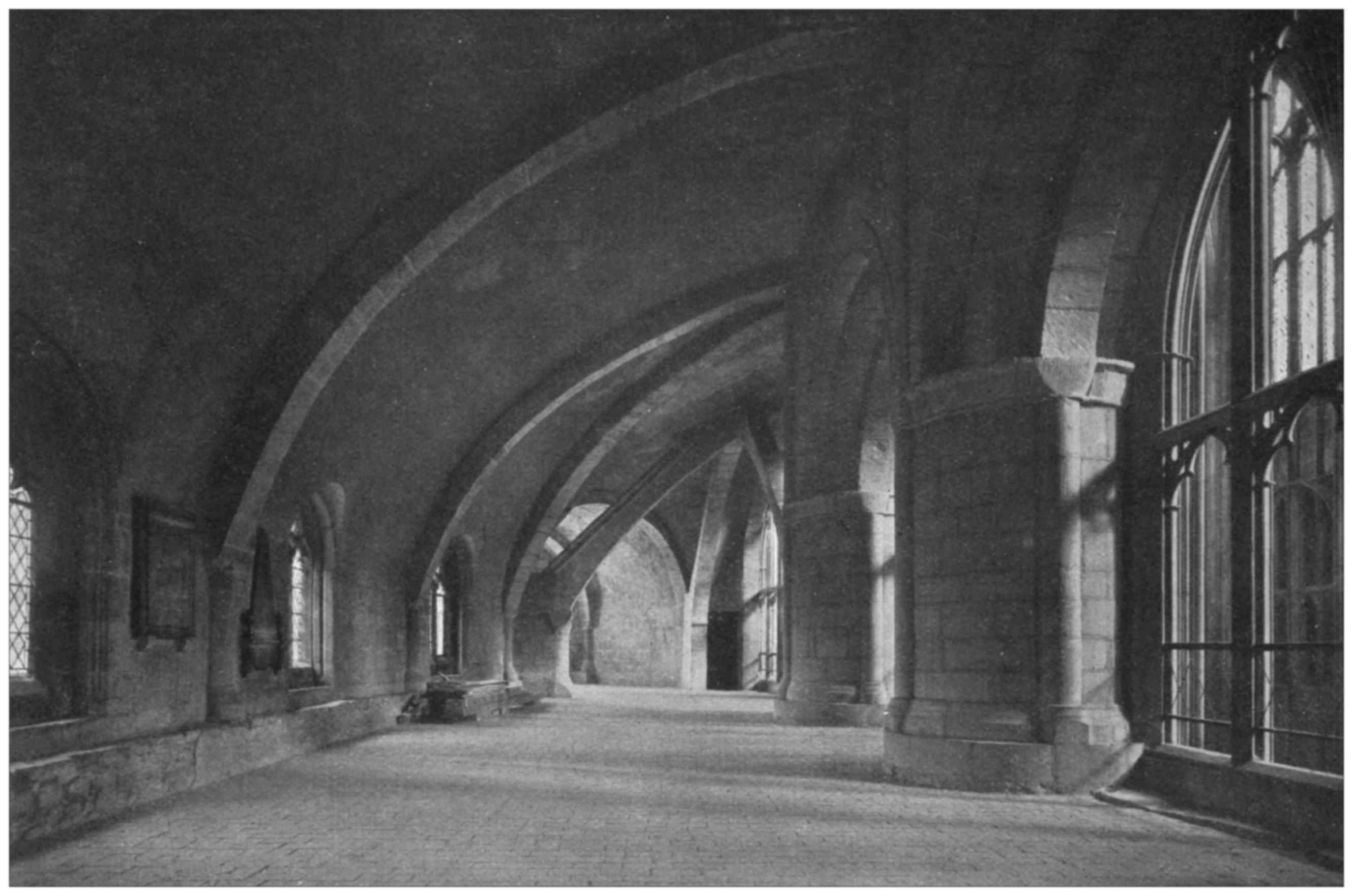
The Triforium of Gloucester Cathedral, looking into the Choir. XI, XII, XIV Centuries.
But among the important Western churches, strangely enough, when we come to the Anglo-Norman Romanesque abbeys and cathedrals of the eleventh and twelfth centuries, the Triforium gallery, so exclusively an Eastern feature, reappears; indeed a great Triforium is positively a characteristic feature in Norman-Romanesque work in England—the Cathedrals of Ely, Peterborough, Norwich, Southwell, Winchester, Durham, and the Triforium of the famous Choir of Gloucester, may be cited as conspicuous examples.
It is hard to explain this striking reappearance of a great Triforium gallery. It is absolutely, as far as we can see, of no possible use, for, different to the East, as we have observed, in the West the sexes are not separated in divine worship; and a gallery for women, therefore, was never required.
What was in the mind here of the great Anglo-Norman builders of the eleventh and twelfth centuries when they arranged a Triforium gallery in their churches is really unknown to us. Was is simply a graceful and striking ornamental architectural device, to enhance the beauty of the interior of these great churches? This it undoubtedly does. Was it any way connected with the visits of pilgrims, so notable a practice in these centuries? Was it in some way intended to multiply the interest of their visit, by providing them with a larger and far more extended procession round and about the church? Something of this kind possibly may account for the strange reappearance of a great Triforium gallery in buildings, for the most part resorted to by great crowds of pilgrims, when the original purpose of a Triforium no longer existed.
That the growing passion for pilgrimage was considered in the planning of these vast Anglo-Norman abbeys and minsters is indisputable, for we find in the design of important abbeys such as Gloucester a large ambulatory or processional aisle, introduced as a prominent feature in these great churches. Such an aisle was doubtless designed for the convenience of pilgrims who frequently thronged these piles. The Triforium gallery possibly, then, was introduced in view of these crowds of pilgrims. We cannot, however, at all pronounce for a certainty that this was the main reason for its introduction in the North and West—quite an unaccustomed feature, but which at once strikes the eye in the Anglo-Norman minsters.
It is an unexplained difficulty, and must be left with these interesting but scarcely satisfactory suggestions.
To sum up: When the great Triforium of an Anglo-Norman cathedral is wondered at, and the question is asked, When was this striking portion of the church first designed, and what was the original purpose which it was intended to serve; and to what uses was it ever put? the inquirer must be told at once to carry his thoughts back to the age of the Emperor Justinian, perhaps somewhat earlier, when the great churches of Constantinople and Salonica were planned and built, when in the planning of these churches a great gallery was designed for the exclusive use of the women worshippers. It was in such a gallery, at S. Sophia, where the Empress Theodora sat and listened when Chrysostom preached, and denounced with his fiery eloquence the vices of the court and society of his age.
This was undoubtedly the origin of the Triforium in Eastern churches which now excites the wonder of the inquirer as to what purpose it was designed and used for. Then the inquirer must be reminded that in the West and North—in Gaul and Italy, indeed throughout the Latin Church—where, different to the Eastern Church, no separation of the sexes was contemplated—no Triforium gallery was, as a rule, planned. It is true that in the important Anglo-Norman cathedrals and abbeys this ancient oriental feature again made its appearance.
But for what special purpose that great school of Norman-Romanesque builders again brought back this striking feature when they planned their mighty piles, will probably for ever remain an undiscovered secret.
On the unexplained secret of the reappearance of the Triforium gallery in certain of the great mediæval churches of the West, notably in the Anglo-Norman Romanesque piles of the eleventh and twelfth centuries—a very remarkable suggestion appears in Mr. Edward Hutton’s eloquent work on Ravenna.
He is describing the great Romanesque Basilica of S. Apollinare Nuovo, the work of Theodoric, the Ostro-Gothic king.
The Mosaics, probably in large part the work of the artists of Justinian, are of an extraordinary and exceptional beauty. They represent upon both sides, through the whole length of the nave, as it were, two long processions of saints—on the one side a procession of Martyrs—some twenty-five figures (men), SS. Clement, Sixtus, Laurence, Cyprian, etc.; on the other side a procession of Virgin Martyrs—Pelagia, Agatha, Eulalia, Cecilia, etc., some twenty-one figures. Mr. Edward Hutton writes here “that there is nothing in Christendom to compare with these Mosaics; they are unique, and, as I like to think, in their wonderful significance are the key to a mystery which has for long remained unsolved.
“For these long processions of saints, representing that great crowd of witnesses, of which S. Paul speaks, stand there above the arcade and under the clerestory where in a Gothic church the triforium is set. But the triforium is the one inexplicable and seemingly useless feature of a Gothic building. It seems to us, in our ignorance of the mind of the Middle Age, of what it took for granted, to be there simply for the sake of beauty, to have no use at all.
“But what if this church in Ravenna, the work indeed of a very different school and time, but springing out of the same spiritual tradition, should hold the key?
“What if the triforium of a Gothic church should have been built as it were for a great crowd of witnesses—the invisible witnesses of the Everlasting Sacrifice, the Sacrifice of Calvary, the Sacrifice of the Mass?
“It is not only in the presence of the living, devout or half indifferent, that that great Sacrifice is offered through the world, yesterday, to-day and for ever, but be sure in the midst of the chivalry of heaven, a multitude that no man can number, none the less real because invisible, among whom one day we too are to be numbered—not for the living only, but for the whole Church men offer that Sacrifice, pro redemptione animarum suarum, pro spe salutis et incolumitatis suæ—Memento etiam Domine, famulorum famularumque tuarum qui nos præcesserunt cum signo fidei et dormiunt in somno pacis.... Here in S. Apollinare, at any rate, for ever they await the renewal of that moment.
“Those marvellous figures that appear in ghostly procession upon the walls of S. Apollinare in Ravenna are really indescribable; they must be seen, if the lovely significance of their beauty is to be understood. What can one say of them?”
Mr. Hutton alludes to the Triforium of a Gothic church, but this unexplained and strange feature of the Triforium in the West reappeared in the great early Anglo-Norman Romanesque piles—in the Choir of Gloucester and in many others.
The Gothic churches, where such a Triforium exists, have simply copied their Anglo-Norman predecessors.
The author of this work by no means must be thought to endorse the above singular explanation of the “secret” of the Triforium which so strangely reappeared in certain of the churches of the West. But he judged it fitting to quote here the striking and remarkable words of the author of Ravenna. He cannot, however, recall any quotation from a mediæval writer in support of the theory in question. It is to him a perfectly novel thought—a thought at once strange and haunting—and here as an interesting and novel suggestion he must leave it.
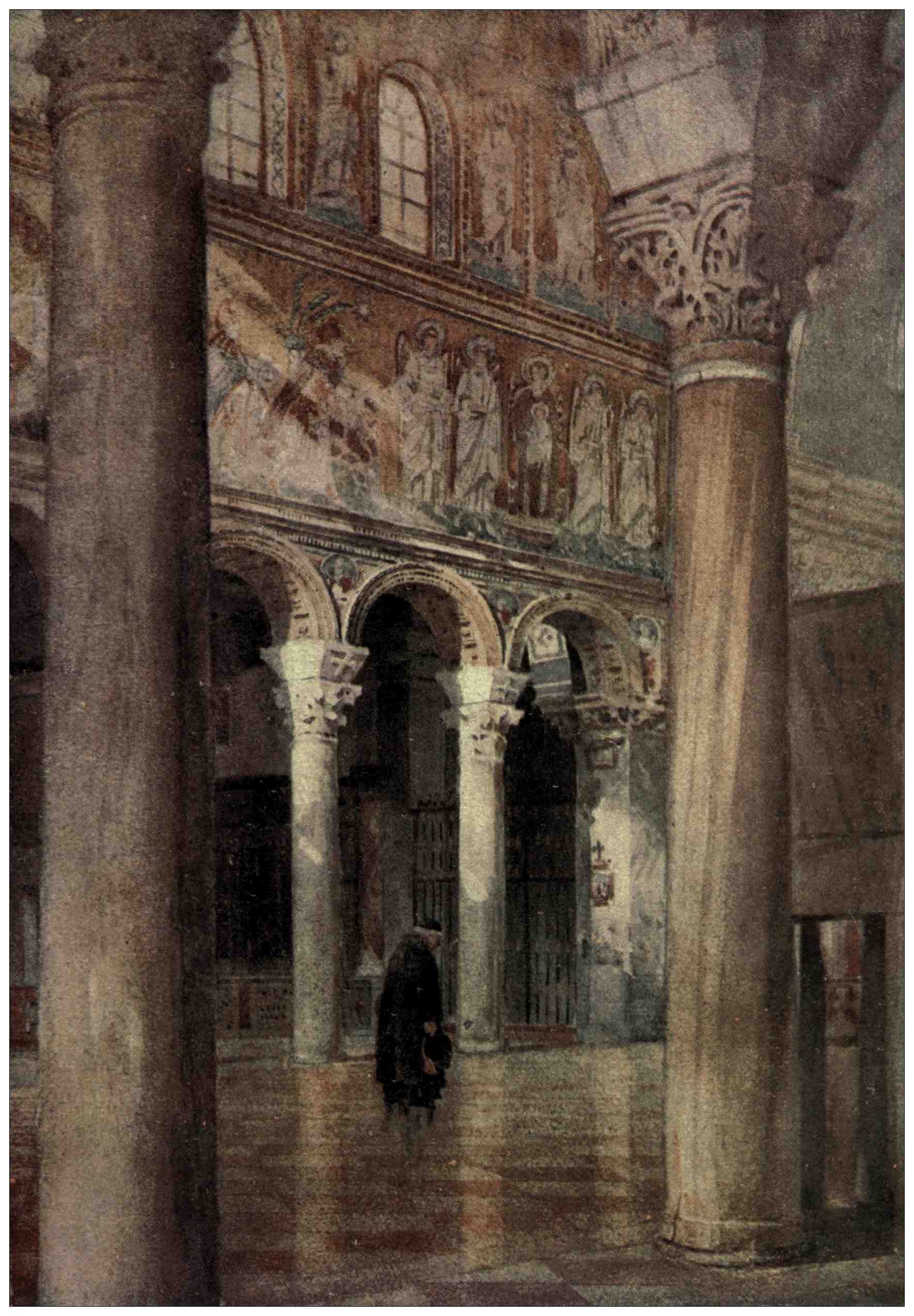
S. Apollinare Nuovo, Ravenna.
Circa
A.D.
519.