THE CAMPANILE OR BELL TOWER
Reading edition
It is to the Comacine builders of Lombardy that the Bell Towers, afterwards so great a church feature in the Middle Ages, are owing. Italy is rightly styled the birthplace of the Campaniles forming part of the structure of a church, or rising close beside it. So these Lombardic Campanile Towers were the ancestors, so to speak, of the innumerable Bell Towers and steeples of the West, erected in the Middle Ages.
The majestic Bell Tower, or Campanile of San Satiro at Milan, Rivoira considers to have been the oldest example of such a structure. The date of its erection was A.D. 876. The Campanile Towers of the ancient churches of Ravenna, such as the Towers of Sant Apollinare Nuovo, of Sant Apollinare in Classe, of San Giovanni Evangelista, must be ascribed to a date much later than the original churches themselves. The great Ravennese churches were built in the fifth and sixth centuries; their Campanile Towers were only erected in the ninth and tenth centuries.
The liturgical use of Bells can be traced as far back as the fifth century. For the first three hundred years of the Christian era the naturally secret and private exercise of the religion of Jesus of course forbade any outward and visible sign of Christian gatherings, such as the noise of bells. In Italy and the West the size and tone of church bells became gradually more and more marked. Hence the Lombardic invention, it may fairly be termed, of the important Bell Tower or Campanile as a distinct feature in church building. The ninth century, as we have stated, is probably the date of the first appearance of these remarkable Campaniles.
In the near East, the use of church bells at all seems to have been unknown before the ninth century; the first time we hear of them in the East was late in that century, when a present of bells was sent to the Emperor Basil in Constantinople by the Venetian Republic—and even then, for some time, they were but little used, for as late as A.D. 1200 the great Basilica of S. Sophia at Constantinople was without them. In Syria they were not introduced before the end of the eleventh century; they were no doubt brought into Eastern lands by the Crusaders after the fall of Jerusalem.
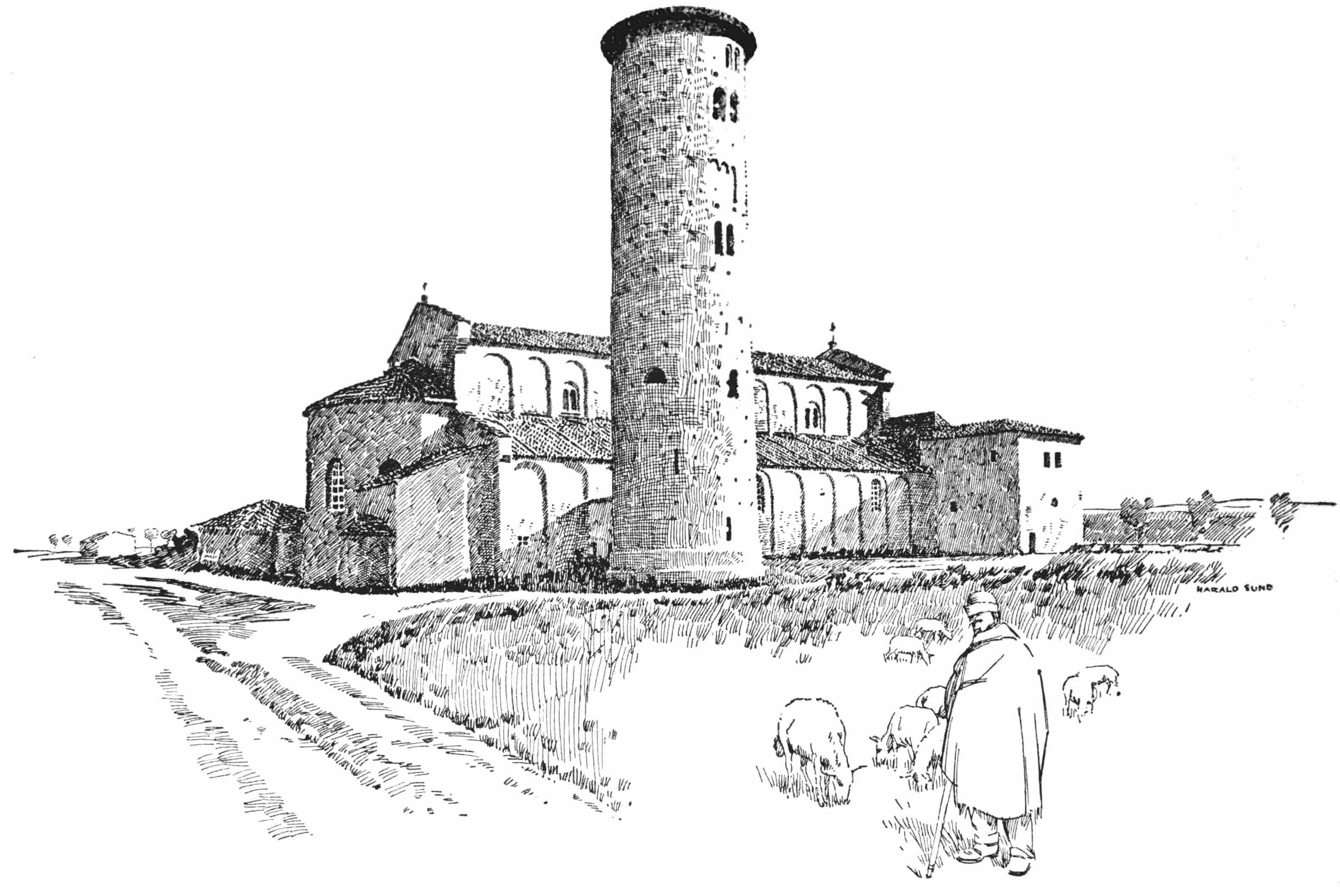
S. Apollinare in Classe, Ravenna. Sixth Century. Showing Campanile added in Tenth Century.
In the few examples of early churches which can be quoted as possessing one or two smaller towers, as was probably the case in certain of the important early Ravennese Basilicas, notably in San Vitale, such small towers were not intended for bells, but simply contained staircases.
Viollet le Duc in his long and exhaustive article on “Cloches” especially calls attention to the fact that in the eleventh century Normandy was remarkable for the number and dimensions of its church bells and bell towers; but the famous French writer and scholar does not seem aware of the reason for this marked feature in their churches. They were evidently part of the Lombardic tradition brought into Normandy by the great church builder William of Volpiano, the pupil of the Lombard Comacine architects, the story of whose coming into Normandy at the invitation of Duke Richard le Bon has been related in detail above.
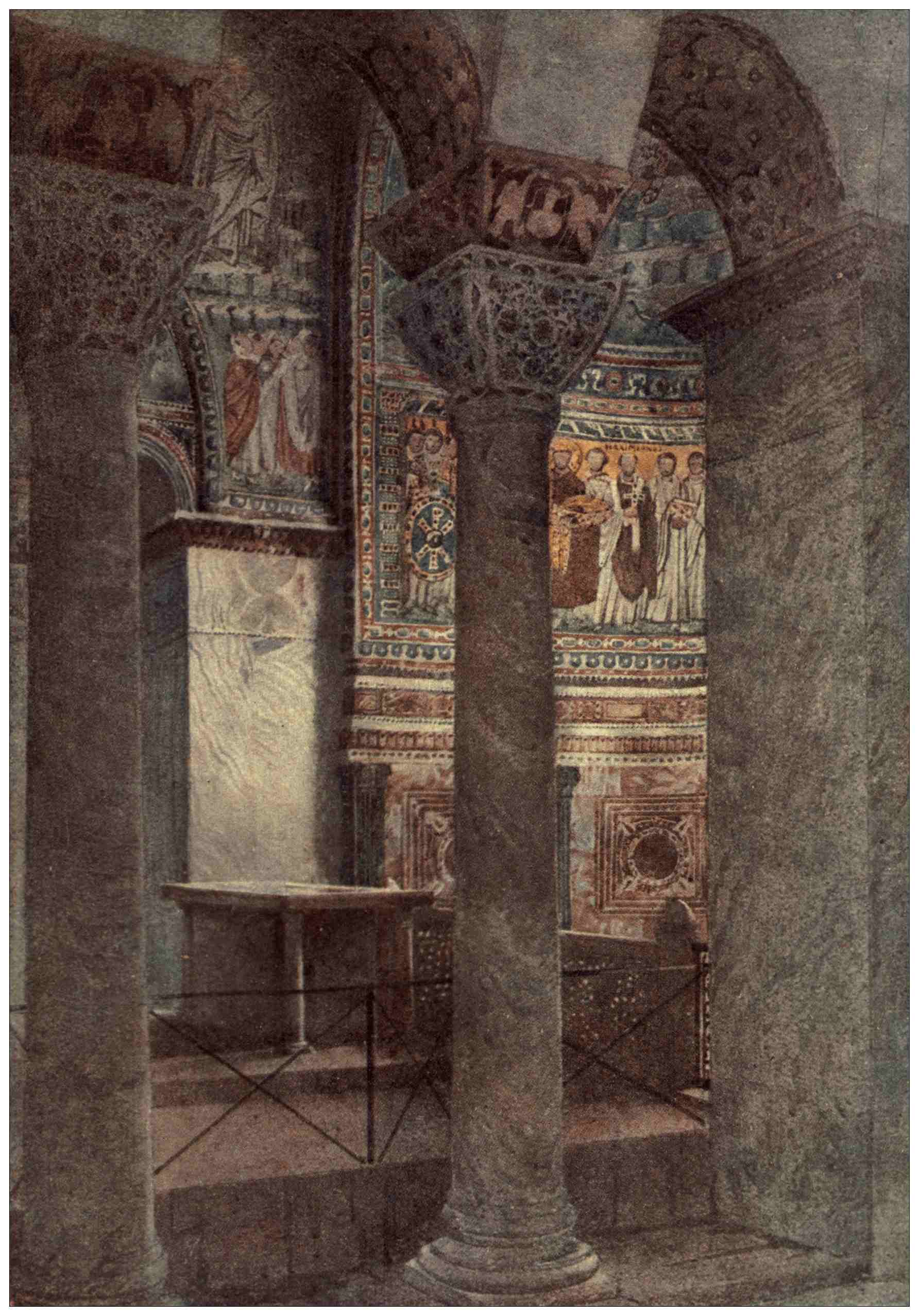
S. Vitale, Ravenna.
Circa
A.D.
526-547.
ON BELLS
The Bell, however, was not unknown to the Greeks and Romans, but in those far-back times it seems to have been, comparatively speaking, of small dimensions.
Durandus, Bishop of Mende (Mimatensis), Languedoc, thirteenth century—the great liturgical writer of the Middle Ages—in his Rationale Divinorum Officiorum, has several pages devoted to the symbolism of bells, much of which is most curious and interesting, though, as usual with this learned writer, often not a little fanciful. For instance, he tells us how he looks on bells as symbols of preachers, who, after the manner of bells, are appointed to remind the faithful of the “Faith.” The clapper, he says, represents the preacher’s tongue, the wooden beam to which the bell is hung typifies the Cross of our Lord.
Durandus considers that the bell was first invented at Nola, a city of Campania, whence came the terms “Campanæ” for the larger bells, and “Nolæ” for the smaller. Various other writers have adopted this curious derivation, amongst others S. Anselm. But this must be considered fanciful.
During the first three centuries, naturally bells would be unused in Christian churches; as we have stated, quiet and privacy of worship being in the ages of persecution, for all assemblies for Christian worship, an indispensable condition.
They were, however, certainly used before the seventh century; there is a tradition that Pope Sabinianus, A.D. 604, directed that a bell shall be rung to give notice of the hours of the “offices.” Bells are alluded to in the Rule of S. Benedict. Bede mentions them in England in the eighth century.
But it was not until the period of the great revival of religion in the eleventh century that the bell began to assume the position of importance in the furniture of a church which we find it occupying in the Middle Ages. The size of the bell gradually increased, and the care bestowed on its casting became greater as the twelfth century advanced.
In the eleventh century we read, for instance, of a bell then remarkable for its size, being presented to the Church of S. Agnan at Orleans by King Robert of France. This bell, probably the largest then known, weighed as much as 2,600 pounds.
As the Middle Ages advanced, the vogue of bells in churches became more pronounced. There were few parish churches but possessed one or two bells, or even more, while the abbeys and cathedrals continued to erect towers to hang bells of various sizes and powers.
In the thirteenth century we find notices of bells of very considerable size and importance. It was not, however, until the fifteenth century that the bell attained to the vast dimensions we are accustomed to associate with the more considerable of these popular and well-loved instruments of music.
Gloucester Cathedral is singularly fortunate in the possession of some very ancient bells of rare sweetness and power; one of these, “Great Peter,” being of considerable size and importance.
This great mediæval bell has now bidden the citizens to prayer for several hundred years.
Various ornaments, usually of a sacred character, were engraved on the mediæval bells. More interesting, though, are the inscriptions, which not unfrequently run round the bell.
The size, however, of the famous Great Peter in Gloucester Cathedral is not comparable with other of the more celebrated bells now in use in various parts of the world—as will be seen from the following table setting forth the enormous weight of many of these great bells.
The largest of these—the Tsar Kolokol of Moscow—said to weigh 440,000 pounds, was never rung. It was broken apparently in the casting—and is now used as a chapel.
Moscow, however, still boasts what probably is the greatest bell in the world; its weight is 128 tons.
Of the other huge bells, we would enumerate—
Weight.
The bell in the Kioto monastery in Japan 76 tons.
The Kaiser bell in the Cathedral of Cologne 25 ”
The chief bell in Notre Dame, Paris 17 ”
Big Ben in the Parliament Houses, London 13 ”
Amiens Cathedral—Its principal bell 11 ”
Great Tom, Oxford 7 ”
DATES
A few important approximate dates are given to illustrate this sketch of Romanesque Architecture: The round-arch style. At Ravenna—then among the Lombards—the Rise of the Lombardic-Norman school of Romanesque builders, and the evolution of Gothic architecture.
circa A.D.
The glory of Ravenna Diocletian—Palace at Spalatro Honorius—Emperor of the West Galla Placidia—(half-sister of Honorius) Theodoric—the Ostrogothic king of Italy Justinian—Emperor of the East 300-305 393-423 408-451 493-526 527-565

Lombardy Alboin—The Lombard Conqueror 568
Rotharis—The Lombard King. His code referring to privileges of Comacine builders. 636-652
Charlemagne—Emperor. His conquest of Lombardy. His Palace-chapel of Aachen 796-804
Pupil of Comacine builders William of Volpiano—Monk of Cluny. Invited by Duke Richard to Normandy 961-1031
Lanfranc of Bec—First Norman archbishop of Canterbury. His works in Normandy and England 1086
Rise and Progress in England of the Norman-Lombardic style
Eleventh century (last part), twelfth century.
The “Coming” and “Rise” of the Gothic style
Roughly in the second part of the twelfth century. Its rapid and general adoption in the thirteenth century.