THE CRYPT
Reading edition
Of the principal terms used in this study on the Crypt.
Crypt is derived from the Greek κρύπτειν to hide, to conceal.
Confessio—The Confession. The burial chamber or vault where lay the remains of one who had “confessed” and borne witness to his Faith by his blood. The “Confessio” is sometimes termed “Martyrium.” Sometimes the word is used for the chamber immediately contiguous to the actual vault of the tomb beneath it, as is the case in the Crypt of S. Peter at Rome.
Memoria.—The chamber or chapel erected over the “Confessio” or burial place of the Martyrs—originally used for the gathering place of the Faithful, pilgrims or others who came to visit and pray over the grave of the Saint buried beneath. The first “Memoria” that we are acquainted with was erected over the vault which held the body of St. Peter. This “Memoria” was built by Anacletus,[25] the successor of Linus; Anacletus is generally reckoned as third Bishop of Rome. It served as a church for the faithful, in which the Eucharist could be celebrated, and a small congregation gathered together. This Memoria of Anacletus was erected shortly after A.D. 70. It is mentioned in the Liber Pontificalis under the record of Pope Anacletus in the following words: “Memoriam beati Petri construit et composuit.”
The “Memoria” of Anacletus was no doubt referred to by the Presbyter Caius in A.D. 210, who calls it the “Tropæum”—the visible monument of the Apostle S. Peter. Tertullian also, as early as the end of the second century, refers to it as an object of pilgrimage from all parts of the world.
Cubiculum.—This was a little burial chamber leading out of the galleries of the Roman Catacombs. These “Cubicula” were hewn out of the rock, generally at right angles to the gallery in which were cut the countless niches each holding one or more corpses.
The “Cubiculum” was intended for the more conspicuous persons in the Church, and especially for those who had through martyrdom, or through any very distinguished work for the Church, merited this special distinction after death; not a few of these “Cubicula” were occupied by the bodies of the men and women who had witnessed a good confession by shedding their blood for Christ’s sake. Many of these little chapels which held the remains of such illustrious dead, became, as time went on, places highly venerated by the congregation.
Catacombs.—The modern name of “Catacombs,” now universally applied to ancient underground Crypts where the dead were interred in the early days of Christianity, and especially used for that vast network of subterranean corridors filled by the Christian dead beneath the suburbs of old Rome, was totally unknown to the original Christian communities who hewed out of the solid rock this mighty cemetery of the Roman dead. The term “Catacomb” is derived from the Greek words κατά κύμβη, the latter word signifying “hollow” or valley.
The district on the Appian Way where the little basilica of S. Sebastian now stands, was especially known as “ad catacumbas” or “the Hollows.”
In the earlier part of the ninth century, the bodies of the more prominent Saints and Martyrs were removed for security’s sake from their original resting-places outside the walls of the city, to the safer custody of the Roman churches within the city, and the once famous subterranean cemeteries in the suburbs gradually ceased to be objects of pilgrimage.
But the one suburban cemetery of S. Sebastian, owing to the tradition that the bodies of SS. Peter and Paul had reposed in the Crypt beneath S. Sebastian for some years when persecution had rendered their original resting-places insecure, ever remained an object of devout pilgrimage.
This Crypt was known as “Cemeterium ad Catacumbas,” and on the re-discovery of the great underground City of the Dead at Rome, late in the sixteenth century, the popular name “ad Catacumbas” came to be applied to all subterranean cemeteries, and especially to the great cemeteries beneath the Roman suburbs.
But it must be borne in mind that, after all, this universally used appellation, when given to the subterranean cemeteries in general, is a curious misnomer, and was unknown, in its present universal signification, in ancient times.
Now it may be positively assumed that all Crypts are generally a memory of, are reminiscent of the sacred and venerated burying-places of the Martyrs and Saints of the age of persecution, notably of the Crypt of S. Peter.
Thanks to the industry of a few modern scholars, the details of S. Peter’s tomb on the Vatican Hill are fairly well known. The sacred remains of the great Apostle and Martyr, ever venerated as the founder of the Roman congregation, were originally laid in a little vault or crypt on the Vatican Hill hard by the place of his martyrdom.
From the first, this spot was visited by pilgrims from many lands, an ever-increasing number, but the place of interment was very small and difficult of access. So Anacletus, traditionally the third Bishop of the Church of Rome, in order to accommodate these numerous visitors to the tomb, built directly over the vault where the Apostle’s body rested, the little chapel known in history as the “Memoria” of Anacletus.
Over this humble Chapel or “Memoria,” the first Christian Emperor Constantine erected the lordly basilica generally known in history as “Old S. Peter’s.” In the same age, or a very little later, various other basilicas or churches were built directly over the “Cubicula” or burial chambers leading out of the Catacomb galleries, where lay the remains of the more prominent Saints and Martyrs interred in the Catacombs of Rome.
In those far-back days, the grave of a Martyr was ever regarded with the deepest reverence, and was constantly visited by pilgrim visitors. No more appropriate spot, it was considered, could be chosen for the celebration of divine service than the chamber which held the Martyr’s grave; but these graves were sunk deep in the ground, and the “Cubicula” of the Catacombs were utterly incapable of containing the officiating clergy and the crowd of the faithful who would wish to worship in these hallowed spots. It was generally considered in the early Church that the remains of the Martyrs and Saints ought not to be removed, for such a removal would be deemed an impious act; never—so taught the teachers of the first age—must the sainted relics of the dead Confessors be translated or disturbed.
To overcome this difficulty, the rock over and round the grave must be cut away, and room must thus be gained as was sufficient for the erection of a basilica or church, large or small, directly over the Crypt or Cubiculum, which contained the Martyr’s tomb. The damage done to such catacombs, thus cut away by the builders of these basilicas, was incalculable; thousands of early Christian graves must have been sacrificed for the preservation of the one grave specially selected for peculiar honour.
This, Lanciani tells us, is the origin of the greatest Sanctuaries of Christian Rome; such as the Churches of S. Paul on the Via Ostiensis, S. Sebastian on the Via Appia, S. Petronilla on the Via Ardeatina, S. Agnes on the Via Nomentana, S. Lorenzo on the Via Tiburtina; these and other sacred historical structures owe their existence to the martyr’s grave over which these churches were built, a grave which no human hand was allowed to touch or to transfer to another and more convenient place.
This was the genesis, the origin of the idea of the Crypt beneath the church. The desire to possess a Crypt in early mediæval times was widely spread. As a rule, though, as we shall presently explain, not always was the Crypt the resting-place of some noted martyr. In Gaul and on the banks of the Rhine these crypts were fairly general in the early Middle Ages: their retention, enlargement, and reconstruction was largely due to the sentiment and tradition of the very early age of Christianity.
In Gaul, in the Merovingian period, in the more important churches they seem to have been very usual; for instance, we still possess the Crypts of S. Avitus of Orleans (sixth century), the Crypt of Jouarre and parts of the Crypt of Vézelay, supposed to contain the remains of S. Mary Magdalene, S. Medard of Soissons; large portions of the vast Crypt of Chartres, the Crypt of the Cathedral of Auxerre, and certain parts of the Crypt of the famous Church of S. Benignus of Dijon, one of the largest existing. The underground Church of S. Seurin of Bordeaux dates, however, from the eleventh century, as does also the famous and vast Crypt of S. Eutropius of Saintes.
On the banks of the Rhine and in the Eastern districts of Gaul, dating from the eleventh century, and even somewhat earlier, we may cite as prominent examples the Crypts of Besançon and Strasburg, and the great underground Church of Spires.
In Anglo-Saxon England, we have the Crypts of Ripon and Hexham, both the work of Wilfred in the seventh century, a little later that of Wing in Buckinghamshire, and somewhat later still, Repton.
In the early Norman period we have in England the important Crypts of Winchester, Worcester, Rochester, Gloucester and Canterbury (in parts). The Oxford and York Minster Crypts were built as late as in the last part of the twelfth century.
But then they came to an end. The vogue of building Crypts ceased soon after the famous action of Suger, Abbot of S. Denys near Paris, who, in A.D. 1144, probably owing to the impossibility of providing for the vast crowds of pilgrims to the Shrines of S. Denys and his two companions SS. Rusticus and Eleutherus in the Crypt of the abbey, brought up from the underground Church of S. Denys the remains of the three saints, and placed them near the high altar of the church above, where they could be more easily seen and visited by the pilgrim crowds.
The example of Abbot Suger seems to have been largely followed, notably at Canterbury, where the body of S. Thomas à Becket, a most popular object of pilgrimage, was removed from the under to the upper church in A.D. 1248.
This general removal of the remains of the saints and confessors from their original place beneath the church, to a position hard by the high altar of the main building above, seems to have taken away completely the traditional interest of the Crypt. It now was never constructed. In the planning of an abbey or of any considerable church the Crypt found no place; and thus the vogue which had prevailed for so many centuries passed away completely.
Singularly enough the great Cluniac Brotherhood of Benedictines, with its two thousand churches, scattered over the countries of the West, never seems to have adopted the Crypt as a part of any of their many homes of prayer. There is little doubt that the example of so mighty and influential a section of the Church of the twelfth century also contributed largely to the disuse of this most ancient and interesting feature, which for some ten centuries or more had occupied a place in the planning of so many of the more important abbeys and homes of prayer in the West.
To sum up, the Crypt was entirely a Latin and Western use; it was virtually unknown, and practically non-existent outside the broad area of Latin Christianity. The custom of the Eastern Church received it not. It belonged exclusively to the Western school of Romanesque architecture. It is interesting to remember that as the school of Romanesque building gave place to another and different school of architecture, the Crypt virtually disappeared. No purely Gothic Crypt can be quoted or referred to.
In the first place it was undoubtedly understood to be the resting-place of the remains of the famous saint or confessor after whom, in so many cases, the church built over the Crypt in question was named, and to whose honoured memory the church was dedicated. But it came to pass, when the vogue or fashion of constructing a Crypt or under-church became very general, that not unfrequently we find this under-church, sometimes of considerable size and importance, designed and planned without the presence of any of these hallowed remains dating from far-back days. Such, for instance, was the vast Gloucester Crypt. No tradition exists in Gloucester of the remains of any saint or confessor ever having been laid to rest in the wide ambulatory or in the central division of that most venerable and solemn under-church which lies beneath the stately Cathedral of Gloucester.
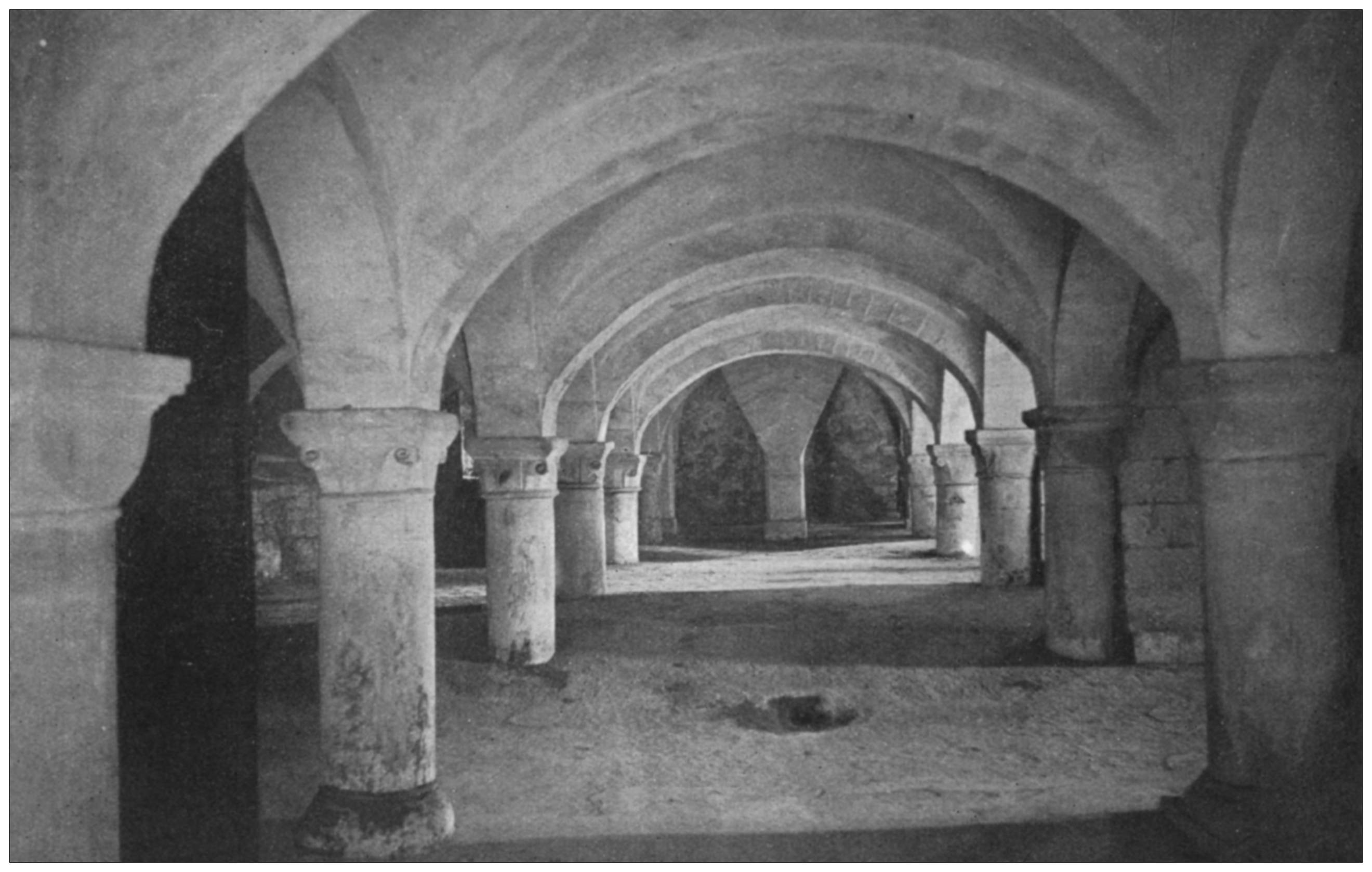
The central part of the Crypt of Gloucester Cathedral. XI Century.
THE CRYPT OF S. PETER ON THE VATICAN HILL The Story of a Tomb
There was one Crypt of remarkable sanctity—that of S. Peter at Rome. It was the favourite object of all Western pilgrimage from the last years of the first century—and it retained its far-reaching popularity for many centuries.
This Crypt which contains the remains of the great Apostle, with the “Memoria” of Anacletus immediately above it, may justly be considered to have set the vogue which prevailed in the planning of a Crypt in so many important churches of Western Christianity, from the fourth until the end of the twelfth century.
The immense and enduring estimation in which this Crypt of S. Peter at Rome was held for so many centuries, has determined the writer of these studies to describe it with some detail—and to tell its eventful and striking story at some length.
In the year of grace 70, Jerusalem and her glorious temple were burnt and destroyed by Titus and his Legions, who saw in Jerusalem, the sacred city and citadel not only of the rebel Jews, but also of the hated Christian sect. There is no doubt but that from the year of the great catastrophe Rome gradually became the acknowledged centre and metropolis of Christendom—it had no longer any recognised centre when Jerusalem was destroyed.
This position has been altered and the influence of Rome has been dimmed, and to a certain extent materially diminished by certain other centres of Christianity which have arisen. But she holds it to a certain extent still. Constantinople the home of the widespread Eastern or Greek Christianity, and later Moscow after the fall of Constantinople, were important religious centres. London among the far-reaching Anglo-Saxon peoples may claim, with some reason, the lofty title of the Metropolis of the Christian world.
Yet after all these great religious centres have been reckoned with, Rome, though her old fame and influence has been sadly tarnished and dimmed, still ranks first. The Eastern or Greek Church, changeless in the midst of change, silently watches her loved metropolis of Constantinople all spoiled and desecrated, in the hands of unbelievers. The Protestant Churches dear to the Anglo-Saxon and Teutonic peoples, reluctantly perhaps, sadly without doubt, in their hearts still think of Rome as the centre or metropolis of that living faith in the Crucified which has been adopted as the religion of the fairest and most powerful portion of the world.
S. Peter is regarded by Roman Catholic writers (as might have been expected) as the founder of the Roman congregation—many too among Anglo-Saxon and Teutonic scholars now accept this view. This conclusion undoubtedly is supported: (1) by the general testimony of early Christian writers mostly of the second century; (2) by the important traditional “Memories” of the presence and preaching of S. Peter in Rome. Some of these “Memories,” it is true, are purely traditional, others have clearly an historical foundation; but taken all together, they constitute an argument of no little weight. In the written testimonies, as well as in the “Memories” which hang round the figures of SS. Peter and Paul in Rome, who are generally joined together as founders of the great Church of the Metropolis of the Empire, it is notable that Peter, not Paul, ever is the principal figure; (3) the place which the two mighty Basilicas of S. Peter and S. Paul have ever occupied in the minds and hearts not only of the dwellers in Rome, but also of all the innumerable pilgrims in all ages to the sacred shrines of Rome, seems accurately to measure the respective positions which the two great Apostles have ever held in the estimate of the Roman congregation.
The comparative neglect of S. Paul’s Basilica in Rome when measured with the undying reverence bestowed on the sister Basilica of S. Peter, is due, not to any want of reverence and regard for the great Apostle of the Gentiles, but solely because Rome itself and the innumerable pilgrims to the Queen City were conscious of the special debt of Rome to S. Peter, who was evidently in all ages regarded as the first and real founder of the mighty Church of the Capital.
This great and revered teacher S. Peter suffered martyrdom about the year 66-67. Somewhere about A.D. 69, when the violence of the terrible persecution of Nero, who perished A.D. 68, was dying away, the Christian worshippers in Rome prepared a tomb in the nearest available spot to the place of his martyrdom on the Vatican Hill. This tomb was a vaulted chamber almost entirely subterranean.
This sacred sepulchre was visited from very early days by ever large and increasing numbers of the faithful, not only belonging to the Roman congregations, but including pilgrims from all parts of the Roman world who wished to pray at the sacred tomb; these visitors were undeterred by any danger of arrest and death. Pilgrimage to the holy places of Jerusalem was impossible since a heathen temple had arisen on the site of the Holy Sepulchre. It was therefore to Rome, and especially to the tomb of S. Peter, that the early pilgrim devotees of Christendom chiefly turned.
But the original sepulchre or vault where the remains of S. Peter rested[26] provided but little space for pilgrims, and was not indeed very easy of access. So Anacletus, who followed Linus as Bishop of the Roman Church, A.D. 79-87, built a “Memoria” or upper chamber immediately above the tomb to serve as a little church or meeting-place for the ever-increasing numbers of pilgrim visitors. This “Memoria” of Anacletus was constructed by simply raising the walls of the tomb or crypt to a higher level, and was of the same shape as the vault itself; thus, as it were, providing a chamber for the pilgrim visitors on the floor immediately above the actual tomb.
This little upper chamber of the tomb, which was above ground, is the “Tropæum” spoken of by Caius the presbyter, when, in A.D. circa 210, he writes as follows: “I can show you the trophies of the Apostles, for whether you go to the Vatican or on the Ostian Way you will meet with their ‘trophies’” (i. e. of SS. Peter and Paul who founded the Church in Rome).
But in addition to building the little upper chamber or “Memoria” of the tomb itself, Bishop Anacletus prepared places, or graves, in which he himself and a certain number of his successors might be buried round S. Peter.
In this sacred burying-place, in these graves prepared by Anacletus round the Apostle’s tomb, were the early second-century Bishops of Rome laid, close to the resting-place of S. Peter, and it is these graves which were laid open in the excavations of which we shall presently speak, in the year 1626.
There is no record of the exact date of the building of the Basilica of S. Peter, but there can be no doubt that it was really, as immemorial tradition has asserted, the work of Constantine the Great after he became absolute master of the Roman world.
We should put the date probably shortly after A.D. 324, in which year the yet earlier Basilica of the Lateran was consecrated. The inscription which still runs along the west front of the Lateran Church—
“Sacrosancta Lateranensis ecclesia, omnium urbis et orbis ecclesiarum Mater et Caput”—
voices the ancient tradition that the consecration of the great Lateran Church preceded the building of S. Peter.
The venerable dedicatory inscription originally on the principal arch which spanned the nave of S. Peter recorded the name of its imperial builder:
“Quod duce Te Mundus Surrexit Ad Astra Triumphans Hanc Constantinus Victor Tibi Condidit Aulam.”
The entry in the Liber Pontificalis, presently quoted, tells of the first Christian Emperor’s special work in the vault or crypt of the Apostle’s tomb.
It was over this sacred tomb and the little “Memoria” above it that Constantine erected the magnificent church known as Old S. Peter’s. Before the days of Constantine, the humble “Memoria” of Anacletus represented the church above the tomb. Under the first Christian Emperor, the little “Memoria of Anacletus” grew into the magnificent Basilica[27] renowned for centuries through the Western world.
But here we have only to do with the tomb and the immediate work above it in the “Memoria” of Anacletus. The entry in the Liber Pontificalis gives us a precise account of what the Emperor Constantine did in the vault of the tomb.
“He hid away the stone coffin which contained the body after this manner: He enclosed the coffin altogether in bronze, and then built up (i. e. filled the vault) with masonry. After this manner he enclosed the body of the blessed Peter and hid it away.”
There is no doubt, however, that the Emperor, in enclosing the sarcophagus of the Apostle with solid masonry, left clear a little space actually above the coffin in the ceiling of the vault, for the same entry goes on to tell us that Constantine made a gold cross and placed it above the bronze covering of the coffin. This gold cross was seen gleaming through an opening as late as A.D. 1594. We know too that in the early Middle Ages, objects of devotion were occasionally lowered from the church above, through the ceiling, and these objects were revered as bonâ fide precious relics of the Apostle whose coffin they had touched.
Here the entry in the Liber Pontificalis ends, and the particulars of any work which Constantine carried out in the “Memoria” of Anacletus, which had been built above the tomb, we can only learn from its present appearance and from detached notices which occur in later entries of the Liber Pontificalis which tell us of the splendid gifts made to this “Memoria” by the Popes and others in the following centuries.
Directly above the “Memoria” it is clear that Constantine, when he built the great church, placed a heavy stone altar. This had to be supported by strengthening the comparatively slender walls of the “Memoria.” The vault of the tomb filled up, save directly above the sarcophagus, with solid masonry, provided a firm foundation, and the “Memoria,” which was now divided into two chambers, was made strong with additional masonry. The lower of the two chambers was completely filled up save for a small opening or passage which led directly down to the vault of the tomb.
The walls of the upper chamber of the “Memoria” were also strengthened with masonry sufficient to support the great altar placed immediately above it, but enough space was left to form the Confessionary, part of which still exists beneath the great altar.
Thus direct communication with the sacred vault of the tomb itself existed by means of the narrow opening or passage through the lower chamber above mentioned, by means of which handkerchiefs or similar objects could be let down so as to touch the sarcophagus in which lay the remains of the Apostle. This opening or passage was closed with two small gratings carefully locked. These gratings are generally known by the term “cataracts”—the one at the lower end, which was in fact the ceiling of the vault, which ceiling consisted of one or more marble slabs; the other on the top of the opening or passage, on the floor of the upper chamber of the “Memoria”—which became the well-known Confessionary.[28]
We possess in the writings of S. Gregory of Tours a vivid description of the manner in which pilgrims to Rome revered the sacred shrine in early times. The description in question was given to S. Gregory by his deacon Agiulphus who had made the pilgrimage. The account is given us by S. Gregory in his book called In gloriâ Martyrum, written about the year of grace 595. We append a translation of the words here of S. Gregory—
“S. Peter is buried in a church called from ancient times the Vatican.... His sepulchre, which is placed under the Altar, is exceedingly rarely entered. However, if any one desires to pray, the gates by which the place is fenced are opened, and he goes in above the sepulchre, and then, having opened a little window, puts his head within and makes request concerning his needs.
“Nor is the result delayed, if only the petition be a just one. For if he desires to carry away with him some blessed memorial, he throws within a little handkerchief that has been carefully weighed, and then watching and fasting, he prays most fervently that the Apostle may give an effectual answer to his devotion. Wonderful to say, if the faith of the man prevails, the handkerchief when it is raised from the tomb, is so filled with divine virtue that it weighs much more than it did before, and then he who has raised it knows that he has obtained the favour which he sought.
“Many also make golden keys to unlock the gates of the blessed sepulchre, and then they take away those which were used before, as a sacred treasure, and by these keys the infirmities of the afflicted are cured. For true faith can do all things.”
Mgr. Barnes in his work on S. Peter’s tomb gives a detailed explanation of the above report of Agiulphus to S. Gregory of Tours.
“The actual sepulchre, the subterranean chamber in which the sarcophagus (of S. Peter) was placed, was scarcely ever opened, and was not, even at that early date (late in the sixth century), accessible to ordinary worshippers. The most that they could hope for, was to visit the Confession under the Altar ... the pilgrim passes on, throws himself with his body prostrate within the recess, raises the little window or grating which closed the aperture in the floor, and so puts himself in communication, not indeed with the tomb itself, but with the space which intervened between the Confession and the vault, which space had once formed the lowest part of the old upper chamber or ‘Memoria’ of Anacletus.”
From the vault and the actual sepulchre he was still shut off by a second grating or cataract—which was unlocked for him.
Through these two gratings, when opened, the handkerchief or other object was lowered so as to touch the tomb, and this could be carried away as a precious relic.
By the early Popes and Bishops of Rome, and other illustrious persons, notably by Pelagius II, A.D. 579-590; S. Gregory, A.D. 590-604; Sergius, A.D. 687-701; S. Gregory III, A.D. 731-741; Paul I, A.D. 757-768; Hadrian I, A.D. 772-795; and S. Leo III—Hadrian’s successor—were magnificent and costly offerings bestowed upon the sacred shrine. These decorated with unexampled magnificence the Confession, the Altar and the canopy above.
In the reign of Paul I, King Pepin of France was also a munificent donor to this famous shrine.
These gifts consisted in gold and silver coverings for the canopy of the altar—in costly mosaics—in precious marble columns—in pavements of silver—in railings and gates of gold—in superb candelabra. Many of these costly gifts are chronicled with much care and detail in entries in the Liber Pontificalis.
A specially interesting entry in the Liber Pontificalis tells us how Charlemagne, accompanied by Pope Hadrian, was permitted to enter the vault of the tomb—the only visit to the sepulchre itself that is recorded. The few words which tell of this, perhaps solitary, visit of the great Frankish sovereign and the Pope are memorable—
“Descendentes pariter ad Corpus beati Petri.”
In the time of Pope Sergius II, we read of another imperial visit to Rome. The Emperor Louis II, A.D. 845, was received with the same ceremonial respect as his great predecessor Charlemagne. He, too, prayed before the Confession, but there is no allusion to any visit to the body of S. Peter. The sacred vault indeed seems to have been, even in these far-back centuries, very rarely if ever entered. Charlemagne’s visit was probably never repeated.
Only two years after Louis II’s visit occurred the destructive raid of the Saracens. For several years these Mahommedan invaders, who had taken possession of Sicily, had ravaged the Italian coasts. They had plundered the great Monastery of Monte Cassino, and in A.D. 847 appeared before Rome. This raid was not unexpected, for some of the treasures seem hastily to have been removed to a more secure home within the walls of the city.
No attempt to move the great bronze-covered sarcophagus was evidently thought of, but the entrance to the vault was concealed by pouring down stones and rubble through the upper opening below the Confession, completely filling up the space between the two cataracts or gratings, which thus escaped the notice of the plundering invaders, who, however, carried off many of the treasures, the gifts of the Popes and other distinguished persons to which we have alluded above, which adorned the shrine.
The Saracens only stayed in the vicinity of S. Peter’s for some eight days, and then retreated. There is little doubt but that the “earthing up” the narrow passage which led to the sacred vault where the sarcophagus lay, the filling it up with the stones and rubbish which still effectually blocks up all access to the tomb itself, must be dated from the period of this raid of the Saracens in A.D. 847.
Much was done by S. Leo IV, A.D. 847-855, and his successors in the Papacy, to restore the damage done and the havoc wrought by the Saracenic raiders; but the passage to the tomb itself was never again opened. Many beautiful and costly gifts were often made to the shrine, and especially to the Confession, by various Popes and illustrious visitors and pilgrims, among whom the Anglo-Saxon Ethelwolf, the father of Alfred, must be included. But in spite of these efforts and gifts the shrine never again reached anything like the glory and magnificence which it possessed before the terrible incursion of the Saracen invaders in A.D. 847.
For more than a thousand years there has been no access to the vault of the tomb; and no serious attempt, for various reasons, has ever been made to restore the original communication which once evidently existed between the floor of the Confession and the sacred chamber which held, and no doubt holds still, the bronze-covered sarcophagus of S. Peter.
We possess no accurate contemporary details of this disastrous Saracenic raid, as the manuscripts of the Liber Pontificalis are deficient here.
A story of surpassing interest is told by Bonanni (Templi Vaticani historia), the authenticity of which is accepted by Marucchi, Lanciani, Barnes and other scholars and experts.
In the spring of A.D. 1594, when the works connected with the new S. Peter’s were going on, Giacomo della Porta, the architect in charge, reported to Pope Clement VIII that a portion of the ground in the vicinity of the tomb had given way, and through an aperture thus uncovered the interior of the chamber of the tomb could be seen.
The Pope, accompanied with three Cardinals, at once visited the spot, and with the aid of a lighted torch the sarcophagus was visible, with the great golden cross of Constantine lying upon it. Clement VIII, after viewing the strange sight, immediately ordered the aperture to be closed with cement in his presence. The names of the Cardinals, who were well known, were Bellarmine, Antoniano and Sfondriato.
The building of the new S. Peter’s was slowly drawing to its completion, when in A.D. 1607 Pope Paul V planned to bring the ancient Confession of S. Peter into sight. In the new planning of the church, this Confession was concealed in the Crypt, and any access to it was almost impossible.
Maderno, the artist and architect, designed and carried out the present arrangement of the great church, which provided for the worshippers an approach to the old Confession—the recess under the high altar. In these works of Maderno, the workmen employed came upon the forgotten cemetery of the Vatican, arranged in the first century by Bishop Anacletus. The “find” was one of extraordinary interest. Torrigio, a “beneficiato” of the basilica, was present when the discovery of this most ancient cemetery was made, and has left us an account of what he saw. Accompanying his description was a plan drawn by Benedetto Drei, the clerk of Maderno’s works.
Of the rare plan in question, a rough drawing has been preserved, and has been of the greatest use in elucidating the more detailed and accurate description of the sacred spot, which description was made a few years later, circa A.D. 1626, when under Urban VIII (Cardinal Barberini), Pope from A.D. 1623-1644, it became necessary to strengthen the foundations of the new mighty bronze Baldachino of Bernini, and elaborate and careful work was undertaken in this sacred spot.
What was then discovered in the ancient cemetery of Anacletus has been told us by Ubaldi, a Canon of S. Peter’s. Ubaldi saw with his own eyes the wonderful things then discovered, and his account is of the greatest value to the historian of the very early days of Christianity in Rome. These precious memoranda of Ubaldi were deposited in the Vatican archives and were only found in quite late days by Palmieri, one of the keepers of these archives; the well-known scholar Armellini has since published them.
We will give a few specially interesting particulars from Ubaldi’s memoranda. The story of these excavations is as follows—
Pope Urban VIII was dissatisfied with the adornment of the high altar, which he deemed quite unworthy of the conspicuous position it occupied in the glorious new Church of S. Peter’s; and he entrusted the decoration to the architect Bernini of Florence. Bernini designed the great Baldachino or canopy of the altar which we see now.
It was an enormous and striking work. Its great size is imperfectly grasped by the ordinary visitor. The vastness of S. Peter’s, it has been well said, dwarfs everything that is in it. This massive Baldachino or canopy of the high altar is composed of bronze largely taken from the portico of the Pantheon originally built by Agrippa, the son-in-law of the Emperor Augustus. It is ninety-five feet in height, and is computed, with its pillars, to weigh nearly one hundred tons.
To carry this tremendous weight of metal, it was considered necessary to place the pedestals of the supporting columns upon a solid and firm foundation, but how to excavate such foundations in the immediate neighbourhood of the tomb of S. Peter, in the midst of the holy graves quite recently discovered surrounding the tomb in the ancient cemetery of Anacletus, for some time seriously perplexed the Pope and his counsellors, and they long hesitated before commencing the work. At last it was decided upon, but the excavations were ordered to be carried out with the utmost care and reverence considering the holy ground where they were to be made; a guard of priests and ministers of the Church was deputed to watch every grave as it was disturbed, and reverently to replace every body and all the dust and ashes which had to be removed. It was from the memoranda made on the spot by one of these watching priests, the Canon Ubaldi, that the striking story, some extracts of which we are about to give, is taken.
A few words descriptive of the spot where the excavations were made will be useful before we speak of the strange and wonderful “find” itself.
It must be remembered that the actual vault of the tomb or crypt in which was the sarcophagus of S. Peter, embedded in the solid masonry of Constantine, lies deep in the ground beneath the locality of the excavations.
The “Memoria” of Anacletus was built originally above, on the walls of the vault of the tomb. Part of the “Memoria” must once have been above ground. Round this “Memoria” Anacletus arranged the little cemetery of the Vatican Hill. In this cemetery, as close as possible to the walls of the “Memoria” above the tomb, were the graves dug for the nine or ten first Bishops of Rome. In other graves in that sacred little God’s acre were coffins containing the remains of certain of the martyrs and confessors of the first and second centuries. It is these graves, in the ancient cemetery round the “Memoria” walls, which were disturbed in the course of the excavations, and whose sacred contents are described in the Memoranda of Ubaldi.
The vault itself or crypt of the Tomb of S. Peter which lay deep below the “Memoria,” was never interfered with.
In this work of excavation necessary for the foundations of the great Baldachino of Bernini, the workmen employed found themselves at once in the ancient cemetery of Anacletus.
Among the graves necessary to be touched, they found close to the wall of the “Memoria,” still in situ, coffins of marble made of single slabs of different sizes. Only one of these slabs seems to have borne an inscription, and that was the solitary word “Linus.” This was most probably a portion of the coffin of the first Bishop who followed S. Peter—the “Linus” saluted by S. Paul in 2 Tim. iv, 21. These coffins placed close to the “Memoria” walls were no doubt belonging to the first Bishops of Rome.
Other coffins were found near, of terra-cotta, containing ashes and bones charred with fire. “It was evident,” writes Ubaldi, “that all the earth on these coffins was mixed with ashes and tinged with blood” (probably the blood of the first martyrs).
These are some among the sacred historical reliquiæ discovered in digging the first foundation.
In digging for the second foundation, a singularly interesting “find” is recorded. Ubaldi relates how a very large coffin, made of great slabs of marble, was uncovered. “Within the coffin were ashes, with many bones, all adhering together and half burned. These brought to mind the famous fire in the time of Nero, three years before S. Peter’s martyrdom, when the Christians, being falsely accused of causing the fire, ... afforded in the circus of the gardens of Nero, which were situated just here on the Vatican Hill, the first spectacle of martyrdom. Some were put to death in various cruel ways, while others were set on fire, and used as torches in the night.... These were buried close to the spot where they suffered martyrdom and gave the first occasion for the religious veneration of this holy spot.... We therefore revered these holy bones as being the first founders of the great Basilica, and having put back the coffin, allowed it to remain in the same place.”
The memorandum on the third foundation contains no detail of any very special interest.
On the fourth foundation, Ubaldi made the following note: “Almost at the level of the pavement, there was found a coffin made of fine and large slabs of marble.... This coffin was placed just as were the others which were found on the other side ... in such a manner that they were all directed towards the altar (of the ‘Memoria’ of Anacletus) like spokes towards the centre of a wheel. Hence it was evident, with much reason, that the place merited the name of ‘the Council of Martyrs.’” These bodies surrounded S. Peter.
Apparently we have here the remains of the first Bishops of Rome for whom Anacletus made special provision when he arranged this earliest of Christian cemeteries. Their names are Linus, the lid of whose coffin lies apart but still close to the Apostle’s vault or crypt, Anacletus, Evarestus, Sixtus I, Telesphorus, Hyginus, Pius I, Eleutherius and Victor. Victor was laid here in A.D. 203. After him no Bishop of Rome was interred in the Cemetery of Anacletus—for by that date it was quite filled up, and the successors of Bishop Victor were, with rare exceptions, buried in a chamber appropriated to them in the Cemetery of S. Callistus in the great Catacomb so named on the Appian Way.
The other interments in the sacred Vatican Cemetery in the immediate neighbourhood of the Apostle’s tomb, noticed in the Ubaldi memoranda, were apparently the remains of martyrs of the first and second centuries of the Christian era; or, in a few cases, of distinguished Confessors of the Faith whose names and story are forgotten, but of whom Prudentius, the well-known Christian poet of the end of the fourth century, writes in his Peristephanon, i. 73—
“O vetustatis silentis obsoleta oblivio Invidentur ista nobis, fama et ipsa extinguitur.”
On the whole we may sum up as our estimate of the Ubaldi memoranda, that it is without doubt an invaluable record of what lies beneath the High Altar and the Western or more sacred part of the great Mother Church of Christendom.
It is very remarkable that the practice of planning crypts only prevailed in important churches of Western Christendom. An imitation of the Crypt of S. Peter at Rome was in these churches of the West constantly aimed at.
In the East, in the near as in the far-East, this “vogue” of planning crypts beneath the churches, never was introduced; for the veneration of S. Peter in the Eastern divisions of Christianity never attained to the popularity we notice in the West. In the East, other Saints, especially S. Mary, the Virgin Mother of the Lord, were revered with a special reverence. This is very marked in Constantinople and in other important centres of Eastern Christianity.