THE CLOISTER
Reading edition
In a great monastic establishment such as Gloucester, the most important and interesting portion of the buildings surrounding the church, belonging to the religious community, was undoubtedly the Cloister.
The history of the origin and development of the Cloister is full of interest. In the years (fourth and fifth centuries) which immediately followed the ratification of the peace of the Church under Constantine the Great, in the more important churches, built often after the Basilican model, it was usual to arrange for a court or open space in front of the principal entrance.
This open court, which corresponded to the Roman atrium, was for the most part surrounded by a portico, or covered walk termed “triporticus” or “quadriporticus,” according as the portico consisted of three or four sides. This court was in the earlier days put to various uses. In it were often gathered the Catechumens, those not yet formally received into the congregation who worshipped within the church itself. Here also were wont to assemble penitents who for some grave offence had been excluded from the society of believers, but who sought readmission. Now and again it was used for the interment of the more distinguished Christians associated with the congregation worshipping in the adjoining Basilica. Hence came the name by which this outer court was sometimes known—“Paradisus”—whence was derived the mediæval term of “Parvis,” which in later times was often attached to the “square or place” lying under the shadow of the chief entrance to the church, as for instance in Paris, “The Parvis Nôtre Dame.”
In the centre or side of this court or atrium, usually was found a well. The Holy Water stoup always found near the entrance of Roman Catholic churches is a “memory” of this atrium well.
In the Cloister Garth, which with the Cloister itself was the immediate successor of this atrium, with rare exceptions, such a well is almost always to be found. To give an example, in the Gloucester Cloister Garth, which is carefully preserved, the old well is still in existence.
As time went on, the original purposes for which this fore-court or atrium was intended existed no longer. The conditions of the Christian society became largely modified, the Catechumen class in many cases almost entirely disappeared, Church discipline became relaxed, the number of penitents shut out from worship in the church became very small—only notorious sinners were excluded.
As a place, too, for public interments, save in rare instances, the portico was disused. In many cases, especially in cities, the large space in front of the church was urgently needed for houses, while on the other hand, new arrangements became necessary for the monastic life which grew up round the ancient churches and abbeys. The Canons and other persons connected with the service of cathedrals and the more important churches, required accommodation.
To meet these new requirements, the outer court—the Atrium or Portico—was removed from its original position in front of the church to a quieter and more secluded place at the side of the cathedral or abbey; and under the well-known mediæval name of Cloister, the “Claustrum,” or enclosed space, this old portico or atrium reappeared, and at once assumed an important, even an indispensable place, among the mediæval abbatial or cathedral buildings.
At first the “Cloister” was little more than a cluster or block of buildings, erected round an enclosed spot immediately under the great house of prayer—mostly buildings designed as the dwelling-place of the Canons and of the minor officials engaged in the services of the church.
The modern term “close” is derived directly from this usage. In very early times a school, where various kinds of learning, profane as well as sacred, existed in connection with the abbey or cathedral, found a home in this cluster of dwellings.
This in England was the case of York in the seventh and eighth centuries; in Canterbury in the days of Theodore and Hadrian; in Winchester in the time of Ethelwolf, in the latter part of the tenth century.
It was, however, in the Western Monasteries after the great revival inaugurated by the important religious House of the Benedictines of Cluny in the tenth century, that the “Cloister” of the Middle Ages attained to its supreme importance. It served many purposes. It was the heart of the community. It was the place where the dwellers in the religious House spent many hours of their quiet life in meditation, in literary work, in teaching. It was there that the novices were often instructed. In the Cloister, too, the copyists of manuscripts plied their various crafts, many simply copying the more ancient and often perishable MSS. in their beautiful and careful handwriting, and thus preserving accurate copies of what the world already possessed of books. How few of the old treasures of literature would have been handed down to the printing presses of the sixteenth century had not this useful work gone on in these quiet cloisters? Certain of the monks, too, were occupied in original research, and in composing and arranging monastic and historical records.
One general plan, with occasional modifications, seems usually to have been adopted in the great Cloisters of the Western Church on the Continent as in England. In the Cloisters were doors leading to the principal chambers and offices connected with the every-day life of a monastic community, such as the Refectory where the monks dined, the dormitory where they slept, during those few hours allotted to them for rest, the Chapter House where they met daily, and consulted together on the business public and private of their House, and on their varied Mission work outside. Other doors in the Cloister led to the Infirmary, where the sick and the aged monks received the tenderest care and attention; to the Abbot or Prior’s special lodgings, to smaller cloisters, sometimes termed a slype (the derivation of this word is unknown), leading into outer courts and separate buildings; such as the guest-chambers, kitchens and store rooms, into the Cemetery of the religious House, into the garden. Two large doors besides, as a rule, opened from the Cloister alleys directly into the church.
In the centre of the Cloister invariably was a small garden—the garth; sometimes simply turfed, sometimes bright with flowers and shaded with trees. In it as a rule the well above referred to was found. The windows of the Cloister walls were, in some cases, especially in the later Middle Ages, wholly or in part, glazed, sometimes with rich stained glass.
Very frequently, in the more wealthy monastic foundations, and also in the case of some cathedrals, the Cloister was richly adorned with sculpture, and in some instances ornamented with colour.
Occasionally costly marbles were used for the pillars and their capitals; indeed, no portion of the sacred building itself received greater attention than did many of these mediæval Cloisters.
As examples of specially beautiful and costly Cloister work, we would cite the well-known Cloisters of S. Paul, outside the walls of Rome, and S. John Lateran. In Sicily the vast and splendid Cloisters of Monreale are noteworthy. In France, the Cloister alleys of the Cathedral of Rouen, S. Trophimus of Arles, the Abbey of Moissac (Tarn-et-Garonne), the Abbey of Montmajeure (near Arles), Mont S. Michel (Normandy), the Cathedrals of Toul, Soissons, and many others, might be instanced. In England the beautiful cloisters of Westminster Abbey are well known. Norwich, too, possesses a notable example.
But the most famous by far in England are the Cloisters of Gloucester. In some respects they are the most beautiful in Northern Europe, none possessing a roof comparable in richness and in general effect; the glory of the fan-tracery of the Gloucester roof gives a special character to the whole of this admirably preserved and perfect Cloister.
So costly and elaborate indeed were the decorations often lavished on this most important part of the monastic buildings of the Middle Ages, that the wonderful display of art in the adornment of the Cloister now and again seems to have excited hostile criticism. As early as in the thirteenth century, we read in the curious poem of Rutebeuf, a writer who was welcome at the Court of S. Louis of France, a bitter note of disapprobation of the splendour and magnificence of these costly works of art which so frequently adorned the Cloisters of the monks in his day and time.
“These monks”—he writes—“who possessed nothing”—these men who “fors l’aumosne n’avoient rien”—yet adorned their austere home with—
“ymages li monstrent bien fètes bien entaillies et portrêtes mult orent cousté, ce li semble.”
Then after an elaborate description, the poet adds, that these things—
“ne font pas la religion mes la bone composition.”
And yet in spite of the stern criticism of the austere poet of the Court of S. Louis, that precursor of our English Wyclif and of the Puritans of a yet later time, few will be found now, even among the sternest critics of mediæval religion, who would dare to find fault with the tender and graceful fancies with which the monastic orders adorned the scenes of their solitary life-work, a work which, according to their light, was wholly dedicated to God.
The Art world and its mighty teaching power would indeed be poorer if some of the men who built and adorned these fair homes of prayer and study, had not, among the many crafts which they cultivated with such untiring zeal and conspicuous success, devoted themselves especially to architecture and its many exquisite developments, outside as well as inside the walls of their church—architecture which in their skilful hands became in their day and time one of the most effective instruments of popular education.
In our days, too, we must never forget that few indeed would have been the remains of the great writers and teachers of Greece and Rome, had it not been for the patient industry of the monks working in their silent Cloister alleys.
It must be remembered that there was no printing press, no scribes save these monks, to hand down the priceless literary treasures of a bygone age. It was their patient industry alone which preserved for us the Holy Scriptures of the New Testament, and the precious words of men who had talked with the Apostles and the pupils of the Apostles, of teachers such as Clement and Irenæus, Origen and Tertullian, Cyprian, Augustine and Jerome. Most of the writings of that long line of illustrious fathers and doctors of the Catholic Church of the first Christian centuries would have been lost irretrievably, had not generation after generation of monkish scholar-scribes toiled unweariedly in their still and often deadly cold Monastic Cloisters.
We who live in the restless evening (is it the evening?) of the world, enjoy the fruits of their labours, and gaze with pathetic interest on the comparatively few undisturbed remains of these once famous homes of learning where so much good and useful work was done. In the quiet beautiful Gloucester Cloister we possess one of these precious relics of that almost forgotten past, to which we owe so much—one of the most perfect that exists in England, perhaps in the whole of Northern Europe.
In such a Cloister as that of Gloucester, some idea can be gathered of the conditions under which the monk-scribes carried on their work of transcribing and editing—a work which, as we have shown, has been of such inestimable value to us. The Cloister architecture might have been, not unfrequently was, a marvel of grace and beauty, but it was utterly devoid of what in modern phraseology is termed “comfort.” There they ever toiled amidst the circumstances of an austere self-denying life. The cold in England and in other countries of Northern Europe, so rich in Monasteries of the first rank, was very severely felt in these cloister-carrels or recesses such as we see in Gloucester. They often wrote with straw heaped round their legs to protect them from the effects of the searching damp and cold, although in the later mediæval period glazing seems to have been somewhat largely introduced with the view of rendering more tolerable the condition of these toilers for God. In the books they transcribed and preserved for us, and adorned with such rare art and skill, we occasionally light upon silent pathetic testimonies to the hardships endured by these tireless scholar-scribes. Montalembert in his Monks of the West, (Vol. VI, Book XVIII, chap. iv), gives us some of these curious and interesting reflections of long-forgotten monk-scribes. We will quote two or three specimens of these Cloister notes.
“Nauta rudis pelagi ut saevis ereptus ab undis In portum veniens, pectora laeta tenet; Sic scriptor fessus, calamum sub calce laboris Deponens, habeat pectora laeta quidem.”
This was found at the end of a Gospel Book of the eleventh century.
The Monk Louis of Wissobrun wrote at the end of the copy he had made of S. Jerome’s Commentary on Daniel—
“Sedibus externis hic librum quem mode cernis Dum scripsit, friguit, et quod cum lumine solis Scribere non potuit, perfecit lumine noctis: Sis Deus istorum merces condigna laborum.”
In a Latin MS. of the Carlovingian epoch, a scribe named Garimbert wrote at the end of his book—
“Sicut navigantibus dulcis est portus, ita scriptori novissimus versus.”
Cassiodorus thus quaintly but touchingly writes of the true aim of the vast work of transcription carried on by the dwellers in these still and silent cloisters—
“What a glorious labour is that which enables us to preach to men by the hands as well as by the voice, to use our fingers in place of our tongues, to place ourselves in relation with the rest of the world, without breaking silence, and to combat with pen and ink the lawless suggestions of the devil! for each word of Holy Scripture written by the scholar-monk is a wound given to Satan ... a reed shaped into a pen, as it glides over the page and traces the divine word there, repairs, as it were, the wrong done by that other reed with which, on the day of the Passion, the devil caused the head of the Lord to be struck.”
Durandus, Bishop of Mende, in his great work Rationale Divinorum officiorum, written in the latter years of the twelfth century, gives us in his customary picturesque language, the symbolical significance of the “Cloister”: “The diversity and variety of the dwellings and occupations connected with the Cloister, and the buildings and offices leading from it, are symbolical of the many mansions and various rewards provided for the Faithful, in the kingdom of the hereafter. ‘For in my Father’s house are many mansions.’”
In a deeper sense the same Durandus[29] adds—“The Cloister represents the state of contemplation of the soul, when it withdraws itself from the world, after it has done away with earthly thoughts and aspirations, and only meditates upon heavenly things.”
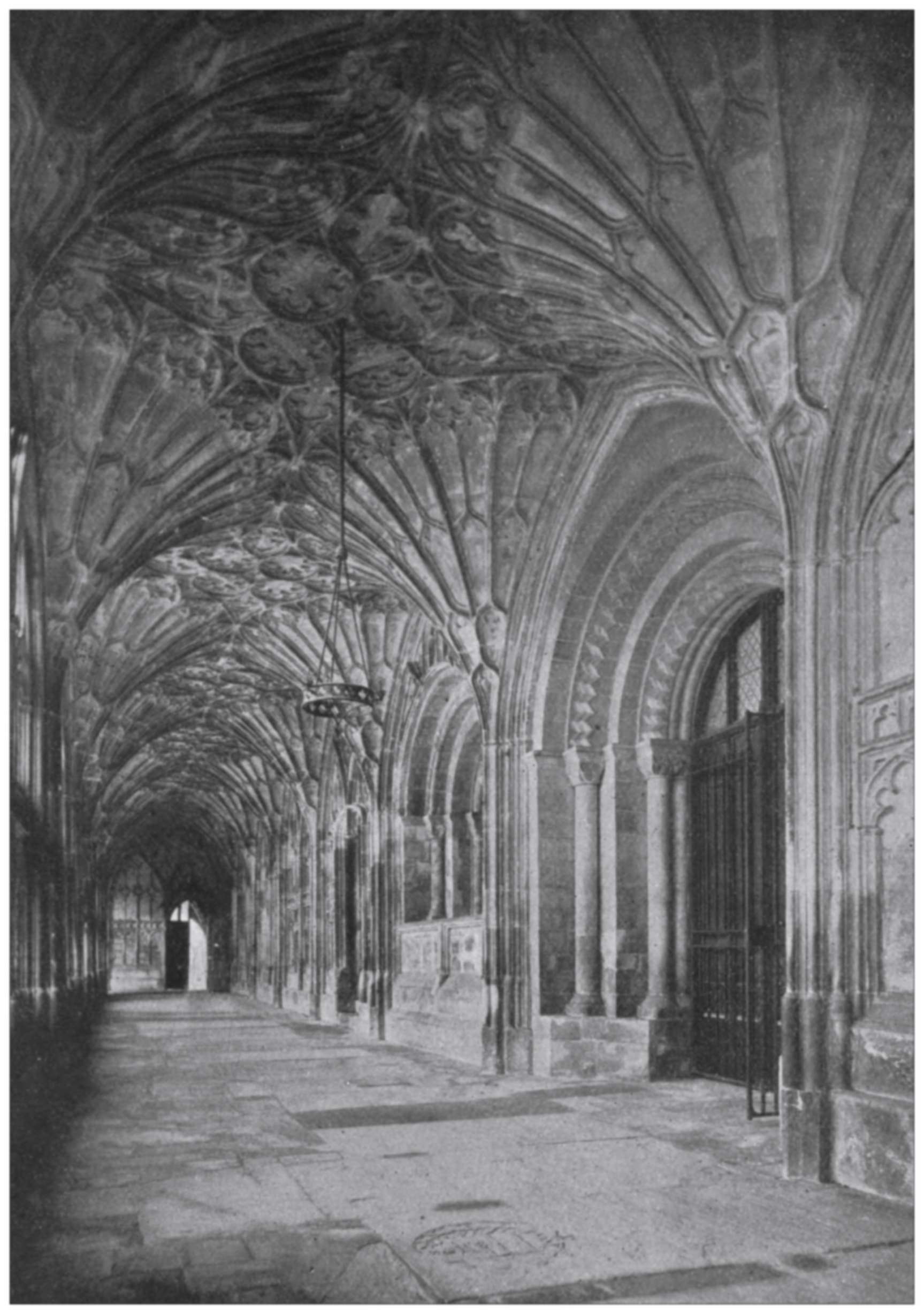
The Cloister of Gloucester Cathedral, showing Romanesque and Gothic work. (The doorway leads into the Chapter House.) XI, XII, XIV Centuries.