Part II MARINE INVERTEBRATES
Reading edition
I PORIFERA (SPONGES)
TABLE SHOWING THE CLASSIFICATION OF THE SPONGES DESCRIBED IN THIS CHAPTER
Phylum and Class PORIFERA Subclass Calcarea Order HETEROCŒLA Family SYCONIDÆ Genus Grantia G. ciliata Genus Leucosolenia L. botryoides Subclass Non-Calcarea Order CHONDROSPONGIÆ Family SUBERITIDÆ Genus Suberites S. compacta Genus Polymastia P. robusta Genus Cliona C. sulphurea Order CORNACUSPONGIÆ Family DESMACIDONIDÆ Genus Esperiopsis E. quatsinoensis Genus Microciona M. prolifera Family HETERORRHAPHIDÆ Genus Tedania Family HOMORRHAPHIDÆ Genus Halichondria H. panicea Family SPONGIDÆ Subfamily EUSPONGINÆ Genus Chalinopsilla C. oculata C. arbuscula Genus Euspongia E. officinalis Var. adriatica Var. mollissima Var. rotunda Var. dura Genus Hippospongia H. equina Var. cerebriformis Var. meandriformis Var. elastica H. canaliculata Var. gossypina Var. flabellum Family SPONGIDÆ Subfamily STELOSPONGINÆ Genus Hircinia H. campana
SPONGES
toc
There are many animals which consist of but one cell. These are called Protozoa, and comprise the Infusoria and other microscopic organisms. The animals next higher in the scale are Metazoa, or multicellular animals, and the first group of this subdivision is Porifera, the sponges, the lowest of the many-celled animals.
For a long time sponges occupied a disputed ground between the animal and vegetable kingdoms. Aristotle was the first to point out that a sponge is not a plant. The assertion was doubted and combated, but at last the animal nature of the sponge was established. Sponges were then believed to be colonies of one-celled animals, but finally it was decided that they were individuals with cells of different kinds that performed functions analogous to those of higher organisms.
The sponge, as commonly seen, is only the skeleton or framework, so to speak, of the living animal. In its natural state it is a very different-looking object. Its entire surface is covered with a thin slimy skin, usually of a dark color, which is perforated with holes corresponding to the apertures of the canals. The organic portion of the sponge is a soft, jelly-like substance composed of three layers—the external (ectoderm), the internal (endoderm), and the middle (mesoderm). The external layer is composed of flat cells. The endoderm has cylindrical cells, each one of which has a flagellate hair. The main mass of the body, the mesoderm or middle layer, is made up of cells having various functions, some being concerned in the formation of framework, some in digestion, and some in reproduction.
The framework is secreted in the mesoderm, and in different [pg102] genera consists respectively of a horny or silicious or calcareous substance, or of the first two of these substances combined. The sponge of commerce has the first kind and is composed entirely of exceedingly fine flexible fibers of a horny substance called spongin. In other species the spongin is intermixed with spicules of silica, or of carbonate of lime, in various shapes. In the sponges, so much valued as curiosities, called "Venus's flower-basket" and "glass-rope sponge," the framework is composed of silicious spicules alone.
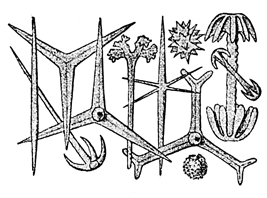
Various forms of sponge-spicules.
The spicules have a great variety of shapes, being rod-like, knobbed, three-pointed, six-pointed, anchor-like, etc., and are a feature in the classification of sponges.
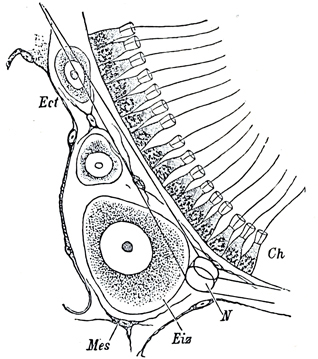
To illustrate choanocytes (Ch): section of a calcareous sponge. Ect, ectoderm; Mes, mesoderm; N, calcareous spicule; Eiz, ovum.
The sponge is traversed throughout by a canal system, consisting of a series of tubes through which water circulates, carrying air and food to the animal. The exterior of the sponge has numerous small pores and a comparatively few large openings. The fine pores are inhalent, taking in and straining the water of its coarser floating material, and then passing it through perforations in their sides into sacs lined with peculiar cylindrical cells having flagellate hairs, each hair having a collar at its base. These cells, called choanocytes, resemble independent animals of the Protozoa, known as flagellate Infusoria or Choanoflagellata. [pg103] They take in and digest food and eject excrement from the area inclosed by the collar. The cilia (hairs) by their constant movement create currents which keep the water in motion. Water, then, is taken through the pores into the first or incurrent canals; thence it is passed into the ciliated chambers, and thence into the excurrent canals, and out through large passages terminating in large openings called oscula, or craters. The canal systems vary. In some species they become quite complex.
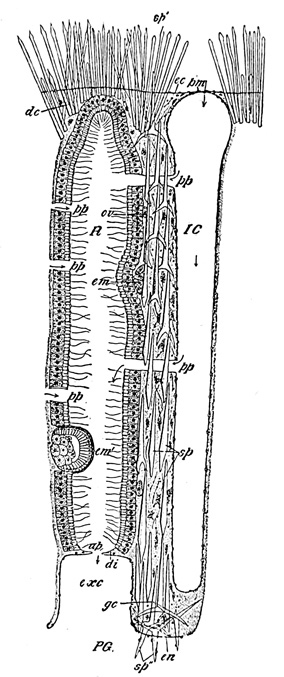
Canal system of Sycon gelatinosum. Transverse section through the wall of a cylinder (parallel with the course of the canals), showing one incurrent canal (IC) and one radial (R) throughout their length; sp, triradiate spicules; sp´, oxeate spicules of dermal cortex (dc); sp´´, tetraradiate spicules of gastral cortex (gc); ec, ectoderm; en, endoderm; pm, pore-membrane; pp, prosopyle; ap, apopyle; di, diaphragm; exc, excurrent passage; PG, paragastric cavity; em, early embryo; em´, late embryo. (The arrows indicate the course of the water through the sponge.)
Sponges vary greatly in shape, size, color, surface, rigidity, canal systems, and skeleton. They are cake-shaped, tubular, digitate, palmate, cup-shaped, vase-shaped, cone-shaped, spherical, hemispherical, pedunculate, etc., their shapes depending upon whether their growth is uniform or is excessive in a horizontal or in a vertical direction. When they grow evenly in both directions massive uniform shapes arise. If lateral growth predominates, broad, low, and incrusting shapes result. When there is an excess of vertical growth the forms are digitate; [pg104] but if vertical growth is not greatly in excess and is restricted to the marginal part, cup-shaped forms result, and tubular forms when lateral growth is particularly restricted. In some varieties tubular masses coalesce; sometimes flat forms unite in intricate compressed folds. Differences in rapidity of vertical growth make undulations more or less marked, producing lobes and protuberances. Sometimes narrow vertical growth is retarded and horizontal growth predominates, forming various shapes on apparent stems.
Many of the horny sponges are colored, in shades of yellow, brown, red, and violet; some are black.
Sponges are divided into two classes, the Calcarea and Non-Calcarea. The former have calcareous skeletons, which make them hard and rigid; the latter have skeletons of spongin-fiber or of silicious spicules, or of the two combined.
All sponges, with the exception of one family (the Spongillidæ, which live in fresh water), are inhabitants of the sea, and live at various depths. The sponges of commerce belong to the Non-Calcarea and are all confined to the genus Spongia. In this genus the skeleton is more or less flexible, being composed of spongin. They are shallow-water species, are confined to seas where the waters are of comparatively uniform high temperature, and flourish best when protected by reefs and islands.
There are fisheries for sponges in the waters of the West Indies, the Bahamas, on the southern and western coasts of Florida, and in the Mediterranean and Red seas. Those of the Mediterranean surpass in quality the sponges of our coasts.
Five species of commercial sponges are taken from Florida waters. They are graded by the trade in the order of their importance, as the "sheepswool," "yellow," "grass," "velvet," and "glove." The fishing for sponges is done from small boats, two persons manning each boat. One man sculls, while the other, using a water-glass, scans the bottom. The water-glass is a box with a pane of glass on the bottom. If the glass is held below the surface and the face is placed in the box, the observer is enabled to see with some distinctness the bottom at a considerable depth [pg105] in these clear waters. The sponges are dragged up by hooks—a primitive method which restricts the fishing to shallow water, the fishing here being in water not deeper than thirty feet, but usually three to twenty feet. The sponges are "killed" by being exposed on the beach for several days; they are then placed in "crawls," or pens, where they are washed by the action of the waves for about a week; then, if clean, they are dried, assorted, strung on cords, pressed and baled for shipment. The sponge-fisheries are of considerable value, and much attention is being given to the subject of artificial propagation. It is thought that such beds could be subjected to the regulations which govern oyster-beds. Already the planting of sponges has been shown to be practicable. The living sponge is cut to pieces, and the cuttings are placed in favorable localities. Pieces planted in Florida waters attain a marketable size in one year.
Sponges reproduce by eggs formed in the mesoderm. The eggs escape as ciliated spheres and swim about until they find a place on which to attach themselves. As soon as they become fixed they grow with much rapidity into mature individuals.
Some species seem to prefer association with other animals and live as commensals with crabs. The crab Dromia is always concealed under a sponge, which grows upon its back. Spider-crabs are often overgrown with sponges as well as seaweeds. In this case, however, the crab finds and plants the sponge himself. Aplysella violacea overgrows worm-tubes. Many sponges afford shelter to numerous small animals which bore into their bodies for protection, no animal seeming to feed upon the sponge.
Sponges may be found in tide-pools, on the under side of stones, on seaweeds, and so on. A small bright-red incrusting sponge with irregular lobe-like branches is common on the New England coast; a thin yellow incrusting sponge also is found on the under side of stones. Grantia ciliata, a small urn-shaped species, having a large aperture at the summit, is found in tide-pools.
Perhaps the most singular in habit of any sponge is Cliona sulphurea, the boring-sponge, a common species found from Cape Cod to South Carolina and abundant in Long Island Sound. It [pg106] is bright sulphur-yellow in color, grows in irregular masses of considerable size and fine texture, and has low wart-like prominences. It lives on shells spreading over both surfaces, at first forming little burrows, but eventually penetrating the shell in every direction, honeycombing and at last completely destroying it by absorption. Sometimes it settles upon living shells and greatly irritates the animal, which constantly secretes new lime to cover the perforations in its shell.
These sponges are an important factor in the economy of the sea, as they disintegrate dead shells, which would otherwise accumulate in vast quantities.
SUBCLASS CALCAREA
Genus Grantia
G. ciliata. Small, urn-shaped or oval, with large aperture at the summit, surrounded by a circle of projecting spicules. It is found in tide-pools and on piles of wharves from Rhode Island northward.
Genus Leucosolenia
L. botryoides. Tubular, branched. Occurs in the same places as Grantia ciliata.
SUBCLASS NON-CALCAREA
Genus Suberites
S. compacta. Elongated, compressed masses, sometimes in several lobes; attached by one edge; texture fine, firm, compact; surface smooth; color bright yellow. It grows on sandy bottoms, and is common in shallow water south of Cape Cod. (Plate XXXVIII.)
Genus Polymastia
P. robusta. When young it forms yellowish-white incrustations over shells and stones; later it grows into long, slender, round, tapering, finger-like projections. Found on the northern New England coasts in deep water.
Genus Cliona
C. sulphurea, the boring-sponge. Irregular massive form of firm texture; surface covered with scattered low wart-like prominences about one eighth of an inch in diameter; bright sulphur-yellow. It destroys, by absorption, vast quantities of dead shells.
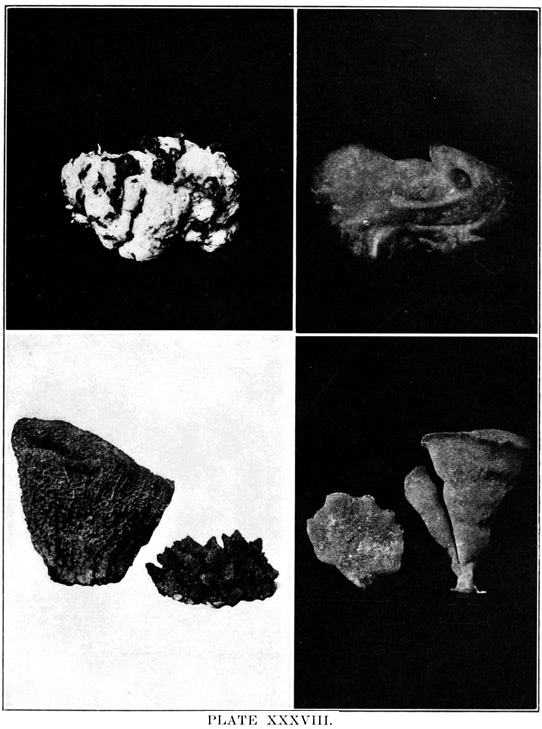
PLATE XXXVIII.
Halichondria panicea. Suberites compacta.
Hircinia campana. Esperiopsis quatsinoensis (found on the sea-beaches of Alaska).
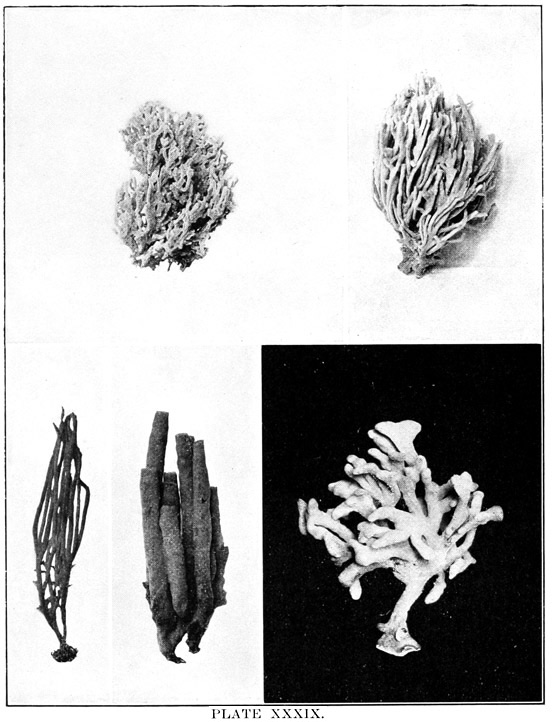
PLATE XXXIX.
Microciona prolifera. Chalinopsilla arbuscula.
Chalinopsilla imitans. Euspongia officinalis, var. tuba. Chalinopsilla oculata.
Genus Microciona
M. prolifera. When young this species forms bright-red incrustations over shells and stones; later it rises into irregular lobes and tubular prominences. When fully developed it is profusely branched in a forking manner. The branches are more or less flattened, and often are palmate at the ends. It grows in clusters six inches in diameter, of a dark orange-red color. When dry it is grayish-brown, brittle, and bristly. It is found from Cape Cod to South Carolina, and is abundant in Long Island Sound. (Plate XXXIX.)
Genus Tedania
Irregular, uneven, pale-yellow masses spreading over seaweeds; oscula scattered irregularly over the surface; texture close.
Genus Halichondria
H. panicea, crumb-of-bread sponge. It resembles the crumb of bread, and is found cast up on all beaches. (Plate XXXVIII.)
Genus Chalinopsilla
C. oculata, the finger-sponge. Stem stout, more or less flattened, dividing at the upper end into branches which vary in form and thickness, being finger-like or more or less compressed lobes; oscula scattered over the smooth, undulating surface; texture rather hard, but delicate; color, when living, dull orange-red; when the animal matter is removed, white. The species is found in shallow and deep water from New York to Labrador. Common in Massachusetts Bay. (Plate XXXIX.)
C. arbuscula. Profusely branched in a forking manner from close to the base; branches slender; clusters six to eight inches high and about the same in breadth; color buff or gray when living, yellowish-white when free from animal matter; texture finer and more delicate than that of C. oculata. It is found in shallow water from Cape Cod to North Carolina, and is abundant in Long Island Sound. (Plate XXXIX.)
Genus Euspongia
E. officinalis. This is one of the commercial sponges and is known as the "glove-sponge." It is the one of least marketable value, having inferior elasticity and becoming brittle with age; yet a Mediterranean sponge of the same species, variety adriatica, is of the finest quality and greatest value. This singular fact demonstrates that the quality of sponges depends largely upon physical conditions. E. officinalis has an average height of five to six inches. It grows on rocky bottoms in shallow water on the east coast of Florida. This species has a number of varieties of various forms; some are dome-shaped, others tubular, rotund, flabellate, etc. The surface is covered with fine tufts and is generally free from ridges. On the sides are numerous small apertures, [pg108] and one or more large oscula occur on top. The color of the living sponge is black. (Plates XXXIX, XL.)
E. officinalis, variety adriatica. More or less globose; sometimes attached by a broad base, sometimes by a short stem; latter form more or less club-shaped; oscula scattered over upper surface. Found in the West Indies and the Mediterranean. (Plate XL.)
E. officinalis, variety mollissima, the Levant toilet-sponge. Generally cup-shaped; oscula on inner side of cup or on upper flat surface; very soft and elastic.
E. officinalis, variety rotunda. Usually massive; attached by a broad base; sides vertical; oscula large and conspicuous on top, or small in longitudinal rows on the sides. In the young this variety may have a conical form with only one orifice, but later it has several oscula. Its rotundity of form increases with the number of large orifices, but in the adult stages the form varies, some being conical, while others have the top divided into radiating ridges.
E. officinalis, variety dura. Irregular, massive, horizontally expanded, with conical process on upper surface.
Genus Hippospongia
H. equina. Some of the sponges of this species are massive, spherical, and attached by a small base; others are horizontally expanded or cake-shaped; some have a depression in the upper surface and become cup-shaped.
H. equina, variety cerebriformis. Massive, circular, cake-shaped, often depressed in the center, producing a cup-shape, attached by broad base; surface broken up by parallel longitudinal ridges having many tufts. Cup-shaped forms predominate, and have a more or less rough surface. This is one of the species known as grass-sponges.
H. equina, variety meandriformis, the velvet sponge. The surface of this variety has a protruding flattened cushion of fiber which slightly resembles the convolutions of the brain-coral. Sometimes these cushions are extended into long pencils. The oscula are large and ragged on the edges; the shape is irregular. The average size is seven to eight inches in diameter. (Plate XL.)
H. equina, variety elastica (variety agaricina, Hyatt), the yellow sponge. This is the second grade of commercial sponge, corresponding to the Zimocca sponge of the Mediterranean. It is found growing with the "sheepswool" in a depth of two to twenty feet, and is abundant. It is massive and cake-shaped. The whole surface is a network covered with numerous small, fine cones. (Plate XL.)
The variety dura is classed with this species, which it resembles in appearance, though it is harder in texture.
H. canaliculata. Massive, frondose; more or less horizontally expanded; bears finger-like processes of varying development on the upper surface.
H. canaliculata, variety gossypina, the sheepswool sponge. This is the highest grade of the commercial bath-sponge. It is called "sheepswool" because, perhaps, of its irregular shaggy surface. It is covered with tufts, the larger oscula occupying the intervening depressions.
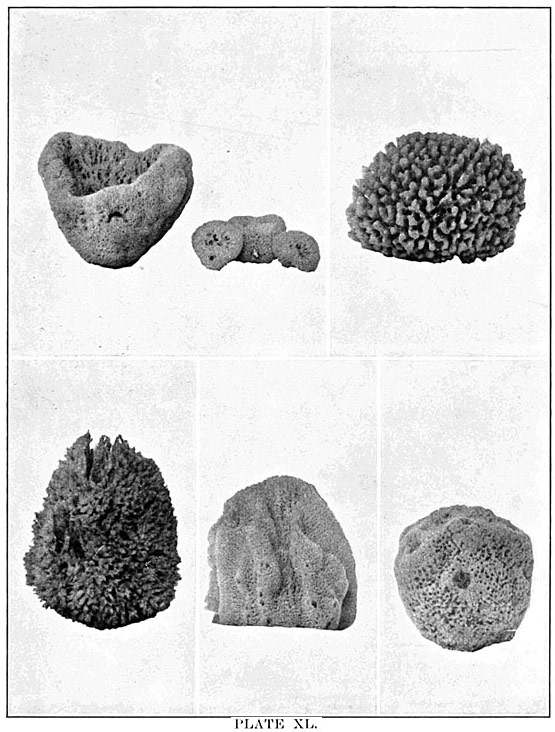
PLATE XL.
Euspongia officinalis, var. adriatica. Hippospongia equina, var. meandriformis.
Hippospongia canaliculata, var. gossypina. Euspongia officinalis. Hippospongia equina, var. elastica.
Sometimes these are very numerous, the whole interior being cavernous; again, the structure is more dense, with fewer large openings and more of the small ones between the tufts; again, the depressions are filled up so that the surface has fewer tufts. When living, the color is shining black. This is the best sponge found on the American coast, and although of coarser texture than the best Mediterranean sponges, it is more durable and quite as elastic. (Plate XL.)
H. canaliculata, variety flabellum (Spongia graminea, Hyatt). This is one of the species of sponges of the third commercial grade, which bear the trade-name of "grass-sponge." The shape is cone-like, with either a flat or a funnel-shaped top. The oscula are on the upper surface. The sides are fluted with deep furrows which contain the small incurrent apertures.
Genus Hircinia
H. campana. The normal variety is vase-shaped, but the species varies greatly in form. Some varieties have branches. When living, its color is black. It is found at Key West in four to forty feet depth. (Plate XXXVIII.)
II CŒLENTERATA (POLYPS)
Phylum CŒLENTERATA Class HYDROZOA (Zoöphytes, small Jellyfishes, and a few Corals) Class SCYPHOZOA (Large Jellyfishes) Class ACTINOZOA (Sea-anemones and most of the Stony Corals) Class CTENOPHORA (Comb-jellies)
CŒLENTERATA
toc
The animals included in the phylum Cœlenterata were once all called zoöphytes, or animal plants, because of their resemblance to vegetable forms. The name Cœlenterata is derived from two Greek words meaning "hollow" and "intestine," and it describes the anatomical structure of each member of the group. They are commonly known as polyps. In the simplest forms the parts which perform the different functions cannot be distinguished one from the other, and even in higher forms there is but little differentiation. Shakspere's description of old age applies to them: "Sans teeth, sans eyes, sans taste, sans everything."
Nevertheless, this very low order of animals has, like the higher orders, such a diversity of form and habit as to require classification. Some of them are stationary, and of these some branch like plants; some move about by the aid of tentacles, some move by means of vibrating cilia, and others move by the contraction and expansion of the soft body.
Cuvier included them in his Radiata, a class comprising all the animals whose parts diverge or radiate from a central axis. Recent classification has divided the radiate animals into several classes. This arrangement of parts is obviously quite different from that of bilateral symmetry, or the disposal of parts on each side of a longitudinal axis. The type of radiate structure is shown in polyps. The body is a sac, in the center of which is another sac or axis. This is the digestive cavity. Vertical partitions extend from the central to the outer sac, forming distinct [pg114] divisions or chambers. The number of divisions varies with the different species and also with the age of the animal. Other partitions start from the outer sac, and extend toward the central axis, but do not unite with it. These partitions, called mesenteries, are always in definite multiples, varying in different species, new divisions growing between the first partitions in regular order. On the inner edge of these partitions the eggs of the animal are formed, which, when mature, drop into the chambers and pass through openings into the inner sac, or digestive cavity, and out of the mouth into the water.
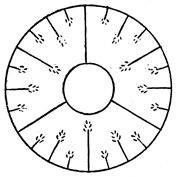
Diagram of radiate structure.
The animals are classed according as the eggs are formed on all or on special partitions, those being of the highest order where a limitation and constancy of function is maintained. The upper surface of the body has hollow tentacles, each one of which opens into one of the chambers and extends outward. All parts of the animal communicate, and whatever enters the mouth circulates through the whole structure; and when assimilation is completed the residue returns by the same road and is expelled through the mouth. This structure is common to all polyps; but there are great differences in their texture, some being soft and some horny, while others deposit a calcareous skeleton (corals). Some grow in colonies, like the hydroids and corals, and are stationary, others are free and independent; some have but few, others have many tentacles; and they differ widely in size, form, and color.
Hydroids, sea-anemones, corals, sea-fans, starfishes, and sea-urchins are different examples of the radiate structure. They are not, however, all of them polyps.
The Cœlenterata are divided into four classes:
Hydrozoa, which include the colonies of zoöphytes which resemble seaweeds, the small jellyfishes which are born of these colonies, and the millepores, which are colonies of zoöphytes which secrete a stony instead of a horny skeleton, yet differ in some respects from other [pg115] stony corals;
Scyphozoa, large jellyfishes, many of which do not have the double form of development;
Actinozoa, the sea-anemones and the different forms of stony corals, including sea-fans, sea-pens, etc.;
Ctenophora, the jellyfishes commonly known as comb-jellies.
TABLE SHOWING THE CLASSIFICATION OF THE HYDROZOA DESCRIBED IN THIS CHAPTER
Class HYDROZOA Order LEPTOLINIÆ (Branched colonies or shrub-like communities of hydroids; some permanently fixed, others liberate swimming-bells) Suborder ANTHOMEDUSÆ (Zoöids not covered by protective sheath; umbrella of medusæ strongly arched; egg-sacs in manubrium) Division TUBULARIANS (Without polyp-cups) Genus Clava C. leptostyla Genus Hydractinia H. polyclina Genus Coryne C. mirabilis Genus Sarsia Genus Eudendrium E. ramosum Genus Tubularia T. indivisa T. Couthouyi Genus Parypha P. crocea Genus Corymorpha C. pendula Genus Hybocodon H. prolifer Genus Pennaria P. tiarella P. gibbosa Genus Bougainvillea B. superciliaris Suborder LEPTOMEDUSÆ (Zoöids covered with cup-like sheaths; umbrella of medusæ thin and not very convex; egg-sacs in line of radial canals) Division CAMPANULARIANS (Polyp-cups stalked) Genus Obelia O. commissuralis Genus Eucope E. diaphana Genus Oceania O. languida Genus Clytia C. poterium C. bicophora Division SERTULARIANS (Polyp-cups sessile) Genus Sertularia S. pumila S. argentea S. cupressina Division PLUMULARIANS (Polyp-cups on one side of branches only) Aglaophemia struthioides Plumularia falcata Family GERYONOPSIDÆ Tima formosa Family ÆQUOREIDÆ Zygodactyla groenlandica Order TRACHYLINÆ (No fixed zoöphyte stage; always free-swimming medusæ) Suborder TRACHYMEDUSÆ (Tentacles spring from margin of umbrella; manubrium long; gonads in connection with radial canals) Trachynema digitale Suborder NARCOMEDUSÆ (Tentacles spring from midway between summit and margin of umbrella; manubrium short; gonads in connection with manubrium) Order HYDROCORALLINA (Skeleton of carbonate of lime) Millepora alcicornis Order SIPHONOPHORA (Pelagic free-swimming colonies; exhibit extreme polymorphism of zoöids) Genus Nanomia N. cara Genus Physalia P. arethusa Genus Vellela V. limbosa
TERMS USED IN DESCRIBING HYDROIDS
Cœnosarc ("common flesh"): The fleshy axis, or organized living bond, by which the zoöids are organically united to one another. It consists of three layers: ectoderm, endoderm, and mesoderm.
Ectoderm ("outside skin"): The outside one of the three organized layers of which every hydroid is composed.
Endoderm ("inside skin"): The innermost layer.
Gonangium ("seed-vessel"): The external horny receptacle within which the gonophores are developed.
Gonophore ("seed-bearing"): A generative zoöid.
Hydranth ("water flower"): A nutritive zoöid.
Hydrorhiza ("water-root"): The part of the colony which fixes it to other bodies, like a root.
Hydrosoma ("water-body"): The entire hydroid colony.
Hydrotheca ("water-receptacle"): The cup-like, horny receptacle which protects the hydranth.
Mesoderm ("middle skin"): A layer which lies between the ectoderm and the endoderm.
Nematophore ("thread-bearing"): The name of peculiar bodies developed in certain genera from definite points; characteristic of plumularians.
Perisarc ("around flesh"): The transparent, chitinous shell, or unorganized outer membrane of horny consistency, which covers to a greater or less extent the soft parts of the colony.
Zoöid ("animal form"): One of the animals which form the colony. [pg119]
CLASS HYDROZOA SEAWEED-LIKE ZOÖPHYTES AND SMALL JELLYFISHES
toc
The hydroids have been called the nurses of jellyfishes. From casual observation these two forms would not be associated together, for the shrub-like organisms, which so much resemble plants that they are often collected and preserved as seaweeds, suggest only vegetable life. Examined with a glass, however, they disclose their animal nature. Along the stems, arranged in various ways, are small cups, from which protrude the numerous moving tentacles of the little polyps living within them.
Hydroids are colonies of associated animals living a communal life. The multitude of individuals composing the colony are invested with a horny covering, the perisarc, which in some genera assumes a tree-like form. Through these stems and branches runs a fleshy tube, a thread of animal substance, which connects in one living whole the zoöids, or individuals of the community. There is division of labor, as in other communities: some of the zoöids obtain the food for the colony, and have tentacles around their open mouths; others have no mouths, but reproduce the species, and at certain stages of development liberate swimming-bells, or small jellyfishes (medusæ).
The typical hydroid colony is attached by a kind of creeping stem from which arises a vertical axis, which gives off short lateral, alternate branches bearing zoöids at their ends. There is often more complex branching. The zoöids in certain genera (tubularians) are uncovered; in others (sertularians) they are incased in a glassy, cup-like, horny sheath.
Three kinds of zoöids, polyps, or hydranths—as they are indiscriminately called—are attached to the stem. Those having an [pg120] open end and a crown of tentacles are the nutritive individuals. Small, club-like dilations are immature zoöids. The blastostyles, or reproductive zoöids, are long, cylindrical, mouthless, and covered. At maturity the cover is ruptured, and the medusæ have the appearance of a pile of thin saucers attached by the middle of the convex side. When at length these saucers are set free as little medusæ, or jellyfishes, the convex side of each saucer, or swimming-bell, is called the ex-umbrella; the concave, under side, the subumbrella. From the center of the subumbrella projects the manubrium, or stomach of the animal. At the free end of the manubrium is a four-cornered mouth. From the attached end of the manubrium four tubes or canals diverge, and, extending through the animal, open into a circular canal which runs around the margin of the umbrella. When the medusa is as above described, it has reached the highest point in its development.
When the medusa has matured, it lays eggs, known as planulæ. These are spherical bodies covered with cilia (hairs), by means of which they swim about for a time; but they finally attach themselves to some object, there to grow and develop into hydroid colonies. The cycle of life is thus completed. This process is known as alternation of generation, or metagenesis, one life-history containing two quite different forms of being. The term of life of an individual is one year, the zoöphyte stage beginning in the autumn and the medusa stage in the spring.
Some medusæ, besides reproducing by means of eggs, multiply by budding, small medusæ growing on the manubrium or on the margin of the umbrella. Sarsia and Lizzia sometimes increase by budding.
The Hydrozoa are not all of the above type. In the sertularians the zoöids perish on the stem and have no medusa life, their reproductive element giving rise to the hydroid form without metamorphosis. The Trachylinæ have no hydroid life, being always free-swimming medusæ; others, the Siphonophora, live a hydroid life which is unattached, the colony floating on the ocean; the millepores secrete calcareous skeletons and always remain fixed, reproducing by budding. [pg121]
Hydroids are very abundant, but are comprised in the few groups mentioned: namely, those which live only in the fixed colonial state; those which have alternation of generation, being first hydroids and then swimming-bells, or medusæ; those which live always in the medusa state, the eggs of the jellyfish developing at once into other medusæ; and the Siphonophora, or those which have a floating colonial state, the hydroid never being attached, but floating at large and capable of locomotion, some of the colony having the function of propulsion.
Hydroids are particularly interesting as exemplifying the close resemblance that may exist in outward appearance between animal and vegetable life and as illustrations of communal life and of the alternation of generation. A few examples of different types are given below.
ORDER LEPTOLINIÆ
The members of this order agree in all essential particulars being branched colonies having two principal forms of zoöids, the nutritive and the reproductive. Some genera attain the length of several inches, or even feet; others are very small tufts growing on shells and seaweeds. The cup may completely inclose the zoöid and be close to the stem (sessile), as in sertularians; it may be on the end of a short stalk, as in campanularians; or it may not reach above the base of the zoöid, as in tubularians. The genera are based upon these differences in the perisarc.
The hydroids, like all other classes, exist in such great variety that it would be impracticable to describe here the many named species; but to recognize the genera is simple. A long tubular pedicel without a cup is characteristic of the tubularians; the campanularians have an arborescent form and bell-shaped cups on stalks; the sertularians have sessile cups; and the plumularians have a feather-like form, with zoöid-cups on one side only of the branches.
The beautiful and varied structure of these "animal plants" is most interesting, and to be fully appreciated they should be seen [pg122] in life and examined with a glass. Some species are confined to deep water, but many are littoral and to be found in tide-pools, in the chinks and crannies of rocks, under stones, and under the hanging Fucus. The horny skeletons of large varieties are frequently washed ashore, and in their tangled masses smaller living species often may be found.
THE TUBULARIANS
This division is characterized by zoöids borne on long, slender stems which are sometimes simple and small, sometimes branching and eight to ten inches long. The zoöid has two rows of tentacles, the central one being sometimes on a kind of proboscis. The reproductive zoöids are in bunches, sometimes below the outer row of tentacles, sometimes between the two rows. The perisarc does not cover the zoöid. In color they are commonly red or yellow.
Genus Clava
C. leptostyla. This species is found growing on Fucus, on the under side of stones at low-water mark, and in tide-pools, where it often covers several feet of the surface of the rock with a delicate velvet-like carpet. It is red in color and is, apparently, a soft and tender species, but it thrives on the most exposed beaches. The colonies are cylindrical tubes about one quarter of an inch in height, rising from a creeping stem (hydrorhiza). Each tube is surmounted by a zoöid with fifteen to thirty tentacles, which is constantly changing form by its contractions. Below the tentacles are reproductive buds arranged in clusters. Common from Long Island Sound northward. (Plate XLI.)
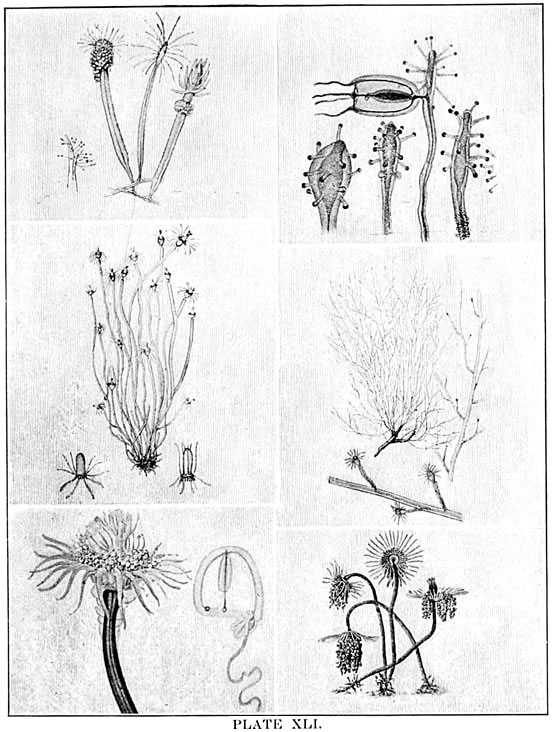
PLATE XLI.
Clava leptostyla. Coryne mirabilis.
Tubularia indivisa. Eudendrium ramosum.
Hybocodon prolifer. Tubularia Couthouyi.
Genus Hydractinia
H. polyclina. The soft, pinkish covering often seen on shells inhabited by hermit-crabs. This association of two different kinds of animals is known as commensalism, and is a partnership formed for the benefit of one or both the individuals. In this case the mossy appearance of the hydroid conceals the shell, while the stinging-cells with which it is invested are weapons of defense against the enemies of the crab and also help to paralyze its prey. In return for these favors the colony is moved about, thereby obtaining perhaps better oxygenation. Originally it was thought that Hydractinia lived only on the shells occupied by hermit-crabs, and that the nomadic life was essential to its existence; but this is not the case, for it is also found growing on rocks in tide-pools. These colonies arise from a creeping stem, which forms a horny, root-like [pg123] network over a surface and develops at intervals projecting points on which the zoöids live. Each colony consists of feeding members, of reproductive members, and of a third kind which seems to have a protective function. These last are more slender than the others, and are without tentacles, but are armed with lasso- or stinging-cells. The colonies are of different sexes, the male being lighter in color than the female colonies. The eggs develop into planulæ, which swim about for a while and then give rise to other colonies. It is found from New Jersey northward, and is very abundant in Long Island Sound.
Genus Coryne
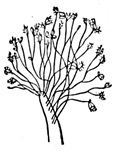
Colony of Coryne, natural size.
C. mirabilis. A hydroid about one inch high, growing in patches and appearing like tufts of moss on rocks between tide-marks. When highly magnified it shows club-shaped tubes with pedicels, terminating in zoöids, scattered over the swollen ends. The medusa-bud is larger than the others and is lower on the tube. It liberates a swimming-bell, which is called Sarsia. (Plate XLI.)
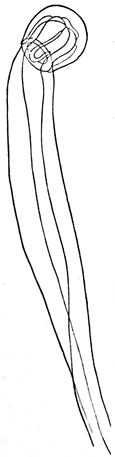
Sarsia, the free medusa of Coryne.
Sarsia
S. mirabilis. This medusa of Coryne is from one quarter to three quarters of an inch in diameter when full-grown. Its umbrella is nearly hemispherical, and from the center hangs a manubrium. From the margin of the umbrella hang four very long tentacles. The shape of its body and the length of its tentacles and proboscis are constantly changing as it moves in the water. These little medusæ are very plentiful in the spring and summer, and swim rapidly in all directions near the surface of the water.
Genus Tubularia
T. Couthouyi. This species is found in the same places as Parypha crocea. The stem is three to six inches long, and is inclosed in a horny sheath, which is more or less ringed or jointed, or it may be smooth throughout. The head, when the tentacles are expanded, measures one and a half inches in diameter. It has a proboscis covered with tentacles, disposed in series, which grow successively shorter, the last being merely papillæ. The medusa-buds hang in clusters between the outer tentacles and the proboscis. The animal grows in bunches of five to ten tubes, which spring from a creeping, tangled stem. (Plate XLI.)
Genus Parypha
P. crocea. This is one of the most beautiful of the tubularians. It has a large, drooping head on a stem three to [pg124] four inches long. It is bright red in color, and from the center of the circle of tentacles the reproductive zoöids hang in a cluster, like a bunch of grapes. It does not liberate swimming-bells. It is found in bunches on piles of wharves and bridges, in brackish water, on the eastern coast as far south as Charleston, South Carolina.
Corymorpha pendula. See Plate XLII.
Genus Hybocodon
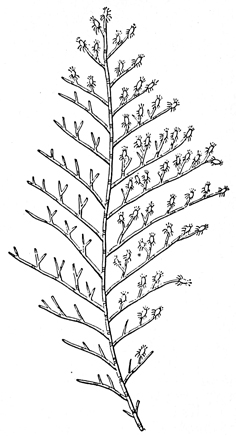
Pennaria tiarella; a branch, natural size.
H. prolifer. One of the largest tubularians, somewhat resembling Parypha crocea. It is deep orange in color, and the head is erect on a long stem. The reproductive zoöids are in a cluster in the center of a double row of tentacles, and resemble a basket of fruit. It grows singly, or in groups of two or three, in shaded tide-pools, which are protected from the surf, and in which the water is very pure. It is found on the Massachusetts coast, but is not common. This species liberates swimming-bells. (Plate XLI.)
Genus Pennaria
P. tiarella. The branches are arranged alternately and at right angles to a central stem or axis; they taper, being shortest at the top and bottom of the stem. The zoöids are red in color, and are arranged along the upper side of branches at considerable intervals. The stems are black and beaded, being constricted at intervals. The zoöids have two rows of tentacles, the upper ones on a small proboscis. From the lower part of the proboscis deep, bell-shaped bodies, which eventually become swimming-bells, are developed. The species is found on rocks and eel-grass along the whole eastern coast.
P. gibbosa. A species similar to P. tiarella, found on the coast of Florida.
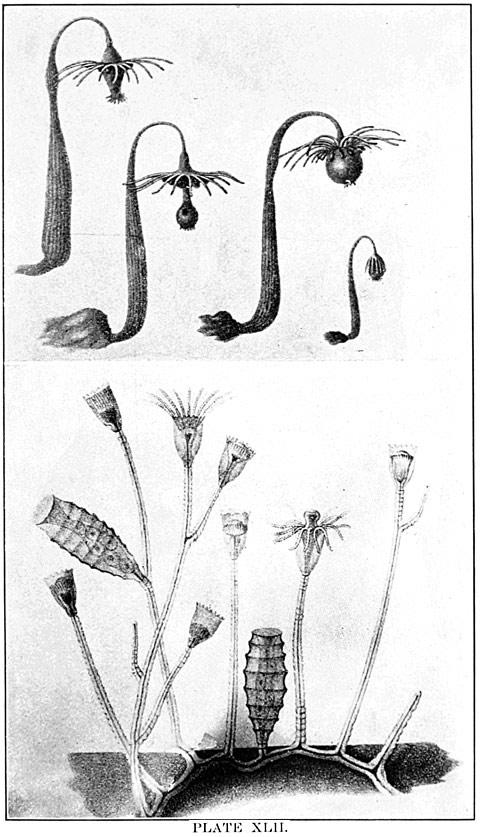
PLATE XLII.
Corymorpha pendula.
Clytia bicophora.
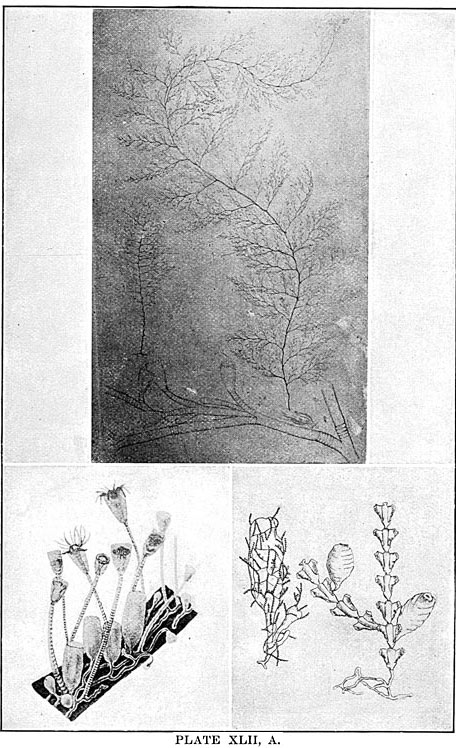
PLATE XLII, A.
Obelia longissima.
Clytia poterium. Sertularia pumila.
Genus Bougainvillea
B. superciliaris. This hydroid is found in tide-pools on the New England coast, growing in clusters, about two inches high, attached to rocks or to mussel-shells. The stem is very slender, and branches. It is red in color. The medusæ which it liberates are found in great numbers in the spring. The tiny swimming-bells are nearly globular. The tentacles are long, are arranged in four clusters on the margin, and extend in every direction. The manubrium is yellow and short, and the mouth is concealed by four clusters of short tentacles. On these oral tentacles [pg125] the eggs of the animal are produced. In its habits it is sluggish, often remaining in one position for several days.
THE CAMPANULARIANS
The hydroids which have an open, bell-shaped cup at the termination of a short, stalk-like stem, or branchlet, are mostly campanularians. This division embraces jellyfishes of different families. Many medusæ cannot be referred with certainty to the hydroids from which they sprang, and the medusa-buds of many of the hydroids have not been noted.
Genus Obelia (Plate XLII, A)
O. commissuralis. This is a delicate, much-branched hydroid, five to six inches long, found at low-water mark in tide-pools, attached to stones and seaweeds, along the rocky shores from Nova Scotia to South Carolina. Its branches are arranged spirally and spread nearly at right angles to the main stem, and the main branches subdivide in a similar manner. Every interval of the stem has a slight curve, and at the base of every branch there are four or five rings. The ultimate branches, or pedicels, bear at their ends bell-shaped cups which have even edges, but are twelve-sided and slightly incurved. The pedicels are ringed for the whole length. The reproductive cups on short ringed pedicels are larger than the others, and occupy the angles of the branches. These cups are constricted and again expanded at the apex, forming an urn-like top.
Genus Eucope
E. diaphana. This species is often abundant on the fronds of Laminaria washed ashore, and also on Rhodymenia and Fucus. It has a creeping base, zigzag in form, but keeping a straight course, and in its branching often forming a network over the surface of the flat fronds. At each angle of the creeping stems rises a pedicel about an inch high, which inclines in the direction of the stem and terminates in a zoöid-cup similar in form to that of Obelia. The medusa which this hydroid liberates is called Thaumatias diaphana. The swimming-bell is very shallow and thin, turning inside out at almost every pulsation. The tentacles are numerous and rigid like stiff hairs. This little medusa is very active and is abundant. The species is found from Long Island Sound northward.
Genus Oceania
O. languida. This medusa is one inch in diameter and one half of an inch high, and is so delicate and transparent that it is hardly visible except in its outlines. In its early stages it is nearly spherical and has no tentacles; later the disk flattens and has from thirty-two to thirty-six [pg126] tentacles and numerous eye-spots. When disturbed it flattens its disk and folds together, leaving its tentacles sprawled in every direction. It is very languid in its movements, and often remains in one position for hours. These medusæ are found only in the hottest hours of the day, but are very plentiful then, shoals of them often stretching for miles, and so thick as to touch one another. Their habitat is the New England coast.
Genus Clytia
C. poterium. This hydroid is found creeping over seaweeds in tide-pools from Long Island Sound northward. The main stem is prostrate, or root-like, running over the body to which it is attached. The stems rise as do the tubularians. The sterile zoöids are on single stems about one quarter of an inch high. The stems are faintly ringed for their entire length, and at the top have a distinct ring, on which rests an open, bell-shaped cup, which is smooth around the rim. The reproductive zoöids are on very short pedicels, and the cups are long and cylindrical, with a wavy outline. (Plate XLII, A.)
C. bicophora. This species is found in the same places as the preceding, and is of about the same size. The long stems are more or less ringed and sometimes branched. The edges of the cups are notched. The medusa-buds are urn-shaped and ringed, and are on very short pedicels. (Plate XLII.)
THE SERTULARIANS
The sertularians are distinguished by the horny cup, which is sessile—that is, set directly against the stem instead of being raised upon a stalk. They are among the most common objects of the beach, and, like the plumularians, are often mistaken for plants by the amateur collector and are gathered and pressed as seaweeds. They are found everywhere along the coast. They zigzag over the fronds of seaweeds or hang in fringes upon them, as well as upon rocks, stones, and shells. They well repay close examination with a glass. Every open cup bears a wreath of tentacles, which makes the branch a spray of stars. This is not an inappropriate comparison, for besides their starry shape some species emit a phosphorescent light.
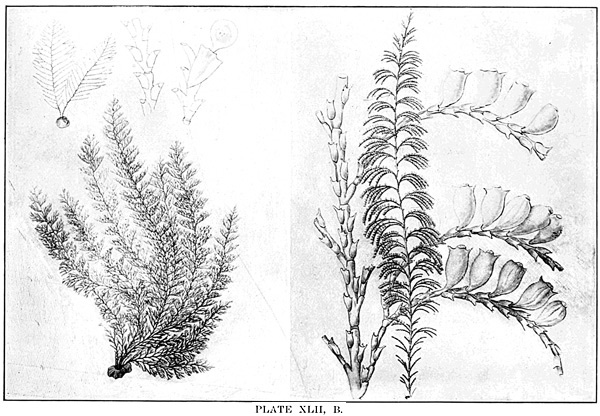
PLATE XLII, B.
Sertularia argentea. Sertularia cupressina.
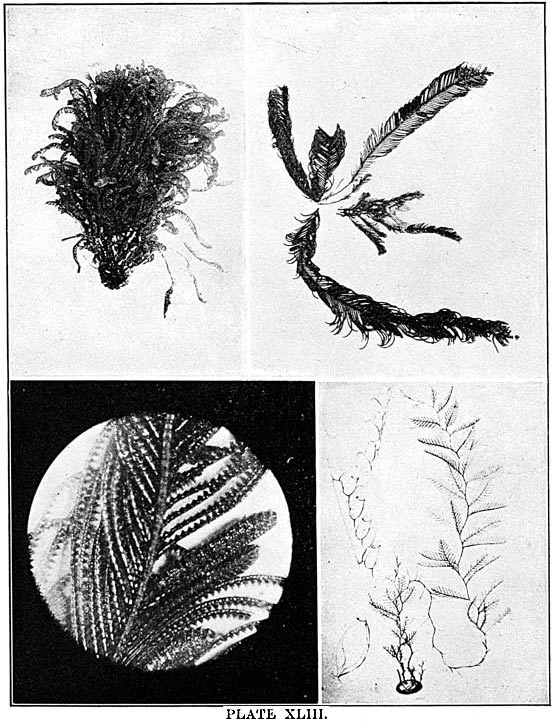
PLATE XLIII.
Plumularian hydroid. Aglaophemia struthioides.
Aglaophemia struthioides, magnified. Plumularia falcata.
Genus Sertularia
S. pumila. The most abundant of all the hydroids on the northeast coast is this species, which is found in profusion upon Fucus and other seaweeds, and mingled with them upon the rocks. It is easily distinguished from the campanularians because its zoöid-cups are close against the stems (sessile) instead of on stalks or pedicels. The stem creeps [pg127] over the fronds of seaweeds, often crossing and recrossing in a tangled mass. At short intervals the upright, straight branches rise to one inch or one and a half inches in height, and are more or less branched. All except the creeping stems are close set on each side, with cylindrical zoöid-cups which turn outward at the ends. The cups of the reproductive zoöids are not sessile; they are much larger than those of the nutritive ones and are urn-shaped. (Plate XLII, A.)
S. argentea. This is a beautiful species, common from New Jersey northward. It has a profusion of silvery branches on a dark stem. The colonies are often a foot or more long, and the branches at the top and bottom of the stem are shorter and fewer than those in the middle of the colony. The zoöid-cups are nearly cylindrical, pressed closely to the stem, nearly opposite or subalternate to one another, and end in pointed tips. The medusa-bud is urn-shaped, with two horns at the top. (Plate XLII, B.)
S. cupressina, the sea-cypress. This species is similar to S. argentea, but the main stem is thicker and longer, and the branches less crowded and less subdivided. The branches are arched or drooping, instead of straight, and gradually decrease in length at some distance from the lower and upper parts of the stem, giving a spire-like apex, the stem often continuing into a bare, branchless extremity. The zoöid-cups are tubular, not much narrowed or divergent above, and two-lipped on the margin. It is found from New Jersey northward. (Plate XLII, B.)
THE PLUMULARIANS
These hydroids are feather-like in the manner of branching, short lateral branches being arranged on each side of a long central stem. In some species the stems are naked below and resemble quills. The zoöid-cups are only on one side of the short branches. (Plate XLIII.)
Genus Aglaophemia
A. struthioides, the ostrich-plume. This species, which is found on the Pacific coast, is perhaps the most beautiful of the hydroids. It varies in size and color, but always suggests a small ostrich-plume. The zoöid-cups are arranged in a single row on one side of each short branch, and the main stem has a joint between each of the branches, which are placed quite close together. The rims of the cups have sharp-pointed teeth, and from the top emerge three tubular projections, which are called nematophores, and are supposed to be degenerate zoöids. At intervals a branch is replaced by a cylindrical body covered with nematophores, and in these the generative zoöids are developed. (Plate XLIII.)
Genus Plumularia
P. falcata (Johnston), or Hydrallmania falcata (Hincks). This species is found on shells and rocks near low-water mark from Long [pg128] Island Sound northward. It is from four to twelve inches high. The main stem is in long spiral turns, and at intervals has spreading plumose branches. The zoöid-cups are tubular and closely pressed against one another, and are ranged in rows on one side of the branchlets; the apertures of the cups are plain and oblique. (Plate XLIII.)
Family GERYONOPSIDÆ
Genus Tima
T. formosa. A very delicate and transparent medusa; size one to two inches in diameter; bell conical; radial tubes four in number; manubrium long, hanging far below the disk; four frilled appendages diverging from the corners of the mouth; tentacles thirty-two; egg-sacs white and following the line of the radial tubes in undulating folds. This species is not very common; it is found on the New England coast.
Family ÆQUOREIDÆ
Genus Zygodactyla
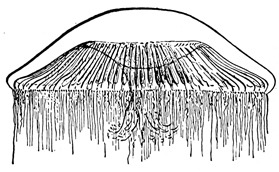
Zygodactyla groenlandica.
Z. groenlandica. Medusa seven to eleven inches in diameter; disk violet-colored and transparent; margin fringed with long, fine, contractile tentacles of a darker violet color; numerous radiating tubes; egg-sacs in slightly waved plates; manubrium hanging below the line of the disk and with a thin frilled membrane depending from it. Found north of Cape Cod in July.
ORDER TRACHYLINÆ
The Trachymedusæ are characterized by their direct development, the egg of the jellyfish producing a medusa and not a hydroid colony.
Genus Trachynema
T. digitale. Size one inch to one and a half inches in height; rose-colored; the bell thin and hard, and conical at the top. The swimming is effected by contractions of the muscular velum (the band around the inner margin of the umbrella) instead of wholly by the bell. The tentacles are long and numerous, and are curled up when moving. The manubrium is long and has four expansions at the mouth. Eight egg-cases [pg129] hang in long pendent sacs from the upper part of the radial canals and reach nearly to the velum. Four garnet-colored eyes in club-shaped processes are prominent on the margin. The animal moves by jerks in straight lines.
ORDER HYDROCORALLINA CALCAREOUS HYDROIDS
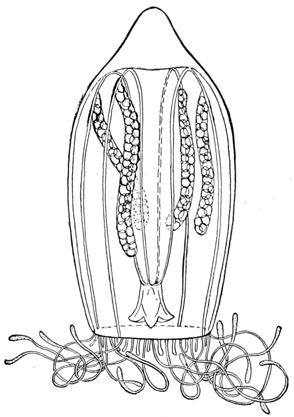
Trachynema digitale.
The genus Millepora ("thousand pores"), which is the type of this order, is a colony of animals, like other hydroids, which secrete calcareous instead of horny coverings. It differs from true corals in that the members of a colony perform different functions, whereas in true corals each member of a community is a complete individual. It differs also in the arrangement of the stony partitions, which in Hydrocorallina are the outside coverings and connecting canals, but in true corals are vertical partitions inside the animal, between the inner and outer sacs, as explained on page 114.
Genus Millepora
M. alcicornis, elk-horn coral. This beautiful coral, which is abundant in Florida and contributes to the building of the reefs, rises in broad expansions, more or less lobed, and suggests by its shape the object for which it is named. The whole mass is porous, being traversed by innumerable canals. Its surface, although smooth compared with that of other corals, is covered with very minute pores, which are of two sizes. The larger ones are the gastropores, or stomach-pores, in which the nutritive animal lives; it has a cylindrical body, with four knob-like tentacles and a mouth. Placed more or less irregularly around the gastropores are smaller pores, the dactylopores (finger-pores), from which emerge slender mouthless processes, or dactylozoöids, with tentacles and stinging-cells. These seem to be the guard-polyps of the community. The cups occupied by the zoöids are shallow. As one animal dies, another succeeds it and builds a horizontal partition separating the new cup from the old one. Thus the stony mass increases in size by the progress of succeeding generations of zoöids. The living animal occupies only the outer, open space. (Plate XLIV.) [pg130]
ORDER SIPHONOPHORA FREE-SWIMMING COLONIES
This order of hydroids consists of free-floating communities and is one of peculiar interest, since it shows in a clear manner the special function of each individual member of the colony, and illustrates better than the foregoing, perhaps, the curious forms of animal life which this class presents.
Genus Nanomia
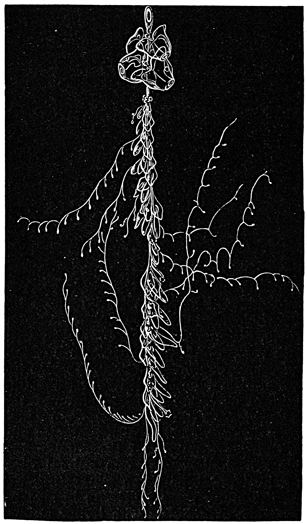
Adult Nanomia cara.
N. cara. This species is found on the New England coast. The members of the community are arranged along a hollow stem about three inches long which opens into every individual. At the top of the stem is a sac, or float; just below this is a group of swimming-bells which have no manubrium or mouth, and whose sole function is to provide locomotion for the community; and below these are three sets of zoöids, each having a triangular shield and tentacles. The tentacles are longer than the main stem. One of these last groups consists of the nutritive members, the mouths of the community, resembling manubriums of swimming-bells out of place. Each one has at the point of attachment a bunch of long, delicate tentacles having pendent knobs of lasso-cells. A second group, also with mouths, has shorter tentacles which are carried in spiral coils. The members of the third group have but one tentacle each and resemble the float at the end of the stem; presumably these drop off and produce new colonies. There are also on the lower part of the stem other reproductive members, which resemble the clusters of buds seen on [pg131] tubularian hydroids. These animals are pink in color and move through the water with a graceful swaying motion.
Genus Physalia
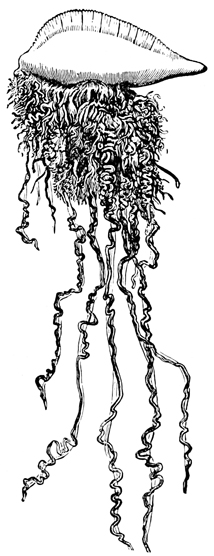
Physalia arethusa; Portuguese man-of-war, one fifth natural size.
P. arethusa, the Portuguese man-of-war. This colony is perhaps the best-known one of the group, since it attracts much attention in Southern waters, and is also one of the most remarkable examples of an animal community. The most prominent part of the compound body is the float, an oblong pear-shaped bag, full of air, which floats on the surface of the water. Its color is bright blue, varying to rose. On the upper side of this air-vessel is a crest, or sail, and from the under side depend long tentacles, or streamers. Some of these tentacles are covered with stinging- or lasso-cells; some are the feeding zoöids, with flask-shaped bodies, and some, which look like bunches of grapes, are the reproductive zoöids. The tentacles in this curious cluster are all close together and hang from one side of the float, near the broader end. The longest are on the outside, which may be called the windward side, since they serve to keep the crest, or sail, before the wind; and when the wind is strong they stretch out to a remarkable length,—forty to fifty feet,—acting as anchors to keep the colony from being driven ashore. They also change its course by raising the pointed end of the float, thus forcing it to "come about." These long tentacles, ordinarily carried more or less curled up, are in bunches of two to four, and emerge from a common stem. Clusters of similar, but smaller, tentacles alternate with the larger ones, but grow somewhat nearer the pointed end of the float; these are purely locomotive organs. Next come two smaller sets of appendages, also of unequal size, which are the nutritive organs of the community. They are clustered together on a stem like the others. The appendages of the third kind are small, resemble bunches of grapes, and are scattered among the nutritive hydræ. These last are the reproductive zoöids of the community.
Genus Vellela
V. limbosa. This hydroid is abundant on the Florida coast. It has a bright-blue, flattened, oblong, bladder-like float, four to five inches [pg132] long, which, is divided into a number of concentric, communicating compartments. The margin of the float is entire, and a triangular sail extends diagonally across the top. On the under side is a single mouth on a manubrium, and surrounding it are a large number of short thread-like appendages having different functions. Some of them are feelers, others bear reproductive buds, and others have stinging-cells. Associated with Vellela is an allied hydroid called Porpita, which has no sail, and in company with these two is a jellyfish called Rataria, which is supposed to be the offspring of one or the other of them.
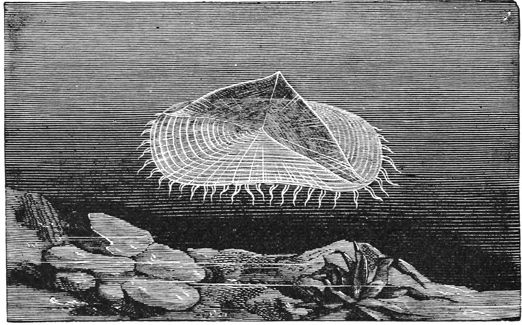
Vellela limbosa.
TABLE SHOWING THE CLASSIFICATION OF THE SCYPHOZOA DESCRIBED IN THIS CHAPTER
Class SCYPHOZOA (Velum usually absent and tentaculocysts present; the eggs are discharged into a gastric cavity. The type of this class is Aurelia) Order STAUROMEDUSÆ (Umbrella conical or vase-shaped; no tentaculocysts) Genus Lucernaria L. auricula Order PEROMEDUSÆ (Umbrella conical and divided by transverse constrictions; four interradial tentaculocysts) Genus Pericolpa P. quadrigata Order CUBOMEDUSÆ (Umbrella four-sided, cup-shaped; four perradial tentaculocysts) Genus Charybdæa C. marsupialis Order DISCOMEDUSÆ (Flattened, saucer-like or disk-shaped umbrella; radial tubes branched; eight tentaculocysts) Suborder CONNOSTOMÆ (Very small; marginal tentacles; short and solid; mouth square without arms) Suborder SEMOSTOMÆ (Square mouth with four long arms; tentacles long and hollow) Genus Aurelia A. flavidula Genus Cyanea C. arctica C. fulva C. versicolor Genus Linerges L. mercurius Genus Pelagia P. cyanella Suborder RHIZOSTOMÆ ("Root-mouth") (Mouth obliterated by growth of oral arms across it; tentacles absent) Genus Cassiopeia C. frondosa
CLASS SCYPHOZOA THE LARGE JELLYFISHES
toc
There is perhaps no marine animal which excites more wonder than the jellyfish. Its transparency, its graceful rhythmical movements, its long streaming tentacles, the variety and eccentricity of its form, and often of its color, attract attention, and one naturally desires to know something of its life-history. Jellyfishes are also called medusæ, because their long appendages suggest the locks of the Gorgon; acalephs, on account of their stinging or nettle-like properties; and sun-jellies, sea-blubbers, etc., because they float upon the surface during the warmest part of the day, when the sun is high. The name jellyfish is inappropriate, since the animal in no way resembles a fish except in the fact that it swims; but it is, nevertheless, the commonest name.
Jellyfishes vary in size from that of a pinhead to six or seven feet in diameter. They differ in the number, size, and position of the tentacles, the number of the radial canals, the form of the manubrium, the position of the egg-sacs, etc.; but the general plan of the internal structure is the same in all species. In shape they are compared to a mushroom. From the center of an umbrella-like top falls a central organ like the stalk of a mushroom. It is called the manubrium and is the mouth and stomach of the animal.
From the top of the manubrium radiate straight or branched tubes, which are connected with a canal which runs around the whole margin of the umbrella. Extending around the inner circumference of the disk in certain species (usually the hydroid medusæ), there is a horizontal shelf, called the velum, or veil, because it sometimes falls like a veil. [pg135]
From the margin of the umbrella depend the tentacles. There are little mineral deposits, like crystals, called lithocysts, disposed at intervals on the margin, and known also as marginal bodies, which are supposed to be eyes. In some species these lithocysts are inclosed in club-shaped bodies, and they are then called tentaculocysts, because they are like small tentacles. These, together with the nerve-fibers, are called the sense-organs; but to what extent jellyfishes can see and feel is undetermined. This is the first appearance of sense-organs in animals. Around the concave surface of the umbrella is a muscular zone, or zone of contractile tissue, by which the animal opens and shuts the umbrella and gets its locomotive power. The gonads, which are conspicuous from being more opaque than the rest of the body, are the egg- or sperm-sacs. They vary in form and in position.
The jellyfish is carnivorous, feeding on small organisms such as crustaceans and even fishes. The tentacles are invested with stinging-cells, as are also the frills about the mouth, when such occur. With these stinging-cells, which are in some species so powerful as to have been compared with an electric battery, the jellyfish benumbs its prey. The stinging properties are due to nettle-like threads contained in poison-cells. When these penetrate the flesh they produce a pain similar to that of an electric shock.
The food is taken into the manubrium by the square mouth at its free end, and is there digested. It is then sent as nutritive fluid through the canal system of the body, and ejected through small pores in the canal which surrounds the margin of the umbrella.
There are two sexes. The gonads of the female contain eggs; those of the male, sperms. The contents of the gonads drop into the central cavity and pass out through the mouth. The fertilized ovum is called a planula, and is a transparent sphere covered with cilia, by means of which it swims about for a time. At length it attaches itself to some object, and becomes in some species a branching colony (hydroid), in other species a strobila. The latter, as it grows, is constricted at intervals, and at maturity resembles a pile of inverted saucers with lobed edges. Each of [pg136] these saucers is finally detached, and when liberated is called an ephyrula, and becomes a jellyfish. Thus its cycle of life is complete. There are some species which, having no hydroid or strobila state, mature without alternation of generation (metagenesis).
The term of life of the jellyfish does not exceed one year. Even the giant Cyanea attains its immense growth in six months. It starts in the spring as an ephyrula, not more than one half of an inch in diameter, and when it dies in the autumn is often six to eight feet in diameter. The bodies of jellyfishes are ninety-nine per cent. water, and the dead ones thrown upon the beaches by the autumn storms rapidly disappear, leaving no traces behind.
The powerful stinging-cells with which the large medusæ are armed make them formidable enemies, and it is probable that some deaths by drowning are caused by swimmers encountering them and becoming paralyzed by them.
ORDER STAUROMEDUSÆ ("Cross-medusæ")
Genus Lucernaria
L. auricula. This little iridescent jellyfish, which measures about one and a half inches in diameter, is commonly found attached to eel-grass by a stalk-like projection of the top of the umbrella. Short, globe-tipped tentacles are arranged in eight clusters, each cluster on a raised prolongation of the margin of the umbrella, and in the center of each space between them is a dark kidney-shaped organ called the anchor. These anchors are used for holding, either for suspension or when moving from place to place. The mouth forms a slight quadrangular projection in the center of the bell-like expansion. The arm-like projections are mottled with two rows of spots, which are the ova. Although a free form and capable of moving about, Lucernaria is sedentary in habit. It is sometimes found free, but generally attached by its extremity to eel-grass or Fucus, seldom to rocks. It is constantly changing its shape. The one it most frequently assumes is that of a cup or inverted bell. It is found on the New England coast. (Plate XLIV.)
ORDER PEROMEDUSÆ ("Maimed medusæ")
Genus Pericolpa
P. quadrigata. Umbrella conical and divided by a horizontal constriction into two parts, the lower one being again divided into lobes. There are four long tentacles and four tentaculocysts. It is not found on the coasts of the United States. [pg137]
ORDER CUBOMEDUSÆ ("Cube-medusæ")
Genus Charybdæa
C. marsupialis. Umbrella square, flattened on top, and of firm consistency. Four tentacles fall from lobes on the umbrella, and four club-shaped eyes are in marginal notches. Plate-like egg-sacs follow each side of the four radial canals. The bell is one inch in diameter and about two inches in height. It is not found on the coasts of the United States.
ORDER DISCOMEDUSÆ ("Disk-medusæ")
Suborder SEMOSTOMÆ
Genus Aurelia
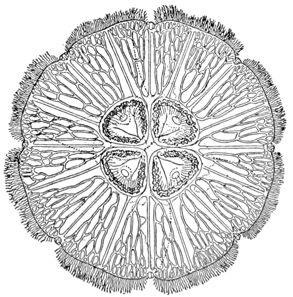
Aurelia flavidula, about one fourth natural size.
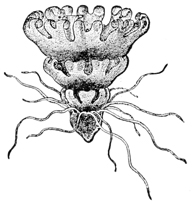
Strobila of Aurelia flavidula.
A. flavidula. Size eight to ten inches in diameter; disk gelatinous, transparent bluish-white, broad and comparatively flat, with a fringe of short tentacles of even length around the margin; margin broken by eight notches, in each one of which is a club-like organ (tentaculocyst) containing calcareous spots or eyes, which are hidden by lappets or hood-like coverings; groups of nerve-cells also lie in the marginal notches; radial canals branched; manubrium very short, with square mouth, which is surrounded by delicate membranes, or oral arms, each arm being a folded membrane tapering to a point. The edges of the membranes are covered with lasso- or stinging-cells. Four egg-sacs, or gonads, are conspicuous in horseshoe shape around the center of the disk. The gonads are pink in the males, and yellow in the females. These medusæ swim in shoals, and are common everywhere in summer. They may be said to be annual animals, for they make their appearance regularly as free-swimming medusæ in the latter part of April, when they may be seen in immense numbers near the surface when the water is smooth and the sky clear. At this time they are about an inch in diameter. They grow rapidly, and by the end of June have attained their full size. At [pg138] the end of July they are fully developed, and begin to discharge their eggs, which go into the folds around the mouth and remain there until they attain the planula stage. After the spawning period the medusæ, reduced in strength, are unable to resist the storms of the autumn, and many of them are cast ashore; many others, in a more or less wasted condition, float near the surface, but the body is less transparent, its tissues are thickened, its tentacles gone, and general dissolution has commenced. In this condition the medusæ are frequently capsized by the air which accumulates in the empty egg-cavities, and, floating helplessly on the surface, are attacked and destroyed by swarms of small crustaceans; thus their cycle of life is terminated. It has been suggested that the destruction of the mothers, by being cast upon the beaches in the autumnal gales, is a provision to set free the planulæ in a position favorable to their existence; for when liberated they fasten upon the rocks and seaweeds of the shore, where, during the winter months, they develop into strobilæ, which in turn free their saucer-like disks early in April.
Genus Cyanea
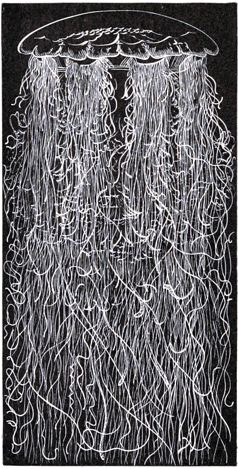
Cyanea arctica, greatly reduced in size.
C. arctica, the sun-jelly or sea-blubber. This is the largest jellyfish known. Some individuals measure seven and a half feet across the disk and have tentacles more than one hundred feet long. Usually they are three to five feet in diameter, with tentacles thirty to forty feet long. The disk is red, the margin white and scalloped. The tentacles, of different colors, are covered with lasso- or stinging-cells, and are arranged in eight distinct, thick clusters on the margin. From the mouth hang four long and very broad, thin curtains, much folded and ruffled, whose edges at times look as if they were embroidered, because great numbers of discharged eggs are attached to them. Four egg-sacs hang from the disk near the manubrium, and eight sense-organs (tentaculocysts), in hardened coverings, lie in some of the deep incisions of the margin. Cyanea [pg139] is usually solitary, seldom being seen in company with others. It is common on the New England coast, and is frequently found stranded on the beach, where it in no way suggests the beautiful appearance it presents when floating in the water. Like Aurelia, Cyanea has a strobila stage. It is supposed that the young remain near the bottom, for they are seldom seen, while adults are plentiful. They begin to appear in numbers at the end of summer from Cape Cod northward.
C. fulva. This species is found in midsummer south of Cape Cod and is common in Long Island Sound. Its general color is light yellowish-brown, the flowing curtains being the darkest part of the animal. It is not as large as C. arctica, and the lobes of the margin are deeper and more rounded.
C. versicolor. The whole disk is bluish milky-white, the flowing curtains are light brown, and the tentacles are pink. It is not so large as C. arctica. Found in the spring on the southern coast.
Genus Linerges
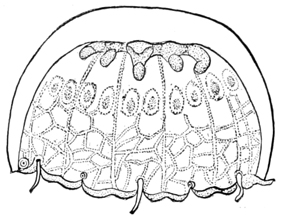
Linerges mercurius, thimble-fish.
L. mercurius, the thimble-fish. The English name indicates the form as well as the size of this little brownish jellyfish, which is found near the Florida Keys, extending in lines for considerable distances.
Genus Pelagia
P. cyanella. Umbrella spherical, margin scalloped, tentacles eight in number; four long appendages ruffled on the edges hang from the mouth; size about two inches in diameter; appendages four inches long; color pink. (See next page.)
Suborder RHIZOSTOMÆ
The Rhizostomæ, or root-mouth jellyfishes, are very remarkable. They have no tentacles, but covering the end of the manubrium and hanging from it like tentacles are oval appendages with numerous minute funnel-like apertures, called suctorial mouths. As the manner of locomotion of jellyfishes is peculiar to themselves, so also is this many-mouthed development unique in the animal kingdom. The type of this group, described below, is found on the Florida Keys. The different species vary in diameter from three to eight inches. [pg140]
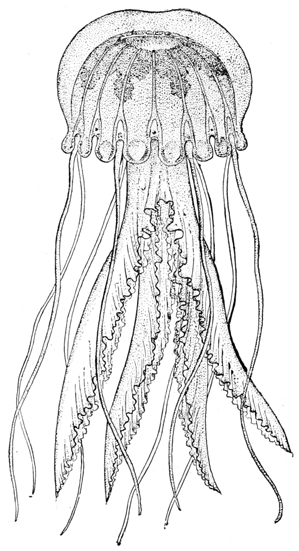
Pelagia cyanella.
Genus Cassiopeia
C. frondosa. This species has a circular disk, on the margin of which are sixteen sense-organs (tentaculocysts), but no tentacles. The lower end of the manubrium, which in other jellyfishes is an open mouth, is closed by eight arms which emanate from it and are usually extended laterally, lying parallel to the disk. These arms are much branched, and the branches, in turn, have numerous appendages. Some of these appendages look like little polyps and have mouths surrounded by crowns of tentacles; others are ovoid bodies without external openings, but with a central cavity connected with vessels leading to the arms. The former are mouths, but the function of the ovoid bodies is not known. Although able to swim freely, Cassiopeia lies usually on its back, as if attached, and languidly opens and closes its disk, rarely changing its position. Its arms, extending upward, appear like the fronds of algæ. These jellyfishes are common on the Florida coast, huddled together on the sands of the coral reefs. (Plate XLIV.) [pg141]
TABLE SHOWING THE CLASSIFICATION OF THE ACTINOZOA DESCRIBED IN THIS CHAPTER
Class ACTINOZOA Subclass Zoantharia (Mesenteries numerous, usually in multiples of six; tentacles unbranched hollow cones) Order ACTINIARIA (The sea-anemones. Single; no skeleton) Genus Metridium M. marginatum Genus Rhodactinia R. davidsii Genus Holocampa H. producta Genus Sagartia S. leucolena Order MADREPORARIA (The stone- or reef-corals. Colonies; skeleton calcareous) Genus Oculina Genus Astræa Genus Meandrina Genus Diploria D. cerebriformis Genus Madrepora M. cervicornis M. palmata Genus Astrangia A. danaë Order ANTIPATHARIA (The black corals) Subclass Alcyonaria or Halcyonoida (Tentacles and mesenteries eight in number; tentacles feathered, that is, with uniform branches) Order ALCYONACEA Genus Alcyonium A. palmatum Genus Tubipora Order GORGONACEA (The sea-fans and sea-whips. Compound, tree-like colonies, with horny axis, branching throughout) Order PENNATULACEA (Free, phosphorescent; colonies, with horny axis; polyps in lateral branches) Genus Pennatula
CLASS ACTINOZOA SEA-ANEMONES, REEF-CORALS, SEA-FANS, SEA-WHIPS, AND SEA-PENS
toc
The animals of this class are divided into two subclasses, based on the following anatomical differences: In the first subdivision, which includes the sea-anemones and the reef-building corals, the polyps have numerous simple, hollow tentacles and radial partitions of the same number, both being some multiple of six. The polyps of a colony are all alike, and the hard matter they secrete is carbonate of lime. In the second subdivision, the Alcyonaria,—or halcyonoids, as they are commonly called,—the tentacles and radial partitions are always eight in number, and the tentacles have small symmetrical appendages or branches. The polyps of this group are often accompanied by small zoöids having no tentacles. The hard secretions are horny and elastic, as in sea-fans, sea-whips, and sea-pens, or they are extremely hard, as in Corallina rubrum.
SUBCLASS ZOANTHARIA ("Animal-flowers")
ORDER ACTINIARIA SEA-ANEMONES
These curious and, at times, beautiful creatures are polyps, and are constructed on the radial system. They have a cylindrical body with a broad base and rows of hollow tentacles around the upper disk. They have a central sac, and a space between the outer and inner sacs which is divided vertically by walls called mesenteries, as explained on page 114. Each tentacle, however many there [pg143] may be, has a corresponding chamber. The inner sac has a mouth, like a slit, at the top of the disk, opening to the outside, and it also has openings into the chambered spaces which surround it. These chambers also open into the hollow tentacles; thus a continuous circulation throughout the whole animal is established.
The food taken in at the mouth is digested in the inner sac, passes through all the chambers of the cavity as nutritive fluid, and is then expelled at the mouth again. The inner sac, or gullet, has longitudinal grooves; two of these are broad and deep, and correspond to the corners of the mouth. These are called siphonoglyphs. The sea-anemone is soft and contractile, and belongs to the only order of this class which does not secrete a skeleton. It has two sets of muscles, one of which extends from the base to the summit of the body and is placed on the dividing partitions. Sea-anemones are classified by the arrangement of the septa and the manner in which the muscles are placed upon them. The other set of muscles is arranged around the circumference of the column or body. Each tentacle is furnished with similar sets of muscles. The animal is sensitive, and at the least alarm contracts its body by means of these muscles, and quickly transforms itself from a beautiful, flower-like form into a shapeless, unattractive, inconspicuous mass.
The Actiniaria are developed from the egg. The eggs form on the edges of the inner walls (mesenteries), and when mature drop into the outer sac (gullet), and out of the mouth as ciliated spheres (planulæ). After swimming about for a time these attach themselves to rocks, and, conforming to the irregularities of the surface, secure a tight hold. The upper surface of the planula then becomes depressed and forms a gullet, and in time a complete animal is formed. The Actiniaria reproduce also by budding. A small protuberance or simple elevation of the body-wall appears on the side at the base, or in some species on the disk of the animal, which generally develops into a complete animal and at maturity falls away from the parent. Sometimes several anemones bud simultaneously from the same individual, and a third generation commences to bud at the same time from the immature young of the parent stock. The sea-anemones increase [pg144] also by self-division. In this case a constriction is formed, which gradually deepens and forms a complete partition of the body, and two individuals exist where originally there was but one.
The Actiniaria are carnivorous and very voracious. They feed on small organisms and on shell-fish and crustaceans, which they suck out of their shells. To secure their prey they are armed with an abundant supply of stinging-cells on the tentacles, and also with fine stinging-threads which are ejected from pores which are distributed over the whole body.
Sea-anemones vary greatly in color and form, and when expanded suggest flowers, but do not resemble the one for which they are named. They abound on every shore, the same genus often being found in widely separated regions. They are larger and more highly colored in tropical waters. Many of the species are littoral, and are found in the tide-pools of rocky caverns, on the under side of rocks, and on the piles of wharves and bridges at low-water mark. The majority of them are attached, but are able to change their location; others, Edwardsia and Cerianthus, swim about when young, and in the adult state burrow in the sand or mud, leaving only their tentacles exposed. Bucidium parasiticum is parasitic on the folds of the membrane which hangs from the mouth of the large jellyfish Cyanea arctica. Fenja and Peachia lie on the sea-bottom, with their bodies horizontal like a worm, the mouth-end and tentacles erect.
Adamsia palliata furnishes another example of commensalism; it lives on the back of shells, commonly the whelk, inhabited by hermit-crabs. Minyas is pelagic; it has a float at one end, and by means of its tentacles swims about freely.
A very few species only are described below, since these polyps are unmistakable, being always columnar bodies, with the upper disk more or less crowded with tentacles, and so brilliant in coloring and beautiful in form as to attract attention if found in the expanded state; otherwise they are easily overlooked.
Genus Metridium
M. marginatum. This is the most conspicuous and abundant sea-anemone of the northeastern coast. It is common from New York [pg145] northward, and is found near low-water mark in tide-pools, on the under side of large stones, in sheltered crevices of rocks, and on the piles of wharves and bridges. In contraction it is a broad, low cone, but when expanded is sometimes ten inches across the disk. Allied species found in Florida are eighteen inches in diameter. The column is smooth, cylindrical, and broader than long. At the top is a slightly elevated, thickened fold, and above this a deeply folded and frilled margin, with numerous fine, short tentacles, appearing like a fringe, which cover the upper side of the disk half-way to the oval mouth. The color is exceedingly variable; commonly the column is yellowish-brown, but it may be pink, white, salmon, orange, or dark brown, or striped or mottled with different colors. The disk and folds are lighter or flesh-colored, and the tentacles are of varying colors, usually grayish with tips of brighter colors. When irritated this species throws out from the column numbers of long, slender white threads (acontia), which are covered with minute stinging-cells. These organs of defense protect the animal from the attacks of many enemies.
Genus Rhodactinia
R. davidsii (Agassiz), Tealia crassiformis (Gosse), the thick-petaled rose-anemone. The color varies, being often bluish-green mottled with crimson, often bright cherry-red, with the thick tentacles somewhat lighter in shade, or flesh-colored. The animal is found in shallow water. It assumes various shapes, changing every few minutes. The tentacles are short, conical, and uniform in size; the column, the breadth of which is greater than its height, often has wart-like processes in longitudinal lines. The diameter of the disk is about three inches. Found from Cape Cod northward in tide-pools and on ledges covered with Fucus.
Genus Holocampa
H. producta. Its column, stretched to its full extent, is a foot in length and about an inch in diameter, but when contracted is much shorter and thicker. It has but twenty tentacles, and these have swollen tips. Rows of suckers extend the length of the column. It ranges from Cape Cod to South Carolina, and is found under rocks at low-tide mark, and also on sandy beaches, buried in the sand, with its tentacles only above the surface.
Genus Sagartia
S. leucolena, the white-armed anemone. It ranges from Cape Cod to North Carolina, and is common in Long Island Sound, being found at low-water mark on the under side of stones. The column is elongated, cylindrical, translucent, flesh-colored, with simple plain disk and long, slender, whitish tentacles crowded together near the margin. [pg146]
ORDER MADREPORARIA STONE- OR REEF-CORALS
The coral resembles the sea-anemone and is a polyp constructed on the radial plan (page 113). It lives in colonies, but, unlike the hydroid colonies, each polyp of the community is a complete organism, and in the reef-building corals all the individual polyps of a colony are alike. The home of each animal is called a corallite, and the aggregation of many corallites is a corallum.
The corallite is composed of carbonate of lime secreted by the polyp, and, broadly speaking, may be called a skeleton. The secretion forms a basal plate and radiating partitions between the mesenteries in the cavity of the animal, and also surrounds the polyp like a cup. In some species this is a solid substance; in others it is like a network through which the animal substance (cœnosarc) of the zoöids of the colony is connected, as in Madrepora.
The polyps reproduce by budding and by self-division (fission), in a manner similar to that of sea-anemones. The way in which the budding or the fission takes place determines the shape of the colony, or corallum, which has a great variety of forms. In some species the budding is confined to certain individuals of the colony. In this case the branched forms result. When growth takes place by fission, hemispherical masses are formed, which are often perfectly symmetrical, as in the so-called brain-corals. In Astræa the polyps are inclosed separately, but in Meandrina fission is confined to the upper half of the polyps, so that a complex polyp is formed, with several mouths opening into a common stomach, making long serpentine furrows on the corallum.
Some of the genera of the second subdivision, the alcyonarians, differ materially from the ordinary idea of corals, as their framework is of a horny and more or less flexible material (chitin). Of these are the sea-fans, sea-whips, and sea-pens. The organ-pipe coral of the same subdivision is an example of an exceedingly fragile lime structure, while the red coral, Corallina rubrum, [pg147] the species so much used for ornamental purposes, has an exceedingly hard and stony character. The madrepore corals are called reef-builders, but not in the sense of constructors of reefs. They do not erect definite structures as bees do. It is the aggregation of the skeletons of the dead polyps, together with other agencies, which forms a reef. The coral polyps, though so minute individually, are almost infinite in numbers. It is estimated that the colonies rise one half of an inch in ten years.
Corals live at different depths in the sea. Those which form the base of the reef are the astræans, which do not live above a depth of six fathoms. They are characterized by little star-shaped spots on the corallum, the radial partitions meeting in the center of the spots, or corallites. Next above the astræans come the mæandrinas and the porites. The former have elongated openings which extend in waving furrows over the surface. The porites resemble astræans, but the pits are smaller, with fewer partitions, and the substance is more porous. Above these and capping the reefs are the beautiful branching and palmate madreporians, together with millepores, numerous varieties of sea-fans (Gorgonacea), and the calcareous seaweeds (nullipores), making a garden of beautiful branching forms of every shape and color.
The coral reef is as thickly inhabited by other living organisms as is the forest by birds and insects. Mollusks, worms, crabs, starfishes, and sea-urchins find resting-places there and work destruction to the coral masses, as they bore and penetrate the reef in various ways until large fragments of it are detached and either washed by the waves to places far from their foundation, or ground to sand, which, filling the interstices of the reef, adds to its solidity.
The living coral is quite different in appearance from the bleached skeletons commonly seen. The surface of the corallum is often soft and downy, from the numerous waving tentacles, and its coloring is vivid and varied. The madrepores are pink, yellow, green, brown, and purple. Tubipora, the organ-pipe coral, has green polyps emanating from its red tubes. White polyps in star-like form dot the branches of the red coral of commerce, Corallina rubrum. The whole mass of Helipora is bright blue, [pg148] and the beautiful sea-pens are both highly colored and phosphorescent. Owing to the fact that these brilliantly colored polyps were mistaken for blossoms, the recognition of their true character was long delayed, they having been ranked as vegetables until comparatively recent times.
With few exceptions, corals do not grow in water below the temperature of 68°, hence they are inhabitants of tropical and subtropical waters. The Florida Keys are coral reefs, and the species described below are to be found there.
Genus Oculina
Arborescent; corallites arranged somewhat spirally on branches and widely separated; branches compact between corallites. Each bud is for a time at the apex of the branch, but finally becomes lateral, and then gives off another bud from its upper surface, and so the stem lengthens. (Plate XLIV.)
Genus Astræa
The star-corals. The corals of this genus are hemispherical masses covered with small star-shaped pits, or corallites. Although the diameter of an astræa-dome may be twelve feet or more, it has only one half or three quarters of an inch of living coral on its surface, the rest being solid matter left behind as the polyps rose in growth. The colony increases by self-division. The septa meet in the center of the corallite, making star-like pits; the surface is comparatively smooth. (Plate XLIV.)
Genera Meandrina, Diploria
Corallum massive, hemispherical in shape, with furrows running in irregular lines over the whole surface. The peculiar serpentine form of the corallite is produced by the animal growing in one direction, fission being incomplete, and new mouths being successively opened until a line of them extends along a common stomach.
D. cerebriformis. This species is commonly known as brain-coral or brain-stone. The hemispherical shape, together with the peculiar serpentine corallites, makes its resemblance to the human brain very noticeable and the name unusually appropriate. This species, when living, is bright yellow. (Plate XLV.)
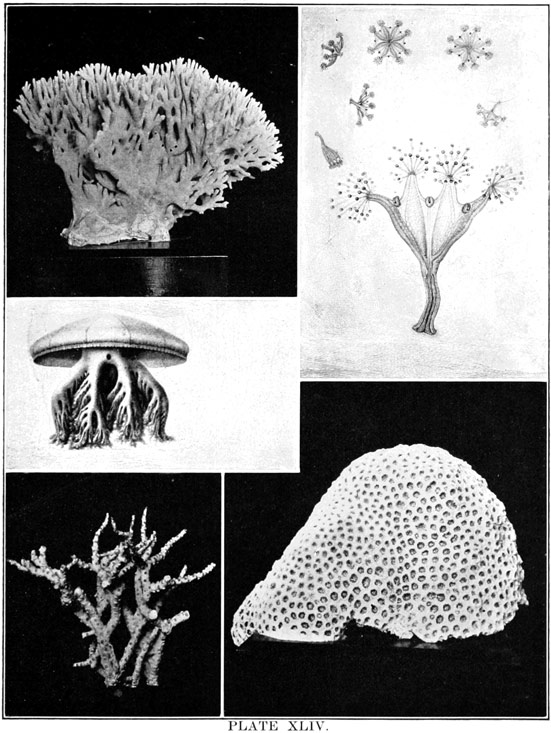
PLATE XLIV.
Millepora alcicornis. Lucernaria auricula.
Cassiopeia frondosa. Astræa argus.
Oculina.
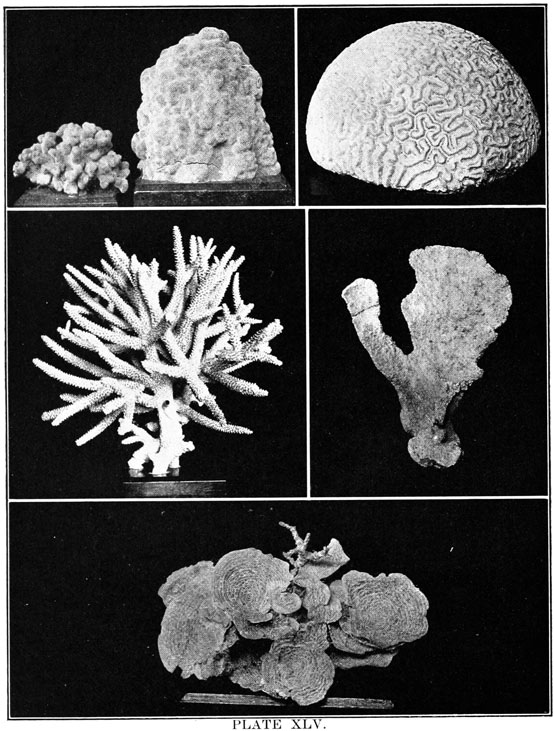
PLATE XLV.
Porites furcata and P. astræaoides. Diplora cerebriformis.
Madrepora cervicornis. Madrepora palmata.
Mycedium fragile.
Genus Madrepora
Some species of these corals appear like branches, while others have flat, low surfaces or fronds; all of them are covered with innumerable small cylindrical cups. Each cup is the home of a polyp, which secretes calcareous matter around its column, and septa between its radial partitions. The corallum, when examined with a glass, looks like meshwork. Through the fine openings of the porous surface, the polyps of the colony are connected by interlacing tubes of animal substance (cœnosarc). The polyps of the madrepore colonies are small in comparison with the connecting structure, which becomes very massive; but, although large, the corallum is fragile, on account of its perforated character and the exceeding delicacy of its parts.
In species which form incrustations, new polyps arise from tissue which spreads beyond the corallites. In some species certain polyps and corallites increase in length, growing longitudinally, and continually form buds around the base. This manner of growth leads to the formation of branches, while the former manner gives lateral extension. Both of these forms of budding may take place at the same time in the same colony. The madrepores are among the most common of the reef-builders. They form reefs which extend for miles around the Florida Keys.
M. cervicornis, the stag-horn coral. This is a branching species which attains large size. Its manner of growth is as follows: At the tip of each branch is an individual polyp, which is larger than those which surround the branch. This is the original animal which started the branch, and is the parent from which all the others on the branch have budded. The large terminal polyp buds around the base; a surplus of lime also collects at the base and clogs its tissues, so that it no longer can perform the functions of life, and after a certain period the base becomes dead matter. The polyp on the upper end continues to live and rises above the excess of solid matter. At the same time it continues to form new buds. The buds become independent corallites and secrete an excess of calcareous matter at their bases, which cements them to the parent stock and increases the thickness of the branch. Thus, as the original polyp constantly rises and buds, the colony assumes a stem-like form, covered with numerous individuals. Certain polyps on the main stem have the attributes of the parent animal. These start branches, and so the process goes on, and in time the colony becomes much branched and arborescent in form. In the living coral each little polyp is like a minute sea-anemone, having a colored cylindrical body surrounded on its upper disk with numerous tentacles. (Plate XLV.) [pg150]
M. palmata. This madrepore grows like the one described above, except that the branches do not remain separated, but unite or grow together, giving broad, flat surfaces which resemble fronds. When carefully examined these surfaces show striations which indicate the course of the branches. The structures forming the lobes are caused by the failure of the branches to unite. On the Carysfort Reef of the Florida Keys this species covers the top of the reef for several miles, nearly reaching the surface, and appears like a vast bed of low yellow shrubbery. (Plate XLV.)
Genus Astrangia
A. danaë. A small coral found on the New England coast. It lives in the clefts of rocks in small patches, sometimes two to three inches across and one quarter of an inch or more high. Frequently it is like a thin crust of lime covered with star-like divisions. Sometimes it forms branches. The living animals are white, and when expanded rise above the cells and resemble a cluster of small sea-anemones.
SUBCLASS ALCYONARIA or HALCYONOIDA
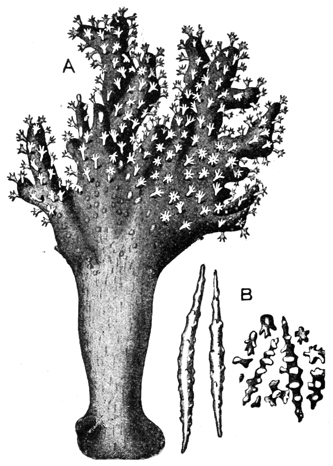
Alcyonium palmatum: A, entire colony; B, spicules.
In this subclass—the actinoid corals—the polyps are of two kinds. The smaller are without tentacles and are called siphonozoöids. The larger have but eight radial partitions and eight tentacles. This limitation of parts places them in a higher rank than the corals of the first subclass. Another characteristic of these polyps is the presence of symmetrical branchlets on the tentacles, which give them a feather-like appearance. These corals are called halcyonoids. [pg151]
Some of them may easily be fancied to have been selected for halcyons' nests, as the name suggests—the sea-fans, for example.
ORDER ALCYONACEA
Genus Alcyonium
A. palmatum. This coral community is found sometimes at low-water mark, but usually in deeper water, attached to shells and stones. It is commonly known as dead-men's-fingers, an unpleasant name given it by fishermen because of a fancied resemblance to a human hand with only the stumps of the fingers. The substance of the coral is semi-cartilaginous, with scattered spicules of lime which give it stability. When the polyps are fully extended the colony is rather attractive in appearance, but not so when contracted. It is found in abundance on the New England coast. An immense Alcyonium, Paragorgia arborea, grows on the fishing-banks off Newfoundland, and is sometimes brought up on the fishing-lines. It is tree-like in form, and measures six feet or more in length.
Genus Tubipora
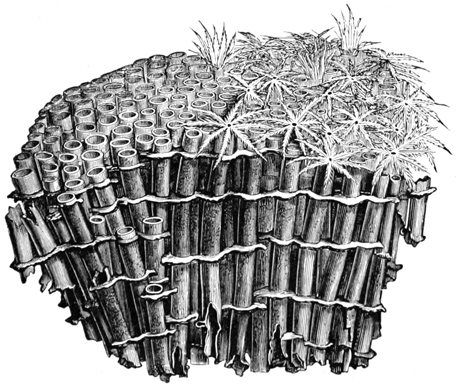
Tubipora, organ-pipe coral, natural size.
The organ-pipe coral. This genus, which is deep red in color and very fragile, consists of many tubes slightly separated from [pg152] one another, but connected by horizontal platforms at short intervals. The form of reproduction, by budding, in this colony is peculiar to itself. The spicules of lime secreted in the polyp unite or fuse into a tube or cylindrical skeleton. At certain stages of development the polyp sends out a horizontal expansion, which unites with the expansions of other polyps and becomes calcified, forming a shelf which binds the tubes together. From the top of the platforms other corallites are formed, and thus a colony is made, which broadens as it rises in its growth. The body of the polyp is green, the skeleton red. It belongs to the East Indian seas and is given here only as an example of a peculiar manner of growth.
ORDER GORGONACEA SEA-FANS, SEA-WHIPS, AND SEA-FEATHERS
These are compound, tree-like Alcyonaria, with a calcareous or horny skeleton which forms a branched axis and is covered with a layer of united polyps having spicules of lime distributed through the mass, which give some firmness to the bark-like covering. Gorgonias, in great variety, grow in abundance on the coral reefs and mud-flats of Florida, forming masses of low shrubbery, pink, yellow, brown, or purple in color.
The sea-whips and sea-feathers are varieties of gorgonias, which are named from their forms. Some have shapes which resemble branching shrubs; others are long unbranched rods, either straight or spiral. They attain a height of several feet and are of various colors. The colony has a horny axis surrounded by a living mass which resembles a sheet of animal matter. This mass consists of polyps closely united, and has throughout its substance spicules of carbonate of lime, making it a kind of calcareous crust or bark. In dried specimens this becomes very brittle, and is easily broken from the horny axis. (Plates XLVI, XLVII.)
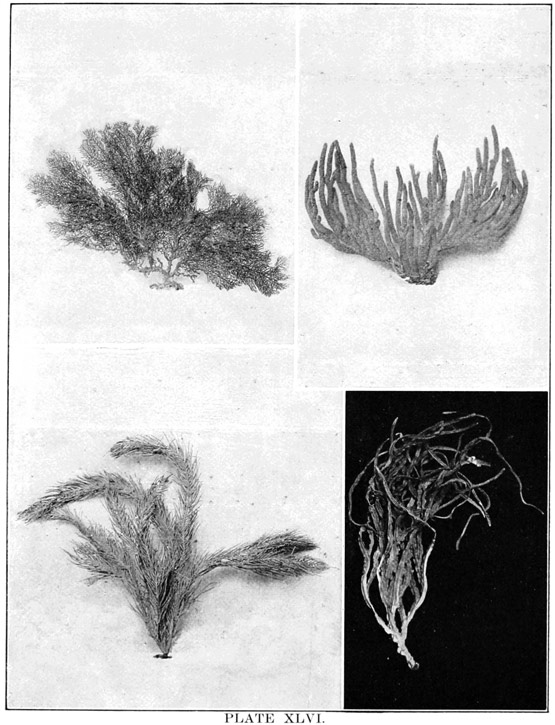
PLATE XLVI. GORGONIAS.
Eugorgia aurantica. Muricea specifera.
Pterogorgia acerosa. Gorgonia anceps.
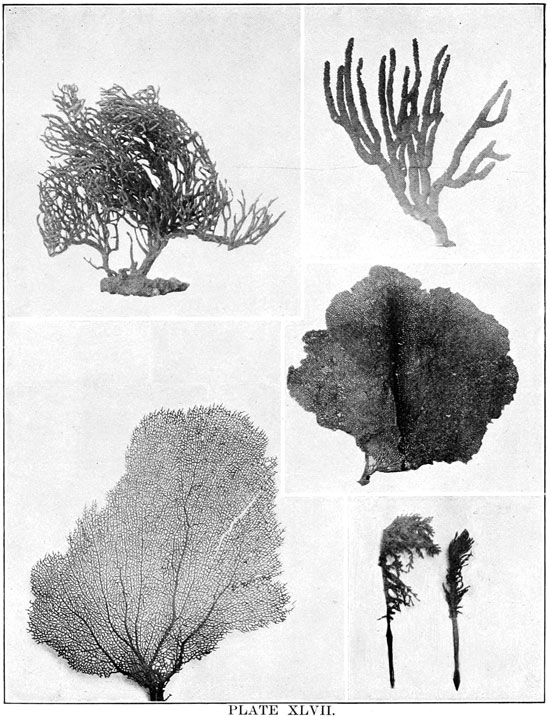
PLATE XLVII.
Leptogorgia rigida (a gorgonia). Eunicea lugubris (a gorgonia).
Gorgonia flabellum (a gorgonia). Leptogorgia Agassizii (a gorgonia).
Pennatula borealis and P. aculeata (sea-pens).
The sea-fans are colonies with a central, horny, flexible, and much-branched axis, covered, as in the sea-whips, with a layer of united polyps containing spicules of lime, which make a somewhat [pg153] firm crust. This, in dried specimens, breaks off readily. The colony branches profusely, or rather separates by fission, in one plane, the large and small branches making a network of fan-like shape and often of great fineness and intricacy. These fans attain a length of several feet and a corresponding breadth, and are abundant in semi-tropical as well as in more southern waters. In color they are red, yellow, brown, or purple.
ORDER PENNATULACEA SEA-PENS
These singular colonies resemble quill-feathers, such as are used for pens, and are named for this reason. The long, horny central axis is naked below, and is partly buried in the sand, but is not permanently attached. The upper portion of the axis has two rows of short, opposite, lateral branches; on the upper side of the branches the polyps live in separate inclosures. Spicules of lime are present in the substance of the branches, which gives them stability. Sea-pens are found at moderate depths and are widely distributed. They are highly colored and phosphorescent. [pg154]
TABLE SHOWING THE CLASSIFICATION OF THE CTENOPHORA DESCRIBED IN THIS CHAPTER
Class CTENOPHORA Order CYDIPPIDA (Two tentacles, retractile into sheaths) Genus Pleurobrachia P. rhododactyla Order LOBATA (Numerous lateral tentacles contained in a groove; body compressed; two large oral lobes) Genus Bolina B. alata B. septentrionalis B. vitrea Genus Mnemiopsis M. Leidyii Order CESTIDA (Ribbon-like form, from body being extremely compressed in the vertical plane) Genus Cestum C. veneris Order BEROÏDA (No tentacles; mouth very wide; gullet occupies greater part of body) Genus Idyia I. roseola I. cyanthina
CLASS CTENOPHORA COMB-JELLIES
toc
These are delicate, free-swimming, generally spherical bodies, resembling jellyfishes in outline, transparency, and gelatinous consistency, but differing from them widely in the manner of locomotion. They are called "comb-jellies" from the rows of flat cilia, arranged like the teeth of a comb, which run in eight meridional lines over the surface. It is by means of these cilia that the animal moves through the water. The little paddles are worked in unison, in single lines, or each one of them can be moved independently, and they give the animal varying and peculiar motions. The Ctenophora are nearly transparent, but have a prismatic coloring, caused by the waving cilia, and at night they are phosphorescent. They are widely distributed, being found in all seas.
The mouth of the animal opens into a gullet which extends two thirds through the length of the body. On each side of the gullet is a vertical tube. The two tubes unite at the base of the gullet, and from there run as a single canal to the end opposite the mouth, and open to the outside through two excretory pores. From the base of the gullet, where the tubes unite, two other tubes extend laterally, which divide and subdivide in a horizontal plane, becoming eight in number, and connect at the surface with the lines of cilia; then, dividing, run in opposite directions to the poles of the spherical body. The animal derives its nourishment and air through this circulatory system. A nervous system is situated at the pole opposite the mouth, in a small area surrounded by cilia, in the center is an eye-speck, or lithocyst. [pg156]
ORDER CYDIPPIDA
Genus Pleurobrachia
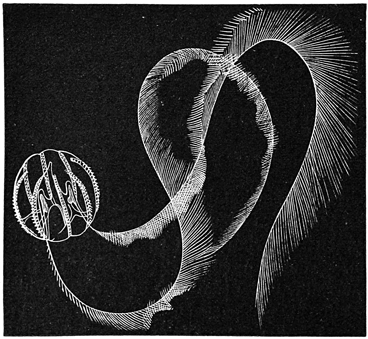
Pleurobrachia rhododactyla, in motion.
P. rhododactyla. A transparent spherical body, one inch to one and a half inches in diameter, with eight combs or plates of flat cilia extending from pole to pole. At one pole is the mouth, like a slit, at the other a small area in the center of which is an eye-spot. From the body hang two tentacles, half a yard or more in length, fringed with cilia. The tentacles are very contractile and can be rolled up or expanded with great rapidity; they take graceful curves as the animal moves rapidly through the water. Pleurobrachia has a pink tint, and prismatic colors play over it from the vibrating cilia. It is a beautiful and interesting creature to watch. Found along the shores of Massachusetts and Maine.
ORDER LOBATA
Genus Bolina
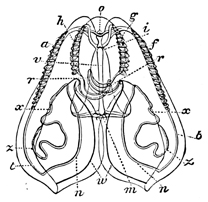
Bolina alata, seen from the broad side: o, eye-speck; m, mouth; r, auricles; v, digestive cavity; g, h, short rows of flappers; a, f, long rows of flappers; b, n, x, t, z, tubes winding in the larger lobes; i, base of gullet. About half natural size.
B. alata. Slightly oval in form; lower part of the body divided into two large lobes which hang below the mouth. Four of the swimming-plates are shorter than the other four and terminate in curious processes or short appendages called auricles. Bolina is about two inches in length, and is very delicate, transparent, and phosphorescent. Its contractile power enables it to vary in outline to a considerable extent. It has a slow undulating motion, and sometimes carries its lobes uppermost and open. Usually found associated with Pleurobrachia from Massachusetts northward.
B. septentrionalis. Found on the northern Pacific coast.
B. vitrea. A species found in Florida. [pg157]
Genus Mnemiopsis
M. Leidyii. Resembles Bolina in general form; often six to eight inches in length; gregarious, thousands often being collected together; exceedingly phosphorescent.
ORDER CESTIDA
Genus Cestum
C. veneris, Venus's girdle. This singular animal, although not an inhabitant of our seas, has its place in this group, and is shown here because of its very curious shape. In form it is flat and ribbon-like. Sometimes it attains a length of five feet, while in breadth it is but one or two inches. The mouth is midway in its length and is opposite the sense-organ or eye-spot. On each side of the mouth is a short tentacle which protrudes from a sac. Four of the swimming-plates are small; the other four extend along the edge of the body. Cestum moves by contractions of the body more than by the combs which fringe its edges. It is very transparent, with a violet hue, and is so delicate that it is difficult to capture it uninjured. Its habitat is the Mediterranean Sea. It may be seen among the zoölogical specimens in almost any museum.