Part II MARINE INVERTEBRATES (continued 3)
Reading edition
CLASS ECHINOIDEA SEA-URCHINS, CAKE-URCHINS, HEART-URCHINS
ORDER DESMOSTICHA SEA-URCHINS
toc
The shell of a sea-urchin consists of many calcareous plates, or ossicles, fitted closely together and forming a continuous exoskeleton. The plates are so united that externally the marks of juncture are not perceptible, but on the interior the shape of these plates is well defined. In examining such a shell, or test (they abound on the beach), it will be seen that its surface is covered with numerous hemispherical projections or knobs, which are grouped in double rows and run in meridional lines from one pole to the other of the more or less spherical body, separating it into ten divisions. Five of these divisions have perforations, or small pores in the plates of the shell, and are called the ambulacral zones or areas, because through these pores pass the small tubes, in the living animal, which connect the tube-feet, or ambulacra, with the radial water-canals and the ampullæ (see page 206). The wide spaces between these double rows of pores are called the interambulacral zones or areas. The ten spaces diverge from the peristome, or soft part around the mouth, in the center of the lower surface, and converge in the small area at the top or aboral side. In the center of this small circular dorsal space is the excretory opening, and surrounding it are ten plates, five of which have openings into the egg-sacs. One of them is larger than the others, and is modified to form the madreporic plate. The other five plates have eye-specks. The ambulacral zones terminate at these ocular plates.
The numerous spines which cover the animal are of three [pg219] kinds, and proceed from the knobs on the exoskeleton, over which they fit, forming ball-and-socket joints, which enable them to move in any direction. The long spines are ribbed, and seem to have no other function than that of protection. The second set, the pedicellariæ, are very peculiar small organs scattered over the surface in great numbers, and consisting of a head bearing three bill-like blades mounted on a long, flexible stalk. The office of some of the pedicellariæ is to remove waste from the excretory opening; this is passed down regular lines and dropped into the water, thus keeping the body clean. Others are constantly opening and shutting their forks, reaching in all directions and grasping and removing anything which may have become entangled in the spines. They also capture floating bits of seaweed, which they drag over the body to conceal it. A third set of projections are the sphæridia, small globular bodies said to be connected with perception.
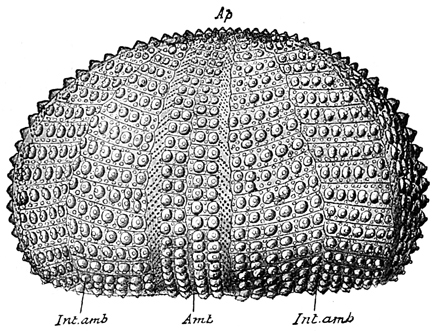
Test of sea-urchin, with the spines removed to show the arrangement of the plates, lateral view: Amb, ambulacral zone with its perforated plates; Ap, apical (aboral) pole; Int. amb., interambulacral zones. (From Bronn's "Thierreich.")
The spines vary greatly in size, number, and form in different species, and are such conspicuous features as to make the identification of species easy. In some the spines are solid and fluted; [pg220] in others they are hollow, sharp, and brittle; again in others they are short and silky, or very long and serrated, and so on. In one species they are so broad and flat as to resemble little sails. (See Dorocidaris.) (Plate LVI.)
The mouth, over which five long teeth project, is a part of Aristotle's lantern, which forms a curious and prominent feature in the center of the lower surface. Ten tentacles, like large tube-feet without suckers, lie around the mouth. The alimentary canal, starting in Aristotle's lantern, winds in two and a half coils around the inside of the shell, supported by mesenteries, and terminates in the excretory opening on the aboral surface. The sea-urchin has also a water-vascular system similar to that of starfishes (page 206). When the tube-feet are distended they project beyond the spines, and enable the animal to move slowly about; but sea-urchins are less active than starfishes, and although they are so well protected by spines and have few enemies after maturity, they lie in sluggish idleness in secluded places, and for further concealment often cover themselves with seaweeds or stones.
The sea-urchin has a nervous system, which starts in a ring around the mouth, ramifies through the body, and terminates in the eye-plates. The tube-feet and all the spines are under nervous as well as muscular control. Egg-sacs lie under the apex of the shell and open by separate ducts into the five plates on the small upper disk. Through these the eggs are discharged into the water, where they become free-swimming larvæ, called Pluteus. This immature sea-urchin (Pluteus) undergoes several curious transformations in the course of its development, and does not in any way resemble the mature animal. In spring the apical disk of the females will often be found covered with orange-colored ova, and that of the males with white sperms. In the growth of the animal, in its mature form, the shell enlarges by accretions of lime on the individual plates, or ossicles, of the exoskeleton, and by new plates formed around the apical disk. Sea-urchins are compared to starfishes folded over, the eye-specks on the ends of the rays meeting in a small area around the excretory opening, the ambulacra following spherical lines and leaving the mouth, as before, on the ventral side. [pg221]
The Echinoidea present great differences in shape, being more or less spherical, oval, discoid, and heart-shaped. These variations are associated with the differences of internal structure, the openings of the digestive tract being at the opposite poles in the spherical and oval forms, but excentric in the disk- and heart-shaped species. The sea-urchins are grouped in three orders in accordance with these variations. All are characterized by the absence of arms, by having the calcareous plates immovably united to form a firm test, and by the great development of the movable spines upon the plates.
Sea-urchins are sometimes called sea-eggs, perhaps from their shape, but possibly from the edible quality of some species, which are eaten by the natives of the shore, who take them at the spawning season, when the egg-sacs are distended. They are gregarious, and frequently are so crowded together as literally to pave the surface of rocks and the bottoms of tide-pools in sheltered places. The following is quoted from A. Agassiz: "Many of the Desmosticha along coasts exposed to the action of the waves live in cavities which they hollow out of the solid rock. This they do, not by means of any solvent, but by mere mechanical action. They chisel out with their teeth the solid rock by incessant turning round and round, and keep their cave, where they are frequently prisoners for the rest of their existence, up to the size required by the growth of their test and spines, by constant gnawing. On the coast of California the common Strongylocentrotus purpuratus occurs in this way. We find long tracts of shore, where this sea-urchin is common, completely honeycombed and pitted by cavities and depressions in which they seek shelter against the powerful surf continually beating against the rocks. The same species does not excavate in sheltered places, where the sea-urchins can find protection between the interstices of large fragments of rock or ledges more or less sheltered from the more direct action of the open sea."
Sea-urchins in cavities of granite rock, where the openings are too small for the animal to get out, are to be seen in thousands on the coast of France at Croisic, Lower Loire. Spines of large sea-urchins are used as slate-pencils by the missionaries in the Pacific Islands. [pg222]
Family CIDARIDÆ
Genus Cidaris
C. tribuloides. Similar to Porocidaris sharreri, but with thicker and stouter spines. Found from South Carolina to Brazil.
Genus Dorocidaris
D. papillota. A deep-water species which occurs off Chesapeake Bay and southward. It has slender spines with distinct longitudinal rows of serrations, and the spines are grouped in rosette-like forms over the small spherical body.
D. Blakei. This species is very peculiar in having broad, fan-shaped spines; vermilion in color. Found in deep water in the Bahamas and West Indies. (Plate LVII.)
Genus Porocidaris
P. sharreri. This species occurs, in deep water, off the coast of North Carolina and thence southward to the West Indies. The shell is light greenish-pink. The spines are white, with brownish-pink at the base, pointed, three and a half inches long, and surrounded at the base with small, flat, triangular, secondary spines. (Plate LVII.)
Family ARBACIADÆ
Genus Arbacia
A. punctulata. A small species found in shallow water on shelly and gravelly bottoms from Massachusetts to Mexico, and common in Long Island Sound. The shell is about one inch in diameter; the spines are rather thick and one half to three quarters of an inch long. The color varies from deep violet—almost black—to straw-color, and the spines are tipped with brown. The South Carolina species are usually brick-red in the bare interambulacral spaces, with darker sutures, and spines tipped with same color. The animal walks by means of its spines, with a tilting motion, and advances quite rapidly. (Plate LVII.)
Genus Cœlopleurus
C. floridanus. This beautiful sea-urchin is taken on the Florida reefs. The very brittle spines are one to four inches long, and are banded with carmine and white. The shell has zones of light chocolate-color alternating with orange and yellow.
Family DIADEMATIDÆ
Genus Diadema
D. setosum. Spines very brittle, and from one to two and a half inches long; jet-black. Found on the Florida reefs. (Plate LVII.)
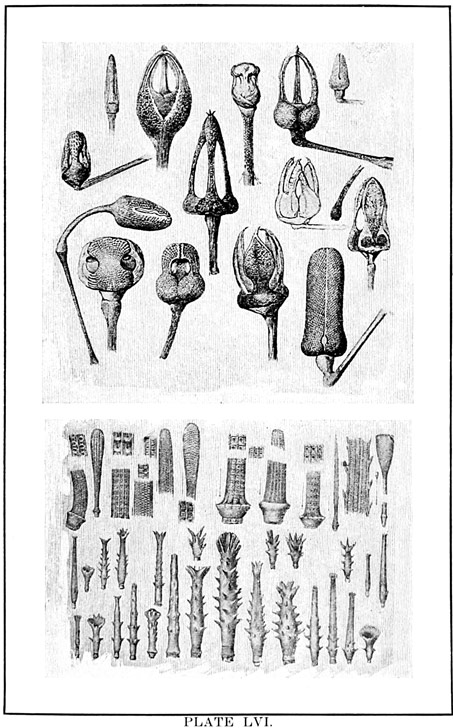
PLATE LVI.
Pedicellariæ of sea-urchins.
Spines of sea-urchins.
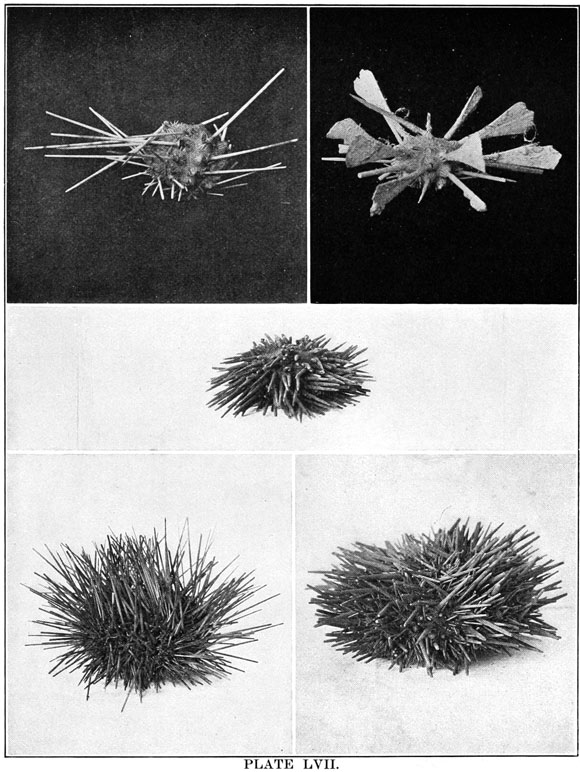
PLATE LVII.
Porocidaris sharreri. Dorocidaris Blakei.
Arbacia punctulata.
Diadema setosum. Strongylocentrotus franciscanus.
Family ECHINOMETRIDÆ
In this family the ambulacral plates have several pairs of pores.
Genus Echinometra
E. subangularis. This species, which ranges from South Carolina to Brazil, and is also found in Bermuda, is common on mud-flats and is easily distinguished by its oblong or elliptical shape. Its shell is about three inches long in its widest portion. The spines are one half of an inch to one inch long, thick at the base and tapering to a point. The color is dark purplish-green to deep violet—almost black.
Genus Strongylocentrotus
S. drobachiensis. This sea-urchin (which bears, perhaps, the longest name in technical nomenclature and has no other, unless that of "sea-egg," which is applied indiscriminately to all sea-urchins) is a very common species in shallow waters of the northern temperate zones. It extends as far as New Jersey on the Atlantic and to the State of Washington on the Pacific coast. Although it is found as far south as New Jersey, it is there rare and small; but farther north, especially on the coast of Maine, it is exceedingly abundant. It is green or greenish-purple in color, and resembles somewhat a large chestnut-bur. The body is circular, somewhat depressed (but of variable thickness), and about two inches in diameter. The spines are moderately slender and longitudinally striated. It feeds partly on diatoms and other small algæ, which it cuts from the rocks with its sharp teeth. It also devours dead fishes, bones and all, and in return is swallowed whole by the wolffish and other large fishes. It moves by means of the tube-feet on its oral surface, slowly dragging itself along, and frequently is seen with seaweed, a stone, or some other substance on its back, which it places there with its pedicellariæ for the purpose of concealment.
S. purpuratus. The common purple sea-urchin of the west coast, from Sitka to Lower California, found in abundance on the rocks just beyond low-water mark. It is about one and a half inches in diameter, with rather thick, pointed, and fluted spines.
S. franciscanus. This is the largest species of the west coast, the shell measuring sometimes five inches across, and the thick spines one and a half inches in length. The tubercles on the naked shells are very prominent, and the zones are very clearly marked. It is purple in color and is often found in great quantities at low-water mark. It ranges from Alaska to Lower California. (Plate LVII.)
Family ECHINIDÆ
In this family the ambulacral plates have but three pairs of pores. [pg224]
Genus Echinus
E. gracilis. This is a deep-water species, which occurs from Cape Cod southward. The shell is nearly spherical, but is a little depressed on the oral side, and has twenty bands of color, alternately green and white. The spines are short and thin.
Genus Toxopneustes
T. variegatus. This is the common species of the Southern States, from North Carolina southward, and is found in shallow water in protected places. The shell is nearly globular; the spines vary in thickness and color, some being long, slender, and greenish, while others have stout and blunt spines of a yellowish or violet tint.
ORDER CLYPEASTROIDEA CAKE-URCHINS
The animals of this order, commonly known as sand-cakes or sand-dollars, are flat and circular like disks. Sometimes they are cut at intervals on the margin; again they have slits through the body (lunules). They have a well-marked star-shaped figure on the dorsal surface. This figure is formed by the ambulacra, or tube-feet, which run in five rounded or petal-shaped lines on the under surface. The mouth, in Aristotle's lantern, is in the center of the somewhat concave ventral surface, the petal-like ambulacral zones meeting at the central space. The excretory opening is on the margin of the disk, at a point between two of the sections of the star-like figure. This marks the posterior part of the body, while the opposite arm of the star marks the front or anterior end. The spines are very fine and silky, and are spread abundantly over the whole animal. Clypeasteroids are mainly found in sand considerably below low-water mark, though some species thrive where they are exposed to the surf on open sandy beaches.
Family ECHINANTHIDÆ
Genus Clypeaster
C. ravenellii. This species occurs in deep water from South Carolina southward. The disk is about four inches in diameter, and is raised [pg225] in the center into a large cone. The ambulacra run down the sides of the cone in straight lines, and around the base is a depressed area which emphasizes a thick border which extends around the scalloped margin. The color is light yellowish-brown. (Plate LVIII.)
Genus Echinanthus
E. rosaceus. This is a large species, oblong in shape, about four to five inches across and much rounded on top, the body being about two inches thick. The ambulacral zones are depressed, leaving prominent elevations which make a very conspicuous figure on the top. The color is light chocolate-brown. Found close to the shore off the coasts of Florida, South Carolina, and the West Indies.
Family SCUTELLIDÆ
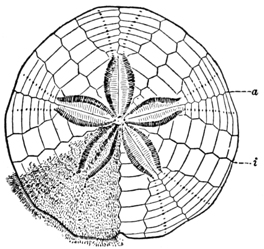
Echinarachnius parma, the sand-dollar. Much smaller than natural size.
Genus Echinarachnius THE SAND-DOLLARS
E. parma. This species, the shells of which are very common objects on sand-beaches from New Jersey northward, is generally known as the sand-dollar. The animals have flat circular disks about three inches in diameter. The ambulacral zones, in five petal-like lines, form a distinct figure on the upper surface. The mouth is in the center of the ventral surface, and the excretory opening is on the edge of the disk. In life they are covered with short, fine, silky spines, which seem like hair, and are purplish-brown in color, but turn green when taken from the water. The sand-dollars are exceedingly abundant off Nantucket Shoals, where the bottom seems paved with them. They are eaten in great numbers by flounders, cod, and haddock. When put in alcohol they stain it a dark color. Fishermen prepare an indelible ink by grinding to powder these animals and mixing it with some liquid. This species is also found on the northern Pacific coast.
E. excentricus. This is the common sand-dollar of the Pacific coast. The disk, instead of being circular as in E. parma, is somewhat straight across the posterior end, and the posterior ambulacral zones are shorter than the other three. The upper side of the disk is raised, forming a cone-like elevation, the apex being the center of the figure.
Genus Mellita
M. testudinata. The disk is rounded in front and straight in the back. Four long, narrow lunules, or cuts, occur on the sides in line with the ambulacral, petal-shaped zones, but do not extend quite to the edge of the disk; and a wide lunule occurs in the interambulacral space [pg226] of the posterior end. The three anterior zones are shorter than the posterior pair. On the upper side of the disk the spines all turn toward the periphery. The color of the living animal is greenish-blue. It is very abundant from Cape Hatteras southward in shallow water, and the shells are sometimes found as far north as Cape Cod. (Plate LVIII.)
Genus Encope
E. michelini. Ambulacral zones unequal in size, the posterior pair usually longer than the others; lunules like notches in the margin, with a large one opening between the posterior ambulacral zones nearly in the center of the disk; disk rounded in front and square at the back. Common on the coasts of southern Florida and the Gulf of Mexico in shallow water. (Plate LVIII.)
ORDER SPATANGOIDEA HEART-URCHINS
The Spatangoidea, or heart-urchins, have heart-shaped or thick elliptical bodies. The mouth and excretory opening are both away from the center and on the ventral side. These animals seem deformed, so much are they out of symmetry and so different in outline from the other orders of the class. The ambulacral zones are in circles, or petaloid in outline, as in cake-urchins, but are not continuous, and the anterior one is usually unlike the others and frequently without pores. The entire body is covered with spines, and these are the chief organs of locomotion; the greater part of them turn backward, giving the living animal the semblance of a porcupine. The mouth is protected by a projecting plate, but Aristotle's lantern is absent in this order. The anatomy is in general the same as in the other orders, but the organs are turned in conformity with the inclosing shell. Most of these animals bury themselves in sand or mud and live in deep water; a few only are littoral species.
Family SPATANGOIDÆ
Genus Moira
M. atropos. Size about one inch by one and a half inches, and one inch thick; color yellowish-white, with brown spines. Found from North Carolina to Florida, from the shore to deep water.
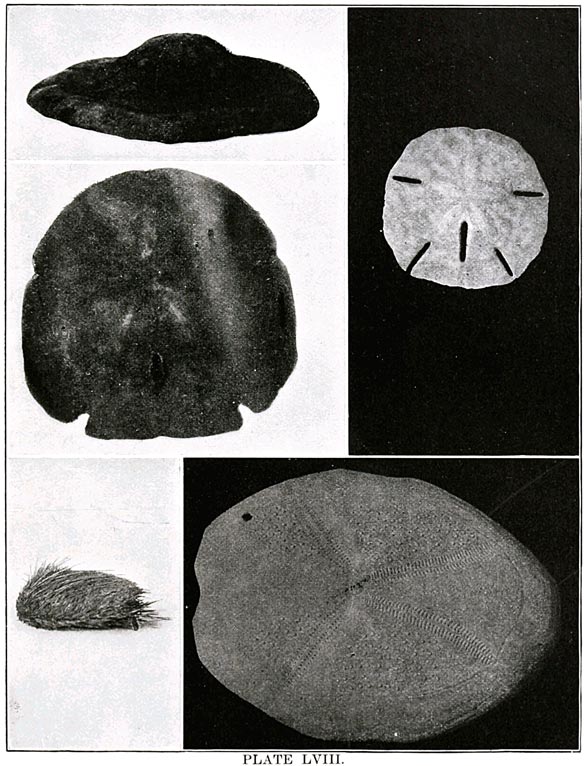
PLATE LVIII.
Clypeaster ravenellii. Mellita testudinata.
Encope michelini. Test of Metalia pectoralis.
Lovenia cordiformis.
Genus Lovenia
L. cordiformis. About one inch by one and a half inches thick; reddish in color; resembles a little porcupine. Found on the southern California coast. (Plate LVIII.)
Genus Schizaster
S. fragilis. One and a half by two inches in size, and one inch thick; color brownish. Lives in deep water off the eastern coast.
Genus Metalia
M. pectoralis. A very large heart-urchin, found on the southern coast of Florida and in the West Indies in shallow water. It is, perhaps, the largest species found, being six to eight inches long and proportionately wide and thick. The shell is thin, more or less elliptical, and densely clothed with long reddish-gray spines. (Plate LVIII.)
Genus Brissopsis
B. lyrifera. A beautiful deep-water species, found off the coasts of Florida and the Gulf of Mexico. It has a red body with pale-yellowish spines. In size it is about two by two and a half inches, and is thickest on the posterior end. It is thickly clothed with long curved spines, some of which form two long tufts in the back. [pg228]
TABLE SHOWING THE CLASSIFICATION OF THE HOLOTHUROIDEA DESCRIBED IN THIS CHAPTER
Class HOLOTHUROIDEA Order ELASIPODA (Deep-sea forms; tube-feet in zones near together) Order PEDATA (Well-developed tube-feet and false ambulacra) Genus Thyone T. briareus Genus Pentacta P. frondosa Genus Lophothuria L. fabricii Order APODA (Without radial canals, tube-feet, or respiratory trees) Genus Synapta S. tenuis S. roseola S. rotifera Genus Caudina C. arenata
CLASS HOLOTHUROIDEA SEA-CUCUMBERS
toc
The holothurians, or sea-cucumbers, although in appearance quite unlike starfishes and sea-urchins, have the characteristic ambulacral zones and other features of the group. In form they are cylindrical, and, when the tentacles and tube-feet are retracted, resemble fat worms; when fully expanded they are somewhat like sea-anemones, the tentacles forming a rosette-like top. The walls of the body are tough and muscular, with small calcareous deposits or spicules of various shapes in the skin. The mouth is at one end, the excretory opening at the other, and along the body are double rows of tube-feet. Often instead of tube-feet, or together with them, are conical processes without suckers. The ambulacra, when arranged in regular zones, are used for locomotion only in the lines running from the madreporic plate. In some species three of the zones are near together, and form a kind of sole on which the animal creeps; again the tube-feet are wholly suppressed, as in Synapta. Besides progressing by means of these suckers, the holothurians move, as do worms, by the extension and contraction of the body. The inner surface of the tough membrane inclosing the body is lined with powerful longitudinal and transverse muscles, by means of which the creature contracts and lengthens its body and changes its form in a wonderful manner. Around the mouth are tentacles, which are often much branched and are used as organs of touch and smell, and sometimes have an ear-sac at the base. From the mouth the food-canal, making one long coil, extends to a chamber [pg231] (cloaca) at the other pole. The cloaca gives off a pair of much-branched respiratory trees, which are constantly supplied with water by the contractions of the cloaca. At the base of one of the respiratory trees are singular structures known as Cuvierian organs. They are numerous, viscid, glandular tubes, which the animal can throw out, and which will adhere closely to almost anything. The holothurian has a water-vascular system, the madreporic plate being near the mouth, but not opening to the outside, and a nervous system which starts from a ring which lies around the mouth. The egg-sacs are branched tubes, often highly colored, which open to the outside, close to the wreath of tentacles surrounding the mouth.
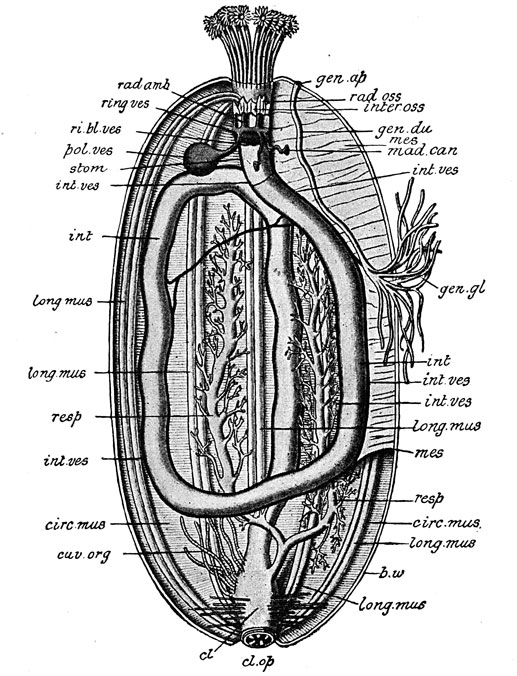
Internal organs of a Holothurian, as seen when the body-wall is divided along the middle of the dorsal surface: b.w., body-wall; circ. mus., circular layer of muscle; cl., cloaca; cl. op., cloacal opening with five teeth; cuv. org., Cuvierian organs; gen. ap., genital aperture; gen. du., genital duct; gen. gl., genital gland; int., intestine; inter. oss., interambulacral ossicles; int. ves., intestinal vessels; long. mus., longitudinal band of muscle; mad. can., madreporic canals; mes., mesentery; pol. ves., Polian vesicles; rad. amb., radial ambulacral vessel; ri. bl. ves., ring blood-vessel; resp., respiratory trees; ring-ves., ring-vessel of the ambulacral system; stom., stomach.
The larvæ, when free-swimming, are called Auricula. In the deep-water species, Cucumaria crocea and Psolus ephippiger, the eggs, when discharged, and the young are carried on the back of the mother. In Cucumaria lævigata there is a brood-pouch, while in Synapta viviparia the young develop in the body-cavity.
The holothurians have the singular power of ejecting the whole of their internal organs and of growing them again in case they escape the enemy they have endeavored to elude by this strange method. They also turn themselves inside out, as it were, as if from nausea, when confined in water too stale for their uses. Often the viscera are ejected through holes in the sides of the body broken by violent muscular contractions.
Holothurians are generally distributed through all seas, but are congregated in greatest numbers in Eastern seas. Their habitat extends from shallow to very deep water. They are found in tide-pools, on rocks, and in sand or mud. Like worms, they live on organic particles contained in mud and sand, which they take into the gullet and pass through the alimentary canal.
ORDER PEDATA
Genus Thyone
T. briareus. This is a large purple holothurian, found in shallow water from Texas to Cape Cod. It is four to five inches long and one inch or more thick, purple in color, and thickly covered over its whole surface with prominent papillæ. [pg232]
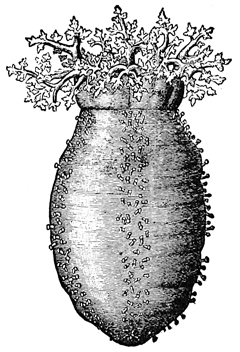
Pentacta frondosa, the sea-cucumber.
Genus Pentacta
P. frondosa. This animal is commonly called the sea-cucumber, and the popular name somewhat expresses its form, but it has the power of changing its shape in a most surprising manner. Sometimes it will be nearly globular, again long and thin, or it may be constricted like an hourglass. When at rest the body is ovate and somewhat pentagonal. On the angles are double lines of suckers, and in the interambulacral zones are a few scattered false ambulacra. The surface is nearly smooth, very dark purple on one side, and inclined to whitish on the other. Ten much-branched tentacles surround the mouth. The animal, when grown and expanded, measures fifteen to eighteen inches in length. This species is found throughout the whole length of both the east and the west coasts. It is very plentiful on the Maine coast in tide-pools and on the rocks at low-water mark. The genus ranges over the greater part of the globe. The tough muscular body is said to be edible, tasting somewhat like lobster, or trepang (Holothuria edulis), which is found on coral reefs in Eastern seas and is much valued as food by the Chinese. The internal organs of P. frondosa are highly colored, making its anatomy easy to trace. The muscular system is plainly defined.
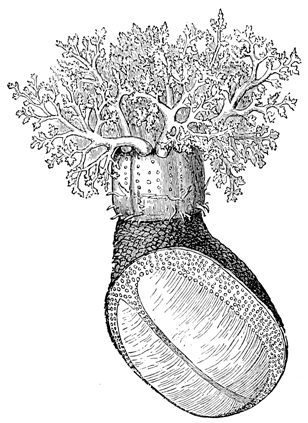
Lophothuria fabricii, showing under surface with three rows of ambulacra.
Genus Lophothuria
L. fabricii (Verrill), Psolus fabricii (Düben), Cuvieria squamata (D. and K.: Agassiz). The body in this species is covered with rounded overlapping scales and numerous granulations, and when it is retracted is about two and a half to three inches long and about one inch thick. [pg233] Rows of tube-feet lie near together, on a flat under surface, and form a kind of sole on which the animal creeps. The oral end of the body is a little raised and bears ten tentacles; these tentacles are profusely and finely branched, and when expanded are about as long as the body. The aboral end is obtuse and a little raised. Around the oral and anal openings the scales are grouped, forming circles in those regions. This holothurian is bright red in color, and when expanded is a beautiful object, perhaps the most attractive in appearance of any in the class. When retracted it has the aspect of an ascidian, and for a time was supposed to belong to that group. It is found on the New England coast on the under side of large shelving rocks.
ORDER APODA
Genus Synapta
S. tenuis. This curious animal is long and slender, and so transparent that its internal organs are clearly visible. Around the mouth are a circular tube and a wreath of twelve branching tentacles. There are no ambulacra. Little spots scattered irregularly over the surface show, when highly magnified, small warts, each one of which has a calcareous projection shaped like a little anchor. By means of these anchors and by the contractions of its body the animal moves through the mud or sand in which it lives, near low-water mark. The sand is collected into rings at the oral end and pushed downward until the whole animal is inclosed in a sand-tube. When empty Synapta is white and transparent, and the digestive canal may be seen wound in a spiral throughout its length; but when gorged with food, sand, pebbles, and shells can be distinctly seen filling the food-canal, and the body then has a dark-gray color. Synapta grows to a length of eighteen inches or more, but is constantly breaking pieces off its posterior end by muscular contractions. When kept in confinement it soon commences to constrict its body at various points, and after a few hours there is nothing left but a mass of fragments. It is viviparous, that is, it carries its young in the body-cavity; the eggs are hatched, and the young approach maturity before they are expelled. This species ranges from Cape Cod to North Carolina, and can be found in the upper part of its burrows when the tide is out.
S. roseola. This species occurs in the same localities as S. tenuis, and differs from it mainly in color, which is pale red, due to minute red spots scattered through the skin.
S. rotifera. A species found in Florida. It is light purplish in color, and has eight or ten branches on each of the twelve tentacles. In this species the spicules of lime in the skin are shaped like wheels instead of anchors.
Genus Caudina
C. arenata. About four inches long and tapers to the ends; the posterior end sometimes narrowed to a long, slender, tail-like extremity; tentacles around the mouth resemble cloves. It lives in sand and may be found on the New England coast, washed ashore after a storm. [pg234]
Class CRINOIDEA Genus Pentacrinus Genus Comatula
CLASS CRINOIDEA FEATHER-STARS AND SEA-LILIES
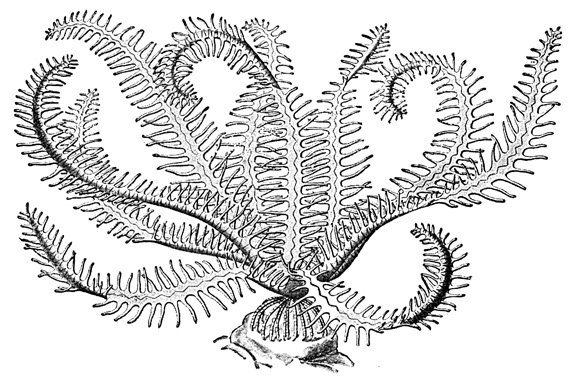
The feather-star (Antedon), illustrating the Comatula form of crinoid.
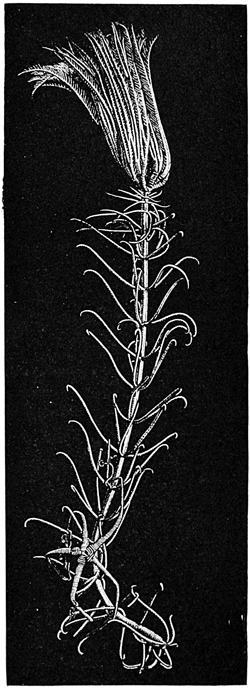
Pentacrinus asteria.
The crinoids are inhabitants of deep water, where they grow in great numbers, forming beds of sea-lilies. Their general form, which suggests the lily, and their feather-like manner of branching, give them the two common names of sea-lilies and sea-feathers. They have a long, jointed stalk, one end of which is attached, while the other bears the disk of the animal. From the disk emanate five arms, which divide near the base, making [pg235] ten arms in all. The arms have short branches along the sides. Ambulacral grooves follow the center of all the arms and branches. The mouth is in the center of the upper side, which in this case is the ventral surface. The genus Pentacrinus remains permanently attached, but Comatula, at a certain stage of development, separates from the stalk and swims freely about by means of its arms. It can attach itself temporarily by tubular processes, which are developed on the dorsal surface at the point where the stem was attached. The ossicles, or plates which cover the dorsal surface, are free, making the crinoid an animal of innumerable joints.
The crinoids are particularly interesting from the fact that they have existed from early geologic times, and their history is written in stone. In the early ages they were the only class of echinoderms, and their evolution into other forms can be traced through successive geologic periods. They existed in such vast numbers that the fossil forms are plentiful and are familiar to every student of geology, and are known as stone-lilies and encrinites. To-day they are decadent, there now remaining only twelve of the two hundred genera which existed formerly. A fine bed of crinoids is found off Cuba, on the slope of the coast where the water rapidly deepens from one hundred to two hundred fathoms. [pg236]
Although the crinoids are deep-water forms, and are never found on the beach, they are given here because they follow in the system of classification and illustrate another curious class of echinoderms. The brief description given may add interest to the fossil forms to be seen in museums.
VI ARTHROPODA
TABLE SHOWING THE CLASSIFICATION OF THE ARTHROPODS DESCRIBED IN THIS CHAPTER
Phylum ARTHROPODA Class CRUSTACEA Subclass Entomostraca (Crustacea of small, often of almost microscopic minuteness, and of comparatively simple organization; appendages have little differentiation) Order PHYLLOPODA (Appendages resemble leaves; mostly fresh-water species) Suborder EUPHYLLOPODA (Phyllopoda of considerable size, bearing ten to sixty pairs of leaf-like swimming-feet) Suborder CLADOCERA (Small phyllopoda; body laterally compressed; carapace like a bivalve shell; four to five pairs of swimming-feet;chief organs of locomotion are the biramous antennæ; abdomen devoid of appendages. They abound in fresh water, are very prolific, and afford a large amount of food to fresh-water fishes) Genus Daphnia Genus Leptodora Genus Moina Genus Polyphemus Order OSTRACODA (Resemble minute bivalve shells; swim by antennæ; body unsegmented; appendages seven pairs only) Genus Cypris (fresh-water) Genus Cypridina (marine) Order COPEPODA (Small size; body long, segmented; four to five pairs of once-branched appendages on thorax; abdomen without appendages; abundant in fresh and salt water; many forms parasitic) Genus Cyclops Genus Cetochilus Genus Sapphirina Genus Siphonostomata Genus Nicothoë Order CIRRIPEDIA (Imperfectly segmented; fixed or parasitic during adult life; inclosed in skin strengthened by calcareous plates; abdomen rudimentary; appendages biramous, usually six pairs) Genus Lepas L. anatifera L. striata L. pectinata Genus Balanus B. balanoides B. eburneus B. rugosus B. geniculatus B. tintinnabulum Suborder RHIZOCEPHALA (Parasitic.) Genus Sacculina (parasitic on crabs) Genus Peltogaster (parasitic on hermit-crabs) Subclass Malacostraca (Highly organized Crustacea, usually of considerable size; appendages much differentiated) Order PHYLLOCARIDA (Small; covered with bivalved carapace; thoracic feet leaf-like; abdominal feet biramous; posterior segment terminates in two long spines; mostly fresh-water species) Order SCHIZOPODA (Small; transparent; shrimp-like; thorax more or less completely covered with soft carapace; thoracic appendages biramous; eyes on stalks) Genus Mysis Without gills or thoracic legs M. sternolepis Genus Euphausia With gills or thoracic legs Order DECAPODA (Thoracic segments unite with head and form cephalothorax, which is covered by carapace; eyes stalked; maxillipeds have exopodites; five pairs of walking-feet without exopodites) Suborder MACRURA (Abdomen usually longer than cephalothorax and commonly extended; rostrum usually prominent; eyes not inclosed in orbits; antennæ and antennules large; antennæ have exopodites. The Set {Penæus, Palæmonetes, and Crangon} are Free-swimming Forms: Shrimps and Prawns.) Genus Penæus P. setiferus P. brasiliensis Genus Palæmonetes P. vulgaris Genus Crangon C. vulgaris C. franciscorum Family ASTACOIDÆ (Creeping Forms: Lobsters and Crawfish) Genus Homarus H. americanus Genus Panulirus P. interruptus P. argus Genus Scyllarus Suborder ANOMURA (Anomalous Forms: Approaching the Brachyura) Family DROMIDÆ Genus Hippoconcha H. arcuata Family PAGURIDÆ Genus Pagurus P. bernhardus P. pollicaris P. longicarpus Genus Clibanarius C. vittatus Genus Pylopagurus Family CENOBITIDÆ Genus Cenobita C. diogenes Family HIPPIDÆ Genus Hippa H. talpoida H. analoga Genus Albunæa A. gibbesii Family PORCELLANIDÆ Genus Porcellana P. sayana P. sexspinosus Genus Petrolisthes P. armatus Family LITHODIDÆ (Fifth pair of feet folded under the carapace) Genus Lithodes L. maia Genus Echidnocerus E. cibarius E. foriminatus Genus Acantholithodes A. hispidus Genus Cryptolithodes C. sitchensis Genus Phyllolithodes P. papillosus Suborder BRACHYURA (Abdomen shorter than cephalothorax, and permanently folded under it; eyes inclosed in orbits; antennules and antennæ small. Of these, the Set {Cancroidæ, Grapsidæ, Ocypodidæ and Maiidæ} are the "Walking Crabs".) Family PORTUNIDÆ (Swimming crabs) Genus Carcinides C. mænas Genus Callinectes C. sapidus Genus Ovalipes O. ocellatus Family CANCROIDÆ Genus Cancer C. irroratus C. borealis C. magister C. productus C. antennarius Genus Menippe M. mercenaria Genus Eupanopeus E. herbstii Genus Eurypanopeus E. depressus Genus Neopanopeus N. texana Genus Rhithropanopeus R. harrisii Family GRAPSIDÆ Genus Hemigrapsus H. nudus H. oregonensis Genus Pacygrapsus P. crassipes Family OCYPODIDÆ (Sand- and fiddler-crabs) Genus Ocypoda O. arenaria Genus Uca U. minax U. pugnax U. pugilator Family MAIIDÆ (Spider-crabs) Genus Libinia L. dubia L. emarginata Genus Hyas H. coarctatus H. lyratus H. araneus Genus Loxorhynchus L. crispatus Genus Pugettia P. gracilis Genus Sternorhynchus S. sagittarius Genus Epialtus E. productus Genus Pitho P. aculeata Genus Lambrus L. pourtalesii Family CALAPPIDÆ Genus Calappa C. flamma Family PINNOTHERIIDÆ Genus Pinnotheres P. ostreum Order STOMATOPODA (Abdomen very large; second pair of thoracic legs very large; gills borne on abdominal segments) Genus Squilla S. empusa Order CUMACEA (Small, shrimp-like) Genus Diastylis D. quadrispinosus Order ARTHROSTRACA (No carapace, as a rule; six to seven pairs of walking-legs; eyes sessile) Suborder AMPHIPODA (Body usually compressed laterally) Genus Orchestia O. agilis Genus Talorchestia T. longicornis Genus Gammarus G. locusta Genus Chelura C. terebrans Genus Caprella C. geometrica Suborder ISOPODA (Body depressed or flattened) Genus Cirolana C. concharum Genus Limnoria L. lignorum Genus Sphæroma S. quadridentatum Genus Idotea I. marina I. ochotensis I. metallica I. wosnesenskii Genus Chiridotea C. cæca C. entomon Class MERISTOMES Order XIPHOSURA Genus Limulus L. polyphemus Class PANTOPODA (Lang) Order PYCNOGONIDA Genus Phoxichilidium P. maxillare
TERMS USED IN DESCRIBING CRUSTACEA
Abdomen: The posterior part of the body.
Antennæ: Articulated appendages which immediately precede the mouth.
Anten´nules: The anterior of the two pairs of feelers of the head.
Bira´mous: Having two branches.
Carapace: A thin chitinous shell covering the cephalothorax.
Cephalic: Pertaining to the head.
Cephalotho´rax: The united head and thorax.
Chela: The pair of pincers, or claw, which terminates some of the appendages.
Che´liped: A leg with chela, or claw, at the end.
Endop´odite: The inner one of the two main divisions of the limb.
Epime´ra: Divisions on the ends of the segments of amphipods and isopods, and belonging to the legs.
Epip´odite: A third branch of a limb.
Epis´toma: A triangular area in front of the mouth.
Exop´odite: The outer one of the two main branches into which the typical limb of any segment is divided.
Gastric mill: The first half of the stomach, where food is ground.
Mandibles: The pair of appendages next behind the antennæ.
Maxil´læ: The first pair of appendages after the mandibles.
Maxillipeds: The three pairs of appendages after the maxillæ.
Metame´res: Segments.
Orbits: Eye-cavities, peculiar to the higher Crustacea.
Prosto´mium: The region in front of the mouth; the preoral part of the head.
Rostrum: The beak in front of the head.
Segment: A part cut off or marked as separate from others.
Somite: A segment of the body.
Squame: A scale.
Telson: The last segment of the abdomen.
Thorax: The middle part of the body.
ARTHROPODA
toc
This subdivision of the animal kingdom includes insects, centipedes, spiders, and crustaceans, which together constitute more than half the known species of animals. Although these animals are so unlike in general appearance, it is easy to recognize the common characteristics which place them together in one group. The name Arthropoda, meaning "jointed-footed," suggests perhaps one of the most obvious points of resemblance. The Arthropoda have bilateral symmetry, one side of the body being like the other; they are covered with a horn-like material (chitin); they are divided into segments; the segments have appendages; and the appendages are jointed so as to admit freedom of motion. Their manner of growth is peculiar; they cast off their rigid external coverings and secrete larger coats of mail, and at these periods increase in size or undergo metamorphosis.
There are such modifications of these general features as the habits of the different species demand. For instance, the appendages may be constructed for walking, swimming, boring, sucking, or the seizure and preparation of food. In some animals the appendages form a part of the breathing-organs, in others are used as organs of sense. Every detail of the organism, down to the hairs, has its special use and function.
CLASS CRUSTACEA
The crustaceans vary in size from microscopic minuteness to two feet or more in length. The giant crab of Japan (Kaempferia kaempferi) exceeds this, being commonly from eight to twelve feet [pg245] across the arms, and is said to reach even greater proportions. Crustaceans live on land and sea, and in both fresh and salt water; they may be parasitic, sedentary, or free and active. There are said to be over ten thousand species, which include crabs, lobsters, shrimps, beach-fleas, wood-lice, barnacles, and water-fleas. Nine tenths of the species are marine; of these some are pelagic, and their transparent forms constitute a part of the plankton. Others live on the bottom in deep water and attain a large size. A vast number live in the littoral zone and form a considerable part of that crowded community. They are scavengers and freebooters, being great fighters, as well as predatory in their habits. As a rule, they feed on dead organic matter, which they consume in surprising quantities; some have also a vegetarian diet. They have, like starfishes, the singular power of throwing off their limbs and growing new ones.
The Crustacea derive their name from the nature of their crust or covering. This is earthy and brittle, not stony, like the shells of mollusks. This crust, or exoskeleton, has various degrees of firmness, from that of a delicate polished cuticle, seen in small forms, to the heavy armor of some crabs and the shell-like character of the covering of barnacles.
The lobster and crab are perhaps the most comprehensive examples as well as the largest in size of the class, the vast majority of the species being minute forms. The ocean swarms with varieties too small to be noticeable to the naked eye.
It is the province of Crustacea to consume decaying organic matter, both animal and vegetable, and in doing this they perform a great service in purifying the waters of the pool, the shore, and even the sea. Not only in this are they serviceable, but to a great extent they serve as food for other animals, their flesh being palatable and preferred to that of other animals whose diet would seem to make them more wholesome. The small forms exist in such myriads, and increase so rapidly, that, although extremely small, they furnish an inexhaustible supply of food. Even some whales subsist upon these minute animals, and for man the larger species are articles of diet that are counted among the luxuries. The crustaceans are remarkable for their varied forms and for their [pg246] perfect adaptation to many different conditions of life. There is no class in the animal kingdom which presents so wide a range of organization, or whose structure deviates so widely from the type form. These differences lie chiefly in the external characters and in the structure of the appendages.
Some species are solitary, like lobsters and crabs; others, like shrimps, are gregarious and live in immense shoals. In the habits of these animals there is much which excites wonder and interest.
ANATOMY OF THE HIGHER CRUSTACEA
toc
The body of a crustacean is divided into segments, which are sometimes distinctly separated, like joints, and sometimes fused into one piece. The head part is called the cephalic portion, the middle section is the thorax, and the posterior part is the abdomen. The horn-like covering of the thorax is the carapace; where it projects over the head it is the rostrum. When the head and thorax are united, as in most Crustacea, the anterior or front portion of the animal is called the cephalothorax. Each segment has a pair of appendages. Each appendage has a joint attached to the body; from this arise two jointed branches, the endopodite and the exopodite, the inner and the outer foot. The appendages are modified to perform special functions. In front of the mouth are two pairs: the smaller ones are the antennules and have ears at the base; the larger ones are antennæ and are feelers. At the base of the antennæ are the green glands, said to have renal functions. Both the antennules and the antennæ are fringed with hairs, which aid in the sense of touch and perhaps of smell. On each side of the mouth are the mandibles. Then come the maxillæ and the maxillipeds, used in capturing and tearing the food and conveying it to the mouth. Thus it will be seen that some of the appendages around the head are connected with the senses, and others are used in eating. Those of the thorax are for walking; those of the abdomen for swimming, guarding the eggs, etc. The food taken into the mouth passes into the stomach through a short passage. The stomach is divided into two parts. The front [pg247] one contains three long teeth which meet laterally and grind the food; this is known as the gastric mill.
When sufficiently fine, the food passes through a strainer of stiff bristles into the smaller portion of the stomach, where it is partially digested, and from there enters a long, straight intestine which reaches the length of the body and opens to the outside on the under side of the telson, or last segment. A large liver also pours its secretions into the intestine. The green substance commonly called "fat" in lobsters is the liver.
The heart consists of an elongated tube, or a short sac, which lies directly under the integument of the back. From this heart-sac, blood, which is colorless, is sent by arteries to all parts of the body; it then collects in spaces called venous sinuses, from which it goes to the gills, and thence back to the heart.
The nervous system begins in a large ganglion in front of the mouth, called the brain; from this two branches arise, which pass on each side of the digestive organs, meeting in ganglia in each segment and extending the whole length of the body. The gills, by which the animal breathes, are upon the limbs, or on the walls of the body immediately adjacent to them, and are generally inclosed in special chambers. In lobsters and crabs two such chambers are found under the flaps of the carapace, above the walking-legs. Gills are divided so as to present much surface to the water, from which they absorb oxygen. They are like a dense mass of little tubes arranged along a central tube. The class has two kinds of eyes, simple and compound; the latter are composed of a number of eyes. In some species the eyes are placed on the ends of movable stalks, which enable the creature to see in all directions and from a higher plane than the body occupies. As a rule, the eyes occur in the head region, but in the shrimp Euphausia they are on the thorax and abdomen. In barnacles simple eyes exist in the young stage, but in adult forms there are no apparent visual organs. The ear (so called) consists of a sac containing small silicious particles suspended in fluid. Numerous fine hairs on the inner surface of the sac connect with nerve-fibrils.
The organs of hearing are in various places. In decapods, or the larger Crustacea, they are at the base of the antennules. [pg248]
The muscles are white bundles of fibers, and are in strips, which is an indication of power and activity. There are four important sets: twisted ventral muscles which bend the tail and are particularly large and strong, those which straighten the tail, those moving the appendages, and those which work the gastric mill.
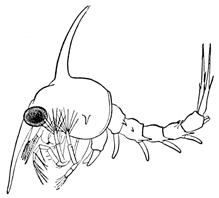
Zoëa of Cancer irroratus. Last stage before it changes to the megalops condition.
The eggs, after being discharged, are attached to the abdominal legs of the mother by a kind of cement, or they are carried in pouches attached to the thorax. In these positions they mature, and hatch at different stages of development in different species. Some emerge with three pairs of legs, and are known as Nauplius; some are Zoëa, having a carapace and abdominal segments, but no abdominal appendages. Another stage is Megalops, with large stalked eyes. Others are hatched as miniature adults. These names were given when the embryo stage was not recognized and the larvæ were thought to be distinct species.
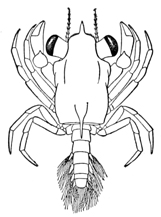
Megalops stage of Cancer irroratus, just after change from zoëa stage.
The growth of the animal is effected by moulting. The Crustacea are named from the crust-like covering which envelops them. It is a horny material, called chitin, in which are deposited particles of carbonate of lime, making a rigid envelop which would prevent all freedom of motion, were it not that there are spaces free from lime, and thus flexible joints are left. When the animal expands it throws off this hard covering and secretes a new and larger one. As the time of moulting approaches, the old covering becomes loosened, and a delicate new one is formed beneath it. The old shell splits open across the back just behind the carapace, and the soft animal withdraws first its cephalothorax and then its abdomen, leaving the cover complete, including even the covering of the eyes and the lining of the stomach. The [pg249] new shell is rapidly hardened, being already formed when the old one is cast, and the animal regains its normal condition in about a week; in the meantime it is defenseless, and lies quiet in some secluded place. Moulting is an exhausting process, and is attended with great dangers. A great mortality occurs at this time from accidents, from weakness, and also from helplessness in case of attack.
The hair-like processes scattered over the shell, often like fringes, are said to be organs of feeling.
SUBCLASS ENTOMOSTRACA
These are Crustacea of small, often microscopic size, of comparatively simple organization, and with appendages adapted to serve the purpose of respiration. These minute animals may be obtained by skimming the surface of the water with a muslin net, preferably at night, then washing off the inside of the net with a small quantity of water into a glass dish. Place the dish on a dark surface before a light, and the little creatures will gather toward the light, and may be satisfactorily observed with a glass.
ORDER COPEPODA
This order, though composed of minute forms, is one of great economic importance, from the fact that the little crustaceans exist in vast numbers and furnish a very considerable part of the food of many fishes. Cyclops is the most common of the fresh-water, and Cetochilus of the marine genera. These, together with other genera, swarm in water wherever life exists, from the smallest pools and ditches to the broad surface of the ocean. Without having drawn a surface-net on some sheltered bay, it is difficult to have an idea of the myriads of Entomostraca in the sea. Although nearly transparent and of such delicate texture as to be almost jelly-like, they sometimes color the sea with a reddish tint for miles. Whales which have baleen, or fringes of whalebone, in the mouth subsist on these small organisms, which are called "brit" by the whalemen. The whales, sometimes in schools, rush through the water with open mouths, engulfing these little [pg250] crustaceans, the baleen straining them from the water. Although devoured in such immense quantities, and sometimes lying dead in sheets of scum on the surface of the water, they maintain their numbers by the exceeding rapidity with which they reproduce. It has been computed that the descendants of one Cyclops may number in one year 4,500,000,000, provided all the young reach maturity and produce a full number of offspring.
One of the free marine forms, Sapphirina, is of especial interest, as it surpasses all animals in phosphorescence and sparkles by day as well as by night. It is one quarter of an inch long, and is broad and flat.
Besides the myriads of free-swimming copepods, there are parasitic forms in great number. The marine parasitic forms are commonly known as fish-lice. They have various habits, some living as commensals, others attaching themselves to animals only to be carried about; the true parasites live upon the blood and tissues of their hosts, and may fasten themselves to the external parts of the body or to the internal organs. Whales, fishes of all kinds, mollusks, starfishes, jellyfishes, and corals, all have some form of parasite, and many have several different kinds of guests. It is said that the haddock has more than a dozen which infest its external and internal membranes.
Nicothoë is found on the gills of lobsters. The truly parasitic forms are usually very degenerate and lose the characteristics of their order.
ORDER CIRRIPEDIA ("Curled feet") THE BARNACLES
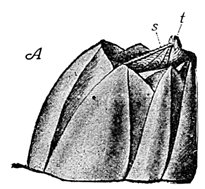
Balanus. A, external view: s, scutum; t, tergum.
Barnacles of the genus Balanus (acorn-shells) (Plate LIX.) are familiar objects on rocky shores, which they often whiten with their shells, and those of the genus Lepas are also widely known. The name of the order is descriptive of their curled appendages. The appendages are fringed like feathers and are drawn into or protruded from the shell at will. When extended they are constantly in motion, and create currents which carry food to the [pg251] mouth of the animal, which is dependent upon such food as comes within range of its tentacles.
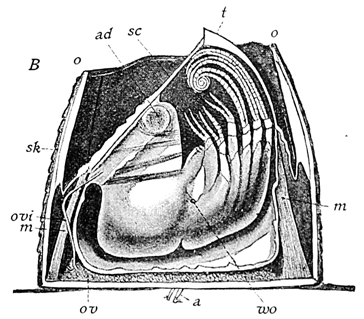
Balanus. B, anatomy: a, antennules; ad, adductor muscle; m, muscles of scuta and terga; o, edge of parapet; ov, ovary; ovi, oviduct; sc, scutum; sk, parapet; t, tergum; wo, female aperture.
Their life-history is interesting. The young barnacle, called a nauplius, in no way resembles the adult. When it emerges from the egg it is a free and independent animal, with one eye, three pairs of legs, and a single shell. It swims about for a while and moults several times. It then has two eyes, two shells, and six pairs of legs. At this period it seeks a permanent home, and attaches its anterior end to the object it selects by means of its antennæ, which have become suckers. It makes its hold secure by secreting a cement which permanently fastens it to the spot. It then undergoes metamorphosis, loses its bivalve shell and its eyes, and attains its characteristic cirripeds, or curled feathery legs, and a new shell covering. During these transformations, from the time it becomes fixed until it attains its adult form, the barnacle fasts, living by the absorption of its own animal fat. Its food subsequently consists of the minute animal forms which abound in the sea. Its further growth is by moulting, but parts only of its covering are disengaged; the shell is permanent, and its successive stages of growth are marked upon it by lines, as in mollusks. The lining of the shell, or enveloping skin of the animal, and also the cuticle of the legs are [pg252] shed, and in the spring of the year these thin, glossy casts are found in abundance floating on the surface of the water near the shore.
There are but three orders of barnacles, namely, those in which the shell is directly attached to the rocks, those which are attached to floating objects by a long stalk, and those which are parasitic on animals. A species of the third order infests the whale.
The older zoölogists classed barnacles with the Mollusca, but in 1829 Vaughan Thompson, in the study of their embryology, found that they should be classed with crustaceans, in company with crabs, shrimps, and water-fleas, with which their immature forms show direct relationship.
Genus Lepas
This genus is commonly known as the ship-barnacle, also as the goose-barnacle. It attaches itself to floating logs as well as to ships, but the latter form its principal home; consequently it is a great voyager, and, though common everywhere, is everywhere considered a stranger. The same species are found on ships coming from the most remote and widely separated regions, and so they cannot be considered native to any one locality. They are wanderers on the deep, and grow in such numbers on the bottoms of ships, especially of those which sail in warm seas, that they seriously impede the progress of the vessels. Aside from diminishing its speed, they do a ship no injury.
There was a tradition, which lasted several centuries, that geese were hatched from these shells, which somewhat resemble eggs. Gerard, in the appendix to his "Herball or Generale Historie of Plants" (1597), gives a picture of shells of Lepas growing on a tree, with geese falling from them and swimming about in the water below. His description is as follows: "There are founde in the North parts of Scotland and the islands adjacent called Orchades certaine trees whereon do growe certaine shell fishes of a white color, tending to russet, wherein are conteined little living creatures; which shells in time of maturitie do open, and out of them grow those little living foules whom we call barnakles, in the North of England brant geise, and in Lancashire tree geise; but [pg253] the other that do fall upon the land do perish and come to nothing." He then describes in detail the various transformations, and ends with: "But what our eies have seen and hands have touched we shall declare."
The long, flexible stalk of Lepas is its anterior end. Generally this stalk is only half an inch long, but in some species it attains the length of a foot.
Huxley describes the barnacle as a crustacean fixed by its head and kicking food into its mouth with its legs. The mouth has a pair of small mandibles and two pairs of maxillæ, the last pair uniting to form a lower lip. The thorax has six pairs of branched appendages. The body is enveloped in a fold of skin, to which are attached five shell-like plates. One of these plates is long and narrow, and extends along the dorsal side; two are large and triangular (the terga); two are small and triangular (the scuta), the long point extending downward. These shells are on the free or posterior end.
Barnacles have a nervous system, consisting of a brain and a chain of five or more ganglia, but no special respiratory or circulatory organs are known; the cirripeds, or feet, are supposed to perform these functions. They have also a food-canal, a digestive gland, and excretory tubes. The eggs are carried under the external fold of the skin in flat cakes.
L. anatifera. The shell is bluish-white, showing lines of growth and faint radiating lines emanating from the anterior basal angle. The upper valves are narrow; the long tips point downward, and the top is blunted, leaving a space which is occupied only by a membrane. Near the apex of the shell, at the back, is a distinct angle. The dorsal valve is broad, not much compressed, and is sometimes grooved lengthwise. The cartilage of the shell and the stalk adjoining the shell are orange-colored. The stalk is grayish-brown and the cirri flesh-colored. The stalk is from one inch to six inches long. The shell is one inch long.
L. striata. Shells bluish-white; valves sharply triangular; dorsal valve compressed, forming a ridge; lines radiate from the basal angle of the lower valves and from the upper angle of the terminal valves, starting from the extreme end; the margins have a narrow edge of yellow cartilage; the stalk and cirri are of a dark slate-color; shell and stalk are each about an inch long.
L. pectinata. Shell shorter and less compressed than in the preceding species; lines of growth and radiating lines distinct; a decided line [pg254] runs from anterior base to summit, a little back of the margin; terminal end broadly obtuse (truncated); dorsal valve much compressed, forming a sharp edge serrated with ten to twelve teeth and distinctly striated or furrowed.
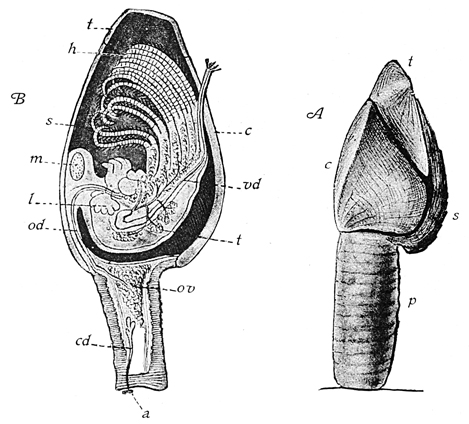
Lepas anatifera. A, the entire animal; B, anatomy. a, antennule; c, carina; cd, cement-gland; l, digestive gland; m, adductor muscle; od, oviduct; ov, ovary; p, peduncle; s, scutum; t, tergum and testis; vd, vas deferens; h, tentacles.
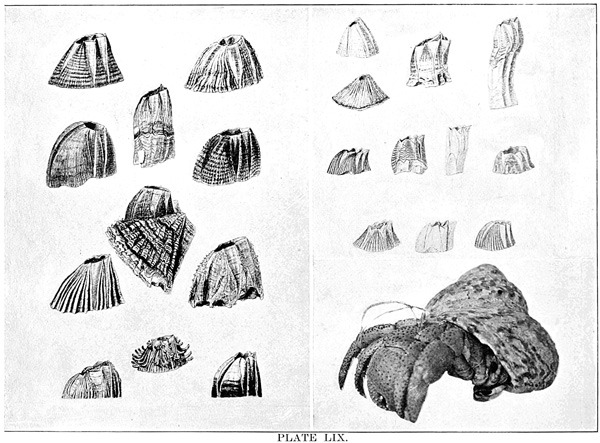
PLATE LIX.
Different forms of Balanus. (After Darwin.) Cenobita diogenes.
Genus Balanus
Balanus is known as the "acorn-shell," or "sea-acorn," and is found in vast numbers and of all sizes between tide-marks, incrusting rocks and the piles of piers. It also may be found attached to floating objects or to shells, or even to living animals, but its usual habitat is stationary. Unlike Lepas, it has no stalk, the shell being directly attached to some object. The body is surrounded by a fold of skin, to which are attached a shell consisting of six or more plates and a fourfold lid, or operculum, consisting of two scuta and two terga. The operculum may be called the door, as the animal opens and shuts it at will and has complete protection when it is closed. If one taps a rock [pg255] incrusted with barnacles, and holds the ear near, the closing of the many doors may be distinctly heard.
The development of Balanus from the larval stage, as also the anatomy of the adult, is similar to that of Lepas. When covered with water and unmolested, there may be seen over a bed of barnacles thousands of tiny fringed feet waving to and fro. The motions look like gestures; they are perfectly regular and rapid, numbering eighty to a hundred a minute. The shell covering formed by barnacles on piles of wharves and bridges is said to be a protective agent; otherwise the barnacles seem to have no economic value in nature, as, unlike other animals, they do not serve, except in very small measure, as food to other classes. The tautog and perhaps some other fishes feed partly upon them. They are sometimes an obstacle to oyster-culture, as they fasten upon the objects intended for oyster embryos, and, growing faster than the latter, soon crowd them off. One species, Coronula diadema, fastens to the skin of whales. It attains the size of two inches in diameter. The shell is half an inch thick and full of cavities, into which the skin of the whale is drawn, giving the barnacle a secure hold. (Plate LIX.)
B. balanoides (Stimp.), B. ovularis (Gould), the rock-barnacle. This is perhaps the most conspicuous of the barnacles. It inhabits the whole northern Atlantic coast, and is so abundant that it not only whitens the rocks with a complete incrustation of shells, but the animals are so crowded that many of them lose their normal shapes and become greatly elongated. When the rocks are covered with water they seem alive, on account of the thousands of waving tentacles. This species also incrusts woodwork between tide-marks.
The shell is small, white, and variable in shape; sometimes its height is less than the diameter of its base; again the height is several times greater and the summit broader than the base. In its early stages the valves are smooth, but later the base is scalloped by four or five grooves. The summit of the plates is even and blunt. The aperture is diamond-shaped. Two valves of the operculum are pointed at the tips; two are blunt, making a deep notch in the summit. These valves are the distinctive feature by which to recognize this species, which varies so much in outward form; the species is also distinguished by its membranous base, which does not form a solid plate like that of other species.
B. eburneus, the ivory barnacle. This species, like B. balanoides, is a very common barnacle, and is found on all kinds of submerged woodwork, whether fixed or floating. It is also found on the carapace of [pg256] crabs and Limulus, and on mollusks. It is chiefly found on objects below low-water mark. It ranges from Massachusetts Bay to Florida. It is easily distinguished from the preceding by its low, broad form and shelly base. The shell is smooth and circular at the base, and inclines backward, forming an oblique cone with a triangular opening; the plates terminate in points at the summit and incline backward, the last one forming a kind of beak. The operculum is pyramidal; two of its valves have both transverse and longitudinal lines well defined at the base, and are coarsely toothed at the edges; the posterior valves are slightly grooved across.
B. rugosus (Gould), B. crenatus. Shell white, cylindrical, somewhat conical, rugged, the summit usually as broad as the base; height often greater than diameter; aperture diamond-shaped, plates ending at the summit in acute spreading points, the posterior plate folded and curved like a beak; plates rough, with coarse, irregular ribs; valves of the operculum at the summit acute, with diverging points; the points striated. Found on shells and stones in deep water and also on bottoms of ships.
B. geniculatus. Shell dirty greenish-white, cone-shaped; aperture about the size of base; shell-plates triangular, unequal in breadth, and with alternate large and small ribs; the smaller ribs compressed and roughened on the edges by the conspicuous lines of growth which run across them; depressed areas between the plates marked with fine cross-lines; front valves of the operculum have coarse plated ridges, which incline over one another and are crossed by fine radiating lines; diameter at base one to one and a half inches; height two thirds the diameter. Found on pecten shells, and abundant off the coast of Maine.
B. tintinnabulum. Shell pink to purplish, conical, with six triangular plates, which are grooved, forming unequal ribs, and crossed by distinct lines of growth; spaces between plates crossed by lateral lines; posterior valves of the operculum longer than the others and curved forward, resembling the beak of a bird of prey; diameter at the base one inch; height one and a half inches. Found in warm waters and on vessels from the South.
Suborder RHIZOCEPHALA
These are parasitic forms and very degenerate. Sacculina lives on crabs, and its term of life is about three years, during which period the afflicted crab does not moult. Its shape is that of an ovoid sac on a stalk, which it attaches between two segments of the ventral surface of its host. The stalk divides and ramifies in a root-like manner within the body of the crab, from whose vital elements it absorbs its nourishment. The roots spread like a mycelium through the whole crab, even to the claws.
Peltogaster lives on hermit-crabs. [pg257]
CLASS MALACOSTRACA
This subclass comprises highly organized Crustacea, usually of considerable size, having the appendages much differentiated, the thorax with eight segments, and the abdomen with seven segments.
ORDER SCHIZOPODA
The name, meaning "cleft-footed," applies to the appendages of the thorax, which are once-branched (biramous). Gills, when present, are attached to these feet, and hang freely in the water. A delicate carapace covers the thorax; the abdomen is proportionately very large, often twice the length of the cephalothorax. In Mysis the eggs are carried in pouches under the thorax, giving the common name of "opossum-shrimp" to this small, transparent, phosphorescent crustacean.
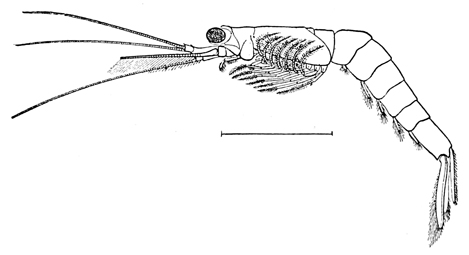
Mysis sternolepis.
Genus Mysis
M. sternolepis. About one inch in length; translucent; antennæ very long; segments marked at joints with dark spots; the last two segments terminate in a stout spine; telson longer than the sixth segment; the sides are nearly straight and are armed with spines; the extremity is cleft; eyes large and prominent. Found abundantly in winter on the shores of still, muddy bays and sounds, especially among eel-grass.
ORDER DECAPODA ("Ten-footed")
The Decapoda are named from their ten walking-legs. The higher forms of crustaceans belong to this order. All the Decapoda have a similar anatomy, but are placed in two subdivisions [pg258] according to their external form. In Macrura, the first subdivision, belong the lobsters, crawfish, shrimps, prawns, and hermit-crabs, animals having a long and more or less cylindrical body, with the abdomen extended; in Brachyura, the second subdivision, are placed the crabs, animals having the thorax broad and flat, and the abdomen bent under the thorax. The Decapoda have twenty segments, all of which, except the last one, have, at some period of life, a pair of appendages. The first two pairs of appendages, or, in the stalk-eyed forms, the first three pairs, are especially connected with the senses, and are often fringed with hairs, which are also considered to have a sense-function. The antennules, or first pair of appendages after the eye-stalks, are sometimes divided into two or three branches. At the base of the antennules are the ears. The antennæ, or second pair of appendages, are undivided, but are larger than the first pair, and are often very long. At the base of the antennæ are the renal glands. Both the antennules and the antennæ are slender, elongated, movable, and full of joints. In some species they are greatly modified, as in Scyllarus, where they are developed into broad swimming-plates and, perhaps, as shovels for burrowing; in some amphipods they are used as swimming-organs. (Plate LX.)
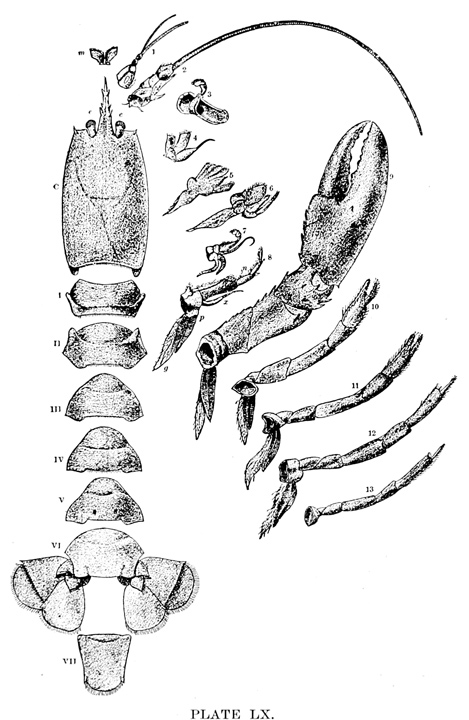
PLATE LX. External Anatomy of a Lobster.
C, carapace; e, eye; g, gill; m, metastoma; n, endopodite; p, epipodite; x, exopodite; I-VII, abdominal segments; 1, antennula; 2, antenna; 3, mandibles; 4, 5, maxillæ; 6, 7, 8, maxillipeds; 9, big pincer; 10-13, walking-feet.
The next six pairs of appendages are grouped about the mouth. They are the mandibles, the maxillæ, and the maxillipeds. The mandibles are at the mouth-opening, and, being heavy and hard, are adapted to tearing and grinding; they have a jointed attachment, the palpus, whose office is to keep the mandibles clean. The two pairs of maxillæ are delicate and leaf-like. The three pairs of maxillipeds grow gradually larger, the last pair being very prominent and extending over the other mouth-parts. Next come five pairs of walking-feet. One or more pairs of these feet have pincer-like ends, or claws. Some species have the claws immensely developed, as in lobsters. The claws are the chelæ, and the feet which bear the chelæ are termed the chelipeds. The rest of the walking-feet have generally single, hook-like ends, but are variously modified in different species. The abdominal segments have six pairs of appendages, also variously modified. The last segment is without appendages, but often is extended into a tail, [pg259] or fin-like expansion. The next to the last segment, in many forms, has appendages modified into swimming-plates, which extend on each side of the telson, forming a broad, fan-like caudal extremity.
They have, then, to correspond to the twenty segments of the body, two pairs of sensory, six pairs of mouth-, and five pairs of walking-appendages attached to the cephalothorax, and six pairs on the abdomen. The terminal segment, or telson, is without appendages. The exopodite is present on the maxillipeds, but disappears from the walking-feet in the higher forms.
In moulting the Macrura split in the longitudinal line down the back; in the Brachyura the split occurs across the body at the point between the thorax and the abdomen.
Suborder MACRURA SHRIMPS, PRAWNS, LOBSTERS, CRAWFISH, AND HERMIT-CRABS
The characteristic features of the Macrura are an elongated body with the abdomen usually extended; a carapace, somewhat cylindrical; and the last pair of appendages of the abdomen (which are attached to the next to last segment) united with the last segment, or telson, to form a powerful caudal fin, used for swimming backward. The creeping forms in moving walk forward, but swim backward.
FREE-SWIMMING FORMS: SHRIMPS AND PRAWNS
In these animals the body is compressed and the carapace is not hard. The abdomen is very large in proportion to the cephalothorax, and has a peculiar bend. The rostrum is often longer than the thorax. The eye-stalks, antennæ, and legs sometimes attain extraordinary length, and the chelæ (claws) are not always on the first pair of legs. In some species chelæ are on two or three pairs of the legs. Above the antennæ are expanded antennal scales, which, together with the long bases of the antennules and very prominent eye-stalks, make the head a broad and conspicuous feature. The difference between shrimps and prawns is not very well defined, the small individuals seeming to be generally called shrimps, the larger full-grown ones prawns. [pg260] Prawns are known as crevettes in France and as Garnelen in Germany, where they are largely used as food. In the United States the shrimp-fishery is an industry of the South. On the California coast the fisheries are very extensive and are monopolized by the Chinese.
Genus Penæus
P. setiferus. This species is about six inches in length when full-grown. A ridge or crest extends along the center of the carapace, and terminates in a long, pointed, toothed rostrum, the teeth being fringed with hair on the inner side. The antennæ are a foot or more in length; there are chelæ on the first three pairs of thoracic feet; the swimming-feet and lateral margins of the segments of the abdomen are fringed with hair; and the caudal appendages are longer than the telson. It ranges from Virginia southward, and is very abundant on the shores of the Southern States, where it is gathered for the markets. The large ones are known as prawns and the small ones as shrimps.
P. brasiliensis. This species is associated with P. setiferus, and, although not so abundant, forms a part of the shrimp-supply in the fisheries. It differs from the former in having a groove on each side of the ridge which runs through the center and whole length of the carapace. The first three pairs of feet are chelated. This shrimp is found as far north as Long Island, and often in brackish water, or even where the water is quite fresh.
Genus Palæmonetes
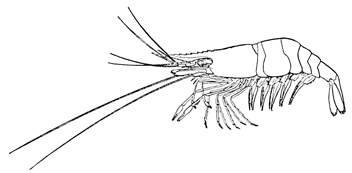
Palæmonetes vulgaris; male.
P. vulgaris (Palæmon vulgaris). Average size one half of an inch in length; body translucent, almost colorless, irregularly spotted; rostrum as long as carapace and toothed on the upper edge. It is found among eel-grass in brackish water, and also in pools and ditches on muddy shores from Massachusetts Bay to Florida. Commonly known as prawns.
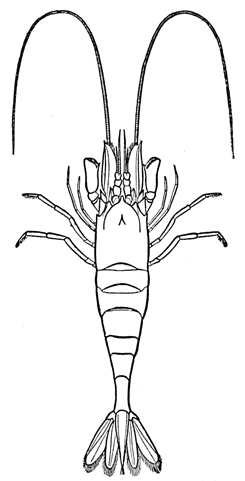
Crangon vulgaris, the common sand-shrimp; male, natural size.
Genus Crangon
C. vulgaris, the common sand-shrimp. It ranges from Labrador to North Carolina on the Atlantic coast and from Alaska to southern California on the Pacific coast. It is found in abundance on sandy shores at low-water mark, and in shallow water below tide-mark; also among rocks and seaweeds. When left by the tide it buries itself in the sand. Its color varies with its location, rendering it inconspicuous. Upon the [pg261] sandy shores it is translucent, pale in color, and often specked, closely resembling the sand, while on dark, muddy bottoms it is much darker. This is an edible shrimp, eagerly devoured by fishes; it is also gathered for the markets. The body of C. vulgaris is broad at the anterior end and tapers to a sharp point at the posterior extremity. A pair of broad, divided appendages on the cylindrical segment, which is next to the last on the abdomen, together with the sharp telson, form a fan-like swimming-tail. As in all shrimps, the antennæ are long and have plate-like antennal scales at the base, which are fringed with hairs. The mandibles are long. The movable finger of the chela is folded across the extremity of the claw.
C. franciscorum, the California shrimp. This species is about three inches in length. It is distinguished from C. vulgaris by its larger size and by the greater length of the movable finger of the chela, which folds parallel to the side of the claw instead of across its extremity. Its color is light or dark yellowish-gray, mottled. This is the shrimp extensively gathered by the Chinese for commercial purposes. The shrimp-meat is dried and cured, and then separated by blowers very much as wheat is cleaned. It is exported to Eastern countries in great quantities, the value of the export being estimated at one hundred thousand dollars per annum.
CREEPING FORMS: LOBSTERS AND CRAWFISH
Family ASTACOIDÆ
Genus Homarus
There are but three species of this genus, which is the most important one of all the Crustacea. They are H. vulgaris of Europe, H. capensis of the Cape of Good Hope, and H. americanus, which occurs on the eastern coast of the United States from Labrador to New Jersey. The lobster-fishery is one of great importance, and of such value that it is governed by stringent laws. The [pg262] annual catch on the Atlantic coast of North America amounts to many millions of lobsters, the money value of which is very large.
H. americanus, the common lobster of the Atlantic coast. The characteristic feature of the lobster is its enormously developed chelæ, or pincer-claws, which are on the first pair of walking-feet. Small claws occur on the next two pairs, and simple hooks on the remaining two pairs. The appendages on the abdomen are divided (biramous). In the female they are used, excepting the last pair, for holding the eggs; in the male they are greatly abridged. The appendages on the next to last segment are divided and broadly flattened, forming with the telson a powerful swimming-paddle. The rostrum is very prominent, and has a long, pointed end, slightly upturned, and several spines.
The lobster belongs to the creeping forms of the order; it walks forward by means of the ten feet, but swims backward by using its caudal fin. It lives in deep water on rocky bottoms, hiding among stones, etc., but frequents sandy shores as well. It lives on dead and decaying animal matter, and it would seem strange that its flesh is so palatable, were it not that we know that chemical combinations which take place in the assimilation of food make one kind as clean, when transformed, as another. All the crustaceans have a similar dietary, being scavengers of the sea; yet fishes find them more acceptable than other animal food, and fishes capable of capturing larger prey subsist largely on the minute entomostracans described elsewhere.
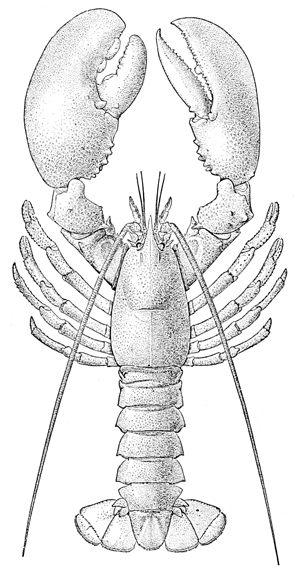
Homarus americanus, American lobster; male.
The lobster is so large that it can easily be dissected, and will serve as a type of the structure of Crustacea. In dissecting one can follow the descriptions given of the anatomy of Crustacea on page 246, and will be interested in observing the beautiful arrangement of the parts and their adaptation to the uses they serve. [pg263]
The female lobster carries her eggs on the abdominal legs, to which they are glued by a kind of cement. After the young emerge from the egg, the zoëæ still cling to the mother for a little time. The lobster moults eight times the first year, five times the second, and three times the third year, after which the male moults twice and the female once a year. It retires to some secluded spot for this operation, which is attended with many dangers. The back splits open longitudinally and the animal slowly withdraws, leaving the shell complete. In preparation for moulting, the lime around the contracted joints of the chelæ is absorbed, so that the soft flesh can pass through. Any injury to a limb at the time of moulting, or which results from fighting or from any accident, is repaired at successive moultings, and a lost member is replaced by a new, but not always a perfect, one.
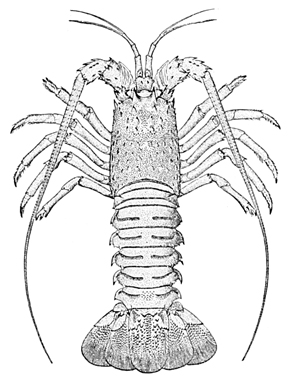
Panulirus interruptus, the spiny or rock-lobster.
Genus Panulirus
P. interruptus. This is the California spiny lobster, rock-lobster, or salt-water crawfish. It differs from the common lobster Homarus of the Atlantic coast in having no large claws, the first pair of feet being simple like the rest, also in having antennæ which are enormously long and very large at the base. The carapace is beset with spines, and the lateral margins of the abdominal segments end in spines. This species lives among the rocks on the southern California coast.
P. argus or americanus resembles P. interruptus, and is found on the coast of Florida.
Genus Scyllarus
Scyllarus has a broad, almost square carapace, which is uneven and coarsely granulated; the anterior corners are sharp, the posterior ones rounded. The antennæ are curiously modified into broad, flat, double plates reaching quite across the straight anterior end of the carapace. The under scales of these modified antennæ are rounded and leaf-like, the upper ones are pointed. The margins of the abdominal plates on the ventral side are toothed, and on the upper side the first three sections have [pg264] knobs, the third one being the most prominent, and forming the posterior extremity when the abdomen is folded in. The walking-feet are all simple and end in points; the first pair are the longest, and the following ones gradually diminish in size. The ventral surface is rough and spiny. The abdomen is of about the same length as the carapace. These animals are found off the Florida coast and are caught in the fish-traps. They are uncommon. The very peculiar development of the antennæ makes them worthy of examination when opportunity offers.
ANOMALOUS FORMS: ANOMURA
The anomalous forms which are intermediate between the suborders Macrura and Brachyura were, until recently, placed in a suborder, Anomura. The members of this group differ from one another, and some of them resemble in external features members of the other divisions of the suborders, but there is a difference in anatomical structure which separates them in the classification.
Family DROMIDÆ
Genus Hippoconcha
H. arcuata. This curious little crab, found on the Florida coast, carries the half of a bivalve shell over its back. Its fifth pair of thoracic legs are bent over the back, and these, together with the fourth pair of legs and the spiny front edge of the carapace, enable the crab to hold the shell in position. This crab was formerly classed with the hermits, all of which were originally called Bernhardus, after the monk of that name.
Family PAGURIDÆ THE HERMIT-CRABS
In these curious animals the posterior part of the body is not protected by a crustaceous covering, and therefore the animal seeks protection by inserting its soft and defenseless abdomen into some hollow object, usually the shell of a gasteropod mollusk, as the whelk or the periwinkle (Buccinum, Littorina). The hermit-crabs do not always use a shell for this purpose, as they are sometimes found in the tubes of plant-stems or in sponges. Like other organisms in the animal world, they seem [pg265] well fitted to make the best of their surroundings, the body becoming modified to suit the peculiar conditions under which they live. In those which inhabit shells the abdomen becomes spiral, in conformity to the convolutions of the shell. All the abdominal appendages are more or less atrophied; the sixth pair become like hooks, and these fasten to the columella of the shell, keeping the crab securely attached to it. In the female some of the abdominal appendages are hair-like and are adapted to carrying the eggs. The thorax, being protected, is protruded from the shell at will. The first pair of feet are much larger than the others, and are provided with claws (chelæ). The first right foot is usually much larger than the left, and, besides the usual functions of capturing and crushing prey, the claw, or hand, serves as an operculum to close the mouth of the shell when the crab retires completely within it. The small left hand is shaped to fill out the parts of the opening not covered by the right one, thus making a close fit. The next two pairs of feet end in simple hooks, and are used for walking and dragging the crab along when he travels. These crabs move about very fast, and the houses upon their backs seem no encumbrance. [pg266]
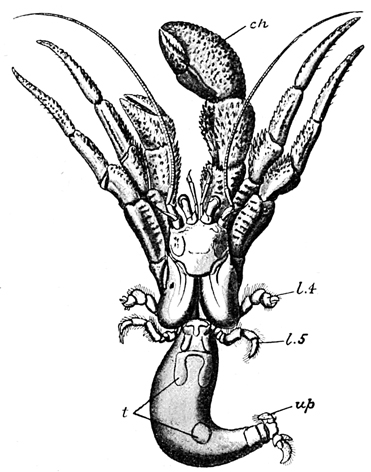
Pagurus bernhardus: ch, chela of first right leg; l.4, l.5, fourth and fifth legs; t, abdominal terga; up, last pair of appendages, modified to fasten to the columella of the shell in which the hermit lives.
In some genera both hands are alike; in others the left one is the larger. In the case of hermits which live in tooth-shells, the right hand is cylindrical in form, fitting the circular opening of the shell. The other extreme is found in the genus Cancellus, where both the chelipeds and the first pair of ambulatory feet are ingeniously shaped, so that when closed they form a round operculum, or door, which closes the way into the compact sponge which this crab has for its carcinœcium, or house. It is interesting to note these differences and observe the perfection with which the feet are formed and jointed to suit the openings of different shells. Some genera show other adaptations to their twisted houses, the eye-stalks being uneven in length and the ambulatory feet unequal on the opposite sides. Besides this, some species are hairy and cover themselves with dirt for further protection. The exposed claws of some hermits have a special armature of spines, which make a fringe of points around the opening of the shell when the crab is withdrawn.
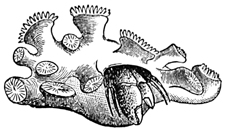
A colony of sea-anemones (Epizoanthus americanus) which had completely covered and absorbed a shell occupied by a hermit-crab (Eupagurus pubescens), which still lived within the cavity. The polyps are not expanded.
As the hermit grows he is occasionally obliged to find a new or larger shell, and there are amusing anecdotes of the troubles he experiences at these times while house-hunting. Very often he tries several shells before he finds one to fit. There is a tradition, not, however, well authenticated, that if the shell chosen happens to be occupied by its natural owner, the crab tears out and devours the unfortunate occupant. If the desired shell is occupied by another hermit inferior in strength to himself, he proceeds to take possession by violence. He then examines carefully the empty shell, inserting his legs and feelers, and if he decides to occupy it he withdraws his abdomen from the old shell and darts it so quickly into the new one that the act of transference is difficult to follow. After walking about with the new shell it sometimes proves to be unsatisfactory and further search becomes necessary. After it is well domiciled the crab never ventures outside the shell until it is obliged to change again on account of growth, or because some stronger crab dispossesses him. The shells of hermit-crabs serve frequently as the home of other animals which live with them a commensal life. The hydroid Hydractinia polyclina often covers the exterior of such shells with a brown, velvety growth. Some sea-anemones also are commensals [pg267] with hermits. Adamsia palliata is always found on the shell occupied by Eupagurus prideaux, and never on any other. This is a European form. On our own coast a red anemone, the Epizoanthus americanus, found in deep water off the entire eastern shore, fastens on the shell occupied by the hermits Eupagurus pubescens and E. kroyeri. This anemone in time absorbs the shell of its host and itself becomes its protector—an advantage to the hermit, who finds room in the yielding polyp-mass for its increasing size, and feels no longer the necessity for change of domicile. The female hermit holds its eggs in the posterior feet until they are hatched; the young are then released, pass into the water, and soon find shells for themselves.
Genus Pagurus
P. bernhardus. This is a large species, bright red in color, rough and hairy. It inhabits the shells of Fulgur carica or of Polynices heros. It ranges from Cape Cod northward, and is replaced on the northern California coast by P. alaskensis and P. aleuticus.
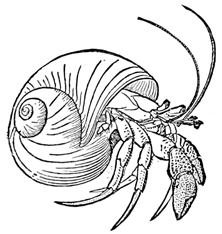
Pagurus bernhardus, the hermit-crab.
P. pollicaris. This hermit inhabits shells similar to those occupied by the last, but is pale red in color, and its surface is granulated and not hairy. The short joint of the chela has a broad angle. It ranges from Massachusetts to Florida, and occurs at low-water mark on rocky and shelly bottoms of bays and sounds.
P. longicarpus. A quick-moving little hermit with long chelipeds, found in small shells at the water's edge in quiet places. They exist in great numbers and are eaten, shell and all, by fish. This species can be distinguished from all others by its very light color and metallic luster.
Genus Clibanarius
C. vittatus. This hermit is found from North Carolina southward along the edge of the water and in tide-pools. It cannot be mistaken [pg268] for any other hermit common on our coast, since it has the very distinctive feature of white longitudinal stripes on the ambulatory feet. The chelipeds are about equal, rough with tubercles, and the tips have smooth black edges. Body and feet are quite hairy. The color is brown and white.
Genus Pylopagurus
This genus is represented in Southern waters by several species. One of the most characteristic of them lives in Dentalium, the tooth-shell. The outer surface of the right hand is formed to close the shell. All the ambulatory feet and the very small left hand fold beneath, leaving only the flat surface of one hand exposed to view. Another species lives in a shell covered with polyzoans.
Family CENOBITIDÆ
Genus Cenobita
C. diogenes. This large hermit-crab, found in Florida and in more southern waters, inhabits the beautiful pearly shell of Livona pica. It lives on land a part of the year, but spends the breeding season in the water. It can be distinguished by its land-roaming habits, its large left cheliped, very stout walking-legs, and compressed eye-stalks. This species climbs the hills, but is more frequently met with in low, shaded, marshy places. (Plate LIX.)
Family HIPPIDÆ
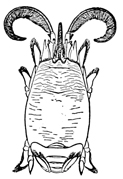
Hippa talpoida, the sand-bug.
Genus Hippa
H. talpoida. This animal, commonly known as the "sand-bug," differs greatly in appearance from a crab. When the appendages are folded under the carapace it somewhat resembles an egg, the body being ovate, about half as broad as long, and the sides forming a nearly regular curve. The carapace is about one and a half inches long, convex, yellowish-white, and nearly smooth. The abdomen is long and pressed under the body, reaching nearly to the front. The eyes are minute and on the ends of long, slender stalks. The antennæ are plume-like and about as long as the carapace. Hippa lives on sandy beaches at or near low-water mark, exposed to the action of the waves. It burrows with great rapidity into the loose and shifting sands, using the short and stout second, third, and fourth thoracic legs and the appendages of the sixth abdominal segment [pg269] for pushing and digging. Crabs of this species are gregarious and may be seen in great numbers, though but few will be captured together by digging, as they rapidly disappear beneath the sand. Sometimes they are found swimming about in the tide-pools. They seem to live upon the organic particles contained in the sand, which they swallow, the mouth not being adapted for mastication. This species ranges from Cape Cod to Florida. (Plate LXI.)
H. analoga. Similar to H. talpoida, but broader and flatter. It is bluish above, yellowish-white below, and the fringing hairs are black. Found on the California coast.
Genus Albunæa
A. gibbesii. This animal is found with Hippa, and, like it, burrows rapidly in the sand. Its general outline is square. The surface of the carapace is marked off with denticulated lines, which make the back appear as if composed of plates. The front edge of the carapace has a row of teeth and a prominent spine at the anterior angles. The abdomen is doubled under itself (not fitting into a groove of the thorax, as in ordinary crabs), this animal being intermediate between the long- and the short-tailed forms. The eyes are on triangular, plate-like stalks. The antennules are very long and are fringed with hair. The chelipeds have claw-like joints, which close across the straight, broad end of the hand. The first two pairs of walking-feet have curious sickle-like terminal joints. The animal is about one and a quarter inches long. Albunæa does not extend as far north as Hippa, its range being from Georgia southward. (Plate LXI.)
Family PORCELLANIDÆ
The crabs of this family are little more than one quarter to one half of an inch across the back. The chelipeds are broad and flattened. The first three pairs of walking-legs are well developed, and the fifth pair are very small and are doubled over the base of the carapace. The sixth segment of the abdomen has a pair of biramous appendages, which, with the telson, form a swimming-fan.
Genus Porcellana
P. sayana. Carapace little longer than broad; breadth about one quarter of an inch; smooth; has three acute denticulations between the eyes, the middle one the largest and depressed in the center; two denticulations on each anterior side; chelæ fringed with hair on the edges; walking-legs somewhat hairy; fifth pair of legs folded over base of carapace; color reddish, with white spots. This species was once called occulata, because of the eye-like spots over its entire surface. The posterior part and abdomen have longitudinal bands of color. The claws are marked like the shell. Found from South Carolina southward, often in the shells inhabited by hermit-crabs. (Plate LXI.) [pg270]
Genus Petrolisthes
P. sexspinosus. Carapace longer than broad; breadth about one half of an inch; space between the eyes broad, but not divided into three teeth as in Porcellana sayana; second joint of the cheliped has five broad teeth on its front edge and five or six small spines on its outer edge; fifth pair of legs doubled over base of carapace; whole body traversed with broken red lines. Found from South Carolina southward. (Plate LXI.)
P. armatus. Carapace longer than broad; breadth about one quarter of an inch; prominent and wide between the eyes; a small sharp spine on each anterior side; chelipeds long; second joint of cheliped twice as long as broad, with three teeth on the front edge and four or five small spines on the outer edge. Found on the Florida coast. (Plate LXI.)
Family LITHODIDÆ
The species of this family have a broad, ovate, uneven body and a prominent rostrum. The fifth pair of legs are rudimentary and are folded under the carapace in the branchial chambers, so that the crabs appear to have but four legs on each side. This is the distinguishing feature of the family, and makes them easily recognized.
Genus Lithodes
L. maia. The carapace is cordate (heart-shaped), and longer than broad, exclusive of the rostrum. The margin is recurved all around, and is beset with numerous very long spines. Six spines on each anterior side margin are regular and longer than the others. The surface of the carapace is covered with tubercles and spines and elevated in places. The rostrum is spiny, a third as long as the carapace, and has two spines at the base, one above the other, a spine at each side, two lateral spines near the middle, and two terminal divergent spines. The chelipeds are unequal and are covered with spines, those on the inner margin being the longer. The color is yellowish-red, lighter underneath; the spines are darker. Found on the fishing-banks off the coast of Maine. (Plate LXI.)
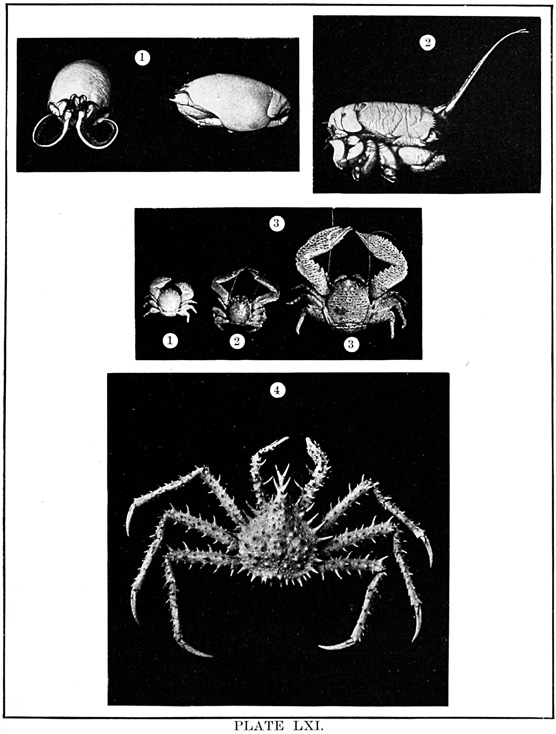
PLATE LXI.
1, Hippa talpoida. 2, Albunæa gibbesii.
3. 1, Porcellana sayana; 2, Petrolisthes armatus; 3, Petrolisthes sexspinosus.
4, Lithodes maia.
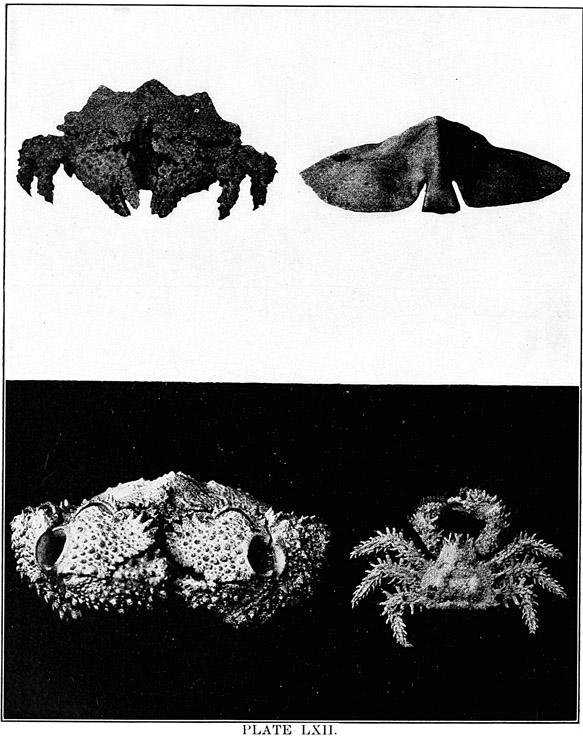
PLATE LXII.
Echidnocerus cibarius. Cryptolithodes sitchensis.
Echidnocerus foriminatus. Phyllolithodes papillosus.
Genus Echidnocerus
E. cibarius. This curious crab has the carapace raised in front into a large cone-like elevation terminating in a long point. Three prominent but smaller cones extend across the center of the back, and two still smaller ones occur on the posterior sides and in the middle of the posterior margin. The whole surface of the carapace is covered with coarse granulations arranged in rosette-like groups. The chelipeds and legs are beset with large tubercles and fold together in such a manner that when retracted the crab is a close, compact, box-like mass, with a very rough, [pg271] spiny armature. The antennæ are broad at the base and covered with small spines on the sides and upper surface, and the eye-stalks are also spiny. This crab sometimes attains the size of ten inches across the carapace and a weight of seven pounds, being among the largest crabs known. It is found at the mouth of the Columbia River and along the northwest coast. (Plate LXII.)
E. foriminatus. This species resembles E. cibarius in the manner of closing the feet, forming a compact, box-like, spiny armature. The body is more depressed than that of the latter, and the cone-like elevations on the back are less prominent. The spines are hairy. The characteristic feature of this species is a semicircular cut in the second joints of the chelipeds, directly opposite to similar depressions in the first walking-legs, so that when the feet are folded a round hole is left, through which water flows freely to the gill-openings, which might, without these open holes, be obstructed by the close folding of the legs against the carapace. Found off the California coast near San Francisco. (Plate LXII.)
Genus Acantholithodes
A. hispidus. The whole body in this species, including the legs, is covered with hairy spines. The abdomen is broad, and covers about the whole under surface of the body, and is also beset with hairy spines, but they are less prominent than those on the upper side. The rostrum, terminating in spines, reaches to the tips of the eye-stalks, which are also spiny. The chelipeds are larger and longer than the walking-feet; the latter taper to a point, ending in a sharp nail. The shape of the body resembles somewhat that of a toad. This is a deep-water species, but it is sometimes brought ashore at Monterey, California, by fishermen who find it in the stomachs of fishes.