Part II MARINE INVERTEBRATES (continued 5)
Reading edition
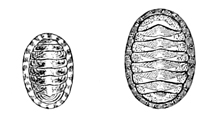
Chiton ruber. Chiton apiculatus.
On the east coast of America there are comparatively few species, and these are all small and inconspicuous. The three commonest ones are Chiton ruber, C. albus, and C. apiculatus. They may readily be found on stones or dead shells fished up from below low-tide mark, or in rock-pools left by the receding tide.
ORDER APLACOPHORA
This second order of the Amphineura is entirely destitute of the shell plates characteristic of the first. The outer mantle surface, however, develops a number of calcareous granules which correspond to a shell. The Aplacophora are symmetrical, having the mouth and the excretory opening at the anterior and posterior ends respectively. The foot is greatly modified, being narrowed at times to a mere slit along the ventral surface. Some of them have long, worm-like bodies. This is no doubt a very primitive form of mollusk, or, if not a primitive form, it has greatly degenerated from some higher type. They are supposed to be commensal in habit and live in the deeper water offshore.
The Aplacophora are not littoral animals, and it is extremely unlikely that one will ever encounter them upon the beach, unless, possibly, after the severest of storms. We may therefore leave them with this mere mention and proceed to the second class of mollusks, the Gasteropoda. [pg324]
TABLE SHOWING THE CLASSIFICATION OF THE GASTEROPODS AND SCAPHOPODS DESCRIBED IN THIS CHAPTER
Phylum MOLLUSCA Class GASTEROPODA Order OPISTHOBRANCHIATA Suborder TECTIBRANCHIATA Family BULLIDÆ Genus Bulla B. (Haminea) solitaria B. occidentalis B. nebulosa Family APLYSIIDÆ Genus Aplysia A. Wilcoxii Suborder NUDIBRANCHIATA Family DENDRONOTIDÆ Genus Dendronotus D. arborescens Family ÆOLIDIDÆ Genus Æolis Æ. papillosa Family DORIDIDÆ Genus Doris D. bilamellata Order PROSOBRANCHIATA Suborder DIATOCARDIA Family ACMÆIDÆ Genus Acmæa A. testudinalis A. testudinalis, Var. alveus A. mitra A. patina Genus Lottia L. gigantea Family FISSURELLIDÆ Genus Fissurella F. alternata F. barbadensis F. (Glyphis) aspersa Genus Lucapina L. crenulata Family HALIOTIDÆ Genus Haliotis H. splendens H. rufescens H. cracherodii Family TROCHIDÆ Genus Margarita M. cinerea M. helicina M. undulata Genus Calliostoma C. occidentale C. jujubinum C. annulatum C. canaliculatum C. costatum Genus Chlorostoma C. funebrale C. brunneum Genus Trochiscus T. norrisi Genus Livona L. pica Family TURBINIDÆ Genus Turbo T. castaneus Var. crenulatus Family NERITIDÆ Genus Nerita N. peleronta N. tessellata N. versicolor Genus Neritina N. reclivata N. viridis Suborder MONOTOCARDIA Family JANTHINIDÆ Genus Janthina J. fragilis Family SCALIDÆ Genus Scala S. lineata S. multistriata S. groenlandica S. angulata Family NATICIDÆ Genus Polynices P. (Lunatia) heros P. (Lunatia) triseriata P. (Lunatia) lewisii P. (Neverita) duplicata P. (Neverita) recluziana Genus Natica N. clausa N. canrena Genus Sigaretus S. perspectivus Family CAPULIDÆ Genus Crepidula C. fornicata C. plana C. aculeata Genus Crucibulum C. striatum C. spinosum Family LITTORINIDÆ Genus Littorina L. litorea L. rudis L. palliata L. irrorata L. angulifera L. scutulata L. planaxis Genus Lacuna L. vincta Genus Tectarius T. muricatus T. nodulosus Family CERITHIIDÆ Genus Cerithium C. floridanum C. muscarum C. minimum Genus Bittium B. nigrum Genus Cerithidea C. scalariformis C. sacrata Family VERMETIDÆ Genus Vermicularia V. spirata Family STROMBIDÆ Genus Strombus S. pugilis S. gigas Family CYPRÆIDÆ Genus Cypræa C. exanthema C. spurca C. spadacea Genus Trivia T. pediculus T. quadripunctata T. californica T. solandri Family DOLIIDÆ Genus Dolium D. galea D. perdix Genus Pyrula P. papyratia Family CASSIDIDÆ Genus Cassis C. tuberosa C. cameo C. testiculus C. inflata Family MURICIDÆ Subfamily Muricinæ Genus Murex M. rufus M. pomum Genus Trophon T. clathratus Genus Urosalpinx U. cinerea Genus Eupleura E. caudata Genus Pteronotus P. festivus Genus Ocinebra O. poulsoni O. lurida O. interfossa Genus Cerostoma C. nuttallii C. foliatum Family MURICIDÆ Subfamily Purpurinæ Genus Purpura P. lapillus P. patula P. hæmastoma P. crispata P. lima P. saxicola Genus Monoceras M. lapilloides M. engonatum Genus Chorus C. belcheri Family COLUMBELLIDÆ Genus Columbella C. mercatoria C. (Anachis) avara C. similis C. (Astyris) lunata C. (Amphissa) corrugata C. (Astyris) gausapata Family NASSIDÆ Genus Nassa N. trivittata N. obsoleta N. vibex N. fossata N. perpinguis N. tegula N. mendica Family BUCCINIDÆ Genus Buccinum B. undatum Genus Chrysodomus C. decemcostatus Genus Sipho S. Stimpsoni S. pygmæus Genus Siphonalia S. kellettii Genus Tritonidea T. tincta Family TURBINELLIDÆ Genus Fulgur F. carica F. canaliculata F. perversa F. pyrum Genus Melongena M. corona Family FASCIOLARIIDÆ Genus Fasciolaria F. gigantea F. tulipa F. distans Family VOLUTIDÆ Genus Voluta V. junonia Family MARGINELLIDÆ Genus Marginella M. apicina Family OLIVIDÆ Genus Oliva O. literata O. mutica Genus Olivella O. biplicata O. boetica Family CONIDÆ Genus Conus C. floridanus C. pealii Family CANCELLARIIDÆ Genus Cancellaria C. reticulata Class SCAPHOPODA Family DENTALIDÆ Genus Dentalium D. dentale D. pretiosum D. hexagonum Genus Entalis E. striolata
CLASS GASTEROPODA
toc
The class Gasteropoda is the largest and most comprehensive subdivision of the Mollusca, and within its wide range of families many differing details of organization are to be found. As a class it possesses all the most characteristic features of the phylum, though it is frequently modified in a high degree. This class includes all the univalve mollusks (except Nautilus and Dentalia), such as the snails, the whelks, and the host of spirally coiled land, fresh-water, and marine shells.
The gasteropod foot is, as has been remarked, primarily the same as in our schematic mollusk—a flat, muscular disk caused by the thickening of the ventral body-surface. The neck, head, and tentacles are also quite the same, but considerable modification of these organs will be found when we come to examine some specimens. The mantle is always present, except in the nudibranch or non-shell-bearing forms; but in few of the Gasteropoda is the mantle so regularly simple as in our ideal mollusk.
Perhaps the most striking feature of the Gasteropoda, and one that will at first surprise him who has in mind the simple structure of the ideal mollusk, is the fact that they are always asymmetrical—that is to say, a median line drawn longitudinally through a gasteropod will not divide it into halves of similar anatomical structure.
The quality of symmetry is an important one throughout the lower orders of animal life. In nearly all phyletic or class descriptions the word "symmetry" occurs, and its exact meaning must be understood. Take, for example, a human being; a median line drawn vertically would divide him into two similar halves—upon each side would be an eye, an arm, a leg, etc., of similar shape and construction. So far at least as the external features [pg329] go, man is then a symmetrical creature; likewise the vertebrates in general. Cases of actual symmetry are found in the lobsters and crabs and in the segmented worms. It is usual in describing mollusks broadly and in general terms to call them symmetrical animals, yet here is the largest class within the phylum, whose representatives are none of them symmetrical. In the Gasteropoda the mouth is anteriorly placed in the head, just as in the ideal form, but the digestive tract, after traversing the visceral cavity in the usual fashion, suddenly turns forward and terminates in an excretory opening either on the right or on the left side of the animal, just back of the head. The various other orifices for the genital and renal glands are also placed in this unexpected anterior position. The gills, or branchiæ, are to be found upon one side only, forward of the heart, and differ somewhat in appearance from the plume-like processes of the Amphineura.
What, then, has become of the corresponding gill we should expect to find on the other side? The symmetrical shape of the foot is not in the least altered, but what has happened to cause this distortion of the visceral portion of the animal? And, finally, will this torsion of the body of the snail perhaps account for the spiral nature of the shell?
An evolutionary process is supposed to have taken place in mollusks, which, if real, would no doubt account for these curious conditions of torsion in the Gasteropoda; but the theory upon which this process is based is altogether speculative, and is not fully sustained by the facts in the case. Originally all mollusks are presumed to have been symmetrical, and are assumed to have resembled very much in form the schematic creature we have already described. Now, for some reason, certain of the primitive mollusks, but not all of them, began to develop a larger visceral mass, which, continuing to enlarge throughout many generations, began finally to protrude above and form a hump on the dorsal side of the animal. This hump, containing the liver, a portion of the intestines, and the generative glands, as it increased in bulk became so much elevated that it could no longer maintain itself in an erect position over the body, but, impelled by its own [pg330] weight, began to sag over to one side. Such a process would of course tend to twist the digestive tract and bring the excretory opening constantly farther forward on one side. At the same time, this process would necessarily interfere, by the weight of the overhanging viscera and the shell covering the mass, with the development of the branchiæ lying upon that side and now crowded under the visceral mass. Thus, according to this theory, this process has continued until, in the modern gasteropod, the digestive tract has been bent upon itself and twisted from a straight course into a curve of almost 180°, bringing the excretory opening near or just over the head, where it empties into the mantle cavity; while the original right gill, by the same movement, has been brought to a position on the left side of the head, forward of the heart, the original left gill having been crowded out, eventually to atrophy and disappear. The same torsion is found in the nerve-cords; the heart, situated at about the pivotal position of this twisting process, has turned about upon itself, leaving an auricle in front of the ventricle, one auricle, like one of the gills, having been lost. The mantle portion covering the visceral hump naturally continued to secrete its shell, though always in conformity with the change, the result being the familiar spiral form of the usual gasteropod shell.
This theory may not be satisfactory, but the asymmetry of gasteropods is a problem to be solved, and a more interesting line of biological investigation could not be found.
Let us now take a good example of a gasteropod and locate its various organs; at the same time we may use the occasion to refer to more important modifications of these organs which will be encountered later in the various genera. The most available gasteropod on the east coast of the United States for this purpose, is Fulgur, both on account of its large size and its abundance. Buccinum may be used if the student is north of Cape Cod and therefore unable to secure a good living specimen of Fulgur; the anatomical differences between the two are slight.
Note the siphon protruding forward from a notch in the shell. This consists merely in an elongation of a fold of the mantle, which is held in a manner to constitute a tube, through which [pg331] the animal draws in water to supply the gills, lying just back of the siphon and concealed under the mantle in the cavity already spoken of as the mantle cavity. With the exception of that portion of the mantle which constitutes the siphon, no part of its margin, it will be observed, can be seen, the edge of the shell completely hiding it from view.
In some genera the siphon is exceedingly long—in fact, longer than the body of the animal. In these cases the mollusk is generally fond of burying itself in the sand and maintaining communication with the world above only by means of this long, fleshy tube. In some genera the siphon is protected by an elongation of the shell, as in Fasciolaria (Plate LXXVI.). An extreme example of this is given in the figure on page 343, which represents a species of Murex, where the siphon is not only protected by the shell, but the shell itself is further protected by the double row of sharp spines with which it is beset.
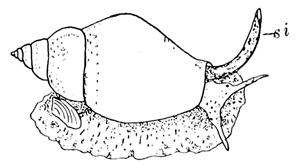
Buccinum undatum: si, siphon.
There are some genera which possess no siphons at all, in all of which cases there is no notch in the shell opening, the aperture being round, as in Natica and in Littorina (pages 368, 371). The mollusks of this type make a fold in the forward part of the mantle which serves as a siphon. Such a muscular folding in the mantle would be technically called a functional siphon.
On the posterior dorsal side of the foot is attached a horny plate, of concentric structure about a central or subcentral point or nucleus. This is called the operculum, and serves to close the entrance of the shell when the animal is withdrawn, the object no doubt being protective. The opercula vary to a great extent in the different genera; in some cases they are calcareous, in others cartilaginous. When the aperture of the shell is very large it often happens that the operculum does not entirely close the opening, as in Fulgur, but in Buccinum it is a close fit. The operculum is entirely wanting in the Pulmonata, one of the [pg332] large orders of the Gasteropoda. The figures represent some of the commoner types of opercula.
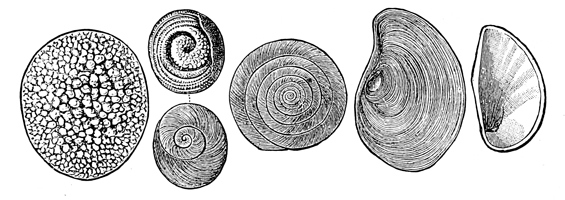
Various forms of opercula, listed left to right.
Turbo (Sarmaticus).
Turbo (Callopoma).
Livona.
Ampullaria.
Natica.
The opercula have been utilized a great deal in the classification of the Gasteropoda, and especially in some groups that have become terrestrial in habit. Often, when shell-characters utterly fail to give a clue to the proper generic position of a new or rare mollusk, the operculum may be relied upon to indicate it.
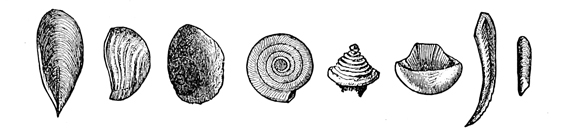
Various forms of opercula, listed left to right.
Pyrula.
Purpura.
Littorina.
Aulopoma.
Torinia.
Neritopsis.
Strombus.
Conus.
TENTACLES
Two tentacles project like fleshy horns from the sides of the head. These are not retractile, as in the land-snails, and their office appears to be that of sensory organs. In both Fulgur and Buccinum the tentacles are comparatively short and stout, and have expanded bases; in many other genera they are long and slender. Almost without exception the Gasteropoda possess tentacles. [pg333]
EYES
In Fulgur the eyes are situated near the bases and upon the outer sides of the tentacles; in Buccinum they are extremely small and are mounted about midway between the bases and the tips of the tentacles. This is the usual position for the eyes in the marine Gasteropoda. Only in the pulmonates, or land-snails, are the eyes placed at the summit of the tentacles. Sight does not appear to be a very important sense in the gasteropods, although the eye in some instances becomes a highly developed organ. A number of forms that have the habit of burrowing deep into the sand or mud are quite destitute of visual organs, and certain cave-dwelling land-shells have entirely lost the sense of vision.
MOUTH AND PROBOSCIS
The mouth will easily be seen in both Fulgur and Buccinum. It is a small slit with slightly thickened, fleshy lips, and is placed on the lower forward portion of the head. In the case of both of these genera the mouth is situated at the end of a proboscis. It will be noted that Fulgur has a comparatively long and stout proboscis, or snout, which is not retractile. Buccinum has a smaller one. It is fairly safe to assume that all gasteropods that possess a proboscis are carnivorous. This organ is greatly developed in some genera, where it actually exceeds in length the rest of the animal. In such instances, no doubt, the creature is enabled to reach the interior portions of the shells of its victims and to devour every vestige of their flesh, for the mouth is most conveniently placed just at the end of this long, trunk-like organ. The genera which have no proboscis are, almost without exception, vegetable feeders.
We must now remove the animal from its shell. It is well to boil it first, for this does away with the annoying mucous secretion that is freely exuded by glands in the foot when the creature is roughly handled. Alcoholic specimens are apt to be much contracted and hardened, and are therefore less satisfactory as subjects for anatomical study. If it is not convenient to boil the [pg334] specimen, break away the shell with a hammer, using care not to lacerate the soft, fleshy portion within; when this is accomplished, wash the animal carefully to remove the slimy exudation. Note the "visceral hump," which is spiral, and which formerly occupied the upper-whorl portion of the shell. The thin skin covering it is the mantle, which below is greatly thickened and free, lying about the foot like a heavy fleshy flap.
MANTLE
The mantle-edge in both of these examples is simple; that is to say, it possesses no fringe of tentacles, nor is it supplemented by extra processes, characters which mark many genera of marine Gasteropoda. In Fulgur and Buccinum the mantle-edge does not protrude below the edge of the shell; but in many genera, especially those which possess smooth, glossy shells, like the cowries (Cypræa) and the graceful Oliva, the mantle is proportionately very much larger. In these two genera, when the animal is extended, as in crawling about the sand, the mantle curves upward and incloses a large portion of the shell itself. Indeed, in some genera the shell is almost entirely concealed by this extension of the mantle (Sigaretus, Natica, etc.).
When the shell is removed, the folding of the mantle which constitutes the siphon can be plainly seen. The office of the siphon has already been referred to, also the fact that the presence of a siphon in the gasteropod mollusk may always be determined by merely glancing at the shell alone, for a notch at the base of the aperture indicates the place through which the siphon passed. In Buccinum this is merely a notch, but in Fulgur the siphonal canal of the shell is much longer. Just why the long siphons of some mollusks should be naked and exposed to danger, while others are so carefully protected by elongated, portions of the shell, is a mystery, but nature is full of such contradictions.
THE GASTEROPOD FOOT
The foot is long, broad, and flat on the under side, like a disk. The variations in the gasteropod foot are almost infinite. [pg335] In some of the species it is amazingly large and powerful, as in Polynices (Natica), and in most of the forms which live along sandy beaches. These are sometimes provided in front with a wedge-shaped process called the propodium, which serves admirably as a plow to push aside the heavy wet sand through which the animal forces its way. In Nassa, which is so common all along our coasts, the foot has two terminal appendages or points behind.
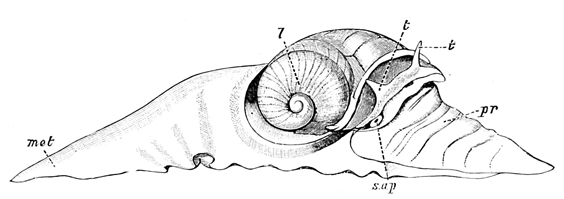
Sigaretus lœvigatus, showing excessive development of the propodium (pr.) and metapodium (met.) in a mollusk living in sand (the shell, which covers only the liver and adjacent parts, has been removed): l, liver; s. ap., aperture of proboscis, here deflected from the median line; t, t, tentacles; f, foot.
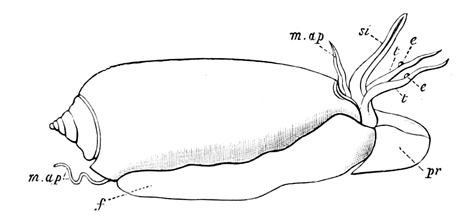
Oliva textilina showing how the front part of the foot (f) is developed into a sort of fender, the propodium (pr.): e, e, eyes; m. ap., front appendage of mantle; m. ap.´, hinder appendage of mantle, folded into the suture when the animal is at rest; si., siphon; t, t, tentacles.
There is no single feature of mollusks more important than the foot, for upon the many modifications of this organ the various molluscan classes are founded. The name Gasteropoda means "stomach-foot," the latter organ being merely a thickening of [pg336] the ventral surface of the animal, giving to the creature, when active, the appearance of crawling upon its stomach.
If a living gasteropod is placed in a jar of sea-water and left undisturbed it will soon crawl up the side of the glass and thus afford an excellent view of the extended under surface of its foot. The majority of the gasteropods are lethargic and slow in movement, but others will be found to be exceedingly lively and able to creep up the sides of the jar and make their escape in a surprisingly short time. Further modifications of the foot will be mentioned later.
THE MANTLE CAVITY
Now let us place the animal with the foot below and the head facing us. The spiral visceral hump will point back and away from the observer. The mantle covering the visceral portion is thin and translucent like an ordinary skin, but at the base of the visceral mass the mantle suddenly thickens very greatly, and spreads over the dorsal portion of the foot or the body like a cloak. The space between the body and the loose-lying mantle is called the mantle cavity, and within this area are to be found several important external organs. To find these it is well to cut the mantle flap in a straight line, beginning just back of the head and ending at the point where the mantle is attached to the body. This will most easily be done with scissors. Having thus divided the mantle in front, throw back the two flaps. On the right-hand side (left of the animal), and attached to the inner side of the mantle thus exposed, will be seen the branchiæ, or gills.
THE BRANCHIÆ, OR GILLS
They consist of a row of flattened filaments bound together at the base like the leaves of a book. The blood is conveyed to these gills by a large vein, and is then forced through the thinly walled filaments, being thus brought into close contact with the water, to which it releases its carbon dioxide, and from which it receives the life-giving oxygen. In certain gasteropods there are two sets of gills, one placed upon each side of the body [pg338] (as in the ideal mollusk); but the presence of two sets of gills only indicates, in these gasteropods, that the twisting process of the viscera, already alluded to as so remarkable a feature of this class, has not proceeded far enough to destroy the functional activity of one of the gills.
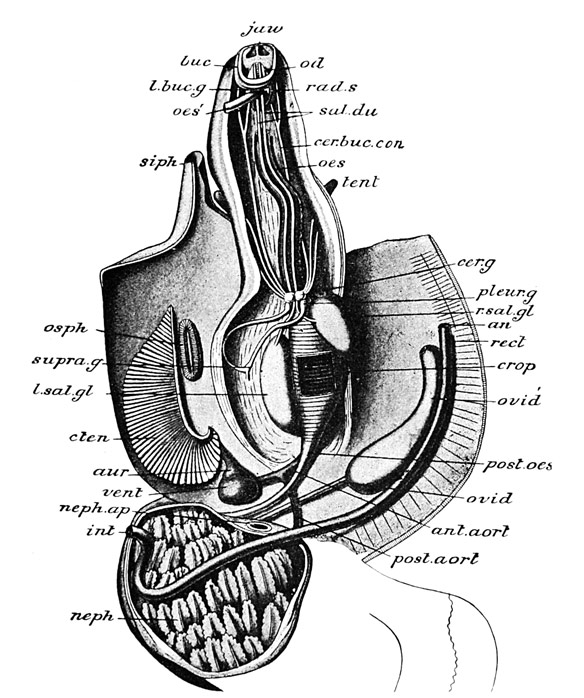
Anatomy of the internal organs of a female gasteropod, viewed from the dorsal side. The roof of the mantle cavity has been divided by a longitudinal incision and the flaps laid out, that on the left bearing the ctenidium and osphradium, and that on the right the rectum and terminal part of the oviduct. The muscular dorsal wall of the body and the introvert have been divided so as to bring into view the anterior part of the alimentary canal and a portion of the nervous system. The buccal cavity has been tilted up and opened so as to show the odontophore, and the esophagus has been cut through near the anterior end. A portion of the ventral wall of the crop has been removed so as to bring the internal folds into view, and the interior of the nephridium with the contained portion of the intestine has been exposed. The stomach is not seen, being hidden by the nephridium, and the ovary is not represented. an., anus; ant. aort., anterior aorta; aur., auricle; buc., buccal cavity; cer. buc. con., cerebro-buccal connective; cer. g., cerebral ganglia; crop, crop; cten., ctenidium; int., intestine; jaw, jaw; l. buc. g., left buccal ganglion; l. sal. gl., left salivary gland; neph., nephridium; neph. ap., nephridial aperture; od., odontophore; oes., esophagus; oes'., anterior end of same, cut and turned aside; osph., osphradium; ovid., oviduct; ovid'., terminal thick-walled portion of oviduct; pleur. g., pleural ganglion; post. aort., posterior aorta; post. oes., posterior esophagus; rad. s., radula sac; r. sal. gl., right salivary gland; rect., rectum; sal. du., salivary duct; siph., siphon; supra. g., supra-esophageal visceral ganglion; tent., tentacle; vent., ventricle.
In general, it may be said that the breathing process of mollusks does not markedly differ from the respiratory methods of higher forms of animals. Whether the breathing is effected by gills or by a pulmonary sac, the essential features of the system are the same as in fishes or mammals. There are, however, some rather peculiar developments in the breathing system of gasteropods that are worthy of notice. The gills themselves differ throughout the various orders of this class both as to their structure and their relative position; in one of the orders (the Pulmonata) the gills have entirely disappeared, and are replaced by a pulmonary sac which fulfils the purpose of a lung.
It is a generally accepted theory that all land or air-breathing mollusks were originally marine, but by a gradual change in their habits have developed into terrestrial forms, losing their gills and acquiring in their place organs which correspond to lungs. The theory is supported by the fact that many species of marine mollusks live between tide-marks, and for several hours daily are obliged to maintain life outside of their native element. The Littorinidæ, which may always be found in abundance on both the east and the west American coasts, usually live high above low-tide line, and some tropical species of this genus actually live in the trees above the reach of high tide. They have gills just as in Buccinum or Fulgur, but the Littorina shell is strongly suggestive of certain land forms, and there is reason to believe that the genus is in course of evolution into a pulmonate. On the other hand, there are to be found in fresh water numerous genera which are true pulmonates, and which are obliged to come to the surface every few minutes to obtain air. One notable genus of marine gasteropods possesses both lungs and gills, and one marine form has entirely lost its gills and breathes only by means of lungs. It is quite likely that all mollusks are able to breathe more or less all along the exposed mantle surface, which is usually [pg339] crowded with capillaries with exceedingly thin walls. This very remarkable method of surface respiration is proved to exist in the nudibranch or shell-less marine Gasteropoda, for they possess neither gills nor lungs.
OSPHRADIUM
Lying just under the gills, and side by side with them, is a smaller, plume-like organ having the appearance of a smaller gill; it is called the osphradium. The office of this organ is not definitely known, but the supposition is that it is the seat of the olfactory nerves. The osphradia are not always present, but whenever found they are placed in close conjunction with the gills, in order, probably, that the animal may best determine the quality of the water brought by the siphon to the breathing-organs. In Buccinum the osphradium is especially prominent. In all mollusks the sense of smell is highly developed. A dead animal anchored to the bottom will very soon attract the carnivorous Mollusca from every direction. This is not a bad way to trap certain species that live upon rocky stations and are otherwise difficult to secure by the dredge.
On the left-hand side (right of the animal), and adhering to the under side of the mantle flap, which has been thrown back, a somewhat inflated and convoluted tube, the rectum, will be seen. It terminates in an opening just within the mantle-edge. By the side of this are the renal and genital openings.
Having now examined the external organs, we may investigate the internal anatomy of our subject. To do this thoroughly requires considerable skill, but for the purpose of merely discovering the relative positions of the principal internal organs a little care only is necessary. The work will be greatly facilitated by boiling the animal for a few minutes, for this serves to harden the tissues and to separate the various organs in a most satisfactory manner.
To begin, open the proboscis from the mouth, cutting back so as to expose the esophagus. It will be seen that the throat is long and very muscular. [pg340]
RADULA
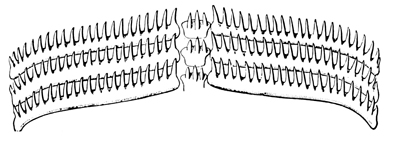
Three rows of teeth from the radula of Fasciolaria trapezium.
Hidden among the red stripes of muscular fiber which line the inner surface of the throat will be found a fleshy strip covered upon one side with many transverse rows of chitinous teeth. This is the lingual ribbon, or radula. Remove as much of it as possible, and examine it with a hand-glass. The radula is a most important organ, and is a unique possession of Mollusca, except the pelecypods, or bivalves. Usually it lies coiled up like a spiral when not in use; its purpose is to tear and rasp food.
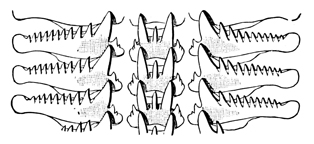
Portion of the radula of Imbricaria marmorata.
The radula has been the subject of much study by conchologists, and has furnished the basis for an arrangement of the numerous sections of gasteropods into somewhat well-defined groups. If the observer has a strong glass he will notice that each transverse row of teeth on the ribbon consists of a median or central tooth with several points or "cusps." Fulgur has a median tooth with three cusps; Buccinum one with six. On each side of the median tooth is a lateral tooth, which in Fulgur will be seen to have six cusps, and in Buccinum five. In many patterns of radulæ there is, besides the median and lateral teeth, still another paired row, called the marginals. In the accompanying figures are given some examples which show small sections of lingual ribbons. While all the radulæ of mollusks are capable of being grouped by their general characteristics, yet in no two species of mollusks are the radulæ quite identical. [pg341]
VITAL ORGANS, STOMACH, LIVER, RENAL GLANDS, ETC.
The digestive tract will be found to widen out a short distance back into a crop or stomach, and, continuing still further, to lose itself in a soft, brownish mass within the coiled spire, which is the liver. The very large size of the liver leads one to suspect that Fulgur and Buccinum must be voracious creatures to need so large an organ for the secretion of bile. In many species of mollusks the stomach and intestines are filled quite solidly, at times, with a gelatinous transparent substance called the crystalline stylet. Just why the digestive tract should be clogged with this substance no one has yet been able to explain, so here again is a chance for original investigation. The intestine curves about after reaching the liver, and comes forward again to appear once more as the rectum, clinging to the inner surface of the free portion of the mantle.
Closely associated with the liver, but differing slightly in color, is the gonad, or organ in which the genital products are formed. Situated dorsally and forward of the liver and gonad is a large renal gland, which may readily be detected by its peculiar structure. In some forms the kidney is closely associated with the gonad, and seems to coöperate with the latter in the generative functions.
HEART AND VASCULAR SYSTEM
To find the heart, make an incision into the body just at the posterior end of the gills. The heart is white and round, and is inclosed within a cavity known as the pericardium; it has a ventricle and one or two auricles, although in Buccinum and Fulgur there is but one auricle.
There is nothing remarkable about the vascular system to distinguish it from that of many higher forms of animals. It is, however, not completely closed—by which is meant that the blood is not always contained within arteries or veins, and that it does sometimes flow into other organs and floods certain other body-cavities, although the vascular system of mollusks is by no means so completely open as is that of insects and crustaceans. [pg342]
Having examined the animal which inhabits the shell and gained an idea of its anatomy, we may now turn to an inspection of the house which it has built for itself, and here we shall find a delightful subject for study.
THE GASTEROPOD SHELL
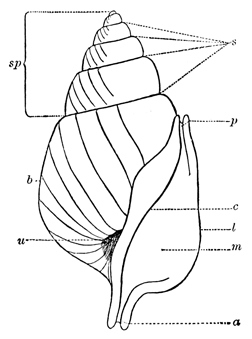
Parts of a gasteropod shell: a, anterior canal; b, body-whorl; c, columella; l, outer lip; m, mouth or aperture; p, posterior canal; s, sutures; sp, spire; u, umbilicus.
An industrious hour of collecting upon almost any beach will provide the student with an abundance of interesting shells. Putting aside the bivalves, the univalve or gasteropod shells remaining should be closely examined for the purpose of becoming acquainted with their various conchological features. The collector will see at once that he has a number of species that differ more or less widely in their general form, size, texture, and sculpture. Some shells will be long in proportion to their width, with many turns of the spire which probably terminates in a sharply pointed apex; others will be almost round, with comparatively few spiral turns which end in a blunt apex, giving to the specimen outlines suggestive of a dome. A wide range of characters will be found in the mouths or apertures of the shells, some being almost if not quite round, others oblong and with a notch cut into the lower portion of the opening, and others possibly with this notch extended into a sort of semi-inclosed channel. A first lesson in classification of the Mollusca may be taken by dividing the results of the first day's collecting of univalve shells into groups according to these prominent shell-characters.
A good knowledge of the parts of a gasteropod shell is essential to the student, and it can readily be acquired. Four specimens are given in the accompanying figures, representing highly divergent [pg343] types of marine gasteropods, and their respective characteristics may be noted by comparing them one with another: Fasciolaria tulipa (Plate LXXVI.), a Floridian shell; Polynices heros, a common species found on all the sandy shores of the American Atlantic coast; Murex tenuispina, an Indo-Pacific species much prized by collectors; and Acmæa testudinalis, commonly found in Maine and Massachusetts at low tide clinging to rocks.
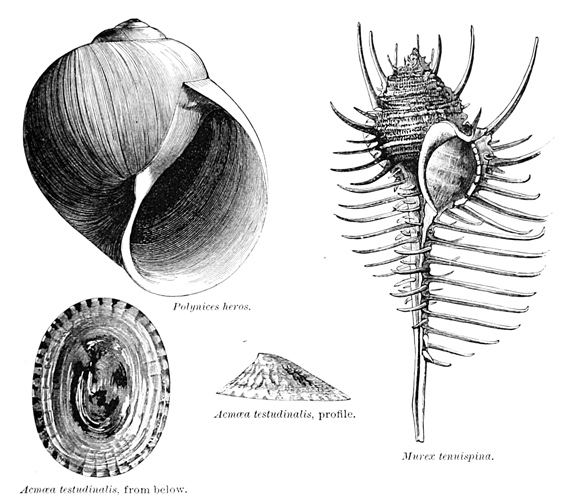
Shells listed clockwise from top left.
Polynices heros;
Murex tenuispina.
Acmæa testudinalis, profile;
Acmæa testudinalis, from below;
The extreme top of the shell is called the apex, and it may be either sharply pointed or obtuse. Each turn is called a whorl; the last one, and always the largest, is called the body-whorl, the others collectively forming the spire of the shell. When the animal first emerges from the egg it is always provided with one or two whorls, which generally may be distinguished at the apex as smoother than the rest of the spire, and a faint line may be discovered where the shell began its growth after birth. These [pg344] first whorls of embryonic growth are usually referred to as the nepionic whorls. The interstices between the successive whorls are called sutures, and these lines of juncture may be shallow or deep according to the convexity of the whorls. The sculpturing of the whorls is often of great complexity, and exhibits nodules, varices, ribs, revolving striæ, spinous processes, and lines of growth. It frequently happens that there is a complete absence of any sculpturing whatever, the whole surface of the shell being perfectly smooth, save for the faint lines of growth to be detected only under a magnifying-glass. The outer edge of the mouth or aperture of the shell is called the outer lip. This may be more or less thickened, expanded, or simple. The inner lip is called the columella, and may be greatly extended anteriorly. When the mouth of the shell is round, and there is no notch or indentation either above or below, it is said to be continuous.
The anterior canal is for the accommodation of the siphon of the animal, which, as noted above, may be very long or almost entirely absent; therefore the character of the shell generally indicates whether or not the animal itself possesses a long siphon. There is in some forms a notch at the upper extremity of the mouth, which is for the accommodation of the anal discharges. When present it is called the posterior canal.
It will be noted that all the specimens figured as examples, save one, are spiral, the coils revolving about an imaginary axis. When the whorls are not too closely coiled there is left open to the view a hollow space throughout the entire length of the shell, which is called the umbilicus. When the coils of the shell are very compact there is no umbilicus to be seen. The umbilical opening may be very large, giving a clear view of the inner surfaces of all the whorls right through to the apex. The usual gasteropod shell is in reality a hollow tube wound about an imaginary axis. Since the tube increases in size as it progresses, the base of the shell is necessarily wider and larger than the apex. Thus all gasteropod shells may be reduced in shape to the single type of a cone or top, modified by the excessive length or shortness of the spire, or otherwise altered by special peculiarities. In Polynices duplicata (page 368), it will be observed that while the [pg345] umbilicus is fairly large, its external opening, in the adult shell, has been almost completely closed by a callous process thrown off from the inner or columellar lip.
Gasteropod shells may be sinistral or dextral, according as the whorls turn to the left or right. The great majority of marine species are dextral, having the opening on the right, although a few species exhibit the curious property of being constructed upon either the one or the other plan without apparent reason. Sinistral specimens of many normally dextral species have been discovered, but they are so rare as to warrant the belief that such specimens are merely deformities or monstrosities resulting from some accident of birth.
The collector will soon learn to distinguish between young and adult specimens, for those finishing touches of wonder and beauty which the mollusk gives to his protective covering are made only by the adult. The outer lip of young gasteropod shells is usually thin and fragile; even if slightly thickened, it has an unformed or unfinished appearance.
Shells differ greatly in their structure, many species being porcelanous like china, others glassy, and many more are of a softer chalky composition. In the latter case the shell is usually covered with a thick membranous skin, which, when removed, leaves a dull, lusterless, white body beneath. Shells of this texture, when cast upon the beach, soon yield to the weathering action of sun and air. The porcelanous shells are composed of successive layers of carbonate of lime, throughout which is a filmy membranous framework of a substance similar to that of which the covering of the Crustacea is formed. The mode of deposition of the various layers of crystalline calcic carbonate and the peculiar lineation of their outer surfaces give rise to the iridescent or nacreous appearance of some shells.
With the exception of those species in which the mantle of the animal is extended over the edge of the aperture and more or less envelops the entire test, there is an outer skin of membranous or organic matter which overlies the surface of the shell. This skin is sometimes quite thick, often hairy, and is usually of a dull greenish- or brownish-yellow color. In many genera this [pg346] outer covering of the shell is excessively thin. In old specimens the epidermis is usually worn away from the apical whorls. It often happens that the shells of the most exquisite colors and markings are thus rendered somber and unattractive by their tenants during life; when the animal dies, or when such specimens are kept in a cabinet for a period of time, the epidermis dries, cracks, and falls off, revealing the wealth of color and design beneath.
The growth of the gasteropod shell is accomplished by the exudation from the margin of the animal's mantle of a liquid containing the shelly matter in solution. The mantle-edge is provided with a complicated system of glands and pores, from which is secreted this "stony liquor." This more or less viscous liquid, containing the carbonate of lime and the other inorganic materials of which the shell is composed, hardens upon exposure, and the shelly matter is then deposited in crystalline form around the edges or lip of the shell aperture. The gasteropod shell therefore grows by the continual building out of its aperture through successive depositions of shelly matter at the extreme edge of the lip. At the extreme edge of the mantle margin are situated those glands which secrete the materials for the epidermis of the shell, and as one would therefore expect, this outermost layer of epidermis is first produced in the advancing growth of the shell. There also are situated the pigment-glands, which produce the color-secretions. The various layers of the shelly substance are successively deposited inside the mouth of the shell by glands situated just back of the extreme edge of the mantle margin. Thus in the growth stage, if one could examine closely the aperture of a gasteropod shell, one would observe at the extreme tip of the lip this projecting epidermis, just beneath it and just inside the aperture a thin deposit of shelly matter, just beneath this, and farther in, another layer, and still farther in a third layer.
The growth of nearly all gasteropod shells is marked by periods of rest. During the inactive seasons the creature may thicken the edge of the aperture to a greater or less extent by an extra deposit of shelly matter, for otherwise the thin lip might soon be [pg347] injured or broken. These places where the lip was thickened, as a temporary protection until the young animal decided to continue building, appear on the surface of adult shells, and persist as varices, "raised lines of growth," "longitudinal ribs," etc. Such forms of sculptural markings generally occur at equidistant points and preserve a scheme of regularity which would indicate that the periods of rest were of seasonal occurrence. All irregularities and all surface features of the external shell simply reflect certain peculiarities of the mantle margin of the animal; all spinous processes, for instance, as in the marvelous Murex tenuispina, indicate the existence of finger-like processes extending from the mantle margin, which once occupied the hollow thorns projecting from the shell. When the outer surface of a shell is devoid of any sculpturing and is perfectly smooth, one may assume that the mantle margin of the animal was simple. If the edge of the lip has a crenulated appearance and the surface of the whorls is decorated with revolving ribs, the mantle margin was probably folded or wavy. There can be no doubt but that the entire mantle surface is provided to some extent with glands for the secretion of shelly matter, for if any portion of the shell is accidentally injured the animal soon repairs the break with a calcareous deposit. But such repairs are never homogeneous in texture with the other parts of the shell of normal growth; the patches are never covered externally with an epidermis, and they are always devoid of color. The function of the epidermis is to protect the calcareous shell from the corroding agents contained in sea-water. Hence it is that, when the epidermis is removed, "dead shells" exposed to the influence of the water or the weather soon lose their brilliancy and luster, and become undesirable for specimens either for the cabinet or for study. It often happens that living shells, inhabiting a region where, for one cause or another, the water is highly charged with impurities of an acid nature, are discovered to be badly corroded about the apex, where the epidermis is thin and likely to be rubbed off. For this reason specimens collected in harbors near large cities or near the mouths of rivers are apt to be poor and defective.
The inner surface of all shells, if not actually nacreous, is [pg348] always perfectly smooth. When foreign substances, such as grains of sand, enter the shell and cannot be removed by the animal, the irritation caused thereby to the soft, fleshy creature induces discharges of a liquid from the glandular surface of the mantle, which hardens about the offending substance and glazes it over with a smooth, pearly deposit.
Acmæa testudinalis (page 343) presents a special type of gasteropod shell which is found in several families. Here the spire seems to be wholly absent, and the entire shell consists of but one large body-whorl. There are very many of these patelliform species, inhabiting many seas and belonging to many different genera, and in nearly all cases their embryonic shells display a spiral form. After birth the animal does not build his house upon the spiral plan, but expands the shell into one large shield-like covering. The student, however, must not presume that Acmæa is an ancestral type just because the simple character of the shell is suggestive of the model chosen to represent a schematic mollusk; anatomically Acmæa presents the complications of body-torsion which show a very considerable evolutionary change, and indicate that its simple shell is probably a degenerate form of a once more highly developed and convoluted one.
The forms, the architecture, and the painting of gasteropod shells are so infinite in variety that it would be unwise to attempt a description of their marvels. A close observer of nature's works soon becomes prepared for every surprise, but he never ceases to be charmed and fascinated by his new discoveries. The careful student alone can learn really to see and appreciate the wonders of nature, and this is especially true in the study of the Mollusca.
CLASSIFICATION OF GASTEROPODS
The Gasteropoda far exceed all the other divisions of the Mollusca in the number of their genera and species. Apparently this has not always been the case. There is evidence tending to show that in past geological epochs the pelecypods (the bivalve shells) outnumbered the gasteropods, but that in the course of time the increase in the genera of gasteropods has been more [pg349] rapid. To judge also from the very large number of extinct families among the cephalopods, which once flourished in astonishing abundance, it would appear that they are a dying race.
The classification of the Gasteropoda is primarily a division into three great orders: the Opisthobranchiata, the Prosobranchiata, and the Pulmonata. The Pulmonata, which include the land and fresh-water gasteropod shells, are characterized by the presence of a breathing-sac, or lung, instead of gills. They are, therefore, essentially air-breathers, and would perish if kept too long under water. The Opisthobranchiata and Prosobranchiata are marine, and, like all animals which breathe by means of gills, soon die when removed from the water. We have already noted, however, how some genera of marine gasteropods that find their station about high-tide mark are able to live for considerable periods out of the water, notwithstanding the fact that they are fully equipped with gills and not possessed of lungs. Indeed, there is one large family of prosobranchs (the Cyclostomatidæ) that has become entirely terrestrial in habit, its members having lost their gills and acquired lungs, but their organization otherwise is so essentially that of the prosobranchs that they have never been considered as pulmonates.
The main difference between these two orders of marine gasteropods is that in the prosobranchs the breathing-organs (the gills) are placed in a position forward of the heart, and the degree of torsion (page 330) characteristic of this molluscan class has been continued until the auricle of the heart is in front of the ventricle. There is always a shell, usually spiral, and, with few exceptions, an operculum. In the opisthobranchs, on the other hand, the relative position of the heart and gills is reversed, and they further differ from the prosobranchs in that the sexes are always united in each individual. The opisthobranchs are not always provided with a shell. One division of the order, known as the "nudibranchs," are entirely naked. These are commonly called the "sea-slugs," and are to be found crawling about the marine vegetation in shallow water, in tide-pools, and on the piling of old docks. Curiously enough, the sea-slugs (see page 354) have no gills at all, but, having lost these apparently essential organs, are [pg350] enabled to "breathe water" through their skin. They are wonderfully beautiful creatures, and the collector must not fail to secure some specimens, put them into a jar of sea-water, and watch them expand.
There are other more superficial differences between the prosobranchs and the opisthobranchs, which will enable even a beginner to distinguish them at a glance. When the latter are possessed of an external shell, it is bulbous, generally glassy, and with a simple lip, the aperture extending the entire length of the shell. Again, the mantle or the propodium of the foot is greatly extended and usually covers the shell almost wholly.
With the exception of the nudibranchs, which are common all along the Atlantic shore, especially north of Cape Cod, there are very few opisthobranchs to be found in American waters. Their shells are not very abundantly found anywhere, though in Florida there are two or three species which an untrained collector might discover.
Practically all the gasteropod or univalve shells that will be taken by the ordinarily expert collector along the shore are prosobranchs. This order includes the great majority of marine gasteropods, and is entitled to the distinction of claiming, in the great number of its genera and species, the most startling eccentricities of form and color to be found among the Mollusca, if not among all marine invertebrates.
Only those species which are actually abundant on the Atlantic and Pacific shores of the United States, and which are likely to be found by the untrained collector, are selected from the long list of forms which belong to the three faunal regions involved.
ORDER OPISTHOBRANCHIATA
Suborder TECTIBRANCHIATA
To avoid confusion, it is well to keep the systematic table in view:
Class GASTEROPODA Order OPISTHOBRANCHIATA Suborder TECTIBRANCHIATA Suborder NUDIBRANCHIATA Order PROSOBRANCHIATA Order PULMONATA
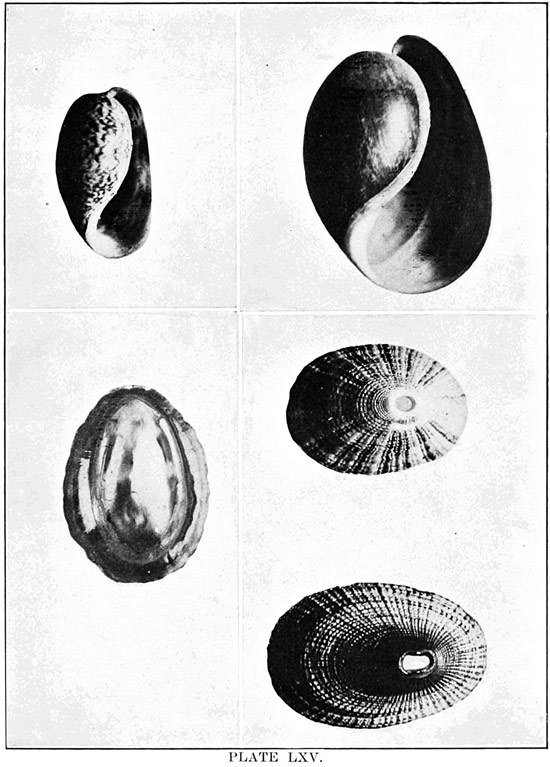
PLATE LXV.
Bulla occidentalis, enlarged. Bulla nebulosa.
Lottia gigantea, inside view. Fissurella alternata.
As has already been remarked, shell-bearing opisthobranchs are not abundantly represented in number of species in North American waters. South of Cape Cod, in muddy bays and well-sheltered places, the little shell, Haminea solitaria, may, however, often be found in considerable numbers.

Haminea solitaria.
Genus Haminea
H. solitaria. Like all external opisthobranch tests, the shell of this species is thin and fragile, and would appear to be of small importance to the creature it only partially protects. It is devoid of spire, is shining bluish-white, sometimes brownish in color, and is marked with revolving grooves, which, being cut across by irregular growth-lines, give its surface a faintly decussated appearance. The aperture is as long as the shell; the columella is incurved. This little species is especially abundant in shallow water about Vineyard Sound and in Peconic Bay.
Genus Bulla
B. occidentalis. This species, which is found in the waters of Florida on all sandy beaches, is a relative of the Northern species just described. The shell is larger than that of Haminea solitaria, and has a color-pattern of mottled or clouded reddish-brown on a white foundation. There is no spire; there is a pit in place of an apex; and the aperture extends the full length of the shell. To the naked eye the surface appears smooth and shining. It is an exceedingly variable species, occurring all through the West Indies, but not north of Florida. The shores of the keys along the west coast of Florida are often strewn with these shells after storms. The animal, like all the shell-bearing opisthobranchs, is very large as compared with the shell, and the large mantle folds recurve upward, almost completely hiding the shell from view. (Plate LXV.)
B. nebulosa. This is one of the largest and finest species of the family Bullidæ. It is found on the coast of California south of San Francisco. The shell is much larger than that of either of the Atlantic species mentioned above, but very closely resembles them in outline, although it is built upon a more generous plan and is more richly painted. It is brownish, mottled with white and yellow patches, and is very suggestive of certain kinds of birds' eggs. The animals have a greatly extended mantle which almost completely envelops the shell. The foot is extremely large, with great wing-like developments upon each side, called parapodia. Some species of Bulla have been seen to swim by means of the lazy flapping of the parapodia. (Plate LXV.)
SEA-HARES
Closely allied to these outer-shell-bearing opisthobranchs is a large and important group of tectibranchs, known as [pg352] "sea-hares." They have a mantle so greatly developed that it actually covers the shell, and its edges unite and fuse over the top. The shell, in consequence, having almost ceased to be of use as a protection, has degenerated into a mere horny plate, and has lost all resemblance to the ordinary gasteropod shell. Having practically lost its protective office and become a mere internal plate, it is quite probable that it will in time wholly disappear. The gills of the sea-hares are concealed under a flap of the mantle, their position being posterior to the heart. The most conspicuous representative of this type of tectibranchs in the United States is the following:
Genus Aplysia
A. Wilcoxii. This species appears at times in vast numbers in the waters of Florida, until the sea may truly be said to be fairly alive with them. They swim lazily with a waving motion of the parapodia. They disappear as mysteriously as they come, and for months not a specimen will be seen. There is a variety of this Floridian Aplysia which occurs at Cape May, but no sea-hares are to be found north of that point. The tropical Pacific furnishes an astonishing wealth of these creatures, belonging to many genera and species, and among them are some of the most beautiful of the invertebrate animals.
Suborder NUDIBRANCHIATA
The opisthobranchs are divided into two suborders, the second of which is called Nudibranchiata. The name is well chosen and very suggestive, for it means "naked or exposed gills"; but this anatomical feature is only one of the peculiarities of this suborder. The nudibranchs are commonly known as "sea-slugs"; for, like the land-slugs, which are also true mollusks, they possess no shell at all. That they at one time carried a shell is evident from the fact that they are born with a rudimentary testaceous covering, which soon afterward disappears.
A striking peculiarity of the nudibranchs is that the conventional molluscan mantle is not usually apparent. Instead of seeing the usual flaps or folds of the mantle which more or less encircle mollusks, and which one seems to have a right to expect, [pg353] they are entirely absent, and the body of the sea-slug assumes in consequence a worm-like appearance. Other notable features of the nudibranchs are the great number of tentacular processes that usually project from the dorsal region of the animal, and, in many of the genera, an entire absence of gills. When the gills are present, as is the case in several of the nudibranch families, they are not placed along the side of the animal, where one would naturally look for them, but are arranged in the form of a rosette of plume-like processes situated in the posterior dorsal region, or, in other words, on the animal's back.
Nudibranchs are commonly to be found all along the Atlantic and Pacific coasts of North America, and more especially in the colder waters north of Cape Cod. They are essentially littoral, and live upon algæ in shallow water, upon eel-grass in sheltered places, and in tide-pools, where there is more or less vegetation. They crawl about the fronds of algæ, or swim, foot upward, with a gentle and undulating motion, or, when caught between tides, may be seen clinging to the under surface of rocks. Protective resemblances have been so remarkably developed in the nudibranchs that they are not always easy to discover; indeed, one may actually be looking at one for some time without suspecting it to be other than some torn fragment of seaweed.
There are many species belonging to several genera which frequent the Maine and Massachusetts coasts, but those most likely to be encountered are the following:
Genus Dendronotus
D. arborescens. This species is about one inch long and variable in color, but is usually reddish-brown or rose. There are no tentacles, but in their place are two antler-like appendages pointing forward and branched like a tree. All along the back are two rows of these curiously branched processes, which give to the animal the appearance of a plant. These cerata, or dorsal papillæ, are delicately transparent, contractile, and richly colored. The function of these papillæ is not fully known. As the animal has no specialized breathing-organs, it is reasonable to suppose that respiration is carried on through the outer skin and perhaps all over the surface of these branched papillæ. The liver, which [pg354] in most nudibranchs is extremely large and completely surrounds the stomach, in Dendronotus also extends into these dorsal cerata, so that they may have some sort of digestive function.
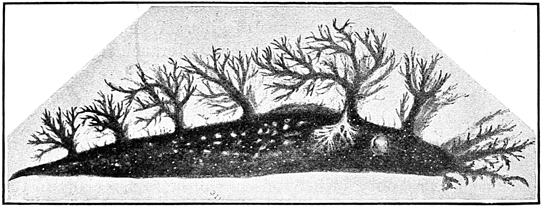
Dendronotus arborescens.
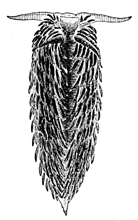
Æolis papillosa.
Genus Æolis
Æ. papillosa. This is probably the commonest nudibranch upon the North Atlantic coast, and it occurs as frequently in European waters. It may readily be found clinging to stones, algæ, the piling of wharves, eel-grass, etc., in bays or in rocky tide-pools. The color is yellowish-gray to orange, with purplish or olive spots. The cerata are very numerous, and cover the dorsal portion of the animal save for an open space along the middle of the back. There are two sets of tentacles, the two dorsal and the two simple labial tentacles. The foot tapers behind to a sharp point, and is truncate in front. As in Dendronotus, the liver is diffused into the cerata, which in Æolis are simple tubular processes without the branching character of those of the former. Both species lay their eggs in a gelatinous, bobbin-like cord, which is hung in festoons over rocks or upon zoöphytes, or at times they wind the cord in a coil upon the surfaces of stones. When the young first hatch out, they are provided with a glassy nautiloid shell, a fact which would indicate that at some remote period they were, like most mollusks, provided with a shell. Æolis swims in an inverted position, and is at times exceedingly active. It is very variable in coloring and in the number of cerata.
Genus Doris
D. bilamellata. In Doris we find a quite different type of nudibranch from that presented by the two genera Dendronotus and Æolis. In one there were numerous branched cerata or dorsal papillæ, in the other many plain cerata, and in neither case were there any specialized [pg355] breathing-organs. In Doris, however, there are no dorsal papillæ at all, the back being covered with calcareous spicules, which form a sort of secondary shell. There is a circlet, or rosette, of retractile plume-like gills, or branchiæ, placed in the middle of the back posteriorly. There are various species of Doris, and of closely allied genera belonging to the family Dorididæ, which are to be found along the New England coast in tide-pools and among rocks. Those seen by the writer never appeared to be other than very sluggish creatures, and proved to be rather unsatisfactory tenants of the aquarium.
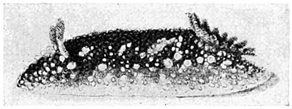
Doris bilamellata.
When discovered at low tide upon moist seaweed or stones, or when disturbed in the water, nudibranchs often appear like small lumps of jelly-like tissue, without a single attractive feature. It is only when they are placed in a jar of sea-water and left unmolested for a few moments that they unfold their beauties to the view. On the Pacific coast there are numerous species of nudibranchs, occupying corresponding shore stations and exhibiting the same degree of high coloration. There are over a thousand species of sea-slugs scattered about the various seas. They find their greatest development in tropical waters, and for brilliancy of tint and variation in form are unequaled by any other class of animal life, save perhaps the butterflies.
ORDER PROSOBRANCHIATA
To this exceedingly large and comprehensive order of gasteropods belong the great majority of univalve mollusks. In point of number of genera and species and in abundance of individuals, the prosobranchs probably exceed all the other orders of mollusks combined. They may be called the typical gasteropods, the shell being univalvular and generally spiral, and the animal exhibiting the singular torsion of the visceral mass which has placed the breathing-organs forward of the heart. They are provided with an operculum (placed upon the posterior dorsal portion of the foot), which is used to close the aperture of the shell against [pg356] enemies when the animal retires within its fortress. They are all marine except a very few families, which, supposedly of marine derivation, have become terrestrial in habit.
The prosobranchs are further subdivided into suborders according to certain peculiarities of the heart and breathing-organs. There is a group of these prosobranchs which gives evidence of an inferior degree of that visceral torsion which is always found in the gasteropods. In this group, or suborder, the heart has two auricles, and there is a pair of gills instead of only a single one. Other internal organs are paired just as they were represented to be in the schematic mollusk. This group also seems to show its primitive character in the want of a proboscis and a siphon, or, in some families, by having the ventricle of the heart traversed by the intestinal canal, just as in the lower class of mollusks, which includes the clams and oysters. For the most part the shells of this group are not typically spiral, but are patelliform, shield-like coverings, with only a suggestion of a spiral form at the very tip of the apex. This group of primitive prosobranchs is included in the following suborder:
Suborder DIATOCARDIA
This suborder is named from the presence of two auricles in the heart.
Family ACMÆIDÆ
The first family to be noted is the Acmæidæ. Its principal genus, Acmæa, is well represented on both the east and the west coast of the United States.
Genus Acmæa
A. testudinalis. This species is found in vast numbers all along the New England shore, clinging to the rocks between tides. They are usually called limpets. The shell is solid, conical, with an oval outline, and with no trace of a spiral form in the adult. When the shell is thoroughly cleaned, it generally presents a mottled coloration of pale green, brown, and white. Inside it is white and nacreous, with a large brown [pg357] area under the apex. The animal has a powerful foot, by means of which it is enabled to cling to a rock with great strength. In order to dislodge it, it is necessary to approach carefully, and, taking the creature unawares, quickly slip a broad knife-blade under the foot, otherwise it is quite impossible to tear it from its resting-place. A. testudinalis lives entirely between tides, and ranges from the northernmost waters to New York. It feeds upon algæ and is a very sluggish animal. It has been said to leave its resting-place and wander about in search of food, returning to its original and usual spot when the tide begins to ebb. (Page 343.)
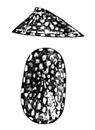
Acmæa testudinalis, var. alveus.
A. testudinalis, variety alveus. This variety is smaller, more fragile, and oblong. It lives upon eel-grass, its oblong shell being adapted to the narrow leaves of the grass. The coloration is brighter—reddish-brown spots on a white surface. It is exceedingly common on the New England coast.
A. mitra. On the Pacific coast there are a number of acmæas. A. mitra is often found dead upon the beaches. It is conical in form and pure creamy-white in color. It looks very much like a clown's pointed cap.
A. patina. This is also very abundant in California. Outside it is dark in color and is often incrusted with mineral deposits. Within there is a dark ring around the edge, then a zone of bluish-white, and a patch of brown just beneath the apex.
Genus Lottia
L. gigantea. This is the largest of the California limpets. Specimens three inches long have been found. The outer surface of the shell is rough and brownish in color. The apex is near one end. Within it is almost black, shining, lustrous, with a horseshoe-shaped muscle-scar under the apex. The color is bluish and brown. (Plate LXV.)
Family FISSURELLIDÆ
This is an extensive family, including several genera and a number of species, commonly known as keyhole-limpets. In the general form of the shell they closely resemble the true limpets, the Acmæidæ, except that they have a hole, or rather a slit, in the shell just back of the apex. Often this slit is so long that it has entirely removed the apex of the conical shell.
Genus Fissurella
F. alternata, F. barbadensis. These species occur upon the southern shores of the United States, the latter, however, being confined to [pg358] extreme southern Florida. F. barbadensis has heavy longitudinal ribs and is light green within, with a rosy circle about the apical perforation. (Plate LXV.)
Genus Glyphis
G. aspersa. One of the numerous species belonging to this family which are found on the west coast of the United States. It is about one and a half inches long, grayish-white, with sharply raised longitudinal ridges, slightly rayed, crossed by revolving ribs, which give to the outer surface a decussated appearance. The apex is forward of the center, and is entirely replaced by a round perforation. The edge is wrinkled, and within smooth and white.
Genus Lucapina
L. crenulata. The largest of the keyhole-limpets; the shell is often four inches in length, while the animal, with its huge yellowish foot and dark-colored mantle, which is thrown back, almost concealing the shell upon its back, is much larger. The apical perforation is very large. Shell flattened, with radiating, rounded, crowded ribs; brownish-white in color; edge crenulated; within pure white. It is found at Monterey, but live specimens are not very frequently seen near the beach. (Plate LXVI.)
Family HALIOTIDÆ
Genus Haliotis
This family is closely allied to the Fissurellidæ. The species are known on the Pacific coast by the name of abalone shells, and in England and the Channel Islands as ormers or sea-ears. There are no species of Haliotis on the east coast of the United States, but one has recently been dredged at a considerable depth in West Indian waters. This family, with the last, possesses the striking anatomical feature of having the heart traversed by the digestive tract. It also has two gills, the degree of torsion in the visceral mass not being sufficient to have crowded out and destroyed the original right gill. The shell is spiral, but is so greatly flattened, and the body-whorl is so greatly extended, that the shell quite loses the spiral appearance. Along the dorsal side of the shell is a row of holes, through which project numerous tentacular processes from the mantle. The outer surface of the shell, before it is polished, is usually rough and unattractive, but within, when the [pg359] animal is removed, it displays a most beautiful and highly colored nacreous surface. The spot near the center of the inner shell surface where the muscles of the foot were attached is usually most brilliantly colored. The shell of the abalone is susceptible of taking a very high degree of polish, and is extensively used in commerce for colored mother-of-pearl and for inlaid work. Haliotis is a vegetable-feeding genus. They cling with great tenacity to rocks about low tide, and it requires skill to remove them without breaking the shell. There are several species in California. The Chinese use the abalone for food, and have waged a persistent war upon the family along the Pacific coast until the specimens are not nearly as common as formerly. They are also eaten in France and in Japan.
H. splendens. The largest and perhaps the most attractive in appearance of the Californian species. Speaking of this beautiful shell, Professor Keep says: "Within, a whole rainbow is condensed in one of the magnificent shells, though the shades of green are most conspicuous. The coloring in the center is particularly fine, resembling a peacock's tail. There are about six open holes near one side of the shell, and its length is about the same number of inches." (Plate LXVI.)
H. rufescens. A large abalone, which sometimes attains a length of eight or nine inches. It is red in color, with three open holes in the body-whorl. The outer portion of the shell is usually incrusted with mineral deposit and overgrown with vegetation.
H. cracherodii. Very dark green without, with five to nine holes; length from one to six inches; spire exceedingly short. Common on the Californian coast in crevices of rocks at low tide.
Family TROCHIDÆ
This is one of the largest and most interesting families of the Mollusca. It contains many apparently widely separated genera and a host of species, which for the most part are littoral, the majority actually living between tide-marks. The typical trochid shell is top-shaped or pyramidal, having a broad base and many closely wound flat whorls terminating in a sharp apex. All the trochids are nacreous within the aperture—a character which is constant throughout the family. The animal has but one gill (the left), a short snout, and often frontal lobes on the head. The edge of the mantle or the epipodial line of the foot is usually ornamented with from three to five cirri. The tentacles are [pg360] long and slender, with short peduncles for the eyes; the operculum is corneous, with a central nucleus. The animals are herbivorous, feeding upon algæ. The trochids are essentially tropical shells, and the most of the genera which are comprised in the family are only to be encountered in the warm waters of the Pacific and Indian oceans. Some forms are very beautiful, and frequently are used as mantel ornaments, and the shells of one little species, which is opalescent in its coloring, are still extensively gathered in the East Indies, to be polished and strung like pearls in necklaces.
Genus Margarita
On the Atlantic coast north of Cape Cod the trochids are represented by the genus Margarita, with five or six species. The shells are small, thin, and globosely depressed, with smooth or transversely striated whorls. The aperture is nearly circular, with a simple lip.

Listed left to right.
Margarita cinerea.
Margarita helicina.
Margarita undulata.
M. cinerea. This species has several prominent revolving ridges upon the upper side of the whorls, with finer ones on the base. Very fine growth-lines cover the entire shell. It ranges all along the coast north of Cape Cod, but is not usually found between tides. The writer has dredged many specimens in shallow water at Eastport and Bar Harbor.
M. helicina. A thinner and more globose species than the last, with a translucent, shining, smooth surface of a yellowish or olive color. M. helicina is very fond of the leaves of Laminaria, and is often found clinging to them when storms have torn these great algæ from the bottom and cast them upon the shore. At Bar Harbor they are common upon the eel-grass in Rodicks Weir. This species can generally be distinguished by its iridescent, metallic luster.
M. undulata. A commoner species, perhaps, than either of the preceding, sometimes found on the rocks of sheltered coves at exceptionally low tides. Judging from the number often to be found in the stomachs of fishes, they must be considered excellent food by the cod and its allied species which thrive along the Maine coast. No doubt millions of M. undulata are yearly destroyed in this way. The shell is depressed, with four rounded whorls, a flattish base, and a large umbilical opening. In color it varies from rose-red to brown. The surface is decorated with numerous revolving raised lines placed at uniform distances. Just below the suture the body-whorl is somewhat undulated with short folds. Height three tenths of an inch, base four tenths of an inch. [pg361]
Genus Calliostoma
This genus is better represented on the Pacific coast of the United States than upon the Atlantic. It comprises a series of marvelously beautiful shells, often exquisitely colored. They are regularly conical or pyramidal in shape, with flattened bases. One never tires in the search for calliostomas. They are not common enough to cause one to lose interest, and whenever a good specimen is captured it seems as though one had found some gem cut and polished by nature's skilful hand and prepared for a place of honor in the cabinet.

Calliostoma occidentale.
C. occidentale. The only species of this genus found on the northeast coast. It is larger than Margarita cinerea, but somewhat resembles it. It is shining nacreous within and without, and has strong revolving ribs, the upper one on each whorl often being broken into a circular row of white dots. The lip is crenulated. This very pretty species is not likely to be met with upon the shore, but may be dredged in shallow water on gravelly bottoms along the Maine coast. Height about one half of an inch.
C. jujubinum. A species which occurs in the waters of Florida. Its form is almost that of a true pyramid. The sutures can scarcely be distinguished. The shell is marked by brown and purplish-red spots on a white background, and has numerous revolving ribs broken into rows of white dots like little glazed beads. The umbilicus is funnel-shaped and wide. In Tampa Bay this shell is frequently found on sponges, and may sometimes be gathered on the beach after storms, even as far north as Hatteras. There are as many as twenty species of this genus in American Atlantic waters, but they are either rare or have deep-water stations.
C. annulatum. A remarkable species of Calliostoma, found in California. The whorls are adorned with revolving rows of raised dots, and the sutures are frescoed in exquisite purple. This beautiful species lives upon seaweed, and on pleasant days comes to the surface of the water. It can then be collected from a boat by drawing in quantities of seaweed. It is very unlikely that the collector will ever find a specimen upon the beach, for the shell is too fragile to withstand the rough handling of the waves. Length one inch.
C. canaliculatum. The largest member of this genus to be found in American waters. It resembles the last species in form, but lacks the purple sutures. The revolving ribs are very numerous and prominent. There is no umbilicus. Length one to one and a half inches. Found on the Pacific coast.
C. costatum. A heavier shell than the preceding, with somewhat more rounded whorls. Reddish-brown in color; numerous revolving ridges; no umbilicus; about three quarters of an inch in length. It is found in rocky places, and sometimes in considerable numbers, just at low-tide mark. Found in California. [pg362]
Genus Chlorostoma
This genus is represented in California by several species, the commonest of which is probably C. funebrale—a doleful name, no doubt given on account of the jet-black color.
C. funebrale. The shell is thick and strong, like most between-tide species, which are constantly exposed to the buffeting of the waves. It is to be found in countless thousands upon rocks exposed at low tide, and may be gathered at any time except full flood-tide, like the littorinas and purpuras of the east coast. Within the aperture the surface is nacreous and greenish in tint; the last whorl is drawn in, like gathers, at the suture. The umbilicus is closed. There is a white nodule at the base of the lip of the columella. Length one half of an inch to one inch. (Plate LXVII.)
C. brunneum. This species is brown, as its name would indicate, and there is greenish nacre within the aperture. It lives upon kelp, or upon rocks at very low tide. Length about an inch. (Plate LXVI.)
Genus Trochiscus
T. norrisi. A flattened shell with rounded, dome-like spire and obtuse apex; a fairly common species. It has a wide, deep umbilicus and a sharp lip. It is of a rich brown color, with dark chestnut about the umbilical region and greenish-white within the umbilicus; there is a band of dark olive-green about the inner margin of the lip. The shell is about two inches in diameter and of a somewhat greater height. The operculum is multispiral, with a central nucleus, and is shaggy and rough. Like all other trochids, it feeds upon algæ. It is often found upon the beach after violent storms. Found in California, south of San Francisco. (Plate LXVI.)
Genus Livona
L. pica. This large and interesting trochid is a West Indian species which sometimes occurs in Florida. It lives about coral reefs and rocky shores, attaching itself in vast numbers to the rocks. This shell is a favorite refuge for large hermit-crabs. It is a curious sight in certain of the West India islands to see a Livona pica shell scrambling up a tree, looking very much out of place upon the back of some terrestrially inclined crustacean. When well cleaned it is a beautiful shell, with black wavy lines over a greenish-white nacreous foundation. The animal has a row of waving cirri upon each side of the mantle, and long, slender tentacles. It is largely used as an article of diet in the West Indies and Central America. (Plate LXVII.)
Family TURBINIDÆ
This family is very closely allied to the trochids, the most striking difference being in the operculum, which in the Turbinidæ is calcareous and usually smooth and very convex on the outside. [pg363] The shells are nacreous within, and the animal, with its rows of waving cirri upon each side, is very suggestive of Trochus. They are, for the most part, shallow-water or littoral forms.
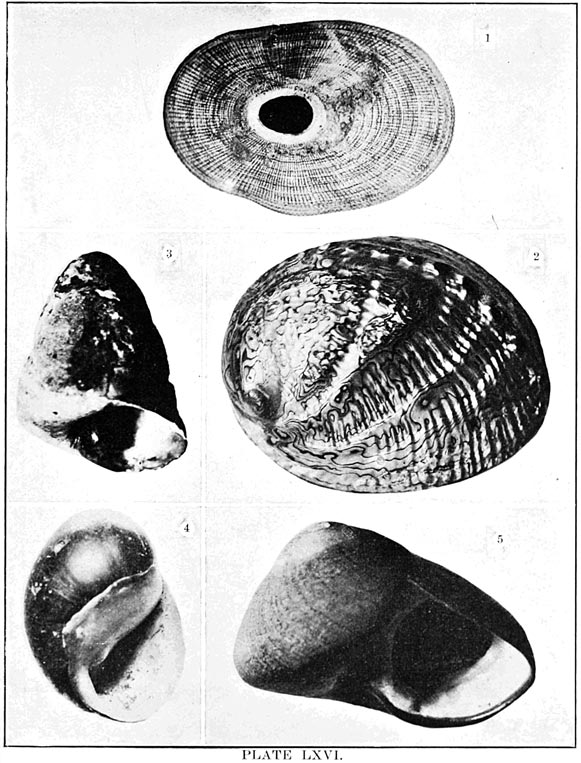
PLATE LXVI.
1, Lucapina crenulata. 3, Chlorostoma brunneum.
2, Haliotis splendens. 4, Neritina reclivata, enlarged.
5, Trochiscus norrisi.
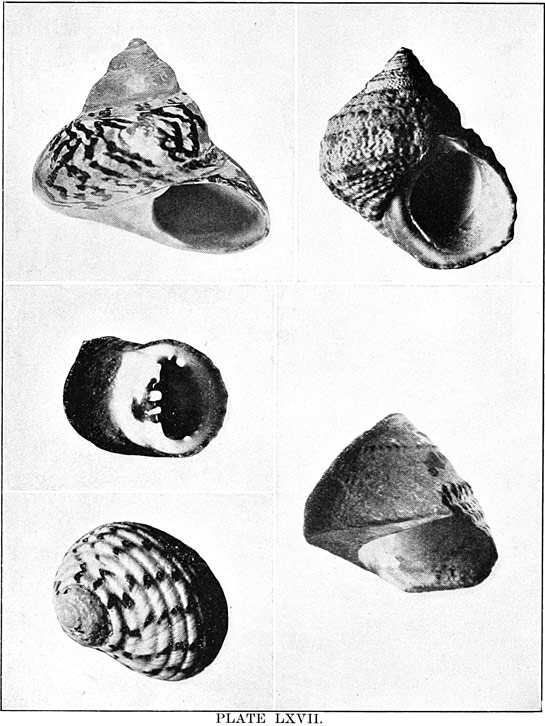
PLATE LXVII.
Livona pica, reduced. Turbo castaneus, enlarged.
Nerita peleronta. Chlorostoma funebrale.
Nerita tessellata.
Genus Turbo
T. castaneus. This species has a range as far north as Cape Hatteras, and is especially abundant at Tampa, on the west coast of Florida. The peculiar operculum is sufficient to identify the genus at once. One variety of this species has a crenulated shoulder upon the body-whorl and is referred to as Turbo crenulatus, A series of intermediate forms establishes the specific identity of the two varieties. (Plate LXVII.)
Family NERITIDÆ
The Neritidæ are strictly littoral forms, almost entirely confined to the warmer waters of tropical seas. The animal preserves the usual diatocardian features—has a short snout and long tentacles. Unlike the trochids and Turbo, it has no cirri along the epipodial margin. The shells are peculiarly shaped, the spire being greatly flattened and scarcely noticeable on account of the unduly large development of the body-whorl; thus the shell takes on a decidedly patelliform appearance. It is without an umbilicus. In the principal genus Nerita the outer lip is sharp on the edge, but greatly thickened just within.
Genus Nerita
N. peleronta. This shell has two teeth on the wide, flat columellar lip, and about them is a blotch of red, suggesting blood. The common name of this shell, "bleeding-tooth," is very appropriate. Found in southern Florida. (Plate LXVII.)
N. tessellata is a smaller species, with heavy revolving ribs, and is further decorated with transverse oblique black lines. The operculum is calcareous. Both of these species have the habit of absorbing the entire inner portion of their shells. They belong to the West Indian fauna, and occur in great numbers on rocky or coral shore stations. They also may be found on the east Florida coast, well to the south. A third species, N. versicolor, often occurs, associated with the other two. It is somewhat smaller than the others and can easily be distinguished by the four teeth on the columellar lip, the edge of the columella being convex. (Plate LXVII.)
Genus Neritina
The genus Neritina is very closely allied to the last, having quite the same form of shell; but it is usually more globular and [pg364] variously ornamented by bright spots or zigzag lines of coloration. The neritinas have acquired the habit of ascending rivers, until they have become almost wholly a brackish- or fresh-water genus. The metropolis of this genus is in the South Sea Islands, where it attains a wonderful development in the clear running streams of the volcanic islands.
N. reclivata. A very pretty olive-green species, with very fine, wavy, longitudinal lines of coloration, found in almost all Floridian streams above the action of the tide. The nacre of the columella and within the aperture is bluish-green, and the operculum is rich olive. (Plate LXVI.)
N. viridis. A small, intensely green species, which, unlike most neritinas, is strictly marine. It belongs to the great West Indian faunal province, but is occasionally found upon the shores of Florida and of Texas.
The prosobranch gasteropods thus far considered (belonging to the suborder Diatocardia) all show by their anatomical structure that the process of visceral torsion, though carried very far within them, has not been complete enough to crowd out and finally destroy one of each of the paired organs. Both auricles of the heart (with some exceptions) were left intact.
Suborder MONOTOCARDIA
In this the second suborder of the prosobranch gasteropods, the twisting visceral process has been carried to the extreme. The heart has but one auricle. There is but one gill (on the left side), and this is attached to the inner side of the mantle flap. In other respects the presence of certain specialized organs would probably indicate that gasteropods belonging to this suborder are a step higher in the scale of life than those which belong to the Diatocardia.
Family JANTHINIDÆ
Genus Janthina
The genus Janthina has an exceedingly thin and semi-transparent shell, deep violet in color on the base and lighter blue on the spire. An interesting feature of this genus is the mode of depositing the ova. The female exudes from a gland in the foot a [pg365] glutinous secretion which hardens in water, and, being filled with air-bubbles, constitutes a float. On the under side of this are deposited the eggs in rows of little capsules. While attached to this float it is impossible for a Janthina to sink, and hence it is that so many of these creatures are sacrificed in onshore gales of wind.
J. fragilis. The shell of this species is so brittle and fragile that it is very clearly not adapted to a life near shore. It is in reality a pelagic species which is occasionally blown ashore during easterly gales along the Atlantic coast of the United States. Vast numbers of these pretty creatures are sometimes encountered far out at sea, floating quietly on the surface. When storms drive them upon the beach, they become utterly helpless; since their foot is not adapted for crawling upon the sand, they soon perish, and their brittle shells are demolished by the surf. In Florida the beaches are sometimes fairly lined with Janthina shells, which make a band of purple along the high-tide mark as far as the eye can reach; then it may be years before they again appear. (Plate LXVIII.)
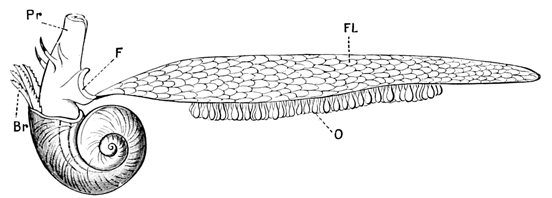
Janthina fragilis: FL, float; O, ova; Pr, proboscis; Br, branchiæ; F, foot.
Family SCALIDÆ
Genus Scala
The shells of Scala have such a peculiar scheme of decoration that once seen they can never be mistaken. They are generally pure white, with well-rounded whorls, all of which are crossed at even distances by greatly elevated and smooth ribs. Each rib represents a rest-period, when the creature thickened the rim of the shell-aperture. The aperture is generally round, with a continuous lip. The animal has a retractile proboscis and long, slender tentacles with eyes at the outer bases, and is a predaceous, [pg366] carnivorous creature. Some Asiatic species of this genus, remarkable for their beauty and rarity, have been greatly prized by collectors. A single specimen of the now well-known S. pretiosa of China has been sold for two hundred dollars—a fancy price, indeed, for a shell which can now be bought for a dollar! There are over fifty species of Scala on the Atlantic coast, but most of them are either rare or belong to a zone of deeper water; there are, however, four or five species which are exceedingly common.
S. lineata. A species which ranges from Hatteras to New England. It has about eight whorls, and is slightly brownish in color. The ribs are robust and not greatly elevated; there are from seventeen to nineteen on the body-whorl. The shell is sometimes painted with a few revolving brownish lines.
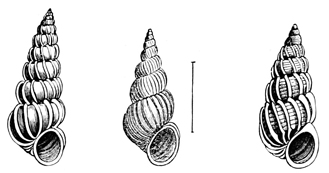
Listed left to right.
Scala lineata.
Scala multistriata.
Scala groenlandica.
S. multistriata. The transverse ribs are much smaller but very numerous; the small spaces between them are marked with many fine revolving lines. Found from Cape Cod southward.
S. groenlandica. Essentially an arctic species, which has found its way down to the New England coast. It is readily distinguished by the flattened, coarsely rounded, revolving ribs, which follow the volutions of the spire. Over them are the usual transverse heavy ribs peculiar to this genus.
S. angulata. The whorls touch one another only by the ribs, of which there are nine to each volution. This species has a remarkably wide range, occurring from Cape Cod to southern Florida. (Plate LXVIII.)
These four species vary from one half of an inch to one inch in length. All of them are found on the beach after storms or may be dredged in shallow water near the shore.
Family NATICIDÆ
This large and interesting family is well represented in the Atlantic waters of the United States, but its more beautiful members live in the tropics. The New England and New Jersey species are dull in color, but offer much of interest to the collector and student. The foot is enormously large, and carries in front a great shield-like fleshy process, which curves back over the head of the animal and serves as a plow in pushing its way through the heavy wet sand of the beach. When the creature is thus seen extended in the act of crawling, one wonders how it is possible for it to withdraw so great an amount of body into its shell; but if it is suddenly seized or irritated, it will quickly [pg367] demonstrate its ability to hide itself completely within its house and to close the door very effectively by means of its operculum. The eyes seem to be wanting, or they are concealed under the skin of the head. The shell is usually quite large, with a depressed spire and well-rounded whorls—especially the body-whorl, which appears to be greatly swollen. The umbilicus is usually open and moderately large, the lip simple.
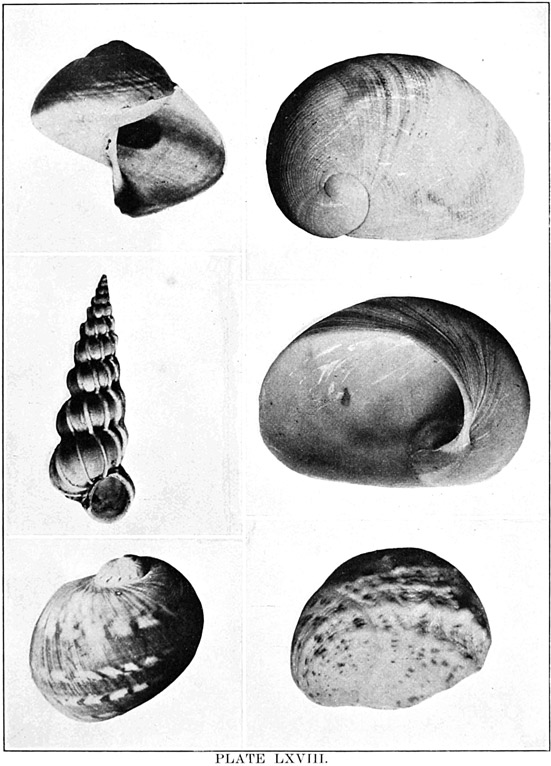
PLATE LXVIII.
Janthina fragilis. Sigaretus perspectivus, upper side.
Scala angulata, enlarged. Sigaretus perspectivus, under side.
Natica canrena. Crepidula aculeata.
Genus Polynices (Lunatia, Natica).
P. heros (generally referred to as Lunatia or Natica heros). One of the commonest large shells and one of the most characteristic species of the New England and New Jersey littoral fauna. It is exceedingly common along the Long Island shore, where it may be found on the open beach, in pools with a sandy bottom left by the receding tide. It is usually partially and frequently wholly buried in the sand. The umbilicus is open and large, the operculum corneous, and the shell heavy and ashy-white to brownish, with (when young) a yellowish epidermis. Its length is from two to four inches. It has no ornamentation whatever. P. heros is a most voracious creature and spends its time in hunting for flesh—either alive or dead—to devour. It feeds upon dead fish, or upon other mollusks whose shell it is able to pierce by means of its radula, making a little round hole through which it sucks out the flesh from within. The curious egg-cases of this species have already been referred to. (See Plate I.) It glues together particles of sand into the form of a basin with the bottom knocked out and broken on one side. In the gelatinous substance of this basin it deposits its eggs in a regular order. These hatch out in midsummer. Egg-cases of this kind can always be found wherever Polynices lives. For a long time naturalists were greatly puzzled by these curious things, and their blunders are recorded in earlier works, where these egg-cases have been elaborately described as living animals belonging to various invertebrate orders. The largest and best specimens of P. heros are to be found south of Cape Cod. (Page 343.)
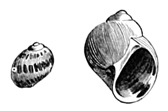
Polynices triseriata, young; Polynices triseriata, older specimen.
P. triseriata. A small shell of exactly the same shape as P. heros, but decorated with three revolving series of bluish or chestnut spots. It is pretty well determined that this so-called species is only the young of P. heros. It is very abundant all along the coast.
P. duplicata. This is even more abundant than P. heros. It has a flatter shell, with an obtuse apex and dome-like spire. The umbilicus is partly or wholly closed by a thick, callous, shelly process thrown off from the columellar lip, and is chestnut in color. The surface of the shell is smooth, often polished, ashy-white below and light chestnut above. The operculum is corneous. The length of the shell varies in different localities from one half of an inch to about two [pg368] inches; the breadth slightly exceeds the length. P. duplicata has a very extensive range, from the Gulf of Mexico to Newfoundland. The largest and finest specimens are found in the vicinity of New York and at Hatteras. In Florida they are usually smaller. This species cannot be confounded with any other upon our coast on account of the heavy callous deposit over the umbilicus. Its habits are similar to those of P. heros.
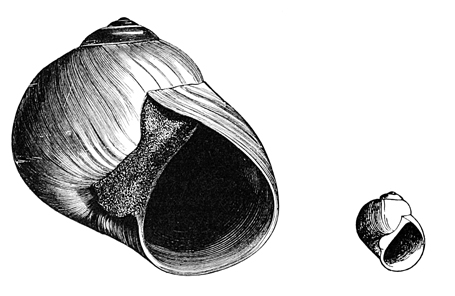
Polynices duplicata. Natica clausa.
Natica clausa. A Northern species which is fairly abundant on the Maine coast. It has a shelly operculum, and the umbilicus is neatly closed by a pure white, shining callosity. Its length is about one half an inch, its color livid white to light brown, white within. The calcareous operculum at once determines this shell. This species (as well as the following one) has retained the generic name of Natica because of the shelly operculum, as explained below.
N. canrena. One of the handsomer species of Natica, which occurs in Florida. Sometimes it is seen as far north as Hatteras. The shell is white, with bars of light chestnut circling the whorls, and with zigzag lines of darker purplish hue crossing them. The base of the shell is white. The aperture is large and flaring, and is purplish within. The umbilicus is partially closed by an entering callous plug. The operculum is calcareous, with eccentric, deeply cut grooves. Found in sandy stations just about low-water mark. (Plate LXVIII.)
P. lewisii. A species which occurs on the west coast of the United States. It resembles its New England relative P. heros very closely. P. lewisii is a Northern species, and does not range south of Oregon. Professor Keep mentions one specimen of the size of a six-inch globe, but such dimensions are very unusual. A good-sized specimen need not exceed four inches in height.
P. recluziana. A species well known on the southern coast of California. The umbilicus is closed by a thick, highly polished white callosity, and the general shape of the shell is strongly suggestive of the common east-coast species P. duplicata. A large specimen is about two inches in diameter.
[There has been much confusion in the generic nomenclature of this family. The old name Natica once did service for all the species; then the names Lunatia, Neverita, and Polynices were applied to certain special forms; but it has been wisely proposed by conchologists to use the name Natica for those forms having a shelly operculum, and to adopt the name Polynices for those having a corneous operculum. Lunatia and Neverita have become subgenera of Polynices.] [pg369]
Genus Sigaretus
A very interesting species of this genus occurs on the east coast, sparingly in New Jersey, but very abundantly south of Hatteras. Sigaretus is a modified Natica. The spire is flattened and minute. The body-whorl, being greatly expanded, gives a wide, flaring, oblique aperture. The shell is ear-shaped and white, with fine revolving lines. There is no umbilicus. The operculum is small and rudimentary. The animal is large, with an enormous foot and greatly developed propodium, and is a sand-dweller. The common east-coast form is S. perspectivus. (Plate LXVIII.)
Family CAPULIDÆ
Genus Crepidula
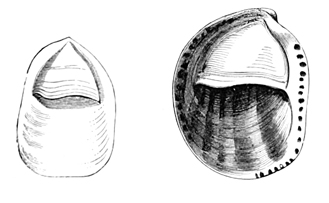
Crepidula plana. Crepidula fornicata.
C. fornicata. All collectors of mollusks on the Atlantic coast sooner or later encounter this exceedingly common species adhering to oyster-shells or scallops, and often to other large live shells. It is cast upon the beach along the entire length of the Atlantic coast. The shell is obliquely oval, dull whitish in color, and either smooth or rough or even ribbed, according to the nature of the surface to which it clings. The spire is almost entirely suppressed, the little inconspicuous apex being turned to one side and closely pressed down against the body of the shell. When looking into the interior of the shell one is reminded of a boat, for the upper portion of the aperture is covered by a horizontal shelly partition, called the diaphragm, a space being left below which would correspond to the forecastle of a ship. The "stern" is round, and the "bow" is suggestively pointed.
C. plana. In this species the shell is white and flat, or slightly concave. Although it is pointed at the "bow" end and square at the "stern," the nautical resemblance stops there, because, being flat, there are no swelling sides and bow. The diaphragm is about one half the length of the shell, convex, shining, white, and translucent. C. plana lives generally within the aperture of large dead shells. It has a wide range, from Maine to Florida.
C. aculeata. A common Floridian species which has a remarkable range, being found in nearly all the tropical and semi-tropical waters of the world. It is smaller than C. fornicata, is reddish-brown with a white diaphragm, and has several radiating ribs on the back, which are inclined to be nodulous. (Plate LXVIII.) [pg370]
On the Pacific coast the following species are found: C. adunca, with a strongly recurved apex, and less than one inch long; C. rugosa, rough, brown, with the apex lying on the edge of the shell, and one inch in length; C. navicelloides, almost identical with the east-coast C. plana. C. aculeata also appears.
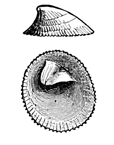
Crucibulum striatum, from above. Crucibulum striatum, from below.
Genus Crucibulum
Crucibulum has a peculiar rounded shield-like form, with a very small apex on one side. Within there is a cup-shaped appendage attached by one side to the inner margin of the shell. This latter feature at once determines the genus.
C. striatum. This species has radiating riblets, cut by circular lines of growth. No dimension would quite reach an inch. It is a common shell on the Atlantic coast, and will be found adhering to stones and other shells, but it is not, strictly speaking, a littoral species.
C. spinosum. The shell exhibits a strong tendency to spinous processes on its back. Found along the southern part of the California shore.