Part II MARINE INVERTEBRATES (continued 6)
Reading edition
Family LITTORINIDÆ
Genus Littorina
Littorina is probably the most characteristic genus of Northern littoral regions. Together with some of its allied genera it is also, probably, equally characteristic of various tropical littoral faunas all over the world. The family comprises strictly between-the-tides genera and species. Indeed, it is suspected that some species of Littorina are making very fair progress toward a terrestrial condition, for they actually live above high-tide mark,—even in the branches of overhanging trees,—and must certainly pass days at a time out of their natural element. That such a transformation is possible need not for a moment be doubted, for there are many land mollusks to-day that give abundant evidence of having been at some past time aquatic or marine species. These changes in nature are constantly going on, and the gradual substitution of a lung for a gill is no very startling metamorphosis. [pg371]
The littorinas fairly swarm in favorable localities upon all shore stations. In Maine and Massachusetts the bold, rocky coast furnishes a home for several species. Often the rocks at low tide are black with them; the algæ that cling in wet masses to the exposed rocks are alive with them. One cannot walk about in such localities without crushing hundreds of specimens. Sometimes they will be found clinging in clusters upon the piling of old wharves, or crawling about the bottom at or about the low-tide mark. The best specimens of Littorina are found in stations where they are bathed twice a day by pure, uncontaminated sea-water; those living near the mouths of streams, or where the water is brackish or impure, are usually small and degenerate. They are vegetable feeders, and have received the common name of "periwinkles." In Great Britain they are used among the poorer classes for food. The animal has a short, broad muzzle, and eyes at the outer bases of the tentacles. The foot is longitudinally grooved, and there is a rudimentary siphonal fold in the mantle. The shells are turbinated, usually heavy, few-whorled, and with a round aperture.
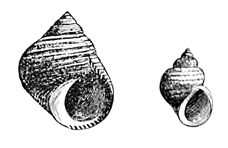
Littorina litorea. Littorina rudis.
L. litorea. This is supposed to be an importation from the Old World—to have come over by way of Iceland and Greenland, and then to have migrated down the Labrador coast. For many years Cape Cod formed a barrier to its advance, but now the species is abundant at Newport, and is reported at New York. It occurs on the Maine coast in astonishing numbers, living in vast colonies on the rocks exposed at low tide. The shell is thick, imperforate (no umbilicus), and usually has flat, spiral ribs. The columella is broad and white; the lip thin and black. The general color varies from black to olive or to dingy gray—sometimes reddish. The operculum is corneous, with the nucleus near the outer edge. Despite the variableness of this very common shell (the variations being chiefly in the height of the spire), it has certain unmistakable characteristics which, once seen, will enable the collector to determine it at once.
L. rudis. A smaller species than the last. It is strong and coarse, with revolving grooves and ribs, or smooth, with interrupted whitish bands and spots. A very common variety of this species is much smaller than the typical form, being about one sixth to one fourth of an inch long, smooth, with white and yellowish spots on olive. It clings to the rocks near high-tide mark, and is usually found attached to its resting-place by a bit of hardened mucus. While the typical L. rudis is heavy and banded, with a moderately high spire and no color, this [pg372] variety is thinner, with a higher spire and smoother surface, and has a color-scheme of decoration. It would be impossible to disconnect the two, for a large series of specimens will demonstrate beyond doubt, through every minute degree of variation, that the two forms belong to one and the same species. The station of L. rudis is much the same as that of L. litorea, but the smaller colored variety of rudis prefers quieter and more sheltered spots. It is occasionally found on reeds and grasses, on the piling of wharves, on large boulders above the line of algæ, and on algæ. It has been the writer's experience not to find rudis and litorea associated together.
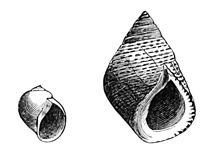
Littorina palliata. Littorina irrorata.
L. palliata. A low-spired, globular shell with a large, tumid, smooth body-whorl. The columella is flattened, curved below, and imperforate. The color is exceedingly variable, but is usually bright, shining olive, and this is especially the case with those individuals that find their station in the dense masses of algæ that form so conspicuous a feature of a low-tide scene on a rocky New England coast. From pure olive-green to yellow or bright red, with revolving black bands, seems a long chromatic leap, but it is not too great for the Designer of these pretty little globular shells. As a rule, the color of the shell simulates pretty closely that of the seaweed upon which it lives, and inexperienced eyes may easily overlook hundreds of specimens, all within close reach. The banded varieties are less common. The head of the animal is somewhat orange in color, the foot slate. The distinguishing features of this species are the smooth, globular shell, the low spire, the broadly flattened columella, and the orange-colored head of the animal. It is found on Fucus between tides, and often associated with L. rudis, on the whole coast north of New Jersey. The three preceding species are distinctly boreal in their range, but their place is taken in southern Atlantic waters of the United States by the following exceedingly common species:
L. irrorata. A solid, robust shell, which attains a length of about one inch. It is in many respects suggestive of L. litorea, its Northern relative, but the spire is higher, with straighter outlines, and the apex is acute. The surface is ornamented with closely set, revolving ribs; the sutures are indistinct; the lip is thin, though thickened just within; and the color is whitish to pale cinereous greenish, sometimes spotted with broken brownish lines. Within it is white, with a reddish tinge on the columella, and brownish spots on the edge of the lip. This species ranges from Maryland to Texas; its station is between tides.
L. angulifera. As the last species resembles L. litorea, so this other common Southern form resembles a greatly developed and large L. rudis of the smoother variety. It has a high-spired shell, with an acute black tip. It has about six whorls, which are variously decorated by wavy, oblique black lines and revolving black lines broken into series of dots and larger spots near the suture. The ground-color varies from yellow to purple. None of the colors are very vivid. Within it is yellowish-white. This species has a much thinner and more delicate shell than any of the littorinas thus far considered. It is common on the piling of wharves and in sheltered nooks everywhere [pg373] between tides. It is essentially a tropical species of very wide and extended range, but it does not occur north of St. Augustine. At Tampa it has been found in vast numbers. (Plate LXIX.)
The California coast furnishes two more species of Littorina. Their station is among the rocks between tides, and their habits are quite the same as those of the east-coast species.
L. scutulata. In this species the color is of various shades, generally dark gray, mottled with white spots. A good-sized specimen measures one half of an inch in length. The spire is high; the columella flattened, broad; the shell is purplish-white within the aperture. (Plate LXIX.)
L. planaxis. Somewhat larger than the last; wider; with a lower spire; grayish in color, sometimes speckled with white; chest nut-brown within. The columella is remarkably flattened, and a portion of the whorl next bordering the columella is excavated as though eaten away by the animal. These two species are often found associated on the rocks. (Plate LXIX.)
Genus Lacuna

Lacuna vincta.
Closely allied to Littorina is the genus Lacuna, one species of which, L. vincta, is very abundant on the New England coast. A curious and distinguishing feature of this genus is the umbilicus, which forms a lengthened groove along the columella. L. vincta rarely exceeds one half of an inch in length, and is thin, with a pointed spire of five whorls. It is either of a uniform horn-color, or purplish, or banded with chestnut. It may best be found upon marine plants in sheltered places, or may sometimes be gathered in quantity from the roots of Laminaria washed in by storms.
Genus Tectarius
The specific representatives of this genus are mostly tropical. T. nodulosus is abundant in Florida. It is about one half of an inch long, and has the flattened columella and round mouth characteristic of Littorina. It is decorated somewhat elaborately by revolving rows of nodules which cover the entire shell. Its station and habits are the same as those of Littorina.
Family CERITHIIDÆ
In this family we meet with a somewhat new type of shell—the long, turriculate shell, with many whorls and with a channeled [pg374] aperture. The Cerithiidæ include a large number of genera, mostly tropical in distribution. Their shells are usually highly ornamented in various schemes of sculpture, but they lack beauty in color. The animal is provided with a siphon, as is indicated by the anterior canal of the shell. The operculum is corneous, with a nearly central nucleus.
Genus Cerithium
C. floridanum. A very common species on the west coast of Florida, also sparingly found at Hatteras. It has eight or ten whorls, a gradually tapering spire, and a sharp apex; the aperture is oblong, with a deeply cut anterior canal projected to the left and backward (when the specimen is held apex up, with the aperture toward the observer). The sculpture is elaborate, consisting of many rows of revolving ribs, and close to the suture there are circling rows of nodes. There is a curious hump just to the left of the aperture, which is quite characteristic of the genus. The color is whitish-gray; the length one and a quarter to one and a half inches. Station, shallow water in lagoons and sheltered spots. (Plate LXIX.)
C. muscarum. Another Floridian species, somewhat smaller than the last (one inch in length). It has heavy, prominent, transverse ribs crossed by circling rows of chestnut spots, one heavy revolving rib around the base; eight or nine whorls; a high-tapering spire; and a sharp apex. The aperture is oblong, with the anterior canal projecting to the left. The columella is arched; the color shining gray to very light purplish. This very pretty little shell may be gathered literally by the shovelful all along the west Florida coast in sheltered spots, on sandy and shallow bottoms. (Plate LXIX.)
C. minimum. A still smaller Floridian shell, with jet-black aperture and anterior canal projecting horizontally to the left. The sculpture-plan is of revolving ribs and a series of white granules just below the sutures. Its station is the same as that of the last. Often the bottom of a lagoon will seem to be literally paved with these somber-hued little shells. From Tampa Bay to Charlotte Harbor they are very abundant.
Genera Bittium, Triforis
These are allied genera, having numerous species upon our coasts, but the shells are so small that the inexpert collector is not likely to notice them. Hosts of these minute, turreted, decussated, blackish shells are to be found on the wiry grasses of salt-marshes. They are also found on algæ at low-water mark. In Triforis the whorls turn to the left. Range from Cape Cod to South Carolina. [pg375]
Genus Cerithidea
C. scalariformis. This species has the suggestive outlines of the family, but the aperture is simpler. The outer lip is considerably thickened, sinuous, and yellow; there is a very slight notch at the angle of the columella, and the lip serves for an anterior canal. The apex is wanting by reason of the usual truncation of two or three whorls of the spire. There are revolving ribs on the base; longitudinal ribs elsewhere. The color is a dingy drab; within, brownish-yellow. It is found in brackish water in Georgia and Florida. This species is said to suspend itself from overhanging vegetation by means of glutinous filaments. It may remain out of water for an almost indefinite time. (Plate LXIX.)
C. sacrata. A species very common on the mud-flats of San Francisco Bay. It is a high-spired shell of ten heavily ribbed whorls, with a series of revolving ribs on the body-whorl. The outer lip is sinuous, and the columella is slightly twisted. It is nacreous and brown within, dingy blue-black without. Length one inch to an inch and a quarter. (Plate LXIX.)
Family VERMETIDÆ
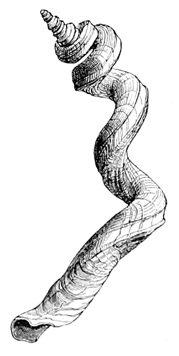
Vermicularia spirata.
Genus Vermicularia
V. spirata. This is a very curious creature when considered from the point of view of the gasteropod mollusk. It seems at first as though it would be better to regard it as a worm which had created for itself a calcareous covering. But it is a true prosobranch notwithstanding the fact that it has departed widely from the conventional design in the fashioning of its shell. At first the shell starts out in a regular form, and then the whorls become separated, finally wandering about in a seemingly aimless manner. The irregular prolongation sometimes measures ten inches in length. The animal is in no way remarkable except in having the viscera greatly elongated and the foot very short and broad. The color of the animal is light brown with black spots; the shell-color is rufous or ashy-white. Shells of this genus are often found grouped together in an inextricable mass. It is found in shallow water from New England to Florida.
Family STROMBIDÆ
This is a particularly interesting family, but it is tropical, and is represented on the shores of the United States by only one [pg376] genus, Strombus, of which we have but a few species. Strombus is a scavenger,—a buzzard among mollusks,—and its sense of smell is evidently very acute. Its eyes are much more highly developed than the usual gasteropod visual organs, and they are placed at the tip-ends of two very substantial eye-stalks or-pedicels. The tentacles are slender and project from the eye-pedicels. The foot is curiously developed; that portion of it which would naturally constitute the creeping-disk is exceedingly small, but the metapodium (the hinder part of the foot, upon which the operculum is situated) is very large. The corneous operculum upon its end, which is far too small to close the entrance of the shell when the creature retires within it, looks like a claw. Instead of creeping along the sand, Strombus proceeds by jumps or awkward leaps, turning its heavy shell first to one side, then to the other. The shell is usually heavy, with the outer lip greatly thickened.
Genus Strombus
S. pugilis. The very common Floridian species, often three to four inches in height, with a short spire covered with nodes or short, obtuse spines, which are also found upon the shoulder of the body-whorl (sometimes smooth). The aperture is long, with a wide notch in the outer lip and a posterior canal. Living specimens have a tough, leathery epidermis covering at least the body-whorl. The color is brownish. The columella is covered with a fairly thick callous deposit, and, as within the aperture, is highly polished, and deep purple, blackish-chestnut, or vivid carnation-red in color. The smoother varieties have gone under the name of S. alatus, but the identity of the two species is assured. This pugilistic Strombus is a very active mollusk, and when placed in a boat will sometimes effect its escape over the side in a most surprising manner. The species is very abundant in all the shallow waters of Florida. A piece of meat on a string, left overnight in some sheltered sandy spot where there are from six to eight feet of water, will surely attract them. In Florida, where the waters teem with life, unless the bait is protected in a wire cage, the chances are that the hosts of crustaceans and fish will make away with it long before the strombs can arrive on the scene. (Plate LXX.)
S. gigas. One of the largest of gasteropods, very common on the Florida Keys and also occurring in southern Florida. Hundreds of thousands of these shells have been sent to Europe from the Bahamas to be cut into cameos. This familiar shell is to be seen everywhere in the South, placed about flower-gardens and lining the paths and walks in yards. It is generally known in Florida and the West Indies as the "conch-shell." The animal is used as food in Key West, and is very generally eaten throughout the Bahamas. From their habit of eating [pg377] these animals the natives of some of the Bahama Islands are themselves called "Conchs." The rich pink color of the shell is very striking.
There are perhaps seventy-five or eighty species of Strombus inhabiting the tropical seas, and many of them are highly prized by collectors on account of their great beauty.
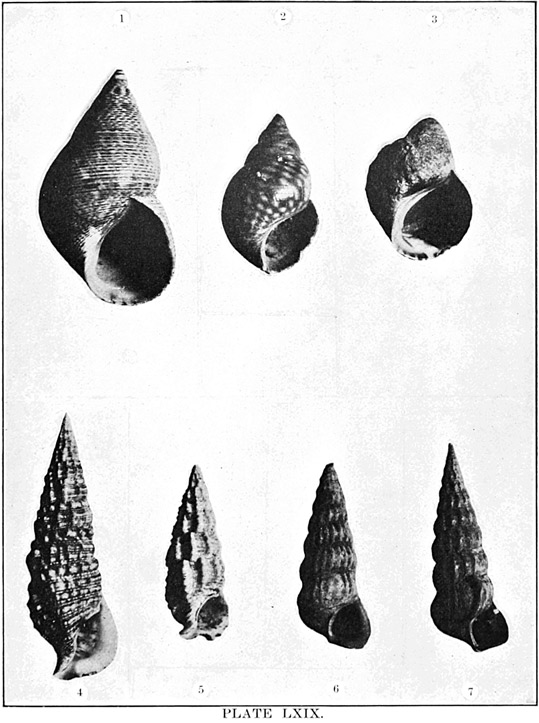
PLATE LXIX.
1, Littorina angulifera, twice natural size. 4, Cerithium floridanum.
2, Littorina scutulata, much enlarged. 5, Cerithium muscarum.
3, Littorina planaxis, enlarged. 6, Cerithidea scalariformis, enlarged.
7, Cerithidea sacrata.
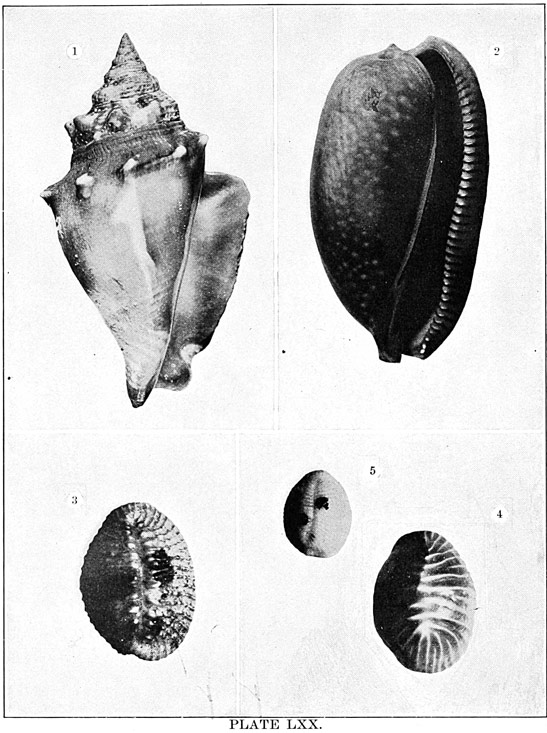
PLATE LXX.
1, Strombus pugilis. 3, Trivia pediculus.
2, Cypræa exanthema. 4, Trivia californica.
5, Trivia quadripunctata.
Family CYPRÆIDÆ
Genus Cypræa
Cypræa is one of the "aristocratic" genera. Whether the shell or the animal itself is considered, there is probably no genus of mollusks which offers so much of beauty and interest to the collector and student. The genus is a tropical one, and finds its metropolis among the coral-fringed islands of the equatorial Pacific. Despite their brilliant colors and general attractiveness, the cowries—for such is their popular name—are very modest and shy; they prefer to hide among rocks, where they may be secure from molestation, for probably their conspicuous appearance is a real source of danger to them. In the animal of Cypræa the mantle is provided with two large lateral lobes, which are reflexed and meet over the top of the shell; thus, when the mantle is fully extended, the shell is entirely concealed. These mantle lobes are often furnished with numerous forked, tufted, or ramified filaments. The foot is long; there is no operculum. The color of the animal is often very striking in its intensity. A description of the cowry-shell is hardly necessary, so familiar is every one with it. A deposit of enamel is made all over the shell, and its painting and decoration, usually very elaborate, is reserved for the adult as a final process in the artistic completion of its home. The aperture is as long as the shell, is channeled at both ends, and is toothed along both margins. The spire is insignificant and is concealed by layers of enamel. In the young the shell has a very different appearance, resembling a sharp-lipped Oliva, and its scheme of coloration may be entirely different from that employed by the adult.
Among the Cypræidæ are many remarkable species. The splendid Cypræa aurantia, a native of the Fiji Islands, is one of the shells most sought after by enthusiastic collectors. The natives [pg378] learned its value long ago, and hold specimens of it at very substantial prices. It is worn as an ornament by chiefs and as a mark of distinction. The well-known C. moneta, also a native of the Pacific Islands, has been very extensively used as money throughout the South Seas and in Africa. There are many collectors of shells who confine their efforts almost exclusively to this and to one or two of the other "aristocratic" genera. From an esthetic point of view this is very natural, but biologically the less pretentious mollusks are quite as interesting.
Of the one hundred and fifty or more species in existence only three are to be found upon the Atlantic coast of the United States, and the chances are decidedly against the finding of any of them north of extreme southern Florida.
C. exanthema. A species not uncommon at Key West, where it may be seen slowly crawling about the mangrove roots near the water's edge. It attains a length of from four to six inches, and is so highly polished that a good specimen could be used as a mirror. In color it is shining, light chestnut, clouded with purple; the lips are a dark, very rich chestnut; over all are whitish spots which appear to shine forth from beneath the enamel. Lengthwise along the middle of the back is a zone of lighter color which reflects a purplish sheen. (Plate LXX.)
C. spurca. Another Floridian species, properly belonging to the West Indian fauna. It is not more than one half an inch long, and is white in color, but it is so thickly dotted with yellow spots upon the back that it would pass for a yellow shell. The base is pure white. The surface of the shell glistens in the light.
Genus Trivia
In the genus Trivia the shell is shaped in every way like that of Cypræa, but its surface is never smooth. In the middle of the back is a longitudinal groove, from which run transverse ribs, which continue around to and enter into the aperture. The shells are always small, never exceeding one half of an inch in length, and their color is generally reddish or brownish, passing to pink.
T. pediculus. A Floridian species, first described by the great naturalist Linnæus. Like most of the descriptions of the earlier naturalists, this is very short and inadequate, and would apply equally well to almost any Trivia. The color is rose-pink, with several large brownish splashes on the back. The spire is entirely hidden. It is found in shallow water in pools, and on the beach after storms. (Plate LXX.) [pg379]
T. quadripunctata. Much smaller than the preceding; rose-red, with four conspicuous reddish-brown dots on the back, two on each side of the median dorsal groove. Found in Florida. (Plate LXX.)
On the California coast are also several species of Trivia and one Cypræa, but they belong to the Southern California peninsula, and are not commonly found farther north than Santa Barbara. The cowry is called C. spadacea; it grows to a length of about two inches, is highly polished, with white base and sides, and is bright chestnut above. As is usual in the cypræas, the spire is covered with enamel.
T. californica. A species found at Monterey and thence south. It lacks the median dorsal groove, and has a whitish color-streak instead. The ribs are white, and the ground-color of the shell is dark brownish-red. These little shells, when found upon the beach, are called "coffee-shells," from their somewhat striking resemblance to the coffee-bean, being flat on one side and rounded upon the other, and otherwise resembling it in size and color. (Plate LXX.)
T. solandri. This species may be found at Santa Barbara and San Diego. It is twice as large as the last species, and has a very deep groove in the back and widely separated ribs. Color rose to brown. The groove on the back penetrates into the white portion of the shell.
Family DOLIIDÆ
This small family furnishes two conspicuously handsome species belonging to the genus Dolium, which range from Hatteras southward into the West Indies.
Genus Dolium
D. galea and D. perdix. The animal in both of these species has a relatively large foot, which spreads out while in the act of creeping and seems far too bulky ever to be withdrawn into the shell. It is square in front, and, bulging out far to each side, tapers to a blunt point behind. The most noticeable feature of the animal, however, is the great development of its proboscis, which is quite as long as the shell itself. The siphon is also long and is curved over the back of the shell. The operculum is wanting in adult specimens. The shell of D. galea sometimes attains a length of eight inches, with a diameter of about six inches; the other species is not quite so large. They are both ventricose, thin, inflated shells, with large body-whorls and crenulated lips. Both are slightly umbilicated and ornamented with revolving, regularly spaced ribs. The ribs of D. perdix are not so highly raised, but they are painted with light reddish-brown spots. D. galea is white, with a lower spire and deeply channeled sutures. (Plate LXXI.)
Genus Pyrula
P. papyratia. One of the commonest as well as one of the handsomest of American shells. It is a Floridian species, found in shallow water and on sandy bottoms. The animal greatly resembles that [pg380] of Dolium, except that it has two side-flaps, which, when extended, partially inclose the shell. The shell is thin, with an almost flat spire and a greatly enlarged body-whorl. The aperture is flaring, and is drawn out anteriorly into a tapering canal, which gives to the shell the outlines of a pear. The ornamentation is revolving, but not highly raised, and there are ribs with very distinct longitudinal lines of growth between. The color is pure white, or sometimes yellowish, with rufous spots; within it is golden. This attractive shell is usually from three to four inches in length, but is sometimes found considerably larger. (Plate LXXI.)
Family CASSIDIDÆ
Genus Cassis
The cassides, commonly known as the "helmet-shells," are carnivorous mollusks, which lead an active life in sandy stations, prowling about in search of bivalves, upon which they prey. They have a large siphon and a fairly large and extensible proboscis. The foot is broad and strong, being well adapted for plowing through the sand. The shell of Cassis is large, generally heavy and inflated, with a short spire and a short, recurved anterior canal. The lip is much thickened. Upon the Atlantic coast of North America there are four species of Cassis. They are all properly West Indian in their faunal relations, but have found lodgment on the American shore at various points. All of them have been taken in the neighborhood of Cape Hatteras, two of them in West Florida, and two in Texas.
C. tuberosa. A large, heavy shell, often from six to eight inches in length, with a flattened spire. The aperture is long and narrow, with large white teeth upon the outer lip, which is also greatly thickened. The columellar lip is ribbed. A heavy deposit of enamel to the left of the columellar lip gives the shell a triangular outline. A row of very large nodes upon the shoulder of the body-whorl and two rows of obsolete nodes below are characteristic features of this species. The color is light yellowish-brown suffused with pink. The aperture and the columellar callosity are flesh-tinted, with chestnut trimmings. The anterior canal is deep and recurved.
C. cameo. A species of about the same size as the last, but more ovate or ventricose in form. It is coarsely striated, with elevated growth-lines, and has circling rows of large, rib-like elevations, having sometimes nodes upon the body-whorl. The columella is conspicuously ribbed and greatly expanded. The outer lip is thickened, and has lamelliform teeth within. Flesh-colored; teeth white; purple-brown trimmings. A great many of these shells are sent yearly from Nassau [pg381] to Italy, where they are used in cameo-cutting. It is owing to the fact that the substance of these shells is deposited in layers of different colors that they are available for this purpose. There are about fifty species of helmet-shells, the one most valued for cameo-cutting being known as the black helmet, C. Madagascarensis.
C. testiculus. A species found outside of the West Indies only at Key West and at Hatteras, where the Gulf Stream has brought so many West Indian forms, and left them at the point where it takes its oblique course away from the shore. This pretty species is smaller than the others just described. It has a low, depressed spire; longitudinal ribs crossing wide, flat revolving ribs; a long, narrow aperture; and a reflexed and thickened outer lip, also toothed. The columella is thickened and ribbed. The anterior canal is recurved over the back of the shell, as is usual in the genus. The color is bluish, with dark spots. There are square black spots on the reflexed lip; the aperture is pink, and the teeth and columellar ribs white. This species is exceedingly common at Nassau, and plays havoc with the more slowly moving bivalves, which it devours. (Plate LXXI.)
C. inflata. Perhaps the commonest species of Cassis on our coast. It is reported to be common at Beaufort, South Carolina, yet it is not so frequently met with out of the West Indies as some earlier collectors would have us believe. Beach-worn specimens, however, are not unusual all along the Florida coast. It attains a size of from three to four inches, and is a rounded, globose, ventricose shell, with a higher spire than is usual in this genus. The surface is almost smooth, the series of revolving ribs being scarcely raised on the body-whorl. The lip is thickened and reflexed, with prominent lamelliform teeth which continue as internal ribs. The lower portion of the columella is calloused and roughly granulated. The color is bluish-white, glazed, with large square brown spots. The region of the aperture is pure white. The collector should not remain content with a specimen or two of the poor beach-worn shells of this species. In general, this advice applies to the collection of all specimens. One can get no idea of the sculpturing and painting of shells from dead and worn specimens. It is quality rather than quantity that makes an interesting cabinet. (Plate LXXI.)
Family MURICIDÆ
Subfamily MURICINÆ
It seems like making a long leap to pass suddenly from the Cassididæ to the Muricidæ. In the natural biological order, as it appears in our present state of knowledge, a host of families and genera intervene between these two. But they are omitted here, either because they do not conspicuously occur upon our own shores, or because they are free-swimming pelagic mollusks, which live only far out at sea and rarely are found on the beaches. The family Muricidæ is an exceedingly large one, including a [pg382] bewildering number of well-characterized genera. It has many representatives in every sea, but, as is apt to be the case, the finest and most striking species are tropical. The animal is not peculiar in any way, being altogether a conventional prosobranch gasteropod, with moderately long foot, and the usual tentacles placed upon a small head. There is a retractile proboscis, which suggests carnivorous habits. In reality the Muricidæ are perfect pirates among the Mollusca, attacking nearly every species they encounter, piercing its shell and devouring the unfortunate inhabitant. They live in rocky and gravelly places or about coral reefs. Their shells are seldom colored, except about the aperture. What the shells lack in color, however, they fully gain in oddness of form and in sculpturing. The anterior canal varies from a mere notch to an astonishingly long channel. The tendency to nodes, varices, spires, and varicose processes in general is a prominent feature of the family.
There are several genera, with numerous species, upon the east and west coasts of the United States, but we can do no more here than mention those which are very common.
Genus Murex
Of this tropical genus there are two Floridian species—M. rufus and M. pomum. The genus has been very extensively divided into subgenera, based upon shell-characters alone. Some of these subgenera are usually accepted at full generic value, and their substitution for the old, well-established name Murex is to be expected. These two Floridian species fall within different subgeneric lines, and the student who goes to a museum to compare his catch with the labeled specimens on exhibition will probably be puzzled to find his two murices named Chicoreus rufus and Phyllonotus pomum respectively. But for our purposes the name Murex will do well enough.
M. rufus. This species scarcely ever exceeds three inches in length. Its spire is moderately high, and the aperture is oblong-ovate, with a long, slightly curved, and almost completely inclosed anterior canal. Through the end of this the fleshy siphon projects in life. The shell is most extravagantly sculptured—so intricately that it is difficult to [pg383] describe it. Its most conspicuous feature is the large foliaceous varices which cross the whorls, projecting almost one fourth of an inch from the body of the shell. Between each of these varices is a large node. There is, besides all this, a system of pronounced revolving ribs which cross the varices and nodes, giving to the shell a greatly roughened appearance. The interior is bluish-white. The operculum is corneous, with a subterminal nucleus. Unfortunately, this really handsome shell is usually incrusted with coralline or calcareous matter, which must be removed with acid before a good idea of its appearance can be had. In color it is reddish-brown to dark chestnut on the varices. It is very common on the west coast of Florida, but rarer elsewhere. (Plate LXXII.)
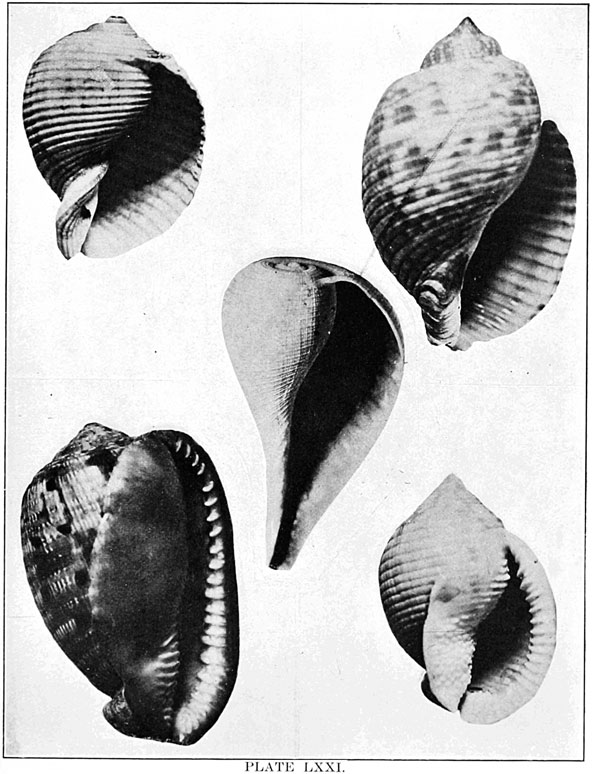
PLATE LXXI.
Dolium galea. Dolium perdix.
Pyrula papyratia.
Cassis testiculus. Cassis inflata.
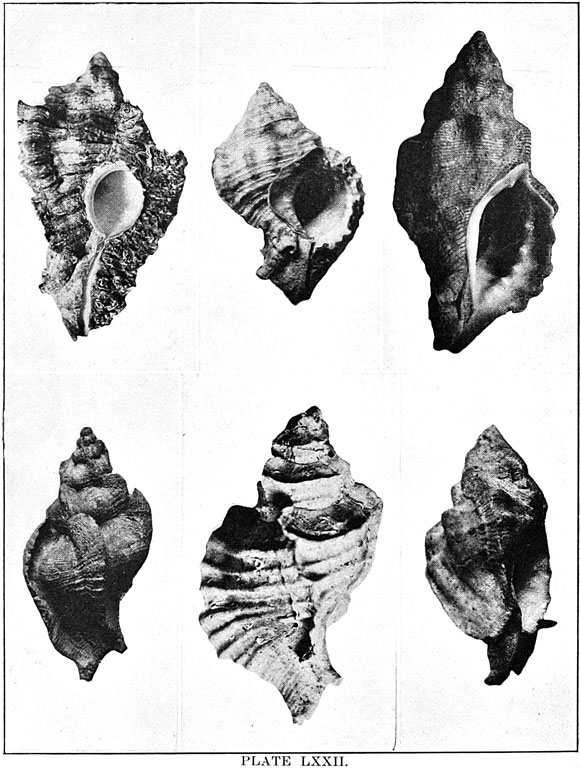
PLATE LXXII.
Murex rufus. Murex pomum. Ocinebra poulsoni, enlarged.
Pteronotus festivus. Cerostoma foliatum. Cerostoma nuttallii.
M. pomum. A more abundant species, found all along the coast from Hatteras to Texas. It is not so elongated as the last, and its sculptural design is much less exaggerated. Between each of the varices are two nodules. The aperture is oblong-ovate, and the anterior canal is nearly closed and recurved toward the back. Revolving ribs cross the varices and nodules. The color is ashen, with chestnut tips upon the nodes and varices, and chestnut-colored patches about the aperture. The varices are simple and not foliaceous as in M. rufus; the shell is more globose. Length two to three inches. (Plate LXXII.)
M. (Phyllonotus) fulvescens. The largest of the American murices. It is not commonly found except in Texas.

Trophon clathratus.
Genus Trophon
T. clathratus. A fairly common shell of the Maine coast; although it belongs to a deeper zone than that of the tides, it is occasionally found after storms upon the shore. It is a small fusiform shell, with many prominent longitudinal ribs and a produced anterior canal. Trophon is a boreal genus, which finds the best conditions for life in the icy waters of Labrador and Greenland.
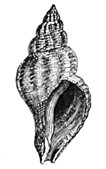
Urosalpinx cinerea.
Genus Urosalpinx
The genus Urosalpinx is closely allied to Murex and Trophon. Several of its species are found on the east coast of the United States.
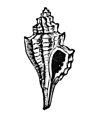
U. cinerea. This well-known species is regarded by Chesapeake and Long Island Sound oystermen much in the light of a plague. These active predaceous mollusks live upon bivalves, and preferably upon oysters. They bore a small round hole through the shell of their helpless victims, and then proceed to extract the succulent, fleshy animal from within. The oystermen call them by the suggestive name of "drill," and wage incessant warfare upon them. In some years these mollusks appear to go into partnership with the large starfish, Asterias, and the combination of the two can soon destroy any oyster-bed. The original home of this destructive little creature is presumed to be in Chesapeake [pg384] Bay, but the transplanting of oyster-spat thence to Long Island Sound has introduced the enemy at the same time. The species has a wide range from Florida to Cape Cod, and locally north of that point; in fact, it may be counted upon to appear wherever there are oyster-beds. The shell is dingy gray in color, and its whorls are crossed by a dozen or more rib-like undulations, and numerous revolving striæ. The anterior canal is produced, and is yellowish-brown within. Length under an inch.
Eupleura caudata.
Genus Eupleura
E. caudata. A curiously flattened shell which has close family connections with that last described. The peculiarly flat appearance is due to the fact that there is a rather wide varix upon each side of the shell. It is a small species, never more than an inch in length, dingy gray, with longitudinal undulations upon the whorls, and a long, narrow anterior canal and crenulated lip. The animal is white and yellow, and is notable for its activity. Found from Maine to Florida, about low-tide mark.
On the west coast of the United States occurs a striking development of a group of the Muricidæ of a curious foliaceous appearance, belonging to the genera Pteronotus, Ocinebra, and Cerostoma.
Genus Pteronotus
P. festivus. The shell is marked by three well-raised varices upon each whorl, which are reflexed backward; between each varix is a rounded knob. All is covered with numerous spiral lines of sculpture, which upon crossing the varices are frilled. The aperture is oval and white within; the anterior canal is entirely closed and is reflexed slightly over the back. Length two inches; color dingy white. Found on the southern coast of California. (Plate LXXII.)
Genus Ocinebra
O. poulsoni. This has the same dingy white color as the species last described. Its plan of sculpturing is somewhat different and consists of a series of rounded varices, about nine to a whorl, crossed by spiral lines. The anterior canal is open, and just within the white aperture, upon the inner side of the lip, is a series of five or six little round teeth. This species frequents the waters near San Diego, and sometimes grows to be two inches in length. (Plate LXXII.)
O. lurida. A much smaller species than the last, being not more than one half to three fourths of an inch in length. Very common at Monterey and in San Francisco Bay. It is strongly marked with spiral lines covering the longitudinal undulations usually found in this genus, but which are less prominently developed in this case.
There are several species of small ocinebras upon the California coast, but they are not easily determined without a more critical examination [pg385] than we are giving our specimens. They are O. interfossa, a small shell with deep spiral grooves, sharp varices, and deep sutures; and O. circumtexta, also small, but heavy, short-spired, with scalloped or crenulated outer lip.
Genus Cerostoma
C. nuttallii. A species belonging to the southern coast of California. It may be recognized at once by two prominent characters: first, a horn-like projection from near the base of the outer lip, and, second, the tumid varices alternating with rounded knobs. It has no spiral series of lines like those in Pteronotus festivus; and it has a row of five or six little teeth upon the inner side of the aperture, like those in Ocinebra poulsoni. The anterior canal is closed. It is about two inches long. (Plate LXXII.)
C. foliatum. A shell somewhat like the last, but almost twice as large, with heavy wing-like varices (three upon each whorl), made up of overlapping plaits. The knobs between the varices are much smaller, while the revolving ribs, though fewer in number than in most of these west-coast murices, are heavy and large. The aperture is oblong, the anterior canal closed. There is a "horn" near the base of the aperture, as in C. nuttallii, but no row of teeth upon the under side of the lip. The color is dingy white. (Plate LXXII.)
In the waters of Oregon and Washington there are a few trophons and other forms similar to the east-coast genera. These no doubt belong to the boreal and arctic faunal provinces, and have spread over both the Atlantic and Pacific northern regions.
Subfamily PURPURINÆ
This is considered a subfamily of the Muricidæ, and the group therefore bears the subfamily termination -inæ. There is no vital difference between it and the subfamily Muricinæ. The operculum in the Purpurinæ has a lateral nucleus instead of a subterminal one, but beyond this there are no essential differences. The shell of the purpuras is generally heavy and solid, being adapted to a life among rocks which are exposed to the beating of the surf. There is a lack of that extravagant sculptural design so characteristic of the true murices, most of the purpuras being comparatively smooth, in order, no doubt, that they may offer as little resistance as possible to the rushing, seething waters of exposed rocky shores.
The Purpurinæ, like some of the murices, when mutilated, exude a reddish-purple fluid. On account of this, the ancient Romans used to gather great quantities of certain Mediterranean forms belonging to these families, place them in large mortars, [pg386] and grind them up, shell and all. A garment dipped in the mixture and then exposed to the sun would receive a rich purple dye. This was the basis of the famous "Tyrian purple." The process was lost, and was rediscovered many centuries later, but it was long ago abandoned in favor of the far superior modern chemical dyes.
Genus Purpura
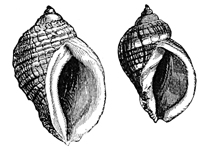
Purpura lapillus. The same; a younger specimen.
P. lapillus. No one who has ever spent an observant hour among the rocks at low tide, on the shores of Massachusetts or Maine, has failed to notice the myriads of P. lapillus clinging to the barnacle-covered boulders, or slowly creeping about in the tide-pools. This rather pretty little mollusk is a native of Great Britain, and there attains its greatest development and exhibits best its marvelous range of variation. It is presumed to be an immigrant in American waters, having found its way across the sea by Iceland and Greenland, and thence down the coast. As it is a cold-water animal, and can only survive in open, rocky stations, it will probably never pass south of New York. It is difficult to describe this well-known species because it is so extremely variable. There is an individuality about the species which causes it to be recognized at once, yet its details are elusive. It is never more than one and a half inches long (in the United States), and varies in color from white through yellow to chocolate. Often it is banded in yellow or brown. Near the only sand-beach of Bar Harbor is a colony with vermilion bands. The shell varies from a smooth to an exceedingly rough exterior, the latter being caused by raised scales along the lines of growth, which make the shell even prickly to the touch. Of this latter form there is a large colony on Campobello Island. Numerous coarse revolving ridges are common. The columella is flattened and smooth, and its lower portion is a little twisted. The anterior canal is short. P. lapillus has been accused of attacking clams and boring their shells, as does the predaceous Urosalpinx cinerea, but the accusation is not well founded. Purpura is carnivorous, and no doubt destroys many young barnacles; but with its short and small foot it would find great difficulty in digging in the sand for clams.
In Florida waters there are several purpuras, which properly belong to the West Indian fauna, but enjoy an extensive range.
P. patula. This species has a rounded body-whorl, and sometimes a low spire, which give it much the appearance of a large limpet. Its back is decorated with rows of nodules in regular order, forming a spiral series. The chief point of distinction is the deeply excavated, broadened, and flattened columella-lip of salmon-color. A portion of the whorl itself is worn down and made smooth by being dragged over sharp coral rocks, revealing underneath the rough, incrusted exterior, a transparent colorless shelly substance. Dark and chestnut-colored [pg387] patches and spots adorn the outer lip. The shell is from two to two and a half inches long. (Plate LXXIII.)
P. hæmastoma. Like its relative, P. lapillus of Northern waters, this species is so variable as almost to defy description. The form that usually occurs from Hatteras to Florida is of a bluish-gray color, and is indistinctly encircled with narrow yellow zones, which are crossed by somewhat vague longitudinal waves of black. The columella and outer lip and interior are orange-yellow. The spire is moderately high, with a sharp apex. The whorls are noduled upon the shoulder. There are revolving grooves throughout, even within the aperture. A Texan variety of this species has a much more elevated spire, with channeled sutures, and small aperture of bright salmon-color.
Upon the Californian coast there are three species of Purpura, which markedly resemble the P. lapillus of the Maine shores. Their extreme variability has given rise to much confusion in their nomenclature; the multitude of names given by numerous authors to the varietal forms of these three species constitute a list of synonyms which is appalling to the systematic student.
P. crispata. With very few modifications, a description of P. lapillus would apply to this species, which occurs commonly at San Francisco and ranges north. Crispata is possibly heavier, with a smaller aperture, and with four or five round teeth upon the inner white surface of the thickened outer lip. It ranges in color from pure white to dark brown and is sometimes banded. The surface may be smooth or rough, and is sometimes ruffled all over with wrinkled frills. Length one and a half inches. Its habits and station are much the same as those of P. lapillus, of which it is possibly a descendant, somewhat modified by changed environment. (Plate LXXIII.)
P. lima. A less common species, with rounded whorls and channeled suture, and about fifteen spiral grooves upon the whorls. The color is light brown; the length from one quarter of an inch to one inch.
P. saxicola. A shell exceedingly abundant along the whole Californian coast, living under quite the same conditions as the purpuras already described. It is smaller than the last two, being always less than an inch in length. It also runs through the gamut of variations as to color-scheme and sculpturing, but always preserves a certain individuality. There is a tendency to a small umbilicus; the outer lip is sharp; the columella is flattened and slightly twisted; and anterior canal is short, and bears to the left. A smaller aperture, with relatively thicker shell, seems to be all that distinguishes it from the smaller varieties of the east-coast species. (Plate LXXIII.)
Genus Monoceras
This genus, which is very closely allied to Purpura, is almost wholly confined to the west coast of the United States. The name is given on account of a peculiarity, which has, however, already been noticed in Cerostoma, namely, a horn-like projection from the basal portion of the outer lip. In all other respects this genus is nothing but a true Purpura. [pg388]
M. lapilloides. The shell in this species is about an inch in length, and has markings which give it a striking resemblance to granite. A row of small round denticles upon the inner surface of the lip is a characteristic already noticed in some of the west-coast murices. Their station is the same as that of the purpuras—between the tides on rocky, exposed shores. (Plate LXXIII.)
M. engonatum. This species has sharply ridged whorls, and revolving ribs with wavy growth-lines between them. In other respects it is almost identical with the last described. It is often found mingled with the seaweed which covers rocks between tides, and, when moist, simulates the color of its surroundings. (Plate LXXIII.)
Genus Chorus
C. belcheri. This family cannot well be left without at least a mention of this large and rather handsome species. Chorus is a genus of but few species, confined to the Pacific shores of North and South America. This particular species does not reach as far north as San Francisco, but may be taken at low tide in the vicinity of San Diego. The prominent feature of the shell is the posterior canal, which, being abandoned as the growth of the shell continues, leaves a series of hollow, folded spiny processes upon the shoulder of the body-whorl, which appear like jagged points upon the spire. (Plate LXXIII.)
Family COLUMBELLIDÆ
This is a large family of small but often exceedingly beautiful shells. Their distribution is mostly tropical, but the list of North American species is a very generous one indeed if the deeper-water forms are included. The animal is quite the same as in the Buccinidæ, to be described later. (See also description of Buccinum undatum on page 330.) The shells are usually quite solid, with a long, narrow slit for an aperture; the outer lip is thickened on the inside, especially about the middle portion, and is deeply toothed; and the lower portion of the columellar lip is also ribbed or toothed.
Genus Columbella
C. mercatoria. This Antillean species is found in Florida, and is one of the gems among the American shallow-water shells. Its height is about one half of an inch. It is decorated with revolving grooves and with a variously patterned color-scheme of broken yellow or reddish [pg389] lines on a white background, or of white splotches on a brownish background. (Plate LXXIV.)
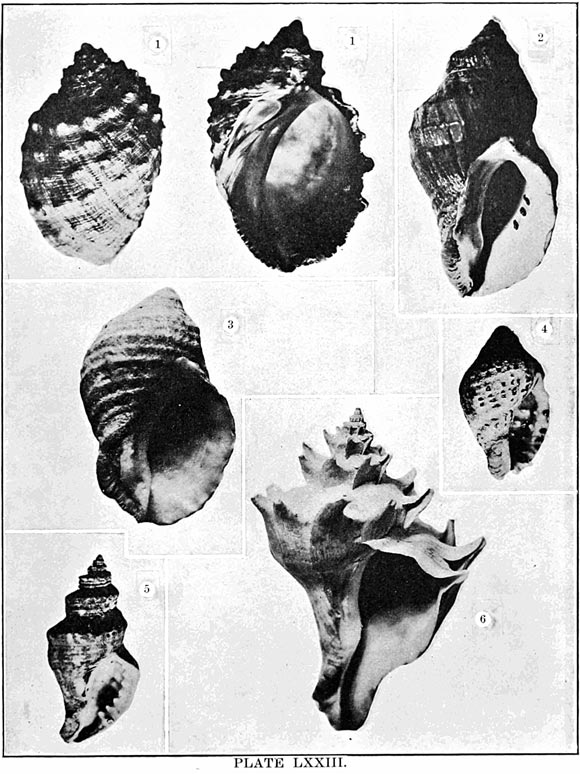
PLATE LXXIII.
1, Purpura patula. 4, Monoceras lapilloides.
2, Purpura crispata. 5, Monoceras engonatum.
3, Purpura saxicola, enlarged. 6, Chorus belcheri.
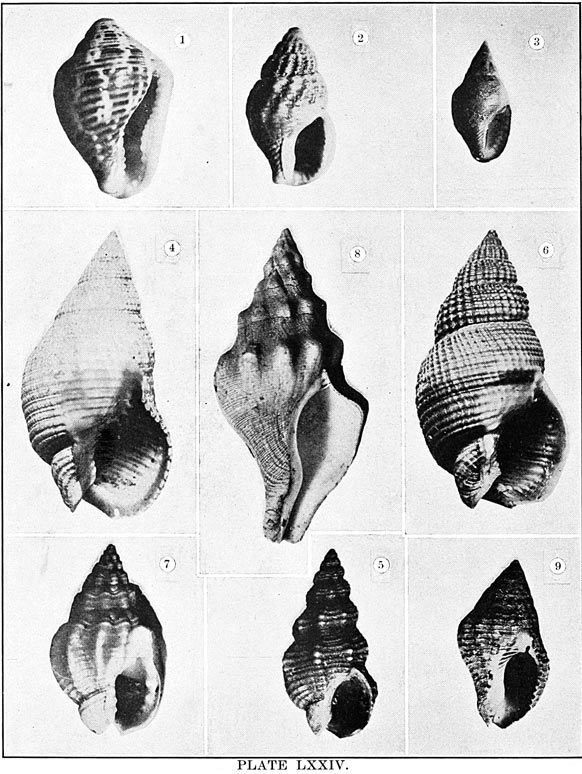
PLATE LXXIV.
1, Columbella mercatoria, enlarged. 6, Nassa perpinguis, enlarged.
2, Columbella (Amphissa) corrugata, enlarged. 7, Nassa tegula, enlarged.
3, Columbella (Astyris) gausapata, much enlarged. 8, Siphonalia kellettii, reduced.
4, Nassa fossata, about natural size. 9, Tritonidea tincta.
5, Nassa mendica, enlarged.
C. (Anachis) avara, and the variety C. similis. These rather slender shells, about one half to three fifths of an inch long, occur from Florida northward to Cape Cod. The upper whorls are smooth, the lower ones are undulated with vertical costæ (ten to thirteen), and the body-whorl is encircled below the middle by a series of revolving, closely set grooves. The aperture is typical of the genus, though less strongly marked by internal callosity on the outer lip and with less prominent teeth than in C. mercatoria. The greater development of the revolving grooves, which spread over the entire surface of the body-whorl and cross the costæ, producing a granulated surface, constitutes the variety C. similis. The color is brownish, with white reticulations. This species is to be found in considerable abundance in sandy mud and among stones and algæ about low-water mark. At New Bedford and Martha's Vineyard, and on Cape Cod, it may always be taken. It is also common at Norfolk and along the Virginia and Georgia coasts.
C. (Astyris) lunata. One of the characteristic eastern-coast shells, which, like the last species, ranges from Cape Ann in Massachusetts to the West Indies. It occurs about low-tide mark and just below, upon stones and algæ, or crawling about on a soft bottom. On account of its generic features, combined with the peculiar coloration, the species cannot be mistaken. The latter is a ground of reddish-brown or fawn, with encircling rows of large white or yellowish spots. The whorls are quite smooth. Length not over one fifth of an inch.
The collector soon learns to recognize the variable forms of these northern-range columbellas. They are not a difficult group, for once their generic position is established by the characters of the aperture (which are constant) the species can readily be determined, notwithstanding their tendencies to vary from the type. Californian waters also have several columbellas. The conchologists of the west coast have preferred to apply to their shells, and indeed to employ in general use, a large number of subgeneric names in place of the ordinarily accepted generic ones. The result of this is to confuse at first the student of conchology, who, though fairly familiar with the molluscan genera, finds himself perplexed when he confronts a list of west-coast shells. Thus the two common Californian columbellas are "Amphissa" corrugata and "Astyris" gausapata, these two species belonging to different subgenera of the genus Columbella.
C. corrugata. This shell finds its metropolis in Puget Sound, but occurs also along the Californian shore. The aperture is wider than is usual in this genus. The surface is deeply wrinkled by longitudinal costæ and is encircled by revolving grooves. Length one half of an inch; color red, or orange to light brown. It is found in shallow protected waters. (Plate LXXIV.)
C. gausapata. This species lives in great numbers about the roots of eel-grass. It is very small and smooth, with a rather high spire. The color of the spire is deep brown; the body-whorl is lighter in color. Occasionally the body-whorl is obtusely carinated just below the suture. This little shell is very common upon many beaches after heavy winds, but it should be sought for at very low tides and gathered alive. (Plate LXXIV.) [pg390]
Family NASSIDÆ
These are familiar, and often very characteristic, littoral shells in all parts of the world. Where they exist at all they are generally to be found in astonishingly large numbers, sometimes even crowding out all other mollusks. They are exceedingly active and predaceous, feeding upon other mollusks, whose shells they bore through by means of the sharp teeth upon their lingual ribbon. The Nassidæ of the east coast find a relentless enemy in the small hermit-crabs, which attack them, drag them from their coverings, and then proceed to occupy the empty shells themselves; the torn and lacerated Nassa animal is thereupon leisurely eaten, a retribution probably well deserved. The animal of Nassa (the principal genus of Nassidæ) is peculiar in having frequently a bifurcated tail; or, to speak more correctly, the posterior end of the foot is terminated by two appendices. It has a long siphon, and eyes placed upon the outer sides and near the base of the tentacles. The operculum has serrated edges.
Genus Nassa
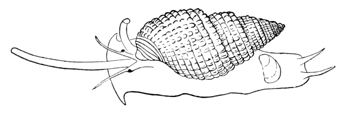
Nassa trivittata, showing the animal as if crawling.
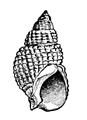
Nassa trivittata.
N. trivittata, N. obsoleta. These are the two nassas of the New England and New Jersey coasts. The first has a more northerly range, extending to the Gulf of St. Lawrence; the other is not usually found north of Cape Cod, but below that point as far as Hatteras it is probably the commonest shell of the coast. It fairly swarms in sheltered muddy reaches about low tide. Little pools left by the tide on the Jersey flats are sometimes so crowded with N. obsoleta that for lack of room the animals crawl over one another. N. trivittata is more commonly taken at small depths in the harbors, where it seems to live well upon all kinds of sea-bottom. Probably they exist in great numbers along the southern shore of Long Island, for the beaches are often lined with their dead and worn shells. Over half the specimens thus found will have a little round perforation upon some whorl, showing that they were victims of some cannibalistic brother. The shells of the Nassidæ have a short, ovate aperture, with a short anterior canal. The inner lip is smooth, and is usually coated over with a more or less heavy [pg391] deposit of enamel. N. trivittata is about one half to seven tenths of an inch long, and is yellowish-white. A series of revolving grooves cutting across a series of longitudinal lines gives the shell a decussated or granulated appearance. The whorls are somewhat shouldered at the sutures, and are white inside. N. obsoleta cannot be called a handsome shell by the most enthusiastic collector. Its spire is usually eroded or completely dissolved away. The color is blackish to olive, with the aperture purplish-black. The columellar lip is arched, with a twist or fold in its lower portion. It is decussated by crossing lines and grooves, though not so conspicuously as N. trivittata; sutures simple; length one half of an inch to one inch. Old specimens not only become eroded, but are usually covered with vegetable mould, and are not over-inspiring to the collector. They often live in brackish water, and frequent all the inlets and marine flats between Cape Cod and Hatteras. Below Hatteras both this and the last-named species occur, though not so plentifully.
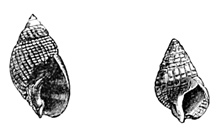
Nassa obsoleta. Nassa vibex.
N. vibex. This ubiquitous little mollusk seems content in any station, and swarms in all the sandy bays of Florida. It is a busybody, always on the move, and its long siphon is constantly vibrating. The shell is about one half an inch long and shining white, with brown or reddish spots. There are prominent longitudinal undulations and revolving lines upon the lower part of the body-whorl. The anterior canal is deeply cut and very short; the columellar lip arched, richly calloused, and often granulated at its base. This is probably the first live shell the collector in Florida will encounter. The animal is very graceful and prettily marked in color. The terminal cirri on the foot form a notable feature—a character belonging to the entire family.
N. fossata, N. perpinguis. On the California coast there are the huge (for this genus) N. fossata and the smaller but no less interesting N. perpinguis, also N. tegula and N. mendica. N. fossata grows to a length of one and a half to two inches. When adult the lip is somewhat thickened, and the entire aperture is bright orange. The color of the shell is ashen-gray, and it is marked with spiral and transverse riblets which produce a granulated surface, especially upon the upper whorls. The shell is ribbed inside the mouth. A deep groove circles the anterior canal at the base of the body-whorl. N. perpinguis is an especially graceful shell, smaller than the last-named and more finely decussated and darker (brown) in color. It also has a deeply channeled groove encircling the base of the body-whorl. It is often banded in chestnut. Both these species occur in the southern part of California only; N. tegula and N. mendica are of more northern range. The former resembles the Floridian N. vibex. N. mendica is a slender shell three quarters of an inch long, with prominent longitudinal ridges, and light brown in color, with a white aperture. (Plate LXXIV.)
Family BUCCINIDÆ
From the number of subfamilies and genera included in this exceedingly large and comprehensive family, it would almost [pg392] seem that it has served as a sort of dumping-ground for various groups of mollusks of uncertain biological affinities. Although the family has recently been reduced by the removal of several large families, it still remains a bulky one.
Genus Buccinum
The animal is described at some length on page 330. It has no striking peculiarities. The siphon in Buccinum is fairly long; the eyes are placed about midway between the base and the end of the tentacles. It is in general a conventional prosobranch animal. The great majority of the members of this family have a boreal range and are found widely distributed within the colder waters of the world.
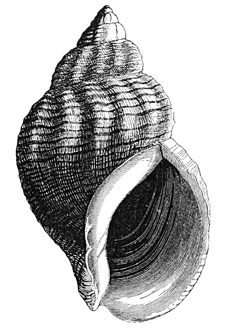
Buccinum undatum.
B. undatum. This is the most prominent representative of the Buccinidæ upon the North Atlantic shores of the United States. It is an exceedingly common shell, ranging from Cape Cod to Greenland. It is also found in England and Scotland, where it is extensively used as food under the familiar name of "whelk." It affects every kind of station and seems to be as much at home in very considerable depths as about the low-tide mark. Upon the Maine coast it may be found almost everywhere, just below low tide. If none are in sight they may be attracted by putting a dead fish in a basket and anchoring it near shore. The American whelk is somewhat smaller than the British variety, although it attains a length of full three inches. It has revolving ribs and longitudinal oblique folds. A yellowish-brown, velvety epidermis covers the entire shell. The lip is simple, and the shell is white or golden yellow within. The columella is somewhat twisted; the operculum is corneous, with a lateral nucleus. The variations in this shell are so great as to have caused naturalists no little perplexity. Specimens taken near large cities are apt to be defective. (Plate I.)
Genus Chrysodomus
C. decemcostatus. One of the most striking shells of our northeast coast. As its name indicates, it is decorated with (normally) ten costæ. [pg393] These are prominent revolving ribs or keels upon the body-whorl, the upper one being the largest, the others diminishing in size toward the base of the shell. Upon the upper whorls but two of these circling keels appear. The lip is plain, but somewhat modified by the termination of the ribs. The columella is arched above; the canal produced (sometimes to the left). The color without is dull ashen-white to horn; within, pure white. The operculum is small, with a terminal nucleus. The animal is the same as Buccinum. This species is not quite so common as B. undatum, but it is often found associated with it. At Eastport and Bar Harbor it is abundant just below low-water mark.
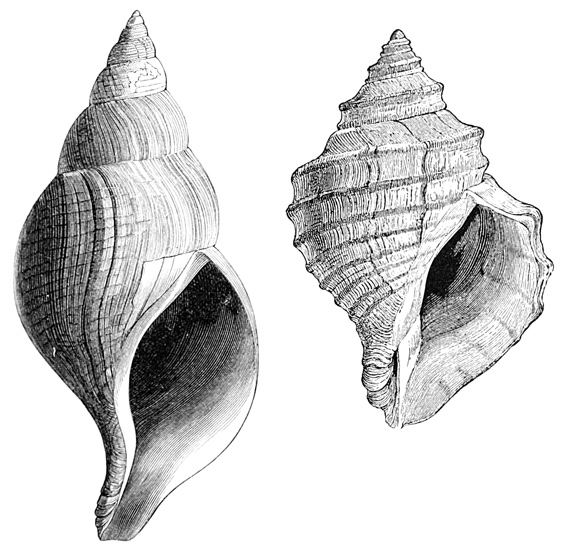
Sipho Stimpsoni. Chrysodomus decemcostatus.
Genus Sipho
S. Stimpsoni. One of the most graceful of the larger shells of our eastern coast. It is almost identical with the S. islandicus of northern European waters, and for a long time was considered to be the same species. S. Stimpsoni is not found south of Cape Cod, except possibly in deep offshore stations. North of that point it ranges to Newfoundland, but it has enjoyed the reputation of being a rare shell and has been greatly prized by local collectors in consequence. It is, in fact, not rare to any one who is provided with a dredge and rope enough to enable him to use [pg394] it effectively in from twenty to one hundred feet of water. The spire is high and regular, with seven to eight slightly rounded whorls. The suture is simple, and there are faint revolving grooves. The epidermis is thick, horn-colored, and sometimes velvety; the lip simple; and the anterior canal produced. The shell is pure white within. The operculum is corneous, with a subterminal nucleus. The animal is the same as Buccinum, but with small irregular specks of black. This shell is found from three to five inches long.
Sipho pygmæus.
S. pygmæus. This species has the same range as that of the species just described, and often occurs associated with the young of the latter. It may be distinguished from S. Stimpsoni by the greater number of whorls, the more prominent revolving ridges, and the smaller aperture. The epidermis is drab-colored and strongly corrugated, inclined to hirsute. The color of the shell is pure white. Length one inch to one and a half inches. It is found from low-tide mark to very considerable depths.
Genus Siphonalia
S. kellettii. Siphonalia is one of the Pacific genera of the Buccinidæ, which finds its greatest development in Japanese waters. One of these Japanese species, S. kellettii, is also found in California. It has the typical animal of the Buccinidæ, and a fusiform shell white to brownish in color, and three to five inches in length. It is conspicuously marked upon the whorls by a revolving series of large rounded knobs and indistinct revolving grooves. The operculum is corneous, the nucleus subterminal. It is found in shallow water to low-tide mark. (Plate LXXIV.)
Genus Tritonidea
T. tincta. A Floridian species which ranges from Hatteras to the West Indies, and finds its station near low-tide mark, upon coralline rock or rough, stony bottom. It is about one inch in length, is of a brownish horn-color, and has an oval aperture with a crenulated outer lip and a deep anterior canal. An entering ridge of white enamel at the top of the columellar lip forms, with one of the teeth of the outer lip, a posterior canal. It is sculptured, with revolving ridges and crossing longitudinal folds. The color is bluish-white within the shell, touched with yellow about the anterior canal and along the edge of the outer lip. (Plate LXXIV.)
Family TURBINELLIDÆ
Genus Fulgur
Of the two genera of this family which occur in American waters, Fulgur may be taken as the most characteristic mollusk of the American Atlantic fauna; that is to say, Fulgur occurs only on the American east coast. Its range is from Cape Cod to the West Indies. The two Northern species are F. carica and [pg395] F. canaliculata, both of which are exceedingly common in sandy shore stations from Cape Cod southward.
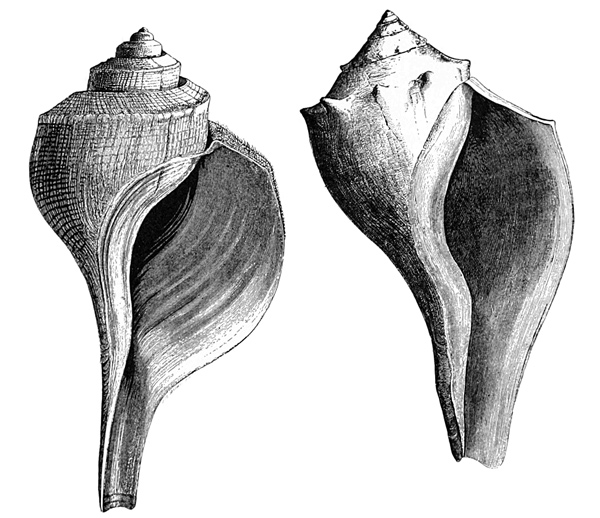
Fulgur canaliculata. Fulgur carica.
F. carica. The largest univalve north of Hatteras, most easily recognized by its pear-shaped shell, with simple suture and brilliant vermilion aperture. The anterior canal is long and open; the columellar lip is twisted and arched, and the outer lip is simple. There is a revolving row of nodes or spines of various degrees of prominence upon the shoulder of the body-whorl, continued on the spiral whorls just above the suture. The color varies from ashen-gray to a dirty brown. In young specimens there are stripes and bands of violaceous brown, and the shells are striate within the aperture. The length of this shell is sometimes nine inches.
F. carica frequents almost any sort of bottom. In Long Island Sound they are common on stony ground, but they do not attain the maximum size and the high degree of aperture-coloration characteristic of those taken along the New Jersey shore, on sandy stations exposed to the surf. The string of curiously shaped capsules containing the eggs of Fulgur is shown in Plate I.
F. canaliculata often occurs associated with the last. It does not attain quite the same size, but specimens of both species are, on the [pg396] average, about equal in cubic capacity. It is pear-shaped, like F. carica, and has a long anterior canal; but its distinguishing features are the flattened shoulder of the whorls and the deeply channeled sutures. The epidermis is brown, thick, and heavy. The color of the shell is whitish-gray, yellowish within. It is found in the same places as F. carica, and is very abundant at Atlantic City and along the entire New Jersey coast.
F. perversa. A Floridian species, immediately recognizable by the fact that it is sinistral; otherwise a description of the shell would almost fit that of F. carica, except in the matter of the color of the aperture, which in F. perversa is brownish-white. The brownish streaks upon the whorls, in young specimens, are a very noticeable feature of this shell. The shoulders of the whorls are rather flatter than in F. carica, but, unlike F. canaliculata, the sutures are simple. The row of nodes or rounded spines which encircles the body-whorl appears in the spire as nodes just above the sutures. The animal is jet-black, and frequents sandy flats, where, at low tide, it may be gathered in considerable numbers, as it plows its way along, almost wholly concealed beneath the sand. Large specimens measure quite a foot in length. In old shells the color-markings are not so brilliant, the shells being a dull, lusterless white. (Plate LXXV.)
F. pyrum. Another Floridian species, much smaller than the last (three to four inches), with a regular, pear-shaped outline, a long anterior canal, a low spire, deeply channeled sutures, flattened shoulders, and no spinous or nodose processes. It is ornamented with revolving inconspicuous ribs or striæ, alternately larger, and has a somewhat hirsute epidermis. The color is white, with transverse broad yellowish or rusty lines; the color within the aperture resembles that of the exterior color-lines. It is found on sandy stations, in shallow water. (Plate LXXV.)
Genus Melongena
M. corona. A Floridian species, named from the single or double row of spinous processes upon the shoulder of the body-whorl and the crenulated appearance of the spire caused by the continuations of the triangular spines. The three apical whorls are not spinous. There is also a row of hollow triangular spines obliquely encircling the base of the shell. The epidermis is heavy, rough, and brown; the aperture oval and large; the outer lip notched at points where the spines commence; the anterior canal wide and short; and the columella white and twisted, and banded within with purplish-chestnut and white. The color without is drab in older specimens, in young specimens chestnut banded with revolving striæ. Length four inches. Found in shallow water. This active predaceous animal must be the terror of the mollusks in Florida. With his sharply toothed radula he is able to pierce even the ponderous clam-shell, Venus mercenaria, variety mortoni, and devour the soft fleshy parts within. No mollusk, save, perhaps, the vigorous Strombus pugilis, can escape the attack of this highwayman. (Plate LXXV.)
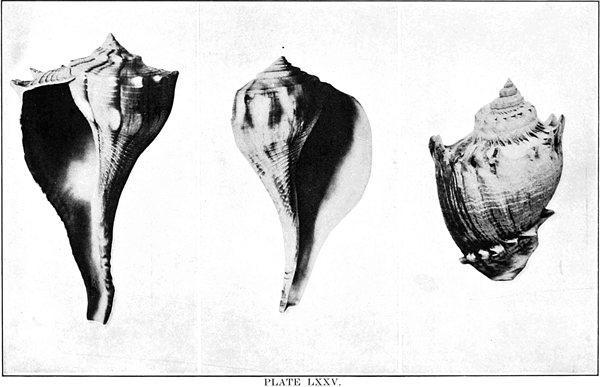
PLATE LXXV.
Fulgur perversa. Fulgur pyrum. Melongena corona.
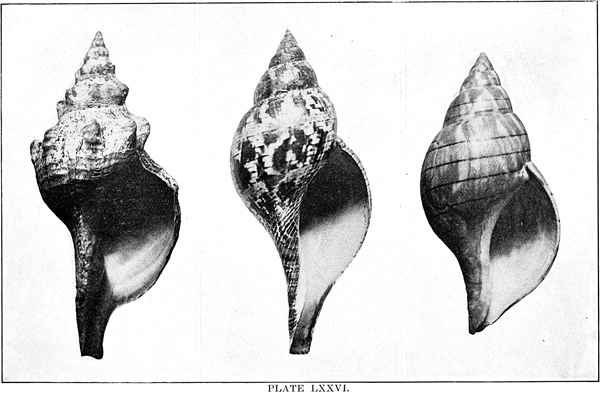
PLATE LXXVI.
Fasciolaria gigantea, very much reduced. Fasciolaria tulipa. Fasciolaria distans.
Family FASCIOLARIIDÆ
This family comprises a number of genera of mollusks which have a fusiform shell, with a long-drawn-out spire and a long anterior canal. The animal is in no manner remarkable; no essential differences are to be noted from the usual conventional type of gasteropod mollusk, represented in the two families last described.
Genus Fasciolaria
This genus is of tropical range, and contains many species of shells which are more or less conspicuous for their large size or their beauty of form. Three species occur in Floridian waters, and all of them may be taken about low-tide mark on the sandy flats which are so characteristic of Florida bays and harbors. All of them are sluggish animals which crawl very slowly along the bottom or bury themselves almost wholly in the sand, leaving only the tip of the spire projecting slightly above.
F. gigantea. This is said to be the largest gasteropod shell known. It often attains a length of sixteen inches, and specimens are reported to have been found measuring no less than two feet. This huge mollusk has a symmetrically fusiform shell, with whorls obtusely ridged and armed with large rounded nodes. The aperture is reddish-brown within. The anterior canal is long and open, and there are three "plaits," or folds, about the columella. The outer lip is more or less sinuate, the color is fleshy-white, and the shell is covered with a thick yellowish or chestnut epidermis. The animal is of a brilliant scarlet color. (Plate LXXVI.)
F. tulipa. An exceedingly common species of Floridian waters, which may justly be classed among the "show shells" of the American Atlantic fauna. It has a typically symmetrical, fusiform shape, with gracefully rounded whorls, and is spirally but not deeply grooved. The sutures are crenulated; the anterior canal is long; there are three entering folds upon the columella; and the outer lip is simple. The scheme of coloration is variable, but there are two chief patterns, which are usually followed, though they often are considerably modified. One is a light-bluish body, variegated with chestnut or olive blotches, which are more extensive upon the spire than upon the body-whorl; the other is a pinkish body, encircled with revolving black lines. The specimens of F. tulipa, which are found so abundantly in the shallow bays and estuaries of the Florida coast, are, for some reason, never brightly colored, as are those taken in the open sea. The length is about four to six inches. (Plate LXXVI.)
F. distans. A form almost identical with that last described. It is much smaller, varying from two to three inches in length, lacks the crenulations of the sutures, and is perfectly smooth, save for a few spiral ridges about the base. The color is bluish-white, with clouded longitudinal [pg398] streaks of olive. Encircling the shell are from four to seven black lines. (Plate LXXVI.)
These three species of Fasciolaria often occur associated upon sand-banks which are exposed at unusually low tides. It requires some force to dislodge the large F. gigantea from its bed of sand. When the apex is discovered projecting an inch or less from the bottom, the collector must scrape away the sand down to the body-whorl, and then secure a good hold upon the spire and pull hard. The stupid animal will not at once withdraw into his shell, but will hang protruded from the aperture like a great piece of vividly red meat. To extract any of these larger fasciolarias from its shell, it is necessary to boil it for ten or fifteen minutes. Large specimens of F. gigantea should remain in the pot half an hour. The heavy corneous epidermis of F. gigantea will dry and crumble away unless it is rubbed with vaseline about once a year.
Family VOLUTIDÆ
Genus Voluta
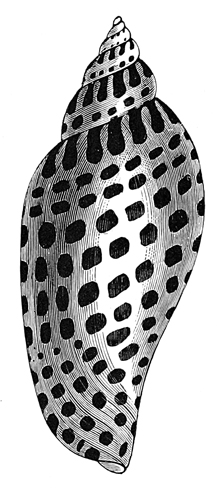
Voluta junonia.
The Volutidæ, like the cowries, are "aristocratic" shells. As was stated above, there are many collectors who have become so fascinated by the shells of a few of these "first families of the Mollusca" that they make great efforts and spend no small sums in seeking to complete their cabinet series of the rare and more beautiful forms. The Volutidæ certainly have very beautiful shells, and they are for the most part exceedingly rare. The reason of their rarity has no doubt something to do with their habits. They are probably largely dwellers upon rocky ground, where the dredge cannot reach them. There is but one species of Voluta upon the American coasts which is available to the shore-collector, and this is the well-known and much-sought-after V. junonia. The animal of Voluta has a very broad foot, and a head curiously divided into two lobes, upon which are placed sessile eyes. A remarkable feature of the genus is the lack of an operculum. [pg399]
V. junonia. This volute has never been taken alive in shallow water near the shore, but is occasionally found cast upon the beach after violent storms. Sanibel Island is the best locality. V. junonia has an obtuse apex, a long aperture, and a shell from three to three and a half inches in length. The color is cream-white, painted with rows of large deep-red spots. In his "American Marine Shells," published nearly thirty years ago, Mr. Tryon says: "This is the most rare and valuable American marine shell; specimens in good condition sell for from fifty to one hundred dollars." A good specimen is probably not worth so much to-day as when Mr. Tryon wrote, but it is at least worth a careful survey of a Floridian beach after a storm.
Family MARGINELLIDÆ
Genus Marginella
This is a family of exquisite little shells. In point of beauty they would rival the volutes were they not so much handicapped by their small size. The largest Marginella is not more than an inch and a half in length, while the great majority of its two hundred tropical species do not exceed one half an inch. The animal is very similar to that of Voluta; indeed, the marginellas were until recently included in the Volutidæ. The shell is also suggestive of Voluta. It is porcelanous, highly polished, and shining like all shells which are covered by a portion of the mantle when the animal is extended. Forty-seven species of Marginella are recorded from the Atlantic coast of the United States. The marginellas frequent sandy or muddy sheltered spots, and may be collected between tide-marks. In California there are several species, which are so minute that it seems hardly worth while to attempt a description of them. They are white and very inconspicuous little shells. One is tempted, however, to speak of some of the fine marginellas of the Bahamas. The animals are quite as beautifully marked as the shells themselves, while the shell of one species is used in jewelry on account of its pearly luster suffused with the most delicate pink.
M. apicina. The most abundant Floridian species of this genus. It is not more than one third of an inch long, with a depressed spire, a large body-whorl, a long aperture nearly equaling the entire length of the shell, a thickened outer lip, and four very prominent plaits on the columella. The surface is smooth. The white, enlarged outer lip is glazed or highly polished, and bluish or brown in color, with red spots. (Plate LXXVII.) [pg400]
Family OLIVIDÆ
Genus Oliva
The genus Oliva is one of the favorites among collectors. It comprises smooth, highly polished, porcelanous, and oval shells with a deeply notched, long, narrow aperture. The columellar lip is usually heavily calloused and ornamented with oblique folds. The animal's foot is very large, and extends laterally into lobes which curve back over the shell. In front the propodium is very large, forming, as in Natica and Polynices, a sort of plow. The mantle lobes almost cover the shell when extended.
O. literata. The only American example out of some sixty known species. It is found in great abundance in sandy tide-pools along the west Florida shores. It ranges from Hatteras to the West Indies, and may be looked for in stations similar to those of the naticas. It is exceedingly active, crawling rapidly over the sand or burying itself very quickly out of sight, and is carnivorous. The shell is highly polished, about two inches long, and pale yellowish-white in color, covered with longitudinal, angulated, or zigzag lines of chestnut. The spire is short, the sutures channeled, and the columella calloused with white enamel, and obliquely striated. (Plate LXXVII.)
Genus Olivella
The genus Olivella resembles Oliva very closely in conchological characters, but the shells are, with few exceptions, exceedingly small, and usually have a somewhat more elongated spire than is the case in the genus Oliva proper. The animal of Olivella seems to be a degenerate, for it possesses neither tentacles nor eyes. In habit and station it resembles Oliva.
O. mutica. In Floridian waters this species is exceedingly common. It is not more than one fifth of an inch long, is highly polished and shining, and yellowish-white in color, with revolving pale rufous bands. It has the typical oliva-shape.
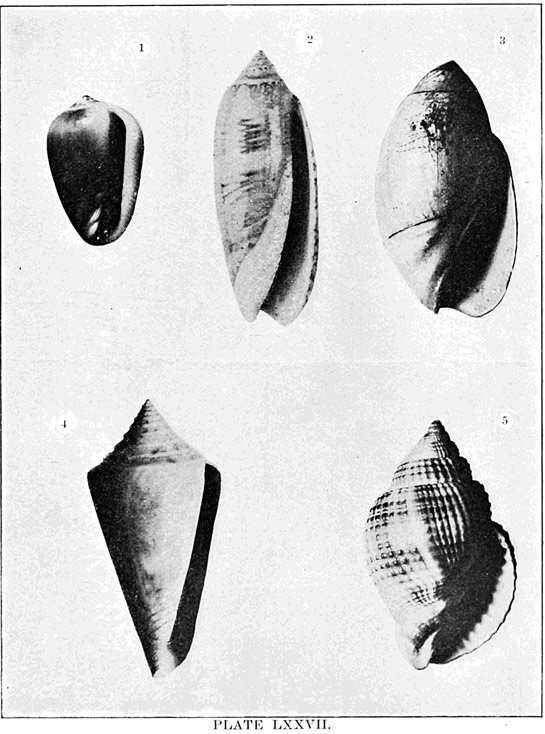
PLATE LXXVII.
1, Marginella apicina, enlarged. 3, Olivella biplicata, enlarged.
2, Oliva literata. 4, Conus floridanus.
5, Cancellaria reticulata.
O. biplicata. A Californian species of considerable interest, the largest of the olivellas. It was evidently used by the aborigines as wampum or as ornaments, for a great many specimens are found among buried Indian relics. This species is about the size and shape of an olive. The spire is short, though longer than the typical Oliva spire, the shell is smooth and highly polished, and the columella is thickly calloused, and has two entering folds near the base. The color is creamy-white to dove-color, with a purple sheen over all, and purple markings [pg401] about the base. Professor Keep speaks of the vast numbers of these olivellas on sandy stations along the Pacific coast. Having found a place where a "little stream of water was oozing out from the bank of sand," he proceeded to dig with a hoe. "I found them [O. biplicata] by the hundreds," he continues, "and I had gathered about a thousand before the tide came in. They seemed to lie in groups just under the surface of the sand, yet wholly concealed from sight." (Plate LXXVII.)
O. boetica. A much smaller Pacific form, with a higher tapering spire. It is brown to bluish in color, and often has yellowish stripes. It is polished and shining. Found in sandy stations.
Family CONIDÆ
Genus Conus
This is a comprehensive family of several highly diversified genera. Its most prominent genus is Conus, a name which indicates the principal feature of the shell, for it is almost an exact cone in shape. Conus, along with Voluta and Cypræa, is entitled to the honor of being considered an aristocrat among mollusks. There are about three hundred and fifty species known, mostly tropical and Indo-Pacific in distribution. The shells have many points of beauty and are often of very high coloration and eccentric markings. Some of the rarer forms are famous in conchological annals for the enormous prices which they have commanded. The rare and beautiful Conus gloria-maris once brought £43 ($215) at an auction sale in London. In all shells of Conus there is a notch at the upper edge of the aperture for the accommodation of a posterior canal. In some other genera of this family this notch becomes a more prominent feature. The animal has a well-developed foot, a retractile proboscis, eyes situated upon the tentacles, and a fairly long siphon. Upon the under surface of the foot is a conspicuous pore, which opens into a water-vascular system of the foot. Conus is accused of having a poison-gland connected with the radula and of having shown vicious traits when captured. The animals are shy, and remain most of the time in hiding, while their pretty shells during life are generally rendered obscure by a dull, colorless epidermis. There are but few species of Conus upon the Atlantic shores of the United States, and these are confined to the warmer waters of Florida and the Gulf of Mexico. [pg402]
C. floridanus. A not unusual shell in shallow-water stations throughout the Florida coast. It has almost the exact outlines of a cone. The flattened shoulder is marked off by an acute carina; the spire is low, but many-whorled and pagoda-like; the aperture is long and narrow, and the lip is simple. The coloring is yellowish, banded on a creamy-white background, or dotted in circular rows. Length two inches. (Plate LXXVII.)
C. pealii. One of the smallest species of this genus, its length never exceeding one half of an inch, whereas the majority of the cones are over two inches in length, and many of them rank as large shells. This little Floridian species is regularly cone-shaped, with carinated whorls, thin outer lip, and pagoda-like, low spire. The color is reddish-brown with sky-blue spots, or bluish-brown with lighter spots. There are encircling grooves about the base of the shell.
Family CANCELLARIIDÆ
Genus Cancellaria
The last family of the Gasteropoda to be considered is the Cancellariidæ, which has but one genus, Cancellaria. There are several species upon the east coast belonging to deeper-water zones, but one well-known species, C. reticulata, is very common on shore stations from Hatteras south. The shell is oblong and solid, with a moderate spire, and whorls slightly flattened below the sutures, and is very roughly granulated or reticulated. The aperture is narrowly ovate, and is ribbed inside. The columella has two very strong and prominent plaits. The color is white, banded and variegated with reddish-brown. Length an inch or more. (Plate LXXVII.)
CLASS SCAPHOPODA
Family DENTALIDÆ
Entalis striolata.
In nearly all collections of shells from the northeast coast of the United States are certain specimens about one to one and a half inches long, pure white, and shaped very much like an elephant's tusk. They are round, hollow tubes, slightly curved, of larger diameter at one end than at the other, and with an opening at either end. There are two very common species of these tooth shells upon the New England coast, [pg403] Dentalium dentale and Entalis striolata. The first has a simple round hole at the smaller end of the shell, and is faintly marked by longitudinal striæ; the other is a smooth shell which has a notch-like fissure on the margin of the apical perforation. Neither of these species is, strictly speaking, a littoral form, for all the Dentalidæ range into deep water, many of them living only in the profounder depths of the ocean. But these two species are exceedingly common in the New England coastal waters, at very moderate depths, and may sometimes be found upon the beach cast up by storms. They live buried in the mud, and feed upon infusorians and all manner of microscopic organisms.
Upon the west coast Dentalium pretiosum is very abundant north of California. It is almost like the east-coast Dentalium, but is more slender. The Indians used to gather these shells and string them together upon long threads to be carried about and used as money. In California occurs Dentalium hexagonum, a very delicate little species with a slightly angulated shell.
Dentalium, as seen in longitudinal section (except the foot): S, shell; Mt, mantle; Sm, shell muscle; Mh, mantle-cavity; F, foot; Mk, cephalic prominence or oral cone; T, captacula; R, radula; D, intestine; L, liver; Af, anus; G, cerebral ganglion; N, kidney; Ge, generative gland.
The animal of the Dentalidæ is remarkable, and easily merits the rank of a separate molluscan class. It has no head, no tentacles, no eyes, no heart, and no gills. It is a mollusk because it has a mantle, a foot, and a radula. Its position, therefore, is between the Gasteropoda, which it resembles in its univalve shell and radula, and the Pelecypoda, to which it is related by the pointed foot and the absence of head and tentacles, and also by the symmetry which pervades its organization.
Upon either side of the mouth, just beneath the flap of the mantle, are bunches of ciliated, contractile filaments (captacula), flattened at the end, which are supposed to be breathing-organs, and are perhaps exserted for the purpose of catching food. [pg404]
The entire absence of such important organs as the heart and gills, together with the fact that they are undoubted mollusks, would indicate that the Scaphopoda are very degenerate animals. The circulatory and respiratory system of mollusks is typically of a high order.
A great many specimens of the Dentalidæ dredged in New England waters are dead shells, occupied by a worm which seals up the larger opening, leaving only a small aperture through which it protrudes its long white body. These must not mislead the collector into a vain search for a mantle and other molluscan characteristics of anatomy.
Some of the larger species of Dentalium from deep-sea stations are four to five inches in length. [pg405]
TABLE OF THE COMMONER NORTH AMERICAN PELECYPODS DESCRIBED IN THIS CHAPTER
Class PELECYPODA Order PROTOBRANCHIATA Family NUCULIDÆ Genus Nucula N. proxima Genus Leda L. tenuisulcata Genus Yoldia Y. limatula Y. thraciæformis Y. sapotilla Family SOLENOMYIDÆ Genus Solenomya S. velum S. borealis Order FILIBRANCHIATA Family ANOMIIDÆ Genus Anomia A. simplex A. aculeata A. lampe Genus Placunanomia P. macrochisma Family ARCIDÆ Genus Arca A. ponderosa A. noæ A. pexata Family MYTILIDÆ Genus Mytilus M. edulis M. hamatus M. californicus Genus Modiola M. modiolus M. plicatula M. tulipa M. recta Order PSEUDOLAMELLIBRANCHIATA Family AVICULIDÆ Genus Avicula A. atlantica Genus Pinna P. muricata P. seminuda Genus Perna P. ephippium Family OSTREIDÆ Genus Ostrea O. virginica O. frons O. lurida Family PECTINIDÆ Genus Pecten P. magellanicus P. irradians P. dislocatus P. islandicus P. æquisulcatus P. hastatus Order EULAMELLIBRANCHIATA Family CARDITIDÆ Genus Cardita C. borealis C. floridana Family ASTARTIDÆ Genus Astarte A. castanea A. undata Family CYPRINIDÆ Genus Arctica A. islandica Family LUCINIDÆ Genus Lucina L. tigrina L. floridana L. pennsylvanica L. dentata L. californica L. nuttallii Genus Loripes L. edentula Family TELLINIDÆ Genus Tellina T. radiata T. alternata T. bodegensis T. tenera Genus Macoma M. secta M. nasuta M. baltica M. proxima M. tenta Family DONACIDÆ Genus Donax D. variabilis D. californicus Family MACTRIDÆ Genus Mactra M. solidissima M. similis M. ovalis M. lateralis Genus Rœta R. canaliculata Family VENERIDÆ Genus Venus V. mercenaria Var. mortoni V. cancellata Genus Cytherea C. (Callista) gigantea C. (Callista) maculata Genus Dosinia D. discus D. elegans Genus Tivela T. crassatelloides Genus Tapes T. staminea T. laciniata Genus Chione C. succincta C. fluctifraga C. simillima Genus Saxidomus S. nuttallii Family PETRICOLIDÆ Genus Petricola P. pholadiformis P. carditoides Family CARDIIDÆ Genus Cardium C. magnum C. isocardia C. lævigatum C. serratum C. mortoni C. substriatum C. corbis C. quadrigenarium C. elatum C. islandicum C. pinnulatum Family MYIDÆ Genus Mya M. arenaria Family SOLENIDÆ Genus Ensis E. directus Genus Solen S. viridis S. sicarius S. rosaceus Genus Tagelus T. gibbus Family GLYCIMERIDÆ Genus Glycimeris G. generosa Family PHOLADIDÆ Genus Pholas P. costata P. truncata P. californica Genus Zirphœa Z. crispata Family TEREDINIDÆ Genus Teredo T. navalis Family PANDORIDÆ Genus Pandora P. trilineata
Anatomy of a pelecypod, Anodonta cygnea. The animal with most of the left mantle lobe removed. a, excretory opening; a. ad., anterior adductor muscle; a. r., anterior retractor muscle; au., left auricle; d. p. a., dorsal pallial aperture; ex. sph., exhalant siphon; ft., foot; in. sph., inhalant siphon; kd., kidney; l. ext. gl., left external gill; l. ext. plp., left external labial palp; l. int. gl., left internal gill; l. int. plp., left internal labial palp; l. m., cut edge of left mantle lobe; mth., mouth; p. ad., posterior adductor muscle; pc., pericardium; p. r., posterior retractor muscle; prc., protractor muscle; rct., rectum; r. m., right mantle lobe; v, ventricle; v. m., visceral mass.
Anatomy of a pelecypod, Anodonta cygnea. Dissection from the left side. a, excretory opening; a. ad., anterior adductor muscle; a. ao., anterior aorta; a. v. ap., auriculo-ventricular aperture; bl., urinary bladder; c. pl. gn., cerebropleural ganglion; d. d., duct of digestive gland; d. gl., digestive gland; d. p. a., dorsal pallial aperture; ex. sph., exhalant siphon; ft., foot; g. ap., genital aperture; gon., gonad; gul., gullet; i. l. j., interlamellar junction; in. sph., inhalant siphon; int., intestine; kd., kidney; m, mantle; mth., mouth; p. ao., posterior aorta; p. ad., posterior adductor muscle; pc., pericardium; pd. gn., pedal ganglion; r. ap., renal aperture; r. au., right auricle; rct., rectum; r. p. a., reno-pericardial aperture; st., stomach; ty., typhlosole; v., ventricle; v. gn., visceral ganglion; w. t., water-tubes.
CLASS PELECYPODA
toc
This is a large and important class of the Mollusca, comprising an extensive group of animals, which vary widely in structure. Next to the Gasteropoda, it is the largest class of the phylum in number of genera and species. The name indicates a "hatchet-shaped" foot, but in many cases it is a misnomer. Acephala, meaning "without a head," is also employed for this class, and is, perhaps, a better term. Lamellibranchiata, referring to the type of gills prevalent throughout the division, is another name often used. The popular name "bivalves" is an altogether correct one, for all the animals of this class have two shells. To the Pelecypoda belong the oysters, clams, scallops, mussels, and, in short, all the bivalve mollusks (the word "valve" meaning "shell"). The organization of a pelecypod is entirely similar to that of a gasteropod or a chiton in its fundamental or essential plan, but it differs widely from both in matters of detail. If the student will keep in mind the general principles of gasteropod or the amphineuran structure when he dissects his first pelecypod, he will quickly see that the latter is about the same as a chiton would be were it folded over from a longitudinal median line as axis along its back, so that the opposite mantle-edges would meet, and its various shell-plates would unite upon either side into a single valve; or it is very like a gasteropod made symmetrical, and covered upon its two sides by separate shells instead of covered over its top by one shell. The loss of head, eyes, and tentacles, the substitution of labial palps, the extension and greater development of the gills, the modification of the foot and mantle, and the presence of certain special glands in the Pelecypoda become mere matters of anatomical detail. [pg410]
Any large clam will serve for dissection. In the neighborhood of New York the edible species known as the "Little Neck" clam (Venus mercenaria), or the larger Mactra of the sandy shores, will answer the purpose very well. In Florida, Callista, Venus, and Cardium are all available. On the west coast the large, heavy Tivela crassatelloides is probably the best subject. The oyster (Ostrea) is a degenerate type; and the scallops (Pecten) and the mussels (Mytilus and Modiola) have certain special modifications of their organs which might prove confusing, so these genera are not recommended for dissection and study at first.
Boiling is apt to shrivel and distort the soft, fleshy animal of the bivalves, and it is far better to examine a fresh specimen. The surest way of opening a clam without injuring the animal is to break one of the shells by sharp taps of a hammer, using great care not to lacerate the body within by a too vigorous assault. Pick off the broken pieces after having separated them carefully with a knife from the mantle margin, to which they cling, and after having cut through the tough adductor muscles as close to the shell as possible. The subject for anatomical study is then prepared "upon the half-shell."
THE MANTLE
The mantle is generally very thin, often a fleshy film of the finest tissue, and adheres to the inner side of each valve. The outer rim of the mantle is thickened and free, i.e., is not attached to the shell. This free portion is capable of slight extension beyond the margin of the shell when the valves are opened and the animal is off guard. In many genera the mantle edge is highly ornate, being waved, crenulated, or fluted, or is beset with several rows of papillæ, and is often richly colored. Mr. Hickson, a naturalist, who traveled in Celebes, says that the brilliant coloring of the mantle margins of mollusks contributed largely to the extraordinary color-effects upon the coral reefs.
It will be seen that the mantle entirely incloses the animal at the back and sides, just as the cover of a book incloses the pages or printed portion. At the posterior end of the animal there is usually a point—or perhaps two points—at which the flaps of [pg411] the mantle lobes unite in order to form two openings. These openings are called the siphons.
1, Solecurtus strigillatus, showing partly united siphons covered with leathery integument: s. af., incurrent siphon; s. ef., excurrent siphon; SS, the two uniting. 2, Cardium edule, showing partly united siphons with papillaceous orifices: A, excurrent; B, incurrent siphon; F, foot. 3, Scrobicularia piperata, in its natural position in the sand, showing very long tubular siphons: A, excurrent siphon; B, incurrent siphon.
SIPHONS
In some cases the mantle lobes do not actually unite to form regular siphonal openings, but in life the free mantle-edges have a way of adjusting themselves posteriorly to form functional siphons without actually coalescing. Usually, however, the mantle flaps not only unite posteriorly to form true siphons, but are capable at that point of varying degrees of protrusion from the shell, and when extended the siphons appear as two tubes. In some genera these siphonal tubes are very long; in others they are fastened together and surrounded by a tough, leathery integument, [pg412] which, like the siphons proper, is only an extended portion of the mantle-edge. The orifices of the siphons are generally papillaceous. These two siphons (for there are always two if there are any at all) are the anal or excurrent (upper) and the branchial or incurrent siphon. The function of the latter is to draw in the pure water to bathe the gills and to furnish food, while the office of the former is to eject waste materials and the water which has already passed over the gills.
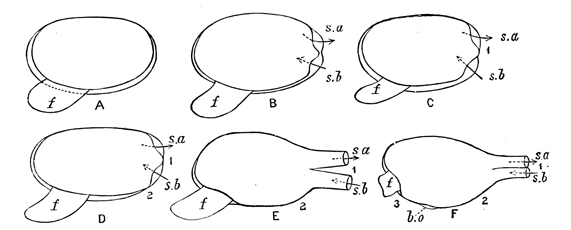
Diagram illustrating the various degrees of union of the mantle lobes: A, mantle completely open; B, rudiments of siphons, mantle still completely open; C, mantle closed at one point; D, mantle closed at two points, with complete formation of siphonal apertures; E, development of siphons, ventral closure more extended; F, mantle closed at three points, with fourth orifice; f, foot; s. a., s. b., anal and branchial siphons; 1, 2, 3, first, second, and third points of closure of mantle; b. o., byssal aperture.
MANTLE FUSION
Besides the points of juncture where the mantle-edges unite to form the siphons, the coalescence of the two mantle lobes may be extended, and they may become further united and fused together at other points. Indeed, the fusion of the mantle-edges may become almost complete; but it always leaves the siphonal openings and a third opening through which the foot may be extended. This opening for the foot is called the pedal opening, or orifice. In such cases, therefore, the mantle becomes much like a bag or sac. The degree of fusion of the mantle-edges appears to correspond closely with certain changes in the organization of the animal, and this feature must be regarded as a very important character. [pg413]