Part II MARINE INVERTEBRATES (continued 4)
Reading edition
Genus Cryptolithodes
C. sitchensis. The most striking characteristic of this singular species is the great development of the carapace, which forms a broad, thin shield extending beyond the body and legs, and completely hiding the animal beneath it. The carapace is smooth and uneven, has a high ridge through the center of the anterior part, and the sides are broadly expanded and bluntly pointed at the extremity. The rostrum appears like a small rectangular piece cut out of the anterior side of the carapace. This species is found in the Strait of Fuca. A similar species, C. typicus, is found near low-water mark on the surf-washed rocks of the beach at Monterey, California. (Plate LXII.)
Genus Phyllolithodes
P. papillosus. The carapace is triangular, about two inches wide at the base, and narrowing to a long, pointed rostrum which terminates in a forked spine. The surface of the carapace is deeply depressed in parts, and forms a heart-shaped figure in the center. The lateral margins have four prominent spines on each side, the two at the posterior ends being [pg272] thicker than the other two. The abdomen is broad, covering the whole under side of the body, and is marked off with prominent raised ridges diverging from the center line. The legs are all beset with long, rough spines. Habitat, the northwest coast. Taken from the stomachs of fishes off Monterey, California. (Plate LXII.)
Suborder BRACHYURA THE CRABS
This group contains the true crabs, which are the highest of the Crustacea. In form they are quite the reverse of the first group. In the Macrura—except in the anomalous forms—the body is long and cylindrical and the abdomen extended, but in the Brachyura the body is flat and broad and the abdomen short and reflexed. Crabs of this suborder inhabit all seas of the globe, and are found from the shore to great depths. Some species live on land, some on the shore, some in deep water. Some forms burrow in the sand; others live under stones and boulders, or conceal themselves in crevices of rocks or in the cavities of sponges. They are divided into many families, and creep, climb, swim, or burrow, their structure being modified to their respective modes of life. There is also great variation in their shapes as well as in their color and markings. This diversity is so great and peculiar that it seems as though each one were more curious than the others.
In crabs the cephalothorax is depressed and often broader than long. The abdomen is relatively small and is folded under the thorax, lying in a groove which it fits so perfectly as to be quite hidden from above. The appendages of the abdomen are much reduced in number. The male has two pairs; the female has four pairs, which it uses for carrying its eggs. The first pair of walking-legs are comparatively large, and end in chelæ, or pinching-claws. The other eight legs terminate in simple points, except in the swimming varieties, when the fifth pair is flattened to form fins, or swimming-paddles. The eye-stalks are long and fit into sockets on the carapace. Both pairs of feelers are small. The antennules are frequently folded into small grooves. The external or third pair of maxillipeds are broad and flat, and cover the mouth-parts like a lid, or operculum. [pg273]
Crabs, like other crustaceans, are scavengers, living on dead animal matter; but the land species are also vegetarian in diet. They are great fighters, but are also wily, often averting danger by resorting to stratagem. They are an interesting and curious group, as they possess a good degree of intelligence and have amusing habits.
From the time they leave the egg until they attain the adult form they pass through several complete and singular metamorphoses. The most marked forms are called the Zoëa and the Megalops. So little do these resemble the adult that originally they were classed as distinct genera far removed from the one to which they really belong. After the larva has moulted several times it appears as in the illustration on page 248—the last zoëa stage. From this it changes directly to Megalops; the Zoëa, seeming to be attacked with violent convulsions, wriggles out of its skin a full Megalops (page 248). The animal then has enormous eyes, an extended abdomen, an elongated carapace, and swimming-legs. This stage is a short one, and at the first moulting changes to a form nearly approaching the adult. From this time they grow by shedding the shell at certain periods. This shedding is supposed to occur twice each summer until they have reached full growth, after which it is probable that they do not again moult; for often they are found with extraneous organisms, such as barnacles and sponges, upon them, of a size that must have required a considerable period of time for growth. The sexes of the same species sometimes differ so much that it is difficult to classify them. Even naturalists have been led into the error of assigning the male and female to separate species.
The front side margins of the carapace in many crabs are edged with a row of teeth or with spines, which vary in number and character in different species. In the spider-crabs the whole surface of the carapace is generally studded with tubercles, spines, and stiff hairs of a peculiar character. This armature is for protective purposes, and is often used to secure foreign bodies, such as algæ, hydroids, and polyzoans, which the crabs place upon their backs to disguise themselves. The burrowing crabs are usually smooth. When in motion the crab moves sideways, using the legs [pg274] of one side to pull with and those of the other side to push with. As all the legs do not move at the same time, a continuous and uniform motion is kept up. Some species move with great rapidity, notably the sand-crab, Ocypoda arenaria. Often when pursued they will run into the surf instead of to their holes. The common edible crab, Callinectes sapidus, of the Atlantic coast, the fiddler-crabs, and the spider-crabs are among the well-known representatives of Brachyura.
Family PORTUNIDÆ SWIMMING CRABS
Genus Carcinides
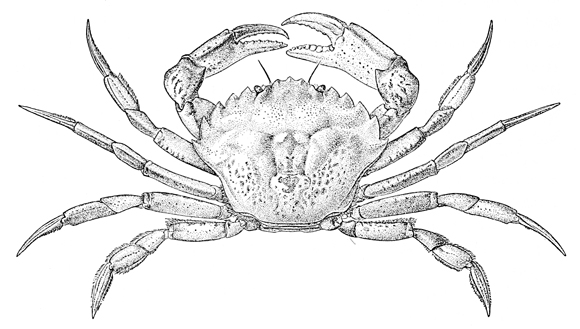
Carcinides mænas, the green crab.
C. mænas (M. J. Rathbun), Carcinus mænas (Leach), the green crab. This is one of the most common species on the Atlantic coast from Cape Cod to New Jersey, and is very abundant in Vineyard Sound, Buzzard's Bay, and Long Island Sound. It is found between tide-marks, frequently well up on the beach, hiding under loose stones, also in tide-pools and in holes and cavernous places on the shore. It is from one and a half to two inches long, and a little more in breadth. It has five acute teeth on each side of the anterior part of the carapace. Its color is green, spotted with yellow, making it quite conspicuous. The surface of the carapace and limbs is more or less granulated. The posterior feet are flattened to form swimming-paddles. It is a very lively creature and has reckless audacity when brought to bay, which justifies its specific name (which implies frenzy). The French call it crabe enragé. [pg275]
Genus Callinectes
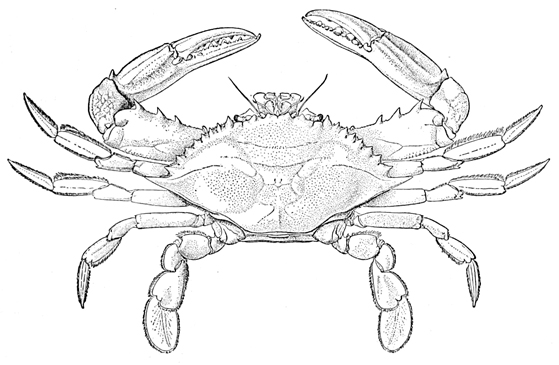
Callinectes sapidus, the blue crab.
C. sapidus (Mary J. Rathbun), C. hastatus (Stimpson), the blue crab. This is the common edible crab of the Atlantic coast. It is known at the North as the "blue crab," and at the South as the "sea-crab." It is found from Cape Cod to Florida, and after the lobster is the crustacean which has the greatest commercial value, being taken in immense quantities for the markets, not only when the shell is hard, but immediately after moulting, before the new shell has hardened, when it is known as the "soft-shelled crab." It inhabits muddy shores, and is common in bays and at the mouths of estuaries. The carapace is about twice as broad as it is long, and has a long, sharp spine on each side which projects outward. This is a distinguishing feature. There are eight short spines on each side between the long spines and the eyes; then come recesses for the eyes, and between the eyes are four unequal teeth and a small spine underneath. The chelæ are large and somewhat unequal in size; then come three pairs of simple feet and a fifth pair, which are flattened, forming swimming-organs. The margins of the carapace and abdomen are fringed with fine hairs, as are also most of the joints of the limbs. The upper surface of the body and claws is dark green in color, the lower surface is dingy white, the feet blue, and the tips of the spines reddish. The body is compressed, the carapace being moderately convex above, and is covered with minute granulations, which are more numerous over some portions than over others. The abdomen of the female is very broad and fills the entire space between the bases of the posterior pair of feet. During the spawning season it is so charged with eggs that often it projects out almost at right angles with the carapace. The [pg276] crabs of this species are very active and can swim rapidly. They also have the habit of pushing themselves backward into the mud for concealment. They are predaceous and pugnacious, and have great strength in their claws, which they use with dexterity. They not only fight their own kind, but show a bold front to all enemies, including man. The average size is six inches across the carapace.
Genus Ovalipes
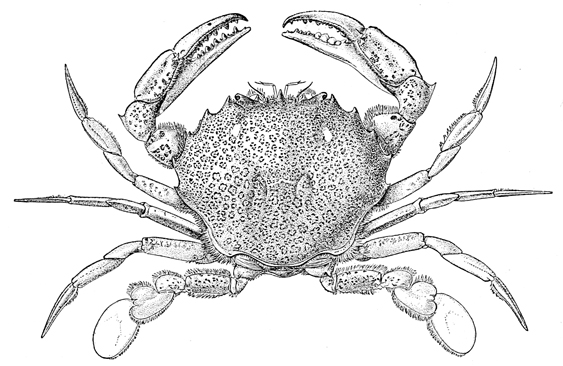
Ovalipes ocellatus, the lady-crab.
O. ocellatus (Rathbun), Platyonichus ocellatus (Latreille), the lady-crab or sand-crab. A species common on sandy shores from Cape Cod to Florida. It is found among the loose sands at low-water mark, even on the most exposed beaches, and also is abundant on sandy bottoms offshore. At low-water mark it buries itself up to the eyes and antennæ in the sand, where it watches for prey and foes, and quickly disappears beneath the sand when danger approaches. It possesses the power of burrowing in common with other marine animals which inhabit exposed beaches of loose sand. By burying itself deep in the sand it is protected from the action of the breakers. This species is easily distinguished by the color and shape of its carapace, taken in connection with its posterior swimming-feet. The body is nearly as long as it is broad, with five prominent spines on each side. The front margin is indented on each side of a three-spined rostrum, to form cavities for the eyes. The first limbs are large and have claws; the posterior ones are flattened into swimming-feet, and the intermediate three pairs are simple in structure, ending in points. In color it is white, covered with spotted rings of red and purple. [pg277]
WALKING CRABS
Family CANCROIDÆ
Genus Cancer
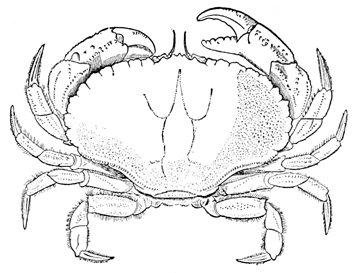
Cancer irroratus, the rock-crab; male.
C. irroratus, the rock-crab. This is the common crab of the New England coast. It ranges from Labrador to South Carolina, but is rare south of New Jersey. It is found on sandy as well as on rocky shores at and below low-water mark and also between tide-marks, hiding among rocks, nearly buried in sand or gravel, and in tide-pools, where sometimes amusing combats between the males may be seen. The carapace is suboval, one third broader than long, the breadth being often from three to four inches. The surface is granulated but smooth; the color is yellowish, closely dotted with brown. The eyes are on short stalks in deep, circular holes, and between the eyes are small teeth. There are nine blunt teeth along each side of the front edge of the carapace. The first pair of legs are short and stout, and terminate in claws. The four posterior pairs are slender and end in pointed tips. This is an edible crab, and it is devoured by the larger fishes, but does not—although there seems to be no reason for it—share to any extent a place in the markets with the blue crab, Callinectes sapidus.
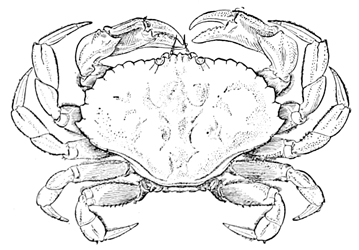
Cancer borealis, the Jonah crab; male.
C. borealis, the Jonah crab. This crab resembles, and is frequently taken for, C. irroratus. It is larger than the latter in full growth, and is heavier and more massive. The carapace and claws are rougher, the granules being irregular in size. The legs are proportionately shorter and heavier. The teeth on the anterior margins are rounded in front, but the posterior ones are sharply pointed. In color [pg278] it is brick-red above and yellowish beneath. It inhabits rocky shores only and is found at low tide on the surface of the rocks, where it is exposed to the action of the waves and also to the attacks of birds of prey, which feed upon it, while C. irroratus, concealed under the rocks in the same locality, escapes their depredations. This species is supplied to the Newport market, where it is considered preferable to the blue crab. Its range is from the eastern end of Long Island to Nova Scotia.
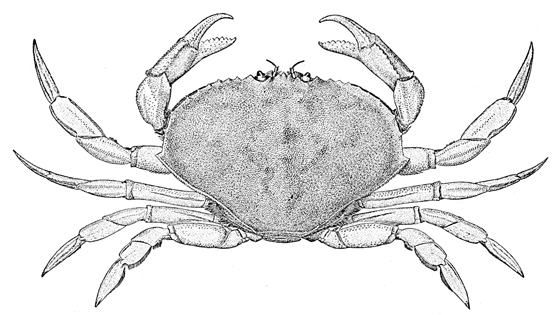
Cancer magister, the common crab of the Pacific coast; male.
C. magister. This species inhabits the Pacific coast and ranges from Alaska to Lower California. The adult male is from seven to nine inches broad and from four to five inches long. The anterior margin of the carapace is an almost regular elliptical curve with nine small teeth on each side. At the end of the curve a large, pointed tooth projects directly outward, and from this the carapace slopes abruptly backward, giving a narrow posterior end. The surface of the carapace is undulated and covered with papillæ, and is light reddish-brown, shading to lighter color in the back. The color of the legs and under surface of the animal is yellowish. The claws are toothed above and ribbed at the sides. It inhabits sandy bottoms below tide-mark and is the largest and most important edible crab of the western coast.
C. productus, the red crab. This species, like the preceding one, is of large size and inhabits the western coast from Alaska to the Gulf of California. The carapace is four and a half inches in length, from five to seven in breadth, and somewhat elliptical in outline. The teeth on the anterior margin are distinctly separate in the adult, but in the young appear as wrinklings of the edge of the carapace. The posterior margins are concave. In color the animal is dark red above and yellowish beneath in the adults, but variable in the young, sometimes being yellow spotted with red, or banded with red and yellow. It inhabits rocky shores. This is an edible crab, but is not taken for the markets, C. magister supplying all demands. [pg279]
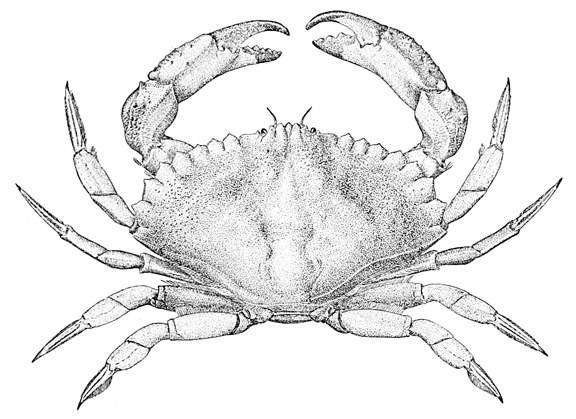
Cancer productus, the red crab; male.
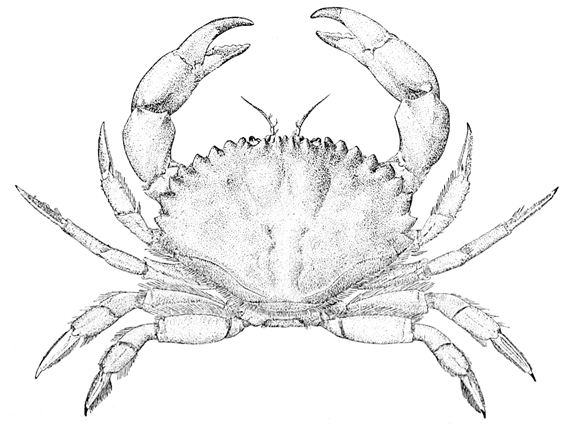
Cancer antennarius, the California rock-crab.
C. antennarius, the rock-crab of the Pacific coast. This species of the California coast inhabits rocky bottoms below low-water mark. The carapace is three and a half inches long by five or six inches wide, and dark purplish-brown in color. The chelæ are marbled with purplish spots and are nearly smooth. The distinguishing features of this crab are its large and hairy antennæ, the hirsute margins of its abdomen and walking-feet, and the numerous hairs on the under side of its body.
Genus Menippe
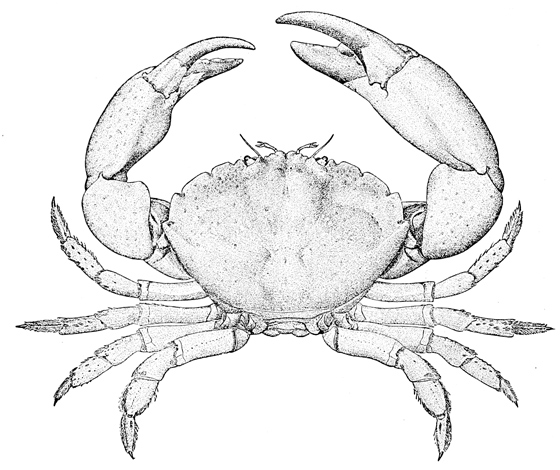
Menippe mercenaria, the stone-crab; male.
M. mercenaria, the stone-crab. This species lives in deep holes in the mud along the borders of creeks and estuaries, and also in crevices between fragments of rock, in stone-heaps and other debris, and is found from South Carolina to Texas. These crabs are edible, and in some localities are hunted for food, one manner of capturing them being to thrust the hand and arm into their holes and drag them out, an operation attended with danger to the inexperienced hunter, who is likely to be badly pinched. They are withdrawn with difficulty, as they offer a strong resistance, bracing themselves with their claws against the sides of their holes, and often hold so firmly to the rocks that they are torn [pg281] apart. They are also taken by a hooked iron which is thrust into the hole; the crab seizes it and is then suddenly jerked from its hole. The adult measures about three by four and a half inches, and the body is from one inch to two inches thick. One of the chelæ is larger than the other, and both are proportionately enormously large, and are tipped with black. The terminal joints of the other four pairs of legs are thickly fringed with hairs and end in points which seem like nails.
Former Genus Panopeus
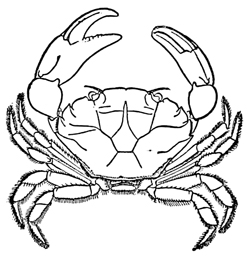
Eurypanopeus depressus, the mud-crab; male, natural size.
Eupanopeus herbstii, Eurypanopeus depressus, Neopanopeus texana, Rhithropanopeus harrisii (Mary J. Rathbun). These four species, formerly all called Panopeus, are small crabs which live in the mud and are commonly known as mud-crabs. They are abundant under stones in muddy places, and occur on the Atlantic coast from Massachusetts Bay to Florida, though they are not commonly met with north of New Jersey. Eupanopeus herbstii is the largest one of the group, some of the Southern ones measuring two inches across. It is found living in mud at low-water mark, or burrowing in banks near high-tide mark. It is dark olive-brown, the claws broadly tipped with black. Eurypanopeus depressus is flattened above, and is smaller than Neopanopeus texana, which is somewhat convex above. The last two are commonly found together and have similar habits. Rhithropanopeus harrisii lives near high-water mark and also in salt-marshes, and is comparatively rare. The claws lack the dark tips of E. herbstii, and a distinct groove follows the edge of the carapace.
Family GRAPSIDÆ
Genus Hemigrapsus
H. nudus (Mary J. Rathbun), Heterograpsus nudus (Stimpson); H. oregonensis (Mary J. Rathbun), Heterograpsus oregonensis (Stimpson). These two species, commonly called respectively the purple shore-crab and the yellow shore-crab, are the most abundant species of the California coast. Hundreds may be found congregated under a single rock. They range from Sitka to Lower California. H. oregonensis literally swarms in sloughs of salt or brackish water, and hundreds of uplifted threatening claws confront the intruder who ventures on these mud-flats when the tide is out. This species, the yellow shore-crab, has a nearly square body. The anterior half of the side margins has two rather deep indentations, [pg282] making two spine-like projections which bend forward. The four posterior pairs of legs are more or less hairy; the chelæ are rather large in proportion. The male is about one inch across and the female is one third less in size. The general color is yellow. H. nudus is found in the same localities, and differs from H. oregonensis in being purple in color, with mottled claws, and in having the denticulations less pronounced and the walking-feet devoid of hairs. It is also a little larger. (Plate LXIII.)
Genus Pacygrapsus
P. crassipes. A species very common on the California coast south of San Francisco. This crab is similar in general features to the purple and yellow ones described above, but is considerably larger, and the carapace is banded with color.
Family OCYPODIDÆ
Genus Ocypoda
O. arenaria, the sand- or ghost-crab. The name Ocypoda means "swift-footed," and, as it implies, this species is especially noted for its rapidity of movement. These crabs are the opposite of the strong-armed, thick-shelled, slow-moving Cancroidæ. An instance is told of a collector having great difficulty to keep up at full run with one which he chased for a considerable distance over the sand. They are also dexterous in burrowing, and live in holes, often three feet deep, dug perpendicularly into the sand. They wander far from their burrows when the tide is out, and every little while raise their stalked eyes and stand on tiptoe to look about. If alarmed, they run with great rapidity to the nearest burrow, or, if danger is close, press themselves on the sand until an attempt is made to touch them, when they again dart away rapidly, and in running hold their bodies high, and double and dodge so that it is difficult to catch them. Ocypoda is colored almost exactly like the sand, and this mimicry, together with its fleetness, makes it interesting to note and difficult to capture. It inhabits sandy beaches above tide-mark from Long Island to Brazil, and subsists largely upon the beach-fleas, which inhabit the same localities. It springs upon them, very much as a cat catches a mouse. The carapace of this species is almost square in outline, and on the anterior corners ends in a spine. A small portion of the carapace folds down like a band between the eyes. On each side of this band, and extending across the front, are large grooves for the eye-stalks. The body is about an inch thick; the first joints of the chelæ are toothed; one chela is a little longer than the other, and both are coarsely granulated. The other four pairs of legs are thickly fringed with hairs. (Plate LXIII.)
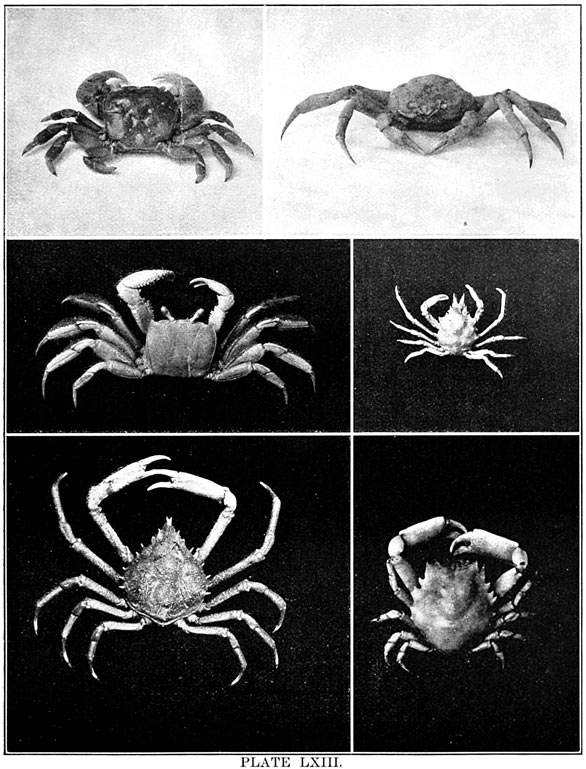
PLATE LXIII.
Hemigrapsus nudus. Hyas araneus.
Ocypoda arenaria. Pugettia gracilis.
Libinia dubia. Pitho aculeata.
Genus Uca
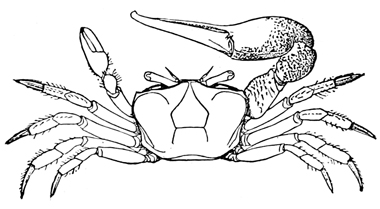
Uca (Gelasimus) pugilator, the fiddler-crab; male.
U. minax (Gelasimus minax), U. pugnax (Gelasimus pugnax), U. pugilator (Gelasimus pugilator), the fiddler-crabs. These species [pg283] of fiddler-crabs occur on the Atlantic coast. They congregate in immense numbers, and excavate their holes in convenient localities above the reach of the tides—on salt-marshes, far up the estuaries, and along the mouths of rivers, even where the water is quite fresh. The males have one claw very largely developed; the other chela is small. The former is likened to a fiddle, the latter to a bow, and this, together with the waving motion of the large claw, gives them their popular name. This comparatively enormous claw is a distinguishing feature by which they are easily recognized without other description. The female has claws of small and equal size. These crabs burrow holes in the mud or sand half an inch to two inches in diameter and a foot or more in depth. The upper part is nearly perpendicular, becoming horizontal below, with a chamber at the end. One species, U. minax, constructs an archway over the mouth of its burrow, in which it sits and surveys the surroundings, but quickly retreats when danger approaches. The crab makes its burrow by scraping up the mud or sand and forming it into pellets, which it carries under the three anterior walking-feet on the under side, using the legs on the side moving forward, and the fourth one on the other side, to climb out of the hole. After peering cautiously about, the crab emerges, and carries its load four or five feet away before dropping it; then again looks about before quickly running back; and, finally, turning its stalked eyes, looks in all directions and suddenly disappears, soon to return with another load. The burrows cover considerable areas, and the crabs are so abundant that the marshes and shores sometimes seem to be alive with them. When alarmed, they lift the large claw and run sideways, after the manner of all crabs, to their holes, and, as many are likely to retreat into the most convenient one, the owner often finds his burrow occupied by other tenants, whom he unceremoniously proceeds to pull out. U. minax ranges from southern New England to Florida, and lives on salt-marshes farther away from the sea than the others, and often where the water is quite fresh. It is larger than the other species, and can be distinguished by a red patch at the joints of the legs. It is a vegetarian in diet, living on small algæ. This is the species which constructs a little observation-house over the mouth of its burrow. It can live out of water, and without food, for several days. U. pugilator lives on sandy and muddy flats and beaches near high-water mark, where the sand is compact and somewhat sheltered, and ranges from Cape Cod to Florida. This species, like U. minax, is a vegetarian. U. pugnax is exceedingly abundant on muddy banks and ditches of salt-marshes, the banks being sometimes completely honeycombed and undermined by them. It ranges from Cape Cod to Florida. [pg284]
Family MAIIDÆ
The members of this family are known as "spider-crabs." Their bodies are thick and more or less round in form, narrowing in front to a long, beak-like projection. The surface is generally rough and irregular, having tubercles, spines, prickles, and hairs. The legs are long. These crabs are often covered with seaweeds, hydroids, and other organisms, which they gather with their long and flexible chelipeds and place upon their backs, presumably to conceal themselves from their enemies. They seem to select, instinctively or with reason, such things as will bear transplanting, sometimes using sponges and polyps which are not destroyed by being torn apart, and they also select their dress with reference to its masking uses. A Hyas covered with bright-colored algæ was seen to remove them and replace them with sponges, when transferred to the locality of the latter, where the former did not grow. The animal takes in his claw the object he has gathered, and first holds it to his mouth, where it is moistened with a secretion of mucus or cement, and then places it on his back. If it does not hold, the operation is repeated, often several times, a new spot on the shell being selected each time. It has also been found that the coats of these crabs are covered with hairs which are differently arranged in different genera, some being hooked, others serrated, etc., and that these aid in holding the transplanted organisms in place. The crab is sometimes so covered with these growths as to be entirely concealed beneath them. It is a sluggish animal, and inhabits shallow water along the whole of the Atlantic and Pacific coasts.
Genus Libinia
L. dubia, L. emarginata. These two species inhabit the Atlantic coast, and are found on muddy shores and flats, among decaying seaweed, in eel-grass, and even beneath the surface of the mud. They are covered with hairs, and sometimes have planted on their backs algæ, hydroids, and even barnacles. The legs of L. emarginata often spread a foot or more. The males are much larger than the females. The species ranges from Maine to Florida. L. dubia does not extend north of Cape Cod. It is found more commonly than L. emarginata in very shallow water [pg285] near shore. It is not so thickly covered with spines, and has a longer rostrum, which is also more deeply divided at the end. (Plate LXIII.)
Genus Hyas
H. coarctatus, the toad-crab. This species of spider-crab is found from Greenland to New Jersey, in shallow as well as in deep water. Its body resembles strongly, both in form and size, that of a toad, hence its common name. It forms an important part of the food of the cod.
H. lyratus. A toad-crab of the Pacific coast, ranging from Bering Sea to Puget Sound; named from the lyre-shape of its carapace.
H. araneus. A species which especially resembles a toad in its form. Found off the northern New England coast. (Plate LXIII.)
Genus Loxorhynchus
L. crispatus, the sheep-crab. This crab occurs on the coast of southern California. The body is thick and about three inches across the widest portion, and tapers to a long, prominent rostrum. It is covered with long tubercles and spines and with short, bristly hairs; the legs are long, the chelipeds stretching fully two feet.
Genus Pugettia
P. gracilis. A small spider-crab found on the Pacific coast from Alaska to Puget Sound. Its body is one half of an inch wide and [pg286] one inch long, with prominent spines on the sides of the carapace, which narrows in front into a long beak ending in two spines. It is red and green above, red beneath. (Plate LXIII.)
Genus Sternorhynchus
S. sagittarius. This is one of the most delicately formed of the spider-crabs. The body has narrow longitudinal stripes of light and dark color. It lives offshore from Cape Hatteras southward.
Genus Epialtus
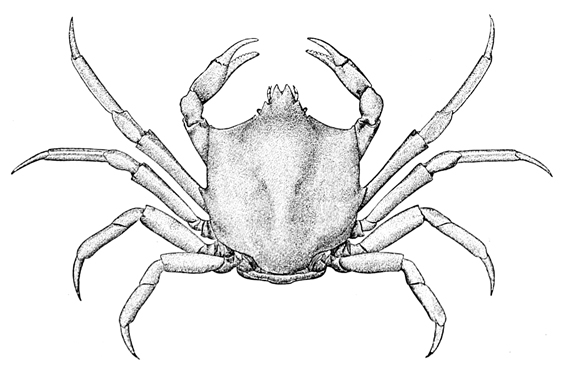
Epialtus productus, the kelp-crab; female.
E. productus, the kelp-crab. This crab inhabits the coasts of California and Oregon, and is found among seaweeds on rocks just below low-water mark. The carapace is smooth, is quadrate in form, is about two inches long and broad, has two spines on each side, and has a prominent denticulated rostrum. This is the most common spider-crab of the Pacific (California) coast. It is olive-green, thus simulating in color the kelp among which it lives. (See page 285.)
Genus Pitho
P. aculeata. The carapace has six spines on each side, the middle two being sometimes partly united; the general outline is pentagonal; the length about one inch. Quite common on the Florida coast. (Plate LXIII.)
Genus Lambrus
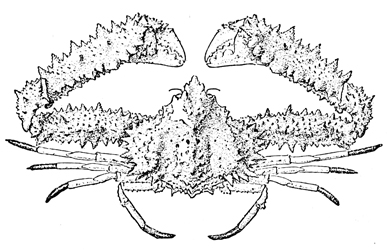
Lambrus pourtalesii.
L. pourtalesii, the long-armed spider-crab. The carapace is broader than it is long and has three elevations all covered with spines. The general surface is pitted and granulated; the rostrum points downward; the chelipeds are very long, the margins armed with spines; the breadth of the carapace is about one and a half inches; and the length of the chelipeds is about three and a half inches. Its range is from Cape Cod to Florida, and it lives among the rocks. (Plate LXIV.) [pg287]
Family CALAPPIDÆ
Genus Calappa
C. flamma, the box-crab. This singular animal lives on sandy and muddy bottoms offshore, from North Carolina southward. The carapace is broad and straight on the posterior side, and is curved on the anterior side, narrowing to the front. The posterior side has prominent denticulations. The body is one and a half inches thick, about four to five inches wide, and two to three inches long. The chelæ are large, broad, and flattened, and are so arranged that when flexed they fit closely together across the front. When folded, and the small legs are withdrawn under the carapace, the animal is shut up as if in a box, and resembles a shell. When in danger it closes its doors, as it were, and abandons itself to the waves, which often carry it ashore. The crested claws resemble the head of a cock. (Plate LXIV.)
Family PINNOTHERIIDÆ
Genus Pinnotheres
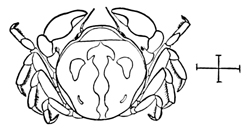
Pinnotheres ostreum, the oyster-crab; male, enlarged four diameters.
P. ostreum, the oyster-crab. The female of this species lives in the gill-cavity of the oyster, and is particularly abundant in oysters from the Chesapeake. The males are seldom seen, and rarely occur in the oyster, but swim freely about. They are smaller than the female, have a firmer shell, and are dark brown above, with a dorsal stripe and two conspicuous spots. The under side of the legs is whitish. The female is commensal, at least in the adult form, and its thin, whitish, transparent carapace is tinged with pink. The species P. maculatum lives in Mytilus edulis (mussel) and in the smooth scallop, Pecten magellanicus. The oyster-crab is a true messmate, and its presence in the oyster may be advantageous in helping to provide food for its host. This crab, like the rest, holds its eggs in the posterior feet until hatched, when the larvæ leave the parent and swim about for a while. The females, at the megalops stage, enter oysters—sometimes two enter the same oyster, but seldom more than one; there it remains permanently, growing to the size of an inch or more in diameter, and becomes a degenerate. The eyes become smaller; the shell never hardens, like its allies which live in open water; its limbs and chelæ are weak; and it has no pugnacity, the protection afforded by the oyster doing away with the need for the common protective features of its kind. Pinnixa cylindrica, a related species, lives in the tubes of large annelid worms as a commensal. [pg288]
ORDER STOMATOPODA
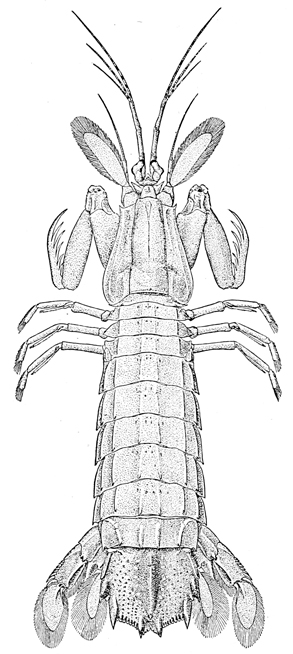
Squilla empusa, the mantis-shrimp.
Genus Squilla
S. empusa. This animal suggests somewhat the lobster, though very unlike it. The carapace is much smaller and softer, and leaves the last three segments of the thorax uncovered. The abdomen is larger and longer in proportion, while the legs and organs are quite different. The whole body is depressed, instead of laterally compressed. It measures from eight to ten inches in length and two inches in breadth. Instead of chelæ, the last joint of the great claw has six sharp curved spines, which fit into sockets in a groove on the second joint. By this singular organ they hold their prey securely. The abdominal feet carry the gills. The antennal scales are oblong and fringed with hair. The antennules terminate in three flagella. The caudal appendages and telson are long, strong, and armed with spines. This animal lives in burrows in the mud below low-water mark, forming large, irregular holes, but is frequently washed ashore. In color it is pale yellowish-green, each segment being bordered with darker green and edged with yellow. It is found from Cape Cod to Florida.
ORDER CUMACEA
Genus Diastylis
D. quadrispinosus. Among the minute Crustacea which swim on the surface of the water, this species, with other small forms, may be captured by using a muslin net. It is a quarter of an inch or less in length. It is easily distinguished by its large carapace, the posterior portion of which is marked off in transverse ridges, the anterior end running into a sharp-pointed rostrum. It has a long, slender abdomen, the sections of which [pg289] are distinctly marked, and it terminates in long, forked spines, which are longer than the telson. It is found from New Jersey northward.
ORDER ARTHROSTRACA
Suborder AMPHIPODA
The Amphipoda have a laterally compressed body, with gills on the thoracic feet and an elongated abdomen. The segments of the thorax are not united, nor covered by a carapace, but the whole body is covered with a segmented, polished, flexible cuticle. The three anterior legs of the abdomen are for swimming-feet, and the posterior ones are adapted for springing. The antennæ are long and hairy. The amphipods comprise the beach-fleas and many other small crustaceans which abound between tide-marks on all beaches. Besides serving in no small measure as food for fishes, they are scavengers of the beach, and consume large quantities of waste matter. They are sometimes used in preparing skeletons for anatomical specimens. Animals to be skeletonized, being fastened to boards and anchored just below the surface of the water in sheltered places, are divested of all flesh in a few hours, and the bones are more completely cleaned than if prepared by a naturalist.
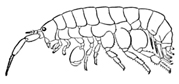
Orchestia agilis; male.
Genus Orchestia
O. agilis, the beach-flea. These little crustaceans exist in countless numbers under the masses of sea-wrack on the beach. When disturbed they jump about with great agility by means of the last three pairs of abdominal feet, which are adapted to this purpose. In color the animal is brown and much resembles the decaying seaweeds among which it lives and upon which it probably feeds. The antennules are short, the antennæ long, on two long, jointed bases. The second pair of feet in the males terminate in chelæ. The last abdominal appendages are stiff and pointed backward. The abdomen is curved under. The length of Orchestia is half an inch or less. Some species occur on all beaches. O. agilis ranges from New Jersey to Greenland.
Genus Talorchestia
T. longicornis (Talitrus longicornis). This species is similar to Orchestia agilis, but is about an inch long when mature and of a paler [pg290] color. It jumps like the latter, but not so strongly. It is found among the weeds and burrowing in the sand a little below high-water mark. The wet sand is often completely filled with its holes. It can be distinguished by its very long antennæ. Another species, T. megalophthalma, is distinguished by its shorter antennæ and very large eyes. Both of these species are grayish in color and closely resemble the sand. Found from Cape Cod to New Jersey.
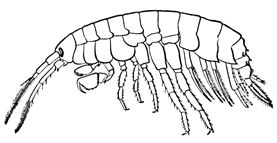
Gammarus locusta, the scud.
Genus Gammarus
G. locusta. The animals of this genus are among the largest of the amphipods. The males are larger than the females, sometimes being one and a half inches long. They are abundant under stones and Fucus at and near low-water mark. Although much larger than the beach-fleas, they otherwise resemble them. They do not jump like the former, but move rapidly, lying on the side, and in water swim with the back downward. Two pairs of the thoracic feet are chelate, and three pairs are longer than the others. The feet on the last segments of the abdomen are stiff and turn sharply back, forming a part of the tail, which is used most effectively in locomotion. The antennules and antennæ are of about the same length. Several species of Gammarus occur in the same range, all having the same general characteristics; some have but one pair of chelate feet; the antennules are usually shorter than the antennæ; the females of all the species have no chelate feet. G. locusta ranges from New Jersey to Greenland. The color is generally reddish- or olive-brown. G. annulatus is found in the same places, but usually a little higher up on the beach; it is lighter in color, and has dark bands with red spots on the sides of the abdomen. G. mucronatus occurs from Cape Cod to Florida. Melita nitida is a smaller slate-colored amphipod found in some places; another is Mœra levis, which is whitish, with black eyes.
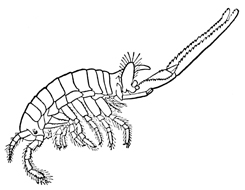
Chelura terebrans, the boring amphipod.
Genus Chelura
C. terebrans, the boring amphipod. This little crustacean is associated in its work on submerged timber with the isopod Limnoria lignorum. The excavations of the latter are narrow and cylindrical, running down into the wood, while Chelura makes larger burrows in oblique lines near the surface, which give the wood the appearance of having been plowed. It is very active and destructive. It feeds upon the wood into which it burrows. Its color is semi-translucent, thickly mottled above with pink. [pg291]
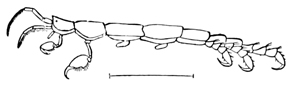
Caprella geometrica.
Genus Caprella
C. geometrica. These very curious little animals, which are so slender as to seem like skeletons, are found in abundance clinging to hydroids, Polyzoa, delicate algæ, or eel-grass, or under stones in tide-pools. They resemble in color, and often in form, the objects on which they live. Holding on by the posterior feet, they extend the body out rigidly or sway it about, so that they resemble little sticks or branches, and often escape detection. In walking, they bring the hind feet up to the front ones, doubling the body into a loop like the canker- or measuring-worm. The appendages on the anterior and posterior ends are furnished with chelæ and hooks; those of the middle section are rudimentary. This animal cannot be mistaken for any other. C. geometrica is found from Cape Cod to North Carolina. Some of the species of this genus may be found on every coast.
Suborder ISOPODA
The isopods have an elongate, flattened, but more or less arched body, composed of seven thoracic segments and a short abdomen of six segments. The six segments of the abdomen are smaller than those of the thorax, and are often more or less united, sometimes into a single piece with scarcely any trace of division above; but the number of pairs of appendages is generally six, showing the composite nature of the apparently simple organ. The last segment, or telson, is broad and has a pair of modified appendages. The seven thoracic legs are not all equal, as the name would imply, but vary greatly in different species. As a rule, they are adapted to walking or attachment, and in the female some have delicate plates which form brood-pouches. The swimming-feet fold under the abdomen, and in some species are inclosed by the first pair, which are large and plate-like, and form a complete cover for the others. The isopods are a large and widely distributed order, varying in size, and are inconspicuous because they cling closely to objects. They are retiring in habit, though extremely ferocious.
The sow-bugs or pill-bugs, common in gardens, under leaves in the woods, and under almost any pile of rubbish among decaying vegetable matter, are a land species of isopods. Other species inhabit [pg292] ponds and streams of fresh water, and still others are found along the shores of all oceans, abounding among the marine vegetation of the shallow waters. Some swim free in the open sea; others are brought up from the greatest depths. Others, again, are parasites, and live in the internal organs of fishes and prawns. Sometimes a prawn is found having what appears like a very swollen throat, which actually is a little parasitic isopod of the family Bopyridæ attached to its gills.
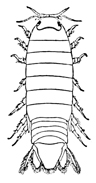
Cirolana concharum.
Genus Cirolana
C. concharum. The body consists of fourteen segments, the first being the head, the next seven the thorax, and the last six the abdomen. On the head are the triangular eyes, the antennules, and the antennæ, and underneath is the mouth, which is covered by the maxillipeds. The dorsal surface is more or less rounded. At the bases of all the segmental thoracic rings excepting the first one are sutures marking off square, scale-like pieces (epimera). The epimera form a border to the side margins. The legs are attached to the epimera, which are, in fact, the upper segments of the legs. The first three pairs of legs have a general resemblance to one another, and are directed forward. The last four pairs are much longer and flatter, and are directed backward. The telson, or last segment, is triangular, and the square or blunt apex is fringed with hairs. On the ventral surface of the thorax in the adult females there is a long pouch for the reception and development of the eggs. This species is usually about one and a half inches in length, but sometimes is longer. Its color is yellowish, with a brown edge on the posterior margins of the segments, somewhat translucent in the thinner parts. It is found from Cape Cod to South Carolina, swimming about in shallow water, and is especially abundant in winter.
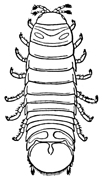
Limnoria lignorum, the gribble.
Genus Limnoria
L. lignorum, the gribble. This little isopod is very destructive in its habits, boring into submerged woodwork, like the ship-worm (Teredo), and doing great damage to the piles of wharves, etc. It burrows to the depth of half an inch, and completely honeycombs the surface of the wood, which then scales off or rapidly decays, and is washed away by the waves. The animal then begins anew, and in a short time, or at the rate of about an inch a year, piles diminish in diameter where Limnoria is plentiful, and are finally destroyed unless protected from these little crustaceans by a sheathing of metal. Although considered as pests, they have an economic value not so often recognized, as they attack all driftwood, and in time entirely destroy floating and water-logged [pg293] timber, which without their destructive agency might become serious obstructions to navigation. Limnoria is only the fifth of an inch in length, and its back is covered with minute hairs, to which dirt usually adheres. It burrows with its mandibles, or jaws, which are chisel-like at the ends. Its habitat extends from a little above to a little below tide-marks throughout the whole Atlantic coast.
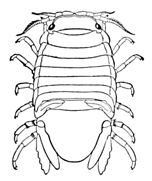
Sphæroma quadridentatum.
Genus Sphæroma
S. quadridentatum. The name of the genus to which this species belongs is derived from the peculiar habit of many of the species of rolling themselves into a ball when alarmed. The body is so constructed as to admit of this singular change of shape. The abdomen turns under, and the last abdominal appendages, together with the narrow epimera, shut in the legs and cover the ventral portions with armor. The body, when extended, is an ellipse a little over a quarter of an inch in length and half that in breadth. The legs are hairy and adapted to walking. The anterior abdominal segments are fused into one, but are marked at the sides with depressed lines. The abdominal feet are plate-like and fringed with hairs. A slight elevation runs around the margins of the animal like a border. The color is variable. Some are a uniform slaty gray; others are marked with a longitudinal patch of color on the back. It is found from Cape Cod to Florida among algæ or rocks, and is easily recognized by its habit of rolling itself into a ball. Sphæroma destructor is a boring isopod, larger than Limnoria, and is even more destructive, since its holes are larger; but its range is limited, or, at least, it has so far been found only in the St. Johns River, Florida.
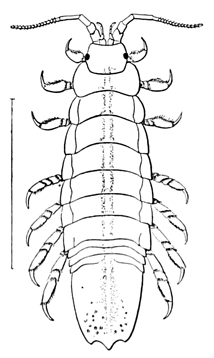
Idotea marina.
Genus Idotea
I. marina (Linnæus), I. irrorata (Edwards). This species is about one inch long, and is easily recognized by the abdomen, the first three segments of which are narrow and terminate in acute teeth, while the other three are fused into one with straight sides and ending in three teeth, of which the middle one is the longest. The first pair of abdominal feet are large, long, and plate-like, covering the other feet and whole under surface of the abdomen like an operculum. The head is nearly square, the eyes are small, and the antennæ have long peduncles. The articulations of the thoracic feet are fringed with hair. The color of this species varies: sometimes it is light or dark green, or brown with black spots; again [pg294] it is striped longitudinally with light color. Sometimes the stripes run transversely in bands or spots. It is found from New Jersey northward on rocky shores of bays and sounds, or in eel-grass on sandy shores.
I. ochotensis. A species very similar to the preceding, but a little larger, found on the Pacific coast.
I. metallica. This species is a little smaller than I. marina, and differs from it in having the end of the telson truncated, or straight, instead of dentate. The head is nearly square. The body is broadest in the middle of the thorax; the projecting epimera give a serrate appearance to the sides. The abdominal feet are inclosed in the operculum-like scales of the first pair of feet. Its color is bright blue or green, often with a metallic luster when seen in the water. It is found swimming free or floating in masses of seaweeds from Long Island northward and also on the Pacific coast.
I. wosnesenskii. A common species on the California coast, about one inch long and dark in color. The abdominal segments are united and bluntly rounded, and each has a small median tooth. The abdominal feet are inclosed by the opercular feet. Eggs and young are carried in a pouch.
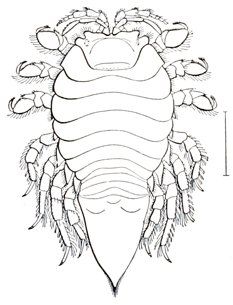
Chiridotea cæca.
Genus Chiridotea
C. cæca. This species burrows beneath the surface of the sand, raising it up into a little ridge, and makes a mound at the end of the burrow, where it may be found. These trails are common on the wet sand. It imitates the sand in color, and is about half an inch in length, with a broad thorax and narrow abdomen terminating in a point. It is found on the New England coast.
C. entomon (Linnæus). This species of the northern Pacific coast is from one to three inches long. The head has the appearance of two lobes, the sides having two rounded ends. The body is broad, the abdomen narrowing to a pointed end. The last segments of the abdomen are united, and the abdominal feet are inclosed by the first pair, which extend over them like an operculum. The epimera are broad, with acute lateral angles.
CLASS MERISTOMES
ORDER XIPHOSURA
Genus Limulus
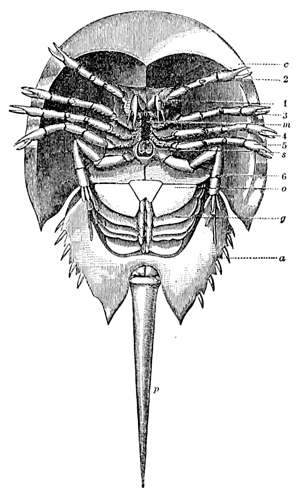
Under surface of horseshoe-crab, Limulus polyphemus: a, abdomen; c, cephalothorax; g, the first gill-bearing abdominal appendage; m, mouth; o, operculum; p, telson; s, metastoma; 1-6, cephalothoracic limbs.
L. polyphemus, the horseshoe- or king-crab. This well-known and curious animal ranges along the Atlantic coast from Maine to Mexico. [pg295] It lives on sandy and muddy shores below low-water mark, where it burrows beneath the surface. At the breeding season—May, June, and July—it comes ashore to deposit its eggs near high-water mark. The crabs come up the beach in pairs, the male being the smaller and riding on the back of the female, holding on by short feet provided with nippers, which are peculiar to the males. Sometimes the female is accompanied by several males, each one holding on to the tail of another and forming a string of animals. After the female has deposited her eggs in a hole excavated by her for the purpose, the male covers them with milt, and they then return to the water, leaving the eggs to be buried in the sand by the action of the waves. The eggs hatch in July and August, and sometimes the beach is literally alive with the young crabs, which, however, soon disappear, and are not seen again until they are well grown. After the spawning season the adults are not very often seen, but usually their empty shells, abandoned in moulting, may be found on the shore. The horseshoe-crab, also called king-crab, is especially interesting from the fact that it is the last survivor of an otherwise extinct group of animals. Its relationships with classes which have become extinct, its nearest relatives being fossils, make it difficult to classify definitely with existing forms. Formerly it was regarded as a crustacean; now it is classed by some authors with the Arachnida, along with scorpions and spiders. It has the characteristics of both groups. There are only two known species of Limulus in the world; the other, Limulus moluccanus, lives on the eastern coast of Asia. L. polyphemus often measures a foot in diameter. The body is composed of three parts. The front portion, or cephalothorax, is broad and semicircular, with posterior angles ending in points. Near each side of its dorsal surface is a pair of large compound eyes covered with thickened cuticle, and near the center line of the shell, at the base of the first spine, a pair of small, simple eyes. The second portion is the abdomen, and the third a long, movable spine attached to the last segment of the abdomen and between two terminal points of the horn-like covering. [pg296] On the cephalothorax are seven pairs of appendages. The first pair are small and lie in front of the mouth; these and the four following pairs have chelæ, or claws. The sixth pair have no chelæ, but at the base have a peculiar process termed the flabellum. These six pairs of appendages surround the mouth, and have bristles at the base which serve as jaws. The seventh pair of thoracic appendages are broad plates called the operculum, which meet and cover the abdominal appendages to a certain extent. The abdomen has five pairs of appendages, which are plate-like and resemble the operculum in form and have an upper and an under piece. On the posterior surfaces of the abdominal feet are large, leaf-like folds, which are the gills. In front of the first pair of thoracic legs is a small tubercle supposed to have an olfactory function. Limulus has a blood-vascular system (the blood being bluish in color), a nervous and a digestive system. It walks with the thoracic feet and swims with the abdominal ones. It enters the sand by pushing in the rounded, anterior end. In moulting the carapace opens on the front edge. Limulus is edible, its meat being, it is said, as good as that of the lobster. (Plate LXIV.)
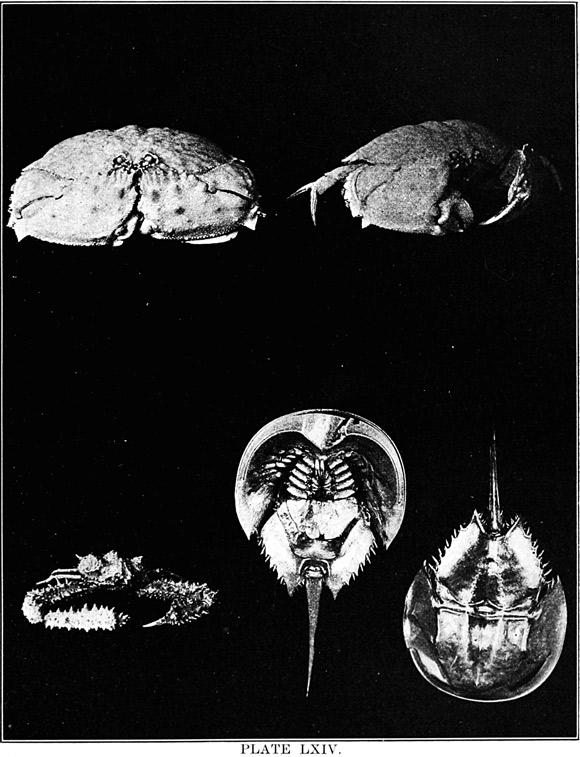
PLATE LXIV.
Calappa flamma. Calappa flamma, claws open, showing form of cockscomb.
Lambrus pourtalesii. Limulus polyphemus.
CLASS PANTOPODA (Lang)
ORDER PYCNOGONIDA
This order of animals, like Limulus, has no definitely determined position in the classification of marine organisms. About one hundred and fifty species of Pycnogonida have been described, of which thirty are found on our coast and are commonly known as sea-spiders. They are found crawling slowly over seaweeds, hydroids, and sponges, and appear to be all legs, but, like other animals, have a digestive, a circulatory, and a nervous system. They are devoid of organs of respiration. The body has a cephalothorax, which bears a conical suctorial proboscis on the anterior end, and on top a prominence containing four eyes. It has three pairs of appendages, two pairs of which are sometimes lacking; then come three free segments and a rudimentary abdomen. There is a pair of short appendages bearing claws (chelæ) and four pairs of long walking-legs. The walking-legs contain a tubular outgrowth of the body, into which the stomach extends. The egg-sacs are in the legs, and open at the basal joints. The male is provided with an extra pair of legs, for the purpose of carrying the eggs after they are deposited by the female. The [pg297] ovigerous legs are run through sac-like pockets and bent under the body, and thus the eggs are carried until hatched.
Genus Phoxichilidium
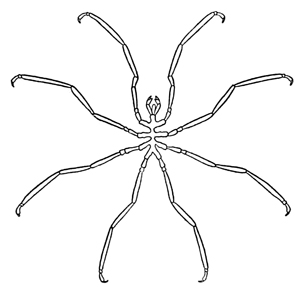
Phoxichilidium maxillare, enlarged.
P. maxillare. This species is found on the New England coast creeping over hydroids and ascidians. It is purple, gray, or brown in color. Its young take shelter in the cavities of hydroids, forming galls.
VII MOLLUSCA
TABLE SHOWING THE CLASSIFICATION OF THE MOLLUSKS DESCRIBED IN THIS CHAPTER
Phylum MOLLUSCA Class AMPHINEURA (Bilaterally symmetrical mollusks, having shell composed of eight plates, or devoid of shell. Including chitons and their allies) Order POLYPLACOPHORA (Shell composed of eight plates) Order APLACOPHORA (Devoid of shell) Class GASTEROPODA (Unsymmetrical univalve mollusks, usually spirally coiled. Periwinkles, whelks, snails, etc.) Order OPISTHOBRANCHIATA (Branchiæ, when present, behind the heart) Suborder TECTIBRANCHIATA (Branchiæ more or less covered by mantle; shell delicate and often rudimentary) Suborder NUDIBRANCHIATA (Devoid of shell and mantle, and without true branchiæ) Order PROSOBRANCHIATA (Branchiæ situated in front of the heart) Suborder DIATOCARDIA (Usually two auricles, two branchiæ, and two nephridia) Suborder MONOTOCARDIA (One auricle, one branchia, one nephridium) Order PULMONATA (Air-breathing mollusks) Class SCAPHOPODA (Mollusks without head, eyes, or heart, with trilobed foot and tubular shell open at both ends. The tooth-shells) Class PELECYPODA (Bilaterally symmetrical, headless, bivalved mollusks. Mussels, cockles, oysters, etc.) Order PROTOBRANCHIATA (Gills form a single pair of plume-like organs, each with two rows of flattened gill-filaments) Order FILIBRANCHIATA (Two pairs of plate-like gills formed of V-shaped filaments) Order PSEUDOLAMELLIBRANCHIATA (Gills plaited so as to form vertical folds) Order EULAMELLIBRANCHIATA (Firm, basket-work gills, the filaments united by vascular connections) Class CEPHALOPODA (Mollusks of high organization, having a definitely formed head surrounded by tentacles; shell, when present, usually internal; shell, external in nautili. Cuttlefishes, squids, octopi, and nautili) Subclass Tetrabranchiata Subclass Dibranchiata Order OCTOPODA Order DECAPODA
TERMS USED IN DESCRIBING MOLLUSKS
Abductor muscles: Muscles which move parts away from the axis.
Adductor muscles: Muscles which draw parts together; opposite of abductor.
Aperture: Opening of the spiral shell.
Bilateral symmetry: Having two equal sides, divided by a central axis.
Branchiæ: Gills, or breathing-organs; organs subservient to respiration through water. Same as ctenidia.
Buccal mass: The mouth-parts as a whole; the organ of prehension and mastication of food; the pharynx: present in all mollusks except lamellibranchs.
Canal: A narrow prolongation of the aperture of a spiral shell.
Carinated: Ridged as if keeled; having a keel.
Cinereous: Ash-gray; having the color of wood-ashes.
Cirri, plural of Cirrus: Filamentous appendages.
Columella: An upright pillar in the center of most of the univalve shells, round which the whorls are convoluted.
Concrescent: Growing together; uniting.
Cordate: Heart-shaped.
Costæ, plural of Costa: Ridges of a shell.
Crenulated: Having a series of notches; marked as with notches, as the indented margin of a shell.
Crystalline style: A transparent gelatinous substance of unknown function, which fills, at times, the stomach-parts of certain mollusks.
Ctenidia, plural of Ctenidium: Gills, or breathing-organs, adapted to water-respiration. [pg303]
Decussated: Crossed; intersected.
Dextral: Having the aperture on the right side of the shell when the apex is upward.
Epidermis: The horny coating or outer skin of some shells.
Foot: The ventral surface of the body on which the animal rests or moves.
Fossette: A little hollow or pit.
Fuscous: Brown tinged with gray; swarthy.
Fusiform: Tapering both ways from the middle.
Lamelliform: Lamellate in structure; disposed in leaf-like layers.
Lingual ribbon: The chitinous band of teeth, or rasp, borne upon the odontophore; the radula.
Lunule: An impressed area just below the beaks of bivalve shells.
Mantle: A fleshy or membranous outgrowth of the outer body-wall; also called pallium.
Mantle cavity: The space between the mantle and the body.
Monomyarian: Having one adductor muscle, as an oyster.
Nephridium: The renal organ of mollusks, corresponding to kidneys in vertebrates.
Node: A knob or protuberance; also a notch in the margin.
Odon´tophore: The lingual ribbon bearing chitinous teeth.
Oper´culum: A horny or shelly plate which serves to close the aperture of the shell when the animal is retracted.
Osphra´dia, plural of Osphradium: Olfactory or water-testing organs.
Otocyst: The cavity, or cyst, which contains the essential parts of an organ of hearing.
Pallial line: The impression or mark made by the mantle, or pallium, on the inner surface of a bivalve shell.
Pallial sinus: A notch or recess of the pallial line; the scar of the siphon.
Papillaceous: Warty; studded with bosses; having excrescences.
Perios´tracum: Same as epidermis.
Per´istome: In zoölogy, mouth-parts in general; in conchology, the margin of the aperture of the shell. [pg304]
Porcelanous: Resembling porcelain.
Rad´ula: Same as lingual ribbon.
Reticulated: Having distinct lines or veins crossing like a network; covered with netted lines.
Sculpture: Elevated or impressed marks on the surface; markings resulting from irregularity of surface; tracery.
Sinistral: Having the aperture of the shell at the left; opposite of dextral.
Sinuate: Curved in and out; wavy.
Siphon: A tubular fold, or prolongation of the mantle forming a tube.
Spire: All the whorls of a spiral univalve, above the first large body-whorl.
Suture: The line of junction of the successive whorls of a univalve shell, or the line of closure of the opposite valves of a bivalve shell.
Teeth: Tooth-like projections on the hinge of a bivalve shell.
Testaceous: Having a hard shell, as distinguished from crustaceous, or soft-shelled.
Turbinate: Shaped like a whipping-top; whorled from a broad base to an apex.
Umbilicus: A central, navel-like depression in the body-whorl; a circular, more or less central pit or hollow.
Umbo: The beak of a bivalve shell; the protuberance of each valve above the hinge.
Varices, plural of Varix: Raised marks on the shell denoting a former position of the lip of the aperture, and indicating periods of rest.
Varicose: Having prominent and tortuous formations on the shell.
Ventricose: Having the whorls of the shell swollen or strongly convex.
Whorl: One of the turns of a spiral shell. Body-whorl, the last whorl.
MOLLUSKS
toc
We now come to another large and important group of animals, with characters so peculiar to itself and differing so radically from those which distinguish any other class of living creatures, that it may be said to occupy almost a unique position in the animal kingdom. Recent investigations have demonstrated that the larval form of mollusks presents some remarkable points of similarity to the embryonic forms of the Annelida and to the larvæ of some other classes of lower organisms. This discovery is one of the triumphs of embryology in its patient search for that connecting-thread that weaves together all the varying forms of animal life. Aside from these subtle evidences of relationship revealed by the microscope, the mollusks appear to occupy a position of considerable isolation in the biological world.
As accepted by zoölogists to-day, this phylum is but the remnant of its former self. Aristotle considered all creatures with a testaceous covering to belong to a single family, and those later patriarchs of biology, Linnæus, Cuvier, and Lamarck, extended the group to include the greater part of all the marine invertebrate animals. Little by little the phylum has been shorn of orders and classes. First, the worms and the Echinodermata were separated into distinct phyla; then the barnacles were discovered to be crustaceans, and were accordingly removed from their position as "multivalves" under the Mollusca; then the tunicates, or ascidians, were found, through the critical examination of their larval stage, to be merely masquerading as mollusks; and lastly, the brachiopods have been somewhat reluctantly removed from their old position with the mollusks and given the [pg306] distinction of a phylum almost exclusively to themselves: they retain their old associations only in the name of Molluscoida.
With some exceptions, all mollusks secrete from their outer skin, or mantle fold, a calcareous protective covering, or shell. This may be either "univalve" or "bivalve" according as it consists of one or two pieces. This phylum includes all the sea-shells which are so commonly found along every ocean beach, in the tide-pools, on rocks at low tide, in estuaries, and, indeed, wherever sea-water is present. The phylum also includes, as one of its large suborders, all the snails and slugs that are to be found crawling upon the land. These are true mollusks, which differ essentially from their marine brethren only in that they breathe by means of a pulmonary sac or lung instead of by gills. There are also many genera and species of mollusks that find their habitat only in the fresh water of rivers, lakes, or ponds; curiously enough, many of these fresh-water forms, like the purely terrestrial snails and slugs, are air-breathers, possessing no gills whatever, and are consequently obliged to make periodic visits to the surface of the water to obtain their necessary supply of oxygen. There are also numerous forms of mollusks that are entirely deprived of a shell covering; and, again, there are intermediate types between these two extremes that produce only more or less developed rudimentary shells. Notwithstanding these variations in the matter of a shell covering,—an important consideration in this phylum,—by reason of their anatomical features these "naked" forms are mollusks quite as much as are those that secrete the most highly developed tests.
The marvelous beauty of sea-shells and tropical land-shells, their almost infinite variety in form and coloring, has given to them an interest among collectors that is very great. There are many wonderful conchological collections in public museums and in private cabinets. It would well repay the lover of beauty as well as the more serious student of nature to examine carefully such collections when opportunity offers, for nowhere in the realm of nature can more exquisite coloring and modeling be found. The fact that shells may be preserved for all time without the expense and the vexations of preservative fluids has no doubt induced many [pg307] to choose this field of natural history for special study. But the true student of zoölogy does not confine his investigations in this phylum to considerations of the shell only, for the protective armor constitutes only a portion, although an important portion, of the anatomy of the mollusk. On the same principle, it would hardly suffice to examine only the skeleton of vertebrate animals in order to become acquainted with the fishes or mammals. In a sense, the testaceous covering of a mollusk may be likened to an outer skeleton.
The older zoölogists were inclined to ignore almost entirely the animal or "soft parts" of mollusks, and their classification of the phylum into "univalve," "bivalve," and "multivalve," based upon shell-characters alone, has since been proved to be wholly artificial. The terms "univalve" and "bivalve" are, of course, often and correctly used to-day to designate mollusks possessing a single or a double shell, such as the common garden-snail, which carries upon its back a single spiral shell, and, on the other hand, the oyster or clam, which is inclosed within two valves which fit closely together. But these terms are not technically used, although they do indicate in a general way the more modern classification. Even among some comparatively recent conchologists a tendency to belittle the value of the "slimy creature" within the shell has led to some curious errors of grouping—mistakes which more thorough and scientific investigation has brought to light. In general, the higher classification into classes, orders, suborders, and families is exclusively based upon anatomical features, and to a large extent, also, is that of the genera; but species are always determined by their shell or conchological characteristics.
When a certain familiarity with the forms and general appearance of shells is gained, a glance at the shell alone will almost always suffice to place it at once in its true generic position, for, along with modifications of the animal itself, corresponding modifications of the shell are quite certain to take place. Hence a fairly expert zoölogist should be able to determine with considerable accuracy from an empty and dead shell the anatomical features of the animal that at one time inhabited it. [pg308]
One of the main reasons for the special interest that seems to have attached to the study of conchology is derived from the fact that the durability of shells has caused their almost perfect preservation as fossils from the very earliest periods of geological time, thus furnishing the key to the solution of many problems of evolution. Upon this page of the earth's history the letters are sharp and clear, and geologists possessing a knowledge of recent forms of mollusks as well as of their geographical distribution have been enabled to read some wonderful stories of the cosmic history of islands and continents.
GEOGRAPHICAL DISTRIBUTION
Mollusks are found in every part of the world. The arctic seas possess their own characteristic faunæ, the more temperate waters of Europe and of America contain their own peculiar genera and species, and the warm waters of the tropic seas furnish the conditions favorable to the life of an immense number of characteristic forms. Again, there are the littoral species, that live only between tide-marks and are therefore exposed to the air for a number of hours each day; some of these live just about high-tide mark and have become almost terrestrial in their habits, while others must be sought at the point of lowest tide, where for only a short time each day they are deprived of their natural element. Then there are the shallow-water forms, which never appear above low-tide mark save when a neap tide surprises them; their range in depth extends to about the hundred-fathom line, more or less. Beyond this depth to several hundred fathoms other characteristic forms appear, and from the more profound depths of mid-ocean the dredge has brought to light a host of curious and interesting species.
It is the temperature of the water rather than the depth that appears to influence the distribution of marine mollusks. Thus, certain species whose natural home is in the shallow waters of the Arctic Ocean have been taken in very deep waters off the southern coast of the United States, the temperature conditions in both stations being substantially the same. This fact, however, must not be too freely accepted as establishing a principle. Some [pg309] shallow-water forms have been taken at great depths, but in general the abyssal fauna is a peculiar one that cannot well be marked off into geographical provinces.
THE ARCTIC PROVINCE
The east coast of America is divided into several molluscan faunal regions. A series of very-cold-water forms belonging to a circumpolar region, called the "arctic province," are found as far south as Newfoundland. On the New England coast a number of these arctic species are also found, urged south by the influence of the cold Labrador current. The most characteristic genera belonging to this arctic fauna which are found upon the Maine and Massachusetts coasts are Buccinum, Chrysodomus, Sipho, Trophon, Bela, Velutina, Trichotropis, Lacuna, Margarita, Pecten, Leda, Yoldia, Astarte, and Mya. Examples of all these genera are encountered as far south as Cape Cod.
THE BOREAL PROVINCE
A "boreal province" corresponds with a similar faunal region upon the European shore. The mollusks which compose this fauna are about three hundred in number, and range along the New England coast from the Gulf of St. Lawrence to Cape Cod. It is a somewhat remarkable fact that many of these species are identical with English and French forms. The striking genera upon the American side are Purpura, Littorina, Polynices (Lunatia and Neverita), Acmæa, Margarita, Chiton, Doris, Æolis, Mytilus, Modiola, Thracia, and Nucula.
THE TRANSATLANTIC PROVINCE
Cape Cod has been regarded, until very recently, as a sharp divisional point between the boreal and the transatlantic provinces, the latter faunal area extending down the Atlantic coast of the United States to southern Florida. At Cape Cod the Labrador current is deflected from the coast, and the warmer shore waters south of that point are unfitted for the development of the boreal forms, though some of them, as we shall see, have passed the [pg310] barrier and maintain themselves very successfully at Martha's Vineyard and in Long Island Sound. Some of the species whose natural habitat is south of Cape Cod are also to be found north of that point, but they do not reach their full development in the colder waters of Massachusetts Bay.
The long stretch of coast-line from Cape Cod to Florida is easily susceptible of faunal subdivision at Hatteras, below which locality a decided mixture of Antillean species is apparent. Between Long Island Sound and Hatteras the littoral molluscan fauna is disappointing to the collector, for the number of species is relatively small, and few even of these are entitled to any claims to beauty of shell. The nature of this coast, virtually a great sweep of exposed sand-beach, is not conducive to a varied or rich fauna. But if this portion of the transatlantic province is lacking in interest to the shell-collector, it is anything but disappointing to the army of men employed in the oyster- and clam-fishery. It is only within this faunal area that the American oyster, Ostrea virginica, the best of the edible shell-fish, finds its natural home, and here the oyster-culture is most extensively carried on.
After storms the Jersey beaches are frequently strewn with Mactra, Tagelus, Arca, and Ensis; in more sheltered places Fulgur and Polynices (Lunatia) are commonly met. These may be accepted as the most characteristic genera of this province.
Just south of Cape Hatteras an observer is struck with the sudden change in the appearance of the shells on the beach. Cardium, Cassis, Dolium, Arca, and Cancellaria at once suggest the West Indies. About the vicinity of Hatteras the Gulf Stream approaches very near the land, bringing with its warm waters many wanderers from tropical homes. From Beaufort to Florida there is another long stretch of exposed and shifting sand-beach, which offers a scant return to the collector of mollusks.
THE CARIBBEAN PROVINCE
When Florida is reached a new world is opened to the naturalist, for there a better acquaintance is made with the great Caribbean province, which, extending from Florida to the northern shores of South America, embraces all the Bahamas, the West [pg311] Indies, the Gulf of Mexico, and the coast of Central America. Strangely enough, the mollusks of the west coast of Florida are more nearly related to those of the transatlantic province than are the shells of the east Florida coast. This remarkable fact in geographical distribution can only be explained by assuming that an open waterway once existed across the northern part of the Florida peninsula, connecting the Atlantic and the Gulf, through which a mingling of the shallow-water forms from Georgia, the Carolinas, West Florida, and the Gulf coast took place. Thus it would appear that when Florida was an island the fauna of its east coast, originally largely Antillean, was less disturbed by the southern migration of American species. The Florida Keys are essentially Antillean. The Caribbean or Antillean fauna is an exceedingly rich and varied one. Among the most prominent genera which may be encountered upon the Florida coast are Strombus, Fasciolaria, Oliva, Marginella, Natica, Sigaretus, Littorina, Tectarius, Neritina, Melongena, Cardium, Callista, Tellina, Lucina, and Cyrena. In such an extensive and rich faunal province one must not expect to find in any given locality a representation of all the characteristic genera. For instance, collections made at Havana, at Nassau, and at Vera Cruz would each contain forms more or less peculiar and local, but certain species would be found in each collection.
On the west coast of America quite the same faunal division into more or less well-marked provinces is to be found. Bering Sea belongs to the arctic province, and contains, with Labrador and Greenland, many identical forms.
THE ALEUTIAN PROVINCE
The shore waters from the southern peninsula of Alaska down to about Vancouver comprise the Aleutian province. Within this area occur some arctic species, notably the soft-shell clam, Mya arenaria, which the fishermen gather in such large quantities for bait along the Maine coast. An increasing number of species common to this west-coast faunal region and to the boreal province of the east coast are being recorded. Some of [pg312] these have been introduced from the East by the agency of man, but others no doubt have a natural range through the icy waters north of America and down through the Bering Sea into the Pacific.
THE CALIFORNIAN PROVINCE
The Californian province extends from the neighborhood of Vancouver to Cape St. Lucas and has about five hundred species. The northern portion of this area contains some very characteristic forms, together with a good mixture of species of more northern habitat; it might properly be regarded as a subprovince. From San Diego south to the cape the character of the fauna gradually changes; this coast-line of southern California has also been considered a subregion. The main characteristic of the Californian province is a large development of Haliotis, of the patelliform mollusks, and of the chitons. A very few minutes on any good collecting-beach of California would convince the Eastern conchologist that he had entered upon an entirely new field of research. The most notable genera are Calliostoma, Chlorostoma, Scurria, Acmæa, various genera of the Chitonidæ, Purpura, Monoceras, Amphissa, Norrisia, Olivella, Chorus, and Haliotis.
THE PANAMIC PROVINCE
The warmer waters of the Gulf of California belong to the Panamic province, which extends down to South America. This is one of the richest and most interesting faunas in the world. At Panama alone, Mr. C. B. Adams, a noted collector and student of conchology, took upward of four hundred species. About eight hundred species are known in the Gulf of California alone.
It must be borne in mind that these faunal provinces relate to littoral and shallow-water species, for the present knowledge of deep-water forms is not sufficient to permit of generalization upon their distribution.
We review here only the conspicuous forms along our own coasts. It may be well to note, however, that in some other parts of the world the development of molluscan life is far [pg313] in excess of anything to be found upon our shores. The veritable paradise of the naturalist is the East Indies. There the "aristocratic" genera, so called on account of their marvelous beauty, occur in their highest development—Voluta, Mitra, Oliva, Conus, and the various murices. There also are to be found the pearl-oysters, Meleagrina margaritifera, that yield their valuable harvest, and the giant clam, Tridacna gigas, which measures sometimes five feet in length. Over eight thousand species of mollusks are described from this surpassingly rich region, yet this vast province, as compared with the American and European shores, has been but superficially exploited by the naturalist. In whatever part of the world a naturalist may find himself, there is always a tempting array of molluscan life to attract him. Each fauna possesses features peculiar to itself, and from the point of view of the true naturalist, the more somber-hued and conventionally formed mollusks of Northern shores are no less interesting than the gorgeously tinted and fantastically shaped species of the tropics. From any faunal province of our own country one may readily gather all forms necessary to furnish ample material for study from which one may acquire an excellent idea of the biological features of the entire phylum.
STATION AND HABITS OF THE MOLLUSCA
The word "station" is used to indicate the nature of the surroundings which an animal chooses as most suited to his well-being. Some groups of mollusks, like the littorinas, the trochids, the purpuras, and the majority of those having patelliform shells, generally live on rocks above low-tide mark; other genera, like Buccinum, Sipho, and Chrysodomus, prefer rocky or gravelly ground below low-tide mark. Other mollusks burrow deep in the mud, many prefer sandy bottoms, while a host of other species seek homes upon the tangled masses of seaweed, living like arboreal creatures in the submarine forests. Nearly every conceivable character of sea-bottom or shore-line between tides harbors its own peculiar types of molluscan life. There are some very curious genera of bivalves that bore their way into the hardest rock and [pg314] there find a comfortable shelter for life. A numerous class of pelagic or free-swimming mollusks supposedly never go to the bottom at all, but spend the whole of their existence on or near the surface of the sea, always in open water, where their fragile shells may not be injured by rough contact with solid substances.
The food of some is vegetable, of others, animal. The bivalves, like the clams, oysters, cockles, and mussels, feed only on microscopic organisms. They create a current of water through their siphons, or mantle openings, and then, by a process best known to themselves, catch and swallow all the animalculæ thus brought to their mouths. The univalves which possess a siphon are, for the most part, carnivorous, and are often most voracious creatures. They feed upon any animal matter they can find, while some of them are enabled by means of a sharply toothed tongue to bore through the solid shells of other mollusks and extract the succulent vitals from within. One energetic little mollusk in particular, Urosalpinx cinerea, is for this reason a great pest upon the oyster-beds. Univalves not possessed of a siphon may generally be considered herbivorous; they pass most of their time peacefully browsing upon algæ.
Mollusks are all oviparous or ovoviviparous; that is, they lay eggs, or, laying eggs, they retain them within their shells until the young are hatched out. As a rule, each species of mollusk has its own particular method of protecting its eggs from external injury. Some construct tough, leathery capsules which are strung together in various patterns. The egg-capsules of Purpura lapillus, resembling little pinkish or yellowish club-shaped stalks, may frequently be found in the crevices of rocks and under the rockweeds. The egg-cases of Polynices (Lunatia) are most peculiar, resembling inverted gelatine-bowls with the bottom knocked out; when wet they are semi-elastic translucent masses in which may be seen myriads of eggs. Buccinum undatum arranges its hemispherical egg-capsules in layers one above the other. The number of eggs so deposited is often very great, running well into the thousands. Egg-capsules of Fulgur are leathery coils of angular disks adhering by one edge to a connecting-band of a similar texture. (See Plate I.) [pg315]
In bivalves the eggs are retained within the parent shell until hatched, and the young, which then escape into the water, are very different-looking creatures from the parent. Generally the young bivalve is free-swimming and exceedingly lively in its movements; sometimes by means of cilia it is enabled to attach itself to any passing host, and thus the species is widely disseminated. The fry soon lose their embryonic form and take on the characteristics of the adult.
The longevity of mollusks varies greatly with the species. Some attain an age of from ten to fifteen years, while some are only annuals. Oysters continue to grow for four or five years, after which they may survive many years more. In truth, little is known concerning the duration of life even of our better-known shore species.
In point of intelligence, mollusks must be relegated to a very low position. They give evidence of possessing no more than the most primary instincts, those of self-preservation and of reproduction. There are some forms that exercise a high degree of protective mimicry. The highest class of mollusks, the Cephalopoda (cuttlefishes, octopi, etc.), is widely separated from the other classes in the development of faculties that appear to correspond with intelligence. They are exceedingly crafty in the pursuit of their prey as well as in eluding capture.
STRUCTURE OF MOLLUSKS
Among the invertebrate animals, especially in the lower orders, wide physiological departures from central or typical forms are frequent. It often happens that a whole group or even suborder will differ so materially in its general characteristics from another group or suborder belonging to the same phylum that the student will be puzzled at first to understand how the two can be nearly related. In many such cases it is only when the essential features of the phylum are thoroughly understood that the relationships of its suborders can be appreciated. An example of widely divergent groups within the same phylum has already been shown in the Echinodermata. Who would at first suppose that the graceful Astrophyton could bear kinship to the inert [pg316] holothurian, or that both of these have the closest family ties with the sea-urchins?
The probable reason for these startling departures from a typical form is that in the lower orders of life, where the organs and their functions are comparatively simple, the laws of evolution operate far more quickly in the adaptation of an organism to environment and changed conditions of life. A decided tendency to this departure from the type is a feature of the mollusks. It would be difficult, if not impossible, to give a general description that would fit both a common garden-snail and the common oyster, yet both are mollusks. A concise definition of the phylum is therefore practically impossible, and it seems here as if nature resented all attempts to circumscribe her living forms by rigid rules.
The most persistent characteristic of the Mollusca is the possession of the "mantle," a sort of outer skin which, like a bag or sack, envelops the creature above and about the sides, but is open below, permitting the animal at will to protrude or withdraw its foot. From the outer surface of this sheath-like mantle, or fold, a calcareous shell is secreted. The modifications of this mantle are infinite; indeed, in some well-marked groups it seems to have wholly disappeared, having in reality become fused to the sides of the animal, and having become therefore a mere outer skin, and no longer a tunic or cloak, as originally intended. As already noted, the mantle does not always secrete a shell, a fact which again reminds us that we cannot give a good comprehensive description of the phylum that always holds true throughout its subdivisions. The best that can be done is to give in general terms the characters which appear in a majority of the forms. A convenient method of going about this is to create, for the sake of clearness, an ideal, model, or fanciful mollusk and clothe it with all the most salient molluscan features, and from such a basis to develop, as we go on, the various types of the actual orders and suborders. There is one class of mollusks, the Amphineura, which conforms reasonably well in most of its features to our comprehension of the schematic mollusk. This class is sometimes referred to by biologists as the "primitive" or "original" mollusks, from which all the other classes have since been derived; but the [pg317] evolutionary history of the development of the various molluscan orders through geological time does not seem to bear out the fact that an "ideal" mollusk, as we shall construct him, ever actually existed, or that his prototype, the Amphineura, was the first and consequently the ancestral type of the phylum. We must therefore only accept this ideal mollusk theoretically, to serve as a guide for the time being. We may profitably use it only as a lay figure—a sort of manikin, which will introduce us to the phylum. After our introduction we must forget our imaginary type and abandon any notion we may have conceived of the parental position of the Amphineura, its closest imitator in actual life.
THE IDEAL MOLLUSK
The ideal mollusk has a compact, somewhat elongated body, the under or ventral portion of which is thickened into a muscular disk, upon which it creeps along. This disk is called the foot. (Note a snail thus crawling upon his "foot.") The foot is rounded or obtusely pointed posteriorly. Forward, the body is slightly narrowed into a neck, and then expanded again into a head. Upon this head are carried two projecting, mobile, fleshy tentacles, one upon each side, that superficially resemble two horns. At the base of each tentacle, upon the inner side, is an eye. Just below and between the tentacles is a small horizontal slit,—the mouth,—the lips being slightly thickened. The visceral portion of the animal is above the foot, or dorsal to it, and extends the whole length of the animal from the mouth to the excretory opening, the latter being situated posteriorly. The visceral cavity is inclosed above by a thin skin; indeed, it is but the great thickening of this skin below that constitutes the foot.
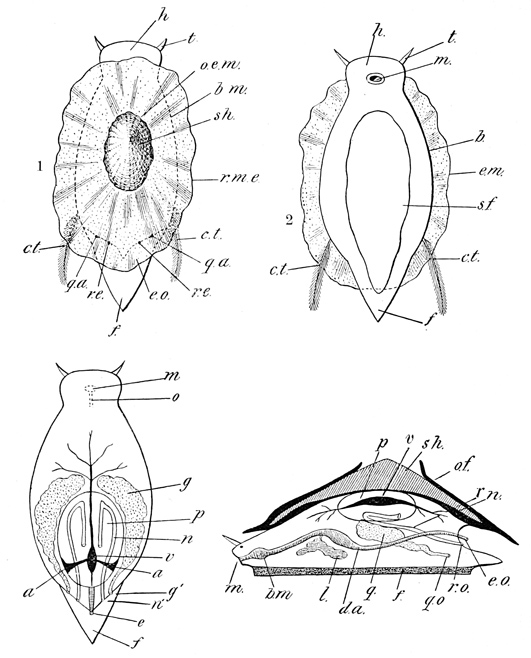
Ideal or schematic mollusk.
1, dorsal view: h, head; t, cephalic tentacle; sh., shell covering visceral mass; b.m., outline of body-mass; r.m.e., edge of mantle; c.t., ctenidia, or gills; q.a., generative apertures; r.e., renal openings; e.o., excretory opening; f, posterior portion of foot; o.e.m., edge of shell.
2, ventral view: h, head; t, tentacle; m, mouth; b, outline of body; e.m., edge of mantle; s.f., lower surface of foot; c.t., ctenidia, or gills; f, posterior portion of foot.
3, horizontal section, showing heart, nephridia, and gonads: m, mouth; o, esophagus; g, gonad; p, pericardium; n, nephridium, or renal organ; v, ventricle; a, auricles; g´, gonad aperture; n´, renal opening; e, excretory opening; f, posterior portion of foot.
4, vertical median section: m, mouth; b.m., buccal mass; l, liver; d.a., digestive tract; q, gonad; f, foot; q.o., gonad aperture, or opening of oviduct; r.o., renal opening; e.o., end of digestive tract, excretory opening; n, mantle; r, nephridium, or renal organ; o.f., recurved portion of mantle; sh., shell; v, ventricle; p, pericardium.]
The digestive tract, beginning at the mouth, opens immediately into a muscular throat, which is called the buccal mass. Within the buccal mass there is a long, fleshy ribbon that bears upon its upper surface numerous rows of sharp teeth; these rows of teeth run crossways on the ribbon, each row containing more or less prominent median teeth, with several laterals upon each side, and with marginal teeth on each side of the laterals. This is called the radula, and is used for tearing or rasping the food. When [pg319] not in use it lies coiled up within the buccal mass. Beyond the buccal mass, food passes into the esophagus, which widens out into a muscular pouch or stomach; this may also be provided with chitinous teeth or hard knobs or plates for the purpose of further triturating the food. Above and partially surrounding the stomach is a large reddish or brownish liver, which furnishes to the alimentary canal the digestive juices. From the stomach the intestine leads to the terminal anal opening. There are two organs, serving the function of kidneys, placed dorsally one upon each side of the body (nephridia). A heart lies within the median line of the body, and consists of a ventricle and two lateral auricles. The vascular system is almost entirely closed; only in so far as it is partially open does it essentially differ from that of higher groups; the blood is whitish or light bluish, and receives its oxygenation in the gills or along the free mantle surface, through which it courses in exceedingly thin capillaries. In this manner respiration is carried on to some extent throughout the whole outer surface of the body. There are two branchiæ (gills). These have the appearance of small feathers and are placed upon each side of the animal posteriorly; they project slightly. Spread over the top of this animal, fitting it perfectly, is a thin fleshy covering attached to its dorsal portion like a skin, but hanging free, like a flap, over the sides, the head, and the posterior end of the animal. Upon the sides it may just cover the tips of the branchiæ, but in front the head is seen to project from under it. The loose-hanging portion of this sac-like covering is somewhat thickened, and perhaps recurved upward upon itself. Upon the edge of this flap all the way around may occur a row of cilia, or tentacular processes. This cloak-like covering is called the mantle, and, as already noted, is the most peculiar and persistent characteristic of the Mollusca. The "cavity" formed between the loose-hanging portion of the mantle and the sides of the foot is called the mantle cavity, and contains posteriorly the gills, or branchiæ. From the outer surface of this mantle a calcareous secretion takes place, forming a shell, which, in our ideal mollusk, will be shaped in conformity with the surface outlines of the mantle, oblong and convex above. Over the lower portion of the shell the edge of [pg320] the mantle recurves. When the creature is disturbed or is at complete rest it may withdraw that portion of the mantle which protrudes from below the shell entirely within the edge of the shell, so that the "soft parts" may be wholly covered, and thus protected from harm. In such a state of rest nothing may be seen from above but a shell. The entire upper surface of the mantle is firmly attached to the under or inner side of the shell, except the mantle margin, this being free.
The nervous system consists of a circumesophageal ring of nerve-cells, with two cords passing along the digestive tract to the posterior end of the animal. In the head and above the buccal mass are several series of nerve-ganglia. These also communicate with the posterior portion of the animal through two parallel cords which pass along its ventral side. From these four principal branches, which traverse the entire length of the creature, minor nerve-cords are thrown off to the tentacles, the foot, the branchiæ, and the various organs of the viscera. The sexes are separate.
Reviewing our "typical mollusk," we find that it is bilaterally symmetrical—that is, uniform upon both sides of a median line from mouth to excretory opening; is unsegmented; has the ventral surface thickened into a creeping foot or disk; and is possessed of a head with tentacular processes, a radula, lateral branchiæ, a heart with a ventricle and two auricles, a well-developed mantle, and a shell.
If the reader can learn these few details of organization he knows the structure of a mollusk. In turning to the actual living forms he will find merely modifications (though sometimes confusing ones) of these various parts.
CLASSIFICATION
toc
The Mollusca are divided into five great classes: Amphineura, Gasteropoda, Scaphopoda, Pelecypoda, and Cephalopoda. These names, it will be noticed, with the exception of the first, all refer to the foot, the modifications of the foot being selected as the basis of the first great divisions of the phylum. The Gasteropoda crawl upon the thickened ventral surface of their bodies (already [pg321] referred to as the foot), as the common garden-snail, the periwinkles, and in general all those mollusks which have a spirally coiled shell. The Scaphopoda have a long, worm-like foot, with which they burrow in the sand or mud. Their shells are like miniature elephant-tusks, but are open at both ends. The Pelecypoda have a more or less club-shaped foot, utilized, in the many families, for a great variety of purposes. They are always inclosed in a bivalve shell. Familiar examples are the oysters, the clams, mussels, etc. The Cephalopoda have the foot modified into a number of arms, which encircle the head or the mouth. They are the cuttlefishes, the octopi, squids, etc.
CLASS AMPHINEURA
ORDER POLYPLACOPHORA
toc
The Amphineura, as already observed, approach most closely to the ideal mollusk just described. They are bilaterally symmetrical. This fact is so important that it constitutes them a class, notwithstanding the fact that in respect to the foot (the basis of division into classes) they would be included with the Gasteropoda, for (barring some exceptional instances) they creep along upon a foot quite as our ideal mollusk would, and as the Gasteropoda do. The head carries no tentacles, thus essentially differing in this respect from the ideal form. The mantle is extended down in front, completely covering the head. The branchiæ are confined to a few pairs of ctenidia, or plume-like gills, within the mantle groove or cavity, and are arranged upon each side of the excretory opening like small feathers.
There are two orders of the Amphineura, the Polyplacophora and the Aplacophora (or Solenogastres), the one name meaning "bearing many plates," and the other "without plates," the word "plate" in this sense being synonymous with "shell." The shell of the first order consists of eight calcareous disks arranged in a longitudinal row along the back or dorsal side of the animal, which overlap like shingles on a roof and admit of great variation of form in the various families. [pg322]
It will be observed from the examples given that the shell plates do not entirely cover the mantle, but that a considerable portion of the upper mantle surface is left exposed along the side of the animal. This exposed portion of the mantle is called the girdle. It is always very much thickened and is often exceedingly tough. In some species it is covered by a great number of calcareous spicules or granules which are embedded in the leathery mantle tissue. Strangely enough, the Chitonidæ (a large family of the Polyplacophora) possess a great number of eyes scattered over the shell plates like minute dots.
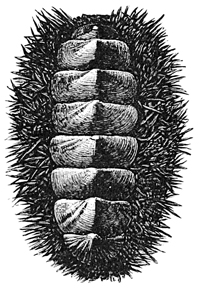
Chiton spinosus, dorsal view.
The members of this order are to be found in all parts of the world, but their greatest development is upon the west coast of America. In California the student of marine life has a splendid opportunity to examine the chitons. They are generally to be found adhering to the under surface of stones about low-tide mark. They are very sluggish in their movements and may readily be removed from their resting-places by suddenly thrusting a knife-blade under the foot and prying them off. When thus detached they have a habit of rolling up into a ball and so remaining indefinitely; to prevent this they should be placed at once in a jar of sea-water, where they will resume their natural position. For preservation as cabinet specimens, chitons should be tied down between two boards or flat substances, to hold them firmly extended until dried; otherwise they are apt to contract out of shape.
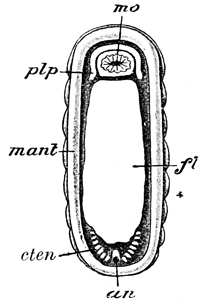
Chiton, ventral view: an, anus; cten, ctenidia; ft, foot; mant, mantle-edge; mo, mouth.
Six or eight species are exceedingly common upon the west [pg323] coast. The collector who has successfully taken a number of these will not fail to note the varying degrees of width of the girdle in the different species. In some cases the girdle partially covers the overlapping shell plates. The largest of all the chitons inhabits the California shores and is known as Cryptochiton stelleri. It measures fully six inches in length and three in width. In Cryptochiton the girdle is continued over the shell plates as a tough, gritty, brownish covering. The shell plates are white, and, as detached pieces, are frequently to be found cast up upon the California beaches, where, from their curious shape, they are often referred to as "butterfly-shells."