Part II MARINE INVERTEBRATES (continued 7)
Reading edition
The figures on pages 411, 412, and 413 show the degrees of mantle fusion in various groups from the open to the almost wholly closed types. One (A, page 413) gives an example of very large siphons united together and protected by the tough, leathery integument. To the right of this cut may be seen the foot projecting from the pedal opening in the mantle. Another gives the two siphons of Cardium, the lower or branchial one being the longer. The mantle-edges below are fluted, and a large foot projects forward. Another shows two siphons of Scrobicularia, of the free and greatly extended type. Fig. B (page 413) illustrates the ventral portion of a pelecypod, which shows very well the most advanced type of mantle fusion. Besides the siphonal openings at the end of the long projection to the left, the only other opening is the very small orifice marked "2," for the accommodation of a small, insignificant foot. In the other figures different degrees of mantle fusion are indicated.
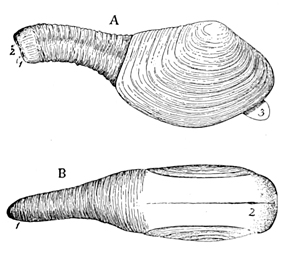
A: 1, incurrent siphon; 2, excurrent siphon; 3, foot. B: 1, siphons; 2, pedal opening.
Before removing the mantle from one side of the specimen to be examined, note the two strong muscles which are at either end of the body. These are the anterior and posterior adductor muscles, their office being to hold the valves tightly shut. They are of great strength, as any one may prove to his satisfaction by attempting to open a clam. Through a long series of forms these two muscles approach each other in position, and in the scallops and the oysters there is but one adductor muscle, occupying a central position. Morphologically it is the survival of the posterior adductor.
THE BRANCHIÆ OR GILLS
Removing carefully the thin, fleshy mantle, the gills are exposed to view—that is, of course, the gills of that side of the [pg414] animal, for there are two sets, one upon each side of the body, or visceral mass, and lying between the body proper and the mantle folds. Each set consists of two plate-like bodies with a texture of reticulated or basketwork appearance. Thus there are the inner and outer right gills and the inner and outer left gills. If one gill is removed and carefully examined it will itself probably be found to be double, consisting of many filaments placed side by side and then doubled back like a row of hairpins, the filaments being united by interciliary processes, or by vascular channels together with more or less dense connective tissue.
The modifications of the pelecypod gills are difficult to follow, but the principle upon which they perform their duties is the same in all cases. The gill-filaments are all connected with a long vein, and, being hollow, admit the blood, which is aërated by close contact with the water and is then returned to another vein in immediate connection with the auricles of the heart. There is another function accomplished by the gills, which in some families seems to be quite as important as their respiratory one, namely, the office of giving lodgment to the ova while in process of development before hatching. At certain seasons the gills of a number of pelecypod genera become literally filled with eggs; sometimes this curious phenomenon extends to the mantle itself, and more or less to the entire surface of the animal. The eggs are first regularly ejected from the genital ducts and find lodgment upon the body-surface, but usually only upon the gills, where they remain as in a brood-pouch between the lamellæ of the inner and outer gills. When the eggs hatch, the free-swimming young escape from the mantle cavity. Probably not more than one individual in a million ever reaches maturity.
The figure on page 408 shows the mantle removed, exhibiting the gills, the foot, the labial palps, and the pericardium, inside of which is the heart. Removing the gills, we find exposed the body, or visceral mass, which, as in the Gasteropoda, is thickened below into the foot. A longitudinal section is shown on page 408, the visceral mass being sliced almost through the middle; a portion of the gills of the farther side shows below. [pg415]
THE FOOT
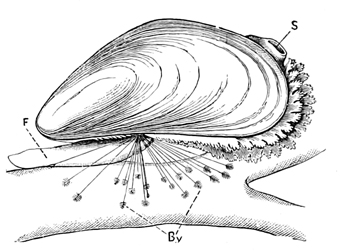
Mytilus edulis, attached by its byssus (By) to a piece of wood: F, foot; S, excurrent siphon, the branchial siphon being below it and not closed.
The foot undergoes great variation, from a strong, powerful organ capable of forcing its way through heavy gravelly bottom or burrowing deeply into the sand or mud, to the merest trace of a pedal organ. In the oyster the foot has become almost entirely atrophied; the stationary life led by the animal renders such an organ quite unnecessary. Excepting in a few families, the pelecypod foot is well developed. In a number of genera the foot contains a gland for the secretion of long silk-like or horn-like fibers, which are collectively called a byssus. The use of a byssus is for attachment to any object to effect a temporary or permanent lodgment. The accompanying cut shows Mytilus edulis, a common east-coast pelecypod, attached by its byssus to a piece of wood. Most bivalves having a strong byssus exhibit a feeble development of the foot; nearly all bivalves, however, show traces, sometimes only in the embryo, of a byssal gland.
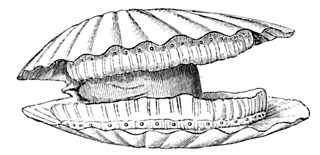
Pecten opercularis, showing the ocelli, or eyes, on the two edges of the mantle.
The visceral mass contains the liver, the exceedingly large generative glands, the kidneys, etc., and through all this soft whitish or reddish mass the alimentary canal wanders about in a tortuous fashion, finally passing through the pericardium and the ventricle of the heart, and terminating just over and back of the posterior adductor muscle. [pg416]
The pelecypods have no head or tentacles, but the place of the latter is taken by two pairs of triangular flaps upon either side of the mouth. These are called the labial palps, and they no doubt operate by means of their ciliated surface to keep in motion the current of water over the gills and to the mouth.
As a rule, pelecypods have no eyes, but when eyes are present they are situated upon the edge of the mantle. The eyes are not highly developed organs, but they nevertheless appear to be very sensitive to light, for the bivalves which are so endowed will, when kept in aquaria, instantly close their shells when the shadow of a fish passes over them.
The heart lies in the pericardium and is situated dorsally, just in front of the posterior adductor muscle. It has a median ventricle and two lateral auricles, each connected with the branchiæ upon its respective side. It seems a curious economy that passes the intestine through the ventricle, but this is the case in the great majority of pelecypod genera. The vascular system is closed and is of a high order. It is probable that "breathing" takes place upon the inner mantle surfaces as well as in the gills themselves; for these surfaces are crowded with excessively fine and delicate capillaries, which bring the blood very near to the water. This power of "breathing by the skin" is quite characteristic of the Mollusca in general.
Having once familiarized one's self with the more prominent features of pelecypod organization, it becomes very interesting to examine anatomically every new form that is captured. Surprises are always in store, and sometimes the peculiar juxtaposition and relative sizes of the organs are a trifle confusing; but, upon the whole, the bivalve organization is simple and lends itself far more readily than does that of the gasteropods to satisfactory examination. Some of the more striking anatomical peculiarities are reserved for mention in the notes upon the various genera and species common upon our shores.
THE PELECYPOD SHELL
As has been seen, the testaceous covering of the Pelecypoda consists of two valves or shells which fit more or less closely and [pg417] firmly together and are placed one upon either side of the animal. The two valves are always held together tightly along a dorsal margin by a "hinge ligament," an exceedingly tough, leathery substance, and they are usually secured the more firmly by a system of interlocking teeth, which project from the hinge. The opening and shutting of the valves is controlled by the adductor muscles of the animal, by the ligament which binds the valves together, and by the cartilage, an elastic pad of rubber-like appearance which is lodged just within the hinge, and is compressed when the valves are closed together. Thus, when the valves are closed, there is always a strain upon the adductor to overcome the elastic resistance of the cartilage. When a pelecypod dies and the pull of the adductor muscles is released, the valves gape open.
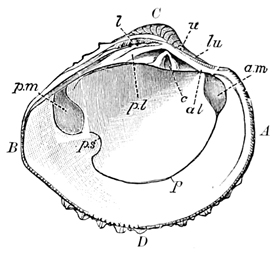
The interior characteristics of a pelecypod shell. Left valve of Venus gnidia: A, anterior, B, posterior, C, dorsal, D, ventral margin; AB, length, CD, breadth of shell; a. m., anterior, p. m., posterior impressions of adductor muscle; p, pallial line; p. s., pallial sinus; l, ligament; lu., lunule; u, umbo; c, cardinal teeth; a. l., anterior lateral tooth; p. l., posterior lateral tooth.
The summit or apex of the valve is called the umbo, or beak. It is usually twisted to some extent, and in certain forms develops a suggestive spiral figure. The beaks of the valves are the points where the shell-growth begins, the secretion of calcareous matter being made by the mantle margin and deposited about the edges of the valves; the growth is therefore constantly away from the umbones.
The umbones usually point forward. In many species they touch each other over the hinge-margin or approximate very closely; in other species the hinge-margin is very wide and the beaks are comparatively far apart. The hinge-margin, lying adjacent to the umbones, is known as the dorsal margin of the shell, in contradistinction to the ventral margin, opposite the umbones. The anterior margin is the front edge and the posterior margin the hinder edge of the shells, through which the siphons may project.
When the umbones are about central in respect to the posterior [pg418] and anterior margins, the shells are said to be equilateral. When the two valves are almost exactly alike in size and shape they are called equivalve.
In many forms there is a heart-shaped space upon the dorsal margin of the closed valves forward of the umbones, called the lunule. Similarly placed back of the umbones is sometimes a more or less clearly defined space called the escutcheon. The outer surface of bivalve shells admits of infinite variety of sculpturing and ornamentation, ranging from a perfectly smooth to a heavily ribbed, nodose, spinous, or deeply decussated surface. The color-markings are often brilliant and eccentric.
The right and left valves may be distinguished by remembering that the siphons are always posterior, and that the umbones usually point forward.
The hinge of bivalve shells undergoes many variations in the different genera. The simplest type is a smooth edentate surface where the two valves meet and are held together only by the strong ligament. Generally, however, there is a system of interlocking teeth, those in the center of the hinge being the cardinals and those upon either side the laterals. In some forms there are rows of fine comb-like teeth along the hinge-margin, with no distinction between cardinals and laterals.
The object of these hinge-teeth is at once obvious, for they give a rigidity and increased strength to the entire mechanism, especially when closed. There is occasionally a saucer-shaped plate or platform just under the cardinal teeth and within the shell, called the fossette. Upon this rests the internal elastic cartilage.
Upon the smooth interior surfaces of the valves are always certain markings, which correspond to anatomical features of the animal and are consequently of considerable importance in the determination of the systematic position of the specimen. First, the well-marked impressions left by the adductor muscles will be noted; then a more or less distinct line which, describing roughly a circle, connects the two muscle scars. This line represents the points at which the mantle became detached from the shell. In other words, all the space within this pallial line (barring the [pg419] muscle scars) was, in life, covered by the mantle, which adhered tightly to it. The space between this pallial line and the outer edge of the valve was occupied in life by the free portion of the mantle. Frequently a depression in the pallial line toward the center of the valve is seen in the posterior end. This is called the pallial sinus, and marks the space occupied by the siphons. The pallial sinus is absent, moderate, or deep, according as the animal possessed no siphons, or small or large ones.
The length of bivalve shells is measured from their anterior to their posterior ends, while the height indicates the greatest diameter between the umbones and the ventral margin.
The greatest possible degree of variation exists in the structure of the pelecypod shell. Every degree of thickness from the most fragile, tissue-like structure to the very heavy and ponderous tests of some of the Veneridæ is to be found. There is also a range in size from the very minute Spheria to the giant Tridacna of Eastern seas, which weighs several hundred pounds. As in the Gasteropoda, there is fortunately a very close parallelism between shell and anatomical variations. One very quickly learns to place a bivalve in its systematic position by a mere glance at the shell alone. While the higher classification into orders, suborders, etc., is based upon anatomical features, the genera often and the species always are founded upon conchological or shell characters.
The Pelecypoda offer one of the most interesting fields for investigation and study among the invertebrates. Although by no means neglected, they have not received as much attention on the part of biologists as has been given to other phyla, or indeed to the other classes of this same phylum.
CLASSIFICATION OF THE PELECYPODA
Nearly every systematic writer upon the mollusks has attempted to give a good classification of the bivalves, yet none of the results is wholly satisfactory. The scheme now generally adopted is one based upon modifications of the gills, or branchiæ, and has practically replaced all the older classifications, which depended [pg420] upon the presence or absence of siphons, the degree of mantle fusion, the arrangement of teeth upon the hinge, the number of adductor muscles, etc. The idea of arrangement according to gill-structure is substantially this: the development of the gill from the simplest and most rudimentary type through successive stages to a higher, more complex, and presumably more efficient type, marks the natural progress or development of the pelecypod animal itself. By adopting the gill as a guide one follows, therefore, a natural method. Upon the other hand, the presence or absence of siphons, the shape of the foot, the number of adductor muscles, all depend merely upon the acquired habits of the animal, these particular features being subject to modification according to environment and changed conditions.
The five orders of the Pelecypoda are: Protobranchiata, Filibranchiata, Pseudolamellibranchiata, Eulamellibranchiata, Septibranchiata.
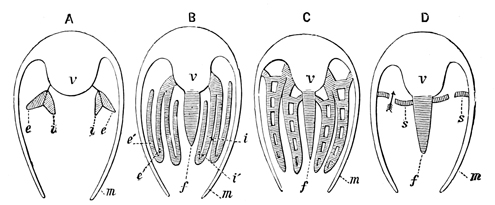
Structure of the branchiæ or gills of pelecypods, seen diagrammatically in section: A, Protobranchiata; B, Filibranchiata; C, Eulamellibranchiata; D, Septibranchiata; e, e, external row of filaments; i, i, internal row of filaments; e´, external row or plate folded back; i´, internal row folded back; f, foot; m, mantle; s, septum; v, visceral mass.
The first includes the simpler type of gill as represented in the accompanying figure (A). Its filaments are short and not reflected. The second, represented in Fig. B, has the filaments long, reflected, and connected (each filament to its adjacent ones) by means of surface cilia. The third type of gill resembles the last except that the ends of the filaments of the outer gill are attached to the mantle, and the ends of the filaments of the inner gill are attached to the foot or visceral mass. The fourth type of gill is far more highly [pg421] developed. The adjacent filaments are connected, not by cilia, but by vascular channels, and the depending and recurved portions of each filament are also connected in a manner presumed to admit of the passage of blood. This gives to the organ the appearance of basketwork or network. The ends of the filaments are attached to the mantle and to the visceral mass, as in the last order, forming cavities or chambers above (see Fig. C). This order includes the great majority of the Pelecypoda.
The fifth and last order is confined to but two rather obscure families, in which the gill-development is carried to the point of substitution of muscular partitions which form a separate chamber connected with the mantle cavity by a narrow slit, the surface of the chamber having respiratory functions (Fig. D).
The collector of living marine objects who has become fascinated by their beauty and who derives pleasure from examining the greater beauty of their structures will find a rich field for research in the pelecypod gills. But unless he has time at his disposal and some skill with a microscope, he would do well not to venture too far into this alluring but difficult and vexatious subject.
Our coastal waters are fairly rich in bivalves, but the most strikingly handsome species of this class—and there are many of them—are inhabitants of warmer seas. Of the great number of bivalves to be found upon our own shores we can only mention briefly some of the commonest species.
ORDER PROTOBRANCHIATA
Family NUCULIDÆ
In this family the gills are of the simplest and most primitive type. The mantle-edges are entirely open along the ventral margin, but they are united posteriorly in some of the Nuculidæ to form two short siphons. The palps are exceedingly large. The foot is also large, and by its disk-like surface is adapted to creeping, much as is a gasteropod foot; its edges are often crenulated or scalloped, and there is no trace of a byssus. The shells are [pg422] equivalve, and their most prominent feature is the hinge, which is beset with sharp, comb-like teeth in two straight rows, one upon each side of a central pit, a space reserved for the ligament.

Nucula proxima.
Genus Nucula
N. proxima. The commonest of several species of the genus found along the New England coast. It is oblique, with a light-olive epidermis, nacreous interior, and finely crenulated margins. Its length is about one quarter of an inch. The animal has no siphons. It lives in either muddy or pebbly stations near the shore, and probably exists in countless thousands in all the bays and harbors of the New England coast.
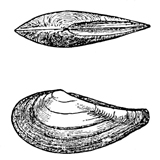
Leda tenuisulcata.
Genus Leda
L. tenuisulcata. This species has a longer shell than the preceding; it is more produced behind, and is narrowed into a blunt, slightly gaping point. The epidermis is light greenish, and the shell has a pearly luster within. The outer surface of the shell is concentrically grooved; the beaks are smooth. The foot is disk-shaped, and the animal is provided with small siphons. The length of this shell is about one inch. Its station is the muddy bottom in shoal water on the New England coast.
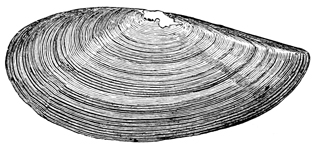
Yoldia limatula.
Genus Yoldia
Y. limatula. This species has the same sort of toothed hinge exhibited in the two preceding species, but the shell is considerably larger (two inches), with a smooth greenish glazed epidermis. The beaks are nearly central. The interior of the shell is light bluish and pearly. The animal has two slender, short, united siphons and a disk-shaped foot with simple margins. This species can make excellent use of its foot, for it crawls with rapidity, and also can execute leaps in an astonishing manner. Found in muddy stations in shoal water on the New England coast.
Y. thraciæformis. A much larger species, found on the New England coast. It may be distinguished by a rib-like wave extending obliquely from the umbones to the ventral margin of the shell. It measures over [pg423] two and a half inches in length and one and a half inches in height, and is dark olive-green. The foot is like that of Y. limatula. The labial palps are exceedingly large.
Y. sapotilla. The shell is ovate, prolonged on one side, thin, fragile, translucent, and covered with a thin, glossy epidermis, greenish in color. The anterior half is semi-oval, the posterior portion narrowed and compressed; within it is pearly-white, with a triangular cartilage cavity, and sixteen to eighteen pointed teeth on each side. In length it is little less than an inch. Found from Long Island Sound northward.
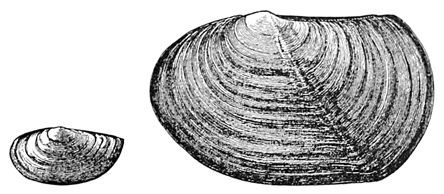
Yoldia sapotilla. Yoldia thraciæformis.
Family SOLENOMYIDÆ
Genus Solenomya
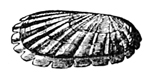
Solenomya velum.
Two species of this genus, which are greatly prized by collectors on account of the extraordinary development of the epidermis of the shell, occur in New England waters. The strong corneous periostracum of a deep chestnut-color projects considerably beyond the margins of the valves; the shells are exceedingly thin and fragile, and are marked with radiating lines. The two species are easily distinguished by their difference in size. S. velum is about one inch long and one half of an inch high. S. borealis, of arctic range, is quite twice that size. Their anatomy is similar in essentials to that of Yoldia. These species live near shore in sandy bottoms, and are occasionally found upon the beach between tides. Chelsea Beach, just north of Boston, is an often-quoted locality.
ORDER FILIBRANCHIATA
There are several families of this order which are well represented in both the Atlantic and the Pacific waters of the United States. The characteristic feature of this group of bivalves is the filamentous gill, that is, a gill with the filaments long, doubled back, and united to each other only by ciliary junctures. These [pg424] junctures are so slight that they break readily when a specimen of a gill is handled, leaving the filaments free. The presence of a byssal gland in the foot, and often a well-developed byssus, is another characteristic of this order.
Family ANOMIIDÆ
Genus Anomia
This is a family of peculiar and highly specialized forms. Anomia has an irregularly rounded shell, with one convex and one flat or concave valve. There is no regular hinge or well-defined hinge-margin, but a raised fossette, or cartilage plate, occupies a position at the top of the valves. In the flat valve there is a large oblong hole just under the apex, through which projects a calcified byssus, by means of which the animal secures itself to oysters, dead shells, stones, or any solid object. The anomias, which have become stationary in habit, have practically lost their foot. The gills are very large and curved, while all the organs seem to be abnormally placed on account of the huge byssus and byssal muscle. For the byssus to pass, as it does, through a specially prepared hole in one of the valves is an extraordinary departure from the conventional types of byssiferous species. The heart is not traversed by the intestine. Altogether, then, Anomia is a very curious genus.
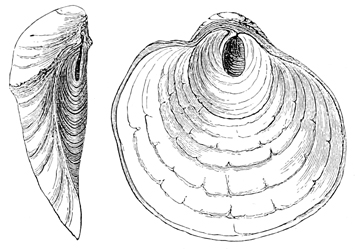
Anomia simplex, side view. Anomia simplex, from below.
A. simplex. The commoner large form of New England. It varies from one to three inches in diameter, is exceedingly irregular in shape, and its surface is variously undulated and plaited in accordance with the surface of the object to which it is attached. Thousands of these valves, disjointed and separated, are cast upon the beaches all along our Atlantic coast. They are light green to salmon- or copper-color, generally fragile and scaly, and have a peculiarly dulled (as though greased) nacre. [pg425]
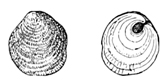
Anomia aculeata, from above. Anomia aculeata, from below.
A. aculeata is much smaller than the last species, and the surface of the convex valve is roughened by prickly scales. The smaller valve is very thin, with an almost circular aperture for the byssus. Its diameter is about half an inch. Found attached to stones, etc., about the holdfasts of Fucus.
A. lampe, a California species ranging more to the south, is small (half an inch), and greatly resembles the east-coast A. aculeata, save as regards the smooth surface of the former.
Genus Placunanomia
P. macrochisma. This species occurs on the Californian coast. It has the same sort of calcified byssus as Anomia, and also the hole to accommodate it in the smaller valve. The scar formed by the muscle which controls the byssus is curiously rayed in this genus. The normal shape of the shell is circular; it is pearly within, and of a greenish tinge without. Two to four inches in diameter. (Plate LXXVIII.)
Family ARCIDÆ
Genus Arca
The Arcidæ may always be distinguished by the long row of comb-like teeth upon the hinge, the total want of siphons (a fact which may be discovered in the shell alone by its lack of a pallial sinus), and the solid trapezoidal or round shell, with its tendency to strong ribs radiating from the umbones. The periostracum, or epidermis, is heavy and often velvety or even hairy. The animal of Arca has the gills placed in an oblique position; the foot is large and strongly developed. No trace of mantle fusion exists. The mantle-edges bear a row of composite eyes. The gill-filaments are entirely free, there being even no ciliary junctions.
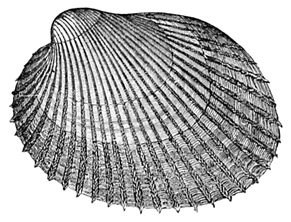
Arca pexata.
A. pexata. An exceedingly common species in Long Island Sound and on the coast of New Jersey. The shell is oblong, with prominent beaks directed forward. The hinge-teeth are arranged in a row posterior to the beaks, while just under the beaks are a number of irregular cartilage-pits. About thirty-two to thirty-six radiating ribs ornament the shell. The inner margins of the shell are rather deeply scalloped; the epidermis is thick, shaggy, and dark [pg426] brown. Length two to two and a quarter inches; height two inches. A. pexata is one of the few pelecypods which have red blood, a fact which accounts for its popular name of "bloody clam."
A. ponderosa. The most prominent Arca upon our Atlantic coast, especially south of Virginia. The beaks of this shell are very prominent, and do not approach each other very closely on account of the wide dorsal margin of the shells, the large space between the beaks being occupied by an external ligament. The hinge-teeth are smaller in the middle. There are from twenty-five to twenty-eight ribs; the ventral margin of the valves is somewhat contracted in the middle. Length two and a half inches; height two inches. Very heavy and solid. This exceedingly common species is often cast upon the beaches south of Hatteras in numbers beyond computation. In life it is covered with a heavy, coarse, velvety epidermis, almost jet-black in color. (Plate LXXVIII.)
A. noæ. The well-known "Noah's-ark" shell, a common species along the shores of the Southeastern States. It also occurs in the Mediterranean. Unlike most arcas, it spins a byssus, by means of which it attaches itself to the under surfaces of stones at low water. The hinge-margin is perfectly straight and regularly toothed. The beaks are high and are situated very far forward. The dorsal margin of the valves is strikingly large, and is marked by lattice-like grooves; it forms a concave surface over an inch in width between the umbones. The shell is strongly ribbed without. The ventral margin of the valves is sinuous and gapes slightly at a central point for the accommodation of the byssus. (Plate LXXVIII.)
Family MYTILIDÆ
Genera Mytilus, Modiola
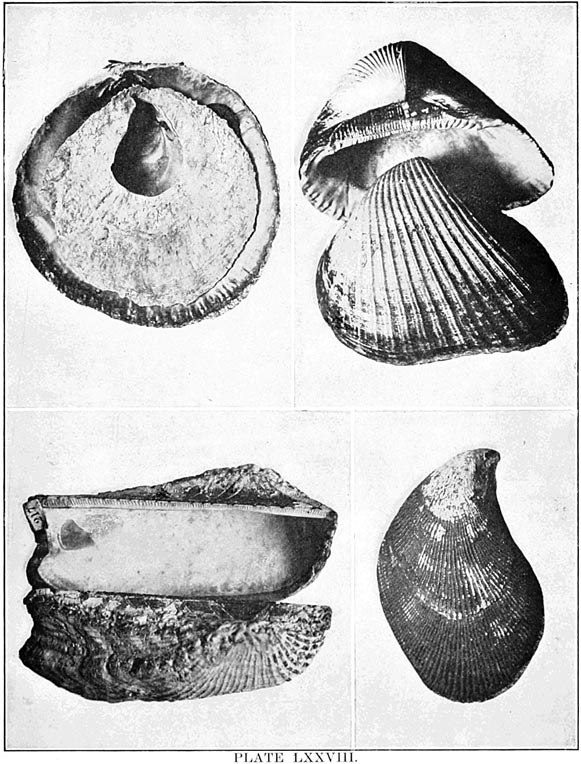
PLATE LXXVIII.
Placunanomia macrochisma. Arca ponderosa.
Arca noæ. Mytilus hamatus.
The Mytilidæ are a large family, including the mussels, so commonly found between tides upon all shores. The two ordinary genera Mytilus and Modiola, which often occur associated together upon our eastern coast, may readily be distinguished one from the other by the position of their beaks. In the former genus the beak is terminal, that is, it is situated at the very tip-end of the shell; in the latter genus it is not quite terminal. Aside from this simple feature, the genera are practically the same, the animals being identical. Mytilus and Modiola, commonly known as mussels, have acquired the stationary habit and are provided with a relatively small foot (in some species amounting to no more than a mere tubercle); but in place of a useful foot is a well-developed byssogenous gland, which secretes an [pg427] exceedingly tough, fibrous byssus. By means of this the animal may not only attach itself firmly to any sort of object, but may actually move about. Fibers of the byssus are thrown out, and, as though possessed of life, they seize upon objects in the direction in which Mytilus desires to move, and by contraction of the muscles which control the byssus the animal is drawn forward, the operation being then repeated. It must be a very tedious method of travel. However, the Mytilidæ are not restless creatures. They pass their lives content to remain firmly fixed to some object, and their movements, if any, are within a very narrow circle. The animal has very long gills of the usual filamentous type. The mantle fuses at one point to form an anal siphon, the lower or branchial one being, therefore, functional. The palps are large. One curious feature of this group is the enormous extent of the genital glands, which actually appear to pervade the entire structure of the animal, gills, mantle, foot, and all. At times the whole being is a veritable receptacle for myriads of tiny yellowish eggs.
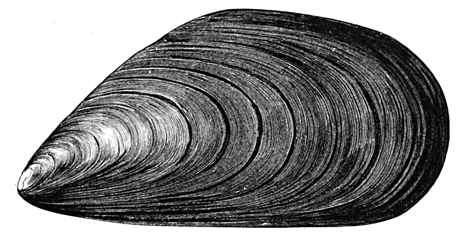
Mytilus edulis, typical form.
The Mytilidæ are of universal distribution, and are for the most part of littoral or shallow-water range. Some species are esteemed as an article of food, notably Mytilus edulis.
Mussel-culture has been profitably carried on in France for a long time, but the genus has not been utilized to any extent as food in this country. [pg428]
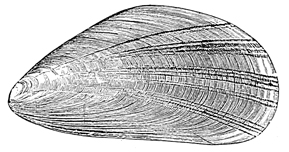
Mytilus edulis, rayed-color variety.
Mytilus edulis is exceedingly abundant along the New England coast. It lives in colonies, often between tides, in pebbly stations among large rocks. It is always so fastened by its byssus that the beaks of the valves point downward, and the ventral margin projects above the sand or mud. The color of the epidermis in the adult form is black or a deep blue-black; the shell proper is violet. Hinge-teeth are wanting. Length two and a half inches. A variety of this species, M. pellucidus, is often found associated with the typical form. It is brightly rayed in green and yellow. M. edulis occurs in Europe, where it is quite extensively used as food. It also occurs (by importation) in San Francisco Bay.
M. hamatus has a more southern range than has M. edulis, and is found from the Chesapeake southward. Its shell is considerably twisted just below the umbonal region, while its whole surface is densely striated. Its color is dark fuscous. Length one to two inches. It is found in great numbers attached to oysters by its byssus. In Florida it is very common. (Plate LXXVIII.)
M. californicus. A common west-coast species, which finds its station among rocks exposed to the surf. It is about the same size as M. edulis, but has a lighter brownish glossy epidermis and several conspicuous, well-rounded, radiating ribs. The animal is orange-colored.
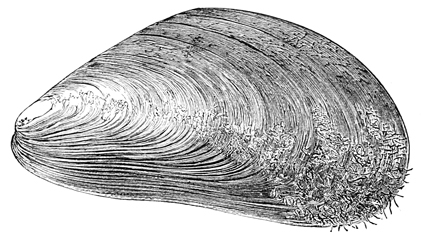
Modiola modiolus.
Modiola modiolus. After violent storms upon the New England coast, when a large Laminaria is wrenched from its rocky bed and washed ashore, its roots will, in many cases, be found clinging to this large mussel. The thick glossy epidermis of deep chestnut-color folds over the margin of the valves, and the outer surface, especially near the ventral margin, is covered with a tough hairy growth. Length four to five inches. The animal is orange-red. The great size and swelling fullness of this species at once distinguish it from all others upon our coast. It is not a shallow-water form, but is extremely common upon all beaches north of Hatteras. It also occurs in Alaskan waters to Puget Sound, where it is known as the "great horse-mussel." Sometimes these large modiolas may be found in rocky tide-pools which are washed by the surf at high tide. They hide far back in the crevices of boulders, and [pg429] are not easily detected. They are not uncommon in such stations at Mount Desert, Maine.
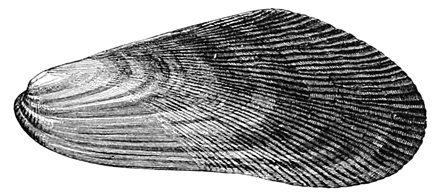
Modiola plicatula, typical form.
M. plicatula. This species of Modiola ranges from Canada to Hatteras, and inhabits the tidal waters of streams, sheltered muddy reaches among reeds, and tidal flats. It is a dingy-looking shell, ornamented with numerous radiating ribs, which are very fine upon the anterior portion of the shell. The epidermis is thin and of a dirty yellowish-green color. Within it is silvery-white. In the ventral margin there is an opening for the accommodation of a byssus. Length about three inches in New England; slightly larger at Norfolk. There is probably no muddy reach of land that is exposed at low tide from Maine to the Carolinas that is not inhabited by M. plicatula.
M. tulipa. This is the "show shell" of the genus Modiola in American waters. It belongs to the Southern fauna, and, like the others of its genus, it moors itself to wood or other solid objects by means of its byssus. It is of about the same size as the last species, but is perfectly smooth and of a bright-yellowish color, with dark rays over the central portion.
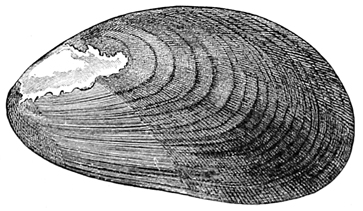
Modiola nigra.
M. recta. A species of Modiola fairly abundant on the Pacific coast from Vancouver to southern California. It has a long, narrow shell with a dark-brown glossy epidermis; lighter posteriorly, and with a short hairy growth. The interior is white. Length three to four inches.
ORDER PSEUDOLAMELLIBRANCHIATA
This third order of Pelecypoda is made up of a number of families in which the gills are filamentous, but in which the filaments [pg430] have become united at their ends to the mantle (on the outer gills) and to the body-mass (on the inner gills). Here also the first traces of the higher type of gill found in the next order appear; that is, a gill in which the filaments are connected by vascular channels instead of by cilia. This order therefore is presumed to connect the true filamentous type of gill with the fully developed lamellar type. As the filaments do not always fuse with the mantle or foot, the description of the pseudolamellibranch gill becomes somewhat vague, and there is some room for doubt whether this order should exist at all.
Most of the genera placed in it are monomyarian; that is, they have but one adductor muscle, or if two, the anterior one is very small and unimportant. The mantle-edges are entirely open, there being no regularly formed siphons. As a rule, the foot is exceedingly small or quite aborted.
Family AVICULIDÆ
In this family there is an exception to the rule just stated: the foot is long. There is a byssus, and the gills (by their outer ascending filaments) are concrescent with the mantle.
The interior of all the Aviculidæ is of a highly polished nacre, and some of the larger species have been extensively collected for mother-of-pearl. To the Aviculidæ belong the pearl-oysters (Meleagrina margaritifera).
A delightful air of romance and adventure surrounds the pearl-fisheries, about which much has been written. The pearl is an abnormal product formed by the deposition of nacre around some foreign object, such as a grain of sand, or—usually, it is said—an egg which has failed to develop properly. They are seldom found in individuals having favorable conditions of growth, but those which are greatly crowded together and covered with various parasites and growths are most productive of them. The pearl is the same in substance as the nacreous shell of the pearl-oyster, and its iridescence is due to the fine striæ of the undulating layers of which it is composed. The pearl as well as the shell is produced by the shell-glands of the mantle. The value of the [pg431] pearl is based on the brilliancy of the nacre, the size, and the form. Luster, or "orient," is to the pearl what brilliancy is to the diamond. The round form has the greatest value, next the pear-shape, and lastly the oval. Pearls of inferior value are produced by other species than Meleagrina margaritifera, the true pearl-oyster. Many bivalves secrete similar bodies, but as they have the nature of the shell, those produced by mollusks having lusterless interiors are of no value. Beautiful pink pearls are found in the gasteropod Strombus gigas, the conch-shell of the West Indies. The shells of the pearl-oyster are themselves very valuable, being the "mother-of-pearl" used in the manufacture of buttons, knife-handles, inlay-work, and so on. They have three grades of commercial value; of the first are the "silver-lipped," from the South Seas, of the second the "black-lipped," from Manila and Ceylon, and of the third the "bullock-shells," from Panama.
Genus Avicula
A. atlantica. A Floridian species which is often found attached by its byssus to large algæ which have been washed upon the beach. The shell is reddish-brown, with many white radial lines. Its obliquely oval shape, the long wing-like extension of the dorsal margin, the inequivalve shells, and the byssal sinus placed just below the forward extension of the hinge, are characteristics which will enable one to recognize the species at once. The structure of the shell is unusual in being so largely composed of organic matter that it possesses elasticity near its thinner edges.
Genus Pinna
P. muricata and P. seminuda. Two species of this family which are very abundant in Floridian waters and are often to be found associated upon the muddy or sandy shores of bays. Like Modiola plicatula, they attach themselves by means of their byssus to shells or stones which lie under the surface. With the pointed end of the shell directed downward, they remain almost wholly concealed in the sand. Only about one quarter of an inch of the broad end of the shell projects above the sand. The edges of the valves are as sharp as knife-blades, and great caution must be used while walking barefooted along a beach inhabited by Pinna. The shells of both species are of a triangular wedge-shape and are composed of a translucent crystalline matter. P. muricata is beset with triangular erect scales which project out like spines. Their edges are also sharp like pieces of broken glass. P. seminuda also has these raised scales, but they are far more numerous [pg432] and much smaller, and are arranged in closely packed radiating rows, the scales becoming obsolete near the umbones. The mantle of the animal is doubly fringed, and much decorated upon that portion which may be protruded from the shell. The posterior adductor is very large and strong; the anterior one has almost disappeared. The foot is long and slender, but is evidently a useless appendage, for the animal's habit is stationary. The byssus is large and very strong. Gloves have been made from the byssal fibers of Pinna mixed with silk. The gills are very long and are distinctly not filamentous, the adjacent filaments being clearly united by vascular channels. A very curious development of the osphradium (see page 339) into an erectile process capable of projection beyond the margin of the shell is a unique feature of Pinna. Sometimes thousands of pinnas are torn loose by storms and cast upon the beaches. They do not range north of Hatteras. (Plate LXXIX.)
Genus Perna
P. ephippium. A West Indian shell, also quite common on the east coast of Florida, and especially upon the Keys. It attaches itself by the byssus in great bunches to mangrove roots, sticks, and all manner of rubbish in brackish water. It has a very flat, irregularly shaped shell of a horn-color, and is from two to three inches across. The distinguishing feature of Perna is the hinge. It is straight and without teeth, but is marked by a row of transverse grooves to which the ligament is attached. These grooves constitute a row of cartilage-pits.
Family OSTREIDÆ
This family probably interests more people than any other one in the class save Aviculidæ. The latter furnishes the pearl-oysters, the former the edible oysters, the two thus appealing to two very strong human cravings—those of vanity and hunger.
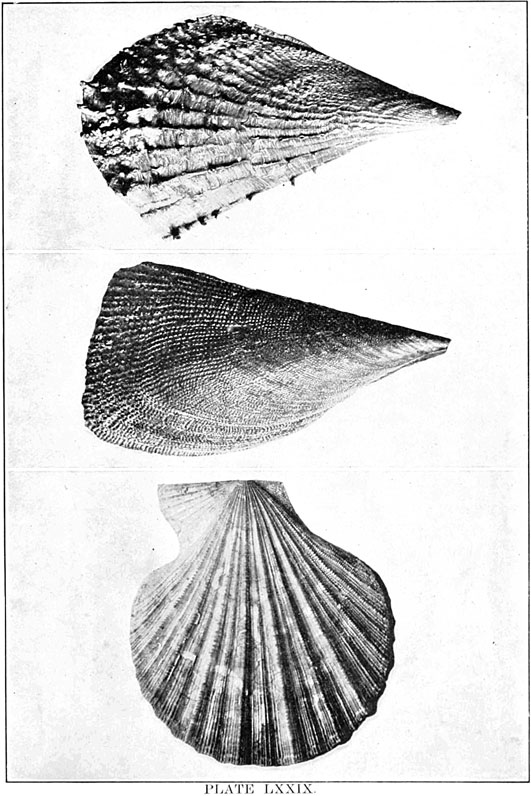
PLATE LXXIX.
Pinna muricata.
Pinna seminuda.
Pecten hastatus.
Few realize what an enormous business the oyster trade has become in the United States. The value of it is stated to be over thirteen million dollars annually, twenty-five million bushels of oysters being taken from the Chesapeake alone. The edibility of the oyster has been known from early times, for vast heaps of empty oyster-shells, known as kitchen-middens, occur in various parts of the world. Some of them are of such size and extent as to warrant the belief that their formation must have required centuries. Shell-mounds are found along the coasts of Florida and are of some archæological value. The cultivation of oysters as recorded by Pliny dates from the first century B.C., at which [pg433] time a Roman named Sergius Orata first cultivated oysters at Baiæ. The acuteness of the gastronomic sense of a Roman epicure is thus described by Juvenal:
He could tell At the first mouthful if his oysters fed On the Rutupian or the Lucrine bed Or at Circeii.
The poet Gay's opinion is expressed thus:
The man had sure a palate cover'd o'er With brass or steel, that on the rocky shore First broke the oozy oyster's pearly coat, And risk'd the living morsel down his throat.
The methods employed in oyster-farming resemble those of agriculture, in that the bed is prepared, seed is sown, superfluous and foreign growths are weeded out, enemies are driven off, and the crop is harvested at stated seasons. The oyster is ovoviviparous; that is, it retains its eggs until they are partly matured. These are held in the gills and mantle folds until the time of spawning, which begins in May and lasts through the summer months. The larvæ are ejected as ciliated spheres, called spat, and swim freely about for some time, often several days, before finding a resting-spot. The oyster-grower secures many of the larvæ by placing in their way substances to which they can attach themselves. The American culturist strews his carefully prepared beds with empty oyster-shells, on which the spat settle, and the seed is thus secured; for the spat, once fastened, lose the power of locomotion and become fixed. At the end of a year the shells which hold the young oysters (now about an inch long and called "fry") are taken up, and the fry are thinned out and replanted, or are sold to other oyster-farmers.
During the period of their growth the oysters are sometimes transplanted several times. At the end of three to five years they have attained marketable size, and the beds are then harvested and prepared for another crop. Some oystermen have several acres of bottom under cultivation. These areas are obtained by purchase or grant from the State, and their limits are as defined [pg434] as are the fenced-off acres of upland meadows. The business of the oyster-culturist is to plant the young oysters and watch their development, keeping the beds thinned, that the oysters may not be too crowded for their normal and symmetrical growth, and protecting them from their enemies, of which there are many. The principal enemies of the oyster are the starfish and the predaceous mollusks Urosalpinx and Nassa. Whole beds have been known to be destroyed in a single night by the visitations of starfishes, hence a constant watchfulness is required on the part of the oysterman. Policing the oyster-farms is another of his cares, for pirates abound, and a bed may be robbed in the night as easily as an orchard may be despoiled of its fruit. Oyster-culture is carried on extensively in Long Island Sound, on the coasts of New Jersey and Virginia, and in the Chesapeake Bay. The oysters from certain localities are esteemed more than others, the flavor of the oyster being very dependent upon the purity of the water and on the organisms upon which it feeds. It has been definitely shown that oysters grown in contaminated waters have been the agents of transmitting disease, notably typhoid fever and cholera.
Oyster-culture has reached the highest degree of perfection in France, where miles of muddy shores left by the ebb-tide are utilized for the purpose. The famous parc at Arcachon, covering ten thousand acres, illustrates the system generally practised. The spat is there collected on tiles coated with cement, piled in layers crosswise, and secured in crates. These tiles are exposed in favorable localities and collect the swimming embryos. The rough cement holding the spat is then chipped off the tiles and placed in wire trays. These ambulances, or caisses ostreophiles, placed between short posts, protect the fry from their enemies. At low tide the young oysters are carefully examined and sorted, and at the right age they are removed to open areas. The parc is divided into regular squares by canals of suitable width, some of the squares having banks and gates to retain the water of the receding tide if desired. Each man's parc is separated from that of his neighbor by canals of greater width, and often by stakes having a few branches on the ends. These [pg435] pignons, which sway in the wind, are said to frighten away the predaceous ray which is apt to hover about the preserves. The parcs are finally thinned out by sending the oysters to other parcs to be fattened. There is a celebrated parc d'élevage at Marennes. It is a collection of artificial ponds, the floors of which are covered with algæ, which harbor vast numbers of diatoms and other microscopic organisms on which the oysters feed. The green diatom (Navicula ostrearia) gives to the oysters of Marennes the green color and peculiar flavor which is so much esteemed by the epicures of France. To the American, however, the green oyster is not acceptable.
Genus Ostrea
O. virginica. A description of this species, our common oyster, is hardly necessary. Every one has seen the rough, shaggy, unlovely shell. The hinge is toothless, but has a wide depression for the ligament. The animal, having stationary habits, has practically no foot at all. There is but one large adductor muscle, around which curve the gills, the latter being united to each other posteriorly. The mantle margin is finely and doubly fringed. Although Ostrea is a stationary mollusk, it has no byssus.
O. virginica has been introduced at San Francisco, where it lives well, but does not seem to multiply very rapidly. The native species, O. lurida, is about two inches long, dark in color, and stained a purplish hue. It is not very delicately flavored.
O. frons. This species has a thinner shell than O. virginica, with coarsely serrated margins. It occurs in beds in the neighborhood of mangroves all along our South Atlantic shores. It cannot compare with its Northern relative in flavor, but, like the European Ostrea edulis, it is sometimes "not bad."
Family PECTINIDÆ
Genus Pecten
The scallop-shells (Pecten) are objects too familiar to require any general description. The rounded valve, usually ornamented with radiating ribs, and the wing-like projections (called "ears"), from each side of the umbonal region, are never-failing characters. The outline of Pecten has been considerably employed in conventional designs for mural decorations; indeed, the figure [pg436] of a well-known Mediterranean pecten (P. jacobius), found commonly in Palestine, became an emblem of religious significance during the middle ages. Returning crusaders fastened to their garments a specimen of "St. James's shell" as an evidence of the fact that they had been to the Holy Land, and the design of the shell came to be adopted upon many coats of arms and also in the insignia of various orders of devout and adventurous knights of the middle ages.
The animal is of the highest type of monomyarian mollusks, that is, of bivalve mollusks with only a single adductor muscle. Unlike most pelecypods, which have a very small foot, Pecten rarely has a byssus, and is neither a stationary nor a sluggish creature. It can propel itself through the water by spasmodically closing and opening its valves, in an eccentric, darting sort of flight, though most of the time it rests quietly upon the bottom. The mantle is entirely open and highly ornate about its margin, which is, furthermore, the seat of many eyes, capable, apparently, of no mean degree of vision. The adductor muscle is very large and strong, and occupies a central position, about which the gills circle; the latter are plainly filamentous.
P. magellanicus. The largest of the east-coast species of Pecten. It is a Northern species, and was long known by the name of P. tenuiscostatus—a name given to it on account of its very numerous radiating striæ; but it was later discovered that the North Atlantic form was in reality the same as the P. magellanicus of Patagonia. The latter being the older name and entitled to priority, our shell became P. magellanicus, the other name falling within its synonymy. The length and height of this scallop are from five to five and a half inches. One valve is more convex and slightly larger than the other, the smaller being lighter in color. The valves gape considerably along their upper margin below the hinge. The cartilage-pit is deep. North of Cape Ann this large species is of common occurrence in moderately deep water. The deeper bays and arms of the sea which everywhere penetrate the Maine coast are its favorite resorts. A good way to catch pectens is to lower a fishing-line at a spot where the fishermen report "scallop-ground," and drag it along over the bottom. Sooner or later it will enter the open shell of some pecten, which will instantly close its valves upon the string and allow itself to be drawn out of the water. In Maine these large scallops are eaten, but they have not found great favor in the city markets. In color they vary from reddish through brown to ashen.
P. islandicus. A species not so large as the last, with more prominently raised ribs (about fifty to one hundred in number), which are [pg437] covered with a multitude of erect scales. The ribs persist upon the interior of the shell. The "ears" are unequal in size. The color is light orange to reddish-brown, with zones of darker and richer color. One valve is flatter than the other and more lightly colored. Greatest length about three inches; height three and a half inches. This is a Northern shell, belonging to the waters of Newfoundland, but its valves are frequently cast upon the New England beaches.
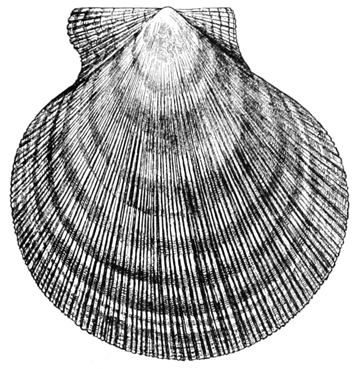
Pecten islandicus.
P. irradians. The common shallow-water species of the Atlantic coast. This exceedingly abundant species does not range north of Boston, but finds an extensive habitat to the south. Its metropolis is Cape Cod, Long Island Sound, and the Jersey coast waters. This is the true scallop of the Boston and New York markets. Only the adductor muscle is eaten. In this species there is not so marked a difference in the convexity of the two valves. There are about twenty elevated and rounded ribs, the spaces between them being also rounded. The color is variable, from a blackish horn to ashen gray. The "ears" are equal; the interior is shining, and grooved to correspond with the external ribs. Length two and three fifths inches, height two and a half inches. On clear, calm days the immature individuals of this species may often be seen in shallow water disporting themselves most gaily, skipping about and snapping their valves in great glee. Their mantle margins are very ornate in scarlet or orange, with rows of bright-blue eyes. Care must be taken in handling scallops, especially the large P. magellanicus, for a finger caught between the valves will be badly bruised.
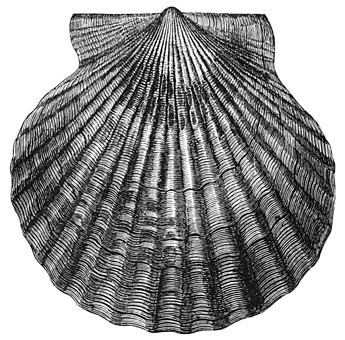
Pecten irradians, typical form.
P. dislocatus. South of Hatteras this species takes the place of its Northern relative, P. irradians. It is somewhat more globular and perhaps not quite so large, but the resemblance between the two species is very marked. It has from twenty to twenty-two rounded ribs, with very numerous concentric wrinkles between them. In color it is white, tinged with purple or yellow, with occasionally a system of blood-red lines crossing the ribs transversely. The diameter is about one and a half inches. This species has the same playful habits as P. irradians, and is not at all easy to capture. When pursued it dives into the mud, and sets up such a commotion by the spasmodic opening and shutting of its valves that the water at once becomes roiled, and the scallop is safely hidden in its murky depths. [pg438]
P. hastatus. There are several very beautiful pectens on the Pacific coast of the United States, and two of these—one of northern and the other of southern range—resemble very closely the two Atlantic species of relatively north and south range, P. islandicus and P. irradians or dislocatus. The first is P. hastatus of Puget Sound. Valves of this exquisite shell are even occasionally found in California. It has very much the aspect of P. islandicus—unequal ears and an ovate form. The most curious thing about this shell is the fact that a different system of sculpturing exists upon the two valves. Upon one the ribs are even and the whole surface is covered with raised scales; upon the other the ribs are alternately of large and small size. Color rose-pink, with deeper bands; one valve lighter-colored, suffused with delicate pink. Height two and a half inches. (Plate LXXIX.)
P. æquisulcatus. The Southern species above referred to as resembling P. irradians or dislocatus. It has about twenty stout, well-rounded ribs, with concentric wrinkles between them. The "ears" are equal. The size and shape are as in P. irradians. The coloring is whitish, varying to shades of brown, and excentrically marked with spots or waving transverse lines of chestnut or horn.
ORDER EULAMELLIBRANCHIATA
With the pectens we leave behind all pelecypods with the true filamentous type of gill. In the order Eulamellibranchiata we find all the families to be possessed of the basketwork or crisscross branchial structure. Each gill is fundamentally formed of filaments which project downward, and then suddenly turn upon themselves and ascend; the ascending and descending limbs are connected, however, by processes of presumably vascular function, and adjacent filaments are connected by truly vascular channels. The closer connection of the filaments to form of each gill a sort of plate is further effected [pg439] by connective tissue, which sometimes is dense enough (though always porous) to obscure the reticulated appearance of the organ. Furthermore, the edge of the outer lamella of the outer gill unites with the mantle; likewise the edge of the inner lamella of the inner gill unites with the body-mass, and behind the body-mass with the gills upon the other side of the animal. This union of the four gills in a straight median line behind the foot and body-mass forms a septum, which divides off from the mantle cavity a "suprabranchial" cavity. Into this cavity the excreta are discharged, and with it the anal or excurrent siphon connects. The branchial or incurrent siphon thus pours its current of water into the lower mantle cavity, to bathe the gills and feed the mouth, while the fresh water is not contaminated by any open and wide connection with the excretory processes. In many of the forms where the siphons are very long and united, this septum, formed by the union of the dorsal edges of the inner gills back of the foot, is continued far into the siphons, constituting the division of the two into the anal and branchial siphons.
Another feature of this order is the marked tendency to mantle fusion. As there are always siphons, the mantle-edges must necessarily have fused at two points at least, in order to have formed the siphons. The tendency, however, is for the fusion to continue, narrowing the pedal opening more and more, as though the mantle were endeavoring to envelop the entire animal in a bag or sac open only at one end (siphonal opening), but yet slightly ripped along one seam (pedal opening).
This order includes the great majority of pelecypods, and admits of many very confusing modifications in its most essential features.
Family CARDITIDÆ
In this, the first family of the order, most of the characteristic features just spoken of are present. Mantle fusion, however, has not progressed beyond a degree which is just sufficient to form the siphons. There is a byssiferous gland. The name Carditidæ refers to the heart-shape of the shells. [pg440]
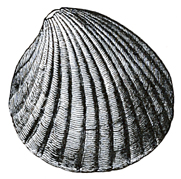
Cardita borealis, natural size.
Genus Cardita
C. borealis. A very common species north of Cape Ann, reported also in deeper water as far south as Hatteras. It is a solid, obliquely heart-shaped shell, with beaks elevated and turned forward. It has about eighteen to twenty rounded radiating ribs, which are broader than the grooves between them. The epidermis is rusty-brown. The hinge is strong, with two prominent teeth; the margins of the shell are strongly crenulated within. Length one inch; height about the same. This is not strictly a between-the-tides species, but its valves are often cast upon the beaches. Fine specimens may be obtained by dredging at Bar Harbor or Eastport.
C. floridana. A very common Floridian species. Its seventeen or eighteen ribs are very heavy, and are rendered nodulous by the numerous bluntly raised scales upon them. The shell is lengthened, and has a well-defined lunule and an external ligament. In color it is yellowish-white, with purple markings when young. Length one inch; height three fourths of an inch. It lives in sheltered bays; detached valves are often found cast upon the beach.
Family ASTARTIDÆ
Genus Astarte
Notwithstanding their rather small size, there is a trimness about the shells of Astarte which, taken together with their rich chestnut epidermis, makes them very interesting and desirable additions to the cabinet. The family is one of cold-water range, with a few representatives on the New England coast. Live specimens are not easily captured, for they live in deeper water than one would care to wade in, nevertheless they are frequently cast upon the beaches after storms. The animal has a very short efferent siphon, large labial palps, and very obliquely placed gills. Not more than twenty living species of Astarte are known, and all of them belong in, or are wanderers from, polar seas. Fully three hundred fossil species of this genus have been described from Mesozoic rocks in all parts of the world. The question naturally arises whether in these its dying days Astarte has sought colder waters in which to pass its remaining existence, or whether climates have changed. The fact that such strictly [pg441] tropical genera as Voluta and Conus are found fossil in northern Siberia seems to be evidence in proof of great climatic variations.
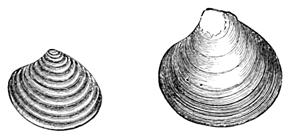
Astarte undata. Astarte castanea.
A. castanea. This species has a thick and heavy shell for one so small, with round ventral margins and prominent beaks. The surface is very slightly undulated and is covered with a thick chestnut epidermis with pale and dark zones. The hinge is broad and flat, with a prominent cardinal tooth upon the right valve, which accurately fits into a pit formed by two teeth on the left valve. Length one inch; height one inch.
A. undata. A species slightly larger than the last, with ten to twenty prominent concentric undulations.
The identification of the many species of Astarte often becomes exceedingly difficult on account of the fact that the genus is a remarkably uniform one in its main characters and is infinitely variable in its minor details.
Family CYPRINIDÆ
Genus Arctica
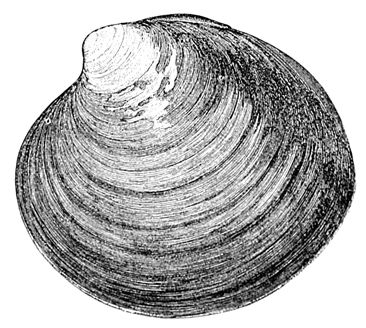
Arctica (Cyprina) islandica.
This family is represented by one species upon the New England coast, which is much sought after by collectors. It is one of the larger clams, but is too uncommon to have received a popular name and to be generally well known by the fishermen along the shore.
A. (Cyprina) islandica. This clam has a thick though not ponderous shell, with prominent beaks and a stout, prominent ligament. Its cardinal teeth are large, but its laterals are very small. A striking feature of this species, which at once separates [pg442] it from all other shells of our coast of similar size, is the coarse, wrinkled epidermis of black to chestnut color. The shell is very suggestive of a large, overgrown Astarte. Length three and a half inches; height three inches. It is found of all sizes, down to one fourth of an inch in diameter, upon muddy stations in moderately deep water near the mouths of rivers; but the surest way to get it is to search the beach after a hard onshore gale.
Family LUCINIDÆ
This family finds its metropolis in warmer waters, and the best representatives of it must be sought for upon the Floridian beaches or in the shallow bays of that sandy coast. A long vermiform foot is a characteristic of the animal, as is also the fact that at times there is only a single gill upon each side of the body. In some of the Lucinidæ, more so than in most other pelecypods, the chief function of the gills is to furnish a brooding-place for the thousands of ova which the creatures generate. Sometimes a Lucina will be captured with the gills swollen out of all proportion, and literally stuffed with tiny, microscopic eggs. At such times the gills lose all semblance of branchial organs. The shells are orbicular, with depressed small umbones, a distinct lunule, a semi-external ligament, two cardinal teeth, and laterals (a variable feature). There is no pallial sinus. The color is white, and the outlines are rounded.
Genus Lucina
L. tigrina. The largest of the group, measuring three inches across and nearly the same in height. It is flatly convex and radially ribbed by a great number of costæ which are crossed and decussated throughout with concentric ridges. The color is white. This fine shell lives only in southern Florida and is abundant in shallow water on sandy stations. (Plate LXXX.)
L. floridana. One of the most abundant bivalves in Florida, often cast in thousands upon the beaches. It lives in shallow protected waters and upon sand-flats which are partly exposed at low tide. It has the usual round outlines of the genus, with exceedingly small umbones, directed forward, and a smooth surface, save for fine growth-lines of a light straw-color. The shell is pure white. Diameter about one inch. (Plate LXXX.)
L. pennsylvanica. A species often associated with the last, but about twice as large. Its thin but tough epidermis clings to the shell in raised concentric lines, giving it a circularly ribbed appearance. The most prominent feature of this species is a depressed line upon either valve extending obliquely from the umbones to the posterior ventral margin, [pg443] causing, at the margin, a pucker or break in its even continuity. The lunule is large and ribbed; the teeth are small; the color is pure white, with a light straw-tinted epidermis. (Plate LXXX.)
L. dentata. In this species the shells are thin and white, with well-marked concentric lines crossed by deep oblique narrow furrows bent at nearly right angles to the lines of growth and forming teeth around the margin. Found along the entire coast.
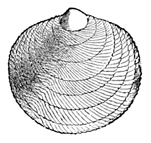
Lucina dentata.
L. californica. The best-known California species of this genus. It is pure white, with fine concentric lines, and varies in size from one half of an inch to one and a half inches in diameter. The lateral teeth are the stronger, and the lunule is upon the right valve only. With these exceptions this species preserves the usual characters of this genus.
L. nuttallii, belonging to the southern shores of California, is decussated like fine wickerwork. The shell is flattened and ridged along the hinge-margin. The color is white. Diameter about one inch in large specimens. (Plate LXXX.)
Genus Loripes
L. edentula. A species which is seldom captured alive. Its home is in the open sea, but vast quantities of its valves are occasionally thrown upon the beaches south of Hatteras, as far as the Gulf of Mexico. On account of the weak hinge ligament, the valves become easily separated, and it is not always easy to find two that will exactly match. Loripes preserves the same circular outlines as Lucina, but is more ventricose, and the hinge and teeth are very feeble. This species is a little over two inches in length and slightly under two inches in height. It is pure white without, and is finely striated with growth-lines; bright orange within, especially about the pallial line and muscle-scars. (Plate LXXX.)
Family TELLINIDÆ
Genus Tellina
If we should create an aristocracy of beauty among the bivalves, as has been done by conchologists among the gasteropods, this family would deserve high rank. Most of the American species of Tellina are too small to impress one very greatly with their beauty, but in the West Indies and in the tropical Pacific waters are some wonderfully handsome shells belonging to this or to the allied genus Macoma. However, we have in Florida the very striking T. radiata, a truly beautiful shell, which, were it less common, would be highly prized in collections. Rarity, no doubt, adds a wonderful luster to shells as well as to gems. The [pg444] animal of Tellina has long, slender siphons, which are separate. The gills are small, and the outer lamella or branchial fold is directed dorsally. Although the foot shows evidences of a byssogenous gland, there is no actual byssus. The shells are porcelanous and translucent, equivalve, with an external ligament, and at least two cardinal teeth in each valve.
T. radiata. This species varies from three to four inches in length, and from one and a half to one and three fourths inches in height. It is highly polished, shining white, and yellowish about the umbonal region, and has three wide rays of bright pink extending from the beaks to the ventral margin. On account of its remarkable coloration it is called the "setting-sun shell." Its surface is smooth. A common variety is of a uniform creamy-white color with carnation beaks. This shell is always offered for sale by the marine curio- and shell-dealers in Florida seaside resorts, and at Atlantic City, Cape May, and elsewhere.
T. alternata resembles the last in shape, being flattish and oblong, but it is more pointed or angulated posteriorly. There is also a slight twist in the posterior end of the shell. Its surface is decorated by numerous impressed concentric lines. The color is uniformly white or yellowish, with pink rays. Length two and a half to three inches; height two and a half inches. Found from Hatteras to the Gulf of Mexico, in shallow, sandy stations and on beaches after storms. (Plate LXXXI.)
T. bodegensis. The most striking species of Tellina found on the west coast, and of rather northern range. It is about two inches in length, creamy-white in color, and ornamented with very fine concentric lines. A very characteristic feature of the genus is present in this species as in the last, namely, a slight twist or bend to one side in the posterior end of the shell.
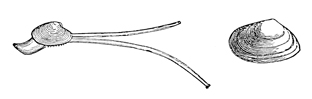
Tellina tenera, showing extended animal. Tellina tenera.
T. tenera. A little Tellina found in New England waters, which, though very small, is worthy of mention on account of its abundance upon all our beaches north of Hatteras. It is only about half an inch long, and slightly over one quarter of an inch high. It may be distinguished by its general generic characters, its iridescent surface, and its delicately marked lines of growth; sometimes it is rose-tinted. Its remarkably long siphons are shown in the accompanying figure.
Genus Macoma
M. secta. A very pretty thin glossy shell from two to three inches in length and about one fourth less in height, which occurs from Monterey southward. The posterior end of the shell is contracted and slightly bent; the pallial sinus is deep. There is an external ligament. (Plate LXXXI.)
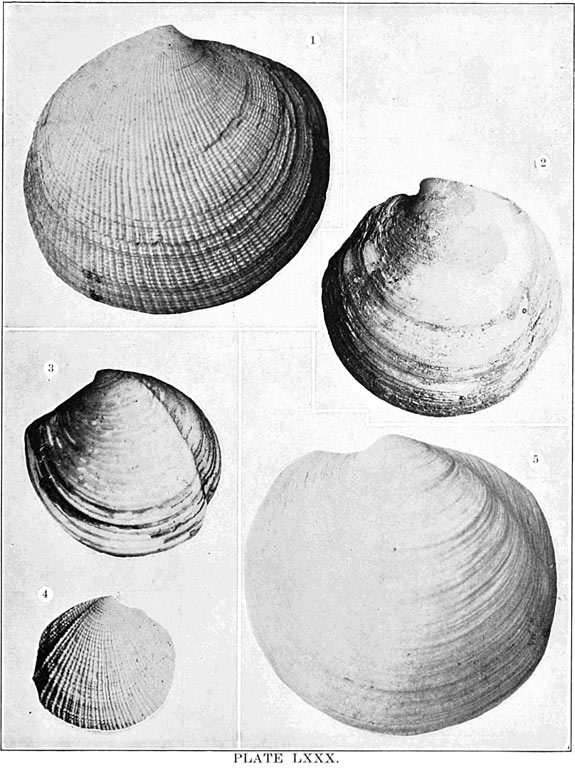
PLATE LXXX.
1, Lucina tigrina. 3, Lucina pennsylvanica.
2, Lucina floridana. 4, Lucina nuttallii.
5, Loripes edentula.
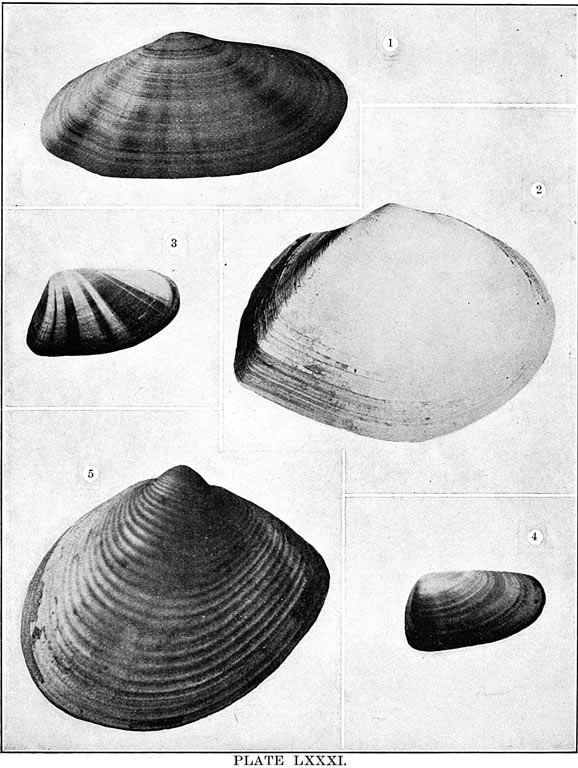
PLATE LXXXI.
1, Tellina alternata. 3, Donax variabilis.
2, Macoma secta. 4, Donax californicus.
5, Ræta canaliculata.
M. nasuta. Another Californian species, with a less shining surface and a very thin light-brownish epidermis. The twisting of the posterior [pg445] margin is striking. It has very fine cardinal teeth. Length two to three inches.
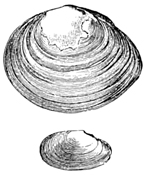
Macoma baltica.
Macoma tenta.
M. baltica, M. proximo, M. tenta. The first two of these species are dingy in color, and are covered with a dirty-looking, thin epidermis. The first has a wide range to Norway and Scotland, and is exceedingly common all along our coast from Maine to Georgia. It occurs plentifully in the Hudson River above New York, and in all sandy or muddy bays. It is rounded in outline, while the next species (M. proxima) is more pointed posteriorly. When these species are buried in the sand their two long, slender siphons project above, one supplying the animal with a constant current of fresh water, and the other ejecting that which, having passed the gills and labial palps, is exhausted of its air and nutriment and contaminated by waste products. M. tenta is white, with very fine lines of growth, and polished and shining within. It is warped posteriorly. Length three fifths of an inch; height two fifths of an inch.
Family DONACIDÆ
Genus Donax
The Donacidæ are represented upon our coasts by comparatively few species, all belonging to the genus Donax. The shells are under an inch in length, and have a peculiarly shortened anterior portion; thus they are inequilateral. Their ventral margins are finely denticulate. The pallial sinus is deep. There are two or three cardinal teeth and a variable number of laterals.
D. variabilis. This little shell, the common Floridian form, exhibits every imaginable scheme of color-combination, and defies general or comprehensive description. Probably the most usual pattern developed is a bluish-white background with purplish radiating lines. Another is a pure-white foundation with red lines. The surface is striated longitudinally with excessively fine riblets. Length one half of an inch or slightly more. In March and April these shells are thrown alive in millions upon the Florida beaches. Each wave seems to be laden with them, and when the foaming waters of each spent breaker recede, the little shells lie still upon the sand for a moment, glittering like jewels in the sunlight; then, with a sudden protrusion of the foot and a quick turn, they all disappear like a flash, buried in the sand before the next breaker strikes them. One must be very quick to catch these active little mollusks. (Plate LXXXI.)
D. californicus. Professor Keep very aptly describes this shell, which is very common in California, as "short and stumpy, cut nearly square off at one end (anterior), and tapering to a rounded edge at the other." The same description fits both this and the Floridian D. variabilis so well that the two forms may be one and the same species. [pg446] If they were shells of arctic range it would be easier to connect them; but as neither is a cold-water form, it becomes more difficult to place them under one name. The increasing number of similar species being found upon the Atlantic and Pacific sides of Central America points almost conclusively to the existence of a waterway between the two oceans, somewhere between North and South America, at no very remote geological period. Possibly the closing of some such waterway through the isthmus connecting the oceans has separated these forms geographically, thus leading us to separate them specifically. (Plate LXXXI.)
Family MACTRIDÆ
This is a very large family of universal distribution and with a great number of genera and subgenera, rather confusedly gathered into subfamilies. The dominant genus Mactra comprises the largest bivalve upon the east coast of the United States.
Genus Mactra
The mactras live in the sand near the margin of the water, often upon the exposed open coast. The mantle is open, except where it is fused to form the siphons. These are short and united. The outer gill is dorsally directed; that is to say, it does not depend into the mantle cavity as does the inner gill, but projects just the other way; it is also smaller than the inner one. The foot is strong, bent, and tongue-shaped, and no doubt well adapted to the rough life in the surf and the heavy, shifting sands. The main characteristic of the mactra shell is the prominent triangular-shaped fossette, or cartilage plate, situated internally and just under the beaks. The shells are equivalve, and devoid of bright colors or striking sculptural features. Internally the pallial line is plain, and the sinus well marked but not deep.
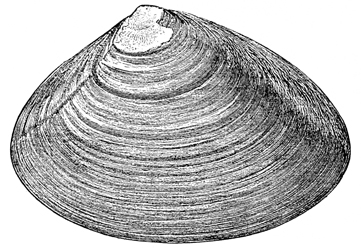
Mactra solidissima.
M. solidissima is one of the very commonest, if not the commonest large bivalve of the New England, Long Island, and New Jersey [pg447] beaches. It is covered with a thin brownish or straw-colored epidermis, usually more or less worn away in adult specimens and wholly absent from the dead valves found upon the beaches. There is a fragile V-shaped cardinal tooth, which is generally broken away in forcing open the valves; the lateral teeth are long and thin, and striated on their receiving surfaces. The length of this "giant clam" is from four to seven inches. This is the first shell the collector will find (north of Hatteras) when he goes to an open, sandy beach.
M. similis. A small variety of the species last described, of similar outline, but less heavy and strong. Its range is from Hatteras southward to Brazil. Passing from New Jersey to Hatteras, Mactra solidissima diminishes in size, and after passing that faunal barrier the Northern form is entirely replaced by this Southern variety. The shell is brighter, though not exactly bright-shining. Its habits are entirely similar to those of the Northern form. On the west coast of Florida it is the most abundant bivalve upon the beaches.
M. ovalis. A species of Northern range, which so greatly resembles M. solidissima as to suggest identity; but the lateral teeth are smooth and not striated, while the shell itself seldom attains a length of over four inches.
Mactra lateralis.
M. lateralis. An exceedingly common shell, found in all the salt-marshes and tidal estuaries of our coast. It is much smaller than the mactras just described, being not over one half of an inch in length. It is white, and is covered with a dirty brown epidermis; the hinge is strong, with deep cartilage fossette and a V-shaped marginal tooth. The laterals are long and slender. The animal has a strong foot and two slender, long siphons which are yellow in color.
Genus Ræta
R. (Labiosa) canaliculata. In this species the cartilage fossette is the same as in Mactra; the marginal teeth are feeble, and there are no laterals. The shells of Mactra which we have examined are heavy or at least solid, but Ræta is thin and fragile; it is pure white in color and is gracefully ornamented by concentric raised ribs. The shell is inflated and gapes slightly posteriorly; it is shining white within and is deeply grooved concentrically in accordance with the external ribs. Length two and a half, height two inches. From Hatteras to Mexico, this is one of the commoner beach shells, but since, as in some other species already named, the hinge ligament and teeth are feeble, the valves become separated by the buffeting of the waves, and are cast disjointed and singly upon the beaches. (Plate LXXXI.)
Family VENERIDÆ
In many respects this is the most distinguished pelecypod family. It is the largest in number of genera and species, is of world-wide distribution, and supplies to hungry man a number [pg448] of comestible species. Several of its genera have been named after various goddesses and nymphs on account of the great beauty of their shells. But from a purely biological point of view also the Veneridæ have claims to distinction, for they seem to represent about the highest type of shell-development among the bivalves. The test is extremely hard and often porcelanous. It is solid without being ponderous and unwieldy in the sense of causing the animal to be helplessly overburdened by the sheer weight of its shell. The valves are equal and have three stout cardinal teeth. The foot is strong, the animal is active, the siphons are free or partially united, and the gills are more or less crumpled and folded. There is a compactness and well-regulated arrangement of the organs in the Veneridæ, which impress one who has examined the anatomy of many pelecypods much as a well-built, efficient, and space-economizing machine would impress a mechanic. None of the organs are weak or crowded out to furnish room for the undue or awkward development of other organs. A good balance is preserved between them all, the result being a high type of pelecypod.
If we do not expect to find any of the more remarkable forms of the Veneridæ upon our shores we shall be the less disappointed when returning from collecting-expeditions. Nevertheless, there are a few species of Cytherea, Dosinia, and Tivela in North American waters which are very handsome shells; but those of our species which are included under the generic name Venus are in point of beauty not worthy of their promising name.
Genus Venus
V. mercenaria. This is the common "hard-shell clam," the "Little Neck" of the hotels and restaurants, with which every one in New York and New England is familiar. The species ranges from Cape Cod to Florida, and occupies two different kinds of station: one in shallow muddy bays near low-tide mark, in estuaries, etc.; the other the sandy stations in open deeper bays or the open ocean. Those coming from "outside" have thinner, more delicate shells, with thin, concentric ribs. They burrow in the sand or mud, or crawl quite rapidly. The siphons are short and are united almost to their ends. The mantle is open (save for the siphons), and the edges are delicately frilled. In the United States this species is very extensively gathered for the markets. When the oyster season closes in April, the hard-shell clam comes into vogue, the season lasting until September or October. The clams are [pg449] extensively gathered in the estuaries from Cape May to Cape Cod. Men armed with rakes drift about in small boats and fish the sluggish creatures up out of the mud. They will live for many days out of water if kept in a cool place. Smaller or immature clams are better for the table, since they are not so tough as their elders. A few features of the shell of this species are noticeable—the rather prominent umbones directed forward, the heart-shaped lunule, the external ligament, the concentric sculpturing of growth-lines, the pure-white interior (with occasionally violet zones about the muscle-scars and margin), the three stout cardinal teeth, the sharp-angled pallial sinus, and the ventral margin finely crenulated within. The greatest length is about three inches and the height two and a half inches, but these dimensions exceed those of the clams usually served upon the half-shell. V. mercenaria ranges into Florida, increasing in size and bulk as it meets the warmer waters of the Gulf Stream. The Floridian form has received the varietal name of mortoni. This massive clam sometimes weighs five pounds, and is fully six inches in diameter. Aside from its great size and thickness, the characters of the shell are wholly those of the smaller Northern form. It is abundant in shallow, muddy, brackish bays, and is gathered by men who "tread out" the clams, feeling for them in the mud and sand with bare feet. The flesh is tough and disagreeably strong, yet the natives appear to relish it, especially when it is made into a chowder.
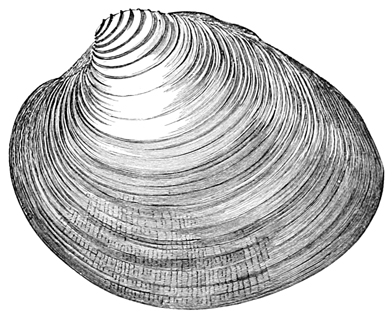
Venus mercenaria, typical form.
V. cancellata. The most abundant species of Venus in Florida, particularly near Tampa and on the west side. It preserves all the characteristics of the genus, and is decorated with a series of high, narrow, concentric ridges, between which are much smaller and more numerous radiating riblets. The color is dirty white to light yellow-brown without, and white and violet within. There are three cardinal teeth and no laterals. The lunule is heart-shaped; the posterior margin is broadened into a wide, concave area into which the concentric ridges do not pass. Length one to one and a fourth inches; height the same. Sometimes the beaches in Florida will in places be banked up with the valves of this very abundant Venus. As they live in shallow water upon sandy stations, they are easily dislodged by the heavy storms which sometimes sweep that usually placid coast. (Plate LXXXII.) [pg450]
Genus Cytherea
C. (Callista) gigantea. One of the most beautiful Floridian shells. It is nearly or quite six inches long and about three and a fourth inches in height. The shell is porcelanous, is covered with a pinkish, livid epidermis, and is decorated with numerous longitudinal color-rays of lilac. The rays are usually broken and interrupted. Within it is china-white, and has a deep pallial sinus. It is very abundant on the west coast of Florida, at Sanibel Island, Egmont Key, Lake Worth, and on beaches. (Plate LXXXII.)
C. maculata. This species is more oval in outline than the last. It is of a fawn-color, blotched or waved with violet-brown, and is porcelanous and shining. The epidermis is also shining and corneous. Within it is china-white in color. The pallial sinus is very deep and wide. Length two and a half to three inches; height one and a half to two inches. This also is a shell to be looked for upon the beach after storms, but it will probably not be seen on the east coast of Florida, although it occurs on the Keys and also at Hatteras. Both of the species have been used as food, but not very extensively. The flesh is not lacking in tenderness, but it has a peppery taste. (Plate LXXXII.)
Genus Dosinia
There are two species of this very graceful genus of Veneridæ south of Hatteras, D. discus and D. elegans. These dosinias have united siphons. The foot is very large and strong, and the mantle margin is both papillaceous and plicated. The shells of these two species are about three or three and a half inches in length and of the same height, and are very flat. The ventral margin is almost a perfect circle, and the beaks are small and pointed. The lunule is small and cordate; the valves are very gracefully sculptured in fine, regular, impressed, concentric striæ, which are finer and less elevated in D. discus than in D. elegans; the shell is porcelanous and white, and is covered by a straw-colored, very fine, transparent epidermis. Within, the strong cardinal teeth are placed upon a long fossette. There is a deep pallial sinus. D. discus is characteristic of the east coast of Florida, while D. elegans is only found upon the west side of the State. Both may be looked for upon the beach, though living specimens must be captured with the dredge. (Plate LXXXII.)
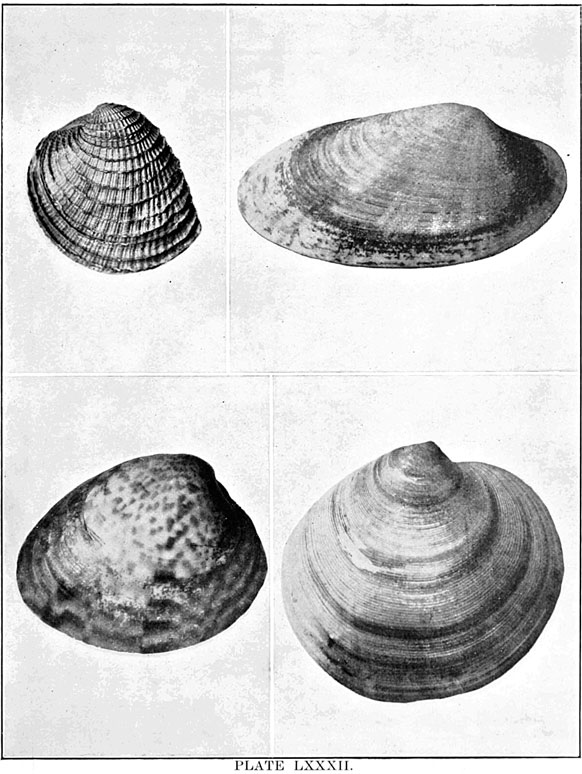
PLATE LXXXII.
Venus cancellata. Cytherea (Callista) gigantea.
Cytherea (Callista) maculata. Dosinia discus.
Genus Tivela
The coast of California is also favored by the Veneridæ, a number of large species belonging to several genera being present.
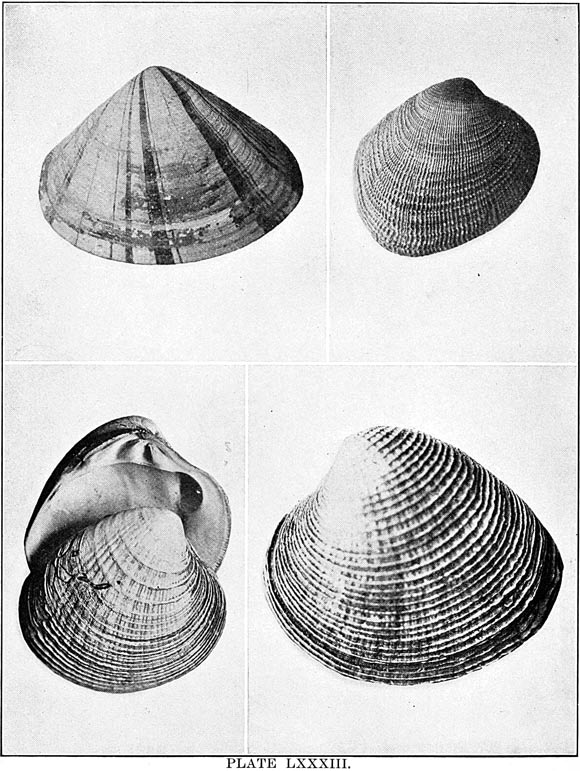
PLATE LXXXIII.
Tivela crassatelloides, one half natural size. Tapes laciniata, one half natural size.
Chione succincta. Chione simillima.
T. crassatelloides. Perhaps the largest and finest of the California species. It is so common in its between-tides station that it used to be collected by plowing a furrow through the sand, the big shells being thrown out upon either side like potatoes. The shells attain a length of five and a half inches, and are porcelanous, thick, and heavy. The margins of the valves are also thick and rounded. The exterior is perfectly smooth, yellowish-white in color, and decorated [pg451] with purplish rays arranged in various groupings; over all is a glossy epidermis. The hinge-teeth are very strong, and a prominent anterior lateral tooth on the left valve is noticeable. There is an external ligament; the pallial sinus is well marked, but not very deep. (Plate LXXXIII.)
Genus Chione
There are three species on the west coast. This genus is very closely allied to Venus, and is considered by many to be only a subgenus of the latter. All three species are white, solid, heavy shells which exhibit the same scheme of sculpturing, namely, numerous longitudinal ribs crossed by larger and less frequent concentric ridges.
C. simillima is shaped almost exactly like the east-coast Venus cancellata, but its concentric ridges are very numerous and sharp. There is a strongly marked cordate lunule, and hardly any pallial sinus. Length one and a half to two inches. (Plate LXXXIII.)
C. succincta has fewer concentric ridges and has a large lunule. There are purple zones within and touching the heavy cardinal teeth. Length two and a half inches. (Plate LXXXIII.)
C. fluctifraga has broad but flatter or well-rounded (not sharp) concentric ridges, no lunule, a small ligament, a fairly deep pallial sinus, and a finely crenulated margin (within) all around the valves, except when interrupted by the hinge ligament. The shell is solid and shining, and marked by deep-purple zones within. Length one to two inches. Found in southern California.
Genus Tapes
This is a prominent genus of the Veneridæ. Its chief feature is the total want of lateral teeth. There are several large species in California.
T. staminea, T. laciniata. These are the most noticeable species. The former is sold in the San Francisco markets as the "hard-shell clam." The shell of this species is from two to three inches in length and of somewhat less height, rounded, and heavy. The sculpturing consists of radiating ribs traversed by strongly marked growth-lines. The teeth are strong, and the pallial sinus is deep. T. laciniata is much like the last, but its surface is reticulated by a crisscross design that is very striking. It also has a deep pallial sinus. These two species are of Southern range. They burrow in gravelly places, among stones, between tide-marks, and their presence may frequently be detected when walking along the beach at low tide by seeing a sudden jet of water ejected from a little hole in the mud or gravel. The animal, becoming alarmed at the approach of something, suddenly snaps shut its valves, and thus forces out some water through its siphons. The foot is very strong and often byssiferous in this genus. (Plate LXXXIII.) [pg452]
Genus Saxidomus
S. nuttallii. The last of the larger west-coast Veneridæ which we shall examine. The genus is very closely allied to Tapes, and no doubt might better be considered as its subgenus. The shell is brownish-white, three to four inches in length, and heavy, rough, and coarse-looking, with irregular concentric ridges. There is no lunule, but a large external ligament is very prominent just back of the beaks. Within it is white, with a deep pallial sinus. Just below the ligament area is a zone of translucent, agate-like shell-structure. This large clam, with several others of the same genus, lives in shallow water near shore.
Family PETRICOLIDÆ
Genus Petricola
P. pholadiformis. Along the Jersey coast, especially about Atlantic City, there are small patches of clay or hard tenacious mud which lie just at the edge of the sea. As the beating of the surf gradually encroaches upon these hard fragments of once extensive clay-beds, many specimens of this curious bivalve mollusk are washed out from their burrows in this clay and cast upon the sandy beach. The animal has long siphons which are united about one third of the way to their ends. Although this creature is allied to the Veneridæ, the degree of mantle fusion present is much greater, leaving in this case only a fairly long slit through which the foot may protrude. The shell is very dissimilar to that of any of the Veneridæ, and in many respects, judging from a conventional standard, is a remarkable form. It is exceedingly thin, is of a chalky texture, gapes widely posteriorly, and is ornamented with transverse ribs, which are feeble upon the long produced posterior portion of the shell, but strong in the anterior part, where they are crossed by the coarse lines of growth, which appear like vaulted scales upon the ribs. The color is a dull white. There are two cardinals in each valve and no laterals. Length one and a quarter to two and a half inches; height one half to three quarters of an inch. This species passes its entire life in the burrow it has made for itself in the clay. Its only motions are made in climbing to the entrance of its burrow or in retreating far out of sight within its depths. Its siphons are tipped with a dark or drab color as a measure of protection from the predaceous crabs which range about the mud surfaces near tidal marks, and are always upon the lookout for succulent bits of flesh.
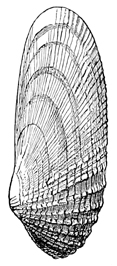
Petricola pholadiformis.
P. carditoides. A petricola of the Californian coast, very similar in its habits to the east-coast form. It bores, however, not only into clay, but also into soft rocks in order to effect a permanent lodgment. Often this species occupies a hole which it has discovered already existing; in this case its shell grows to fit the surroundings. The hinge-teeth, and sculpturing are frequently reduced and sometimes are quite obsolete; but the shell has the chalky, thin texture that is characteristic of the genus. [pg453]
There is another family of rock- and mud-boring bivalves which superficially resemble the petricolas, but their anatomical organization removes them to a little distance from the Petricolidæ. They are considered further on, under the name of Pholadidæ.
Family CARDIIDÆ
Genus Cardium
This is another important family of the Pelecypoda, which, with the Veneridæ, the Mactridæ, and the Tellinidæ, is entitled to distinction on account of its high organization, its high type of shell, its universal geographical distribution, and its great beauty. The dominant genus is Cardium—a name given on account of the fact that the shell is shaped like a heart. The animal has a very long, recurved, and surprisingly strong foot. The mantle-edges are quite freely open to the siphonal region and are highly papillate and waved. The siphons are usually very short, but have wide exterior openings and are also strongly papillate about their margins. The gills are obliquely situated, and seem to be thicker and heavier than is usual in pelecypods; they are much folded, the outer lamella being the smaller. With such a pointed foot and such short siphons Cardium is obviously not a deep-burrowing genus; but it does partially bury itself in soft semi-liquid sand. Its progression is effected by leaps which it is enabled to make by reaching far out with its foot, then suddenly twisting to one side and throwing the shell several inches. The shell is ventricose, is closed or gapes slightly posteriorly, and has prominent subcentral umbones and an external ligament. The sculpture-scheme of Cardium (if the shell is not perfectly smooth) is one of radiating ribs or ridges, which, being regular, form a perfect crenulation of the ventral margin. There are two cardinal teeth in the center, and one lateral tooth upon both the anterior and the posterior side: the latter are situated at some little distance from the beaks.
C. magnum. The largest and finest "cockle" of the east coast of the United States. It is, indeed, one of the finest cockles in the world. The almost perfect heart-shape is striking. The posterior side is somewhat flatly depressed. The thirty-three to thirty-seven regularly disposed, broad, radiating ribs; the regularly crenulated margins; the yellowish-brown color garnished with transverse rows of chestnut or [pg454] purple lines or spots; the brownish-purple posterior area—all combine to make this large Cardium a beautiful species. Its length is four inches; height five and a quarter inches. It is a very abundant species on the open Florida beaches, where it is often left exposed and alive at very low tides. (Plate LXXXIV.)
C. isocardia. This also is a Floridian species, of elongated heart-shape and with radiating ribs. It is not more than half as large as the last-described species. The ribs are decorated with erect vaulting scales which are exaggerated portions of growth-lines. The beaks are smaller in proportion than in C. magnum. The shell is brown to straw-color, stained with purplish-brown without, and has a bright salmon-red or purplish-pink interior. The margins are deeply crenulated. The teeth are arranged as in the last-described species. It is very common on the beaches of western Florida. (Plate LXXXIV.)
C. serratum, C. lævigatum. These two species have a perfectly smooth surface, and inflated, globose, heart-shaped shells, and are of a creamy-white color, suffused with a yellowish, golden tint which suggests the color of butter. Some forms are shiny, and citron-yellow and pinkish toward the margins, whence the name of "peach-shell." Height one to two inches. Not uncommon upon Florida beaches. (Plate LXXXIV.)
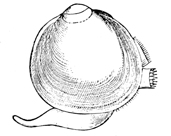
Cardium mortoni, showing extended animal.
C. mortoni. Another of the smooth forms of Cardium (placed in the subgenus Lævicardium). It occurs in Florida and also extends up the coast to Cape Cod, being very abundant in Long Island Sound. In the neighborhood of Martha's Vineyard and along the north shore of Long Island this very pretty little species has been reported as occurring in soft ground even above low-tide mark, near the mouths of creeks. It is enough to say of it that it is a smaller edition of C. lævigatum and may be further distinguished by a purple blotch on the posterior margin, just within the valves, the general color within being bright yellow. In young specimens, zigzag lines of dark fawn-color upon the pale-yellowish background of the smooth exterior surface of the shells are a noticeable feature. The largest specimens measure an inch in length and nearly the same in height. The long cirri upon the siphons are striking.
C. substriatum. A cockle of this inflated, smooth type, which strongly resembles the east-coast form, found upon the Pacific coast. The name indicates that it is not altogether smooth, a fact only revealed, however, by a magnifying-glass. It is about one half of an inch in length, and of a light drab-color, spotted and sometimes radially lined with yellowish-brown. Professor Keep likens this species in both shape and color to a sparrow's egg. (Plate LXXXIV.)
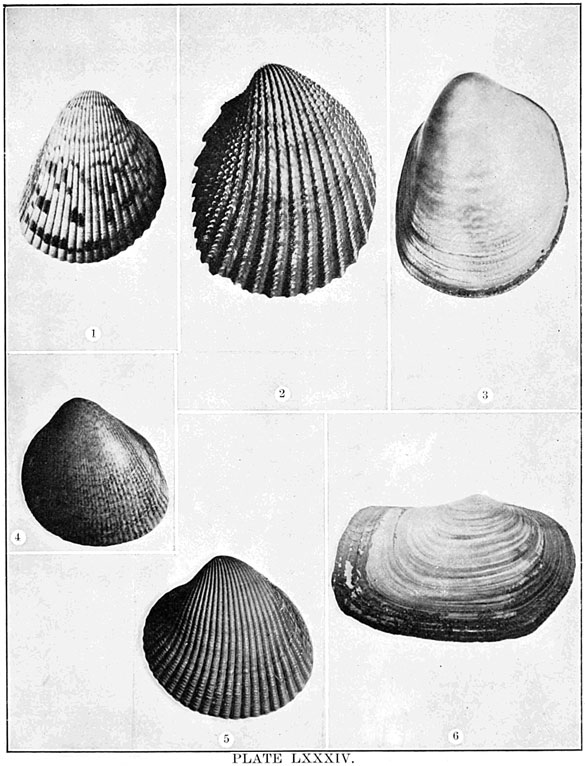
PLATE LXXXIV.
1, Cardium magnum, much reduced. 4, Cardium substriatum, enlarged.
2, Cardium isocardia. 5, Cardium corbis (young specimen).
3, Cardium lævigatum. 6, Glycimeris generosa.
C. elatum. A veritable giant among the cardiums. It is found on the southern Californian coast, though rarely north of the Mexican border. It is of the smooth, glossy type belonging to the subgenus Lævicardium. It attains a diameter of six inches, and is of a creamy-yellow appearance.
C. corbis, C. quadrigenarium. These two Californian cockles are of the ribbed type displayed in the eastern C. magnum and C. isocardia. C. corbis is found in the northern Californian and Puget Sound region, [pg455] and C. quadrigenarium on the southern shores of California. The former is a full, round, heart-shaped shell with about thirty somewhat scaly ribs. The edge of the shell is deeply toothed; the color light brownish; the diameter from two to three inches. It preserves all the features of the genus as regards both shell and anatomical characters. The other species, C. quadrigenarium, very strongly resembles C. magnum in size and shape. It lacks the flattened area on the posterior portion of the shell which is characteristic of the east-coast species, and its uniform brownish-white coloration is less striking. It has about forty regularly spaced, radiating ribs, which are smooth upon the umbonal region, but elsewhere are armed with spiny processes. Diameter about six inches. (Plate LXXXIV.)