Part II MARINE INVERTEBRATES (continued 2)
Reading edition
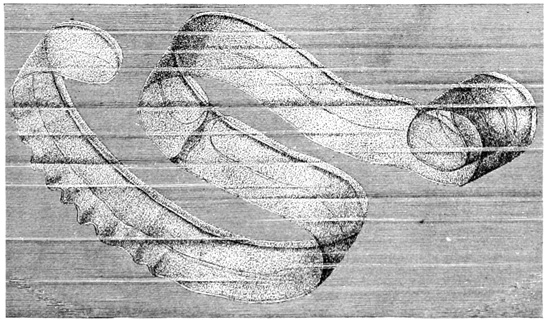
Cestum veneris.
ORDER BEROÏDA
Genus Idyia
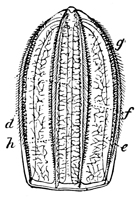
Idyia roseola, half natural size: d, e, f, g, h, rows of locomotive flappers.
I. roseola. This species has an ovate body three to four inches in height and about half as broad. Some individuals are larger. It has [pg158] an eye-spot on the upper rounded side, and at the other end a very large mouth opening into a digestive cavity, which occupies the greater part of the body. A delicate fringe surrounds the area about the eye-spot, and eight rows of cilia run from there to the oral end. It has no tentacles. Idyia is pink and especially highly colored at the spawning-time. Like other jellyfishes, their part in life is finished when they have discharged their spawn, and the first September storms break them to pieces. In July and August they are plentiful on the New England coast. They appear at the surface of the water in the hottest part of the day, but disappear entirely when the water is in the least rough or the weather is cold or the sun overcast. Their movements are slow and graceful, the long axis being carried in a nearly horizontal position. They are exceedingly voracious, feeding chiefly on other Ctenophora, and often swallowing animals as large as themselves.
I. cyanthina. This species, found on the northern Pacific coast, broadens near the center, making it somewhat vase-shaped. Idyopsis Clarkii, a similar genus, found in Florida, is globular. All these species are very beautiful, the rapid movement of the cilia giving them a brilliant iridescence.
III WORMS (PLATYHELMINTHES NEMATHELMINTHES ANNULATA)
TABLE SHOWING THE CLASSIFICATION OF THE WORMS DESCRIBED IN THIS CHAPTER
Phylum PLATYHELMINTHES Class TURBELLARIA Order POLYCLADIDA Genus Planocera P. nebulosa Genus Stylochopsis S. littoralis Genus Leptoplana L. folium Order TRICLADIDA Genus Planaria P. grisea Genus Procerodes P. frequens Genus Bdelloura B. rustica B. candida Genus Fovia F. Warrenii Order RHABDOCŒLIDA Class TREMATODA (External and internal parasites) Class CESTODA (Internal parasites) Class NEMERTINEA Genus Tetrastemma T. arenicola Genus Nemertes N. socialis N. viridis Genus Meckelia M. ingens M. rosea Genus Cerebratulus C. angulatus Genus Cosmocephala C. ochracea Genus Polina P. glutinosa
Phylum NEMATHELMINTHES Class NEMATODA Genus Pontonema P. marinum
Phylum ANNULATA Class CHÆTOPODA Subclass Polychæta Order ERRANTIA Family SYLLIDÆ Family APHRODITIDÆ Genus Polynoë P. squamata P. sublevis Genus Harmothoë H. imbricata Genus Aphrodite A. aculeata Family PHYLLODOCIDÆ Genus Phyllodoce P. gracilis Family NEREIDÆ Genus Nereis N. virens N. pelagica N. limbata Family NEPHTHYDIDÆ Genus Nephthys N. ingens N. picta Family EUNICIDÆ Genus Marphysa M. sanguinea Genus Diopatra D. cuprea Genus Arabella A. opalina Genus Lumbriconereis L. tenuis Family GLYCERIDÆ Genus Glycera G. americana G. dibranchiata Order SEDENTARIA or TUBICOLA Family SPIONIDÆ Genus Nerine N. agilis N. coniocephala Family CIRRATULIDÆ Genus Cirratulus C. grandis Family TEREBELLIDÆ Genus Thelepsus T. cincinnatus Genus Amphitrite A. ornata Genus Polycirrus P. eximius Genus Chœtobranchus C. sanguineus Family AMPHICTENIDÆ Genus Cistenides C. Gouldii Family MALDANIDÆ Genus Clymenella C. torquata Genus Maldane M. elongata Family ARENICOLIDÆ Genus Arenicola A. marina Family SABELLIDÆ Genus Sabella S. microphthalma Family SERPULIDÆ Genus Serpula S. dianthus Genus Spirorbis S. borealis Subclass Oligochæta (Mostly terrestrial or fresh-water forms) Class GEPHYREA Order SIPUNCULOIDEA Genus Sipunculus S. nudus Genus Phascolosoma P. Gouldii Class HIRUDINEA (Leeches)
WORMS
toc
Burrowing in sand and mud, lying under stones and in crevices of rocks, concealed in various kinds of tubular cases which are free or attached to stones or shells, crawling over the ground or seaweeds, swimming free or attached to other animals, is found in abundance a class of animals commonly known as "worms," and generally regarded as repulsive creatures unworthy of attention.
To the biologist, however, worms are among the most interesting forms of lower animal life. The amateur collector, if he stops to give them careful consideration, will probably find them unexpectedly interesting, and will be surprised to find how many varieties of them there are, and how different they are from his preconceived notion of them. Worms are varied in structure, their habits are strange, and their form and color often beautiful. Although plentiful, they are not conspicuous, but are easily found if search is made for them, and so large a class of shore animals should not be passed by unnoticed. Unusual biological interest is attached to this group because, in the different types, affinities with other classes of animals are found, suggesting, perhaps, connecting-links with higher organizations. They are the first animals to show definite bilateral symmetry, or two similar sides, and to carry the same part of the body always in front. Formerly one division, called Vermes, comprised all the worms. To-day they are separated into four divisions, or phyla. The most careless observer easily recognizes the basis of separation, for the flatworms, the round- or threadworms, the wheel-like animalcules, and the jointed worms have very obvious differences. The names given the phyla express these distinctions, the termination [pg164] meaning "worm"; the prefixes Platy-, Nemat-, Troc-, meaning "flat," "thread," "wheel," respectively; while Annulata, meaning "ringed," describes the segmented forms belonging to that phylum.
There are vast numbers of parasitic worms, which live internally or externally on their hosts, there being no animal of land or sea, of high or low degree, which is not subject to the affliction of these visitors. The parasitic worms are degenerate, some being without digestive organs, or without eyes, or without locomotor organs, and so on, as the case may be, the host supplying the missing function. The life-history of these low forms is interesting; but parasitic worms do not come within the scope of this book, and are mentioned only to mark their place in the series.
PHYLUM PLATYHELMINTHES FLATWORMS
toc
The flatworms have a flattened body, more or less compressed in the different classes. Ordinarily the body is very thin, and, when short, has a leaf-like form; when long it is ribbon-like. Some species are thick in the middle and thin at the edges. They have a dorsal, or upper, and a ventral, or under, surface; a right and a left side; an anterior and a posterior end. The anterior end is carried forward and has some of the characteristics of a head, though a distinct head is not apparent. The mouth is on the ventral surface. In some species it is in the middle of the length of the body; in others it is before or behind this point.
The flatworms are the first animals to assume pronounced bilateral symmetry. They are soft-bodied, having no supporting skeleton, and they have no segments, or divisions, such as are found in higher types, as in Annulata. They have no body-cavity, the space between the organs and the body-wall being filled with tissue. The alimentary canal has no anal aperture, the excretions being carried off by a water-vascular system consisting of branching vessels which end in minute bundles of vibrating cilia, called ciliary flames. These flames communicate with the exterior through small pores or flame-cells. Their sense-organs are eyes [pg165] and otocysts. The latter are sacs containing crystals of carbonate of lime, and their function is supposed to be that of hearing.
The flatworms are hermaphroditic, and their propagation is by means of eggs. They are numerous and very generally distributed, occurring in fresh and salt water, on land and shore, on the surface and in the depths of the sea. A vast number also are parasites and infest, internally or externally, nearly every living creature. The parasitic forms differ anatomically from the free-living worms. The internal parasites, living by absorption of the digested food of their hosts, have no digestive organs; they are also devoid of organs of sense and of defense. The external parasites, being carried about by their hosts, are without organs of locomotion.
CLASS TURBELLARIA
The turbellarians are the simplest group of bilateral animals and occupy the lowest place among worms. They owe their name to the fact that they are covered with cilia, which are constantly in motion and cause a slight turbulence in the water around them.
ORDER POLYCLADIDA ("Many-branched")
The polyclads are found below half-tide mark on the under side of stones and on seaweeds. Sometimes they are found swimming about at night. They are leaf-like in form, one inch to two inches in length, and are very thin and delicate. They adapt themselves to the inequalities of the surfaces to which they attach themselves, and often are of the same color, and therefore are so inconspicuous that they are apt to escape notice. They move with a gliding motion over surfaces, and often swim when in search of food.
The intestine is much branched and has no anal aperture. From the mouth, which is placed in the center of the ventral surface, a pharynx, or muscular fold, is protruded in some species, which enables the worm to attach itself to and consume prey of considerable size. After digestion has taken place, the fecal [pg166] matter collects in the main intestine and is forcibly ejected by the pharynx. Numerous eyes are collected in groups on the anterior dorsal surface, or arranged around the margin of the body. The eggs are laid in shell-like cases, and cemented together in plate-like masses or in spirals, and attached to shells or stones. (Plate XLVIII.)
Genus Planocera
P. nebulosa. One half of an inch wide and three quarters of an inch long, circular or elliptical in shape; very flat and thin; olive-green on the dorsal surface, with a line of darker color on the posterior end, and whitish retractile tentacles on the back. Found creeping on under side of stones in tide-pools.
Genus Stylochopsis
S. littoralis. About one half of an inch long; changeable in form, from broad oval to elliptical; color pale green, veined with a lighter shade on the dorsal side, flesh-colored on the ventral surface; numerous eyes arranged in irregular rows near the margin and in groups in front of the tentacles, also clusters of eyes on the tentacles. Found under stones between tide-marks.
Genus Leptoplana
L. folium. Body flat; margin thin and undulated; shape leaf-like, but changeable; about one inch long and one half of an inch wide; color pale yellow, veined with a deeper shade; eyes in four groups near the anterior end.
ORDER TRICLADIDA ("Three-branched")
The triclads are divided into three groups: those of the fresh-water ponds and streams, those of the land and sea, known as planarians, and those of the sea. The planarians are the most interesting worms in the order. The triclads differ from the polyclads in being elongate in form and in having the intestine in three branches instead of in many. The mouth is midway in the length of the body, on the ventral side, and from it protrudes a pharynx, which is cylindrical or bell-shaped, and is capable of great dilatation. With the pharynx the worm, which is wholly carnivorous, envelops other worms, crustaceans, or any animal food. Several species are found on the under side of stones in tide-pools.
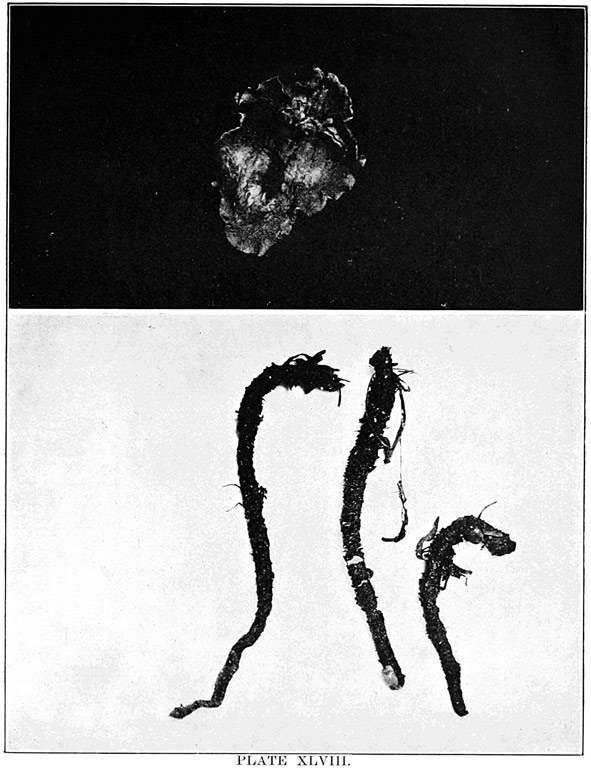
PLATE XLVIII.
Polyclad worm.
Worm-tubes of Diopatra.
Genus Planaria
P. grisea. Oval or elliptical in form; anterior end truncate; posterior end rounded; color yellow or gray, with a light stripe; two black eyes surrounded with white; length one half to three quarters of an inch; width about one eighth of an inch. Found under stones between tide-marks.
Genus Procerodes
P. frequens. One eighth of an inch long; brown or black above, gray below; has two kidney-shaped eyes; active and abundant. Found under stones near high-water mark.
Genus Bdelloura
B. rustica. Body milk-white, smooth, thin. Found on Ulva latissima (sea-lettuce).
B. candida. Parasitic on the gills of the horseshoe-crab.
Genus Fovia
F. Warrenii. Bright red, narrow, oblong. Found on eel-grass.
ORDER RHABDOCŒLIDA
Minute, active worms found among the red seaweeds. They are brown in color, and are marked by one or more transverse white bars.
CLASS NEMERTINEA
The nemerteans are long, narrow, flat, smooth worms, and vary from one half of an inch to many feet in length. They are exceedingly contractile, and when alarmed can shrink to less than half their normal length. They are very generally distributed, and are to be found between tide-marks, in loose coils like a string, under stones on sandy and muddy shores. The very long species, like Lineus marinus, are solitary, but other smaller species are gregarious, many worms being coiled together in tangled masses. Some species are to be found in empty shells, and others live among the seaweeds. They are very slimy, the epidermis secreting an abundance of mucus, and they can often be tracked by the trail of slime they leave behind them. This mucus sometimes hardens, forming for some species a tubular [pg168] covering; others remain naked. All are covered with vibrating cilia, which is a universal feature of flatworms. In color they may be white, yellow, green, red, purple, etc., and sometimes they are banded or striped with a contrasting color. The ventral is usually lighter than the dorsal surface.
The principal characteristic of the nemertean worms is a long thread-like organ, known as the proboscis. This lies in a sheath along the center of the dorsal surface, and is quickly thrown out to a great length, and as quickly completely withdrawn within the body. The proboscis is slender, hollow, muscular, and full of nerves. It reaches the outside through a pore at the anterior end of the body, and has no connection with the alimentary system. It is used as a feeler and as a weapon. Some species have a sharp spine at the end of the proboscis, others have stinging-cells. The proboscis is sometimes so forcibly ejected that it breaks off, in which case it retains its vitality for some time, and seems as if it were itself a worm. A new proboscis is quickly grown by the worm to take the place of a lost one. The head is a little broader than the body, and has eyes arranged in one or several pairs on each side. The mouth is on the ventral surface, near the anterior end, has thick lips, and is very dilatable. Through the mouth the animal ejects a part of the esophagus and envelops its prey, which is often of considerable size. Chætopod worms they often swallow whole; the soft parts, after being digested, are carried off through the regular passages, ending in the ciliary flames (page 164), while the indigestible parts are ejected at the anus. Often the spines and bristles find their way out by perforating the intestine and the body-wall, without apparently doing the worm any injury. The perforated parts quickly heal.
These worms have the strange power of regenerating lost parts; mutilated portions are soon repaired. The anterior end, when severed from the rest of the body, grows again into a complete individual, while the posterior end continues to perform part of its functions and retains its vitality for a considerable time before dying. One species, Lineus sanguineus, is capable, after being broken in pieces, of regenerating each section into a perfect worm. [pg169]
The nemerteans are carnivorous, voracious, and often cannibalistic. They will live for some time in confinement, losing, however, their bright color, and the smaller worms will gradually disappear, as they are devoured by the larger ones. The mode of locomotion varies with the order. Some species attach their long proboscis to a distant object, then drag the body to it; some glide rapidly along by means of the muscles of the body and the cilia which cover it; others swim. The swimming forms have thin edges which have a wave-like motion, and this, together with a lateral movement of the tail, propels them through the water. In some species the worm develops directly from the egg; others pass through a larval stage before reaching maturity.
Genus Tetrastemma
T. arenicola. Dark flesh-color or purplish; slender, cylindrical, four to five inches long when extended; head changeable in form and partly distinct from body because of slight constriction at the neck. It lives in sand at low-water mark.
Genus Nemertes
N. socialis. Individuals very slender, five to six inches long when extended; color brown or black, a little lighter underneath; three or four eyes in lines on each side the head. It is abundant under stones on rocky shores, many coiled together, forming large masses.
N. viridis. Color olive-green or brown, crossed by faint pale lines; body changeable in form; when extended, six to eight inches long, one eighth of an inch or less in breadth; row of dark eyes on each side of flat head. Common under stones between tide-marks on northern rocky shores.
Genus Meckelia
M. ingens. One of the largest nemertean worms; found on sandy and muddy shores near low-water mark. The young, from several inches to a foot long, are common. When full-grown some attain the length of twelve or thirteen feet, and are an inch in breadth and quite flat when extended, but can contract to two or three feet in length, and are then nearly cylindrical. This worm, although so soft, penetrates the sand with great rapidity. Its head changes shape constantly and assists the proboscis when burrowing. It is also able to swim. Its color is yellowish or flesh-color, with whitish edges and a central band.
M. rosea. The largest specimens are six to eight inches long and one quarter of an inch broad; lives in burrows on sandy beaches; color red or pink; often covered with sand, which adheres to the mucus which the worm secretes. [pg170]
Genus Cerebratulus
C. angulatus. Olive-green, with light dorsal stripe.
Genus Cosmocephala
C. ochracea. Two to three inches long when extended; gray or yellowish-white, and mottled by the internal organs showing through the translucent body; line of lighter color down the back; anterior end often orange-colored. It is common near low-water mark under stones and in the dead tubes of Serpula.
Genus Polina
P. glutinosa. One to two inches long; color orange or light yellow, with a faint line of deeper color down the center of the dorsal surface; very slimy; eyes numerous, in oblique lines on the head. Found in tide-pools on algæ.
PHYLUM NEMATHELMINTHES ROUNDWORMS
toc
The worms of this phylum have the general name of roundworms, which distinguishes them from the flatworms of the preceding division and from the segmented worms of the Annulata. The body is elongated, cylindrical, smooth, and pointed at both ends. With few exceptions, they are parasitic.
A few of the nematode species are free, living under stones and among seaweeds at about low-water mark.
CLASS NEMATODA
Genus Pontonema
P. marinum. Slender, white, smooth, active, cylindrical; constantly coiling and uncoiling itself.
PHYLUM ANNULATA SEGMENTED WORMS
toc
The name of this phylum expresses the principal characteristic of the group of worms which have elongated bodies composed of series of short parts, or ring-like divisions. Each one of these segments contains a separate and similar set of internal organs. [pg171]
The annelids are divided into four classes, one of which, the Gephyrea, has not the characteristics which distinguish the group. The classes are easily recognized by conspicuous features. Some have bristles; others have scales; others have tentacles around the head and inclose themselves in tubes. Many are highly colored, and all are of great interest to the naturalist from the diversity of their habits, form, and structure, and from the analogies they bear to other and higher types of animals.
The annelids are the highest type of worms, their organs having attained more special functions. The sense-organs of eye and ear are more developed, and the nervous system has distinct centers, or ganglia, the first and largest ganglion being a part of the head. They are found in abundance everywhere. Some species grow to the length of one foot or two feet. Some are carnivorous, others vegetarian, and many are mud-eaters, swallowing sand and mud for the sake of the organisms they contain. They themselves are food for fishes, which devour them in vast quantities, rooting them out of their burrows or capturing them at night, at which time they swim about.
CLASS CHÆTOPODA ("Bristle-footed")
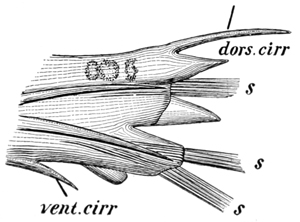
A magnified parapodium of Nereis dumerilii: dors. cirr., dorsal cirrus; vent. cirr., ventral cirrus; s, setæ.
The bristle-worms. This class of worms has bunches of bristles on both sides of each segment of the body, which serve as organs of locomotion, or bristle-feet. The bristles emanate from outgrowths of the body known as parapodia, which are practically limbs. The parapodia are sometimes divided into distinct lobes or branches. The bristles are of various shapes and often of brilliant color. They are usually horny, sometimes simple, sometimes divided into joints, and vary in shape in different genera. The parapodia have, besides the bristles, a second set of [pg172] hair-like appendages, called cirri. These are sense-organs and also have a respiratory function. The cirri too vary in shape in different genera. Generally they are hair-like, but sometimes conical; again they are broadened into scales, as in the Aphroditidæ.
The body-cavity in chætopod worms is divided into a series of chambers or segments. These divisions seem on the exterior like constrictions, and give the body the appearance of a series of rings. The internal organs are repeated in each segment, so that each of the latter contains a portion of the alimentary canal, a pair of nephridia, a pair of nerve-ganglia, and blood-vessels which connect the main blood-vessels running along the dorsal and ventral surfaces. The alimentary canal runs through the body, but is constricted at each joint. The nephridia are curved tubes, which are excretory organs, opening to the outside and carrying off the waste products which have passed into the fluid of the body-cavity.
The chætopod worms have a well-developed nervous system, beginning with a two-lobed ganglion forming a brain and head, then extending through the worm in a double ventral chain and series of ganglia. They have also a blood-vascular system. The blood is either colored or colorless. Sometimes it is a bright red or green, and is often visible through the body-wall. The circulation is effected, not by means of a heart, but by wave-like (peristaltic) contractions of the dorsal blood-vessel. The body is cylindrical, but in many cases is somewhat flattened. There are two layers of muscles, one of which encircles the body, while the other extends parallel with its length. Respiration is effected by gills, which may be simple, hair-like appendages to the parapodia, or branched, or comb-like in form. Sometimes they are confined to the middle segments, as in Arenicola; sometimes to the segments near the head, as in Tubicola; or they may be extended over the whole dorsal surface.
SUBCLASS POLYCHÆTA ("Many-bristled")
The polychæte worms have one or two well-developed parapodia, or limbs, on each side of every segment of the body, and on each [pg173] parapodium is a bunch of bristles, or chætæ. There are hundreds of species of this class of worms, the species being based on the shape and the lobes of the parapodia, the relative length of the cirri, the form and arrangement of the chætæ, and so on. They are abundant on the shore everywhere, but abound where rocks and stones afford them some shelter. Many burrow in the sand and mud. In doing this the worm eats his way into the hole, swallowing the mud and sand. He assimilates the organic or vegetable matter the mud contains, and ejects the rest in cylindrical coils, known as castings, which lie in heaps at the mouth of the burrow. By these castings they may be traced. Others secrete tubes.
The polychæte worms are divided into Errantia, which are wandering, free-swimming forms, and Sedentaria or Tubicola, which live in tubes permanently. These distinctions are not strictly correct, since some species of errant polychætes form tubes (Eunicidæ), and some Sedentaria form no tubes.
Many polychætes are beautifully colored, some in vivid reds and greens, with various markings; some are iridescent; some are phosphorescent.
ORDER ERRANTIA
Carnivorous, free Polychæta, with protrusible pharynx armed with a horny jaw. "They are active, fierce beasts of prey."
Family SYLLIDÆ
This family is the highest in organization of the worms. They are small, the majority being less than an inch in length, and many are minute. They are often highly colored. Many have long cirri on the feet; some have alternation of generation. They are common everywhere along the coast, but are not seen unless searched for. Sponges sometimes are alive with them. They are interesting subjects for microscopic study.
Family APHRODITIDÆ
The scale-bearing annelids. This family of worms is distinguished from all others by having scales on the back. The scales, called elytra, are flattened dorsal cirri carried on the upper parapodia, [pg174] and generally on alternate segments and in a double row down the back. The elytra are the breathing-organs, and, although of a horny texture, are richly supplied with nerves. The worms are short and have a large protrusible pharynx armed with a double pair of horny jaws.
Genus Polynoë
The species of Polynoë are determined by the number of scales they bear. They have a flattened short body with nearly parallel sides. The bristles are of a bright golden color. The proboscis is large and has four powerful jaws at the end and a circle of papillæ at the top. They are sluggish in movement and are found under stones and in the crevices of rocks. When disturbed they roll themselves into a ball.
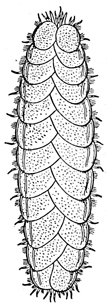
Polynoë squamata.
P. squamata. Twelve pairs of rough scales; color sandy-brown, speckled; one inch to one and a half inches long; the broad, oval scales overlap and entirely cover the body and head. Some Polynoë when disturbed throw off every scale. Very common north of Cape Cod.
P. sublevis. Twelve pairs of smooth scales; usually grayish-brown in color, speckled with dark spots; iridescent; last pair of scales more slender than the others; length one and a quarter inches, breadth about one quarter of an inch.
Genus Harmothoë
H. imbricata. Sixteen pairs of smooth scales; variable in color; usually gray, speckled, or striped.
Genus Aphrodite
A. aculeata. This polychæte, sometimes called the sea-mouse, is one of the most beautiful of worms. It is brightly iridescent in color, from its setæ, which form a fur-like coating over the dorsal surface. It has fifteen pairs of scales, but they are hidden by the numerous setæ. These bristles cover its sides and back. Some are coarse and nearly an inch long, with sharp points, and are barbed near the ends. They curve over the back like the quills of a porcupine. The body is three to six inches long. It is broadest in the middle and tapers to a point. They live in mud below tide-mark, and may be found washed upon the beach after storms. [pg175]
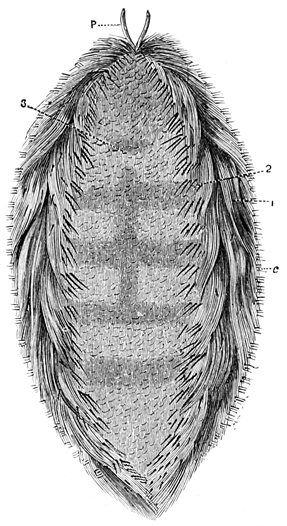
Aphrodite aculeata, natural size: c, neuropodial chætæ; p, palps; 1, iridescent bristles; 2, stiff chætæ; 3, felting bristles of notopodium.
Family PHYLLODOCIDÆ
These animals are commonly known as "paddle-worms," on account of having leaf-like cirri, which they use in locomotion. The head is long and bears four pairs of short and four pairs of long tentacles. The body is long and depressed, sometimes two feet in length, usually eight to twelve inches long. The general color is bright green and iridescent. Found in tide-pools. Specimens are often found by digging in sandy mud, or they may be obtained by placing old shells and other material in a dish of sea-water. When the water becomes a little stale, the worms of this and other families make their way to the sides of the dish, where they secrete a colorless slime which holds mud or any light matter that it may come in contact with. In this condition, when lifted or disturbed, they crawl rapidly out of the slime, and show to good advantage their elongate body, which is often beautifully colored.
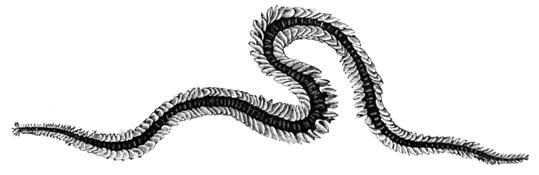
Phyllodoce paretii.
Genus Phyllodoce
P. gracilis. Three inches or more long and one sixteenth of an inch wide; large proboscis, with twelve longitudinal rows of prominent [pg176] projections on the swollen base, its terminal end smooth, with a circle of round projections at the orifice; color green, with a row of dark spots down the center of the dorsal surface and a fainter line of spots on each side at the base of the parapodia. Found on the New England coast.
Family NEREIDÆ
Genus Nereis
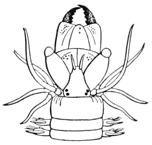
Head of Nereis pelagica.
Among the most common of the polychæte worms is the genus Nereis, various species of which are found in all parts of the world. They are abundant under stones, among seaweeds, and living in burrows between tide-marks. They are active, fierce, and voracious. Some attain a length of eighteen or more inches. They are commonly known as "clam-worms," and are used by fishermen for bait. Nereis has a distinct head, consisting of two parts. One, the prostomium, bears on its upper side four eyes and a pair of short, conical tentacles, and on the lateral sides a second pair of processes called palps. The palps are more conspicuous than the tentacles, and consist of two parts, a large base and a small terminal point, the latter capable of being withdrawn. The palps are sense-organs and perhaps test the food. The second part of the head, or peristomium, bears on the sides four pairs of long tentacles which are used as feelers. The mouth is on the ventral side, and through it Nereis throws out its pharynx, which contains a horny, notched jaw. It seizes its prey with this jaw, which, with the pharynx, is then withdrawn and tears the food apart, acting like a gizzard. The body of Nereis is rounded above and nearly flat below. Each of the segments has a pair of parapodia, bearing a bundle of bristles and cirri. The last segment of the body is elongated, cylindrical, and without parapodia, but has on the end a pair of long cirri, which give the appearance of a divided tail. Each segment of the body, except the head- and tail-segments, contains a pair of excretory tubes (nephridia), ganglia of nerves, and a portion of the intestine and of the vascular system. There are circular muscles by which the worm can diminish its diameter, longitudinal [pg177] muscles in four bands, and muscles to move the parapodia. Breathing is carried on over the whole surface of the body, and especially in parts of the lobes of the parapodia called gills. Its sense-organs are eyes, palps, tentacles, and cirri.
N. virens. This species is found from New York northward in muddy and shelly sand, and under rocks between tide-marks, living in burrows, which it lines with a mucous secretion. It is very active, and voracious, feeding on other worms, Crustacea, etc., which it captures with its horny, protruded jaw. At night it leaves its burrow and swims freely about like an eel, frequently falling a prey to fishes. In color it is dull bluish-green, with some iridescence. The gills, which are leaf-like appendages on the parapodia, are green on the anterior end of the body and become bright red farther back. This species, and N. branti of Alaska, are the giants of polychæte worms, often measuring eighteen inches or more in length.
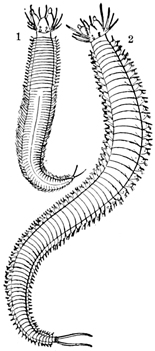
Nereis pelagica. 1, male; 2, female.
N. pelagica. Found in abundance on the New England shore and northern coasts under stones and on shelly bottoms. The female is four to five inches long, while the male is only two inches in length. In this species the body is widest in the middle, while in other species it is widest at the anterior end. The palps are long, and the second head-piece (peristomium) is twice as long as the next segment. The color is reddish-brown and iridescent.
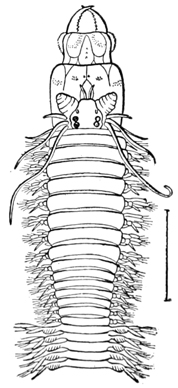
Nereis limbata. Male, anterior part of body, head and extended proboscis.
N. limbata. Five to six inches long; jaws light yellow, sharp, and slender; parapodia and bristles smaller on the anterior than on the posterior end; color dark brown, with light lines on the sides and appendages, pale red on the posterior end; dorsal blood-vessel apparent, and the heart-like pulsations can be distinctly seen. The male worm is red in the middle section. Found along the middle Atlantic coast on sandy shores.
Family NEPHTHYDIDÆ
In this family the worms have a long, thick, flattish body, a section of which has a quadrangular form. The lobes of the parapodia are widely separated and fringed [pg178] with membrane, appearing like double parapodia. The pharynx is very large and projected as in Nereis.
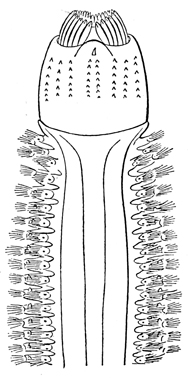
Nephthys ingens. Anterior part of body and extended proboscis; ventral view. Enlarged.
Genus Nephthys
N. ingens. Sometimes six inches long and one quarter of an inch broad; usually smaller; color whitish, with red blood-vessel showing on dorsal side; appendages dark blown; moves actively and burrows quickly into the mud; when captured often breaks off a portion of the posterior end, which it is able to reproduce; proboscis large; branchiæ between the dorsal and ventral parapodia. Found burrowing in all kinds of mud on the New England coast.
N. picta. More slender than N. ingens; color whitish, mottled with brown on the dorsal anterior end; often a dark line down the back; head square in front and triangular in the back. Found in sandy mud at low-water mark.
Family EUNICIDÆ
These are beautiful worms, having a reddish-brown iridescent body, with bright-red branching gills, which look like feathers, along the back. They form parchment-like tubes.
Genus Marphysa
M. sanguinea. Length six inches or more; color bronze or brownish-red and iridescent; has bright-red branched gills and six caudal cirri of different lengths; body flattened, except at the anterior end, where it becomes narrow and cylindrical; has powerful jaws. It is found under stones and in clefts of rocks at low-water mark, or more commonly in parchment-like tubes on shelly beaches, from Cape Cod to New Jersey.
Genus Diopatra
D. cuprea. This is one of the largest and most beautiful annelids. It is found from Cape Cod to South Carolina at low-water mark, in sandy mud-flats, living in long tubes which project above the surface two or three inches and are hung with seaweeds and bits of foreign matter. Diopatra is twelve inches or more in length and one half of an inch in breadth. In color it is reddish-brown, specked with gray, and has a brilliant whitish or opal-like iridescence. The appendages are yellowish-brown, specked with green. The body is flattened. From the fifth segment long, dull to bright red, much-branched gills, resembling plumes, [pg179] extend nearly to the end of the worm. On the ventral side of the parapodia are whitish tubercles with a dark spot in the middle. These papillæ secrete the long, broad tube in which the worm lives. The worm is difficult to capture, for when pursued it retreats quickly into its tube, which is so large that it can easily turn around within it. (Plate XLVIII.)
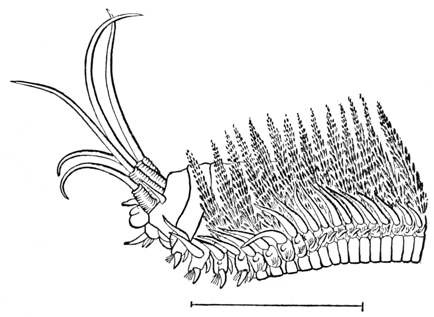
Diopatra cuprea. Head and anterior part of body, showing part of the branchiæ; side view.
Genus Arabella
A. opalina. Body cylindrical, twelve to eighteen inches long, one quarter of an inch wide in the middle, and tapers to the ends, which are comparatively small; lateral appendages short; color bronze, with brilliant, opal-like iridescence; head small, conical, but blunt and without tentacles; four eyes in transverse row at the base of the head; segments well marked; coils into spirals when outside of its burrow. Found in compact sandy mud at low-water mark on the New England coast.
Genus Lumbriconereis
L. tenuis. Twelve inches or more long, and slender, like a fine cord; bright red and somewhat iridescent; very fragile. Abundant in sandy mud on the northern New England coast, and found from New Jersey northward.
Family GLYCERIDÆ
These worms are long and smooth, with numerous segments. They taper at both ends. The head is small, conical, sharply pointed, and has four very small tentacles. The proboscis, or [pg180] pharynx, when protruded, is very large and long, and appears too large for the worm. The proboscis has four hook-like jaws. These worms burrow rapidly and disappear almost instantly into the mud or sand.

Glycera meckelii, with pharynx everted.
Genus Glycera
G. americana. Color red or purple; has branched gills on upper side of parapodia. Found from South Carolina to Cape Cod on sandy and muddy shores and flats near low-water mark.
G. dibranchiata. Has a simple gill on both sides of the parapodia; about eight inches long and one quarter of an inch wide in the middle; proboscis one inch long and wider than the body on the upper end. Abundant from New Jersey to Cape Cod.
ORDER SEDENTARIA THE TUBICOLOUS WORMS
Many of this order construct tubes in which they live permanently. Some species of both Sedentaria and Errantia have habits pertaining to the other. These worms are without a protrusible pharynx and without jaws. The body is usually divided into two or three sections by segments and appendages of different forms. They have hair-setæ on a limited number of segments only, varying with the species; the remaining segments have uncini, or hooked comb-like rows of setæ, which are very small, but often crowded in bunches. Uncini exist also on segments having hair-setæ. Parapodia are often lacking on the posterior parts and are usually without cirri. The gills are usually confined to the anterior end and are sometimes represented by tentacles around the head. The different species have characteristic tubes, formed by mucus secreted by epidermal glands. Sometimes the mucus hardens, making a parchment-like tube; again it cements together grains of sand, or bits of shell, seaweeds, etc. Some species secrete [pg181] calcareous tubes; these are often found on rocks, in coral, and in the shells of mollusks. The anterior end of the body is more highly developed than the posterior end.
Family SPIONIDÆ
Genus Nerine
N. agilis. Two to three inches long; slender; somewhat flattened at the anterior end; head conical and sharp; the two tentacles about one half of an inch long; four eyes; color reddish-brown, light green on the sides; gills red; tentacles greenish-white. It burrows with extreme rapidity and lives on exposed beaches near low-water mark.
N. coniocephala. Two and a half inches long, one sixteenth of an inch in diameter; head conical; body flattened on the dorsal side, round on the ventral side; has two long tentacles turned backward and a membrane on the gills of the anterior segments; gills red; bristles long and numerous.
Family CIRRATULIDÆ
Worms of this family have a cylindrical body, more or less attenuated at each end; segments similar throughout; many segments with long, filamentous cirri which act as gills; and a conical head. They live in burrows.
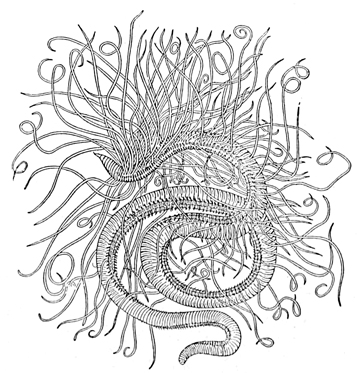
Cirratulus grandis.
Genus Cirratulus
C. grandis. Four to six inches long; head acute; segments numerous, short, and distinct; color dull yellow, or orange, to brown, often iridescent beneath; ventral surface somewhat flattened. Numerous long, filamentous, red to orange-colored cirri extend nearly the whole length of the body and act as gills. It is common in sand and gravel at low-water mark from Cape Cod to New Jersey. [pg182]
Family TEREBELLIDÆ
The body is cylindrical and largest on the anterior end; there are one to three pairs of more or less branched gills on the anterior end, and the ventral surface of the anterior segments is thickened by glands which secrete mucus for tube-building. These gland-spaces are called shields.
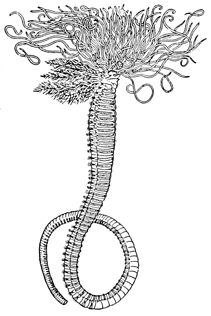
Amphitrite ornata.
Genus Thelepsus
T. cincinnatus. Two to four inches long; pale red; marked like lacework on the back; gills have numerous unbranched filaments arising separately in two transverse rows; tubes thin, transparent, flexible, and hung with foreign substances; attached along the whole length.
Genus Amphitrite
A. ornata. Twelve to fifteen inches long; flesh-color, reddish, or brown; three pairs of red plume-like gills and numerous flesh-colored tentacles around the anterior end; tentacles constantly in motion and sometimes extended eight or ten inches; tubes a quarter of an inch or more in diameter, and firm, being composed of sand and mud. It is found under stones in mud, gravel, and sand at low-water mark from Cape Cod to New Jersey, often associated with Cirratulus grandis.
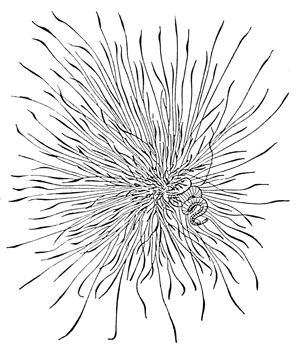
Polycirrus eximius.
Genera Polycirrus, Chætobranchus
P. eximius, C. sanguineus. These are two species of bright-red, fragile worms, found under stones, in mud. They do not form tubes. The first is a small worm, the second twelve to fifteen inches long. Both have long, crowded tentacles extending in every direction and distended as the blood flows into them. C. sanguineus has [pg183] tentacles sixteen inches in extent, and branched gills on short pedicels on the back. They are common in mud at low-water mark from Cape Cod to New Jersey.
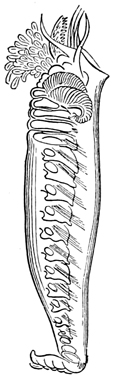
Cistenides Gouldii.
Family AMPHICTENIDÆ
Genus Cistenides
C. Gouldii constructs conical free tubes of grains of sand in a single layer; body short and a little curved; head obliquely flattened; two broad groups of golden bristles turned upward on each side of the anterior end; one to two inches long; color light red or flesh-color, mottled with red or blue. This is a common worm, and its horn-shaped tubes are so plentiful as to attract attention on sandy shores. They will repay examination with a glass, so beautifully are they built. The worm has bunches of golden bristles arranged in two rows close to the flattened anterior end, which make a kind of operculum to the tube. This feature makes the species easy to identify. The worm is transparent; the internal organs showing through give it the various bright colors. It is found on sandy and muddy shores from New Jersey northward.
Family MALDANIDÆ
The tubes of these animals are formed of sand, a short portion projecting, and are very abundant in certain places. There is a horny plate on the upper surface of the head, and the skin on the sides of the head is raised in folds. There is a funnel-like process at the posterior extremity; gills are lacking. Some of the segments in the middle of the body are longer than the rest.
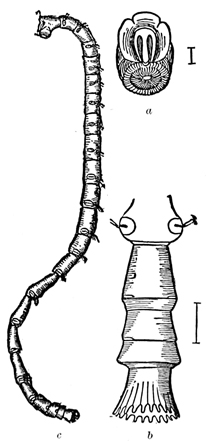
Clymenella torquata. a, head and extended proboscis, front view; b, posterior end; c, entire animal, side view, natural size.
Genus Clymenella
C. torquata. Body long, composed of twenty-two segments; the fifth segment has a collar-like fold; the caudal extremity is funnel-shaped and edged with papillæ; both [pg184] the first and the last three segments are bare, the rest have short bristles above and hooks below; head has a prominent convex plate with a raised border; worm pale red, with bright-red bands around the segments, sometimes brownish. It constructs nearly straight tubes of pure sand close to low-water mark in sheltered coves, and ranges from New Jersey northward.
Genus Maldane
M. elongata. Six to eight inches long, one eighth to one quarter of an inch in diameter; body cylindrical, cut obliquely at both ends; head bordered by a slight fold; color brown, with red blood showing through. Found in sandy mud at low-water mark, in firm, deep tubes of fine mud, on the New England coast.
Family ARENICOLIDÆ
Genus Arenicola
A. marina. Five to ten inches long; brownish-green; body cylindrical, thickest on the anterior end; anterior and posterior ends without chætæ; twelve to thirteen pairs of branched red gills on the central segments. It makes burrows eighteen to twenty-four inches deep on sandy southern shores, and can be traced by castings at the mouth of the burrow. Commonly known as "lugworm," and used by fishermen for bait.
Family SABELLIDÆ
In this family the gills arise from two semicircular bases forming the crown; the second lobe of the anterior extremity is reversed like a collar; the gill-filaments have secondary processes, and the tubes are flexible, composed of cemented mud or sand. Found under stones, the tube passing around the stone and opening upward.
Genus Sabella
S. microphthalma. Length of tube one and a quarter inches, diameter one eighth of an inch; body olive-green, specked with white; wreath of tentacles half as long as the body; tentacles pale yellowish or flesh-colored, with transverse lines of darker color. It is found on the southern New England coast.
Family SERPULIDÆ
This family forms white calcareous tubes. One of the dorsal gill-filaments is flattened, forming an operculum, or cover, with [pg185] which the tube is closed when the worm has withdrawn itself inside. The tubes are commonly found attached to shells and rocks, usually solitary, but sometimes in clusters, crossing and recrossing each other on the surface of the shell or rock. Plume-like gills are attached to the anterior end of the body. The color differs in different species. These worms may easily be mistaken for the mollusks Vermetus, which live in similar tubes of larger size, growing in masses.
Genus Serpula
S. dianthus. Tubes often three inches long and one eighth of an inch wide, the fixed end coiled and contorted, free end with circular opening; tubes often show circular ridges, marking periods of growth; operculum funnel-shaped, the exterior striated and the edge bordered with short processes; wreath of gills nearly circular and divided into two symmetrical parts; color variable. It is found in tide-pools, also on the under side of rocks at low-water mark, either solitary or congregated in masses, and ranges from Cape Cod to New Jersey.
Genus Spirorbis
S. borealis. A minute calcareous tube, in a close, flat coil attached on one side; easily mistaken for a minute gasteropod shell; worm has an operculum and wreath of gills. Found on the fronds of seaweeds, on shells, etc.
CLASS GEPHYREA
This class of animals, once placed near the holothurians, belongs with the annelid worms on account of their mode of development, their structure being entirely dissimilar. They are without segments and without parapodia. The body-cavity is filled with fluid and is traversed by connective tissue and fine muscular fibers. They are subcylindrical animals which can retract the anterior end of the body. The mouth is surrounded by tentacles, or by tentacular folds, and is at the base of the proboscis. They live in fissures of rocks, in sand, mud, rock, or coral, and in deep gasteropod shells. Their distribution is general.
ORDER SIPUNCULOIDEA
Genus Sipunculus
S. nudus. The body is cylindrical, a foot or more in length when extended. It is divided into two portions. The anterior end, to the [pg186] extent of one sixth of the entire length of the worm, is capable of being withdrawn into the remainder of the body. This portion is called the introvert. The introvert is retracted by means of special muscles forming a sheath around the gullet and connected at the other end to the body-wall about half-way down the body. It is narrower than the rest of the body and is covered more or less closely with small horny papillæ which turn backward and overlap like scales. The rest of the body is divided into longitudinal furrows and circular markings, giving it the appearance of being divided into squares. These markings correspond to muscles which lie beneath. The introvert, when retracted, leaves at the opening a lobed and plaited fold of the integument, giving the appearance of tentacles. When the introvert is expanded there is a fringe-like funnel around the mouth. The body is covered with a horny cuticle and has an iridescent luster. The animal lives buried in the sand and feeds upon sand, deriving its nourishment from the organisms contained therein. The sipunculoids pass so much sand and mud through their bodies that they are said to modify the mineral substances on the bottom of the sea, as earthworms do the soil of the land.
Genus Phascolosoma
P. Gouldii. Body cylindrical, a foot or more in length, a quarter or half of an inch in diameter when expanded; but the body constantly changes in size and shape as it is contracted or expanded; surface of body parchment-like in texture and marked off in small squares; color dull white to light brown. It is found on the New England coast in sand and gravel at low-water mark.
IV MOLLUSCOIDA
TABLE SHOWING THE CLASSIFICATION OF THE MOLLUSCOIDA DESCRIBED IN THIS CHAPTER
Class POLYZOA Subclass Ectoprocta (Excretory opening outside lophophore; mouth in center of circle of tentacles; tentacles retractile) Order GYMNOLÆMATA (Circular lophophore) Suborder CYCLOSTOMATA (Tubular calcareous zoœcia, with circular apertures devoid of closing apparatus) Set ARTICULATA (Erect branches divided at intervals by chitinous joints) Genus Crisia C. eburnea Set INARTICULATA (Erect or adherent zoarium; unjointed) Genus Tubulipora T. flabellaris Genus Diastopora D. patina Suborder CHEILOSTOMATA (Calcareous or chitinous zoœcia, usually with opercula; avicularia, vibracula, and ovicells often present) Set CELLULARINA (Flexible erect forms) Genus Ætea Æ. anguinea Genus Eucratea E. chelata Genus Cellularia C. ternata Genus Caberea C. Ellisii Genus Bugula B. turrita B. Murrayana B. flabellata Set FLUSTRINA (Cells quadrate; front wall of zoœcium membranous or depressed, and has ridge-like margin) Genus Flustra F. membranacea Genus Membranipora M. pilosa M. lineata M. tenuis Set ESCHARINA (Zoœcium wholly calcified) Genus Escharella E. variabilis Genus Mollia M. hyalina Genus Cellepora C. scabra C. ramulosa C. pumicosa Suborder CTENOSTOMATA (Horny or gelatinous zoœcia, having tooth-like processes which close the apertures when the tentacles are retracted) Genus Alcyonidium A. ramosum A. hirsutum A. hispidum A. parasiticum Genus Vesicularia V. dichotoma V. custata Subclass Entoprocta (Excretory opening within lophophore; mouth near margin of area, which is surrounded by tentacles; tentacles roll up instead of being retracted) Genus Pedicellina P. americana
TERMS USED IN DESCRIBING POLYZOA
Avicula´ria: Specifically modified zoœcia, resembling a bird's head, found only in the Cheilostomata.
Brown bodies: Brown pigment-masses contained in the zoœcia and derived from the breaking down of the polypides.
Lo´phophore: The disk bearing the mouth and circlet of ciliated tentacles.
Orifice: The open end of the zoœcium.
Ovicell: The receptacle in which the eggs develop.
Pe´ristome: The ridge around the orifice of cell.
Po´lypide: The parts of the animal within the zoœcium.
Vibra´cula: A lashing filament, or specifically modified zoœcia, found only in the Cheilostomata.
Zoa´rium: The whole colony.
Zoϫcium: The body-wall of a single individual. [pg191]
POLYZOA
toc
Among the numerous objects to be found on the beach at low tide are the Polyzoa, of which there are said to be seventeen hundred named species of the marine forms. These little animals, although so plentiful, are inconspicuous, and it may be said that their very existence is not known to those who are not professed naturalists; yet they are easy to see, incrusting with a delicate calcareous lacework the surface of stones and shells and seaweeds in the tide-pools, and hanging from the rocks like branches of delicate seaweeds. There is hardly a frond of even the fine red algæ on which cannot be found the little tube holding shelly saucers, or the creeping stems or branches of polyzoans. Any one of these little masses, when examined with a pocket-glass, will surprise one with its delicate and beautiful structure.
This class of animals is also called Bryozoa, and certain species have the common names of sea-mats and corallines. They are broadly divided into two groups, namely, the erect and the incrusting forms. Those having tree- or plant-like shapes resemble seaweeds, while the colonies which spread over stones, shells, and algæ resemble moss, hence the name Bryozoa (moss-animals). Both groups have the general appearance of hydroids, because, like them, they are colonies having plant forms and having their organisms inclosed in cup-like sheaths. The resemblance, however, is but a superficial one, for the Polyzoa have a much higher organization, each animal of the colony being a separate and distinct individual. They can easily be distinguished by the hair-like processes on the tentacles. The ciliated tentacles and complete alimentary system are the conspicuous differences between these colonies and those of the hydroids.
The Polyzoa are very numerous and form a most attractive [pg192] group. They are plentiful everywhere, occurring between tide-marks and at great depths on the floor of the sea. Rocks protected from the sun are often incrusted with the calcareous forms, while branching species hang from the rocks and adorn rock pools. Membranipora, in lace-like sheets, will be found on the larger seaweeds as well as on various submerged objects. The beautiful little Crisia may be looked for on the fronds of red algæ, and Alcyonidium, in soft moss-like patches, on Fucus. On some beaches are scattered the sea-mats, Flustra foliacea, looking like bits of brown paper. A pocket-lens will reveal the marvelous and orderly arrangement of the two layers of cells, or zoœcia, placed back to back. There is not a more surprising object in the animal kingdom than a living branch of Bugula. The cells on its spiral, profusely branched clusters have appendages resembling a bird's head, with its bill constantly opening and shutting. Of the erect polyzoans some are entirely calcareous and rigid; such species live in deep water, and their colonies are called corallines, as are also the calcareous algæ. They have existed in vast numbers since early geologic times, and are plentiful in the Tertiary deposits, known as Coralline Crags. Other erect forms have a calcareous framework, which is not continuous, but has horny intervals, so that the colonies are flexible and can be swayed by the tides in shallow water where they live. Others have complete horny exoskeletons. The same differences occur in the incrusting forms, those on the seaweeds being either flexible, so that they bend with the plant, or if entirely calcareous are so small that they do not break when the plant sways to and fro. Still others are gelatinous and resemble bits of sponge. The calcareous forms are usually ornamented with ridges which form beautiful patterns.
The individuals of the polyzoan colonies are small polyp-like organisms which have a cup-like inclosure of horny or of calcareous substance, or of the two combined, as mentioned above. This inclosing sheath is the exterior or cuticle of the animal and is called the zoœcium, the whole colony being called the zoarium. The animal substance within the zoœcium is the polypide, and consists of the mouth, tentacles, and alimentary system. A disk at the anterior end of the body, bearing the circle of tentacles, is [pg193] the lophophore; it is a contractile body, being, with the tentacles, protruded from the zoœcium or drawn within it at will. In some species the orifices of the zoœcia are surrounded with spines; others have lids, called opercula, which shut down when the polypides are retracted. A singular modification of the zoœcia is seen in the genus Bugula, where peculiar shapes like birds' heads, called avicularia, occur. In these singular appendages the upper beak is hooked, while the lower one, or mandible, is the operculum of the zoœcium. These constantly open and shut by means of muscles, and although their function is not certainly known, it is thought that they capture prey. Other modifications are whip-like processes, or flagellate filaments, called vibracula, which constantly beat the water. In many of the zoœcia of the colony there are dark-colored masses, called brown bodies. These are formed by the degeneration of the polypides, which at certain periods break down, their tentacles and alimentary system ceasing to act and becoming brown masses. The body-wall then puts out a bud internally and forms a new polypide, which absorbs, or passes out, the brown body. The term of life of a single polypide is not known, but in every colony many such transformations are constantly taking place.
The colonies originally start from larvæ produced in the ovicells of the zoaria. The ovicells are sometimes very large and pear-shaped, occurring at intervals on the stems; or there may be one at the top of each zoœcium. They look like pearls. A larva, when liberated, swims about for a time, then attaches itself to a fixed object, and increases, by budding, into some one of the various forms which the colonies take.
SUBCLASS ECTOPROCTA
ORDER GYMNOLÆMATA
Suborder CYCLOSTOMATA ERECT OR CREEPING POLYZOA
The zoœcia are more or less cylindrical; the upper ends are sometimes completely free and sometimes closely adherent. The [pg194] opening of the cell has no operculum. Ovicells, containing the embryos, appear like pear-shaped swellings.
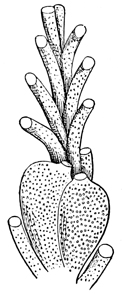
Crisia eburnea; a branch bearing ovicells, highly magnified.
Genus Crisia
C. eburnea. This species is found in tide-pools on algæ, especially on the red seaweeds, growing in bushy tufts from one half of an inch to an inch high. Calcareous, with horny joints; cells in two rows, semi-alternate, cylindrical, free at one end, bent; no operculum; ivory-white; ovicells large and pear-shaped. Common from Long Island Sound northward and on the Pacific coast.
Genus Tubulipora
T. flabellaris. This species is found attached to slender branched algæ, in coral-like masses of long, crooked, tubular cells united at the base and spreading into fan-shapes placed flat against the fronds. It is sometimes one quarter of an inch in diameter. On the same alga may often be found Crisia, Mollia, and Cellepora. (Plate XLIX.)
Genus Diastopora
D. patina. Tubular cells rise from a saucer-shaped disk about a quarter of an inch in diameter; cells lie obliquely or stand erect, and are crowded toward the center; margin of disk without cells; colony white and calcareous. Found on algæ and eel-grass from Long Island Sound northward.
Suborder CHEILOSTOMATA
In this suborder the zoœcia are either horny or calcareous, and the orifices are usually surrounded with spines and have opercula. The orifices generally have raised margins, or peristomes. Ovicells form helmet-like coverings overhanging the orifices.
Genus Ætea
Æ. anguinea. Delicate, white, creeping, calcareous stems, from which rise numerous club-shaped cells, about one eighth of an inch high, each one with an aperture in the end. This species creeps in wavy lines along the fronds of algæ, and is frequently found on Dasya, Griffithsia, Plocamium, and eel-grass.
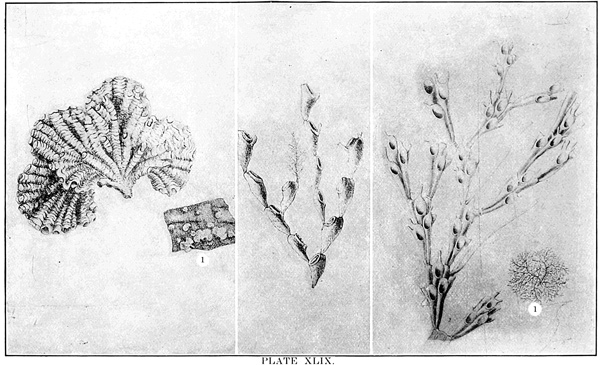
PLATE XLIX.
Tubulipora flabellaris. 1, Tubulipora flabellaris, natural size. Eucratea chelata. Cellularia ternata. 1, Cellularia ternata, natural size.
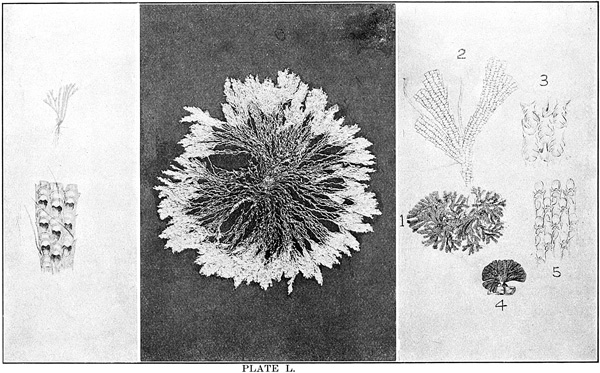
PLATE L.
Caberea Ellisii. Bugula turrita. 1, Bugula Murrayana; 2, B. Murrayana, magnified; 3, B. Murrayana, a few cells, more highly magnified; 4, B. flabellata; 5, B. flabellata, magnified.
Genus Eucratea
E. chelata. A small, delicate species rising from a creeping stem. It has branches composed of single rows of horn-shaped cells having an oblique aperture on the side. Found at extreme low-water mark on hydroids, shells, stones, and Fucus. (Plate XLIX.)
Genus Cellularia
C. ternata. Zoarium filamentous, spreading, about one inch high, white, calcareous, branched in a forking manner; cells long, narrowest at base, arranged in series of three and on the same plane, apertures oblique and facing one way; horny joint between each cluster of cells. This species grows in deep water from Cape Cod northward, and is found on objects washed upon the beach. (Plate XLIX.)
Genus Caberea
C. Ellisii. Zoarium erect, with fibrous base, leaf-like, branches in a forking manner; branches straight, stiff, narrow, spreading; cells arranged in rows of three, adherent throughout; long bristles emanate from near base of many cells; egg-capsules globular, smooth, pearly. Common from Cape Cod northward in deep water. (Plate L.)
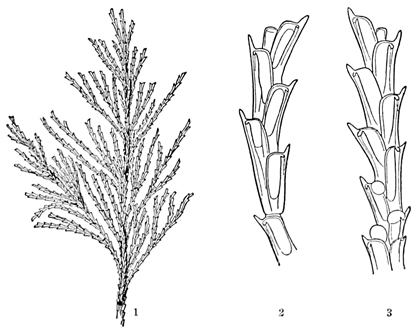
1, Bugula turrita, enlarged; 2, the same, a branchlet, highly magnified; 3, the same, a branchlet, bearing ovicells.
Genus Bugula
B. turrita. This is a very abundant species, found everywhere along the coast from Maine to North Carolina. Large quantities of it are [pg196] sometimes thrown upon the beach by storms. It grows in erect tufts, sometimes a foot long, and is much branched; the branches grow around the stem in a spiral manner, forming dense clusters. The lower part of the stem is often naked (having lost the branches) and bright orange in color, while the tufts of branches at the top are pearly-white or yellowish. The cells are long, with a long, pointed spine on the upper outer angle. Like all species of Bugula, it has bird-head appendages, which can be seen under a powerful glass. (Plate L.)
B. Murrayana. Clusters of broad, thin, flexible fronds, one to two inches high, attached by a slender base and spreading in entangled masses; fronds wedge-shaped, flat, dividing in a forking manner; outer cells have bristle-like filaments, which constantly beat the water; all cells have avicularia, or bird-head appendages. (Plate L.)
B. flabellata. Fan-shaped fronds of flat branches, divided in a forking manner; the cells are arranged in four or five longitudinal rows, are oblong, with a spine at each side of the circular aperture, and are capped with pearl-like ovicells. This species, like others of the genus, bears the very singular structures known as avicularia, or bird-head appendages. They show, under a strong glass, a hooked beak, like that of the hawk or parrot. These beaks are attached by flexible stems and are provided internally with powerful muscles by which they are constantly opened and closed; the beak can bite with considerable force. In this species they are attached to the sides of the cells. (Plate L.)
Genus Flustra
F. membranacea. This species forms gauze-like incrustations on the fronds of seaweeds, and is common on Fucus and Laminaria, spreading irregularly over several inches of space. The cells are oblong, quadrangular, with a blunt, hollow spine at each angle. Many specimens have simple horny tubes, closed on top, rising from some of the cells to the height of half an inch. (Plate LI.)
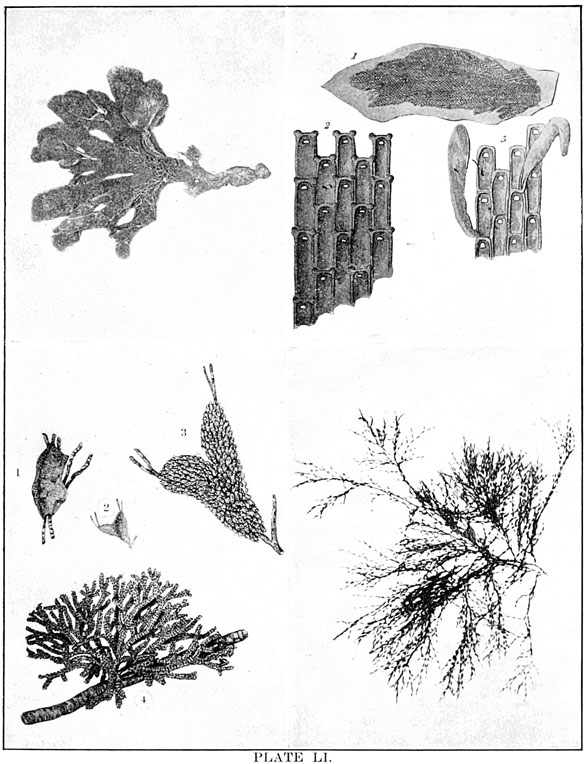
PLATE LI.
Flustra foliacea. 1, Flustra membranacea; 2, 3, F. membranacea, magnified.
1, 2, Cellepora pumicosa, natural size; 3, C. pumicosa, magnified; 4, C. ramulosa. Vesicularia dichotoma.
Genus Membranipora
M. pilosa. An incrusting variety, composed of a single layer of cells spreading irregularly over the surfaces of stones, shells, and seaweeds, sometimes completely covering the fronds of Chondrus crispus, Phyllophora, Rhodymenia, and other algæ. The cells are membranaceous, with a calcareous rim, and have one long hair and several small ones surrounding the large roundish apertures. It is found in abundance on the shores from Long Island Sound to the Arctic Ocean.
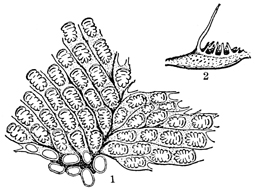
1, Membranipora pilosa; a few of the cells seen from above, magnified. 2, Membranipora pilosa; a single cell, seen in profile.
M. lineata. Cells oblong, crowded, closely adherent; slender spines on edge of aperture, which bend over and meet across it; incrusts rocks and shells in broad, thin, radiating patches; cells [pg197] much smaller and narrower than those of M. pilosa; easily distinguished from that species by its manner of spreading and the absence of the one long hair. Common from New Jersey northward.
M. tenuis. Common on pebbles, often covering their whole surface with a lace-like incrustation of very small oblong cells having a three-lobed aperture. Found in Long Island Sound and north to Cape Cod.
Genus Escharella
E. variabilis. This species forms calcareous incrustations on shells or pebbles. The layers are thin, but eventually overlap one another, and the incrustation sometimes becomes an inch thick and resembles coral. The color of the living animal is dull red. The species ranges from Cape Cod to South Carolina, and is abundant in Long Island Sound.
Genus Mollia
M. hyalina. Cells subcylindrical, irregular, transparent, smooth, and more or less oblique. The species forms small circular disks on algæ in tide-pools.
Genus Cellepora
C. scabra. It forms branching, coral-like masses on slender red algæ.
C. ramulosa. Branches cylindrical, rough, dividing in a forking manner, spreading, two to three inches high, calcareous; cells urn-shaped, irregularly arranged, apertures contracted, long spine on the outer edge. It is found in deep water attached to shells, and in tide-pools, where it grows chiefly on Sertularia and other hydroids and on slender red algæ. It ranges from Long Island Sound to Greenland. (Plate LI.)
C. pumicosa. Cells urn-shaped, irregularly crowded together, forming a conglomeration of porous, brittle masses, not exceeding an inch in breadth, usually round when small, oblong and knobbed when large; spine on outer margin of aperture. It incrusts stones and the stems of Fucus. (Plate LI.)
Suborder CTENOSTOMATA
Genus Alcyonidium
A. ramosum. Twelve to fifteen inches high; much branched; branches smooth, cylindrical, one third of an inch in diameter, usually crooked; branches in a forking manner; color rusty-brown. Abundant in shallow water, attached to rocks, from New Jersey to Cape Cod.
A. hirsutum. A species common on seaweeds, sometimes completely covering them, forming dirty, straw-colored, thick, cartilaginous crusts covered with numerous conical papillæ. These are the cells, or zoœcia; they are surrounded with spines. Circular yellow spots occur over the surface, which are clusters of eggs. A good pocket-lens will show the cells, laid in beautiful order, and perhaps the extended tentacles. Found from Long Island Sound northward. [pg198]
A. hispidum. One of the most common species found incrusting the fronds of Ascophyllum at low-water mark. It forms fleshy, brown, soft crusts of moderate thickness, and has spines scattered over the otherwise smooth and glistening surface. The cells are inconspicuous, and each one has five long rigid bristles. Habitat, Long Island Sound to Greenland.
A. parasiticum. It forms thin, earthy crusts on algæ and hydroids. The surface is porous; the cells are distant and arranged irregularly, and seem as if composed of sand cemented with mud.
Genus Vesicularia
V. dichotoma (Valkeria pustulosa). This species grows in clusters of crowded slender stems, which branch in a forking manner, the branches dividing in different planes, making a tree-like form one to three inches high. At the points where the branches divide is a dark, opaque substance, and at these points also the cells are crowded in clusters of spiral rows and are greenish-brown in color. The dark spots are in marked contrast to the white translucent substance of the rest of the stem, giving a spotted aspect to the whole. (Plate LI.)
V. custata. Delicate, thread-like, jointed stems, with slender opposite branches; cells small and elliptical, arranged mostly in clusters. Found creeping like a small dodder-plant over other polyzoans, hydroids, and seaweeds.
SUBCLASS ENTOPROCTA
Genus Pedicellina
P. americana. A very small species. Club-like zoœcia rise from slender, white, creeping stems; tentacles roll up instead of retracting into the cups. Found on hydroids, other polyzoans, and algæ.
V ECHINODERMATA
Phylum ECHINODERMATA Class ASTEROIDEA (Starfishes) Class OPHIUROIDEA (Brittle-stars) Class ECHINOIDEA (Sea-urchins) Class HOLOTHUROIDEA (Sea-cucumbers) Class CRINOIDEA (Feather-stars and Sea-lilies)
TERMS USED IN DESCRIBING THE STRUCTURE OF ECHINODERMS
Abo´ral surface: The side opposite the mouth.
Ambula´cra: Tubular feet used in moving.
Ambulacral zones: The five areas containing the rows of tube-feet.
Ampul´læ: Reservoirs or vesicles at the base of the tube-feet.
Auricula´ta: The larval stage of holothurians.
Bipinna´ria or Branchiolaria: The larval stage of starfishes.
Dorsal surface: The back of the animal, generally, but not necessarily, the upper side.
Exoskeleton: Outside framework or support, differing from a true skeleton which lies inside the body.
Interambulacral areas: The five areas between the ambulacral zones.
Larva: The animal in a stage of development from the time it leaves the egg until it reaches the complete form of the species.
Madreporic plate: A sieve-like plate of carbonate of lime.
Oral surface: The side on which the mouth is placed.
Ossicles: Calcareous plates which cover the body and form the exoskeleton.
Pedicella´riæ: Small spines which have divided ends, like scissors or forceps.
Plu´teus: The larval stage of sea-urchins.
Po´lian vessels: One to ten sacs arising from the ring-canal.
Ring-canal: The canal around the mouth.
Spines: Processes which rise from the surface of the animal.
Stone-canal: A calcareous tube leading from the madreporic plate to the ring-canal.
Suckers: Sucking-disks on the ends of the tube-feet.
Ventral surface: The side opposite the dorsal surface.
Water-vascular system: A series of canals which conduct water through the animal. [pg202]
ECHINODERMATA
toc
The echinoderms, although their shapes are very unlike in the different classes, have the same general internal structure, and also other features which place them together in one group. They are radiates (page 113) of the highest type; they have an exoskeleton; and many of them are beset with spines, from which the name is given. They have locomotor organs, the ambulacra, and a water-vascular system peculiar to themselves. Some have the very strange power of casting off, and developing again, parts of the body.
The development from the egg to the adult is remarkable, and of unusual interest to naturalists. The larval stage of echinoderms is so unlike the mature animal that for a long time the larvæ were thought to be another class of animals, and therefore were given the names which they still retain.
In observing echinoderms it will be seen that the dorsal part is carried uppermost by some, such as the starfishes and sea-urchins. In the former the back is broad and extended; in the latter it is curved and contracted. But in crinoids the back is carried downward and is extended like a stalk; in the sea-cucumbers (holothurians) the dorsal and ventral surfaces are parallel with the long axis of the cylindrical body, instead of being on a plane with the mouth and excretory opening. Owing to the unusual positions of the dorsal and ventral surfaces, the terms oral (mouth side) and aboral (side opposite the mouth) are generally used in describing these species.
The surface of the body is divided definitely by the ambulacra, the ambulacral zones, and the interambulacral spaces, but differently in the different classes. The movement of the animals is [pg203] effected by means of the tube-feet, or ambulacra. These have suckers, which are attached or released by the power of the water-vascular system. The madreporic plate, which can be distinctly seen in starfishes at the angle of two of the arms, is a calcareous porous plate which opens into the stone-canal. This canal passes through the body and opens into a circular tube which runs around the mouth. A system of canals extends from this circumoral tube, or ring-canal, and eventually one canal opens into each tube-foot. Water, entering by the madreporic plate, passes through the various canals and into the tube-feet, which it distends. When the feet are pressed against a substance and the water is withdrawn, a vacuum is formed, which causes the disk-ends of the feet to act like suckers. When the feet are again flooded the hold is relaxed. Thus the animal drags its body along with a slow, gliding motion. The madreporic plate, being calcareous, is said to act as a filter, purifying the water as it passes into the body, which it furnishes with oxygen as well as with locomotive power.
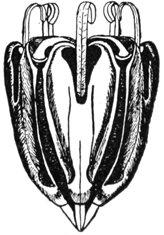
Aristotle's lantern.
A curious organ found in the Echinoidea (sea-urchins) is called Aristotle's lantern. It is a complicated arrangement, not fully understood, having forty parts, and is connected with the alimentary system. One of the parts is the mouth, over which five teeth project. These teeth grasp and grind the food. The exoskeleton is composed of plates of carbonate of lime, called ossicles, which cover the surface of the body. The ossicles are of various sizes and shapes, and are one of the determining features in classification. They may be scattered spicules of lime, separated plates joined by connecting rods, or overlapping plates; or they may be fitted together so as to form a continuous shell. The starfishes are usually carnivorous, the sea-urchins usually vegetarian, while the holothurians, after the manner of worms, take in sand and mud, deriving their nourishment from the organic particles contained in them. All echinoderms live in the sea. [pg204]
TABLE SHOWING THE CLASSIFICATION OF THE STARFISHES DESCRIBED IN THIS CHAPTER.
Class ASTEROIDEA (Starfishes) Order PHANEROZONIA (Ossicles not crowded; large marginal ossicles; spines only on dorsal surface; pedicellariæ sessile) Family PORCELLANASTERIDÆ Genus Ctenodiscus C. corniculatus Family ASTROPECTINIDÆ Genus Astropecten A. articularis Genus Psilaster P. floræ Genus Luidia L. senegalensis L. clathrata L. alternata Family PENTAGONASTERIDÆ Genus Mediaster M. æqualis Family ANTHENEIDÆ Genus Hippasteria H. phrygiana Family PENTACEROTIDÆ Genus Pentaceros P. occidentalis P. reticularis Genus Nidorella N. armata Family ASTERINIDÆ Genus Asterina A. folium A. miniata Order CRYPTOZONIA (Ossicles crowded; pedicellariæ stalked) Family SOLASTERIDÆ Genus Solaster S. endeca S. decemradiata Genus Crossaster C. papposus Family ECHINASTERIDÆ Genus Cribrella C. sanguinolenta Genus Echinaster E. sentus Family HELIASTERIDÆ Genus Heliaster H. multiradiata Family ASTERIIDÆ Genus Asterias A. vulgaris A. Forbesii A. ochracea A. gigantea
CLASS ASTEROIDEA THE STARFISHES
toc
These animals are named from their star-shaped outline. Some have five long, spreading arms diverging from a small disk, which is hardly more than their point of union; others have a large body with short arms, which are like angular projections of the body, giving a pentagonal shape. Some genera have a greater number of arms than others; Solaster has eleven to thirteen, and Heliaster (the sun-stars, found on the west tropical coast) has thirty to forty.
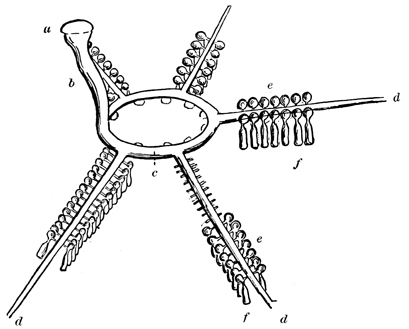
Diagram of water-vascular system of a starfish: a, madreporite; b, stone-canal; c, ring-canal; d, radial canals; e, ampullæ; f, ambulacra.
The mouth of the starfish is in the center of the ventral side. A ventral or ambulacral groove extends through each arm. In these grooves the ambulacra, or tube-feet, are arranged in rows. The ambulacra are hollow, cylindrical bodies, each of which has a sucker at one end, and is connected at the other end with a little globular body, the ampulla. The ventral groove forms a ridge in the body-cavity. It is called the ambulacral zone, and is formed by a double row of elongated plates, which meet and form a raised line along the middle of the inside of the arms, and appear like ribs; between them lie the ampullæ. These plates are called the ambulacral ossicles. Numerous other ossicles extend over the surface, buried in the integument of the body, making a calcareous network, or exoskeleton. The ossicles are connected by muscles so that the animal is not rigid, but is able to bend the body and even creep through comparatively small places. The ossicles are covered with spines of two kinds. The very minute ones are the pedicellariæ, and have a jointed end which opens and shuts like a pincers. Their principal use seems to be to remove waste matter or other substances from the body, keeping it free and clean. The pedicellariæ are arranged, in some species, in circles around the [pg206] bases of the spines, and form groups over the dorsal surface. Examining the backs of different starfishes with a strong magnifying-glass, one will be surprised to see the varied grouping of the spines and pedicellariæ. At the extremity of each arm is a red eye-spot, which is sensitive to light, and a tube-foot, which has no sucker and which is believed to act both as an olfactory and as a feeling organ. The madreporic plate lies at the angle of two of the arms or rays. Water filters through the madreporic plate and passes by the stone-canal to the ring-canal around the mouth, and thence to the radial tubes, one of which extends through each arm and is connected by a branch with each tube-foot. At the base of each tube-foot there is a globular reservoir, or ampulla. A valve connects the tube-foot and ampulla. When the ampulla is contracted, water is forced into and distends the tube-foot; when the ampulla is distended, it withdraws the water from the tube-foot, thus acting like a suction-bulb. When water is sent into the tube-feet they are greatly extended and are then placed against an object. The water being then withdrawn through the ampullæ, a vacuum is formed, and the suckers are tightly attached. By the alternating movements of the ambulacra the animal is dragged slowly along and moves with a gliding motion. It does not deviate from a straight path, going over elevations or through depressions without turning aside; its body conforms to the irregularities of the road and never bridges over spaces. The stomach extends a little way into the arms, and a short intestine leads to the excretory opening in the center of the back. Starfishes are carnivorous and voracious, and are particularly [pg207] destructive to oyster-beds. The animal fastens itself to a bivalve, and protrudes a part of its stomach, with which it envelops its prey and slowly sucks it out of its shell. When feeding on small mollusks they take them into the stomach directly. Starfishes regain by natural growth parts of the body which may be lost. Sometimes the animal throws off an arm to escape capture, and self-mutilation also occurs where unfavorable conditions exist. Oystermen formerly were ignorant of the starfish's wonderful powers of regeneration, and were in the habit of cutting up those captured in their forks and throwing them overboard, thus increasing the number instead of destroying their enemies, as each arm with a piece of the body attached to it will, it is said, become a new individual. This tenacity of life makes starfishes difficult to destroy, and they are exceedingly plentiful in all seas. One naturalist speaks of seeing on the coast of Maine a bed of starfishes which extended several miles and covered the bottom so closely that he picked sixty individuals off a small stone. On the northern shores of the Pacific coast they abound in great variety, and some are of unusual size. Asterias gigantea of this region measures two feet across. Another species, Phyncopodia helianthoides, measures a yard in diameter, and has twenty or more arms. The most common species of the Atlantic coast are Asterias vulgaris and A. Forbesii; the former ranges from Long Island northward, the latter from Massachusetts to Florida. These are the species particularly destructive to oyster-beds. Asterias vulgaris sometimes grows to be fifteen inches in diameter; from this, which is perhaps the largest, are found starfishes of all sizes down to the very small Cribrella. They inhabit all varieties of bottoms, from low-water mark to deep water. They are not always abundant in the same place, but seem to move about.
Some oystermen believe that the starfishes get into masses like a ball and are rolled along by the tide. This idea comes from the fact that an oyster-bed may be free from them one day and the next be covered by these pests. To get rid of them the beds are swept over with a tangle, which is an iron bar holding swabs of raveled rope. The spines of the starfish are caught in the [pg208] tangle, and often hundreds are brought up in one haul and are then killed by steaming.
The anatomical system of the starfish is easily traced by cutting off, with scissors, the skin from the dorsal surface of the disk, and also cutting a slit down one of the arms. In the center of the body will be seen the upper part of the stomach, a small star-like spot, from which radiate five branches, which divide and lead into the much-ramified, plume-like organs which extend through the arms. These are the pyloric cæca, whose function is to secrete the digestive fluids. The much-folded stomach occupies the greater part of the central space, its large convolutions showing on top. The mouth connects with the stomach on the ventral side. By turning back the skin from the arm, small filiform processes can in some large species be seen; these are the dermal branchiæ, or breathing-organs, which may either project through pores in the skin between the ossicles or be entirely retracted. If the pyloric cæca be laid back, one can see the rib-like arrangement of the ambulacral ossicles, and also the ampullæ, which lie between the ossicles on each side of the ridge. If an ampulla be inflated and then pressed, the corresponding tube-foot will be seen to extend. To follow successfully the water-vascular system, beginning in the madreporic plate and extending through the stone-canal to the ring-canal around the mouth and thence through the arms, requires a strong glass and more skilful manipulation.
ORDER PHANEROZONIA
Family PORCELLANASTERIDÆ
Genus Ctenodiscus (Plate LII.)
C. corniculatus. Pentagonal; about two and a half inches in diameter; the body flat, with wide marginal plates, giving a flat edge to the rather long, pointed arms; madreporic plate large; color greenish; ambulacra without suckers, seeming to be adapted to pushing through soft mud rather than dragging over hard surfaces. It lives in deep water on muddy bottoms and ranges from Massachusetts to Greenland. When dredged the animal is usually found to be filled with soft mud.
Family ASTROPECTINIDÆ
In this family there are only two rows of tube-feet; the rays end in sharp points and have large ossicles on the margins. [pg209]
Genus Astropecten
A. articularis. The body is flat and smooth; the rays sharply pointed and conspicuously bordered with marginal ossicles and fringed with short spines; two rows of ambulacral feet; color rich purple. Found in shallow waters of South Atlantic coast on sandy bottoms. (Plate LII.)
Genus Psilaster
P. floræ. Diameter four to five inches; arms sharply pointed and conspicuously bordered with large ossicles; body flat, with smooth surface, the ossicles seeming like mosaic; bright pinkish flesh-color. It occurs in deep water off the eastern coast as far south as New Jersey.
Genus Luidia
This genus of starfishes is celebrated for its peculiar habit of breaking in pieces when taken from the water, and therefore good specimens are almost impossible to obtain.
L. senegalensis. Twelve to fourteen inches across; arms long and narrow, tapering to a point and fringed on the edges with spines; surface rather smooth, showing the separation of the ossicles; color almost white, with dark line running through the center of each arm; usually nine arms. Found in shallow water on the coasts of Florida and the Gulf of Mexico.
L. clathrata. Four to five inches across; light-colored; with a fringe of spines on the margins of the arms, which taper to a point; two rows of ambulacra. It is found from New Jersey southward, and is one of the most common starfishes on the sandy beaches of North and South Carolina. (Plate LII.)
L. alternata. Upper surface purplish, with irregular yellowish bands on the arms; under surface yellow. Found in shallow water on the Florida coast.
Family PENTAGONASTERIDÆ
Genus Mediaster
M. æqualis. Body flat; the five rays equal or exceed in length the diameter of the disk; margins have double row of large plates; surface covered with granules, which are easily rubbed off; bright red above, pale orange below; diameter four inches. Common on the coasts of Oregon and California.
Family ANTHENEIDÆ
Genus Hippasteria
H. phrygiana. This beautiful starfish lives in deep water, but is sometimes thrown up on the beach, and ranges from Cape Cod northward. [pg210] It has a large, pentagonal, bright-scarlet disk, five to six inches in diameter, with arms rather long and pointed. The upper side is raised and cushion-like, and is covered with blunt spines; the margins have larger spines of the same shape. The pedicellariæ are sessile and so long and large as to be easily seen with the naked eye. (Plate LII.)
Family PENTACEROTIDÆ
Genus Pentaceros
P. occidentalis. Pentagonal; eight to twelve inches in diameter; ossicles a network of rod-like plates, with prominent spines at the points of union; body inflated in the center and running in wedge-like form to the ends of the rather long and narrow arms; the upper lines of the ridges have spines more prominent than those on the rest of the body; the spines of the larger specimens are more like large warts or small hemispheres. Found on the Lower California coast.
P. reticularis. This starfish is the largest species on our coasts. It is common in southern Florida close to the shore. The body is three to four inches thick, flat on the oral surface, but raised on the upper side, and tapers down in wedge-like form to the points of the short arms. The prominent blunt spines which cover its surface are arranged in a somewhat regular net-like order, and the sharp-edged margins have an even row of larger spines of the same form. The madreporic plate is nearly in the center of the disk, and is quite conspicuous, being bordered with a circle of small spines. Its color is dull yellow, and its size often a foot or more in diameter. It is the large starfish so often seen in curiosity-shops. (Plate LII.)
Genus Nidorella
N. armata. This very curious pentagonal species, found on the California coast, is five to six inches in diameter and red in color. The upper surface is raised and covered with thick, pointed spines one half of an inch to one inch long, arranged in lines, but not crowded. The ossicles on the margins are large; some of them are hemispherical and bear large spines. Smaller spines border the under edge of the margins. (Plate LIII.)
Family ASTERINIDÆ
The starfishes of this family are pentagonal, with a large body and short arms. The disk is more or less elevated in the center, and the edges are sharp. There are two rows of ambulacra. The ossicles are notched and overlapping. The family is confined to temperate and tropical waters.
Genus Asterina
A. folium. Small, pentagonal, swollen (gibbous). Found on the Florida coast.
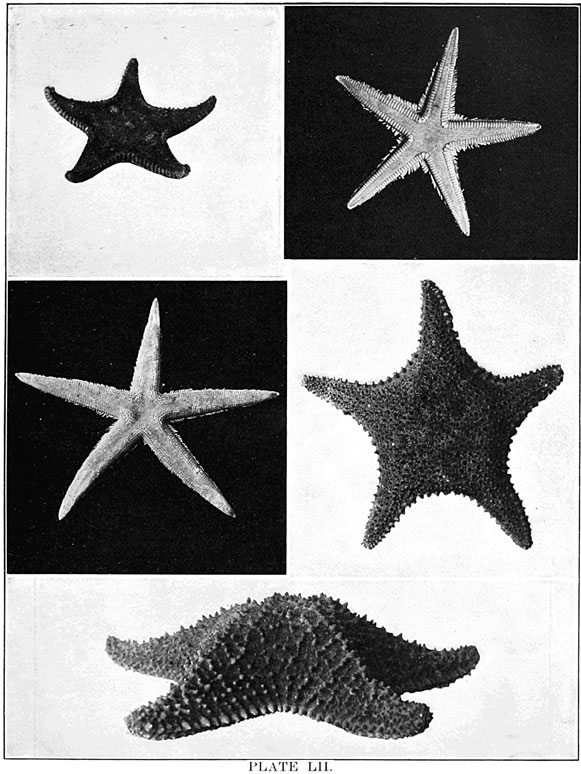
PLATE LII.
Ctenodiscus crispatus. Astropecten articularis.
Luidia clathrata. Hippasteria phrygiana.
Pentaceros reticularis.
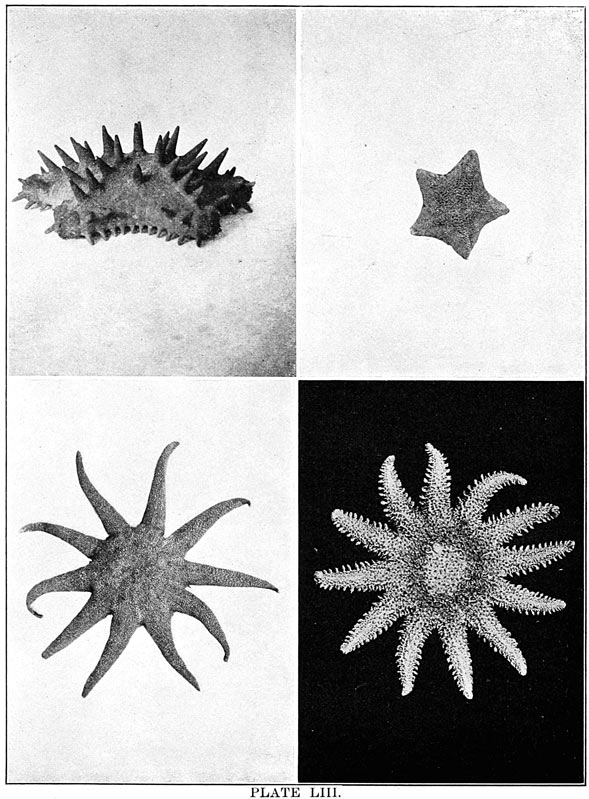
PLATE LIII.
Nidorella armata. Asterina miniata.
Solaster decemradiata. Crossaster papposus.
A. miniata. Pentagonal; somewhat raised in center; about one and a half inches across; edges sharp. Found on the California coast close to shore. (Plate LIII.)
ORDER CRYPTOZONIA
Family SOLASTERIDÆ
Genus Solaster
S. endeca. Dark red in color; nine to eleven arms, which are shorter than the breadth of the disk; diameter of disk about five inches; two rows of ambulacra; surface rather smooth. Common on the coast of Maine, and found from Cape Cod to Newfoundland below low-water mark.
S. decemradiata. This species is common on the North Pacific coast. It has ten arms, which are about twice the length of the diameter of the body, the whole body being about a foot across. (Plate LIII.)
Genus Crossaster
C. papposus. Twelve to fifteen arms, half as long as the breadth of the body; upper surface an open network of calcareous rods, or ossicles; at their points of union are club-shaped tubercles bearing tufts of smaller spines; concentric lines and spots of red and purple over the spiny upper surface; color light underneath. Common on the New England coast. (Plate LIII.)
Family ECHINASTERIDÆ
Genus Cribrella
C. sanguinolenta. This species is abundant north of Cape Cod and is found of all sizes from half an inch to two inches in diameter and of various colors—purple, orange, red, yellow, flesh-color, etc. It has five round arms, generally about four times as long as the breadth of the disk. The ends are often turned upward. It is covered with crowded short spines, like little warts, which give it a nearly smooth surface. It has two rows of ambulacra. It moves with two of its arms turned forward, as if they were dragging the other three behind them. Unlike most species, the young are not free-swimming, but the eggs are carried around the mouth of the mother, and the young are retained there until they are capable of taking care or themselves. (Plate LIV.)
Genus Echinaster
E. sentus. This species occurs close to shore in the waters of Florida and is perhaps the most commonly observed species on the beach. It extends as far north as New Jersey. It is purplish in color, and about four and a half inches in diameter, with two rows of ambulacra, five arms, and a surface rough with spines. [pg212]
Family HELIASTERIDÆ
Genus Heliaster
H. multiradiata. Spines on the upper surface of rays in five rows, but close to the disk proper become reduced to one row. Found on the coasts of Lower California and Mexico. (Plate LIV.)
Family ASTERIIDÆ
The Asteriidæ have the following characteristics: four rows of tube-feet; ossicles small and unequal; spines isolated or grouped; pedicellariæ of two forms, forceps-like and scissors-like respectively. They include the very common forms found on all beaches.
Genus Asterias
A. vulgaris. The common starfish of the Atlantic coast, from Long Island Sound to Labrador. It occurs at low-water mark and extends into deep water. It has five arms, which taper to a point. Large specimens measure fifteen inches across. The upper surface is rough, being covered with short spines, which are largest and thickest at the edges of the rays, and surrounding them are the pedicellariæ. The color varies from pink, yellow, and brown to purple.
A. Forbesii. The common starfish of the Atlantic coast, from Massachusetts Bay to the Gulf of Mexico. This species resembles very closely A. vulgaris, but can be distinguished from it by the madreporic plate, which is bright orange, while in the former it has the same color as the animal; also the arms are a little swollen at the base and terminate more bluntly. These two species are very destructive to oyster-beds, especially where their ranges overlap. It is computed that they destroy annually two hundred thousand dollars' worth of oysters. Vast numbers congregate where the feeding-ground is good, and move in long lines from place to place. The oystermen dredge over the beds and bring them up in thousands, then steam them or throw them on the shore above high-water mark. (Plate LIV.)
A. ochracea. The common starfish of the Pacific coast, from Sitka to San Diego. Five rays, each hardly twice as long as the diameter of the body; spines running irregularly over the surface, but forming a pentagon at the middle of the disk and inclosing the madreporic plate; diameter eight inches. It is very common near San Francisco on rocks at low-water mark. (Plate LIV.)
A. gigantea. Body very large and swollen; six rays, somewhat less in length than twice the diameter of the disk; aboral surface covered with numerous short, blunt, equidistant spines of uniform size and regularly distributed; spines contracted at the base and striated; diameter two feet. Found on the California coast.
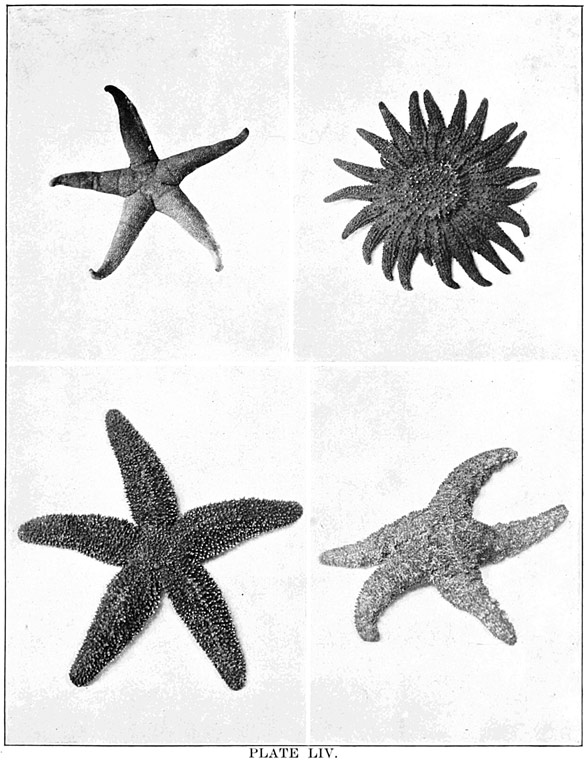
PLATE LIV.
Cribrella sanguinolenta. Heliaster multiradiata.
Asterias Forbesii. Asterias ochracea.
TABLE SHOWING THE CLASSIFICATION OF THE BRITTLE-STARS DESCRIBED IN THIS CHAPTER.
Class OPHIUROIDEA (Brittle-stars) Order EURYALIDA (Skin without plates; arms simple or branched, and capable of being rolled up) Genus Astrophyton A. Agassizii Order OPHIURIDA (Skin with plates) Genus Ophiopholis O. aculeata Genus Amphiura A. squamata Genus Ophiocoma O. riisei O. æthiops O. Alexandri Genus Ophiothrix O. angulata
CLASS OPHIUROIDEA BRITTLE-STARS
toc
The ophiurans, or brittle-stars, differ from the starfishes in having the arms quite distinct from the body. In starfishes the arms are extensions of the body, and the viscera extend partway into them, while in ophiurans the body is a central disk, with the five narrow arms attached to its margin. In form they suggest a spider, and sometimes are called sea-spiders. The name brittle-star is also descriptive, since they break off their limbs readily. The arms are narrow, taper to a point, usually curl at the ends, and have no ambulacral grooves, but are completely covered with bare calcareous plates (except in the first order, where they have a skin and no plates). The ambulacra are small spines without suckers, which emanate from the sides or margins of the arms and do not serve for walking. The madreporic plate is on the ventral surface, in one of the circular shields which surround the mouth. The alimentary canal ends blindly. The egg-sacs lie between the arms and open by slits on the under side, close to the arms, where they join the disk. Water flows in and out of these pouches, which are thought to have also respiratory and excretory functions. No eye-specks have been found, but they must exist, since the animal is sensible to approaching danger and quickly retreats. The ophiurans are more active than starfishes, moving by wriggling, and clambering with their arms. They are shy and hard to find, and it is difficult to capture a whole one, since they throw off pieces of their arms at the least alarm. Often they completely dismember themselves, an action which does them no permanent injury, since they reproduce lost parts. They are more commonly inhabitants of deep than of shallow waters, and are brought up from the bottom in dredges in great numbers. [pg215] Some species may be found near low-water mark under stones and in clusters of mussels, and often in seaweeds, thrown up from deep water, on the shore.
ORDER EURYALIDA
Genus Astrophyton (Plate LV.)
A. Agassizii. This very singular ophiuran is commonly called the basket-fish, from its resemblance to a basket when the tentacles are rolled up. Its body is covered with skin instead of calcareous plates. The body is thick and somewhat circular in form, with elevated radiating ridges on the upper side, and the skin is marked off in star-like divisions. From the margin of the body extend five arms, which at once divide in a forking manner; each section again divides, and this division in pairs (dichotomous division) continues until the ends of the arms have become very numerous and attenuated. The arms are carried curled up or straight at will. In moving, the animal seems to walk on these branches as if on tiptoe, and in this position it forms a kind of net which entraps prey. The arms and prominent parts of the disk are yellow, and the depressed or membranous parts brown. Astrophyton is six to eighteen inches in diameter. It is found off the northern New England coast.
ORDER OPHIURIDA
Genus Ophiopholis
O. aculeata. This is a common species, found in shallow water on the North Atlantic coast. A similar or perhaps identical species occurs on the North Pacific coast. It is spotted purple or variegated in color. The upper surface of the body is covered with plates variously arranged, sometimes in the shape of a star, and each one is surrounded with small spines. The under side of the egg-sacs is covered with small spines. These sacs open by slits on each side next the arms, and have a rounded appearance, bulging out between the arms. The arms, which are long and attenuated at the ends, have on the upper side transverse oval plates surrounded by a border of flat, roundish granules. Sometimes the plates are divided into two or three pieces, when they are similarly bordered with granules. The arms are fringed with rows of thick, compressed, obtuse spines, generally six in each row. The under sides of the arms have large quadrangular plates slightly separated from one another and extending across the whole surface in regular, even rows. (Plate LV.)
Genus Amphiura
A. squamata. This very delicate species, found on shelly bottoms below low-water mark from New Jersey northward, has a body less than one quarter of an inch in diameter, with arms two inches or more [pg216] in length and thread-like in size. These long, slender arms have, on both the upper and under surfaces, a row of overlapping plates, and are fringed with small spines, three in a row. The color is gray or whitish, sometimes marked with darker gray or brown. (Plate LV.)
Genus Ophiocoma
O. riisei, O. æthiops, O. Alexandri. These animals have long spines on the sides of the arms, which give them a bushy appearance. The surface of the body is granulated, but the arms are covered with wide plates. Their color is brown above and light beneath. O. riisei is found at Key West, the other two species on the coast of Lower California. (Plate LV.)
Genus Ophiothrix
O. angulata. Body covered with short, rough spines; egg-sacs conspicuous and extend like lobes between the arms; rays narrow and thickly beset with long spines, which are serrated on the edges and ends. Found on the Florida coast. (Plate LV.)
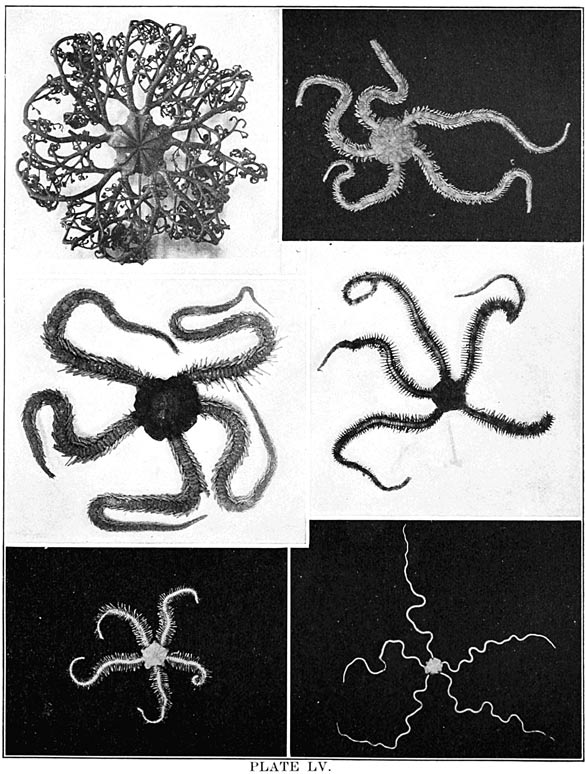
PLATE LV.
Astrophyton. Ophiopholis aculeata.
Ophiocoma æthiops. Ophiocoma Alexandri.
Ophiothrix angulata. Amphiura squamata.
TABLE SHOWING THE CLASSIFICATION OF THE ECHINOIDEA DESCRIBED IN THIS CHAPTER
Class ECHINOIDEA Order DESMOSTICHA or REGULARIA (Shell usually globular; mouth and anus polar; lantern of Aristotle present) Family CIDARIDÆ Genus Cidaris C. tribuloides Genus Dorocidaris D. papillota D. Blakei Genus Porocidaris P. sharreri Family ARBACIADÆ Genus Arbacia A. punctulata Genus Cœlopleurus C. floridanus Family DIADEMATIDÆ Genus Diadema D. setosum Family ECHINOMETRIDÆ Genus Echinometra E. subangularis Genus Strongylocentrotus S. drobachiensis S. purpuratus S. franciscanus Family ECHINIDÆ Genus Echinus E. gracilis Genus Toxopneustes T. variegatus Order CLYPEASTROIDEA (Corona or shell a more or less flattened disk; anus excentric; lantern of Aristotle present) Family ECHINANTHIDÆ Genus Clypeaster C. ravenellii Genus Echinanthus E. rosaceus Family SCUTELLIDÆ Genus Echinarachnius E. parma E. excentricus Genus Mellita M. testudinata Genus Encope E. michelini Order SPATANGOIDEA or PETALOSTICHA (Heart-shaped; mouth and excretory opening excentric; no lantern of Aristotle) Family SPATANGOIDÆ Genus Moira M. atropos Genus Lovenia L. cordiformis Genus Schizaster S. fragilis Genus Metalia M. pectoralis Genus Brissopsis B. lyrifera