XVII. THROUGH YELLOWSTONE PARK
Reading edition
AN INDEPENDENT JOURNEY ON HORSEBACK—GEYSERS AND PAINT-POTS—WAITING FOR AN ERUPTION—YELLOWSTONE CAÑON AND FALLS—THE LAKE AND ITS TROUT—A TENT HOTEL—MYSTERIOUS SOUNDS.
Like all the other transcontinental railroads, the Northern Pacific has its grandest scenery on the western half of its course. On the eastern section, between Livingston and St. Paul, the train traverses monotonous prairies, suggestive of the ocean, but less exhilarating, on account of the dust, and less uncertain and exciting, and with only a few prairie dogs, herds of cattle, grain-fields, and ugly little villages to vary the view from the car windows. But on its western section there is the magnificent scenery of the Cascade Division, with Mt. Tacoma, or, for those starting east from Portland, the romantic Columbia River route. As both of these have been described at length in preceding chapters, we can here pass at once to what is the climax of the Northern Pacific route—the Yellowstone Park, although reference must be made in passing to the rare beauty of Lake Pend D’Oreille, the shores of which the train skirts for hours. At Livingston the tourist leaves his comfortable Pullman and takes the branch road, which in a few hours lands him at Cinnabar, where stages have to be taken, as no railway is allowed within the limits of the Yellowstone Park.
This little branch railroad reminded me of some of the so-called “passenger trains” in Southern Europe. For slowness it would certainly get the first prize at a national exhibition of time-tables. “Gentlemen,” I once heard a conductor exclaim, as he entered the waiting-room of a railway station in Southern Germany,—“Meine Herren, hurry up with your beer; it is time to start.” But local color varies. On the Yellowstone Road the train was stopped for ten minutes in one place to leave a box of merchandise in the middle of a field, and to dispose of a bucketful of buttermilk which a nut-brown maiden had brought there for the trainmen and passengers; and shortly afterwards the train was again stopped, apparently because the engineer had espied a couple of prairie-chickens on the hill-side. He pursued them with his revolver, bagged one of them, and after that the train stubbornly proceeded to its destination, notwithstanding the polite request of one of the passengers to the conductor to stop until he had caught a string of trout in the adjacent Yellowstone River. A week later, when I returned over the same road, the train stopped for a quarter of an hour at one place while the conductor, engineer, and brakeman amused themselves with a game of base-ball.
The gateway through which the train enters the fertile Paradise Valley and the National Park is bounded east and west by lofty mountains, on which, however, only a few specks of snow remained in the first week of August. Indeed, throughout the Park I saw much less snow than the guide-book had led me to expect; but for this an uncommonly warm summer may have been responsible. Yet even without snowy summits the Yellowstone mountains are picturesque, and must appear sublime to those who have never been in Switzerland. In ruggedness and grotesqueness of outline they are unrivalled, and the colors are often unique, the rocks being sometimes so white that they present the appearance of slightly discolored snow, such as is seen in the lower portions of glaciers; and this partly atones for the absence of real snow.
After a dusty stage ride, lasting several hours, and very much uphill, the passengers are landed at the Mammoth Springs Hotel, where a fair supper and good beds await them. Although this hotel is conveniently located near the foot of the remarkable many-storied, snow-white terrace-mound, built by the calcareous deposits of the hot springs, and adorned with the most brilliant colors, its site is nevertheless badly chosen; for there is no view from either the front or back windows, or from the piazza; whereas, if the building had been erected only a few hundred yards to the front, visitors might have enjoyed an extensive and delightful mountain view on all sides. This error is possibly responsible, to a large extent, for the fact that fewer visitors than had been expected make this large hotel their home for a week or two. With the exception of that at the Upper Geyser Basin, all the Yellowstone Park hotels are placed in like manner, though in each case a picturesque situation might have been found within a short distance. Perhaps the builders calculated that visitors, after their wearisome stage ride of forty or fifty miles and a subsequent brief inspection of the geysers, would hardly look upon the hotels as anything else than a place for providing them with meals and beds.
Having been apprised of the disadvantages to which those who take the regular round trip by stage in five days are subjected, I concluded to see the Park in a more leisurely manner, and hired a saddle-horse for a week at the rate of two dollars and a half a day, to which one dollar and a half a day was added for taking care of the horse at the several stations; thus making the expense about the same as it would have been if I had taken the regular forty-dollar coupon ticket, which includes fare and hotels for five days. They seem to have great faith in human nature in Wyoming; for I was allowed to take away my horse without leaving a deposit, and even without being asked my name! On entering the Park, an officer rode up and requested me to register, explaining that all persons entering privately were asked to leave their names, and state how long they intended to stay, as a precautionary measure against violations of the laws relating to hunting and forest fires. These regulations, with others, are printed on linen and conspicuously posted along the road every few miles, so that no one can plead ignorance of the law. Scattered throughout the Park are also hundreds of signs reading “No Hunting,” “Extinguish your Fires,” with others indicating good places for camps. In the Geyser Basins the principal springs and geysers are also marked by sign-boards, though not so liberally as might be desired. There should be more of them near the road to indicate the most remarkable spots. At present the “paint-pots” and the Gibbon and Tower falls are very apt to be missed by tourists. Some of the sign-boards of the Geyser Basins need renovating. At Norris one of these attracted my attention; and after getting my eyes within six inches to decipher the obscure inscription, I read the word “Dangerous!” These danger signals ought to be much more frequent. The very day when I was at Norris, a lady broke through the crust near one of the springs and was badly injured.
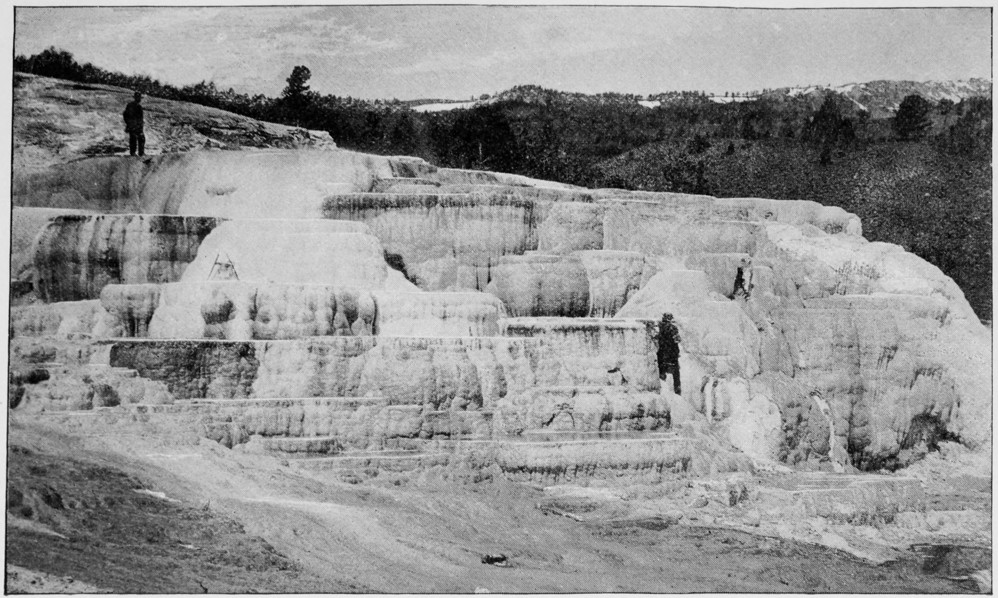
MINERVA TERRACE—YELLOWSTONE PARK.
Norris Geyser Basin is directly south of Mammoth Hot Springs, and is the place where the tourist, if lucky, gets his first view of a geyser. If the reader has never looked at a map of the National Park, he may get an approximate idea of its topography by bearing in mind that the principal curiosities are so placed as to form a parallelogram. The road first leads south from Mammoth Springs to the four geyser basins,—Norris, Lower, Midway, and Upper; then east to the Lake; then north to the Falls and Grand Cañon, and over Mt. Washburn, to Yancey’s; and thence back west to the Mammoth Springs. The patrons of the stage line, however, miss the Lake and Mt. Washburn, and are obliged to return by the same road a great part of the way. This must be very fatiguing, as the road between Mammoth Springs and Norris is most dreary and uninteresting, being generally lined on both sides by melancholy wastes of blackened tree corpses—a veritable forest cemetery. Now that fires are carefully guarded against, a vigorous undergrowth of young trees is perceptible, which in time will obliterate these and the many similar stretches of charred timber.
The hotel at Norris was destroyed by fire about the middle of July, 1887, and I arrived just in time to be the first occupant of a room in the new hotel. In the ruins of the old hotel were still to be found heaps of roast potatoes, hams, and other meats, and groups of molten beer and wine bottles twisted into peculiar shapes. Beer and wine, by the way, may be had at all these hotels, although no bars are allowed within the limits of the Park. The water throughout this part of the Park is strongly flavored with sulphur and other mineral ingredients, and is apt to disagree with some people. After supper I went up the road for a mile to see the Geyser Basin. The distinguishing characteristic of the Norris Basin is the many steam-holes, which send out uninterrupted columns of steam, with a deafening roar. I have read of canary-birds who were silenced forever after hearing a mocking-bird imitate and surpass their song. I wish all locomotive engineers could be sent to the Norris Basin; perhaps that would make them stop competing as to which of them can make night most hideous with steam-whistles. Besides these steam-holes there are simple hot springs, sizzling “frying-pans,” mud geysers, and “paint-pots,” in which paste of various colors is boiling and blubbering. A bench has been placed beside one geyser which every seven minutes sends up a mass of liquid mud, splashing and spluttering, and darting out arms in every direction, like a hideous polyp, until the frenzy has reached its climax and forced some of the mud over the border; whereupon the agitation subsides as gradually as it came on, and the liquid mass disappears down a fathomless hole, where it compresses the steam until it has gained sufficient volume to drive the nasty intruder once more out of its hole.
While I was watching this ludicrous spectacle, some of the workmen who were building the new hotel passed by and invited me to follow them and see the “Monarch” geyser spout. We occupied a place on the hill-side where there was no danger that the wind would drive the steam and hot water into our faces, and waited. The liquid eruption was due at eight, but the Monarch long refused to give us an audience. The workmen, meanwhile, discussed the news of the day,—the accident to the lady, already referred to, the moral character of the new dish-washer, and the death of a popular saloon-keeper, “a splendid fellow, who never refused a man a drink whether he had money or not.” The Monarch awaited this opportunity to make the transition from the ridiculous to the sublime, and, precisely at nine o’clock, with hardly any warning, he shot up a hot stream into the air a hundred feet or more, and kept it there for several minutes, the moon furnishing just enough light to see the stream of water amid the steam. Après nous le déluge appeared to be his motto; for we found it difficult to reach the road again because of the inundation he created during his brief activity. One of the workmen told me he waited for the eruption every evening, and that he had discovered some springs not known previously, including one sourer than a lemon (probably sulphuric acid). The number of hot springs in the Park seems, indeed, to be countless. Every day the tourist comes across them repeatedly, often most unexpectedly, and it seems probable that some of the greatest wonders of the Park remain to be discovered on the forest-clad hill-sides.
Among the most curious of the springs are the groups of little ones, with openings no larger than peas, lining the banks of the brooks and roadside, and so hot that one has to exercise caution in riding across them.
I should have stated that perhaps the prettiest sight on the road from Mammoth Springs to Norris is the frequent patches of dense grass, ordinarily of a pale yellowish green color, but if seen from above, facing the sun, of the richest yellow, suggestive of lakes of liquid gold. More beautiful still are the golden rivulets which form the outlets of some of the hot springs in the Lower and Upper Geyser Basins. As the “Fountain,” the principal geyser of the Lower Basin, was at rest when I saw it, I devoted most of my time to admiring these streamlets with their golden beds. All the gradations in color, from red through blood-orange, and orange to pale yellow, are here to be seen, the color fading out gradually with the distance from the spring. Quite as beautiful as the colors themselves are the exquisite waving golden lines and honey-comb figures which adorn the bottom of these rills, the reflections of the wavelets and ripplets on the surface of the water. In some places these dainty figures are replaced by rows of silky yellow fibres gently undulating with the movement of the water. The bottom of these rills is not hard, but consists of a soft pulpy mass, in some places several inches deep. This is fortunate; for otherwise some of those irrepressible idiots who write their names even on the bottoms of the white basins into which the water flows from the geyser craters would not hesitate to mar also the beauty of these fairy brooks.
The hero of Midway Geyser Basin is the “Excelsior,” which, however, has been quiescent for several years. It forms an immense pool, which, with some others and their overflow, converts the Basin into a place of most dismal, forbidding aspect. It is close by the Firehole River, which is lined by hot springs, one of which has the aspect of a pigmy water-fall, the spray being represented by the steam. When one considers the number of these mineral springs, and the fact that the Excelsior has been known to vomit sufficient hot water to convert the Firehole River, a hundred yards wide, into “a foaming torrent of steaming hot water,” one wonders no longer that this river, like several others in the Park, notwithstanding that its water is usually cool, rapid, and clear as a crystal, is destitute of fish. Were it not for this occasional excess of hot mineral water, there would be scores of places where a tourist might go through the unique performance of catching a trout, and boiling it in an adjacent spring, without moving from his place. As it is, those who wish to try this curious experiment have to do so at the Gardiner River or the Yellowstone Lake.
Few of the unfortunate tourists who are hurried through the Park on the Wakefield stages have an opportunity to see a geyser in activity till they arrive at the Upper Geyser Basin. Here more than a dozen geysers of the first magnitude are congregated; and although some are very irregular, and others only play at long intervals, there are several which every one who remains a few hours can see. A blackboard in the hotel gives a list of the geysers and their intervals of performance, and the hotel is so placed as to command a view of almost the whole basin, so that, whenever one of the irregular geysers starts up, the guests may be at once informed, and hasten to the scene. Fortunately, one of the finest geysers in the basin is “Old Faithful,” only a hundred yards from the hotel, and so-called because it spouts once in sixty-five minutes, almost with the regularity of a clock. The “Grand,” “Castle,” “Beehive,” and “Splendid” geysers are also certain to play for the benefit of those who spend a day at the Upper Basin. But the grandest of them all, the “Giant,” wakes up only once in a fortnight; and unfortunately I arrived just eight hours too late to see it. But there was no room for disappointment, as the other geysers afforded more than enough excitement and wonder for a day.
Even if these geysers were extinct, it would be worth a visit to this Basin to see the fanciful, lofty craters built up by the calcareous deposits of the hot springs. No two geysers appear to be quite alike in their style of playing. Some have more steam mixed with their water than others; some shoot up a constant stream; others, an intermittent one, somewhat like the various forms of rockets. The stream of the Castle looks almost like a water-fall flowing upwards and vanishing in mid air; and the Splendid afforded the spectacle of two lovely rainbows.
Besides these exciting geysers, which represent the sublime, the Upper Geyser Basin has some of the loveliest pools or springs in the Park, as representatives of pure, placid beauty. Chief among these are the “Morning Glory” and the “Gem,”—pools of fathomless depth filled with diamond of the purest water, lined inside with the richest, deepest colors, and with a “horrid” black hole at the bottom, suggesting the entrance to the nether regions. Into one of these pools a stupid boy once threw a stick, and his poor dog jumped in after it and was boiled to pulp in a few minutes. In another was found the bare skeleton of an elk, possibly driven into it by pursuing wolves,—a fine subject for a ballad.
From the Upper Basin I might have gone straight to the Lake; but as the road is a mere trail on which a horse cannot run, and the distance is therefore too great to cover in one day, I returned to the Lower Basin, whence it was only about thirty-five miles to the hotel camp at the Lake. With many tourists it seems to be a moot point whether it is worth while to visit the Lake; and as few used to go there, the accommodations until recently were of a most primitive kind. There were two men at the camp, and three tents—one for cooking, one for eating, and one to sleep in. An Englishman and his wife were the only guests besides myself. The lady naturally desired the sleeping-tent to be made up into two separate rooms, and the “landlord” finally submitted to the extra trouble this involved, though afterwards he was overheard commenting to his assistant on “them fussy English.” When the English lady got up in the morning to wash, she found the towel had already been used by her husband and myself, so she asked for another. The assistant replied he had already put out a fresh towel for that date, but after a moment’s hesitation he decided to make an exception in her favor, and produced a second.
For the season of 1890, however, a new hotel was opened, and boats placed on the Lake; and the tourist who omits it makes a great mistake. Not only does it rank among the curiosities of the world, being the only lake of its size at so great an altitude (7788 feet above the sea; or, as the guide-book graphically puts it, if Mt. Washington could be sunk in it with its base at sea-level, “its apex would be nearly half a mile below the surface of the lake”); but its intrinsic beauty would insure it renown at any altitude. Snow there was none on the surrounding mountains when I saw them; but, like all mountains, they gain immensely in picturesqueness and apparent loftiness by being seen across a sheet of water. And a beautiful sheet of water the Lake is, aside from its surroundings; but it is treacherous, and there is a violent thunder or wind storm almost every morning at eleven. About six o’clock in the morning I distinctly heard the mysterious rushing sounds in the air referred to in the guide-book as unexplained. I suppose they are due to the sound of the waters dashing against the beach and borne on by the wind, gradually accumulating loudness. Or the sounds may be due to the movements of the capricious and fitful wind among the tree-tops. I repeatedly heard a gust of wind approaching in that way with a magnificent crescendo and climax which a modern orchestra could hardly equal.
Everybody knows that the Yellowstone Lake is as brimful of trout as the Columbia River is of salmon. But a general notion prevails—even among those who dwell in the Park—that they are all unfit to eat, being infested by worms. This is an error. About half the trout are as sound as any other fish, and can be readily distinguished from the diseased ones. In the middle of the Lake it is said that all are sound,—a statement for the truth of which I cannot vouch. Our Englishman caught a dozen in the river just after it leaves the Lake. The cook assorted them, threw away the bad ones, and fried the others, which proved to be as good fish as I ever ate. The next day, on the way to the Falls, I stopped for a short time to catch a few of the numerous two-pounders that I saw swimming near the shore. Further down the Yellowstone the trout are smaller and less abundant than near the Lake, so that there is some sport in catching them; but where I stopped it was very much like fishing in a reservoir filled with hungry hatched fish. All I had to do was to select my fish, place the bait before his nose, and pull him in. I took along half-a-dozen which I knew to be sound, but at the Falls hotel I was informed that their French cook refused to touch the Lake trout. As the hotel itself furnished trout for supper caught below the Falls, where they are admitted to be sound, I did not argue the point with the cook, who was busy providing for an excursion party of fifty.
If the Yellowstone region contained nothing but the two falls at this place, and the Grand Cañon, it would have been worth while to reserve it as a National Park for all time. The two falls, though only half a mile apart, are utterly different in character; as the smaller, upper one plunges into a quiet, small basin in a secluded idyllic retreat, while the lower plunges three hundred and fifty feet down an abyss which is formed by the stupendous walls of the Grand Cañon, of which several miles lie before the eyes of the dazed spectator. The best place to enjoy the grandeur of the Falls and the Cañon is not at Lookout Point, as is generally believed, but at the edge of the Falls. Seen from a distance above, these Falls present a unique sight. The water flows on like any other rapid current until suddenly it appears to vanish in the air. On approaching the edge of the Falls, this illusion resolves itself into a scene which Niagara can hardly equal. As the water plunges into the pool below, it is dissolved into clouds of vapor that put to shame the steam columns of the biggest geysers. The breakers which wildly dash against the sides of the pool indicate the turbulence of the water beneath this spray and foam. Some of the spray is carried by the wind to the abrupt walls of the Cañon, where it nourishes mosses and lichens, which add one more color to the numerous tints that adorn these rocks. These tints bewilder by their variety and richness. The same strong mineral waters that have painted such exquisite brook-bottoms in the Geyser Basins here undertook a kind of fresco-painting on a scale of the most sublime grandeur.
Near the summits of some of the rocks may be seen some curious caves. Other rocks terminate in turrets and pinnacles suggesting mediæval architecture; and some of the rocky walls are adorned with a mosaic of brown, red, yellow, and white, as elaborate as the floor of St. Mark’s in Venice. Some of the turrets, when you climb up to them, appear so woefully weather-beaten that it looks as if you could kick them over; but you cannot. The torrent, at a dizzy depth below, in which the green water struggles wildly for supremacy with the white foam, enlivens the scene; and in one place a turn of the river-bed, near a streak of painted rock, gives the impression of two water-falls side by side, one green, the other red; one in motion, the other frozen.
From the Grand Cañon the coupon tourists return to the Mammoth Springs and Livingston, while those who travel independently can enjoy the ride over Mt. Washburn, with its extended views of the Rocky Mountains, its fertile sides fairly crammed with flowers of the richest colors and strangest varieties, and its solitary trail through the depths of a primeval forest, frequently blocked by fallen trees, on which one may not meet a human being in eight hours, nor hear any sound but the melancholy moan of a poor tree against which a dead trunk has fallen, and is wounding it with every movement of the wind. The dismal delight of this ride is as indescribable as the exciting sport of trouting that may be enjoyed at Yancey’s, whence it is but a short distance back to our starting-point, the Mammoth Springs Hotel.
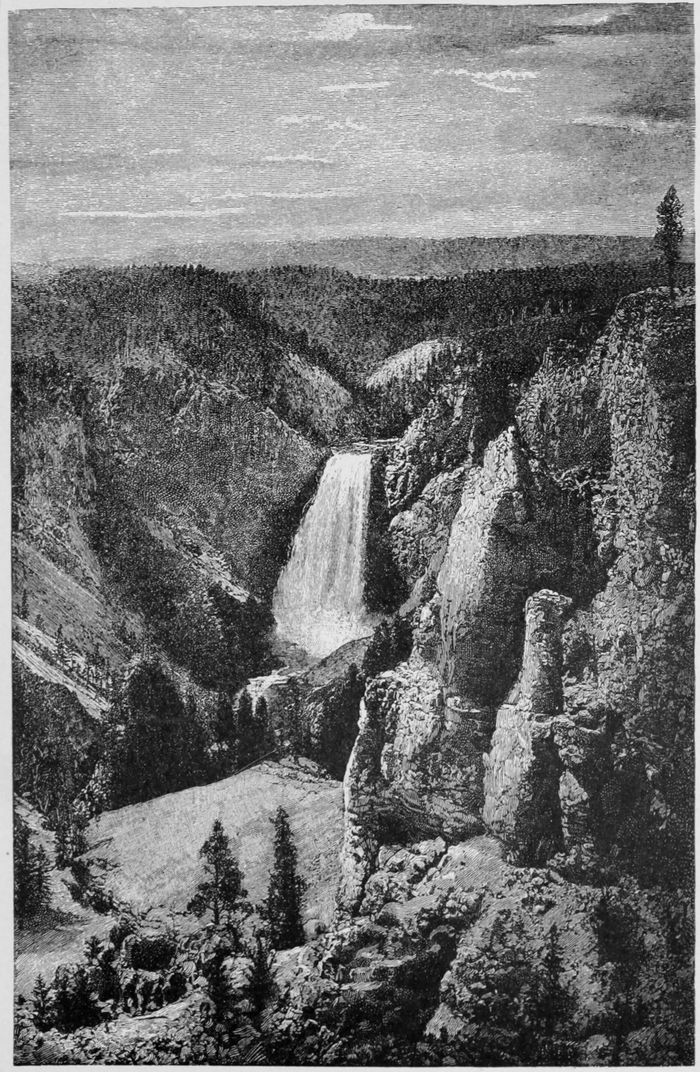
FALLS OF THE YELLOWSTONE.
After spending a week in the National Park on horseback, I came to the conclusion that what the Park chiefly needs now is a railroad,—not a steam railway, which would frighten the game and set fire to the forests, but an electric railroad. Great as are the wonders of the Yellowstone Park, the intervening distances are so great and the scenery often so commonplace, that nothing would be lost, and very much gained, by having an electric road. Dust and fatigue could be thus avoided, and more time devoted to the wonders of the Park in three days than at present in a week.