IX. LAKE TAHOE AND VIRGINIA CITY.
Reading edition
CLIMATIC PARADOXES IN SAN FRANCISCO—A LONG FERRY-BOAT—SNOW-SHEDS AND DONNER LAKE—TRUCKEE RIVER—LOGGING AND FISHING—TAHOE CITY—ROUND TRIP ON A BOAT—A LAKE AMIDST SNOW MOUNTAINS—A CINNAMON BEAR—BUTTERFLIES, SNOW, AND A BLUE SKY—LARGE TROUT, AND HOW TO CATCH THEM—SUNSETS REFLECTED IN THE LAKE—OTHER COLOR PHENOMENA—THE FLUME TO CARSON VALLEY—A MOUNTAIN RAILWAY—DESOLATE NEVADA MOUNTAINS—MINING UNDER A CITY—GOLD HILL.
The climatic conditions of San Francisco are anomalous and curious; shade trees, for instance, which are the greatest desideratum and blessing in Los Angeles, are not desired by San Franciscans, because the air is cool enough in summer without artificial shade. On the other hand, it is never so cold but that many semi-tropical plants will survive a whole winter in a sheltered situation outdoors; and San Francisco has in its public places some palm-trees high enough to attract attention even in San Diego. The avoidance of extremes is what constitutes the charm and value of the climate of San Francisco. But if the natives tire of this “golden mean,” and desire to experience the extremes for the sake of variety, they can gratify their wish by a few hours’ ride on the Central Pacific Railroad. At Sacramento they may find the thermometer above ninety in May, and just beyond it a place where oranges ripen six weeks sooner than at Los Angeles; while the station of Summit, a few hours further on, may be buried under four or five feet of snow,—an article almost unknown in San Francisco. Californians, however, are not greatly addicted to the habit of seeing the wonderful sights of their State, and such places as the Yosemite Valley, the Big Tree Groves, and Lake Tahoe owe their fame and vogue chiefly to Eastern and foreign tourists. There are now half-a-dozen transcontinental routes to choose between, so that it does not necessarily follow that every one crosses by the Central Pacific; but those who prefer the Northern or the Canadian Pacific should not neglect at least to patronize the Central Pacific to the extent of twenty dollars for a round-trip ticket, which includes the finest scenery along the whole road,—the semi-tropical Sacramento Valley, the sudden transition to the snow-crowned summit of the Sierra Nevada, the snow-sheds, Donner Lake, with a side excursion to Lake Tahoe, and the silver mines in Virginia County, Nevada. Lake Tahoe has been as often described as San Francisco; but as every pair of eyes looks at the world from its own point of view, perhaps I may be allowed to tell briefly what I saw. Lake Tahoe has only been known a few decades, while the sights of Greece and Egypt were described two thousand years ago, and are still “written up” in newspapers and periodicals.
Until two years ago the time-tables of the Central Pacific were so arranged that the passengers lost all the fine mountain scenery between Sacramento and Reno in the darkness of the night, unless they took an emigrant train. Now, however, Donner Lake and the snow at Summit and Cape Horn, where the train rounds a mass of precipitous rock over an abyss two thousand feet below, and the thirty-four miles of snow-sheds, which cost the company three hundred and fifty thousand dollars, can be seen by getting up at five o’clock. Previous to this we come upon one of the curiosities of California,—a ferry-boat four hundred and twenty-four feet long and one hundred and sixteen wide, which carries the whole train across a branch of the San Francisco Bay, thirty miles from the city. It is dark, and the motion is imperceptible. “What are we stopping here for so long?” asks a lady of the porter. “We are on a ferry.” “But why don’t they start?” “Why, we are half-way over!” It must be admitted that although the change in the time-table is an improvement, much of the Sierra scenery still remains unseen, being hidden by the snow-sheds in which the train moves along mile after mile, as in an interminable tunnel. There are a few gaps and window-holes here and there, but not nearly enough to give the passengers a satisfactory view of either the mountains, or of the lovely Donner Lake. This lake is otherwise unfortunate in having the attention drawn from its fine elongated outlines and mountainous surroundings by the eternal tale which some one in every seat is sure to tell of the unfortunate Donner party of emigrants who were snowed in here, and lost thirty-four of their eighty-one members through cold and starvation; or else some one will begin to tell of big hauls of trout recently made, for Donner Lake is as full of trout as Tahoe, and more convenient to the city markets.
At Truckee we leave the train to connect with the Tahoe stage. This is only a rough, lumbering town, but the laws of etiquette are enforced all the same; for in the hotel office a notice is posted, that “Gents are Requested to wear their Coats in the Dining-room.” We comply with this rule the more readily as the temperature at this early morning hour, and at this height, offers no inducement for sitting in our shirt-sleeves. We find that although our train was on time, the stage with which we were to connect had left without us. The stage company is in an evil predicament. It has fifteen miles to cover between Truckee and Tahoe; and if it waits for the train, the boat at Tahoe City probably will not wait for it. However, an extra stage was provided for our party, and the driver informed us that if we had come a day sooner we should have been caught in a first-class snow-storm (this was about the middle of May). To-day, however, the sun was out bright and warm, melting the snow rapidly, without thereby improving the road. The trees still had on a snow-costume, fitting as snugly as if tailor-made, so that while there was not a speck in the blue sky, every gust of wind sprinkled us with a shower of loose snow and solid crystals. The extraordinary difference in California between shade and sunshine was prettily demonstrated by the fact that although the sun had already melted the snow on and near the small shrubs, little patches of it remained wherever a tiny isolated plant of six inches cast its little streak of shade.
The road keeps alongside of the rapid Truckee River, which forms the outlet of Lake Tahoe and connects it with the great Pyramid Lake in Nevada,—being, therefore, like the Niagara, not a river in the ordinary acceptation of the term, having its source directly in the springs or melting snows and its mouth in the ocean, but a mere connecting link between two fresh-water lakes entirely isolated from the ocean. As both these lakes are alive with trout,—Pyramid even more than Tahoe, owing to its greater size and difficulty of access,—it may be imagined that the Truckee is good fishing-ground. Not so good, however, as it used to be; for whereas formerly the trout used to come up the Truckee from Pyramid Lake in great numbers to spawn in Tahoe, a dozen dams are now in the way, impeding their progress; and the difference this makes is already so perceptible that last year the fish commissioners had to place half a million young trout in Tahoe, and this year a still larger number was to be put in, since in a lake twenty-two miles long and ten wide, half a million is after all a mere handful. Besides trout, there are many whitefish, suckers, chubs, and other fish in this river, and the driver showed us a deep pool in which some law-breaking Chinamen once killed over three thousand pounds of fish by a dynamite explosion.
The Truckee River is also utilized by the lumbermen to float their logs to market. We saw many of the loggers rolling in the timber and wading in the snow-water with their big rubber boots. They get five dollars a day and board, which is not too much, considering that their amphibious life in ice-water exposes them to rheumatism and pneumonia; while at the same time they are sure to earn their wages, since they have to keep at work briskly all the time in order to keep warm. Slides are to be seen on the mountain sides, on which the timber is shot down into the water, and the driver had a story of an Indian who once for a bottle of whiskey tobogganed down on one of these logs, saving himself by a plunge in the pool at the end. It sounded like a “California story,” but was told with so much circumstantial detail that we were forced to believe it. Near its outlet at the lake the river is dammed, and whenever desirable the floodgates are opened, and the rush of liberated waters carries the timber down to the station.
By and by, when the population of San Francisco has reached over half a million, this dam will doubtless be raised a few feet and the Truckee outlet converted into an aqueduct. It will cost a neat little sum, for it takes the train eleven hours to come from San Francisco to Truckee; but the city needs the water, as its present supply is of poor quality and inadequate. With Tahoe on tap, the San Franciscans will have the best water of all the cities in the world; for Tahoe has no equal in purity and clearness, its bottom being pure gravel, without a trace of slime or mud, so that stirring it with a cane does not cloud it the least shade. But before the San Franciscans can get permission to swallow the Truckee River they will have to reckon with the Nevadans, who utilize it extensively for milling and irrigating purposes, and who, moreover, own the eastern half of Lake Tahoe.
Tahoe City is situated on the shore of the lake, not far from where it finds an outlet in the Truckee River. It consists of a dozen houses, including a “Grand Central Hotel” and a boarding-house, the latter being open all winter, while the hotel was closed when I was there. The boat which makes a round trip of the lake every day had left an hour before we arrived, so we were obliged to stay here till next morning. But this was far from being a misfortune, for Tahoe City commands one of the finest views on the whole lake shore. Those who arrive in the morning are apt to feel that the lake does not quite come up to its reputation. It seems, indeed, a large, majestic body of water, and the knowledge that it lies as high above the level of the ocean as the summit of Mount Washington adds to its apparent grandeur; but the sun is on the wrong side, and the profiles of the mountains opposite do not stand out clearly enough. But in the afternoon, and especially towards sunset, when Tahoe City is in the shade, and all the light withdrawn from it seems to be concentrated on those mountain ridges, intensified by reflections from the glowing surface of the lake, then the snow-peaks do stand out superbly against the blue sky and the golden clouds; and the scene becomes truly sublime as we watch the faint, rosy sunset glimmer gradually climbing one summit after another, and fading away till only one tip retains its tinge, thereby proving that it is the highest of the peaks, though seemingly it is not. Knowing the rate of the sun’s motion, why should it not be possible to measure the height of inaccessible mountains by thus watching the fading sunset glow on them? An old fisherman, to whom I described the Swiss Alpglühen, declared that he had never seen anything just like it at Tahoe, but the scene I had just witnessed was a very fair substitute for it.
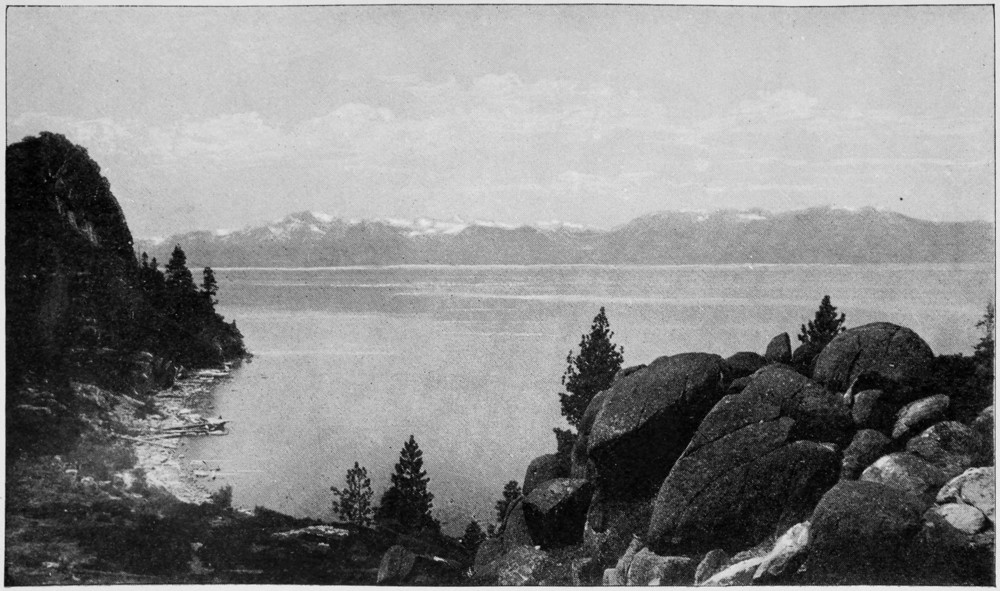
LAKE TAHOE.
Strolling along the shores of Tahoe one can enjoy a solitude as profound as if no human eye has ever before gazed on this liquid mountain mirror in a Sierra frame. A few logs here and there, in the water or washed ashore, are the only visible signs that man has ever been there. The faint, distant roar of a torrent, or the mocking of that sound by the melancholy voices of pines, only intensifies the feeling of isolation. Two weeks previously I had been at the Yosemite, where the flowers and bushes were in full bloom; but Tahoe lies two thousand feet higher, and some distance farther north than that Valley, hence the season is later. The first flowers were just budding out here, and the smooth, alligator-skinned manzanita bush was only in flower, while at Yosemite it had already formed its “little apples” a fortnight sooner. There, too, the hotels were open in the middle of April, while of those on the shores of Tahoe only one had opened its doors for the season, and the fire was burning all day long in our little inn at Tahoe City. At the supper-table Nevada beef was neglected for the more succulent lake-trout. They are delicious, especially the silver trout: yet I saw a man at the next table commit the gastronomic atrocity of putting Worcestershire sauce on Tahoe silver trout. Then he called to the waiter-girl, a buxom, rosy-cheeked country maiden, for a teaspoon—probably to eat it with. “Great Cæsar!” exclaimed the maiden. “Haven’t you got a spoon? Why didn’t you sing out?”
Next morning, as the little steamer starts with us on its round trip, a pleasant surprise is in store for us. As seen from Tahoe City the lake had seemed so perfect as to make us fancy we had seen about all there was of it. But hardly have we left the pier when new groups of snow-capped mountains, grander even than those we had been gazing upon, arise where before nothing had been visible but a dense, gloomy forest. And when we get far enough towards the middle of the lake to take it all in at a glance, we find that it is indeed a mountain lake, being shut in on all sides by giant peaks rising from nine to eleven thousand feet above sea-level. There is reason to believe that the site of the present lake was once a monstrous volcanic crater. It is now a reservoir in which is stored the outflow of more than fifty brooks and creeks, which drain an area of about five hundred square miles of mountains, and its depth is from fifteen hundred to eighteen hundred feet—water enough to extinguish a crater of even such vast size. It is a curious fact that this lake, though lying more than a mile above sea-level and surrounded by snow-fields, never freezes, even in the coldest Sierra midwinter. Perhaps this is due to the frequent squalls which agitate its surface and prevent the ice from gaining a foothold. These squalls, blowing down the cañons, make sailing on the lake somewhat risky at any time in the year, and tourists desiring a Christian burial for their mortal remains will do well to avoid sail-boats, because the bodies of those who are drowned here are never recovered, the coldness of the water preventing decomposition and the formation of gases which would bring them to the surface.
The steamboat, however, does not fear these squalls, which seem to strike only certain limited portions of the lake at a time. It makes half-a-dozen or more stops at points where there are summer hotels, which are open from about the middle of May to the end of October. Tallac’s opens a few weeks earlier, and I made that my headquarters for a few days. The superb view from here includes Mt. Tallac, highest of the Tahoe peaks, bearing on its hollow sides dazzling Alpine snow-fields, so large that one looks instinctively for solid ice-rivers at its lower end; but the California summer sun does not tolerate perennial glaciers even at these Sierra heights, and the straggling pine-trees sticking up like stubbles here and there through the lower névés indicate that not even these snow-fields are eternal like those of Switzerland or Alaska. But in early May the scene is still quite Alpine, especially the immense snow-ridge with perpendicular sides, which resembles the snow-wall that connects the Mönch with the Jungfrau as seen from Mürren.
Tallac’s is the largest of the hotels on Tahoe, but not large enough to indicate that San Franciscans come here in vast crowds during the season. The reason is obvious. Though scenically incomparable, Tahoe is not in midsummer as cool a place as San Francisco, which, during July and August, is the coolest place on the Pacific Coast. Were Tahoe within eleven hours’ ride of sultry New York, there would be a score or two of hotels on its bank in place of half-a-dozen. Residents say it was Eastern tourists who made Tahoe the resort it is now. Tallac’s is situated in the midst of a primitive mountain wilderness, and tourists anxious to see a wild animal in its native haunts will have no great difficulty in gratifying their curiosity. One day I set out to climb part way up the mountain which begins to rise about a mile or so behind the hotel. I followed a cow-path, but it soon was lost in a swamp which is fed by snow-water brooks, and which I had some difficulty in crossing. Beyond the swamp, on beginning to climb the mountain, I soon found myself in the midst of thousands of manzanita bushes, which presented a curious spectacle. The branches were bowed down by heavy snow, which formed a continuous layer over them thick enough apparently to walk on. But appearances were deceptive; for as soon as I came into contact with the bushes, the snow slipped off, the liberated branches flapped against my face, and I was surprised to find them covered with blossoms. To add to the contrast, several butterflies were flitting about in the warm sunlight. It takes California for such odd mixtures of the seasons,—snow-fed swamps haunted by mosquitoes, flowering bushes bowed down by snow, under a blue sky, and visited by butterflies.
The finishing touch was given by a large cinnamon bear, who suddenly hove in sight only a few hundred yards below me. As these bears are considered quite as vicious and aggressive, at certain times, as grizzlies, and having no means of defence except an olive walking-stick, I concluded not to molest the poor beast, but edged off quietly to the left, unseen, and made my way back through the trackless jungle of the swamp. In the evening I met two ladies who had been out alone in the afternoon for a walk, and had seen “a large yellowish animal with a slender body and a long tail.” They changed color on hearing that it was undoubtedly a California lion, and made a vow never again to go into the woods alone. A small boy who is attached to the hotel as a guide for brook-trouting parties told us his bear story, which had a somewhat more dramatic climax than mine. He went fishing alone one day, and having found a good place, he tied his horse to a tree, and started up the creek. Suddenly he heard a crackling and whining noise near him, and at the same moment a cinnamon bear thrust her head through the brush. A small tree being close at hand, the boy climbed out of reach just as the bear arrived at its foot. She was in a dangerous mood because she had her two cubs with her; but it was to the cubs that the boy owed his release; for after a moment they became impatient and moved away, and the old bear followed them. As soon as they were out of sight, he slid down the tree, ran for his horse, and thus survived to tell the tale.
The same boy assured me that he had seen trout caught in the lake weighing twenty-two, twenty-four, and twenty-nine and three-quarters pounds respectively. This being both a fish story and a California story, seemed a tough combination; but in the morning he took me out in a boat to fish, and as luck would have it, we were followed for a time by a monstrous trout which must have weighed fully twenty-five or thirty pounds. He would not take the bait, however, and such monsters are not often caught, the average catch being from one to three pounds. I caught three in a couple of hours, weighing together about four pounds, and that seemed to be considered a good catch at the hotel for that season. Fishing luck at Tahoe varies greatly with the season, the time of day, and the knowledge and skill of the fisherman. The best place to throw the line is just where the water becomes so deep that the bottom is no longer visible. Row slowly all the time, and let out a very long line, with a very bright silver spoon, to attract the game. The bright spoon seemed to be of prime importance; for I had one and caught three fish, while the boy, who had a dull spoon, did not get a bite. Whole minnows are used as bait, and the catching of these in a brook, or in the lake with bread crumbs and a net, gives employment to a thin, mummified old Indian who haunts the premises.
Another local character is old Yank, who formerly owned Tallac’s and now has built a rival hotel on a smaller scale near by. Yank is eighty-two years of age, and he presents a unique sight, standing upright in his boat, propelling it with one oar and jerking his fish-line with the other hand. His clothes are greasy rags and tatters, and he himself boasts that his baths are about as frequent as the blossoming of the century plant. Yet his cheeks are rosy, his frame vigorous, his voice firm, and eyes sparkling, bearing eloquent testimony to the tonic value of the combined lake and mountain air of Tahoe. He has lived here more than a quarter of a century. With pride he showed me some boats lying in the yard which he had constructed and painted with his own hands, and the use of which was to be free to the guests (this was aimed at the other hotel). He seemed to feel somewhat conscious of his tramplike appearance, and explained that those were only his winter clothes, and that as the season opened he would have to dress up “on account of the ladies.” An enormously fat and large dog is his companion. “Fat?” he exclaimed, echoing my exclamation,—“fat? You ought to see my wife!”
The salubrious Tahoe air is responsible for an appetite which would fatten a consumptive. But if the dinner-bell coincides with sunset and its concomitant celestial fireworks, it would be an exhibition of the purest animality to go and eat. The end of the long pier is a good place to see the colored sunset clouds, but better still is it to take a boat and row a mile or two from shore. About sunset the wind usually subsides, and Tahoe becomes as placid and perfect a mirror as the famous Mirror Lake in the Yosemite, but on an infinitely larger scale. Here are not only mountain peaks and pine-wooded shores reflected in the water, but the whole sky, with its sunset clouds, more brilliantly colored and more fantastically shaped than anywhere in the world, is mirrored below. The earth no longer seems a hemisphere, but a perfect symmetrical globe with the spectator in the centre, floating on the invisible water like a disembodied spirit. I have never been up in a balloon, but I do not believe that even ballooning can make one so vividly realize what must be the sensations of an eagle soaring with outspread, motionless wings through the azure ether. However, Tahoe does not need these colored cloud reflections as borrowed plumes to adorn itself with. Its own varied and ever-changing surface-colors are equally enchanting, though more sombre and melancholy. There are several zones of color. The shore is lined with sand, coarse as bird-shot and clean as the water itself, and for a distance of several hundred yards this sand is visible as we row into the lake, corrugated by the waves like the tiny furrows in the palms of our hands, and giving the water a yellowish tint. Farther in, it becomes blue, gradually shading into so deep a hue that we are ready to believe that a ship with a cargo of indigo must have gone down here, and feel tempted to dip a pen into it to see if it will do to write with; but dip up a glassful, and it is as clear and colorless as if it had just spouted from an artesian well, and as cold.
An artist endowed with the courage to reproduce these colors realistically would surely be denounced by the critics as a visionary idealist. But no artist could ever paint them as they appear to the eye, because no palette has ever held colors so rich and deep and at the same time so delicate and transparent. And still less than the sombre brilliancy of these colors could a painter reproduce an idea of their movements, in which lies half their charm. Cloud shadows climbing up a mountain side are a fascinating sight, but not to be compared with the spectacle of the irregular patches of color that are chased by the wind across the crests of the Tahoe wavelets, like semi-liquid purple, green and violet mists, vanishing in the distance into air, and followed by other color-waves in rapid succession. The best place to enjoy this unique spectacle is not in front of the hotel, where the trees act as a wind-break, but to the left, near the first bridge. As I stood here the first morning, a brisk breeze was blowing, with a clear blue sky overhead. Looking leewards, the water nearest the shore appeared gray, bordered by a light violet, with yellowish and purple patches; then came a deep green streak, followed by a broader indigo band, and finally a deep violet field, bounded by a faint mist raised a little above the surface of the water and slightly veiling the mountains. Every morning the details were new, and would have been so, no doubt, had I remained four hundred instead of four days. Tourists go into raptures over the waving motions of the Western wheatfields, but what are these monochromes to the polychromatic waves that chase one another across Tahoe?
In making the circuit of the lake, we had passed a place where a railway was seen climbing up the steep lake-side, not far from the little town of Glenbrook. This railroad is a connecting link between Lake Tahoe and the distant silver mines at Virginia City. At first sight the connection between an inclined railway on the shore of Lake Tahoe and the Virginia City silver mines seems as enigmatic as that pointed out by Darwin as existing between old maids and clover-fields. But the mystery is easily explained. Nevada is as treeless as the greater part of Spain; wherefore the miners have to come to California for fuel, and for planks to build their shafts. Lake Tahoe is surrounded by densely wooded hills which are gradually being denuded to supply the demands of the Nevadan miners. The logs are floated across the lake, hauled up the hill on the railway, and cut up into boards and planks, which are thence floated down in a V-shaped flume to Carson, whence they are taken by another mountain railroad to Virginia City. No visitor to Tahoe should fail to follow these planks to Carson and beyond—not necessarily in the flume, but by taking the stage at Glenbrook. The stage road to Carson is dusty, but most interesting. The first half of it is all up hill, the second half of it is all down hill, and the distance fourteen miles. Just before we reach the summit, Tahoe once more shows its face and casts a parting glance at us. Then we get a splendid view of the Carson Valley, deep down below us, and walled in on the other side by chain upon chain of bare, desolate, lofty mountain ridges. Unprotected by tree or stump, the snow has melted from even the highest peaks, and the snow-peaks which we see later (and which seem to justify the name of Nevada or “snowy”) are in California. We stop at a wayside inn for a moment, and a comely young girl asks the driver if there is “room for one more.” But a stage is not a street-car, and the driver had to confess that he was “afraid not, Nellie, unless one of the men will hold you on his lap.” Nellie looked non-committal; and if none of the passengers spoke and offered to take her, this was surely owing to bashfulness, and not to a lack of gallantry.
Once or twice the driver stopped to collect a letter that had been placed in a box fixed on a post by the roadside. To prevent useless stoppages and delay, these letter-boxes are uncovered, and the depositor has to take his chances of rain, which, however, are hardly worth considering in summer. Frequently we cross the flume, or drive alongside of it, but of course it makes a shorter cut to Carson than the stage-road, and in some places descends at such a steep angle that the timber in it is said to be carried along at railroad express speed. Half a million feet of timber can be thus floated down in a day, provided there are none of those jams which sometimes extend for half a mile along the flume and cause much trouble. Just before entering Carson we come to the end of the flume, where the timber is dropped, and piled up in rows of interminable length. The Carson Valley, through which we had been passing, is dry, dusty, and entirely devoid of trees, and the town, therefore, with its surrounding green meadows and fine rows of shade trees lining the streets, seemed like an oasis in the desert.
Carson, the capital of Nevada, has some good public buildings, and about four thousand inhabitants, but is not likely ever to have many more. It was crowded on this occasion with visitors from the country, and Piute Indians with their squaws and pappooses were loitering at every street corner. The monstrous, startling circus posters pasted everywhere explained this influx from the country and neighboring towns. It was nothing more nor less than Sells Brothers’ “Enormous United Shows”; “A Grand Olympian Festival”; “The Eureka of Canvas Entertainments”; “Prodigious, Overshadowing, and Enormous”; “Gigantic, Sweeping, and Brilliant Centralization of Sterling and World-Endorsed Entertainments”; “Fully a Century in Advance of all Contemporaries.” I bowed my head in awe on reading these announcements.
The appearance of the women and girls in this circus crowd did not seem to indicate that the climate of Carson Valley is invigorating, or its resources fattening. Though they wore white dresses, they looked so thin and sharp that it seemed a wonder the strong wind did not carry them off bodily. On account of the circus there were extra trains, but not enough cars, so that half the passengers had to stand. ’Twas always so, said a local privileged jester; “You never can get enough of Carson.” This train, en route for Virginia City, took home those who had attended the matinée. For the evening performance another extra train was to be sent down all the way from Virginia City, which appears not to have held out sufficient inducements to the circus company to come up, so that “it served them right if they got left and had to come down to Carson,” as one of the passengers remarked, with much feeling. This railroad from Carson to Virginia affords one of the most marvellous and entertaining rides in the world. The puffing of the engine would tell a blind man how steep is the grade all the way up; and how crooked and winding the road is, may be inferred from the printed notice to employees that fifteen miles an hour is the highest speed allowed. Sometimes the engineer might almost shake hands with a man on the last platform; and there is a story of an engineer who jumped off the locomotive on seeing a red light straight ahead, which proved to be the lantern on his last car. Some one has added these curves together and found that between Carson and Virginia passengers travel seventeen times round the circle. Several miserable shanty villages are passed, half buried in empty tin cans, and as we get up higher the outlooks become more and more desolate and rugged. Even Arizona has nothing more bleak and naked than these endless vistas of Nevadan mountains. No tree or other vegetation, except coarse sage bush. Yet the soil is said to be fertile, and to need only water to make it valuable. Deep down in the cañon below us, where the Carson River winds along, this statement is verified by the green fields and orchards which border it. Interminable wooden steps lead down from the railroad stations to these oases. “With water,” says a Nevadan, “all the mountain sides may be made veritable hanging gardens”; and all that is needed for this metamorphosis is to store the winter water in artificial cañon-reservoirs for summer tapping.
We are also told that between these forbidding bare mountain ranges lie valleys from one to thirty miles in width, but hidden by the intervening ridges, so that the State as a whole is really not so forbidding as it looks. Little, however, has been done so far in agricultural development, and Nevada is still almost exclusively a mining State. Were it not for the mines and the mineral deposit in dry lake-beds, there would be no railway except the Central Pacific; and as the mines now worked are much less productive than formerly, it is not surprising that Nevada should be the only Western State whose population is decreasing.
It cost about three million dollars to build the Virginia and Truckee Railroad, from Reno, on the Central Pacific, to Virginia City—a distance of fifty-two miles, although a bee-line would make it only about seventeen miles. Three millions may seem a big sum for so short a road, but it led to a region whence more than three hundred and fifty million dollars in gold and silver have been taken by mule, ox-team, stage, and rail, since the discovery of the Comstock Lode, thirty years ago. Should the mines ever become exhausted, it would be worth while, though it might not pay, to keep up the road as a scenic route. As we near the mining regions, the mountain scenery becomes more and more stupendous. We pass through a few tunnels, and suddenly a most unique view is spread out before us: a series of immense wooden buildings scattered picturesquely along the mountain sides, like mediæval castles, though without towers or other architectural features. Smoke is belched forth from the high chimneys, and by the side of every such building is a huge gray mound of waste ore,—the accumulation of years. Other mounds are seen where there are no buildings, but only holes into the mountain side, looking as if some gigantic animal had been burrowing and thrown out the soil. These mounds are graves in which some miners’ dreams of millions are buried.
As the train winds along and up the hill-side, these sights disappear and reappear repeatedly, in different groupings, till at last we come to Silver City, the first of the three towns which perch closely together on the side of the silver mountain, Mt. Davidson, about seventeen hundred feet above the river, and as far from the summit. Mining is not as profitable here as it was formerly, and as it is now a few miles beyond; but there are many small gold veins. “Nearly every head of a family in the town,” says the guide-book, “has his own mine; and when he wants money, he shoulders his pick, goes out to his mine, and digs it, as a farmer in the East digs a ‘mess’ of potatoes.”
Two miles beyond Silver City is Gold Hill, which once had as many inhabitants as Virginia City has now,—eight thousand,—but has only about three thousand at present. At Virginia City, many pleasant surprises are in store for us. In this aërial town, built like an eagle’s nest on the side of a rocky mountain, surrounded in all directions by similar bleak mountains without a sign of civilization or habitation on them, you naturally expect to take up lodging in a one-story shanty, eat canned beef, and sleep on a cot; but nothing of the sort. Crawling up the hill—everything is up and down hill here—a few hundred steps, you come to the International Hotel, six stories high, with elegantly furnished rooms, and fare good enough for the very reasonable charges. It stands in the principal business street, which is lined on both sides with not only such indispensable places as drug stores, grocers’ and butchers’ shops, but with fine jewelry and fancy stores, and even book and music stores. Elegantly dressed women, many of refined appearance, promenade the streets, bent on shopping; and, by way of contrast, there are groups of squaws sitting on the rubbish on corner lots, or following their lords and masters.
Every block, of course, has its saloon; for aside from the naturally bibulous propensities of miners, the great dryness of the air at this elevation creates an irresistible thirst every hour, so that the bar-keepers must do a thriving business. Excepting this elevation of over six thousand feet, there is little here to mitigate the action of the sun’s rays, which in summer must be intolerable. The trees are not high enough to afford much shade, having been destroyed, like everything else, in the great fire of 1875. But that fire, which annihilated the town, as usual taught a good lesson, and now there is a hydrant at every corner whence water can be forced high above the highest building by its own pressure, no engine being needed. The waterworks of Virginia are perhaps the most interesting in the world—both above and below ground. The pipe which bridges the Washoe Valley is seven miles long and has a capacity of over two million gallons a day. This water had to be brought over to Mt. Davidson from the main range of the Sierra Nevada, because there was not enough on the surface of Davidson. Below the surface, on the other hand, there was an ocean of unwelcome water, hot and cold, which constantly filled up the shafts and had to be pumped out at an enormous expense. To overcome this trouble, the Sutro tunnel was built 1650 feet below the surface, and almost four miles in length. Ten million gallons of water have passed through this tunnel in twenty-four hours. A day or two can be profitably spent in seeing these hydraulic wonders, besides the reducing mills, with their ingenious machinery, in which electricity is yearly playing a more important part, economizing power by transmitting it at different points from the Sutro tunnel, and preventing waste by superior processes of amalgamation. Of course no tourist must fail to don a miner’s suit in order to experience a sensation like that of falling from a balloon in descending a shaft, and to feel a heat more stifling than a desert blast. It is the strangest thing about this strange mountain city that you need only walk a block or two from any given point to find a place where you can descend from two to three thousand feet into the bowels of the earth, till the six-foot opening at the top appears no bigger than a hand.
The miners only work a few hours every day, and you understand why when you come back to daylight bathed in perspiration. After waiting long enough to cool off, climb to the top of Davidson. Contrasts are always pleasant; and none more so than this transition from half a mile in the dark interior of this planet to the summit of a mountain which rises a mile and a half above sea-level. Davidson is isolated, like the Rigi, and the view is therefore very extensive, embracing a large portion of Nevada. On one side is a fine circle of Sierra snow-peaks; on another, Washoe Lake, and the green meadows along the Truckee River; all of which, however,—snow, meadow, and lake,—form mere oases amid the barren wastes of illimitable gray mountain ranges. A flag-pole has been erected on the summit of Davidson, and the way in which it is fastened by means of granite blocks piled on high and iron chains on every side, indicates the strength of the winter storms at this altitude.