XV. A WEEK IN ALASKA.
Reading edition
A GREAT SALT-WATER RIVER—THE GENUINE AMERICAN SWITZERLAND—HIGHEST SNOW-MOUNTAIN IN THE WORLD—THE EXCURSION SEASON—ISLANDS AND FORESTS—INDIAN TRAITS—ALASKAN VILLAGES—GLACIER BAY—AN ICEBERG FACTORY.
If Long Island Sound could be continued for about a thousand miles, past the coasts of Maine, Newfoundland, and Labrador, as far as the entrance to Hudson’s Bay, so that tourists might go all the way on fast river-steamers, with state-rooms on the main deck, and without the slightest risk of sea-sickness; and if this hypothetic “Long Island” could be broken up into several thousand, which, instead of being flat and sandy, were covered with forests of almost tropical luxuriance and with mountains of an infinite variety of shape, continually increasing in altitude until they culminated in two snow-peaks higher than Mt. Blanc, outrunners of the third highest mountain range in the world, and sending clear down and into the salt water numerous glaciers, compared with which those in Switzerland are mere pigmies,—if, in other words, the strip of coast which extends from Tacoma, Washington, to Glacier Bay in Alaska could be transferred to the Atlantic side, it is safe to say that at least a score of large steamers, crowded with passengers, would be going up and down this salt-water river all summer long. The Atlantic Coast people, however, even if they possessed this scenic bonanza, would hardly be able to enjoy it comfortably, on account of the icy ocean current which sweeps down Davis Strait and chills and befogs Labrador and Newfoundland even in summer. Most persons in the East seem to imagine that Alaska must be in a similar, if not a worse, predicament; but they reckon without the warm Japan Current which does for Southern Alaska what the Gulf Stream does for the British Islands. Northwestern Alaska, indeed, shares with Northern Siberia the honor of having the coldest climate in the world; but the southeastern portion of the coast, as far north as Sitka, has a climate much warmer than that of Maine, though Sitka is some fifteen degrees of latitude north of Portland, Maine. It must be borne in mind how vast a country Alaska is,—as large, one writer has calculated, as the original thirteen States. A still more graphic way of realizing its extent is by noting that from California it is as far to the western extremity of Alaska as it is to New York; so that the central city of the United States is not Omaha or St. Paul, but San Francisco!
Fifty years hence, in my humble opinion, San Francisco, or the then metropolis of the Pacific Coast, will be not only geographically but in many other ways the centre of American life. The agricultural, scenic, climatic, and hygienic superiority of the Western to the Eastern Coast is too great not to affect the question of population and civilization. But long before that era Alaska will have universally established its claim to that much abused-phrase “the American Switzerland,”—unless, indeed, the terms should be converted, and Switzerland come to be complimented as “the European Alaska.” Yearly the number increases of those who ask themselves whether, instead of going to Europe every summer, it would not be worth while to try a Western trip. Before the Yellowstone Park and Alaska were made conveniently accessible, this Western trip could hardly have been recommended as an equivalent for Europe; but now the scales are pretty evenly balanced, and as soon as the St. Elias range shall have been included in the regular round trip, and provided with guides, roads, and hotels, Switzerland will have to “take a back seat”; for St. Elias rises twenty thousand feet into the air, and can be seen from base to top, with a snow-and-ice mantle reaching down to the very level of the ocean, while the highest mountain in Switzerland is only 15,784 feet high (to the spectator only about twelve thousand, as he is already several thousand feet high when he sees it), and has a snow-mantle of only about seven thousand feet. Indeed, considering that in the Himalayas and the Andes, the only two ranges that tower above the St. Elias, the snow-line is as high as fifteen thousand to twenty thousand feet, it is clear that St. Elias must be the highest snow mountain in the world.
Unfortunately, the present Alaskan round trip does not include St. Elias, although the majority of the tourists would gladly risk the chances of sea-sickness by making the additional two hundred miles from Sitka in the open sea. Two mountains of the St. Elias range, with their stupendous glaciers,—Fairweather and Crillon, both higher than Mt. Blanc,—are, however, visible to those who make the present tour; and although, like St. Elias, they are lamentably apt to hide themselves beneath and above clouds, even those who miss this wonderful sight find so much that is unique in the other attractions, that no one has ever been known to feel the slightest desire to “get his money back.” Were the scenery much less inspiring than it is, yet would the trip be worth making for its hygienic value. Here, for two or three weeks, one can breathe a delicious mixture of ocean and mountain air, the latter just sufficiently impregnated with the fragrance of pine forests to prevent that enervating languor which an exclusive lung diet of ocean air is apt to breed. As regards the appetite for solid food, its average size may be inferred from Captain Carroll’s favorite joke,—that, as the provisions are running short, he shall be compelled to take the turbulent outside passage back in order to curb the gastronomic propensities of the passengers.
The fare provided on these steamers is about as good as that on the average Atlantic steamers, but the daily salmon and a few other dishes become monotonous, and the passengers look in vain for “local color” in the bill of fare; i. e. for venison and bear steak, wild ducks and geese, salmon-berries, and some of the usual kinds of fish that haunt these waters. The fault for this omission is laid on the shoulders of the Indians, who are said to be too lazy to hunt and fish for more than they need for themselves daily. But as they willingly work in the mines for two dollars a day, it is probable they would gladly hunt and fish for the steamer stewards if enough were offered them. Yet, as just intimated, one needs no such special stimulants for the appetite, and one thing is certain, that the large number of invalids who cross the Atlantic yearly, chiefly to get the benefits of a sea-voyage, would do much better to go to Alaska, for there they would be sure of gaining in weight daily, owing to the absence of sea-sickness. And another thing in favor of the Alaskan tour is, that one is certain to find pleasant companionship on the steamers. The passengers on Atlantic steamers represent all classes of society, and even of the tourists not all are pleasure-seekers in an æsthetic sense; but of the Alaskan passengers the majority are apt to be persons of refinement and taste, since the only magnet that can draw them there is the hope of enjoying fine scenery.
Most of the tourists, not feeling quite certain whether Alaska will come up to their expectations, go on the elegant new steamer which is provided with all modern comforts and makes the round trip in twelve days; but not a few regret afterwards that they did not take one of the old freight steamers, Idaho or Ancon, which require about a week more for the trip, and, as they repeatedly stop a whole day at interesting places, allow the passengers more time to explore the neighborhood, and go fishing, observe the natives, hunt for curios, etc. The fast steamer makes only six or seven stops in twelve days, remaining from two to six hours at each place; and for almost three days after leaving Victoria she makes no stop at all, thus resembling an ocean steamer,—a resemblance made the more suggestive by a series of rocky islands near Victoria that look very much like the coast of Ireland when first approached on the voyage to Liverpool.
The regular tourist season extends from the middle of April to the middle of October. Early in the year passengers will see more of the “midnight sun,” but in July and August fogs and rain are less common, although even during those months the warm winds blowing inland from the Japanese Current are very apt to condense into clouds and rain,—a wise arrangement which prevents the scenery from becoming monotonous to the tourists; and if any interesting point is thereby missed, there is always a chance of seeing it on the return trip,—unless, indeed, the captain should choose a different channel. There is an endless variety to select from, and the marvel is that any captain or pilot should ever be able to find his way through this labyrinth. For what the Milky Way is among stars, this island-studded archipelago is among terrestrial water-ways. Captain Carroll, however, finds his way as unerringly as the salmon which at some seasons splash about the ship, bound for the rivers of the interior. There is not a single lighthouse—only here and there a rude post. Fortunately the nights never become entirely dark, and even a dense fog does not arrest the steamer’s progress; for the pilots have learned, by blowing the steam-whistle, to judge by the echo the distance from either shore; and the water is almost invariably so deep that danger is reduced to a minimum.
During our trip, which commenced on August 22, the fog was never dense enough to call for the steam-whistle; but the dense smoke, the result of forest fires and “clearings,” which had prevented us from enjoying the Columbia River scenery and Mts. Hood and Tacoma, also hid from us the charms of the far-famed Puget Sound region with its background of Olympian and other snow-mountains. Gradually, however, as we passed along British Columbia towards Alaska, the smoke grew less dense and finally disappeared entirely. Isolated columns of smoke were still to be seen frequently in the midst of the primitive forests, indicating Indian camps; but in Alaska, thanks to the frequent rains, forest fires cannot occur—a fact which will console the economically minded for the enormous wastes of timber in Washington Territory and Oregon. The visible wealth of Alaska, as Mr. Hallock remarks, lies in these forests: “There is a supply here of 5,700,000,000 feet at a low estimate, a very large part of which is at once accessible for shipment, as saw-mills and vessels can lie right alongside the timber at tide water all the way up the coast as far as it extends”; and Alaska with its islands is said to have a coast line of twenty-five thousand miles, equal to the circumference of the globe.
Not only has Alaska the third highest mountain range in the world, but if the greatest landscape artist had been consulted, its members could not have been arranged in a manner more continuously impressive to the tourist. Beginning near Victoria with a moderate altitude and mere patches of snow on the sides, they daily grow higher and whiter until the climax is reached in the St. Elias group. When we were northward bound, the smoky atmosphere hid the distant peaks and left the impression that snow was rather scarce for the first three days; but on the return trip a shower had preceded us, clearing away this smoke, revealing snow in abundance, including, about thirty-six hours from Victoria, an undulating range with immense snow-fields that would not be without honor even in Switzerland; and this was before Alaska proper had been reached.
The whole of the second and third days the passengers could imagine themselves sailing along the Hudson River Highlands or Loreley Rock on the Rhine; but after that all comparison with Eastern rivers ceased, and the Columbia alone, with its background of snow-mountains, afforded approximate terms of comparison. The hour for sleep was postponed as long as possible, from fear of losing some of the grand sights. As one of the passengers remarked, it would be possible to make hundreds of Lake Georges out of this Alaskan salt-water river. The word “lake” is very appropriate, as the channel widens and apparently comes to an end, as in a few places on the Hudson, so that tourists frequently amuse themselves by guessing which way the pilot is going to turn next. In some places the channel is so wide that land disappears on one side; at other times so narrow that a woman could throw a stone on either shore.
Of the abundance and variety of islands which adorn this water-way, only those can form a remote conception who have seen the Thousand Islands of the St. Lawrence. But in Alaska, as one writer has remarked, we see not a thousand islands only, but “a thousand miles of islands,” some as large as a State or a European kingdom, others just large enough for a house and garden; while many look as if future generations would inevitably call them “Picnic Islands,” so cosey and inviting are they. Like the mountains that line the shores, all these islands are densely wooded and very few of them are flat. Indeed, a strip of flat land in this part of Alaska is such a curiosity that the tourist’s attention is unconsciously attracted by it—reminding one of the young Tyrolean girl’s exclamation on entering for the first time the monotonous plain between Munich and Stuttgart: “Oh, mamma, look out of the window. How beautiful! there is not a mountain in sight!”
Bare hill-sides are almost equally rare in Alaska, till one reaches the glacier regions. Everywhere the forests extend down to the very edge of the water, and during high tide they actually seem to overlap or grow out of the water. Consequently there is no beach, its place being taken at low tide by ten feet or more of rocky wall adorned with mosses and other vegetable and animal growths, and sometimes almost as brilliantly colored as the walls of the Yellowstone Cañon. The forests above add to this an endless variety of green tints, indicating the different kinds of wood, the age of the trees; or, perchance, an isolated streak of fresher color betrays the path of an avalanche which carried away the old trees and made room for a new growth.
Some of the mountains are so rocky that they afford insufficient nourishment to the trees, which consequently die after a certain age, their gray, leafless skeletons suggesting the thought that after all forest fires have their use as a sort of scavengers. Still, these gray and green forests are less uninviting than those black and green charnel forests in which the fires have done their work incompletely; and they are the exception, not the rule, in Alaska.
For the first three days, as already intimated, these aspects of nature were the only new experiences and sights offered to the Olympian’s passengers, no stops being made after Fort Townsend and Victoria till we reached Juneau (the largest town in Alaska), omitting Nanaimo, Tongas, and Wrangel. It is customary to stop at each place of any importance, either in going up or returning, the captain being guided in his decision chiefly by the necessity of passing certain dangerous places when the tide is favorable.
The most perilous of these places is Seymour Rapids, some hours north of Nanaimo. As we approached these narrows, the water presented a most turbulently fascinating appearance, twirling around furiously in hundreds of little whirlpools, while large portions of the surface appeared to be several feet higher than the adjoining parts, as if a submarine earthquake had raised some places and thus made the water run down hill. The spectacle was as exciting as the Niagara rapids, and more sublime, because the fact of being on the water, and the knowledge that there were hidden rocks all about, added just that slight suspicion of danger which stimulates the feeling of sublimity.
In the narrowest part of the channel a regular water-fall was produced by the headlong plunge of the tide waters down some rocks near the eastern shore, while the other side was rendered equally dangerous by numerous rocks, thus leaving only a very narrow channel in the middle for the steamer to pass through. The Idaho and Ancon never attempt this passage while the tide rushes through it like a mountain torrent, but the Olympian plunged in boldly. In vain, however, did the engineer strain every muscle of his machinery; for more than an hour the noble steamer, though paddling away at a rate of almost twenty miles an hour, did not move a yard. Here was a lovely situation for timid souls, with plenty of time to speculate on the possibility of the shaft or rudder breaking, and to recall the fact that in this very place two vessels have already come to grief, one at a sacrifice of seventy Chinese lives! But the Olympian suddenly made a spurt, and the salt water-fall and the maelstroms were left behind.
On the fourth day we met the Pinta in a shallow, quiet bay, and exchanged greetings, mails, and provisions. The Pinta is the diminutive man-of-war which cruises these waters and keeps the Indians in subjection through the fear of having their villages bombarded. While the brass buttons of the officers exerted their usual magnetic power over the eyes of the young ladies, the other passengers were less romantically employed in watching the jelly-fish which crowded about the steamers, literally by the million.
The next incident of importance was our stop at the gold mines opposite Juneau, and subsequently at Juneau itself. Everybody went ashore to see the mines and the quartz mills, where a hundred or more machines reduce the ore to sand with a most terrific noise. The mine was said to be worth twice the price paid for Alaska, and it was evidently prospering, to judge by the additional buildings in course of erection.
At Juneau, which is a larger place than Sitka, the first thing that strikes the eye is the large number of “drugstores,” almost every other building being labelled as such. Can it be that the Indian habit of leaving the heads and tails of salmon to decay in the street, in their part of the village, has such an injurious effect on the health of the Juneauites? or has the fact that the sale of whiskey is forbidden in Alaska a remote bearing on the subject? Certainly neither the whites nor the Indians look unhealthy.
Most of the Indian men were at work in the mines, but the squaws sat in rows on the pier or in front of their houses, offering for sale grass baskets, furs, blankets, small canoes and paddles, totem-poles, wooden spoons, masks, bracelets made of silver dollars, berries, etc. Each squaw seems to have the shrewdness and business instincts of a Jew and a Yankee rolled into one. In their own language they comment freely on the tourists,—tit for tat,—and appear to find their doings rather ludicrous, which, no doubt, they sometimes are. These squaws have obviously given their husbands elementary lessons in “woman’s rights”; for the latter never dare to sell anything for a lower price than first asked, and if the wife says No, the bargain comes to naught. The squaws are also allowed to share the labor of the men on the water, and they are experts in paddling their own canoes. Their domestic accomplishments are less admirable. The interior of the house is as uncleanly as the blankets they wear, and it would not be pleasant to think of entering their huts were it not for the disinfecting smoke which pervades them. With a few exceptions, they have no stoves, the food being cooked over an open fire in the centre of the floor. The smoke seeks to escape through a hole in the roof, but, before escaping, it is utilized for curing strips of salmon that are hung on strings below the hole. In front of the houses other rows of salmon are suspended on sticks to dry in the sun; and before each hut lies a canoe carefully covered with mats, to protect it against the sun.
At Sitka we had an opportunity to see the Indians as influenced by missionary efforts. The Mission School contains over a hundred boys and girls. The girls do the cooking, and the boys are experts in carpentry. Their chairs and bedsteads are very neatly made, and are to be seen in most of the Indian huts. The boys wear a blue uniform, to give them a sort of esprit de corps; and the girls appear to give considerable attention to their appearance, especially in the arrangement of the hair. Their gait is very ungraceful, owing, as some say, to the fact that their ancestors spent so much of their time in canoes. Among the half-breeds, and the Indians too, some have considerable beauty of figure and face; and were it not for the large mouth, many more would be pretty.
It is impossible to look at these Indians and not come to the conclusion that they are descended from the Japanese. The whole cast of the face is Japanese: the cheeks, the small, sparkling black eyes, with their scant lashes and brows, and the complexion, are unmistakably so; and the fact that, not so many years ago, some Japanese mariners were shipwrecked on the Alaskan coast, makes the Japanese origin of the American Indian all the more probable. Another Japanese trait of these Indians is their bright intelligence and their eagerness to adopt the customs of the white man. They learn very readily, and some of the pupils recited and prayed in English, while several squaws and Indian men prayed in their own guttural language. The singing of these children did not differ much in quality of tone or intonation from that in our primary schools.
Besides these Indians, there is little of interest in Sitka itself besides the old Russian castle and the Greek church, in which it is odd to see pictures of saints in these out-of-the-way regions. The church itself does not deserve the amount of attention it has received, except from an antiquarian point of view; but the charms of Sitka harbor have hardly been exaggerated even by those who compare it to the Gulf of Naples. The arrival of a steamer is always a great event for the Sitkans, natives and whites, who assemble on the wharf to greet her arrival and cheer her departure; and the local weekly paper, the Alaskan, was enterprising enough to get out an extra in a couple of hours, with the passenger list; and this edition the young ladies bought by the dozen and mailed to their friends as conclusive evidence that they had been so near the north pole.
In speaking of Sitka before Glacier Bay I have followed the map rather than the steamer’s course; for Sitka is already some distance on the home stretch, and before arriving there the steamers visit Lynn Canal, which leads up to the Chilcat country, famous for its furs, blankets, salmon-canneries, and glaciers; and then Glacier Bay, which runs almost parallel to Lynn Canal, and, with the Muir Glacier, represents the climax of the present Alaskan tour. Lynn Canal contains a large number of glaciers, each of which would make the fortune of a village and a dozen hotels in Switzerland, and conspicuous among them are the magnificent Eagle and Davidson Glaciers, which would be the “lions” of Southern Alaska were they not slightly surpassed in grandeur by the Muir Glacier, which, Jumbo-like, therefore gets all the attention of the visitors.
As the steamer enters Lynn and Glacier bays, the scenery becomes truly Arctic, as well as the climate, and overcoats are in demand. Vast snow-fields are visible in every direction, and the frozen rivers or glaciers which represent their drainage all creep down to the water’s edge, in some cases presenting a front of several miles. As the steamer moves on, the panorama constantly changes, showing the mountains and glaciers from every point of view without involving the slightest fatigue on the part of the tourists; and as soon as one ice-river is out of sight, another shows its edge, and gradually stands revealed in all its grandeur. One never gets over the surprise that the snow-line should be so low—that the snow in the crater-like dug-outs on the mountain sides should be so near the level of the ocean in midsummer.
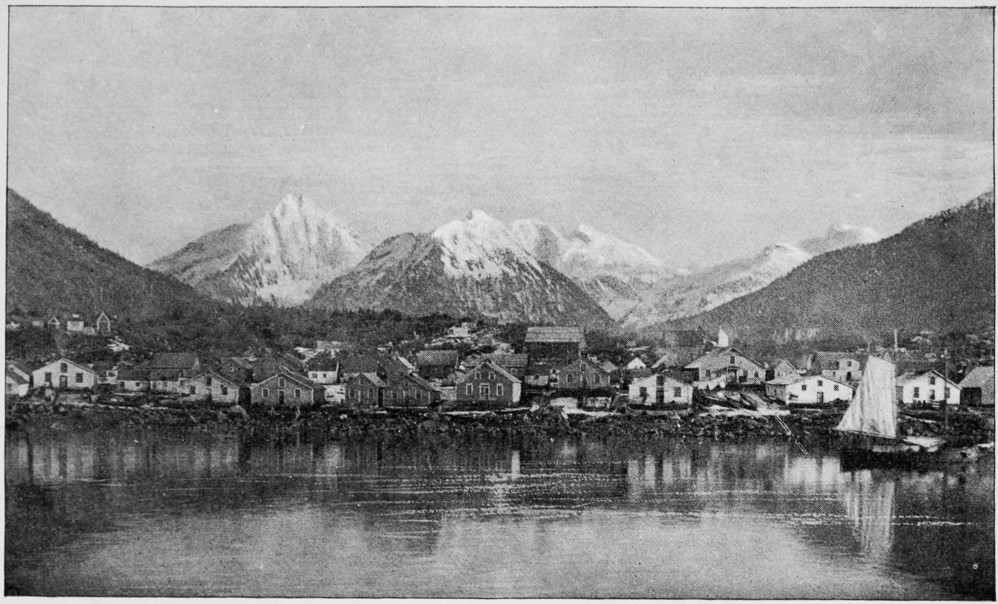
SITKA.
On entering Glacier Bay, another Arctic surprise awaits the tourist. Icebergs of all shapes and sizes begin to float about the steamer, some just large enough to fill the steward’s depleted ice-box, others, the size of a steamer, compelling the Olympian to moderate her speed. As the great glacier is in sight two hours before the steamer reaches it, though headed directly for it, the passengers have ample time to admire the exquisite blue and white tints of these icebergs, and note their odd forms and resemblances to the hull of a steamer, various geometrical figures, a bundle of logs, a fairy grotto, or a sphinx, etc. Some of them are entirely covered with scores of gulls, which fly away with harsh cries as the steamer approaches.
It appears incredible that the surface of the glacier which lies a few miles ahead should be more than two hundred feet above the water; it seems no more than twenty; but the apparent height constantly increases until the steamer brings up suddenly within a few hundred feet of the icy wall. Then there is a chorus of ohs and ahs, and the Bishop of Rochester (England), who is one of the passengers, dogmatically pronounces it the grandest sight in the world.
Imagine a wall of solid ice, two hundred and twenty-five feet high, extending for about a mile to right and left, the upper portions white and broken up into the most fantastic crags and pinnacles, like the rocks of the Yellowstone Cañon; the lower portions of a deeper and deeper blue, according as the increased pressure from above and from the sides has squeezed out the air and changed the solid snow into pure ice, producing near the centre a grotto of more than celestial blue. Imagine, furthermore, that there are eight hundred feet more of this wall under the water, that even if it is true that the Muir Glacier moves thirty or forty feet a day, instead of only two or three, like those of Switzerland, the portion of ice now visible to the eye represents snow that fell perhaps hundreds of years ago, and has been slowly creeping down with the ice-river ever since—and the meaning of the word “sublime” will perhaps become clearer than any metaphysical definition could make it.
Every ten or fifteen minutes the spectator is startled from his reveries by an explosion, followed by an aggravated multitudinous echo, and caused by the fall of a portion of the ice-wall into the bay, where it floats away as an iceberg. As it splashes into the sea, the water flies up as in a geyser, and a wild wave dashes over the rocks, tosses about the steamer, and threatens to land it high and dry on the beach.
After this spectacle has grown familiar, the boats are lowered, and every one goes ashore to climb up the side of the glacier and get views of its rugged surface, resembling a stormy ocean suddenly frozen with all its white-caps. Here also can be seen the dozen or more tributary glaciers which combine to make the Muir, and the semicircle of snow-mountains whose sides they adorn. The amateur photographers have brought their apparatus along, and take groups of the passengers with this picturesque background; and then the steamer’s whistle summons all back to embark for Sitka.
As the steamer slowly gets ready to depart, one notices what in the excitement had previously escaped notice,—the grooved and polished rocks, at least a thousand feet up the mountain side, indicating how high the glacier must have been formerly. A century ago Glacier Bay was not navigable, and according to Indian tradition the Muir Glacier has receded five miles in three generations; but this need not alarm tourists, as it still has a reserve to last a few thousand years longer. On leaving Glacier Bay we were so fortunate as to see the giants Crillon and Fairweather outlined against a perfectly clear sky, illuminated by one of the most gorgeous sunsets I have ever seen, and the glories of which did not fade till ten o’clock. It is a superb mountain group, bearing a distant resemblance to the Mönch-Eiger-Jungfrau group, as seen near Mürren, which Mr. Tyndall does not stand alone in regarding as the finest in Switzerland.