II. SOUTHERN CALIFORNIA IN WINTER.
Reading edition
A COLLAPSED “BOOM”—LOS ANGELES TO-DAY—PROSPECTS FOR IMMIGRANTS—POULTRY AND CATTLE—FIVE SOURCES OF WATER FOR IRRIGATION—WINDMILLS, AND TUNNELS UNDER RIVER BEDS.
In 1887 all the hotels in Los Angeles were overcrowded, the post-office almost unable to get through with its business, the city growing like an asparagus stalk after an April shower, and the demand for labor so great that the workmen could practically dictate their own terms. The smaller towns and would-be towns had also caught the infection, and were building huge hotels, cement sidewalks, and street-car lines; not because it was supposed that towns of two thousand inhabitants needed such things, but in order to be able to advertise in the Eastern papers and in real-estate circulars that the place had street-car lines, cement sidewalks, and hotels “with all the modern conveniences.” Each town printed a special illustrated pamphlet in which its unique attractions, as compared with all rivals, were set forth, culminating in the claim that its township was the “Italy of America” or of the West; while San Diego brought matters to a climax by styling itself “the Italy of Southern California.”
In 1889, when I made my second visit to Los Angeles County, I found everywhere evidences that the boom had collapsed. The street-car lines in the small towns barely paid expenses, though it was regarded as an act of local patriotism to ride on them; and the cement sidewalks, which had been prolonged far into the fields, had failed to charm into existence the rows of houses that had been looked for. In the metropolis itself, workmen were grumbling at insufficient employment, merchants clamored that their rents were fifty per cent too high, many store windows were pasted with closing-out notices, real-estate offices were no longer as abundant as saloons, and the bookstores, more wretchedly supplied than those of any town of ten thousand inhabitants in the United States, were even selling the twenty-cent paper novels at “cut rates.” The newspapers of Northern California, of Oregon, Washington, and other Western States as far east as Kansas, which had long been jealous of the prosperity of Southern California, and desired a boom of their own, crowed loudly over the “busted boom” of Los Angeles, while the papers of that city, no longer compelled by the pressure of real-estate advertisements to add two or four extra pages to their issues, had daily elaborate editorials to disprove the allegations of their envious rivals.
An unprejudiced observer, interested only in the climate and the scenery, and not in the real estate, of Southern California, could not but admit, from the signs just noted, that these “envious rivals” were right in insisting that the boom had collapsed; but the inferences drawn from this fact, that Southern California had been overpraised, and that its road was to be down hill in the future, were absurd. Southern California cannot be overpraised, and, in my humble opinion, its prospects are brighter than those of any other portion of the United States. To a large extent the late boom was nothing but a huge gambling scheme, an epidemic of wild land-speculation, which carried along in its rush thousands of thoughtless victims, like the mad stampede for Oklahoma. Southern Californians knew better than others that the sudden rise in their land prices were artificially stimulated and would be followed by a reaction; but they were bound to make hay while the sun shone, and found to their delight that the sun shone longer in California than elsewhere, in the metaphorical sense as well as in reality. At last the storm came, and swept away many of the “tenderfeet,” or late comers, and their new buildings, whose débris is now lying about, so to speak, and is pointed at as a terrible warning and lesson; but the only lesson it does teach is that people should avoid real-estate gambling. The fragments of the ruins will soon be cleared away, and then it will be found that, although many individuals have suffered during the storm, the State as a whole has been benefited by it.
In many cases the large, useless hotels built in the small towns have already been secured at a bargain for school buildings, and in the larger cities many public works have been provided which, without the artificial stimulus of the boom, would have been postponed to the indefinite future; as, for instance, the long flume, costing almost a million of dollars, which now provides San Diego and vicinity with abundant pure water, and will do more to develop the resources of the county than the discovery of several gold mines. Los Angeles made the great mistake of not building a sewer to the sea during flush times, and now suffers under the disadvantage of vitiated air, which, if not remedied, will destroy its reputation as a health resort.
In other respects, Los Angeles is already recovering from the effects of the collapse. Fine new buildings are again going up, the streets are always animated, and the cable-car tracks have been lately prolonged into the picturesque hilly region behind the city, which affords the finest imaginable sites for suburban cottages, with superb views of the mountains, and a glimpse of the Pacific Ocean, fourteen miles away. Though founded in 1781, Los Angeles had less than five thousand inhabitants in 1860, and only thirteen thousand in 1880, while to-day it has sixty thousand or more. Thirteen years ago no railroad connected it with other parts of the world, while to-day it is one of the greatest railroad centres in the West. And as it still remains, what it always was, unsurpassed by any city in the world for climatic and scenic advantages, it has every reason to look forward to a prosperous and brilliant future.
Southern California includes five counties,—Los Angeles, Santa Barbara, Ventura, San Bernardino, and San Diego,—embracing, as General N. A. Miles points out, “a territory nearly the size of the State of New York, and with natural resources of ten times its value.” This seems a big statement, but its truth can be realized, without the use of figures, by considering that these five counties are capable of supplying the United States with all the figs, raisins, prunes, wine, olives and olive oil, oranges, lemons, nuts, and canned fruits that are now imported from France, Italy, and Spain; most of them, with proper care, equal in quality if not superior to the imported articles. Although large quantities of all these fruits are already raised, they are a mere trifle compared with what the soil is capable of yielding to a larger population. It has been proved over and over again that ten to twenty acres of good irrigable land are all that is needed to support a family, and there is therefore room for hundreds of thousands of immigrants. However, it is candidly admitted that Southern California is a land of more promise to the farmer who has at his disposal a capital of a few thousand dollars than to the emigrant who brings with him little but a team and a pair of muscular arms; for improved land, with bearing vines and fruit trees, costs from one hundred to five hundred dollars an acre, while unimproved land, though it may be had for one-fifth those prices (twenty to one hundred dollars), yields no return for several years, unless grain is raised; for all of the semi-tropical fruits above named require from three or four to ten years before a profitable crop is yielded.
And yet personal observation has led me to believe that there are special opportunities in this region precisely for the farmer with limited means, if he is willing to curb his ambition and content himself with dairy farming and the raising of poultry on a large scale for the market. The farmers now settled in Southern California are so ambitious to become orange, olive, or vineyard kings that they entirely neglect the farmyard, and have hardly enough milk and butter and vegetables for home consumption. It is almost impossible in any part of Southern California to get a good piece of beef or mutton, and chickens are imported by the carload from Kansas and other “Eastern” States, and sold at absurdly high prices at Los Angeles, although in this mild climate it is easy to raise chickens all the year round, and I have myself seen splendid broods of young ones grow up in about half the time they need in the East to reach a marketable size, the simple precaution being taken of providing them with dry housing during rainy nights. If this is not done, their growth is remarkably retarded, and many of them become diseased, and, if not killed or isolated, will infect a whole yardful of poultry.
Cattle-raising, too, must prove profitable in a region where the animals can feed on the green foothills and valleys all the “winter,” and in summer eat the sun-dried grass or clover which covers the whole country. The wild, clover-like alfileria, which furnishes most of this natural hay, grows in profusion along the roadsides and in the meadows, and even fills up the empty patches in the cactus fields. After the spring rains it attains a height of ten to fifteen inches, with a dozen plants to the square inch, and is so juicy and tender that one can mow it down with a cane or with the hands; and a week later it is as high as if it had never been cut. It looks so luscious and sweet as to almost make one long to be a cow or a sheep, in order to be really “in clover” for once. Again, the cultivated clover, or Chilian alfalfa, if sufficiently irrigated, yields half-a-dozen or more crops of hay a year, which makes the sweetest butter and meat in the world. Yet the Southern Californians, as I have just said, import most of their butter and meat; consequently, if some farmers should undertake to supply the local market with homemade products, fresher and cheaper, because with no freight charges on them, they would have a sure source of prosperity before them. It is probable that the drought of 1863–64 discouraged the cattle business; but there has been none since that time, and with the present railway facilities and a reasonable foresight in storing hay, no disaster need be feared in the future. Moreover, one of the best and cheapest kinds of cattle food, pumpkins, as large as beer-barrels, can be raised here by the thousand with hardly any trouble or expense. Sometimes they lie in a field so densely that one might walk over it without touching the ground; and I saw several fields in which hundreds of fine pumpkins, for which the farmers had no use, owing to the scarcity of cattle, were left to rot on the ground.
Before purchasing land in California of the South, it is well that the investor should have made up his mind in regard to what branch of agriculture he wishes to devote himself. For although it is one of the chief advantages of this soil that it can be made to produce most of the fruits of the temperate and semi-tropical, and some of the tropical zones, yet each township or locality has its special adaptedness for this or that product, and to ignore this is to labor under disadvantages. Thus, Riverside and vicinity have been found most favorable to the culture of the orange, because the destructive scale-bug does not flourish here as it does nearer to the coast. Of lemons, the finest specimens are grown near the Mexican border, in San Diego County, which also furnishes some of the best raisins and olives. Santa Barbara County yields the finest pampas plumes and the best walnuts, and Los Angeles County is still the wine centre of the South, notwithstanding the ravages of the mysterious vine disease. The conclusion, too, is being gradually reached that for vineyards the foothills are the best localities, since in Europe all the best vines are raised on the hill-sides. Plants of a distinctly tropical type, also, like tea, bananas, etc., might perhaps be successfully raised on the lower foothills, which have an immunity from the light frost that occasionally, in winter and spring, visits the lowlands near the ocean. And besides these facts, it is well to know that in the same locality the soil often presents great differences, so that in a twenty-acre field one-half may be well adapted for the orange or olive, while the other half needs a different crop. Above all things, “tenderfeet” should beware of buying land immediately after the spring rains; for then the whole face of the country is covered with a rich carpet of grass and flowers, so that it is difficult to distinguish the good land from the sand-bottomed site of a former river bed, useless for anything but cactus.
Finally comes the most important of all questions,—the facilities for irrigation. Grain, if sown in winter or early spring, ordinarily needs only the regular rains of the season to reach maturity, and there are localities where many other crops can be raised without irrigation; but these are the exception, and as a general thing the semi-tropical fruits which constitute the specialty of Southern California, need water for profitable culture. So well is this now understood that it is a favorite joke of the natives to say that if you pay for the air and water, they will throw in the land gratis.
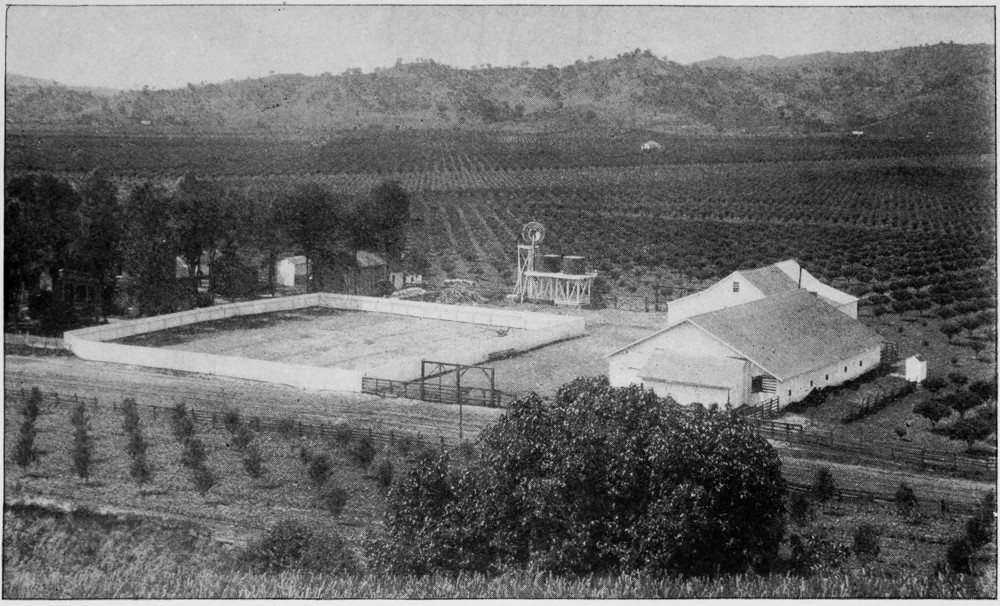
FRUIT FARM IN SOUTHERN CALIFORNIA.
Fortunately there are no fewer than six sources from which crops are supplied with water, if we include rain. For small vegetable or flower gardens sufficient water can be raised by means of windmills, which are kept in brisk motion every afternoon by the sea-breeze in the whole region within twenty or thirty miles of the ocean, except during two or three of the “rainy months,” when they are not needed. These mills also supply the kitchen, and it is curious to note how cold the water remains in the large tanks exposed all day long to a semi-tropical sun. Much of the water used in town and orchard is supplied by artesian wells, which, however, occur only in certain belts, especially in Los Angeles and San Bernardino Counties, although none of these, I believe, equal one dug in Sonoma County last winter, which is one hundred and fifteen feet deep, cost only two hundred dollars, and yields almost half a million gallons every day.
Rivers of the size of the Sacramento, or those of Oregon, Southern California has none, but there are some smaller rivers and a large number of creeks, fed by the mountain snows, which are tapped in two ways for irrigating purposes,—on the surface and below the bed. The surface water is often carried many miles in ditches; and wise is the community which lines its ditch at once with cement, else in summer it loses almost two-thirds of its water supply by absorption on the way. The Santa Ana River, which is quite a respectable stream in winter, and after rains becomes a formidable torrent, liable to overflow its banks and change its channel (thereby causing boundary disputes), is in summer tapped so freely that its bed becomes dry, and not a drop reaches the ocean.
Much more curious than this surface tapping, however, is the tunnelling, by means of which the water which has buried itself beneath the sandy river bed, as if to escape the merciless pillaging of the hot sun and the greedy farmers, is brought to the surface again and utilized. It is in this way that the Santa Ana River is despoiled of its last drop, and the value of this procedure may be estimated from the statement made by the San Bernardino Times, that “the Ontario Land Company has driven a tunnel in under San Antonio Creek, a distance of nearly eighteen hundred feet, at a cost of about fifty-two thousand dollars, and they have about two hundred and fifty inches of water, worth a quarter of a million of dollars.” As it hardly ever rains during the summer, all the water thus drawn off the rivers in the irrigating season comes from the springs and the melting snows in the mountains. This is just about sufficient for the present needs of the population; but no fears need be entertained for the future, since, as the rural population increases, it will become profitable to expend large sums in building reservoirs in the cañons to store the abundant winter water which now runs to waste in the ocean. In this way the mountains can be made to yield an absolutely unlimited amount of water, sufficient to support tens of millions; and the lesson taught by the Johnstown disaster will prevent the dams from being carelessly constructed.