VIII. SAN FRANCISCO AND CHINATOWN.
Reading edition
MOUNTAINOUS CHARACTER OF THE PACIFIC COAST—THE HILLS OF SAN FRANCISCO—CABLE-CAR TOBOGGANING—THE GOLDEN GATE AND CLIFF HOUSE—SCENES IN THE CHINESE QUARTER—JOHN’S TABLE DELICACIES—LUNCH IN A CHINESE RESTAURANT—AN HONEST BOOKSELLER—CHINESE WOMEN—OPIUM DENS—BEHIND THE SCENES IN A CHINESE THEATRE—THE ASIATIC TRADE—CALIFORNIA HOTELS, RESTAURANTS, AND WINES—BERKELEY AND THE UNIVERSITY—THE CLIMATE OF SAN FRANCISCO.
A glance at a relief map of the United States shows a most striking contrast between the Atlantic and the Pacific slopes, especially within a few hundred miles of the coast. In the east, the mountains are few and low; whereas in the whole of California, Oregon, and Washington there is hardly a spot whence the view does not include a mountain range with a few snow-peaks. And this hilly structure characterizes also the three leading cities of the coast, and many of the smaller ones. Los Angeles, near one end, has recently built cable-cars to climb the hills which shut it in; Portland, near the other end, is beginning to build hers; and San Francisco, in the centre, has long had the most complete cable-car system in the world. Rome may have been built on seven hills, but San Francisco, as its inhabitants love to claim, is a city of a hundred hills. There is Californian exaggeration in this; for the greater part of the present city stands on about a dozen hills, with the intervening valleys and the level lots created by digging twenty million cubic yards of earth out of the hill-sides, and filling up the hollows; but beyond these there are scores of suburban hills, so to speak, waiting to be annexed; and when the city shall have grown to the size of London,—which, of course, is only a question of time,—it will probably cover a hundred hills: q.e.d.
For purposes of drainage and other sanitary reasons, this hilly structure of the city is a decided advantage, and that it adds greatly to the picturesqueness of the impression which it makes on visitors is obvious. Approaching it at night on an Oakland or Saucelito ferry-boat, or viewing it from an elevated point, it does not present to the eye such a limitless area of countless lights as does New York seen from Union Hill, Hoboken; but the grouping of the lights is more fascinating, some of them leading in straight, double lines up the hills; while others are arranged in semicircles along the amphitheatric valleys. To get a bird’s-eye view of San Francisco in the daytime, one need not climb arduous towers, as in Eastern and European cities; but has only to take a front seat on a cable-car,—with an outlook unimpeded by driver or horses,—to see the city from half-a-dozen high hills, and as many different points of view. No city in the world can be seen so easily, so quickly, and so delightfully, as San Francisco, from these cable-cars, which, in the long run, make perhaps as good time as the New York elevated trains. It is a constant up and down, and the sensation of rapidly ascending a hill through rows of handsome residences and flower gardens, without having to pity the poor, puffing horses, is as agreeable as the sudden plunges downward, so fast, and often so precipitous, that by shutting the eyes one can easily imagine himself to be out tobogganing. The feeling is similar to that experienced at Mauch Chunk, Pennsylvania, on descending the hill for twenty minutes on a car whose only motor is gravitation.
The most enjoyable of the cable-car excursions is the one in the direction of the Golden Gate and Cliff House, connecting in the suburbs with a new steam-dummy road only completed a short time ago, and not yet mentioned in the guide-books. This excursion is really one of the finest in California, and should be missed by no tourist; for it gives him superb views of the city from several hills, and of the bay studded with pretty islands, and finally takes him to the very edge of the Golden Gate, where he can see the ships and steamers entering or departing for China, Japan, Australia, and every port of Europe and America. The road continuously skirts the shore, being dug or blasted out of the precipitous hill-sides; and directly below us are the Pacific breakers blindly dashing themselves into foam and spray on the rocks. The terminus is the Cliff House, with its “seal rocks,” densely inhabited by the sea-lions, which have been too often described to call for more than mention. There are countless seal rocks between San Diego and Sitka, but none so near a large city as these, which may be looked on as a free aquarium and an addition to the Golden Gate Park. They would have long since been depopulated were they not protected by law. The fishermen clamor for a repeal of this law, because the seals kill so many salmon bound for the Sacramento River at the other end of the bay; but the gain of a few hundred fishermen would be the loss of three hundred and fifty thousand San Franciscans. As well let the city fathers turn over the Golden Gate Park to the vegetable gardeners. It takes up many acres which might be planted with useful cabbages and onions,—enough to enrich quite a number of gardeners; for it is three miles long and half a mile wide, containing one hundred and fifty acres more than the Central Park in New York. Besides, it contains poison-oak, and is so “unimproved” in part, that only a few years ago a wildcat was killed in it. Therefore, down with the Park! let it be exterminated, together with the useless, harshly barking, salmon-eating seals!
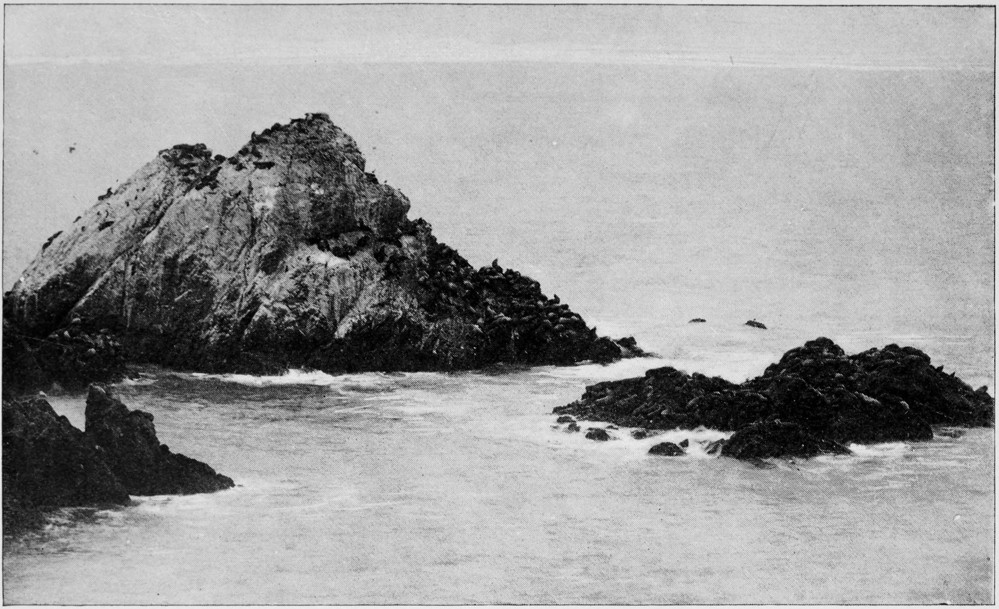
SEAL ROCKS—SAN FRANCISCO.
No doubt more people have had their first glimpse of the illimitable Pacific at the Cliff House than from all other places on the Californian Coast; and it is a most delightful spot to spend a few hours, although at any time of the year a light overcoat is desirable. When we are ready to return we have the choice of several roads, none of which, however, is as attractive as the one we came on. So we once more connect with the cable-cars and have another five cents’ worth of tobogganing—without snow or danger of broken limbs. I should think that cable-car tobogganing parties ought to be among the most popular amusements in San Francisco. I am sure if I lived there I should ride to the Cliff House every day in the year. The return trip takes us through different streets from those we saw before, and on arriving at the corner of Jones and Washington Streets, a most magnificent prospect opens before us. We have risen to the crest of a hill, which seems to be the end of the world, when suddenly the whole city lies far down below us, and the car makes an almost perpendicular plunge a few hundred yards, as if determined to lose no time in getting there. You must hold on tightly, but there is no cause for alarm, as the frequent accidents on these roads do not happen in such places, but in the crowded streets below. Presently a still greater surprise awaits us. The car turns a corner, and without a moment’s warning we are in China, which we had imagined five thousand miles away. In other parts of the city we see an occasional Chinese laundry and a few Chinamen mingled with the throng of Americans; but here the proportions are more than reversed,—Chinese men, women, and children, Chinese shops and signs, Chinese conversation, and Chinese smells monopolize the attention.
San Francisco has more than twenty thousand Chinese, hence it may be imagined that Chinatown is not a village. Anti-Mongolians like to compare it to a cancer which is eating its way through the vitals of the city, constantly enlarging at the edges. Blocks upon blocks in some of the best streets are given over to the Asiatic invaders; and while the large buildings formerly occupied by Americans have been left standing, they have undergone such a thorough metamorphosis that if the Chinese should ever be driven from the city (as they were from Tacoma), the simplest way to Americanize these streets again, would be to blow them up with dynamite and rebuild them—which would also perhaps be the best way for sanitary reasons. But while the main buildings and streets have been left as originally laid out, a number of side streets and narrow alleys—exact copies of those in China—have been created to connect them, and fill up every vacant yard and corner; for a Chinaman is not happy unless crowded as closely as salmon in an Alaskan creek. What adds to this effect of crowding is that all life and activity seems to be concentrated on the ground floor, no business being apparently carried on in the upper floors, which look uninhabited and empty, without window curtains, or shutters, or signboards, or other signs of habitation, excepting in the restaurants, whose outsides, from base to roof, are gayly and gaudily decorated, and illuminated at night with Chinese paper lanterns. The old stores with their large rooms have been subdivided into many smaller ones—some of them only fifteen to twenty feet wide or even less. The place of signboards is taken by the well-known wide scrolls of red paper with Chinese characters printed on them, and pasted vertically on the street side, while smaller ones are pasted on the windows. Some of the narrowest alleys have no stores, but only cheap eating-houses, gambling-places, and rows of barred windows, behind which wretched female slaves solicit passers-by. Among them are some rather pretty faces, but others are hideously marked by disease. In the gambling-dens domino-playing seems to be the favorite game. It is different from ours, though the blocks are similar, and some of the players are as expert in mixing and placing them, and as excited and flushed as the poker-players who monopolize the smoking-room on transatlantic steamers.
The principal impression given by Chinatown is that these Mongolians chiefly live to eat, though on looking at their provisions, one often wonders that they can eat and live. About two-thirds of all the stores are meat, fruit, or grocery stalls. The fruits and vegetables exposed for sale are mainly American varieties, though among them are some strange to our eyes. The bundles of long sticks tied together, seen everywhere, are sugarcane from the Sandwich Islands, of which the Johns—and demijohns, as the boys are called—seem to be especially fond. Of watermelons, John seems to be as inordinately enamored as a negro. The butcher-shops have the largest collections of curiosities. Pork and poultry are the favorite meats of Chinamen, but they must of course do everything differently from our way. We smoke our pork and eat our poultry fresh; they eat their pork fresh and smoke their poultry. Smoked ducks, chickens, and geese are suspended everywhere as a bait to passing epicures. Dried and smoked fish, some from China, fill up large barrels, and some are eaten fresh. Poultry also is sometimes eaten fresh—at least certain parts, for in one heap on the counter you will see the entrails of chickens; in another, the combs and beards of roosters; and in a third, the heads and claws! Nothing is wasted. A frequent sight is a large tub filled to the brim with cold boiled rice. I bought a cake in a baker’s shop, below the pavement, marked with neat Chinese letters. When I opened it, subsequently, I found that behind the inoffensive-looking crust it harbored rice and another finer grain, watermelon seeds, little pieces of bacon, several hazel-nuts, and some other mysterious ingredients. Obviously I had come across a sort of Chinese mince-pie. I didn’t eat it. In another store I bought an album containing a collection of Japanese girls, some of them real beauties (the Chinese, I was informed, do not allow their women to be photographed), some very cheap silk handkerchiefs embroidered on both sides; and for seventy cents an elegantly carved bamboo, shaped like a large dude’s cane and containing inside a telescoped fishing-rod, which I subsequently found useful in trouting in the brooks near Lake Tahoe.
An old man with a bookstall on the street, of whom I bought an illustrated volume, altogether upset my notions of Chinese morality. I asked him how much it was, and understood him to say “four bits”; so I gave him fifty cents and walked off with the book. But he ran after me, and saying “two bits,” gave me back a quarter. His countrymen seemed to be pleased to see me walking along with a Chinese book under my arm, and several of them smiled and greeted me, which they had not done before. The majority of the Chinese in San Francisco belong, of course, to the lowest classes of their race; but there are among them some of refined and educated appearance, though I could not make out whether those wearing goggles as large as butter-plates thereby intended to convey the impression that their eyes had been greatly injured by excessive study. Women are frequently seen wobbling along the street, dressed in blue or black blouses and baggy trousers, almost like those of the men, though much wider. Their deformed feet are placed on solid wooden soles with embroidered silk above, and their faces are almost as greatly deformed as their feet by the hideous Chinese custom of combing the hair tightly back from the forehead. More numerous than the women are children of both sexes, dressed in the most gaudy green, blue, and other costumes and caps. Their round cherubic faces, sparkling eyes, and fresh, healthy complexion present a cheerful contrast to the sallow complexion, sunken cheeks, and hollow eyes of the adults, victims of opium-smoking and other forms of dissipation.
Chinatown in the daytime may be freely visited by the “Melican” man and woman. At night it is advisable to take a policeman or a guide, and leave the women at home, unless their nerves are shock-proof. The scene at night differs from that in the daytime; for whereas in the morning Chinatown seems little more than a big market-place, at night it is one vast barber-shop in which half the population seems to be engaged in shaving and mutilating the other half. There are no curtains; and if you stop a minute and look into one of the tiny shops on the ground floor or in the cellar, you will see a tonsorial artist deftly shaving his victim’s head, chin, eyebrows, lashes, nose, clean his ears, etc. Perhaps you are standing this moment over a Chinese dormitory; for space is expensive in so large a city, and John utilizes every inch of it by making his bed under the sidewalks. We follow the guide into subterranean haunts, down several flights of rickety stairs, to get a peep at the opium-dens. It is estimated that there is only one Chinaman out of every five in San Francisco who does not revel in his daily opium debauch, and even that fifth man uses it occasionally as a sedative. Some manage to get drunk on ten cents’ worth a day, while others need as much as a dollar’s worth, of a superior quality. It was the ten-cent variety we saw on this tour. The guide occasionally drops a quarter in certain places, and is in return allowed free access with his protégés. In dingy little rooms, not much larger than a state-room in a steamer, there are several bunks, in each of which lies or sits a Chinaman, in varying stages of stupid intoxication. Some are already asleep, others are just lighting their pipes, and not one of them pays the slightest attention to the intruders, unless spoken to. One helpless old wreck lies on a bundle of rags, which, the guide said, he has not left for five years. His hands and face are mere bones covered with yellow parchment, but he still has strength and brains enough left to obey the guide when commanded to show us the process of opium-smoking by holding a little lump of the drug in the flame of a small lamp, where it burns and is turned round like sealing-wax, and then stuffed into the small pipe and smoked, the fumes being inhaled through the lungs and puffed out through the nose. It is not a pleasant odor, but it doubtless serves to disguise other odors infinitely worse. The only ventilation in these rat-holes is a little slit, six inches by two, above the door: yet here these Asiatics spend the whole night, the lodging being included in the price of the opium. In one place we passed through a kitchen with a closet in the middle of it, but as a general thing we did not find subterranean Chinatown as filthy as it has often been described; certainly not so bad as some of the places visited in New York and London on “slumming” excursions. The fear that Chinatown might become a breeding-place of bacterial epidemics leads the sanitary authorities to look well to their duties; and besides, San Francisco never has any “hot waves,” and its climate is in other respects unfavorable to pestilential diseases, so that Chinatown has not proved such a plague spot as it might become under less favorable conditions.
Many tourists who are anxious to see the opium-dens feel inclined to draw the line at the restaurants, at least so far as eating there is concerned. But there are Chinese restaurants in San Francisco which vie in elegance of furnishing and fine gilded carvings with the most famous Parisian cafés. A good cup of tea can here be obtained, and there can be no harm in tasting the half-dozen kinds of preserves and cake served with it—all for twenty-five cents. There is preserved ginger, and small oranges, and pickled melon, China nuts and other delicacies, and a sort of oyster-fork to eat them with. In one of the rooms you will probably see several Chinamen eating a sort of ragout out of a large bowl, with chopsticks—every mouthful being first dipped into a kind of sauce. The bowl is held close to the mouth, to make the chopsticks less elusive substitutes for spoons. Eating with chopsticks is exciting and somewhat like fishing: you never know when you will get the next bite.
The thing to visit next is one of the temples, or Joss Houses, of which there are dozens in the city, some belonging to trade associations. Visitors are allowed to go behind the altars as close to the hideous idols as they please, the keepers themselves seeming to look upon their charge as a sort of dime museum; and as the admission is free, they try to earn an honest penny by selling little bundles of incense tapers to visitors.
It is getting late, and they are ready to lock the door after we are out; but the theatre is still a-going, and to that we now repair. As the floor is crowded, we walk right on to the stage, through a side gate, and sit down near the actors. Our presence does not jar with the scenery, as there is none of that commodity visible, unless it be the band, which occupies the centre of the stage and fills the air with Mongolian noise and dissonance. The instruments may be described as a gong or cymbals, a stick struck rapidly on a noisy board, and an embryonic banjo and violin which sounds like a hysterical oboe. Yet there is melody and harmony occasionally in these last two instruments, which almost incessantly accompany the actors’ words, as in a modern music-drama, leaving their noisy neighbors to emphasize the murders and other striking episodes. The actors sometimes stand on the stage floor, sometimes on a chair or table. Their declamation is a sing-song in a high falsetto voice. There are no women, but the best actor is an impersonator of female rôles, and has his face painted and his hair combed back in the most “stylish” way. The faces of these actors are utterly void of expression. Having heard enough of their play, we went into the green-room, where one of the actors explained to us his costumes and their prices in China. In a corner there was tea on tap, to which every one seemed to resort at intervals of five minutes. We went out by the other stage door, and stood in the very centre of the stage, watching the musicians; yet our presence there did not seem in the least to disconcert the spectators, who, with hats on, were attending to the play with open-mouthed interest, though they never applauded or laughed or gave any other signs of approval or disapproval. Sometimes, however, they do throw cigar-ends and other objects at actors who offend them by their art or sentiments.
Dime museums, shooting-galleries, dirty little restaurants, cheap drug and clothing stores, and similar places generally mark the transition from Chinatown to San Francisco proper. In one or two streets the transition is of a different sort, leading gradually through more elegant Chinese stores and wholesale houses to the American quarters. San Francisco has many fine streets, in strolling through which one can easily believe the statements that the city has one-third of all the wealth on the Pacific Coast, harbors fifty millionaires, and has exports including treasure to the value of more than a hundred million dollars a year. Such streets as Market, Kearney, Montgomery, and Post would attract attention even in Paris or London, and there is evidence of general prosperity in the numerous elegant residences as well as in the thronged business streets. Of late, an uneasy feeling has betrayed itself over the rivalry of the Canadian Pacific Railway and its harbor town, Vancouver, in attempting to secure the trade with Japan and China, the distance being somewhat in favor of Vancouver. But there is plenty of room for several large cities on the Pacific Coast; and San Francisco, having the only good harbor between San Diego and Puget Sound, need not be afraid of retrograding if the Canadians get some of the tea trade. Even if they should get the whole of the Asiatic trade, which is impossible, the handling and shipping of California wine, fruit, and agricultural products would suffice always to make San Francisco one of the three or four largest cities in America; and the opening of the Nicaragua Canal will give its trade a new and great impetus.
Market Street is the Broadway of San Francisco, but it differs from Broadway in New York in being as crowded in the evening as in the daytime. Yet the evening crowd is not the same as the day crowd, being bent on pleasure merely, like the multitudes which promenade in the alamedas of Spanish cities, late in the afternoon. San Franciscans are too busy to give up the afternoon hours to pleasure, so they have their daily street review and reception between eight and ten o’clock in the evening, during which hours Market Street is as crowded as Fifth Avenue on Sunday afternoons. The throng comes to an abrupt end a block or two above the Palace Hotel, and visitors stepping thence into a comparatively deserted street are apt to be surprised on suddenly finding that they have to elbow their way through a dense, moving mass of men and women. It seems strange that the crowd should not include the Palace Hotel in its promenading line, so as to give the guests in the large bay-windows, which make up the entire front of this immense structure, a chance to review it. San Franciscans are fond of boasting of this as being the largest hotel in the world, and one of the most sumptuously furnished, having cost about seven million dollars. Few cities, indeed, are so well supplied with good hotels as San Francisco, which has four of the first rank besides the Palace. There are accommodations and prices to suit all purses, but I do not believe there is another city in the world where one can get such an elegantly furnished, spacious room, with board, for three dollars a day, as on the upper floors of the Palace, where the air, light, and view are better than on the more expensive lower stories. The fare is generally good in these hotels, as it ought to be in the metropolis of a State which furnishes all the staples and delicacies of the table in abundance and always in season. Butcher’s meat, however, as elsewhere on the coast, is frequently tough, and poultry seems to be exceedingly scarce or expensive, for it is seldom seen on the bill of fare. There are some restaurants, too, where good meals can be obtained; but it makes one indignant to find that even here in the chief city of California, some of the restaurateurs are too idiotic, or dishonest, or both, to furnish California wines under California labels at sensible prices. The California wines are there, of course, but under French labels and at fancy prices, varying from two to five dollars; whereas, if the wine (which is really much better and purer than nine-tenths of all imported French clarets) were honestly labelled, it could be sold at a quarter of those prices. The same humbug flourishes in most Eastern restaurants, but here one would think the mob would rise in its patriotic indignation and State pride, and summarily expel these short-sighted, swindling restaurateurs. Claret is so cheap by the gallon that it ought to be served free with meals, as in Spain, instead of that deadly American drink, ice-water.
There are cheap eating-houses in San Francisco where a poor man can get soup, meat, a dish of vegetables, and a glass of claret or beer,—all for ten cents. There is no exaggeration in Mr. J. S. Hittell’s statement that “the wages of labor are still fifteen to thirty per cent higher than on the other side of the continent, and fifty to one hundred per cent higher than in Europe, while the cost of living is lower than in either.” Notwithstanding Chinese competition (about which a great deal too much fuss is made in California, since the Chinamen are absolutely needed, especially in harvest-time), it is doubtless true that there are few places in the world where the laboring-man fares so well as here, owing to the cheapness of provisions and the ease with which a cheap suburban residence on the back hills or across the bay may be reached.
In the matter of picturesque suburbs, San Francisco is admirably supplied. Cross the bay in any direction, and you will find no end of fine sites for villas or towns, and the suburban capabilities of the islands which beautify the bay have hardly begun to be exploited. Every half-hour a large and comfortable ferry crosses the bay directly east to Oakland, noted as a city of elegant homes. A few miles beyond lies Berkeley, the Cambridge of California, being the site of the University of California. But neither Cambridge in New England nor in Old England has a view to compare with that obtainable from Berkeley University and the hills rising up behind it,—a view which includes San Francisco, the bay, looking like a large lake, and some fine mountain groups. Here is some of the best society to be found in the West, and connected with the University is a gallery and good library for the use of the students, whose ranks generally include seventy or eighty young women.
Another ferry runs from the city northward to the charming suburb of Saucelito, which, although but a few miles away, has a climate eight degrees warmer in winter than San Francisco, being sheltered by a high hill from the violent trade winds and the fogs which find free access through the Golden Gate, where they enter in order to take the place of the vacant spaces left by the rising of the air in the heated Sacramento Valley of the interior. Saucelito is the favorite picnic ground of San Franciscans, and it commands superb views of the bay and its islands, the city, and the Golden Gate, but its building-ground is limited, since the parts unsheltered by the wall of the hill are exposed, more even than the city opposite, to wind and weather. These trade winds and fogs constitute the greatest drawback of the climate of San Francisco, and make it unsuited for invalids, even in summer. For owing to the trade winds and the effect of the Japan current, arriving via Alaska, there are only seven days in a year when the thermometer rises to 80°; and the mean temperature of July is 60°, or 17° lower than in New York. Hence sea-bathing is a pleasure rarely indulged in near San Francisco, the temperature of the water being only 53° in July,—10° or 12° lower than at Santa Barbara.
Eastern people, and especially Europeans, coming to California for climatic reasons are too apt to forget the immense size of this State and its infinite variety of climates. California, if transferred to the Atlantic Coast, would extend from Boston to Charleston, having as much coast line as in the East is divided between ten States. A year ago I crossed the ocean with an Englishman who was apparently in the last stages of bronchitis, and we agreed to meet in January at San Diego. He had not appeared in April, and I concluded he had died on the way across the Continent. But he had gone to San Francisco, where his trouble at once increased so much that he found himself in a worse condition than ever, and cursed the climate and the London physician who had sent him to California. Fortunately, a friend enlightened him on the diversity of climate in California, and he went to Santa Barbara, where I accidentally came across him, looking hale and vigorous, gaining weight, climbing hills, and eating like a bear. For persons with weak lungs, therefore, San Francisco is not a desirable residence; but for healthy folk it is an ideal climate, because the temperature is hardly ever oppressively warm or uncomfortably cold for those who are well supplied with flannels. If there are only seven days a year when the thermometer rises above 79°, there are, on the other hand, only five days in a year when it falls to the freezing-point. Such a climate breeds no numbness, lassitude, sultriness, dolce far niente; hence the San Franciscan is energetic, quick in his movements, but not morbidly nervous. The pale-faced fragile clerks and dudes of New York and Philadelphia would either die here of lung disease, or if “fit to survive” would soon assume the healthy, robust appearance of San Franciscans, to whose strong lungs the trade winds, which sweep the city and ever renew its atmosphere, are a tonic and a luxury.