VII. SANTA BARBARA AND THE YOSEMITE.
Reading edition
A DAM UNDER A RIVER-BED—BEANS AND CULTURE—AN ÆSTHETIC TOWN—BEAUTIFUL GARDENS—SPANISHTOWN AND CHINATOWN—THE MOJAVE DESERT—ON THE WAY TO THE YOSEMITE—A FINE STAGE RIDE—FLORAL WONDERS—THE SIERRA SNOW-PLANT AND MARIPOSA LILIES—RESEMBLANCE TO OREGON SCENERY—DISCOVERY OF THE VALLEY—THE YOSEMITE AND BRIDAL VEIL FALLS—RAINBOW SPRAY—EL CAPITAN AND MIRROR LAKE—ORIGIN OF THE VALLEY—YOSEMITE AS A LAKE—GLACIER POINT AND OTHER EXCURSIONS—THE BIG TREES IN THE MARIPOSA GROVE.
There are two ways of reaching Santa Barbara from Los Angeles (or San Francisco),—either on a coast steamer or by the new railway branch from Saugus, about twenty-five miles north of Los Angeles, which was completed two or three years ago. For scenic reasons the latter route is preferable, as it takes us in succession over the lovely San Fernando Valley, through a mountain cañon, and lastly, for almost thirty miles, along the edge of the ocean, thus exhibiting Nature in her three principal phases. Near San Fernando, which is a pretty and inviting place, may be seen one of the greatest curiosities in the State, showing what strange methods are sometimes resorted to in Southern California to secure water for irrigation. It is a granite dam, fifty feet deep, which brings to the surface the water of a subterranean river. Only three feet of the dam are above ground, the rest being sunk down to the bed-rock, so as to force up into the surface-pipes a stream of water fifteen feet deep and forty feet wide. Another curiosity of San Fernando is a small boy who, while the train stops, walks up and down with a basket on his arm, shouting incessantly, “Nice sweet oranges, five for a nickel, eight for a dime!”
Soon after leaving San Fernando the train plunges into a cañon, where we get a near view of the foothills and mountains which had so often aroused our curiosity and a desire to make their acquaintance. They are of the most diverse forms and colors, now rugged, gray, and forbidding, and again femininely rounded, green, and handsome. At Newhall and beyond we greet the sight of beautiful oak groves on the foothills,—real, natural, unirrigated shade trees, with cows resting under them. The ocean is reached at Santa Buenaventura, which is getting to be a seaport doing a considerable export business in grain, oil, pork, flaxseed, honey, and, above all, beans. The region between this town and Santa Barbara, is remarkably favorable to the growth of beans, 113,700 sacks having been raised in 1887, as compared to only 35,000 sacks of corn, the next highest item; and we are not a bit surprised, therefore, to read in the guide-book that “Santa Barbara prides herself on being more æsthetic and cultured than her somewhat plebeian sisters, San Diego and Los Angeles.” Hereafter it will be impossible to doubt the Boston-baked-beans theory.
There is unquestionably an air of refinement and good taste about Santa Barbara which impresses one as favorably as the scenic and climatic attractions. It is a substantially built, most picturesquely situated town of four or five thousand inhabitants, traversed by a long, wide business street in which are many elegant stores which at once indicate it to be a great resort of tourists; and what predisposes one especially in favor of this place is the clean and noiseless asphalt paving of the streets, which promises rest and refreshing sleep to the victims of nervousness and insomnia,—a pavement which if introduced by legal enactment in every town and city in the country, would reduce the income of physicians twenty-five per cent. But as there are few but physicians who know this fact, we of course hear very little about it. The Arlington is one of the most comfortable and best managed hotels in California, and from its cupola a good view of the town and surroundings may be obtained. To the west is the Pacific, bounded by the semicircular harbor, which is invaded by a long pier,—the coolest place in town. Then, in a wider semicircle, comes the town, half buried amidst the Peruvian pepper and other fine shade trees, extending up to the foothills, behind which rise the green and gray snowless mountains.
Santa Barbara is not a commercial place, there being no large ships in the harbor, and its trade only local. More than any other place in Southern California it gives the impression of being merely a town of quiet homes and a pleasure and health resort for tourists and invalids. Though Indian remains must be scarce by this time, there are here, for the benefit of this class of visitors, a large number of curiosity stores, whose goods are probably manufactured in San Francisco, like the “Indian relics” and curios sold in Alaska. The old Mission, however, is genuine, and attracts many visitors. A pleasant resort is the free library, well stocked, and the reading-room, which is always cool, but has the objectionable feature of commanding so fine a view that it requires a special effort to prevent the eyes from constantly wandering away from the pages of the books.
The gardens of Santa Barbara are probably the finest and most varied in the State, and nowhere else did I find myself so frequently obliged to stand still and peep over fences at some new species or varieties of flowers or flowering shrubs and trees. Persia itself can hardly excel Santa Barbara in roses, three hundred varieties of which are found here. “At one of our annual rose fairs we have seen one hundred and fifty-six varieties of roses, all cut from one garden that morning,” says the Rev. A. W. Jackson; in “Barbariana”; and the wonderful cosmopolitanism of California soil and climate is indicated by the assertion that “trees native to Peru, Chili, Australia, China, Japan, New Zealand, North Africa, South Africa, Southern and Central Europe, Southern and Western Asia, and our own Southern and Northeastern States, are found growing in it side by side.”
There are years when the thermometer does not rise above 85° or sink below 35°, and for this climate Santa Barbara is partly indebted to the four mountainous islands (similar to Catalina) which lie twenty miles or more to the westward and shut out the cold trade winds. Fogs, however, are abundant in spring, and there is an occasional scorching day or two, or a dust-storm; but these blemishes, as Mr. Jackson cheerfully remarks, amount to no more than “the freckles on the face of a young lady, who is beautiful and delightful notwithstanding.” Like every other town of over two thousand in this part of the State, Santa Barbara has its Spanishtown and Chinatown, but with this difference, that there is said to be a remnant here of the better class of Spaniards who formerly owned the State and lived in large adobe houses, while in other towns little now remains but a handful of the poorer classes, aptly characterized as “Greasers.” Though poor, they are not always honest, according to report; and I have myself seen young girls enticing a neighbor’s chickens with a handful of wheat into their house, whence they never issued again; and sometimes they catch them with fish-hooks. The men make a precarious living by taking care of cattle and horses or doing some agricultural work. They speak a very corrupt Spanish, and live in a most primitive way in one-room shanties raised a foot or two above the ground. The children run about barefooted all the year round, and the women are ignorant of the uses of flannel, their dress consisting simply of a calico wrapper: hence it is not surprising that, as a prominent physician informed me, a large proportion of them succumb to the sudden changes of temperature, and die of consumption,—the very disease against which this climate, with proper precautions, is so potent.
It is a significant fact that although an American occasionally marries one of these Mexican women, it hardly ever happens that an American woman marries a Mexican. Thus disease, emigration to Mexico, and intermarriage are gradually decimating the Mexicans, and in two or three decades few will be left in Southern California. It is a sign of the times that at Santa Barbara the Chinese are gradually invading Spanishtown. Say what they will, the Californians at harvest-time are glad of all the Chinamen they can get; nor are there many who refuse to patronize the Chinese vegetable man, who is a feature of every place. Every morning he comes round with a wagon-load of assorted vegetables which he sells at such an absurdly low price that even farmers find it more economical to buy than to raise their vegetables. Five or ten cents will supply a family of three or four with choice vegetables for two meals; and the man always throws in a bunch of celery or some other thing which in the East would cost as much as is here paid for the whole. But John can afford it. All he asks of life is his daily ration of rice, a portion of a room to sleep in, and a brisk sea-breeze to fly his musical kite, which he watches and listens to by the hour with an expression of genuine enjoyment.
In coming to Santa Barbara, the last fifty miles were made in the darkness, so that the saline breeze alone gave evidence that for almost two hours the train skirts the ocean. In returning, we take the morning train, to connect at Saugus with the north-bound Los Angeles train for Yosemite, and thus get a chance to enjoy this ride along the ocean, which is very different from the stretch between San Diego and Oceanside,—there, a level, sandy beach, and the mountains at a distance; here, a mountain chain with its foot in the breakers, leaving hardly room enough for the train to wind along, the piles occasionally lapped by the waves. Between Saugus and Mojave numerous large bee ranches can be seen from the train, though there seems no superabundance of flowers.
As we enter the Mojave Desert,—which is a real desert, by reason of its sandy soil, and not simply in appearance, owing to the lack of irrigation,—the most conspicuous objects are the large yucca cactus-trees, rising to a height of forty feet and more, with large, thick branches, which furnish fibre for paper. On all sides isolated, naked hills, and clusters of hills with curious vertical water-furrows, rise as abruptly out of the level, sandy floor as Catalina does from the Pacific. By and by darkness closes in, and we miss the experience of passing through the seventeen tunnels and seeing the famous “Loop,” where the train crosses its own track about eighty feet above. All that we remember of this region is the dismal howling of the desert wind, which is cold enough to make blankets comfortable even in a Pullman sleeper, though in the daytime the temperature in this region may have been anywhere between 100° and 120°.
At 3.30 the porter wakes us, and at 4.10 we are dropped in the midst of a prairie, a quarter of a mile beyond the Berenda station, whence a branch road is to take us in the direction of the Yosemite Valley. The short ride to Raymond, the terminus of the branch railway, is over a level region densely inhabited by jack-rabbits, who are used as targets by pistolled tourists in the freight car. Perhaps it is hardly correct to say that this region is level; for there are thousands of curious little round hills several feet high and fifteen or twenty in diameter. They are locally known as “hog-wallows,” but their origin is unknown. At Raymond, those of the passengers who had been wise enough to telegraph a week in advance for outside or box seats on the stages take possession of them with a feeling of proud superiority over their less prudent fellow-travellers. But there are stages and stages, and an inside seat in a new stage, with good springs, is preferable to an outside seat on an old rickety stage, at least for those who would rather lose some of the scenery en route than be “seasick” all the way, as not a few ladies are; for the road is rough and the pace rapid, regardless of holes and bumps. Four horses are attached to the stage, which are changed seven times before we reach the Valley, next day at noon. In the height of the season this company employs three hundred horses. The ascent begins at once; mountain air and scenery surround us, and become more inspiriting and inspiring in a gradual crescendo, till the climax is reached at Inspiration Point, just above the Valley. The vegetation changes every few hours and becomes constantly more fascinating. Large, stately oak-trees are everywhere, adorned with pendent branches of mistletoe as large as beehives. The stage passes under some of these, which leads a passenger to remark that it is lucky for young ladies that this route is not open during Christmas week.
Grub Gulch is the suggestive name of a small place we stop at for a few minutes; and further on, while the horses are being changed, passengers have a chance to inspect the reducing works of the Gambetta gold mine, the flume of which, conducting water from an enormous distance, runs along the stage road for hours. We stop for lunch at Grant’s Sulphur Springs, a wild, romantic mountain resort, the proprietor of which built a stretch of road costing twelve thousand dollars, on condition that the stages should pass his way and stop for lunch. Supper is served at the Wawona Hotel, where we spend the night. This place has its own attractions in the shape of a fine water-fall, a lake, a trout-stream, Hill’s picture gallery, and an Alaskan bear in a cage near the river.
It may seem strange that a bear should be imported from Alaska to the Sierra, which has plenty of its own. But they are less easily caught here, and avoid the haunts of men. We saw none on the way, nor any other animals except squirrels and a few birds, among which the pretty but unmusical bluejays predominated. One passenger said that he caught a glimpse of two deer, but could not prove his assertion. Scenery similar to that of the preceding day, only grander and more of it. There may be mountains in other parts of America to match these, but nowhere such a bewildering profusion and unique beauty of flowers, shrubs, and trees. The driver showed no disposition to stop and give us a chance to pick these floral novelties; and wisely, for we should have never reached the Valley if he had. An amateur botanist, on foot or on horseback, would require a week to get there. It is not only those fringing the road that can be enjoyed from the stage, but those at a distance, too; for they grow in large blue, yellow, white, or red patches, looking like irregular garden beds, resting cosily under a shade tree, or exposed on a sunny ledge or hill-side, where they sometimes present the appearance of gayly colored rocks. Even Southern California has nothing to match this; for although there may be a still greater profusion of flowers, there are not so many varieties as here. Bleeding hearts, larkspurs, and lupins in all colors, yellow and white violets, snapdragons, fragrant California lilac, honeysuckles, tiger-lilies, etc., etc., carpet the ground with the luxuriance of weeds. Fortunately those that are most peculiar to the region are also the most abundant; namely, the Indian pinks (with fringed scarlet petals, looking like groups of tiny Japanese parasols), Indian paint-brushes, Mariposa lilies, and snow-plants. The long-stemmed, tulip-shaped, white and yellowish Mariposa lilies are especially numerous; and when one of the passengers jumped out as the stage climbed up a hill and brought back a handful, two of the ladies exclaimed simultaneously, after glancing at the curiously marked downy inside, “Why, they look just like butterflies!”—which shows that they are well named; for mariposa is Spanish for butterfly.
But the gem of the collection is the Sierra snow-plant, which is of such striking and unique appearance, that even those who do not ordinarily care much for flowers cannot repress an exclamation of rapturous admiration when they first see one. It is called snow-plant because it grows only at an elevation of from four to eight thousand feet, while the last snow-patches are melting: but the name is misleading, as one expects from it a white flower; whereas, the small, bell-shaped flowers, as well as the scaly, brittle, thick stems around which they cluster irregularly, in great profusion, are all one red blush of blood color. They push themselves like mushrooms out of the ground, displacing the layer of dry needles under the fir-trees; and the mode of their growth and origin is, I believe, still something of a mystery to botanists. Of the shrubs I will mention only the dogwood, whose blossoms are as pure white and as large as in Oregon; the tough leather-plant, with yellow flowers, similar to those of the dogwood; and the manzanita, so called from its berries, which look like little apples. On account of its beautiful, smooth, brown rind, marked like alligator skin, it is much coveted for canes, and every young man hunts a few hours for a good specimen; but though the bush is over-abundant, straight sticks are so rare that they are sold for five dollars on the spot.
After spending a winter in treeless Southern California, the sight of the dense and stately Sierra forests is as agreeable as that of the rare mountain shrubs and flowers. As we ascend higher and higher, the change in the forest trees is similar to that which we encounter in going northward towards Oregon and Washington. At a place where the oaks are still abundant, we notice two isolated pine-trees on a hill-side; these become more and more abundant, till, in the higher regions, they become replaced by firs, often prettily draped with yellow moss (which completely hides the branches, and makes the whole tree yellow), many of them dotted with innumerable holes in which woodpeckers insert their acorns,—so tightly that neither squirrel nor bluejay can get them out. The resemblance to Oregon scenery is heightened by the numerous burnt stumps, the mosses, and the ferns. Higher and higher we creep, and more and more magnificent becomes the scenic outlook over the mountain crests rising behind each other in endless succession like the waves of a stormy sea, with an occasional glimpse far down into the yellow, sunburnt San Joaquin Valley, and the Coast Range, one hundred and fifty miles away, like a faint silhouette. In this howling wilderness of desolate forests and mountains, which it takes the stage almost two days to traverse on a smooth road, the thought occurs again and again how in the world any one ever discovered this Yosemite Valley, hidden away in the heart of the Sierras, to which no arteries led them. Had it not been for the pursuit of that band of Indians by Captain Boling, in 1851, under the guidance of two Indian chiefs, it is possible that this gigantic gorge of the Merced River might still answer to the description given of it at that time by one of the friendly chiefs: “In this deep valley one Indian is more than ten white men. The hiding-places are many. They will throw rocks down on the white men if any should come near them. The other tribes dare not make war upon them; for they are lawless like the grizzlies, and as strong. We are afraid to go to this valley, for there are many witches there.”
Once discovered by white men, the Valley was sure to become world-famed ere long, though the soldiers and gold-hunters who first saw it did not realize that they had come across the most wonderful collection of water-falls, precipitous cliffs, fantastic peaks, and other scenic features, to be found in a similar compass anywhere in the world. In approaching a spot which, although discovered less than forty years ago, is already as well known the world over as Niagara or Mont Blanc, expectation is of course at fever heat. What adds to the excitement, is the knowledge that the first bird’s-eye-view of the whole Valley which we get on this route is also the finest. It is at Inspiration Point, where the driver gave us just two minutes to take in the most famous scene in California. But these stage-drivers have sad experiences. Ours told me how some time previously he had stopped his stage at this point, and how every one was seemingly wrapped in admiration too deep for speech, when a lady on the back seat suddenly broke the silence by exclaiming, “Oh, my! I wonder why they have no lace curtains at the Wawona Hotel!”
It is of the Valley as a whole only that one gets the finest impression from this point; the individual features, the giant precipitous wall of smooth granite, known as El Capitan, and especially the water-falls, do not reveal their full grandeur till we are directly beneath them. As the stage winds down into the Valley, such a bewildering variety of scenic surprises crowd each other that one should have as many eyes as an insect to take them all in; and it is amusing to see all the passengers pointing at once in different directions to call attention to something that particularly strikes their fancy, while each one is too busy to heed the others. The stage traverses almost the whole Valley, which is over six miles in length, landing the majority of the tourists at the State-built Stoneman House, although some stop at Barnard’s, a mile less distant, directly opposite the triple Yosemite Falls, which are what a reporter would call a “three-decker.” These falls, as well as the Bridal Veil, and others less famous, are seen from the stage as it traverses the Valley; but of course they want a whole afternoon at the very least for proper inspection; so, after washing off the abundant Yosemite dust, and partaking of lunch, we hire a carriage or saddle-horse, and retrace our steps through the Valley, making our first stop at the Yosemite Falls. In coming up the Valley the driver had asked us how wide we thought the Yosemite creek was at the height where it falls over the edge. It looks about a foot wide, and the guesses ranged from two to ten feet. “Sixty feet wide,” he replied. Our new driver made it forty feet, and on consulting Professor Whitney’s “Yosemite Guide-Book” (which still remains by far the most graphic and reliable account of the Valley ever written, but of which it is absolutely impossible to find a copy in the book-market, though for years there has been a great demand for it—a rare instance of publishers’ stupidity) we found that he makes it only twenty feet in width and two deep, but still sufficient to furnish from half a million to a million and a half cubic feet of water in an hour to form the falls. Yet it is not so much by its volume that the Yosemite Falls imposes as by its unequalled height. The upper fall has a descent of fifteen hundred feet; the middle, of six hundred and twenty-six; and the lower, of four hundred; making together a water-fall (for they are almost in a vertical line) of over twenty-six hundred feet, or more than half a mile—sixteen times as high as Niagara.
With an umbrella or rubber coat one can get quite near the foot of the lower falls, and enjoy the spectacle of the spray, and of the rainbow which forever hovers over it, like a circle of humming-birds. To the left of the falls is a sort of Cave of the Winds, whence a strong blast is forced on the upper part of the descending water, swaying it to and fro several feet, and producing the occasional effect of a lateral curve. Indeed, the aspect of the falls changes as constantly as the expression on a human face, and one might visit it scores of times without seeing it exactly as it was before.
Having given as much time as possible to these falls, we continue our trip down the same side of the Valley, to the right of the clear and rapid Merced River, till we come under the shadow of El Capitan, the summit of which is thirty-three hundred feet straight overhead—almost seven times as high as the highest European cathedral. A single perpendicular wall of this height would make this rock one of the wonders of the world; but here are two such walls, half a mile in length, smooth as marble, meeting at a right angle, which makes “The Captain” an absolutely unique sight: “Sublimity materialized in granite,” as Hutchinson puts it. Vast as this rock seemed from Inspiration Point, one must walk or drive along its base fully to realize its grandeur and sublimity. “The whole of New York,” exclaimed an enthusiastic companion, “might have been quarried out of that rock without making a damaging impression on it!” The smooth surface is in one place darkened by what seems a young fir-tree a few feet high, but which is said to be an old tree over a hundred feet high. How it ever got a foothold and nourishment half-way up this naked rock, is a mystery. Even a tree, one would think, should become dizzy and lose its balance in such a situation.
Below El Capitan the Valley gradually contracts into a cañon, “not having the U shape of the Yosemite, but the usual V shape of California valleys.” The descent is extraordinarily abrupt, and the Merced River rushes and tumbles along in a continuous headlong current almost as wild and impetuous as the Niagara Rapids. High up on the steep right wall of the cañon we see the Milton road winding upwards like a white thread. Our downward road continues as far as the Cascade Falls, which, though they would elsewhere be regarded as stupendous, here seem something of an anticlimax after the Yosemite Falls.
Not so with the Bridal Veil Fall, which we next visit, after returning as far as El Capitan and crossing the river to the other side of the valley. Although only about one-third as high as the Yosemite Falls, the Bridal Veil has features which make it fully their equal in charm. The proper time to visit it is at five o’clock in the afternoon, on account of the beautiful rainbows which then form in it; and it should be approached from the lower part of the Valley to see them to the best advantage. At first the rainbow hovers over the fall about two-thirds up towards its top; but as we draw near, it gradually sinks down, till at last it seems to be dashed to pieces on the cascades at the foot of the falls, where it covers everything with a mass of iridescent spray, including the neighboring rocks and grass and bushes, to which it is wafted by the wind. Like the Yosemite, this fall is constantly swayed to and fro by the wind, as much as twenty feet from its perpendicular course, and to this fluttering in the wind of its spray-like mass it owes its name. The wind constantly changes, so that at one moment the inverted water-rockets descend on the right, and the loose spray on the left, and the next moment vice versa. Sometimes there are two water-falls,—one upward and one downward; for when the wind blows towards the fall, a dense spray rises up to the very top of the fall, where it is blown over the ledge like a cloud. And what still more heightens the beauty of the scene is, that beyond the ledge nothing is visible, so that the water seems to tumble right out of the blue sky into the deep Valley.
More than any rivals, the falls of the Yosemite Valley are constantly altered by changes in the wind, moon, and sunlight; and it is this great variety of aspect, together with the unparalleled height, that constitutes their unique fascination and makes them superior to all other water-falls, except of course Niagara, which is so utterly different in character as to be incomparable. Over the magnificent fall of the Yellowstone they have the advantage that they can be seen from below as well as from above.
On the other hand, there is more charm of color in the Yellowstone cañon, the few spots and stains on the Yosemite walls being insignificant in comparison with the brilliant mosaic which covers the sides of the other cañon. Nor are the peaks and pinnacles which tower over the lower walls of the Yosemite quite as fantastic and architecturally suggestive as those of the Yellowstone, or those that may be seen on approaching the Engadine from Chur, or leaving it for Como. And yet they are so superb that the Yosemite would be hardly less frequented were all its water-falls blotted out of existence—as they practically are late in summer, when there are no more snows to melt and replenish them. When Horace Greeley visited the Valley, the Yosemite Falls were momentarily so insignificant that he pronounced them “a humbug”; yet his admiration of the Valley was none the less superlative. Cathedral Rock, the Three Brothers, The Sentinel, Sentinel Dome, Cloud’s Rest, El Capitan, and North and South Domes form an assemblage of peaks sufficiently imposing to compensate the late summer tourist for the disappointment caused by the fickle water. Yet, if possible, Yosemite should be visited in May, not only because the water-falls are then at their best and the surrounding peaks still snow-capped, but because there may be, and often is, a belated snow-storm of a few days’ duration, which gives an opportunity of seeing the Valley both in its summer and its winter aspects, in rapid succession.
On the way back to the hotel a dispute arose in our carriage as to the origin of the Valley. Clarence King states in his “Mountaineering in the Sierra Nevada” that various markings which he noted had convinced him that at one time a glacier no less than a thousand feet deep had flowed through the Valley, occupying its entire bottom. The eminent Californian geologist, Mr. Muir, also has advocated the theory that the Valley was eroded by glaciers; whereas, Professor Whitney emphatically declares that a more absurd theory was never advanced, and gives his reasons why he believes neither in the erosive action of ice, nor of aqueous erosion, as being the cause of the formation of the Valley, nor in its origin through a mountain fissure. He advances the startling theory that Yosemite Valley was formed by the sinking down of its bottom to an unknown depth during a convulsive moment of the surrounding mountains. We tried to find reasons for or against these various theories in the aspect of the opposing walls, to see if they would fit into each other, or show signs of erosion; but of course where doctors differ it was not to be supposed that amateurs could come to an agreement, so the question remains an open one. But there is a certain fascination in Professor Whitney’s theory, with the corollary that at one time the cavity thus formed “was, undoubtedly, occupied by water, forming a lake of unsurpassed beauty and grandeur, until quite a recent epoch.” Beautiful as the present floor of the Valley is, with its great variety of grasses, flowers, shrubs, and trees, one cannot help fancying that a Lake Yosemite, on which one might approach the foot of the water-falls in a boat by moonlight, would be more romantic still; and such a lake could be made by damming the Merced River below El Capitan. But it would cost many millions.
Too much for one afternoon are all these scenes and speculations, and we reach the hotel thoroughly exhausted and hungry. The bill of fare at the Stoneman House is a considerable improvement on that of the original inhabitants of the Yosemite, who used to live on acorns, scorched wild oats and grass seeds, dried caterpillars, roasted grasshoppers, and similar delicacies; but in other respects the arrangements are somewhat primitive, and the lady who missed the lace curtains at the Wawona Hotel probably was equally disappointed at the Stoneman House, where the guests have to sleep with blue spectacles on unless they wish the sun to wake them at six, by shining straight into their faces through the bare windows. However, there is good reason for getting up early; for Mirror Lake must be visited before the breeze, which is apt to blow soon after sunrise, has had time to disturb the surface of the “Sleeping Water,” as the Indians used to call this shallow little lake situated a few miles up the Tenaya cañon.
Mirror Lake deserves attention, not only because in it are reflected some of the finest mountain forms in America, but because it indirectly helped to give the Valley its present name. The Indian name for it was Ahwahnee. One morning, according to the Indian legend, a chief went to the Sleeping Water, where he ran across a monstrous grizzly bear. After a terrific combat, in which his only weapon was the limb of a tree, he despatched him, and henceforth his followers called him Yo Semite, or Big Grizzly, which name was handed down to his children, and ultimately to the whole tribe; and at the first white men’s camp-fire in the Valley it was thus named at the suggestion of Dr. L. H. Bunnell.
Mirror Lake is small, and not especially impressive as a body of water, but its grand surroundings and the absolute stillness of its surface make it perhaps the most perfect aqueous mirror in the world. The bunches of grass in the middle of the lake, the trees lining its borders, and the bold mountains in the background are reflected so clearly and so vividly that in a photograph it is difficult to tell which is the real picture or which the image, the water itself appearing like a thin sheet separating the two antipodal views. It is under the guidance of Mr. Galen Clark, the superintendent of the Valley, that the lake is seen to best advantage, as he knows all the best points of view, and is armed with a slightly concave looking-glass which makes the scene doubly a mirror-lake. No painting could equal in beauty the miniature views of subaquatic landscape shown in this glass, in all the natural colors—the blue sky resting on the gray and white rocks, and the dark green trees showing every branch and every needle with perfect distinctness. The climax comes when the sun begins to peep from behind the mountain summits, which here hide it an hour longer than in the lower Valley. In Mr. Clark’s mirror it looks like a large electric light whose dazzle throws the mirrored views of sky, mountain, and forest into a gloomy shade, making the scene like a dream of the lower world. We had to keep on the move constantly to keep the sun in view, yet not too high, and I never before realized how quickly the sun does travel, or how the conformation of the mountain ridges can make it seemingly go now to the left, and now to the right. When it had climbed too high to be looked at comfortably even in a mirror, a breeze suddenly arose and obliterated the scenery painted on the lake’s surface. Just at that moment two wagon-loads of tourists arrived from the hotel. They had known as well as we that Mirror Lake after sunrise is nothing but an ordinary pond, but had lingered too long over their breakfast or between their sheets. Such is the average tourist—travelling hundreds of miles, and enduring the fatigues of staging to see a world-famous scene, and then missing all for the sake of a few more bites of tough beefsteak!
The whole day still lies before us, and it is part of the regular programme to spend it in seeing the Vernal and Nevada Falls. The carriage takes us across a bridge, where saddle-horses are in waiting for those who dread the climb. Make the driver stop a few minutes on the middle of the bridge, because thence you get one of the finest views of one of those unique mountain formations of the Sierra Nevada,—the North Dome, as true to its name and as absolutely symmetrical and regular as any capitol or religious edifice ever constructed. The falls we have seen so far are formed by creeks which fall over the Yosemite walls and then join the river below; but those we are to see now are formed by the Merced itself, and therefore promise to be more imposing in volume, even if inferior in height. A wide bridle-path leads up the steep gorge, perfectly safe for the most nervous, though much blasting was necessary to make it so. Superb views of the Valley beneath, of the precipitous cliffs on all sides, and from them a water-fall or two which would make the reputation of any ordinary mountain region, but which here are hardly noticed amid the abundance of first-class cataracts. A deserted log cabin near the foot of the Vernal Fall marks the place where we can either follow the horses up to the top of the fall or climb up by a steep footpath by the side of the fall. By all means this path should be taken, either going or descending, the latter being preferable not only as being much easier, but because our descending from the top to the base of the fall makes it seem higher, grander, and louder every moment.
The Vernal Fall is about four hundred feet high and eighty feet wide—considerably lower than those in the Valley, but much wider and more voluminous, and therefore stands midway between the kind of falls which impose through their massiveness, of which Niagara is the type, and those whose principal charm lies in their height and eternal variation of aspect, as is the case with the Yellowstone, Bridal Veil, and Yosemite Falls. Few hear of the Vernal Fall before coming to the Yosemite; yet if it were situated amid the mountains of Switzerland, it would be surrounded by a dozen hotels and seen by a hundred thousand visitors every summer. Approaching it by the footpath, we are soon enveloped in a drenching spray, the haunt of a superb rainbow, which at first forms a complete circle, but as we get up higher is gradually reduced to the semi-circular form of ordinary rainbows (another reason for taking this path on returning, since a scenic crescendo is preferable to a decrescendo). The last part of the ascent is made on a series of stairs, dizzy but safe, built through a sort of cavern in the rock, where we can get a peep right into the home of rare ferns and mosses, kept green by the spray, and fortunately just out of reach of amateur botanists. At the summit, the guide steps out on the smooth granite to the edge of the fall, and holds out his hand for those who wish to approach and see its foot. The upper part can be seen by leaning over a curious granite parapet, about three feet high, looking, as Professor Whitney remarks, “as if made on purpose to afford the visitor a secure position from which to enjoy the scene.” It is only a foot or two wide, and looks as if it were rent off the rest of the rock to some distance below, and as if it might be easily kicked over; but this feeling of insecurity, where you know you are perfectly safe, only adds to the grandeur of the scene.
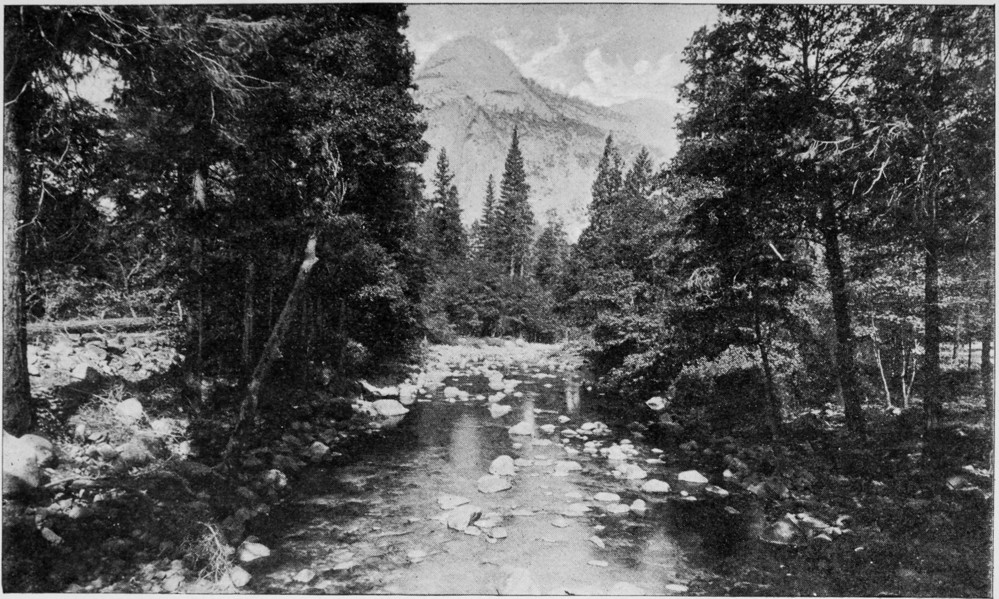
NORTH DOME—YOSEMITE VALLEY.
It would be impossible to find a more romantic and commanding spot than this. At your feet is the Vernal Fall and the turbulent Merced tumbling down the mammoth gorge; in the other direction, less than a mile upwards, is another water-fall, world famed,—the Nevada,—and between these two falls are endless combinations of wild rocks and shooting waters. Only a few yards above the Vernal is an eddying hollow known as the Emerald Pool; and immediately above this is “the flume, where the stream glides noiselessly but with lightning speed over its polished granite bed, making a preparatory run for its plunge over the Vernal Fall,” as the first white man who ever saw this spot, J. H. Lawrence, happily described it. The guide here tells the story of an Englishman who wanted to “take a bawth, don’t you know,” in this flume, and who was carried down by the swift and powerful current into the Emerald Pool, where he caught on to a bush just in time to avoid being swept over the falls.
In low water the thin layer of swiftly moving water gives the flume a silvery appearance, whence it has received the name of Silver Apron; but if the Indians had any name for it, it must have been the more poetic designation of Arrow Water, or something similar. It is not safe to go near its edge; for it is sometimes suddenly widened by one of those curious irregular pulsations and reinforcements noticed in many cascades. We now cross a bridge over the raging torrent, and stop at the Casa Nevada, where Mr. Snow and his wife always are ready to provide a bountiful lunch at short notice. I believe that the principal reason why this lunch is so bountiful is because Mrs. Snow wants to get off her favorite joke at least once a day. Some one is sure to ask where she gets all these victuals, whereupon she replies, “We raise them,” adding, after a pause and a look at the incredulous faces, “on mules.” Mr. Snow is known as Perpetual Snow, from having lived here almost twenty years, and he sometimes facetiously offers to show summer visitors “six feet of Snow” right in his house. He has albums for sale containing fine collections of Yosemite ferns—thirty-six different kinds; and shows with pride his old registers in which many famous visitors have signed their names.
Only a few steps from the house, the Nevada Fall comes thundering down its six hundred feet or more, according to the season. To the left is Liberty Cap, almost as precipitous as El Capitan, yet often ascended. A path leads up to the summit of the Nevada Fall, which, however, cannot be approached near enough to get a downward glimpse; but this is compensated for by the fine side views one gets of it coming up. Further on is the mountain called Cloud’s Rest, from which superb views of the valley and surroundings, as well as the high Sierras, are obtainable, but which can rarely be visited with comfort before the middle of May, on account of the deep snow-patches under which the path is buried. There is also a trail leading from the Casa Nevada over to one of the most famous parts of the Yosemite walls,—Glacier Point; but there is so much to see there that one ought to devote a whole day to it. Therefore we return to the Valley the same way we came, and the next morning are again in the saddle, bound for Glacier Point, directly over the hotel. Everybody has seen pictures of Glacier Point, and the huge boulder which projects at one place several feet over the edge of the wall. On this boulder many persons have had their photographs taken, with nothing between them and the bottom of the Valley, more than half a mile beneath, than a bit of projecting rock, and nothing to hold on by. On the ledge to the right, however, an iron railing has been securely fastened, so that the most timorous can now look down with perfect safety.
At this point a flag is floating, and in the evening it is customary to build a fire, and afterwards throw the brands and coals over the brink. To the hotel guests directly below, who have been watching for them, these brands present the appearance of a golden water-fall, thus adding one more to the Yosemite’s incomparable collection.
Looking up from this Valley, shut in on all sides by perpendicular walls, and lofty peaks from twenty-five hundred to seven thousand feet in height, it seems impossible that a way to the summit should have been found except by climbing up the cañon as we did yesterday; but there is a more direct path straight up the wall, to which the guide conducts us, after passing the village and the seldom-used, solitary chapel. The ascent is very steep in some places, and hard on man and beast; but so well planned as to be without risk or danger, even though the horse does occasionally poke his nose over a yawning abyss. Fortunately for the nervous, the most “ticklish” places are concealed by the dense brush clinging to the rocks, else the stubborn habit of the animals, of always walking as near the brink of the precipice as possible, would cause many a heart to stop beating momentarily. The air is wonderfully exhilarating and clear, and nothing could be finer than the aspect of the receding Valley, and the triple Yosemite Falls directly opposite, which are almost always in sight.
Half-way up, on our side, is the Agassiz Rock,—a huge boulder, in a state, apparently, of dangerously unstable equilibrium, and looking like some of the fantastic pinnacles of the Yellowstone cañon, as if it might be kicked over with one foot; but appearances are deceptive. There is a good hotel at the summit, where the horses are left with the guide, while we proceed a few hundred yards farther, to Glacier Point. Imagine how the Valley would look from a balloon, and you have some conception of the gruesome charms of Glacier Point, whence the outlook or downward look into the Valley is more perpendicular and awe-inspiring than from Inspiration Point, which affords the more picturesque view of the whole length of the Valley, its depth being a subordinate feature. But the advantage of Glacier Point lies in this, that by walking a few steps to the right, an entirely different scene is commanded,—a scene which includes both the Vernal and Nevada Falls, and beyond them an imposing array of snow-clad Sierra summits. It is here that every visitor must feel the impotence and barrenness of words to paint the images treasured in his memory; and were every word a photograph, a description would convey but a faint impression of the original. But we are to go up higher yet, where a still wider circle of mountains, cliffs, domes, cañons, and snow-fields will come within the field of vision. The Sentinel Dome is our goal now, although the guide is not quite certain whether the path is sufficiently free from snow for the horses: we do come upon many large snow-patches, a foot or two deep, but we always manage to get through or around them. Fresh snow of this depth sometimes falls as late as the end of May, even in the Valley below.
At last we emerge from the forest, tie our horses to the last trees, and clamber up the bald pate of the Dome. Hence the billowy crests of the Sierra Nevada, including peaks of thirteen thousand feet and over, show themselves in something approaching their real height and sublime grandeur. The scene is not unlike that of the Spanish Sierra Nevada, as seen from Granada, thus presenting one of the numerous resemblances between Spain and California. The surface of the Sentinel Dome is full of curious small holes, probably the product of innumerable expansions and contractions of the rock under the influence of alternating heat and cold. The very top is occupied by a stunted, gnarled, and broken pine, presenting the appearance of a veteran warrior and storm wrestler, covered with wounds, upon which it exudes the soothing balm of a remarkably fragrant kind of pitch. Beware of touching it! a second’s contact will ruin a suit. Had Heine ever been in California, we might feel certain that this tree must have suggested to him that fine poem of the pine-tree dreaming amidst its winter snows of the palm-tree bathed in sunshine,—say in the Mojave Desert, but a hundred miles away.
Returning toward the Valley, we soon come to a place known as Washburn Point, where the view of the falls and mountains is similar to that obtained from the Sentinel Dome, and perhaps even more impressive because of its being nearer. From here the scenery of the high Sierras can be seen even by those who are unable to walk or ride on such arduous paths; for there is a good wagon road leading hence to the Wawona Hotel, and striking the road to the Valley some miles above. For pedestrians, by far the best way to see the Valley would be to take this road from the Wawona, spending the night at the Glacier Point Hotel, devoting the next day to this place and the Sentinel Dome, and descending to the Valley on the day following by way of the Nevada and Vernal Falls. Thus the Valley may be visited without any uphill work at all.
It is well to make all one’s plans in advance, so as to be able to reserve a good return seat on the stage as soon as you arrive at the Stoneman. The stage leaves early in the morning, and returns as far as the Wawona Hotel, where we arrive in time for lunch. After lunch uncovered stages drive up to the hotel, and everybody gets aboard for a visit to the Big Trees in the Mariposa Grove. The round trip covers seventeen miles only, thus leaving plenty of time to see the arboreal giants at leisure. The road takes us more deeply into the virgin forest than we have penetrated yet, and there are many superb trees which attract the attention long before the Mariposa Grove is reached. Some of the passengers begin to comment on a few big sugar pines, and even express a desire to stop and measure them; but the driver scornfully refuses to waste any time on such pigmies. So on and up we go, and at last come to a few scattered specimens which the driver admits belong to the real Big Tree family; but he does not stop till we reach the world-renowned Grizzly Giant, the thickest, though not the highest, of all the Sequoias. With the exception of some specimens of the African Baobab, this is the thickest tree in the world, so far as known, though by no means the highest. In one of the other nine Big Tree groves found in California (and only in California)—the Calaveras—there is a tree fifty-three feet higher than any one in the Mariposa Grove, and Professor Whitney refers to an Australian eucalyptus four hundred and eighty feet in height, overtopping the tallest Sequoia by one hundred and fifty-five feet. But for height and thickness combined, the Sequoia excels all other trees; and as the Mariposa Grove contains the thickest trees, it is the most impressive of all, since in the height of a three-hundred foot tree a difference of ten or twenty feet is hardly noticeable, while in the circumference every foot tells.
Ten of our party clasped hands to encircle the Grizzly Giant, but the endmen could not begin to even see each other on the other side. I walked around it and counted fifty-three steps. The exact, measurement is ninety-three feet seven inches, without allowing for that portion of the bark which has been destroyed by fire. The best idea of its enormous girth is conveyed by one of Taber’s excellent photographs, in which a horse stands alongside of the tree, at full length, while a dozen men are scattered at intervals along the bark, without nearly filling up so much of the tree as is included in the view. Though blackened and cruelly hollowed out by fire, the Grizzly Giant is still alive, but its upper part is as dilapidated and time-worn as the lower; and no wonder, for it must have first stuck its roots into Sierra soil perhaps three or four centuries after the advent of Christ, by the most conservative estimate. The lowest branch of this tree is fully six feet in diameter—large enough to set up as a Big Tree by itself,—“as large as the trunks of the largest elms of the Connecticut valley.”
Most of the tourists cut off little slices of the bark, which in this case is hardly a reprehensible practice, for it would take decades of such petty vandalism to make any impression on this monster. Yet there are other mementos that might as well be taken, such as the mosses clinging to it and the cones found under it. These cones are surprisingly small,—only about two inches in length,—especially when compared with other cones found in this region and offered for sale at the hotels, put up in wooden frames and covered with moss—some of them a foot and a half or more in length. But the Grizzly Giant must not detain us too long; for there are several hundred more Sequoias to be seen, and, as a punster suggested, a Big-treatise might be written on the Mariposa Grove alone.
As we pass from the Lower to the Upper Grove, these trees become more and more numerous among the pines and firs, until at last we come to a genuine grove of Sequoia giganteas,—a real forest cathedral. There is a flutter of excitement as we approach the Tunnel Tree, or Wawona (which is Indian for big tree), through which the stage drives as it stands, with horses, passengers, and all. The diameter of this tree at the ground is twenty-seven feet, or three feet less than the Grizzly Giant; the “tunnel” by which we go through it is ten feet high and from six to ten feet wide. Just as we drive into it, a poetic youth exclaims to his fair companion, “Now look out for spiders!” and others of the same class must have passed through before, for names are written on the inside, and even visiting-cards tacked on. The wood chopped out here was of course made into relics and sold years ago, yet paper knives and other things made of it are still to be had in the grove in quantities to suit.
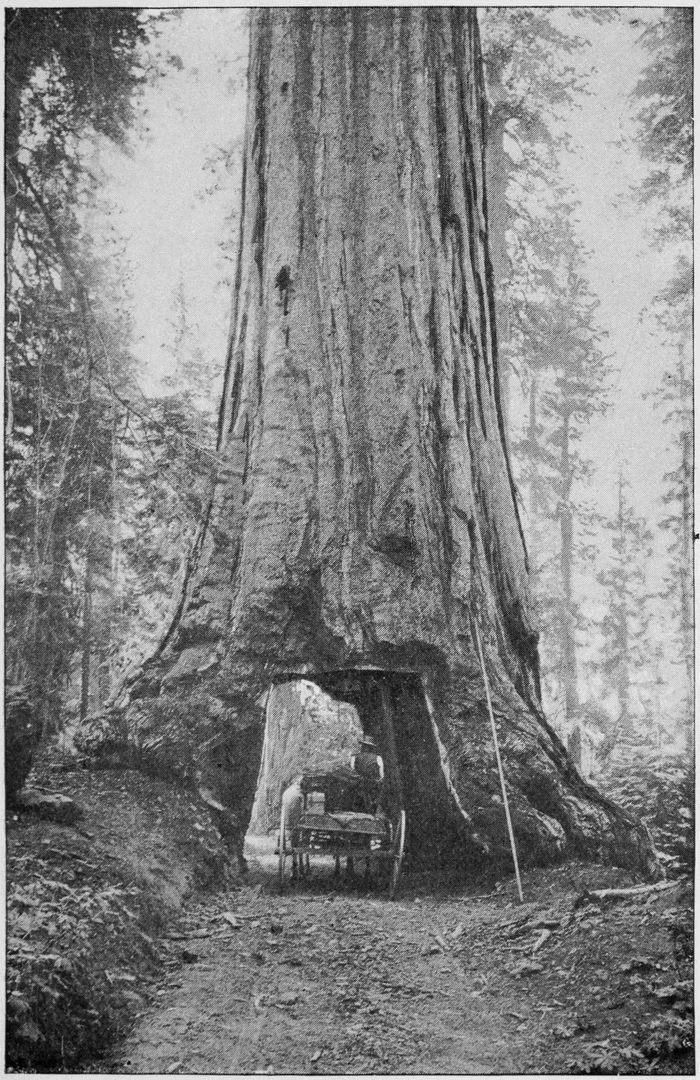
BIG TREE—YOSEMITE VALLEY.
At a little log cabin, occupied by the guardians of the grove, the stage stops again, and the venturesome climb up the prostrate trunk of a fallen monarch, on a rickety ladder. The upper part of the trunk is rotten, and resembles the hull of a wrecked ocean steamer. It once took five men three weeks to fell one of these giants; and even after the connection of the trunk with the stump had been severed, it took three days of wedge-driving before the tree could be made to fall. Imagine, therefore, the force of wind required to throw over such a tree, and the nerve of Andrew Jackson Smith, who once remained in the hollow of one of them, known as Smith’s Cabin (in the South Grove), during a Sierra storm which threw down “Old Goliath”!
The guardians of the grove have for sale packages of seeds of the Big Trees, though they frankly tell purchasers that not one in a hundred will grow. They have a nursery near the cabin, and often send young trees away. The Sequoia gigantea, although found nowhere except in the Sierra Nevada of California, grows readily elsewhere, and vast numbers have been planted in this country and abroad. The climate of England is said to be specially favorable to it, and from seeds planted there in 1853 have grown trees which are already over sixty feet in height and ten in girth. A thousand years hence England will have her Big Tree Groves, and they will be more beautiful than those of California, because better guarded against forest fires. But they will lack the majestic mountain surroundings.
It would almost seem as if the existence of these giant trees in the Sierra Nevada were intended by nature as a striking artistic contrast and compensation for the utter absence of forests in Southern California,—a contrast heightened by the numerous other fine species of evergreen trees, especially the famous redwood groves, which Professor Whitney has described so poetically. Outside of Ceylon and other tropical countries there is, perhaps, no region which has so fine and varied an assortment of valuable woods as the Yosemite neighborhood. No visitor should fail to see the admirable collection of ornamental objects prepared by J. Starke, some of them inlaid with several dozen kinds of Sierra woods, making a mosaic as elegant as mother-of-pearl. And I must once more refer to another thing in which the Yosemite region is unexcelled,—the flowers.
After seeing the unrivalled Valley, in which Nature, as in a final operatic chorus, has grouped in an overwhelming ensemble all her motives—snow-peaks, domes, spires, precipices, lakes, rivers, and water-falls—all in the small compass of six or seven miles, the scenery on the way back to the San Joaquin Valley, fine as it is, and seemed on coming, cannot but have the effect of an anticlimax. Not so with the flowers, which have only gained in beauty, variety, and abundance during our week’s stay in the Valley. Once I got off the stage, while it was climbing a hill, and in the space of half a mile gathered twenty-two kinds, which excited many “ohs” and “ahs” from the other passengers. California poppy patches, nestling under trees, formed such indescribably lovely groups that sometimes every hand in the stage was pointed at them by a unanimous impulse. In some places the flowers stand so dense that a botanist, in measuring off a square yard, found over three thousand plants on it. Here a flower-painter might spend his life making perfect pictures which he need only copy from nature; and he could not fail of at least one of the attributes of genius,—he need never repeat himself.