X. MT. SHASTA AND CRATER LAKE.
Reading edition
THE OREGON AND CALIFORNIA RAILROAD—CALIFORNIA’S GRANDEST MOUNTAIN—ISOLATED PEAKS OF THE CASCADE RANGE—VOLCANIC REMNANTS—SISSON’S—INDIANS AT HOME—SOURCES OF THE SACRAMENTO—EFFECTS OF RAIN—OREGON’S NUMEROUS RIVERS—FISH AND CRAW-FISH—SOUTHERN OREGON—A MYSTERIOUS MOUNTAIN LAKE—THE OREGON NATIONAL PARK—THE WILLAMETTE VALLEY—OREGON WHEAT AND FRUIT.
With the exception of the Canadian Pacific and the Rio Grande, there is no railway on this continent which offers to tourists such a unique and imposing variety of mountain and forest scenery as the Oregon and California, or Shasta Route, which connects San Francisco with Portland. For many hours after leaving Sacramento, the train follows the banks of the Sacramento River, whose water in this upper part of its course is as clear as the Rhine in Switzerland. No fewer than eighteen times does the train cross the winding river, which at every turn offers a new picturesque view. But it is not till Mt. Shasta comes into view that the real grandeur of this route is made evident. Mr. Bryce, in his “American Commonwealth,” insinuates that there is little fine scenery in this country; but if there is another railroad in the world which skirts the base of an isolated snow-mountain over fourteen thousand feet in height, and so vast in circumference that it takes the train five or six hours to get around it, I have not seen it or heard of it; and Shasta is only one of half-a-dozen snow-peaks which may be admired on this route and its continuation north to Tacoma and Seattle. There is something absolutely unique about what may be called the Oregon System of mountain peaks (since Oregon once embraced all this region), beginning with Shasta (14,440 feet), in Northern California, and including the Three Sisters (8,500), Mts. Jefferson (9,000) and Hood (11,200) in Oregon, and Mts. St. Helen’s (9,750), Adams (9,570), and Tacoma (14,444) in Washington. Elsewhere, as in Switzerland, or along the Canadian Pacific Railway, snow-peaks are always adjacent or jumbled together in irregular groups; and this is the case even in the Sierra Nevada of Central California. But the ‘Oregon’ earth-giants, from Shasta to Tacoma, are all isolated peaks, separated by many miles from other peaks, with only a low range of mountains to connect them; and this gives them a grandeur and individuality which is lacking in peaks that simply form one of an irregular group. As Mr. Joaquin Miller poetically puts it: “Here, the shining pyramids of white, starting sudden and solitary from the great black sea of firs, standing as supporting pillars to the dome of intense blue sky, startle, thrill, and delight you, though you have stood unmoved before the sublimest scenes on earth.”
It is owing to this isolation that Shasta is the grandest mountain in California. Mt. Whitney is several hundred feet higher, but it stands in a region where there are a hundred peaks each over thirteen thousand feet in height, and therefore is not able to assert itself properly. Moreover, Whitney is several hundred miles further south, where the solar heat disposes of the snow-fields every summer, and does not compel them to seek the valley in the shape of glaciers; whereas Shasta has five glaciers, one of which is more than three miles long. Jefferson, Hood, and Tacoma also have fine glaciers, easily accessible.
As compared with the mountains of Switzerland, Shasta has this advantage: that whereas the former rarely, even in summer, have the advantage of standing out against a clear blue sky, which adds so very much to the sublimity of the scene, Shasta rears its snowy head day after day and month after month into the cloudless azure. Late in summer, however, it loses some of its grandeur through the melting of most of its snow-fields; and in this respect Mt. Hood is superior to Shasta, as it keeps its snow-mantle throughout the usual Oregon summer. Besides the California sun, the snows of Shasta have another enemy in the internal volcanic heat which has not yet subsided. Shasta has its big craters, and there are a score of smaller ones in the lower neighboring cones. A few hundred feet below the summit there is a hot sulphur spring, to whose heat John Muir and Jerome Fay, being caught in a snow-storm in 1875, owed the preservation of their lives.
One of the best ways to realize the great height of Shasta, is by noting the very long time the sun lingers on the mountain side after it has set at Sisson’s, in Strawberry Valley,—fully half an hour. After it has gone down, on dark nights in May, a solitary star will arise immediately over the summit, looking at first as if some venturesome climber had started a fire, dwarfed by the distance. One does not realize how jagged are the ridges of Shasta until the evening sun casts their gray silhouettes on the adjacent white snow-fields.
All this can be seen from the porch of Mr. Sisson’s hotel—the same hotel that used to feed the passengers and the horses of the stages so many years before the Oregon and California Railroad was built; and the same Mr. Sisson who, twenty years ago, served as Clarence King’s guide up the mountain. Mr. Sisson now has the satisfaction of seeing quite a respectable village which has grown up in the picturesque spot selected by him a quarter of a century ago; but he no longer has the strength to act as guide; nor does he need to, as he is well-to-do. Accordingly, I had to content myself with one of the Indians in his employ, as guide up the mountain side. May is too early to make the complete ascent, but we thought we could get above the timber line at any rate. But even this proved impossible, owing to the deep masses of snow which carpeted the sombre forest at a height of eight thousand feet. Yet the trip proved worth taking without the final climb. The path led through the densest imaginable forest, and was impeded every five minutes by a fallen tree. In looking at the millions of dead trees which rot on the ground in these California and Oregon forests, one cannot suppress the thought, “What a blessing this wood would be to the starving, freezing thousands in our large cities, during the winter months!”
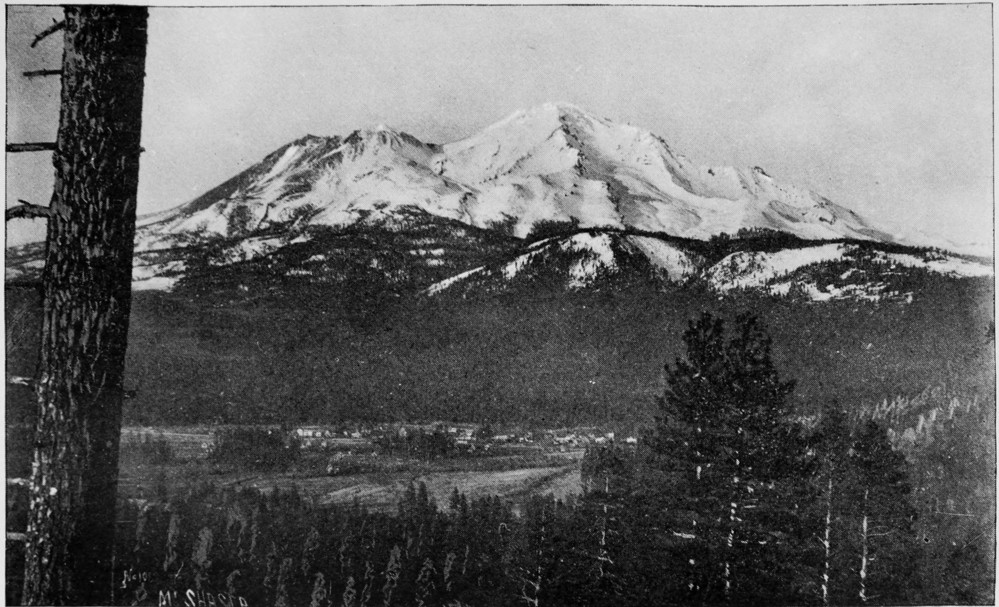
MOUNT SHASTA.
It is this superabundance and natural waste of wood everywhere that breeds indifference in the people of this coast and the natives to the devastating forest fires which occur every summer. My Indian guide amused himself by setting trees on fire in several places, and to the question why he did this, I could get no satisfactory answer. He also very kindly tried to amuse me by rolling huge rocks down a tremendous precipice. I should have been less surprised than hurt had he thrown me down too, in retaliation for the injury inflicted on him and his race by the intruding white man, who has reduced the former lords of this region, where they could hunt and fish to their heart’s content, to the condition of day-laborers earning their bread by the sweat of their brow. How galling it must be to the noble savage to have to dig stumps and level roads while his squaws look on, because, forsooth, the perverse white man will not permit the squaws to do the grubbing, and him to look on!
Mr. Sisson took me to a small Indian camp near his house, where he wanted to engage a man for a job. The young buck was gorgeously arrayed in a pair of old trousers and a new linen shirt, evidently just arrived from San Francisco, with its bosom starched stiffly enough for a city dude. He was obviously conscious of this ornament, and, probably in consequence of it, wanted more money for the job than Mr. Sisson had previously paid him. Noblesse oblige! The squaws, young and old, and the children, were all very fat, dirty, and stupid-looking, and were crowding around a fire, eating fried meat and flat, round cakes of dough baked in a pan, looking as if it would give chronic dyspepsia to an ostrich or a goat. I was also shown an Indian hut where there had been a dance on the preceding Fourth of July, white visitors being charged twenty-five cents admission.
One of the most interesting places Mr. Sisson has to show his guests is the source of the Sacramento River. About a mile from his house, at a place to which steps lead down from the railway track, the water rushes out from several springs in a great volume, forming immediately a trout-brook of respectable size, which hurries away in the new daylight, as if glad to have escaped its subterranean source. These springs issue from under Mt. Shasta, and doubtless owe their being to the melting of snow and glacier ice by the internal volcanic heat—a worthy origin of so romantic a river as the Sacramento. Near these springs is a valuable iron-water spring, which also belongs to Mr. Sisson, and is one of his most important possessions, now that the town founded by him is getting to be a regular resort for San Franciscans, Portlanders, and Eastern tourists, not only on account of the view of Shasta, but because of the beautiful forest scenery, and the excellent trout-fishing in the neighboring McCloud River. Six large rivers and many smaller ones are born of Shasta and neighboring peaks, and it is these icy streams that the trout and the salmon delight in. The Sacramento itself, however, does not afford any sport in this vicinity.
After leaving Sisson’s, Shasta still remains in sight for some time; for it takes some time even for a railway to get away from a mountain, of which it has been remarked that “if it could be sawed off at the four-thousand-foot level, or five hundred feet above the valley, the oval plain thus made would be eighty miles in circumference.” Some of the views of Shasta after leaving Sisson’s are even grander than at the station, and in certain atmospheric conditions the snow-cone may be seen floating, as it were, on a mystic haze resembling water. The aspect of the mountain gradually changes, and what had seemed smooth, gradual slopes are now seen to be rugged precipices rising one above the other.
We now approach that mammoth fragrant forest between the Pacific Ocean and the Cascade Mountains which is known as Oregon, and it becomes obvious at once that the chief difference between Oregon and California is comprised in the word RAIN. Shortly after crossing the Oregon line evidence begins to multiply that we have entered the rain belt. There are more deciduous trees, more ferns and mosses, more underbrush in the pine forests, and, most significant of all, more rivers. California has in its whole coast line of seven hundred miles only one navigable river, while Oregon, with a coast line of only three hundred and fifty miles, has four fine navigable rivers,—the Rogue, the Umpqua, the Willamette, and the Columbia,—with many smaller ones. All of these run from east to west, except the Willamette, which divides the State by flowing northward into the Columbia near Portland, thus creating the fertile Willamette Valley, to which Portland chiefly owes its wealth.
The Willamette has some tributaries which alone would make the fortune of several counties in Southern California, where nothing can be done without irrigation; whereas in Oregon no one but vegetable gardeners ever thinks of such a thing. One of these tributaries is the Pudding River, along the banks of which many charming scenes may be enjoyed, and which is full of fish, which, however, have the peculiarity that they never take a bait. In the Santiam and some of the other rivers the fishing is excellent, and the creeks are full of trout and of crawfish, which are delicious, and of which I have caught as many as a hundred in an hour, with three strings and three pieces of beef. A favorite form of picnicking in Oregon is to take a sauce-pan and salt, catch a few hundred of these tender and juicy crawfish, boil them, and enjoy a feast fit for prelates.
The rain, to which Oregon owes its numerous rivers and creeks, is not as abundant in the southern as in the northern part of the State. There is a gradual transition from thirty-two inches at Jacksonville to thirty-eight at Salem, fifty-three at Portland, and seventy-two at Astoria. The Rogue River Valley climate has been described as “a compromise between the droughts of California and the great rain of the Willamette Valley.” Grapes are raised here equal to the best in California, and the peaches have been known to fetch higher prices in the San Francisco market than the California varieties. Melons also are raised here in great abundance for the Portland market, Northern Oregon (where the thermometer sometimes does not register above 85° during a whole summer) being too cold for their successful cultivation. Southern Oregon is at present but thinly settled; but if its climatic, scenic, and agricultural advantages were generally known to immigrants, it would fill up rapidly.
Two large lakes, the Upper and Lower Klamath, will in course of time become popular resorts of Oregonians, and some miles north of the Upper Klamath is Crater Lake, which, although much smaller, is by the Oregonians considered the greatest curiosity on the Pacific Coast, and which used to be, and still is, regarded as holy ground by the Indians of the neighborhood. Local authorities tells us that “in the past none but medicine men visited it; and when one of the tribe felt called to become a teacher, he spent several weeks at the lake, in prayer to the Shahulah Tyee.”
Crater Lake lies in the heart of the Cascade Mountains, and at so great an elevation—6,257 feet—as to be rendered inaccessible, except in summer, by the depth of the snow in the surrounding forests. It is about one hundred and twenty miles from Ashland, and may be reached from that city, or from Medford, by stage. The road follows the banks of the tumultuous Klamath River, and passes through the Klamath Indian Reservation, near Fort Klamath, which was abandoned in 1889, as being no longer necessary. A narrow defile known as Mystic Cañon is also of interest, and it is well to bear in mind that in the older guide-books Crater Lake is put down as Mystic Lake. Mystic it certainly is, but its present name is preferable because more definite; for Crater Lake is really a body of water which, like Lake Tahoe, fills up a volcanic orifice. And a most gigantic crater it was, for the circumference of the lake is more than twenty miles. There is only one place where one can climb down to the water; the rest of the shore consists of precipitous walls from fifteen hundred feet to three thousand feet in height, which are less slanting than they appear in photographs. These high walls, which are mirrored in the water with their fringe of trees, effectually shut out the mountain breezes, so that the water is placid, and rarely ruffled. There is something mysterious about this water; for it has no visible or discoverable inlet or outlet, and yet it is always clear and sweet. Fish, however, do not inhabit it, probably because none ever succeeded in getting there; and even water-fowl, it is said, avoid this solitary, silent mountain lake. In the middle of the lake stands an island, about three miles long, of volcanic origin, rising to a point eight hundred and forty-five feet high, and ending in a crater four hundred and seventy-five feet in diameter. There are caves along the shores which may have some connection with the water-supply, as a current is observable near them. The depth of the lake has never been ascertained, but it has been sounded for two thousand feet without reaching bottom.
A few years ago an effort was made to have the Crater Lake region reserved as the Oregon National Park, and in 1888 a bill to this effect passed the United States Senate. As there is much valuable timber on the neighboring mountain ranges, and much fine grazing land, there is reason to believe that a branch road will ere long connect Crater Lake with the Oregon and California Railroad; and when that has been built, every visitor to the Pacific Coast will feel that he can no more afford to miss this lake than the other two scenic wonders of Oregon—the Columbia River and Mt. Hood.
Going northward towards Portland, the wonderful fertility of the Willamette Valley is what chiefly arrests the attention of tourists. Wood being cheaper than coal in this region, the train frequently stops to get a fresh load of fuel from the huge piles of timber which at intervals extend along the road, sometimes a quarter of a mile without a break. During these stops, some young man may be seen running to a neighboring wheat or oat field to compare height with the stalks, sometimes to his disadvantage. But these rich agricultural lands were all taken up long ago, and the emigrant with a slender purse and a desire for government land has to seek a region more remote from the railway. The towns along this route, including Roseburg, Eugene, Albany, Salem, and Oregon City, have not grown so fast during the last ten years as Portland, or as the towns of Washington and California; but the inhabitants confidently believe that their day will come when the more sensational California and Washington towns have passed through their boom period, and they modestly claim that they prefer steady and slow growth to a boom which too often becomes a retrograde boomerang. At Oregon City, tourists should be on the lookout for the falls of the Willamette, below which the Indians formerly used to spear salmon, but which now serve the more prosaic purpose of furnishing water-power to the woollen mills on the spot, and electric power to Portland twelve miles away.
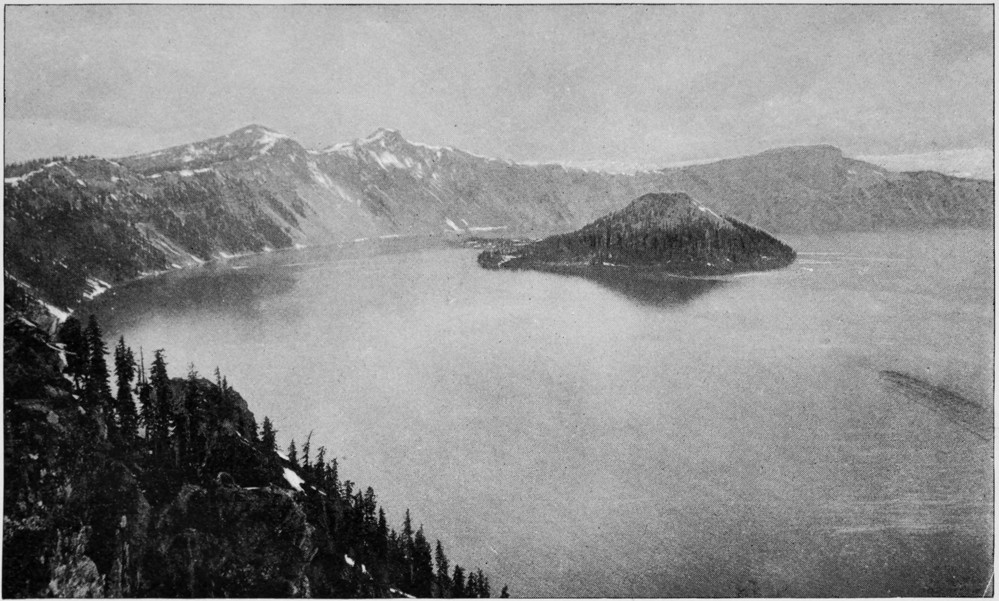
CRATER LAKE.
The Willamette Valley, through which our train has passed on the way from Roseburg to Portland, is the garden of Oregon. Twenty years ago wheat and apples were almost exclusively cultivated in this region. Then the discovery was made that the soil and climate are remarkably well adapted to hop culture, and most of the farmers at once gave up their grain-fields and orchards and raised hops. Farmers have their fashions as well as city folks, and they are just as apt to go to extremes. The hop-raising business was overdone; prices fell; and now many of these farmers are returning to their grain and fruit, in which no other State surpasses Oregon, in quality as well as in quantity.
Concerning Oregon fruit I can speak from personal experience, as I was brought up near an orchard numbering two thousand apple, pear, and plum trees. For peaches and grapes the climate of Northern Oregon is hardly warm enough, and the apples and pears, too, are perhaps a little smaller than they are in California, but in flavor they are vastly superior. Indeed, neither in the East nor in any part of Europe have I ever tasted apples to compare with those of Oregon. They have a richness and delicacy of flavor which must persuade any one that, if apples were less abundant, they would be considered superior in taste and fragrance to those tropical and semi-tropical fruits which are more highly valued because of their scarcity in our latitude. In most parts of the East an apple is an apple, and few people know or care about the names of the different kinds; but an Oregonian would no more eat certain kinds of apples than he would a raw pumpkin. An epicure is no more particular in regard to his brands of wine than an Oregonian is in the choice of his favorite variety of apples; and there are half-a-dozen kinds which I have never seen at the East, and the systematic introduction of which in the New York market would make any dealer’s fortune.
For some reason or other the Oregonians seem less enterprising than their California neighbors, and instead of sending their fruit East, they often allow it to rot on the trees—including superb plums, and Bartlett pears that would fetch eight to ten cents apiece in New York. Eastern capital is wanted to start transportation enterprises; and a still more important desideratum in Oregon is a larger population. The growth of the State has been remarkably slow, considering its agricultural advantages and its fine climate. In the census of 1880, the population numbered only 174,767. But there were already “16,217 farms, and their products are tabled at a cash value of $13,234,548,”—a curious commentary on the exclamation of a member of Congress forty-five years ago, that he would not “give a pinch of snuff for the whole Territory.”
Eastern notions regarding the climate of Western Oregon are almost as widely astray as they are regarding Alaska. Barrows points out that, although the mouth of the Willamette is two hundred miles further north than Boston, no ice has been formed on it thicker than window-glass since 1862; and that in some of the counties snow has not covered the ground for three consecutive days for a score of years. The rainy season, which takes the place of the Eastern winter, is trying to the patience of some; yet this rain is very different from our muggy, foggy, sultry winter rains in New York. It is known as a “dry” rain, because however it may drizzle, it does not seem to saturate the air and depress the spirits by impeding the natural evaporation and healthy action of the skin. Doubtless this peculiarity of climate is largely responsible for the remarkably beautiful complexions of Oregon and Washington women, though something may be due to the fact that, as children, they live almost entirely on fruit. The heat of Oregon summer days is not often oppressive, being generally mitigated by a gentle breeze, and the nights are always cool enough for refreshing sleep.