Chapter XIX · ANTHROPOLOGY.
Reading edition
The races of man which I am about to enumerate at the commencement in this chapter, extend over a region of Eastern Africa lying between the first degree north of the Equator and five degrees to the south, and bounded on the west by the Victoria Nyanza and the thirty-fourth degree of east longitude, and on the east by the Indian Ocean. I wish, for the sake of comparison, to review all the known races inhabiting this wide stretch of country; but I shall more especially describe those dwelling in the vicinity of Mount Kilima-njaro, with whom I have come into personal contact during my recent stay in that district.
The country which lies between the Victoria Nyanza and the coast, and is circumscribed by the limits I have just cited, offers certain peculiarities of conformation worthy of recapitulation, inasmuch as they doubtless influence the races of men inhabiting those regions. Beyond the fertile cultivated coast-belt, which is rarely more than ten miles broad, begins the Nyika, a strange “wilderness,” as its name imports, covered with harsh repellant vegetation, and almost unprovided with running water. Here the rainfall is scanty, and the country bears a parched look all the year round. This semi-desert, except where it is 396broken by mountainous districts or intersected by great rivers, extends uninterruptedly to within a short distance of the eastern shores of the Victoria Nyanza—is indeed the prevailing type of scenery throughout Africa, for the Dark Continent is on the whole less forested than any other part of the tropics. But, as a happy contrast to this dreary “veldt,” as it is called in the south, rise the magnificent mountain systems of Usambara, Taita, Pare, Ugweno, Kilima-njaro, Kiulu; not to mention other mighty ranges which Thomson has made known to us, and which offer from his description the same characteristics as those I have myself explored. Another break in the Nyika is made by the courses of perennial rivers flowing to the Indian Ocean, such as the Ruvu or Luvu, the Tzavo or Sabaki, the Tana, and a few minor streams of less importance. The marked distinction between the outward aspects of the well-watered forest country on the banks of rivers, lakes, or amid high mountains, and the great rolling plains sparsely covered with stunted trees or thorny scrub which I call the Nyika, is carried out further in the races of man inhabiting either. The forest country on the hills or along the rivers is occupied by resident agriculturists, belonging principally to the Bantu family, ethnologically and linguistically, and the forbidding wilderness in the plains is ranged over by the semi-nomad, cattle-keeping Masai, who for the present must be regarded as forming an independent group in African anthropology.
The Masai, who occupy a large portion of this district, are divided into many classes, tribes, and even independent nations. Some are settled agriculturists (called by the coast people Wa-kwavi), others are still 397fierce semi-nomads, spreading far and wide in their raids, though retaining a certain tribal district in which they make a more or less permanent abode. There are the Wa-kwavi of En-ǰemsi and the district of Lake Baringo; of Laikipia; Kosova and Lumbwa, near Kavirondo. There are also the Wa-kwavi of Aruša and Méru, near Kilima-njaro, and of the Ruvu river, and Ṅguru in the south. The principal Masai clans are those of Sigirari, Kisoṅgo, Sogonoi, Ṅgiri, and Laitokitok, in the vicinity of Kilima-njaro, and of Matumbato, Kaputei, Kinaṅgop, Dogilani, Eṅ-guaso Eṅ-gišu—(Cattle-river)—districts stretching to the north and west of the great snow-mountain. Thomson[48] considers the Masai of Kilima-njaro to be the purest in blood, and the most free from foreign admixture.
To the extreme north of the district under review certain peoples have been made known to us by Thomson’s explorations, such as the Nandi, Sūk, and Kamasia tribes, which, according to this distinguished traveller’s observations, would seem to be related in language and race with the Masai, and help to fill up the blank between the southern members of that family and their distant relatives, the Latuka and Bari, in the valley of the White Nile.
The principal Bantu tribes in this region are the Wa-tutwa, Wa-kara, and Wa-rori on the south-eastern shores of the Victoria Nyanza, and the Ba-samia and Ba-nyara to the north of Kavirondo; the Wa-kikuyu, Wa-mbe, and Wa-δaičo to the south and west of Mount Kenia; the A-kamba, inhabiting a large district known as Ukambani, between the rivers Amboni and Tzavo; the Wa-pokomo on the Tana, which flows from the base of Kenia to the Indian 398Ocean; the A-nyika, A-digo, Wa-bondei, and the Arabized Wa-swahili on the coast between Lamu and the mouth of the Ruvu at Pangani; the Wa-sambara and Wa-zeguha that inhabit Usambara and the adjacent plains; the Wa-taita of the Taita mountains, midway between Kilima-njaro and the coast; the Wa-pare and Wa-gweno, and, lastly, the Wa-taveita, dwelling to the south-east of Kilima-njaro; the Wa-kahe of the Upper Ruvu, and the Wa-čaga, who inhabit all but the northern flanks of the great snow-mountain.
The north-eastern portion of this district, which I term Eastern Equatorial Africa, is mainly populated by the Galla and Somali peoples, two races bitterly opposed to one another, although closely related in blood and language. They form a remarkably distinct variety of man apparently midway between the Negro on the one hand and the Arab on the other. Their languages belong to the Ethiopic branch of the Hamitic family according to some, and according to others constitute (with their congeners) a separate and independent group, with certain undeniable approaches to the Semitic and Hamitic tongues.
The region over which the Galla race exists is a curiously extended one, and yet often strangely restricted in width. They occupy, roughly speaking, a long, narrow strip of Eastern Africa scarcely exceeding, at the utmost, 200 miles in breadth, in fact more or less confined between the thirty-seventh and fortieth degree of east longitude, but nevertheless stretching in a southerly direction from the twelfth parallel north of the Equator to the fourth parallel south, over a distance of some 1100 miles. The Gallas have largely mingled with the population of Abyssinia in North-Eastern Africa, and now they are every year 399advancing farther and farther southward down the Zangian coast, pushed on by their remorseless foes the Somali. At present the Gallas are nearing Mombasa, and the Somali have begun to approach the banks of the Tana river. Inland the southern boundary of the Galla extension is at present the Sabaki river. On the west they border on Ukambani, the country of the A-kamba, a Bantu race, and farther north they march with the Masai district till about 4° or 5° N. of the Equator, when, as far as we know, tribes of Nilotic negroes become their western neighbours. Apparently, as time goes on, they will come betwixt hammer and anvil. The Somali will push them farther and farther west, while the Masai will force them to recoil eastwards to avoid his savage raids. Thus their future is rather gloomy. Perhaps the best thing they can do is to advance towards the Nile and Abyssinia.
There is a curious colony of Nilotic negroes settled in the district of Kavirondo on the eastern bank of the Victoria Nyanza, surrounded on all sides by tribes of Bantu and Masai race. From what we know of their language, philologically, at any rate, they are closely related to the Šiluk people of the White Nile, and must represent a curious and isolated colony of Nile negroes, the remnant of some former invasion now surrounded on all sides by people of alien origin. They are only known as yet from the descriptions of Swahili traders, and no European has yet visited their country save the hasty coasting trip along their shores which Stanley made when circumnavigating the Victoria Nyanza.
Thomson has explored the country to the north of Kavirondo, and we learn from him that there the people are Bantu, speaking apparently a language closely 400related to Lu-ganda and Ki-nyoro. The nearest kinsmen, therefore, of this Šiluk colony on the Victoria Nyanza, would seem to be the Lur people who inhabit the north-western bank of the Albert Nyanza, in 4° N. latitude. I think it very probable that, at any rate in language, the Šiluk race is a distant relative of the Masai. The Bari tongue, one of the most northern members of the Masai group, betrays in its vocabulary a resemblance to certain languages of the Šiluk family which can hardly be accidental or be accounted for by a theory of loan-words. The same thing occurs also with the Diṅka, as Lepsius pointed out in the preface to his “Nuba Grammar.”[49]
Much yet remains to be ascertained about the relationships and affinities of the reported dwarf races 401lying between Kilima-njaro and the Nyanza, who may turn out possibly to resemble the Doko who inhabit a portion of the almost unknown regions stretching between Abyssinia and Masai-land. There are also curious helot tribes living in serfdom with the Masai and the Galla, and speaking the languages of their masters, though they are said to retain independent tongues of their own. Such are the Wa-boni (also known as the Wa-sania, Wa-dahalo, Wa-ta, ǰuwano, Alaṅgulo, &c.) who live in the vicinity of the Sabaki, Tana, and Ozi rivers, also on various parts of the coast between Malindi and the River ǰub. Then, also, there are the Endorobo (a Masai term, probably En-dorobo, “the short, stumpy, inferior”), the Elkonono, a tribe of blacksmiths. The Wa-boni (their very name is foreign, as may be seen by the Swahili prefix Wa-) live among or near the southern Galla tribes, and are often plundered by these tyrants. They are chiefly hunters, practise no agriculture, and keep few domestic animals but dogs. In physical type, judging by the few specimens I have seen in the vicinity of Lamu, I should call them very unlike the Galla. They are sooty black, undersized, and very negroid in their features, with woolly hair. M. Greffulhe, a French merchant who had come in contact with them while living and trading in their country, was kind enough to furnish me with a few words of their language, which I insert in a foot-note.[50] The reader will see 402that it is principally the same as Galla, except that in the numerals it makes a slight approach to Masai which is not so evident in the former tongue.
The Endorobo and Elkonono whom I encountered to the north-east of Kilima-njaro, were living near the Masai encampments as a helot race of hunters and smiths. I was informed that they manufactured all the spears, shields, and swords of the Masai. They were an ugly lot, very different in appearance from the Masai, short in stature, black, and with their legs often bowed and exhibiting a negro’s shin. I could not elicit any words of their own language—if they possessed a peculiar speech—and in my hearing they only spoke Masai.
403In the country to the west and north-west of Usambara, below the mountains, are the remnants of a curious tribe of cattle-keepers, the Wa-mbugu, as their Usambara neighbours call them. They are sometimes known as the Ala. In appearance they are pleasing, with thin lips, well-shaped noses, rather narrow eyes, and not unlike the Masai. Their colour is a deep brown-black, and their hair does not apparently differ from the frizzly chevelure of the Bantu negro. The language they speak (which has recently been brought to light by Archdeacon Farler of Magila[51]), is a thorough enigma. While possessing Bantu prefixes, and using them as they are used in Bantu languages, its word-roots, with one or two exceptions, are utterly unlike anything we have yet met with. The exceptions are a few terms taken from Masai, Ki-kamba, and Ki-sambara.
On the coast, especially between Lamu and Pangani, ancient Arab settlements were planted a thousand years ago, and though their pristine glory has long since departed, some of the descendants of these early colonists still remain, and together with the more recently arrived ’Omani and Hadramauti Arabs represent the Semitic family in this congeries of nations. The intermixture of Arab and Bantu has formed the curious mongrel race known as the Wa-swahili, or “people of the coast” (from the Arabic Sahel, coast), and these enterprising traders have, especially in late years, played a most important rôle, for good and for bad, in the opening-up of Eastern and Western Africa.
I will now proceed to describe more in detail such of those tribes and races with whom I came into personal contact during my expedition to Kilima-njaro. 404They fall naturally into two groups—the Masai and the Bantu.
Until I had safely reached Kilima-njaro with all my goods, I was not at all anxious to encounter any of the former race, great as was the interest I felt in their strange customs and the structure of their euphonious language. Nevertheless, when Mandara sent to me one day the message that a party of Masai had come to visit him and trade, and that I might run over and interview them, I hastened to do so; and, tucking my note-book under my arm, I made off to Moši, where the good-natured chieftain, who was a fluent speaker in Masai, served as my interpreter, and wrung from his solemn, stately guests some of the information which I here impart. At that time Thomson had only just returned to Zanzibar from his wonderful journey through Masai-land, and the result of his observations had not been given to the world: so that the Masai were to me nearly a new subject, and I was eager for enlightenment as to their idiosyncrasies. To many of my readers who have perused Mr. Thomson’s interesting work, much of what I here write may seem a twice-told tale, but as a matter of fact it is rather the filling in the details of the picture Mr. Thomson has so vividly and faithfully drawn.
The Masai of whom I write belong mainly to the clans of Kisoṅgo,[52] Sigirari, and Laitokitok. I have come in contact with them both on the march and when I have been living at Taveita or Moši, whither their women and elders would come to purchase honey and vegetables. I have also traded with 405the Wa-kwavi (agricultural Masai) of Taveita, Aruša, and the Ruvu valley.
The distinction made between the Wa-kwavi and Masai has been already commented on, and I would only refer to it again to repeat it is little more than one based on mode of life. In speech these two divisions of the race are identical, and the Wa-kwavi only differ from the Masai in appearance in those districts where they have made slaves among the neighbouring Bantu tribes and taken the females as concubines, a thing which has occurred considerably—as I am informed by Swahili traders—in those vague districts lying between Kilima-njaro and Unyamwezi. But as the Masai of neighbouring districts do the same, with the same result, namely, that the colour of the skin becomes black, and the features lose all fineness of moulding—this negroid mingling is not to be taken as a characteristic of the Wa-kwavi section.
The previous history of the Masai people has been a common incident in the unwritten race-struggles which surge among savage humanity. It has been that of most rising and invading populations, like the Huns and Turks and Goths of Europe. First, some tribe, or division of a tribe, has been forced into war in self-defence, and has won a victory over its assailants. Then it acquires a taste for fighting, and from being persecuted becomes the persecutor. It spreads its conquests and ravages far and wide, the fighting qualities descend from father to son in increasing intensity. Soon, however, there are no weaker peoples left to subdue or to harry. The land is a wilderness, cultivation has ceased. The fighting tribe suffers from hunger. Then a section of them turns to the soil and commences a rude agriculture. 406This pursuit in time prospers, and the improved condition of the agriculturist attracts the envy and greed of their nomadic brothers. A civil war ensues, which, no matter what vicissitudes may happen, ends in the triumph of the tillers of the soil, for to defend their crops and granaries they construct fortifications and walled towns. Then with the victory of the settled authorities comes an opening for commerce. The lives of traders are safer among a hardworking colony of agriculturists than amid lawless rovers and cut-throats. So, in time, civilization finds an opening into what was once a terra incognita on account of the fierceness of its inhabitants. So it has been, and is, with the Masai. The last few decades a perceptible alteration in their condition of life has begun to appear. That section of them known as the Wa-kwavi has taken to a settled mode of life. No longer do they rove about seeking whom they may rob and slay, but they dwell within fixed limits, cultivate the soil, and encourage traders to settle in their midst. A bitter civil war has raged between them and their still nomadic cousins, at times a war of mutual extermination, but somehow or other the settlements of the Wa-kwavi continue to increase and prosper, while not a few of the tribes of Masai who retain their pastoral habits and still scorn to till the soil are being confronted by a disagreeable alternative that they themselves can recognize. They must either turn their spears into spades and their swords into reaping-hooks—or starve. The cattle disease which has lately raged among them throughout the length and breadth of the land, has played havoc with the herds on which their main sustenance depends. As to renewing their live-stock by raids on the tribes of the coast or the far 407interior, that will soon be—is already—an impossibility. Where their victims were too weak to resist they have simply given up cattle-keeping for fear of attracting the ruthless plundering of the Masai, and now subsist meekly on vegetables and fowls; where they were already strong, they have become stronger, either by settled government or by occupying unassailable positions. Soon there will be no cattle left to raid, and the Masai will range the wide deserted plains in all their splendid insolent bravery and die of inanition. The inhabitants of the walled cities or the lofty hills will dwell secure from attack, and the wretched remnants of vanquished tribes still lingering in unprotected haunts will not be worth robbing. Then the proud Masai must turn to and wring from the soil that sustenance which only comes as the reward of honest labour. A dear old warrior of Kisoṅgo, with the manners of a well-bred Arab, and the physique of an aged Hercules (supposing that hero to have recovered his attack of blood-poisoning and to have attained the condition of a magnificent ruin), said to me a little more than a year ago, “Ah, when you next return to Taveita in twelve months’ time, you will find us all Embarawuio (Wa-kwavi), like these people of Kikoro,[53] whom we used to rob and kill when I was a youth. And now, see! All our cattle are dying, though we have sent them to the pastures of ǰipé, and I have to come here to buy food from these Es-singa (slaves), who are fat and strong, and lack not good things to eat.” The old gentleman had, in fact, come with a troop of wives and many asses to buy grain and honey and dried bananas. In time these more civilized Wa-kwavi will prevail in numbers and power over the fierce pastoral 408Masai, and thus Eastern Equatorial Africa will be opened up to safe and profitable trade. At the very worst, however, the Masai are neither so dangerous nor so bloodthirsty as the Soudanese Arabs or the fanatical Tuaregs of the Sahara. If you are content to pay their tribute, you need not fight, and if you are forced to defend yourself, these people are powerless in front of a stockade, as they have no guns, and never throw their spears, being only accustomed to a hand-to-hand fight. We may be thankful that Mohammedanism has not yet reached them to turn them into mad fanatics or faithless cut-throats like their neighbours to the north and east. It is, indeed, a curious subject for reflection that this powerful religion, which in a short time swept like an epidemic over all Somali-land and the entire Soudan from Red Sea to Atlantic, should have halted on the borders of Masai-land, powerless in its appeals.
The physical appearance of the unregenerate robber Masai is splendid. It is a treat to the anthropological student to gaze on such magnificent examples of the fighting man. It is an example of one side of our multiform nature pushed to an exclusive and supreme development. The Masai warrior is the result of the development of Man into a beautiful Animal. To call him God-like, as we do the Greek ideals, would be silly and inappropriate—as much so as seeing divinity in a well-bred race-horse or an Alderney cow. To compare him with the statues of Apollo with which we are most of us familiar in foreign galleries or as plaster casts in English palaces of entertainment, is unfair to the one and the other. If you could find Apollo represented with huge-lobed ears, fang-like teeth, high cheek-bones, and a woolly crop, not to 409mention other peculiar and, to our, or perhaps I may say your notions—for I am personally without prejudices—ungraceful developments, then you might aptly compare his ideal representation with the living Masai; or if you could discover specimens of these people who possessed the fleshy effeminate contours, the sexless countenance of vacuous beauty attributed to the god of poetry, music, and prophecy, you might more fittingly describe them as dark statues of Apollo. As it is, the physical perfection of these East African beef-eating, bloodthirsty warriors is of the prize-fighter’s or the rowing-man’s ideal, rather than the æsthete’s.
The full-grown Masai of pure blood generally attains six feet in height by the age of seventeen, though at that time he is often spindly and cumbersome, an ungraceful hobbledehoy. Three years, however, of an exclusive diet of milk, blood, and half-raw beef-steaks, combined with a rigorous training in warlike and athletic exercises, have developed him into a sinewy, muscular man of admirable proportions, broad of chest, with a smallish head, a graceful neck, and limbs whose muscles seem hard as iron. There is no fat on his body. I cannot say that his hands and feet are always well-shaped. Though the instep is high, the foot spreads out rather broadly and squarely at the toes; the minor ones advancing nearly in a line with the big toe.
Their faces are somewhat Mongoloid in look, at first sight. The rather narrow, slanting eyes, the prominent cheek-bones, and the pointed chin suggest that impression. On the other hand, the nose is often beautifully shaped, with high bridge and delicately-carved nostrils, which obey sensitively the passing feelings of their owner, quivering and dilating with 410pride and rage, or widening and relaxing with good humour. Their heads are often singularly round and broad for Africans, though at the same time I have not failed to see the most dolichocephalic skulls among the true Masai. The hair is certainly longer and less frizzly than among the true negroes, though at the same time this may be only due to the careful and continual combing-out it undergoes and its straightening with a thick paste of clay and fat. It is, after all, a negro’s wool, and is not longer or more abundant, certainly, than the regular Papuan crops of hair which the Bantu people of the Upper Congo have been found to possess.
The ears of the Masai are naturally large, and, inasmuch as big ears are admired, this may be an inherited and perpetuated peculiarity; but, apart from what Nature has done for the race, Art steps in and effects greater changes still in the individual. When quite young the Masai children drill holes through the lobes of their ears. Through these small twigs are pushed, beginning at the size of lucifer-matches and gradually increasing as the aperture is extended until a huge wedge of ivory, four or five inches in diameter, can be passed easily through the lobe of the ear, which is changed to a thin loop of skin drooping to the shoulder. Sometimes a kind of wooden stretcher is employed, like a cotton-reel with a groove at both ends, and this is inserted lengthwise, to extend the ear. Usually, when it is considered sufficiently large, a row of fine iron chains, made by the skilful Čaga forgers, will be hung to the distended loop, or there may be a circular wooden or ivory ring like Mandara’s, which is illustrated on page 107. Married people change all these ornaments for discs of copper-wire, coiled round and round and looking just like small 411Catherine-wheels in shape. These are hung on to the ear, and it is de rigueur to do so on entering the marriage state.
The eyes, in these people, as already noted, are long and slanting. The sclerotic is clearer and whiter than in the typical negro, though in most of the men it becomes very bloodshot and enhances their fierce, wicked look. The eyebrows are prominent and generally hairless—I think the hairs are pulled out purposely with tweezers. Whether there is much sign of beard or moustache I cannot say. The men I have seen are always rigidly smooth-faced. They use razors (El-morūnya) of iron, made by the El-konono, a helot tribe of blacksmiths. I fancy the place of shaving-soap is taken by a thin layer of wet clay. “To shave,”—barn—, also means “to scrape,” in their language. I do not think, however, there is much growth of beard in these people, or that they need to shave very frequently.
The shape and size of the mouth varies exceedingly in the Masai, doubtless according to the greater or less purity of the race. This feature is always large, but frequently the lips are thin, and the upper one rather inverted than everted. The teeth are generally very ugly. They are often carious, but even when sound they project at an angle from the purple-red, discoloured gum, and appear like isolated fangs. The wide space which is often seen between the two middle incisors of the upper jaw is doubtless due to artificial filing, and is supposed to aid them in the projecting of their saliva, which is such an important ceremony with these people.[54] Instances of marked prognathism I have never seen among the Masai.
412As regards their limbs, I have generally noticed that the forearm is long, as it often is in Africans, and that the tip of the middle finger nearly reaches the knee when the arm is dropped by the side. The forearm is generally thin and rather straight all the way down, but although the muscles do not much project they are hard as iron. These few lines of vague description are of little use to anthropologists, and I regret very much that I have not a series of body-measurements to give you, but such a thing was impossible with the Masai. They angrily rejected the proposal when I advanced with my measuring-tape.
The colour of their skin is a dull chocolate-brown, ordinarily, varying between the Nos. 28 and 42 of Broca’s colour types. Occasionally among the women lighter shades may be seen, but this is generally in the vicinity of the Wa-gogo people, who are very light-complexioned negroes. Some Masai—more especially Wa-kwavi—are a dull black, but this tone always accompanies coarse features and indicates a mixture with captives from the black tribes east, south, and west. Hair on the body seems tolerably abundant in the usual parts, if allowed to grow—at least, so I am informed—but it is always rigorously pulled out, and all the Masai I ever saw were carefully depilated.
Circumcision is generally performed on the male at the age of fourteen, as far as I can ascertain—that is to say, it is done as one of the preparatory rites that celebrate the attainment of manhood. The manner of operation and the result are, I believe, quite peculiar to the Masai.[55]
413After birth, the Masai baby (who is generally quite yellow when first born), is carried in a roll of leather attached to its mother’s shoulders. Female infants are considered a disappointment, and are often termed contemptuously “pans,” or “empty, hollow vessels” (E-modi). The more boys a wife bears, the more she is esteemed. Up to the age of three both sexes alike are term “Eṅ-gera” or “children”—a word meaning “the sheep sort,” or “the little sheep.” Then the males are distinguished as “Eṅ-aiok” (sing. Eṅ-aion), and later as “El-aiok,” while the girls continue to be called Eṅ-gera until they attain puberty, when they are known as En-doye (sing. En-dito). Young men after circumcision, when they leave the family home and consort with the warriors, are called “El-barnodi,” from the roots barn, to shave, and odi, or godi, a calabash. It means that they shave or scrape the milk-calabashes (which are never cleaned with water, but by scraping and rubbing with wood-ashes) for the young warriors, and make themselves otherwise generally useful. At about the age of seventeen they become fighting-men, and join the army, which includes practically the entire manhood of the nation between the ages of seventeen and twenty-four. The young men are known as El-moran. Their dress is picturesque but scanty. In ordinary, everyday life they wear nothing, and walk about in all their splendid, shameless nudity; or if they wish to make a little toilet, or are about to leave the camp, they sling a 414leathern cape about the shoulders or over one shoulder, tie a narrow leather girdle round the waist, in which to stick a knife or wooden club, and don their leather sandals, of which, by-the-bye, they are continually cutting out fresh pairs from new ox-hides, this being almost the only form of work they do not consider menial. When going to war, however, these simple adornments above described are considerably added to. The leather cape is removed, and its place is taken—firstly, by a long piece of cloth, sewn down the middle with a coloured stripe; and secondly, by a thick carapace made of kite’s feathers, or, as in my sketch, by a cape made of the skins of the Colobus monkey. A cap of Colobus skin may also be worn on the head, or a striking head-dress made of ostrich feathers, and shaped roughly like an ellipse. The leather cape which ordinarily is worn round the shoulders will now be twisted round the waist like a belt, and in the folds of this are secured the knobkerry (Ol-oikuma) and the Ol-alem or sword. Sometimes a ring of goat-skin, with the fur outside, or a strip of Colobus skin, will be worn round the ankles, and then, with a long-bladed spear and shield four feet high, the equipment of a Masai warrior is complete.
The hair of the men is combed out into long frizzles, artificially lengthened with strips of bark, and stiffened with clay and fat. Sometimes it is worn in long locks like rats’-tails, or more frequently it is drawn into a couple of pig-tails both over the forehead and at the nape of the neck. The women usually shave their heads, wholly or in part, and bestow little care on that part of their person. On the other hand, they are much more extensively clothed than the men, being enwrapped generally from head to feet in ample garments of dressed leather. Their necks, wrists, 415and ankles are covered with massive coils of iron or copper wire, and beads are largely used to ornament the fringe of their clothing.
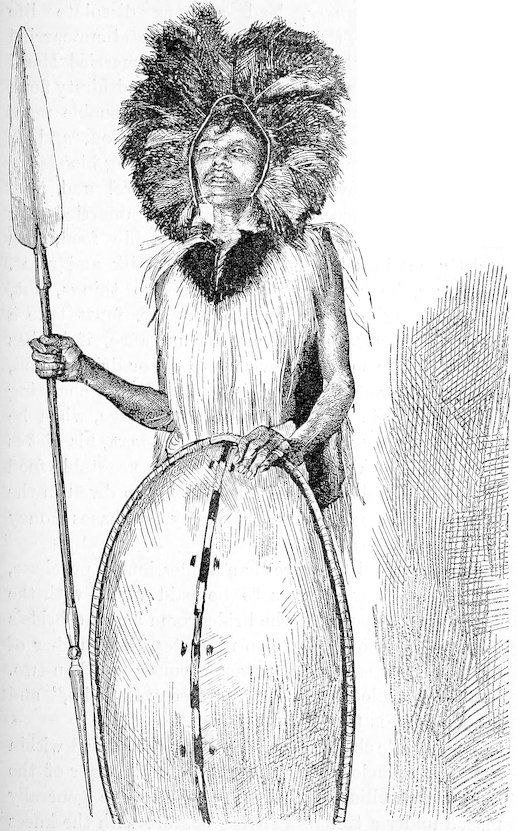
Fig. 74—A Masai Warrior.
The Masai men rarely marry until they are over twenty-five, 416nor the women until twenty. But both sexes, avant de se ranger, lead a very dissolute life before marriage, the young warriors and unmarried girls living together in free love. The married Masai is a changed being. From a lustful, bloodthirsty fiend he becomes a staid, courteous, and reasonable man, anxious to obtain and impart information, and as desirous of healing a breach and preventing bloodshed as before he loved to foment a quarrel and take part in a massacre. Whilst still an unmarried man and a warrior he abjures all vegetable food, and strictly confines himself to a diet of milk and meat. Moreover, he must not mix these two things, but, before changing from one to another, must take a powerful purgative, so that, for instance, if he has been living on milk, and wishes to eat or drink blood, he must thoroughly clear his system before changing from one to the other. But after marriage, when he is no longer looked upon as a fighting-man, his diet is unrestricted. He now seeks to obtain vegetable food from the humble races of cultivators who dwell in the vicinity of his settlement, or eagerly purchases honey with tusks of ivory.
Marriage is little more than a question of purchase, and the amount of cows to be paid varies with the comparative wealth of the bridegroom and the bride’s father. This question also regulates the number of wives. They seldom, however, espouse less than two. Married people are generally called “El-kieko,” and the husband is termed “El-moruo.”
When little children die, they are often buried within the village enclosure, or even beneath the floor of the mother’s dwelling. Grown-up persons are generally placed under a tree in a sitting posture with the knees 417touching the chin. A calabash supposed to contain milk, but generally empty, is placed by the side. A slight excavation in the ground is either chosen or made, in which to put the body. Stones are then heaped around it and over it, and grass is thrown on the top, so that a kind of cairn is generally formed. Nevertheless, the hyenas scarcely ever fail to pull down this mound and drag out the corpse, which is then devoured without any interposition on the part of the surviving relatives. When any person dies within an inhabited village, the settlement has to be purified by the medicine-man with a liquor made from the half-digested food (E-moǰok) in the stomach of an ox, which is killed for the occasion. After death the name of a deceased person is never mentioned, lest his spirit should obey the call and return. Notwithstanding this impression, these people have almost no fear of or belief in ghosts or demons, and mock at the Bantu people in their vicinity for their elaborate propitiation of the shades.
The Masai worship a vague Supreme Being, whom they call “Eṅ-gai,” a feminine word also meaning the “heavens” and “rain.” Eṅ-gai is sometimes supposed to dwell on the summit of Kilima-njaro, which is therefore called “Eṅgaǰi-Eṅgai” or the House of God. This Great Spirit with whom rain and grass[56] are peculiarly associated—as being the chief sign and result of his beneficence—is propitiated with loud singing and dancing (Isīlil). They also sacrifice sheep, and tie all the bloody remains in the skin and leave it on isolated mountains, or at a place where 418many paths converge. The Masai mention another and weaker divinity, whom they also designate by a female appellation—“En-naiterkob.” En-naiterkob seems to be a kind of earth-spirit (Eṅ-kob, the earth, the world), in contradistinction to Eṅ-gai, the heavens, the over-arching sky. The Masai often call on Naiterkob to mediate with Eṅ-gai and obtain the granting of their prayers for rain, success in war, or many male children. They regard with peculiar veneration the snowy summits of both Kilima-njaro (Ol-doinyo oibor, the white mountain) and Kenia (En-durkenia, or Ol-doinyo oigeri, the spotted mountain), imagining that these are at once the chosen residence of Naiterkob and the places on which Eṅ-gai reposes, and that they are therefore the most fitting sites for mediation with the Most High.
The political constitution of the Masai tribes is mainly patriarchal, but the rule is sometimes a dual one. The father of the tribe, the supreme chief, is generally a man chosen for his wealth, his wisdom, or his martial renown; or it may be that he is a mighty medicine-man skilled in the arts of divination and prophecy, and able to compound powerful drugs from the roots and bark of certain trees. If the former he is called Ol-beiǰani, and holds his place as long as he can keep it, but if his power is sacerdotal—if he is an Ôl-eibon, then he is probably supreme till death. The office is not hereditary. Sometimes the Beiǰani and the Eibon are found ruling side by side—the temporal and spiritual chieftains. In other cases it may be the Eibon who wields exclusive power or unites the temporal and spiritual functions in his own person. The Wa-kwavi states are usually little republics ruled by an oligarchy of all the wealthier or more powerful 419elders. Here the Eibon, or medicine-man, plays a less important part.
The Masai are very respectful in disposition to their elders, and the younger members of the community will seldom sit in the presence of the old men. At the same time they exhibit little grief at the death of their comrades, whether in battle or in village squabbles. As to remorse, that outcome of civilization does not exist among them. A Masai will murder his friend or neighbour either in a free fight over a herd of captured cattle, or in pursuance of private revenge, and live not a whit the less merrily afterwards. Nevertheless, while it is thought an honourable distinction to kill a fellow-citizen in fair fight, to murder any one secretly or by surprise is punished by a heavy fine. This is for the good of the community, not because it is thought wicked. The Masai, in fact, have scarcely any conceptions of good and bad like those of Europeans. Torono, which we translated “bad,” really means “broken, useless, inferior, spoilt;” Maṅgadi is not “wicked,” but “cruel;” Sidai is not “good,” but “loose-mannered, easy-going, wanton, unchaste.” Certain actions are recognized as injurious to the community and the commonwealth, and as such they are punished and repressed; but they do not, as do many races of men, connect different good or bad deeds with the pleasure or displeasure of the gods. Were the Masai given to enunciating moral maxims they would probably say, “To be good is to be silly,” and “Be cunning and you will prosper;” “Happy is the man who has smashed many skulls and stolen many cows: his children shall honour him,” and so on.
The agricultural Wa-kwavi build their houses generally after the method of the Bantu or other foreign 420races in whose vicinity they settle; besides copying them in many other particulars. The semi-nomad Masai do not make much pretence at architecture. As they roam about over certain districts, they often inhabit different portions at different times of the year. In the rainy season they may take to the open plains where the grazing is now good for the cattle, but in the winter or rainless period they will change to hilly ground where the mists create perennial verdure, or to the vicinity of great lakes and rivers for the same reason. Their quickly-constructed towns or villages, of which the women are generally the architects and builders, consist of a huge circle of low mud huts, surrounded by a thorn fence. In the middle of this enclosure the cattle are kept at night. Their huts are generally built as follows: first making a rough framework of pliant boughs, which are bent over and stuck in the ground at both ends, they plaster on this a mixture of mud and ox-dung, and, for further resistance to heavy rain, hides are thrown over the top, outside. The height of the dwellings barely exceeds four feet. There is a low, porch-like door. The only attempt at furniture is a hide laid across a row of sticks to serve as a couch at night.
The length of the house may be from nine to ten feet, and the breadth five. The top is generally rounded from the nature of the framework. They often, especially when built in a row, look like little more than inhabited mud walls.
The principal utensils of the Masai are calabashes, made from gourds and the huge fruit of the baobab-tree, leather bags, pots and spoons hollowed out of soft wood, or made of clay for cooking purposes. Snuff-boxes and pipe-bowls are made from the hard 421shells of certain fruits, or from ivory or rhinoceros horn. Their spears, knives, razors, and all metal instruments are made by the curious El-konono tribe, who dwell among them as vassals and serfs. Some of the poor Masai make a subsistence by neatly sewing leathern garments and disposing of them to women or old men in exchange for food.
The domestic animals of the Masai are oxen, goats, sheep, donkeys, and dogs. Fowls they despise and do not keep. Their cattle absorb all their thoughts. For their possession and retention wars are waged. The gift of an ox is a sign of solemn peacemaking, and is generally accompanied by much spitting right and left of the men who lead it. Nearly all their rites and superstitions are connected with cattle. They believe that they are the lawful heritage of the Masai race, whose primal ancestor received from Naiterkob the power to tame the wild oxen of the woods; and under this impression they “lift” the cattle of all weaker nations, maintaining that they have no right to their possession. Nevertheless, they probably got their kine from their northern home, somewhere on the White Nile, for the generic word they use for cow and cattle is identical with that of the Bari people round Gondokoro, and related to similar terms in the Šiluk and Diṅka tongues (vide Vocabulary). The only type of ox which I have seen in their possession is that humped Asiatic breed (the zebu), so common in Tropical Africa, and which probably owes its introduction to the ancient Egyptians. But I am informed that farther in the interior to the eastward of Kilima-njaro, there is another breed of cattle in the possession of these people—a breed like the oxen of the Cape and South-west Africa, with large bodies, no hump, and immense 422widespread horns. On the Kunene river (South-west Africa, latitude 17° S.) I have met with the two breeds side by side—the big, long-horned and the small, humped cattle. In Angola there is a mingling of the two. On the Gold Coast and the Oil rivers I have only seen the small, humped variety, though I am told farther inland the other appears. Whence this long-horned, straight-backed, large-sized ox (which is normally a dun-brown) came from, I am at a loss to say. Of course it was not African in its origin, as in Africa there is not, nor, as far as we know, has there been, a wild ox of the genus Bos. Yet this last breed—which much resembles the Hungarian and South European (Spanish) cattle, was evidently an early introduction into Africa, for in many districts it appears to have preceded the humped kind. It was the only breed the Hottentots possessed. It seems to be very much kept by the populous nations in the interior of South Central Africa, between the Congo and Zambezi.
The Masai have a word for the pig which is also common to their distant relatives on the Nile (vide Vocabulary), but they do not keep it in a domestic condition. The term for pig is used to indicate the wild warthog (Phacochœrus).
Their goats are those of East Africa generally, a small, plump variety. They possess two breeds of sheep, only one of which I have seen. This is the hairy, fat-tailed sheep, with short horns. The other I judge from report to resemble the tall, big-horned, chest-maned, domestic sheep of Central and Western Africa (vide illustration, p. 428 of my book, “The River Congo”). The common fat-tailed sheep is called Eṅ-gera, and the long-horned kind El-mērekeš, or El-kirieš.
423The Masai donkeys are generally splendid beasts, and are simply and solely the wild Ethiopian ass (Equus hœmiopus) domesticated. Where they have been free from mixture with coast breeds, they are, as I saw them, literally undistinguishable in size, colour, and markings from the wild ass of Abyssinia and North-east Africa. They have none of the stripes on the legs which appear in the wild ass of Somali-land. The Masai must have got them from the far north. Their word for ass agrees with that in the Latuka language spoken in 5° north latitude, to the east of the Nile (vide Vocabulary).
The Masai are much attached to their dogs. Generally each child is followed about by one, its own exclusive pet. They are—those that I have seen—disappointing mongrels, all colours, and of no marked breed. Generally the ears are erect and pointed. The colour may be fawn, fawn and white, black and tan, all black, or black, tan, and white. They are about the size of large terriers. They never bark.
The marabou storks (Leptoptilus), vultures, and hyenas (H. crocuta) which frequent the Masai encampments are strangely tame, and are protected for the useful scavenging they perform. Strangers cause grave offence by killing them. The spotted hyena is often called by the Masai “Ol-uwaru onyoǰine”, the limping leopard. The striped hyena, which is rarer and shyer, and keeps more to the open, is called “Otonu.”
Whenever the warrior Masai are on a journey they are positively accompanied by flights of vultures and a few marabou storks. Wherever they stop to slaughter cattle, these scavengers descend and feast on the offal till they are so gorged that you may see a Masai pushing 424them away with his foot. The hyenas that haunt the vicinity of their burial-places root up and devour the dead soon after their relatives have laid them in the soil, without in any way being checked or molested.
The Masai rarely kill or eat any of the game around them—zebras, giraffes, buffaloes, and antelopes, so that their country from long preserving has become a hunter’s paradise. Unfortunately, the Masai are incensed at any guns being fired in their vicinity, lest the report should stampede their cattle; consequently a sportsman would often find himself cruelly hampered.
The ivory in which these people trade is secured for them by the helot tribes of hunters—En-dorobo, El-mau, and others, who actively pursue the elephants with spears and poisoned lances. The Wa-kwavi, who are agricultural Masai, cultivate, of course, most of the East African vegetables—sugar-cane, maize, bananas, millet, tobacco, sweet potatoes, and the collocasia root. The names of all these things are derived from Bantu languages, and are not related to terms employed by the other members of the Masai family in the Nile basin. Tobacco is not smoked by the Masai, but mixed with natron (magad) and chewed. It is also powdered and taken as snuff most extensively. Tobacco is always called by a corruption of the coast name, which again is only a variant of “tobacco.” It is wonderful, considering how recent is the introduction, that tobacco has so quickly spread among these wild people that they already forget its foreign origin.
The Masai are very fond of honey, which they not only purchase from their agricultural, bee-keeping neighbours, but also obtain from the stores of wild bees in warthog or ant-bear burrows. To these they are often guided by the honey-bird (Indicator), a creature 425they naturally regard with kindness. From the honey, mixed with water, they make an intoxicating mead called “ol-marūa.” This and sour milk are their chief beverages. Milk is regarded as a sacred fluid. They will never give or sell it to strangers of other nations, and were it not that the women are less rigid in their views than the men, and that they may occasionally be bribed with beads to bring milk clandestinely to the strangers, this grateful fluid would otherwise be unprocurable in Masai-land. Moreover, although they will readily give or sell castrated bullocks, they will never willingly part with a cow. The most heinous act a stranger can commit in their land is to boil milk. This, they think, will so enrage the cows that they will at once run dry. Any one caught doing so can only atone for the sin with a fearfully heavy fine, or, failing that, the insult to the holy cattle will be wiped out in his blood. Talking of blood, this is one of the Masai warrior’s chief and favourite forms of nutriment. The ox is generally stunned with a blow on the back of the head, and then a vein is opened in the throat. To this the Masai applies his lips, and sucks and sucks until he can hold no more or until his impatient comrades tear him from the spurting vein. Doubtless the salts in the warm blood supply a need in his diet, for in no other form does salt mix with his food, the warriors being compelled to refrain from the salted tobacco their elders so enjoy.
Commerce and the cattle disease will do much to open up Masai-land, which is the finest country in Africa. The one will soften and the other will tame these fierce people. The increasing love of trade goods impels them to encourage the arrival of coast caravans, and the loss of their cattle, as before explained, will 426force them to till the soil. Then, as my old Masai friend prophesied, they will all become Wa-kwavi, and if the original nomad Masai be a fierce, intractable, insolent bully, he no sooner becomes a settled agriculturist than he changes into the nicest, quietest, honestest, mildest inhabitant in Africa. Therefore, although they may fail to see it, the greatest boon Eṅ-gai can confer upon them is to sweep their cattle off the land.
Almost exclusively the Masai inhabit the plains round the Kilima-njaro district, while the uplands still retain the older population of the country. This consists of people belonging linguistically and racially to the great Bantu family, which occupies nearly all Africa south of the Equator. From a linguistic point of view the Bantu are absolutely homogeneous—there is no mistaking a Bantu tongue for a member of any other family. But ethnologically the distinction is much disputed. Some good authorities maintain that the Bantu races (Kaffirs, Congo, Swahili people, and the inhabitants of the great lakes) do not agree amongst themselves in any particular type, nor differ markedly from other negroes on the Nile or the west coast. This is a question of such intricacy, and needing so much careful argument, that I am not prepared to enter into it here, nor am I ready or anxious to prove the racial homogeneity of the Bantu-speaking people. While I recognize that there is certainly a great physical similarity between the Ovampo, Ovaherero (Damaras), the inhabitants of the Upper Congo, the Ba-ganda of the Victoria Nyanza, and the Zulus, I admit at the same time that there are many other tribes and races speaking Bantu languages who differ markedly from the fine types above cited. I have seen natives from the borders of Lake Nyassa, from the Lower Congo, 427from East Central Africa, who presented all the most hideous and exaggerated features of the Gold Coast negro, although the yellow faces in some of them might suggest an ancient strain of Hottentot or Bushman. Of course the Bantu is a negro—so is the Masai, the Wolof, the Mandiṅgo, or the pale-faced Berta of Abyssinia; so also, in my opinion, are the Hottentots and Bushmen. All African races with frizzly hair I would call negroes, whether their noses varied (as they do in the same tribe) from the patulous, wide nostrilled, bridgeless form of the Bushman to the fine, aquiline, delicately-shaped organ which you encounter among the Masai or the Wolof. There is no feature constant like the hair. You may meet some tribes of Bushmen who are dwarfs, and others (such as those found near the Kunéné and Upper Zambezi) who attain the average size. The colour of all negroes may vary in the same district from jet-black to tawny-yellow, but still their hair, though it may be long or short, is frizzly. Nevertheless, among the negro races there are wide differences that separate them into certain fairly well marked groups, the members of which evince more affinity for one another than for other sections of the sub-species or variety. Thus the low types of Masai resemble, not the Bantu, but the negro races of the Nile—the Šiluk-Diṅka people—from whom they perhaps originally sprang. The finest physical type of the Bantu, whether he be found in Damara-land, on the Victoria Nyanza, or in Natal, offers much the same characteristics in common, and does not at all resemble the Masai, who may be the highest development of the Nile negro, or the Wolof, who is among the handsomest samples of the races of Northern Guinea. Therefore, inasmuch as the mountaineers of the Kilima-njaro district and 428elsewhere, who speak languages of the Bantu family, differ from the Masai in speech and in physical features, and resemble rather in both these points the majority of the inhabitants of the southern half of Africa (who also belong linguistically to the same group), and further, as I cannot call one negro and the other negroid (since both are negro), I prefer to use the term Bantu in a physical as well as in a linguistic sense, and to speak of the Bantu peoples in contradistinction to the Masai. The principal Bantu tribes in the district I am describing are the Wa-taveita on the River Lumi, at the base of Kilima-njaro, the Wa-čaga, who, under many chieftains and political divisions, inhabit the great mountain, the Wa-gweno and Wa-kahe to the south, and the A-kamba and Wa-taita to the north-east and east. When I started for Kilima-njaro from Mombasa I encountered no inhabitants until we reached the hills of Maungu, on the borders of Taita. Here some people came and sold us honey and spoke to us in the Ki-taita dialect. At Ndara and Bura we subsequently saw more of the Wa-taita, and many of them afterwards emigrated to Taveita and Čaga, and even entered my service as hunters and scouts, so that I was enabled to see a good deal of them from first to last, and take down vocabularies of their dialect.
In outward appearance the Wa-taita are unprepossessing. They are about the medium height, the men varying generally from five feet three inches to five feet nine inches, and the women from four feet eleven inches to five feet four inches. They have fairly good figures, the limbs, especially the legs, are well formed, but the men are somewhat effeminate and slight-looking. In facial aspect there is much 429variation. While many have little pug noses with no perceptible bridge, and a much-rounded, projecting forehead, others exhibit an almost Red Indian physiognomy, with aquiline noses, high cheek-bones, and retreating foreheads. The teeth are artificially filed and sharp pointed, but are naturally set somewhat wide apart in the jaw. The whites of the eyes are much clouded. The ears are so tortured and misshapen by prevailing fashion, that it is hard to guess their original shape. The body is disposed to be hairy, but is carefully depilated all over, even to the plucking out of eyebrows, eyelashes, beard and moustache. The colour of the skin is generally dull, sooty-black, but this is often disguised by the coating of soot or red earth and fat or castor-oil, which is rubbed over the skin. The hair is generally shaved all round the head, and only allowed to grow on the occiput. Here it is much cultivated and pulled out into long strings, which are stiffened with grease and threaded with beads. Beads, indeed, are the adoration of the Wa-taita. The women wear massive collars of them, sometimes six inches broad and three inches deep, which are placed round the neck, and sometimes so lift up the chin as to compel the wearer to keep the head well thrown back. Several hundred strings of beads are bound round the waist, smaller bands cross and recross the back and breasts, they are banded round the shaven part of the head, they hang in scattered strings from the temple downwards, they decorate the tiny tablier or leather apron which is worn for purposes of decency, and the borders of the two-tailed leathern garment which hangs on the back and legs are also edged with beads of various colours. In both sexes the lobes of the ears are pierced, and 430the hole is widened until the distended flap of skin nearly reaches the shoulder. When this result has been attained, many rings of beads are inserted, and continue to weigh down the distorted ear, the outer auricle of which is further pierced and hung with beads of a larger kind. This hanging the ears with beads is peculiar to the Wa-taita, the other mountain races in the vicinity employing for the like purpose fine iron chains, bolts of wood, or rings of wood or ivory. There are but slight traces of religion among them. They are afraid of spirits, who are supposed to dwell in large forest trees, and perhaps for the reason that their dead are always buried in the forest. The country is but slightly wooded, but on the hill-tops clumps of high trees are religiously conserved. The baobabs among these people, as among other East African races, are looked upon as particularly the abode of spirits. The word for God in their language is Mulungu, but I more than suspect it is a borrowed term from the coast tribes, and that Eruwa, “sun,” is their true conception of an over-ruling deity. Among the Wa-pare, the Wa-gweno, the Wa-taveita, and the Wa-čaga the word for “sun” and “God” is identical. Mulungu is in use among the A-nika and the A-kamba, and Muūngu and Mungo among the Wa-swahili and the Wa-pokomo. All these variants descend from an original form, Mu-n-kulu-n-kulu, which is most closely preserved in the modern Zulu U-nkulunkulu. The adjective -kulu in nearly all Bantu tongues has the meaning of “great” or “old.” To this was added the n prefix, then the personal prefix mu, so that finally the combination meant the “old, old one,” for great and old in this sense are almost synonymous, and Bleek conjectures the term to have been a relic of 431ancestor worship, or the deification of some tribe-founder.
One other incident may be mentioned about the Wa-taita before I leave them. Their marriages are arranged first by purchase, the intended husband paying the father of the girl the three or more cows fixed as the price. When these preliminaries are settled the girl runs away and affects to hide. She is sought out by the bridegroom and three or four of his friends. When she is found, the men seize her and carry her off to the hut of her future husband, generally each man holding a limb, so that she is supported by four men including the bridegroom. On arriving at their destination, being accompanied on the way by bands of laughing girls and women, she enters the hut with her four captors, and each in turn is allowed to exercise a peculiarly marital privilege. Then having been in this strange manner repaid for their services, they leave her to the exclusive possession of her husband. She remains with him for three days, then is escorted back to her father’s house by another procession, and finally returns to her future home to take up the cares and duties of domestic life.
The language of the Wa-taita is about intermediate between the dialects of the coast and those of Čaga.
The A-kamba, who live on a broad stretch of country to the north of Taita nearly to the base of Kenia, are the neighbours of the Gallas on the coast. They are very roving, colonizing people, and great hunters. I have seen many of them at Taveita, whither they would bring rhinoceros horns and dried rhinoceros flesh for sale. These are on the whole a good-looking race, and I was surprised to find in many that the hair, though short, is straight, which together 432with a light skin shows an intermixture of Galla blood. They are slightly clothed in leathern coverings with a certain regard for decency. Originally, according to their traditions, inhabitants of plains and mountains to the south-east of Kilima-njaro, they were driven farther north by the inroads of the Masai, and eventually settled in that long strip of country which separates the latter race from the Galla. Here they have taken pretty firm root, together with their close relations, the Wa-kikuyu and the Wa-δaičo of Kenia, and however they may have been harassed by both Masai and Galla, they have increased and multiplied. Indeed of late years they have become too numerous in their own land for the limited supply of food, and so are compelled to wander to the coast and to Taveita in search of subsistence. They are a quiet, industrious, manly race, very different to the wretched A-nyika of Mombasa (teste Krapf), and will doubtless, when their country comes to be opened up, play the same important rôle of carriers and workmen as the Wa-swahili of Zanzibar.
The beautiful forest district of Taveita is inhabited by two different colonies. One a Kwavi people of Masai origin, and the other and more primitive a most interesting Bantu tribe, the Wa-taveita, who exhibit marked peculiarities in their language and ideas. Let me begin by saying that they are one of the pleasantest people I have ever encountered in Africa. They are of fair height, some of the men being both tall and robust, and attaining occasionally six feet in height. Their figures are often models of symmetry and grace. They anoint the body with oil and ochre, as do the neighbouring people already described. The hair is dressed in many fashions, more often divided 433with fat into separate strips, and the whole united in a pigtail at the back, or else allowed to hang in long locks about the face and shoulders. They frequently let the beard and moustache grow, and generally abstain from plucking out eyelashes and eyebrows, as is done elsewhere, though this is also occasionally practised at Taveita. Circumcision is general. Marriage is of course a matter of purchase, but no sign of imitating capture seems to be practised here. If the young man cannot afford to pay for his wife at once, he gives over to the father a certain portion of the price, and his intended bride is betrothed to him and carefully prevented from communicating with other males until the rest of the purchase is paid. Then she becomes a wife, and directly signs of pregnancy are manifest she is dressed with much display of beads, and over her eyes a deep fringe of tiny iron chains is hung, which hides her and also prevents her from seeing clearly. She is generally accompanied by an old woman, who is deputed to screen her from all excitement and danger until the expected event has taken place; after which little further fuss is made, and other succeeding children are born without any extra precautions being taken.
After marriage the greatest laxity of manners is allowed among the women, who often court their lovers under the husband’s gaze; provided the lover pays, no objection is raised to his addresses. Both sexes have little notion or conception of decency, the men especially seeming to be unconscious of any impropriety in nakedness. What clothing they have is worn as an adornment or for warmth at night and early morning. These people are affectionate and kindly in their family relations, as may be instanced by such an 434episode as the one recorded on page 214 of this work. Nevertheless they display strange callousness sometimes where death is concerned. The body of a much-loved wife or child is hastily buried in a shallow trench outside the circle of huts, and covered with stones and grass. The hyenas at night proceed to exhume and devour the corpse without provoking any interference from the sorrowing relatives, who the next morning will kick aside the osseous fragments of their loved ones without exhibiting the slightest sign of emotion or tenderness. They have a vague belief in life after death, but it is the disembodied spirits on whom they concentrate their thoughts, and not the lifeless clay, which is to them of no account. This is not as most of their congeners think—it is rather the effect of Masai influence; for among the majority of Bantu negroes very considerable attention is paid to the corpse, under the idea that the spirit of the dead person is still much affected by the condition and disposal of its previous tenement.
The people of Taveita subsist mainly on vegetable food, of which they rear a great variety in their beautiful gardens. They also eat fish and meat. The fish are caught in the River Lumi, which runs through the settlement, by means of skilfully-made wickerwork traps and weirs. They also construct from the midribs of a Raphia palm most clever rods and lines, the whole material coming from the palm, with a native-made iron hook superadded.
435
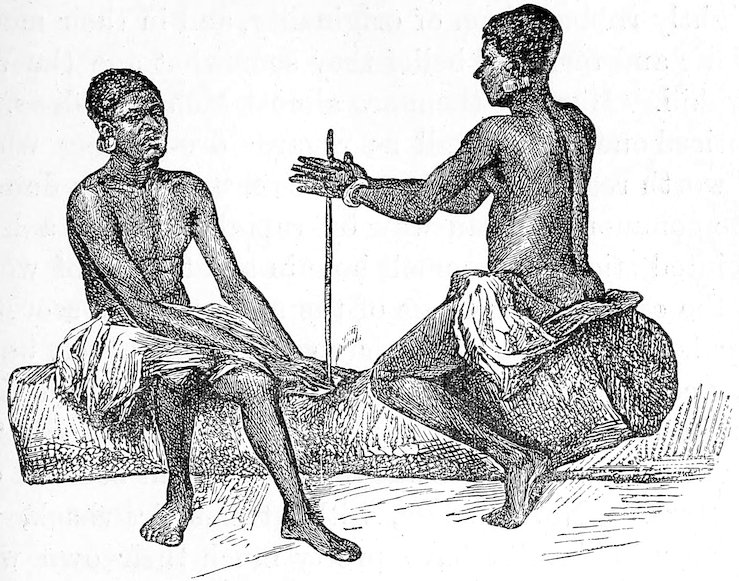
Fig. 75.—Men of Taveita making fire.
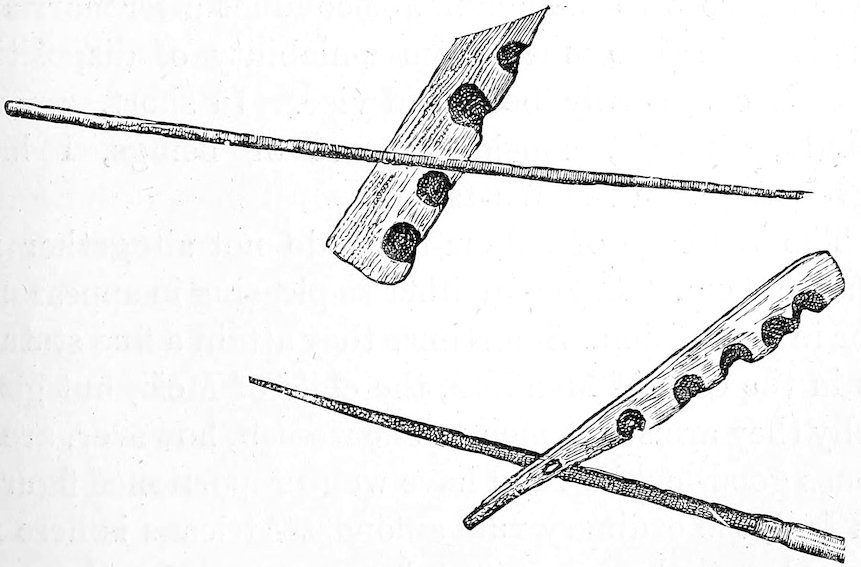
Drills and Fire-sticks.
The Wa-taveita proper number about 2000. They bear an excellent reputation among the coast traders for honesty and friendliness. They speak Ki-swahili almost universally, and speak it with singular correctness; but of course among themselves Ki-taveita is the only language used. This very interesting Bantu dialect offers many curious features and retains a number of archaic words in its vocabulary. It is somewhat midway between Ki-kamba and Ki-čaga 436but offers independent features of its own. So much intercourse with traders from the coast seems to have slightly robbed them of originality, and in their modes of life and forms of belief they somewhat ape the Wa-swahili. Many of them are almost Mohammedans. I noticed one little detail as regards fire-making which is worth recording. To produce fire, which is done in the common African way by rapidly drilling a hard pointed stick into a small hole in a flat piece of wood, is the exclusive privilege of the men, and the secret is handed down from father to son, and never, under any conditions—so they say—revealed to women. I asked one man why that was. “Oh,” he said, “if women knew how to make fire they would become our masters.” Nevertheless, without this drawback, the fair sex in Taveita have pretty much their own way. I have known one or two leading matrons who have always insisted on having their voice in the deliberations of the Wazēē, or elders, who govern Taveita. I have referred to their laxity of conduct after marriage, but it springs so much from amiability of disposition that it can hardly be called vice. In short, a more kindly, sensible, considerate set of beings, I have never met than the Wa-taveita.
The Wa-čaga of Kilima-njaro do not altogether resemble them. They are neither so pleasing in appearance nor in disposition. Sometimes they attain a fine stature, as in the case of Mandara, the chief of Moši, but generally they are short men. The women, however, are at times good-looking, and have well-proportioned figures. In fact, the ordinary rule amongst Africans is here reversed, and the women are handsomer than the men. Amongst these people we again meet signs of marriage by capture, but in their case it does not seem to be as I have described in the Wa-taita, for the bridegroom 437is quite equal single-handed to the capture of his wife, and certainly not disposed to reward his friends in the same manner as the less exclusive M-taita husband. On several occasions when I observed a marriage ceremony during my residence in Čaga, I found it consisted (after the purchase of the woman had been privately arranged) in the husband carrying off his wife pig-aback, while the relatives and friends pursued with shrieks of laughter, affecting to try and rescue the screaming girl; but, of course, all this was simulated, and a survival of past customs, for nowadays a man only gets his bride when he has settled the bargain previously with his future father-in-law. In such states as Moši, where there is a relatively large standing army, the chief will generally distribute the female slaves captured in war among his soldiers, and dower them himself with cattle. Thus his soldiers become indebted to him for their domestic happiness, and are consequently very much attached to the person of their monarch, who is, to them, the sole dispenser of benefits.
Real immorality hardly exists among the Wa-čaga; Mohammedan influence not having as yet initiated them into vicious thoughts and ways. We should be apt to call, from our point of view, their nakedness and almost animal unconsciousness of shame indelicate, but it is rather, when one gets used to it, a pleasing survival of the old innocent days when prurient thoughts were absent from the mind of man. The Wa-čaga cannot be accused of indecency, for they make no effort to be decent, but walk about as Nature made them, except when it is chilly, or if they wish to look unusually smart, in which cases they throw cloth or skins around their shoulders.
There are, as far as I can ascertain, no initiatory 438ceremonies among the Wa-čaga, such as are so constantly met with in other tribes of Bantu negroes in connection with the entrance into a state of puberty of young people of either sex. Circumcision, if performed on the male, which it is not universally, is generally done after the age of puberty.
The Wa-čaga share with the Masai, whom they may have copied, a curious habit of spitting on things or people as a compliment or sign of gratitude. I remember one man, after I returned to my settlement in Čaga from a short trip to Taveita, was so pleased at my safe return that he took my hand in his and spat repeatedly at the sky, saying constantly “Eruwa iča!” (“God is good!”). They have but a vague idea of the deity. Indeed, one never knows whether or not he is identical with the sun, for that luminary bears just the same name, “Eruwa.” It is interesting to notice, in contradistinction to the derivation of the name of God I recently gave as coming from ancestor worship, that among other African nations the deity is identified with the sky or the sun. Thus there is the term “Eruwa” already referred to, which indicates “God” in Ki-čaga. Among the Wa-taveita it is “Zuwa,” also “Sun,” although the Swahili have lately introduced their word, Muungu. The form “Eruwa,” “Zuwa,” is identical in origin with the Swahili “ǰua,” the Luganda “Njuba,” the Congo “Ntuva,” all meaning sun, and all remounting to an archaic form “Nduba.” On the Upper Congo the Ba-yanzi have but one word for God and sky—“Ikuru,” or “Likulu.” Even among the Gallas “Waka” means indifferently God and sky, and in the Masai language “Eṅgai” (a feminine word) means both God, sky, and rain.
439However, to return to the subject of the Wa-čaga. Though having little religious belief, they are very superstitious, and have great dread of sorcery. Large trees are supposed to be much affected by ghosts, and for this reason are spared by the axe. Their dead are buried in these isolated forests, sometimes in hollow trees, sometimes in the ground. Hyenas generally dig them up and eat them—this being little cared for by the survivors, as is the case among the Masai and the Wa-taveita.
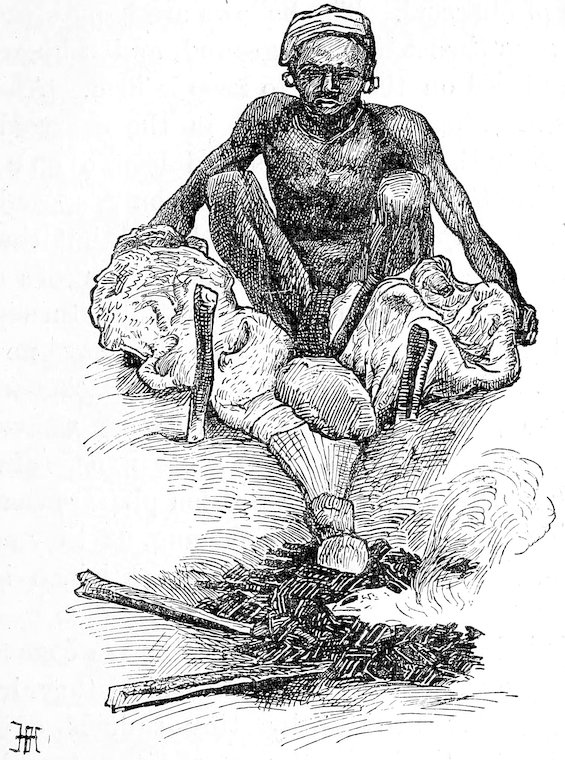
Fig. 76.—A Čaga Forge.
The Wa-čaga are clever smiths, and forge all kinds 440of utensils, weapons, and ornaments from the pig-iron they receive from the country of Usanga, near Lake ǰipé. The forge is but a pair of goat-skin bellows converging into a hollow cone of wood, to which is added two more segments of stone pierced through the centre and ending in a stone nozzle which is thrust into the furnace of charcoal. The bellows are kept steady by several pegs thrust into the ground, and a huge stone is often placed on the pipe to keep it firm. After the iron has been heated white hot in the charcoal it is taken out by the iron pincers and beaten on a stone anvil. The Čaga smiths make not only spear-blades and knives of apparently tempered steel, but they can fabricate the finest and most delicate. Out of a rhinoceros horn they will make a beautifully turned and polished club, carved by hand, for they have no turning lathe. Pottery is almost absent. Basket-work is carried to great perfection, and they can weave it so tightly that milk may be held in these utensils of woven grass or banana-fibre. The wooden platters that they make show no little skill in shaping, as they are cut out of solid blocks of wood, and not joined in any way.
But it is in their husbandry that the Wa-čaga mostly excel. The wonderful skill with which they irrigate their terraced hill-sides by tiny tunnels of water diverted from the main stream shows a considerable advancement in agriculture. Their time is constantly spent in tilling the soil, manuring it with ashes, raking it, and hoeing it with wooden hoes. All their agricultural implements, except the choppers, adzes, and sickles, are of wood—wooden hoes, wooden stakes, and so on. They have a very clever mode of irrigating equally a given surface. As the little canals 441of water are always elevated above the cultivated plots, they will tap it at a convenient spot above the bed to be watered, and then turn the stream into a rough conduit made of the hollow stems of bananas cut in half, the end of each stem overlapping the next. Then as the water enters the last joint it is freely turned right and left, dispersing the vivifying stream in all directions.
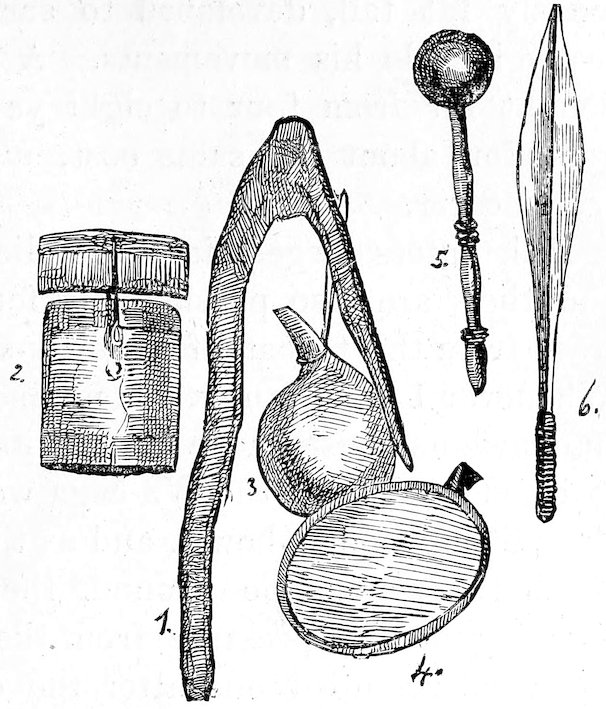
1. Wooden Hoe.—2. Leather Honey Case.—3. Gourd.—4. Wooden Tray or Dish.—5. Club made from Rhinoceros Horn.—6. Knife. Fig. 77.—Čaga Utensils.
The food of the Wa-čaga is mostly vegetable. Fish are absent from the streams of their country; but, morever, like the Wa-taita, they think them unfit to eat, and of the same nature as serpents. They breed fowls in large numbers, but merely to sell to the passing caravans of traders from the coast, for they themselves abjure poultry as food, thinking it unwholesome and unmanly. Their other domestic animals are the ox, the goat, the sheep, and the dog, though the latter animal is rarely seen. The oxen are much valued. They belong to the humped Zebu breed prevalent throughout East Africa from the days of the ancient Egyptians. The goats are small and handsome, with poorly developed horns, drooping ears, and often two small appendages of skin in place of the ordinary 442beard. The sheep are of large size, hairy, with fine dewlaps and drooping ears. The male has an enormously fat tail, developed to such an extent as to really impede his movements. A fine sheep may be bought for from four to eight yards of cloth, a fat goat for about the same cost, and a milch goat a trifle dearer.
Milk enters largely into the diet of the Wa-čaga, and they are also passionately fond of warm blood fresh from the throat of a newly-slaughtered animal. Whenever I killed an ox for my men—who being Mohammedans insisting on cutting its throat and letting it bleed to death—the Wa-čaga would assemble with their little wooden bowls, and as the animal lay in its death throes on the ground, the hot purple blood spurting at high pressure from the severed veins, the eager natives filled one after the other their wooden vessels and then stepped apart from the crowd to drink the coagulating gore with utter satisfaction and a gourmet’s joy. They are great flesh-eaters when they can afford it, but, as I have already said, their main diet is vegetable. Among the plants grown for food are maize, sweet potatoes, yams, arums (Colocasia antiquorum), beans, peas, red millet, and the banana. Tobacco is also largely cultivated, and the natives chew it and consume it as snuff mixed with natron-salt. Honey is produced in immense quantities by the semi-wild bees which make their hives in the wooden cases put up by the natives among the forest trees. A large barrelful may be bought for two yards of cloth.
The Wa-čaga inhabit the western, southern, and eastern slopes of Kilima-njaro. The northern side of the mountain is without any other inhabitants than roving bands of Masai. The principal Čaga states, 443beginning on the west, are Šira, Kiboṅoto, Mačame, Uru, Kibošo, Mpokomo, Moši, Kirua, Kilema, Maraṅu, Mamba, Mwika, Msai, Rombo, Useri, and Kimaṅgelia. Although these little states are perpetually quarrelling among themselves, they are nevertheless closely united by ties of blood and possess a common language, Ki-čaga, unless, indeed, the Warombo, as I have sometimes thought, speak a dialect of their own.
The inhabitants of Kahe (the country lying due south of Kilima-njaro in the plains of the Upper Ruvu), of Ugweno, and also, I am told, of Mount Méru, seem to resemble closely the Wa-čaga in language and in physical features. They were doubtless the same race not long since, but the invasion of the Masai split them up into different sections, and they became isolated in their coigns of refuge, some on the mountains, some in the marshy swamps. The Wa-gweno are a very timid set, and greatly afraid of witchcraft. Everything at all strange or incomprehensible is “usawi” (sorcery). They not only dread the Masai with all their hearts, but they also invest the little Lake ǰipé, which lies at the foot of their mountains, with imaginary terrors, declaring they dare not fish on its banks or cross its waters in canoes, on account of an awful kelpy-like monster which dwells in the lake and sallies out to devour all who may approach the waterside. In vain do the Wa-taveita go and fish there fearlessly under the eyes of the Wa-gweno; these timorous folk nevertheless continue to avoid the lake wherein are present such boundless stores of food. I have no doubt that the legend of the water-monster arose from either the voracious crocodiles or the obstreperous hippopotami which inhabit the waters of ǰipé.
444
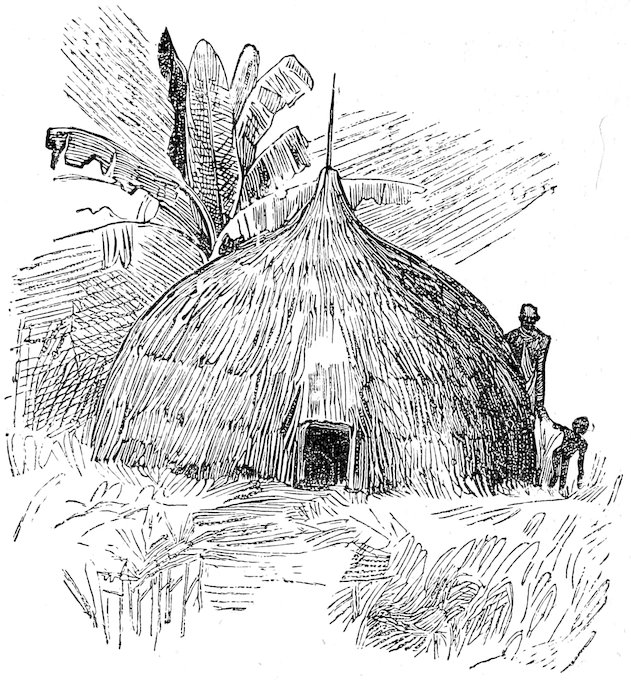
Fig. 78.—A Čaga House.
My readers may possibly have been disappointed to find in this chapter so little information as to peculiar customs or beliefs exhibited by the people it described. I can only say this want is not owing to any lack of probing or questioning on my part. I have come to the conclusion that whatever religious notions, mystic ceremonies, initiatory practices which the inhabitants of Kilima-njaro may have retained originally from their ancestors and shared with their other existing relatives, have at the present time disappeared, or have been worn away by constant changes of abode, massacres, flights, and all the incidents of an anxious struggle for existence, which the fluctuating peoples of Eastern Equatorial Africa have, for the last few centuries, undergone. Those who may have read what I have previously written respecting African races on the Congo, in Angola, and elsewhere, will perceive that 445I have often had to remark curious initiatory ceremonies, elaborate animistic belief displayed in burial customs, various modes of phallic worship, and obscure superstitions connected with eating or drinking. Scarcely any of these phases of savage religion, fancy, or folk-lore, have I encountered in the peoples who inhabit Kilima-njaro and its vicinity. I do not say they are non-existent, I merely mention that they have not come under my personal recognition, and if succeeding travellers are more fortunate than I in this particular, I shall conclude that in spite of my constant investigation these peculiarities have failed to display themselves to my perception.
446