Chapter XVIII · ZOOLOGY.
Reading edition
I will precede the enumeration of my zoological collections by a short sketch of the main features of the Kilima-njaro fauna.
To begin with our near kinsfolk, the monkeys. I found these creatures much more abundantly present in East Central Africa than during my journeys on the West Coast. Although Western Africa is probably better provided with species of quadrumana than any other division of the continent, the monkeys are much scarcer in numbers and harder to see, possibly owing to the greater density of the forests.
During eight months on the Congo I only saw monkeys twice in a wild state, and that in one place only; and throughout my entire stay of sixteen months in West Africa I can only remember six occasions on which I actually beheld these animals in a state of nature. On the other hand, I had scarcely left the East Coast, to journey towards Kilima-njaro, when monkeys showed themselves abundantly in the wilds.
The first to attract my attention were the baboons, probably the species known as Cynocephalus hamadryas, C. Sphinx, and C. babouin. They were generally found on the outskirts of native plantations, where they almost subsisted on the maize and other 351food-stuffs stolen from the gardens of their more highly-developed fellow-primates. In the inhabited region of Kilima-njaro, generally known as the country of Čaga, baboons were strangely abundant. They were generally in flocks of fourteen to twenty, of all ages, and both sexes. They were so little molested by the natives that they showed small fear of man, and, instead of running away, would often stop to look at me about twenty yards off, and the old males would show their teeth and grunt. I have frequently seen the natives driving them from the plantations, as they might a troop of naughty boys, and the baboons retreating with swollen cheek-pouches, often dragging after them a portion of the spoil. On one occasion, in a river-bed at the foot of Kilima-njaro, my Indian servant, ordinarily a very plucky boy, met a troop of baboons, who, instead of fleeing up into the trees, came running towards him in a very menacing manner, and he was so frightened at their aspect that he took to his heels. The baboons followed, and, but that the boy forded the shallow stream, and put the water between him and his pursuers, he might have had an awkward contest. I killed a baboon once in Čaga, one of a troop who were rifling a maize plantation, and its companions, instead of running away, surrounded the corpse and snarled at me. As I had fired off both barrels of my gun, and had no more ammunition, I went back to my settlement to fetch some of my followers, and upon the approach of several men the baboons ran off. We picked up the dead one and carried it back. It was a female, and apparently young and tender. Out of curiosity I had its flesh cooked the next day and ate it,[36] hoping in this lawful 352way to form some idea of the practice of cannibalism; I can only say that the succulence and quality of this creature’s flesh were quite unexceptionable. I have noticed this with most of the species of Old-World monkey I have as yet tasted. During my four months’ stay in Mandara’s country I ate the common Cercopithēcus pygerythrus constantly, and found it made a very toothsome stew. The most remarkable monkey in all this region is probably the Colobus, which apparently offers a new variety or sub-species in the country round Kilima-njaro, remarkable for having an entirely white heavily-plumed tail. The common species, with a black tail tipped with white, I have shot in the forested plains near the coast. The Colobus monkey is almost the only one that quite avoids the neighbourhood of man; the other genera frequent the vicinity of native plantations, and doubtless profit by the abundance of cultivated food. I never observed any Galago (a lemuroid animal) in this district, nor do the natives speak of one, although it is a genus well represented in other parts of Africa.
Bats are by no means common or often seen. I saw some fruit-bats once in the forest hanging to a sycamore fig-tree. No member of the group of Insectivora came under my notice. The Carnivora in this country of big game are, of course, well represented. The lion is very abundant and very bold; but the leopard is more feared by the natives than his larger ally. While stopping in Mandara’s country, two of that chief’s subjects were killed by leopards, one of them 353close to the frequented village-green. The leopard ascends the mountain up to about 8000 feet, scarcely higher. I shot one of these creatures in the valley of a stream in broad daylight. I think it had been sleeping by the water, and was suddenly awakened by my near approach, and too dazed to fly immediately. The most common dog is the side-striped jackal. There is a wild dog found on Kilima-njaro which barks loudly. It is quite nocturnal, and I have never been able to shoot it; but from its appearance in bright moonlight it looks somewhat like the Abyssinian dog (Canis Simensis). The natives know it by a different name from that applied to the jackal—viz. Nzudu.
Hyenas are very common, and both species, striped and spotted, are present; but the striped hyena more affects the hills, while the spotted kind inhabits the plains. The spotted hyena is a much more predatory animal here than one generally imagines. Not only does it steal sheep and calves from the herds, but it even carries off children, and will often attack wounded or weakly men. I once sent a sick man back to the coast a short distance by himself, and he was severely bitten at night by the hyenas. He succeeded, however, in beating them off, and recovered from his wounds.
Civets and genets are very abundant; so also are one or two specimens of ichneumon. I noticed no kind of weasel, ratel, or badger.
The Orycteropus Æthiopicus, or Ant-bear, is common on the plains, to judge by his many huge burrows; but I have never seen him, and only identify him from natives’ descriptions.
Among the Rodentia there were few that came under 354my notice. A species of Graphiurus[37] (probably G. capensis) is found in the forests of Kilima-njaro. The porcupine is fairly common, and a small black rat infests the natives’ houses.
A hyrax is found on Kilima-njaro (H. Brucei) between 7000 and 11,000 feet. It lives entirely in the trees, which it climbs with the facility of a squirrel. It is much sought after by the Wa-čaga for its warm, furry skin, which is made into cloaks.
The elephant inhabits Kilima-njaro up to a great height. I have seen two females and a young one at an altitude of 13,000 feet, crossing a stream-valley, and mounting the opposite bank with the agility of goats. As I have also met with this creature in the Chella Mountains of Angola, where he climbs to 8000 feet, in fact, as high as he can go, I am convinced he can easily adapt himself to a mountain life.
Round the base of Kilima-njaro the rhinoceros is very abundant; and in Lake ǰipé hippopotami are found. The zebra (Equus Chapmani) is present in incredible quantities in the plains round Kilima-njaro. In fact, the vast herds of varied game which pasture on the level country between the snow mountains and the coast remind one of the tales of Gordon Cumming.
Among the more noticeable Ruminantia are the buffalo (Bubalus Caffer), the giraffe (very abundant), the eland, the kudu, the bush-buck (Tragelaphus sylvaticus), the sable antelope (Hippotragus niger), the pallah, one or two gazelles, gnus, hartebeests, bless-boks, and many small species of Neotragus and Cephalophus. The kudu penetrates up the mountain to a height of 14,000 feet, in company with the buffalo, 355attracted possibly by the sweet perennial pasture. A Neotragus and a Cephalophus are also found at high altitudes. I give here a drawing of a head of the little Neotragus antelope (possibly N. Kirki) found on Kilima-njaro. As you may see, it has the nose nearly developed into a trunk, a tendency which is very common, after all, among mammals, and which reaches its utmost development with the elephant.
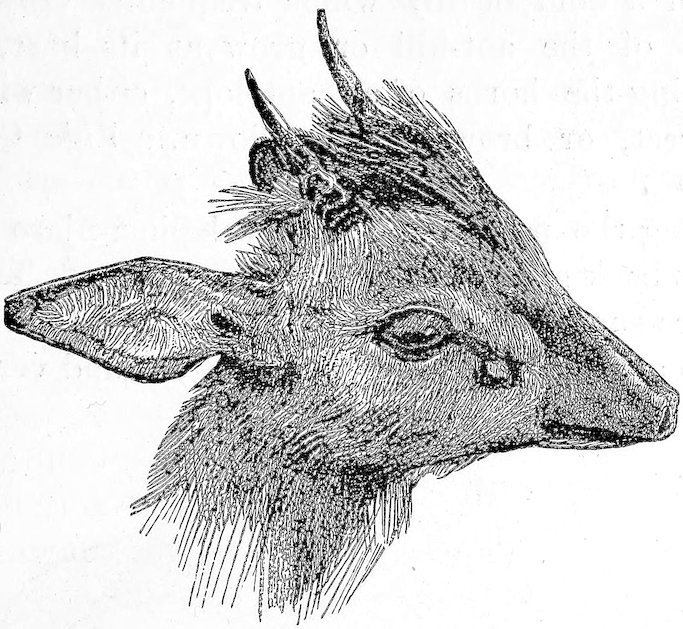
Fig. 66.—Neotragus Kirki.
In the plains round Kilima-njaro the red hartebeest (Alcephalus Cokei) is found in myriads. This creature by the colour of its coat and its strange shape assimilates marvellously with the huge red ant-hills (habitations of the white termites) which abound in the districts favoured by the hartebeests. When you are out stalking it is really most difficult and puzzling sometimes to know which is hartebeest and ant-hill; for the long grass hiding the antelope’s legs leaves merely a red humped mass which, until it 356moves, may well be a mound of red earth. The unconscious mimicry is rendered the more ludicrously exact sometimes by the sharply-pointed flag-like leaves of a kind of lily which frequently crown the summit of the ant-hill or grow at its base, thus suggesting the horns of an antelope, either with the head erect, or browsing low down. Vide Chapter IV.
Among the passerine birds of Kilima-njaro I have brought back six that are new to science. Three of these are sun-birds, one is a flycatcher, and the remaining two are chats. The sun-birds are found very high up the mountain, in that resembling the hummingbirds which frequent the Andes near to the snow-line. They hover round the long tubular flowers of certain labiate plants, and on being captured it will be noticed that the feathers of the brow are thickly covered with pollen, so that in these regions sun-birds share with insects the means of fertilizing flowers.
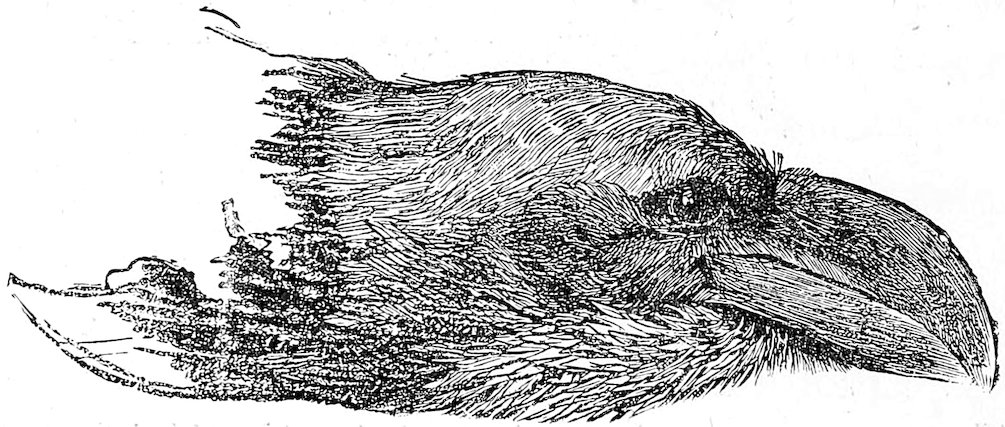
Fig. 67.—Head of Great-billed Raven (Corvultur albicollis).
The bird mentioned in Chapter XIII. as being found at a height of 14,000 feet, the highest dweller, except the occasional passing ravens or kites, is Pinarochroa hypospodia, a kind of stonechat.
Other passerine birds of a note are a lovely oriole (Oriolus notatus), which frequents the forests of the 357lower slopes, and the great white-necked raven, alluded to and illustrated in Chapter XIII.
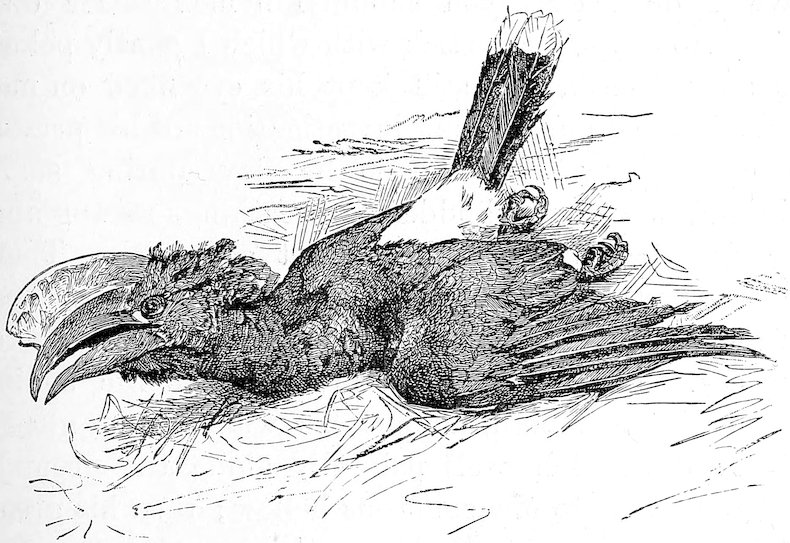
Fig. 68.—The dying Hornbill.
The great crested hornbill (Buceros cristatus) is generally distributed over the mountain up to 6000 feet, especially near habitations. They show no fear of man, being generally protected by the natives, who look upon them with superstitious awe, arising possibly from their being useful scavengers, as well as from their peculiar loud cry, which resembles at times that of the wailing of a woman in distress, at others that of the braying of an ass. In August and September they are generally breeding, and occasionally the head of the female may be seen peering out from a hole in a tree, some thirty or forty feet high, where she has been plastered in by her affectionate husband. By the chips lying about it would appear that these holes are excavated by the birds to the required size. They are monogamous, and show great affection for each other, which is fortunate, as the female during 358incubation has entirely to rely on her mate for daily sustenance. I shot a fine male hornbill once, at Taveita, and he fell to the ground mortally wounded. His dying struggles were quite touching to behold, and I felt almost criminal in having caused his death. His breath came and went in great gasps, and his snowy stomach was streaked with red blood. His large eye with long lashes gazed at me with calm wonder and vague reproach, as if to say, “What ill have I done that you should kill me?” He disdained to snap at the stick with which I gently poked his opened beak, and still kept his eye fixed on me, regarding my impertinent investigations of his person as unnecessary insults. So he lay during some minutes, with long shuddering breathings raising and lowering the feathers of his breast and back. Then another hornbill, evidently his mate, came and perched on the bough of a neighbouring tree and uttered a low cry. The dying bird started up to life again, raised his head high, flapped his widespread, glossy wings, dragged himself painfully along the ground, and gave vent to one sonorous bellow; then his great head dropped on one side, and his wide-open eye glazed with an expression of eager hope hardened in it even in death.
A beautiful turaco inhabits the forests in Kilima-njaro. It is bluish-green-purple, with a white-lined crest and scarlet skin round the eyes. Its wings, like most other turacos, have intense crimson pinions, and therefore it is a gorgeous object as it flaps its loose flight through the forest aisles.
Several species of pigeon are found on the mountain, notably one very fine bird, Palumbus arquatrix, which inhabits the upper regions.
359Francolin and guinea-fowl are most abundant, but the latter bird I have never met with at any great altitude above the plains.
Numbers of water-birds frequent the shallow lakes and swamps in the vicinity of Kilima-njaro. Lake J̌ipé is a great resort of pelicans, geese, egrets, and saddle-billed storks. I have only noticed one water-bird on the mountain at any altitude, and this was a species of duck, I think Anas xanthorhyncus, which was found inhabiting ice-cold streams at an elevation of 11,000 feet.
The abundance of vultures has already been remarked, and is in marked contrast to what may be observed in West Africa, where these vultures are absent, and their place is filled by another Accipitrine scavenger (Gypohierax), who apparently finds so little offal to sustain him, that he has in many places to turn his attention to fishing.[38]
360
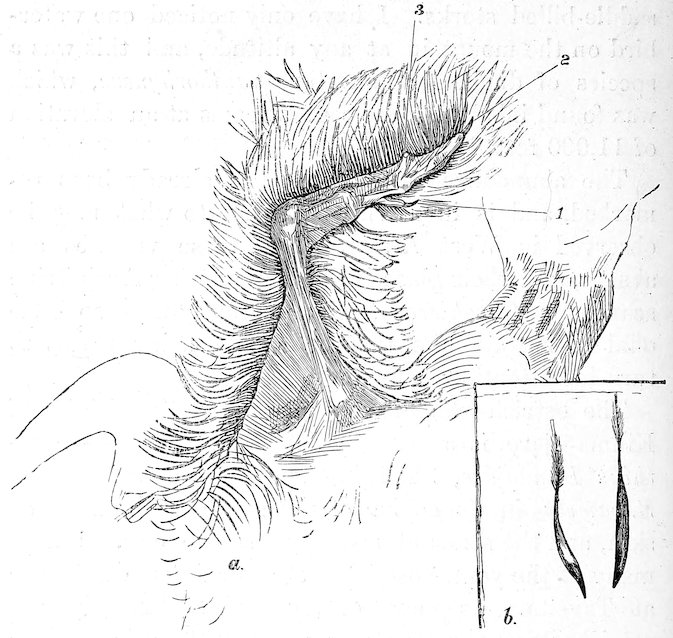
Fig. 69.—(a) The right Manus or Wing of young Ostrich. (b) Scale Feathers of young Ostrich.
The ostrich which is so numerous in the vicinity of Kilima-njaro, is a recently determined species—Struthius Danaoides, Shelley—apparently differing from S. camelus in the colour of the soft parts and naked skin, and the size and markings of the egg. I kept many of the young ostriches alive during my residence at Taveita. As most of my readers know, young ostriches for the first few months of their life are covered with curious scale-like plumes, but, unless they are scientific ornithologists, they may not be also aware that the hand (wing) of the ostrich exhibits three fingers, instead of the two that most other birds possess. The third finger is without a claw. This is but one of the many details which make the ostrich more reptilian than other living birds. The ostriches breed during the months of June, July, and August in the vicinity of Kilima-njaro. The hatched young appear about the month of October, or a little earlier. I am told by the Wa-taveita that for the first few days after emerging from the egg they remain under the guardianship of the mother, but I must own that whenever I have myself seen them, they were, no matter if young enough to be run down and easily captured, unaccompanied by any parent. Nevertheless the natives persist in their statement, and they further averred, without any questioning from me, that 361the male ostrich simulates lameness (like the peewit and the wild duck), in order to distract the pursuit of his children by would-be captors.
Among reptiles, crocodiles are found in Lake ǰipé and in the River Ruvu. Large varanus lizards (Monitor niloticus) are frequently found in the forests of Taveita. They share the water and the trees as their habitat, generally plunging into the stream when frightened or disturbed. They seem to me to feed largely on fish, and no doubt often capture and eat small squirrels and birds. When extended full length along a tree-trunk, immobile, and exactly matching the colour of the bark with their grey-green mottled skin, these creatures are very hard to distinguish from their surroundings, and doubtless often in consequence deceive the sharp eyes even of a squirrel. From what I know of these creatures, and from what the natives tell me, they use their long, heavy, whip-like tail as a powerful weapon. When driven into a corner they will slash right and left, and if the tail strikes your shins they will certainly be barked. A blow with the tail will kill a dog, and I believe many an unwary bird, squirrel, and possibly small monkey, is flicked from a tree overhanging the stream into the water, and plunged after by the agile lizard. The teeth of this creature are weak and blunt, and only sufficient for mastication.
There are some five species of snakes, mostly non-venomous. The common python is present.
Chameleons are not only very common on Kilima-njaro, but are found up to an altitude of 13,000 feet. The natives consider them venomous and hurtful, and scream with fear if one is pushed near them. They regarded me as a sorcerer when I handled these creatures 362with impunity. Of course the poor little chameleons, like the “effets” that our nurses always warned us against, are entirely innocuous, and make, moreover, interesting pets, being a source of amusement with their goblinish ways and strange appearance. Frogs are found in the ice-cold streams as high up as 13,000 feet. Tree-frogs of many kinds haunt the forest, and chirp perseveringly.
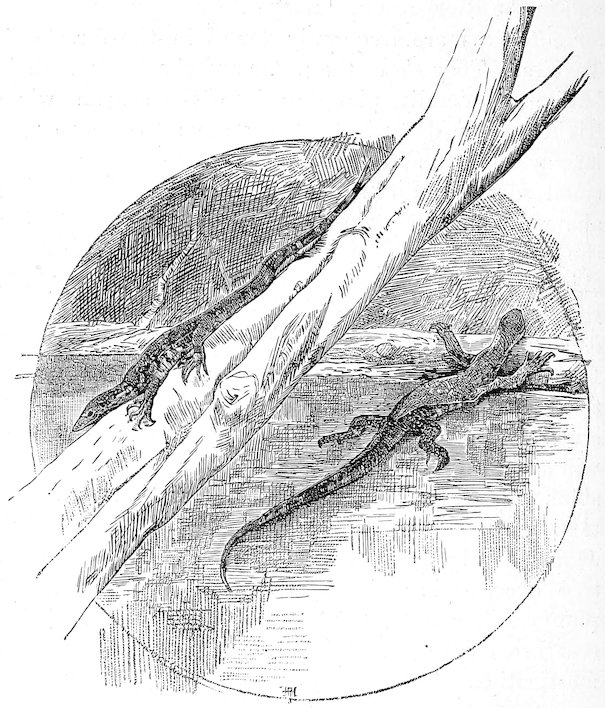
Fig. 70.—Varanus Lizards.
363Fish are nowhere found in the rivers of Kilima-njaro, save in the River Lumi, which flows into Lake ǰipé. I give a drawing of the only kind caught in the Lumi, which is the river of Taveita. It is probably a species of Barbel or Labio, of the family Cyprinidæ. In Lake ǰipé a silurus is very common, and there are many other kinds of fish also present, but the shores of the lake are deserted, nobody fishes there, and the fish would not rise to ordinary bait; and therefore as my time at ǰipé was short, and my health bad, I had no opportunity of investigating its piscine forms. Freshwater crabs of the genus Thelphusa (T. depressa, var. Johnstoni) are present in most of the mountain streams. They appear to be most closely related to the river-crabs of Natal and South Africa.
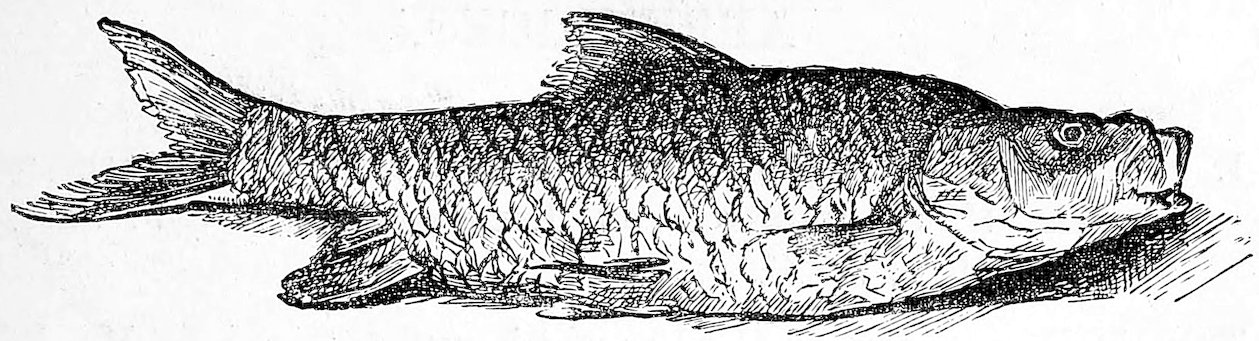
Fig. 71.—A Fish from the River Lumi.
Throughout this region butterflies are few and scarce. They do not penetrate much higher than 8000 or 9000 feet. The common clouded yellow is often seen on Kilima-njaro.
Bees and wasps penetrate to a height of 14,000 feet. They belong principally to the genus Xyloropus. Most of the beetles are allied to, or identical with, South-east African forms. One new species has no allies nearer than India. Others are related to Abyssinian species, and some to the beetles of Somali-land.
364