LIST OF MAPS AND ILLUSTRATIONS.
Reading edition
MAPS.
NO. PAGE
1. General Map of East Equatorial Africa to face 1
2. Route to Kilima-njaro 16
3. Kilima-njaro to the Coast (valley of the Ruvu) to face 296
4. Masai languages to face 446
5. Map of Bantu languages 479
6. Kilima-njaro and its vicinity (Proc. R.G.S.) the end
ILLUSTRATIONS.
FIG.
Portrait of the Author Frontispiece
1. Sir John Kirk 17
2. Sir John Kirk at home to face 21
3. Mtépé (with mat sail) 22
4. Small mtépé and outrigger canoe 23
5. A corridor in Sir John Kirk’s house to face 25
6. Arab dau 26
7. Fishing boat and outrigger canoe 26
8. A Saracenic doorway 27
9. Zanzibar Harbour from the Consulate to face 29
10. A view over the house-tops 28
11. Zanzibar orchids 33
12. Kigelia Africana 34
13. A street in Zanzibar 36
14. The bay of Mbwéni to face 38
15. Colobus Kirkii 39
xiv16. Mombasa to face 42
17. The Shaws’ house, Kisolutini; the first mission station in East Africa 47
18. Virapan, my Tamil servant 62
19. Antelopes and ant-hills (the red hartebeest) to face 65
20. Zebras 67
21. The first view of Kilima-njaro to face 71
22. Sable antelope 69
23. The strange creeper 82
24. The River Habari 83
25. Trees with honey-boxes 92
26. Mandara’s left ear 107
27. View of Mandara’s village from Kitimbiriu to face 119
28. Head and shoulders of our cow 121
29. A view towards Mačame 124
30. A view towards Ugweno 125
31. Mount Méru 126
32. A kite 128
33. Kibô in the early morning to face 136
34. A native dam 137
35. “Kitimbiriu” (our first settlement on Kilima-njaro) 138
36. A corner of our settlement to face 143
37. Clematis and hibiscus 147
38. A ravine in Moši 150
39. Kilima-njaro seen from above Moši (“palms and snow”) to face 152
40. Mkindu palm (Phœnix sp.) 153
41. Čaga doorway 157
42. Čaga storehouse and dwelling 158
43. The captive 159
44. A soldier of Mandara’s 195
45. The Mkuyuni Stream 207
46. Vulturine attitudes 217
47. The Mpala antelope (Æpyceros melampus) 219
48. The Game country to face 220
49. Female Roan antelope (Hippotragus equinus, ♀︎) 224
50. My settlement at Taveita 227
51. Tree fern (Lonchitis pubescens) 231
52. Kilima-njaro, showing both its snow-capped peaks to face 234
53. Raven soaring 235
54. Kibô cloud-capped 258
xv55. Kimawenzi 265
56. Senecio Johnstoni 268
57. Curious rocks, marked like a tortoise-shell 270
58. Great-billed ravens 271
59. The dome of Kibô from an altitude of 11,000 feet 278
60. Lake Čala 291
61. Kilima-njaro seen from Lake ǰipé to face 298
62. Masai camp 305
63. Musa Ensete, a wild banana 331
64. (a) Bunch of fruit of M. Ensete; (b) Single fruit, half natural size 333
65. Branching borassus palm 349
66. Neotragus Kirkii 355
67. Head of great-billed raven (Corvultur albicollis) 356
68. The Dying hornbill 357
69. (a) The right manus or wing of young ostrich. (b) Scale feathers of young ostrich 360
70. Varanus lizards 362
71. A fish from the River Lumi 363
72. Colobus Guereza, var. caudatus. From the “Proceedings of the Zoological Society” 389
73. Graphiurus capensis; (a) foot, (b) hand 392
74. A Masai warrior 415
75. Men of Taveita making fire 435
76. A Čaga forge 439
77. Čaga utensils: 1. Wooden hoe. 2. Leather honey-case. 3. Gourd. 4. Wooden tray or dish. 5. Club made from rhinoceros’ horn. 6. Knife 441
78. Čaga house 444
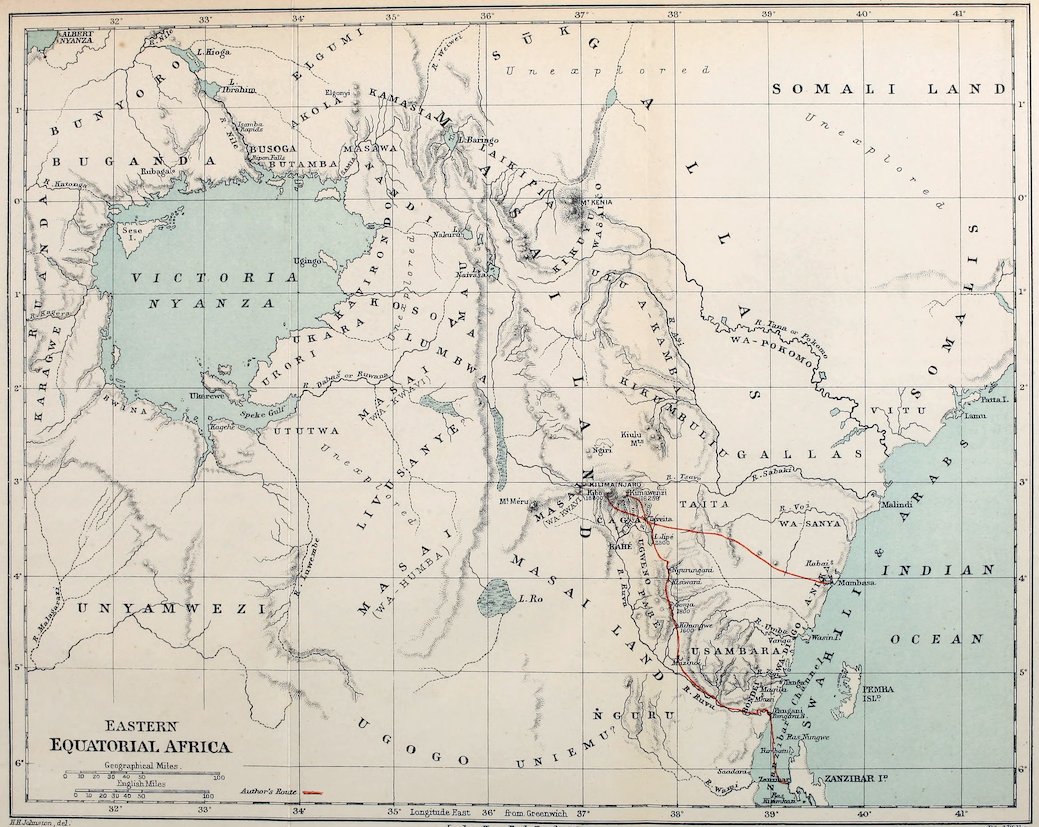
H.H. Johnston, del. Weller.
[Click anywhere on map for high resolution image.]
THE KILIMA-NJARO EXPEDITION.
1