Chapter XX · THE LANGUAGES OF THE KILIMA-NJARO DISTRICT.
Reading edition
(a) Masai.
(b) Ki-čaga, Ki-taveita, &c. (Bantu Languages).
The interest taken in African languages is a newly awakened but a growing one. The work of Bleek, Lepsius, Müller, Steere, and Schön; of Barth, Koelle, Krapf, and Reinisch—not to mention many other earnest workers in this freshly opened field, who each contribute their quota to our present sum of knowledge—has at length begun to meet with due appreciation, and though many of these patient grammarians and students of unrecognized forms of speech have passed away, yet in almost every case their work has begun to acquire a notoriety and a value that neither they nor their publishers hoped for when the grammars or vocabularies or handbooks were first issued to an unheeding public.
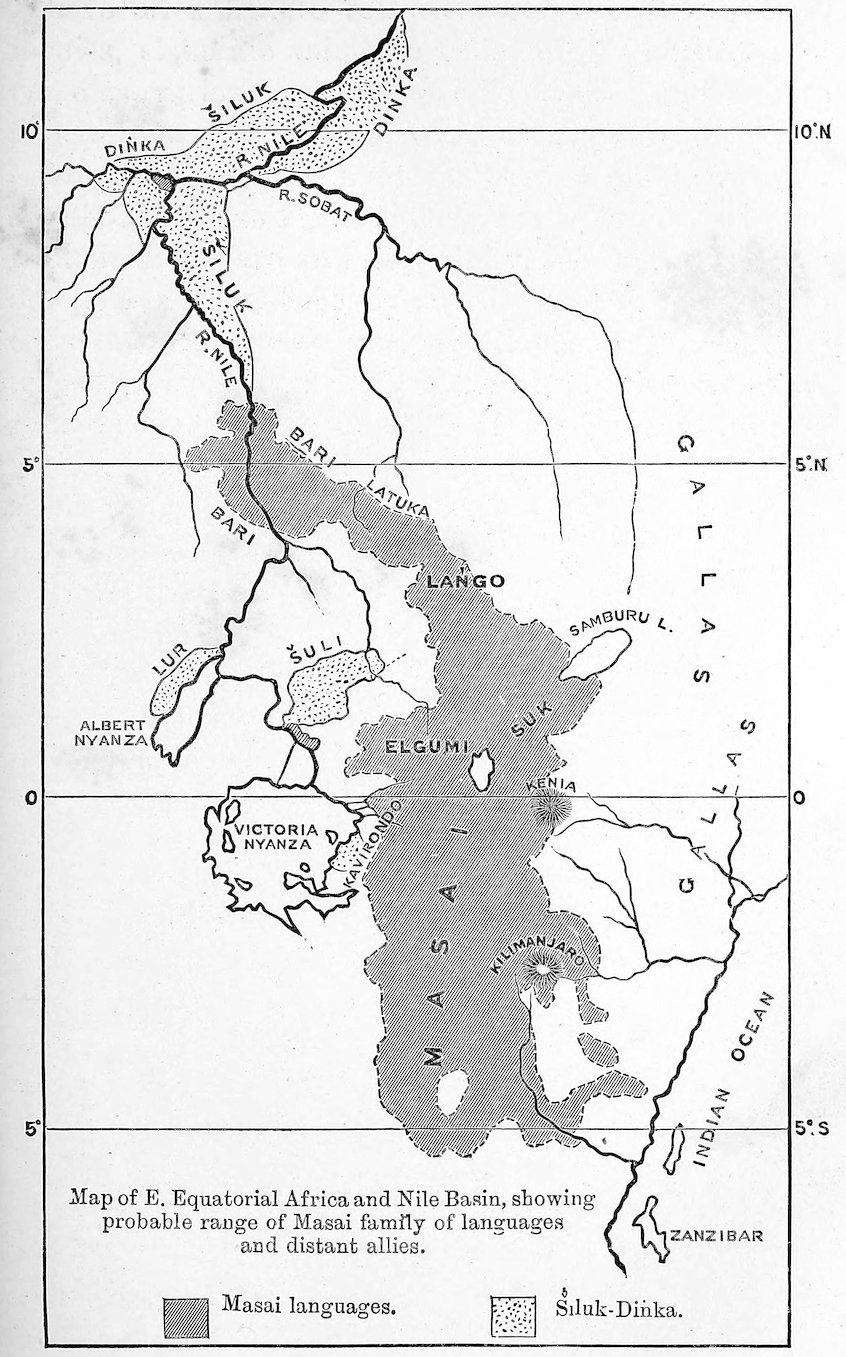
To face page 446.
Those who are beginning or prosecuting their African linguistic researches owe a debt of gratitude to Mr. Robert Needham Cust[57] for his painstaking bibliographical work, which tabulates every known source of information on the subject, and where some form of order is introduced into what, from very paucity of knowledge, has long been a hopeless maze 447of conflicting theories. Imperfect as our grasp of the subject is, we are able now at least to rise from its contemplation with certain definite ideas as to the grouping or classifying of African tongues. We know there is the great Bantu family in the southern half of the continent; the common origin and relationships of the Hamitic languages becomes apparent; the tongues appertaining to the Semitic group in the north and north-east are relegated to their place; and if more general classifications of the vast number of Negro and negroid forms of speech are found to be at present illusory, we can at least recognize several very distinct and natural families, lacking, it may be, any appreciable relationships with extraneous linguistic groups outside their own area, but possessing evident signs of a common structural plan and a common origin. Such are the Nuba tongues, the Fula group, the Hausa, Kanuri, Wolof, Kru, Mande, Bagirmi, Šiluk, and Diṅka language-clusters of Central and Western Africa. Distinct also, and offering only a slight indication of possible affinities, is the language spoken with but little dialectal variation by the well-marked race known as the Masai, whose ethnological features have been treated of in the preceding chapter.
In the south, south-west, and south-central districts of Africa, enclaves of the Bushman and Hottentot tongues are found—the “Click” languages, as they are often called, and the subject of their mutual relations is still much disputed by authorities. But Theophilus Hahn[58] shows that there is decided resemblance in many words of common use, and in the 448first three numerals, and even Bleek is constrained to admit that the difference between the speech of Hottentot and Bushman scarcely exceeds that between English and Latin or English and Sanscrit, languages derived from a common Aryan stock, though widely separated by time and manner of development.
(a) Masai.
As far as is known, the neighbourhood of Kilima-njaro offers languages belonging to only two of the African families which I have mentioned—the Masai and the Bantu. As has been already stated, helot tribes of En-durobo are often found in the vicinity of Useri, Kimaṅgelia, and the north-eastern slopes of Kilima-njaro, but those few with whom I came into personal contact only spoke Masai, and could not be induced to utter any words or phrases of their own speech if they still possessed any special dialect peculiar to them. My materials for a superficial study of the Masai language were principally derived from individuals, both Masai proper and the so-called “Wa-kwavi,” or agricultural Masai, who visited the chief Mandara for trade during my residence in Moši; from the Wa-kwavi of Kikoro, near Taveita; from the few Masai whom I met near Useri, and from the roving Masai who visited Gonǰa, at the foot of the Pare hills, and Semboja's town, Mazindi, on the western flank of Usambara. I find my vocabularies agree pretty closely with those of Krapf and Erhardt, and the chief differences arise from what I believe to be the more exact orthography I have employed. Erhardt gives in general the form of the word more correctly than Krapf. Both their vocabularies, however, are deserving of the highest credit as having 449been compiled with wonderful accuracy under circumstances of much difficulty.
Krapf called his work “A Vocabulary of the Wa-kwavi Tongue,” and Erhardt entitled his, more justly, “A Vocabulary of the Masai Language.” Neither seemed to be aware that they were studying the same form of speech, although practically the only difference in their vocabularies comes from the employment of diverse modes of orthography. The language they illustrated seems to be a tolerably pure form of Masai which is spoken in the vicinity of Kilima-njaro.
I find some discrepancy between my linguistic notes and those of Mr. Last, who visited the southern Masai, or Wa-kwavi dwelling in Northern Nguru. I believe that gentleman has in hand a voluminous MS. vocabulary which will, doubtless, exhibit an interesting study of the language; but the sentences and words given by him in the Royal Geographical Society’s “Proceedings” for September, 1883, seem to show that the dialect is either a very corrupt one or has been imperfectly understood. Some words are evidently borrowed from neighbouring Bantu dialects, and the possessive pronouns and persons of the verb are sometimes not in accord with the English translation.
About Northern Masai we know but very little. It was a great disappointment to me that Mr. Joseph Thomson, who is the sole European who has yet visited those regions where the Masai impinge on other races to the north, should have had no opportunities of making linguistic notes. He would otherwise have been able to throw some light on the affinities and origin of the Masai language. He mentions the people of Sūk who dwell somewhere to the north of Lake 450Bariṅgo, and observes that their language resembles Masai to a certain extent, with, however, distinct differences. What these differences are he does not tell us, and therefore we cannot conjecture, in the absence of information, what affinities the Sūk language may display.
The researches of Dr. Emin-Bey (the governor of the Egyptian Equatorial provinces, whose fate is still uncertain) throw a certain amount of light on the northern members of the Masai family of languages. He gives us a vocabulary of the Latuka language (of which a few words were also gathered by Sir Samuel Baker), and places the position of the Latuka people in about 5° N. of the Equator, where they are nearly surrounded by the negro tribes (and languages) of Madi, Šuli, and others. Dr. Emin-Bey says the Latuka belongs to the Laṅgo cluster, farther south, calls the Laṅgo a Galla language, and remarks that the Latuka also evinces Galla affinities. In these suppositions I am disposed to disagree with him. The Latuka language has absolutely less relationship with the Galla than the few slight and doubtful signs exhibited by the Masai: and the probability is that, as the Latuka is said to be closely related to the Laṅgo, this latter language is also of the Masai group. Though the Latuka tongue differs considerably from Masai proper, perhaps to the extent of fifty per cent., in the small vocabulary collected by Dr. Emin-Bey, there is, however, no doubt whatever that it is a language of the same family, and I shall endeavour to show in the appended vocabulary that it agrees in many test-words and essential points with Masai. The only other known tongue which can at present be said to form an independent member of this family is the Bari, a 451language spoken over a fairly large district on both banks of the White Nile between 4° and 6° N. latitude. The fact of its evident relationship to Masai was pointed out by Lepsius in the preface to his Nubian grammar, but this interesting discovery has been completely ignored by other authorities on African languages, who have grouped the Masai with Nuba,[59] Fula, and many other utterly dissimilar tongues.
At the present time, from the information we possess, we are able to constitute a separate family of African languages called the Masai, of which the undermentioned forms of speech are probably members. (I append a query to those of doubtful existence or affinities.)
Bari.
Latuka.
Laṅgo?
Sūk?
Samburu?
Masai.
The only possible affinities that the Masai group displays for other independent families of African languages are, on the one hand, with the Diṅka and the Šiluk tongues, and on the other, with the Galla branch of the Hamitic family.
With the Diṅka and Šiluk (Šuli, Lur, Šiluk, &c.), the resemblances are confined to a certain undoubted correspondence in the vocabularies, numerals, and pronouns; while in grammar there is scarcely any affinity.
Masai proper, more than the northern members of the family, approaches the Galla somewhat in grammatical construction, and there are, besides, a few cases of correspondence in the numerals and pronouns. 452There is absolutely no distinction between the Masai proper and the agricultural Masai, or “Wa-kwavi,” as regards their language. The vocabularies given by Krapf of the Wa-kwavi, and Erhardt of the Masai, only differ slightly in orthography, and are independent versions of one and the same form of speech. As I have already remarked, the Masai tongue, wherever spoken by Masai people, offers, as far as we yet know, little dialectal variation, though it is used over a district stretching between 5° 30′ S. and the Equator. In this uniformity it resembles the Galla language, which exhibits but trifling differences in the dialects spoken on the confines of Abyssinia (12° N. latitude), and on the coast of the Indian Ocean, near Mombasa. Doubtless the fact is due to the roving habits of the race, for, as has been already mentioned, the Masai warriors range in their raids over nearly the entire district that bears their name, and thus are kept in constant communication with the outlying tribes of their race.
Before describing in a superficial manner the grammatical construction of the Masai tongue, I feel bound to remark that for beauty and simplicity of expression it stands almost unrivalled among the languages of Africa. Compared with such dreadfully complicated forms of speech as the Fulde (spoken by the Fulbe or “Fulahs” in Central and West Africa), where there are some nineteen[60] ways of forming the plural, and the verbs with their many tenses and moods are worse than in Greek, the Masai language offers the grammatical simplicity of English. It has, moreover, a very copious vocabulary, and its combinations of sounds are harmonious, simple, and easily pronounced 453by Europeans. Another pleasant feature about it is that every syllable is so clearly enunciated by the people who speak it that a stranger may much more easily distinguish each word and realize its meaning than is ordinarily possible with a barbarian tongue.
The leading features of the Masai language are these. It distinguishes three genders or classes of nouns, answering approximately to masculine, feminine, and neuter (or common). These genders are indicated by the form of the demonstrative article, demonstrative pronoun, nominal, adjectival, and participial prefix, but only the last—the neuter, or common—is represented in the personal pronouns and in the persons of the verb.
There are two numbers, singular and plural. The plural is formed by an addition to or a change in the termination of the noun in the singular, sometimes by a change of article,[61] and in certain parts of speech (pronouns, a few adjectives, &c.) by prefixing or affixing Ku or K to the root.[62]
There are no cases or declensions of the noun expressed by inflection or change in termination. The substantive in the genitive case follows the governing word, with a particle interposed between the nominative and genitive. This particle seems to be either masculine, feminine, or neuter, according to the gender of the noun in the nominative case.
The adjectives are either independent substantives assuming an adjectival position, or else they are participles from a verbal root, preceded by the masculine, feminine, and neuter (or general, or collective) prefixes.
454The personal pronouns precede the verb. The possessive pronouns follow the noun. The demonstrative pronouns may either be placed before or after the substantive. The interrogative pronoun precedes the verb, so also does the relative particle, and the interrogative particle precedes the noun.
The stem or root of the verb remains unaltered, but the tenses and modifications of the sense (such as a passive, a reciprocal, a causative meaning, &c.) are formed by adding both prefixes and suffixes. Many of these are traceable to abbreviated forms of independent verbs.
The negative particle is always prefixed to the verb. It is generally expressed by the particle me (m- before a vowel); but in certain tenses negation is indicated by the use of a separate prefix formed from an auxiliary verb.
The prepositions in Masai, as their name indicates, precede the word they govern. The only postpositions are certain enclitic adverbs.
The accent in Masai falls occasionally (especially in derivatives) on the first syllable of the word (generally the root), most frequently on the penultimate, and rarely on the last.
Having briefly noted the leading characteristics of the language, I will now proceed to examine its important features in a somewhat more detailed manner.
As regards the phonology of Masai it may be remarked that the vowels have mostly their Italian value. There are no obscure or modified sounds, and in this the Masai language resembles most of the Bantu forms of speech, wherein, also, there are no vowels that are not clearly and distinctly sounded as in Italian. In Masai words may end in a consonant (unlike the opposite rule in Bantu), but two consonants never 455come together, unless one of them be a nasal or a liquid. The sounds represented in the language are these:—
Vowels.—a, e, i, o, ô, u. (U is sometimes pronounced as a semi-diphthong, like “u” in the word “sure.”)
Diphthongs.—ai, ae, ao, au; ea, ei, eo, eu; ia, ie, io, iu; oa, oe, oi, ou; ua, ue, ui, uo.
Consonants.—(No aspirates; neither h, h′, nor χ (kh) are represented). Gutturals.—k, g. Palatals.—y, ǰ (sounding both as French “j” and “dj”), d′ (“dy′” an intermediate sound between “d” and “j”). Č (ch in church) is not present in Masai. Dentals.—d, t, s (no z), š (sh), ž. Liquids.—l, r. Nasals.—n, ṅ (ng′), ny. Labials.—m, b, p, w, v. (F and v are absent in Southern Masai.)
It may be noted here that in Masai the hard and soft forms of the gutturals, dentals, and labials are easily interchangeable. It is difficult to know sometimes whether to write D or T, K or G, B or P. In the same way Š, Ž, and ǰ are hardly distinguishable from one another. The word Žore, “friend,” is pronounced sometimes Šore, ǰore, and even Dyore. Guduk, “mouth,” may be Kutuk, Gutuk, or Kuduk.
The article in Masai[63] seems to be of three forms, viz. ôl, el, and en. The first may be taken as meaning “strong, big, masculine,” and is probably related to ole, olewa, “strong, male, manly.” Or it may be a compound between this sexual adjective and the second article el, which latter seems to be common in 456gender and collective in number, serving as plural to ôl, and sometimes preceding nouns of a collective character that have no singular. El most probably is a demonstrative pronoun of common gender, and the same as ele, he, she, it, this (plur. kulo, they, these).
Both ôl and el drop their liquid consonant before the letter “s” beginning a word; as in Arabic, a double sound of that consonant is heard, as—ossesin (= ol-sessin, “the body”), ossoit (= ol-soit, “the stone”), es-soit (= el-soit), &c.
The last of the three articles, en, assumes the forms e, es, eṅ (sometimes eṅg), and em, according as it precedes nouns commencing with an n or m, an s, a vowel, or a labial; as—E-modi, “a pan,” or “pot;” e-naṅga, “cloth;” es-siaṅgiki, “a wife;” eṅ-oloṅ, or eṅ-goloṅ “the sun;” eṅ-guduk, “the mouth;” em-bere, “the spear.”
The article en is mainly feminine in its significance, but it also gives a diminutive, depreciatory, weakened, playful, or affectionate character to the word it precedes. Thus eṅ-ker is “a female sheep” (ôl-ker, “a ram”), eṅ-doinyo, “a hill” (ôl-doinyo, “a mountain”), em-barawui, “the Wa-kwavi, or agricultural Masai,” a contemptuous name used in the feminine sense by the nomad Masai to imply cowardice; eṅ-guǰita, “tender grass” (ôl-guǰita, “strong, rough grass”), and so on.
The article en (with its variants, e, eṅ, eṅg, em, &c.) seems to be more immediately derived from ena, the feminine demonstrative pronoun answering to ele in the masculine, before described. It is possible that ena may be a compound of el, the common article, directive, or demonstrative, and na the feminine particle—i.e. el-na, e-na, ena, en. Just as I already hinted 457that ôl may be compounded of o (ole, “male”) and el.
This consideration leads us to the discussion of the masculine, feminine, and neuter (or common) particles which are often prefixed to nouns and adjectives.
O, oi, li, le, indicate masculinity or strength when prefixed to a root. These forms are evidently derived from ole (plur. olewa), “male,” a term which is possibly allied to the verbal stem gol, “to be strong,” and iôlo, yôlo, “to know,” “to be able,” and even oloṅ, goloṅ, “sun.” Placed before a root word, ole has by contraction or abbreviation become o, oi (ole, o-e, o-i), le, &c. This prefix is used at present to give a masculine character to the word it precedes: as oigob (oi-kob; kob, “land”), “men of the land;”[64] o-irok, “black,” masc.; o-ibor, “white,” masc. (ol-doinyo oibor, “the white mountain”); o-irosi, “heavy,” masc.; li-kai, “another,” masc.; l-ino, “thy,” masc.; and so on.
The traces of the common or neuter prefix, e, ei, or el (ele), are not so frequent as either the masculine or feminine particles; still there are several words in which it is indisputably present, as ei-bardani, “bride or bridegroom;” ei-gulo, “breast-bone;” ei-baṅgi, “a moderate-sized hill;” e-ǰon, “fresh, green;” e-irok, “black;” e-ado, “long;” e-muaja, “how much?” all adjectives in the common gender: and abstract nouns, as eweji, “place;” eiso (Latuka, eido), “heaven;” e-duwa, “bitterness;” e-gogo, “old age,” &c.
The feminine prefix is na, and appears to be connected with the root, nana, “weak, soft, tender,” even in a depreciatory sense, “worthless, rotten.” It is united to all stems to which a special 458feminine sense is to be given. Thus, na-ido “sister,” a term of address to women oido, “brother,” masc.; eido, “the brotherhood,” common; na-daṅgile, “dear one, darling”—a term applied to women; na-do, “long,” fem. (enaṅga nado, “the long cloth”); na-gai, “good, well,” adv. from -gai, “good” (En-gai, fem., “God, rain,” lit. “the good”); na-ǰon, “green,” fem., &c.
Examples of the above prefixes applied to the same root:—
-ǰon, “fresh, green.”
Masculine. Common. Feminine.
Ôl-doinyo oǰon, El-ata éǰon, Em-benek naǰon,
“the green mountain.” “fresh oil.” “the green leaf.”
There would appear at times traces as of all these particles—o, na, and e—forming or having formed themselves into pronouns for the classes they represent, especially in juxtaposition with the verb. At the present moment this only appears in participial adjectives formed from verbs, and not in the tenses, where only the common prefix, e, is represented. Whether anciently all three forms were used as pronouns—he, she, and it—or whether such a development is approaching, I cannot say. At present, he, she, it, they, are represented by a common verbal pronoun or particle—e or ei. Thus we say—
Ôl-duṅani e-mud (-mud = the root of the verb).
En-daṅgile
El-eduwa
El-dana
The man he disappears.
The woman she
The bitterness it
The people they disappear.
Also ele, the demonstrative pronoun, is generally 459accepted as a personal pronoun, meaning “he,” “she,” and “it.” “They” is ordinarily expressed by the plural form of this word, viz. kulo. Of course, for strictly demonstrative purposes, this pronoun has a feminine form, which will be treated of afterwards.
To summarize what I have been saying, it would seem as if originally there had been in Masai three genders or classes of nouns—masculine or strong, common or general, feminine or diminutive—and that these three classes were provided with certain particles which were prefixed to word-stems to indicate the class or gender of the governing noun. This somewhat reminds one of the concord in Bantu languages, but the resemblance is not effectually carried out; if it were, you would be able to say in Masai—
Ôl-duṅani o-gol o-šam; ki-šam-ole;
The man strong he loves; we love him;
= The strong man loves; we love him;
or,
En-daṅgile na-lulunga na-kweni; ki-niṅ-na.
The woman healthy she laughs; we hear her.
= The healthy woman laughs; we hear her.
As it is you say—
Ôl-duṅani o-gol e-šam; ki-šam-ele, and En-daṅgile na-lulunga e-kweni; ki-niṅ-ele.
In the Bantu tongues, where there is a large (in all sixteen) number of noun-classes, the governing prefix of the subject follows throughout. Thus in Swahili they say—
Wa-tu wa-zuri wa-ja; na-wa-ona;
The men handsome they come; I them see;
= The handsome men are coming; I see them;
or—
Ki-tu ki-dogo ki-mo; Tu-ki-pate.
The thing little it is within; That we it may get.
= The little thing is inside; let us get it.
460In the sex-denoting Hamitic, Semitic, and Aryan tongues this concord, imperfectly as it is now represented, once existed, though the sex-denoting particles were generally added to the termination of the word instead of preceding it.
Thus in Galla (Hamitic) they say—
Niti hieti oboleti-ši ilalti iši wamte.
Woman poor sister her saw (and) her called.
= The poor woman saw her sister and called her.
In this case the syllable ti, which has a feminine signification, and iši, its variant, run through all the words dependent on the governing noun.
In Hottentot[65] almost the same thing presents itself (I quote from Bleek’s Grammar):—
//Nã-tara-ti, sida !hau-s-di-ti, /nĩ !ā-s-!na //an-hã-ti, hõ-ti-da-ra, gare-da-ra goma-n ã-te.
Those women our tribe’s they, another village in dwelling find them we do, praise we do cattle of them.
= The women of our tribe who live in that village, we find them, we praise their cattle.
In Arabic (Semitic) much the same concord is present as in Galla. Thus, to use the same phrase we might say:—
الامراة مسكينة شافت اختها و نادتها
Al-imrat maskinat šāfat uχt-ha wa nadat-ha.
The poor woman saw her sister and called her.
In many of the Aryan tongues the concord is exhibited by more or less uniform terminations of words according to gender, which are usually constant in their operation.[66] We most of us can call to mind the 461masculine, feminine, and neuter endings of familiar Aryan languages, which modify the same root in a generic sense, and which are repeated in the dependent adjectives and pronouns. It is as much a concord as what strikes us so particularly in Bantu, only it takes the form of a suffix instead of a prefix.
The personal pronouns in Masai are:—
Sing. Plur.
1. nanu. iok.
2. ie, or iye. endai.
3. ele (he, she, it). Vide demons. pron. kulo.
The 2nd person singular ie seems to be a somewhat mutilated form. I fancy there are slight indications in the language of its once having had a masculine and feminine form, as in the Semitic tongues; possibly oiye, loiye (loiye is still used as a form of saluting males) for the masculine, and naiye for the feminine. The 2nd person plural seems to be of a feminine character, and to be composed of enda, demons. pron. fem., “that,” and ie or iye, “thou”—so that it would originally assume the meaning of “you, there.” In Galla, all nouns, whether masculine or feminine, use the feminine pronoun, and are considered to be in the feminine gender when used in a collective sense.
Ele and kulo, the 3rd pers. sing. and plur. are simply demonstrative pronouns, and when not standing with the verb would be common or masculine in gender. The female equivalents are ena and kuna. The objective forms of the personal pronouns are 462apparently the same as those in the nominative case. In construction they are placed after the verb or predicate.
“I give you” is Nanu aišo ie. I give you.
“Thou givest me” is Iye īšo nanu. Thou givest me.
At the same time, it must be remarked that in speaking Masai the pronoun in the objective case is often understood rather than given. Thus “I give” will often stand for “I give him, or you, or them,” according to the context.
Reflective pronouns are often simply the ordinary personal forms, but in cases of peculiar emphasis the words os-sesin (body), ôl-dau (heart), are used in conjunction with possessive pronouns. Thus “I, myself,” is nanu, os-sesin-lai, lit. “I, my body;” or “I love myself,” Nanu ašam ôl-dau-lai, lit. “I love my heart.”
For the 3rd person, sing. and plur., a form ninye, or nenye, is sometimes used. This may possibly be an old feminine form of the 3rd person possessive article, enye, and may refer to a feminine noun understood. A reciprocal form of the pronouns is sometimes made by prefixing pa, a preposition meaning “for, by, with,” as paiok, paye, &c. This has often the force of “each other.”
Before the verb-root certain particles are used which seem originally to have been abbreviated forms of the personal pronouns.
For the 1st person sing. a-.
„ 2nd „ „ i-.
„ 3rd „ „ e-. (Vide supra.)
„ 1st „ plur. ki-.
„ 2nd „ „ ki-.
„ 3rd „ „ e-.
463Examples:—
-kweni, to laugh.
A-kweni, I laugh.
I-kweni, Thou laughest.
E-kweni, He, she, it laughs.
Ki-kweni, We laugh.
Ki-kweni, You laugh.
E-kweni, They laugh.
It is possible that the form of the 1st pronominal prefix in the verb was na,[67] an abbreviation of nanu. There are one or two cases in which it still seems to linger, as in naji, “I am called.” The form of the 1st and 2nd persons plural, it will be noticed, are the same. As may be noticed in several African languages, the 2nd person plural has not a very well fixed existence, and seems to borrow forms from the other persons.
The possessive pronouns are used as suffixes, and are:—
Sing. Plur.
My, -lai, masc.; ai, fem. and common. -lainai, masc.; -ainai, fem. and common.
Thy, -lino, masc.; -ino or -nono, fem. and common. -linono, masc.; -nono, fem. and common.
His, her, its, -lenye, masc.; -enye, fem. and common (sing. and plur.).
Our, -laṅ, masc.; -aṅ, fem. and common (sing. and plur.).
Your (doubtful; possibly -inye or -enye, the same as his, &c.).
Their, -lēnyěna, masc.; -ēnyěna, fem. (sing. and plur.).
Examples of above:—
Arabe-lai, my friend (masc.).
Anaši-ai, my sister (fem.).
Eiboni-lino, thy chief (masc.).
Naiu-ino, thy mother (fem.).
Aji-enye, his house (fem.).
Tokitin-ainai, my things (fem.).
&c.
The relative pronouns in Masai seem to present but 464one form, and that is a slight one. It consists of n- prefixed to the pronominal particle preceding the verb, as:—
Ôl-duṅani nešam (n-e-šam).
The man who loves.
En-doki našam nanu.
The thing which love I.
= The thing which I love.
The interrogatives are:—
Aṅai? “who? which?” Nyo? and Ainyo? “what?” K-, Ka?[68] is often prefixed to nouns, and means “what sort of?” “what-?” Ka-l-kiteṅ? “what sort of a bullock?” &c.
All these interrogatives need the relative n- before the verb, as Aṅai neno? “Who is coming?” Ken-doki neti? “What thing is here?”
The demonstratives are:—
Sing. Plur.
Masc. Fem. Masc. Fem.
Ele or elo. Ena, “this.” Kulo or Kule. Kuna, “these.”
Elde. Enda, “that.” Kulde. Kunda, “those.”
Sometimes n or ni (a form of the adv. eni, “here,”) is prefixed to all the forms, and accentuates their position—nelo means “this, here.” When prefixed to the plural, ku is left out, as nieldo, “those, these.” All these demonstratives may take their place as personal pronouns.
Adjectival pronouns are:—
Poki or boki, “all, every.”
(Pokirare, all two = both.)
-kai, other.
Likai, masc. sing. }
Eṅkai, } fem. } the other.
Nakai, } sing. and plur. } the others.
Kulikai, common. }
The adjectives in Masai are either independent nouns used in an adjectival sense (like in many of our 465compound substantives, such as, “dog-collar,” “mealworm,” &c.) and unassociated with gender or class; or else verb-roots, which are preceded by the class-prefix of the noun they qualify, and which are adjectives in a participial sense.
Of the first description there are words like torono, torok, originally a substantive meaning “destruction, anything broken, spoilt,” but now only used as an adjective with the meaning of “bad, very bad,” according to termination. Torok is at once the plural and the intensified form. Thus:—
Ôl duṅani torono is “the bad man.”
Ôl duṅani torok is “the very bad man.”
El duṅanak torok is “the bad men.”
Adjectives of this description generally agree with their governing substantive in number (unless they are only found in a collective form possessing no plural), but exhibit no prefixes indicative of gender; but those of the second class, which comprise the bulk of the adjectives, and which may possibly be present-participles, always prefix to their stem the distinctive particle showing the class of the noun they qualify. Thus, iroši, a verb-root meaning “to be heavy,” becomes oiroši, masc., nairoši, fem., eiroši, common, according as it serves as adjective to—
Ôl-alem (masc.), “the knife.”
En-dolu (fem.), “the hatchet.”
El-ekari (common), “the bread.”
These adjectives do not change their termination in the plural. Masculine nouns, which, as I have already explained, go into the common, neutral gender when they become plural, change their adjectival prefix also. Thus you say:—
466Ôl-doinyo oibor (the white mountain), sing.;
but
El-doinyon eibor (the white mountains), plur.
The adjectives, however, remain the same in both numbers for feminine and common nouns.
In Masai, the adjectives always follow the nouns.
In treating of the prefixes, pronouns, and adjectives, I have said so much about the substantive indirectly that there remains but little to remark respecting this important part of speech.
In Masai, it seems to me that the substantive originates from a verbal-root rather than that it gives birth to the verb, as seems to be the case in the commencement of Aryan speech, I shall treat of this further when discussing the verb.
I have already treated of the three genders, or classes of nouns, in Masai; I will now briefly explain how the plural is formed. This, in the majority of substantives, is done by adding k or ki, n or ni[69] to the root, with, unless it ends in a vowel or a liquid, a vowel in between the root and the plural suffix. As a matter of fact, most substantives end in a vowel.[70]
One or two seemingly irregular plurals are formed by adding a to the root, or tin,[71] as:—
Kera, plur. of Ker, “a sheep.”
Eweǰitin, „ Eweǰi, “a place.”
Tokitin, „ Toki, “a thing.”
Many collective nouns, or nouns of neuter gender, form no plural, or occasionally (and this is also noticeable in certain adjectives) form a plural by prefixing ku. This prefix ku will have been already noticed in 467the demonstrative pronouns where it forms the plural (ku-na, ku-lo, ku-lde, &c.). It is evidently an old plural prefix of neuter gender. There are no “cases” distinguishable in the Masai noun, but when it is used in a “vocative” sense the definite article is dropped and the class prefix substituted. Thus, in addressing children you say “Na-kera!” “Oh, children!” instead of Eṅ-kera, “the children,” “Ô-duṅani!” “Oh, man!” “Eiboni!” “Oh, chief!”
It is difficult to treat of the Masai verb without entering somewhat into the question of the construction of the Masai language.
I believe that it is possible to trace most of the fundamental ideas which form the base of this speech to monosyllabic roots. Many of these are still existing in their primitive form, side by side with their polysyllabic variants, and it is not difficult to guess at the agglutinative processes which have built up the structure of the language.
The particles which are used to form the different concepts that are built up from a single root may be placed before or after the stem. Sometimes they consist of independent verbal roots, prefixed or affixed, or they may be simple reduplications of the primitive idea with a view of intensifying it, or adverbial or prepositional prefixes, or affixed particles used in a passive sense, and so on. An example will better illustrate my meaning.
From the root, ud, “digging, boring, hollowing,” is derived—
eṅg-ud-uk (eṅg. = the art. fem.
(“the mouth”) ud = the root.
uk = another stem, meaning “shining, glittering;” therefore
eṅg-ud-uk means the glittering cavity, viz. “the mouth.”)
468eṅg-ud-uk-aǰi (the “door”) (aǰi = house. Engudukaǰi, lit. “the mouth of the house.”)
e-ud-oto = “hole.”
eṅg-ud-a = “the digger,” viz. “the field rat.”
en-d-ud-e = “the bowels;” lit. “a cavity.”
en-d-ud-ua = “a basket;” lit. the plaited or “dug into.”
en-d-ud-unio = “the heel,” in the sense of the heel’s continually “digging” into the ground.
-ud-i, passive = to be dug, hollowed.
ud-i-ki = a kind of double passive; lit. “to be furrowed (viz. wrinkled) repeatedly.” = to purpose, intend, after reflection.
-ud-i-kini = to be intended or destined for.
i-ud = to rub, to wipe.
im-ud = “im” = to pass; lit. to pass down, to set, as the sun. Eṅ-goloṅ eimud = “the sun sets.”
is-ud-o = to hide, conceal.
is-ud-orie = to hide carefully, viz. hide different portions in different places. Or = to divide. The prefixed s is from the adv. si = again, and implies “repeated digging.”
ib-ud[72] = to fill up.
ib-ud-i = to be filled. &c.
Many of the leading verbal-roots will be found in the Vocabulary.
I will now give a few illustrations of the Masai verb and of its method of conjugation.
Example I.
-en, to bind together.
Active Voice.
Present Tense.
Affirmative. Negative.
Nanu[73] aen, I bind. Maen, I bind not.
Iye ien, Thou bindest. Mien, Thou bindest not.
Ele eën (or ēn), He, she, it binds. Mēn, He binds not.
Iok kien, We bind. Mekien, We bind not.
Endai kien, You bind. Mekien, You bind not.
Kuloeën (or ēn), They bind. Mēn, They bind not.
469
Past Tense.
Affirmative. Negative.
Atena, I bound. Ituaen, I bound not.
Itena, Thou boundedst. Ituien, Thou boundedst not.
Etena, He bound. Etuēn, He bound not.
Kitena, We bound. Itukien, We bound not.
Kitena, You bound. Itukien, You bound not.
Etena, They bound. Etuēn, They bound not.
Future Tense.
(The particles used in forming this tense are evidently relics of the roots -lo, -po, signifying “to go.” Vide Vocabulary, verbs.}
Alaēn, I shall find. Malaen, I shall not bind.
(lit. ālo, I go. aen, to bind.) Milaen, Thou shalt not bind.
Melaen, He shall not bind.
Ilaēn, thou shalt bind. Mekilaen, We shall not bind.
Elaēn, He shall bind. Mekilaen, (or Mekipuaen), You shall not bind.
Kipuaen, We shall bind.
(Kipu is an irregular plural of alo, to go, from another root.)
Mepuaen, They shall not bind.
Kipuaen, You shall bind. (The vowels that come together in this tense are often contracted with one sound. Thus “Kipuaen” will be generally heard “Kipwen.” I spell them thus to show the proper mode of conjugating the tense.)
Epuaen, They shall bind.
Imperative Mood.
Maten, let me bind. Mien, bind not.
Tena, bind thou.
Maten, let us bind. Mienieni, bind ye not.
Endena, bind ye.
Subjunctive Mood.
Present Tense.
Pēn, If, when, whilst I bind. Pemaen or pemēn, If I bind not
Peien, If thou bindest. Pemien, If thou bind not.
&c. &c.
This tense is made by prefixing the preposition pe, if, when, whilst, &c., to the present indicative.
Another combination is with the relative particle n, ne, and expresses, “that I may,” &c. It always 470follows an interrogative pronoun or a preceding verb. This tense is often expressed by an infinitive in English, as:—
Ayau naen, I wish to bind; lit. I wish that I may bind.
After a relative or interrogative pronoun it is prefixed to the verb in the same manner, as:—
Aṅai nēn? Who is binding? lit. Who that is binding?
Its manner of uniting with the personal prefixes of the verb is the same as that of pe, me, and other particles already given, viz.:—
Naen, that I may, thou mayest, he may, &c., bind.
Nein,
Nēn,
Nekien,
Nekien,
Nēn,
Both these particles, pe and ne or ni, together with others, such as teni, “if,” perchance, K, Ka, “What?” (Kaien? “What art thou binding?”) may be prefixed to all the tenses of the indicative mood in the active and passive voices, thus giving them a subjunctive or potential sense.
Thus you may say:—
Petena, If he bound.
Neitukien, That we bound not.
&c.
Passive Voice.
-eni, to be bound.
Indicative Mood.
Present Tense.
Affirmative. Negative,
Aeni, I am bound. Maeni, I am not bound.
Ieni, Thou art bound. Mieni, Thou art not bound.
&c. &c.
Adding for this tense -i to the present indicative, active voice.
471
Past Tense.
Affirmative. Negative.
Atēnaki, I was bound. Ituätenaki, I was not bound.
Itēnaki, Thou wast bound. Ituitenaki, Thou was not bound.
And so on. &c.
Adding -ki to termination of past tense, indicative; active voice.
Future Tense.
Alaeni, I shall be bound.
&c.
Imperative Mood.
Tenaki, be thou bound.
Endenaki, be ye bound.
Besides the above-mentioned tenses, others can be formed by the aid of auxiliary verbs, as:—
Aidipa atena, I had bound, I have already bound; lit. I have finished, I have bound.
Ituaidip atena, I had not bound, &c.
Ayau naen, I would bind; lit. I would, will, desire that I bind.
Many verbs, especially derivatives, and those commencing with i, make their past tense differently from the mode already described, viz. by simply affixing a to the root. Thus:—
Aidip, I finish.
Aidipa, I finished.
Aiken, I count.
Aikena, I counted.
The mode of forming the past tense in other verbs is, as in the first example, given by prefixing -ta, -te, -ti, -to, or -tu, to the root, and adding a to stems ending in a consonant, as:—
A-t-ena (properly a-te-ena), I bound.
A-ta-šama, I loved (from šam, to love).
A-ti-riša, I equalled (from riš, to equal).
A-to-roro, I trod (from roro, to tread).
A-tu-šuma, I put down (from šum, to put down).
472It may be remarked that on the tonic vowel of the root, the vowel of the prefix -t- generally depends.
The elements of construction in the verb may be briefly summarized.
The present affirmative is simply the root with the personal prefixes added. The past affirmative is formed by prefixing -ta, -te, -ti, -to, or -tu, to the root, and affixing a, or by doing the latter only in the case of most derivative verbs commencing with i.
It is possible that the -ta, &c., prefixed to the verb to form a past tense is related to the verb-root -ta, “to be, become, have.” The origin of the future tense has already been surmised. It is formed by prefixing -l (al, il, el) to the three persons in the singular of the present tense, and -po (kipu, epu) to the three persons in the plural.
The imperative, it will have been remarked, resembles greatly the past tense in the affirmative. In those verbs which form their preterite without prefixing -t-, the imperative also lacks this particle, and resembles the past tense exactly in the 2nd pers. sing. In the 2nd pers. plural, the e, en, em, end, placed before the verb, as in Endašam, “love ye;” Enden, “bind ye,” stands for Endai, “you.”
The negative is generally formed by prefixing m or me- to the affirmative. This particle is derived from the adverb emme, “no, not.” The exception to this rule lies in the negative past tense of indicative where itu, etu takes the place of m. I cannot obtain any clue to the origin of this prefix, unless it is related to -toa, “died, ceased” (Atoa, “I died.”)
The passive is usually formed by adding i in the present, and ki in the past tenses to the form of the active voice. In some verbs, -i is replaced by -ki or 473-ni, and either of these two may be doubled to intensify or modify the sense.
The meanings of verbal-roots may be altered by various affixes and prefixes. Among the former are—
-šo, causative (from -išo, to give).
-ate, reciprocative.
-ie, transitive.
-si, intensitive (from -si, again).
-ge, restrictive (from -ge, only, but).
-ka, applicative.
The verb “to be, to have (viz. be with), to become, to exist,” is expressed by three forms:—
-ra, -ta, and -ti.
-ra applies more to actual existence, and is only used in the present tense, -ta is used in present and past, and with compounds. It is often translated by “to have.” -ti applies to locality generally, and is possibly no thing but the preposition ti, “in, on” (Ati, “I am here,” Iti, “thou art here, or there,” &c.). There are some few defective verbs, and one or two such as “to go,” “to come,” which are irregular, and made up of several different roots, as happens often in other tongues.
As previously explained, great variety of meaning may be obtained from the original monosyllabic roots, which express simple concepts, by the agglutinative process which tacks on before and behind other particles which enlarge, diminish, or intensify the primitive sense of the verb.
Adverbs in Masai are generally affixed, and prepositions prefixed to the verb-root. Many independent nouns or verbs have the form of adverbs and prepositions. The conjunctions are au, “or, either;” o and na, “and, with,” according to gender.
Having now passed the main features of this language 474in review, we may be better able to fix its position and relationships among other African linguistic groups.
In the recognition of sexual gender it resembles the Semitic, Hamitic, and Hottentot tongues; but, as I have tried to show, this generic distinction is somewhat hazy and seems to have originated rather in differentiating the strong, big things from the small and weak. The three classes in Masai, viz. strong or masculine, neuter or common, feminine or weak, seem to occupy a somewhat intermediate position between the many arbitrary classes in the Fula and Bantu languages, and the two genders of nouns—male and female—in the Semitic and Hamitic families. The “feminine” consonant in Masai is n. In the Hottentot,[74] Hamitic, and Semitic languages it is generally t (ϑ (th), š, h).
In the question of construction the primal roots of the Masai language seem to have been monosyllabic—in this differing from the Bantu and Hamitic (wherein they were probably dissyllabic) and the Semitic (in which they were trisyllabic and triliteral). The manner of forming the plural by adding an affix to the root resembles the plan adopted in certain Hamitic or Ethiopic tongues, particularly in Galla, where the few plurals that exist are made by adding -n, -ni, -da to the singular form of the noun. The secondary and rarer mode of giving a plural signification to a root (chiefly in pronouns and adjectives, and in Bari in certain nouns) by changing the prefix to ku (Bari, ko), reminds one of the prefix-governed families of African tongues.
The mode of forming derivative verbs by affixing 475various suffixes to the stem, thus imparting a reciprocal, causative, or intensitive meaning to the simple root, recalls the same method in the Galla and Bantu languages.
At the same time, although the Masai group offers certain points of agreement in grammatical features with the Hamitic and Bantu divisions, there is no positive approximation to either. Certain of the numerals bear a slight resemblance to those of the Galla, and there are also a few words alike in the vocabularies of both these groups, but the similarity is possibly accidental, or some of the words may have been borrowed, one from the other. Masai certainly resembles Galla in its recognition of sexual gender, but differs from it by the possession of a third or neuter class of nouns (the Galla, all Hamitic or Semitic tongues beside, only recognizes two genders, masc. and fem.). Judging by certain indisputable resemblances between the vocabularies of Masai and Bari and the Diṅka-Šiluk tongues, there is a great probability that the origin of the Masai family of languages is to be traced to the basin of the White Nile. Its affinities with the Galla branch of the Hamitic group raise the same interesting problems as the similarity which exists in certain grammatical features between the Hausa language of the Niger basin and the Berber tongues. On these points depend the solution of many difficult questions respecting the origin of the Hamitic and Semitic languages, and possibly races.
I append the following vocabulary of Masai for purposes of reference rather than with any idea of giving a glossary of the language. This would be out of place in a work of this sort, and therefore the following list of words is only given for the convenience 476of the student of African philology who may happen to take up this book.
I have added to the Masai vocabulary words from other African languages, either belonging to the same group or forming part of separate linguistic families which might seem to be remotely connected with the Masai.
The mode of spelling adopted in these and other vocabularies which follow, and throughout the volume where African names are introduced which have not a generally accepted orthography, is practically the same as that proposed in Lepsius’ “Standard Alphabet.” The following letters are used:—
Vowels:—
a, ā, e, ē, i, ī, o, ō, ô, ö, u, ū, ü.
Consonants:—
k, g, υ, χ, h′, h, y, ǰ, č, d′, d, ϑ, δ, t, s, š, z, ˇ, l, r, n, ṅ, ń (ny), m, b, p, f, v, w.
In their pronunciation it may be said roughly that the vowels are sounded as in Italian and the consonants as in English, but for the benefit of those who have not studied Lepsius’ system I give a further explanation. Among the vowels
a is sounded as in “master.”
ā „ „ “rather.”
e „ „ “met.”
ē „ „ “grey.”
i „ „ “bit.”
ī „ „ “ravine.”
o „ „ “not.”
ō „ „ “bone.”
ô „ „ “store,” or a in “all.”
ö like the German ö in “Böse,” or French œu in “cœur.”
477u „ „ “put.”
ū „ „ “rule” (oo).
ü like the French u or German ü.
The consonants are sounded thus:—
k as in “kitten.”
g as in “gate.”
γ (the Greek gamma) like the Arabic غ (γain), a sound resembling the Northumberland “burr” or the French
“r grasséyé.”
χ (the Greek chi), like ch in German or خ in Arabic.
h′, like the Arabic ح, a strongly aspirated h.
h as in “house.”
y as in “year.”
ǰ as in “jar” (the English “j”).
č as ch in English or c before e and i in Italian. Ča = cha.
d′ a sound like “dy,” intermediate between ǰ and d.
d as in “day.”
ϑ as th in “think.”
δ as th in “that.”
t as in “tale.”
s as in “sail.”
š, English sh, as in “shawl.”
z as in “zinc.”
ž as in “azure” = the French “j.”
l as in “lace.”
r as in “Rome.”
n as in “need.”
ṅ as in “singing”—a ringing nasal sound like ng, but carrying on no sound of the g.
ń, sometimes used at the end of words for ny = the Spanish ñ.
m as in “maid” and “umpire.”
b as in “boat.”
p as in “perch.”
f as in “fail.”
v as in “veil.”
w as in “wait” and “nawab” (a consonantal u).
Where the accent is not marked, it generally falls on the penultimate.
478(b) The Bantu languages of Kilima-njaro.
At the risk of wearying a majority of my readers, I will preface my vocabularies of the Bantu languages of the Kilima-njaro district by a slight sketch of the main features of this most remarkable family of tongues. The word “Bantu” has been so often used in this book that there are some who may be unaware of its meaning, and annoyed at its constant repetition and apparently meaningless character. To these, and not to the advanced in African studies, I tender this little general dissertation.
479
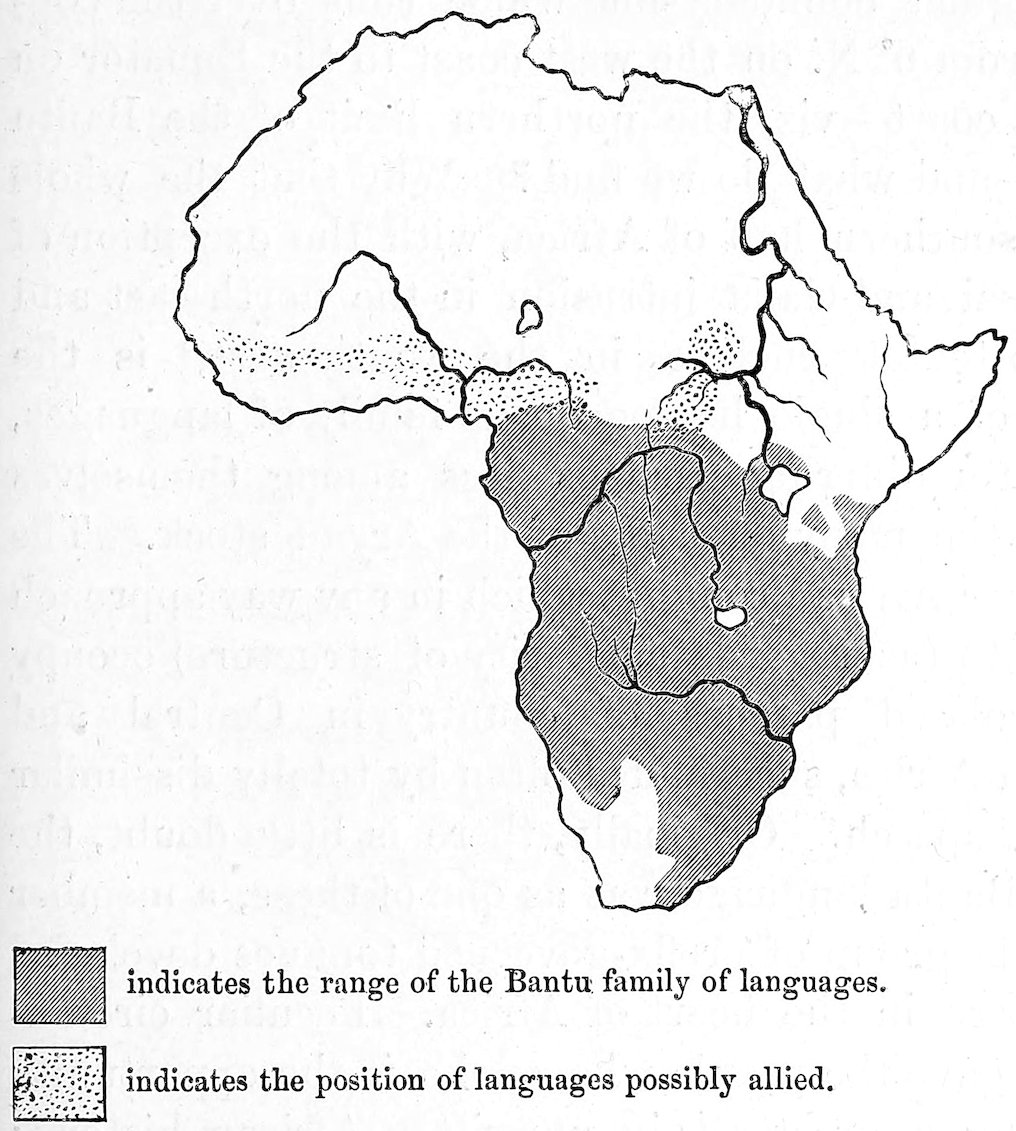
Map No. 5.—Map of Africa, showing range of Bantu Languages.
Any one who glances at a linguistic map of Africa—such an one as Mr. Ravenstein has drawn for Mr. Cust’s book on African languages—will hardly fail to perceive how thickly certain districts, such as Abyssinia, the basin of the White Nile, the Lower Niger, or the country round Sierra Leone, are dotted with the names of distinct languages. Nor is it merely a question of numerous dialects of common origin. Many of these tongues—spoken, it may be, by only two or three thousand inhabitants of a single cluster of villages in a circumscribed area—are quite isolated, quite without relationships to other known forms of speech; or again, some of the languages may show faint indications of possible affinities—just a few hints in their grammatical construction or vocabulary, or phonology—sufficient to enable great generalizers in philology to bundle them together in one common group, in a desperate hope of simplifying the arrangement of African languages. Even the well-marked and undoubted natural families that overlie these regions—the Hamitic, the Fula, the Nubian, the Šiluk, the Hausa, the Mandiṅgo—exhibit only sufficient similarity of structure in their different branches to enable the philologist to satisfy himself that he is justified in regarding them as forming homogeneous groups. But the various members of any one of these families often differ widely in their vocabularies, and sometimes are unlike in many grammatical points. For instance, Galla and Šilha (Shlu) (the language of the Moroccan Berbers) are both members of the Hamitic group, yet, beyond their structural resemblance and their agreement in certain main features of grammar, they scarcely possess a root or test-word in common.[75] I need not multiply instances 480of this; the fact is already recognized by students of African languages, that in the northern half of the continent there are bewildering multitudes of diverse tongues belonging to many independent families, and apparently irreducible to a common origin. Yet cross the irregular boundary-line which runs over the continent from 6° N. on the west coast to the Equator on the east coast—viz. the northern limit of the Bantu speech—and what do we find? Why that the whole of the southern half of Africa, with the exception of the Masai and Galla intrusion in the north-east and the Hottentot enclave in the south-west,[76] is the domain of a single homogeneous family of languages, the Bantu differing perhaps less among themselves than do the many offshoots of the Aryan stock. The only other African tongues which in any way approach the Bantu (as regards similarity of structure) occupy little isolated patches of country in Central and Western Africa, surrounded often by totally dissimilar forms of speech. Originally, there is little doubt, the primal Bantu language was as one of these, a member of a little group of prefix-governed tongues developed somewhere in the heart of Africa. Peculiar circumstances gave the people who spoke it the opportunity of playing a great rôle in unwritten African history; and the Bantu negroes, at one time very likely an obscure and unimportant tribe like the Temne and Bulom of Sierra Leone, the Efik of Old Calabar, or the Tumale of Kordofan, became the ruling and almost 481the exclusive race of Southern Tropical Africa, swallowing up, obliterating, absorbing the previous inhabitants of the land, and carrying their own form of language triumphantly from the Upper Nile to Natal, and from the River Tana on the east coast to Fernando Po on the west. In the spread of the Masai race and language we may see, on a much smaller scale, a parallel to this extension of the Bantu. It will be remembered that I already have pointed out the relations which the Masai language bears to the Šiluk and other tongues spoken in the basin of the White Nile. Some of these forms of speech resemble Masai about as much as the Non-Bantu prefix-languages resemble Bantu-proper. Most of them are spoken over small and confined areas. Yet the range of the Masai tongue and its various dialects extends almost uninterruptedly from 3° N. to 5° S. of the Equator, wherever the Masai race has spread in its warlike raids. Now we know that in many parts of Eastern Equatorial Africa the Masai only arrived, as it were, the other day. In many districts, too, in the centre of their present home the remnant of aboriginal natives still retain the oral tradition that several generations ago the Masai were unknown in the land. Yet, with the exception of a few isolated mountain-ranges where the Bantu-speaking inhabitants still linger, the Masai language is dominant throughout the whole length and breadth of the huge country known as Masai-land. Moreover, it is probable that had this warlike race not encountered natives armed with firearms and dominated by Arabs on the south, they would have overrun a considerably larger district than the one they at present occupy, and their language would have acquired an even greater range, and in course of time have lost its uniformity, 482and become split up into many separate dialects. Yet it is probable that some centuries ago the Masai were only a small section of a Nilotic race which adverse circumstances drove from its original home, and forced farther and farther south, the Masai all the time developing their fighting qualities, first to save themselves from extinction, and then in turn to pursue a successful policy of rapine and dominion. Such, in all likelihood, were the origin and history of the spread of the Bantu race and language. It is quite possible that before their advent the southern half of Africa was sparsely populated, perhaps by a low type of negro in the north and west, and Hottentots, Bushmen, and Pigmies in the south and centre. The invading Bantu carried all before him in the early days of his invasion, and was probably little but a fighting-man, as is the Masai at the present day. In the west, however, he was stopped—choked, one might almost say—by the dense negro population, and in the south-west by the Hottentots, who were probably driven to bay in this corner of the continent. In the centre of Africa the race and language of the Bantu people are purest to this day, probably from the much less intermixture which took place between them and any previous inhabitants. Judged by his purest types—the inhabitants of the great lakes and the Congo basin—the Bantu was probably a red race in its origin. Intermixture with Hottentots has given the Zulus a yellowish tinge, and clicks in their language, and the fusing of Bantu and Negro on the west coast has debased the character of the speech and deepened the colour of the skin.
Taking into consideration the fact that the unwritten languages of a savage people vary with 483extraordinary rapidity, and noting at the same time how great is the uniformity in grammar, construction, and vocabulary between all the Bantu languages, we can hardly believe that they are a very ancient offshoot of the negro race, or that the date of their original dispersion from their centre of development is very far removed. I should think, as far as we may judge, that it is about 2000 to 2500 years since the Bantu people commenced their invasion of Southern Africa; and that before this date—before the dispersal of what was evidently a compact and homogeneous tribe—one common language, the Bantu mother-speech,[77] was spoken. One of the principal reasons which induces me to hazard this guess as to the recent period at which this family of languages split up into separate branches and spread out over half the continent of Africa, is the interesting fact that in nearly every form of Bantu speech the domestic fowl is indicated by words of one type, all pointing to a common origin. This in its most archaic form is ṅguku. This is the term used in Ki-nyoro,[78] in Lu-ganda (the language of Buganda, on the north-west shore of the Victoria Nyanza), in the tongues of the Upper Congo, of Lake Tanganyika, of Kilima-njaro, at the present day, while variants of the same word are found in Kafir (iṅkuku), Zulu, Mpoṅgwe, and, in short, almost all the known members of the Bantu group. Now this leads us to believe that the domestic fowl must have been known to the original Bantu race before it commenced its migrations from the centre of its development, from 484its primal home. Yet the era of the domestication of Gallus Bankiva is not a very remote one, as far as we can ascertain, even in Malacca and Indo-China, its original habitat. Hindustan seems to have known it as a domesticated bird about 2000 years B.C., China about 1200 B.C., and the Polynesians possibly carried it with them when they started about two thousand years ago to colonize the Pacific Archipelagoes. From India it spread to Persia, and the Persians made it known to the Greeks about 1000 B.C. Aristophanes called it the “Persian bird.” It was not known to the Romans till much later, and the Ancient Jews ignored it till long after the Babylonian captivity. It was introduced into Egypt, as far as we can tell, during the early part of the Ptolemic rule. Down the Nile it quickly spread to the negro and negroid inhabitants—as quickly as turkeys, Muscovy ducks, pine-apples, manioc, Indian corn, and other American products have penetrated to the heart of Africa during the last two centuries—and thus probably reached the ancestors of the Bantu race not more than some two thousand years ago. Even yet there are many parts of Africa where the fowl is not known, such as in Masai-land and in some parts of South and West Africa. The Bushmen have it not. Moreover, the fact that there is such an absence of special varieties and peculiar breeds seems to suggest that the fowl in Africa has not yet had time to depart in any marked manner from the original stock.[79]
By studying the comparative vocabularies of the 485Bantu languages, many interesting conjectures may be made as to the original home and primitive condition of this people. Thus the fact that similar words are used in the remotest and most widely separated members of the group to express “leopard,” “elephant,” “hippopotamus,” “buffalo,” “pig,” “ape,” “monkey,” “grey parrot,” “bee,” &c., leads us to believe that these creatures were familiar to the primitive Bantu race; while we may infer that because the rhinoceros, giraffe, lion, ostrich, and zebra are known by many different and varying terms in the dialects of those tribes acquainted with them, they were unknown to the forefathers of the people in their ancestral home. Now the first-mentioned list of creatures (with many others which might 486be cited but for want of space) suggest a well-forested and well-watered country in West Central Africa as the original abode of the Bantu race. The grey parrot, for instance, is found as far east as the Victoria Nyanza, and as far south as Angola, but otherwise is confined to Western Africa. The leopard, elephant, apes, and monkeys mostly affect densely-wooded regions. The hippopotamus only inhabits big rivers or lakes. The buffalo is rarely found westward of the Niger. On the other hand the lion, giraffe, rhinoceros, zebra, or ostrich decidedly prefer the sparsely-wooded steppes and savannahs of Eastern and Southern Africa; so that, on the whole, we may conclude that the primitive Bantu being unacquainted with them, and knowing other creatures (such as the grey parrot) confined to the forested districts of Western Central Africa, there had his primæval home, and thence started on his career of conquest and colonization over Western, Southern, and Eastern Africa.
From the fact that there is a common name for “ox” (ṅgombe, iṅkombo, iṅkomo, omo, ṅombe) throughout nearly all the Bantu languages, we may safely infer that cattle-keeping was a feature of the primitive life of the race, and also that they were agriculturists, because the terms applied to various implements for tilling the soil, to “ploughing,” “digging,” “sowing,” “reaping,” are retained, very little altered, by some of their remotest descendants. We may gather from the same reasons that besides the ox they possessed other domestic animals, namely, the goat, possibly the sheep, the dog, the pig,[80] and the fowl. Of the present 487cultivated plants, very few were known to them in the days before their dispersal, perhaps only millet, pumpkins, edible arums, the banana, and a few obscure roots and fruits.
They seem to have been acquainted with the use of iron and copper, used smelting-forges of the primitive type still in vogue, and beat out knives, spears, and arrow-heads as they do now. The bow was certainly in common use, and its name is not only well-nigh universal throughout Bantu Africa, but also seems to have sprung from a very old root. Pottery, basket-weaving, and some form of clothing, either of plaited grass, banana-fibre, or imported cloth, was in use. Canoes were familiar to the early Bantu people, to judge by the universality of their primitive name. A conception of a Supreme Being or Creator seems to have existed, but a belief in spirits of the dead, in magic, witchcraft, certain vague forms of “fetishism,” and phallic worship certainly prevailed, and the “medicine-man,” “rain-maker,” or magician most undoubtedly exercised as powerful a sway over the primitive Bantu as he does throughout every branch of his widespread descendants.
Apparently in that golden age before their dispersal the Bantu people were neither acquainted with small-pox, syphilis, nor many forms of disease which plague them nowadays. They smoked hemp, possibly, but not tobacco, and they drank one or two kinds of fermented liquors. They anointed themselves with oil, rancid butter, red earth, and the dyes of certain trees. They sang and they danced, and they possessed drums and musical instruments with strings.
Circumcision is not universal among all Bantu nations at the present day, and it is possible that it 488was not originally practised by their common ancestors, though at the same time it may have been partially in use. Initiatory ceremonies for youths on attaining manhood were certainly in vogue. Just as the life of the early Aryans may be conjectured from the examination of word-roots common to most of the forms of speech which are descended from an Aryan mother-tongue, or in the same way by a careful study of the modern Bantu languages, we are able not only to reconstruct the primitive Bantu speech, but we can also glean much information as to the relative culture and mode of life existing in the original tribe of negroes from which most of the Bantu races of Africa are descended.
It is just possible that some of my readers may wish to know the meaning and origin of this term “Bantu” which has been so frequently used in this book, and which is generally accepted as the designation of an important family of African languages and a large section of the negro race. “Bantu” (properly Ba-ntu) means “men, people, folk.” It is the plural of Mu-ntu “a man,” “a human being,” and is a term which under different variations is present in nearly every one of the languages belonging to this family. It may become Wantu, Wandu, Watu, Vantu, o Vantu, Vatu, Atu, Batu, Wanu, Vanu, Anu, o Manu, but it is always traceable back to the archaic form—Bantu. This with the added article in some languages becomes a Bantu. Such it is in Zulu, in Kaffir, and such it is in Ki-nyoro and Lu-ganda, on the Victoria Nile and the Victoria Nyanza. On account of the universality of this form, and of its being so characteristic of the structure of these languages, it was proposed by Bleek as a fit designation for the great South African family 489of prefix-governed tongues. Many other titles, of course, have been suggested. Krapf proposes, firstly, “Nilotic,” which is absurd, as only one or two outlying members of the family touch the Nile; and Orphno-Cushitic, which is utterly unmeaning and very cumbersome. Another writer suggests “Kaffir-Congo” as a fit appellation, but how is this term to include the languages of Kilima-njaro and the Cameroons? “Zingian,” “Zanjian,” are equally silly and inadequate. “The prefixing languages” is not sufficiently restrictive, as several other African groups are governed by prefixes—in short we return to “Bantu” as the only satisfactory designation of this class of languages and of the tolerably homogeneous races who speak them. The leading characteristics of the Bantu languages have been much misinterpreted by various writers on African philology. As a rule one original author takes the question up in a superficial manner, studies one particular language, or at most a small section of the entire group, draws a few hasty conclusions, and those who succeed him in a consideration of the subject copy him like unreasoning parrots, and spend neither time nor trouble in elaborating an opinion of their own. Thus Bleek, who only made a detailed study of Kaffir-Zulu, and was (through no fault of his) unacquainted with more recently discovered tongues, states that he considers the Kaffir-Zulu to be the most archaic form of existing Bantu speech and the nearest approach to the original mother-tongue. Other writers succeeding him blindly copy the same opinion and parade it as their own, whereas had they taken the trouble to make any independent researches, using recent material to aid them, they would have long since ascertained that Kaffir-Zulu is 490very far from proving to be the Sanskrit of the Bantu. Again, other authors, speak of the concord (a feature by no means peculiar to the Bantu, but present in many other radically different languages, as I have pointed out on page 459) as “euphonic alliteration.” This is rubbish. Its origin is clearly not euphony, but lies in the laborious reiteration which in so many savage languages is used to obtain certainty of meaning; and as to alliteration, why in most languages it does not exist because the nominal and other prefixes no longer correspond in sound. For instance, in Lu-ganda, one of the most archaic of Bantu languages, we should say—
Muti guli muvundo gutuka; tugisale.
Tree that rotten falls; let us it cut down.
= That rotten tree is falling; let us cut it down.
If it were a question purely of euphonic alliteration we should expect to find mu as the concord-prefix applied to “Muti,” a noun of the third class. But, as you see, it is sometimes mu, sometimes gu, and sometimes gi. This is explained to the careful student who finds by research that the original form of the third prefix was ṅgu, which became changed in some situations to mu, and in others to gu or gi. This is not only the case in nearly all the Bantu languages, but it applies to many of the prefixes, and shows that anything like alliteration does not often occur.
Another generally enunciated dictum about the Bantu languages was that all their roots were polysyllabic. This is, however, not the case. While some of the simple concepts expressed in words of more than one syllable cannot be dissolved any farther into their component elements, at the same time many most important ideas are expressed by monosyllabic 491roots which are certainly not abbreviations. Such are the widespread forms found in nearly every member of the group: -fa, “dying, to die;” -pa, “to give;” -ndi and -ba, “to be;” -ta, “to slay;” ńa (nya) “to evacuate;” ya, za, “to come,” &c., and numberless noun-roots, such as -ti (in mu-ti, “a tree”—anything to do with wood; ka-ti, “a little stick;” -ka, diminutive prefix), -ntu, “an object” (mu-ntu, “man;” ki-ntu, “thing;” pa-ntu, “place,” &c.), and so on.
We may therefore reduce the real features of the Bantu family of languages to these:—
I. They are agglutinative in their construction.
II. None of their words ever end in a consonant except in rare instances, where the termination through contraction becomes a nasal sound.
III. No two consonants come together without an intervening vowel, except where one of them is a nasal or a labial.
IV. Substantives are divided into many classes or genders, the full number of which is sixteen. These are governed by characteristic prefixes, differing in singular and plural, and observing the “concord” throughout the sentence.
V. No sexual gender is recognized, but two particular classes of prefixes (one singular, and one plural) indicate sentient forms of animal life only, though these may also be expressed by nouns bearing other prefixes as well.
VI. The pronominal-particles (which are really identical in origin with the prefixes) must always precede the verbal-root, except in the imperative mood.
VII. The verbal-root may modify its termination by change of vowel or by suffixing certain particles; or it may even change its radical vowel, either to form a tense or to alter the original meaning of the simple stem, this being actually inflection.
VIII. Adjectives and numerals always follow the noun.
The complete number of prefixes is, as before remarked, sixteen. Bleek has made it eighteen, by adding two prepositions to the list, which in a few of the languages appear to adopt the concord; but they 492are independent prepositions, and not true pronominal-prefixes.
In the most archaic forms at present discoverable the sixteen prefixes are as follows:—
Singular. Plural.
1. Mŭ. 2. Ba (Mŭ and Ba are only applied to sentient beings).
3. Mū (Ṅgu).[81] 4. Mi (Ṅgi).
5. Di or Li (Ndi). 6. Ma (Ṅga).
7. Ki (Ṅki?). 8. Bi (Pi?).
9. N- (Ni?). 10. Ti, Ti-n (ϑi-n?).
11. Lu. 12. Tu (often diminutive in sense).
13. Ka (often diminutive in sense).
14. Bu (generally used to form abstract nouns from concrete roots).
15. Ku (a directive; identical with preposition meaning “to.” Used as an infinitive with verb-roots).
16. Pa (locative; only applied to nouns or other forms of speech indicating place or position).
There are few instances of the prefixes changing from plural to singular in signification, or vice versâ, except that the 14th (Bu), which is generally used to form abstract nouns, may occasionally serve as plural to the 13th (Ka). The 15th and 16th (Ku and Pa) are of no number, being practically prepositions. Ku is used with verbs in the sense of “to,” and as an adverb of locality. Pa only serves as concord to nouns of place, and as a preposition generally means “here” and “on.” The 9th prefix often adheres to nouns in both numbers.
As regards the correspondence of singular and plural prefixes, it is by no means constant, though the plan set forth above is considered by some the normal 493one. The 1st (Mu) always takes the 2nd (Ba) as a plural, but the 2nd prefix may occasionally become plural to the 9th (N-). The 5th always takes the 6th and the 7th and the 8th as plural, but the 6th prefix (Ma) and the 8th (Bi) sometimes correspond with other singular prefixes. Thus Ma may often be the plural of Bu, or of N-, or of Lu. Again, the 12th prefix (Tu) is very often the plural of the 13th (Ka), and the 10th (Tin or ϑin) of the 11th (Lu). In some languages certain prefixes drop out altogether, and are either represented by a hiatus or replaced by another prefix. Indeed, there are very few Bantu languages in which all the sixteen prefixes are present, and probably none in which they all retain their archaic forms.
In Makonde, a language spoken about Cape Delgado in East Africa, the entire sixteen are present, and possibly this occurs also in Ki-nyoro, the tongue spoken in Bu-nyoro, on the Victoria Nile, Oči-herero, of Damara-land, and probably a few languages of the Congo basin and the Upper Zambezi possess this distinction. On the other hand, there are many Bantu tongues in which the number of classes has become very much diminished, while some of the prefixes have so changed their forms as to become fused into others, and no longer recognizable. Thus, in Mpoṅgwe, the corrupt tongue of the Gaboon, there are only twelve of the original sixteen classes represented, and among these the 1st, 3rd, and 11th assume the same form, and can only be distinguished by their corresponding plurals or concord. In Swahili, also, the classes are reduced to twelve, and in some other languages to eleven, and even ten.
Again, the forms of the prefixes often vary from the standard already cited. Thus Ba will become Va, Wa, 494A, and even Ma. And ϑin or Tin change to Zin, Din, Lin, or ϑon.
The Bantu languages have been divided for convenience of description into four main branches, the Western, Southern, Eastern, and Central. These are not altogether natural and homogeneous divisions, as some of the languages though geographically close to one another are in reality widely separated in manner and time of development. However, for the present this arrangement, being a simple one, may stand.
It is, therefore, in the Eastern division that the Bantu languages of Kilima-njaro are placed, though they exhibit certain points of resemblance to the tongues spoken on the Victoria Nyanza. On the whole, perhaps, their most decided affinities lie with the languages to the east of them, namely, the Ki-kamba, Ki-taita, Ki-nyika, and Ki-pokomo.
The language spoken on Kilima-njaro is Ki-čaga. This seems to be the speech of all the Bantu inhabitants of the mountain, unless, indeed, the Wa-rombo are to be excepted. These wild people seemed to me to use a different dialect to the rest of the Wa-čaga. (Vide Chapter XIV.)
To the south-east of the great mountain is the little agricultural colony of Taveita. Ki-taveita is the language used by the Bantu half of the population—Masai being the speech of the remainder. Ki-gweno closely resembles Ki-čaga. It is the dialect of the Ugweno mountains to the south of Lake ǰipé.
Ki-kamba is spoken by the A-kamba dwelling on the upper waters of the Tzavo river, but as this language has already been described by Krapf, and latterly by the Rev. A. Downes-Shaw,[82] I do not think it necessary 495to include it in my vocabularies, otherwise than to point out an occasional correspondence of terms.
For the system of orthography used in spelling these languages, I would refer the reader to the explanation given on page 476 in connection with the Masai vocabulary. In the phonology of these languages several facts require to be noticed.
Ki-čaga, which has evidently been an isolated tongue for several centuries, surrounded by an ocean of Masai, has developed rather a peculiar pronunciation. Some of the vowels, especially u, have acquired a much duller and more indistinct sound than is usual among Bantu languages, where ordinarily the vowels have a clear, open sound, as in Italian. In Ki-čaga it is often difficult to distinguish between a and u (ü) and i. In many words where u is the tonic vowel in other forms of Bantu speech, it is changed to i in Ki-čaga.
G often becomes h, and sometimes γ. H may replace several consonants, but generally stands where a g is used in other tongues. L as an initial is very frequently changed to n,[83] and sometimes r, while r is an exceeding common sound, being constantly substituted for t, d, and z. Sometimes d stands for t, and after the former letter a “trilled” sound like an r is often heard, so that the listener hardly knows whether to write such a word as wanda, “place,” wanda, or wandra. F before i often becomes š (ši), and p changes to w. In Ki-taveita g often becomes γ, but never h. D sometimes replaces t, and so does s in a few words, but otherwise t holds its place and does not change to r or h, as is so frequently the case in Ki-čaga or Kinyika. V has a tendency to become w, and p does 496not exist in the language, its place being nearly always taken by h, in foreign words by b, and in a few cases by f. Ki-gweno offers much the same features as Ki-čaga in its phonology, except that h instead of w replaces p, and t is not so often changed to r.
497
A TABLE OF SUBSTANTIVAL PREFIXES IN KI-ČAGA, KI-GWENO, AND KI-TAVEITA.
Ki-čaga. Ki-gweno. Ki-taveita.
Classes. Classes. Classes.
Singular. Plural. Singular. Plural. Singular. Plural.
1 Personal 2 1 Personal 2 1 Personal 2
Mu- Wa- Mu- Wa- Mu- Wa-
M- M- M-
A-
3 4 3 4 3 4
Mū- Mu- Mū- Mi- Mū- Mi-
Mwi- M-
M- M- M-
Mi-
5 6 5 6 5 6
Ni- Ma- Ni- Ma- Ni- Ma-
Nyi-
Li- I-
I-
Ri- Ri- ǰi-
(—)
7 8 7 8 7 8
Nki- Nši- Ki- Fi- Nki- Wi-
(Ngi-) Ši- Ki- Vi-
Ki- Fi-
Č-
9 10 9 10 9 10
N- N- (M-) N- N- N- (M-) N- (M-)
(M-[84]) Nǰ- (M-) (M-) Ni- Ni-
6 + 10
Ma-n-
11 10 11 6 + 11 11 6 + 11
Nu- N- Lu- Ma-lu- Lu- Ma-lu-
Nyu- Nǰ- Nu- 10
Nyo- (M-) N-(M-)
(—)
U-
13 Diminutive 8 13 Diminutive 8 13 Diminutive 8
Ka- Ši- Ka- Fi-? Ka- Tu-
8
(Ki-?) Vi-
14 6 + 14 14 6 + 14 14 6 + 14
Wu- Ma-wu- Wu- Ma-wu- Wu- Ma-wu-
U- Ma-u- U- Ma-u-
15 6 15 6 15 ?
Plural in nouns.
Ku- Ma- Ku- Ma- Ku-
16 Locative 16 Locative 16 Locative
Wa- Ha- Ha-
498
EXAMPLES OF THE ABOVE PREFIXES APPLIED TO NOUNS.
Ki-čaga. Ki-gweno. Ki-taveita.
Class 1. Mu-ndu, a man. Class 1. Mu-ka, a woman. Class 1. Mu-ndu, a man.
Sing. M-gogo, a girl. Sing. M-du, a man. Sing. M-fuma, a chief.
A-suko, a devil.
Class 2. Wa-ndu, men. Class 2. Wa-ka, women. Class 2. Wa-ndu, men.
Plur. Wa-gogo, girls. Plur. Wa-ndu, men. Plur. Wa-fuma, chiefs.
Wa-suko, devils.
Class 3. Mu-ri, a tree. Class 3. Mu-ri, a tree. Class 3. Mu-ti, a tree.
Sing. M-tingo, a drum. Sing. Sing. M-furo, a river.
Class 4. Mi-ri, trees. Class 4. Mi-ri, trees. Class 4. Mi-ti, trees.
Plur. M-tingo, drums. Plur. Plur. Mi-furo, rivers.
Mwi-ša, thorns.
(Sing., Mu-ša.)
Class 5. Ni-fuo, a bone. Class 5. Ni-fumo, spear. Class 5. Ni-ganza, a hand.
Sing. Nyi-ho, a stone. Sing. Ri-so, an eye. Sing. I-gi, an egg.
Li-boro, an egg. ǰi-so, an eye.
I-ruṅ, a leopard.
Ri-na, a name.
Class 6. Ma-fuo, bones. Class 6. Ma-fumo, spears. Class 6. Ma-ganza, hands.
Plur. Ma-ho, stones, &c. Plur. Me-so, eyes. Plur. Ma-gi, eggs, &c.
Class 7. Nki-mnyo, a toe. Class 7. Ki-ndu, thing. Class 7. Ṅki-kitu, forest.
Sing. Ki-ndu, a thing. Sing. Sing. Ki-ndu, a thing.
Č-oondi, a sheep.
Class 8. Nši-mnyo, toes. Class 8. Fi-ndu, things. Class 8. Vi-kitu, forests.
Plur. Ši-ndu, things. Plur. Plur. Wi-ndu, things.
Ši-ondi, sheep.
Class 9. N-umba, a house. Class 9. N-yumba, house. Class 9. N-goma, a spirit.
Sing. M-beho, a wind. Sing. M-bua, nose. Sing. Ni-wui, a bed.
N-dofu, an elephant. M-budyi, a goat.
Class 10. N-umba, houses. Class 10. N-yumba, houses. Class 10. N-goma, spirits.
Plur. M-beho, winds. Plur. M-bua, noses. Plur. Ni-wui, beds.
Cl. 6 + 10. Ma-n-dofu, elephants. M-budyi, goats.
Class 11. Nu-čaa. finger-nail. Class 11. Lu-čaa, nail of finger. Class 11. Lu-tiko, a zebra.
Sing. Nyu-ruso, a thread. Sing. Nu-ilimi, the tongue. Sing. Lu-hembe, a hoe.
U-tufo, the heel.
Ošo, sword.
Cl. 6 + 11. Ma-lu-čaa, nails. Cl. 6 + 11. Ma-lu-tiko, zebras.
Plur. Ma-lu-limi, tongues. Plur.
Class 10. N-čaa, nails, &c. Class 10. M-bembe, hoes.
Plur. Nǰ-ošo, swords.
Class 13. Ka-rika, a grave, a little ditch. Class 13. Ka-mwana, a little child. Class 13. Ka-handi, a knife.
Sing. Sing. Sing. Ka-ṅonǰe, a lamb.
Class 12. Tu-ṅonǰe, lambs.
Plur.
Class 8. Ši-rika, graves. Class 8? Fi-mwana?, little children. Class 8. Vi-handi, knives.
Plur. Plur. Plur.
Class 14. Wu-ki, honey. Class 14. Wu-ra, a bow. Class 14. Wu-yaṅga, sorcery.
Sing. U-sawi, a ghost, spirit. Sing. U-sawi, a ghost, witchcraft. Sing.
Cl. 6 + 14. Ma-wuki, honey-boxes. Cl. 6 + 14. Ma-wu-ra, bows. Cl. 6 + 14. Ma-wu-yaṅga, sorceries.
Plur. Ma-u-sawi, ghosts. Plur. Ma-u-sawi, ghosts.
Class 15. Ku-ru, an ear. Class 15. Ku-ru, ear. Class 15.
Sing. and all infinitives. Ku-aša, birth, to be born. Sing., & in infinitives of verbs. All infinitives of verbs.
Class 6. Ma-ru, ears. Class 6. Ma-ru, ears.
Plur. Plur.
Class 16. Wa-ndu, a place, places. Class 16. Ha-ndu, a place. Class 16. Ha-ndu, a place.
Sg. & pl. Sg. & pl. Sg. & pl.
499
THE CONCORD IN KI-ČAGA AND KI-GWENO.
Classes. Sing. Plur. Sing. Plur. Sing. Plur. Sing. Plur. Sing. Plur. Sing. Sing. Sing. Sing. Sing.
1. 2. 3. 4. 5. 6. 7. 8. 9. 10. 11, takes 10 as plur. 13, takes 8 as plur. 14, takes 6 as plur. 15, takes 6 as plur. 16.
Examples of Nouns. Mu-ndu. Wa-ndu. Mu-ri. Mi-ri. Ni-fuo. Ma-fuo. Ki-ndu. Ši-ndu. N-umba. N-umba. Nu-čaa. Ka-rika. Wu-ki. Ku-du. Wa-nda.
Mu-. Nyi-. Nki-. Fi-.
Adjectives.
Good. Mu-ča. Wa-ča. Mu-ča. Mi-ča. Li-ča. Ma-ča. Ki-ča. Ši-ča. I-ča. Zi-ča. Lu-ča. Ka-ča. U-ča. Ku-ča. Wa-ča. Ki-gweno differs in one or two points from Ki-čaga in its concords. Thus the concord for the 6th class (Ma-) is A- or Nya-, and for the 8th always Fi-. In the 14th class it is always Wu-, and in the 16th class Ha- instead of Wa-. The nouns, pronouns, &c., given as examples of the concord are in Ki-čaga. They differ slightly from Ki-gweno.
Bad. Mu-bi. Wa-bi. Mu-bi. Mi-bi. Li-bi. Ma-bi. Ki-bi. Ši-bi. I-bi. Mȯi. Lu-bi. Ka-bi. U-bi. Ku-bi. Wa-bi.
Possessive
pronouns.
My. U-ako. W-ako. Fu-ako. Y-ako. Ly-ako. G-ako. ǧ-ako. Š-ako. Y-ako. Z-ako. L-ako. K-ako. W-ako. Kw-ako. Wa-ako.
Thy. U-fu. Wa-fu. Fu-fu. Yi-fu. Li-fu. Ga-fu. Ki-fu. Ši-fu. I-fu. Zi-fu. Lu-fu. Ka-fu. U-fu. Ku-fu. Wa-fu.
His, her, its. U-ake. W-ake. Fw-ake. I-ake. Ly-ake. G-ake. Č-ake. Š-ake. Y-ake. Z-ake. L-ake. K-ake. W-ake. Kw-ake. W-ake.
Our. U-aru. W-aru. Fw-aru. Y-aru. Ly-aru. G-aru. Č-aru. Š-aru. Y-aru. Z-aru. L-aru. K-aru. W-aru. Kw-aru. W-aru.
(Fu-ru.)
Your. U-nyi. Wa-nyi. Fu-nyi. I-nyi. Li-nyi. Ga-nyo. Ki-nyi. Ši-nyi. I-nyi. Zi-nyi. Lu-nyi. Ka-nyi. U-nyi. Ku-nyi. Wa-nyi.
Their. U-wo. Wa-wo. Fo-wo. I-wo. Li-wo. Ga-wo. Ki-wo. Ši-wo. I-wo. Zi-wo. Lu-wo. Ka-wo. U-wo. Ku-wo. Wa-wo.
Personal
pronouns.
Nom.:
He, it, &c. A-. W-a. Fu-. I-, Y-. Li-, ly-. Ga-, G-. Ki-, Č-. Ši-, Fi-. I-, Y-. Tzi-, Z-. Lu-, L-. Ka-, K-. Wu-, W-. Ku-Kw-. Wa-.
Acc.:
Him, &c. -mu-, m-. -wa- -u-. -i-. -li-, -ly-. -ga-. -ki-. -fi-. -i-. -zi-. -lu-. -ka-. -u-. -ku-. -wa-.
Demonstrative pronouns.
This. U-u. Awa. U-fu. Ii. Ili. Aha or aga. Iki. Iši, Ifi. Ii. Izi. Ulu. Aka. Uu. Uku. Awa.
That. U-la. Wa-la. Fu-la. I-la. Li-la. Ga-la. Ki-la. Ši-la, I-la. Zi-la. Lu-la. Ka-la. U-la. Ku-la. Wa-la.
Interrogative. Fi-la.
Which? U-ku. Wa-ku. Fu-ku. I-ku. Li-ku. Ga-ku. Ki-ku. Fi-ku. I-ku. Zi-ku. Lu-ku. Ka-ku. U-ku. Ku-ku. Wa-ku.
How many? Wa-ṅga. I-ṅga. Ha-ṅga. Ši-ṅga. Zi-ṅga-.
Numerals.
1. U-mo. Fu-mo. Li-mo. Ki-mo. I-mo. Lu-mo. Ka-mo. U-mo. Ku-mo. Wa-mo.
2. Wa-vi. I-vi. Ga-wi. Ši-vi. Tzi-wi.
ϑi-vi.
3. Wa-raro. I-raro. Ga-raro. Fi-raro. Tzi-raro.
Ši-raro.
4, &c. Wa-na. I-na. n-na. Fi-na. Tzi-na.
Ši-na.
Many. W-eṅgi. Iṅgi. eṅgi. Si-ṅai. Ny-iṅgi.
(Wa-iṅgi.) Nǰ-iṅgi.
500
THE CONCORD IN KI-TAVEITA.
Classes. Sing. Plur. Sing. Plur. Sing. Plur. Sing. Plur. Sing. Plur. Sing. Plur. Sing. Sing. Sing. Sg. & P.
1. 2. 3. 4. 5. 6. 7. 8. 9. 10. 11, takes 6 & 10 as plur. 12. Plur to 13. 13, takes 12 & 8 as plur. 14, takes 6 as plur. 15. 16.
Examples of Nouns. Mu-ndu. Wa-ndu. Mu-ti. Mi-ti. Ni-ganza. Ma-ganza. Ki-ndu. Wi-ndu. Ṅ-goma. Ṅ-goma. Lu-tiko. Tu-mwana. Ka-handi. Wu-ta. Ku-fwa. Ha-ndu.
Adjectives.
Good. Mu-wedi. Wa-wedi. Mu-wedi. Wa-wedi. Li-wedi. Ma-wedi. Ki-wedi. Vi-wedi. Wedi. M-bedi. Lu-wedi. Tu-wedi. Ka-wedi. U-wedi. Ku-wedi. Ha-wedi.
Bad. Mu-wiwi. Wa-wiwi. Mu-wiwi. Mi-wiwi. Li-wiwi. Ma-wiwi. Ki-wiwi. Vi-wiwi. Wiwi. M-biwi. Lu-wiwi. Tu-wiwi. Ka-wiwi. U-wiwi. Ku-wiwi. Ha-wiwi.
Possessive pronouns.
My. U-aṅgu. W-aṅgu. U-aṅgu. Y-aṅgu. Ly-aṅgu. -aṅgu. Ki-aṅgu. Vy-aṅgu. Y-aṅgu. ǰ-aṅgu. Lu-aṅgu. Tw-aṅgu. K-aṅgu. U-aṅgu. Kw-aṅgu. H-aṅgu.
Thy. U-ako. W-ako. U-ako. Y-ako. Ly-ako. -ako, Ki-ako. Vy-ako. Y-ako. ǰ-ako. Lu-ako. Tw-ako. K-ako. U-ako. Kw-ako. H-ako.
His, her, its. U-akwe. W-akwe. U-akwe. Y-akwe. Ly-akwe. -akwe. Ki-akwe. Vy-akwe. Y-akwe. ǰ-akwe. Lu-akwe. Tw-akwe. K-akwe. U-akwe. Kw-akwe. H-akwe.
Our. U-etu. W-etu. U-etu. Y-etu. Ly-etu. -etu. Ki-etu. Vy-etu. Y-etu. ǰ-etu. Lu-etu. Tw-etu. K-etu. U-etu. Kw-etu. H-etu.
Your. U-enu. W-enu. U-enu. Y-enu. Ly-enu. -enu. Ki-enu. Vy-enu. Y-enu. ǰ-enu. Lu-enu. Tw-enu. K-enu. U-enu. Kw-enu. H-enu.
Their. U-awo. W-awo. U-awo. W-awo. Ly-awo. -awo. Ki-awo. Vy-awo. Y-awo. ǰ-awo. Lu-awo. Tw-awo. K-awo. U-awo. Kw-awo. H-awo.
Personal pronouns.
Nom.:
He, it, &c. A-. Wa-. U-. I-, Y-. Li-, ly-. A-. Ki-, Či-. Vi-, Vy-. I-. ǰ, or Zi-. Lu-. Tu-. Ka-. Wu-. Ku-. Ha-.
Acc.:
Him, it, &c. -mu-, -m-, -wa-. -u-. -i-, -y-. -li-. -a-, -ma-. -ki-. -vi-. -i-. -ǰ- or -Zi. -lu-. -tu-. -ka-. -wu-. -ku-. -ha-.
-či-.
Demonstrative pronouns.
This. Ha-u. Ha-wa. Ha-u. Ha-yi. Ha-ili. Ha-ma-. Ha-iki. Ha-iwi. Ha-i. Ha-iǰi. Ha-ulu. Ha-utu. Ha-ka-. Ha-wu. Ha-uku. Aha.
That. Ha-u-la. Ha-wa-la. Ha-u-la. Ha-yi-la. Ha-ili-la. Ha-ma-la. Ha-iki-la. Ha-iwi-la. Ha-i-la. Ha-iǰi-la. Ha-ulu-la. Ha-utu-la. Ha-ka-la. Ha-wu-la. Ha-uku-la. Aha-la.
Interrogative.
Which? Nu-hi. Wa-hi. Nu-hi. Ni-hi. Li-hi. A-hi. Ki-hi. Vi-hi. I-hi. ǰi-hi. Lu-hi. Tu-hi. Ka-hi. U-hi. Ku-hi. Ha-hi.
How many? A-wo. Iyo. Amo. Iwyo. Iǰo. Utwo.
Numerals.
1. U-muezo. U-muezo. li-muezo. i-muezo. Ki-muezo. I-muezo. Lu-muezo. Ka-muezo. U-muezo. Ku-muezo. Ha-muezo.
2. W-ere. Y-ere. M-ere. Vi-wi. ǰi-wi. Tw-ere. Ha-re.
3. Wa-tatu. I-tatu. Ma-tatu. Vi-tatu. N-datu. Tu-tatu. Ha-tatu.
4. &c. Wa-nne. I-nne. Ma-nne. Vi-nne. ǰi-nne. Tu-nne. Ha-nne.
Many. W-eṅgi. I-ṅgi. M-eṅgi. V-iṅgi. H-engi.
501