Front matter (continued 9)
Reading edition
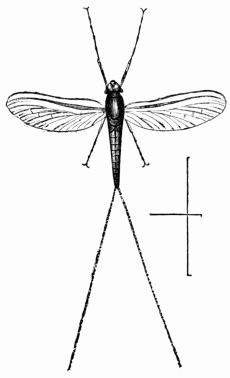
Fig. 393.—Cloëon diptera.
In the perfect state, as well as in that of the larva and the pupa, the Libellulæ are carnivorous. Their rapid flight makes them expert hunters, and their enormous eyes embrace the whole horizon. They seize, while on the wing, flies and butterflies, and tear them to pieces immediately with their strong mandibles. Sometimes, the ardour of the chase leading them on far from the streams, they are met with in the fields. The female lays her eggs in the water, from which emerge larvæ which remind one somewhat of the form of the insect, only their body is more compact and their head flattened. The larvæ and pupæ inhabit the bottom of ponds and streams, where, keeping out of sight in the mud, they seek for insects, molluscs, small fish, &c. If any prey passes within their reach, they dart forward, like a spring, a very singular arm, which represents the under lip. It is a sort of animated mask, armed with strong jagged pincers and supported by strong joints, the which, taken together, is equal to the length of the body itself. This mask acts at the same time as a lip and an arm; it seizes the prey on its passage, and conveys it to the mouth. "When any aquatic insect approaches them at a time when they are in a humour for eating," says Charles de Geer, "they shoot the mask forward very suddenly and like a flash of lightning, and seize the insect between their two pincers; then, drawing back the mask, they bring the prey up to their mandibles, and begin to eat it. I have remarked that they do not spare those of their own kind, but that they eat each other up when they can, and I have also seen them devouring very small fish which I put by them. It is very difficult for other insects to avoid their blows, because, walking along generally in the water very gently, and, as it were, with measured steps—almost in the same way a cat does on the look-out for birds—they suddenly dart forward their mask and seize their prey instantaneously." [118] Fig. 394 represents, to the left, the larva of the dragon-fly, with the instrument of attack which we have called a "mask," and which it is making use of for seizing a small insect; on the right, the adult dragon-fly coming out of the nymph.
Fig. 394.—Larva of the Libellula, and the perfect insect emerging.
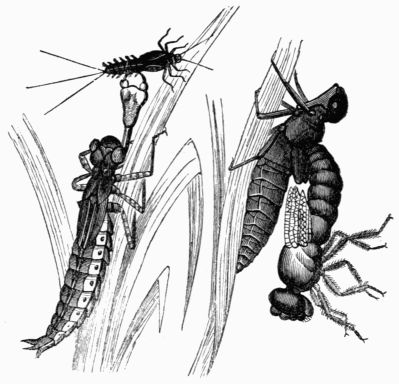
The respiration of these larvæ is very singular. Their abdomen is terminated by appendages, which they open to allow the water to penetrate into the digestive tube, the sides of which are furnished with gills communicating with the tracheæ. The water, deprived of oxygen, is then thrown out, and the larva advances thus in the water by the recoil. It has no tufts of external lateral gills, which in the case of the Ephemeræ do the duty of fins. The pupa already presents stumps of wings. To effect its metamorphosis it drags itself out of the water, where it has lived for nearly a year, climbs slowly to some neighbouring plant, and hangs itself there. Very soon the sun dries and hardens its skin, which all of a sudden becomes crisp, and cracks. The dragon-fly then sets free its head and its thorax, and its legs; its wings, still soft and wanting in vigour, gain strength by coming in contact with the air, and, after a few hours, they have attained their full development. Immediately the insect abandons, like a worn-out suit, the dull slimy skin which had covered it so long, and which still preserves its shape (Fig. 394), and dashes off in quest of prey.
Fig. 395.—Libellula depressa, the Common Dragon-Fly.
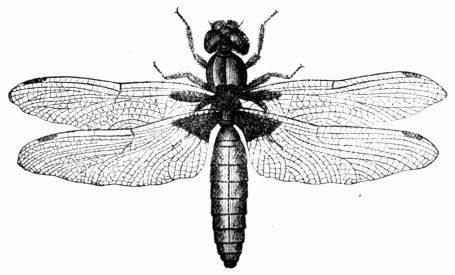
The Libellulas are common all over the world. Their type is the Libellula depressa (Fig. 395), very common in Europe. The male is brown, with the abdomen blue underneath; the female, of a sort of olive-yellow, bordered by yellow on the sides. Both have the abdomen broad and flattened.
The Æshna, with a cylindrical abdomen, attains to the length of two and a half inches. Its flight is more rapid than that of the swallow. The Calepteryx flies more slowly. The male is of a metallic blue, its diaphanous wings are traversed by a band of greenish blue; the female, of a bronzed green, has wings of a metallic green, with a yellowish mark on the edge. These insects rest on reeds, retaining their wings in a vertical position.
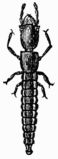

Fig. 396.—Male Raphidia. Fig. 397.—Larva of a Raphidia. Fig. 398.—Pupa of a Raphidia.
The Agrions, which are of the same family, have the body white, brown, or green, and the eyes very prominent. They are more slim and graceful than the Libellulas, properly so called; their larva are very elongated.
Fig. 399.—Mantispa pagana.
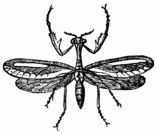
In the spring, one meets in the woods with insects having large heads and elongated thoraces. The females have a long auger, with which to deposit their eggs under the bark of trees, where their larvæ, which feed on insects, and twist themselves about like small serpents, live. The pupæ are also very active; they resemble the adults very much, and have the wings laid against the body. These insects, which are met with everywhere, but always in small numbers, are the Raphidias, which we see represented (Figs. 396, 397, 398) in the state of larva, pupa, and adult, and the Mantispas (Fig. 399), one species of which is common in the south of Europe.
Fig. 400.—Semblis lutarius, imago, pupa, and larva.

M. Blanchard classes in the same tribe the genus Semblis, whose larvæ are aquatic, with scaly heads, provided with eyes, and with curved mandibles and short antennæ. The larvæ and the pupæ breathe, like those of the Ephemeræ, by articulated external processes, or gills, analogous to those of fishes. Nevertheless the pupæ live on land, not in water. They hide themselves in the earth at the foot of trees, and the adult issues forth at the end of a fortnight, leaving its pupa skin behind. It lives but a few days. The female lays her eggs on reeds, stones, &c. Fig. 400 represents the Mud Semblis in its three states.
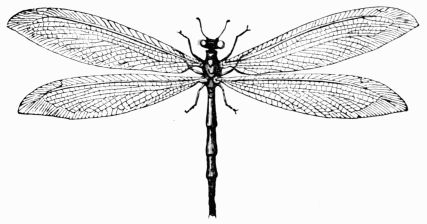
Fig. 401.—Ant-lion (Myrmeleo formicarius).
We now come to those Neuroptera which undergo complete metamorphoses. They are the Myrmeleonidæ, of which the Ant-lion (Myrmeleo) is the most prominent type, and the Phryganidæ, or Caddis Flies.
The larvæ of the Ant-lions live on the land, and are carnivorous. When about to undergo their transformation into pupæ, they spin for themselves a silky cocoon. The larvæ of the Phryganeas, on the contrary, live in the water. They surround themselves with a sort of protecting case, composed of a silky shell and incrustations of all sorts. The pupæ, as well as the larvæ of these insects, breathe by means of gills.
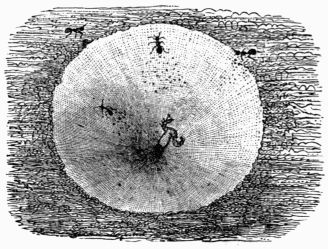
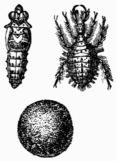
Fig. 402.—Ant-lion's funnel. Fig. 403.—Larva, cocoon, and pupa of the Ant-lion.
The Ant-lion (Myrmeleo formicarius, Fig. 401) is found in the environs of Paris. It is an elegant insect, resembling the dragon-fly, but is distinguished from it by its antennæ. Its larva is of a rosy, rather dirty grey, with little tufts of blackish hair on its very voluminous abdomen. Its legs are rather long and slender; the two anterior pair of legs are directed forwards, whilst the hind legs are fixed against the body, and only permit the animal to walk backwards. These larvæ are met with in great abundance in sandy places very much exposed to the heat of the sun. There they construct for themselves a sort of funnel in the sand (Fig. 402), by describing, backwards, the turns of a spiral whose diameter gradually diminishes. Their strong square head serves them as a spade with which to throw the sand far away: they then hide themselves at the bottom of the hole, their head alone being out, and wait with patience for some insect to come near. Scarcely has the ant-lion perceived its victim on the borders of its funnel, when it throws at it a shower of dust to alarm it, and make it fall to the bottom of the precipice, which does not fail to happen. Then it seizes it with its sharp mandibles, and sucks its blood; after which it throws its empty skin out of the hole and resumes the look-out. Ants especially become its prey, whence its name of Ant-lion. Towards the month of July, the larvæ make themselves a spherical cocoon, mixed with grains of sand, in which they are transformed into pupæ which are hatched towards the end of August. The perfect ant-lions diffuse an odour of roses; their flight, which is weak, distinguishes them from the dragon-flies. We meet in the south of France with a very beautiful species of Ant-lion, the Myrmeleo libelluloides (Fig. 404); its larva can move forwards, and does not dig itself a funnel.
Fig. 404.—Myrmeleo libelluloides.
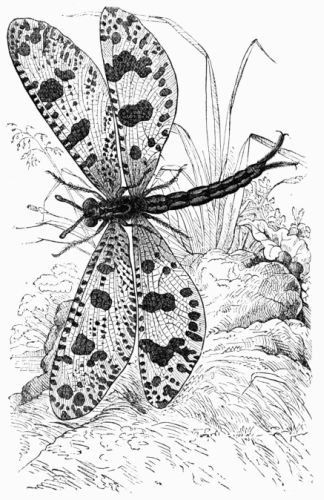
The genus Ascalaphus (Fig. 407) is remarkable for the long clubbed antennæ of its members, and for their rapid flight. They like the sun, and live especially in hot countries; however, one meets with the Ascalaphus, in the month of July, near Paris, on the dry declivities of Lardy and of Poquency. Their larvæ (Fig. 406) have mandibles adapted for suction. They watch for insects under heaps of stones, and spring upon their prey.
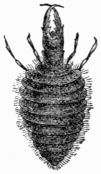
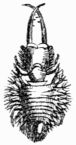
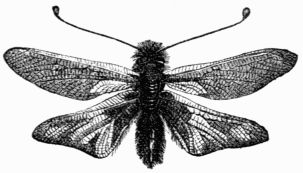
Fig. 405.—Larva of Myrmeleo libelluloides. Fig. 406.—Larva of Ascalaphus. Fig. 407.—Ascalaphus meridionalis.
The first states of the Nemoptera [119] (Fig. 408) are as yet little known. They are insects with wings spotted with yellow and black, the lower ones almost linear, and are met with in southern countries, and but very rarely in the south of France.
The Hemerobii, to which are given by the French the name of Demoiselles terrestres, or Land Dragon-Flies, are very small delicate insects, of an apple-green colour, with golden red eyes. These insects leave on the fingers, when seized, an offensive odour. Réaumur calls them Lions des pucerons (Plant-Lice Lions), because their larvæ, which resembles the larvæ of the ant-lions, and which live on plants, feed on plant-lice. They attack also caterpillars. Their mandibles are provided with a canal for suction, like those of the foregoing species.
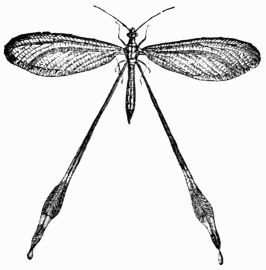
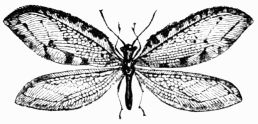
Fig. 408.—Nemoptera Coa. Fig. 409.—Osmylus maculatus.
The insects of the genus Osmylus (Fig. 409) are rather rare; but may be found in the shrubs which border ponds. They also belong to the Hemerobidæ. Their larvæ live in wet ground.
Fig. 410.—Panorpa, male and female.
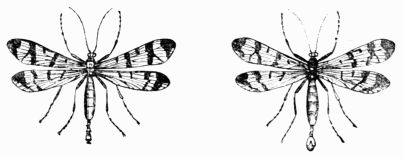
The Panorpatæ constitute a singular little family, having a peculiar shaped head, which is prolonged to a sort of long and slender beak. Aristotle called them Scorpion Flies, and thought they were winged scorpions. The Panorpas, properly so called (Fig. 410), are found on hedges and plants during the summer. They have slim bodies spotted with yellow and black, and four straight wings, also spotted with black. In the males the abdomen terminates in a pair of pincers (Fig. 411), which rather remind one of the tail of a scorpion, and which are destined to seize their prey, which they kill by piercing with their beak. The female lays her eggs in the ground (Fig. 412). In a week the larva makes its appearance; it is a month in developing, it then buries itself still deeper in the earth, and changes into a pupa, which, after a fortnight, comes again into the light in the form of a perfect insect. There are two other genera of Panorpatæ, of which Bittacus tipularis (Fig. 413), resembling a large gnat, furnished with four wings, and Boreus hyemalis (Fig. 414), of a brilliant black, met with in Sweden and in the elevated parts of the Alps, jumping about on the snow in considerable troops—are representatives. The latter has been found in England.

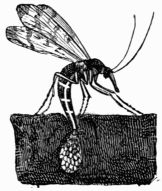
Fig. 411.—Pincer of male Panorpa. Fig. 412.—Female Panorpa laying.
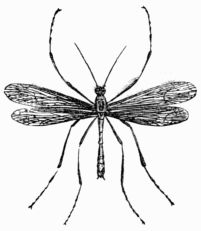
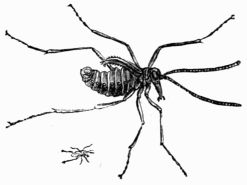
Fig. 413.—Bittacus tipularis. Fig. 414.—Boreus hyemalis (magnified and natural size).
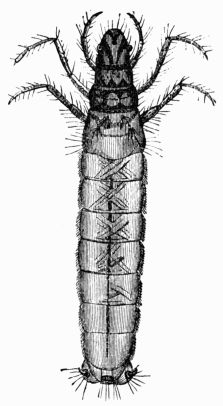
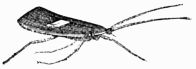
Fig. 416.—Phryganea rhombica, in repose.
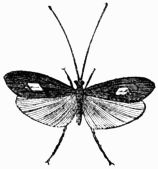
Fig. 415.—Larva of Phryganea rhombica. Fig. 417.—Phryganea rhombica.
The Phryganidæ, or Caddis Flies, are known by their larvæ, of which anglers make great use. Réaumur classed them as aquatic moths. The soft and delicate body of the larvæ is protected by a case, to which they cling by two hooks, placed at the extremity of their abdomen. They are called by different names in allusion to their habits; as, for instance, case worms, from their living in a case covered with little bits of wood or sand, which they draw after them as they go. Their scientific name, Phryganea, signifies fagot. [120] The Phryganeæ, in the adult state, very much resemble moths. They approach them in having rudimentary mouths, and wings without articulations, but furnished with small hairs, analogous to the scales of Lepidoptera. They may be said to form a sort of connection between the Lepidoptera and Neuroptera. They have been called Mouches papilionacées, or Papilionaceous Flies. The eggs laid by the female Phryganea are enclosed in gelatinous capsules, which swell in the water and attach themselves to stones, &c. The larva has the appearance of a little worm without feet. It is soon hatched, and resembles at first a little black line, and may be easily reared in an aquarium. The operation of making the silky case which it draws after it, and which protects its abdomen, may then be observed. When it is disturbed, it retreats entirely within its case. The interior is smooth, and lined with mud; on the exterior it is fortified with stones, &c.
Fig. 418. Regular cases of a Phryganea.
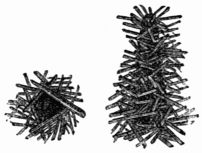
The Phryganea rhombica (Figs. 415, 416, 417) furnishes its case with bits of wood or grass, arranged as shown in Fig. 418. Some species arrange these bits of wood and glass in spiral, others in parallel series. The Phryganea flavicornis covers its dwelling with little shells. "These kinds of dress," says Réaumur, "are very pretty, but they are also excessively singular. A savage who, instead of being covered with furs, should be covered with musk rats, moles, or other entire animals, would have on an extraordinary costume; this is in some sort the case with our larvæ." Other Phryganeæ employ for constructing the case which serves them as a dwelling sand and small pebbles; each species always employing the same materials, unless they are entirely deprived of these and obliged to employ others. These cases protect the larvæ against the voracity of their enemies. The larvæ have a scaly head; and the three first rings of their body are harder than the rest. They live in water, and breathe by means of branchious sacs, arranged on the abdomen in soft and flexible tufts. They eat everything that is presented to them: leaves, and even insects and the larvæ of their own kind. The pupæ are motionless. They stay about a fortnight in their case, the orifice of which is closed by gratings of silk, then break through the gratings, and leave their prison. In this state (Fig. 419) they swim on the water until they meet with an object to which they can attach them selves, and so get out. Then they swell till they crack their skin over the back, and the perfect insect emerges.
The Phryganea pilosa (Fig. 420) is of a yellowish grey, with hairy wings, little adapted for flying. These insects do not eat, and never leave the neighbourhood of the water. During the day they rest on flowers, on walls, or on the trunks of trees, their wings folded back, and their antennæ together. In the evening they fly in dense swarms over streams and ponds. They are attracted by light, as are many nocturnal insects; and are sometimes found in great numbers on the lamps on the quays in Paris.
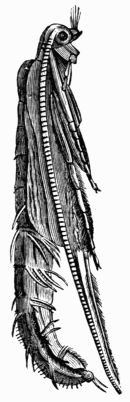
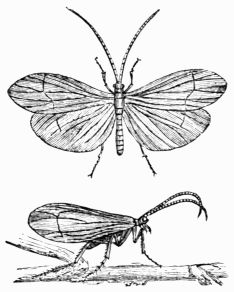
Fig. 419.—Pupa of Phryganea pilosa, magnified. Fig. 420.—Phryganea pilosa.
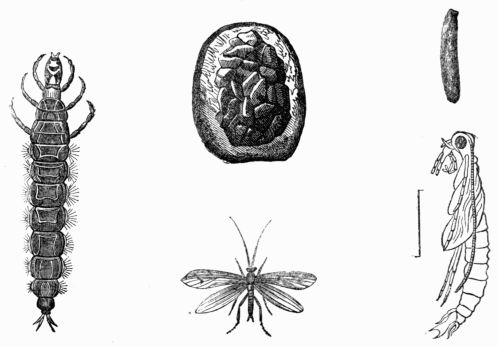
The Hydropsyches (Fig. 421) and Rhyacophili (Fig. 422) are small insects which resemble the Phryganeæ very closely. Their larvæ have, for the purposes of respiration, some gills, others retractile tubes. They construct for themselves fixed places of shelter, more or less imperfect, at the bottom of the water, and against large stones, which they leave occasionally for a few moments. Sometimes these cases contain several larvæ. Fig. 421 represents the various states of a Hydropsyche; the larva is seen on the left, the pupa on the right, the winged insect in the middle. Two of the insect's tents, or places of shelter, are represented below. Fig. 422 shows the different states of Rhyacophilus vulgatus, larva, cocoon, pupa, and imago. The genus Rhyacophilus has this peculiarity, that the larva spins itself a cocoon in the interior of its dwelling before changing into a pupa.
Fig. 421.—Hydropsyche (Phryganea) atomaria, larva, pupa, imago, and larva-case.
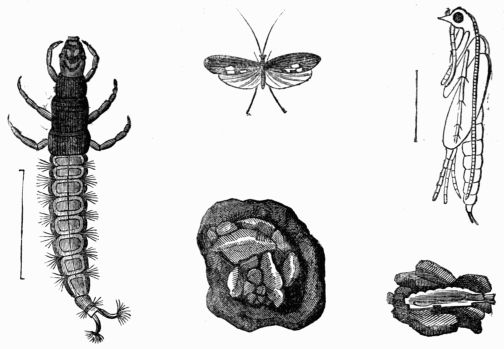
Fig. 422.—Rhyacophilus vulgatus, larva, pupa, cocoon, and imago (male).
IX.
COLEOPTERA.
In collections of insects the Coleoptera almost always occupy the principal place. They are sought after by collectors on account of the brightness of their colours, of the solidity of their integuments, and the facility with which they can be preserved. This circumstance has contributed much to give to the Coleopterous Order marked preponderance in the immense series of insects. Many more have been collected than any one has as yet been enabled to describe; and the collections are encumbered with species of which no naturalist has yet given an account.
Admitting that the first-rate collections contain each about 25,000 perfectly distinct species, and that a certain fraction of these treasures is peculiar to each collection, M. Blanchard came to the conclusion that we must estimate the number at more than 100,000 of the species of Coleoptera which would be obtained if the different entomological collections of France, England, and Germany were put together. But every day we see arriving from different regions of the globe new riches, hardly dreamt of up to that time; and it is not only the small species, but the larger and more beautiful also, which furnish their contingent. It may, then, be believed that, if the entire surface of the earth were carefully explored, we should obtain an incalculable number of Coleoptera, having sufficient characteristics to constitute distinct species or kinds.
The Coleoptera (from [Greek: koleos], a sheath, and [Greek: pteron], a wing) are insects with four wings. The anterior wings, or elytra, are not used in flying; they are sheaths, more or less hard, sometimes varied with bright colours, and never crossing over each other. The posterior wings are membranous, presenting a ramification of veins, and usually folding up under the elytra, which protect them when at rest. The mouth of Coleoptera is provided with mandibles, with jaws, and two quite distinct lips, and is suited for mastication. They undergo complete metamorphosis. After an existence of greater or less extent in the larva state (in the case of the cockchafer three years), the insect changes into a pupa, which remains in a state of complete immobility. After a certain time, the pupa bursts its envelope and assumes the form of a perfect insect. The Coleoptera presents the utmost variety of habits as regards their habitations and food. One does not find in this Order those admirable instincts, those manifestations of intelligence, which bring certain Hymenoptera near to those beings which are highest in the animal scale; but they offer peculiarities very well deserving serious and profound study. Some are carnivorous, and thus they are useful to man in destroying other noxious insects, which they seek on the ground, on low plants, on trees, and even in the depths of the waters. Many of these Coleoptera feed on animal matter in a state of putrefaction. We may look on them as useful auxiliaries: they are Nature's undertakers.
A great number live in the excrements of animals. The dung of oxen, buffaloes, and camels afford shelter to Coleoptera of different families, which thus live on vegetable matter more or less animalised. Others attack skins and dried animals in general; and some are the pest of entomological collections. Lastly, immense legions of Coleoptera are phytophagous; that is to say, they attack roots, bark, wood, leaves, and fruits, and cause much annoyance to the agriculturist. Above all, the larvæ are to be dreaded. Those which live in wood may in a few years occasion the loss of trees, vigorous and full of life; or completely destroy the beams of a building. Certain larvæ, such as those of the cockchafer, eat away the roots of vegetables, and so destroy the harvests. Others, lastly, devour the leaves and the stalks of plants, attack the flowers in the gardens, or the corn in the barns; and so man makes desperate war against them.
In the immense variety of known Coleoptera we must be contented to choose those types which are most prominent and most characteristic. We will begin with the Scarabæides, with their heavy compact body, and short antennæ, terminated by a foliaceous club. It is to this tribe that belongs the beautiful Rose Beetle (Cetonia aurata), which lives on roses; the Cockchafer (Melolontha vulgaris); the Scarabæus of the Egyptians; &c.
This is the most interesting tribe of the whole Order Coleoptera. It corresponds with the great division of the Lamellicornes of Latreille. This name of Lamellicornes was intended to remind us of the arrangement into laminæ, more or less close together, of the club of the antennæ of these insects. Many Scarabæi have their mandibles membranous, or at least partially so, and always small. This peculiarity corresponds to their habits. Never, indeed, have they to triturate hard bodies; they all feed either on flowers, on leaves, or on stercoraceous matter. Their larvæ resemble each other much, even those of families very widely differing from each other in the perfect state. They are large, whitish worms, with diaphanous skins, scaly heads, furnished with toothed mandibles, living in the ground or in rotten wood. The pupæ are fat and stumpy, and they already show the features of the perfect insect. They make a chamber in which to undergo their changes. They remain generally three years in the larva state. The duration of the pupa is very short, as also is that of the perfect insect. The differences of the sexes are often very marked on the exterior, by protuberances, horns, &c., which constitute the distinctive ornament of the males.
In the group of Scarabæides we shall have to speak, above all, of the Cetoniadæ, the Chafers, and the Scarabæi properly so called. The family Cetoniadæ is one of the most remarkable, on account of the beauty of the insects which compose it and of the richness of their metallic lustre, some being of great splendour, and others having velvety tints. The larvæ live in wood in a state of decomposition; the perfect insects frequent flowers, and like the sun.
Fig. 423.—Rose Beetle (Cetonia aurata).
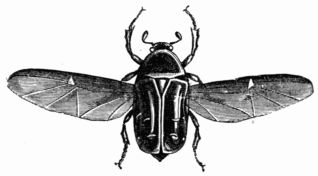
This family contains a great number of species, the type of which is the Rose Beetle (Cetonia aurata), of a beautiful green colour shot with gold, with transverse whitish lines. The rose beetle frequents roses especially, of which it eats the petals and the stamens. It is the Golden Melolontha of Aristotle, who tells us that this unfortunate insect shared with the cockchafer the privilege of amusing children. The Cetonia flies by day and by night, making use of its inferior wings without opening the elytra (Fig. 423). When seized, it pours out from the extremity of its abdomen a fœtid liquid, the only means of defence the poor insect possesses. The larva (Fig. 424) much resembles the larva of the cockchafers, but the legs are shorter. It is found in rotten wood, and often in ants' nests. When it has acquired its full development it makes a cocoon of an oval form (Fig. 424), in which it transforms itself into a pupa; the cocoon is composed of bits of wood agglomerated with a silky matter which the larva secretes.
Fig. 424.—Larva and cocoon of the Rose Beetle.
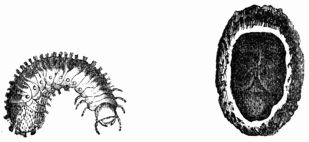
The larva of the Cetonia splendidula—which is the most magnificent found in France—is met with sometimes in the nests of wild bees. In Russia the rose beetle is considered a very efficacious remedy for hydrophobia. In the governorship of Saratow, which is traversed by the Volga, hydrophobia is very frequent, on account of the heats which reign during the whole summer in its arid steppes. The inhabitants, incessantly exposed to be bitten by mad dogs, have tried in succession a great many preparations to remedy the results of these terrible accidents. It appears that the Cetonia, dried and reduced to powder, has produced on many occasions good effects. This is the recipe which an inhabitant of Saratow published in a Russian journal—adding, that he had employed it for thirty years, that not one of the patients treated by him had died, and that his remedy could be employed with success in all the phases of the disease:—In spring they search at the bottom of the nests of the wood ant for certain white larvæ, which they carefully preserve in a pot, together with the earth in which they were found, till the moment of their metamorphosis, which takes place in the month of May. The insect, which is the common rose beetle, is killed, dried, and kept in pots hermetically sealed, so that it may preserve the strong odour which it exhales in spring, which seems to be a necessary condition of the remedy proving efficient. When a case of hydrophobia presents itself, they reduce to powder some of these, and spread this powder on a piece of bread-and-butter, and make the patient eat it. Every part of the insect must enter into the composition of this powder, which, for this reason, cannot be very fine. During the whole time a patient is under treatment he must avoid drinking as much as possible, or, if his thirst is very great, he must only drink a little pure water; but he may eat. Generally, this remedy produces sleep, which may last for thirty-six hours, and which must not be disturbed. When the patient wakes, he is, they say, cured. The bite must be treated locally with the usual surgical appliances.
As to the dose of the remedy, that depends on the age of the patient and the development of the disease. They give, to an adult, immediately after the bite, from two to three beetles; to a child, from one to two; to a person in whom the disease has already declared itself, from four to five. Given to a person in good health, the remedy, however, would not be the least dangerous. In cases in which the symptoms of hydrophobia show themselves some days after the employment of the remedy, they recommence the treatment. They have also tried to prepare this remedy with insects collected not in their larvæ but in the imago state, by catching them on flowers, and it seems that these attempts have succeeded. According to M. Bogdanoff, in many governorships of the south of Russia the lovers of sporting are in the habit of making their dogs from time to time swallow (as a preservative) half of a Cetonia with bread or a little wine. Every one in those countries is persuaded of the efficacy of this means for stopping the development of the disease. One ought not, perhaps, to reject a belief so widespread and deeply rooted without some experiments to guarantee us in doing so, for medicine does not yet possess any remedy against hydrophobia: it might not then be useless to try this.
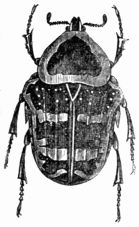
Two smaller species than the rose beetle, the Cetonia stictica and the Cetonia hirtella, which has yellowish hairs, live on the flowers of thistles. Western Africa, the Cape, Madagascar, &c., are very rich in species of Cetoniæ. Among the Cetoniadæ is the genus Goliathus, gigantic insects which inhabit Africa. Their total length sometimes attains from three to five inches. Their colours are generally a dull white or yellow, which has nothing metallic about it, with spots of a velvety black—these are due to a sort of down of an extreme thin ness, and which very easily comes off. The head of these enormous Coleoptera is generally cut or scooped out, and is adorned sometimes with one or two horns. Their legs, strong and robust, are armed with spurs, and sometimes present on their exterior sharp indentations, which give to these insects a crabbed physiognomy, which their inoffensive habits are far from justifying. All these horns, and all these teeth, which look so terrible, are nothing, in fact, with a great number of these insects, but simple ornaments. They compose the picturesque uniform of the males. They are equivalent to the bear-skin caps, the flaming helmets, and the bullion-fringed epaulettes of our soldiers. The dress of the female Goliathus is much more modest, as is becoming to the sex. We here represent the Goliathus Derbyana (Fig. 426) and Polyphemus (Fig. 427).
Fig. 425. Cetonia argentea.
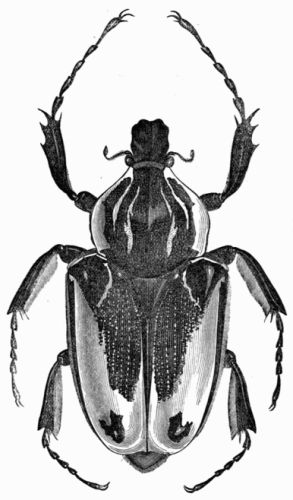
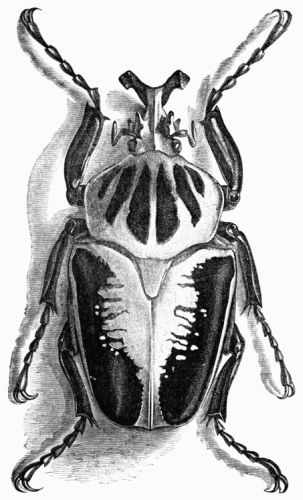
The Goliaths were formerly excessively rare in collections, and of a price inaccessible to ordinary amateurs—one single specimen costing as much as twenty pounds. But for some time the Goliaths of the coast of Guinea and of Cape Palmas have been sold to European amateurs at a modest price, thanks to those travellers who, after the example of Dr. Savage, have collected them by hundreds in the countries which produce them. These enormous Coleoptera are seen on the coast of Guinea fluttering about at the top of trees, the flowers of which they are seeking after. To catch them the trees are felled or else they are shot at with a gun loaded with sand, as is also done for the humming-birds. The species which Dr. Savage made common is the Goliathus cacicus, of which we represent the male and female (Figs. 428, 429). It is met with on the coast of Guinea. The Goliathus Druryi (Fig. 430) inhabits Sierra Leone, on the west coast of Guinea. The numerous expeditions which are at the present moment being made into the interior of Africa will not fail to increase the number of species of these splendid insects, which are the ornament of all collections.
The group of the Trichiadæ, which has in this country and in France a few representatives, is very nearly the same as that of the Cetoniadæ. The Trichiadæ have the elytra shorter, the abdomen bigger, and the legs more slender. The Trichius fasciatus, which is black, and covered with an ashy down, with the elytra yellow, and with three black bands, is to be met with in quantities on the garden rose -tree, in the months of June and July. The larvæ live in the interior of old beams of wood, respecting their surfaces. In a garden, at a few leagues from Paris, a little wooden bridge had been built. It seemed on the outside to be in a perfect state of preservation. Nothing on the exterior would have led one to think it was possible for the oak timbers which composed it to break down. A good many of them, however, broke suddenly. It was then seen that the wood had been scooped out right up to the surface, which was nothing better than a thin sheet, of an imperceptible thinness. All the interior was full of Trichii, in the states of larva, pupa, and perfect insect.
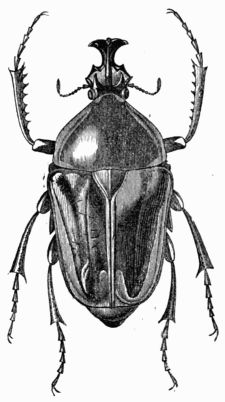
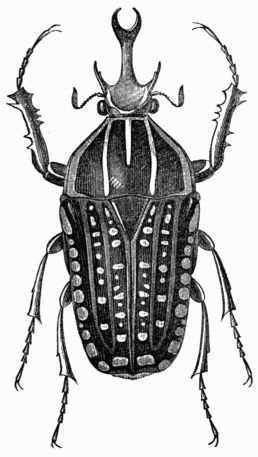
Fig. 426.—Goliathus Derbyana. Fig. 427.—Goliathus Polyphemus.
The Trichius fasciatus, sometimes called the Bee Beetle, is very common in the environs of Paris. Geoffroy has described it under the rather quaint name of the "Livrée d'Ancre," because the Marquis of Ancre made his servants wear yellow coats, bordered by braid alternately crossed with green and yellow.
Fig. 428.—Goliathus cacicus, male.
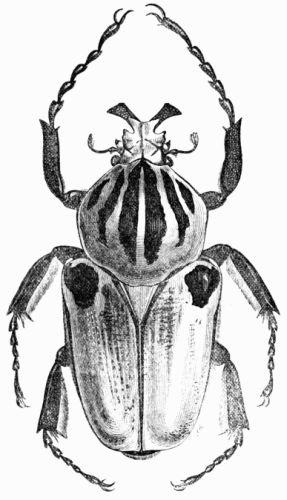
Fig. 429.—Goliathus cacicus, female.
The Osmoderma eremita is a large insect, of purple colour, formerly common in the environs of Paris, and which, now-a-days, cannot be found nearer than Fontainebleau. One must look for them in earth which fills up the cavity of old willows or of pear trees. The smell of Russia leather, or of plum, which it exhales, has caused it to be called, in some places, the Plum-tree Beetle.
Fig. 430.—Goliathus Druryi (natural size).
The Gnorimus nobilis much resembles the rose beetle, and is found on elder flowers, the whiteness of which this golden insect relieves. One species, much smaller, only one or two lines long, is the Valgus hemipterus, which is often met with in spring, in the dust of the roads. The female has a long auger, which enables it to deposit its eggs in rotten wood. Dumeril has described at length the singular movements of this little insect:—The jerking and, as it were convulsive, movements by which it transports itself from one place to another; its tottering attitude, resulting from the excessive length of its hind legs; the vertical carriage of these, which, by their singular direction, interfere much with the walking, which is directed by the other legs. One should, above all, notice the artifice which the Valgus employs, as indeed do many Coleoptera, to escape from his persecutors, by counterfeiting death. As soon as it is seized by any enemy, its members stiffen and become motionless. The body, abandoned to itself, lies unevenly on whatever side it falls, for its legs no longer bend; if you bend them over, they remain in the inclination given to them. Nothing then betrays life in this little dry and slender being, frozen with fear, and imitating death, without, perhaps, being aware itself of what it is doing.
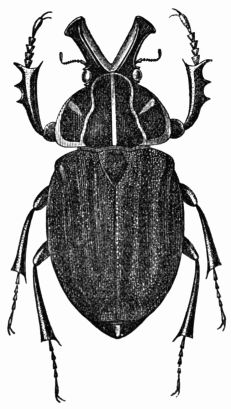
We must still further mention here the Incas—beautiful insects of the same group, which are met with in South America, and whose males have an extraordinary head. They fly during the day round the great trees on which they live. Fig. 431 represents the Inca clathrata.
The most commonly-known insect of the family with which we are now occupied is the cockchafer. The French word for cockchafer, hanneton, according to M. Mulsant, comes from the Latin, alitonus (which has sonorous wings), which first became halleton. Linnæus gave them first the name of Melolontha, which they probably had among the Greeks, and which seems to be the case from this passage in Aristophanes, in his comedy of "The Clouds:"—"Let your spirit soar," says the Greek author, "let it fly whither it lists, like the Melolontha tied with a thread by the leg." We see that the habit of martyrising cockchafers is of very early date. The Common Cockchafer (Fig. 432) is one of the greatest pests to agriculture. In its perfect state it devours the leaves of many trees, principally those of the elm; and so children call the fruit of the elm-tree by the name of "Pains d'Hanneton." But the destruction which they occasion in their perfect state is little when compared with that which is caused by their larvæ—those white grubs so dreaded by agriculturists.
Fig. 431.—Inca clathrata.
Cockchafers make their appearance from the month of April, if the season is warm. But it is in the month of May that they show themselves in great quantities; and so they are called in Germany Maikäfer (Maychafer). They are met with also in June. The duration of their life as a perfect insect is six weeks. They fear the heat of the day and the bright sunshine, so, during the day, they remain hooked on to the under surface of leaves. It is only early in the morning, and at sunset, that one sees the cockchafers fluttering round the trees which they frequent. They fly with rapidity, pro ducing a monotonous sound by the friction of their wings. But the cockchafer steers badly when it flies; it knocks itself at each instant against obstacles it meets with. It then falls heavily to the ground, and becomes the plaything of children, who are constantly on the look-out for them. There is a saying, "Étourdi comme un hanneton." What contributes still more to render the flight of these insects heavy and sustained only for a short time together is that they are obliged to inflate themselves like balloons in order to rise into the air: it is a peculiarity which they share with the migratory locust. Before taking its flight, the cockchafer agitates its wings for some minutes, and inflates its abdomen with air. The French children, who perceive this manœuvre, say that the cockchafer "compte ses écus" (is counting its money), and they sing to it this refrain, which has been handed down for many generations:—
"Hanneton, vole, vole, Va-t'en à l'école."
A variation which we hear in the western provinces of France is the following:—
"Barbot, vole, vole, vole, Ton père est à l'école, Qui m'a dit, si tu ne voles, Il te coupera la gorge Avec un grand couteau de Saint-George."
Fig. 432.—Cockchafer (Melolontha vulgaris).
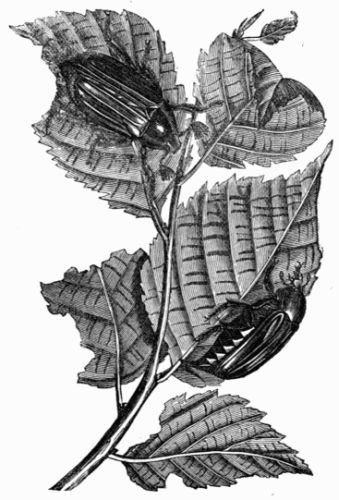
During the day the cockchafers remain under the leaves in a state of perfect immobility; for the heat which gives activity to other insects, seems, on the contrary, to stupefy them, and it is during the night only that they devour the leaves of elms, poplars, oaks, beech, birch-trees, &c. In years when their number is not very great, one hardly perceives the damage done by them; but at certain periods they appear in innumerable legions, and then whole parts of gardens or woods are stripped of their verdure, and present, in the middle of the summer, the appearance of a winter landscape. The trees thus stripped do not in general die; but they recover their former vigour with difficulty, and, in the case of orchard trees, remain one or two years without bearing fruit. It is principally the trees skirting woods, and situated along cultivated fields, which are exposed to the ravages of the cockchafer, because the larvæ of these insects are developed in the fields. In the interior of forests they are never met with in great numbers.
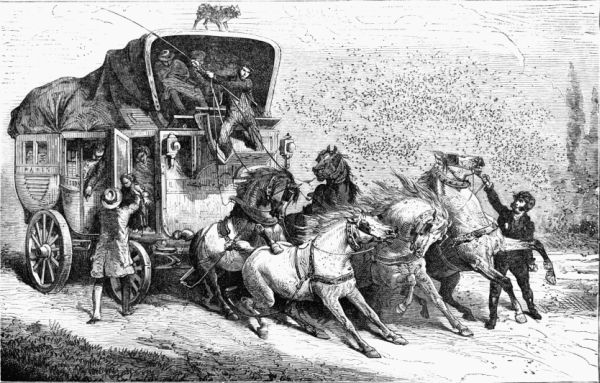
In certain years cockchafers multiply in such a frightful manner that they devastate the whole vegetation of a country. In the environs of Blois 14,000 cockchafers were picked up by children in a few days. At Fontainebleau they could have gathered as many in a certain year in as many hours. Sometimes they congregate in swarms, like locusts, and migrate from one locality to another, when they lay waste everything. To present an idea of the prodigious extent to which cockchafers increase under certain circumstances, we will give a few statistics:—In 1574, these insects were so abundant in England that they stopped many mills on the Severn. In 1688, in the county of Galway, in Ireland, they formed such a black cloud that the sky was darkened for the distance of a league, and the country people had great difficulty in making their hay in the places where they alighted. They destroyed the whole of the vegetation in such a way that the landscape assumed the desolate appearance of winter. Their voracious jaws made a noise which may be compared to that produced by the sawing of a large piece of wood, and in the evening the buzzing of their wings resembled the distant rolling of drums. The unfortunate Irish were reduced to the necessity of cooking their invaders, and, for the want of any other food, of eating them. In 1804, immense swarms of cockchafers, precipitated by a violent wind into the Lake of Zurich, formed on the shore a thick bank of bodies heaped up one on the other, the putrid exhalations from which poisoned the atmosphere. On May 18, 1832, at nine o'clock in the evening, a legion of cockchafers assailed a diligence on the road from Gournay to Gisors, just as it was leaving the village of Talmontiers; the horses, blinded and terrified, refused to advance, and the driver was obliged to return as far as the village, to wait till this new sort of hail-storm was over. M. Mulsant, in his "Monographie des Lamellicornes de la France," relates that in May, 1841, clouds of cockchafers traversed the Saône, from the south-east in the direction of the north-west, and settled in the vineyards of the Mâconnais. The streets of the town of Mâcon were so full of them, that they were shovelled up with spades. At certain hours, one could not pass over the bridge without whirling a stick rapidly round and round, to protect oneself against their touch.
XI.—A Diligence surrounded by a Cloud of Cockchafers.
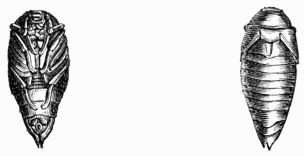
The coupling takes place towards the end of May, after which the males die; the females only surviving them from the time necessary to ensure the propagation of the species. The number of eggs which a female lays is from twenty to thirty. With her front leg she hollows out a hole in the ground from two to four inches in depth, and deposits her eggs, of a yellowish white and of the size of hemp-seed, therein. Her instinct leads her to choose soft, light, and well-manured soils, which are, at the same time, the best ventilated and the most fertile. We may conclude from this that cultivation and labour have made the cockchafer more common than it was formerly. It is the child of civilisation, the parasite of agriculture. In from four to six weeks after being laid, the little larvæ are hatched (Fig. 433), and immediately attack the roots of vegetables. They have a hard and horny head, and slender black legs, longer than in any other species of Scarabæides. Their body is composed of a whitish pulp under a transparent skin; the head and the mouth have a reddish tinge. The length of their existence in this state is three, sometimes four years. From the egg laid in the month of June is hatched a larva, in the month of July. It increases in size during the last six months of the year, and continues to do so during the two following years, changing its skin many times during the period. Towards the end of the third year it changes into a pupa, after having surrounded itself with a cocoon consolidated with a glutinous froth and some threads of silk. The pupa (Fig. 434) is of a pale russety yellow, with two little points at the extremity of its body; the elytra and the wings, lying down, cover the legs and the antennæ.
Fig. 433.—Larva of the Cockchafer (Melolontha vulgaris).
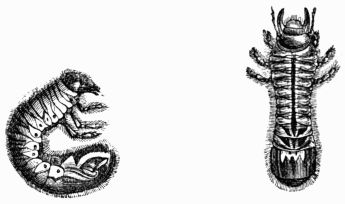
Fig. 434.—Pupa of the Cockchafer (Melolontha vulgaris).
Towards the end of October the perfect insect is already marked out, but it is still soft and weak. It passes the winter in its hiding-place, hardens and becomes coloured at the end of the winter, and shows itself by degrees on the surface of the ground. In the month of April, three years after its birth, the cockchafer emerges from the earth, and commences its attack on the leaves of trees. This long duration of the development of the insect explains why we do not see them every year in the same number. When they have once appeared in great quantities, it is not for three years afterwards that we need expect to see their progeny again in proportionate numbers. It is, then, every three years that we have a cockchafer year like 1865, but in the intermediate years they are never very abundant. For the first year the little larvæ do not eat much. They feed then principally on fragments of dung, and on vegetable detritus, and keep together in families. In winter they bury themselves deeply, so as to be secure against frost and floods. Next spring the want of a greater abundance of food forces them to disperse. They then make subterranean galleries in all directions, without, however, going far from the place where they were hatched. They begin attacking the roots which they find within their reach; the damage they do increasing with their size and the strength of their mandibles. Among roots, they seem to prefer those of the strawberry and of rose-trees; but they do not despise other vegetables, and attack legumes and cereals as well as bushes and plants. The ravages which they occasion are sometimes incalculable; market gardens are sometimes entirely devastated. Fields of lucerne have been seen partially destroyed by them; meadows of great extent lose their pasturage; oat fields die off before they have come to maturity; and many of the ears of corn fall before they are cut.
In proportion as they increase in age and in strength—especially in their last year—do they attack also ligneous vegetation. When they have gnawed away the lateral roots of a young tree, the new shoots corresponding to them dry up. The larvæ then attack the principal root, and thus bring about the death of the tree. There will be found round the roots of trees thus attacked immense numbers of these worms. M. Deschiens relates that he had seen six hectares of acorns, sown three times in the space of five years with a perfect result, entirely destroyed as many times by the larvæ of the cockchafer. A nurseryman of Bourg-la-Reine suffered, in 1854, from the ravages of these terrible larvæ, losses which he estimated at 30,000 francs. Others only preserved about a hundredth part of their plants. In Prussia they destroyed, in 1835, a considerable nursery of trees in the Institut Forestier. In the forests of Kolbetz more than a thousand measures of wild pines were destroyed in the same way.
We shall not, then, be surprised to learn that the thunders of excommunication were formerly launched at the cockchafers, as they were also at the caterpillars and the locusts. We do not know whether this had much impression upon them. In 1479, the cockchafers having occasioned a famine in the country, were cited before the ecclesiastical tribunal of Lausanne. The advocate (Fribourg) who defended them, did not find, doubtlessly, in the resources of his eloquence arguments powerful enough in their favour; for the tribunal, after mature deliberation, condemned the accused troop, and sentenced them to be banished from the territory. But it is not enough to pass a sentence—there must also be the means of putting it in execution; and these were wanting to the tribunal of Lausanne. And so the condemned cockchafers continued to live on Swiss land, without appearing mindful of the condemnation which had been fulminated against them.
The larvæ of the cockchafer are not easily destroyed. They successfully resist those scourges which one fancies must harm them. Thus, the inundation which devastated the banks of the Saône, fifteen years ago, had no effect on them. The land and meadows, which had remained for from four to five weeks under water, were none the more rid of them. The only circumstance which is really hurtful to them, and to the adult cockchafer, is late frost in the months of April and May. When these frosts come after mild weather, they surprise the larvæ at the surface of the soil, and kill them. Unfortunately, the same causes do harm to the plants which have already begun to spring up. Nature has not, then, sufficiently provided the means of destroying these mischievous beings. One would say that she had not foreseen their extraordinary multiplication, which has been, we must confess, encouraged by agriculture and by the cultivation of the land.
Animals do not contribute much towards limiting the number of cockchafers, although the latter are not wanting in natural enemies. Among insects, it is the large species of Carabus which search after the larvæ as well as the adult cockchafers. The Carabus auratus attacks them with great coolness. M. Blanchard saw a carabus seize a cockchafer in the middle of the road, open its belly with its mandibles, and devour its intestines. The cockchafer tossed about from one side to the other, and even walked, while it was undergoing its cruel punishment; and the Carabus followed it without interrupting its work. Some reptiles, many carnivorous animals, such as the shrew-mouse, pole-cats, weasels, rats, and certain birds, especially the night-birds, prey upon the cockchafer and its larvæ. Ravens and magpies, which are seen going from clod to clod, make savage but insufficient war against them. In fact, all these animals together do not destroy the hundredth part of the cockchafers which are born every year.
As an example which will show the extent of the evil, a field of 29 acres was ploughed up into 72 furrows. At the first ploughing were gathered 300 larvæ per furrow; at the second, 250; at the third, 30 more; which amounted to 600 per furrow, and to 43,200 in all. Man, who is the victim of these ravages, has been necessarily obliged to think of a means of destroying this enemy. Many infallible means have been proposed, which have, however, given no result. Prizes have been offered, but the evil has not diminished. Here are a few of the processes recommended.
Immediately after the ploughing, you must turn into the field infested by the larvæ a flock of turkeys, to whom it will be a great treat to devour them, or else you must sow in the field rape-seed, very thickly, which you must then bury by a very deep ploughing, when it is as high as your hand. Colewort, it is said, kills the larvæ, while it at the same time manures the soil. Or again, you must plough up the land on the approach of hard frosts, to expose the worms to the cold. Lastly, you can water the field with oil of coal, or sprinkle it with ashes of boxwood. All these are expensive. The simplest means are here the best. It is better to depend upon labour than destructive substances, whose employment always presents inconveniences. Considering the difficulties which oppose themselves to us in our search after larvæ, we had better collect them in their adult state by violently shaking the branches of the trees on which they doze during the day, and then kill them in some way or other, thus destroying from twenty to forty eggs with each female. A general cockchafer hunt, rendered obligatory by a law, and encouraged by prizes, would be the only efficacious means of opposing a pest which costs agriculture many millions. This means would also be less costly than the turning up of the land concealing the larvæ, when it is remembered that they prefer land in full bearing.
In 1835 the General Council of La Sarthe voted a sum of 20,000 francs for a cockchafer hunt. Nearly 600,000 litres were delivered in, thanks to a prize of three centimes per litre. As a litre contains about 500 cockchafers, there were thus destroyed about 300,000,000 of them. It is true that M. Romieu, then Prefect of La Sarthe, who was the principal promoter of this excellent measure, became food for the wit of the newspapers, and was represented dressed like a cockchafer in the Charivari. Derision and ridicule are too often the reward of useful ideas. In Switzerland were taken, in 1807, more than 150,000,000 of these insects. But these isolated measures were useless in producing a durable result.
It has been tried to make use of cockchafers in industrial arts. According to M. Farkas, they have succeeded, in Hungary, by boiling them in water, in extracting from them an oil, which is used to grease the wheels of carriages; and, according to M. Mulsant, the blackish liquid which is contained in the œsophagus may be used for painting. But the produce arising from these industrial occupations is not considerable enough to ensure them a certain extension, which is to be regretted, for agriculture would thus be rid of one of its most formidable scourges. Poultry are sometimes fed on these insects; pigs are also very fond of them.
The Melolontha Hippocastani differs from the common species in having black legs. The Melolontha fullo, twice as large as the common species, is variegated with tawny and white. It is met with on the sea-coasts, and on the downs of the north and south of France, as its larvæ feed on the roots of maritime plants.
Among the genera very near to the cockchafer we will mention the little Rhizotrogus, light-coloured and hairy, which flies in the evening in the meadows, and the Euchloras, or Anomalas, of splendid metallic colours. The Anomala vitis is an insect of about half an inch long, of a beautiful green, bordered by yellow, with the elytra deeply furrowed. It sometimes causes extensive ravages in the vineyards.
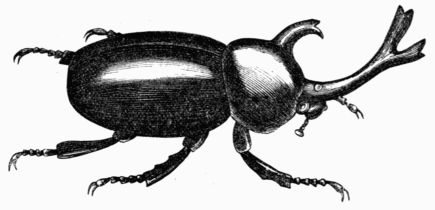
After the Cetoniadæ and the Cockchafers, we come to the Scarabæidæ, properly so called. The Oryctes nasicornis (Fig. 435) is very common all over Europe. It is about an inch long, of a chestnut-brown, and perfectly smooth. The male has on the head a horn, which is wanting in the female (Figs. 436, 437). Its larva, which is a great whitish worm, larger than that of the cockchafer, lives in rotten wood and in the tan which is employed in hot-houses and in garden-frames. They were to be found by hundreds in the old hot-houses of the Jardin des Plantes at Paris. The market-gardeners, who employ the tannin of the oak bark, have rendered this Coleopteron very common in the environs of that capital. Fig. 438 represents an exotic species, the Xylotrupes dichotomus.
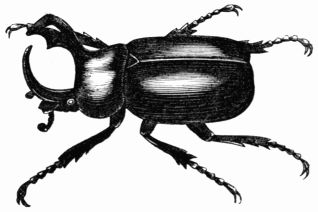
Among the true Scarabæi we meet with many species of gigantic size, especially in America. Dynastes Hercules, a great insect of a fine ebony black, with its elytra of an olive grey, is not rare in the Antilles. Its thorax is prolonged into a horn as long as its body, and bent round at the extremity; its head has also a long horn standing erect. The females want these appendages. Fig. 439 represents the Golofa claviger of Guyana.
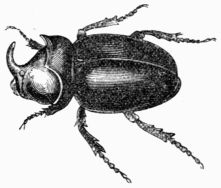
Fig. 436.—Head of Oryctes nasicornis, male.

Fig. 435.—Oryctes nasicornis, male. Fig. 437.—Head of Oryctes nasicornis, female.
The Geotrupes are insects almost as common as the chafers. As their name reminds us, they make holes in the ground, which they scoop out, particularly in meadows, under cow-dung which has grown dry on the surface. It is under the excrements of ruminating animals and horses that they must be looked for. They fly especially at night, and may be seen buzzing about on fine summer evenings in the vicinity of dung heaps.
Fig. 438.—Xylotrupes dichotomus.
The Geotrupes stercorarius, the Shard-born Beetle, Clock, or Dumbledor, is of a brilliant bluish black, and attains to a length of about two-thirds of an inch. We may consider this Coleopteron as a useful auxiliary of man in ridding the soil of excrementitious matter. The genus Trox, which belongs to the same group, generally inhabits sandy countries, and has its body nearly always covered with earth or dust; it lives on vegetable substances, or on animal matter in a state of decomposition. The habits of the genus Copris resemble those of Geotrupes; they live in excrement. The form of their clypeus, broad, rounded, without teeth, and advancing over the mouth, suffices to distinguish the kindred species. In the environs of Paris and in England the Copris lunaris is found. The larvæ of these insects form a cocoon composed of earth and dung, before transforming themselves into pupæ; this cocoon is more or less round, and acquires a great hardness.
Fig. 439.—Golofa claviger.
The species of the genus Ateuchus collect portions of excrement, which they make up into balls, and roll till they are as perfectly rounded as pills, and in which they lay their eggs. This habit has gained for these insects the name of pill-makers. Their hind legs seem to be particularly adapted for this operation, for they are very long and somewhat distant from the other legs, which gives to the Ateuchi a strange appearance, and makes it hard work for them to walk. They walk backwards and often fall head over heels. They are generally seen on declivities exposed to the greatest heat of the sun, assembled together to the number of four or five, occupied in rolling the same ball; so that it is impossible to know which is the real proprietor of this rolling object. They seem not to know themselves; for they roll indifferently the first ball which they meet with, or near which they are placed.
Fig. 440.—Scarabæus (Golofa) Porteri.
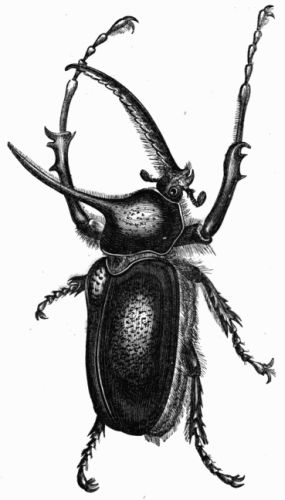
Fig. 441.—Scarabæus enema, or Enema infundibulum.
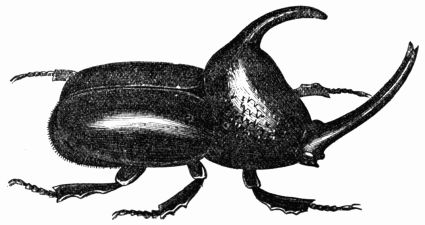
The Ateuchi are large flat insects, with a broad-toothed clypeus; they all belong to the Ancient Continent. The type of the genus is the Ateuchus sacer (Fig. 442), the Sacred Scarabæus of the Egyptians. This insect is black, and attains to a length of a little less than an inch. It is to be found commonly enough in the south of France, in the whole of southern Europe, Barbary, and Egypt. The paintings and amulets of the ancient Egyptians very often represent it, and sometimes give it a gigantic size. It is, doubtless, then, this species which was an object of veneration with the Egyptians.
There exists another species, which is always represented as of a magnificent golden green, and to which Herodotus also attributes this colour. As it was not to be found in Egypt, it was thought for a long while that the Egyptians had painted the black species of a more splendid colour in order to pay it homage. But in 1819 M. Caillaud actually found at Meroe, on the banks of the White Nile, the Ateuchus Ægyptiorum, which resembles the Ateuchus sacer much in colour, but has a golden tint. Since then it has also been brought from Sennaar. The two species were both probably sacred. Hor-Apollon, the learned commentator on Egyptian hieroglyphics, thinks that this people, in adopting the scarabæus as a religious symbol, wished to represent at once, a unique birth—a father—the world—a man. The unique birth means that the scarabæus has no mother. A male wishing to procreate, said the Egyptians, takes the dung of an ox, works it up into a ball, and gives it the shape of the world, rolls it with its hind legs from east to west, and places it in the ground, where it remains twenty-eight days; the twenty-ninth day it throws its ball, now open, into the water, and there comes forth a male scarabæus. This explanation shows also why the scarabæus was employed to represent at the same time a father, a man, and the world. There were, however, according to the same author, three sorts of Scarabæi: one was in the shape of a cat, and threw out brightly shining rays (probably the Golden Scarabæus, Ateuchus Ægyptiorum); the two others had horns; their description seems to refer to a Copris and a Geotrupes.
As other remarkable species of Scarabæi we represent the Scarabæus enema (Fig. 441), with strong horns, the Megacerus chorinæus (Fig. 443), the Megalosoma anubis (Figs. 444 and 445), and the Dynastes Hercules (Fig. 446).
The last family of the Scarabæidæ contains the Lucanidæ, or Stag Beetles. These Coleoptera are of great size, and their head is armed with enormous robust mandibles, which give them a ferocious air, which their inoffensive habits do not in any way justify. They live in half-rotten trees, the destruction of which they accelerate. Their mandibles, of such prodigious size only in the male, are of more inconvenience to them than they are of use, as they impede their flight. Their strength enables them to raise considerable weights, but they make no other use of them than to show their strength, which is enormous. They do not attack other insects, and live only on vegetable juices.
The common Stag Beetle (Figs. 447 [121] and 448) attains to a length of two inches, or more, including its mandibles, and is of a dark brown chestnut colour. They are met with during the months of May, June, and July, in large forests, climbing along trees and hooking themselves on to the trunks by their mandibles. Charles De Geer says that the Stag Beetle imbibes the honeyed liquid which is found on oak trees, a tree it particularly seeks after, which has caused it to be called in Swedish Ek-Oxe (Oak ox). It is supposed that it eats the leaves also. It sometimes attacks insects. Westwood says that it has been seen to descend from a tree carrying a caterpillar in its mandibles. Swammerdam had one which followed him like a dog when he offered it honey. They only fly in the evening, holding themselves nearly straight, so as not to see-saw. Their larvæ—which are whitish, with russety heads, live in the interior of trees, their existence in that state lasting nearly four years. Many naturalists think that the larva of the Lucanus was the Cossus of the Romans, which figured on the tables of the rich patricians, and particularly of Lucullus.
Fig. 442.—The Sacred Scarabæus of the Egyptians (Ateuchus sacer).
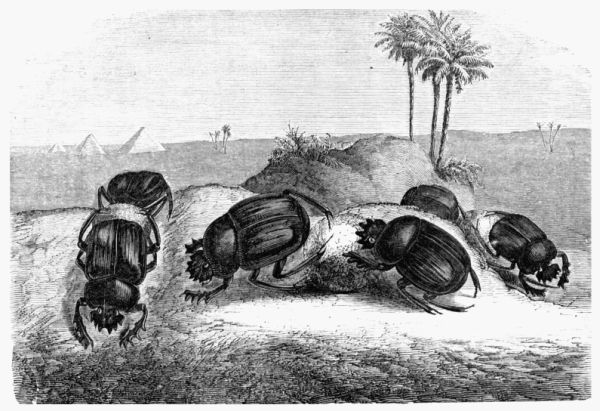
Fig. 443.—Megacerus chorinæus.
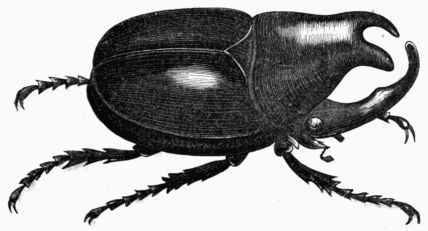
Fig. 444.—Megalosoma anubis (male).
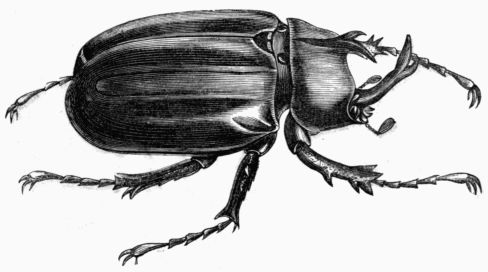
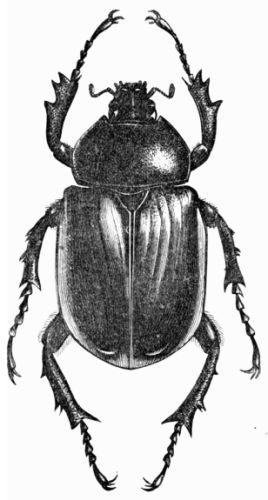
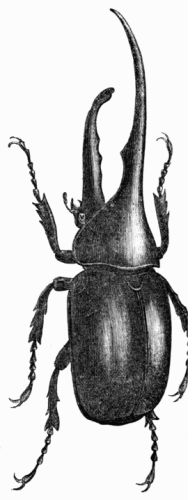
Fig. 445.—Megalosoma anubis (female). Fig. 446.—Dynastes Hercules.
Fig. 447.—Common Stag Beetle (Lucanus cervus).
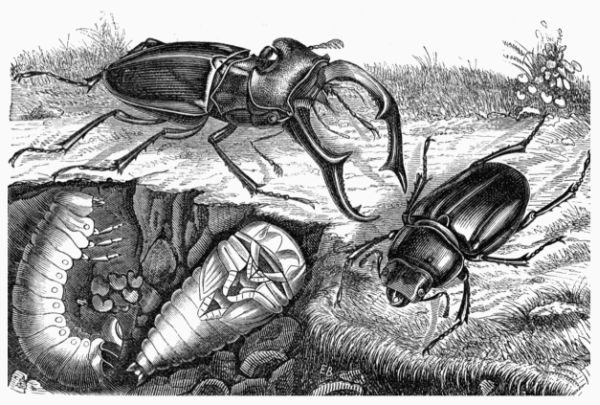
Fig. 448 represents the Stag Beetle (Lucanus cervus); Fig. 449, an exotic species, the Lucanus (Homoderus) Mellyi, from the Gabon; Fig. 450 the Lucanus bellicosus; and Fig. 451 another exotic species from Celebes, Dorcus Titan.
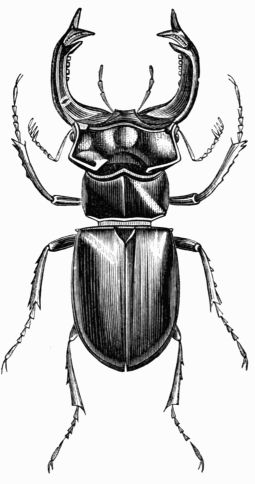
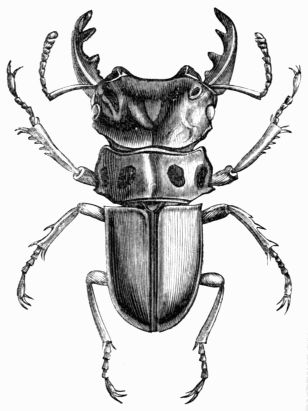
Fig. 448.—Stag Beetle (Lucanus cervus). Fig. 449.—Lucanus (Homoderus) Mellyi.
The Syndesus cornutus (Fig. 452) of Tasmania, and the Chiasognathus Grantii, from the coast of Chili (Fig. 453), of a beautiful golden green, shot with copper, belong to genera akin to Lucanus.
We arrive now at the tribe of Silphales, which are still more useful to man than the Dung Beetles (Scarabæidæ), since many of them disencumber the soil of the carcases of animals in a state of putrefaction. The most remarkable insects of this tribe are the Histers, the Silphas, properly so called, and the Necrophora.
Fig. 450.—Lucanus bellicosus.
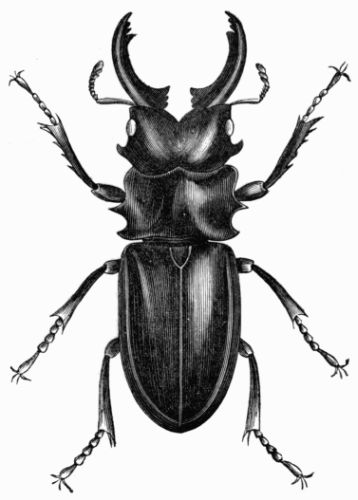
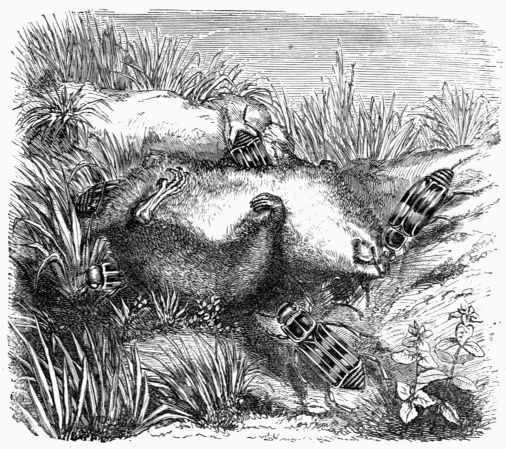
The Histers are small insects, to be recognised by their body being almost round, smooth, and shining, with the elytra marked with striæ, and their mandibles pretty well developed. They attain to a length of about a fifth of an inch. The Silphæ, thus named on account of their broad and rounded form, are of a large size (about half to three-quarters of an inch), of a dark colour, and exhale a sickly odour. When seized, they disgorge a blackish liquid. They introduce themselves under the skin of the carcases of animals, and devour their flesh to the very bone. The larvæ, flat and serrated, live like the adults, in carrion. The commonest species is the Silpha obscura, of an intense black, delicately dotted. Two species found in England and in the environs of Paris, Silpha quadripunctata and the Silpha thoracica, climb trees and attack caterpillars. It appears to be certain that the larva of the Silpha obscura does a great deal of damage to beet-root, whose leaves it devours. The Necrodes come very near to the Silphæ. They are distinguished from them by having the hind legs larger. Only one, Necrodes littoralis, occurs in England. Fig. 459 represents the Necrodes lacrymosa, from Australia. The Necrophori, or Grave-diggers, are honest undertakers, who carefully bury carcases left on the soil. As soon as they smell a field-mouse, a mole, or a fish in a state of decomposition, they come by troops to bury it, getting under the carcase, hollowing out the ground with their legs, and projecting the rubbish they dig out in all directions. Little by little the carcase sinks; at the end of twenty-four hours it has generally disappeared into a hole five inches in depth, but the Necrophori sink it still lower—as far as from seven to ten inches below the surface. They then mount it, cast the earth down into the grave so as to fill it, and the females lay their eggs in the tomb, where the larvæ will find an abundance of food. When the ground is too hard to be dug, the Necrophori push the carcase further, till they find permeable soil. A mole has been run through with a stick, or else tied by a string, to see how the Necrophori would get over the difficulty. They scooped out the soil underneath the stick, and cut through the string, and the mole was buried in spite of the obstacles. Fig. 460 represents a troop of Necrophori burying a small rat.
Fig. 451.—Dorcus Titan.
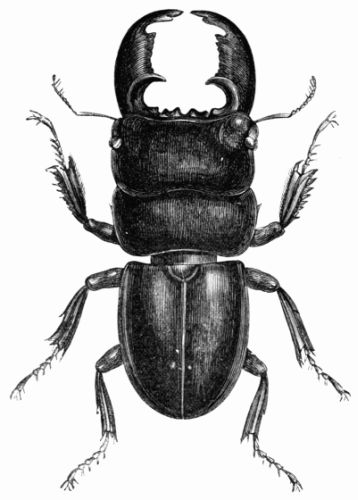
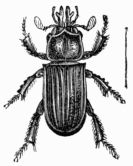
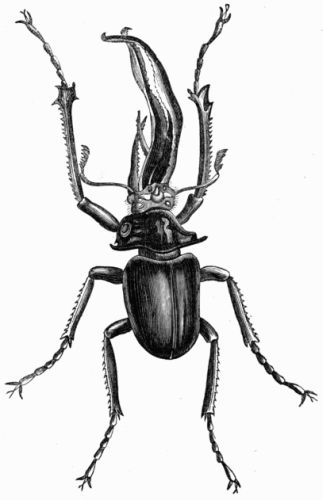
Fig. 452.—Syndesus cornutus. Fig. 453.—Chiasognathus Grantii.
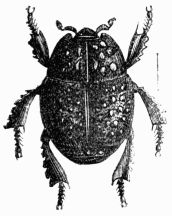
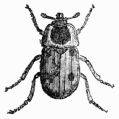
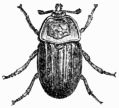
Fig. 454.—Hister rugosus. Fig. 455.—Silpha quadripunctata. Fig. 456.—Silpha thoracica.
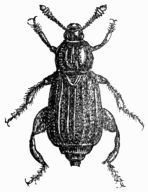
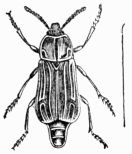
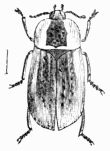
Fig. 457.—Necrodes littoralis (male). Fig. 458.—Necrodes littoralis(female). Fig. 459.—Necrodes lacrymosa.
Fig. 460.—Burying Beetles (Necrophorus vespillo) interring the body of a rat.
The Necrophorus vespillo (Fig. 461) is variegated with yellow and black; the Necrophorus Germanicus (Fig. 462) is larger, quite black, and rarer. All these insects exhale a disagreeable musky smell. Their bodies are often covered with parasites, which are carried along by them by hooking on to their hairs, and which make use of the Necrophorus as a vehicle in which they get their food.
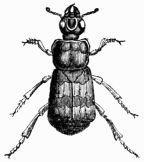
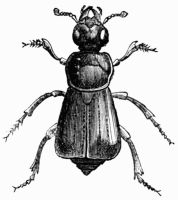
Fig. 461.—Necrophorus vespillo. Fig. 462.—Necrophorus Germanicus.
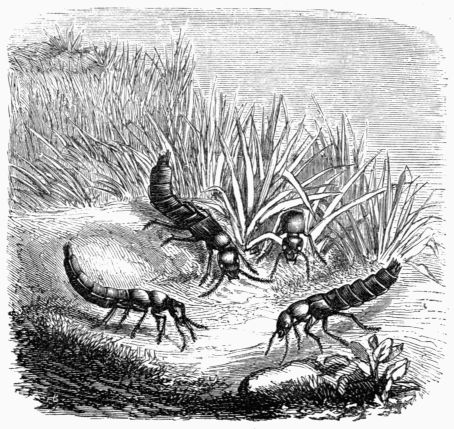
Fig. 463.—Staphylinus (Ocypus) olens, imago, pupa, and larva.
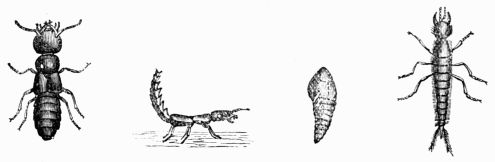
The Staphylinidæ live in the carcases of animals, on manure, in detritus, and attack living insects. They are, for the most part, of small size, and are distinguished by their elytra, which are short, and resemble a waistcoat or a jacket; but their wings are fully developed. The large species have strong mandibles. When irritated, the Staphylini disgorge an acrid black liquid; and by the abdomen they emit a volatile fluid having a musky odour.
We see frequently on roads the Staphylinus olens (Figs. 463 and 464), which, when it finds itself attacked, raises its abdomen, and thrusts out two little whitish bladders, which pour out a volatile liquid. Its larva lives under stones, and its habits are the same as those of the adult insect. It is very carnivorous, and very active, and often attacks those of its own kind. The Staphylinus hirtus (Fig. 466) resembles at a distance a humble-bee, on account of its long yellow hairs. The Staphylinus maxillosus (Fig. 465) has black and white hairs. The genera Pselaphus and Claviger, akin to the above, contain little insects which live as parasites in the nests of ants. The Pselaphus Heisii (Fig. 467), less than a line long, lives on the débris of reeds, on the borders of marshes.
Fig. 464.—Staphylinus (Ocypus) olens.
The Claviger foveolatus (Fig. 468) is met with in the nest of a little yellow ant, which takes as much care of it as of its own progeny, because the Claviger secretes a liquid very much appreciated by ants, who are continually occupied in licking its back.
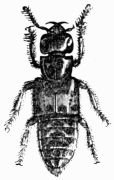
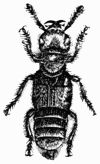
Fig. 465.—Staphylinus maxillosus. Fig. 466.—Staphylinus hirtus.
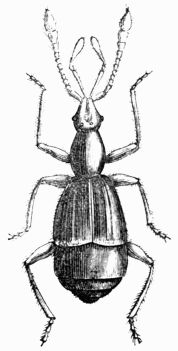
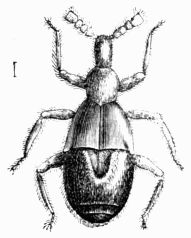
Fig. 467.—Pselaphus Heisii (magnified). Fig. 468.—Claviger foveolatus (magnified).
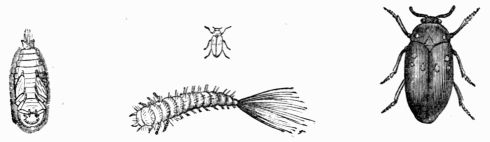
The Dermestidæ attack by preference the tendons and the skins of carcases. A few of the insects of this family are the plague of our collections and the furriers. They devour a quantity of dry substances—skins, feathers, catgut, hair, objects made of tortoise-shell, the dried bodies of insects, &c. Some other Dermestidæ feed on animal matter still fresh: such is the Bacon Beetle, Dermestes lardarius (Fig. 469), which is to be met with in some dirty pork-shops. It is black, with the base of its elytra tawny and marked with three black spots. The larvæ are covered with a russety hair; they eat bacon, skins, and also attack each other. The perfect insect does no damage. Like all the Dermestidæ, it counterfeits death when handled. The Dermestes vulpinus, of a tawny grey, injures furs; and the Hudson's Bay Company, whose storehouses in London were infested by this insect, offered a reward of £20,000 for a means of destroying this insect. The furriers have also cause to dread the Attagenus pellio (Fig. 470), whose larva, covered with yellowish hairs, has at its extremity a sort of broom, which assists it in moving.
Fig. 469.—Bacon Beetle (Dermestes lardarius), magnified and natural size.
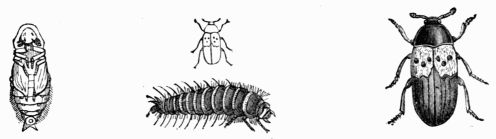
Fig. 470.—Attagenus pellio, magnified and natural size.
The Anthrenus museorum, the fifteenth of an inch in length, black, with three grey bands, drives collectors to despair, for its larva destroys their collections. It is covered with grey and brownish hairs, which it bristles up the moment it is touched. The perfect insect feeds on flowers, and counterfeits death when seized. All possible means have been tried for getting rid of the Anthrenus by placing in the collection camphor, benzine, tobacco, sulphur, &c., but benzine very soon destroys them.
Fig. 471.—Hydrophilus piceus.
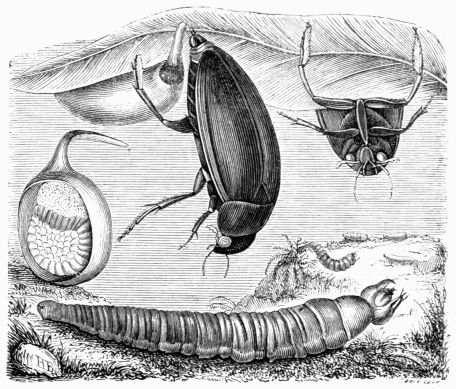
The Hydrophili, very different to the group which we shall presently consider, are herbivorous, and are to be found on the leaves of aquatic plants. The Hydrophilus piceus (Fig. 471), which attains to an inch in length, is common in our fresh waters. It must not be seized without taking precautions, as its breast is provided with a strong point, which pierces the skin. It draws in air by thrusting its antennæ out of the water, and placing them against its body, the bubbles of the air, which get involved in a sort of furrow, slip under the body, and fix themselves to the hair, in such a manner that the animal seems to be clothed in pearls. It is thus the air reaches the spiracles. The female of the Hydrophilus is sometimes seen clinging to aquatic plants, head downwards, forming her cocoon, terminated by a long pedicle, in which she places her eggs, by means of the two bristles situated at the extremity of the abdomen (Fig. 472). After having drawn this after her for some time, she leaves it to itself in calm water. At the end of a fortnight there come out from it little brown larvæ, very active, which ascend the water plants. These larvæ are at the same time herbivorous and carnivorous. They live on plants and small molluscs, which they seize from underneath, and whose shell they break by pressing them against their back, to extract from it the animal. If attacked, they emit a black liquid, which discolours the water, and enables them to escape. At the end of two months the larva comes out of the water, and burrows into the ground to undergo its metamorphosis into a pupa (Fig. 473), which becomes a perfect insect a month afterwards. The latter gets its colour little by little, and comes out of the ground at the end of twelve days. According to M. Dumeril, the intestine of the larva grows gradually longer and longer, and its diet becomes that of herbs, the adult preferring vegetable food to animal matter. It is at the end of summer that the Hydrophilus piceus becomes perfect, and it passes the winter in a state of torpor at the bottom of the water. The females lay in the month of April. A small species, Hydrous caraboides, is commoner than the large one; its body is more rounded behind.
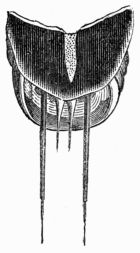
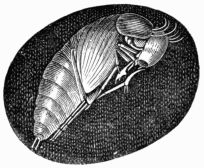
Fig. 472.—Bristles at the extremity of the abdomen of the Hydrophilus. Fig. 473.—Pupa of the Hydrophilus.
We are now going to consider a series of aquatic and carnivorous insects; the Dytisci, Water Beetles, the Cybisters, and the Gyrinidæ, or Whirligig Beetles. These are perfect corsairs, whose rapacity even exceeds that of many of the land Coleoptera. Not contented with devouring one another, when pressed by hunger, with attacking especially the larvæ of all aquatic insects, such as the Libellulæ and Ephemeræ, they feed also on molluscs, on tadpoles, and on small fish. It is easy to rear them in captivity. If confined in a small aquarium, their habits would be much more amusing than a few golden fish, which one meets with everywhere, and which are only good enough to amuse European Schaabahams. Care must be taken to cover the aquarium at the top with gauze, to prevent the perfect insects from escaping. This tribe is not very numerous nor varied in its forms. An oval body, legs curved and widened into oars, provided with hairs, distinguish the insects which compose it. They imbibe air at the surface of the water.
Fig. 474.—Dytiscus marginalis, male and female, and front leg of male magnified.
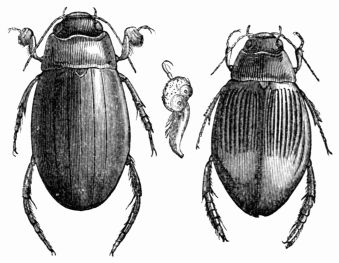
The most carnivorous of this group are the Dytisci and the Cybisters. They may be called the sharks of the insect world. Nothing which lives in the water is safe against the voracity of the Dytiscus. They attack small molluscs, young fish, tadpoles, larvæ of insects, and suck greedily the bits of raw meat which are thrown to them. They may be kept in an aquarium for many years by feeding them on animal matter. Their oval-shaped body, with its sharp sides, permits them to cut through the water with great ease—the hind legs serving as oars. They are to be found in stagnant waters during the greatest part of the year, but principally in autumn. During the winter they bury themselves in the mud and under moss. The females lay their eggs in the water. The larvæ are long, swelling out at the middle, furnished with hairs, and grow rapidly. To undergo their metamorphosis into pupæ they bury themselves in the earth.
Fig. 475.—Pupa and larva of Dytiscus marginalis.
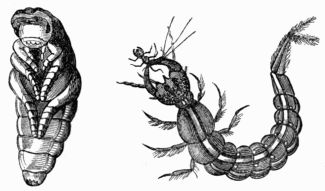
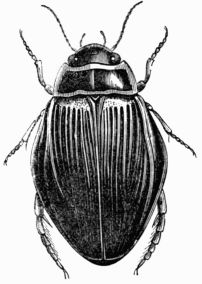
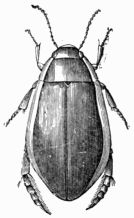
Fig. 476.—Dytiscus latissimus. Fig. 477.—Cybister Rœselii.
The perfect insects are amphibious, and fly from one pond to another to satisfy their voracious appetites. The most common species of this genus is the Dytiscus marginalis (Fig. 474), of a dark greenish brown, yellowish on the sides. The elytra of the male are smooth; those of the female are fluted. The front leg of the male is provided with suckers. The larva is brown; the pupa of a dirty white.
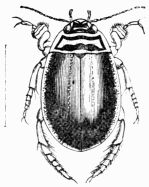
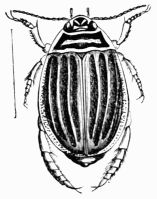
Fig. 478.—Acilius sulcatus (male). Fig. 479.—Acilius sulcatus (female).
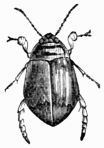
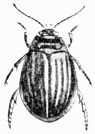
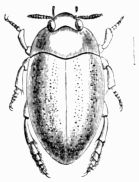
Fig. 480.—Acilius fasciatus (male). Fig. 481.—Acilius fasciatus (female). Fig. 482.—Noterus crassicornis.
The Dytiscus marginalis sometimes attacks Hydrophilus piceus. It pierces it between the head and the thorax, that is, in the weak point of the cuirass, and devours it, in spite of its being the stronger. The largest of the Dytisci, the Dytiscus latissimus (Fig. 476), is almost confined to the north of Europe. The Cybisters abound especially in warm countries. The Cybister Rœselii (Fig. 477), a European species, has the reputation of having been taken in England. This group contains also a great number of insects more or less resembling the preceding in their conformation and habits. We will confine ourselves to representing a few by figures.
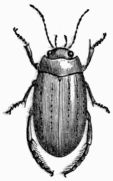
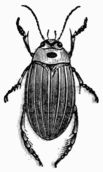
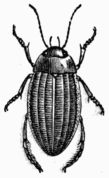
Fig. 483.—Colymbetes cinereus. Fig. 484.—Colymbetes notatus. Fig. 485.—Colymbetes striatus.
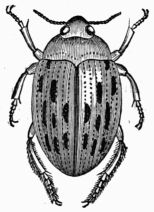
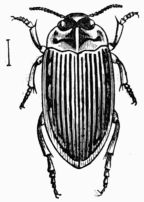
Fig. 486.—Haliplus fulvus. Fig. 487.—Hydroporus griseo-striatus.
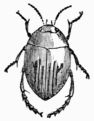
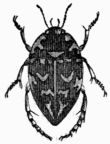
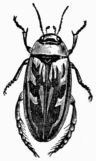
Fig. 488.—Hydroporus confluens. Fig. 489.—Suphis cimicoides. Fig. 490.—Laccophilus variegatus.
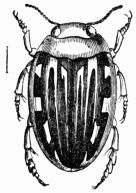
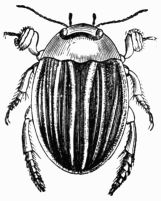
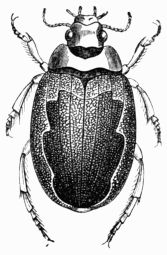
Fig. 491.—Laccophilus minutus. Fig. 492.—Hydaticus grammicus. Fig. 493.—Pelobius Hermanni.
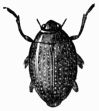
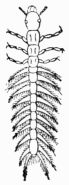
Fig. 494.—Gyrinus natator. Fig. 495.—Larva of Gyrinus natator.
The Gyrinidæ, which come very near to the Dytiscidæ, like water which is clear and a little agitated. They are small black insects, living in troops, and which swim with rapidity, describing incessantly capricious circles, which has gained for them the name of "Whirligigs." They are remarkable for the disposition of their eyes, which are double; so that the Gyrinidæ seem to have four eyes. The lower ones look into the water and watch for the prey or the fish that advances as an enemy; whilst the upper eyes look upwards towards the air, and warn the insect of the approach of enemies from above. To escape from fish, the Gyrinus jumps out of the water, and also makes use of its wings; to escape from birds it dives rapidly. This activity, and this double sight, make the capture of the Gyrini a task of great difficulty. They must be caught with a net. At the moment of being seized they emit a milky and fœtid liquid.
The females lay their eggs end to end, on the leaves of aquatic plants. The larvæ are long and narrow, and of a dirty white. They come out of the water at the end of the summer, and form for themselves a cocoon on the plants bordering the banks. After a month, the perfect insect is hatched, and plunges into the water. The Gyrinus striatus (Fig. 496) is found in the waters of southern Europe.
All these species are of small size, and do not exceed a fifth of an inch in length; but in the tropics we find Gyrini two-thirds of an inch long. One of these species, distinctus, exists in the little lake of Solazies, in Réunion Island, noted for its mineral waters. The visitors amuse themselves by fishing for this insect with a line baited with a bit of red cloth, which it attacks. It is found also in a mineral spring in Algeria. The Epinecti (Fig. 498) are large Gyrinidæ from Brazil, with very long front legs.
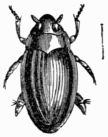
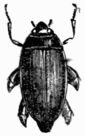
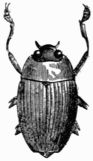
Fig. 496.—Gyrinus striatus. Fig. 497.—Gyrinus distinctus. Fig. 498.—Epinectus sulcatus.
The carnivorous land insects par excellence—those which are most formidable, on account of their ravages and voracity—are the Carabidæ. This family, one of the most numerous of the Order Coleoptera, consists of insects with long legs, and armed with powerful mandibles, suited for tearing their victims to pieces. They are the lions and the tigers of the Coleoptera, whilst the Necrophori and the Silphæ play the part of hyænas and jackals. The eyes of the Carabidæ are very prominent, which allows them to see their prey at a great distance. They take refuge under stones and under the bark of trees; but in fine weather they are also to be seen running along roads. Ardent and audacious, it is by no means rare to see them attacking species much bigger than themselves. The activity which distinguishes these insects is found also in their larvæ, which pursue living prey, instead of remaining shrouded in the midst of their food, like the larvæ of the Scarabæidæ.
These carnivorous insects are very numerous—a fortunate circumstance, considering the immense quantity of small noxious creatures, caterpillars, weevils, and an infinity of other parasites, the pests of agriculture, which they destroy. The popular prejudice, then, is to be regretted, which leads ignorant farmers to exterminate them. They ought, on the contrary, to be introduced into market gardens, as toads are, and as cats are into granaries. "The Carabidæ," says M. Michelet, "immense tribes of warriors, armed to the teeth, which, under their heavy cuirasses, have a wonderful activity, are perfect rural constabulary, day and night, without holidays or repose, protecting our fields. They never touch the smallest thing. They are occupied entirely in arresting thieves, and they desire no salary but the body of the thief himself." But ignorance destroys these useful hunters. Children, seduced by the richness of the elytra of the Carabi, amuse themselves in catching these vigilant protectors of our farms, without knowing the bad effect of what they are doing. Fortunately, education is spreading little by little in the country; the farmers begin to be awakened to their true interests, and to know how to distinguish the useful animals which it behoves them to preserve in their fields for the safeguard of their crops. In some places in France they have already made attempts to introduce the Carabidæ and the Cicindelidæ into gardens, and they have found them succeed very well.
The true Carabi are to be known by their oval convex body, their long antennæ, and elegantly-carved thorax. They are, in general, of more massive forms than the Cicindelidæ, which compose a kindred family. The latter form, in some sort, the vanguard and the light troops; the others, the heavy battalions. The Carabi coming out in general at night, or at least at twilight, and keeping themselves hidden under stones during the day, it is not easy to observe their manœuvres.
The Carabus auratus (Fig. 499), which abounds in fields and gardens on the Continent, may be considered as the type of this genus. It has elytra of a beautiful green, with three ribs, and the legs yellowish. When it is touched it disgorges a black and acrid saliva, and ejects from the abdomen a corrosive liquid of a disagreeable odour. It lives on the larvæ of other insects. It has been seen to attack even large insects, such as the cockchafer.
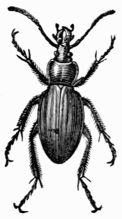
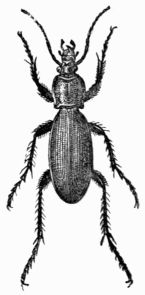
Fig. 499.—Carabus auratus. Fig. 500.—Carabus violaceus.
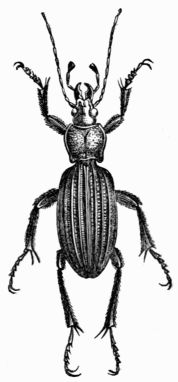
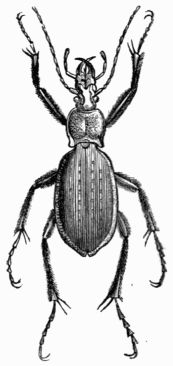
Fig. 501.—Carabus canaliculatus. Fig. 502.—Carabus Adonis.
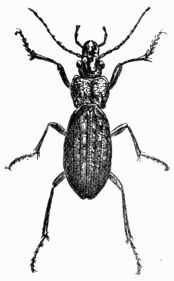
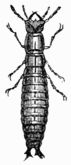
Fig. 503.—Carabus nodulosus. Fig. 504.—Larva of Carabus auronitens.
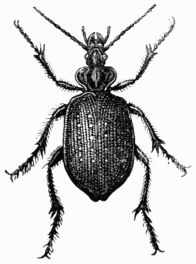
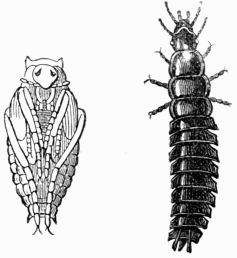
Fig. 505.—Calosoma auropunctata. Figs. 506, 507.—Pupa and larva of Calosoma auropunctata.
In England and the environs of Paris, Carabus violaceus (Fig. 500), whose dress, of a sombre colour, is surrounded by shades of red and violet, is met with. In the Pyrenees many Carabi with metallic reflections are found, whose beautiful colours are the delight of collectors; the Carabus splendens, the Carabus rutilans, &c. But the most beautiful insects of this tribe come from Siberia and the north of China. Let us mention, for example, the Carabus smaragdinus, of a beautiful grass-green; the Carabus Vietinghovii, of a beautiful blue black, bordered with azure, with a golden band, &c.
Fig. 508.—Calosoma sycophanta pursuing a Bombardier Beetle (Brachinus explodens).
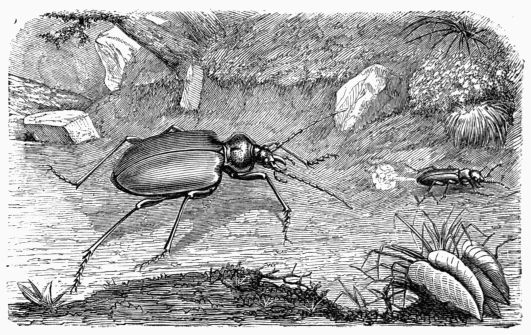
The Carabus Adonis (Fig. 502) is not rare in Alsace, and is found on the banks of streams.
The long flat larvæ of the Carabi live in the trunks of trees, among leaves, under moss, &c. They are active, and live on other insects. Fig. 504 represents the larva of the Carabus auronitens.
Another genus of the same family is Calosoma. They have wings under their elytra—the true Carabi have not—which they use in passing from one tree to another.
In the month of June is to be found on oak trees the beautiful Calosoma sycophanta (Fig. 508), the occasional occurrence of which in England is unquestionable; it is, however, presumed that the specimens have reached our shores from the Continent by flight, favoured by strong easterly winds. This insect is of a beautiful violet blue, having the antennæ and the legs black, and the elytra of a splendid golden green, with longitudinal streaks. According to Réaumur, the larva of the Calosoma often chooses a home in the nest of the Procession-Moth Caterpillar (Bombyx processionea), on oak trees, and it very soon rids the tree which is infested by them.
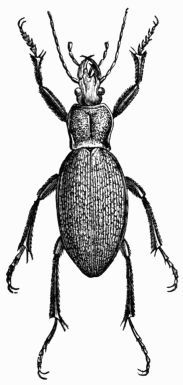
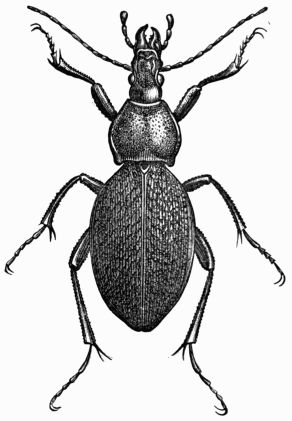
Fig. 509.—Procrustes coriaceus. Fig. 510.—Procerus gigas.
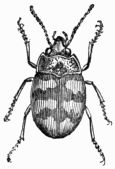
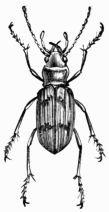
Fig. 511.—Omophron libatum. Fig. 512.—Nebria arenaria.
The Calosoma auropunctata is found in the south of France. Its larva (Fig. 507) devours snails, and establishes itself in their shells. These larvæ have been known to fill themselves so full of food as to become double their natural size, in which state they are sometimes devoured by those of their own species. A smaller kind, the Calosoma inquisitor, is very frequently to be met with in woods. Fig. 508 presents Calosoma sycophanta pursuing a Bombardier (Brachinus explodens), which squirts out a vapour of pungent odour.
In the countries of the south-east of Europe, and in Asia Minor, one finds enormous Carabidæ, the Procrustes and the Proceri, which attain nearly two inches in length, and whose integuments resemble very rough shagreen. One species alone is met with in France, the Procrustes coriaceus (Fig. 509). In Austria is found the Procerus gigas (Fig. 510).
The genus Omophron (Fig. 511) contains small, almost globular Carabidæ of a pale yellow, with green lines, and which live in the sand bordering rivers. The Nebrias in general prefer mountainous countries. The largest species, the Nebria arenaria (Fig. 512), is found all along the coast of the Mediterranean, and even on the western shores of France. But its colours grow paler as it advances northward on the African coast. It is of a bright yellow with black lines. The Nebrias hide themselves either under masses of seaweed cast up by the waves, or under the stumps of trees cast ashore by the sea. When they are deprived of their place of shelter, they run away with such rapidity that it is very difficult to catch them. In Senegal is found the genus Tefflus (Fig. 513), great black Carabidæ with fluted elytra.
Other kindred genera are—Damaster (Fig. 514), remarkable for elongated pointed elytra; Anthia (Fig. 515), which is met with in sand in Africa and in India, and whose head is armed in a formidable manner; and Campylocnemis, of which Schrœteri (Fig. 516), an Australian insect, of a bright black, attains to more than an inch and three quarters in length, and whose short serrated legs enable it to hollow out the ground. There is found on the coasts of the south of France a representative of this group in the Scarites lævigatus (Fig. 517), which conceals itself in a hollow, like the cricket, and devours everything which comes within its reach.
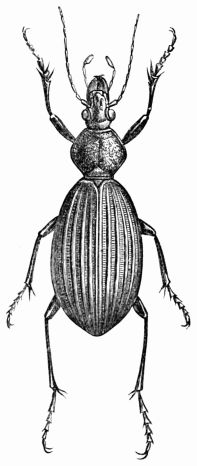
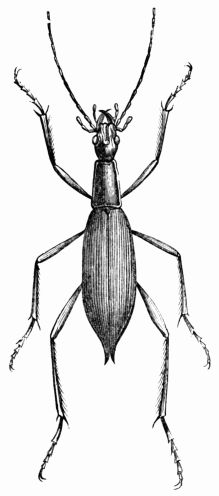
Fig. 513.—Tefflus Megerlei. Fig. 514.—Damaster blaptoides.
The innumerable tribe of Harpalidæ contains carnivorous beetles of very small size, sometimes of a bronze-green, sometimes black, either dull or shining, and which render great service to our gardens. Hidden under stones, in dry leaves, at the foot of trees, they attack a number of small insects, caterpillars, millepedes, &c., and thus exterminate a quantity of vermin. The Harpalus æneus (Fig. 518), which is seen shining in the midst of the paving stones like a little bronze plate, is found everywhere. The Galeritas (Figs. 519 and 520) are distinguished by their antennæ, which are thick at the base; they exhale a very strong odour: nearly all are peculiar to America. One of the most curious insects of this tribe is the Mormolyce phyllodes of Java (Fig. 521) whose elytra project in such a manner as to give it the appearance of a leaf. It lives under bark. The larva and the pupa (Fig. 522) resemble those of other genera of which we have been speaking.
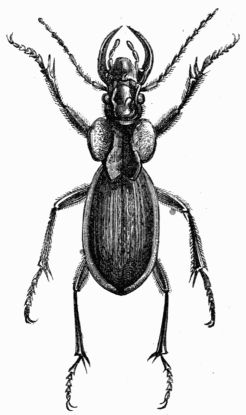
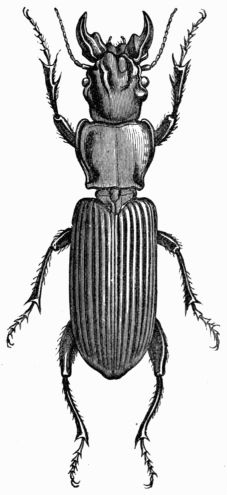
Fig. 515.—Anthia thoracica. Fig. 516.—Campylocnemis Schrœteri.
The next great family of the tribe of carnivorous beetles is composed of the Cicindelidæ—slender insects, with large prominent heads, very long legs, and which are very active in their movements. The Cicindelidæ like sandy plains. When the sun shines they fly in a zig-zag manner, but their flight is not continued for long together. In dull weather they are to be seen running on the turf or hiding themselves in holes, and are met with on the sea-shore, where they are seen sometimes to pop up by hundreds. They live on flies and little shrimps, which abound on the sea-shore.
Fig. 517.—Scarites lævigatus.
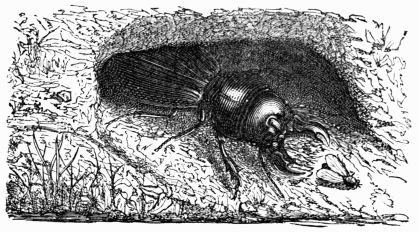
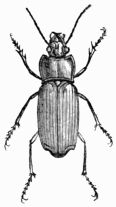
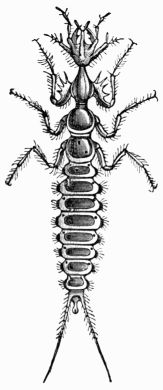
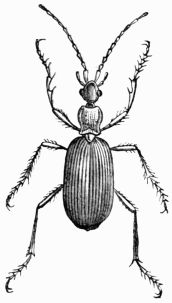
Fig. 518.—Harpalus æneus. Fig. 519.—Larva of Galerita Lecontei. Fig. 520. Galerita Lecontei.
Fig. 521.—Mormolyce phyllodes.
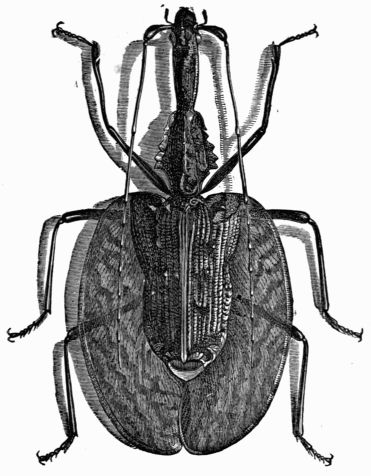
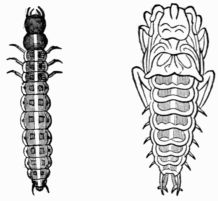
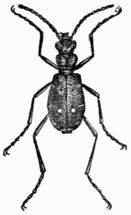
Fig. 522.—Larva and pupa of Mormolyce phyllodes. Fig. 523.—Tiger Beetle (Cicindela campestris).
The Cicindela campestris (Fig. 523), or Tiger Beetle, is of a beautiful green, spotted with white; the abdomen is of a bronze red. In this country it is the commonest of the genus. The Cicindela hybrida, of a dull green, relieved by light bands, inhabits sandy woods. The Cicindela maritima differs from the preceding. The Cicindela sylvatica, which flies very well, is not easy to catch, and is to be often met with in the warm glades of the forest of Fontainebleau and at Montmorency; it is not unfrequent here. Its colour is brown, spotted with white; it diffuses a strong smell of the rose, to which succeeds, on being seized, the acrid odour of the secretion which it disgorges. We here represent the Cicindela Dumoulinii (Fig. 524), the Cicindela rugosa (Fig. 525), the Cicindela scalaris (Fig. 526), the Cicindela heros (Fig. 527), the Cicindela quadrilineata (Fig. 528), and the Cicindela capensis (Fig. 529).
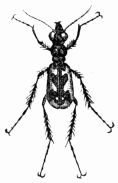
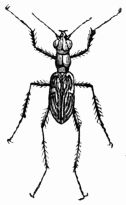
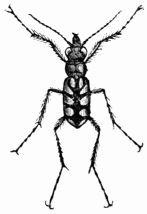
Fig. 524.—Cicindela Dumoulinii. Fig. 525.—Cicindela rugosa. Fig. 526.—Cicindela scalaris.
The ferocity of these insects is remarkable. They quickly tear off the wings and legs of their victim, and suck out the contents of its abdomen. Often, when they are disturbed in this agreeable occupation, not wishing to leave it, they fly away with their prey; their flight, however, is not sufficiently powerful to allow of their carrying to any great distance such a heavy burden. When a Cicindela is seized between the fingers, it moves about its mandibles and en deavours to pinch, but its bite is inoffensive and not very painful. They are prodigiously active in running. Armed with jaws which are powerful enough to overcome their victims and to seize them at once, they can dispense with stratagem.
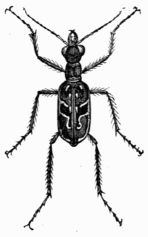
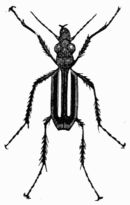
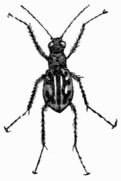
Fig. 527.—Cicindela heros. Fig. 528.—Cicindela quadrilineata. Fig. 529.—Cicindela capensis.
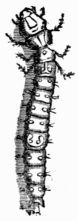
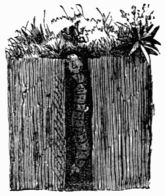
Fig. 530.—Larva of Cicindela campestris. Fig. 531.—Ambush of larva of Cicindela campestris.
Their larvæ (Fig. 530) are soft, and have short legs. To satisfy their voracity they are obliged to lie in ambush in holes. They are two-thirds of an inch long; their head is horny and in the form of a trapezium. The first segment is also horny, and of a metallic green. The eighth has a pair of tubercles with hooks, of which the larva makes use in ascending and descending its vertical hole, like a sweep in a chimney. This hole (Fig. 531) is a foot or more deep. To dig it, the larva employs its mandibles and its legs in the following manner: it twists itself round, loads with earth the flat surface which covers its head, climbs along the chimney by twisting itself into the form of the letter Z, and thus transports its load, as a bricklayer's labourer carries a hod of mortar up a ladder. Arrived at the mouth of the hole, it throws to a distance the rubbish with which its head is loaded; or, if too heavy, it simply deposits it, pushing it away as far as possible. It is difficult to watch their proceedings, for they are very mistrustful, and retire immediately into their hole when alarmed. They remain in ambush at the entrances of these subterranean passages, which they hermetically seal with their head and thorax. It is a species of pitfall which sets itself in motion the moment anything endeavours to pass it. The unfortunate who ventures is precipitated into the well, and the Cicindela forthwith devours it. These habits remind one of those of the ant-lion. When the time arrives for the metamorphosis, the larva of the Cicindela enlarges the bottom of its hole, and stops up the entrance with earth before changing. The pupa (Figs. 532, 533) is of a pale glossy yellow, covered with small spines. The metamorphosis takes place between August and October; the perfect insect emerges in spring.
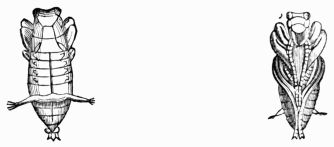
Upper-side. Under-side.
Fig. 532, 533.—Pupa of a Cicindela
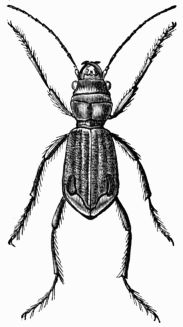
Fig. 534.—Tetracha Klugii. Fig. 535.—Tetracha oxychiloides.
Nearly akin to the Cicindelas are the Tetrachas (Figs. 534, 535, 536), from Africa and tropical America; the Manticoras (Fig. 537), which are distinguished by their robust and thick-set appearance; the Pogonostomas (Fig. 538), which live in Madagascar; the Ctenostomas, peculiar to America (Fig. 539), remarkable for the length of their pendent and bristly palpi; the Omus, of California; the Therates (Fig. 540), insects of the East Indian Islands, &c.
Fig. 536.—Tetracha bifasciata.
The tribe of Tenebrionidæ, called formerly Melasomas, because they are nearly all black, resembles in some points the Carabici. They seek after dark places, and avoid the light, and are found on the ground under stones; their movements are slow, and they walk with difficulty. The best-known insect of this group is the Blaps, of repulsive smell, inhabiting dark damp places, such as cellars, and only coming out of its retreat during the night. The elytra are joined together, and they have no wings. The vulgar regard them as an omen of ill-luck. Fig. 541 represents the Blaps obtusa. According to the report of a traveller, the women in Egypt eat the Blaps sulcata cooked with butter, to make them fat. They are employed also against the ear-ache, the bite of scorpions, &c.
Another genus of the same family is the Tenebrio (Fig. 542), of a blackish-brown, with the elytra striated, and of half an inch in length. The larvæ, the well-known meal-worms, live in flour; they are cylindrical, and of a light tawny colour (Fig. 542). The insect which is considered as a type of the tribe of the Pimelides is the Pimelia bipunctata, which is common in the south of France.
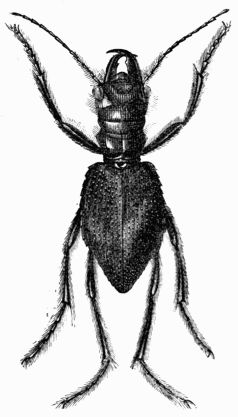
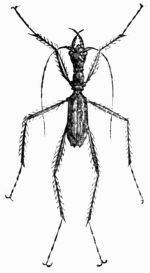
Fig. 537—Manticora tuberculata. Fig. 538.—Pogonostoma gracilis.
We come now to the tribe of blistering beetles, of which the best known is the Cantharides (Cantharis or Lytta). These insects are generally of soft consistency, and their elytra very flexible. A few remain constantly on trees. All are very brisk and active. When swallowed they are a dangerous poison, but are used in medicine for making blisters.
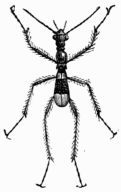
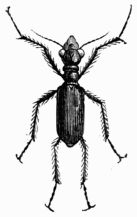
Fig. 539.—Ctenostoma rugosa. Fig. 540.—Therates labiata.
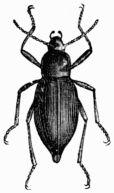
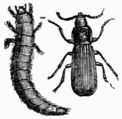
Fig. 541.—Blaps obtusa. Fig. 542.—Tenebrio molitor (larva and imago).
The Cantharides of commerce (Cantharis [Lytta] vesicatoria) are of a beautiful green, attain to a size of four-fifths of an inch, and are found on ash-trees, lilacs, and other shrubs. Commerce for a long time brought them from Spain, and some still come from that country; hence the common name of Spanish fly. As they live in great numbers together, collecting them is easier and less expensive than would be that of other species of the same family which are not gregarious, but which have the same medicinal properties. The presence of the Cantharides is manifested by the strong penetrating odour which they diffuse to some distance. When, by aid of this smell, they are discovered, generally settled on an ash, they are collected in the following manner:—Very early in the morning a cloth of light tissue is stretched out at the foot of the tree, and the branches are shaken, which causes the insects to fall (Plate XII.). These, numbed by the cold of the night, do not try to escape. When there is a sufficient quantity, the four corners are drawn up and the whole plunged into a tub of vinegar diluted with water. This immersion causes the death of the insects. They then carry them to a loft, or under a very airy shed. To dry them they spread them out on hurdles covered with linen or paper, and from time to time, to facilitate the operation, they are moved about, either with a stick or with the hand, which is more convenient; but it is then necessary to take the precaution of putting on gloves, for, if touched with the naked hand, they would cause more or less serious blisters. The same precaution must be observed in gathering them.
When the Cantharides are quite dry, they put them into wooden boxes or vessels of glass or earthenware hermetically sealed, and preserve them in a place protected from damp. With these precautions, they may be kept for a long while without losing any of their caustic properties. Dumeril made blisters of Cantharides which had been twenty-four years in store, and which had lost none of their energy. When dry, they are so light that a kilogramme contains nearly 13,000 insects. Aretius, a physician who flourished at Rome in the first century of our era, seems to have been the first to employ Cantharides, reduced to powder, as a means of vesication. Hippocrates administered them internally in cases of dropsy, apoplexy, and jaundice. But it is pretty nearly established that the Cantharides of the ancients were not the same species used at the present day; they were, probably, a kindred species, the Mylabris chicorii. A blistering principle has been extracted from these insects, called Cantharadine. This organic product presents itself under the form of little shining flakes, without colour, soluble in ether or oil. One atom of this matter applied to the skin, and particularly to the lower lip, makes the epidermis rise instantaneously, and produces a small blister filled with a watery liquid. In spite of the corrosive principle which the Cantharis contains, it is attacked, like other dried insects, by the Dermestes and the Anthrenus, which feast on them without suffering the smallest inconvenience.