Front matter (continued 5)
Reading edition
Fig. 186.—Deilephila (Chærocampa) elpenor.
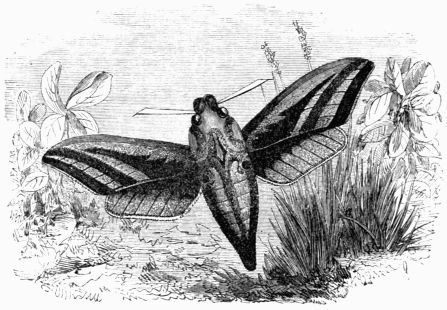
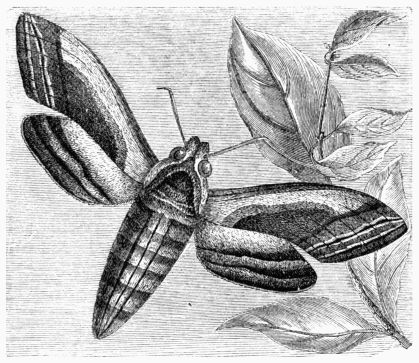
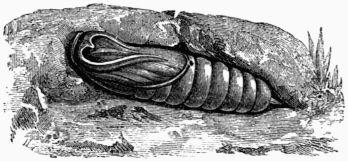
The caterpillar of this sphinx (Fig. 187) is of a dark brown, delicately striped with black. Two grey lines run down each side of its body, and on the fourth and fifth segments are two black eyes bordered by light violet. This caterpillar is found most often on certain kinds of Epilobium, but will also eat of the vine, fuchsia, and bed-straw. It must be sought in damp places, by streams and ponds, from the end of July till September. It constructs on the surface of the soil a shapeless cocoon with moss and dry leaves, which it fastens together with some silky threads. Its pupa (Fig. 188), of a yellowish brown, has short bristles on the rings of the abdomen. The caterpillar possesses in the highest degree the retractile power which has gained for certain species of this genus their popular names. The Privet Sphinx (Sphinx ligustri, Fig. 189) has its upper wings rather narrow, about two inches long, of a reddish grey, and veined with black above, with the middle of a dark brown, the inner margin with rose-coloured hairs, and the hind margin having two whitish flexuous lines running along it. The hind wings are of a rose tint, with three black bands. The wings are of a reddish grey below with a common black band. The abdomen has black and rose-coloured rings above, and in the middle a brownish band wholly divided by a black line.
Fig. 187.—Larva of Deilephila (Chærocampa) elpenor.
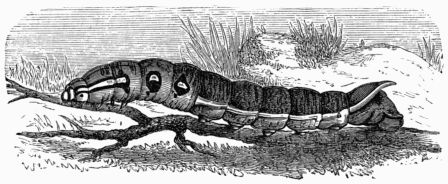
Fig. 188.—Pupa of Deilephila (Chærocampa) elpenor.
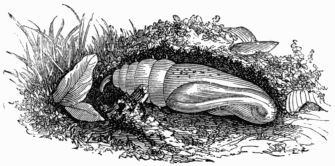
Fig. 189.—Privet Hawk-Moth (Sphinx ligustri).
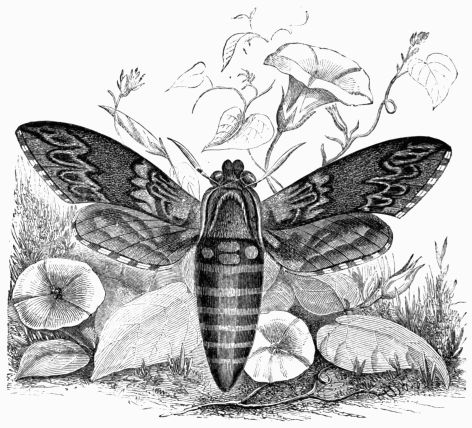
This species is very common in all parts of Europe. One finds it in gardens from June to September. Of all the caterpillars of the genus Sphinx, this is the one which, by its attitude when in a state of repose, most resembles the sphinx of fable, from which the genus has derived its name. It is of fine apple green, with seven oblique stripes, half violet and half white, placed on each side of its body, and three or four small white spots beyond these stripes. The stigmata are orange, the head is green, bordered with black. The extremity of the body is surrounded by a smooth horn, black above, yellow below (Fig. 190). This beautiful caterpillar is not rare. It lives on a great number of trees and shrubs, but it is principally on the privet, the lilac, and the ash tree, that it must be looked for. Three or four days before it buries itself in the earth to change itself into a chrysalis, its beautiful colours grow dim. During the month of June and September is found the Convolvulus Sphinx (Sphinx convolvuli, Fig. 192), with brown wings, and with the abdomen striped with transverse bands alternately black and red. The caterpillar of this species, which presents a great number of varieties, lives on many kinds of Convolvuli, but particularly on the field species. It is generally rare here, but occasionally abundant.
Fig. 190.—Larva of the Privet Hawk-Moth (Sphinx ligustri).
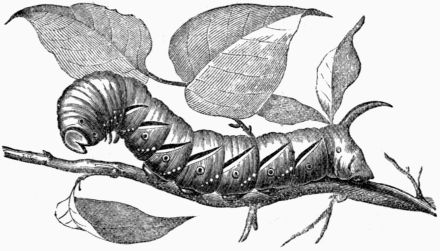
Fig. 191.—Pupa of Sphinx ligustri.
It is to the genus Acherontia that a well-known moth belongs. We refer to the Death's-head Moth (Acherontia atropos). It is the largest species of hawk-moth. This insect presents, roughly marked out in light yellow, on the black ground of its thorax, a human skull. This funeral symbol, joined to the plaintive cry which this moth emits when frightened, has sometimes inspired terror into the whole population of a country. The appearance of this moth in certain countries having coincided with the invasion of an epidemic disease, some thought they saw in this doleful sylph of the night the messenger of death. The Acherontia atropos plays a great part in the superstitions which are believed in by the country folk in England. One hears it said in country places that this ominous inhabitant of the air is in league with the witches, and that it goes and murmurs into their ears with its sad and plaintive voice the name of the person whom death is soon to carry off. In spite of its ominous livery, the Atropos does not come from Hades; it is no envoy of death, bringing sadness and mourning. It does not bring us news of another world; it tells us, on the contrary, that Nature can people every hour; that it was her will to console them for their sadness, to grant to the twilight and to the night the same winged wanderers which are at once the delight and ornament of the hours of light and of day.
Fig. 192.—The Convolvulus Sphinx (Sphinx convolvuli).
This is the mission of science, to dissipate the thousands of prejudices and dangerous superstitions which mislead ignorant people.
Fig. 193.—Death's-head Hawk-Moth (Acherontia atropos).
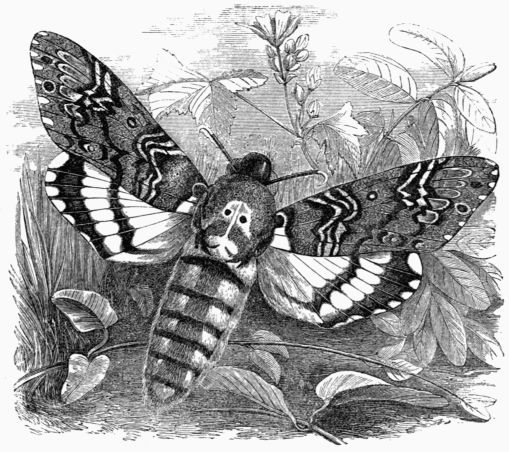
This moth has the front wings of a blackish brown colour, having lighter irregular bands varied with brown and grey, above and below. On the middle of the front wing there is a well-defined white dot. The hind wings have two black bands, the upper narrower than the lower one; the rest of the wing is a fine yellow. The abdomen has likewise from five to six yellow and as many black bands; in the middle is a long blackish longitudinal band. This moth is not very rare, and may be found in autumn. Its flight is heavy, and, as we have said, the insect never flies till after sunset. If caught, or when teased, it utters a cry which is very audible.
The death's-head hawk-moth would be a very inoffensive being if it did not make its way into bee-hives, in order to steal the honey, of which it is excessively fond. It is to no purpose that the bees dart their stings at the intruder, they only blunt them against its thick skin, and soon, terrified at its presence, disperse on all sides.
Fig. 194.—Larva of the Death's-head Hawk-Moth (Acherontia atropos).
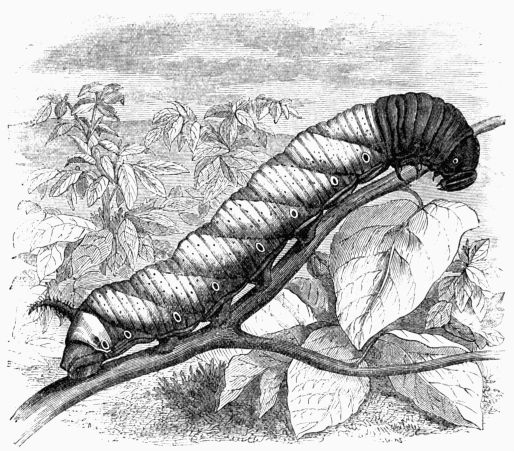
The caterpillar of the Acherontia atropos (Fig. 194) is the largest of all European caterpillars. It attains to as much as four and a half inches in length by eight lines in diameter. Its colour is lemon yellow, which changes into green on the sides and belly. From the fourth to the tenth ring inclusively it is ornamented laterally with seven oblique bands of an azure blue, which are tinted with violet, and bordered with white on the side. These bands joining together over the back of each segment resemble so many chevrons placed parallel to each other. The body is, moreover, dotted with black. At its extremity is a yellow horn, curved back like a hook, and covered with tubercles. The head is green, and marked laterally with a black stripe. It lives chiefly on the potato, and the Lycium barbarum, sometimes called the tea-tree, a shrub belonging to the Solanaceæ. It buries itself in the earth to change into a chrysalis (Fig. 195) of a bright chestnut brown.
Fig. 195.—Chrysalis of the Death's-head Hawk-Moth.
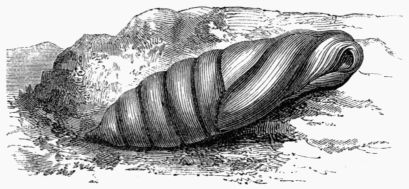
Fig. 196.—Lime Hawk-Moth (Smerinthus tiliæ).
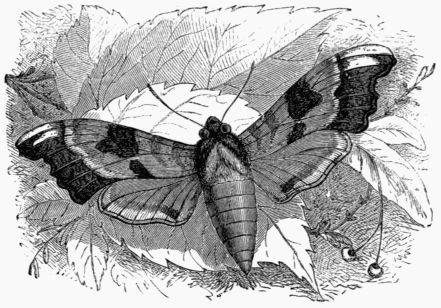
Fig. 197.—Larva of the Lime Hawk-Moth (Smerinthus tiliæ).
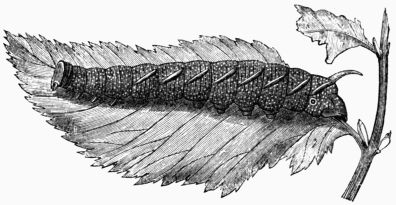
Fig. 198.—Eyed Hawk-Moth (Smerinthus ocellatus).
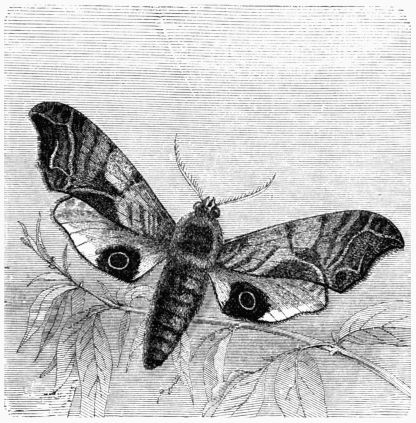
We will mention still further, in the family of the Sphingidæ, three species of the genus Smerinthus, which fly heavily and by twilight.
The Lime-tree Hawk-moth (Smerinthus tiliæ, Fig. 196) has its upper wings grey with some shades of green, and moreover, in the middle of the wing an irregular band of a brownish green colour. The thorax, covered with hairs, is grey, with three green longitudinal bands. The abdomen is also grey. The moth flies heavily after sunset, and is found on the trunks of trees during the months of May and June. The larva (Fig. 197) is glaucous green dotted with yellow, and marked on each side with seven oblique lines of the same colours. Its wrinkly horn is blue above and yellow below. It is found on the lime and the elm. It buries itself at the foot of the tree on which it has fed to change into a chrysalis without making a cocoon.
Fig. 199.—Poplar Hawk-Moth (Smerinthus populi).
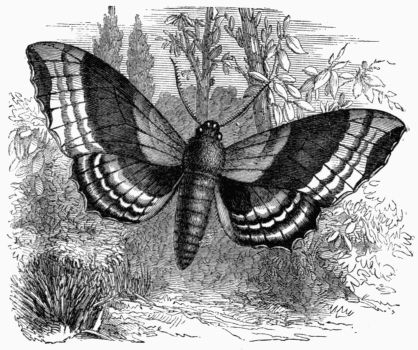
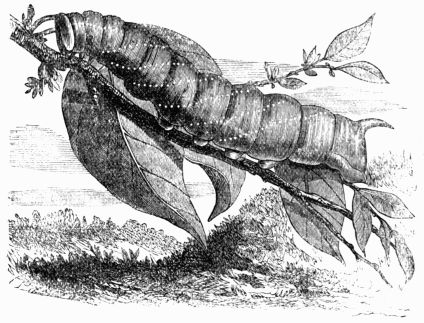
We will content ourselves by here giving drawings of two other species of the same genus: the Eyed Hawk-Moth (Smerinthus ocellatus, Fig. 198), which is not rare during the months of May and sometimes August, the caterpillar of which lives on the leaves of willows, poplars, and fruit-trees; and the Poplar Hawk-Moth (Smerinthus populi, Fig. 199), whose caterpillar (Fig. 200) lives on the poplar, the aspen, and sometimes on the willow and birch.
The division of Bombycina contains the largest of moths, and at the same time species of a middle and small size. These moths take no nourishment, and live only for a short time—long enough to propagate their species. They rarely fly during the day, only showing themselves in the evening. The group is dispersed over nearly all parts of the world, and may be recognised by the antennæ generally being cut like the teeth of a comb in the males, by their thick, strong bodies, and, in the majority of cases, by their large head, by their wings more or less large, and by their heavy flight.
Fig. 200.—Larva of the Poplar Hawk-Moth (Smerinthus populi).
In the Bombycina are found the genera Sericaria, Attacus, Bombyx, Orgyia, Liparis, &c.
It is to the genus Bombyx that the silkworm belongs, that celebrated insect called by Linnæus Bombyx mori, a name which reminds us at the same time of its most ancient denomination, and of the mulberry tree, on which these caterpillars feed.
M. Guérin-Méneville has called the silkworm "the dog of insects," for it has been domesticated from the most ancient times, and has become deprived of great part of its strength in the process. The moth of the silkworm can no longer keep its position in the air, or on the leaves of the mulberry when they are agitated by the wind. It can no longer protect itself, under the leaves, from the burning heat of the sun and from its enemies. The female, always motionless, seems to be ignorant of the fact that she has wings. The male no longer flies; he flutters round his companion, without quitting the ground. It ought, however, to be possessed in the wild state of a sufficiently powerful flight. M. Ch. Martins found that after three generations reared in the open air, the males recovered their lost power.
Before speaking of the different phases of the life of the silkworm and the rearing of this precious insect, we will notice the origin and progress of the silk trade, one of the most important branches of commerce in the South of Europe and in the East.
The native country of the silkworm is not better known than that of the greater number of plants and animals which form the staple of agricultural industry. Probably, however, it was China. It was certainly in this vast empire that long since the business of fabricating silk began. One reads the following in "L'Histoire générale de la Chine," by M. Mailla:—
"The Emperor Hoang-ti, who lived 2,600 years before our era, wished that Si-ling-chi, his wife, should contribute to the happiness of his people; he charged her to study the silkworm, and to try to utilise its threads. Si-ling-chi caused a great quantity of these insects to be collected, which she fed herself in a place destined exclusively for the purpose; she not only discovered the means of rearing them, but still further the manner of winding off their silk and of employing it in the manufacture of fabrics."
It may be asked, however, if the learned men who composed this recital did not collect under the reign of the emperor Hoang-ti all the events and all the discoveries whose dates were lost in the obscurity of the most remote periods of history. Is not the Empress Si-ling-chi a mythical person? a sort of Chinese Ceres, to whom, under the title of goddess of the silkworm, they then raised altars?
Here, at any rate, is how Duhalde[50] analyses the recital of the Chinese annalists on the remarkable fact of the introduction of the silkworm and its rich products into the Chinese empire:—
"Up to the time of this queen (Si-ling-chi)," says he, "when the country was only lately cleared and brought into cultivation, the people employed the skins of animals as clothes. But these skins were no longer sufficient for the multitude of the inhabitants; necessity made them industrious; they applied themselves to the manufacture of cloth wherewith to cover themselves. But it was to this princess that they owed the useful invention of silk stuffs. Afterwards, the empress, named by Chinese authors, according to the order of their dynasties, found an agreeable occupation in superintending the hatching, rearing, and feeding of silkworms, in making silk, and working it up when made. There was an enclosure attached to the palace for the cultivation of mulberry trees.
"The empress, accompanied by queens and the greatest ladies of the court, went in state into this inclosure, and gathered with her own hand the leaves of three branches which her ladies in waiting had lowered till they were within her reach; the finest pieces of silk which she made herself, or which were made by her orders and under her own eye, were destined for the ceremony of the grand sacrifice offered to Chang-si. (Plate V.)
"It is probable," adds Duhalde, "that policy had more to do than anything else with all this trouble taken by the empresses. Their intention was to induce, by their example, the princesses and ladies of quality, and the whole people, to rear silkworms: in the same way as the emperors, to ennoble in some sort agriculture, and to encourage the people to undertake laborious works, never failed, at the beginning of each spring, to guide the plough in person, and with great state to plough up a few furrows, and in these sow some seed.
"As far as concerns the empresses, it is a long time since they have ceased to apply themselves to the manufacture of silk; one sees, nevertheless, in the precincts of the imperial palace, a large space covered with houses, the road leading to which is still called the road which leads to the place destined for the rearing of silkworms, for the amusement of the empresses and queens. In the books of the philosopher Mencius, is a wise police rule, made under the first reigns, which determines the space destined for the cultivation of mulberry trees, according to the extent of the land possessed by each private individual."
M. Stanislas Julien[51] tells us of many regulations made by the Emperor of China, to render obligatory the care and attention requisite to rearing silk.
Tchin-iu, being governor of the district of Kien-Si, ordered that every man should plant fifty feet of land with mulberry trees. [52] The Emperor (under the dynasty of Witei) gave to each man twenty acres of land on condition that he planted fifty feet with mulberry trees.[53] Hien-tsang (who ascended the throne in 806) ordered that the inhabitants of the country should plant two feet in every acre with mulberry trees.[54] The first Emperor of the dynasty of Song (who began to reign about the year 960) published a decree forbidding his subjects to cut down the mulberry trees. [55]
V.—The Empress Si-ling-chi gathering Mulberry Leaves.
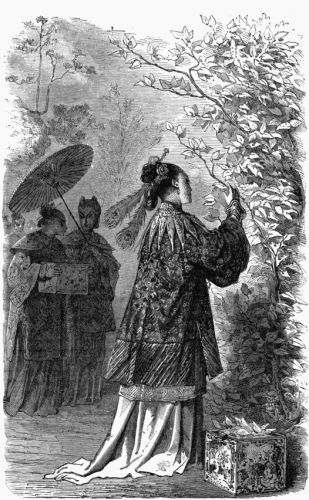
By all these means, according to the testimony of M. Stanislas Julien, the business of the fabrication of silk became general in China. This great empire soon furnished its neighbours with this precious textile material, and created for its own profit a very important branch of commerce.
It was forbidden, under pain of death, to export from China the silkworm's eggs, or to furnish the necessary information in the art of obtaining the textile material. The manufactured article only could be sold out of the empire. It was thus that the Asiatic nations very soon understood silk; and that in many of their cities they applied themselves to weaving stuffs of this precious substance. The carpets and dyed stuffs of Babylon, mixed with gold and silk, enjoyed in ancient times an unparalleled renown. China was not, however, the only country that then furnished silk to the towns of Asia Minor. At a very distant period India sent by her caravans very considerable quantities of it. M. Émile Blanchard (of the Institute) remarks, however, that the tissues of India must be made of a different silk from that of China, that is to say, of a silk of some of those Bombyces of which the public has been told so much of late years, and of which we shall have soon to speak.
Silk commanded for centuries a prodigiously high price. In the time of Alexander its value in Greece was exactly its own weight in gold, and so it was very parsimoniously employed in silk tissues. These were so transparent that women who wore them were scarcely covered.
Silk was unknown to the Romans before Julius Cæsar. It was to him that Rome owed its acquaintance with this new material. He introduced it, moreover, in a singularly magnificent manner. One day, at a fête given in the Colosseum—a combat of animals and gladiators—the people saw the coarse tent of cloth, intended to keep off the rays of the sun, replaced by a magnificent covering of Oriental silk. They murmured at this gorgeous prodigality, but declared Cæsar a great man. The introduction of silk among the Romans was the signal for luxurious expenditure. The patricians made a great display with their silk cloaks of incalculable value; so that, from the time of Tiberius, the Senate felt itself called upon to forbid the use of silk garments to men. Examples of simplicity are sometimes set in high places; thus, the Emperor Aurelian refused to the Empress Severina so costly a dress.
The commerce in silk bore doubly hard upon Europe, both on account of the value of the material and of the great use which was made of it. Persia was the emporium, and had the monopoly of this merchandise. The Emperor Justinian I., who reigned at Constantinople from A.D. 527 to 565, tried all the means within his power of freeing his States from this ruinous tyranny, when a circumstance occurred, very fortunately for the national commerce, which brought about the introduction into Europe of sericulture, or the cultivation of silk.
Two monks of the order of St. Basil, in their ardour for the propagation of the faith, had pushed forwards into China. There they had been initiated into the operations which furnished the fabric so highly prized. On their return to Constantinople, and hearing of the project that Justinian entertained of depriving the Persians of the monopoly in silk, the two monks proposed to the Emperor to enrich his state by introducing the art of fabricating this material. The proposition was greedily accepted, and the two monks returned again to China, with the object of procuring the eggs of the insect. Having arrived at the end of their journey, they succeeded in getting possession of a quantity of silkworms' eggs. They hid them between the knots of their sticks, and started back to their native country, without being once interfered with. Two years afterwards they re-entered Constantinople with their precious booty. [56] The larva were fed on mulberry leaves. Immediately afterwards began the rearing of the worms and the preparation of the silk, according to the instructions given by these courageous travellers. The first broods succeeded perfectly, and so plantations of mulberry trees were seen to multiply and spread through the whole extent of the Eastern Empire. It was, above all, in Southern Greece that this branch of industry assumed an immense importance. It was then the Pelopon nesus lost its old name, and was called the Morea, from the Latin name for "mulberry," morus. [57]
Constantinople and Greece, during centuries, furnished the whole of Europe with silkworms. This diffusion, however, was effected very slowly. The Greeks attached great importance to retaining the monopoly, and the emperor Justinian had caused to be established at Constantinople itself silk manufactories, where the most skilful artificers of Asia, who were forbidden to reveal the various processes to strangers, worked.
Towards the beginning of the eighth century the Arabs introduced the silkworm into Spain. But this industry remained confined within narrow limits. It was in fact not till after the twelfth century that sericulture began to spread throughout Europe. Roger, King of the Two Sicilies, possessing a navy that commanded the Mediterranean, employed it chiefly in making excursions and conquests. He ravaged Greece, and, not satisfied with the booty he carried away from that unfortunate country, wished still further to deprive them, for the good of his own kingdom, of the silk monopoly, the source of their riches. Roger carried away into Sicily and Naples a great number of prisoners, amongst whom were some weavers and men who had devoted themselves to the rearing of silkworms. In 1169 he established these workmen in houses adjoining his own palace at Palermo. There they dyed the silk of different colours, and mixed it with gold, pearls, and precious stones.
From Sicily the art of preparing silk spread over the rest of Italy. In 1204 the workers in silk constituted themselves into a syndicate at Florence. It is not, however, till 1423—more than two hundred years after the introduction of this branch of industry into Italy—that we find the first mention of the cultivation of the mulberry tree in Tuscany. In 1440 each Tuscan peasant was forced to plant at least five mulberry trees on the land he cultivated. In 1474 the commerce in silk fabrics with all parts of the world had become extremely prosperous at Florence. In 1314 the Venetian manufactures began to assume much importance. Three thousand workers in silk were then established in Venice.
Without dwelling longer on the propagation of the silk trade in Italy, let us pass on to its establishment in France. It was in 1340 that some French gentlemen, who had stayed some time in Naples, planted in Avignon the first mulberry trees. [58] According to Olivier de Serres, it was not introduced till much later into Dauphiné. It was not introduced into Alan, near Montelimart, till 1495, by the Seigneur Guyape de Saint-Aubain. [59] Louis XI. made great efforts to develop the silk trade in France, by inviting over Italian workmen; and they began under his reign to fabricate silks in Touraine and Lyons. Francis I. greatly developed the trade of Lyons. In 1554, under Henry II., the masters and men employed in the manufacture of gold, silver, and silk in Lyons were twelve thousand in number. Under Henry II. were planted the mulberry trees of Bourdezière, Tours, Chenonceaux, Toulouse, and Moulins. These plantations, however, were of very small extent. They were not the result of a general and truly popular effort; moreover, civil war came very soon, and turned men's minds away from the isolated attempts of some few private individuals. Sericulture, in fact, did not assume any great importance in France till the reign of Henry IV.
This king saw with grief considerable sums of money leaving France each year for the purchase of raw silk or of silk stuffs. Two men marvellously furthered his project of encouraging the silk trade. One of these men was Barthelemy Laffemas, called Beausemblant. For a long time he had been writing memoir upon memoir, to demonstrate the advantages to be derived from the plantation of the mulberry tree in France; and he tells us that silkworms were then raised with success at Nantes, at Poissy, and even at Paris. The second supporter whom Henry IV. found in the propagation of sericulture was a man distinguished in a very different way from that of M. Laffemas. This was Olivier de Serres, the author of the "Théâtre de l'Agriculture;" he whom Henry IV. called his lord and master in agriculture. Olivier de Serres was the first among his countrymen who had published instructions regarding the cultivation of mulberry trees and the rearing of silkworms. Henry IV., who had noticed his writings, called him to Paris; and, on his solicitation, caused twenty thousand mulberry trees and a great quantity of silkworms' eggs, of which a distribution was made over the whole of France, to be imported from Italy. From that moment, sericulture was propagated rapidly in the Cévennes, in Provence, in Languedoc, in Touraine, and many other provinces. Mulberry trees were planted at Fontainebleau, in the royal park of Tournelles, and even in the Tuileries, where an Italian lady, named Julle, reared silkworms for Henry IV.
Notwithstanding this great impulse, sericulture dwindled away on the death of that king. It received a fresh impulse under Colbert, the great minister, who succeeded in creating the spirit of commerce and trade in France. New manufactories were established, and plantations of mulberry trees formed in many of the provinces. All this progress was suddenly brought to a standstill by the iniquitous revocation of the Edict of Nantes, which deprived France of her leading commercial men. Driven from their own country, the Protestant families of the Cévennes established abroad silk manufactories, the fabrics of which rivalled those of French production.
In the eighteenth century the intendants of the provinces tried, but with very slight success, to give a fresh impetus to sericulture in France. The Abbé Boissier de Sauvages published, about 1760, some works, which prove him to have been a patient observer, an accurate reasoner, and a clever rearer of silkworms. Boissier de Sauvages is the father of modern silk-culture. During the first Revolution, men's minds were occupied with graver subjects than the cultivation of the mulberry tree. But, on the return of peace, they got to work again on all sides. In 1808, the minister Chaptal estimated the weight of the cocoon harvest at between five or six thousand kilogrammes; whilst the invention of the Jacquard loom gave an immense impulse to the weaving of silk stuffs. Amongst those who introduced and benefited the art of sericulture, we must not forget Dandolo. Dandolo, who was born at Venice in 1758, and died in 1819, was the first who, at the beginning of this century, applied himself seriously to the amelioration of the processes employed in the cultivation of silk. He endeavoured to regulate the temperature, to introduce more order into the distribution of the food to the worms, to have more spacious premises, and to have these properly ventilated.
Now we are on this subject, we must mention the names of those who at the present day have rendered important services to sericulture—such as M. Camille Beauvais, who raised silkworm rearing from the inactivity into which it had been plunged; M. Eugène Robert, who founded in the south of France the first successful silkworm nursery; M. Guérin-Méneville, who has devoted his life to the study of the same question, and to whom Europe owes the introduction and the acclimatisation of some species which will render us, perhaps, one day very great services; and lastly, M. Robinet, who has elucidated several practical questions in the art of sericulture. In bringing to a close this rapid historical epitome, we will state that France consumes annually 30,000 kilogrammes of silkworms' eggs, each kilogramme being at the present time worth from 300 to 500 francs, and even more. The value of manufactured silks represents annually about 8,000,000 francs; and we find by official statistics that France exported in 1863 silk stuffs to the value of 384,000,000 francs. This immense trade shows how much silk is now-a-days everywhere appreciated; in those numerous tissues called taffeta, satin, and velvet, each of which seems to have a charm—a peculiar attraction. The consistency of the stuff, the smoothness, the softness of surface, the manner in which silk receives colours, the brightness, fineness, power of reflecting, the rustling, the light or heavy folds,—all these are beauty, elegance, and luxury, in whatever way these words are understood.
The Bombyx mori has, however, nothing alluring in its appearance. Other caterpillars of the genus Bombyx have brilliant liveries; they are adorned with spots, blue as sapphires, green as emeralds, red as rubies, but produce threads without brightness and fineness. The humble silkworm, in a white blouse, like a workman, has nothing brilliant in its dress, and yet it gives to the whole world its most beautiful and gorgeous array. The body of the silkworm is composed of thirteen distinct segments. In front are three pairs of articulated legs, which will become later those of the moth. In the middle and towards the posterior part, are five pairs of membranous legs, furnished with a circle of very fine bristles, which assist the animal to hook itself on to leaves and stalks. On the two sides of its body are eighteen stigmata, or respiratory mouths.
The head of the silkworm is remarkable; it is scaly, horny, and formed of one single piece. The mouth is provided with six small articulated pieces. Below is a simple blade, the upper lip, having in its middle a hollow, into which the animal causes the edge of the leaf it is gnawing to enter, and holds it thus without any exertion. Underneath the lip are inserted two large jaws, which cut the leaf as a pair of scissors. Underneath, some weaker jaws divide the fragments, and a little organ, articulated on to each jaw, that is to say, a palpus, pushes them back towards the mouth, and prevents the smallest particle of the leaf from falling. And lastly, in the space comprised between the two jaws, is an under-lip, which completely closes the mouth below. At the extremity of this piece may be seen a little prolongation, a sort of papilla, pierced with a hole, which is the orifice that gives issue to the silky thread.
The organs which serve for the elaboration and emission of the silk have a peculiar interest for us. If we dissect a silkworm under water, we succeed, sooner or later, after having removed the outer parts, in laying bare a double apparatus, placed along the two sides of the intestinal canal and below it. This is the apparatus which secretes the silk; it is the double silk-bearing gland. Each one of these glands is composed of a tube formed of three distinct parts (Fig. 201). The part which is nearest to the tail of the worm is a bent tube, A B C, of a thirtieth of an inch in diameter, and about nine inches in length, twisted a great many times into irregular zig-zags. This part of the silk-producing organ is continued in an enlarged portion, D E, which is the reservoir of the silky matter. To the extremity, E, of this reservoir, is attached another capillary tube, E F. These two capillary tubes, proceeding from the two glands, unite together like two venous trunks, as the plate shows, in one single, short canal, F, which opens in the mouth of the worm, at its under-lip.
Fig. 201. Silk secreting apparatus.
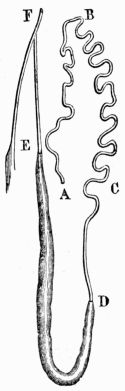
It is in the narrow hinder tubes that the silky matter is formed. It collects in the swollen part, D E, which is, properly speaking, the reservoir; and remains there in the glutinous state. Having reached the capillary tubes, it begins to assume consistency, and forms two threads, which are united together at the point of junction of the tubes, and come out through the orifice, with the appearance of a single thread, to be conducted and directed by the animal to those points it has selected.
It was hoped that by taking from the body of the worm the viscous matter contained in the glands, silk could be formed. But this hope was disappointed. It was found possible, it is true, to take the silk out; to draw it out into threads more or less fine; but up to this time it has only been possible in this way to obtain a matter which, when dried, more or less resembles catgut, and is easily enough spoilt by water.
The viscous substance contained in the glands must then be elaborated by the insect itself. When it arrives in the conduit common to the capillary tubes, under the form of a thread, it is impregnated with a sort of varnish, which is poured into them from two neighbouring glands. The varnish unites the two threads into one single thread, and imparts to it the brilliancy of silk, and the property of resisting the action of water. It is during the last phases of the worm's development that the silky matter becomes abundant in the glands. At this period the animal eats much; and it is certain that the substance to be converted is furnished by the leaf of the tree on which the insect feeds.
In consequence of this having been remarked, some manufacturers have attempted to obtain their silk directly from the mulberry leaf; but they only get a bad floss or refuse silk. This is because the silk is not formed in the mulberry leaf. The organs of insects are laboratories, in which manipulations unknown to man are carried on, manipulations which he has not been able to imitate.
After this rapid glance at the fundamental parts of the organism of the silkworm, we will occupy ourselves with the natural history, properly so called, of this insect, and with its rearing, carried on with a view to the production of silk.
As belonging to the first part of this programme, we have to speak of the moult, of the ages of the silkworm, of its maturity, of its mounting or ascending season, of the formation of the cocoon, of the chrysalis, of the moth, and the eggs.
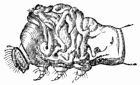
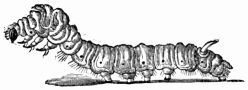
Fig. 202. Head of the Silkworm during moulting. Fig. 203. Position of Silkworm while moulting.
The name moult has been given to a sort of crisis during which the renewing of the skin of larvæ takes place. When it approaches, the silkworm changes its colour. Its robe, which was white or grey, and opaque, becomes yellow and somewhat transparent. The head swells considerably, especially above, and the skin becomes wrinkled (Fig. 202). The worm then fasts, and prepares to cast its skin. It places here and there some silk threads on the surrounding objects. It then slips under these threads, so that during its movements the old skin which it will abandon is, so to speak, gathered up. It then assumes a peculiar position, that represented in Fig. 203, and remains in it in a state of immobility which has been called sleep (sommeil).
During this sleep the new skin is formed under the old. A liquid oozes forth between the two membranes which separates them, and allows the silkworm to leave its old skin. To effect this, the worm begins by raising its head, and by making contortions. The old skin splits round the muzzle, or snout, on the head and back; then by different movements the animal emerges from its skin, which remains held up by the silken threads. The duration of the time occupied in moulting varies with the degree of the heat or humidity of the atmosphere; but in general the state of sleep lasts from twelve to twenty-four hours. One hour after the crisis the worm begins again to eat.
Fig. 204. Egg and first age.

The ages of the silkworm are the periods of time which elapse between one moult and another. If we observe some silkworms when the temperature is favourable, we shall find that there are four moults, and consequently five ages. At the first age (Fig. 204), the silkworm is black and hairy; then of a nut colour at the moment when the first moult is going to take place. "The appearance presented by these worms collected together on a leaf," says Dandolo, "is that of a downy surface of a dark chestnut colour, in the midst of which one sees nothing but a movement of little animals having their heads raised, working them about, and presenting black, shiny muzzles. Their bodies are completely covered with hairs arranged in straight lines, between which one perceives along the whole length of the body other longer hairs." [60]

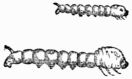
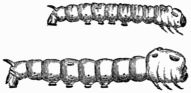
Fig. 205. Second age. Fig. 206. Third age. Fig. 207. Fourth age.
The first age lasts for five days. At the second (Fig. 205), the worm is grey, almost without down, then of a yellowish white, and one sees the crescents making their appearance on the second and fifth segment. At the third age (Fig. 206), there is not a single hair remaining, and the worm becomes whitish, and is always becoming lighter. The third age lasts six days, as does also the fourth (Fig. 207). At the fifth (Fig. 208), the worm has very nearly reached the end of its career in the caterpillar state, and now is the time of its greatest voracity. This age is the longest; it lasts nine days.
At each of these periods in the life of the silkworm may be remarked a physiological fact to which has been given the name of frèze. When the silkworm has just moulted it eats little, but the time very soon arrives when it does so with extraordinary avidity. It is indeed insatiable. The frèze of the last age is called the grande frèze. It takes place about the seventh day. During this day worms, the produce of thirty grammes [61] of eggs, consume in weight as much as four horses, and the noise which their little jaws make resembles that of a very heavy shower of rain. It is at the end of this stage that the insect prepares the shelter in which is to be brought about its metamorphosis into a chrysalis.
Fig. 208.—Fifth age.
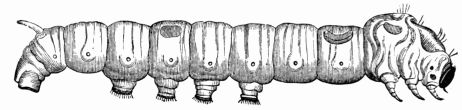
A little while before this it ceases to eat, turns yellow, and becomes as transparent as a grape. It is now said to have reached its maturity. Up to this moment the worm had never tried to leave its litter. It lived a sedentary life, and never thought of wandering away from its food. Now it is seized with an imperious desire for changing its quarters. It gets up, it roams about, and moves its head in all directions to find some place to cling on to. It walks over everything within its reach, particularly over those obstacles which are placed vertically. It aspires, not to descend, like the heroes of classic tragedy, but to rise. It is for this reason that this period of the silkworm's life has received the name of the mounting or ascending season. It now looks for a convenient place in which to establish its cocoon. Every one has remarked how the animal sets to work to accomplish its task. It begins by throwing from different sides threads destined for fixing the cocoon; this is what we call refuse silk. The proper space having been circumscribed by this means, the worm begins to unwind its thread—a continuous thread of about a thousand mètres long.
It has been calculated, let us say by the way, that forty thousand cocoons would suffice to surround the earth at the equator with one thread of silk. Folded on itself almost like a horse-shoe, its back within, its legs without, the worm arranges its thread all round its body, describing ovals with its head. It approximates gradually the points of attachment of the thread. As long as the cocoon is not very thick one can watch it through the meshes of the web applying and fixing its thread, still to a certain degree soft, in such a manner as to make it adhere closely to the parts already formed.
"We can state," says M. Robinet, "that the silkworm makes every second a movement extending over about five millimètres. The length of the threads being known, it follows that the worm moves its head three hundred thousand times in making its cocoon. If it employs seventy-two hours at its work, it is a hundred thousand movements every twenty-four hours, four thousand one hundred and sixty-six an hour, and sixty-nine a minute, that is to say, a little more than one a second."
About the fourth day, after having expended all its silk, [62] the worm shut up in the cocoon becomes of a waxy white colour, and swollen in the middle of its body. The abdominal legs wither away; the six fore legs approach each other and become black. The parts of the mouth tend downwards; the skin wrinkles. Very soon it is detached and pushed down towards the hinder part, and the chrysalis appears under the rents in the skin. It is at first white, but speedily becomes of a brown red.
The silkworm remains in general from fifteen to seventeen days in the pupa state. At the moment of hatching, the moth begins by breaking the skin in which it is shut up, and which is pretty thin. But how can it come out of the silky prison which it has itself built? To effect this it makes use of a peculiar liquid contained in a little bladder with which its head is provided, and which was discovered by M. Guérin-Méneville. It moistens the cocoon with this liquid; which soaks through and penetrates the whole thickness of the silken wall which confines it. The threads of silk of which it is composed are moistened and disunited, but not broken. The moth opens a passage for itself through the threads thus separated, and makes its appearance in the light of day. Its wings are folded back on themselves, and it is still quite wet, but it seeks immediately for a good place in which to dry itself, and in a little time assumes its final appearance (Figs. 209, 210). The female (Fig. 210) has whitish wings, the antennæ only slightly developed and pale, the abdomen voluminous, cylindrical, and well filled. It is quiet, heavy, and stationary. The male is smaller; its wings are tinged with grey, its antennæ blackish; it moves about, beats its wings together, and is lively and petulant.
Fig. 253.—Silkworm Moth (Bombyx mori), male.
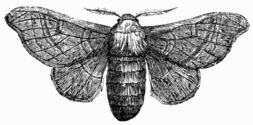
Fig. 210.—Silkworm Moth (Bombyx mori), female.
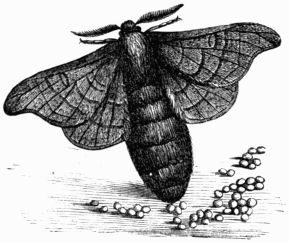
Before laying her eggs, the female looks out for a place suitable for this purpose. When she has found this place, she ejects an egg covered with a viscous liquid, which causes it to adhere to the body upon which it falls. Very soon she lays a second egg by the side of the first, then a third by the side of the second, and so on. She very rarely piles them up on each other. The laying lasts about three days; the number of eggs is from 300 to 700 for each female. These eggs are generally tentacular and flattened towards the centre. At the moment at which they are laid they are of a bright yellow. In a week they become brown. The colour changes then to a reddish grey; lastly it becomes of a slaty grey, remaining this colour during the autumn, winter, and a great part of the spring. Then as the temperature rises, the colour of the eggs passes successively through bluish, violet, ashy, and yellowish shades. And, lastly, they become more and more whitish every day as the hatching time approaches.
If looked at closely, one remarks a black spot and a brownish crescent extending along the circumference. The black spot is the head of the worm, which closely touches the shell; the crescent is the body, which is already covered with little hairs. When it leaves the egg, the silkworm gnaws through the shell on its side, never on its flat surface. When the opening is large enough, it breaks out through it, head foremost, and immediately fixes a thread of silk to any object it can reach, no doubt in order to prevent itself from falling. Sometimes the opening is too small to allow of the head passing out, and the larva is forced to come out backwards, that is to say, tail foremost. At times, not being able to get its head free, the poor animal very soon dies of fatigue and hunger.
VI.—A Silkworm rearing Establishment.
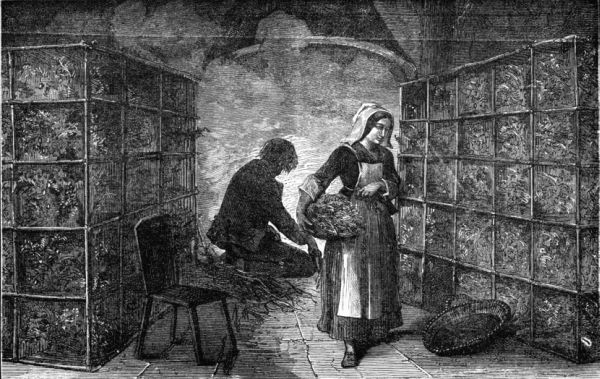
We will now give a summary of the rearing of the silkworm, that is to say, of the attention which must be paid to this insect that it may construct its cocoon advantageously. We will call to our aid in this very rapid summary the works or notices of MM. Robinet, Guérin-Méneville, Eugène Robert, and Louis Leclerc, and we must not forget the excellent and classical Dandolo. [63]
When it is desired to rear silkworms—magnans, as they were called in old French, and as they are still called in the patois of Languedoc—the first thing to do is to obtain good eggs, good grain, to use the technical word, and then to choose suitable premises. The essential, the fundamental point, in the rearing, is to possess premises in which the air is easily renewed. The worms should have as much air as possible given to them without ever being allowed to be chilled. There is no better means of attaining this end than by keeping a constant open fire in a room, and by letting air into the room from another chamber which separates it from the open air. One has, in this way, the best workroom for a small rearing.
In the workshop are arranged racks, by the aid of which are placed, at the distance of 50 centimètres from each other, frames made of reeds. These frames, or canisses, as they are called in the Cévennes, may be from 1 mètre to 1¾ mètres in breadth. They should be placed in such a manner that one can easily pass round them to place and remove the worms, and to distribute their leaves to them uniformly. They should be protected by a small border of a few centimètres in height, to prevent the worms from falling. And lastly, they should be covered at the bottom with large sheets of paper. (Plate VI.) A provident silkworm-rearer has always at his disposal a cellar or cool room, so as to be able to stow away his leaves as soon as they are brought in from the country.
What we have just said applies especially to a small rearing. In large establishments, or even those of second-rate importance, everything is in advance of this, and mathematically regulated: aspect and arrangement of rooms, furniture of these rooms, warming, ventilation, &c. So, for a rearing house for 300 grammes of eggs, the building should be constructed in such a manner that its front and back look east and west, to avoid any inequality in the heat derived from the sun. It ought to consist of a ground-floor, a very lofty first-floor, and of a rather low roof. The ground-floor comprises the chamber of incubation, the store-room for leaves, and the air-chamber with the grate intended for warmth and ventilation. The first-floor constitutes the rearing-room properly so called.
But let us leave these grand industrial establishments, to return to our rearing houses on a small scale, such as are found among the peasants of the Cévennes. They generally receive the silkworms' eggs before the end of the winter. In order to preserve them till the hatching season, they are placed in thin layers, in a piece of folded woollen stuff, which must be hung up in a cool, but not a damp place, exposed to the north. As soon as the buds of the mulberry tree begin to be partially open, they proceed to the incubation of the eggs. They are spread out on sheets of paper, in very thin layers, placed on a table in a room having a southern aspect, and left thus during three or four days, taking care to prevent the rays of the sun from touching them. It is necessary also, from time to time, to open the windows. After three or four days, the fire is lighted, taking care not to have more heat than 13° Centigrade round about the table which supports the eggs, and which should be placed as far as possible from the fire. Each day the room is warmed a little more, in such a way that the temperature is raised 1° to 2° a day, until 25° Centigrade of heat have been attained, at which temperature it is to be maintained when the eggs have reached the last stage, and till the hatching is terminated. On the first day few worms are hatched; but the hatching of the second day is very abundant, as also that of the third. Of these newly-born worms two divisions are made, separated by an interval of twenty-four hours. The worms which are born afterwards are thrown away, unless they are so abundant that they can be made a third batch of, which is to be mixed up with the second at the period of the moult.
In the large rearing houses there is a special chamber for the incubation. Various simple, convenient, cheap apparatuses, whose main object is to create a permanent warm and damp atmosphere, whose degree of heat can be regulated at will, have been proposed. M. Louis Leclerc, in his pamphlet entitled "Petite Magnanerie," has given a description and drawing of a little box which is very useful for facilitating the hatching of eggs. We refer those of our readers who wish for further information on the subject to that work. As soon as the worms are hatched, the eggs are covered with net, and over this are placed mulberry boughs, covered with tender leaves, on which all the little worms congregate. They are then lifted up with a hook made of thin wire, and the worms are placed on a table covered with paper, leaving a proper space between each. They are given, as their first meal, tender leaves cut into little pieces with a knife. These are the operations gone through for the two raisings of worms on the second and third day of the hatching. During this first age they give them from six to eight meals a day, taking care to distribute their food to them as equally as possible. The first meal is given at five o'clock in the morning; the last at eleven or twelve o'clock at night.
When the moult is approaching, the young ones are made to climb on to boughs having tender leaves, so that they can be moved to litters as thin and clean as possible, and there sleep in a good state of health. When the mass of worms is well awake again, the next thing to do is to take them off the litter on which they moulted, and to give them food. If this problem were proposed to a person strange to the operation which is now occupying our attention—to separate the worms from the faded and withered food upon which they are reposing, without touching them—he would certainly be very much at a loss what to answer. The solution of this problem presented for a long time great difficulties, and occasioned numerous reverses in the rearing. Now-a-days, thanks to the employment of a net, the délitement, or taking them off their bed, has become an easy operation.
Over the worms, placed on a table, is spread a net, the meshes of which are broad enough to allow them to pass through. On this net are spread the leaves which are to compose a meal. The worms immediately leave the old food, and get on to the new leaves. They then lift the litter with the worms, and throw away the old leaves, now unoccupied, clean the table, and replace the net with the worms. At the next délitement the first net is found under the litter. Figs. 211 and 212 represent two forms of these nets made of thread.
Thread nets, which were of great use, have been supplanted lately, with great advantage, by paper ones, which were invented by M. Eugène Robert. These are leaves of paper, of a peculiar manufacture, pierced with holes proportioned to the size of the worms which are to pass through them. The paper net can be used advantageously also for separating the worms that are too near together, or, as they say, for the dédoublement. Formerly, the délitement and the dédoublement were done by hand—a tedious work, and one that presented serious disadvantages. Now-a-days, as we have seen, the worms themselves perform these two perilous operations.
At the second age they still cut the leaves for the worms, but into larger pieces, and proportioned to their size. During the day the temperature of the room ought to be kept to 21° Centigrade, but it may be lowered by 1° or 2° during the night. Towards the end of this age they have only four meals. When the worms are on the point of going to sleep, their meals are decreased.
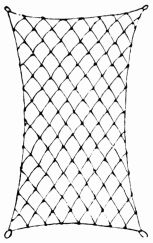
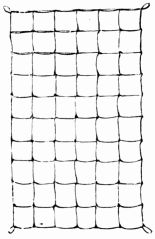
Fig. 211.—Lozenge-shaped net. Fig. 212.—Square net.
During the third age the number of the meals is kept to four, the first being given towards five o'clock in the morning, and the last between ten and eleven o'clock at night. The leaf is cut into much larger pieces, and distributed as equally as possible. The délitement and the dédoublement are proceeded with as in the preceding age. One begins to find pretty often during this period of the life of worms, some luisettes—that is to say, worms which have not strength enough to moult. They are larger than those just woke up, and that have not as yet eaten, and are shiny. They must be carefully removed, for they will not be long before they die, and infect the air of the room.
During the fourth age they no longer cut the leaves, but give them a great deal more at once. The result is that the litters increase in thickness, and that the délitement must be performed oftener; for the rest, four meals are always necessary. Many luisettes may be seen during the fourth age. The moult which follows the fourth age is the most critical phase in the life of the silkworm. During their sleep they are a prey to acute suffering, and are plunged into a state of lethargy which resembles death. The dryest and cleanest litters diffuse very soon a sickly smell. This moult lasts from thirty-six to forty-eight hours. During this time the room should be kept to at least 22° Centigrade.
When they awake out of this last sleep the attendant should continually be on his guard, as it is then that diseases break out. The worms suffering from these different diseases have received different names. There are besides the luisettes the arpians—that is to say, worms that have exhausted all their energy in the work of the last moult, and have not even strength to eat—the yellow, or fat worms, which are swollen, of a yellowish colour, and which very easily die; the flats or mous, the soft or indolent ones which, after having eaten a great deal and become very fat, die miserably, and enter into a state of putrefaction. And lastly, it is at this age that the muscardine, which hardly shows itself at any other age of the insect, appears with great intensity.
The muscardine is a terrible scourge to the rearers of silkworms. The losses which result from this disease in France are estimated at at least one-sixth of the profits. No particular symptom allows of our recognising the existence of this disease in worms which, however, contain its germ; only, the worm, which has eaten up to that time as usual, appears almost in a moment to change to a duller white; its movements become slower, it becomes soft, and is not long before it dies. Seven or eight days after its death it becomes reddish and completely rigid. Twenty four hours afterwards a white efflorescence shows itself round the head and rings, and soon after the whole body becomes floury. This flour is a fungus called Botrytis bassiana, of which the mycelium develops itself in the fatty tissue of the caterpillar, attacks the intestines, and fructifies on the exterior. This fungus has been considered as the immediate cause of the muscardine, and has been also regarded as the last symptom or end of the disease. The communication of the disease by contagion has alternately been admitted and denied. As its true cause, and any efficacious means of opposing it, are still unknown, the breeders of silkworms must be content to apply—so as to prevent or struggle against this dreadful scourge—the precepts of hygiene: good ventilation, excessive cleanliness, frequent délitements, and good food properly prepared.
After the muscardine, we must mention another epidemic disease still more terrible, the gattine. This disease shows itself from the very beginning of the rearing, and increases in intensity at each age, so that the number of worms able to enter regularly into the moult becomes smaller and smaller. We are still in a state of utter ignorance as to the cause of this last affection, which has occasioned, for the last ten years, incalculable losses in the rearing houses, which threatens the silkworm with complete destruction, and which in the meanwhile has ruined the unfortunate countries of the Cévennes, the principal seat of sericulture in France.
During the fifth age, the worms become large so quickly that on the fifth or sixth day they are obliged to be moved away from each other on the litter. The délitement must be made every two days, or indeed, every day now, on account of the enormous amount of the excrement; and, at the same time, a good ventilation must be constantly maintained. The temperature of the room should now be kept to 24°, without ever exceeding this degree of heat. When it is perceived that the worms wish to ascend, or mount, there are placed on the tables, at certain distances from each other, little sprigs of heather or very dry branches of light wood.
Fig. 213.—Sprigs of heather arranged so that Silkworms may mount into them.
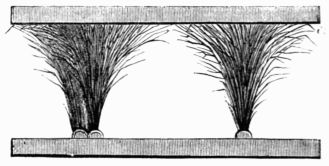
When the worms begin to mount into the heather, one must encabaner—that is to say, form with these branches little hedges, curved back like a hut or cradle, the openings of which are, on an average, seventeen inches or so (Fig. 213). At the expiration of twenty-four hours all the good worms have mounted. The laggards who remain under the cabanes are taken off by hand, and placed on a table, which is immediately encabanea.
The cocoons spun on these branches of heather ought to be large, heavy, and well-shaped. The good cocoons are regular; their ends are rounded and not pierced; and they are hard, especially at their extremities, and have a fine grain. They are cylindrical. The best are drawn in towards the middle, or have a concavity on either side of it (Fig. 215). Every one knows that there are white and yellow cocoons. They are the produce of different races of worms.
Commerce recognises two kinds of white silk: the first white and the second white. The silk of the first white is produced by the race Sina, the cocoons of which are of a perfect and azured white. They produce the most beautiful and most precious silk, and serve for the fabrication of light and delicate coloured tissues. The silk of the second white is furnished by two races: the Espagnolet and the Roquemaure.
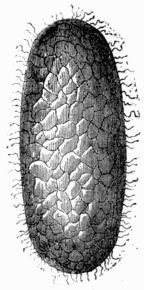
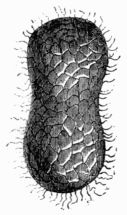
Fig. 214.—Spherical cocoon of the Bombyx mori. Fig. 215.—Cocoon of Bombyx mori, drawn in towards the middle.
The races that produce yellow cocoons are more numerous than the white ones. The yellow races are divided into three groups: those that have small, middle-sized, or large cocoons. The first and second are stronger, and more esteemed than the last.
The greater number of the races of silkworms have, let us here mention, white and yellow cocoons; there are some, however, whose cocoons are of a greenish white, or even quite green, or of a reddish green. One race, raised in Tuscany, near Pistoia, has cocoons of a pale rose colour; and, lastly, mention has been made of cocoons of a purple colour.
Fig. 216.—Larva, pupa, cocoon, and moth of Bombyx mori.
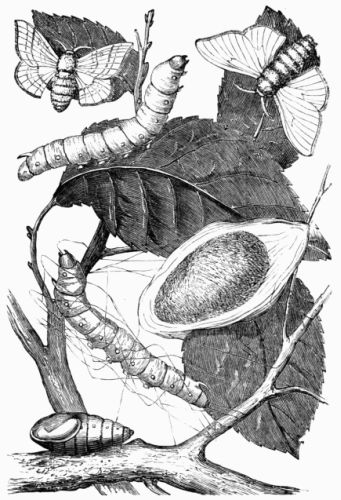
When the cocoons are completed, the people in charge of the rearing establishments separate them from the heather and sell them to the silk-spinners. But they must manage to get these cocoons into a state in which they will remain entire during a long time. They must, in other words, kill the chrysalis, to prevent the cocoons being pierced by the moth. To kill the chrysalis so as to prevent the development of the imago is an operation which is called the étouffage, or stifling.
Fig. 217.—Apparatus for stifling the chrysalides in the cocoons.
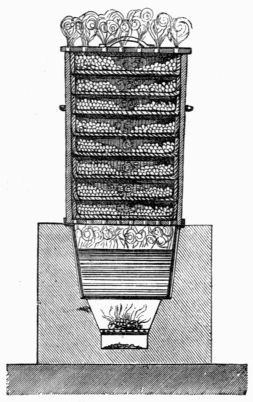
To effect this stifling, the cocoons are exposed to a high temperature. Formerly, in the Cévennes, the cocoons were placed in a baker's oven, heated for baking bread. But they ran the risk thus of being burnt, or of a certain number of chrysalides remaining alive. Now, to kill the chrysalides, they make use of steam at 100°, produced by water boiling in a vessel, and which passes through wicker baskets filled with cocoons.
The rearer must also take care at the time he gathers them, to separate the cocoons which are to provide eggs for the next year. As the female cocoons are heavier than the male cocoons, they are easily separated by weighing them in a pair of scales.
To obtain the eggs, or grain, the cocoons are fixed on sheets of brown paper, covered with a slight coating of paste made of flour. They are arranged in such a manner that the moths shall find no obstacle when they come out of them, head foremost; and, moreover, so that they may be able to reach with their legs the cocoon which is opposite them, so as to hang on to it, and to facilitate their exit from their own cocoon (Fig. 218). The male and female cocoons are pasted on separate sheets.
Fig. 218.—Sheet of paper with rows of cocoons prepared for the exit of the moths destined for laying eggs.
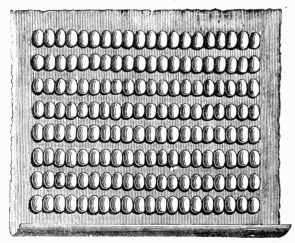
Fig. 219.—Sheets of paper stuck into screens, and inclined for the reception of moths.
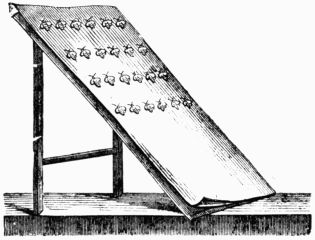
It is from fifteen to twenty days after the montée, or mounting, and when the temperature of the rooms has been kept between 20° and 25°, that the moths begin to be hatched. As they appear, they are seized by the wings and placed on cloths stretched out for the purpose, where they are left for about an hour, till their wings have fallen flat on their bodies. As soon as they have evacuated a red liquor, the males and females, which up to that time have been apart, are put together.
They then stick sheets of paper on to screens, putting from twenty-five to thirty females on each sheet (Fig. 219). It is here the moths lay their eggs. The sheets of paper, covered with eggs, are then hung on wires, at a small distance from the ceiling of a room having a northern aspect, which is never warmed. They remain thus, exposed to all variations of temperature, till the return of the warm weather. We will say a few words, to bring this subject to an end, on the winding of cocoons and the spinning of silk.
The winding of cocoons is an operation which at first sight appears very simple, but which is in reality a difficult and delicate process. It requires unremitting attention, great experience, and a delicacy of touch which can only be found in the fingers of woman, or rather, in the fingers of certain women.
The woman who is spinning, stands before a sort of loom which is called tour (Fig. 220). Under her hand is a copper containing water, which she heats to the required degree by opening the tap of a tube, which brings a current of steam. She plunges the cocoons into the hot water, and moves them about in it, to soften the gummy substance which sticks the silken threads of the cocoon together. Then she beats them, with a light hand, with a small birch-broom. The threads of the cocoons get caught in the extremities of the twigs of which the little broom is made, and the workwoman seizes with her fingers the bundle of threads, and shakes them about till she perceives that they are all single, and in a fit state to be joined together.
Fig. 220.—Silk-winding Establishment.
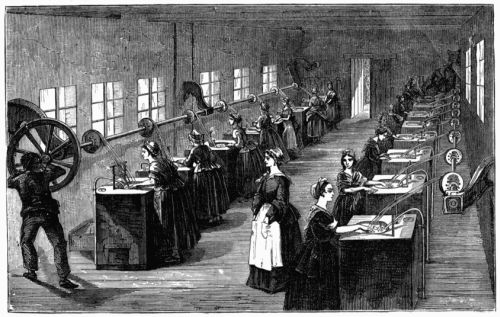
Let us suppose that it is wished now to make up a brin, or staple, by uniting together the ends of five cocoons. She chooses five ends in the mass, makes of these a bundle, and introduces it into the hole of a filière. She makes two staples (brins) at once, one on her right, the other on her left hand. She then brings them together, she crosses them, rolls them, and twists them, the one on the other, several times; after which, she separates them from above and keeps them well apart, making each of them pass into a hook at a distance, from which they are going to twist round into a hank, separately, on a wheel. The two threads thus twisted are drawn close together, compressed, and become one, getting round by rolling on each other, and being kept in continual motion, drawn out as they are by the rapid motion of the wheel.
The difficulty which the emptying the cocoon of its silk thread presents, makes us understand what difficulties those manufacturers must have met with who have lately attempted to extract from the stalks of mulberry leaves a sort of silk. We will enter into no details of the attempts which have been made to accomplish this object in our time, attempts which have, however, been crowned with no success whatever. We will confine ourselves to reminding the reader that these attempts are far from being of recent origination, since they date back to as far as Olivier de Serres, the father of French sericulture.
In a little work published by Olivier de Serres, in 1603, under the title of Cueillette de la Soie, "The Gathering of Silk," we find a memoir entitled: La second richesse du mûrier, qui se trouve en son escorce, pour en faire des toiles de toute sorte, non moins utile que la soie provenant d'icelui, "The second wealth of the mulberry tree which is found in its bark, how to make of it cloth of all sorts, not less useful than the silk derived from this tree." Olivier de Serres proves in this memoir that the second bark, or liber, of the mulberry tree contains a fibre capable of replacing hemp or flax, and he describes the processes by which this may be obtained. The processes which had been proposed by Olivier de Serres in 1603, were resumed in the Cévennes a dozen years ago by M. Duponchel on the one hand, and on the other by M. Cabanis, [64] who operated on the bark instead of taking the whole of the wood of the mulberry tree. But none of these attempts have given any good results up to the present moment.
The various diseases which for the last fifteen years have been so fatal to the mulberry silkworm, have suggested the idea of acclimatis ing in Europe other silk-producing Bombyces, if not with the view of superseding, at least as auxiliaries to the mulberry species. The genus Attacus has furnished these auxiliaries. Among the species which have, in this respect, the greatest claims to our attention, we must place in the first rank those which feed upon the leaves of the oak tree. Indeed, the trees which can be made use of for their cultivation are very numerous in Europe, and, moreover, the silk produced by these worms appears to possess superior qualities.
There are three oak-feeding species of the genus Attacus. They are Yama-Maï, Pernyi, and Mylitta.
Fig. 221.—Larva of Attacus (Bombyx) Yama-Maï.
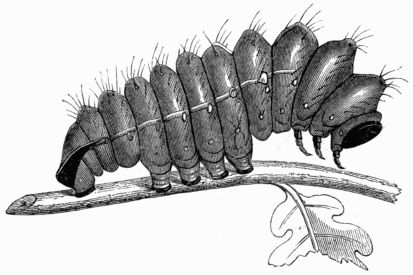
The silk of Yama-Maï is as bright as that of the mulberry silkworm, but a little less fine and strong, and occupies the first rank after it. If we could succeed in acclimatising this species it would supply any deficiency there might be in our crops of ordinary silk.
The eggs of the Attacus Yama-Maï were brought from Japan—where this worm is reared—conjointly with the mulberry silkworm, in 1862. The larvæ hatched at Paris, in 1863, were green, of a great size, remained in that state eighty-two days, and were easily reared. Their cocoon resembles that of the mulberry species. It is composed of a beautiful silk of a silvery whiteness in the interior, and of a more or less bright green on the exterior. The moth is very large and beautiful, of a bright yellow colour, approaching orange.
We give a drawing of the Attacus Yama-Maï, taken from the plates which accompany M. Guérin-Méneville's memoir. [65]
Fig. 222.—Cocoon of Attacus (Bombyx) Yama-Maï.
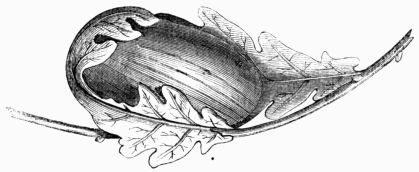
Fig. 223.—Attacus (Bombyx) Yama-Maï.
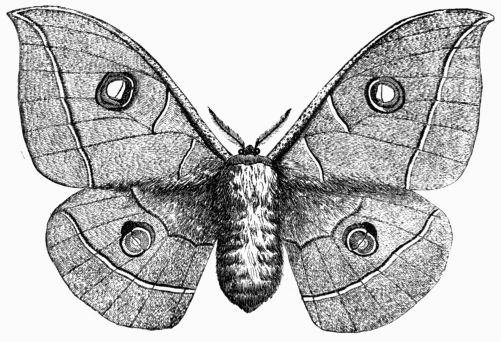
Fig. 221 represents the larva, or caterpillar, two-thirds natural size; Fig. 222, the cocoon, drawn on the same scale; and Fig. 223, the moth.
In 1866, M. Camille Personnat published a very interesting monograph of Yama-Maï, which may be consulted with profit by both cultivators of silk and naturalists. [66]
Attacus pernyi yields a remarkably beautiful silk, fine, strong, and brilliant, which can be spun and dyed with great ease. The tissues obtained from it partake of the qualities of ordinary silk, of wool, and of cotton. This species of Attacus, which is reared on the oak in Mandchouria, has given rise to great hopes in France. The cocoons and moths of this worm were exhibited for the first time at the Universal Exhibition of 1855. They were reared by M. Jordan, of Lyons, from some cocoons sent over from China by the missionaries. It is much to be desired that this species may be acclimatised in Europe.
Fig. 224.—Cocoon of Attacus (Bombyx) pernyi.
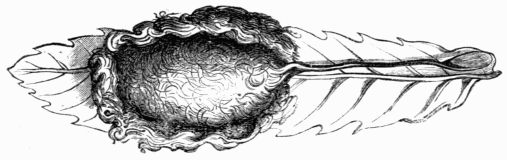
Figs. 224 and 225 represent, after drawings in the Memoir of M. Guérin-Méneville, already referred to, the cocoon and moth of the Attacus pernyi.
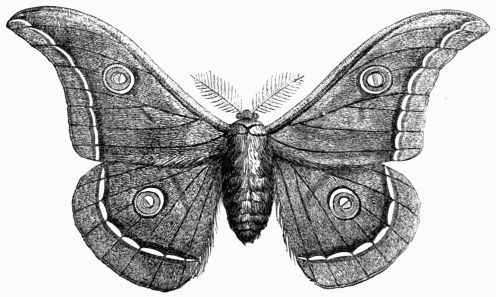
The silk which Attacus Mylitta produces is perhaps superior to that of Pernyi. When the cocoons are properly prepared, the silk can with ease be wound off from one end of them to the other. This worm is found in various parts of Bengal and of Calcutta, and also at Lahore, and its silk is exported in considerable quantities under the name of tusseh. Brownish stuffs are made of it in India of firm and bright texture, which are used for summer clothing, or for covering furniture.
Fig. 225.—Attacus (Bombyx) pernyi.
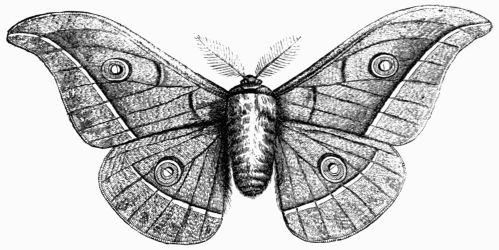
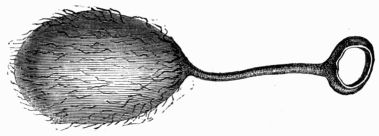
Figs. 226 and 227 represent the moth and the cocoon of Attacus Mylitta after M. Guérin-Méneville.
Fig. 226.—Attacus (Bombyx) Mylitta.
In 1855 M. de Chavannes reared this species in the open air, near Lausanne, in Switzerland. This treatment succeeded perfectly, without any degeneration, for many years. It, however, died out at last, from the effects, perhaps, of too great a difference in the climate, or from those accidents, still so little understood, to which even the insects of our own country are subject. This was unfortunate, as this species is one of those whose acclimatisation in Europe is the most to be desired, for it would render great service to the cultivators of silk.
It remains for us to speak of two other species, which are very important, inasmuch as their domestication in Europe is now an accomplished fact. We mean the Attacus or Bombyx of the Ailanthus, and also that of the Castor-oil plant.
Fig. 227.—Cocoon of Attacus (Bombyx) Mylitta.
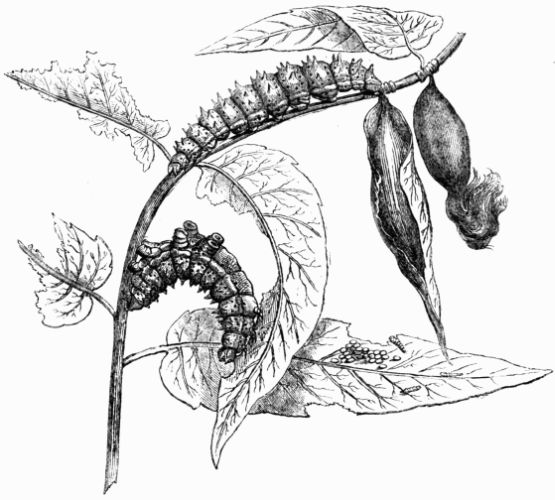
Every one has heard of the Ailanthus silkworm (Attacus [Bombyx] Cynthia), whose acclimatisation in Europe has been materially assisted by the admirable and persevering efforts of M. Guérin-Méneville.
The Ailanthus worm is a native of Japan and of the north of China. It was brought over in 1858 by Annibale Fantoni, and sent to M. Guérin-Méneville by MM. Griseri and Colomba, of Turin. When it is nearly full-grown it is emerald green, with the head, the feet, and the last segment of a beautiful golden yellow, and has black spots on each segment. This worm, in its full-grown state, is represented by Fig. 228; in the same figure are also represented the eggs and the cocoon. The moth has the abdomen yellowish underneath, with little white tufts. Its wings are traversed by a white band, which is followed exteriorly by a line of a bright rose; each wing is also marked by a lunula or crescent-shaped spot.
In 1858 M. Guérin-Méneville presented to the Académie des Sciences of Paris the first moths and the first eggs laid in France of the Attacus Cynthia. This able entomologist demonstrated very soon afterwards—1st, that the caterpillars of this insect can be reared in the open air, and with scarcely any cost for management; 2ndly, that it produces two crops a year in the climate of Paris and the north of France; 3rdly, that the cultivation of the Ailanthus, or the false Japan varnish tree, on which this insect lives, is easy even in the most sterile soil.
Fig. 228.—Eggs, larvæ, and cocoons of Attacus (Bombyx) Cynthia.
M. Guérin-Méneville showed still further that ailantine, the textile matter furnished by the cocoon of the Cynthia, is a sort of floss silk holding a middle place between wool and the silk of the mulberry-tree worm, and which, as it can be produced at scarcely any expense, would be very cheap, and would serve for the fabrication of what are called fancy stuffs, for which ordinary floss silk is now used. In 1862 M. Guérin-Méneville sent in a Report to the Minister of Agriculture on the progress of the cultivation of the Ailanthus, and of the breeding of the silkworm, which was reared in the open air on this tree. He mentions, in his Report, the rapid development of the cultivation of the tree in France, the great number of eggs of the Ailanthus silkworm sold, the foundation of a model silkworm nursery at Vincennes, and, this one great point gained, that they had found out the way of unwinding the silk from the cocoons of the Cynthia in one unbroken and continuous thread.
Till then European industry had only succeeded in drawing from the cocoons of the Ailanthus silkworm a floss silk, composed of filaments more or less short, obtained by carding, and unable to produce, when twisted, anything better than floss, that is to say, refuse silk. It is to the Countess de Vernéde de Corneillan, on the one hand, and to Doctor Forgemot on the other, that the merit is due of having obtained an unbroken thread of silk from the cocoon of Attacus Cynthia.
A monograph on the Ailanthus silkworm appeared in 1866 under the title, "L'Ailante et son Bombyx, par Henri Givelet." [67] It is a complete account of all the results obtained up to the time, both as regards the rearing of the silkworm and also as regards the cultivation on a large scale of the Ailanthus, or false Japan varnish tree. [68]
The Castor-oil Plant Silkworm (Attacus [Bombyx] ricini) is a species very nearly akin to the Ailanthus worm, perhaps only a variety, and comes from India. The silk which it produces is very similar in every respect to that of the Cynthia. The rearing of this worm could never attain to any great importance in France, on account of the necessity there is of renewing the plantations of the castor-oil plant each year. It would, however, afford an additional source of income to the farmers in the south of France, who cultivate the castor-oil plant with a view to selling its seeds, which are much used in pharmacy.
Nearly allied to the genus Attacus, which furnishes us with all these precious auxiliaries to the mulberry silkworm, are a great number of other species, both indigenous to Europe and exotic, mostly remarkable for their great size, and a few of which are common in this country.
Fig. 229 is the largest European moth, but never found farther north than the latitude of Paris. Its wings are brown, waved, and variegated with grey. Each of them has a large black eye-shaped spot, surrounded by a tawny circle, surmounted by one white semicircle, and by another of a reddish hue, the whole completely enclosed in a black circle. "These moths," says Geoffroy, "are very large; they look as if they were covered with fur, and, when they fly, one is inclined to take them for birds."
Fig. 229.—Saturnia pavonia-major.
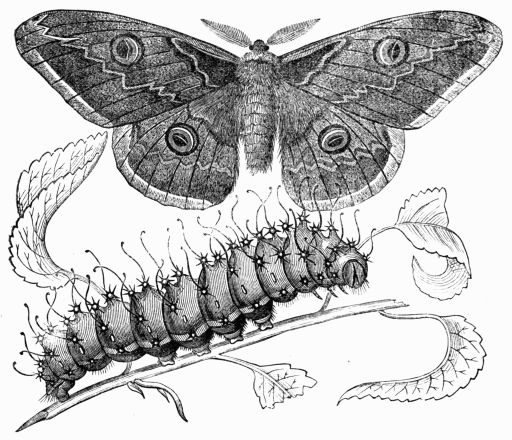
Saturnia pavonia-major comes from a very large caterpillar, which is of a beautiful green, with tubercles of turquoise blue, each of which is surmounted by seven stiff divergent hairs. This caterpillar lives principally upon the elm, but it feeds also upon the leaves of the pear, plum, and other trees. It spins a brown cocoon, formed of a coarse silk of great strength. It is not until the following spring that it becomes a moth.
The Emperor Moth (Saturnia carpini, Fig. 230) much resembles the above, except in size. This species is common in England, and its green larva, covered with black or pink warts, from which spring hairs, as in the last, is by no means rare on heath in the autumn. It also feeds on bramble and other plants.
Fig. 230.—Emperor Moth (Saturnia carpini).
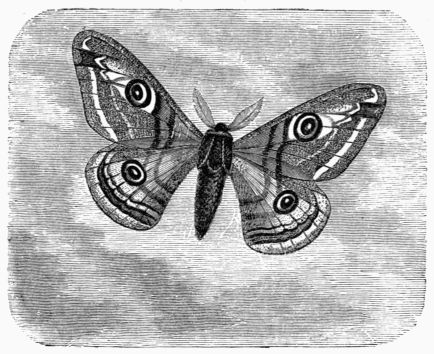
Among the Attaci foreign to Europe, we must mention Atlas (Fig. 231), the expanse of whose wings exceeds four and a quarter inches. This magnificent moth, one of the largest known, comes from China.
The family Bombycidæ comprises many species which we must not omit to mention.
The Lackey (Bombyx neustria) derives its name from the colour of the caterpillar, which has longitudinal lines of various colours, and a blue head. These caterpillars live together on a great number of our forest and garden trees, to which they do much damage. The moth (Fig. 232) has a brownish body, and wings of a more or less tawny yellow colour, with two darker lines on the front wings.
The Procession Moth (Bombyx processionea) is a small greyish moth, the caterpillars of which live in numerous troops on oak trees, and devour the leaves at the moment of their development. In the evening these caterpillars come out of their common nest, and form a sort of procession; hence their name Procession Moth. "I kept some for a little time in my house in the country," says Réaumur. "I brought an oak branch which was covered with them into my study, where I could much better follow the order and regularity of their march than I could have done in the woods. I was very much amused and pleased at watching them for many days. I hung the branch on which I had brought them against one of my window shutters. When the leaves were dried up, when they had become too hard for the jaws of the caterpillars, they tried to go and seek better food elsewhere. One set himself in motion, a second followed at his tail, a third followed this one, and so on. They began to defile and march up the shutter, but being so near to each other that the head of the second touched the tail of the first. The single file was throughout continuous; it formed a perfect string of caterpillars of about two feet in length, after which the line was doubled. There two caterpillars marched abreast, but as near the one which preceded them as those who were marching in single file were to each other. After a few rows of our processionists who were two abreast, came the rows of three abreast; after a few of these came those which were four abreast; then there were those of five, others of six, others of seven, others of eight caterpillars. This troop, so well marshalled, was led by the first. Did it halt, all the others halted; did it again begin to march, all the others set themselves in motion, and followed with the greatest precision.... That which went on in my study goes on every day in the woods where these caterpillars live.... When it is near sunset you may see one caterpillar coming out of any of the nests, by the opening which is at the top, which would hardly afford space for two to come out abreast. As soon as it has emerged from the nest, it is followed by many others in single file; when it has got about two feet from the nest, it makes a pause, during which those who are still in the nest continue to come out; they fall into their ranks, the battalion is formed; at last the leader sets off marching again, and all the others follow him. That which goes on in this nest takes place in all the neighbouring nests; all are evacuated at the same time."
Fig. 231.—Attacus (Bombyx) Atlas.
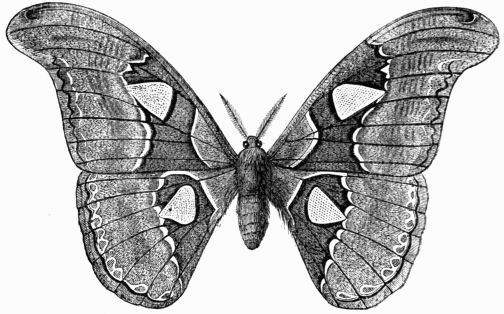
Fig. 232.—The Lackey (Bombyx neustria).
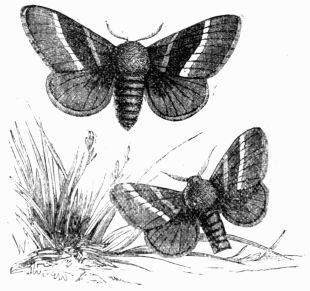
One part of Fig. 233 shows the arrangement of the caterpillars on coming out of the nest. These caterpillars are furnished with long hairs, slightly tufted, which come off with the greatest ease, and which if they penetrate into the skin, cause violent itching. In 1865 a number of the alleys of the Bois de Boulogne were shut up from the public in order to save them from this annoyance. These caterpillars construct a covering common to them all, in which they live, and transform themselves therein, each insect making for his own private use a small cocoon. This insect is said to have been found in England, but there is not sufficient evidence to admit it into our lists.
Fig. 233.—Larvæ of the Procession Moth (Bombyx processionea).
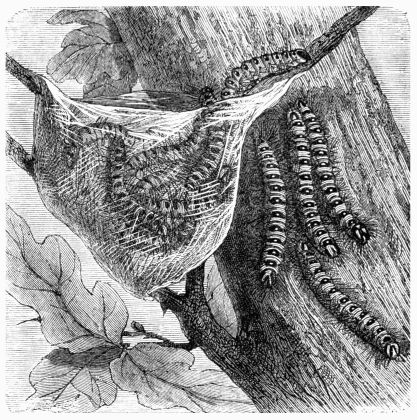
Fig. 234.—The Vapourer Moth (Orgyia antiqua), male and female.
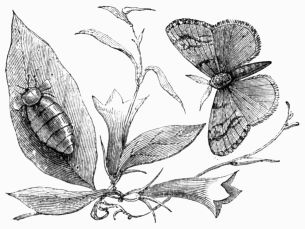
The Orgyias comprise a great number of small species, of a dark colour, which do a great deal of damage to our forest trees. In Sep tember and October the male of the Orgyia antiqua, with his tawny wings, may often be seen flying about the streets of London. The female (Fig. 234) is remarkable, as she has only the rudiments of wings, and only goes as far as the side of her cocoon. The caterpillar of the Orgyia pudibunda, called also the Hop Dog, attacks almost every sort of tree. When the state of the atmosphere favours their propagation, they appear in fearful quantities, and cause the greatest havoc. During the autumn of 1828, in the environs of Phalsbourg, they were to be counted by millions. The extent of the woods laid waste was calculated at about fifteen hundred hectares. It is common in this country.
Fig. 235.—Orgyia pudibunda.
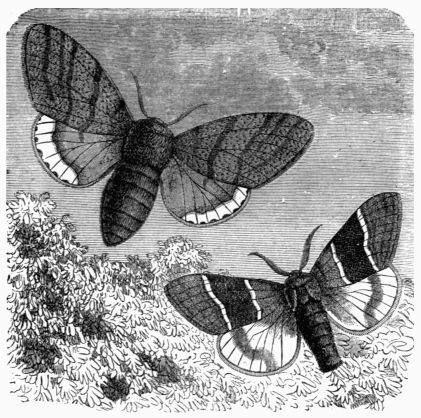
Among the genus Liparis, the species of which are also very destructive to trees, we must mention the Brown-tailed Moth (Liparis chrysorrhœa, Fig. 236), a species by no means rare in England. The caterpillars live in quantities, on apple, pear, and elm trees, and destroy the plantations of the promenades of Paris.
Fig. 236.—Liparis chrysorrhœa.
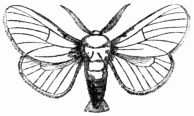
The females of this genus tear off the fur from the extremity of their abdomens to make a soft bed for their eggs, and to preserve them from the cold. And yet they are never to see their young, for they die after they have laid their eggs. Another tribe of Bombycina contains species of a small size, which are remarkable from the habits of their caterpillars, which make, with foreign bodies, cases, in the interior of which they live and undergo their metamorphoses.
The caterpillars of the genus Psyche live in a case composed of fragments of leaves, of bits of grass and straw, of small sticks of wood, or of little stones, stuck together, and intermixed with silky threads.
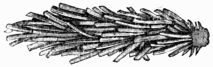
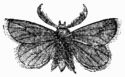
Fig. 237.—Case of Psyche muscella. Fig. 238.—Psyche muscella.
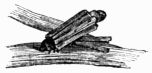
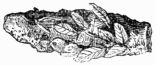
Fig. 239.—Case of Pysche rubicolella. Fig. 240.—Case of Psyche graminella.
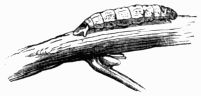
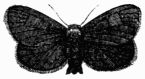
Fig. 241.—Larva of Psyche graminella. Fig. 242.—Psyche graminella.
VII.—The Goat-moth (Cossus ligniperda). Larva, pupa, and perfect insect. 1, 2. Perfect insect. 3. Pupa. 4. Larva.
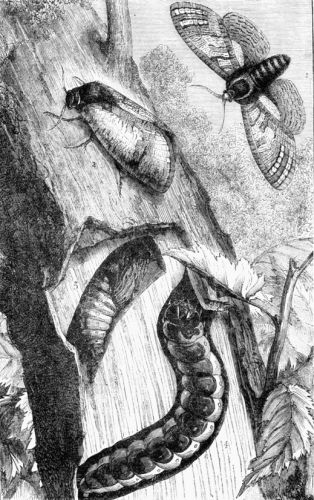
We give a representation (in Figs. 237, 239, and 240) of the cases of the caterpillars of three different kinds. The females of these moths are completely destitute of wings, and resemble caterpillars. As a general rule they hardly ever leave their case. The males (Figs. 238, 242) are of a blackish grey, and fly very swiftly.
The caterpillars of the genus Hepialus are difficult to observe, as they live in the interior of the roots of various vegetables. Such is the common Ghost Moth (Hepialus humuli), which sometimes causes the greatest damage.
Fig. 243.—Zeuzera æsculi.
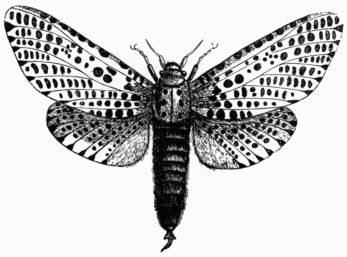
The type of the genus Zeuzera is Zeuzera æsculi, or Wood Leopard (Fig. 243). It has white wings with large blackish blue spots on the anterior, and small black spots on the posterior wings. The caterpillar, of a vivid yellow, spotted with black, lives in the interior of the trunks of a great many trees, principally the chestnut, the elm, the lime, and the pear tree. This moth, which is known also by the name of Coquette, is to be seen in the evening flying about the public gardens of Paris, and is not rare in England. The most celebrated species of the allied genus Cossus is the Wood-boring Goat Moth (Cossus ligniperda), figured in the opposite plate. The moth has a heavy brownish body and greyish wings streaked with black. It is found in most parts of Europe. The caterpillar is of a reddish colour, as if it had on a leathern jerkin, and disgorges a liquid which is believed to soften ligneous fibres, and it lives in the interior of willows and other trees. It was on this caterpillar that Lyonnet made his admirable anatomical researches.
Fig. 244.—Larva of Dicranura vinula.
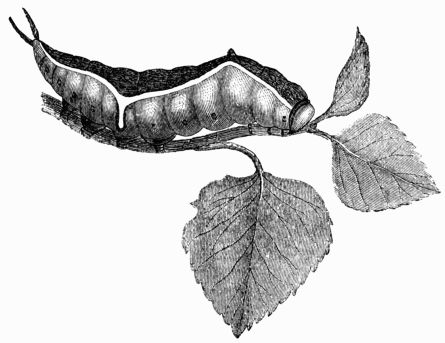
Fig. 245.—Dicranura vinula.
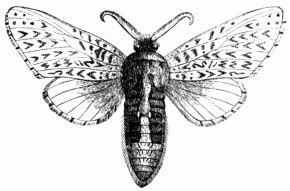
Another tribe of Bombycina comprises some very strange caterpillars, whose hindermost feet are changed into forked prolongations, which they move about in a threatening manner. These sort of fly-traps are perhaps meant to keep at a distance those insects which would lay their eggs upon the caterpillar's body. The caterpillars of Dicranura are of this kind. We give a representation of the caterpillar and the moth of the Puss Moth (Dicranura vinula, Figs. 244, 245), as also the moth of the Dicranura verbasci, the former of which is common in England, and the larva may be found during the late summer and early autumn feeding on poplars and willows; and of the caterpillar of Stauropus fagi, the Lobster Moth (Fig. 247), rare in France, whose appearance is strange indeed. The moths, on the contrary, have nothing about them remarkable.
Fig. 246.—Dicranura verbasci.
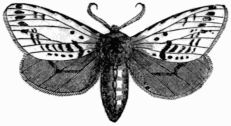
Fig. 247.—Larva of the Lobster Moth (Stauropus fagi).
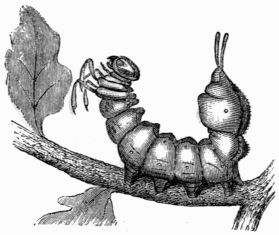
The Noctuina are a group of Lepidoptera of middling size, and generally found in woods, meadows, and gardens, where their caterpillars have lived. They seldom fly till about sunset, or during the night. Their upper wings are of a dark colour, with spots in the middle of a particular shape. Their lower wings are of various colours, often whitish, sometimes red or yellow.
Fig. 248.—Noctua tegamon.
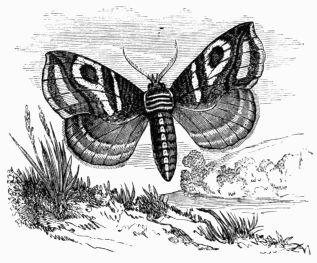
Fig. 249.—Noctua nebulosa.
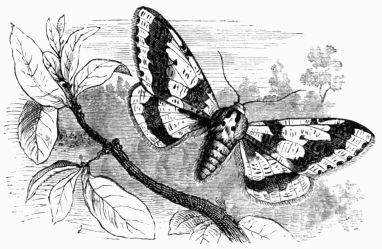
We give representations of some of the species of this group. [69] Noctua tegamon, Fig. 248; Noctua nebulosa, Fig. 249; Noctua musiva, Fig. 250; Noctua brunnea, Fig. 251; Catocala fraxini, Fig. 252; Catocala Americana, Fig. 253; Catocala paranympha, Fig. 254; Catocala nupta, Fig. 255, the Red Underwing; and Erebus strix, Fig. 256.
Fig. 250.—Noctua musiva.
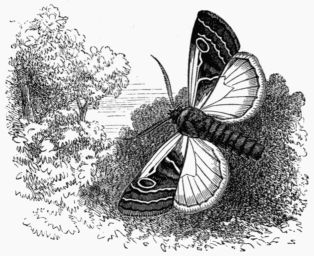
Fig. 251.—Noctua brunnea.
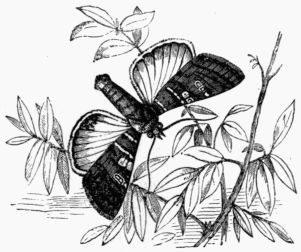
The bodies of these moths are robust and sometimes massive, and are scaly rather than woolly. The thorax is sometimes bristling with hairy tufts.
This genus includes 800 species, of which there are about 300 in France. The caterpillars of the Noctuina are smooth or very slightly covered with hair, usually of a pale colour, and live on low plants, of which they devour, some the leaves, others the roots; then it is they are most destructive to agriculture. There are some of them which eat any caterpillars they may chance to meet, and even those of their own species, leaving nothing but the skin. Some of them surround themselves with a light cocoon before becoming chrysalides; others bury themselves in soft, well-pulverised soil.
Fig. 252.—Catocala fraxini.
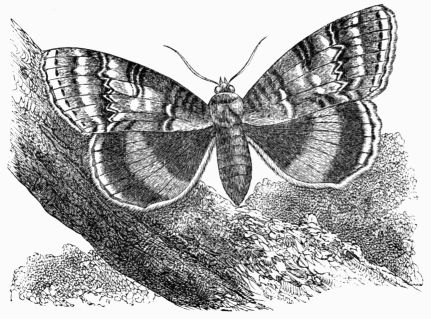
Fig. 253.—Catocala Americana.
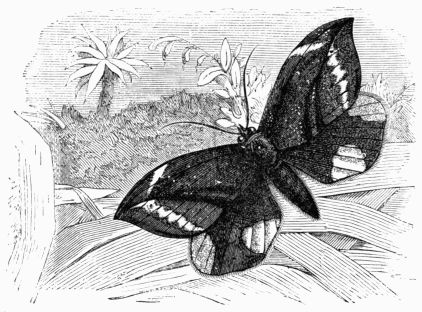
Fig. 254.—Catocala paranympha.
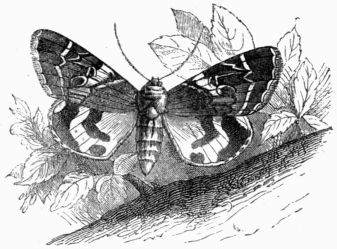
Fig. 255.—Catocala nupta.
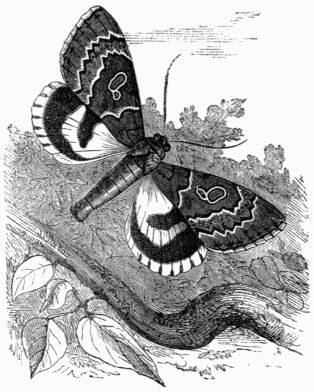
Fig. 256.—Erebus strix.
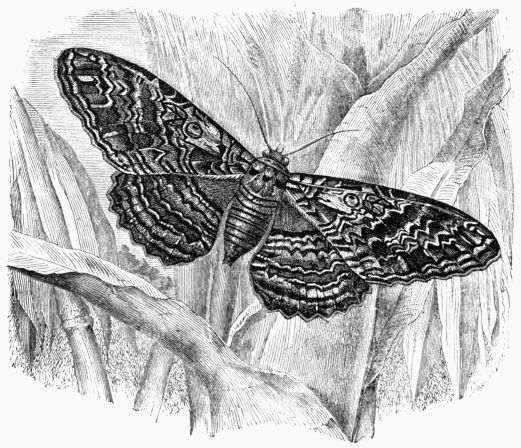
The family of Geometrinæ, or Geometers, comprises moths of a middling size, and usually flying after sunset and during the night. [70] They frequent the alleys of damp woods, where they become the prey of the Libellulæ [71] and other carnivorous insects. Their bodies and abdomens are slender, their wings large, thin, fragile, often of a dark colour, with brilliant markings.
The caterpillars of the Geometrinæ are known by the name of loopers or geometers. We have previously described their singular organisation. They are continually spinning a silken thread, which keeps them attached to the plant on which they live. If you touch the leaf which supports them they immediately let themselves fall.


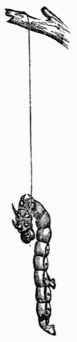


Fig. 257.—Looper hanging by its thread. Fig. 258.—Seen at the side. Fig. 259.—Front view. Figs. 260 and 261.—Remounting its thread.
"Nevertheless, they do not generally fall to the ground," says Réaumur; "there is a cord ready to support them in the air (Fig. 257), and a cord which they can lengthen as they will; this cord is only a very thin thread, but has nevertheless strength enough to support the caterpillar (Figs. 258, 259). All that there seems to fear is, that the thread may lengthen too quickly and the caterpillar fall, rather than descend gently, to the ground. But what we must first remark and admire is, that the caterpillar is mistress of its movements, and is not obliged to descend too quickly; it descends by stages; it stops in the air when it pleases. Generally it only descends at most about one foot at a time, and sometimes only half a foot or a few inches, after which it makes a pause more or less long, as it pleases." It is in this way that the caterpillars let themselves fall from the top of the highest trees: they remount again with no less ease.
Let us listen to Réaumur's description of the means employed by this caterpillar to ascend these heights. Figs. 260 and 261, drawn, as the three preceding ones, from the plates in Réaumur's Memoir, help us to follow the explanation given by the illustrious naturalist of the evolutions of our little acrobat:—"To remount," says Réaumur, "the caterpillar seizes the thread between its jaws, as high up as it can; as soon as it has done this it twists its head round, lays it over on one side, and continues to do so more and more every moment. Its head seems to descend below the last of the scaly legs which are on the same side as that to which it is inclined. The truth is, however, that it is not its head which descends, the part of the thread which it holds between its jaws is a fixed point for its head and for the rest of its body; it is that portion of the back corresponding with its scaly legs which the caterpillar twists upwards; the consequence is that the scaly legs and that part of the body to which they belong then ascend. When the last pair of legs is just over the jaws of the caterpillar, one leg, viz., that which is on the side towards which the head is inclined, seizes the thread and brings it over to the corresponding leg on the other side, which is advanced to receive it. If the head is then raised, which is done immediately, it is in order that it may seize the thread at a higher point than that at which it was caught at first; or, which is the same thing, the head, and consequently the whole body of the caterpillar, is found to have ascended to a height equal to the length of the thread which is between the place where its jaws seized it the first time and that where they seized it the second time. The first move in the upward direction is thus made, and the second soon follows.... If you were to seize the caterpillar on its arrival at the end of its upward journey, you would see a packet of threads huddled together between the four hindmost of the scaly legs. The greater the height ascended the greater is the size of this packet. All the turns of the thread which compose it are entangled. So the caterpillar does not consider it of any value. As soon as the insect can walk it gets rid of the mass, sets its legs free, and leaves it behind before one or at most two steps have been taken. The cord is wasted on each ascent, but the caterpillar can afford to lose as many as it likes, for it has in itself the source of the matter necessary for the composition of the thread, and it is a source from which that which was drawn off is being continually re-supplied. Moreover, spinning the thread costs the caterpillars but little; indeed, the loopers economise this thread so badly that most of them leave it behind them wherever they go."
Fig. 262.—Hybernia leucophearia, male.
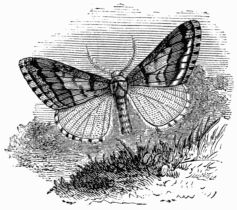
They are found on many trees, but particularly on the oak, the foliage of which they often entirely devour. They burrow into the ground to change into chrysalides, and undergo all their metamorphoses in the course of the year. Others do not become perfect insects till the autumn, or sometimes not even till the following spring. A few assume the perfect state in winter. There are, indeed, some of these, such as the males of the Hybernias, which fly about on the foggy evenings of November. The females of this genus have either no wings at all, or else only rudimentary ones. Two species, the Hybernia defoliaria, or Winter Moth, and the Chimatobia brumata, abundant here, are very common in the environs of Paris.
M. Maurice Girard says, in his work on the metamorphoses of insects, that the females of these moths can easily be found at the beginning of November, in a very strange place, namely, on the gas lamps of the public promenades; for instance, along the roads in the Bois de Boulogne. No doubt they had climbed up to this height, attracted by the light, or perhaps had been carried thither by the males, which fly, having wings.