Front matter (continued 2)
Reading edition
M. Guérin-Méneville has published some very interesting remarks on the migrations of the larvæ of a particular kind of Tipula, known by the name of Sciara. We will borrow from that entomologist the following curious details, which will initiate us into one of the most wonderful phenomena in the whole history of insects. These small larvæ are without feet, hardly five lines in length, and about the third of a line in diameter. They are composed of thirteen segments, and have small black heads.
In some years, during the month of July, may be found on the borders of forests in Norway and Hanover, immense trains of these larvæ, formed by the union of an innumerable quantity fixed to each other by a sticky substance. These collections of larvæ resemble some sort of strange animal of serpent-like form, several feet long, one or two inches in thickness, and formed by the union of an immense number, which cling to each other by thousands, and move on together. The whole society advances thus with one accord, leaving a track after it on the ground, as a material indication of its presence.
These strange collections of living creatures form societies, sometimes only a few yards long; but at other times it happens that they form bands from ten to twelve yards in length, of the breadth of a hand and the thickness of a thumb. M. Guérin-Méneville observed columns as many as thirty yards in length. These troops advance as slowly as a snail, and in a certain direction. If they encounter an obstacle—as a stone, for instance—they cross over it, turn round it, or else divide into two sections, which reunite after the obstacle is passed. If a portion of the column be removed so as to divide it into two parts, it is quickly reunited, as the hindmost portion soon joins that which precedes it. Lastly, if the posterior part of this living ribbon be brought into contact with the anterior, a circle is formed, which turns round and round on the same ground for a long time, sometimes even for a whole day, before breaking, and continuing to advance. They are never met with in bad weather, but only when the sun is warm.
The curious and astonishing phenomenon of an assembly of larvæ without feet, advancing with an equal movement resulting from the individual motion of thousands of little worms, was remarked for the first time, in 1603, by Gaspard Schwenefelt. This naturalist says that the inhabitants of Siberia consider this phenomenon as an indication of a bad harvest if they go towards the mountains; whereas, if they descend towards the plains, it is the sign of a good one. In 1715 Jonas Ramus mentioned the same phenomenon, recalling a superstition attached to it by the peasants of Norway. This writer informs us that the peasants of that country, on meeting one of these moving columns, throw down their belts or waistcoats on the ground before it. If the orme-drag (that is the name given to the moving column) crosses over this obstacle, it is a good sign; but on the other hand, if the column turns round the obstacle, instead of crossing it, some mischief may be expected.
The same animals were observed in 1845 at Birkenmore, near Hefeld, by M. Rande, Royal Inspector of the Forests of Hanover.
M. Guérin-Méneville is of opinion that these larvæ, which exist in great numbers in certain districts, sometimes devour all the nutritive substances contained in the ground. After having done so, they are obliged to come out of it, in order to seek at a distance a place where they will find food, or perhaps only a suitable place to undergo their metamorphosis. It is then that this singular journey commences. As regards the uniting of these myriads of individuals into columns, M. Guérin-Méneville thinks that it can be explained by the necessity these insects feel for mutual protection against the drying effect of the atmosphere when they are forced to leave the ground. United into masses, and moistened by the glutinous matter which connects them, they can leave their former place of abode without danger; if each were by itself, they would soon perish. Here, as in other cases, union is strength; and the strength of these larvæ lies in this protecting moisture. However it may be explained, the migration of these troops of insects are among the most astonishing phenomena of Nature.
Brachycera.
The Brachycera, from βραχυς, "short;" and κερας, "a horn" —these Diptera having short antennæ—are divided into four groups. In this subdivision the sucker is composed of six bristles. Amongst other families it includes that of the Tabanidæ; the insects belonging to which family are of remarkable strength, and possessed of daring and courage in the highest degree. Their wings are provided with powerful muscles, their feet are very strong, and their trunk is provided with six flat, sharp lancets. Distributed over the entire world, their instinct is everywhere the same, it is the desire for blood, at least in the females; for the males are not so warlike, they do no harm, but live on the juices of flowers. They are chiefly found in woods and pastures, and during the hottest part of the day in summer may be seen flying about seeking for their prey.
M. de Saint-Fargeau has described the manner in which the males fly. They may be seen flying hither and thither in the glades of woods, remaining for some time suspended in the air, then darting quickly and suddenly away a yard or two, again taking up the same immovable position, and in each of these movements turning the head to the opposite way from that in which they are going. This naturalist is certain that on these occasions they are watching for the females, which they dart upon. When they have succeeded in doing so, they rise so high as to be out of sight.
To this group belongs the genus Tabanus.
The first species we shall mention, Tabanus autumnalis (Fig. 33), a common species, is eight or nine lines in length, and of blackish colour. The palpi, the face, and the forehead are grey; the antennæ black; the thorax grey, striped with brown; the abdomen spotted with yellow; the legs of a yellowish white; and the outer edge of the wings brown.
Another species (Tabanus bovinus) is twelve lines in length, and of a blackish brown. The palpi, the face, and the forehead are yellow; the antennæ black, with a whitish base; the thorax, covered with yellow hair, is striped with black; the posterior edge of the segments of the abdomen pale yellow; the legs yellowish, with the extremities black, and the exterior edge of the wings yellow. This species is frequently met with in woods.
A third species, Chrysops cæcutiens (Fig. 34), which belongs to the same family, and of which the generic name Chrysops signifies golden-eyed, torments horses and cattle very much by biting them round the eyes. Its thorax is of a yellowish colour, striped or spotted with black; the abdomen yellow, and the eyes golden.
In the next group of the Brachycera the sucker is composed of four bristles, and the antennæ generally terminate in a point which appears to be rather a development than an appendage.
This group includes a number of genera, but the following only possess sufficient interest to claim our attention. From the Tanystomæ we select the families of the Asilidæ, Empidæ, and Bombylidæ. As types of the Brachystomæ we select the Leptidæ and Syrphidæ.
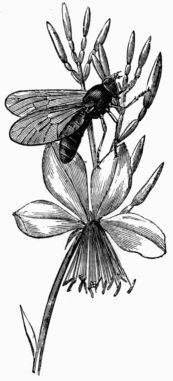
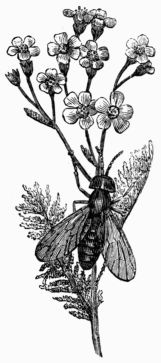
Fig. 33.—Tabanus autumnalis. Fig. 34.—Chrysops cæcutiens.
The chief characteristic of the Asilidæ is strength. All their organs combine to produce this quality, which they display only too much, being as formidable to cattle as the Tabani, but even surpassing those insects in natural cruelty.
The Asilidæ unceasingly attack other insects, and even those of their own kind. Their trunk is strong; one of the fibres of the sucker is furnished with small points, turned back, which are intended to hold firmly to the body into which it has entered. They carry on their devastations in the glades of woods and on sunny roads.
We will mention in this group Asilus crabroniformis (Fig. 35), an insect ten to twelve lines long, having a yellow head, black antennæ, and thorax of a brownish yellow. The three first segments of the abdomen are black, the second and third having a white spot on each side, the remaining segments are yellow. The wings are yellowish, spotted with black on the inner and hind margin. This species is common over the whole of Europe, and lives at the expense of caterpillars and other insects, of which it sucks the blood with the greatest voracity.
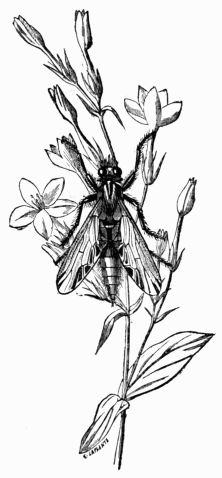
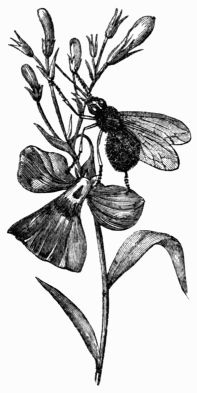
Fig. 35.—Asilus crabroniformis. Fig. 36.—Bombylius major.
The Empidæ live in the same way as the Asilidæ, but the males are chiefly nourished by the juices of flowers.
"They wage war on other insects," says M. Macquart, in his "Histoire Naturelle des Diptères," "either when flying or running, and they seize their victims with their feet, which are formed in various ways, and well adapted for their purpose, but it is in the air that their hunting, as well as their amours, chiefly take place. They unite together in numerous companies, which during fine summer evenings whirl like gnats about the water's edge. A singular observation, however, that I have made on the Empis, is, that among the thousands of pairs that I have seen resting on hedges and bushes, nearly all the females were occupied in sucking an insect; some had hold of small Phryganeæ, [13] others of Ephemeræ, [14] and the greater part of Tipulæ."
The Empidæ have the trunk bent down, and resembling the beak of a bird; but the Bombylidæ, on the contrary, have the trunk extended straight in front.
The typical genus which has given its name to this latter group is easily to be recognised by the elegance of the fur which covers its body, the slenderness of its feet, and the length of its wings, which extend horizontally on each side of the body.
Much more common in hot climates than in the North, these insects, the larvæ of which are not yet known, take flight in the middle of the day, when the sun's rays are hottest. They fly very fast, making a dull buzzing sound, and hover over flowers, from which they draw the juices without settling.
Fig. 36 represents the Bombylius major, which is common enough throughout the whole of Europe. This insect is from four to six lines long, black, with yellow fur; the feet light yellow; and the wings have the edges bordered with a sinuous brown band.
The genus Anthrax, belonging to this family, has a different form to Bombylius. The body is much less hairy; the trunk is short and concealed in the mouth; the wings, which are very large, are clothed, at least in the principal genus, in a garb of mourning, sufficiently remarkable, in which the combinations of black and white are admirably diversified.
"Here," says M. Macquart, "the line which separates the two colours is straight; there it represents gradations, in other cases it is deeply sinuous. Sometimes the dark part shows transparent points, or the glassy part dark spots. This sombre garb, added to the velvet black of the body, gives the Anthrax a most elegant appearance; and while resting on the corolla of the honeysuckle and hawthorn to suck the juice, forms a most striking contrast, and sets forth its beauty no less than that of those lovely flowers."
Anthrax sinuata is common in Europe.
The family of the Syrphidæ includes three remarkable types, which we cannot pass over in silence. They are Vermileo, Volucella, and Helophilus.
Vermileo de Geeri (Fig. 37), which inhabits the central and southern parts of France, is four or five lines in length. Its face is white; its forehead grey, bordered with black; the thorax of a yellowish grey, with four brown stripes in the male; the abdomen light yellow, spotted with black; and the wings glassy.
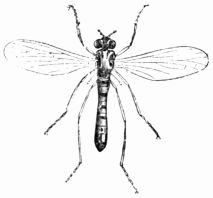
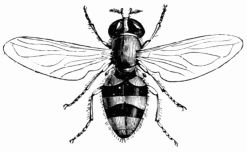
Fig. 37.—Vermileo de Geeri. Fig. 38.—A species of Volucella.
The larva of the Vermileo has a thin cylindrical body, capable of bending itself in every direction; a conical head, armed with two horny points; and the last segment elongated, flat, elevated, and terminated by four hairy tentacles; at the sides of the fifth segment may be observed a little angle, from which projects a horny retractile point.
It is of very singular habits. It makes a small tunnel in the sand, having a conical mouth, where it waits, like the spider, immovable. As soon as an insect falls into the hole, it raises its head, and squeezing its prey in the folds of its body, devours it, and afterwards throws out the skin. It lives in this way for at least three years before attaining the perfect state.
The Volucellæ (Fig. 38) have a strong resemblance to the humble-bee. Certain kinds make use and abuse of this resemblance to introduce themselves fraudulently into its nests, and to deposit their eggs therein. When these eggs have hatched, the larvæ, which have the mouth armed with two mandibles, devour the larvæ of their hosts, the bees. This is the return they make for the hospitality they have received!
Fig. 39.—A species of Helophilus.
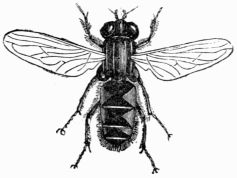
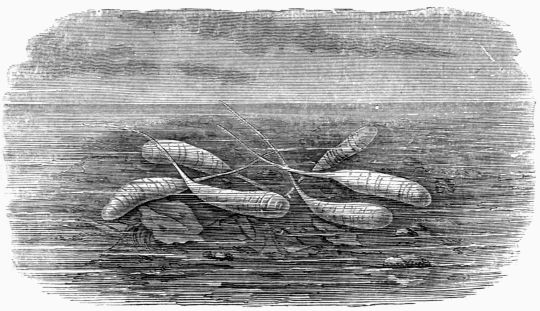
The Helophili (Fig. 39) deserve to be mentioned here on account of the singular form of many of their larvæ. The head is thick, fleshy, and varying a little in form. But the point by which they are easily to be distinguished from most other larvæ is, that they have always very long tails, sometimes, indeed, out of proportion to the length of the body. Réaumur called these larvæ "vers à queue de rat;" they are known in England as rat-tailed maggots, and their habits are aquatic. Having placed some of them in a bason of water, Réaumur saw that they kept in a perpendicular position at the bottom of the bason and parallel to one another, the extremities of their tails being on the surface of the water. He then increased the depth of the water by degrees; and, as it got deeper, observed that the tail of each worm became longer. These tails, which at first were only two inches long, at last attained to five.
It will be remarked that the body of each worm does not exceed five lines in length. The tail is a peculiar organ, by the aid of which the worm breathes, although its body may be covered by water to the depth of several inches. It is composed of two tubes, one of which shuts into the other, like a telescope. Réaumur calls it the breathing tube. It terminates in a little brown knob, in which, according to Réaumur, are two holes for the purpose of receiving the air, and which have five little tufts of hair, which float on the surface of the water. When the time comes for the metamorphosis of these worms, they come out of the water and bury themselves in the earth; the skin then hardens and becomes a sort of cocoon. In this cocoon the insect loses the form of a worm, and takes by degrees that of the pupa, which it keeps until circumstances cause it to throw off its last coverings, and to appear in the winged state.
Fig. 40.—Larvæ of a Helophilus.
What an eventful life! what a life full of changes and turns of fortune is that of these insects, which pass the first and longest period of their existence under water, another part of their life under the ground, and, finally, after having existed in these two elements, enjoy, high in the air, the pleasures of flight!
The third group of Brachycera is that of the Dichæta; that is, those flies having two-fibred suckers. Among these are classed the Œstri, the Conopes, and the flies properly so called.
The genus Œstrus, the Gad, Bot-fly, or Breeze, comprises those formidable insects which attack the horse, the sheep, and the ox. [15] The labours of Réaumur, in his admirable Memoirs, and those of M. Joly, Professor of Zoology to the Faculté des Sciences de Toulouse, who published some most valuable researches on this subject, in 1846, will guide us in the following brief explanation.
The following is the description given by M. Joly of the Gad-fly (Œstrus equi) represented in Figs. 41, 42, which are taken from a drawing which accompanies that naturalist's Memoirs.
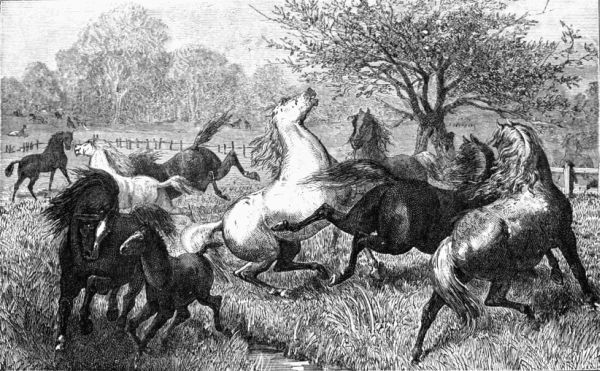
I.—A Herd of Horses attacked by Gad-flies (Œstrus equi).
The head of this insect is large and obtuse; the face light yellow, with whitish silky fur; the eyes blackish; the antennæ ferruginous; the thorax grey; and the abdomen of a reddish yellow, with black spots. The wings are whitish, not diaphanous, with a golden tint, and divided by a winding band of blackish colour. The feet are palish yellow.
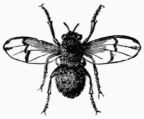
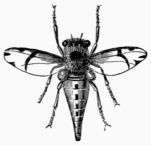
Fig. 41.—Horse-fly, male (Œstrus [gasterophilus] equi). Fig. 42.—Horse-fly, female (OEstrus [gasterophilus] equi).
This species is found in France, in Italy, and also in the East, especially in Persia, and rarely in England. During the months of July and August the Œstrus frequents pastures, and deposits its eggs chiefly on the shoulders and knees of horses (Plate I.). In order to do this, the female suspends herself in the air for some seconds over the place she has chosen, falls upon it, and with her abdomen bent, sticks her eggs to the horse's hairs by means of a glutinous liquid with which they are provided, and which soon dries. This is repeated at very short intervals. It often happens that from four to five hundred eggs are thus deposited upon the same horse. Guided by a marvellous instinct, the female Œstrus generally places her eggs on those parts of the horse's body which can be most easily touched with the tongue, that is, at the inner part of the knees, on the shoulders, and rarely on the outer part of the mane.
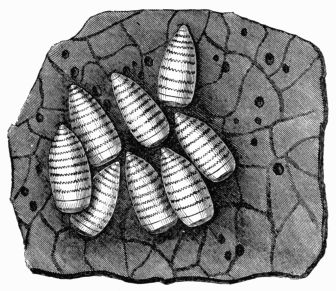
Fig. 43.—Eggs of the Gad-fly (Œstrus [gasterophilus] equi) deposited on the hairs of a horse.
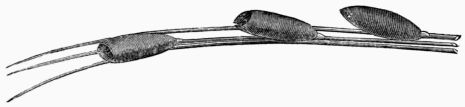
The eggs of the Œstrus, which are white and of conical form, adhere to the horse's hair, as shown in Fig. 43. They are furnished with a lid, which at the time of hatching opens, to allow the exit of the young larva, which takes place, according to M. Joly, about twenty days after they are deposited. In fact, it is not in the egg state, but really in that of the larva, that the horse, as we shall explain, takes into his stomach these parasitical guests, to which Nature has allotted so singular an abode. When licking itself, the horse carries them into its mouth, and afterwards swallows them with his food, by which means they enter the stomach. It is a remarkable fact that it is sometimes other insects, as the Tabania for instance, that by their repeated stinging cause the horse to lick himself, and thus to receive his most cruel enemy. In the perilous journey they have to perform from the skin of the horse to his stomach, many of the larvæ of the Œstrus, as may be supposed, are destroyed, ground by the teeth of the animal, or crushed by the alimentary substances. There is hardly one Œstrus in fifty that arrives safely in the stomach of the horse; and yet if one were to open a horse which had been attacked by the Œstri, the stomach would be nearly always found to have many of the larvæ sticking to its inside. Fig. 44, taken from a drawing which accompanies M. Joly's Memoirs, represents the state of a horse's stomach attacked by the Gad-fly larvæ.
Fig. 44.—Portion of the stomach of the horse, and larvæ of Œstrus (gasterophilus) equi.
The larvæ are of a reddish yellow, and each of their segments is armed at the posterior edge with a double row of triangular spines, large and small alternately, yellow at the base, and black at the point, which is always turned backwards. The head is furnished with two hooks, which serve to fasten the larva to the internal coats of the stomach. The spines with which the whole surface of the body is furnished contribute to fix it more perfectly, preventing the creatures, by the manner in which they are placed, from being carried away by the food which has gone through the first process of digestion.
It is probable that this larva, so singularly deposited, is nourished by the mucus secreted by the mucous membrane of the stomach, and that it breathes the air which the horse swallows with its food during the process of deglutition. It must be acknowledged, however, that it is in the midst of a gaseous atmosphere which is very unhealthy, for nearly all the gases generated in the stomach of the horse are fatal to man and to the generality of animals, as they consist of nitrogen, carbonic acid, sulphuretted hydrogen, and carburetted hydrogen. To explain how the insect can live under such circumstances, M. Joly has suggested the following ingenious hypothesis:—
"When the stomach which the larva inhabits," says this learned naturalist, "contains only oxygen, or air that is nearly pure, the insect opens the two lips of the cavity which contains the spiracles, and breathes at its ease. When the digestion of the alimentary substance generates gas which is unfit for respiration, or when the spiracles run the risk of being obstructed by the solid or liquid substances contained in the stomach, it shuts the lips, and continues to live on the air contained in its numerous tracheæ."
"Whatever may be the value of this explanation," adds M. Joly, "it is nevertheless very curious to see an insect pass the greater part of its life in an atmosphere which would be instantly fatal to most animals, and in an organ where, under the government of life, chemical processes bring about the most wonderful changes of the food into the substance of the animal itself. But how can the insect itself resist the action of these mysterious powers, and remain alone intact in the midst of all these matters which are unceasingly changing and decomposing? This is another question which it is difficult, or rather impossible, to explain in the present state of science; another enigma which humbles our pride, and of which He who has created both man and the worm alone knows the secret."
Arrived at a state of complete development, the larva of the Œstrus imprisoned in the stomach of the horse leaves the membrane to which it has been fixed, then directing the anterior part of its body towards the pyloric opening of the stomach, allows itself to be carried away with the excrementitious matter. It traverses, mixed with the excrementary bolus, the whole length of the intestinal canal, leaves it by the anal orifice, and on touching the ground at once seeks a suitable place to go through the last but one of its metamorphoses.
The skin then gets thick, hardens, and becomes black. All the organs of the animal are composed of a whitish amorphous pulp, which soon assumes its destined form, and the insect becomes perfect. It then lifts a lid at the anterior part of its cocoon, emerges, dries its wings, and flies off.
Fig. 45.—Bot-fly (Œstrus bovis).
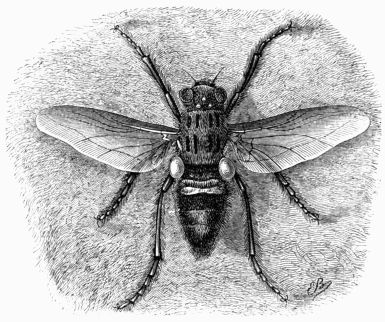
The Bot-fly (Œstrus bovis, Fig. 45) has a very hairy body, large head, the face and forehead covered with light yellow hair, the eyes brown, and the antennæ black. The thorax is yellow, barred with black; the abdomen of a greyish white at the base, covered with black hair on the third segment, and the remainder of an orange yellow; the wings are smoky brown.
II.—A Herd of Cattle attacked by Bot-flies (Œstrus bovis).
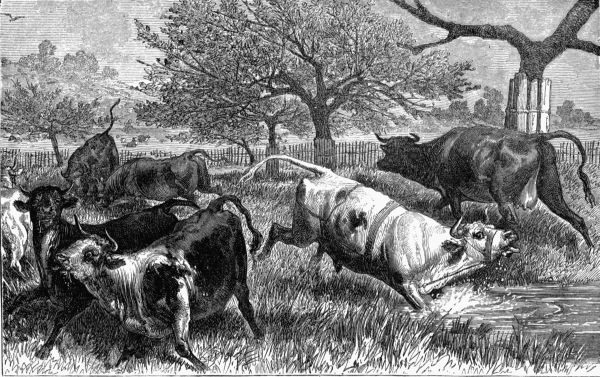
As soon as the cattle are attacked, they may be seen, their heads and necks extended, their tails trembling, and held in a line with the body, to rush to the nearest river or pond, while such as are not attacked disperse (Plate II.). It is asserted that the buzzing alone of the Œstrus terrifies a bullock to such an extent as to render it unmanageable. As for the insect, it simply obeys its maternal instinct, which commands it to deposit its eggs under the skin of our large ruminants.
Let us now explain how the eggs of the Œstrus, deposited in the skin of the bullock, accommodate themselves to this strange abode. The mother insect makes a certain number of little wounds in the skin of the beast, each of which receives an egg, which the heat of the animal serves to bring forth. It is a natural parallel to the artificial way which the ancient Egyptians invented of hatching the eggs of domestic fowls, and which has been imitated badly enough in our day.
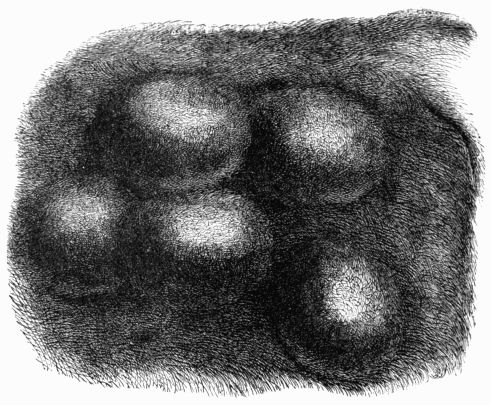
Directly the larva of the Bot-fly is out of the egg and lodged between the skin and the flesh of its host, the bullock, it finds itself in a place perfectly suitable to its existence. In this happy condition the larva increases in growth, and eventually becomes a fly in its turn. Those parts of the animal's body in which the larvæ are lodged are easily to be recognised, as above each larva may be seen an elevation, a sort of tumour, termed a bot—a bump, as Réaumur calls it, comparing it more or less justly to the bump caused on a man's head by a severe blow.
Fig. 46, taken from a drawing in Réaumur's Memoirs, represents the bots of which we speak.
The country people are well aware of the nature and cause of these bots. They know that each one contains a worm, that this worm comes from a fly, and that later it will be transformed into a fly itself. Each of these bots has in its interior a cavity, occupied by a larva, which, as well as the bot, increases in size as the larva becomes developed.
It is generally on young cows or young bullocks—in fact, on cattle of from two to three years of age—that these tumours exist, and they are rarely to be seen on old animals. The fly, which by piercing the skin occasions these tumours, always chooses those whose skin offers little resistance. Each tumour is provided with a small opening, by which the larva breathes.
In order to examine the interior of the cavity, Réaumur opened some of these tumours, either with a razor or a pair of scissors. He found them in a most disgusting state. The larva is lodged in a regular festering wound, matter occupying the bottom of the cavity, and the head of the worm is continually, or almost continually, plunged in this liquid. "It is most likely very well off there," says Réaumur; and he adds that this matter appears to be the sole food of the larva.
"The position of a horned beast," observes the great naturalist, "which has thirty or forty of these bumps on its back, would be a very cruel one, and a terrible state of suffering, if his flesh were continually mangled by thirty or forty large worms. But it is probable they cause no suffering, or at least very little, to the large animal. Besides," continues Réaumur, "those cattle whose bodies are the most covered with bumps, not only show no signs of pain, but it does not appear that they are prejudicial to them in any way."
Fig. 46.—Bumps produced on Cattle by the larvæ of the Bot-fly.
Réaumur tried to discover how the larva, when arrived at its full growth, succeeds in leaving its abode, as the opening is smaller than its own body.
"Nature," says Réaumur, "has taught this worm the surest, the gentlest, and the most simple of methods, the one to which surgeons often have recourse to hold wounds open, or to enlarge them. They press tents into a wound they wish to enlarge. Two or three days before the worm wishes to come out, it commences to make use of its posterior part as a tent, to increase the size of its exit from its habitation. It thrusts it into the hole and draws it out again many times in the course of two or three days, and the oftener this is repeated, the longer it is able to retain its posterior end in the opening, as the hole becomes larger. On the day preceding that on which the worm is to come out, the posterior part is to be found almost continually in the hole. At last, it comes out backwards, and falls to the ground, when it gets under a stone, or buries itself in the turf; remaining quiet and preparing for its last transformation. Its skin hardens, the rings disappear, and it becomes black. Thenceforth the insect is detached from the outer skin, which forms a cocoon, or box. At the front and upper part of the cocoon is a triangular piece, which the fly gets rid of when it is in a fit state to come into the open air."
Fig. 47, taken from drawings in Réaumur's Memoirs, represents the imago of the Œstrus leaving the cocoon.
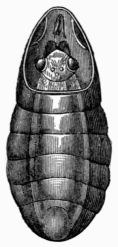
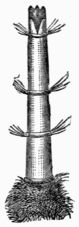
Fig. 47. Imago of Bot-fly emerging. Fig. 48. Ovipositor of the Bot-fly (Œstrus bovis).
The reader is, most likely, desirous to know with the aid of what instrument the Œstrus is able to pierce the thick skin of the ox.
The female only is possessed of this instrument, which is situated in the posterior extremity of the body. It is of a shiny blackish brown colour, and as it were covered with scales. By pressing the abdomen of the fly between one's two fingers it is thrust out. Réaumur observed that it was formed of four tubes, which could be drawn the one into the other, like the tubes of a telescope (Fig. 48). The last of these appears to terminate in five small scaly knobs, which are not placed on the same line, but are the ends of five different parts. Three of these knobs are furnished with points, which form an instrument well fitted to operate upon a hard thick skin. United together, they form a cavity similar to that of an auger, and terminating in the form of a spoon.
The Gad-fly, or Breeze-fly of the sheep, Œstrus (Cephalemyia ovis), has obtained notoriety on account of its attacking those animals.
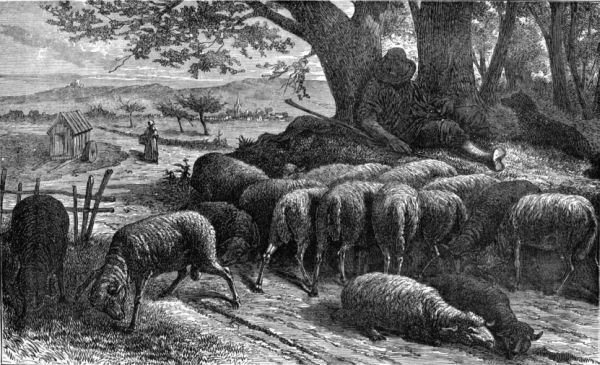
Even at the sight of this insect the sheep feels the greatest terror. As soon as one of them appears, the flock becomes disturbed, the sheep that is attacked shakes its head when it feels the fly on its nostril, and at the same time strikes the ground violently with its fore-feet; it then commences to run here and there, holding its nose near the ground, smelling the grass, and looking about anxiously to see if it is still pursued.
Fig. 49.—Cephalemyia ovis.
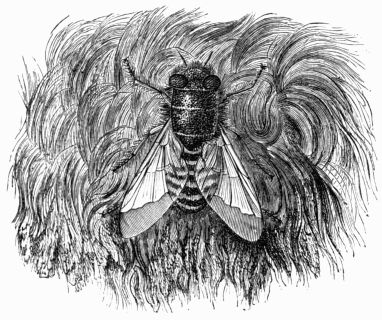
It is to avoid the attacks of the Cephalemyia that during the hot days of summer sheep lie down with their nostrils buried in dusty ruts, or stand up with their heads lowered between their fore-legs, and their noses nearly in contact with the ground. When these poor beasts are in the open country, they are observed assembled with their nostrils against each other and very near the ground, so that those which occupy the outside are alone exposed (Plate III.). The Cephalemyia ovis (Fig. 49) has a less hairy head, but larger in proportion to the size of its body than the Gad-fly (Gasterophilus equi). Its face is reddish; its forehead brown with purple bars; its eyes of a dark and changing green; its antennæ black, its thorax sometimes grey, sometimes brown, bristling with small black tubercles; the abdomen white, spotted with brown or black; and the wings hyaline.
III.—Sheep attacked by Cephalemyia ovis.
The Cephalemyia (Œstrus) ovis is to be found in Europe, Arabia, Persia, and in the East Indies. It lays its eggs on the edges of the animal's nostrils, and the larva lives in the frontal and maxillary sinuses. It is a whitish worm, having a black transverse band on each of its segments. Its head is armed with two horny black hooks, parallel, and capable of being moved up and down and laterally. Underneath, each segment of the body has several rows of tubercles of nearly spherical form, surmounted by small bristles having reddish points, and all of them bent backwards. "These points," says M. Joly, "probably serve to facilitate the progress of the animal on the smooth and slippery surfaces of the mucous membranes to which it fixes itself to feed, and perhaps also to increase the secretion of these membranes by the irritation occasioned by the bristles with which they are furnished." [16]
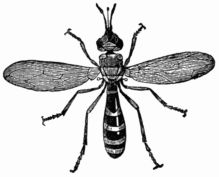
Fig. 50.—Conops.
Fixed by means of these hooks to the mucous membrane, which it perforates, the larva nourishes itself with mucus, and lives in this state, according to M. Joly, during nearly a whole year. At the end of this time it comes out, following the same course by which it entered, falls to the ground, and burying itself to the depth of a few inches, is transformed into a pupa. The cocoon is of a fine black colour. Thirty or forty days after its burial it emerges in the perfect state, and detaching the lid at the anterior end of the cocoon by the aid of its head, which has increased considerably in size, takes flight.
Notwithstanding the formidable appearance of their trunks, the habits of the perfect Conopes (Fig. 50) are very quiet. In the adult state they are only to be seen on flowers, of which they suck the honeyed juice. But with their larvæ the case is otherwise. These latter live as parasites on the humble-bees (Bombi). Latreille saw the Conops rufipes issue in the perfect state from the body of a humble-bee, through the intervals of the segments of the abdomen.
The Mucides form that great tribe of Diptera commonly known as flies, and which are distributed in such abundance over the whole world. Faithful companions of plants, the flies follow them to the utmost limits of vegetation. At the same time they are called upon by Nature to hasten the dissolution of dead bodies. They place their eggs in the carcases of animals, and the larvæ prey upon the corrupt flesh, thus quickly ridding the earth of those fatal causes of infection to its inhabitants. The organs of these insects are also infinitely modified, in order to adapt them to their various functions.
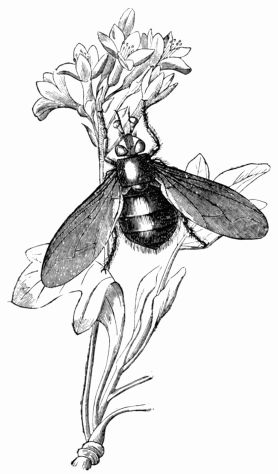
Fig. 51.—Echinomyia grossa.
M. Macquart divides the Muscides into three sections—the Creophili, the Anthomyzides, and the Acalyptera.
The Creophili have the strongest organisation; their movements and their flight are rapid. The greater part feed on the juices of flowers, some on the blood or the humours of animals. Some deposit their eggs on different kinds of insects, others on bodies in a state of decomposition, some again are viviparous. The insects of the genus Echinomyia, for instance (Fig. 51), derive their nourishment from flowers. They deposit their eggs on caterpillars, and the young larvæ on hatching penetrate their bodies and feed on their viscera. How surprised, sometimes, is the naturalist, who, after carefully preserving a chrysalis, and awaiting day by day the appearance of the beautiful butterfly of which it is the coarse and mysterious envelope, sees a cloud of flies emerge in place of it!
But there is another singular manœuvre performed by some of the species of the Diptera with which we are at present occupied to prepare an abundant supply of provision for their larvæ as soon as they are hatched. The following are the means they employ. It is well known that certain fossorial Hymenoptera carry their prey—other insects which they have caught, weevils, flies, &c., and which they intend should serve as food for their own larvæ—into their subterranean abodes. These Diptera, spying a favourable moment, slip furtively into their retreats, and deposit their eggs on the very food which was intended for others. Their larvæ, which are soon hatched, make great havoc among the provisions gathered together in the cave, and cause the legitimate proprietors to die of starvation.
"This instinct," says M. Macquart, "is accompanied by the greatest agility, obstinacy, and audacity, which are necessary to carry on this brigandage; and, on the other hand, the Hymenoptera, seized with fear, or stupefied, offer no resistance to their enemies, and although they carry on a continual war against different insects, and particularly against different Muscides, they never seize those of whom they have so much to complain, and which, nevertheless, have no arms to oppose them with."
The Sarcophagæ are a very common family of Diptera, and are chiefly to be found on flowers, from which they steal the juice. The females do not lay eggs, but are viviparous.
Réaumur, with his usual care, observed this remarkable instance of viviparism proved in a fly, which seeks those parts of our houses where meat is kept to deposit its larvæ. This fly is grey, its legs are black, and its eyes red.
When one of them is taken and held between the fingers, there may often be seen a small, oblong, whitish, cylindrical worm come out of the posterior part of the body, and shake itself in order to disengage itself thoroughly. It has no sooner freed itself than the head of another begins to show. Thirty or forty sometimes come out in this manner, and, on pressing the abdomen of the fly slightly, more than eighty of these larvæ may sometimes be made to come out in a short space of time. If a piece of meat be put near these worms, they quickly get into it, and eat greedily. They grow rapidly, attaining their full size in a few days, and make a cocoon of their skin, from which in a certain time the imago issues. If the body of one of these ovo-viviparous flies (for the eggs hatch within the parent) be opened, a sort of thick ribbon of spiral form is soon seen. This ribbon appears at first sight to be nothing but an assemblage of worms, placed alongside of and parallel to one another.
Each worm has a thin white membranous envelope, similar to those light spiders' webs which float about in autumn, which the French call fils de la vierge, and we denominate gossamer.
The fecundity of this fly is very great, for, in the length of a quarter of an inch, the envelope in which these small worms are enclosed contains 2,000 of them. Therefore this ribbon, being two inches and a half long, contains about 20,000 worms.
The members of the genus Stomoxys, though nearly related to the house-fly, differ from it very much in habits. They live on the blood of animals. The Stomoxys calcitrans is very common in these climates. Its palpi are tawny yellow, antennæ black, thorax striped with black, abdomen spotted with brown, and its trunk hard, thin, and long. It deposits its eggs on the carcases of large animals.
The Golden Fly, Lucilia Cæsar, lays its eggs on cut-up meat, or on dead animals. It is only three or four lines in length, of a golden green, with the palpi ferruginous, antennæ brown, and feet black.
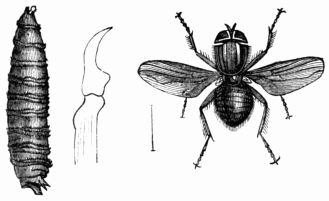
Fig. 52.—Lucilia hominivorax.
A species of this genus, the Lucilia hominivorax, has lately obtained a melancholy notoriety. We are indebted to M. Charles Coquerel, surgeon in the French Imperial navy, for the most exact information concerning this dangerous Dipteron, and the revelation of the dangers to which man is liable in certain parts of the globe. But let us first describe the insect, which is very pretty and of brilliant colours.
Fig. 52, taken from M. Charles Coquerel's Memoir, represents the larva and the perfect insect, as well as the horny mandibles with which the larva is provided. It is rather more than the third of an inch in length, the head is large, downy, and of a golden yellow. The thorax is dark blue and very brilliant, with reflections of purple, as is also the abdomen. The wings are transparent, and have rather the appearance of being smoked; their margins, as well as the feet, are black.
This beautiful insect is an assassin. M. Coquerel has informed us that it sometimes occasions the death of those wretched convicts whom human justice has transported to the distant penitentiary of Cayenne.
When one of these degraded beings, who live in a state of sordid filth, goes to sleep, a prey to intoxication, it happens sometimes that this fly gets into his mouth and nostrils; it lays its eggs there, and when they are changed into larvæ, the death of the victim generally follows.[17]
These larvæ are of an opaque white colour, a little over half an inch in length, and have eleven segments. They are lodged in the interior of the nasal orifices and the frontal sinuses, and their mouths are armed with two very sharp horny mandibles. They have been known to reach the ball of the eye, and to gangrene the eyelids. They enter the mouth, corrode and devour the gums and the entrance of the throat, so as to transform those parts into a mass of putrid flesh, a heap of corruption.
Let us turn away from this horrible description, and observe that this hominivorous fly is not, properly speaking, a parasite of man, as it only attacks him accidentally, as it would attack any animal that was in a daily state of uncleanliness.
In many works on medicine may be found mentioned a circumstance which occurred twenty years ago, at the surgery of M. J. Cloquet. The story is perhaps not very agreeable, but is so interesting as regards the subject with which we are occupied, that we think it ought to be repeated here. One day a poor wretch, half dead, was brought to the Hôtel-Dieu. He was a beggar, who, having some tainted meat in his wallet, had gone to sleep in the sun under a tree. He must have slept long, as the flies had time enough to deposit their eggs on the tainted meat, and the larvæ time enough to be hatched, and to devour the beggar's meat. It seems that the larvæ enjoyed the repast, for they passed from the dead meat to the living flesh, and after devouring the meat they commenced to eat the owner. Awoke by the pain, the beggar was taken to the Hôtel-Dieu, where he expired.
Who would suppose that one of the causes which render the centre of Africa difficult to be explored is a fly not larger than the house-fly? The Tsetse fly (Fig. 53) is of brown colour, with a few transverse yellow stripes across the abdomen, and with wings longer than its body. It is not dangerous to man, to any wild animals, or to the pig, the mule, the ass, or the goat. But it stings mortally the ox, the horse, the sheep, and the dog, and renders the countries of Central Africa uninhabitable for those valuable animals. It seems to possess very sharp sight. "It darts from the top of a bush as quick as an arrow on the object it wishes to attack," writes a traveller, M. de Castelnau.
Fig. 53.—The Tsetse Fly (Glossina morsitans).
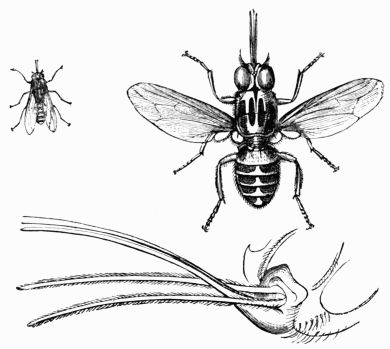
Mr. Chapman, one of the travellers who have advanced the farthest into the middle of Southern Africa, relates that he covered his body with the greatest care to avoid the bites of this nimble enemy; but if a thorn happened to make a nearly imperceptible hole in his clothing, he often saw the Tsetse, who appeared to know that it could not penetrate the cloth, dart forward and bite him on the uncovered part. The sucker of blood secretes—in a gland placed at the base of his trunk—so subtle a poison, that three or four flies are sufficient to kill an ox.
The Glossina morsitans abounds on the banks of the African river, the Zambesi, frequenting the bushes and reeds that border it. It likes, indeed, all aquatic situations. The African cattle recognise at great distances the buzzing of this sanguinary enemy, and this fatal sound causes them to feel the greatest fear.
Livingstone, the celebrated traveller, in crossing those regions of Africa that are watered by the Zambesi, lost forty-three magnificent oxen by the bites of the Tsetse fly, notwithstanding that they were carefully watched, and had been very little bitten.
"A most remarkable feature in the bite of the Tsetse is its perfect harmlessness in man and wild animals, and even calves so long as they continue to suck the cows. We never experienced the slightest injury from them ourselves personally, although we lived two months in their habitat, which was in this case as sharply defined as in many others, for the south bank of the Chobe was infested by them, and the northern bank, where our cattle were placed, only fifty yards distant, contained not a single specimen. This was the more remarkable, as we often saw natives carrying over raw meat to the opposite bank with many Tsetses settled on it.
"The poison does not seem to be injected by a sting, or by ova placed beneath the skin, for, when one is allowed to feed freely on the hand, it is seen to insert the middle prong of three portions, into which the proboscis divides, somewhat deeply, into the true skin. It then draws it out a little way, and it assumes a crimson colour, as the mandibles come into brisk operation. The previously-shrunken belly swells out, and, if left undisturbed, the fly quietly departs when it is full. A slight itching irritation follows, but not more than in the bite of the mosquito. In the ox this same bite produces no more immediate effects than in man. It does not startle him, as the gad-fly does; but a few days afterwards the following symptoms supervene: the eyes and nose begin to run, the coat stares as if the animal were cold, a swelling appears under the jaw, and sometimes on the navel; and, though the animal continues to graze, emaciation commences, accompanied with a peculiar flaccidity of the muscles, and this proceeds unchecked until, perhaps months afterwards, purging comes on, and the animal, no longer able to graze, perishes in the state of extreme exhaustion. Those which are in good condition often perish, soon after the bite is inflicted, with staggering and blindness, as if the brain were affected by it. Sudden changes of temperature produced by falls of rain seem to hasten the progress of the complaint; but in general the emaciation goes on uninterruptedly for months, and, do what we will, the poor animals perish miserably.
"When opened, the cellular tissue on the surface of the body beneath the skin is seen to be injected with air, as if a quantity of soap bubbles were scattered over it, or a dishonest awkward butcher had been trying to make it look fat. The fat is of a greenish-yellow colour, and of an oily consistence. All the muscles are flabby, and the heart often so soft that the fingers may be made to meet through it. The lungs and liver partake of the disease. The stomach and bowels are pale and empty, and the gall-bladder is distended with bile. These symptoms seem to indicate, what is probably the case, a poison in the blood; the germ of which enters when the proboscis is inserted to draw blood. The poison-germ contained in a bulb at the root of the proboscis, seems capable, although very minute in quantity, of reproducing itself. The blood after death by Tsetse is very small in quantity, and scarcely stains the hands in dissection....
"The mule, ass, and goat enjoy the same immunity from the Tsetse as man and game. Many large tribes on the Zambesi can keep no domestic animals except the goat, in consequence of the scourge existing in their country. Our children were frequently bitten, yet suffered no harm; and we saw around us numbers of zebras, buffaloes, pigs, pallahs and other antelopes, feeding quietly in the very habitat of the Tsetse, yet as undisturbed by its bite as oxen are when they first receive the fatal poison. There is not so much difference in the natures of the horse and zebra, the buffalo and ox, the sheep and the antelope, as to afford any satisfactory explanation of the phenomenon. Is a man not as much a domestic animal as a dog?
"The curious feature in the case, that dogs perish though fed on milk, whereas the calves escape so long as they continue sucking, made us imagine that the mischief might be produced by some plant in the locality, and not by Tsetse; but Major Vardon, of the Madras army, settled that point by riding a horse up to a small hill infested by the insect, without allowing him time to graze, and though he only remained long enough to take a view of the country and catch some specimens of Tsetse on the animal, in ten days afterwards the horse was dead."[18]
The inhabitants of the Zambesi can, therefore, have no domestic animal but the goat. When herds of cattle driven by travellers or dealers are obliged to cross these regions, they only move them during the bright nights of the cool season, and are careful to smear them with dung mixed with milk; the Tsetse fly having an intense antipathy to the dung of animals, besides being in this season rendered dormant by the lowness of the temperature. It is only by such precautions that they are able to get through this dangerous stage of their journey.
The large blue Meat-fly, the familiar representative of the genus Calliphora, is known to all by its brilliant blue and white reflecting abdomen. This fly, which is common everywhere, is the Calliphora vomitoria on which Réaumur has made many beautiful observations, which we will make known to our readers.
Fig. 54.—Eggs of the Meat-fly (Calliphora vomitoria).
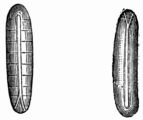
If we shut up a blue meat-fly in a glass vase, as Réaumur did, and place near the insect a piece of fresh meat, before half a day is passed, the fly will have deposited its eggs thereon one after the other, in irregular heaps, of various sizes. The whole of these heaps consist of about two hundred eggs, which are of an iridescent white colour, and four or five times as long as they are broad. In less than twenty-four hours after the egg is laid the larvæ is hatched. It is no sooner born than it thinks of feeding, and buries itself in the meat with the aid of the hooks and lancets with which it is provided.
These worms do not appear to discharge any solid excrement, but they produce a sticky liquid, which keeps the meat in a moist state and hastens its putrefaction. The larvæ eat voraciously and continually; so much so, that in four or five days they arrive at their full growth. They then take no more nourishment until they are transformed into flies. They are now about to assume the pupa state. In this condition it is no longer necessary for them to remain on the tainted meat, which has been alike their cradle and their larder, and where until now they were so well off. They therefore leave it and seek a retreat under ground.
The larva then assumes a globular form and reddish colour, loses all motion, and cannot any longer either lengthen or shorten, or dilate or contract itself. Life seems to have left it. "It would be considered a miracle," says Réaumur, "if we were told there was any kind of quadruped of the size of a bear, or of an ox, which at a certain time of the year, the beginning of winter for instance, disengages itself completely from its skin, of which it makes a box of an oval form; that it shuts itself up in this box; that it knows how to close it in every part, and besides that it knows how to strengthen it in such a manner as to preserve itself from the effects of the air and the attacks of other animals. This prodigy is presented to us, on a small scale, in the metamorphosis of our larva. It casts its skin to make itself a strong and well-closed dwelling."
If one opens these cocoons only twenty-four hours after the metamorphoses of the worms, no vestige of those parts appertaining to a pupa is to be found. But four or five days afterwards, the cocoon is occupied by a white pupa, provided with all the parts of a fly. The legs and wings, although enclosed in sheaths, are very distinct; these sheaths being so thin that they do not conceal them. The trunk of the fly rests on the thorax; one can discern its lips, and the case which encloses the lancet. The head is large and well formed, its large, compound eyes being very distinct. The wings appear still unformed, because they are folded, and, as it were, packed up. It is a fly, but an immovable and inanimate fly; it is like a mummy enveloped in its cloths.
Nevertheless, it is intended this mummy should awake, and when the time comes it will be strong and vigorous. Indeed, it has need of strength and vigour to accomplish the important work of its life. Although its coverings are thin, it is a considerable work for the insect to emerge, for each of its exterior parts is enclosed in them as in a case, much the same as a glove fits tightly to all the fingers of the hand. But that for which the most strength is necessary is the operation of forming the opening of the cocoon, in which as a mummy it is so tightly enclosed.
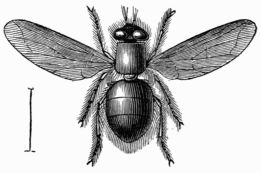
The fly always comes out at the same end of the cocoon, that is, at the end where its head is placed, and also where the head of the larva previously was. This end is composed of two parts—of two half cups placed one against the other. These can be detached from each other and from the rest of the cocoon. It is sufficient for the fly that one can be detached, and in order to effect this, it employs a most astonishing means. It expands and contracts its head alternately, as if by dilatation; and thus pushes the two half cups away from the end of the cocoon. This is not long able to resist the battering of the fly's head, and the insect at length comes out triumphant. This fly, which should be blue, is then grey; it, however, comes quickly to perfection, at the end of three hours attaining its ultimate colour; and in a very short space of time every part of the animal becomes of that firmness and consistency which characterises them. At the same time, the wings, which at the moment it came into the world were only stumps, extend and unfold themselves by degrees. The meat-fly is represented below (Fig. 55).
Fig. 55.—Blue-bottle fly (Calliphora vomitoria), magnified.
One of the features in the formation of this fly which most attracted the attention of Réaumur, and which is likely to excite the curiosity of all those who take an interest in insects, is the composition of its trunk. We will, therefore, with that illustrious observer, take a glimpse at the remarkable and complicated apparatus by the aid of which the fly can suck up liquids, and can even taste solid and crystalline substances, such as sugar.
It is no difficult matter to make a fly show its trunk extended to its full extent. One has only to press between the finger and thumb either the two sides of the upper and under part of the thorax. It is thus forced at once to put out its tongue.
The trunk appears to be composed of two parts joined together, and forming a more or less obtuse angle (Fig. 56). The first portion of the trunk, that which joins the head, is perfectly membranous and in the form of a funnel. We will call it the conical part, and show it separately (Fig. 57). The second portion terminates in a thick mass, in part cartilaginous or scaly, and of a shiny brown colour. Above the conical portion are two oblong antennæ, without joints, of chestnut colour, and furnished with hairs.
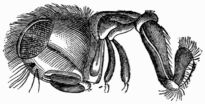

Fig. 56.—Trunk of the Meat-fly. Fig. 57.—Conical part of the trunk.
On ceasing to press the thorax, the membranous conical portion may be seen to draw itself back within its sheath (Fig. 58). The second portion is at the same time drawn into the cavity, but it raises itself by forming a more and more acute angle, so that when it reaches the opening of the cell it is parallel with, and its length is equal to that of the cell, which is quite large enough to receive it. The base lengthens and flattens a little, and conceals the trunk.
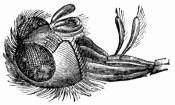
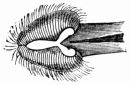
Fig. 58. Retractile proboscis of Blue-bottle fly. Fig. 59. Extremity on the proboscis of a fly.
Let us cause the trunk to extend itself a second time, in order to observe its tip minutely. Here the opening is placed, which may be looked upon as the mouth of the insect, and is provided with two large thick lips (Fig. 59). These lips form a disc, perpendicular to the axis of the trunk; the disc is oval, and is divided into two equal and similar parts by a slit. The lips have each a considerable number of parallel channels situated perpendicularly to the slit. These channels are formed by a succession of vessels placed near each other. On pressing the trunk we see that these vessels are distended by a liquid. Réaumur, from whom we borrow these details, discovered a few of the uses to which this trunk is applied. He covered the interior of a transparent glass vase with a light coat of thick syrup. He then put in some flies, when it was easy to see some of them proceed to fix themselves to the sides of the vase, and regale themselves on the sugary liquid, of which they are very fond. He observed them carefully, and in his admirable work he recommends those who are curious to try the experiment, with which, like himself, they will certainly be satisfied.
While the body of the trunk is stationary its end is much agitated. It may be seen to move in different ways, and with an astonishing quickness; the lips acting in a hundred different ways, and always with great rapidity. The small diameter of the disc which they form lengthens and shortens alternately; the angle formed by the two lips varies every instant; they become successively flat and convex, either entirely or partly. All these movements, Réaumur remarks, give a high idea of the organisation of the part which performs them.
The object of all these movements is to draw the syrup into the interior of the trunk. If we observe the lips (Fig. 60) attentively, it will easily be seen that they touch each other about the centre of the disc, and leave two openings, one in front, the other at the back. The one in front is, one may say, the mouth of the fly, as it is to this opening that the liquid is brought, which is intended to be and is soon introduced into the trunk. Without occupying ourselves for the present with the channel through which it rises, we may first ask, whatever that channel may be, what is the power that forces the liquid into it?
Fig. 60. Lips of the proboscis of a fly.

It is nearly certain that suction is the principal cause of the liquid flowing up the trunk. It would thus be a sort of pump, into which the liquid is forced by the pressure of the external air. The fly exhausts the air from the tube of its trunk, and the drop of liquid which is at the opening penetrates and goes up this channel through the influence of the atmospheric pressure. To this physical phenomenon must be added the numerous and multiplied movements which take place in the trunk, and which are intended to cause sufficient pressure to drive the liquor which is introduced into the channel upwards.
Réaumur wished to know how it was that very thick syrups, and even solid sugar, can be sucked up by the soft trunk of the fly. What he saw is wonderful. If a fly meets with too thick a syrup, it can render it sufficiently liquid; if the sugar is too hard, it can dissolve small portions of it. In fact, there exists in its body a supply of liquid, of which it discharges a drop from the end of its trunk at will, and lets this fall on the sugar which it wishes to dissolve, or on the syrup it wishes to dilute. A fly, when held between the fingers, often shows at the end of its trunk a drop, very fluid and transparent, of this liquid. "The water poured on the syrup," says Réaumur, "would not always insinuate itself sufficiently quick into every part of it; the movement of the fly's lips hastens the operation; the lips turn over, work, and knead it, so that the water can quickly penetrate it, in the same way as one handles and kneads with one's hands a hard paste which it is wished to soften, by causing the water by which it is covered to mix with it. This, again, is the same means the fly employs with sugar. When the trunk is forced to act upon a grain of irregular and rugged form, on which it cannot easily fasten, its end distorts itself to seize and hold it. It is sometimes very amusing to see how the fly turns over the grain of sugar in different ways; it appears to play with it as a monkey would with an apple. It is, however, only that it may hold it well in order to moisten it more successfully, and afterwards to pump up the water which has partly dissolved it."
Réaumur often observed a drop of water at the end of the trunks of flies which were perfectly surfeited with food. This drop ascended the trunk, then re-descended to the end, and this many times in succession. It appeared to him that it was necessary for these insects, as for many quadrupeds, to chew the cud, as it were; that, in order the better to digest the liquid they had passed into their stomachs, they were obliged to bring it back into the trunk that it might return again better prepared.
In order to assure himself directly of the reality of his supposition, Réaumur tested the water which a fly, that he says "had got drunk on sugar," had brought back to the end of its trunk; he found this to be sugar and water. Also, having given a fly currant-jelly, he observed, after it had sufficiently gorged itself, several drops of red liquid in its trunk, and having tasted it, found it had the flavour which, from its appearance, he guessed it would have.
The illustrious observer, who had already made all these discoveries on the formation and functions of the trunks of insects, often reflected on the fact that the liquors of which flies are most fond are enclosed under the skin of certain fruits, such as pears, plums, grapes, &c., or even under the skin of some animals of which they suck the blood. In order that the trunk of a fly may act under such circumstances, it is necessary for it to pierce and open the skin. If this is the case, flies ought to be possessed of a lancet. He looked a long time for this lancet, and at last found it. It is situated on the upper side of the part of the trunk which is terminated by the lips; it is placed in a fleshy groove, and is enclosed in a case. It has a very fine point, and is of light colour (Fig. 61). The point is situated in the opening which is to be seen between the lips of the trunk, at its anterior end, through which liquids may pass. That is the only opening of the lips; and the sucker which takes up the liquid is the same part which we just now called the case of the lancet.
Réaumur is so interesting an author that it is difficult to cease quoting him; but we must continue our review of the principal kinds of Diptera.
The genus Musca (fly), in which Linnæus comprised the immense series of Diptera, with the exception of the Tipulidæ, the Tabanidæ, the Asilidæ, the Bombylidæ, and the Empidæ, is now reduced to the House Fly and a few resembling it. The habits of these troublesome companions are in conformity with the two great principles of animal life, that is, eating and propagating their species.
Flies feed principally on fluids which exude from the bodies of animals; that is, sweat, saliva, and other secretions. They also seek vegetable juices; and they may be seen in our houses to feed eagerly on fruits and sweet substances.
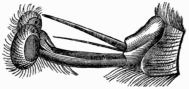
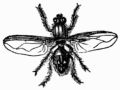
Fig. 61.—Lancet of the Meat Fly. Fig. 62.—House Fly (Musca domestica).
The common flies deposit their eggs on vegetables, and particularly on fungi in a state of decomposition, on dung-heaps, cow dung, &c. They are essentially parasites, settling on both man and beast, to suck up the fluid substances which are diffused over the surface of their bodies. In our dwellings they eat anything that will serve to nourish them. Generation succeeds generation with the greatest rapidity.
The House Fly (Musca domestica, Fig. 62) is about three lines in length, ash coloured, with the face black, the sides of the head yellow, and the forehead yellow with black stripes; the thorax is marked with black lines; the abdomen is pale underneath, and a transparent yellow at the sides, in the males, and is speckled with black. The feet are black; the wings transparent, and yellowish at the base. This species is extremely plentiful throughout the whole of Europe. Every one knows how annoying it is towards the end of the summer, and especially so in the South of France during the hot season.
The Ox Fly (Musca bovina), a near relation of the house fly, is also very common. It settles on the nostrils, the eyes, and the wounds of animals.
The Executioner Fly (Musca carnifex), which is not rare in France, also attacks oxen. It is of a dark metallic green colour with a slight ash-coloured down. Its forehead is silvery at the front and sides; the abdomen is edged with black; the wings hyaline, and yellow at the base.
Section of the Anthomyides.—The section of Anthomyides comprises insects which appear to be Creophili whose organisation has become weakened by almost insensible degrees. Their colours vary very much—black, grey, and iron-colour are everlastingly shaded and blended together. To that may be added reflections which are above the ground colour, and which change the hues of the little animal according to the incidence of the rays of light. The Anthomyides resemble the genus Musca very closely in their habits as well as in their organisation.
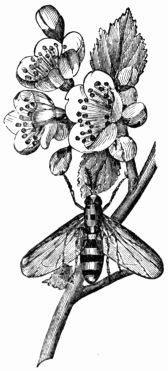
Fig. 63.—Anthomyia pluvialis.
In this group of Diptera we will first say a few words about the Anthomiæ. These flies are to be found in most gardens, and on all flowers, particularly on the heads of Compositæ and Umbelliferæ. They often unite in numerous bands in the air, and indulge in the joyous dances to which love invites them. The females deposit their eggs in the ground, and their larvæ are there quickly developed. The latter suspend themselves to certain bodies, the same as some lepidopterous chrysalides, in order to transform themselves into pupæ.
The Anthomyia pluvialis (Fig. 63) is from two to four lines in length, and of a whitish ash-colour. Its wings are hyaline, the thorax has five black spots, and the abdomen three rows of similar spots.
We will stop a moment with the Pegomyiæ, which are very interesting in the larva state, and which excited the interest and sagacity of Réaumur.
The cradle of these Diptera is the interior of leaves. They work as the miners of the vegetable world, in the parenchyma or cellular tissue of the leaf, between the two epidermal membranes. The henbane, the sorrel, and the thistle, especially nourish them. If one holds a leaf in which one of these miners has established itself against the light, one sees the workman boring the vegetable membrane. Its head is armed with a hook, formed of two horny pieces, and with this hook it digs into the parenchyma of the leaf. The effect of this digging is visible, as those places become by degrees transparent. Each blow detaches a small portion of the substance of the leaf. It is thus that these miners hollow out galleries for themselves, in which they find shelter, food, and security. Some are changed into pupæ in the gallery which they have hollowed out, others go out of the leaves when they are near their final transformation.
Fig. 64.—A species of Helomyza.
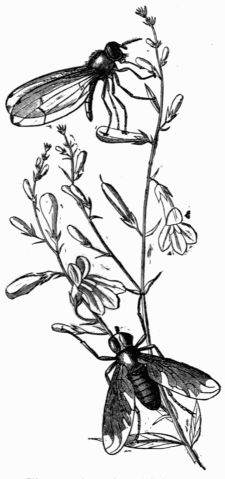
Section of Acalyptera.—The Acalyptera, which are the last of the great tribe of Muscidæ, comprehend the greater number of these insects. Their constitution appears to be peculiar and slow. They live principally in the thickest part of woods, on grasses, and aquatic plants. Fearing the lustre and warmth of the sun, they never draw the nectar from flowers. Their flight is feeble, and they never indulge in those joyous ethereal dances which we have mentioned when speaking of the preceding groups. Their life is generally melancholy, obscure, and hidden. Some of them seek decomposed animal and vegetable substances, others living vegetables.
We shall only be able in this immense group of Muscidæ to mention a few types which are interesting from various reasons, such as the Helomyzæ, the Scatophagæ, the Ortalides, the Daci, and the Thyreophoræ.
The Helomyzæ (Fig. 64) live in the woods. Their larvæ are developed in the interior of fungi. Réaumur studied the larvæ of the Truffle Helomyza. The head of this fly is ferruginous, its thorax is of a brownish grey, its shoulders of a brownish yellow, its wings brownish, the abdomen yellow and brown, and the feet red. The larvæ of these insects commit depredations for which gourmands will never forgive them, destroying, as they do, their truffles. When one presses between one's fingers a truffle that is in a too advanced state, one feels certain soft parts, which yield under pressure. On opening the truffle, the larvæ of the insect of which we are speaking will be found inside. These larvæ are white and very transparent. Their mouth is armed with two black hooks, by means of which they dig into the truffle in the same way as other larvæ dig into meat. The excretions of these little parasites cause the truffle to become decomposed and rotten. In a few days the larvæ become full-grown. They then leave their abode and go into the ground, there to change into pupæ.
The Ortalidæ form a tribe which is remarkable for the upright carriage of the wings, which are generally speckled, by the vibratory movement of these organs, and especially for the cradle chosen by them for their progeny in fruits and grains. Nature seems to have assigned to each species its own particular vegetable.
We will only mention here the Cherry-tree Ortalis, whose larva lives on the pulp of that fruit. This fly is about a line and a half long. It is of rather a metallic black colour, its head light yellow, the edges of its eyes white, and the tarsi red. The wings have four broad black stripes.
Fig. 65.—Dacus oleæ.
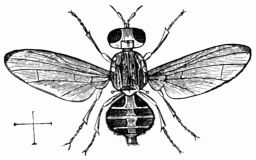
The Olive Dacus (Dacus oleæ, Fig. 65) is a little fly, about half the size of the house fly, of ashy grey colour on the back, its head orange-yellow, its eyes green, and its forehead yellow, marked with two large black spots. The thorax is adorned with four lightish yellow spots, and its hind part, as well as its antennæ and wings, are of the same colour. The wings are transparent, reflecting green, gold, pink, and blue, according as the rays of light fall upon them, and are remarkable for having a small black spot at their extremity. The abdomen is of a fawn colour or orange-yellow, spotted with black on each side. This fly performs sudden and jerking movements; it keeps its wings extended, and rather jumps than flies. It is a destructive insect, a perfect scourge, which causes every two or three years a loss of five or six millions of francs to French agriculture.
M. Guérin-Méneville has made some valuable observations on the Olive Dacus, and at the request of the Imperial Society of Agriculture of Paris, has indicated the way to preserve the olive from these ruinous larvæ, which generally destroy two crops out of three. We will borrow the following details from this learned entomologist: "At the time when the olives are formed the Dacus proceeds to place an egg under the skin of each of the fruits. By means of a little horny instrument, with which the female is provided, and which contains a small lancet, she pierces the skin of the olive; she moves her wings and lays her egg. She afterwards cleans and rests herself, by passing her feet over her head, wings, and other parts of her body. She then flies away, and seeks another olive, to deposit in it another egg; she repeats this operation until she has placed on as many olives the three or four hundred eggs which she bears."
Fig. 66.—Olives attacked by Dacus oleæ.
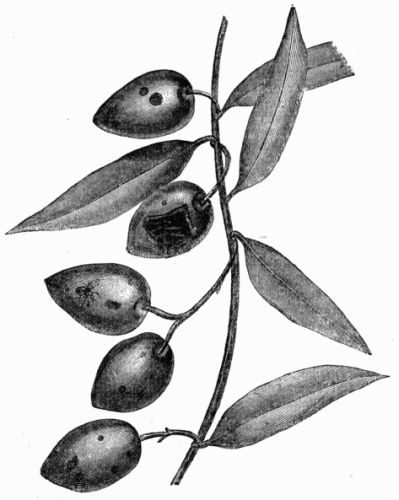
Fig. 66, taken from the Memoir published by M. Guérin-Méneville, in the "Revue Nouvelle" of the 15th July, 1847, shows the Dacus laying its eggs on the olive, and the larvæ that are already hatched in another of the same fruit. The larvæ which succeed these eggs (Fig. 67) are whitish, soft, and without limbs. They pass fifteen or sixteen days in boring a gallery in the pulp of the olive, at first vertically, until they reach the stone, then on one side, and along the side of the stone. When they have reached the term of their development, they approach the surface, enlarging the first channel and leaving between it and the exterior air only a thin pellicle, in the middle of which may be perceived the first small opening by which the mother had introduced her egg in the commencement.
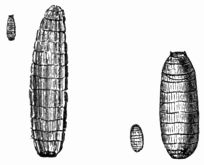
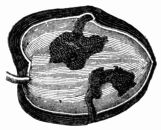
Fig. 67. Larvæ of Dacus oleæ (magnified and natural size). Fig. 68. Gallery formed by larva of Dacus oleæ.
Fig. 68, copied from a drawing in the Memoirs of M. Guérin-Méneville, shows the gallery bored round the olive by the larva of the Dacus. The larva thus prepares an easy issue for the perfect insect. Its skin then contracts, its body diminishes in length, and is transformed into an oval cocoon, which soon gets brown, and is the chrysalis of the insect. At the side of the head it shows a curved line, a thin suture which marks a sort of cap or door, which, at the time of its hatching, the insect will be easily able to force open with its head. The fly is hatched twelve days after its metamorphosis from the larva to the pupa. It has thus taken the Dacus twenty-seven to twenty-eight days to arrive at this state, from the time the egg was laid; besides which, this species, in the warm climates of Provence and Italy, can reproduce itself several times from the beginning of July, the period at which the first flies begin to lay, till the end of autumn.
In order to save a considerable portion of the olive crop of these countries, M. Guérin-Méneville has advised hastening the harvest sufficiently for all the olives to be pressed at a time when the larvæ of the last generation, which would be preserved in the olives that are left, or in the earth, according to the climate, are still in the fruit. If a first operation were not sufficient to destroy them all, it should be repeated the following year. The sacrifice entailed by this practice would be amply compensated by a succession of good crops and the certainty of a sure and permanent profit. In fact, by an early gathering at least half a crop of oil is still obtained; whereas, by waiting for the usual period of gathering the olives, sufficient time is left for the larvæ of the Dacus to devour their parenchyma, which deprives them of the little oil that they might have yielded if their destruction had been accomplished earlier. This early gathering has the advantage of causing the destruction of a great number of larvæ, which will be so much towards diminishing the means of reproduction of the fly.
III.
HEMIPTERA.
The Hemiptera are particularly distinguished from other kinds of insects by the form of their mouth, which consists of a beak, more or less long, composed of six parts: that is, of a lower lip, or sheath; four internal threads, representing the mandibles and jaws of the grinding insects, and which are the perforating parts of the beaks; and, lastly, of the upper lip or labrum. Owing to this apparatus, these insects are essentially sucking ones, and chiefly nourish themselves with the juices of vegetables, which they draw up with their beak. The wings of the Hemiptera are usually four in number; in some species they are membranous and similar to each other, and in others the upper are of rather harder consistency than the lower ones. In general, the former are quite different from the lower wings, and are only membranous at the tip, whereas the other part is thick, tough, and coriaceous.
The Hemiptera are divided into two very distinct sections. The one is composed of insects whose beak grows from the forehead or upper part of the head, and whose anterior wings are half coriaceous and half membranous, having the base of a different texture from the extremity: these are the Heteroptera (ἑτερος, different; πτερον, wing). The other section is composed of those whose beak grows from the lower part of the head, and whose anterior wings are always of the same consistency throughout: these are the Homoptera (ὁμος, the same; πτερον, wing). We are about to give the history of these two sub-orders.
Heteroptera.
The insects formerly known by the general name of Bugs have been divided by Latreille into two large families, containing: the one the Geocorisæ, [19] or Land Bugs; the other the Hydrocorisæ, [20] or Water Bugs.
The land bugs consist of a great number of kinds, which, for the most part, are of little interest. We will only mention here the Peniatomidæ, commonly known as Wood Bugs; the Lygæi, Bugs, properly so called; the Reduvii, and the Hydrometræ.
The Pentatomidæ, which comprise many genera, include the wood bugs of most authors. They are to be found on plants and trees. They fly quickly, but only for a short time.
Fig. 69. Grey Pentatoma (Raphigaster griseus).
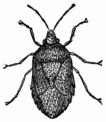
The Ornamented Pentatoma (Strachia [Pentatoma] ornata), known as the Red Cabbage Bug, is very commonly found on the cabbage, and on most of the cruciferous plants. It is variegated with red and black, and its colours are subject to numerous variations. The Grey Pentatoma (Raphigaster griseus), Fig. 69, is common throughout the whole of Europe. In autumn these bugs are frequently to be found on raspberries, to which they impart their disagreeable smell. They are also to be found in quantities on the mullein, when that plant is in flower. The upper parts of the head are of a greyish brown, and are sometimes slightly purple. The coriaceous part of the hemelytra is of a purple tint, but the membranous part is brown. All these parts are covered with black spots, which are only to be seen with a magnifying-glass. The wings are blackish. The under part of the whole body and the feet are of a light and rather yellowish grey, with a considerable number of small black spots. The abdomen is black above; and it is bordered with alternate black and white spots.
We have repeated here the description given of this bug by the illustrious Swedish naturalist, De Geer, because our young readers have most likely met with this insect, or will do so some day when gathering raspberries.
The Grey Pentatoma, marked with black, yellow, and red, is to be found throughout the whole of Europe in cultivated fields and gardens, sometimes also on the trunks of large trees, especially elms. This species, in common with the greater part of those which compose the group we are describing, emits a smell when irritated or menaced by some danger. At other times no odour will be noticed. Let us hear what M. Léon Dufour says on this subject.
"Seize the Pentatoma with a pair of pincers and plunge it into a glass of clear water; look through a magnifying-glass, and you will see innumerable small globules arising from its body, which, bursting on the surface of the water, exhale that odour which is so disagreeable. This vapour, which is essentially acrid, if it happens to touch the eyes, causes a considerable amount of irritation. If one of these insects is held between the fingers, so as not to stop up the odoriferous orifices, and to cause this vapour to touch a part of the skin, a spot, either brown or livid, will ensue on that part, which lotions, though repeatedly applied, will at first fail to remove, and which produces in the cutaneous tissue an alteration similar to that which succeeds the application of mineral acids."
The disagreeable smell exhaled by different species of Pentatoma is the result of a fluid secreted by a single pear-shaped gland, either red or yellow, which occupies the centre of the thorax, and which terminates between the hind legs.
With the Syromastes, which are bugs of this same section, the secretion has, on the contrary, an agreeable smell, which reminds one of that of apples. Many kinds of Pentatoma are destructive to agriculture. Others, however, attack the destructive insects, and ought therefore to be carefully spared. We will mention in this case the Blue Pentatoma, which kills the Altica [21] of the vine.
There may be observed, at the foot and about the lower part of trees, or at the base of walls exposed to the mid-day sun, groups of fifty or sixty small insects pressed close to each other, and often one on the top of the other, their heads in the direction of a centre point. They are red, spotted with black. In the neighbourhood of Paris the children call them "Suisses," probably on account of the red on their bodies, that being the colour of the uniform of the Swiss troops formerly in the service of France. In Burgundy the children call them "petits cochons rouges." They will be found described in Geoffroy's "Histoire des Insectes," under the name of the Red Garden Bug. At the present day they are placed in the genus Lygæus.[22] When the bad weather comes, these little "Suisses" take refuge under stones and the bark of trees to pass the winter. During the whole of that season they remain in a sort of torpid state. But in the first days of spring they revive, and resume their ordinary habits. They suck the sap of vegetables, piercing the capsules of divers kinds of mallows, and always keeping in the sunshine.
Fig. 70. Bed Bug (Acanthia lectularia), magnified.
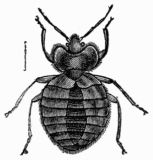
Fig. 71. Egg of Bug, magnified.

The Bug, popularly so called, or Bed Bug (Acanthia lectularia, or Cimex lectularius, Fig. 70), a most disagreeable and stinking insect, abounds in dirty houses, principally in towns, and above all in those of warm countries. It lives in beds, in wood-work, and paper-hangings. There is no crack, however narrow it may be, into which it is unable to slip. It is nocturnal, shunning the light. "Nocturnum fœtidum animal," says Linnæus. Its body is oval, about the fifth of an inch in length, flat, soft, of a brown colour, and covered with little hairs. Its head is provided with two hairy antennæ, and two round black eyes, and has a short beak, curved directly under its thorax, and lying in a shallow groove when the animal is at rest. This beak, composed of three joints, contains four thin, straight, and sharp hairs. The thorax is dilated at the sides. The abdomen is very much developed, orbicular, composed of eight segments, very much depressed, and easily crushed by the fingers. The hemelytra are rudimentary. It has no membranous wings. The tarsi have three articulations, of which the last is provided with two strong hooks.
"These animals," says Moquin-Tandon, in his "Zoologie Médicale," "do not draw up the sanguineous fluid by suction, properly so-called, as leeches do. The organisation of their buccal apparatus does not allow of this. The hairs of the beak applied the one against the other exercise a sort of alternate motion, which draws the blood up into the œsophagus, very much in the same manner as water rises in a chain pump. This rising is assisted by the viscous nature of the fluid, and above all, by the globules it contains." The part of the skin which the Bug has pierced, producing a painful sensation, is easily recognised by a little reddish mark, presenting in its centre a dark spot. Generally a little blister rises on the point pierced, and sometimes, if the Bug-bites are numerous, these blisters become confluent, and resemble a sort of eruption. These disgusting insects lay, towards the month of May, oblong whitish eggs (Fig. 71), having a small aperture, through which the larva comes out. The larva differs from the insect in its perfect state, in its colour, which is pale or yellowish. This insect exists in nearly the whole of Europe, although it is rare or almost unknown in the northern parts. The towns of central Europe are the most infested by this parasite, but those of the north are not completely free from its presence. The Marquis de Custine assures us that at St. Petersburg he found them numerous. It is found also in Scotland; is very rare in the south of Europe; and seldom seen in Italy, where it is, however, replaced by other insects more dangerous or more annoying.
It has been said that the Bug was brought into Europe from America; but Aristotle, Pliny, and Dioscorides mention its existence. It is certain that it was unknown in England till the beginning of the sixteenth century. A celebrated traveller, a Spanish naturalist, Azara, has remarked that the Bug does not infest man in his savage state, but only when congregated together in a state of civilisation, and in houses, as in Europe. From this he concluded that the Bug was not created till long after man, when, after many centuries had elapsed since his appearance on the globe, men formed themselves into societies, into republics, or little states.
The bug is not a gluttonous insect, always bloodthirsty; on the contrary, its sobriety is remarkable. It is only after a prolonged fast that it bites animals; and Audouin has stated that it can live a year and even two years without food.
From time immemorial a number of different means have been employed for destroying these insects; but in spite of all, nothing is more difficult than to get rid of them from wood-work and paper-hangings, when they have once infested them. In general, strong odours cause their death. And so, to rid oneself of these disagreeable guests, it has been recommended to use tobacco smoke, essence of turpentine, the fumes of sulphur, &c. Mercurial ointment and corrosive sublimate are also excellent means for their destruction; and for the same purpose the merits of a plant belonging to the order Cruciferæ, Lepidium ruderale, have been much vaunted; and more recently still, the root of the Pyrethrum, a species of camomile, reduced to powder, and blown into the furniture or wood-work. This powder is known and employed at Paris under the name of "poudre insecticide."
There are two other kinds of bugs (Acanthia) which attack men. The one is the Acanthia ciliata, which has been found in the houses of Kazan, and which differs from the bed bug not only in its form, but also in its habits. It does not live in companies, in the narrow cracks of furniture, but moves about alone, at a slow pace, over walls or the counterpanes of beds. Its beak is very long, and its bite is very painful, and produces obstinate swellings.
The other species is the Acanthia rotundata, which is found in the Island of La Réunion, and attacks men in the same way as does the European bug. Two species of the same genus live as parasites on swallows and domestic pigeons. There is another species, which is peculiar to the bats of our climates.
The Reduvius personatus, called also Fly Bug, by Geoffroy, the old historian of the insects of the environs of Paris, is common enough in France. It keeps to the houses, and is found especially near ovens and chimney-pieces. It is about three-quarters of an inch in length, oblong, flat on its upper side, brownish, has horizontal hemelytra crossed over each other, and very fully developed wings, which serve for flight. Its head, narrow, supported by a well-defined neck, is provided with two composite and two simple eyes. It requires, no doubt, to see very clearly, as it flies by night. It should not be caught without great caution. If you desire to examine it closely, when, in the hottest part of the summer, it comes in the evening and flutters round the lights, you must be careful how you seize it, for it wounds. The wounds inflicted by it are very painful—more painful than those of the bee—and they immediately cause a numbness.
As the Reduvius kills different insects very rapidly, by piercing them with its long beak, it is probable that it secretes some kind of venom. But as yet the organ that produces this poison has not been discovered. However that may be, its beak is curved, and about the tenth of an inch long, the surface bristling with hairs. It is composed of three joints, and contains four stiff, lanceolate, and very pointed squamose hairs.
This insect often seeks its prey in places where spiders spin their webs. When they walk on, or are caught in, the spiders' webs, the spiders take care not to seize them, for they fear their beak. They prudently allow them to struggle about the nets, where they very soon die of hunger. The Reduvius is often seen, either a prisoner or dead, in the midst of a spider's web.
"This bug," says Charles de Geer, "has, in the pupal condition, or before its wings are developed, an appearance altogether hideous and revolting. One would take it, at the first glance, for one of the ugliest of spiders. That which above all renders it so disagreeable to the sight is that it is entirely covered, and, as it were, enveloped with a greyish matter, which is nothing else but the dust which one sees in the corners of badly-swept rooms, and which is generally mixed with sand and particles of wool, or silk, or other similar matters which come from furniture and clothes, rendering the legs of this insect thick and deformed, and giving to its whole body a very singular appearance."
What instincts! what habits! Under this borrowed costume, under this cloak, which is no part of itself, the insect, as it were, masked, has become twice its real size. What becomes of its disguise, and how does it manage to walk? Of what use to it is this dirty and grotesque fancy dress?
Let us listen to De Geer. "It walks as fast, when it likes, as other bugs; but generally its walk is slow, and it moves with measured steps. After having taken one step forward, it stops a while, and then takes another, leaving, at each movement, the opposite leg in repose; it goes on thus continually, step after step in succession, which gives it the appearance of walking as if by jerks, and in measure. It makes almost the same sort of movement with its antennæ, which it moves also at intervals and by jerks. All these movements have a more singular appearance than it is possible for us to describe."[23]
By means of this disguise, it can approach little animals, which become its prey, such as flies, spiders, bed bugs.
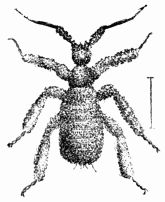
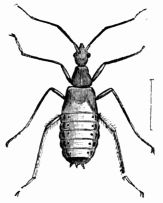
Fig. 72.—Pupa of Reduvius personatus, covered with its cloak of dust (magnified). Fig. 73.—Pupa of Reduvius personatus, denuded of its cloak of dust (magnified).
To see what a curious appearance the Reduvius presents, one should take off its borrowed costume. Then you will observe an entirely different animal, and one which has nothing repulsive about it. With the exception of the hemelytra and wings, which it has not yet got, all its parts have the form which they are to have later, after the wings are developed.
Fig. 72 represents, from Charles de Geer's Memoir, the pupa of the Reduvius personatus covered with dust, and resembling a spider; Fig. 73 the same insect cleaned, freed from the cloak of dust which served to disguise it.
Fig. 74.—Hydrometra stagnorum.
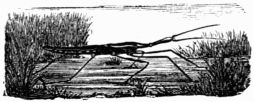
The Hydrometræ (from ὑδωρ, water, and μετρειν, to measure) have linear bodies. The head, which forms nearly the third of the entire length, is furnished with two long antennæ, and armed with a thin, hair-like beak. The legs are long, and of equal length. The reader may have often seen the Hydrometra stagnorum walking by jerks on the surface of the water (Fig. 74). The body and legs are of a ferruginous colour, the hemelytra a dull brown, and the wings hyaline, or glassy, and slightly blackish. Geoffroy says that it resembles a long needle, and calls it the Needle Bug.
The Hydrocorisæ, or Water Bugs, have the antennæ shorter than the head, or scarcely attaining to its length, and inserted and hidden under the eyes, which are in general of remarkable size. All these Hemiptera are aquatic and carnivorous. We will mention the two principal types, the Nepæ, or Water Scorpions, and the Notonectæ, or Boatmen.