Front matter (continued 6)
Reading edition
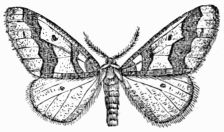
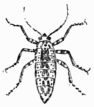
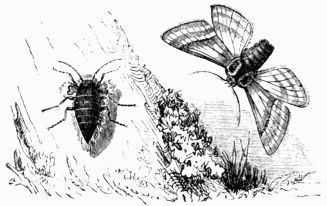
Fig. 263.—Winter Moth (Hybernia defoliaria), male. Fig. 264.—Winter Moth (Hybernia defoliaria), female.
In February and March appear other analogous species. "We may find," says M. Maurice Girard, "near Paris, in the meadows which surround the confluence of the Seine and the Marne, at the end of the month of March, the Nyssia zonaria (Fig. 267), the males of which insect remain during the day motionless on the grass." [72]
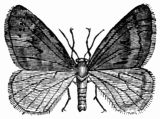
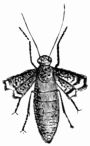
Fig. 265.—Chimatobia brumata, male. Fig. 266.—Chimatobia brumata, female.
There are some species of this family in which the wings of the females are developed like those of the males. [73] Such are thePeppered Moth (Amphidasis betularia) and the Currant Moth (Abraxas grossulariata), whose caterpillar lives on the red currant and gooseberry, and an immense number known as Thorns, Carpets, Waves, &c.
Fig. 267.—Nyssia zonaria, male and female.
The section of the Pyralina contains the smallest nocturnal Lepidoptera, and nearly all those tiny species which flutter round our lights in the evening.
Fig. 268.—Penthina pruniana.
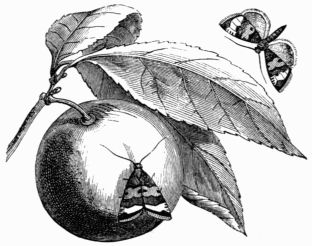
Here are some drawings of a few of the numerous species of this section, remarkable for their small size and beauty:—Penthina pruniana, Ædia pusiella, Xylopoda fabriciana, Pœdisca autumnana, Tortrix roborana, Philobacera fagana, Tortrix sorbiana, Antithesia salicana, Pœdisca occultana, Argyrolepia æneana, Sericoris Zinkenana, Sarrothripa revayana, Cochylis francilana, Choreutes dolosana (Figs. 268 to 281).[74]
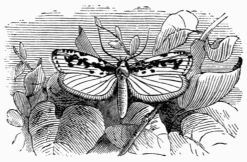
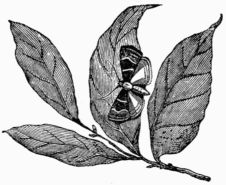
Fig. 269.—Ædia pusiella. Fig. 270.—Xylopoda fabriciana.
In a book of this kind we can only mention some types among these last insects, which claim our attention in what we might almost call a tyrannical manner. We will, therefore, content ourselves by saying a few words about the Green Tortrix, the Pyralis of the Vine, the Bee-hive Moth, some species of the Clothes Moth family (Tineina), and finally of the Œcophoræ.
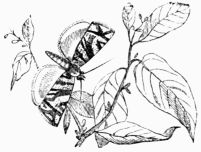
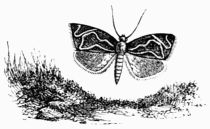
Fig. 271.—Pœdisca autumnana. Fig. 272.—Tortrix roborana.
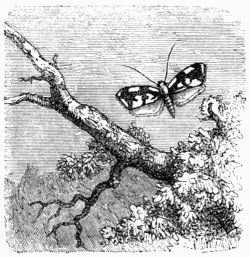
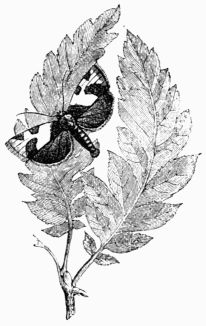
Fig. 273.—Philobacera fagana. Fig. 274.—Tortrix sorbiana.
The Green Tortrix (Tortrix viridana) has wings of a green colour, with the margin and fringe whitish on the anterior, and of an ashy grey on the posterior wings. The under-side of the four wings is of a bright white, as if it had been silvered. This pretty moth comes out in the month of May. It is so common everywhere, that at this season it is only necessary to shake the branches of the oaks which border the alleys of the woods to set in motion hundreds of them. The caterpillar is green, with black warty spots, each having a hair of the same colour. They are wonderfully lively, the moment they are disturbed taking refuge in a rolled leaf, which serves them as a dwelling-place. If they are pursued, they let themselves fall by the aid of a thread, and do not re-ascend till they think they can count on repose and security. This, and many kindred species, do a great deal of damage to our trees. They strip them of their leaves, and sometimes give them, during the first days of summer, the sad and melancholy appearance which they present in the middle of winter.
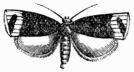
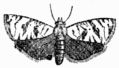
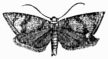
Fig. 275.—Antithesia salicana. Fig. 276.—Pœdisca occultana Fig. 277.—Argyrolepia æneana.
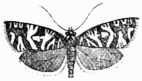
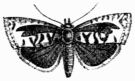
Fig. 278.—Sericoris Zinkenana. Fig. 279.—Sarrothripa revayana.
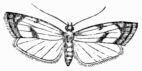
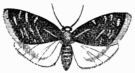
Fig. 280.—Cochylis francilana. Fig. 281.—Choreutes dolosana.
We have just alluded to the tube formed of a rolled leaf, in which the caterpillar takes refuge, and in which it lives. This tube it constructs itself. Réaumur has devoted a magnificent chapter of his Memoirs to observations on the skill with which divers species of caterpillars fold, roll, and bind the leaves of plants and trees, especially those of the oak. Let us listen to the great observer:—"If one looks attentively at the leaves of the oak tree towards the middle of the spring, many of them will be seen to be rolled in different ways. The exterior surface of the end of one of these leaves has, it appears, been rolled back towards the interior surface, in order to describe the first turn of a spiral, which is then covered by many other turns (Fig. 282). Some leaves are rolled towards their exterior surfaces, others are rolled towards their interior surfaces, but in a totally different direction. The length or axis of the first roll is perpendicular to the principal rib and to the stalk of the leaf, the axis of the latter parallel to the same rib (Fig. 283). Work of this kind would not be very difficult to perform for those who had fingers; but caterpillars have neither fingers nor anything equivalent to fingers. Moreover, to have rolled the leaves is only to have done half the work: they must be retained in a position from which their natural spring tends constantly to draw them. The mechanism to which the caterpillars have recourse for this second part of their work is easily perceived. We see packets of threads attached by one end to the surface of the roll, and by the other to the flat surface of the leaf. They are so many bands, so many little cords which hold out against the spring of the leaf. There are sometimes more than from ten to twelve of these bands arranged nearly in the self-same straight line. Each band is a packet of threads of white silk, pressed one against the other, and yet we must remember all are separate." [75]
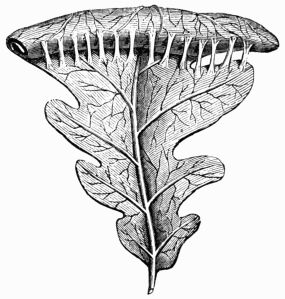
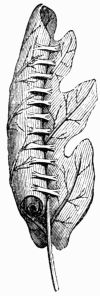
Fig. 282.—Oak leaf rolled perpendicularly. Fig. 283.—Oak leaf rolled sideways.
Réaumur made the oak-leaf rollers work in his house. He has admirably described all their little manœuvres, but we lack the space to convey to the reader the result of his minute observations. In fact, the leaf-rollers construct for themselves a sort of cylindrical cell, which receives light only through the two extremities. The convenience of this green fresh habitation is, that its walls furnish food to the animal which inhabits it. The caterpillar, thus sheltered, sets to work to gnaw away at the end of the leaf which it rolled first; it then eats all the rolls it has made, up to the very last.
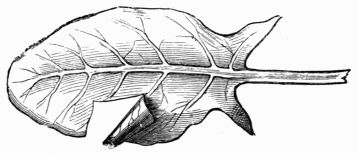
Fig. 284.—Leaf of sorrel, a portion of which is cut and rolled perpendicularly to the leaf.
Réaumur found also rolls which had been formed of two or three leaves rolled lengthwise, and he saw that the leaves which had occupied the centre had been almost entirely eaten. He saw also caterpillars which continued to eat while they were making their habitation. Let us add that one of the ends of the roll is the opening through which the caterpillar casts its excrement; that the caterpillar can prepare itself a fresh roll if it is turned out of the first; and, lastly, that it is in a rolled leaf that the caterpillar undergoes its metamorphoses into a chrysalis and into a moth.
Réaumur studied other leaf-rollers; for instance, those which roll the leaves of nettles and of sorrel. The last one works in a manner which deserves to be mentioned. Its roll is of no particular shape, but it is its position which is remarkable. It is set upon the leaf like a ninepin (Fig. 284). The caterpillar has not only to twist it up into a roll, but also to place it perpendicularly on the leaf.
Figs. 285 and 286.—Willow leaves rolled by a caterpillar, and section of a bundle of leaves drawn together by a caterpillar.
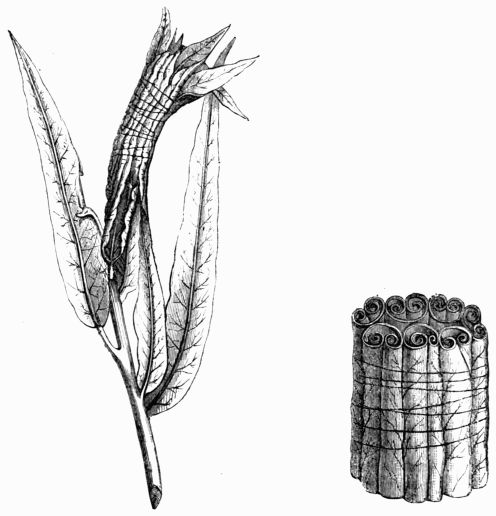
Next to the rolling caterpillars, let us mention those which are contented with folding the leaves. These caterpillars then lie in a sort of flat box. Besides the rolling and folding caterpillars, there are still those which bind up a good many leaves in one packet. These packets are to be found on nearly every tree and shrub, and the caterpillar, lying nearly in the middle of the packet, is well sheltered, and surrounded by a good supply of food. We will content ourselves by giving a drawing, after Réaumur, of the pretty arrangement of the leaves of a species of willow (Figs. 285, 286). In the figures we see the parcel bound together by the caterpillar. In that to the right we see the transverse section of the packet of leaves magnified. At the two edges are seen the threads which keep the leaves together, and the cavity occupied by the caterpillar.
The Vine Pyralis is produced from a leaf-rolling caterpillar, which deserves our attention on account of the ravages which it has for some time committed, and which it still commits in vineyards. It was at the end of the sixteenth century that this pyralis first showed itself in the environs of Paris, in the territory of Argenteuil. "The inhabitants of this commune," writes the Abbé Lebœuf, "looked on the insects which spoiled their vines in the spring of 1562 as a visitation of God. The Bishop of Paris gave orders that they should offer up public prayers for the diminution of these insects, and that they should join to their prayers, exorcisms, without leaving the church." Prayers, processions, exorcisms, were again had recourse to in 1629, in 1717, and in 1733, to stop the ravages of this insect among the vines of Colombes, in the territory of Aï.
The country of the Mâconnais and the Beaujolais became in their turn the theatre of the ravages of the pyralis. These ravages very soon increased and spread. In 1836, 1837, 1838, this plague raged in the departments of the Saône-et-Loire, of the Rhône, of the Côte-d'Or, of the Marne, of the Seine-et-Oise, of the Charente-Inférieure, of the Haute-Garonne, of the Pyrénées-Orientales, and of the Hérault.
To give an idea of the losses which may be occasioned by the pyralis, in a period of ten years (1828-1837), twenty-three communes comprised in the two departments of the Saône-et-Loire and of the Rhône lost 75,000 hectolitres of wine a year, which may be valued at 1,500,000 francs. If we were to calculate the supply of articles of all sorts which this great number of casks of wine would have necessitated, the imposts on their transport, the duty, the taxes levied on their sale, the carriage by land and water, which would have brought receipts into the treasury, and lastly the diminution of taxes which had to be granted for seven years to the vine proprietors in the department of the Saône-et-Loire, and in 1837 in the department of the Rhône, and which amounted to a total of more than 100,000 francs, we shall find that the ravages of the pyralis caused in these two departments an annual loss of 3,408,000 francs, and as the visitation lasted ten years, we get the enormous sum total of 34,000,000 destroyed by the ravages of one species of insect. The moth of the pyralis (Fig. 287) shows itself from the 10th to the 20th of June. It is yellowish, more or less shot with gold. When at rest, its wings are folded back one over the other like a roof. Its flight is of short duration; it contents itself with going from one vine stock to another.
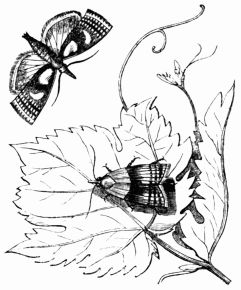
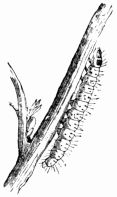
Fig. 287.—The Vine Pyralis. Fig. 288.—Caterpillar of the Vine Pyralis.
It is at sunset mostly that you see the moths of the pyralis fluttering about. They remain quiet during the day, particularly when the sun is at its hottest. They live on an average for ten days. The females lay their eggs—which are at first green, then yellowish, then brown—on the lower surface of the leaves.
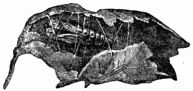
Fig. 289.—Chrysalis of the Vine Pyralis.
The caterpillar of the pyralis (Fig. 288) is called, in vulgar parlance, according to the different places in which it occurs, vine worm, summer worm, vintage worm, shell. In the south of France it is called, in the patois of Languedoc, babota. Almost immediately after they leave the eggs, the little caterpillars hide themselves in the fissures of the vine stocks or the props which support them. They spin a small cocoon of a greyish silk, in which they remain curled up till the month of May. From the moment the leaves begin to develop they throw out threads here and there, entangling all the young shoots of the vine, which gives a desolate appearance to the vineyards. The leaves of the vine are their favourite food, but they attack the seeds of the grape also. As they increase in size every day, the damage they do goes on increasing, and has not reached the maximum of intensity till the moment when the caterpillars are about to change into chrysalides. They are then three-quarters of an inch long and of a yellowish green colour.
Fig. 290.—The Vine Pyralis in its three states. 1. Leaf with batches of eggs laid upon it. 2. Batches of recently laid eggs. 3. Eggs in which caterpillars can be perceived. 4. Batch of eggs from which the caterpillars have already emerged. 5. Small caterpillars hanging by threads. 6. Leaf with the chrysalis. 7. Caterpillar. 8. Moth.
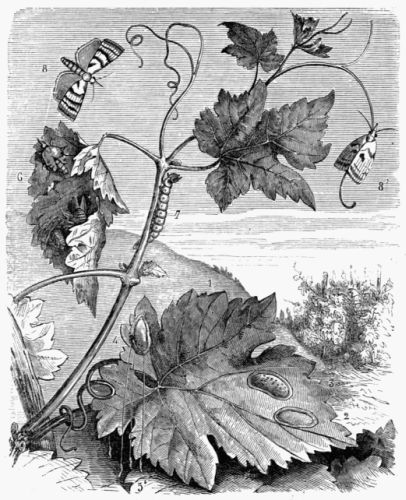
From the 20th of June to the 10th of July they seek shelter in the dry and interlaced leaves which have already served them for places of refuge and partly also for food, or else they make themselves a fresh nest.
At the end of two or three days, the caterpillar has become a chrysalis (Fig. 289), which in a short time assumes a brown colour. Shut up in the interior of the cocoon which the caterpillar had spun before undergoing its metamorphosis, it changes into a moth at the end of from fourteen to sixteen days.
The best way to diminish the ravages of the pyralis is to pluck off the leaves which are laden with eggs, and burn them, or bury them in deep holes.
Fig. 290, which we devote to the conspicuous insect whose destructive history we have been here able to sketch only slightly, gives all the particulars relating to this dangerous guest of the vineyards. On a branch of the vine may be perceived the pyralis in the caterpillar state, the eggs which have been laid by the moths, the chrysalides, and perfect insects. The eggs are shown at two periods of their development.
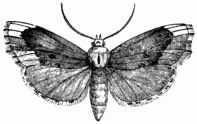
Fig. 291.—Galleria cerella.
The Bee-hive or Wax Galleria is to be met with in all countries where bees are reared.
The moth (Fig. 291) hides itself during the day round about the bee-hives, and endeavours to make its way into them after sunset. The caterpillar is of a dirty white, with brown warty spots, each surmounted by a fine hair. It lives on wax, twines its threads round the honeycomb, and very soon causes the larvæ contained in it to perish.
When it emerges from the egg, which the female has laid in the honeycomb, the caterpillar makes for itself with the wax a round tube, in which it is safe against the stings of the bees. This tube, at first very small, is lengthened and enlarged as the caterpillar increases in size. It is generally from three to five inches in length. It is in the interior of this that the caterpillar constructs itself a hard cocoon, resembling leather, and it changes into a brownish chrysalis.
A species of the genus Butalis, the Butalis or Alucita granella, is, in certain cantons of France, one of the greatest pests to agriculture. The caterpillar of the Tinea granella undergoes its metamorphosis in the interior of grains of barley and of wheat, which it devours without being perceived from without. The female lays her eggs on the grains of corn before they are ripe. From four to six days after, the eggs are hatched, and the young caterpillars are hardly as thick as a hair. Each one takes possession of a grain of corn, and penetrates into it by an imperceptible opening. They eat the flower without injuring the teguments of the grain.
Fig. 292. Tinea granella.

When it has attained its full size it spins itself a cocoon of white silk in the interior of the grain, which, after having been its lodging and its larder, becomes for some time its tomb. It has, however, taken care beforehand to make at the extremity of the grain a circular opening, through which the moth may come out when the grains have been threshed and stored up in the granary.
It is important to mention the Tineina, not because these little moths are beautiful—they are, on the contrary, very dingy—but because it is in this group that are found those insects which do the greatest damage to our crops. The moths of the genus Tinea are very small. Their wings, which are greyish or brownish, are generally marked with whitish and yellowish spots or lines. These are the little moths which, in our houses, burn themselves so frequently in the flames of the candles.
Their caterpillars are small, voracious, and deserve, on account of the damage which they cause, to be compared to rats and mice. Furnished with powerful jaws, they destroy everything they find in their way, such as woollen stuffs, hair, furs, feathers, grain, &c.
The Tineina are divisible into three groups: 1st, the species hurtful to our stuffs and furs; 2ndly, the species which destroy our corn crops; 3rdly, the phytophagous species, that is to say, those which feed on plants.
In the first subdivision must be classed the Fur Moth, the Woollen Moth, and the Hair Moth.
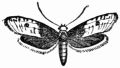
The Woollen Moth is represented in the figure on next page. Its caterpillar has the form of a worm, and is of a glossy whiteness, with a few hairs thinly sprinkled over it and a grey line on its back. It is enclosed in a tube, or sheath, open at both ends, in the interior of which is a sort of tissue of wool, sometimes blue, sometimes green, sometimes red, according to the colour of the stuff to which the insect attaches itself and which it despoils. The exterior of this sheath is, on the contrary, formed of silk made by the insect itself, of a whitish colour.
Fig. 293. The Woollen Moth (Tinea tapezella).
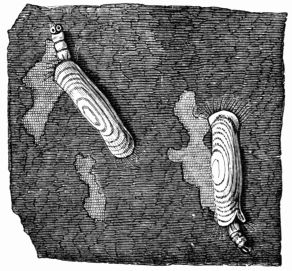
The caterpillars are hardly hatched before they begin to clothe themselves. Réaumur observed one of these worms during the operation of enlarging its case. To do this it put its head out of one of the extremities of its sheath, and looked about eagerly, to the right and to the left, for those bits of wool which suited it best for weaving in. In Fig. 294, we see two larvæ occupied in eating a piece of cloth.
Fig. 294.—Larvæ of the Woollen Moth (Tinea tapezella).
"The larva changes its place continually and very quickly," says Réaumur. "If the threads of wool which are near it are not such as it desires, it draws sometimes more than half its body out of its case to go and look for better ones farther off. If it finds a bit that pleases, the head remains fixed for an instant; it then seizes the thread with the two mandibles which are below its head, tears the bit out after redoubled efforts, and immediately carries it to the end of the tube against which it attaches it. It repeats many times in succession a similar manœuvre, sometimes coming partly out of its tube, and then again re-entering it to fix against one of its sides a new piece of wool."
After having worked for about a minute at one end of its tube, it thinks of lengthening the other. It turns itself round in its tube with such quickness, that you would imagine it could not have had time to do so, and would think that its tail was formed in the same way as its head, and possessed the same address in choosing and tearing out the bits of wool.
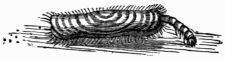
Furthermore, when the moth which is working at elongating its case does not find the threads or hairs of wool to its taste within reach of its head, it changes its place. Réaumur saw this insect walking, at some speed even, carrying with it its case. It walks on its six front legs (Fig. 295). With the middle and hind legs it clings to the interior of its case.
Fig. 295.—Larva of a Tinea walking.
At the same time that the larva becomes longer it becomes stouter. Very soon its garment will be too narrow for it. Will it enlarge its old coat, or will it make itself a new one? Réaumur discovered that it preferred to widen its old coat.
That is what our naturalist saw when he placed larvæ with blue cases, for instance, upon stuff of a red colour. The bands which extended in straight lines from one end of the case to the other, showed the part that had been added.
"From watching them at different times," says this admirable observer, "I find that the means which they employ is precisely that to which we should have had recourse in a similar case. We know of no other way of widening a sheath, a case of any stuff that we find too narrow, than to split it right up and to let in a piece of the proper size between the parts which we have thus divided; we should let in a piece on each side if the shape of the tube seemed to require it. This is also exactly what our larvæ do, with an extra, and which with them is a necessary, precaution, so as not to remain exposed while they are working at the enlargement of their garment. Instead of two pieces, which should each be as long as their case, they let in four, each of which is not longer than half the length of their case; and so they never split up more than half the length of the case at the same time, which has enough stuff left in it to keep it together while this opening is being filled up."
The wools of our stuffs furnish the moths not only with clothing, but also with food. Their excrements are little grains, which are the same colour as the wool they have eaten.
Fig. 296. Case of the Moth attached to a piece of cloth.
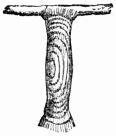
When they are full grown, and the time approaches for their metamorphosis, the larvæ abandon their food, and establish themselves in the angles of walls. They creep up to the ceilings and suspend themselves to them by one extremity of their tube. The two ends of the tube are now closed by a silken tissue (Fig. 296). The larva thus enclosed very soon changes its form; it becomes a chrysalis; then at the end of about three weeks it is set free as a moth.
The Fur or Skin Moth works like the carpet moth: it makes itself a case of the same form, and constructs it in the same manner. Only in this case its covering is made of a sort of felt resembling that of which our hats are made.
While the Carpet Moth only detaches from the various stuffs the wool it requires for clothing and nourishment, the Fur Moth causes much more considerable and more rapid damage. It cuts off all the hairs which are in its way right down to the skin; it seems as if it took a delight in cutting them off. That which is necessary for its wants is nothing in comparison to the great quantity of hair one sees fall off a skin on which it has established itself, when it is shaken. As it advances it cuts more thoroughly than a razor could all the hairs which are in its way.
The Hair Moth (Fig. 297) shows itself in great numbers in the perfect state, from the end of April till the beginning of June. They appear again in September, and generally stay behind cabinets and other pieces of furniture.
Fig. 297.—Hair Moth.

The caterpillar, which is cylindrical, white, destitute of hair, and striped with brown, lives principally in the hair with which furniture is stuffed, and sometimes in hair mattresses. When it has reached its full size, it abandons its abode, pierces through the stuff which covers the hair, and constructs for itself with this stuff a case of silk, open only towards the end where the head is. At the beginning of April it shuts its case, and changes itself into a chrysalis.
We can only here mention some of the phytophagous species, as the Cherry-tree Moth (Tinea cerasiella), the Hawthorn Moth (Tinea cratægella), the Burdock Moth (Tinea lapella), and the Rustic Moth (Tinea rusticella).
The caterpillars of the Œcophoræ resemble whitish worms. They attack the leaves, the blossoms, the bark, and certain parts of the fruit of trees. Some of these hollow out for themselves galleries in eating the fleshy part; others also make galleries, but only in the cuticle of the tree, or in the tenderest part of its bark. Some, again, shut themselves up in one or many leaves rolled like a trumpet, while others keep at the summits of plants, whose leaves they bind together in a parcel with threads. And, lastly, some devour the stones of fruits, such as that of the olive.
The moths of these caterpillars are very small, and generally of brilliant metallic colours, they are to be found in the woods, and still more in the orchards, from the beginning of June till the month of September.
The Œcophoræ are very slim and elegantly formed. Their anterior wings, which are very narrow, are often ornamented with silvery longitudinal lines, the posterior wings exactly resembling two feathers.
The caterpillars live and metamorphose themselves in portable cases, which they manufacture from the membranous portions of leaves, whose flesh alone they eat. These cases are generally of a brown colour, resembling a dead leaf. They are attached perpendicularly under the leaves of many trees, but often under those of fruit trees.
Certain species of Œcophoræ have cases partly covered with loose pieces only slightly attached, formed of portions of leaves, and arranged in such a way that Réaumur compares them to the furbelows which ladies used formerly to attach to the bottom of their dresses.
V.
ORTHOPTERA.
Among the Orthoptera [76] we meet with some of the largest of insects, and particularly those which are of strange and extraordinary shapes. The best known insects of this order are the Mantes, Cockroaches, Earwigs,[77] Locusts, Grasshoppers, Crickets, &c.
The Orthoptera have the anterior wings long, narrow, half-horny. These are elytra, which serve as cases for their second wings, as is the case with the Coleoptera. But the elytra of the Orthoptera are less solid and less complete than those of the Coleoptera. Moreover, they generally overlap each other when the insect is at rest, which is another distinctive characteristic. The second wings are membranous, very broad, and veined; and, when at rest, are folded up like a fan. The mouth is composed of free pieces. The mandibles, the jaws, and the two lips, always well developed, show them to be insects which grind their food. Their voracity, and the rapid way in which they multiply, sometimes make these insects the pest of the country. Above all, they are to be met with in hot countries, where they cause such great damage that all vegetation disappears on their passage. There are not a great variety of species of Orthoptera. They are insects whose metamorphoses are incomplete; that is, they undergo only trifling changes from the moment when the eggs are hatched to the time when the insect is fully developed.
When it leaves the egg, the young one resembles its parents; it differs only in size and in having no wings. After moulting four or five times it has almost reached its full growth, and its wings begin to appear under a sort of membrane. This is the pupa state. A final moulting sets free the wings also, and the insect, now perfect, launches itself into the air with its congeners.
The Orthoptera are vegetable feeders, and frequently commit great ravages on various crops. They are divided into two groups, viz., those which run, and those which jump or leap. We will begin with those which run, which contains the Earwig (Forficula), the Cockroach (Blatta), the genus Mantis, or Leaf Insects, and the genus Phasma.
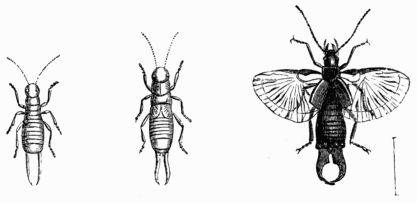
The Forficula, or Earwig, is represented in Figs. 298, 299, 300, in its three different states. The lower wings are very broad, and folded at the same time like a fan, and doubled up. Its abdomen terminates in a sort of pair of pincers, resembling those which the jewellers formerly used for piercing the ears of young girls as a preparatory step to their wearing ear-rings. Hence, without doubt, their French name of Perce-oreille, or ear-piercer; for there is nothing to justify the vulgar belief that these insects introduce themselves into the ear, and bore a hole into its interior, through which they may penetrate into the brain; in fact, they are very innocent insects, and do little harm. They live on vegetable matter, and more especially the interiors of certain flowers.
Figs. 298, 299, 300.—Common Earwig (Forficula auricularia)—larva, pupa, and imago.
The Forficulæ avoid the light. They are to be found in the chinks of trees, under bark, and under stones. The female watches over the eggs with maternal solicitude, and carries them away elsewhere when they are touched. She also protects the larvæ and pupæ till they are strong enough to dispense with all attention.
The Blattæ, or Cockroaches, are very destructive insects, as the name, derived from the Greek word Βλαπτειν, to damage, implies. They are omnivorous, attacking all sorts of dead substances, vegetable and animal. Horace reproaches them with devouring stuffs, like the moths:—
"Cui stragula vestis, Blattarum ac tinearum epulæ, Putrescit in arca."
These disagreeable insects devour our eatables, abounding in kitchens, in bakers' shops, on board merchant vessels, &c. Their flattened bodies allow them easily to introduce themselves into the cracks of cases or barrels; so that, to be safe against their attacks, it is necessary, on long voyages, to shut up the goods in zinc-lined boxes, or cases made of sheet-iron well soldered together.
Chamisso relates that the sailors having opened some barrels which should have contained rice and wheat, found them filled with German Cockroaches (Blatta Germanica). This transubstantiation was not very agreeable to the crew! Other naturalists have seen this insect invading by millions bottles which had contained oil. The Cockroach is very fond also of the blacking on boots, and devours leather and all. One pupa sometimes eats the skin cast off by another pupa, but a Cockroach has never been known to attack another with a view to eating him afterwards.
These Orthoptera have a flat broad body, the thorax very much developed, the antennæ very long, and the legs thin but strong, which enable them to run with remarkable quickness. They diffuse around them a sickening odour, which often hangs about objects they have touched. Aristophanes, the Greek comic poet, mentions this peculiarity in his comedy of "The Peace." They come out mostly at night, and hide themselves during the day. They are the most cosmopolitan of all insects. Carried over in ships, they perpetuate everywhere, just like weeds! Persian powder, composed of pulverised pyrethra, is an excellent means to employ for their destruction.
Most of the species of cockroaches are black or brownish. Two among them, the Blatta Germanica and the Blatta Laponica, which are to be met with in the woods round about Paris, have domesticated themselves in dwellings of the northern countries. They are a quarter of an inch in length. The Russians pretend that the former was imported from Prussia by their army, on its return from Germany, after the Seven Years' War (1756-1762). Till this period it was unknown at St. Petersburg, where now-a-days it is met with in great numbers. It lives in houses, and eats pretty nearly everything, but prefers white bread to flour and meat. The Blatta Laponica devours the smoked fish prepared for the winter.
The German naturalist, Hummel, made some interesting obser vations on the development and habits of the very prolific Blatta Germanica. It lays its eggs in a silky capsule, which is in the form of a bean, with two valves in the interior. This is drawn about for some time appended to the extremity of the abdomen, and after a time abandoned.
Hummel placed under a bell-glass a female cockroach and a perfect egg-pouch, which had only just been abandoned by another female. He saw the cockroach approach the bag, feel it, and turn it about in all directions. She then took it between her front legs, and made a longitudinal opening in it. As the opening grew wider, little white larvæ were seen to come from it rolled up and attached together. The female presided at this operation. She assisted the larvæ to set themselves free, aiding them out gently with her antennæ. In a few seconds they were able to walk, when she ceased to trouble herself about them.
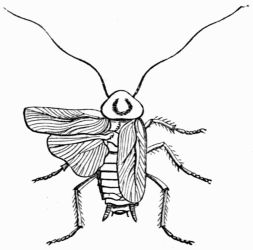
Fig. 301.—The Cockroach (Blatta orientalis).
The larvæ change their skin six times before reaching the perfect state. When they come out of their skin they are colourless, but the colour comes in a few minutes. At the fifth moult, which takes place three months after birth, they become pupæ, with rudimentary wings, the whole shape of the insect being well marked. The sixth, or last moult, takes place at the end of six weeks. The pupa is now changed into a perfect insect. The female is distinguished from the male by the greater size of her abdomen.
The most destructive of the Blattæ, or Cockroaches, are those which have been imported into Europe by the ships coming from the colonies. The Kakerlac Americana is from an inch to an inch and a quarter long. It infests ships, running about at night over the sleeping passengers, and devouring the food. They are to be met with in all parts of the world. They abound particularly in the warm parts of America. The Blatta orientalis is more commonly met with than the above. It swarms in kitchens, in bakers' shops, provision shops, &c., where it hides in the cracks of the walls, or against the hinges of the doors. It is a small hideous animal, of a repulsive smell, and of a reddish brown colour. It is a little larger than the Blatta Americana. In France it is called by various names, such as Cafard, Panetière, Noirot, Bête noir, &c. If in the middle of the night you suddenly enter with a light into the down-stairs kitchens, you will often see these little beasts running about on the table, and devouring the remains of the food with astonishing rapidity.
The largest species of the genus of which we are now treating is the Kakerlac insignis, which inhabits Cayenne and Brazil, and in length sometimes exceeds an inch and three-quarters, and in the extent of its wings four inches and a half.
It is principally in hot countries that the cockroaches do the greatest damage. In the Antilles, of which they are the pest, it is affirmed that in one single night they can bore holes through trunks, through cases, and through bags, and destroy objects which were supposed to be in perfect safety. Sometimes the walls, the floors, the beds, the tables, everything, in short, is infested by them, and it is impossible to find a way of preserving the food from their repulsive touch. One can, however, partially succeed in destroying them by the aid of insect powders. They have, however, natural enemies. Poultry and owls are very fond of them. A species of wasp, Chlorion compressum, lays up a stock of cockroaches, which it previously renders insensible, for its larvæ. Many species of Chalcidiæ, a family of Hymenoptera, also live on the eggs of these Orthoptera. There are also among the cockroaches certain brightly-coloured exotic species. These colours show that they do not avoid the light. We will mention as examples the Brachycola robusta and the species of Corydia.
The Mantidæ are pretty insects, of very different habits from the preceding. They alone of the Orthoptera are carnivorous. They eat live insects, seizing their prey as it passes by them. They rest generally on shrubs, remaining for hours together perfectly motionless, the better to deceive other insects which are to become their victims.
It is this fixed and as it were meditative attitude which has gained for them the name of Mantis, derived from the Greek word μαντις, or "diviner," as it was imagined that in this attitude they interrogated the future. The manner in which they hold their long front legs, raised like arms to Heaven, has also contributed to make this superstitious notion believed, and sufficiently explains the names given to divers species of Mantidæ; such as Nun, Saint, Preacher, Suppliant, Mendicant, &c. Caillaud, a traveller, tells us that in Central Africa a Mantis is an object of worship. According to Sparmann, another species is worshipped by the Hottentots. If by chance a Mantis should settle on a person, this person is considered by them to have received a particular favour from heaven, and from that moment takes rank among the saints!
In France the country people believe that these insects point out the way to travellers. Mouffet, a naturalist of the seventeenth century, says on this subject, in a description of the Mantis:—"This little creature is considered of so divine a nature, that to a child who asks it its way, it points it out by stretching out one of its legs, and rarely or never makes a mistake."
In the eyes of the Languedoc peasants the Mantis religiosa is almost sacred. They call it Prega-Diou (Prie-Dieu), and believe firmly that it performs its devotions—its attitude, when it is on the watch for its prey, resembling that of prayer. Settled on the ground, it raises its head and thorax, clasps together the joints of its front legs, and remains thus motionless for hours together. But only let an imprudent fly come within reach of our devotee, and you will see it stealthily approach it, like a cat who is watching a mouse, and with so much precaution that you can scarcely see that it is moving. Then, all of a sudden, as quick as lightning, it seizes its victim between its legs, provided with sharp spines, which cross each other, conveys it to its mouth, and devours it. Our make-believe Nun, Preacher, our Prega-Diou, is nothing better than a patient watcher and pitiless destroyer. The Mantis religiosa (Fig. 302), common enough in the south of France, comes as far north as the environs of Fontainebleau. The Mantis oratoria, rather smaller, is less commonly met with.
These elegant insects are remarkable for their long slim bodies, their large wings, and their colours, which are generally very bright. In some species their green or yellowish elytra look so exactly like the leaves of trees that one can hardly help taking them for such.
The Mantis lays its eggs at the end of summer, in rounded, very fragile shells, attached to the branches of trees; they do not hatch till the following summer. The larvæ undergo several successive moultings. Nothing equals the ferocity of these Orthoptera. If two of them are shut up together, they engage in a desperate combat; they deal each other blows with their front legs, and do not leave off fencing until the stronger of the two has succeeded in eating off the other's head. From their very birth, the larvæ attack each other. The male being smaller than the female, is often its victim.
Kirby tells us that in China the children procure them as in France they do cockchafers, and shut them up in bamboo cages, to enjoy the exciting spectacle of their combats.
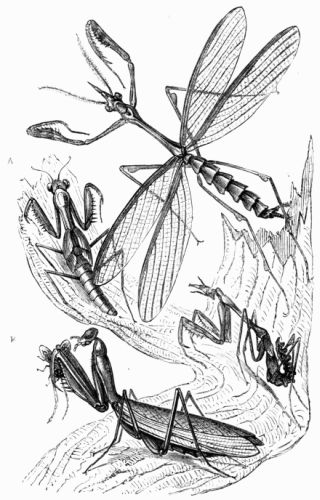
Fig. 302.—Mantis religiosa and its larva (A). Blepharis mendica and its larva (B).
Acanthops, a genus of this family, inhabits the Brazils.
Akin to the Mantis are the Eremiaphilæ, which live in the deserts of Africa and Arabia. They drag themselves gently along on the ground, and as they are the same colour as the sand on which they are found, it is very difficult to distinguish them when at rest. The traveller, Lefebvre, relates that he always found these Orthoptera in places destitute of all vegetation, and where there were no other sorts of insects which could have served them for food; it is therefore probable that they live on microscopic insects.
The Empusa, which forms another genus of Mantidæ, has the antennæ indented like a comb in the males, thread-like in the females. The Empusa gongylodes, which inhabits Africa, has cuffs to its arms and flounces to its robe.
The genus Blepharis, to which belongs the Blepharis mendica, is met with in Egypt, Arabia, and in the Canary Islands. This insect, which is of a pale green, is not rare in the south of France. It is represented with the Mantis religiosa in Fig. 302.
The Phasmata, or Spectres, are distinguished from the Mantidæ by their very elongated bodies, straight and stiff as a stick, by their having no prehensile legs, and by their food, which is exclusively vegetable. Their eggs are laid uncovered, having no silky envelope. As for the habits of these insects, they are little known, the greatest number of the species being exotics, inhabiting chiefly South America, Asia, Africa, and New Holland. It is in this tribe that we meet the most extraordinary and the most monstrously shaped insects, as the popular names they have received in different countries show: such as Spectres, Phantoms, Devil's Horses, Soldiers of Cayenne, Walking Leaves, Animated Sticks, &c.
Among the Phasmæ we also find the largest insects known, for they attain a considerable length, Phasma gigas nearly reaching a foot. The most beautiful are those of New Holland and of Tasmania, such as Cyphocrana (Phasma) gigas.
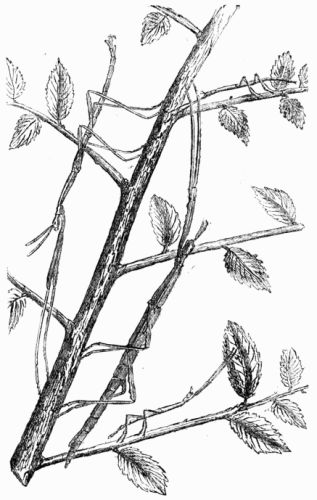
Some species are destitute of wings, and resemble so exactly dry sticks that it is impossible to tell the difference. The best known is the Bacillus (Phasma) Rossia (Fig. 303), which is found in the south of France. This inoffensive insect walks gently along the branches of trees, and likes to repose in the sun, its long antennæ-like legs stretched out in front. Others of the genus Phyllium are provided with wings, and have altogether the appearance of the leaves on which they live; such are the Walking Leaves of the East Indies. According to Cunningham, all these insects are of solitary and peaceable habits. They are only to be met with alone or in pairs, drawing themselves gently along on shrubs, on which they pass the hottest months of the year. Some of them, when they are seized, emit a milky liquid of a very strong and disagreeable odour.
Fig. 303.—Phasma Rossia—male, female, and larva.
Those Orthoptera which we have already mentioned had all their six legs adapted to running, and are called Cursoria. Those which jump, to which we now come, have their hind-legs stronger and thicker, which enables them to leap, and are on that account called Saltatoria. This section comprises three families, which have for their principal types the Crickets, Locusts, and Grasshoppers.
All these insects resemble each other in the disproportion which exists between their hind-legs and the other pairs. Another characteristic which is common to them consists in the song of the males. This song, so well known, which seems to have for its object to call the females, is nothing but a sort of stridulation or screeching, produced by the rubbing together of the wing cases, or elytra. But the mechanism by which this is produced varies a little in all the three kinds. With the Crickets the whole surface of the wing cases is covered with thick nervures, very prominent and very hard, which cause the noise the insect produces in rubbing the elytra one against the other. With the Locusts, there exists only at the base of the elytra a transparent membrane called the mirror, which is furnished with prominent nervures, and produces the screeching noise. And, lastly, in the Crickets the thighs and elytra are provided with very hard ridges. The thighs, being passed rapidly and with force over the nervures of the elytra, produce the sound, in the same way as a fiddle-bow when drawn across the strings of a violin. In all these insects the male alone is endowed with the faculty of producing sound.
The Crickets and Grasshoppers have very long and thin antennæ, whilst the Locusts have short antennæ, and either flattened or filiform, or swelling out at one extremity like a club. The female of the first two is provided with an ovipositor in the shape of an auger.
We will study successfully the three types of these families, that is to say, the Crickets, the Locusts, and the Grasshoppers.
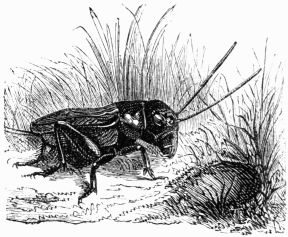
The Field Cricket (Gryllus campestris, Fig. 304) lives alone in a hole which it digs in the ground, and in which it remains during the day. It only quits its retreat at night, when it goes in search of food. It is very timid, and at the least noise ceases its song. If it is stationed on the side of its hole, it retreats into it the moment any one approaches.
The holes of the crickets are well known to country children, who take these insects by presenting a straw to them. The pugnacious cricket seizes it directly with its mandibles, and lets itself be drawn out of its hole. It is this which has given rise to the saying, "plus sot qu'un grillon" (a greater fool than a cricket). It is very susceptible of cold, and always makes the opening of its hole towards the south. It lives on herbs, perhaps also on insects.
The House Cricket is about half an inch long, of an ashy colour, and is to be met with principally in bakers' shops and country kitchens, where it hides itself during the day in the crevices of the walls or at the back of the fireplaces. It eats flour, and also, perhaps, the little insects which live in flour.
If crickets are put into a box together, they devour each other. This does not prove conclusively that they are carnivorous, for there are many species, eating nothing but vegetables, which would destroy each other in a similar case. Some authors say that these insects are always thirsty, for they are often to be found drowned in the vessels containing any kind of liquid. Everything damp is to their taste. It is for this reason that they sometimes make holes in wet clothes, which are hung up before the fire to dry. They inhabit, by preference, houses newly built; for the mortar, being still damp, allows them to hollow out their dwelling-places with greater ease.
Fig. 304.—Field Cricket (Gryllus campestris).
The habits of the House Cricket (Gryllus domesticus) are nocturnal, like those of its congener of the fields. It is only at night that it leaves its retreat to seek its food. When it is exposed against its will to the light of day, it appears to be in a state of torpor. This insect reminds one of the owl, among birds, not only from its habit of avoiding the light, but also from its monotonous song, which the vulgar consider, one does not know why, a foreboding of ill-luck to the house in which it is heard. Formerly this singular prejudice was much deeper rooted than it is at present The song of the cricket has merely the object of calling the female. The Wood Cricket (Gryllus [Nemobius] sylvestris) is much smaller than the above, and is met with in great numbers in the woods, where its leaps sometimes produce the noise of drops of rain.
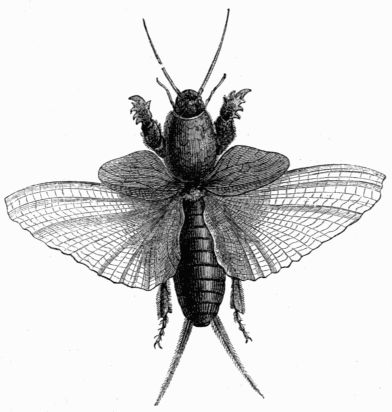
Fig. 305.—Mole Cricket (Gryllo-talpa vulgaris).
The female crickets have a long egg-layer, or ovipositor, with which they deposit their eggs, of which each one lays, towards the middle of the summer, about three hundred, in the cracks and crevices of the soil. The larvæ pass the winter in that state, and do not become pupæ and perfect insects till the following summer.
Mouffet relates that, in certain regions of Africa, the crickets are objects of commerce. They are brought up in little cages, as we do Canary birds, and sold to the inhabitants, who like to hear their amorous chant. It is said that some tribes eat these insects. In France they are sought after as baits for fishing, and are used also in menageries for feeding small reptiles. Next to Gryllus come the genera Œcanthus, insects of the south of Europe, which live on plants, and which one often sees fluttering about flowers; Sphæria, which live in ant-hills; Platydactylus; and, lastly, the Mole Cricket (Gryllo-talpa), whose habits deserve attention for a while.
The Mole Crickets are distinguished from all other insects by the structure of their fore-legs, which are wide and indented, in such a manner as to resemble a hand, analogous to that of the mole. This leg betrays the habits of the cricket much better than our hands betray ours. They make use of them, indeed, as spades, with which they hollow out subterranean galleries, and accumulate at the side of the entrance-hole the rubbish thus drawn out. The French name comes from the old French word courtille, which means garden. Such places and vineyards are the favourite haunts of these destructive insects.
If the Mole Crickets, or Courtilières, have spades on their front legs, their hind-legs are very little developed, so that it would be perfectly impossible for them to jump, particularly as their large abdomen would hinder their so doing. The wings are broad, and fold back in the form of a fan; they make little use of them, and it is only at night-fall that the mole cricket is seen to disport himself, describing curves of no great height in the air. It is found principally in cultivated land, kitchen-gardens, nursery gardens, wheat fields, &c., where it scoops out for itself an oval cavity communicating with the surface by a vertical hole (Fig. 306). On this hole abut numerous horizontal galleries, more or less inclined, which permit the insect to gain its retreat by a great many roads, when pursued.
It is easy to understand that an insect which undermines land in this way must cause great damage to cultivation. Whether the crops serve it for food or not, they are not the less destroyed by its underground burrowings. Lands infested by the mole cricket are recognisable by the colour of the vegetation, which is yellow and withered; and the rubbish which these miners heap up at the side of the openings leading to their galleries, resembling mole-hills in miniature, betray their presence to the farmer. To destroy them, they pour water or other liquids into their nests, or else they bury, at different distances, vessels filled with water, in which they drown themselves. From the month of April the males betake themselves to the entrance of their burrows, and make their cry of appeal. Their notes are slow, vibrating, and monotonous, and repeated for a long time without interruption, and somewhat resembling the cry of the owl or the goat-sucker.
Fig. 306.—The nest of the Mole Cricket (Gryllo-talpa vulgaris).
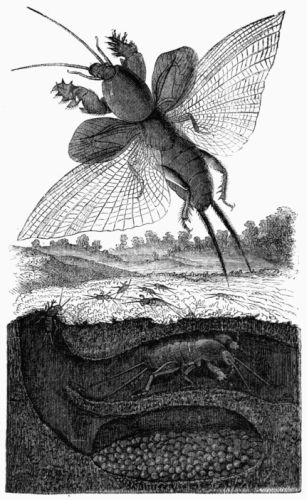
The female lays her eggs, to the number of from two to three hundred, in the interior of a sort of chamber scooped out in soil stiff enough to resist the action of rain. The hatching takes place at the end of a month.
It is not till the following spring that the larvæ pass into the pupa state, and that the organs of flight begin to be marked out. According to M. Féburier, three years are required for the complete development of the mole cricket, which is a fact that indicates remarkable longevity in these insects. All authors agree, moreover, in extolling the solicitude with which the mole cricket takes care of her little ones. She watches over them, and, they say, procures them food.
The genus Tridactylus, which bears a great analogy to the mole cricket, is the smallest genus of Orthoptera known; the species are not more than a sixth of an inch in length, and are found in the south of France, on the banks of the Rhône and other rivers, where they disport themselves in sand exposed to the sun. The Tridactyli leap with remarkable agility, even on the surface of the water, for their legs are provided with flat appendages much resembling battledores.
The Grasshoppers and Locusts take much longer leaps than the Crickets, owing to the conformation of their hind-legs, and they often make use of their wings also, which are very fully developed. These insects are unable to walk, on account of the disproportion which exists between their different pairs of legs. The female is provided with a curved ovipositor with two valves, which serves for breaking up the ground for the reception of its eggs. The male produces a sharp stridulation or screeching sound, by rubbing the cases of its wings—which are furnished with plates which might be compared to cymbals—one against another.
The song of the grasshopper, known by everyone, is a monotonous "zic-zic-zic," which can be heard during the day in grassy places. It is on account of this song that the name of Cigale is sometimes given, though wrongly, to the great green grasshopper. As we have already said in speaking of the Cigale, it is the green grasshopper which La Fontaine had in view in his fable of La Cigale et la Fourmi, for all the plates which ornament the ancient editions of the fables of this author represent a grasshopper, and not a Cigale. Grasshoppers are spread over the whole surface of the earth, but are to be met with chiefly in South America, which contains nearly three-fourths of the species known. The European species, on the contrary, are few.
Their habits resemble those of the other herbivorous Orthoptera. They live in meadows, on trees, devouring the leaves and stalks of plants; but they are never found in such great numbers as to cause damage at all to be compared to that caused by the locust. They appear in the month of July and disappear at the beginning of the cold weather. Towards the end of summer their song is heard in the meadows and wheat fields. The females, summoned by the males, are not long in coupling and laying their eggs, which do not hatch until the following spring, in the ground. After four months the larvæ change into pupæ, which already show rudimentary wings, and which by a fifth month pass into the perfect state.
The Great Green Grasshopper (Locusta viridissima) is very common in Europe. It remains during the day on trees, and in the evening disports itself in the fields.
Fig. 307.—Decticus verrucivorus.
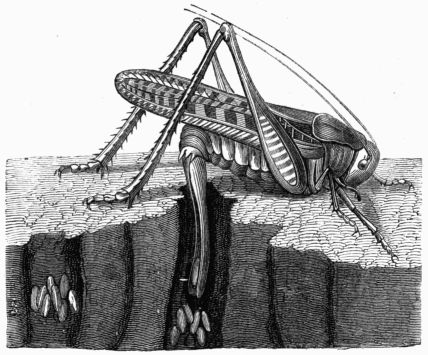
The Decticus verrucivorus (Fig. 307) is a shorter and more thick-set species, whose distinctive feature is a very broad head. Its colour is grey of various shades, and it is to be heard singing during the day in fields of ripe wheat. The name comes from the use made of it by the peasants in Sweden and Germany as a cure for warts.
"The peasants," says Charles de Geer, "make these locusts bite the warts which they often have on their hands, and the liquid which at the same time flows from the insect's mouth into the wound causes the warts to dry up and disappear. It is for this reason they have given them the name of Wart-bit or Wart-biter."
The Phaneropteræ and the Copiphores are exotic Locusts. The Ephippigeræ are small species whose thorax, which is very convex, resembles a saddle.
One often meets in the environs of Paris the Vine Ephippiger (Ephippigera vitium), which is greenish, with four brown stripes on its head. In this species the wing cases, or elytra, are almost obsolete, and the wings are reduced to mere arched scales, whose friction produces a stridulation or screeching noise. The females are provided with a similar apparatus, so that they perform duets. [78]
The genus Gryllacris resembles the crickets. It contains the Anostostomæ of New Holland, which are said to be destitute of wings, even in the perfect state.
We arrive now at the redoubtable tribe of Acridium, or Locust, whose fearful ravages are so well known.
These are, among the Orthoptera, the best adapted for jumping. The thigh and the leg, folded together when at rest, are stretched out suddenly under the action of very powerful muscles. The body, resting then on the tarsi and on the flexible spines of the legs, is shot into the air to a great height. They fly very well, but the power of walking and running is denied to them, as it is also to the other Saltatoriæ. The females have no ovipositor. This peculiarity, and the formation of their antennæ, which are very short, distinguish the locusts from the grasshoppers.
The males, as we have already said, make a shrill stridulation by rubbing their thighs over their elytra. There is never more than one thigh in motion at a time; the insect using the right and the left by turns. The sound is made stronger by a sort of drum filled with air, and covered with a very thin skin, which is found on each side of the body, at the base of the abdomen. The locust's song is less monotonous than that of the grasshopper. It is capable of much variation; it is a noise just like that of a rattle, but with sounds which vary very much, according to the species.
They move about by day, frequent dry places, and are very fond of sitting on the grass in the sun. Certain species, which inhabit the warm regions of the south, move their legs with scarcely any noise; it being only perceptible to a very fine ear.
Locusts are very abundant in many parts of the world. In northern countries, where they multiply less rapidly, their ravages are less disastrous, though still very considerable. But in the southern portions of the globe they are a perfect pest—the eighth plague of Egypt. Certain species multiply in such a prodigious manner, that they lay waste vast spaces of land, and in a very short time reduce whole countries to the very last state of misery. These insects inflate themselves with air, and undertake journeys during which they travel more than six leagues a day, laying waste all vegetation on their road.
Fig. 308.—Locust (Acridium [Œdipoda] migratorium).
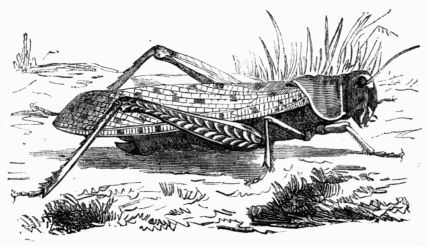
The most destructive species is the Migratory Locust (Acridium [or Œdipoda] migratorium, Fig. 308), which is very common in Africa, India, and throughout the whole of the East. Isolated specimens of this insect are to be found in the meadows round about Paris, especially towards the end of the summer, and, very rarely, in England. This species is greenish, with transparent elytra of a dirty grey, whitish wings, and pink legs. A second species, the Italian locust, also does a great deal of damage in the south. All the species undergo five moults, which take six weeks each. The last takes place at the end of the hot weather, towards the autumn.
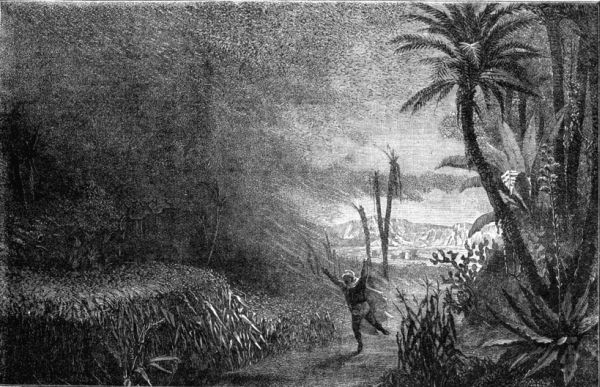
It is especially in warm climates that they become such fearful pests to agriculture. Wherever they alight, they change the most fertile country into an arid desert. They are seen coming in innumerable bands, which, from afar, have the appearance of stormy clouds, even hiding the sun. As far and as wide as the eye can reach the sky is black, and the soil is inundated with them. The noise of these millions of wings may be compared to the sound of a cataract. When this fearful army alights upon the ground, the branches of the trees break, and in a few hours, and over an extent of many leagues, all vegetation has disappeared, the wheat is gnawed to its very roots, the trees are stripped of their leaves. Everything has been destroyed, gnawed down, and devoured. When nothing more is left, the terrible host rises, as if in obedience to some given signal, and takes its departure, leaving behind it despair and famine. It goes to look for fresh food—seeking whom, or rather in this case, what it may devour! (Plate VIII.)
During the year succeeding that in which a country has been devastated by showers of locusts, damage from these insects is the less to be feared; for it happens often that after having ravaged everything, they die of hunger before the laying season begins. But their death becomes the cause of a greater evil. Their innumerable carcases, lying in heaps and heated by the sun, are not long in entering into a state of putrefaction; epidemic disease, caused by the poisonous gases emanating from them, soon break out, and decimate the populations. These locusts are bred in the deserts of Arabia and Tartary, and the east winds carry them into Africa and Europe. Ships in the eastern parts of the Mediterranean are sometimes covered with them at a great distance from the land.
It is related in the Bible, in the tenth chapter of Exodus, that Jehovah commanded Moses to stretch forth his hand to make locusts (Arbeth) come over the whole land of Egypt as the eighth plague, destined to intimidate Pharaoh, who had rebelled against Him. These insects arrived, brought by an east wind, and covered the surface of the country to such a degree that the air was darkened by them.[79]
They ate up all the herbs of the field and all the fruit of the trees which the hail (the seventh plague) had left. A west wind swept them away again, when Pharaoh had at last promised to allow the children of Israel to depart.
VIII.—A Cloud of Locusts in Algeria.
Pliny relates that in many places in Greece a law obliged the inhabitants to wage war against the locusts three times a year; that is to say, in their three states of egg, larva, and adult. In the Isle of Lemnos the citizens had to pay as taxes so many measures of locusts. In the year 170 before our era they devastated the environs of Capua. In the year of our Lord 181 they committed great ravages in the north of Italy and in Gaul. In 1690 locusts arrived in Poland and Lithuania by three different ways, and, as it were, in three different bodies. "They were to be found in certain places where they had died," writes the Abbé Ussaris, an eye-witness, "lying on one another in heaps of four feet in height. Those which were alive, perched upon the trees, bending their branches to the ground, so great was their number. The people thought that they had Hebrew letters on their wings. A rabbi professed to be able to read on them words which signified God's wrath. The rains killed these insects: they infected the air; and the cattle, which ate them in the grass, died immediately."
In 1749 locusts stopped the army of Charles XII., King of Sweden, as it was retreating from Bessarabia, on its defeat at Pultowa. The king thought that he was assailed by a hail-storm, when a host of these insects beat violently against his army as it was passing through a defile, so that men and horses were blinded by this living hail, falling from a cloud which hid the sun. The arrival of the locusts had been announced by a whistling sound like that which precedes a tempest; and the noise of their flight quite over-powered the noise made by the Black Sea. All the country round about was soon laid waste on their route. During the same year a great part of Europe was invaded by these pests, the newspapers of the day being full of accounts relating to this public calamity. In 1753 Portugal was attacked by them. This was the year of the earthquake of Lisbon, and all sorts of plagues seemed at this time to rage in that unfortunate country.
In 1780, in Transylvania, their ravages assumed such gigantic proportions that it was found necessary to call in the assistance of the army. Regiments of soldiers gathered them together and enclosed them in sacks. Fifteen hundred persons were employed in crushing, burying, and burning them; but, in spite of all this, their number did not seem to diminish; but a cold wind, which fortunately sprang up, caused them to disappear. In the following spring the plague broke out again, and every one turned out to fight against it. The locusts were swept with great brooms into ditches, in which they were then burnt; not, however, before they had ruined the whole country. Locusts showed themselves at the same time in the empire of Morocco, where they caused a fearful famine. The poor were to be seen wandering on all sides, digging up the roots of vegetables, and eagerly devouring camels' dung, in hopes of finding in it a few undigested grains of barley.
Barrow and Levaillant, in their travels through Central Africa, speak of similar calamities having happened many times between 1784 and 1797. They add that the surface of the rivers was then hidden by the bodies of the locusts, which covered the whole country.
According to Jackson, in 1739 they covered the whole surface of the ground from Tangiers to Mogador. All the region near to the Sahara was ravaged, whilst on the other side of the river El Klos there was not one of these insects. When the wind blew they were driven into the sea, and their carcases occasioned a plague which laid Barbary waste.
India and China often suffer from these destructive insects. In 1735 clouds of locusts hid from the Chinese both the sun and moon. Not only the standing crops, but also the corn in the barns and the clothes in the houses were devoured.
In the south of France locusts multiply sometimes so prodigiously that in a very short time many barrels may be filled with their eggs. They have caused, at different periods, immense damage. It was chiefly in the years 1613, 1805, 1820, 1822, 1824, 1825, 1832, and 1834, that their visits to the south of France were most formidable.
Mézeray relates that in the month of January, 1613, in the reign of Louis XIII., locusts invaded the country around Arles. In seven or eight hours the wheat and crops were devoured to the roots over an extent of country of 15,000 acres. They then crossed over the Rhine, and visited Tarascon and Beaucaire, where they ate the vegetables and lucerne. They then shifted their quarters to Aramon, to Monfrin, to Valabregues, &c., where they were fortunately destroyed in great part by the starlings and other insect-eating birds, which flocked in innumerable numbers to this game.
The consuls of Arles and of Marseilles caused the eggs to be collected. Arles spent, for this object, 25,000 francs, and Marseilles 20,000 francs. Three thousand quintals of eggs were interred or thrown into the Rhône. If we count 1,750,000 eggs per quintal, that will give us a total of 5,250,000,000 of locusts destroyed in the egg, which otherwise would have very soon renewed the ravages of which the country had so lately been the victim. In 1822 were spent again, in Provence, 2,227 francs for the same object. In 1825 were spent 6,200 francs. A reward of 50 centimes was given for every kilogramme of eggs, and half the sum for every kilogramme of insects. The eggs collected were burnt, or else crushed under heavy rollers. The gathering was entrusted to women and children. The operation consisted in dragging along the ground great sheets, the corners of which were held up. The locusts came and settled on these, and were caught by rolling the sheet up.
In the territory of Saintes-Maries, situated not far from Aigues-Mortes, on the Mediterranean coast, 1,518 wheat sacks were filled with dead locusts, amounting in weight to 68,861 kilogrammes; and at Aries 165 sacks, or 6,600 kilogrammes. The rewards given amounted to 5,542 francs; but, notwithstanding all this, the following year the locusts caused still greater damage.
Locusts are always to be found in Algeria, in the provinces of Oran, Bona, Algiers, and Bougia, but they never commit those terrible ravages which change cultivated countries into deserts. There are in Algeria years of locusts as there are with us years of cockroaches, of blight, of caterpillars, &c. These plagues are fortunately rare. The most terrible took place in 1845 and in 1866. In the former year a formidable invasion of locusts took place. It lasted five months, from March to July, each day bringing new bands of these devastating insects; and M. Henry Berthoud, then in Algeria, saw a column of them, whose passage began before daylight, and had scarcely ended at four o'clock in the afternoon. Dr. Guyon, doctor to the army, and correspondent of the Institute, addressed to this learned body an account of a few peculiarities of this invasion, of which he was a witness. He speaks of a band which passed on the 16th of March over the plain of Sebdon, going in the direction of the desert of Angard. Their passage lasted three hours. The locusts, having found nothing to devour in the desert, came back again, and next day made a descent upon the plain of Sebdon, which is 30 kilomètres long, by 12 to 15 kilomètres broad. In four hours all the crops were devoured, and all vegetation destroyed. "The locusts," says the Doctor, "left behind them an infectious odour of putrid herbs, produced by their excretions."
At Algiers, in the Faubourg Bab-Azoum, they penetrated in masses into the barley stores, and there was the greatest difficulty in driving them away, great barricades being raised before the storerooms to stop the invasion. In 1845 they penetrated into the pits in which the natives preserve their wheat. According to the report of the Commandant de la Place of Philippeville, M. Levaillant, a column of locusts alighted in the country round about that town on the 18th of March, 1845, which extended from 30 to 40 centimètres, and the locusts were found heaped upon the ground to the height of three décimètres.
In the environs of Algiers alone were destroyed, in 1845, 369 quintals of locusts. It is computed that 400 locusts go to a kilogramme. This gives, then, a total of 14,760,000 insects destroyed. As in this number half were probably females, and as each female lays on an average seventy eggs, the result we arrive at is, that this stopped the production of 516,600,000 larvæ on the territory of Algiers alone. The invasion of locusts which took place in 1866 was as disastrous as that of 1845. It was in the month of April, 1866, that the vanguard of these destructive insects appeared. Debouching through the mountain gorges and through the valleys, into the fertile plains near the coast, they alighted first on the plain of Mitidja and on the Sahel of Algiers. Their mass, at certain points, intercepted the light of the sun, and resembled those whirlwinds of snow which, during the storms of winter, hide the nearest objects from our view. Very soon the cabbages, the oats, the barley, the late wheat, and the market-gardeners' plants, were partly destroyed. In some places the locusts penetrated into the interiors of the houses. By order of the government of Algiers the troops joined the colonists in combating the plague; and the Arabs, when they found that their interests were suffering, rose to lend their aid against the common enemy. Immense quantities of locusts were destroyed in a few days; but what could human efforts do against these winged multitudes, who escape into space, and only abandon one field to alight in the next?
It was impossible to prevent the fecundation of these insects. The eggs quickly producing innumerable larvæ, the first swarms were very soon not only replaced, but multiplied a hundredfold by a new generation. The young locusts are particularly formidable on account of their voracity. These hungry masses threw themselves upon everything which was left by those which went before them. They choked up the springs, the canals, and the brooks; and it was not without a great deal of trouble that the waters were cleared of these causes of infection. Almost at the same time the provinces of Oran and of Constantine were invaded. At Tlemcen, where within the memory of man locusts had never appeared, the ground was covered with them. At Sidi-bel-Abbes, at Sidi-Brahim, at Mostaganem, they attacked the tobacco, the vines, the fig-tree, and even the olive-trees, in spite of the bitterness of their foliage. At Relizane and at L'Habra they attacked the cotton-fields. The road, 80 kilomètres long, which connects Mostaganem with Mascara, was covered to the whole of its extent.
In the province of Constantine the locust appeared almost simultaneously, from the Sahara to the sea, and from Bougia to La Calle. At Batna, at Setif, at Constantine, at Guelma, at Bona, at Philippeville, at Djidjelly, the inhabitants struggled with energy against this invasion, but neither fire nor any obstacles opposed to the advance of this winged army were able to stop their ravages. The French Government, to alleviate as much as possible the ruin which was thus brought upon the colony, opened a public subscription at the end of the year 1866.
The negroes of Soudan endeavour to frighten the locusts in their flight by savage yells. In Hungary they employed for the same object the noise of cannon. In the middle ages, for the want of cannon, they exorcised the locusts. A traveller of the sixteenth century, the monk Alvarez, relates that he also employed exorcisms against an immense host of these destructive insects which he met with in Ethiopia. When he perceived them, he made the Portuguese and the natives form in procession, and ordered them to chant psalms. "Thus chanting," says he, "we went into a country where the corn was, which having reached, I made them catch a good many of these locusts, to whom I delivered an adjuration, which I carried with me in writing, by me composed the preceding night, summoning, admonishing, and excommunicating them. Then I charged them in three hours' time to depart to the sea, or else to go to the land of the Moors, leaving the land of the Christians; on their refusal of which, I adjured and convoked all the birds of the air, animals, and tempests, to dissipate, destroy, and devour them; and for this admonition I had a certain quantity of these locusts seized, and pronouncing these words in their presence, that they might not be ignorant of them, I let them go, so that they might tell the rest." If one reflects that on their arrival in the land of the Moors, these same locusts were perhaps received by prayers which had for their object to send them back to the land of the Christians, they must have been very much embarrassed by such contradictory adjurations.
The Arabs have also an infallible means of ridding themselves of the locusts. Here is what General Daumas tells us on the subject According to Ben-Omar, the Prophet read one day, on the wings of a locust, written in Hebrew characters: "We are the troops of the Most High God; we each one lay ninety-nine eggs. If we were to lay a hundred we should devastate the whole world." Upon which Mahomet, greatly alarmed, made an ardent prayer, in which he begged God to destroy these enemies of Mussulmans. In answer to this invocation, the angel Gabriel told Mahomet that a part of his prayer should be granted. Since that epoch, indeed, words of invocation to the Prophet, written on a piece of paper, and enclosed in a reed, which is planted in the middle of a wheat-field or orchard, have the power of turning away the locusts. [80] This receipt is infallible, at least so say the devout Mussulmans.
There exists another quite as efficacious. They take four locusts, and write on the wings of each a verse of the Koran (four verses of the Koran are appropriated to this purpose). They then let the locusts thus marked fly into the midst of the swarm, and the flying army immediately take another direction.
By what the Arabs say, the locusts possess a number of virtues. When you see them in a dream, they announce the future; if you dream that you are eating them, it is a good omen; if you dream that it rains golden locusts, God will restore to you that which you have lost; &c. When Omar-ben-el-Khottal was Caliph, the locusts seemed to have completely disappeared. There was great sadness in the country in consequence. The Caliph especially was very much afflicted at it. He sent carriers into Yemen, into Cham, and into Irak, to see if they could not find a few. One of the envoyés succeeded in his mission, and brought back a handful of locusts. "God is great!" cried Omar, who from that day had no more misgivings. In order to understand first the despair and then the satisfaction of the Caliph Omar, it is written, so say the Mussulmans, that the human race will disappear from the earth after the extinction of the locusts; that these insects were formed of the rest of the clay out of which man had been formed, and that they were destined to serve him as food.
And so locusts and fish are the only creatures which God allows the Mussulman to eat without being skinned. They must, however, have been killed by one of the faithful, for otherwise their flesh is impure! The Arabs eat, and are very fond of locusts. When he was asked his opinion on this article of food, the Caliph Omar-ben-el-Khottal said, "I only wish I had a basketful of them, wouldn't I scrunch them!"
According to General Daumas, locusts, fresh or preserved, are good food for both men and camels. They are eaten grilled or boiled, or prepared in the kous-koussou, after their legs, wings, and heads have been taken off. Sometimes they are dried in the sun, and reduced to powder, which is mixed with milk, and made into cakes with flour, dripping, or butter and salt. Camels are very fond of them; and they are given to them after having been dried, or roasted between two layers of ashes. Dried and salted, they are in Asia and in Africa an object of commerce. At Bagdad they sometimes cause the price of meat to fall. The taste of their flesh may be compared to that of the crab. Eastern nations have eaten locusts from time immemorial. The Greek comic poet, Aristophanes, tells us, in the "Acharnians," that the Greeks sold them in the markets. Moses allowed to the Jews four species, which are mentioned in Leviticus. St. John the Baptist, following the example of the prophet Amos, made them his food in the desert, where he found nothing but locusts and a little honey. The wholesomeness of this food was, however, disputed among the ancients. Strabo relates that there existed on the borders of the gulf of Arabia a people called by him Acridophagi, or Locust-eating people; but they all came to a miserable end. These people procured for themselves locusts by lighting great fires, when the equinoctial winds brought these hosts. Blinded and suffocated by the smoke, the locusts fell to the ground, and were picked up greedily by them, and eaten, fresh or salted. "These locust-eaters," says Strabo, "are, it is true, active, good runners; but their life never exceeds forty years. As they approach this age, a horrible vermin issues from their bodies, which eats them up, beginning from the belly, and so they die a miserable death." The same tale is to be met with in a description of Admiral Drake's voyage round the world. This traveller speaks of the natives of Ethiopia, who live on locusts, as dying eaten up by winged insects bred in their own bodies.
It is difficult to explain the origin of such fables. Travellers who have visited Arabia agree in declaring that the locust is a most wholesome article of food; that it is even fattening. At any rate, it is good food for cattle and poultry. The ancients employed locusts in medicine. Dioscorides asserts that the thighs of the locust, reduced to powder, and mixed with the blood of the he-goat, is a cure for leprosy; and mixed with wine, is a specific against the bite of the scorpion, &c.
It remains for us to describe some other species of grasshoppers less destructive in their ravages than the Acridium migratorium.
In the deserts of Egypt is to be met with the great Eremobia, and in South America the Ommexeca, which walks rather than springs. On the other hand, the Tetrix springs very well. A remarkable feature about them is their thorax, which is prolonged into a point, and covers the whole body. They are small insects of gay and brilliant colours, and generally remain on the leaves of low plants, and escape easily from the hand that tries to catch them. The Tetrix subulata, of a brownish colour, is common during spring, in the environs of Paris, in the woods, and in dry and arid fields. The Pneumoræ are very strange insects. The males have a very prominent abdomen, which resembles a bladder filled with air; and their wings are very much developed. The females have the abdomen of the ordinary shape; their wings are very short, or even quite rudimentary. The former produce a sharp stridulation, by rubbing their hind-legs against a row of small tubercles, which are to be seen on each side of the abdomen. The sound is rendered still more penetrating by the vesiculous or bladder-like abdomen, the skin of which is stretched as tight as a drum. The Pneumoræ inhabit the South of Africa, as also do the Truxales, a few varieties of which, however, are to be met with in Spain, Sicily, and the South of France.
We will pass in silence over a great number of other less interesting species of Orthoptera. Those which we have described suffice to justify us in what we said above, namely, that this order contains insects of the strangest and most anomalous forms.
VI.
HYMENOPTERA.
The Order Hymenoptera comprises those insects which have four naked membranous wings, lying in repose horizontally upon the body, and intersected by a network of nerves. The name is derived from two Greek words—ὑμην, a membrane, and πτερον, a wing. The mouth is composed of two horny mandibles, jaws, and lips adapted for suction.
It is amongst the Hymenoptera that we meet with the most industrious insects, some of which seem to possess real intelligence. These little animals offer the most admirable examples of sociability. Born architects, they construct dwellings marvellously contrived, which serve them, at the same time, as nurseries in which to rear their progeny, and storehouses in which to lay by their provisions. Nothing can equal the solicitude with which they watch over their young larvæ, still incapable of motion. They form republics, governed by immutable laws, and make war against their enemies in order of battle. They have predilections or antipathies for those who court their society, on account of the material advantages they derive from them.
The Bees, the Humble Bees, the Wasps, and the Ants, are the best-known types of this order of insects. Among a great number of the Hymenoptera the females are armed with a sting, or lancet, a wound from which causes great pain. All these insects undergo complete metamorphoses. In the larva state the aculeate species are incapable of motion and of obtaining food; but Nature has provided in different ways for their preservation. They are often lodged and fed by the workers of the tribe, unfruitful females, which, with a self-denial very rare in Nature, seem to have no other vocation than to sacrifice themselves to the welfare of the larvæ. The workers construct the nest and bring in the provisions. This is the case with honey bees, wasps, and ants.
Some deposit their eggs in the bodies of other insects, which die immediately the larvæ which live in them have attained their full development. The larvæ of the Chalcididæ and of the Ichneumonidæ furnish examples of Hymenoptera which inhabit the interior of the body of another insect. Other parasitical species carry on their depredations in a different way. They content themselves with laying their eggs in the nests of other species of the order, which have the advantage over them in being able to construct for themselves places of refuge. Their larvæ live thus on their neighbours' goods, nourishing themselves on the provisions which were laid up for others. In this way live the Cleptes, the Chrysides, &c. Lastly, others, such as the Gall-insects, and the Tenthredinetæ, or Saw-flies, live in their first state exposed on plants, and feed upon their leaves.
We shall only here describe the principal families of the Order Hymenoptera, which contains a considerable number of species. These families will be—1st. The Apiariæ, containing the Honey Bees, the Melipodes, and the Humble Bees. 2nd. The Vespiariæ, or Wasps. 3rd. The Formicariæ, or Ants. 4th. The Gallicolæ, or Gall-insects.
Bees.—Man, from the very earliest age, before any civilisation existed, knew the value of bees, and took advantage of the products of these industrious insects. The Bible makes mention of honey bees. Their Hebrew name is Deborah. The Greeks called them by the name of Melissa, or Melitta.
Their wonderful architectural powers, their economical forethought, the wonderful combination of their reasonings, which denote a real intelligence, their admirable social organisation, have in all times fixed the attention of naturalists, as they have also that of poets and thinkers. Virgil has celebrated them. In the fourth book of his Georgics, the Latin poet has summed up all that the ancients knew about bees. He paints with a good deal of truth many traits in their history, points out their enemies, and sets forth with accuracy all the care that should be taken of them. In the words of the Mantuan poet, they are heavenly gifts, dona cælestia, and their intelligence excited his admiration:—
"His quibus signis atque hæc exempla secuti, Esse apibus partem divinæ mentis, et haustus Æthereos dixere." ...
Let us hasten to say, however, that all which the ancients, naturalists or poets, Greek or Latin, relate on the subject of bees, is a mixture of truth and error, and rests generally on mere supposition. Aristotle knew well the three sorts of individuals which are comprised under the title of bees, and some other principal facts relating to their history; but these facts are not stated accurately and precisely in his account of them, and they are, above all, misinterpreted. The Greek philosopher understood insects in general very badly. He made them spring from the leaves of trees, and brought forward a multitude of errors about them, which the most simple observation would have sufficed to dissipate. Pliny tells us that Aristomachus of Soles consecrated fifty-eight years to the observation of the habits of the bee, and that Philiscus of Thrace passed, for the same motive, all his life in the forests. But this devotion to one object does not appear to have produced much result, if one compares the discoveries of our own age with the errors which Pliny, Aristotle, and Columella have chronicled respecting them. Pliny says that bees occupy the first rank among insects, and that they were created for man, for whom their work procures honey and wax. He adds that they form political associations, that they have councils, chiefs, and even a code of morality and principles.
One sees by this opinion of the Roman naturalist in what high esteem the ancients held bees. But they had the most singular ideas on the reproduction of these little beings; and as no one had ever seen their generation, they invented fable after fable to explain their origin. Some pretended that bees sprang from an ox recently killed, and buried in manure. Others added that they only sprang into existence from the chest of a young ox killed with violence. The most courageous bees came from the belly of a lion in a state of putrefaction. It was from the head of this same animal, in a state of corruption, that the kings (i.e., the queens) were formed. The carcases of cows furnished the mild and tractable bees; a calf could only furnish small and weak ones. Other naturalists, or rather other dreamers, made these insects spring from the calices of sweet-scented flowers. Combined and separated in a certain manner, the flowers engendered bees. They said, further, that the bees sought on the blossoms of the olive trees and of the reed a seed which they rendered fit for the formation of their larvæ.
All these fables, which sprang from the imagination of the ancients, were developed by a writer of the Renaissance, a certain Alexander de Montfort, author of a work entitled "Printemps de l'Abeille." If we were to believe him, the king of the bees is formed of the juice which the workers extract from plants. These latter are created from honey; and the tyrants, i.e., the females, which do not manage to become sovereigns of a hive, are formed only of gum. It will be seen that he had profited only too well by what he had read in Greek and Roman authors.
The bee was very much thought of in ancient Egypt, and is often represented on their monuments, above the sculptured ornaments which contain proper names, with two semicircles and a sort of sheaf, or fasciculus. Champollion Figeac thinks that this group, taken together, represents a title added to a proper name. According to Hor-Apollon, another commentator on Egyptian hieroglyphics, the bee in the country of the Pharaohs was the emblem of a people sweetly submissive to the orders of its king. Nothing can be better than this comparison. It was for this reason, no doubt, that Napoleon I. sprinkled the symbolical bees over the imperial mantle which bears the arms of his dynasty.
All the fables, all the hypotheses, spread about and cherished by the ancients respecting these industrious little insects, were dissipated in a moment when, by the invention of glass bee-hives, first made in the beginning of the last century by Maraldi, a mathematician of Nice, we were enabled to observe their operations and habits. It is from this period only that our exact knowledge of the really wonderful life of these insects dates. Before Maraldi, the Dutch naturalist, Swammerdam, had written an excellent "History of Bees." He died before he had published his work, and when, a long while after his death, it was at length printed, other investigators had already pushed on their observations further than he had. Thanks to the invention of Maraldi, Réaumur, John Hunter, Schirach, and Francis Huber, had unveiled, by their admirable researches, the wonderful habits of these insects. The discoveries of Francis Huber seem to be almost miraculous, when we remember that this observer was blind from the age of seventeen.
Deprived of sight, Francis Huber did not the less wish to consecrate his life to the observation and the study of Nature. He caused the best works of his day on natural history and physics to be read to him, his usual reader being his servant, named Francis Burnens, a native of the Pays de Vaud. The honest Burnens took a singular interest in all he read, and showed by his judicious reflections the true talent of an observer, and Huber resolved to cultivate his talent. Very soon he could place implicit reliance in his companion, and see with another's eyes as if they were his own.
The two naturalists (we do not hesitate to give this title to the poor peasant of the canton of Vaud who so well seconded his master in his long hours of study) conceived a host of original experiments, which led them to discover truths which no one up to that time had dreamt of. The results of their researches were published, in 1789, in a volume which produced a profound sensation among naturalists. [81] Burnens was at a later period called back to the bosom of his family, and invested by his fellow-citizens with important functions. Francis Huber then continued his observations through the eyes of the excellent wife he had married. A second volume was thus composed by him twenty years after the appearance of the first. This volume was published by his son, Pierre Huber, to whom we are indebted for the admirable researches concerning ants, of which we shall have to speak further on.
We will now speak of the habits of the bees. The labours of Réaumur, of Schirach, and of Huber, have perfectly revealed them to us, and have initiated us completely into the habits of these precious insects, which are for us to a certain extent domestic animals. We will begin by describing the Common Bee (Apis mellifica).
During the greater part of the year the population of our hives is composed exclusively of two sorts of individuals—the female, or mother bee, called also the queen bee; and the working bees, or neuters, which are, properly speaking, females incompletely developed. A third kind of individuals, the males, called also drones, are generally not met with except from May to July.
Fig. 309. Working Bee (Apis mellifica).
The working bees are the people, the crowd, the servum pecus, the living force, the bee community. They are recognised by their small size, reddish brown colour, and, above all, by the palettes and brushes with which the hind legs are furnished.
The three pairs of legs which are inserted in its thorax are its tools. The two hind-legs are longer than the other pairs, and present on the exterior a triangular depression, resembling a palette, which is surrounded by stiff hairs, forming, as it were, the borders of a sort of basket, in which the insect deposits the pollen of flowers. The broadest part of the leg articulates with the tarsus, which is of a square form, smooth on the exterior, and having hairs on its interior surface, which has caused it to be named the brush. The joint is used for gathering the pollen; it folds back on the leg (Fig. 310), and forms with it a sort of small pair of pincers; and, finally, the leg is terminated by four smaller articulations, the last of which is armed with hooks. The other tools of the working bee consist of a pair of movable mandibles, which close the mouth on its two sides, and of a trunk or proboscis (Fig. 311), which may be considered as a sort of tongue.
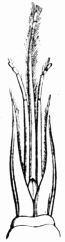
Fig. 310.—Leg of a Bee (magnified). Fig. 311.—Trunk of a Bee (magnified).
With its mandibles the working bee seizes any hard substance. The trunk serves it to collect the juice lying on the surface of the petals, or at the bottom of the corolla of the flower. When a bee has settled on a full-blown flower, it is seen immediately to make for the interior of the corolla, to put out its trunk, and apply it to the petals; it lengthens, shortens, and twists and bends it in all directions. When the hairy surface of this organ is covered with vegetable juice, the bee returns it to its mouth, and deposits the booty in a conduit, whence the juice passes into the first stomach. This trunk is then, in all respects, a tongue, with which the bee sucks, licks, and pumps up the honey of flowers. But it also gathers the pollen. When it enters a flower the bee covers itself with pollen from head to foot, and then passing its brushes carefully over its whole body, removes the dust which adheres to it in every part, and piles it up on the triangular palettes of its hind-legs, in such a manner as to form balls of greater or less size. If the flower is not quite full blown, the bee makes use of its mandibles to open the anthers, in which case the front pair of legs transmit the booty to the second pair, which stores them in the baskets of the third. When it has gathered as much as it can carry, the bee returns to the hive, its legs laden with pollen.