Front matter (continued 7)
Reading edition
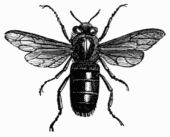
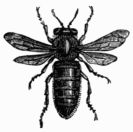
Fig. 312.—Male, or Drone (Apis mellifica). Fig. 313.—Female, or Queen (Apis mellifica).
This complete set of tools which we have just described is only to be met with among the working bees. The males, or drones (Fig. 312), larger and more hairy than the working bees, emitting a sonorous and buzzing sound, have no palettes on their legs, the hairs on their tarsi are not appropriated to the work of gathering, their mandibles are shorter, and they have no aculeus, or sting, which is the working bee's weapon.
The female, or queen (Fig. 313), is smaller than the male, and has a longer body than the working bees, and the wings, shorter in proportion, cover only the half of its body, whereas with the other bees they cover it entirely. The only part she has to play is that of laying eggs, and so she has no palettes and brushes. The sovereign is, as suits her supreme rank, exempted from all work. She is always escorted by a certain number of working bees, who brush her, lick her, present honey to her with their trunks, save her every kind of fatigue, and compose a train worthy of her feminine majesty. One very remarkable fact is that only one queen lives in each hive. Perfect sovereign of this tiny state, she rules over a people of some thousands of workers. It is not rare to find 20,000 working bees in a hive, and all submissively obey their sovereign. The number of males is scarcely one-tenth part of that of the working bees; and they only live about three months. The workers represent the active life of the community.
"The exterior of a hive," says M. Victor Rendre, "gives the best idea of this people, essentially laborious. From sunrise to sunset, all is movement, diligence, bustle; it is an incessant series of goings and comings, of various operations which begin, continue, and end, to be recommenced. Hundreds of bees arrive from the fields, laden with materials and provisions; others cross them and go in their turn into the country. Here, cautious sentinels scrutinise every fresh arrival; there, purveyors, in a hurry to be back at work again, stop at the entrance to the hive, where other bees unload them of their burdens; elsewhere it is a working bee which engages in a hand-to-hand encounter with a rash stranger; farther on the surveyors of the hive clear it of everything which might interfere with the traffic or be prejudicial to health; at another point the workers are occupied in drawing out the dead body of one of their companions; all the outlets are besieged by a crowd of bees coming in and going out, the doors hardly suffice for this hurrying, busy multitude. All appears disorder and confusion at the approaches to the hive, but this tumult is only so in appearance; an admirable order presides over this emulation in their work, which is the distinctive feature in bees." [82] A very simple calculation may serve to give us an idea of this prodigious activity. The opening of a well-stocked hive gives passage to one hundred bees a minute, which makes, from five o'clock in the morning till seven o'clock in the evening, eighty thousand re-entrances, or four excursions for each bee, supposing there is a population of twenty thousand workers.
Let us now follow their occupations from the moment in which they establish themselves in a hive. The workers begin by stopping up all the openings except one door, which is always to remain open. A certain number set out to look for a resinous and sweet-scented substance, known under the name of propolis, which is destined to cover the inner surface of the hive, as its name shows, which is derived from a Greek word signifying outskirts, or suburb. Huber asserts that it is gathered from the buds of plants. This substance has not yet been employed in the arts, although it possesses the same qualities as wax, as M. de Frarière remarks in his work "On Bees and Bee-keeping."[83] The propolis is employed in Italy for making blisters. This gum is viscous and very adherent. The bee works it up into balls, and carries it in this form to the hive, where other labourers take possession of it. They seize the pellet with their mandibles, and apply it to cracks which they have to make air-tight. They use the propolis for another purpose still, which deserves to be mentioned.
It happens sometimes that an enemy penetrates into their hive, and that the bees are not strong enough to cast this intruder out of their dwelling. What do they do? As soon as they have discovered the invasion of their domicile, they set upon the impudent intruder, and sting him to death. But how can they drag out the dead body, which is often very heavy? such, for instance, as a slug. On the other hand, it would be dangerous to abandon its carcase in the midst of the hive. A Roman Emperor said that the dead bodies of our enemies always smelt good. This is not the opinion of the bees. They know that if they abandon the carcase in the hive it would infect the place, to the great danger of their health. They therefore embalm it. They encase it in propolis, which preserves it from putrefaction. It is said that the art of embalming was practised for the first time by the ancient Egyptians. It is an error: the first inventors of this art were bees.
If, instead of a slug, it is a snail whose evil genius has conducted it into the interior of a beehive, the proceeding is more simple. The moment he has received one sting, the snail retires under the protecting roof of his movable house. The bees thereupon at once wall him in by closing the opening to his shell with this material. The shell is then cemented to the floor of the hive, and the house of the poor mollusc, become its tomb, remains thus in the midst of the hive, as a sort of decorative tumulus. When the sides of the hive are well closed, the bees lay the foundations of their cells.
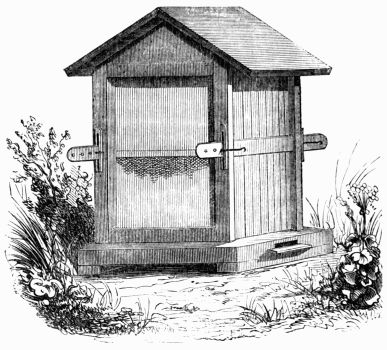
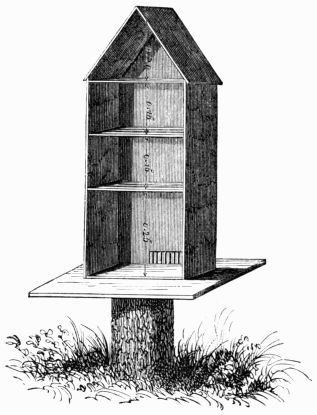
It was not formerly so easy to observe the details of the work done by the bees as it is at the present day; for these insects, once in their hives, have a great aversion to the light. If they are put into a glazed hive, their first care is to shut up all the windows, either by plastering them over with propolis, or by forming, by means of the well-marshalled battalion of working bees, a sort of living curtain. In order to be able to take them unawares, and study them at his own convenience, Huber constructed a hive with leaves, which opened like a book. Fig. 314, which represents the hive with leaves, which is sometimes used, gives an idea of the plan adopted by Huber in order to enable him at will to open the hive and surprise its inmates. Huber had also recourse in certain cases to a glass cage placed in the interior of the hive, and which he could easily move to the light.
Fig. 314.—Bee-hive in Leaves.
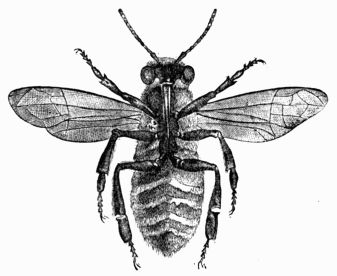
Thanks to his ingenuity, Huber was able to follow the working bees in all the various phases of their labours. When they begin to construct their hives they divide the work among themselves. A first detachment is employed to gather the wax, which is the building stone of our little architects. It was thought for a long time that wax was solely the pollen of flowers, elaborated in the stomach of bees, and then disgorged by the mouth. It was reserved for a peasant of Lusac to be the first to discover the true nature of this secretion. This observer, who did not belong to any school, or at most belonged to Nature's school, found the flakes of wax sticking between the lower arches of the rings of the abdomen or belly of the working bee. The wax, then, is produced by the insect by exudation, and is not simply the pollen gathered from flowers. Huber himself states that bees exclusively nourished on pollen do not secrete wax, and that, on the contrary, they do furnish it when they eat saccharine matter. It is easy to perceive the little plates of wax by slightly raising the last rings of the bee's abdomen. Fig. 315 represents a bee very heavily laden with this matter.
Fig. 315.—Bee seen through a magnifying glass at the moment when the plates of wax appear between the segments of the abdomen.
The working bees suspend themselves from the roof of the hive in such a manner as to form festoons. The first clings to the roof with his front legs, the second hooks himself on to the hind legs of the first, and so on, as is shown in Fig. 316. They in this manner form chains, fixed by the two ends to the roof, which serve as a bridge or ladder to the bees which join this assembly.
Fig. 316.—Clusters of Bees.
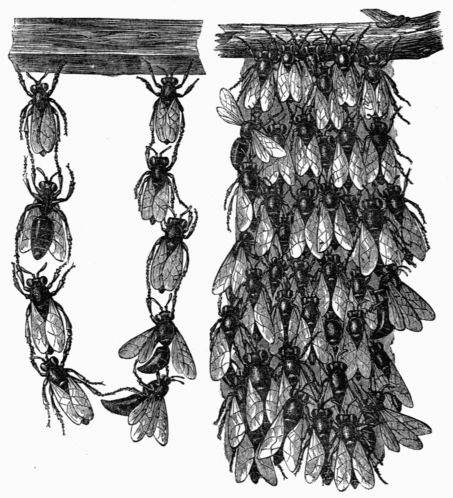
The result of all this is at last a cluster or swarm of bees which hangs down to the bottom of the hive. In this attitude they remain at first motionless, waiting till the honey in their stomachs is changed into wax. When the wax is sufficiently elaborated in its organs, one of them detaches itself from the group of which it forms a part. It takes between its legs one of the flakes of wax adhering to the rings of its abdomen, kneads it with its mandibles, moistens it with its saliva, and gives it the appearance of a soft filament, which it sticks on to a projecting point of the roof. To this first layer it adds others, till it has exhausted all its wax. Then it leaves its post, and returns to the fields; another worker—another mason, as they are sometimes called—succeeds it, and continues the laying of the foundations. Presently shapeless blocks of wax hang down from the roof. It is in these blocks that other workers, with their mandibles, hollow out and form the first cells. While the workers continue to prolong the foundation-wall, and whilst the first cells are being shaped, new ones are roughly sketched out or rough-hewn, and the work advances with a marvellous rapidity.
Each cell forms a small hexagonal cup, closed on one side only by a pyramidal base, produced by the meeting together of three rhombs. The honeycombs are the result of two layers of cells placed back to back, arranged in such a way that the bases of the one become the bases of the other, the base of each little cell being formed by the union of the bases of three opposite cells. The bees begin by forming the base of the cell; they then add the six sides, or walls, which are to complete the hexagonal cup. At the same time others set to work on the opposite side of the comb, and construct little cells back to back with the cells of the front surface. They do not finish them off at once. The walls are at first very thick: new workers, who succeed those who merely mark out the work, being occupied in planing down the rough-hewn cells, and in reducing the walls to the desired thickness. This work is accomplished with an incredible celerity, for the bees can build as many as 4,000 cells in twenty-four hours. There is very good reason for the hexagonal form being adopted by the bees in constructing their cells, as it involves a question of economy, which these insects have solved in their most admirable manner.
Fig. 317.—Cells constructed by Bees.
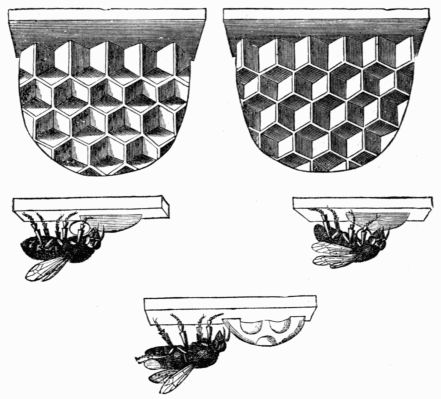
"When one has well examined," says Réaumur, [84] "the true shape of each cell, when one has studied their arrangement, geometry seems to have guided the design for the whole work, and to have presided over its execution. One finds that all the advantages which could have been desired are here combined. The bees seem to have had to solve a problem containing conditions which would have made the solution appear to be difficult to many geometricians. This problem may be thus enunciated:—Given a quantity of matter, say of wax, it is required to form cells which shall be equal and similar to each other, of a determined capacity, but as large as possible in proportion to the quantity of matter which is employed, and the cells to be so placed that they may occupy the least possible space in the hive. To satisfy this last condition, the cells should touch each other in such a manner that there may remain no angular space between them, no gap to fill up. The bees have satisfied these conditions, and at the same time they have satisfied the first conditions of the problem in making cells which are tubes having six equal sides, or in other words, hexagonal tubes.... We see still further that the best thing the bees could do to economise their space and materials, was to compose their honeycombs of two rows of cells turned in opposite directions."
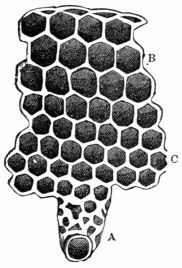
Fig. 318.—The cells of a Bee-hive. A, large cell intended for the larvæ of the queens. B, middling-sized cells intended for the larvæ of the males. C, small cells intended for the larvæ of the workers.
This arrangement, it will be seen, enables them to economise the half of the wax intended for making the bases of the cells. They economise it still more by making the bases and the sides of the tubes extremely thin; the borders only of the comb being fortified by an excess of wax. These two-sided combs descend from the roof of the hive in parallel series, their thickness being about half an inch. They are fixed to the top by a sort of wax foot, and fastened to the sides by numerous bands. The bees pass between the rows, besides excavating circular openings, which serve as doors of communication. The form and the general arrangement of these buildings are otherwise very varied, according to circumstances. The bees always accommodate themselves to the nature of the hive.
In all these operations they exhibit great judgment. It is impossible, when one has once seen them at work, to look on them as mere organised machines, whose instinct is their spring of action; we are forced to concede to them intelligence.
The cells are of three dimensions: the small ones intended for the larvæ of the workers, the middling-sized ones for the larvæ of the males, and the large ones for the larvæ of the queens.
These last—that is, the royal cells—are generally only about twenty in number, in a hive containing 20,000 bees. Constructed of a mixture of wax and of propolis, resembling a rounded thimble, they form tubes of half an inch long, turned towards the exterior, and placed always vertically, in such a manner as to appear detached from the comb.
The weight of a royal cell is equivalent to that of a hundred other cells. The bees spare nothing to make it comfortable and spacious. "It is quite a Louvre," says Réaumur.
But independently of their use as cradles, these cells serve as storehouses for honey.
A few of these are used in turn for both these purposes, but a great number are reserved exclusively for stores of honey and pollen. This is brought, as we have already said, in the form of pellets, in the baskets which the hind legs form. The working bee, when it has gathered it, pushes it into the cell, pressing it with its hind-legs. Another then arrives, and kneads up the mass to make it adhesive. The bee brings the honey in its first stomach, and disgorges it into one of the cells where it is to be kept. However, it is not always by carrying its honey into a cell that the worker is relieved of it, often finding an opportunity to deliver it on the way.
Fig. 319.—Interior of a Hive.
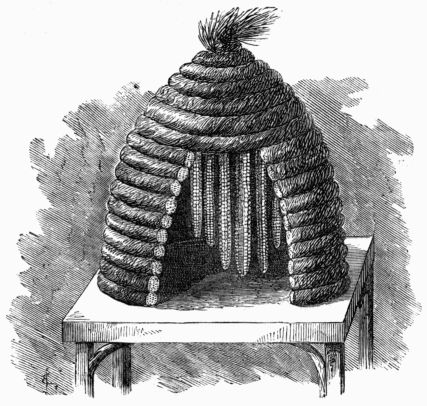
"When it meets," says Réaumur, [85] "any of its companions who want food, and who have not had time to go and get any, it stops, erects and stretches out its trunk, so that the opening by which the honey may be taken out is a little way beyond the mandibles. It pushes the honey towards this opening. The other bees, who know well enough that it is from there they must take it, introduce the end of their trunks and suck it up. The bee which has not been stopped on its road, often goes to the places where other bees are working, that is, to those places where other bees are occupied, either in constructing new cells, or in polishing or bordering the cells already built; it offers them honey, as if to prevent them from being under the necessity of leaving their work to go and get it themselves."
The honey which fills the store cells is intended for daily consumption, and also intended as a reserve for the period when the flowers furnish no more. The empty cells are left open, the workers making use of them when they want them, particularly during rainy days, which keep them at home. But the cells which contain the honey put by in reserve are closed. "They are," says Réaumur, "like so many pots of jam or jelly, each one of which has its covering, and a very solid covering it is too." This covering, composed of wax, hermetically seals the pots containing this reserve of honey. The object of this is to keep the honey in a certain state of liquidity, by preventing the evaporation of the water it contains. It is a remarkable fact that it does not run out of the cells which are open, although their position is almost always horizontal. This is because there are always in the sides of these narrow tubes points enough to keep it in, and that besides this the last layer of honey is always of greater consistency than the liquid in the interior, and upon which it forms a sort of crust.
When the harvest has been abundant, many combs of closed cells may be found in each hive, perfect storehouses of abundance, furnished for the wants of the bad season. When the construction of the cells goes on well—often on the day after the bees have installed themselves in their hive—the queen goes out to meet the males. At the hour when these are accustomed to disport themselves in the sun, that is to say, from noon till five o'clock, she leaves the hive, whirls about for a few seconds, and disappears into the air. At the end of half an hour she returns, pregnant.
When the female returns to the hive, she is the object of every attention, the workers pressing round her, and forming quite a train. Many approach her, and lick the surface of her body; others brush her, caress her, and present her their trunks full of honey. Forty-eight hours after her return to the hive the mother bee generally begins laying.[86] Running over the honeycomb, she deposits an egg in each empty cell, and fixes it to the bottom by means of a glutinous secretion, in such a way that the egg is suspended in the interior of the cell. They have the appearance of little oblong bodies, of a bluish white. If the queen, in a hurry to lay, lets more than one egg fall into the same cell, the workers who accompany her hasten to carry out and destroy those that are in excess. This is often the case when the combs have not enough cells to contain all the eggs laid. We have said that the queen only lays worker eggs at this time; the others are laid later. She continues to lay until the cold weather approaches, when she ceases to do so, and does not resume her occupation until the return of spring. This laying is very abundant. The queen produces at least two hundred eggs a day; so that in the space of two months she lays more than twelve thousand. Towards the eleventh month of her existence in the perfect state, the queen begins laying the eggs which will produce males, their number varying from 1,500 to 3,000; the deposition of these eggs occupies about a month.
Towards the twentieth day, the workers lay the foundations of some royal cells. When these cells have attained a certain length, the queen deposits an egg in each, allowing, however, one or two days to intervene between the laying of these privileged eggs, so that the young queens to whom they are to give birth should not be hatched all at the same time, which would cause difficulties and even wars concerning the right of their succession to the throne. This complication human governments have not been always able to avoid, as history shows; but the bees have found out a way of doing so.
The distribution of the eggs in the cells is not left to chance. Each egg, according to the sex to which it belongs, is deposited in the cell which awaits it. The eggs of the females do not, however, differ in any way from those of the workers. The difference in their development depends entirely on the space and food allowed them.
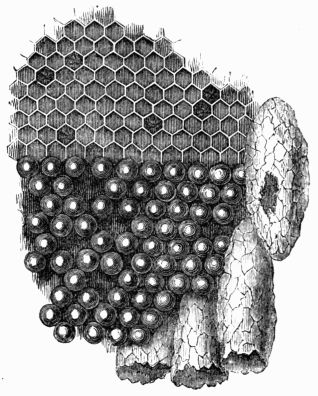
We represent (Fig. 320) a portion of a comb containing the eggs placed in the cells, as also the royal cells. The regular order of laying is such as we have just described, but the result is quite different when the impregnation of the queen has been retarded by an accidental captivity of two or three weeks. The longer this delay, the greater will be the number of male eggs. If the queen is shut up for more than twenty days after her birth, she can then lay nothing but male eggs during the remainder of her existence. It seems, also, that this delay troubles her intellect; for she then often makes blunders as to the cells. She lays the eggs of the males, or drones, in the cradles prepared for the queens, and thus brings confusion into the future community.
The eggs, once laid, are left to the care of the working bees, which Réaumur called the nurses, in opposition to the wax-workers, which are employed in works of construction. According to many bee-keepers, and especially M. Hamet, [87] this division of duties is not positive. The young workers are the wax-workers; the old ones, collectors of honey, and nurses. However, when the honey-harvest is at its height, all the workers collect the spoil. Every individual is pressed into the service at the harvest time, as with men.
Fig. 320.—Portion of the comb, with the eggs occupying the cells. One of the royal cells has been opened by the queen.
The eggs are not long in being hatched. From the moment when the larva comes out of the egg till that of its metamorphosis into a pupa, it keeps in its cell, rolled up, motionless as an Indian idol in its sacred temple. The working bees visit it from time to time, to see that it wants for nothing, and to renew its provisions. They also carefully inspect the different cells, and assure themselves of the good condition of their nurslings. The pap which they give them as food is whitish, and resembles paste made of flour. It is apparently a preparation of pollen, prepared in the body of the insect. As the larvæ increase in size, their food is made to acquire a more decided taste of honey, and to become even slightly acid. It seems, then, that the bees know how to graduate the food of their larvæ in such a manner as to bring it nearer by degrees to honey.
Fig. 321. Larva of the Bee (magnified).

In the space of five days the larvæ are developed; they have absorbed all their pap, and have no need from that time of any nourishment, for they are about now to change into pupæ. Now the nurses pay them a last attention. They wall them up in their cells, closing the openings with a waxen covering. The larvæ then get close to the wax covering. In thirty-six hours they have spun for themselves a silky cocoon, in which they undergo their transformation into pupæ. The moult, which precedes their metamorphosis, constitutes a crisis, as with the caterpillars of Lepidoptera.
The perfect insect is hatched seven or eight days after its transformation into a pupa, the organs being developed little by little, and the young bee is then ready to appear in the broad daylight. It breaks through the thin transparent covering in which it is still swathed; then, with its mandibles, it pierces the operculum, or door of its prison, and opens a way for itself by which it can issue forth. With the assistance of its front legs it clings to the rim of the cell, and draws itself forward, till it has set free the whole of its body. The other bees lavish upon this newly-arrived little stranger all possible attention, to make its entrance into the world easy and agreeable; assisting and supporting it till it has become quite strong. It very soon becomes strong. If it is a working bee, it is not long in getting to work and in mixing with its companions in labour.
This is the way in which the hatching of ordinary bees takes place, workers and males; the first, twenty days after they are laid; the second, twenty-four days after. The rearing and birth of the young queens is slightly different. In proportion as the larvæ increase in size do the workers enlarge the cells which contain them; and then again gradually diminish their size as the moment of their last metamorphosis approaches. A special and peculiar food is given to the larvæ of the queens; it is quite different from that which is given to the larvæ of the working bees, being a heavier and sweeter substance. This special food seems to exercise such an energetic influence on the development of the ovaries, that simple workers which have accidentally received any of it, during their larval state, become pregnant and lay a few eggs. But this anomalous development remains imperfect, because the prolific food was only administered in a small quantity. Besides which, the size of the cells is of great importance to the development of the larvæ imprisoned in them; and so the larvæ of working bees, having lived in the small cells, can never attain the proportions of the queen, nor acquire her fecundity. But all this is changed if these larvæ are moved into the large cells and fed on this royal pabulum; they then become veritable queens. If, with us, the coat does not make the man nor the frock the monk, it is certain that with the bees the cradle helps materially to make the queen.
When the queen through some accident or other has perished, the plebeian population of the hive very quickly perceive the misfortune, and without losing time in useless regrets, apply themselves to repair their loss. They choose the larva of a working bee, less than three days old, on which they bestow the treatment suited to change it into a female. The workers enlarge the cell of this grub by demolishing the surrounding cells, and administer to it a strong dose of royal food, to effect its transformation. This marvellous metamorphosis is accomplished like those which one reads of in fairy tales, where so many poor beggars are changed, by a wave of the hand, into beautiful princesses, covered with gold and precious stones. Only here the fairy tale is a true story; the poet's dream is a real phenomenon. According to Francis Huber, the larva intended to produce a female has to change its position. The workers add then to its domicile a sort of vertical tube, into which they push and turn round the young grub which is the hope of the community. For twelve days a bee, a sort of body-guard, has special charge of the person of our infant. It offers it food, and pays it many other delicate little attentions. When the moment for the metamorphosis has come, the orifice of the tube is closed, and the bees await the hatching of the new queen. Thus the loss of the queen is speedily replaced. The larvæ of the queens, when they are shut up in their cells, have the head downwards, whilst the larvæ of the males have the head upwards. Their hatching takes place thirteen days after the laying of the eggs.
As soon as they have quitted their cradles, the young queens are ready to take flight. The others, workers and males, are less strongly organised. Before they are able to take a part in the sports and labours of the old ones they require a rest of twenty-four hours, during which the nurses lick them, brush them, and offer them honey. But the young workers require to undergo no apprenticeship before they do the work which devolves upon them. They go straight to their work, and suppress all apprenticeship. Nature is their guide and counsellor.
When the hatching has begun, each day adds some hundreds of young bees to the population of the hive, which is not long in becoming too small for the number of its inhabitants. It is then that those curious emigrations of this winged people take place which are called swarms. The queen leaves the hive, with a part of her subjects, and founds a new colony elsewhere. In the climate of France the bees generally swarm in the months of May and June. In the south very thickly populated hives may furnish as many as four swarms in a season, but in the north rarely more than one or two. But in some years swarming does not take place at all, for the want of a sufficient population. In such cases the workers do not construct royal cells at the period when the eggs of the males are laid, and the swarming is put off till the following spring. It occasionally happens that a hive, although full of bees, cannot make up its mind to send out a swarm, and also that the hives thinly populated send out abundant swarms. There are, then, other causes than the excess of population which exercise an influence on this annual crisis in the life of bees. The first swarm is always led by the old queen; if other swarms succeed, it is the young females lately hatched who lead the way.
There are many signs which announce that a swarm is going to take place. The appearance of the males, or drones, is one of the first signs. Another sign, but far from being infallible, is the excess of the population in the common home. The bees seem then to find themselves so ill at ease in their over-crowded hive, that part of them go out and keep outside, either on the stand upon which the hive is placed, or upon the hive itself. Crowds of bees may be seen heaped up on each other outside, only waiting for the signal of departure. But the least equivocal of all the signs, that which points out the event for the very day, says Réaumur, is when the bees of a hive do not go into the country in as great a number as usual, although the weather may be favourable and seem to invite them to do so. "There is no sign," says Réaumur, "which points out so surely that a swarm is preparing to take flight, as when, in the morning, at those hours when the sun shines, and when the weather is favourable for work, the bees go out in a small number from a hive from which they went out in great quantities on the preceding days, and bring back only a little rough wax. The fact of their acting in this manner seems to force us to concede to bees more intelligence and foresight than many people are inclined to allow that they possess; at any rate, it is exceedingly puzzling to those who wish to explain all their actions by saying that they are purely mechanical. Does it not seem proved that from the morning all the inhabitants of a hive have been informed of the project which will be executed not before noon, or, perhaps, not for some hours after it?... There is a well-known story of an old grenadier, who, being comfortably asleep while his comrades were pitching their tents, answered to his general, M. de Turenne, when questioned on the subject, 'that he knew very well that the army would not remain long in the camp they were pitching.'
"All our bees, or nearly all, seemed to have foreseen the move that their queen was about to make, as that old soldier had foreseen the general's order to his army." [88]
In a hive which is going to "cast," as it is called in technical phraseology, there is often heard, in the evening, and even during the night, a peculiar humming. All seems to be in agitation. Sometimes, to hear the noise, it will be necessary to bring your ear close to the hive; you then will hear nothing but clear and sharp sounds, which seem to be produced by the flapping of the wings of one single bee. "Those who know better than I do the language of bees," says Réaumur, "have told marvels of these sounds. They pretend that it is the new queen that makes this noise; that she is, perhaps, haranguing the troops she wishes to go with her; or that, with a kind of trumpet, she animates them to undertake the great adventure. Charles Butler, the author of 'Female Monarchy,' attributes to this noise quite another signification. He says that it seems as if the bee which aspires to become queen supplicates the queen-mother, by lamentations and groans, to grant it permission to lead a colony out from the hive; that the queen does not yield sometimes to these touching prayers for two days; that when she does acquiesce, she answers the suppliant in a fuller and stronger voice; and that when you have heard the mother-bee grant this permission, you may hope next day to have a swarm.... Butler has determined all the modulations of the chant of the suppliant bee, the different keys to which they are set, as also those of the chants of the queen-mother. He pretends that it is not allowed to those who wish to raise themselves to a superior rank to imitate the chants of the sovereign; woe betide the young female if she should dare to do so! it would only be in a spirit of revolt, and she would be immediately punished by the loss of her head. The old-established queen does more than that: at the same moment she condemns to death those bees which had been seduced." [89] The true cause of this unusual noise is the agitation of the wings of a great number of the bees in the middle of the hive.
It has been remarked, that when about to swarm the bees seem as if mad. They lose their senses; the queen setting them the example. Francis Huber has made the most curious remarks on this subject. Here is, according to this immortal observer, what goes on in the hive when an emigration is about to take place:—The queen, being angry at the noise which the young females ready to be hatched are making in their cells, runs about the hive, examines the cells, and endeavours to destroy those which contain the females; but she meets with a very firm resistance from the workers, who take upon themselves to protect them. She endeavours here and there to lay an egg, but generally retires without having done so. She runs, stops short, sets off again, walks over the bodies of the workers she meets; sometimes, when she stops, the bees near her stop also, as if to look at her. They advance briskly towards her, strike her with their heads, and mount on her back. She then dashes off, carrying with her some of the workers. Not one of them offers her honey; she takes it herself from the open cells, which are for the use of the whole hive. They no longer draw up in line on each side of her as she moves along, her guard of honour no longer surrounds her; she seems fallen from her high rank.
However, the first bees which were disturbed by her now follow, running like herself, and spread alarm in their turn among the rest of the population. The road which the queen has traversed is to be recognised by the excitement which she has caused on her passage, and which cannot now be calmed. Very soon she has visited every corner of the hive, so that the fever has become general. She now no longer lays her eggs in the cells, but lets them fall anywhere at random. She seems to have lost her wits.
The nurses in their turn are attacked with the contagion. They pay no attention now to their charges. Those which return from the country have no sooner entered the hive than they take part in these tumultuous movements, and give themselves up to the general excitement. Not even thinking of depositing the pellets of pollen which they carry on their legs, they run about apparently without aim. The delirium takes possession of the whole republic. The end of all this is a general sortie. The whole hive, with the queen at its head, precipitates itself towards the door, and issues forth to create a swarm. Once in the fresh air, they become quiet; their madness subsides, and they fix themselves to a branch of a tree, and having been captured, set to work again as usual. Francis Huber often remarked that, in a swarm which had started, if the queen, who directed the flight, were seized and killed, immediately all the bees would return to the hive. It would seem that, having lost their chief, they acknowledged themselves incapable of forming a colony.
A swarm never comes out except on a fine day, or, to speak more accurately, at an hour of the day when the sun is shining, when the air is calm, and the sky clear. It is generally between ten o'clock in the morning and three o'clock in the afternoon. "We observed," says Francis Huber, "in a hive all the signs which are the fore-runners of a cast for a swarm—disorder and agitation—but a cloud passed before the sun, and quiet was restored to the hive; the bees thought no more of swarming. An hour after, the sun having shown itself again, the tumult recommenced, increased very rapidly, and the swarm set out on its journey." [90]
At the moment which precedes their exit, the buzzing increases in the hive. Some of the workers go out first, as if to ascertain the state of the atmosphere. The moment the queen has passed the threshold, the emigrants follow in a cloud behind her; in an instant the air is darkened with bees, which crowd together and form a thick cloud. The swarm rises, whirling round about in the air; it poises itself for a few minutes over the hive, to allow time to reconnoitre, and for the laggards to join, and then goes off at full speed.
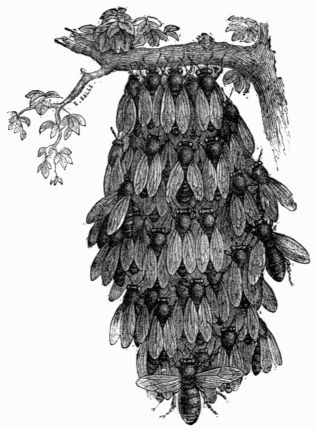
The queen does not make choice of the place where the company shall find shelter. When a branch of a tree has been selected by a certain number, they fix themselves on it. Many others follow them. When a great many have collected, the queen joins the throng, and brings in her train the rest of the troop. The group already formed becomes larger and larger every instant. Those which are still scattered about in the air hasten to join the majority, and very soon all together compose one solid mass or clump of bees clinging to each other by their legs. This cluster (Fig. 322) is sometimes spherical, sometimes pyramidal, and occasionally attains a weight of nine pounds, and may contain as many as 40,000 bees. From this moment, although they are uncovered, they remain still. In a quarter of an hour everything becomes quiet, and the bees cease to hover about the cluster more than round an ordinary hive. Now is the moment to take possession of the swarm in a hive prepared beforehand to receive it. If delayed too long, the troop flies off, and establishes itself in some natural cavity, as the hollow of a tree, &c. The bees then return to their wild state.
Under a warm climate, where flowers abound, the hives may cast several times in succession. The first swarm, however, is always the best. It is more numerous, and has before it more time to provision itself. If the weather remains favourable, it is not rare to see it send out a swarm itself three weeks after leaving the old hive. The old queen then leads the emigration of the second swarm, abandoning the colony she had lately founded. If the original hive sends forth several swarms, the interval between the first and the second is from seven to ten days; the third and the fourth follow at shorter intervals. But these late casts have rarely vitality enough to exist long.
Fig. 322.—Cluster of Bees hanging to a branch.
A swarm never returns to a hive it has once left. It is surprising then that a hive can furnish a second swarm after the interval of a few days, without being too much weakened. But the old queen, in quitting her domain, leaves behind her a considerable quantity of brood. These larvæ are not long in re-peopling the hive, so as to furnish a second swarm. The third and the fourth casts weaken the population more perceptibly; but there remain still enough workers to continue operations. In some cases the agitation of the cast is so great as to cause all the bees to quit the hive together, leaving it deserted; but this desertion only lasts an instant, one part of the swarm wisely returning to their home.
All those which start away become members of the new colony. When the general delirium we have spoken of has taken possession of them, they precipitate themselves together, they pile themselves up all at the same time by the door of the hive, and get so hot as to perspire freely. Those which are in the midst of the mêlée bear the weight of the whole crowd, and seem bathed in sweat. Their wings become damp, and they are no longer able to fly, and even if they manage to escape, they get no further than the stand, and are not long in re-entering the hive, instead of following the main body of the emigrants. We must not forget that a part of the population is always out at those hours of the day when the swarms take place, engaged in collecting provisions; and having collected the spoil, these workers return to the hive abandoned by the greater part of their companions, and betake themselves to their usual occupations, as if nothing had happened. They form the nucleus of the new population, which is soon enlarged by the hatching of the pupæ. We have already said that the first swarm is always led by the old queen or mother, and that it starts before the hatching of the young females. If she had not gone out before their birth she would have destroyed them, and the new hive would have been unable to re-organise itself for the want of a chief.
The first swarm having set out, those bees which remain in the hive pay particular attention to the royal cells. If the young queens make efforts to escape from them, their guardians watch them narrowly, and as the prisoners destroy their covers of wax the guards restore them; but as they do not desire the death of the inmates, they pass in some honey through the opening before they close it, so as to ameliorate their captivity. At the appointed moment, the issue of the first egg laid quits her cradle. Very soon she yields to the murderous instinct which impels her to destroy her rivals, so that she may reign with individual sway over the community. She searches for the cells in which these are shut up, but the moment she approaches them the workers pinch her, pull her about, drive her away, and oblige her to move on, and, as the royal cells are numerous, she finds with difficulty any corner in her hive where she may be at rest. Incessantly tormented by the desire of attacking the other females, and incessantly driven back by the guard, she becomes very much excited, passes through the different groups of workers at a run, and communicates to them her agitation. She leads the inmates of the hive the same sort of dance frequently in the course of the day.
Sometimes the young queen at the end of her attempts utters a shrill song, analogous to that of the grasshopper. This song, so unusual among these insects, has the effect of petrifying the bees. So says Francis Huber, speaking of a queen which had just been hatched, and which was trying in vain to satisfy her jealous instincts. "She sang," says he, "twice. When we saw her producing this sound, she was motionless, her thorax rested against the honeycomb, her wings being crossed on her back, and she moved them about without un-crossing them, and without opening them. Whatever cause it was that made her choose this attitude, the bees seemed affected by it, all of them now lowered their heads and remained motionless. Next day the hive presented the same appearances, there remained still twenty-three royal cells, which were all assiduously guarded by a great number of bees. The moment the queen approached these, all the guards were in a state of agitation, surrounded her, bit her, hustled her in every way, and generally finished by driving her off; sometimes when this happened she sang, resuming the attitude which I just now described; from that moment the bees became motionless." [91] But the fever which had seized on the young queen ended by communicating itself to her subjects, and, at a particular moment, a new swarm set out under her guidance.
When the emigration is effected, the workers which had remained at home set free another female. This one acts in the same way as the first. She tries to get at her rivals still imprisoned, and whom she can smell in their cradles; but the guards repel her with vigour, and defeat all her attempts, till she makes up her mind to emigrate with a new swarm. This curious scene is repeated, with the same circumstances, three or four times in the space of a fortnight, if the weather is favourable, and the hive well peopled. In the end, the number of bees is so much reduced, that they can no longer keep such vigilant guard round the royal cells, and it then happens that two females come out together from their cradles. Immediately the two rivals look for each other, and fight, and the queen that comes victorious out of this duel to the death reigns peaceably over the people she has won for herself. If, in the tumult which precedes the swarming, a female escapes from her prison, it may happen that she is carried away in the swarm. In this case the deserters divide into two separate bands, but the weakest in numbers are not long in breaking up, the deserters going to swell the principal swarm. At last all the troop is reunited, and it then contains two queens. As long as the swarm remains fixed on its branch, all passes quietly, in spite of the presence of a second queen. But as soon as it has become domiciled, the affair becomes serious; a duel to the death takes place between the two aspirants to the command. Two queens cannot exist in the same hive. One of them is de trop and must be got rid of.
Francis Huber was the first to describe these duels between the queens. We quote an interesting account which he has left us of a combat which he watched on the 12th of May, 1790:—"Two young queens," says he, "came out on that day from the cells almost at the same moment, in one of our smallest hives. As soon as they saw each other they dashed one against the other with every appearance of the greatest rage, and put themselves in such a position that each one had its antennæ seized between the teeth of its rival; the head, the thorax, and abdomen of the one were opposite to the head, the thorax, and abdomen of the other; they had only to bend round the posterior extremity of their bodies, and they would reciprocally have stabbed each other with their darts, and both engaged in the combat would have been killed. But it seems as if Nature would not allow this duel to end by the death of both of the combatants. One would say that she had ordained that those queens, finding themselves in this position (that is to say, face to face and abdomen to abdomen), should retreat that very instant with the greatest precipitation. And so, as soon as the two rivals felt that their posterior parts were about to meet, they left go of each other, and each one ran away in an opposite direction.... A few minutes after they had separated from each other their fear ceased, and they recommenced looking for each other. Very soon they perceived the object of their search, and we saw them running one against the other. They seized each other, as at the first, and put themselves in exactly the same position. The result was the same; as soon as their abdomens approached each other they only thought of getting free, and ran away. The working bees were very much agitated during the whole of this time, and their tumult seemed to increase when the two adversaries separated from each other. We saw them on two different occasions stop the queens in their flight, seize them by the legs, and keep them prisoners for more than a minute. At last, in a third attack, the queen which was the most infuriated or the strongest, rushed upon her rival at a moment when she did not see her coming; seized her with her jaws by the base of her wing, then mounted on to her body, and brought the extremity of her abdomen over the last rings of her enemy, whom she was then able to pierce with her sting very easily. She then let go the wing which she held between her teeth, and drew back her dart. The vanquished queen dragged herself heavily along, lost her strength, and expired soon afterwards." [92]
These singular combats take place between young maiden queens. Francis Huber, by introducing into a hive some queens from other hives convinced himself that the same animosity impels the females which are pregnant to fight with and destroy each other. From the moment when the young queen to whom the sovereignty has fallen is pregnant, she is anxious to destroy all the royal pupæ which still exist in the hive, and which are then given up to her without resistance by the workers.
Οὑκ ἁγαθὁν πολνκοιρανἱη. ἑις κοιοανος ἑστω, Εἱς βασιλεὑς…. [93]
Become a mother, the female attacks one after the other the cells which still contain females. She may be seen to throw herself with fury on the first cell she comes to. She makes an opening in it with her mandibles large enough to allow her to introduce her abdomen, and then turns herself about till she has succeeded in giving a stab with her sting to the female which it contains. She then withdraws, highly satisfied with what she has done. The working bees, who up to this moment have remained indifferent spectators of her efforts, take upon themselves the rest of the business. They set to work to enlarge the hole made by the ruling queen, and to draw out the carcase of the victim.
In the meanwhile, the fierce and jealous sovereign throws herself on another cell, and breaks into it with violence. If she does not find in it a perfect insect, but only a pupa, she does not condescend to make use of her royal weapon. The workers take on themselves to empty the cell and destroy its contents. These executions over, the queen can for the future occupy herself in laying, without having anything to fear from rivals. Let us remark, in passing, that man is not much behind these insects whose savage exploits in cruelty we have just related. Among certain tribes of Ethiopians the first care of the newly-crowned chief is to put in prison all his brothers, so as to prevent wars by pretenders to the throne. Delivered from all dread of rivals, our queen sets to work with an indefatigable zeal; and the workers, animated by the hope of a numerous progeny, heap up provisions around them.
But now a new tragedy is about to be enacted. The drones, that is to say, the males, are now no longer wanted in the colony: their mission is over. By an inexorable law of Nature they must be got rid of, and the working bees proceed to make general massacre of them. It is in the months of July and August that this frightful carnage takes place. The workers may be seen furiously giving chase to the males, and pursuing them to the extremity of the hive, where these unfortunate insects seek a place of safety. Three or four workers dash off in the pursuit after a male. They seize hold of him, pull him by his legs, by his wings, by his antennæ, and kill him with their stings. This pitiless massacre includes even the larvæ and pupæ of the males. The executioners drag them from their cells, run them through with their stings, greedily suck the liquids contained in their bodies, and then cast their remains to the winds. This slaughter goes on for many days, continuing till the males have been completely got rid of, they not being able to defend themselves, as they have no stings.
They are allowed to live, however, when they are fortunate enough to inhabit a hive deprived of its queen. There they even find a place of perfect safety when they have been driven out of another hive, and may be met with in this refuge until the month of January. In like manner the lives of the males are spared in those hives which, instead of a true queen, have only a female half impregnated, which lays only male eggs; but a hive of this kind, whose active population cannot be increased, ends by being abandoned by its inhabitants. The sterility or absence of the queen entails the dissolution of the society. She is, in fact, the life and soul of the hive; and without her there is no hope, no courage, no activity. The populace, abandoned to itself, falls into anarchy. Famine, pillage, ruin, and death are at its doors. Having no progeny to set their hopes on, the bees live from one day to another without a care for the morrow. They leave off working, and live entirely on theft and rapine, and at last they disappear entirely. It is a society become rotten and broken up for the want of a moral tie.
If the loss of the mother bee takes place at a period at which there still exist in the hive some larvæ of working bees of less than three days old, the nurse (as we have already said) adopt some of these larvæ, and make them into queens by means of the physical education and special nourishment which they give them. In this case, then, the evil can be repaired; the workers themselves find a remedy without assistance. But if the hive possesses a degenerate queen, which only lays male eggs, the intervention of man is necessary to save it, by the substitution of a properly impregnated queen. If, indeed, a strange queen wished to penetrate alone into a hive already containing a sovereign, she would infallibly be stopped at the door and stifled by the sentinels who guard the entrance to the hive. These would surround her immediately, and keep her captive under them till she perished, either through suffocation or hunger. They do not employ their stings against an intruding queen, except in the case of an attempt being made to deliver her from their clutches: they get rid of her by stifling.
When it is wished to introduce into a hive a stranger queen, after having removed the original sovereign, many precautions must be used before putting her into the common home. It is only after some time that the bees become aware of the disappearance of their queen; but they then manifest great emotion. They run hither and thither, as though mad, leaving off their work, and making a peculiar buzzing sound. If you return to them their original sovereign, they recognise her, and calm is immediately restored; but the substitution of a new queen for the original sovereign does not produce the same effect in every case. If you introduce the new queen half a day only after the removal of the old queen, she is very badly received, and is at once surrounded, the workers trying to suffocate her. Generally she sinks under this bad treatment. But if you allow a longer interval to elapse before you introduce the substitute, the bees, rendered more tractable by the delay, are better disposed towards her. If you allow an interregnum of twenty-four hours, the stranger queen is always received with the honours due to her rank, a general buzzing announcing the event to the whole population of the hive. They assign to their adopted queen a train of picked attendants; they draw up in line on her passing by; they caress her with the tips of their antennæ; they offer her honey. A little joyful fluttering of the escort announces that every one in the little republic is satisfied. The labours out of doors and indoors then begin anew with more activity than ever.
It is principally during stormy days, when the heat and the electricity in the air are favourable to the secretion of pollen in plants, that the bees go into the fields to make their harvest. They heap up provisions in the hive against the cold season, not forgetting, however, to watch over the eggs, their future hope, "spem gentis," as Virgil calls them.
These peaceful occupations are sometimes interrupted by the dire necessities of war. It happens that the bees of an impoverished hive, impelled by hunger, that bad counsellor, make up their mind to attack and to pillage the treasures of a neighbouring hive which is abundantly stocked with provisions. A savage fight then takes place between the two battalions. Each one precipitates itself with fury upon its adversary. Two bees press against and bite each other till one is overcome. The victor springs upon the back of the vanquished, squeezes it round the neck with its mandibles, and pierces it between the rings of its abdomen with its sting. The victorious bee places itself by the side of its fallen enemy, and resting on four of its legs, rubs its two hind ones together proudly, as a sign of supreme triumph. Réaumur relates a strange fact, which he says he often observed, and which proves that the insects we are treating of do not fight to satisfy a sanguinary and savage instinct, but (which is less reprehensible) to satisfy their hunger. Bees attacked by a superior force are in no danger of losing their lives if their enemies can induce them to give up their throats—that expression conveys the idea. Supposing three or four are furiously attacking one bee: they are pulling it by its legs and biting it on its thorax. The unfortunate object of this attack has then nothing better to do, to escape alive from such a perilous situation, than to stretch out its trunk laden with sweet-scented honey. The plunderers will come one after the other and drink the honey; then, cloyed, satisfied, having nothing more to demand, they go their way, leaving the bee to return to his dwelling-place.
There are also strange fights—regular duels—between the bees of the same hive. Very hot weather has the effect of irritating them, and making them boil over with rage. They are then dangerous to man, whom they attack boldly. But more often it is amongst themselves that they quarrel. One often sees two bees which meet seize each other by the neck in the air. It happens also that a bee, in a state of fury, throws itself on another who is walking quietly and unsuspiciously along the edge of its hive. When two bees are struggling in this manner they descend to the ground, for in the air they would not be able to get purchase enough to be sure of striking each other. They then engage in a hand-to-hand fight, as the gladiators used formerly to do in the circus. They are continually making stabs with their stings, but almost always the point slips over the scales with which they are covered. The combat is sometimes prolonged during an hour, before one of them has found the weak point in the other's natural cuirass, and has buried its terrible weapon in the flesh. The victor often leaves its sting in the wound which it has made, and then dies, in its moment of triumph, through the loss of this organ. Sometimes the two combatants, in spite of long and savage assaults, cannot succeed in injuring either's solid armour. In such a case they leave each other, tired of war, and fly away, despairing of obtaining a victory.
At the end of autumn, when the bees no longer find any flowers in the fields to plunder, they finish rearing their eggs on the pollen, which they keep in store, and the queen ceases to lay. Numbed by the cold of the winter, the workers cease to go out. Crowded together they mutually warm each other, and thus hold out, when the cold is not too intense, against the rigour of the frosts. Huddled up between the cakes of the honeycomb, they wait for the return of fine weather, to recommence their labours at home and abroad. After two or three years of this laborious existence the bee dies, but to live again in a numerous posterity, as Virgil says:—
"At genus immortale manet, multosque per annos Stat fortuna domus, et avi numerantur avorum!"
There has been a good deal of discussion on the question whether bees constitute monarchies or republics. According to our opinion, theirs is a true republic. As all the population is the issue of a common mother, and as each bee of the female sex can become a queen—that is to say, a mother-bee, if it receives an appropriate nourishment—it is manifest that the title of queen has been wrongly given to the mother-bee. After all, she is nothing more than president of a republic. The vice-presidents, as we have already pointed out, are all those females which at any given moment may be called by choice—that is, by popular election—to fulfil the functions of the sovereign, when death or accident has put an end to her existence. "There is no such thing as a king in Nature," said Daubenton one day, in one of his lectures at the Jardin des Plantes. The audience immediately applauded, and cried "Bravo!" The honest savant stopped, quite disconcerted, and asked his assistant naturalist the cause of this applause, perhaps ironical. "I must have said something stupid," repeated poor Daubenton between his teeth, remembering the saying of Phocion under similar circumstances. "No," replied his assistant naturalist, "you have said nothing but what is quite true; but, without meaning it, you have made a political allusion. You spoke against kings, and our young republicans thought that you were alluding to Louis XVI." "Indeed," said the coadjutor of Buffon, "I had no idea that I was talking politics!" The bee republic, this little animal society, is admirably constituted, and all its citizens obey its laws with docility.
Bees have often served as an example, proving, according to some, the marvellous intelligence of certain little animals; according to others, an insect wonderfully developed. For ourselves, we have never well understood what people mean by the word instinct; and we frankly grant to the bee intelligence, as we do also to many animals. The greater number of the acts of their life seem to be the result of an idea, a mental deliberation, a determination come to after examination and reflection. The construction of their cells, always uniform, is, they say, the result of instinct. However, it happens that under particular circumstances, these little architects know how to abandon the beaten track of routine, reserving to themselves the power of returning, when it is useful to do so, to the traditional principles which ensure the beauty and regularity of their constructions. Bees have been seen, indeed, to deviate from their ordinary habits in order to correct certain irregularities—the result of accident or produced by the intervention of man—which had deranged their works.
Francis Huber relates that he saw bees propping up with pillars and flying buttresses of wax a piece of the honeycomb which had fallen down. At the same time, put on their guard by this sad accident, they set to work to fortify the principal framework of the other combs, and to fasten them more securely to the roof of the hive. This took place in the month of January, and therefore not during the working season, and when to provide against a distant eventuality was the only question. M. Waland has reported an analogous observation. Is there not here, in the first place, a true and excellent reasoning, then an act, an operation, a work, executed as the result of this reasoning? Now, an operation which is performed as the result of reasoning, is attributable to intelligence. Again, the bees give different sorts of food to the different sorts of larvæ. They know how to change this food when an accident has deprived the hive of its queen, and it is necessary to replace her; this is another proof of intelligence.
But it is, above all, in the face of an enemy that the intellectual faculties of these insects show themselves. There are always at the entrance of every hive three or four bees, which have nothing else to do but to guard the door, to keep a watch over incomers and outgoers, and to prevent an enemy or an intruder from slipping into the community. When one of them perceives an enemy on the borders of the hive, it dashes forwards towards it, and by a menacing and significant buzzing warns it to retire. If it does not understand the warning, which is a rare occurrence—for men, horses, dogs, and animals of all kinds know perfectly well the danger to which they expose themselves by approaching too near a hive in full operation [94] —the bee gets a reinforcement, and very soon returns to the combat with a determined battalion. All this is, it seems to us, intelligence.
Fig. 323.—Sentinel Bees guarding the entrance to the hive.
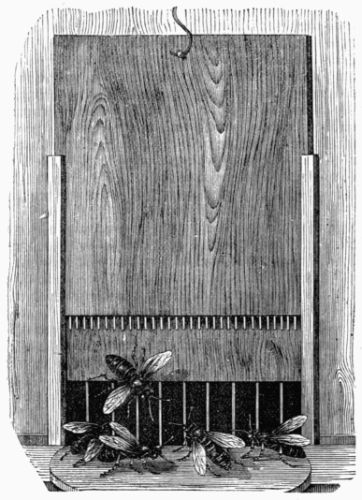
We have just said that there are sentinels at the entrance of every hive. They touch with their antennæ each individual that wishes to penetrate into the house. Hornets, the Death's-head Sphinx, slugs, &c., often try to introduce themselves into the hive. In that case, on the appeal of the watchful porters, all the bees combine their efforts to defend the entrance to their habitation. It would be impossible for them, in fact, to stop the ravages of their enemies when once entered into the interior. When a sphinx has succeeded in introducing itself into a hive, it sits down and drinks the honey in great bumpers, devouring all the provisions: and the unfortunate proprietors of the house are obliged to emigrate. To stop the entrance of moths which fly by night, the bees contract, and sometimes barricade, their door with a mixture of wax and propolis. When a slug or any other large animal has managed to introduce itself into the interior, they kill it and wrap it up in a shroud of propolis, as we have already related.
However, they are quite helpless against certain microscopic parasites which sometimes attack them. The bee-louse, which has been described and drawn by Réaumur in one of his Memoirs, [95] and the parasite which was described in 1866 by M. Duchemin, the Sugar Acarus, which is found in the liquid honey of those hives which are attacked by the disease called the rot (pourriture), are the most serious enemies of the bee. The Gallerias are also terrible enemies to them. Every hive thus attacked is ruined. These destructive insects attack also the wild bees, drive them from their nests, and destroy the wax of the cakes forming the comb. The Galleria impudently makes his home in the houses of bees, wild as well as domesticated.
The habits of bees in their wild state, which make their nests in the trunks of trees and other cavities, do not differ from those of domesticated bees. Only the latter become tame with man, getting used to those who look after them, and becoming less aggressive towards strangers.
Apiculture, or bee-keeping, is still at the present day an important business, although honey has lost a great deal of its utility since the introduction of sugar into Europe. Without entering into many details on apiculture, that is to say, on the attention it is necessary to pay to bees, we will mention the principal duties of the bee-keeper.
When, in the spring, the bees font la barbe (as the French say), that is, when they are getting ready to swarm, one must watch narrowly, so as not to lose them. As soon as a swarm has settled on a tree or on any artificial resting-place prepared on purpose in the neighbourhood, it is approached, after having covered one's face with a piece of transparent linen or canvas, or with a hood, and the cluster is caused to fall into a hive turned upside down. The hive is then turned up and again put in its place; or else, if it is only to serve for the conveyance of the swarm to another place, shaken about before the door of the hive which the swarm is destined to occupy. The bees then beat to arms, and set to work to enter their new habitation in a compact column. Fig. 324 represents the manner in which one ought to proceed in order to gather a swarm of bees, which is fixed on a branch of a tree, and introduce it into the hive prepared for it. Let us listen on this subject to an experienced bee-keeper, M. Hamet: "As soon as a swarm has fixed itself anywhere, and there are only a few bees fluttering round the cluster, you must make your preparations for lodging them in a hive you have got ready for the purpose. Some people rub the hive on the inside with aromatic plants or honey, with the object of making the bees fix themselves there more surely. This precaution is not indispensable. What is essential is, that the hive should be clean, and free from any bad smell. It is a good thing to pass it beforehand over the flame of a straw fire, which destroys the eggs of insects and insects themselves which may have lodged in it.
Fig. 324.—Taking a swarm.
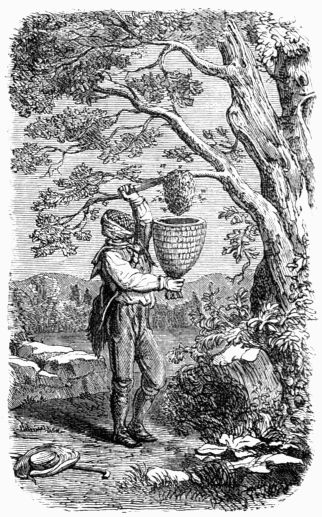
"After having covered your head with a veil, if the swarm has settled in a difficult place, and you are afraid of being stung, you hold the hive under the cluster of bees and make them fall into it, either by shaking the branch to which the swarm is attached, very hard, or by means of a small broom, or even with the hand, for then they very rarely sting: it is hardly ever necessary to take any precautions in approaching them, except for swarms which have been fixed for many hours, or since the day before. When the bees have fallen in a mass to the bottom of the hive, you turn this gently over, and place it on a piece of linen stretched out on the ground near the place where the swarm was, or on a tray, or simply on the ground itself, if it is dry and clean. You will have taken care to place on this linen a little wedge, a stick or a stone, to raise the hive a little, and to leave room through which the bees may enter. A great part of the bees which fall into the hive fix themselves on to its sides; but a good number are dropped on the linen when the hive is turned. This is the manner in which you act when it is determined to lodge the swarm; but when the swarm is to be lodged in another hive, as we shall see farther on, immediately that the bees recognise the lodging which is destined for them, they set to work to beat to arms, and to enter in a compact column their new dwelling; those which are fluttering about in the air are summoned by this call, and are not long in alighting on the spot where the rest of their companions are fixed. At the end of a quarter or half an hour, at the most, all, or nearly all, have entered the hive. A few still hover about round the place where the swarm was fixed. If the number is considerable, and if many have stopped in this place, you must make them quit it by placing some offensive herb, such as celandine, horehound, field camomile, &c., on it, or project the smoke of a rag upon them, which will drive away the bees and force them to look for the colony or to return to the mother-hive. You may also project smoke, but in moderate quantities, on the bees grouped around and on the borders of the lodging which you have just given them, and which they will not be long in entering." [96]
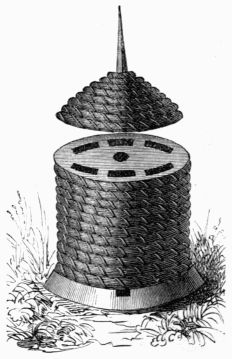
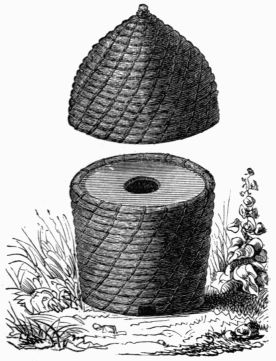
Fig. 325.—Bell-shaped hive. Fig. 326.—English hive.
A good swarm weighs from four to six pounds; one pound contains about four thousand bees. The second swarm weighs rarely more than two pounds, and the third still less. You can also form artificial swarms by drawing off the bees of one hive into another, an operation which is easy with bell-shaped hives. A glance at Fig. 325, which represents the common hive of the north of France, that is to say, the bell-shaped, will show how easy it is to effect that drawing off, or pouring out of the bees, by joining together at their bases two hives, the one empty, the other containing a swarm. In order to have control over the bees during the operation, you must slightly stupefy them with the smoke of a smouldering rag.
Beehives are of a thousand different shapes, each of which has its particular advantage. They are made of wood and of straw; and the shapes used in different countries are very various. We give as examples, Figs. 325, 326, 327, 328, 329.
Fig. 327.—Swiss hive.
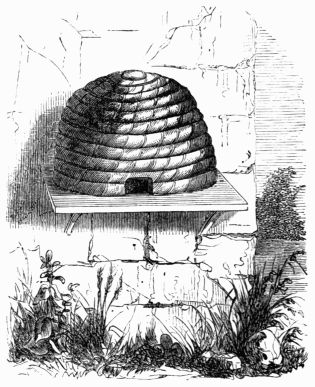
The site, that is, the place where hives stand, is not a matter of indifference. It is generally supposed that bees ought to be established in a place fully exposed to the sun, and to the greatest heat of the day. This is a mistake. M. de Frarière, in his work on bees and bee-keeping, recommends the hives to be placed under trees, in such a way that they may be kept in the shade. Fig. 330 shows the way in which M. de Frarière recommends hives to be arranged.
Dr. Monin, author of an interesting monograph of the bee, published in 1866, after treating of the different arrangements which have been recommended for hives, concludes thus:—"It is to satisfy all these requirements that experienced bee-keepers so much recommend for the hives an exposure to the ten o'clock sun; that is to say, that they should be turned in such a manner that the sun may shine on their entrances when it has already attained a certain height above the horizon, and sufficiently warmed the surrounding air for the bees, which the brightness of its rays has tempted forth, not to be seized with cold and numbed before they have been able to return home again."[97]
Fig. 328.—Polish hive.
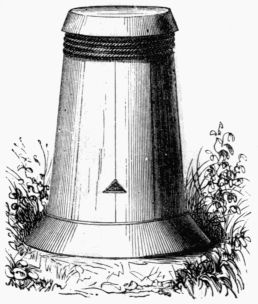
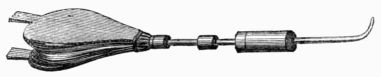
In the month of March a gathering of wax is made by cutting away the lower part of the hives, where the cakes have grown old. The principal honey harvest takes place towards the end of May, June, or July, according to the place the hives are in. A larger or smaller gathering takes place according to the quantity of honey ready, and the state of the season. As the bees will not see the violation of their domicile and theft of their winter provisions without anger, to get possession of the honeycomb with which the hive is filled, you must put these irritable insects into such a state that they are unable to injure you. They can be rendered peaceable by smoking them. The smoke is forced into the hive with the assistance of a pair of bellows, the arrangement of which is shown in Fig. 331. If the fumigation is prolonged, the bees are very soon heard to beat their wings in a peculiar manner; they are then in what is called in French l'état de bruissement, or the roaring state. When they stand up on their hind legs and agitate their wings, you can do with them almost anything you like—cut away the honeycomb, abstract the eggs, or take out the honey—without their troubling themselves about it. But this state of things must not last too long, or you may suffocate your bees. It is a sort of anæsthesis into which the bees have been thrown; and, as with men, this must not be prolonged.
Fig. 329.—Garden hive.
Some bee-keepers, in order to collect the honey harvest, suffocate their bees by burning sulphur matches. This is a bad practice. "Those authors who recommend us to suffocate the bees," says M. Hamet, "under the pretext that their colonies will become too numerous, and who add, 'You cannot eat beef without killing the ox,' are more stupid than the animal they have chosen for their comparison." A hive often produces from twelve to twenty pounds of honey each year, and a proportional quantity of wax. It may, then, furnish to the bee-keeper an important revenue, especially as the rearing of bees gives scarcely any trouble, and involves scarcely any labour, as it is only necessary to select a spot with a proper exposure and well supplied with flowers.
Fig. 330.—Hives under the shade of trees.
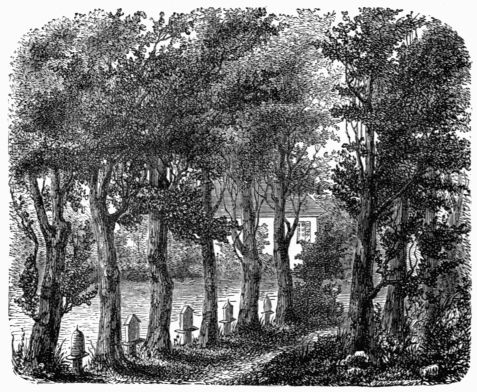
Fig. 331.—Bellows used to stupefy Bees.
We possess in Europe two species or races of bees—the Common Bee (Apis mellifica), and the Ligurian Bee (Apis ligustica), whose abdomen is tawny, with the rings bordered with black. It is this latter species of which Virgil sang, and which is found in Italy and Greece. It has been remarked that the Ligurian bee pierces the calices, at their bases, of those flowers which are too long for it to penetrate into easily, and thus gets possession of the honey, whilst the common bees pass these flowers over. This observation proves that the former is the more intelligent of the two races. In Egypt a bee is reared called the Banded Bee (Apis fasciata).
Ten or twelve other species of honey-bees exist in Senegal, the Cape of Good Hope, Madagascar, East Indies at Timor (Apis Peronii), &c. The European bee has been acclimatised in America, but it soon returns to its wild state, as indeed do all our domestic animals when transported to the other hemisphere. At the Cape of Good Hope the Hottentots seek greedily after the nests of wild bees, a bird called the Indicator guiding them in this chase. This bird is observed flitting about from tree to tree, making a little significant cry. They have only then to follow this bird-informer, for it will not be long in stopping before some hollow tree which contains a nest of bees. The Hottentots always acknowledge its services by leaving it a part of the booty.
Fenimore Cooper, the novelist, tells us, in his work entitled "The Prairie," how the bee-hunters in America discover the wild hives. They place on a plank, covered with white paint still moist, a piece of bread covered with sugar or honey. The bees, in plundering this bread, get some of the paint on their bodies, and are then more easily tracked when they return to their hives. In North America they are, as it were, the harbingers of civilisation. When the Indians perceive a swarm trying to establish themselves in the solitudes of their forests, they say to one another, "The white man is approaching; he will soon be here." True pioneers of civilisation, these insects seem to announce to the forests and deserts of the New World that the reign of Nature has passed away, and that now the social state has begun to play its part—a part that will never end.
Fig. 332. A species of Melipona.
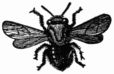
The bees peculiar to South America have no sting: these are the Meliponas. These (Fig. 332) are more compactly formed than our bees, have a more hairy body, and are smaller in size. Very numerous in the virgin forests, they make their nests in the hollows of trees. The wax produced by them is brown, and of an indifferent quality. Under thick leaves of wax are found cakes, with hexagonal cells, containing the males, females, and neuters. The cells of the larvæ are closed by the workers, and the larvæ spin themselves a cocoon inside. All around the cradles are large round cells, entirely different in form from the cradles, in which the honey is stored. It is probable that the males, the workers, and the females, live together in great harmony, and even that there is in each nest more than one female, for the absence of the sting must prevent any combats. If a few cakes of the Melipona's honeycomb are moved into the hollow of a tree, they always found there a new colony. We may conclude from this that the workers procure for themselves females whenever they want them by means of a special sort of food. The savage inhabitants of the American forests collect this honey; but, with the carelessness of uncivilised man, they at the same time destroy the nests of these precious insects. They have now begun to domesticate certain species of Meliponas, by introducing them into earthen pots or wooden cases. These insects have been brought to Europe, but they have always perished in the first cold weather. During the summer of 1863 there was, in the Museum of Natural History of Paris, a nest of Melipona scutellaris from Brazil, but it did not prosper.
The Humble or Bumble Bees.
If in the month of March one passes through the fields, which are beginning to get green, or through the woods, still deprived of their leaves, there may be seen, hovering hither and thither, great hairy insects, resembling gigantic bees. These are the females of a species of bee, called by the French "bourdons," from the buzzing noise they produce; and by us "humble bees," probably from their German name "hummel," given for the same reason. These females have been awakened by the spring sun. They examine the cavities of stones, the heaps of moss, and the holes in banks, &c., seeking for a suitable spot to construct a nest for their progeny.
The humble bees are of the same family as the bees, whom they resemble in their organisation. Like them, they are divided into males, females, and neuters, or workers. But their companies only last a year. At the end of autumn the whole population has become extinct, with the exception of the pregnant females, which pass the winter in a state of torpor at the bottom of some hole, where they wait till the spring to perpetuate their race. Their societies comprise generally only a small number of individuals, from fifty to three hundred. They are of peaceful habits, their ephemeral existence beginning and ending with the flower season.
Fig. 333.—Male Humble Bee.
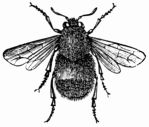
The humble bees are known by their great size, their short, robust body, encircled by bands of very bright colours, and by the noise they make in flying. Their hind legs are armed with two spurs. The females and the workers have the same organisation for plundering flowers as the bees have: they have similar trunks, and their legs are fitted with brushes and baskets for gathering pollen. The males, like the males of hive bees, have no sting. The greater number have their dwelling-places underground; others make their nests on the surface of the soil, in the cracks of walls, in heaps of stones, &c. The former establish themselves in cavities situated as far as half a yard underground, and approached by a long narrow gallery. It is almost always a solitary female who has been the architect of the nest. She cleans out the cavity she has chosen, makes it as smooth as possible, and lines it with leaves and moss, to embellish the subterranean house in which she is to pass nearly all her existence.
The Moss Humble Bee (Bombus muscorum), called also the Carding Bee, chooses an excavation of very little depth in which to make its nest, or else itself undertakes the hollowing out of a hole in the ground. It covers this with a dome of moss or dry herbs. But it does not fly when transporting the moss, it drags it along the ground, with its back turned towards the nest. Having seized a packet of the moss, it sets to work to draw out the bits with its mandibles, and then pushing them under its body, throws them in the direction of the nest by a sort of kick from its hind legs. Sometimes, towards the end of the season, many humble bees are to be seen working in line. The first seizes the moss, and after having carded it, passes it under its body, and throws it to the second, which throws it on to the third, and so on, up to the nest. When the materials are ready, the insect makes use of them to manufacture a sort of hemispherical lid, or covering, resembling felt, which shuts the nest in, and is lined with wax. If you lift up this covering, or small dome, which it is not dangerous to do, for humble bees are not very aggressive, you find beneath it a nest composed of a coarse comb.
The cells which compose the nest, and which are to receive the larvæ of the insect, are of an oval shape, and of a pale yellow or even of a blackish colour. Fig. 334 represents these cells. The wax of which they are composed has none of the qualities of that of hive bees, but is soft, sticky, and brownish.
Fig. 334.—Cells from a Humble Bee's nest.
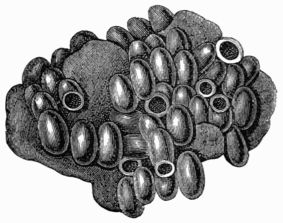
When the mother humble bee—which at first was alone and built her house single-handed—has made a certain number of cells, she seeks for honey and pollen, and prepares a paste, which she deposits in the future cradles. She then lays six or seven eggs in each. The larvæ which come from them live in common, at the same table, under the same tent. The cell is at first only the size of a pea; it soon becomes too narrow, splits and cracks, and requires to be enlarged and repaired many times, a work of which our industrious insects acquit themselves with a good deal of care and attention. Before passing into the pupa state each larva spins for itself a shell or cocoon of very fine white silk. It ceases to eat, remains at first rolled up, then expands itself little by little, and changes its skin after three days. It passes fifteen days in the pupa state in a quiescent condition. After the normal time has elapsed for it to remain in its hiding-place, it delivers itself from its mummy-like covering, with the help of the mother or the workers. The humble bee then appears, robust, and its body covered with a greyish down.
When the successive hatchings have furnished to the mother the reinforcement she is waiting for, the workers she has raised occupy themselves in building new cells, and in raising the wall of enclosure which is to protect the nest. This wall, formed of wax, starts from the base, and raises itself, like a vertical rampart, from every point in the circumference. They then surmount this by the first roof, which is flat, supported by some pillars, and in which they have left one or two irregular openings. The whole is finally protected by a hemi spherical covering of moss, made into a sort of felt and lined with wax. Fig. 335 represents, in its entirety, a nest of this humble bee.
Fig. 335.—Nest of the Moss Humble Bee (Bombus muscorum).
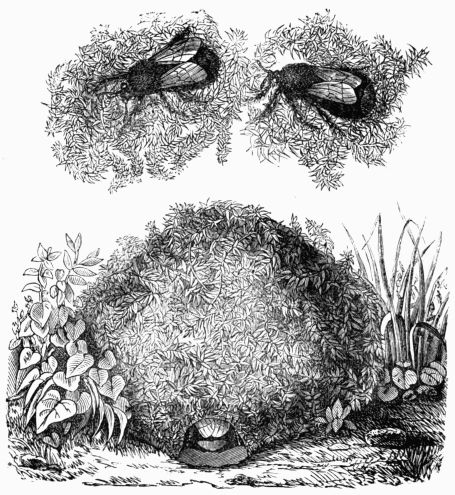
The workers also take their part in rearing the eggs. They bring the paste, which they slip into the cells to the larvæ by a small hole, which is shut immediately afterwards. Later, they again give their assistance in disengaging the pupæ from their envelopes. In short, they make themselves generally useful; but they have one bad fault: they are very fond of eating the eggs laid by the mother. They try to seize them as she deposits them, or drag them from the cells, and suck their contents. And so the mother is obliged to be incessantly defending her eggs against the voracity of the workers, and to be con stantly on her guard, so as to be ready to drive away these marauders from cells newly filled.
We owe to an English naturalist, Newport, the knowledge of another curious fact relating to the laying of humble bees, which is the expedient the females and the males have recourse to for hastening the hatching of the eggs. They place themselves, like fowls sitting on their eggs, over the cocoons containing the pupæ almost hatched. By breathing quickly, these industrious insects raise the temperature of their bodies, and consequently that of the air in the cells. Thanks to this supplementary heat, the metamorphosis of the pupæ is much hastened. Newport, by slipping miniature thermometers between the cocoons of the nymphs and the sitting humble bees, ascertained that the temperature of the latter was about 34° C., whilst the temperature of the cocoons left to themselves was only 27° C.; that of the air in the rest of the nest being only from 21° to 24° C. After many hours of incubation, at the same time natural and artificial, in which Art and Nature are so closely allied, after the sitting insects have many times relieved one another, the young humble bees come out of their cells. They are at first soft, greyish, moist, and very susceptible to cold. But after a few hours they become stronger, and the yellow and black bands with which their abdomens are surrounded begin to be marked out. The spring laying produces exclusively workers. The greatest abundance of eggs are laid in August and September. The laying of the female eggs begins in July; that of the males follows soon after.
Until autumn the humble bees are incessantly enlarging their nests, and multiplying their little pots of honey. Without accumulating a great stock of provisions, for which they have no occasion, they always keep in reserve a quantity of pollen and honey for their daily wants. The cells in which the honey is stored differ very much in shape. Some species of humble bees give them long and narrow necks; others, less recherché in their style of construction, simply make cylindrical vases. There are among the humble bees races of artists and races of simple builders; the one construct with taste, the other only seek the useful.
During the day the humble bees cull honey from the flowers. At night they enter their home; but a certain number take the liberty of sleeping out. Surprised by the arrival of night in the bottom of the calyx of a sweetly-scented flower, they philosophically determine to sleep in the open air, lying on this perfumed bed, with the heaven as their canopy.
The coupling of the humble bees takes place towards the end of September. It costs the males their life, as it does with the hive bees. The impregnated females do not lay till the following spring; it is they who, after the winter is passed, will become the mothers of new generations. They will take the reins of the family when the mother who founded the colony, the males, as also the workers, shall, according to the laws of Nature, have passed away. There are often, on the other hand, some workers which, born in the spring, become fruitful, and lay the same year, but only the eggs of males. These become a butt for the jealousy of the reigning mother, who pursues them with fury, and devours their eggs. These, however, have themselves cruel hearts. Animated by a profound jealousy, they dispute the occupancy of the cells savagely, so as to be able to lay a few eggs in them, which are no sooner laid than they are destroyed by their savage sisters. However, they never make use of their stings in any of these attacks. The humble bee population is peaceful, even in its combats. After the first cold weather in autumn, all these insects, as we have said, perish, except the pregnant females. These privileged depositaries of the race, spes altera domûs, look for a place of retreat, and there sleep till the following spring. Then they wake up and found new colonies, which continue the race.