Front matter (continued 8)
Reading edition
For a long while were confounded with the humble bees certain insects which have the same appearance, that is to say, a hairy body, with bands of various colours, but whose hind legs are adapted neither for gathering honey nor for building. These are the genus Psithyrus: it was Lepelletier de Saint-Fargeau who discovered their true position. These are parasites, and only consist of males and fertile females, without workers. They lay their eggs in the nest of the humble bee. They are, indeed, so like their hosts, that they can introduce themselves into their dwellings without raising any suspicion. The humble bees admit them freely, and receive them as if they belonged to the family; so much so, indeed, that the poor humble bees themselves bring up the larvæ of these impudent guests. In the Order Hymenoptera one meets with many examples of these sorts of parasites, which instal their progeny in the nest of another insect, as the cuckoo does in the nests of other birds.
Solitary Bees.
We have up till now found the insects of the great family of bees collected together in perfectly organised societies. But there are a great number of species of this family which live alone. We will briefly mention the most interesting of them.
The females of the solitary bees are impregnated like those of the humble bees, and lay in spring, after having passed the winter asleep. They build a nest divided into cells, fill it with eggs, and with a honied paste shut it up, and die, without having seen their progeny hatched.
Figs. 336, 337, 338.—Anthophora parietina.
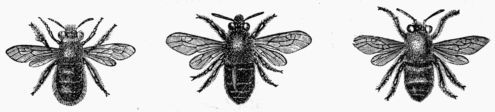
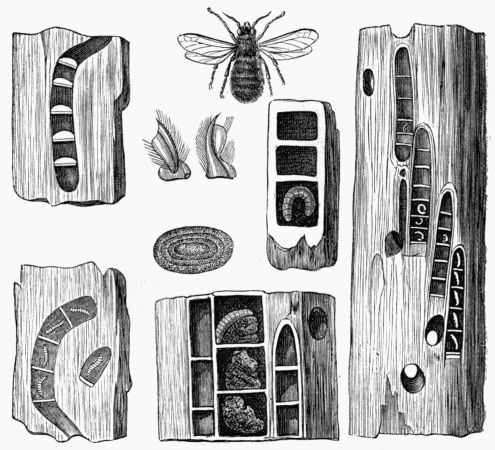
Fig. 339.—Carpenter Bee, Pupæ, Eggs, Galleries, and Nests.
The Anthophoras (Figs. 336, 337, 338) resemble bees, but they are more hairy, and of greyish colour. Their nest, composed of earth tempered and agglutinated with their saliva, is made in the cracks of old walls or in the ground. It has the form of a twisted tube, and is divided, by partitions, into compartments, each of which is to receive a larva. Each insect, when hatched, pierces its own wall, and profits by the hole of exit of the brother which preceded it.
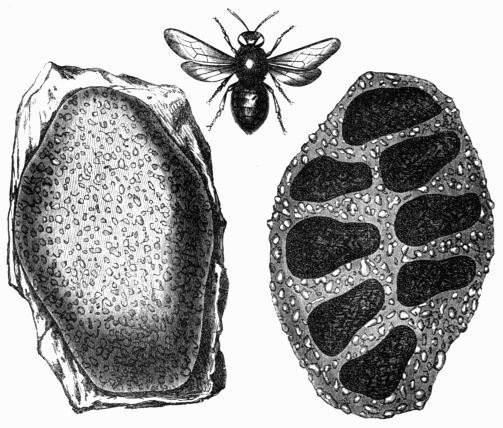
Fig. 340.—Mason Bee and Nest.
These insects do not live together in societies. Indifferent neighbours, they do not lend each other mutual assistance. They have their parasites, the Melactas, like the humble bees. These parasites are hairy, blackish insects, spotted with white, laying their eggs in the nests of the Anthophoras, which permit them to do so, and, at the expense of their own progeny, bring up the intruder's little ones.
The Carpenter Bee, or Wood-piercer (Xylocopa), hollows out galleries in decayed wood, and builds in them cells placed one over the other—a work often occupying many weeks. She then furnishes the bottom of the cell with pollen mixed up with honey, lays an egg in the middle of this paste, and closes the cell by a ceiling of saw-dust agglutinated with saliva. On this ceiling she establishes a new cell, and so on, right up to the orifice, which she closes in the same manner. Réaumur is astonished, with reason, at the admirable instinct which makes this provident mother determine the exact quantity of nourishment which will be necessary for its larva. When this has absorbed all its provisions, it alone quite fills up its cell, and changes into a pupa. It is worthy of remark, that the head of the young is always turned downwards, in such a way that it is by the bottom of its cell that it comes out. The bottom of the first is very near the surface of the wood, so that the insect it encloses has only a thin layer of wood to pierce through in order to set itself free. Each one of those which are born next has only to pierce the floor of its hiding-place to find the road before it free. The Xylocopæ pass the winter in the pupa state, and the perfect insects, with wings of a beautiful metallic violet, appear in the spring, but are not found in this country.
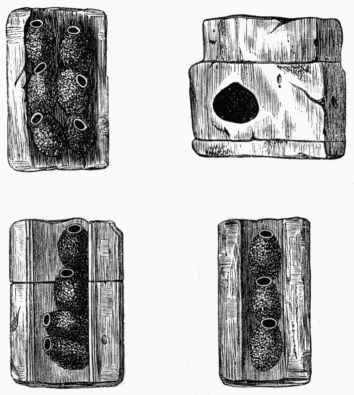
Fig. 341.—Interior of the Nest of the Mason Bee.
Other solitary bees have their hind legs unsuited for the gathering of pollen, but have the rings of the abdomen furnished with hairs for that purpose. Such are the Mason Bees of Réaumur, belonging to the genera Osmia and Chalicodoma, [98] which build their nests against walls with tempered earth, which become very hard.
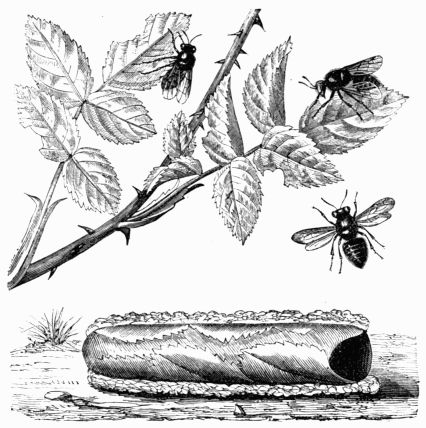
Fig. 342.—Rose Megachile (Megachile centuncularis).
These nests (Figs. 340 and 341) are filled with cells of oblong form arranged irregularly. At first sight they might be taken for little lumps of earth plastered against the wall. When the perfect insect emerges, it is obliged to soften the mortar with its saliva, and to remove it, grain by grain, with its mandibles. The nests of Chalicodomas are common in the environs of Paris, on walls of rough stones exposed to the south. They are often to be found in the parks of Meudon, of Conflans, of Vésinet, &c.
The Leaf-cutting Bees (Megachile) are not less worthy of remark in their habits. These insects make their nests in tubes lined with the leaves of the rose, the willow, the lilac, &c., placed in a cylindrical burrow. Each nest contains generally from three to six cells, separated by partitions of leaves. They cut off the pieces of leaves they require with their mandibles, the notches being wonderfully cleanly cut, as if they had been done with a punch.
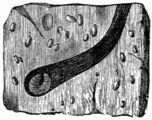
Fig. 343. Gallery of an Andrena.
They make as many as eight or ten envelopes in succession with the leaves, which, as they get dry, contract, keeping, however, the form given to them by the insect. The cells destined to receive the eggs acquire thus a certain solidity. Fig. 342 represents the nest of the Megachile.
The Upholsterer Bees (Anthocopas) line their nests with the petals of flowers, as, for example (Papaver rhæas), the corn-poppy. Their burrows are made perpendicularly in the beaten earth of roads, and each contains one solitary cell, lined with portions of petals. When the egg has been laid at the bottom of this cell, the bee fills up the rest of the hole with earth, to hide it from notice.
The Mining Bees (Andrenæ) hollow out in the ground tubular galleries (Fig. 343). They are not larger than ordinary flies. A great number of other bees are known, but their habits are little understood, and we shall not occupy ourselves about them.
Wasps.
Every one knows the wasps as a race of dangerous brigands which live by rapine, are incessantly fighting battles, and which exist only to do harm. However, wasps, like Figaro, are better than they are reputed to be. Their societies are admirably organised; their nests are models of industry and artistic fancy. They have even certain domestic virtues which deserve our esteem; only they are an excitable race it is well not to cross. If great heat adds to their natural irritability, they savagely attack those who annoy them, and pursue them to a distance. No one, indeed, is ignorant that their sting is very painful. In cold weather, and towards night, they are less vivacious and less to be dreaded.
Fig. 344.—Wasp's Nest.
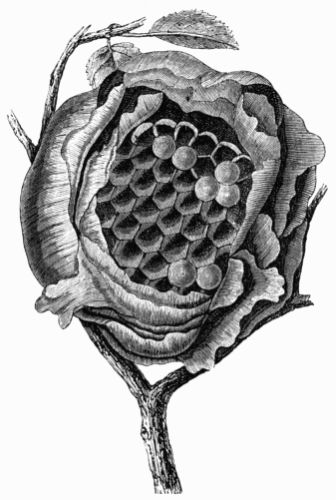
The wasps are distinguished from the bees by a decided characteristic. In a state of repose they fold together their upper wings, which then seem very narrow, only spreading them out when they are about to fly; whilst the latter when at rest keep their upper wings spread out.
Wasps live in companies, which last only a year, and are composed of males, females, and workers. But the female wasp does not pass her entire life in idleness as a queen, like the mother hive bee. She occupies herself in making the nest and in taking care of the young, like the mother humble bee. The males have also their duties. They watch over the cleanliness of the habitation, and are the sanitary commissioners and undertakers to the city. These are easily recognised by their oblong bodies, having so slight a connection with the thorax, as it were by a thread.
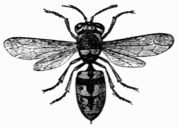
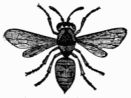
Fig. 345.—Common Wasp (Vespa vulgaris). Fig. 346.—Bush Wasp (Vespa norvegica).
Their sting is larger than that of the bees, and is supplied with poison from a pouch placed at its base. The males have no sting. Wasps do not secrete wax. With their mandibles they scrape wood and plants, the fragments of which they agglutinate together in such a way as to form a tough cardboard. Thus, they invented the manufacture of paper long before men. Charles de Geer, in his celebrated work, sums up the habits of these insects in the following manner:—"Wasps," says he, "are, like bees, fond of sweets and honey, although they rarely seek them in flowers; but their principal food consists in matters of quite a different kind, such as fruits of all kinds, raw flesh, and live insects, which they seize and devour. They sometimes do dreadful damage in bee-hives, devouring the honey, and killing the bees. They do not gather wax; their nests and their combs are composed of a matter resembling grey paper, which they get from rotten wood, and which they scrape off with their jaws; they make a sort of paste of these scrapings by moistening them with a certain liquid which they disgorge. The cells in the combs are hexagonal, and very regular, like those of bees." [99]
Fig. 347.—The Hornet (Vespa crabro).
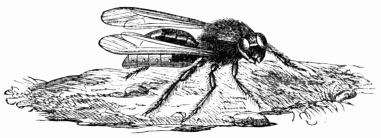
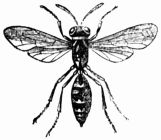
Wasps collect the materials with which they build near the place where they have chosen to establish their domicile. These materials are ligneous fibre, mixed up with saliva, with the aid of which these insects prepare the paper-like substance, which is very tough, and destined to form the walls of the cells and their exterior covering. The greater number make their habitation in the ground. Of these is our Common Wasp (Vespa vulgaris), which is black, agreeably contrasted with bright yellow. The Bush Wasp (Vespa norvegica), which inhabits woods, constructs its nest between the branches of shrubs or bushes. It is smaller than the common species. The Hornet is the largest European species of the family of the Vespidæ. The substance of its nest is yellowish, and very fragile, and is constructed under a roof, in a loft, or in the hole of an old wall, but most often in the hollow of a decayed tree. Another species of this family (Polistes gallica, Fig. 348) fixes its little nest by a footstalk to the stem of some plant.
Fig. 348.—Polistes gallica.
Wasps begin laying in spring, and go on laying all the summer. Each cell receives one single egg, and, as with bees, the workers' eggs are the first laid. Eight days after the laying, there comes out of each egg a larva without feet, and already provided with two mandibles. These larvæ receive their food in the form of balls, which the females or the workers knead up with their mandibles and their legs before presenting to their nurslings, very nearly in the same way as birds give their beak full of food to their little ones. At the end of three weeks the larvæ cease to take food, and begin to shut themselves up in their cells, the interior of which they line with a coating of silk. In this they change their form, and assume the appearance of the perfect insect, with its six legs and its wings, but motionless, and contracted together. A sort of bag keeps all the organs swathed up together (Fig. 349). This pupa state lasts for eight or nine days, at the end of which time the insect is fully developed; it casts its skin, breaks the door of its prison, and launches itself into the air. A cell is no sooner abandoned than a worker visits, cleans it, and puts it in a fit state to receive another egg.
Fig. 349. Pupa of the common wasp.

During the summer the female wasp remains constantly in the nest, absorbed with family cares. She is occupied in laying eggs and in feeding her progeny, with the active assistance of the workers, or mules, as Réaumur and Charles de Geer call them, because they are unfruitful.
In the interior of the nests you generally find the most perfectly good understanding existing, and the most perfect order, in spite of the warlike instincts of these insects. It is only on rare occasions that this domestic peace is disturbed by the quarrels of male with male or worker with worker; but these combats are not deadly. Never, moreover, has one nest of wasps been known to declare war against another for the purpose of robbing it. "The government of wasps," says M. Victor Rendu, "explains very well the gentleness of their public conduct. Amongst them there are no despots; no one either reigns or governs; each one lives at liberty in a free city, on the sole condition of never being a burden to the state. They all act in concert, without privileges or monopolies, under the influence of a common law—the great law of the public good, from which no one is exempted."[100]
But this model republic is fatally doomed to early destruction. At the approach of winter all the workers, as also the males, perish. Some pregnant females alone hold out against the cold, and get through the winter, to propagate and perpetuate their species. Before dying, these insects destroy all the larvæ which are not hatched at the first approach of cold weather. In spring the females revive, and begin alone the construction of a new nest. They then lay workers' eggs, which are not long in furnishing them a whole regiment of devoted and active assistants. These traits are pretty nearly the same for the different species of wasps, the only difference being in the way in which they build their nests.
Fig. 350.—Exterior of a Wasp's Nest on a branch of a tree.
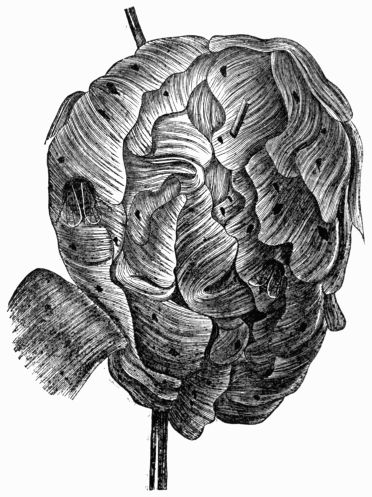
We have already said that the common wasp makes its nest in the ground. A gallery, of about an inch and a half in diameter, leads to the nest, situated at a depth which varies from six inches to two feet. "It is," says Réaumur, "a small subterranean town, which is not built in the style of ours, but which has a symmetry of its own. The streets and the dwelling-places are regularly distributed. It is even surrounded with walls on all sides. I do not give this name to the side of the hollow in which it is situated; the walls I allude to are only walls of paper, but strong enough, nevertheless, for the uses for which they are intended." Generally, the shape of the outside of a wasp's nest is spherical or oval, sometimes conical. Its diameter is about from twelve to sixteen inches, its surface, which resembles a mass of bivalve shells, has one hole for entrance, and another for exit, just large enough to allow of one single wasp passing in or out at the same time (Fig. 350).
Fig. 351.—Interior of a Wasp's Nest, after Réaumur.
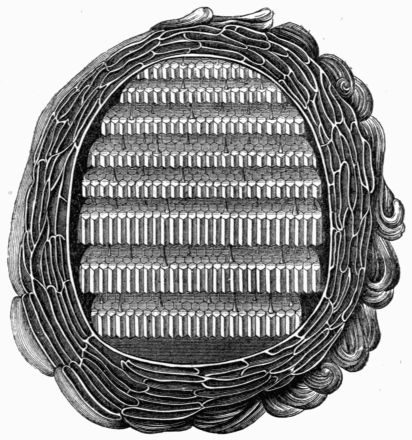
The wasps' nest is composed, in the interior, of fifteen or sixteen horizontal galleries, arranged in storeys, and supported by numerous pillars of separation. We give here (Fig. 351) a section and view of the interior, drawn from memory by Réaumur. [101] The cakes forming the combs are composed of hexagonal cells, which are always used as cradles, never as storehouses. They open below. The exterior envelope of the nest is made with leaves of a sort of greyish, very gummy paper, which is applied layer by layer. Réaumur has given a very detailed account of the way in which these insects construct their nests.[102] They collect fibres of wood—which are their raw material—make them into a sort of coarse lint, which they reduce to balls, and carry between their legs to the nest. These balls are next stuck on to the work already begun. Then the insect stretches them out, flattens them, and draws them into thin layers, as a bricklayer spreads mortar with his trowel. The wasp works with extreme quickness, always backwards, so that it may have incessantly before its eyes the work it has done: the movement of its mandibles is even quicker than that of its legs.
Towards the end of summer the nest may contain 3,000 workers, and many females, who live together in perfect harmony. The number of males exceeds that of the females. A female weighs, by herself, as much as three males or six workers. With the exception of those which are occupied in building and in taking care of the eggs, all wasps go out hunting during the day. They are carnivorous, and may be seen attacking other insects, which they tear to pieces after having killed, so as to carry the bits to their nests, where thousands of mouths are clamouring for their food. The wasp pays great attention to the vines. It penetrates also into the interior of our houses, and infests the butchers' shops; but this the butchers do not much mind, for the wasp drives away the flies which would lay their eggs on the meat and thus contribute to its corruption.
As the winter approaches, the wasps go out less and less, and very soon cease to do so at all. The greater number then die, huddled up in their nest. A few females only, as we have said, get through the cold season. They sleep with their wings and legs folded up, which gives them the appearance of chrysalides. They can nevertheless sting in this state, as M. Guérin-Méneville found out to his cost. The spring wakes them up, and they then found new colonies. "It is at this season," says M. Maurice Girard, in his book on the "Metamorphoses of Insects," "that, with a little trouble, it would be easy to diminish in a very perceptible degree the number of wasps, which are, later, so destructive to the fruit, by catching in nets the females, which might be attracted in quantities by means of the blossom of the black currant." This is a useful hint to gardeners.
The Hornets are distinguished from other wasps by their great size. They make their nests in the trunks of old trees, perforating the sound wood to arrive at the heart, which is rotten, or hollowing for themselves a hole, which they clear out by the gallery which leads to it. In this hole they construct first a dome suspended to the top by a footstalk; then a series of combs composed of cells, hanging the first to this dome, the second to the first, and so on, by stalks or pillars of a paper-like substance. When fixed under roofs, these insects have often the form of an elongated pear. Fig. 352 represents one of these nests, after Réaumur. The societies of hornets contain fewer members than those of the common wasp; at most 200 insects.
Fig. 352.—Hanging Hornet's Nest.
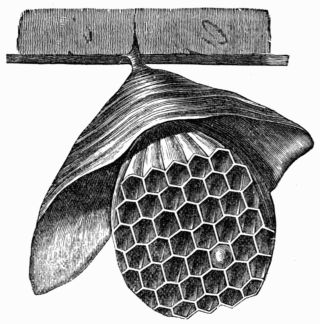
The Polistes are a peculiar kind of wasp, smaller than the others, slender, with the abdomen tapering towards the base. The construction of their nests is more simple, having no envelopes, as shown in Fig. 353. They attach them to the stems of broom, furze, or other shrubs, by a footstalk, or pedicle. They are like little paper bouquets, composed of from twenty to thirty cells, grouped in circle.
Fig. 353.—Nest of Polistes gallica.
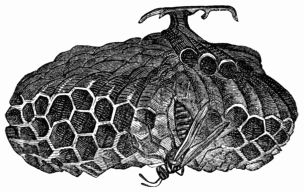
Fig. 354. The Card-making Wasp (Chartergus nidulans).
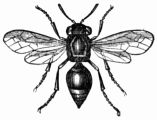
The Card-making Wasp of Cayenne (Chartergus nidulans, Fig. 354) is a consummate artist. Its nest represents a sort of box or bag, made of a substance resembling cardboard, so fine and so white that the best worker in that material would be deceived by it. This nest has only one single hole at its base; each of the combs it contains is likewise pierced by a hole in its centre, to afford a passage to the wasps. In an architectural point of view, the card-making wasp is almost superior to the bee, for the latter does not build its house, it only furnishes it, as Latreille remarks with truth. The Brazilian species of Chartergus, which the inhabitants call Lecheguana,[103] manufactures a honey, the use of which is not without danger, as it occasions vertigo and sharp pains in the stomach. The naturalist, Auguste Saint-Hilaire, during his sojourn in Brazil, himself experienced ill effects from eating it.
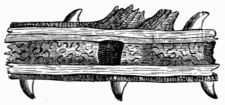
There are, moreover, solitary wasps, which make their cells in holes which they scoop out in the ground, or in the stalks of certain plants. In the adult state these live on honey; but their larvæ are carnivorous, and the female is obliged to bring them living insects. The commonest of these solitary wasps belong to the genus Odynerus. This insect makes its nest in the stalk of a bramble or briar (Fig. 358) with a mortar which it prepares. The larva (Fig. 356) lines its cell with a silky cocoon. It is the last egg laid which is hatched the first; then come the others, in an inverse order from that in which they were deposited. If it had been in the other order, the insects could not have come out of the cells without destroying on their way the less advanced pupa.
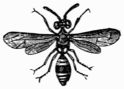
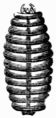

Fig. 355.—A species of Odynerus. Fig. 356.—Larva of the Odynerus. Fig. 357.—Pupa of the Odynerus.
Fig. 358.—Nest of an Odynerus in the stem of a bramble.
Ants.
The habits of the Ants are as remarkable as the habits of the bees. In their marvellous republics each one has his fixed duties to perform, of which he acquits himself willingly and without constraint. In consequence of their habits of foresight and frugality, ease reigns in the dwellings of these little animals, which become attached to their nest by a feeling of patriotism. Woe betide him who disturbs them in their occupations, or destroys their house! Like bees, they form a regular republic, composed—first, of males; secondly, of females; thirdly of neuters, or workers. We shall see, further on, the labours and the part played by each one of these three orders of the republic. Let us speak first of the species.
Ants are divided into a great number of species, which have been carefully described by De Geer, Latreille, and Francis Huber, the son of the celebrated blind man who wrote the history of bees. All these species have, however, some general traits in common, by which they may be easily distinguished from all other insects. Ants have a slim body on long legs. The workers are stouter and smaller than the males; and these last are smaller than the females. The males have large and prominent eyes, whilst the eyes of the workers and females are small.
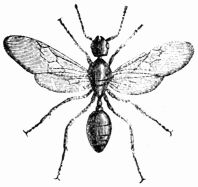
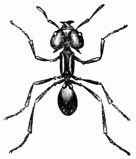
Fig. 359.—Red Ant. Male magnified. (Myrmica rubra.) Fig. 360.—Brazilian Umbrella Ant. (Atla cephalotes.)
Ants are provided with antennæ, bent in the form of an elbow, with which they examine everything they meet, and which seem to assist them in the communication of their ideas. Two horny, very strong mandibles serve them at the same time as pincers, tweezers, scissors, pick-axe, fork, and sword. A thin short neck joins the head to the thorax, to which, in the case of the males and females, are attached four large veiny wings. The workers only have no wings. Of the three pairs of legs, the hind ones are the longest. Each pair is armed with a spur, and fringed with very short hairs, which serve the purpose of brushes. The abdomen, large, short, oval, or square, is always most voluminous in the females.
There are three genera of ants which we shall mention. The Myrmicæ have two knobs to the pedicle, by which the abdomen is attached to the thorax; the Poneræ only one. In these two genera, the females and the neuters have a sting, and the larvæ do not spin a cocoon in which to change into pupa. Lastly, the Formicæ—ants properly so called—have but one knob on the pedicle of the abdomen, as in Ponera; their larvæ spin a silky cocoon. They have no sting, but they pour into the wounds made by their mandibles an acid liquor, the pungent smell of which is well known. This liquid is formic acid, a natural product, which the chemist now-a-days knows how to make artificially, by the action of dilute sulphuric acid on maize and other vegetable matters. Their whole body is impregnated with this acid, and has a strong sour smell. Some people like to chew ants, on account of their sourish taste. "They also make," says Charles de Geer, "creams for side-dishes, to which these ants give, they say, the taste of lemon-juice." We know, in the south of France, people who have eaten these crèmes aux fourmis! Polyergus forms a sub-genus of Formica.
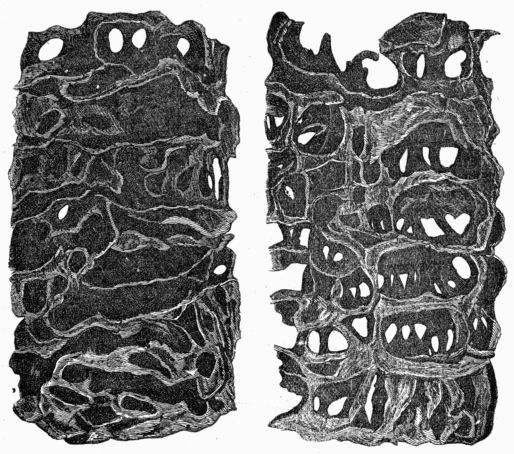
Fig. 361.—Sections of an Ant's Nest.
In all these species, the workers, or neuters, have the charge of the building, provisioning, and rearing of the larvæ—in fact, all the care of the household, and the defence of the nest. Deprived of wings, they are bound to the soil, and condemned to work. As compensation, to them belong strength, authority, power: nothing is done but through them. "Born protectors of an immense family still in the cradle," says M. Victor Rendu, "by their vigilance, their tenderness, and their solicitude, without being mothers themselves, they share in the duties and joy of maternity. Alone, they decide on peace or war; alone, they take part in combats: head, heart, and arm of the republic, they ensure its prosperity, watch over its defence, found colonies, and in their works show themselves great and persevering artists."
The nests of ants (Figs. 361, 362) are known under the name of ant-hills. They vary very much, both as to their form and the materials employed in making them—wood and earth are the principal. That which strikes one at first sight, is the size of these dwellings, which form a curious contrast to the smallness of their builders. Each species of ant has an order of architecture peculiar to it. The Red Ant (Formica rufa), one of the commonest in our woods, constructs a little rounded hillock with all kinds of objects—fragments of wood, bits of straw, dry leaves, the remains of insects, &c. This hillock, the base of which is protected by material of greater solidity, is nothing more than the exterior envelope of the nest, which is carried underground to a very great depth. Avenues, cleverly contrived, lead from the summit to the interior. The openings vary in width; and, as night approaches, are carefully barricaded. They are opened every morning, except on rainy days, when the doors remain shut, and the inhabitants confined within.
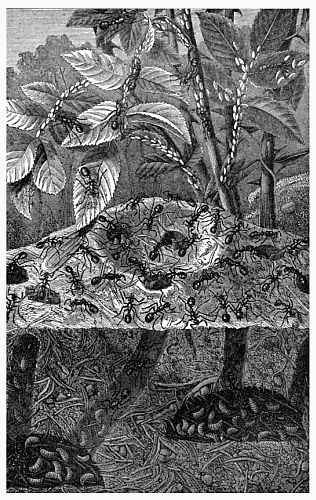
The ant-hill, or formicarium, is at first simply a hole hollowed out in the soil, the entrance to which is masked by the building materials. But the miners do not cease to hollow out galleries and chambers, arranged by stories. The earth and rubbish are carried out, and serve to construct the upper edifice, which rises at the same time that the excavation grows deeper. It is a labyrinth bored in all directions. It contains corridors, landings, chambers, and spacious rooms, which communicate with each other by passages which are often vertical. All the corridors lead to a large central space, loftier than the others, and supported by pillars; it is here that the greater number of the ants congregate. These ant-hills often rise to a height of fifteen inches above the ground, and descend to an equal depth. Fig. 362 shows the interior of an ant-hill, drawn from Nature. Outside it are to be seen some ants occupied in sucking plant-lice.
Fig. 362.—Section of an Ant-hill.
The group of Mason Ants contains a great number of varieties: the Ashy-black Ant (Formica nigra, Fig. 363), the Brown, the Yellow (Formica flava), the Blood-red, the Russety (Polyergus rufescens), the Black, the Miner (Formica cunicularia), the Turf Ant, &c. All these species employ a mortar, more or less fine, in raising their hillocks, at the same time that they hollow out their underground dwellings. The Jet Ant (Formica fuliginosa) excavates wood, hollowing out its labyrinth in the trunk of a tree with consummate skill. The Red Ant (Myrmica rubra) plies, according to circumstances, the trade of a mason or excavator.
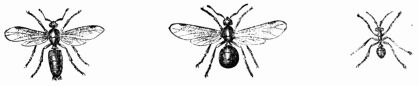
Fig. 363.—Ashy-black Ant (Formica nigra). Male, female, and worker.
The masons work when they can profit by the rain or by the evening dew, to make their mortar. They only go out after sunset, or when a fine rain has wetted their roof. Then they set to work. They roll up pellets of earth, bring them back in their mandibles, and stick them on to those places where the building was left unfinished. From all sides the earth-workers may be seen arriving, laden with materials. All these are bustling, hurrying, busy, but always in the greatest order, and with a perfect understanding among themselves. Every part of the building is going on at the same time. The apartments spring up one above another, and the edifice visibly rises. The rain, the sun, and the wind consolidate and harden the building so cunningly contrived by these industrious workers, who have received from God alone their marvellous science. With no other tool than their mandibles, the excavators work their way through the hardest wood. They bore holes right through it, riddling it completely with numerous storeys of horizontal galleries. The Yellow Ant raises its little hillocks in fields, and passes the winter in a burrow or underground dwelling-place.
Fig. 364.—Ashy Ant. Male, worker, and female.
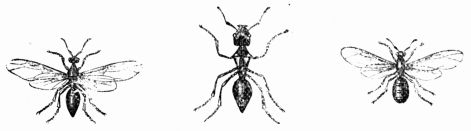
Independent of the principal entrances, there exist, in some nests, masked doors guarded by sentinels. Many species also hollow out covered galleries, which they only unmask in extreme danger, either to open an outlet for the besieged, or to turn the enemy who has already invaded the place. Ant-hills are, in fact, perfect fortresses, defended by a thousand ingenious contrivances, and guarded by sentinels always on the qui vive.
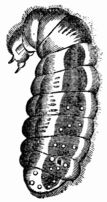
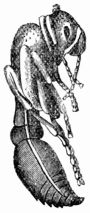
Fig. 365.—Larva of the Red Ant. (Myrmica rubra). Fig. 366.—Pupa of the Red Ant (Myrmica rubra) magnified.
The domestic life of the different species is nearly the same. The birth and rearing of the little ones, and the duties of the adults, do not differ perceptibly from each other in the various species of ants. The females live together in harmony. They lay, without ceasing to walk about, white eggs of cylindrical form and microscopic dimensions. The workers pick them up, and carry them to special chambers. In a fortnight after the laying, the larva (Fig. 365) appears. Its body is transparent. A head and wings can be made out, but no legs; the mouth is a retractile nipple, bordered by rudimentary mandibles, into which the workers disgorge the juices they have elaborated in their stomachs; and as they lay by no provisions, they are obliged to gather each day the sugary liquids destined for the food of the larvæ.
From their birth, a troop of nurses is charged with the care of them. They put them out in the open air during the day. Hardly has the sun risen, when the ants, placed just under the roof, go to tell those which are beneath, by touching them with their antennæ, or shaking them with their mandibles. In a few seconds, all the outlets are crowded with workers carrying out the larvæ in order to place them on the top of the ant-hill, that they may be exposed to the beneficent heat of sun. When the larvæ have remained some time in the same place, their guardians move them away from the direct action of the solar rays, and put them in chambers a little way from the top of the hill, where a milder heat can still reach them. We then see the ants themselves taking the well-earned luxury of a few minutes' rest, heaping themselves up together, right in the sun. There is no observant inhabitant of the country who has not seen the curious spectacle which we have just mentioned—that is to say, the population of an ants' nest carrying into the sun the young nurslings, so that they may experience the action of the solar heat. We recommend the dweller in towns who is in the country for a day to stretch himself out near an ant-hill in the warm weather, and witness this spectacle, one of the most curious in Nature. The care which the working ants bestow on their young does not consist only in nourishing them and procuring for them a proper temperature; they have also to keep them extremely clean. With their palpi they clean them, brush them, distend their skin, and thus prepare them for the critical trial of their metamorphosis.
At this moment the larvæ of ants, properly so called, spin themselves a silky cocoon, of a close tissue and of a grey or yellowish colour; those of the Myrmicæ and of the Poneræ do not surround themselves with a silky cocoon before changing into pupæ. These are at first of a pure white, but they very soon assume a brown colour, which increases until it becomes dark brown. They possess all the organs of the adult, enveloped in a membrane so thin that it seems to be iridescent. Fig. 366 represents the pupa of the red ant. They are the cocoons enclosing the pupæ, which are incorrectly called in the country ants' eggs, and are given to young pheasants and partridges. The pupæ remain motionless till the insects emerge, which is accomplished with the assistance of the workers. These latter tear the covering from the pupa, and complete its deliverance. They then watch over the newly-born ant. For some days they feed it, help it to walk, and do not abandon it till it can dis pense with their good offices. These workers, when provisions fail, or when the ant-hill is threatened with any great danger, take in their mandibles the eggs, the larvæ, the pupæ, and sometimes those females and the males which refuse to follow them. Thus laden, they go their way, to seek for another country they may call their own. They never forget, in their hurried emigrations, the infirm or sick workers, which would perish in the house now abandoned and deserted.
The males and females lately hatched do not enjoy the same liberty as the young workers. They are confined to the ant-hill, where they are kept in sight till the day of the general departure. It is towards the end of the month of August that swarms of winged ants of both sexes are seen to issue forth. The males come out first, agitating their iridescent and transparent wings. The females, less numerous, follow them closely. All of a sudden one sees this troop raise itself at a given signal, and disappear in the air, where the coupling takes place. The males perish immediately afterwards. The females impregnated return to the paternal home, or else found new colonies with the assistance of a few workers who are their escort. From this moment they no longer require wings. The workers make haste to cut them off, or, indeed, which oftenest happens, they themselves tear them off. With their wings they lose the desire for liberty. Henceforward, they will quit their retreat no more, the cares of their approaching maternity now alone occupying them. The working ants reserve for them subterranean chambers, where they are kept in sight by the sentinels. At certain hours only are they to be met with in the upper storeys. When they wish to walk, a company of guards presses round them on all sides so as to prevent them from advancing too quickly. There are no sorts of attentions they do not heap upon them to make them forget their captivity. They caress them, brush them, lick them, they offer them food continually. On the least appearance of danger, the workers take possession, first of all, of the pregnant females, and drag them out by the secret outlets, so as to put in a place of safety their precious persons, the hope of the community. The workers' task is immense, for their labours increase in the same proportion as the population increases. But the division of work and the good understanding which exists between the members of the community, allow them to be prepared for anything that may happen, and to supply all their necessities.
Nothing is more amusing than to observe the shifts ants are put to in transporting objects of great size. They stumble, they tumble head over heels, they roll down precipices; but, in spite of all accidents, return to their task, and always accomplish it. The tranquil inhabitants of these subterranean republics are bound together by mutual affection in a devoted fraternity, which makes them ever ready to assist each other. They all help one another as much as they can. If an ant is tired, a comrade carries it on its back. Those which are so absorbed with their work that they have no time to think of their food, are fed by their companions. When an ant is wounded, the first one who meets it renders it assistance, and carries it home. Latreille having torn the antennæ from an ant, saw another approach the poor wounded one, and pour, with its tongue, a few drops of a yellow liquid on the bleeding wound.
Huber the younger one day took an ant's nest to populate one of those glass contrivances which he used for making his observations, and which consisted of a sort of glass bell placed over the nest. Our naturalist set at liberty one part of the ants, which fixed themselves at the foot of a neighbouring chestnut tree. The rest were kept during four months in the apparatus, and at the end of this time Huber moved the whole into the garden, and a few ants managed to escape. Having met their old companions, who still lived at the foot of the chestnut tree, they recognised them. They were seen, in fact, all of them, to gesticulate, to caress each other mutually with their antennæ, to take each other by the mandibles, as if to embrace in token of joy, and they then re-entered together the nest at the foot of the chestnut tree. Very soon they came in a crowd to look for the other ants under the bell, and in a few hours our observer's apparatus was completely evacuated by its prisoners. When an ant has discovered any rich prey, far from enjoying it alone, like a gourmand, it invites all its companions to the feast. Community of goods and interests exists amongst all the members of this model society. It is the practical realisation of the dream formed by certain philosophers of our day, who were only able to conceive the idea, the possibility, the project of such a community of goods and interests, which is among ants a reality.
How do these insects manage to make themselves understood in such various ways, asking for help, giving advice, giving invitations? They must have a language of their own, or else they must communicate their impressions by the play of their antennæ.
When an ant is hungry, and does not wish to disturb itself from its work, it tells a foraging ant as it passes, by touching it with its antennæ; the latter approaches it immediately, and presents it, on the end of its tongue, some juice it has disgorged for this purpose. The antennæ, then, are used by the ants for the purpose of making themselves understood by each other. Dr. Ebrard, who studied these insects attentively, is of opinion that they use them in the same way as a blind man does his stick, to feel their way with, for their sight is not good. The age to which ants live is not well known. It is believed that the workers live many years.
Ants eat all sorts of things. One sees them eating fresh or decaying meat, fruits, flowers, particularly everything which is sugary. They attack living insects, and kill them and suck their blood. Like many insects, they are very fond of sugary liquids—honey, syrups, pure sugar, &c. Dupont de Nemours relates in his Memoirs that, to guarantee his sugar-basin against the invasion of ants, he had found no better plan than to make it "an island," that is to say, to place it in the middle of a vessel full of water. He felt sure that he had made the fortress safe against any attack; but listen to the stratagem made use of by the besiegers. The ants climbed up the wall to the ceiling, exactly perpendicularly over the sugar-basin. From there they let themselves fall into the interior of the place, penetrating thus by main force, and without injuring any one, into the magazine. As the ceiling was very high, the draught caused them to deviate from the straight line, and thus a certain number fell into the fosse of the citadel, that is to say, into the water in the vessel. Their companions stationed on the bank made all efforts imaginable to fish out the drowning ants, but were afraid of taking to the water of such a large lake. All that they could do was to stretch out their bodies as far as possible (keeping on the bank the while), to lend a helping hand to their drowning friends. Nevertheless, the salvage did not progress much; when the ants, which were getting very uneasy, conceived a happy thought. A few were seen to run to the ant-hill, and then to reappear. They brought with them a squad of eight grenadiers, who threw themselves into the water without any hesitation, and who, swimming vigorously, seized with their pincers all the drowning ants, and brought them all on to terra firma. Eleven, half-dead, were thus brought to shore, that is, to the rim of the basin. They would probably all of them have succumbed, if their companions had not hastened to lend them assistance. They rolled them in the dust, they brushed them, they rubbed them, they stretched themselves on their dying companions to warm them; then they rolled them and rubbed them again. Four were restored to life. A fifth half recovered, and, still moving its legs and its antennæ a little, was taken home with all sorts of precautions. The six others were dead. They were carried into the ant-hill by their afflicted companions. It seems like a dream to read such things as this, and yet Dupont de Nemours tells us, "I have seen it!" Ants are also very fond of a peculiar liquid which the plant-lice secrete from a pouch in the abdomen. When they have got possession of a plant-louse, they excite it to secrete this liquid, but without doing it any harm. They carry the plant-lice into the ant-hill, or into private stables. There they keep them, give them their food, and suck them. We have already mentioned these curious relations which are established between ants and plant-lice. [104] Fig. 367 shows an ant thus occupied. The Gallinsecta also furnish the ants with sugary liquids.
During the cold of winter the ants sleep at the bottom of their nests, without taking any food. A small number of species only hold out through the severe season, by shutting themselves up in the ant-hill with a number of plant-lice. It is thus that they pass the winter with a supply of food. We must mention, however, that in warm countries the ants do not hybernate.
We have just described ant society during the quiet periods, when peace reigns supreme; but they are not more exempt than other animals from the necessities and dangers of war. They have a great many enemies among the population of the woods; they must, then, be prepared to repel their attacks. They display in that the most scientific resources of the military art applied to defence.
It is almost needless to say that the sentinels are, at all times, posted at a reasonable distance from the ant-hill, to observe the environs. When the fortress is unexpectedly attacked, whether by large insects, Coleoptera for instance, or by the ants from a neighbouring nest, these vigilant sentinels immediately fall back and give the alarm to the camp, not, however, without having boldly confronted the enemy and opposed to him an honourable resistance. Having re-entered the nest in all haste, they precipitate themselves into the passages, tapping with their antennæ all the ants which they meet, and thus spreading the alarm in the city. Very soon the agitation has become general, and thousands of combatants sally forth from the citadel, ready to repel the attack and make the enemy bite the dust.
Fig. 367.—An Ant milking Aphides or Plant-lice (magnified).
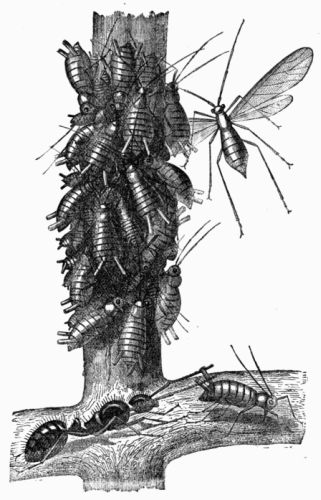
The possession of a flock of plant-lice is sometimes a subject of discord, and becomes a casus belli between two neighbouring ant-hills. But, usually, the war has for its object to make prisoners in other nests, and to carry off part of the inhabitants as slaves. This is the origin of mixed ant-hills, which, independently of their natural founders, contain one or two foreign species, helots whom the conquerors have taken away from their birth-place, to make of them auxiliaries and slaves. In these mixed ant-hills the species imported occasionally exceed in number the original population, as it happens sometimes in those ships which are used in the slave trade, and on which the slaves are often found in greater numbers than the sailors composing the crew. The phalanx of ants reduced to a state of slavery pay all sorts of attentions to their masters. They lick them, brush them, caress them, carry them on their backs, feed them—good and faithful servants that they are—and even rear their progeny. The masters impose on their slaves all sorts of work. They only reserve for themselves the making of war. From time to time they undertake expeditions against some neighbouring ants' nest. If they are conquered and come back without bringing with them any prisoners, the slaves or auxiliaries are sulky to them, and will not allow them for some time to enter the nest. If, on the contrary, they return loaded with booty, they flatter them, give them food, and relieve them of their prisoners, which they lead away into the interior of the fortress. The warlike tribes, however, never carry off any other but the larvæ and nymphs of workers from the ant-hills they plunder. These young captives get used to their kidnappers: brought up in fear of their masters, they never think of abandoning them.
Fig. 368.—Russet Ants (Polyergus rufescens).
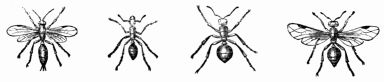
Two species constitute the warrior tribes which form societies mixed with the species they reduce to slavery. They are the Russet Ant (Fig. 368) and the Blood-red Ant (Fig. 369). They always attack the nests of the Ashy-black (Formica fusca) and the Miners.
Fig. 369.—Blood-red Ant (Formica sanguinea).
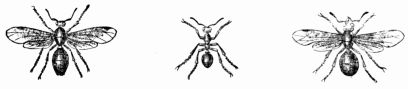
The Russet Ant has mandibles made for war; they appear cut out for struggling and fighting. The Blood-red Ants are less ferocious; they work themselves, and make none of those sweeping raids by which the Russet Ants depopulate the neighbouring ant-hills.
What Peter Huber has done for bees, Francis Huber, his son, has done for the ants. It is from Francis Huber that we borrow the description which it remains for us to give of the habits of ants in times of war. He thus relates one of these expeditions, of which he was a witness:—"On the 17th of June, 1804," says he, "as I was walking in the environs of Geneva, between four and five in the afternoon, I saw at my feet a legion of largish russet ants crossing the road. They were marching in a body with rapidity, their troop occupied a space of from eight to ten feet long by three or four inches wide; in a few minutes they had entirely evacuated the road; they penetrated through a very thick hedge, and went into a meadow, whither I followed them. They wound their way along the turf, without straying, and their column remained always continuous, in spite of the obstacles which they had to surmount. Very soon they arrived near a nest of ashy-black ants, the dome of which rose among the grass, at twenty paces from the hedge. A few ants of this species were at the door of their habitation. As soon as they descried the army which was approaching, they threw themselves on those which were at the head of the cohort. The alarm spread at the same instant in the interior of the nest, and their companions rushed out in crowds from all the subterranean passages. The russet ants, the body of whose army was only two paces distant, hastened to arrive at the foot of the nest; the whole troop precipitated itself forward at the same time, and knocked the ashy-black ants head over heels, who, after a short but very smart combat, retired to the extremity of the habitation. The russet ants clambered up the sides of the hillock, flocked to the summit, and introduced themselves in great numbers into the first avenues; other groups worked with their teeth, making a lateral aperture. In this they succeeded, and the rest of the army penetrated through the breach into the besieged city. They did not make a long stay there; in three or four minutes the russet ants came out again in haste, by the same adits, carrying each one in its mouth a pupa or larva belonging to the conquered. They again took exactly the same road by which they had come, and followed each other in a straggling manner; their line was easily to be distinguished on the grass by the appearance which this multitude of white cocoons and larvæ, carried by as many russet-coloured ants, presented. They passed through the hedge a second time, crossed the road, and then steered their course into a field of ripe wheat, whither, I regret to say, I was unable to follow them." [105]
Huber adds that, having returned to the pillaged nest to examine it more closely, he saw some ashy-black workers bringing back to their home the few larvæ which they had succeeded in saving. Having later discovered the nest of these Amazons, which is the name he gives to the warrior ants, he found there many of the ashy-black ants living on very good terms with their kidnappers.
The Amazons begin their expeditions at the end of June, during the hottest hours of the day. They come out in long files, eight or ten abreast, preceded by their scouts. These columns start at a run, in a straight line, and without feeling their way. They have no chieftain. The van is re-formed every moment. Those who are in front do not remain there; at the end of a certain time they go and range themselves in the rear, and are replaced by those which were behind. The whole troop is thus in constant communication through its entire length. Rarely does the expedition divide into two bodies. Arrived under the walls of the fortress, the column halts and masses itself into one corps. The assault is made with incredible impetuosity. In the twinkling of an eye the place is escaladed, taken by storm, and pillaged, and the ashy-black ants are either put to flight or led away into captivity. The same ant-hill may be invaded as many as three times running on the same day; but then the ashy-black ants, on their guard, have barricaded themselves in, and in that case the aggressors return home without pillaging them.
Fig. 370.—Mining Ant (Formica cunicularia), male, worker, and female.
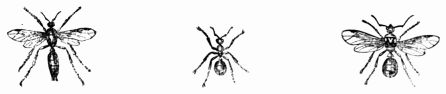
The Mining Ants (Fig. 370) are less timid than the ashy-black; and, as they defend themselves with more energy, there are frequently deadly combats, and the field of battle is left covered with heads, legs, and limbs, scattered about here and there with the dead and wounded. The miners pursue the pillagers, and snatch their plunder from them. But they are sometimes driven back vigorously, and the russet ants gain their lair with the plunder.
The tactics of the Red Ants (Formica sanguinea) differ from those of the russet. They only sally forth in small detachments, which begin by engaging in skirmishes with the scouts thrown out round the enemy's ant-hill. Couriers, despatched from time to time to the camp of the red ants, bring up reinforcements. When the troop feels itself sufficiently strong, it invades the nest of the ashy-black ants, and carries off their offspring, which the latter have not had time to secure. Sometimes, also, the red ants instal themselves in the nest whose inhabitants they have ejected, and transfer their own population to it. The motive for this emigration is that the old nest has become useless, or that it is exposed to some danger. The red ants are not the only ants which thus desert their birth-place. Many species abandon it likewise, for analogous motives, and construct elsewhere another dwelling, to which they transport all the population of the first nest.
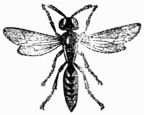
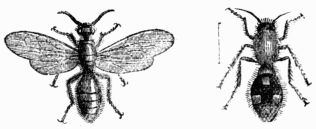
Fig. 371.—Philanthus triangulum. Fig. 372.—Mutilla Europæa, male and female.
When we reflect on the habits of ants, we are forced to admit that intelligence and reason appear still more in their acts than in those of bees. The life of ants, as well as that of bees, as far as we are concerned, is an unintelligible enigma. The acts of animals, in general, are sometimes an abyss unfathomable to our reason. The Orientals say, "The last word may be written on man: on the elephant, never!" Let us add that they should no more say that the elephant will be an inexhaustible theme, but that the history of the ant will continue so always.
The best-known genera of the Fossores, or Fossorial Hymenoptera, are Philanthus (Fig. 371), which feeds its larvæ on bees, having first numbed them by its sting; Pompilus and Sphex, which attack spiders; and Mutilla (Fig. 372), whose females resemble ants, being variegated with red and yellow, the males, being provided with wings and smaller in size, and black. The Mutillæ are parasitical on solitary bees, their larvæ devouring their larvæ.
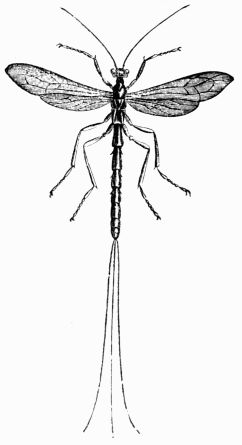
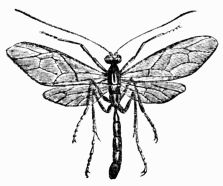
Fig. 373.—A species of Pimpla. Fig. 374.—A species of Ophion.
Other Hymenoptera lay their eggs under the skin of certain insects, especially when these are in the larva or caterpillar state, thus rendering service to agriculture by destroying a great number of noxious insects. In lieu of a sting they have an auger, intended to pierce the skin of their victims. It is thus that the Ichneumons introduce their eggs under the skin of caterpillars. The Pimplas (Fig. 373), which belongs to this group, have a very long ovipositor, which, with its two appendages, constitute three lancets, and enable them to get at the larvæ in their retreats. The Ophions (Fig. 374) have a sickle-shaped abdomen. They lay their eggs on the skin of caterpillars, which they attack with the short cutting auger with which they are provided.
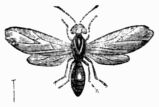
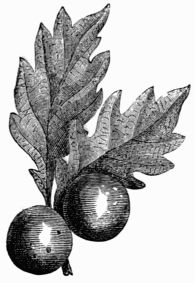

Fig. 375.—Gall insect (Cynips quercusfolii). Fig. 376.—Oak Galls, produced by Cynips quercusfolii. Fig. 377.—Interior of a Gall.
The Cynips, or Gall-insects, are small black or tawny Hymenoptera, the females of which have an auger, rolled up spirally and hidden in a fissure of the abdomen, with which they prick the young shoots of plants. A peculiar liquid which they pour into the hole round the egg they have laid, causes an excrescence to grow, which is called a "gall." The larva is developed in the centre of this gall, and transformed into a pupa; and afterwards into a perfect insect, which makes its exit by a hole in the wall of its prison. Fig. 375 represents the Cynips of the oak tree (Cynips quercusfolii), and Figs. 376 and 377 the galls it produces. The galls of the rose are hairy, and are sometimes called "Robin's Cushion." The gall-nut, rich in tannin, which is used in the manufacture of ink, is the produce of a foreign Cynips, which lives on an oak found in the East. Apples of Sodom, which travellers bring back from the shores of the Dead Sea, are large galls [106] full of dry dust and larvæ.
The Urocerata and the Tenthredinetæ form two tribes of insects, of which the first are of great size, have a cylindrical body, the abdomen being attached to the thorax in its whole breadth, without any pedicle.
Fig. 378.—Sirex gigas.
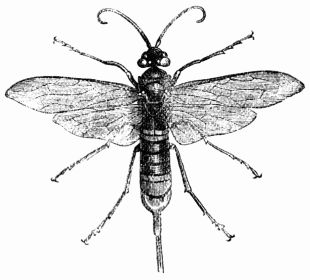
The insects of the genus Sirex (Fig. 378), belonging to the former of these, lay their eggs in living wood, and their larvæ live for many years in the interior. They are to be met with in great numbers in forests of pine trees, and, according to Latreille, show themselves sometimes in such great numbers as to become an object of terror. The female of the Giant Sirex (Sirex gigas) possesses a long rectilinear auger. The mandibles of the larvæ are of great strength, and are even capable of perforating lead. This fact has been observed many times. In 1857 Marshal Vaillant presented to the Académie des Sciences some packets of cartridges containing balls which had been pierced through by the larvæ of the Sirex during the sojourn of the French troops in the Crimea. Some of these insects were still shut up in the gallery which they had hollowed out in the metal. M. Dumeril (and this was one of the last works of that venerable and learned naturalist) wrote a Report on this subject, in which were recorded many analogous instances. He quoted, as an example, that M. le Marquis de Brême, in 1844, showed to the Société Zoologique many cartridges in which the balls had been perforated by the insects to a depth of about a quarter of an inch. These cartridges came from the arsenal of Turin. They had been placed in barrels made of larch wood, the inside of which had been attacked by the insects. It was discovered that it was after having left the wood that they had gnawed through the envelopes of the cartridges, and at last into the balls themselves. In 1833 Audouin presented to the Société Entomologique de France a plate of lead, from the roof of a building, on which this naturalist supposed that the larvæ of a Callidium[107] had made deep sinuosities, as they do in wood. Before this, parts of the leaden roofs at La Rochelle had been noticed not only gnawed, but pierced from one side to the other, by the larvæ of Bostrichus capucinus. [108] In 1844 M. Desmarest reported the erosion and perforation of sheets of lead by a species of Bostrichus and by Callidium. In 1843 M. Du Boys presented to the Société d'Agriculture of Limoges some stereotyped plates—composed, as is well-known, of a very hard alloy, formed of antimony and lead—which had been pierced and riddled with holes by two specimens of a Bostrichus. The holes were a seventh of an inch in diameter by two inches in depth. The stereotypes were thus perforated, although they had been wrapped up in many folds of paper and cardboard. As the printing served for a work called "Les Fastes Militaires de la France," one may say that the brave soldiers received from an insect more wounds than their enemies had ever given them.
To prove that these insects have really the power to perforate metals as others perforate and pass through woody matter, the entomologist of Limoges made the following experiments. He placed in a leaden box, the sides of which were thin, a living specimen of the Fire-coloured Lepture of Geoffroy (Callidium sanguineum), a Coleopteron which is commonly found in houses in France in winter, its larvæ being developed in great numbers in firewood. Above this box he fitted on another, also containing a specimen of this insect, which he shut in with a third box. A few days afterwards he separated the boxes. The middle one had been pierced through, and the two insects were found together, the one which was below having made a hole through which it might introduce itself into the middle box. M. Du Boys made a chemical experiment which enabled him to establish beyond a doubt that the insect which had gnawed the metal had not made it serve as its food. The dried body of one of these insects was analysed. After having immersed it in nitric acid it was completely burnt, and there could not be found in the ashes acted upon by the nitric acid the least trace of lead. This experiment proves that these insects had for their object only to escape from the galleries in which they were accidentally deposited in their larva state, and that it was not until they had undergone their complete transformation that they endeavoured to gain their liberty. Observations of the same kind were multiplied after the Report of M. Dumeril. The Académie des Sciences received, in the month of June, 1861, two Memoirs—one from M. Heriot, captain of artillery, the other from M. Bouteille, curator of the Museum of Natural History of Grenoble—containing many new observations on the perforation by insects of leaden balls contained in cartridges prepared for war. M. Milne-Edwards read to the Académie des Sciences a short Report on these works.
The insect which had produced the perforations observed in the balls sent to the Crimea in 1857, and which M. Dumeril particularly studied, was the Sirex juvencus, and had been taken from France in the wood forming the boxes which contained the cartridges. In the other case of which we are speaking, that is to say, of the cartridges which were sent in 1861 to the Académie by Captain Heriot and by M. Bouteille, the perforations had been produced by other species. M. Milne-Edwards, who found the insect that had caused this strange damage, had no trouble in recognising it as the Sirex gigas, which, in its larva state, lives in the interior of old trees or pieces of wood, and which, after it has gone through all its metamorphoses, comes out of its retreat to reproduce its kind. To clear themselves a passage, they cut away with their mandibles the ligneous substances or other hard bodies they meet with on their road. It was in pursuing this object that the insects, imprisoned accidentally in the packets of cartridges when they were yet only in the larva state, must have attacked the leaden balls, as also the paper and the other matters which they met with on their road, and which opposed their passage. M. Bouteille proves, in his Memoir, that M. Dumeril has committed an error in saying that the perforating organ employed by the Sirex to attack the leaden balls in the cartridges in the Crimea was the auger situated at the extremity of the abdomen of the female, and intended for cutting into that part of the wood where it is to lay its eggs. M. Bouteille has established, in fact, that they were not only the females which attacked the cartridges, but that the males, which have no auger, had occasioned the same damage.
The Tenthredinetæ are called "Saw-Flies," because the females are furnished with a double auger, notched like a saw, with which they cut into the branches in which they lay their eggs. The larvæ of these insects have a striking resemblance to the caterpillars of Lepidoptera. They can only be distinguished from them by a great globular head, not hollowed out, and by their abdominal legs, in general to the number of more than ten. They are called false caterpillars (Fig. 379). Most of them, when touched, erect themselves and move about in a threatening manner. They spin a silken cocoon before changing into pupæ. The Lophyrus pini, which devours the leaves of pine trees, belongs to this family.
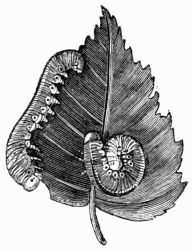
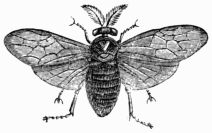
Fig. 379.—Larva of a Saw-Fly. (Tenthredo). Fig. 380.—Lophyrus pini.
VII.
THYSANOPTERA.
The very small black flies which are such a source of annoyance to travellers in the summer-time, and which fly into our eyes and crawl over our faces during the prevalence of warm windy weather, principally belong to a kind of insect which is characterised by having very remarkable wings when in the adult condition. These insects exist by myriads, and there are several species of them; and they are all exceedingly destructive to flowers, and especially to the bloom of cereal plants. The little black insects are to be seen on almost every flower, and they devour the delicate cellular tissues of the petals. Thrips cerealium is very destructive when it occurs in multitudes upon the wheat, barley, and oats, for it interferes with the proper nutrition of the grain, by nibbling the protecting envelopes and the tissue which connects it to the stalk.
Figs. 381, 382.—The Adult Insect and Larva of Thrips cerealium (magnified).
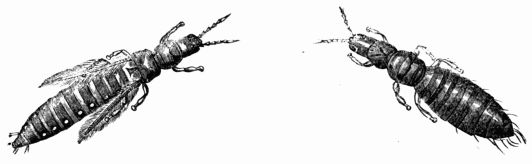
All the members of the genus Thrips—and they alone constitute the order now under consideration—possess four very narrow membranous wings, without any folds or network upon them, but furnished and decorated with beautiful fringes upon the edges. These fringes characterise the Order, which in other respects is closely allied to the Orthoptera, and they give the name to it. The Thysanoptera ([Greek: thysanoi], fringes; [Greek: pteron], a wing) have filiform antennæ and very large eyes, and the different species of the genus Thrips have a great diversity of wing fringing. The structure of the wings is somewhat analogous to that observed in the Lepidoptera, in the Pterophorina and the Alucitina.
The metamorphoses of the Thysanoptera have not received much attention, but they are known to be of the incomplete kind. The quiet chrysalis condition is not observed, and the larvæ are born from the egg greatly resembling the adults. The absence of wings is the great distinction between the larval and the imago state, as it is in the closely-allied order of the Orthoptera. The larva moults several times, and the wings are gradually added, the colour of the insect altering also.
VIII.
NEUROPTERA.
The Neuroptera—the type of which order are the Libellulæ, or Dragon Flies—have four membranous wings, generally rather broad, provided with transverse delicately reticulated nervures, which gives them the appearance of lace. Although one of the least extensive, this Order presents the greatest modifications of form and of habits.
One section of Neuroptera contains some insects which undergo incomplete metamorphoses. The Libellulæ, the Ephemeræ, and the Termites, belong to this category. The insects belonging to the other section, in which are classed the Phryganidæ, [109] or Caddis Flies, the Panorpatæ, and the Myrmelionides, or Ant Lions, undergo complete metamorphoses. The pupæ of the first walk and live absolutely in the same way as the larvæ; only, at the moment of the last transformation, the skin of the pupa splits, and the perfect insect comes forth. In the case of the second, on the contrary, the pupa is motionless, inactive, and takes no food, as in the Hymenoptera, Coleoptera, &c. In spite of this diversity in their mode of development, all these insects resemble each other too much for us to divide the Order; from which it follows that we must not attach too much importance to differences of transformation by which the insect arrives at its perfect state.
The most interesting insects among the Neuroptera are the Termites, improperly called White Ants, on account of the great analogy which exists between their habits and those of ants. They constitute, by their way of living, a striking anomaly in the order in which their conformation places them. In fact, they live in very numerous societies, and build very solid and very extensive dwelling-places—quite Cyclopean or Titanic works in comparison to the tiny dimensions and weak and feeble appearance of the insect. (Plate IX.)
IX.—Nests of White Ants.
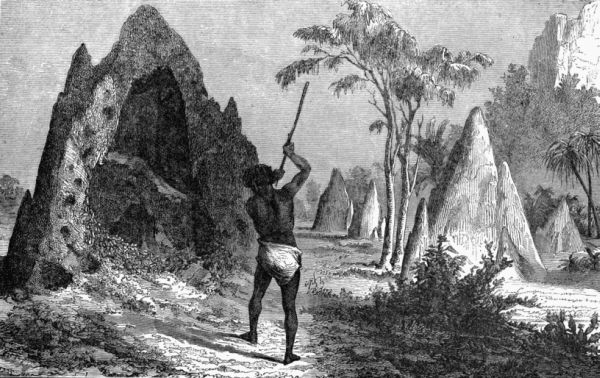
Many travellers have spoken of these insects. They are met with in the savannahs of North America, in Guyana, in Africa, in New Holland, and even in Europe, whither they have been imported. M. de Prefontaine relates that, when he was travelling in Guyana, he saw the negroes besieging certain strange buildings, which he calls ant-hills. They dared not attack them, except from a distance, and with fire-arms, although they had taken the precaution of digging all round them a little fosse filled with water, in which the besieged would be drowned if they made a sortie. These were the termites' nests.
Perhaps it is to termites Herodotus alludes when he speaks of ants which inhabit Bactria, and which, larger than a fox, eat a pound of meat a day. [110] Retired in the sandy deserts, these gigantic insects hollow out (says he) subterranean dwellings, and raise mounds of golden sand, which the Indians carry away at the peril of their lives. Pliny, who relates the same fables, adds that there were to be seen in the Temple of Hercules the horns of these ants. Even in our own days some travellers have repeated absurd fables about termites. They have attributed to them a venom which one cannot breathe without being poisoned; they have said that a single bite was enough to cause a mortal fever. The truth, as it is revealed to us by conscientious observers, is still stranger than these fictions or errors. The termites present curious modifications, on the nature of which naturalists are not agreed. There are, in the first place, the perfect insects, males and females, which are provided with wings; then there are the neuters, which are divided into soldiers, whose duty it is to defend the nest, and into workers, upon whom devolve the architectural works and household cares. These last are smaller than the soldiers. Latreille and some other naturalists think that these workers are the larvæ of the termites. Smeathman thinks that the soldiers are the pupæ. M. de Quatrefages admits that the soldiers are the neuters, and that the workers are recruited both from the larvæ and from the pupæ. It may be admitted, with other naturalists, that the soldiers and the workers are neuters: the first, abortive males; the second, abortive females. Here is, indeed, what M. Lespès has observed in the termites of the Landes. Among these insects, the most numerous are the workers: their size is that of a large ant, and their duties are to excavate galleries, to search for provisions, and to take care of the eggs, the larvæ, and the pupæ. The workers have a rounded head and short mandibles, and are blind. The soldiers, less numerous, have an enormous head—nearly as big as the rest of their body—very strong, crossed mandibles, and are blind like the workers. Anatomy showed M. Lespès that both are neuters—that is, the soldiers, males, and the workers, females—with aborted organs.
The larvæ of the females much resemble the workers. Those which are to become males or females are distinguished from those which are to become neuters by very slight rudiments of wings, and their pupæ show already imperfect wings, hidden in cases; furthermore, they have eyes hidden under the skin. The males and females alone have eyes; they also have wings, which they lose immediately after the coupling. Those which proceed from the pupæ with long wing cases become small kings and queens after their swarming, which takes place at the end of May. The pupæ with short wing-cases become perfect in the month of August, and produce larger males and females, which become kings and queens. All these couples are collected by the neuters; and the queens, large and small, set to work immediately to lay. The largest are much the more fruitful. The workers do not seem to take any care of them at all. With the exception of this last peculiarity, everything probably goes on in the same manner with the exotic termites; but with the latter the queen is an object of worship.
Fig. 383 represents the four types of the republic of the Termes lucifugus. On the left is a worker, on the right a soldier, in the centre a winged male, all three very much magnified, the lines drawn by their side showing the natural size. Below the male is the pregnant queen (D D D D), of a species of which we are about to speak, of the natural size.
Many species of termites were studied with care by the English traveller, Smeathman, at the end of the last century, in Southern Africa. His account of them is the most exact and most complete which we have of these insects. [111] The largest of the species observed is the Termes bellicosus. The workers are a fifth of an inch long, the body soft, and of an extreme delicacy, but the sharp mandibles capable of attacking the hardest bodies. The soldiers are twice as long, and weigh as much as fifteen workers, and may be distinguished by their enormous horned head, armed with sharp pincers. The male weighs as much as thirty workers, and attains to a length of nearly four-fifths of an inch.
Fig. 383.—Termes lucifugus. Male (A), Worker (B), Soldier (C), magnified. Fecundated female of Termes bellicosus, natural size, surrounded by workers (D D D D).
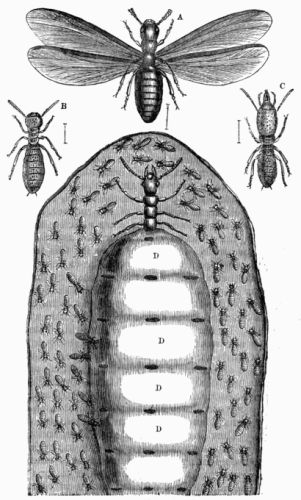
But the pregnant female leaves all these dimensions far behind. Her abdomen becomes two thousand times as big as the rest of her body! She then attains to six inches in length, and weighs as much as thirty thousand workers. By a hideous contrast, the head alone does not increase in size. d d d d (Fig. 383) is an exact representation of this monster. She is always motionless and captive in her cell, entirely occupied in laying. Her fecundity surpasses all bounds: sixty eggs a minute, more than 80,000 a day. Smeathman is inclined to think that this prodigious laying goes on during the whole of the year. "This soft, whitish beast," says M. Michelet, "a belly rather than a being, is as large, at least, as one's thumb; a traveller professes to have seen one of the size of a crawfish. The larger she is, the more fruitful, the more inexhaustible, this terrible insect-mother seems to be the more adored by the fanatical rabble. She seems to be their beau ideal, their poetry, their enthusiasm. If you carry away with any rubbish a portion of their city, you see them instantly set to work at the breach to build an arch which may protect the venerated head of the mother, to reconstruct her royal cell, which will become (if there are sufficient materials) the centre, the base of the restored city. I am not astonished, though, at the excessive love which this people show for this instrument of fecundity. If all other species did not combine to destroy them, this truly prodigious mother would make them masters of the world, and—what shall I say?—its only inhabitants. The fish alone would be left; but insects would perish. It suffices to be remembered that the mother-bee does not produce in a year what the female white ant can produce in a day. By her they would be enabled to devour everything; but they are weak and tasty, and so everything devours them."[112] In fact, birds are very greedy after termites; poultry destroy immense quantities of them. Ants give chase to them and eat them by legions. The negroes in Southern Africa cannot be sated with them. They gather such as have fallen into the water, and roast them like coffee; thus prepared, they eat them by handfuls, and find them delicious. The Indians smoke the termites' nests, and catch those that have wings. They knead them up with flour, and make a sort of cake of them. Travellers, moreover, all agree in speaking of them as very nice food, comparing their flavour to that of marrow or of a sugared cream. Smeathman prefers them to the famous palm worm (ver palmiste of the colonists), a delicacy known in South America, which is the larva of the Calandra palmarum, a species of beetle. It seems, however, that an abuse of fried termites brings on a dysentery which may prove mortal.
X.—Nest of the White Ant (Termes bellicosus), in Central Africa, after Smeathman. 1. Male. 2, 4, 5. Neuters. 3. Gravid Female.
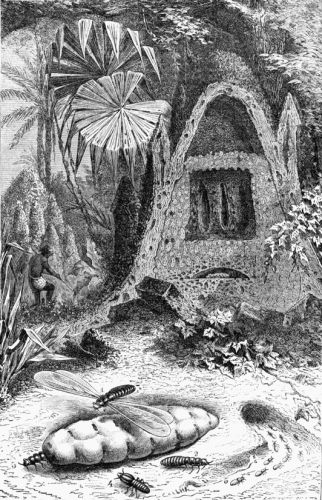
All the species of termites are miners, but the greater number are also architects and masons. A few make their nests round a branch of a tree. This nest is of enormous dimensions: it is as large as a tun. The illustration (Plate X.)—after a drawing in Smeathman's work—shows a nest of the Termes bellicosus, composed of bits of wood firmly stuck together with gum. Above their subterranean galleries the greater part of termites construct vast edifices, which contain their magazines and nurseries. The Termes mordax and Termes atrox raise perfect columns, surmounted by capitals which project beyond them and give them the appearance of monstrous mushrooms. These columns attain a height of twenty inches, with a diameter of five; they are constructed with a black clay, which, worked up by the insects, acquires great hardness. The interior is hollow, or rather perforated with irregular cells; but the most curious edifices are those of Termes bellicosus. These are irregularly conical mounds, flanked by a certain number of turrets, decreasing in height. Smeathman gives them a height of from ten to twelve feet; but Jobson[113] affirms that he has seen some as high as twenty feet. If men constructed monuments so disproportionate to their size, the great pyramid of Giseh, instead of being 146 mètres in height, would be 1,600, and would be higher than the Puy-de-Dôme!
These knolls of earth are of a solidity which will bear any trial. Not only can many men mount on them without shaking them, but buffaloes establish themselves upon them as watch-towers, from which they can see over the high grass which covers the plain, if the lion or the panther is threatening them. These edifices are hollow; but their sides are from fifteen to twenty inches thick, and are as hard as a rock. They are hollowed out into galleries, which connect them with the underground dwelling. Under the dome is a pretty large vacant space, a sort of top storey or attic, occupying one-third of the total height, and which keeps up in the edifice a more uniform temperature than if all the block had been filled up. On a level with the ground is the royal cell, oblong, with a flat floor and a rounded ceiling, and pierced with round windows. All round are distributed the offices; they are rooms also with rounded and vaulted ceilings, communicating with each other by corridors. On the sides rise the magazines, with their backs placed against the walls of the house; they are filled with gums and with vegetable juices solidified and in powder. On the ceiling of the royal chamber rise pillars of about two feet in height, which support the egg rooms. These are little cells with partitions of saw-dust stuck together with gum, which separate at the opening the large chambers from the clay halls. Placed between the attics and the great nave surmounting the royal hall, the nursery is in the most desirable position possible for uniformity of temperature and for ventilation.
The royal cell encloses a unique couple, objects of the most assiduous attentions, but kept in closest captivity, for the doors are too narrow to afford a passage to the monstrous queen, and even to the male, who keeps generally crouching by her side. Thousands of servants busy themselves round the mother; they feed her and carry away, night and day, the myriads of eggs which she lays. The eggs are placed in the egg houses, where they give birth to white larvæ, resembling the workers, which nourish themselves at first on a sort of mouldy fungus which grows on the partitions of their cells. They then become pupæ, then neuters, or males and females, the last two being provided with wings.
On a stormy evening the males and females come out of their nest by millions to couple in the air; then immediately afterwards they fall to the ground and lose their wings, when they become an easy prey to their enemies. A few couples only, picked up by the workers, are put under shelter, and become the nucleus of a new colony. The soldiers have no other occupation but to defend the nest. If man attacks them, at the first blow with the pick-axe they are to be seen running out furiously. They attack their aggressors, pierce them till they bring blood, and with their sharp pincers hang on to the wound, and allow themselves to be torn to pieces rather than leave go their hold. The negroes who have no clothes are soon put to flight; Europeans only get off with their trousers very much spotted with blood. During the combat, the soldiers strike from time to time on the ground with their pincers, and produce a little dry sound, to which the workers answer by a sort of whistling. The workers immediately make their appearance; and with their pellets of mortar set to work to stop up the holes, and to repair the damage. The soldiers then re-enter, with the exception of a small number, who remain to superintend the work of the masons; they give, at intervals, the usual signal, and the workers answer by a whistling which means, "Here we are!" as they redouble their activity. If the attack recommences, the soldiers are at their posts, defending the ground inch by inch. During this time the workers mask the passages, stop up the galleries, and wall up with care the royal cell. If you manage to penetrate as far as this sanctuary, you may pick up and carry away from the cell which contains them the precious couple without the workers in attendance on them interrupting their work, for they are blind.
They never venture in sight except in extreme cases. No one is ignorant of the terrible destruction these insects occasion to the works of man. Invisible to those whom they threaten, they push on their galleries to the very walls of their houses. They perforate the floors, the beams, the wood-work, the furniture, respecting always the surface of the objects attacked in such a manner that it is impossible to be aware of their hidden ravages. They even take care to prevent the buildings they eat away from falling by filling up with mortar the parts they have hollowed out. But these precautions are only employed if the place seems suitable, and if they intend to prolong their sojourn there. In the other case they destroy the wood with inconceivable rapidity. They have been known, in one single night, to pierce the whole of a table leg from top to bottom, and then the table itself; and then, still continuing to pierce their way, to descend through the opposite leg, after having devoured the contents of a trunk placed upon the table. On account of the devastations which they occasion, Linnæus has called the white ant the greatest plague of the Indies.
There exist in France two species of termites, the Termes lucifugus, a little insect of a brilliant black (at least in the male), with russety legs, which is common enough in the moors of Gascony; and the Yellow-necked White Ant (Termes flavicollis), which lives in the interior of trees and does a great deal of mischief in Spain and in the south of France to olive and other precious trees, whilst the first attacks oak and fir trees. Latreille established that it is the Termes lucifugus which causes such havoc at La Rochelle, at Rochefort, at Saintes, at Tournay-Charente, in the Isle of Aix, &c., where many houses have been completely undermined by these terrible insects. But M. de Quatrefages [114] has proved that the habits of the termes found in towns differ in many essential points from the habits of termes in the country. And so it is most probable that the former belong to an exotic species, which must have been unfortunately imported into France by a merchant vessel. According to M. Bobe-Moreau, [115] it was only in 1797 that termites were discovered for the first time in Rochefort, in a house which had stood for a long while uninhabited, and which they had completely undermined. In 1804, Latreille relates, as a "hearsay," that the termites had for some years made the inhabitants of Rochefort uneasy; but in 1829 the same author tells a very different tale. He speaks with dismay of the ravages committed by this insect in the workshops belonging to the Royal Navy. The importation of the termes into France is then of recent date. A note which was sent to M. de Quatrefages by M. Beltrémieux, fixes with still greater accuracy the date of the importation of the termites; it must have taken place about 1780, a period at which the brothers Poupet, rich shipowners, caused bales of goods to come from St. Domingo to Rochefort, to La Rochelle, and to other places in that neighbourhood which possess storehouses. The ravages which the termites have committed in the towns of La Saintonge are really frightful. Like Valencia, in New Granada, these towns will find themselves one of these days suspended over catacombs. At Tournay-Charente, the floor of a dining-room fell in, and the Amphytrion and his guests tumbled together in the cellar. There may be seen in the galleries of the Museum of Natural History of Paris the wooden columns which supported this room, and which were preserved by Audouin, who had been sent on a mission to report on the damages done. Audouin also selected, as an object of curiosity, a lady's bridal veil, which had been entirely riddled with holes by the termites.
At La Rochelle these insects took possession of the Prefect's house (built by the brothers Poupet), and of the Arsenal. There they invaded offices, apartments, court, and garden. They could not drive in a stake, or leave a plank in the garden, but it was attacked the next day. One fine morning the archives of the department were found destroyed, without there being the smallest trace of the damage to be seen on the exterior. The termites had mined through the wood-work, pierced the cardboard, eaten up the parchments and the papers of the administration, but had always scrupulously respected the upper leaf and edges of all the leaves. It was by mere chance that a clerk, less superficial than his colleagues, one fine day raised one of the leaves which hid this detritus, and thus discovered the destruction of the archives. All the papers of the Prefecture are now shut up in boxes of zinc.
These termites do not venture, any more than their congeners, into the light of day. These terrible miners always envelop themselves in obscurity, and construct on all sides covered galleries as they advance into a building. M. Blanchard and M. de Quatrefages saw in La Rochelle the galleries made by them. They are tubes formed of agglutinated material, which are stuck along the walls in the cellars and the apartments, or else suspended to the roof like stalactites. Certain parts of Agen and of Bordeaux begin also to suffer from the ravages of these insects. The danger appears to be imminent.
We are indebted to M. de Quatrefages for some interesting experiments on the termites of La Rochelle. Not only has the learned naturalist helped to make known to us the habits of these dark-loving insects, but he has also told us how to destroy them. Different substances have been tried in vain to stop these terrible ravages—essence of turpentine, arsenical soap, boiling lye, &c. M. de Quatrefages had recourse to gaseous injections. He tried successively binoxide of nitrogen, nitric acid, chlorine and sulphurous acid; chlorine, above all, fully answered his hopes. With pure chlorine he killed the termites instantaneously; mixed with nine-tenths of air, he suffocated them in half an hour. "For attacking the termites," says M. de Quatrefages, "one ought to choose by preference the period of their reproduction, so as to destroy the pregnant females. It is probable that, like their exotic congeners, the termites of France will endeavour to defend themselves by walling up the interior of their galleries at the first signs of an attack. The operator must then act with a great deal of promptitude, and direct the apparatus as much as possible into the very centre of their habitation, where the galleries are the broadest and the most numerous.
"With whatever care one acts, and whatever may be the success of a first attempt, it seems to me impossible to destroy in one campaign all the termites of a locality. In this, as in all operations of the same kind, a certain amount of perseverance is necessary, especially if it is in a town or in a country infested by them to a very great degree; in that case one will be forced to repeat the operation from time to time. When, on the contrary, the termites are already cantoned, it seems to me that the success ought to be lasting. This is fortunately the case at La Rochelle; and by knowing how to profit by it, one may doubtlessly prevent the spread of these pests, which at one time or another, may attack the whole town." [116]
In 1864 the Lords of the English Admiralty addressed an inquiry to the Entomological Society of London, on the best means of preserving wood from the attacks of the Indian termites. In answer to this inquiry, the Entomological Society recommended many processes: the injection of quicklime or of creosote, the application of arsenical soap, &c. But it does not appear that these processes are infallibly efficacious, nor, above all, easy to employ.
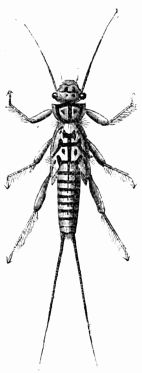
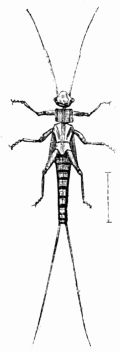
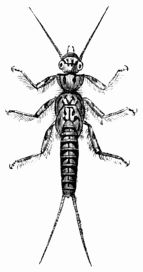
Fig. 384.—Larva of Perla bicaudata. Fig. 385.—Larva of a Nemoura. Fig. 386.—Perla marginata (larva).
Among other Neuroptera which undergo incomplete metamorphoses, we may mention, first, the genera Perla and Nemoura, [117] (Figs. 384, 385, and 386), which flutter about the banks of rivers, and settle on stones, shrubs, and aquatic plants. Their larvæ are naked, without cases, and always live in the water, hiding themselves under stones, to watch for small insects, for they are carnivorous. One sees them often balancing their bodies, holding on to a pebble. They go through the winter, and only become pupæ in the spring. After moulting, they have the rudiments of wings. Very soon afterwards the pupæ leave the water, and undergo their metamorphosis. The adult lives only a few days, for its mouth is not suited for re ceiving food. The larvæ have, at the end of their bodies, two long threads, which remain in the perfect Perla, but not in the perfect Nemoura; the latter lose the two caudal hairs when they arrive at the adult state. One species of Perla is very common on the quays of Paris.
Fig. 387.—Perla bicaudata.
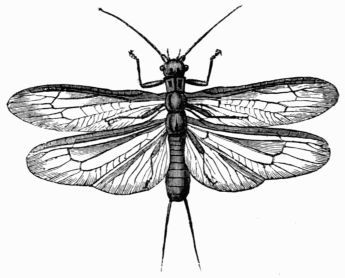
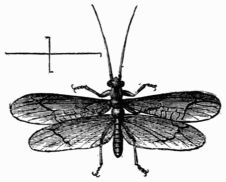
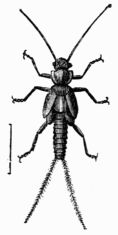
Fig. 388.—Nemoura variegata. Fig. 388.—Nemoura variegata (larva).
The Ephemeridæ, or May-Fly family, have long, slender bodies, provided with two or three long silky hairs. Their name indicates the short duration of their existence. They appear in great numbers at certain seasons of the year. Their hatching takes place at sunset; they have coupled and laid their eggs by sunrise next day, and have ceased to live; so that the banks of rivers, of ponds, of lakes, are strewed with their bodies. Their number is sometimes so considerable that, according to Réaumur, the soil seems as if it were covered with snow, and they are gathered up for manure. The common Ephemera, or May-Fly (Ephemera vulgata, Fig. 390), is of a brown colour, banded with yellow, and the wings smoky, with brown spots. These insects are remarkable for their elegant flight; they are continually rising and falling. When they move their wings they rise; but if their wings, though spread out, remain motionless, as also the silky hairs which form their tail, they fall again. They may be seen in myriads in places where there is much water.
Fig. 390. Ephemera vulgata, imago.
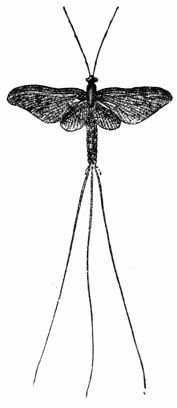
We have said that the Ephemeræ live only for a few hours. This is the general rule; but their existence can be prolonged for ten or fifteen days by preventing their copulation. If, however, the duration of the life of these insects is so short when they have reached the perfect state, and when the conformation of the mouth prevents them from taking any nourishment, their larvæ state is of very long continuance. Swammerdam says, in his curious Memoir, entitled "Vita Ephemeri," it is not less than three years.
The females lay their eggs in one single mass, and let them fall into the water, in the form of a packet. The larvæ which come out of them are very active, and swim with great ease; but generally conceal themselves under the pebbles at the bottom. The sides of their abdomen are provided with gills, very much fringed, which serve them, not only for breathing the air under the water in the same way that fish do, but also for swimming. The larvæ have, at the extremity of their body, two or three hairs, like the perfect insect. They hollow out galleries in the beds of rivers and ponds, and live on small insects. The pupa (Fig. 392) differs only from the larva (Fig. 391) in having the rudiments of wings. When about to undergo their metamorphosis, they come out of the water and cling to plants, &c. The skin cracks on the back when it is dry, and there comes out a heavy insect, which flies feebly, and has opaque wings. It is still enveloped in a very thin skin, of which a last moult, after a few hours, frees it. This skin remains sticking to the plant on which the moulting was effected, preserving the shape of the insect. This moult is peculiar to the Ephemeræ; it is the transition from the false imago (pseudo-imago) to the imago.
In the same family is the genus Cloëon, whose larvæ prey on minute insects. The Cloëon diptera (Fig. 393), which has only two wings, is often to be met with in houses, resting on the window panes and curtains. All these insects keep badly in collections; they lose their shape, and their members are so fragile that the least shock suffices to break them.
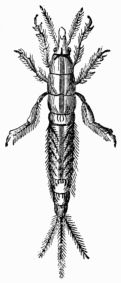
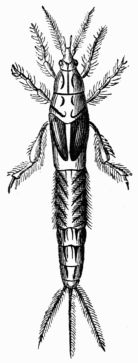
Fig. 391.—Larva of an Ephemera. Fig. 392.—Pupa of an Ephemera
The Libellulas, or Dragon-Flies, are insects of a well-defined type. The elegance of their shape, the grace of their movements, have won for them among the French their common appellation of "Demoiselles." They are always of largish size. Many are of bright and metallic colours, which are not inferior in beauty to those of butterflies. Their wings, of an extreme delicacy, always glossy and brilliant, present varied tints; sometimes they are completely transparent, and have all the colours of the rainbow. Often, the colour of the males differs from that of the females. They may be seen fluttering about on the water during the whole summer, especially when the sun is at its highest. They fly with extreme rapidity, skimming over the water at intervals, and escaping easily when one wishes to catch them. Nothing is prettier than a troop of dragon-flies taking their sport on the side of a pond or on the banks of a river, on a fine summer's day, when a burning sun causes their wings to shine with most vivid colours.