Part 11 / Book 2 — CHAPTER VII THE BIRTH OF GERMAN NATIONALITY [843-936 A.D.] (continued 2)
Reading edition
Larger fortified towns were at that time still unknown in Saxony and Thuringia; only on the banks of the Rhine and the Danube, and beyond these rivers where the Romans had once lived, were there on German soil populous towns with fortified walls and towers, which, however, since the expeditions of the Normans and the Hungarian wars, lay mostly in heaps and ruins. The Saxons according to ancient custom still lived in single houses standing alone in the midst of their fields and meadows, or else they assembled in open villages. Only here and there arose royal palaces and castles of the nobles, only here and there were the enclosed seats of bishops, priests, and monks, the first gathering-places of a more active intercourse. The boundaries were also poorly protected; the strongholds which Charlemagne had once laid out had been mostly destroyed in the wars against the Danes and Wends. The land thus, without being able to offer any resistance, lay open to the inroads of the enemy, which could not be checked in the interior either, on account of the scattered settlements. The first necessity, therefore, seemed to Henry to be to enlarge the existing forts and fortify them more strongly, to lay out new strongholds so as to be able to assemble larger forces in secure places. This was especially imperative on the frontiers in order to repulse the enemy on the very threshold.
Henry had already succeeded in destroying the Serbs on the Saale, and at the same time the Wendian tribes which had forced their way across the middle Elbe had been driven back across the river. In these frontier regions, which had fallen to him as the victor, Henry had settled large numbers of his dependents and bound them to military service in return for larger or smaller fiefs. He had thus at the same time established military colonies on the conquered territory, and here, where everything was on a military footing, and in the neighbouring districts which stood mostly under the same leadership with the marks he had free hand to carry out his plans. In the same way King Edward of England had a few years before restored or newly built a long line of frontier forts, and thus secured his realm against the inroads of the enemy; perhaps Henry in his undertakings had the example of the Anglo-Saxons in mind.
Day and night people were now at work building in the frontier districts. House had to adjoin house, and court, court; everything was surrounded with walls and ramparts. The work went on without a moment’s pause. Henry encouraged the people to unaccustomed efforts, because he wished them to become hardened in times of peace, so that they would be better able to endure the privations of war. Thus there grew up in those districts settlements surrounded with walls and ramparts: smaller places were enlarged, destroyed fortifications restored; often large numbers of human habitations suddenly sprang up, where before only a simple hut had stood. At that time, Quedlinburg in the Harz was wholly rebuilt; Merseburg, which was always a place dear to the king, was enlarged and surrounded by a stone wall.
Henry at the same time opened at Merseburg an asylum for criminals; this was done in order to populate the town and make it capable of defending itself against the enemy. These suspicious characters lived in a suburb of Merseburg, whereas the citadel itself was occupied by more reliable dependents. These criminals were called the Merseburgans, and formed a troop of soldiery which Henry seems often to have used in especially dangerous enterprises. “It was,” says Wittekindf [the historian], “a band composed of robbers; for the king, who liked to be mild towards his subjects, exempted even thieves or robbers, when they were brave and warlike men, from their deserved punishment and caused them to settle in the suburb of Merseburg. He gave them fields and arms and ordered them to keep the peace with their countrymen; against the Wends, however, he let them make plundering expeditions as often as they pleased.” So strong was this Merseburg troop that a few years later it furnished 1,000 men for the war with Bohemia.
But also in other ways Henry tried to increase the population of the fortified towns. He commanded all diets, popular gatherings, and festivities to be held within the walls of the citadel; as often as the Saxons came together they were to assemble in the strongholds so that they might gradually become accustomed to life in enclosed places, which they still regarded as imprisonment. Here also he perhaps was following the example of King Edward, who in the same way ordered all commercial dealings to be conducted within the gates of the citadel. But the fortified places of Saxony and Thuringia were not only to provide the possibility of offering a strong resistance to a fresh attack of the enemy; they were at the same time to provide refuge and safety to all the inhabitants of the frontier regions. Consequently every ninth man had to move into the town to erect a dwelling for himself and his eight companions, and also to provide granaries and storehouses, since the third part of all the fruits of the field which were produced had to be delivered in the citadel and were there stored. The eight, however, who remained outside cultivated the field of the one within, sowed it and harvested it, and brought the harvest into his granaries. Without the citadel there could be no buildings, or only worthless ones, since these were destroyed at the first attack of the enemy.
His military provisions, so far as can be seen from the scanty records, dealt with feudal service in Saxony, which he compelled from now on to be rendered in horses and mounted soldiers. Henry remodelled the organization of the army and the conduct of war, and brought them into new lines which were followed by the Germans for a long time afterward.
[924-929 A.D.]
Henry was occupied four years with the ordering of all these things. “My tongue,” says Wittekind,f “cannot tell with what precaution and watchfulness he did everything at that time which could help to protect the fatherland.” As soon, however, as Henry knew that his army was in fighting trim, he used it to attack the Wend tribes (928). They were the nearest enemies of the empire and of Saxony, and at the same time less dangerous than the Hungarians; so that the war against them was considered the best school to prepare for the stronger enemy. The first attack was upon the Hevelli, a Wend tribe, which dwelt on both sides of the Havel and on the lower Spree. Several times they fought, and Henry conquered each time, penetrating finally to the chief stronghold of the tribe, the present Brandenburg. The city, at that time called Brennaburg, lay surrounded by the Havel. It was midwinter when Henry laid siege to it, and he pitched his camp on the ice. Ice, iron, and famine,—the three brought about the fall of Brennaburg, and with it the whole of the land of the Hevelli fell into the hands of the conqueror.
Henry next proceeded southward against the Daleminzi, against whom he had won his first laurels. They were familiar with the strokes of Henry’s sword and did not dare to meet him in open battle. They shut themselves up within their stronghold, Gana, but this also was taken on the twentieth day. Deadly hatred had long reigned between Wends and Saxons, which here demanded sanguinary sacrifices. The city was plundered, the grown men were killed, the children sold as slaves. Severe custom would have it thus, and the German has taken his word “slave” from the Slavs.
Henry also proceeded against the Czechs in Bohemia, whose lands adjoined those of the Daleminzi, with whom they were tribally related. Only since one generation had the tribe been ruled by one family, that of the Premyslids; Christianity had made some headway under this single rulership, although it found difficult entry among the stiff-necked tribe.
A more powerful resistance was to be expected from this numerous tribe, united under one rule, than from the other Slavic stems. Therefore the king called on Duke Arnulf for aid, and a Bavarian army advanced through the Bohemian forest, at the same time with the king, into the land of the Czechs. It was the first time that the Bavarians had given the Saxons military attendance. They penetrated clear into the centre of the country where Prague is located on the bank of the swift Moldau. Here the young Bohemian duke Wenceslaus, who had already accepted Christianity through the influence of his pious grandmother, Ludmilla, surrendered himself and his land to the king (929). He received it again in fief and from now on paid the Saxons a tribute, which perhaps already at that time, as later, consisted of 500 silver marks and 120 oxen. From that time on the kings of Germany demanded feudal service and obedience from the Bohemian princes, until finally the land itself at a much later period fell to the German princes.
[929 A.D.]
While the king himself was subjugating these Slavic stems, his counts had fought with success against the Wends living in the north. The Redarii living in the lake districts north of the Havel as far as the Peene were first conquered, then the Abodriti and the Wilzi who dwelt north and west of them clear to the shores of the Baltic. Within a short time the greatest part of the land between the Elbe and Oder was won for Saxon rule, but the hard will of the Wend tribes living in these districts was not broken and the blood of their relatives which had been shed cried for vengeance. First the Redarii arose in rage against German rule; they gathered together and fell upon Walsleben. The strongly fortified town was at that time well populated, but it could not defend itself against the superior numbers of the enemy. It was taken by assault and all its inhabitants were killed; not one saw the light of the coming day. This was a signal for a general uprising. The Wend tribes of the north arose to a man, to throw off the hated yoke of the Saxons.
Henry prepared quickly for battle and ordered Count Bernhard, to whom he had intrusted the guardianship of the Redarii, and Count Thietmar, to begin the war at once, by the siege of Lenzen, a stronghold which was in the hands of the Wends. The Saxon militia was assembled as well as possible in the general haste, and together with the war forces from the marks, was placed under Bernhard’s command. When Lenzen had been besieged for five days, it was announced by spies that an army of Wends was in the vicinity and that it would attack the Saxon camp at the fall of night. Bernhard at once assembled his warriors in his tent and ordered them to remain under arms the whole night. The crowd separated and each gave himself up to joy or sorrow, hope or fear, according to whether he desired the battle or not. Night came on; it was darker than usual, the sky covered with heavy clouds, and the rain fell in torrents. In such weather the courage of the Wends sank and they gave up the attack. When, however, the morning dawned, although the Saxons had been under arms all night, Bernhard decided to venture an attack himself, and gave the signal for battle. Thereupon all took an oath forgiving themselves their failings and each other their ancient feuds—such was the custom before a battle—and with a solemn oath swore to support and aid each other in the strife as they would their leaders. Then when the sun came up—the sky shone in clear blue after the storm of the night—they marched out of camp.
At the first assault Bernhard had to give way before the superior force of the enemy. But he noticed that the Wends had no more cavalry than he, although they had countless numbers of infantry which moved forward on the muddy ground only with great difficulty and was driven back by the force of the cavalry. Consequently he did not lose courage, and the confidence of himself and his followers increased when they saw that a dense steam went up from the wet garments of the Wends, whereas they themselves were surrounded with clearest light; it was as if the God of the Christians were fighting with them against the heathen. Again the signal for attack was given, and with a joyful war cry they charged on the ranks of the enemy. The Wends stood close together, and it was attempted in vain to break a path through their compact ranks; only on the right and left were a few isolated squads of Wends attacked, conquered, and killed. Much blood had already been shed on both sides and the Wends still kept their stand. Then Bernhard sent a messenger to Thietmar asking him to hasten to the help of the army, and the latter quickly sent a captain with fifty knights clad in armour, to attack the enemy from the side. With the rattle of armour this band charged like a tempest upon the Wends; their ranks wavered, and soon the whole army broke into the wildest flight. The sword of the Saxons raged in all parts of the field. The Wends tried to reach Lenzen, but in vain; for Thietmar had occupied all the roads. Thereupon many of them in despair plunged into a neighbouring lake, and those whom the sword had spared found death in the waves. Not one of the infantry escaped and very few of the cavalry. Eight hundred were taken captive; they had been threatened with death and they all found death on the following day. More than one hundred thousand Wends were said to have perished. The Saxons also suffered severe losses and lost many a noble man from their army. With this victory the war was ended. The battle was fought on September 4th, 929; Lenzen surrendered the next day. The inhabitants laid down their arms and asked only for their lives; this was granted them, but they had to leave the city naked. Their wives and children, their slaves, their possessions—all fell into the hands of the conquerors.
[929-933 A.D.]
Bernhard and Thietmar won great renown above all the German people, because they had won a glorious victory over an innumerable army of the detested Wends with a comparatively small force collected in haste. The king received them with the greatest honour, and from his mouth their deeds received the highest tribute. Other joyful sounds mixed with the jubilee of victory. Just at that time Henry was celebrating the marriage of his eldest son Otto. He had chosen a life companion for him from the royal family of the tribally related Anglo-Saxons; the beautiful Editha, daughter of King Edward and a sister of King Athelstan, who at that time ruled England with a strong hand, was to be led to the altar by Otto. Athelstan had felt himself so flattered by Henry’s suit that he sent over to Germany not only Editha, but also her sister Elgiva; Henry and Otto might choose between the two. Accompanied by Athelstan’s chancellor Thorketul, the princesses sailed up the Rhine as far as Cologne, where they were met by Henry’s ambassadors. Editha remained the chosen one and the marriage was celebrated at once with great pomp (930). As a rich dowry from her husband Editha received Magdeburg and many beautiful estates in Saxony.
But the nine years of the truce with the Hungarians were now nearing their end and war was again threatened with these most terrible enemies of the empire. Henry had made good use of his respite. Saxony was protected by firm strongholds, the king had at his disposal an army experienced in war and faithfully attached to him; it was now time to measure swords with the old enemy. It was not long until the ambassadors of the Hungarians appeared to demand the tribute as usual, but they returned this time with empty bags. Thereupon the mounted bands of the Hungarians saddled quickly, and countless swarms took their way towards the west through the land of the Daleminzi; but the latter knew that Henry was prepared for war, and instead of the demanded tribute they scornfully threw a fat dog before the enemy. However angry the Hungarians were at this insult, they nevertheless did not stop for revenge, but hurried on to the land of Thuringia, which they laid desolate in the winter of 932-933. When Thuringia could no longer support the large numbers of the enemy, a part of the army proceeded further west in order to attack Saxony from another side.
[933-934 A.D.]
Henry had already collected a strong force of cavalry from Saxony and Thuringia and had ordered out the militia. Also from Bavaria and the other lands subject to him, many knights, it is related, had hurried to his standard. Quietly he awaited the moment when the countless swarms of the enemy should separate. Scarcely, however, had that troop separated and started towards the west, than Saxons and Thuringians attacked it impetuously. In a sanguinary battle the leaders of the enemy fell and their hordes fled panic-stricken in all directions. Many perished from the winter frosts, others died of hunger; a large number fell into captivity.
The other, larger part of the Hungarian army, however, which had remained in the east, in Thuringia, had in the meanwhile been informed that there was a castle in the neighbourhood where lived a sister of the king—she was born to Duke Otto out of wedlock and had married a Thuringian named Wido—in which there was much gold and silver. Consequently they at once set out and assaulted the castle. They would have taken it at the first attack if the fall of night had not put an end to the battle. Scarcely, however, were their arms at rest, when they heard of the defeat of their companions, of the victory of the Saxons, and of how King Henry was advancing against them with a powerful army. They lit great bonfires to collect their scattered troops and at once began their retreat.
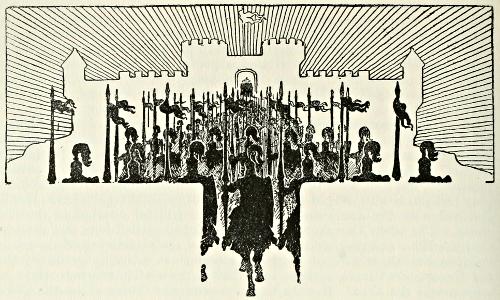
Henry was camped that same night not far from the Hungarians in a place which was then called Riade, perhaps the present Rietheburg, in the golden meadow on the Unstrut, where many strongholds of the Luidolfings were scattered on all sides. When morning broke and it was learned how near the enemy was, the king determined to attack them at once and placed his army in battle array. He exhorted his followers to put all their trust in God, and declared that he would be with them to-day as in so many other battles; the Hungarians were enemies of the empire and of them all, they must fight to avenge their fatherland and their fathers; the enemy would soon give way if they would only charge bravely and strike boldly. Then the heart of each one in the army swelled with courage; they all saw with joy how their king hurried about on his horse, now in front, now in the middle, and now on the last ranks of the army, and how everywhere the flag of the archangel Michael, the chief banner of the empire, waved before him. The king was afraid that when the Hungarians saw the large numbers of armed horsemen of the Saxons they would not keep their stand but would break apart and thus frustrate a decisive battle. Consequently he sent on ahead a small force of one thousand Thuringian infantry with only a few armed knights. He thought that when this force appeared the Hungarians would at once give battle and then be led on, clear up to the battle ranks of his army. And so it happened. The Hungarians ventured close to the king’s army, but as soon as they caught sight of the troops of knights they turned and fled. And they fled so rapidly that, although they were pursued for two miles, only a few of them were captured or killed; the king, however, stormed their camp and freed all prisoners. It was the 15th of March, 933; after it, so long as Henry lived, no Hungarian was seen on German soil.
When this memorable victory had been fought, there was no end to the jubilee in the army and in the whole Saxon land. As father of the fatherland Henry greeted his army and his people; they extolled him as world-ruler and emperor almost as if they had had a premonition of the greatness and power which were reserved for his son Otto. He, however, gave God the glory for the victory; he attributed his success to divine aid alone, and the tribute which he had been accustomed to pay to the enemy he now gave to the church in order to give it to the poor. Far over the whole world spread the renown of the great Saxon king, who had been the first to conquer the much-feared Hungarians in a great battle and had driven them out of his land.
And Henry’s sword was to reach even the last enemy of the Saxons—the Danes. The latter had long since overstepped the bounds which the emperor Charles had once marked out for them. Not only the frontier district between the Eider, the Treene, and the Schlei had they taken in possession, but also, after the unfortunate battle in which Duke Bruno fell, they had seized all the land north of the Elbe, with the aid of the Wends, and had with fire and sword laid waste the fruitful districts of the Holsteins. The whole German population which had settled here was crowded over the Elbe, and they were hardly safe from the plundering of the enemy even on the hither side of the broad stream. It was only gradually that the Danes were driven back so that the Saxons could return to their old seats across the Elbe. But the Germans were also harassed by the Danes from a different quarter; bands of northern pirates landed continually on the coasts of Friesland and penetrated far into Saxony and Lorraine.
[934-936 A.D.]
The Danes seem often to have been overpowered, since we learn that in 931 Henry baptised the kings of the Abodriti and of the Danes. But the struggle was not ended. Therefore, the old hero rose once again at the end of his life and led his army across the boundaries of the Danes (934). Their king, Gorm the Old, although he was skilled in many battles as a successful fighter, and had first united the kingdom of the Danes on the islands in Skane and Jutland, yet did not dare to meet the conqueror of the Hungarians in an open battle. He sued for peace and promised to accept any conditions. Henry re-established the old boundaries of the empire, by giving the abandoned districts as a fief to Saxon warriors; he gave these northern districts a similar military organisation to the marks captured from the Wends. The districts between the Eider, the Treene, and the Schlei, called later the mark of Schleswig, remained in the German Empire until Conrad II, nearly a hundred years later, ceded to the Danes the land as far as the Eider. This cession seemed to be favoured by circumstances, but it was not a fortunate act, since it displaced the boundaries which Charlemagne had established and Henry had restored.b
The same year (934 A.D.) a friendly meeting took place between him and the kings of France and Burgundy on the Char, a tributary of the Maas. Henry afterwards planned a visit to Rome, but died without accomplishing that project (936 A.D.), when at the height of his splendour and renown. He was buried at Quedlinburg, his favourite residence.e
FOOTNOTES