Part 11 / Book 1 — CHAPTER III. JUSTINIAN AND THEODORA [525-548 A.D.]
Reading edition
In the exercise of supreme power, the first act of Justinian was to divide it with the woman whom he loved, the famous Theodora, whose strange elevation cannot be applauded as the triumph of female virtue. Under the reign of Anastasius, the care of the wild beasts maintained by the green faction at Constantinople was entrusted to Acacius, a native of the isle of Cyprus, who, from his employment, was surnamed the master of the bears. This honourable office was given after his death to another candidate, notwithstanding the diligence of his widow, who had already provided a husband and a successor.
[525-527 A.D.]
Acacius had left three daughters, Comito, Theodora, and Anastasia, the eldest of whom did not then exceed the age of seven years. On a solemn festival, these helpless orphans were sent by their distressed and indignant mother, in the garb of suppliants, into the midst of the theatre; the green faction received them with contempt, the blues with compassion; and this difference, which sunk deep into the mind of Theodora, was felt long afterwards in the administration of the empire. As they improved in age and beauty, the three sisters were successively devoted to the public and private pleasures of the Byzantine people; and Theodora, after following Comito on the stage, in the dress of a slave, with a stool on her head, was at length permitted to exercise her independent talents. She neither danced, nor sang, nor played on the flute; her skill was confined to the pantomime arts; she excelled in buffoon characters, and as often as the comedian swelled her cheeks and complained with a ridiculous tone and gesture of the blows that were inflicted, the whole theatre of Constantinople resounded with laughter and applause. The beauty of Theodora was the subject of more flattering praise and the source of more exquisite delight. Her features were delicate and regular; her complexion, though somewhat pale, was tinged with a natural colour; every sensation was instantly expressed by the vivacity of her eyes; her easy motions displayed the graces of a small but elegant figure.
[The question of the beauty of Theodora has been a subject for much discussion. “A contemporary,” says Bury,l “said it was impossible for mere man to describe her comeliness in words, or to imitate it by art”; but he adds that we cannot judge how far this remark was due to the enthusiasm of adulation. He admits, however, that she was doubtless beautiful, although somewhat short in stature and of pale complexion.]
In the most abject state of her fortune and reputation, some vision, either of sleep or of fancy, had whispered to Theodora the pleasing assurance that she was destined to become the spouse of a potent monarch. Conscious of her approaching greatness, she returned from Paphlagonia to Constantinople; assumed, like a skilful actress, a more decent character; relieved her poverty by the laudable industry of spinning wool; and affected a life of chastity and solitude in a small house, which she afterwards changed into a magnificent temple. Her beauty, assisted by art or accident, soon attracted, captivated, and fixed the patrician Justinian, who already reigned with absolute sway under the name of his uncle. Perhaps she contrived to enhance the value of a gift which she had so often lavished on the meanest of mankind; perhaps she inflamed, at first by modest delays and at last by sensual allurements, the desires of a lover who from nature or devotion was addicted to long vigils and abstemious diet. When his first transports had subsided, she still maintained the same ascendant over his mind, by the more solid merit of temper and understanding. Justinian delighted to ennoble and enrich the object of his affection; the treasures of the East were poured at her feet, and the nephew of Justin was determined, perhaps by religious scruples, to bestow on his concubine the sacred and legal character of a wife. But the laws of Rome expressly prohibited the marriage of a senator with any female who had been dishonoured by a servile origin or theatrical profession; the empress, a barbarian of rustic manners but of irreproachable virtue, refused to accept a prostitute for her niece.
[527-548 A.D.]
These obstacles were removed by the inflexible constancy of Justinian. He patiently expected the death of the empress; he despised the tears of his mother, who soon sank under the weight of her affliction; and a law was promulgated in the name of the emperor Justin, which abolished the rigid jurisprudence of antiquity. A glorious repentance (the words of the edict) was left open for the unhappy females who had prostituted their persons on the theatre, and they were permitted to contract a legal union with the most illustrious of the Romans. This indulgence was speedily followed by the solemn nuptials of Justinian and Theodora; her dignity was gradually exalted with that of her lover; and, as soon as Justin had invested his nephew with the purple, the patriarch of Constantinople placed the diadem on the heads of the emperor and empress of the East. But the usual honours which the severity of Roman manners had allowed to the wives of princes could not satisfy either the ambition of Theodora or the fondness of Justinian. He seated her on the throne as an equal and independent colleague in the sovereignty of the empire, and an oath of allegiance was imposed on the governors of the provinces in the joint names of Justinian and Theodora. The eastern world fell prostrate before the genius and fortune of the daughter of Acacius.
Her private hours were devoted to the prudent as well as grateful care of her beauty, the luxury of the bath and table, and the long slumber of the evening and the morning. Her secret apartments were occupied by the favourite women and eunuchs, whose interests and passions she indulged at the expense of justice; the most illustrious personages of the state were crowded into a dark and sultry antechamber, and when at last, after tedious attendance, they were admitted to kiss the feet of Theodora, they experienced, as her humour might suggest, the silent arrogance of an empress or the capricious levity of a comedian. Her rapacious avarice to accumulate an immense treasure may be excused by the apprehension of her husband’s death, which could leave no alternative between ruin and the throne; and fear as well as ambition might exasperate Theodora against two generals who, during a malady of the emperor, had rashly declared that they were not disposed to acquiesce in the choice of the capital.
But the reproach of cruelty, so repugnant even to her softer vices, has left an indelible stain on the memory of Theodora. Her numerous spies observed, and zealously reported, every action, or word, or look injurious to their royal mistress. Whomsoever they accused were cast into her peculiar prisons, inaccessible to the inquiries of justice; and it was rumoured that the torture of the rack, or scourge, had been inflicted in the presence of a female tyrant, insensible to the voice of prayer or of pity. Some of these unhappy victims perished in deep unwholesome dungeons, while others were permitted, after the loss of their limbs, their reason, or their fortune, to appear in the world the living monuments of her vengeance, which was commonly extended to the children of those whom she had suspected or injured. The senator or bishop whose death or exile Theodora had pronounced, was delivered to a trusty messenger, and his diligence was quickened by a message from her own mouth: “If you fail in the execution of my commands, I swear by Him who liveth forever, that your skin shall be flayed from your body.”
If the creed of Theodora had not been tainted with heresy, her exemplary devotion might have atoned, in the opinion of her contemporaries, for pride, avarice, and cruelty. But if she employed her influence to assuage the intolerant fury of the emperor, the present age will allow some merit to her religion, and much indulgence to her speculative errors. The name of Theodora was introduced, with equal honour, in all the pious and charitable foundations of Justinian; and the most benevolent institution of his reign may be ascribed to the sympathy of the empress for her less fortunate sisters. A palace, on the Asiatic side of the Bosporus, was converted into a stately and spacious monastery, and a liberal maintenance was assigned to five hundred women, who had been collected from the streets and brothels of Constantinople. In this safe and holy retreat they were devoted to perpetual confinement; and the despair of some, who threw themselves headlong into the sea, was lost in the gratitude of the penitents, who had been delivered from sin and misery by their generous benefactress. The prudence of Theodora is celebrated by Justinian himself; and his laws are attributed to the sage counsels of his most reverend wife, whom he had received as the gift of the Deity. Her courage was displayed amidst the tumult of the people and the terrors of the court. Her chastity, from the moment of her union with Justinian, is founded on the silence of her implacable enemies.
The wishes and prayers of Theodora could never obtain the blessing of a lawful son, and she buried an infant daughter, the sole offspring of her marriage. Notwithstanding this disappointment, her dominion was permanent and absolute; she preserved, by art or merit, the affections of Justinian; and their seeming dissensions were always fatal to the courtiers who believed them to be sincere. Perhaps her health had been impaired by the licentiousness of her youth; but it was always delicate, and she was directed by her physicians to use the Pythian warm baths. In this journey, the empress was followed by the prætorian prefect, the great treasurer, several counts and patricians, and a splendid train of four thousand attendants. The highways were repaired at her approach, a palace was erected for her reception; and as she passed through Bithynia, she distributed liberal alms to the churches, the monasteries, and the hospitals, that they might implore heaven for the restoration of her health. At length, in the twenty-fourth year of her marriage, and the twenty-second of her reign, she was consumed by a cancer; and the irreparable loss was deplored by her husband, who, in the room of a theatrical prostitute, might have selected the purest and most noble virgin of the East.
THE FACTIONS OF THE CIRCUS
A material difference may be observed in the games of antiquity; the most eminent of the Greeks were actors, the Romans were merely spectators. The Olympic stadium was open to wealth, merit, and ambition; and if the candidates could depend on their personal skill and activity they might pursue the footsteps of Diomede and Menelaus, and conduct their own horses in the rapid career. Ten, twenty, forty chariots were allowed to start at the same instant; a crown of leaves was the reward of the victor, and his fame, with that of his family and country, was chanted in lyric strains more durable than monuments of brass and marble. But a senator, or even a citizen, conscious of his dignity, would have blushed to expose his person or his horses in the circus of Rome. The games were exhibited at the expense of the republic, the magistrates, or the emperors; but the reins were abandoned to servile hands; and if the profits of a favourite charioteer sometimes exceeded those of an advocate, they must be considered as the effects of popular extravagance and the high wages of a disgraceful profession. The race, in its first institution, was a simple contest of two chariots, whose drivers were distinguished by white and red liveries; two additional colours, a light green and a cerulean blue, were afterwards introduced; and as the races were repeated twenty-five times, one hundred chariots contributed in the same day to the pomp of the circus. The four factions soon acquired a legal establishment, and a mysterious origin, and their fanciful colours were derived from the various appearances of nature in the four seasons of the year; the red dog-star of summer, the snows of winter, the deep shades of autumn, and the cheerful verdure of the spring.
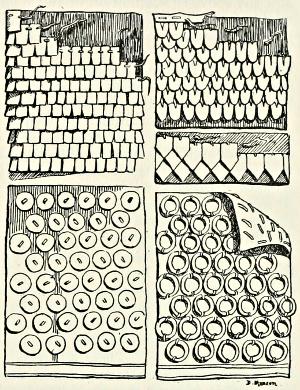
Coats of Mail, very early Period
Another interpretation preferred the elements to the seasons, and the struggle of the green and blue was supposed to represent the conflict of the earth and sea. Their respective victories announced either a plentiful harvest or a prosperous navigation, and the hostility of the husbandmen and mariners was somewhat less absurd than the blind ardour of the Roman people, who devoted their lives and fortunes to the colour which they had espoused. Such folly was disdained and indulged by the wisest princes; but the names of Caligula, Nero, Vitellius, Verus, Commodus, Caracalla, and Elagabalus were enrolled in the blue or green factions of the circus; they frequented their stables, applauded their favourites, chastised their antagonists, and deserved the esteem of the populace by the natural or affected imitation of their manners. The bloody and tumultuous contest continued to disturb the public festivity, till the last age of the spectacles of Rome; and Theodoric, from a motive of justice or affection, interposed his authority to protect the greens against the violence of a consul and a patrician, who were passionately addicted to the blue faction of the circus.
Constantinople adopted the follies, though not the virtues, of ancient Rome; and the same factions which had agitated the circus raged with redoubled fury in the hippodrome. Under the reign of Anastasius, this popular frenzy was inflamed by religious zeal; and the greens, who had treacherously concealed stones and daggers under baskets of fruit, massacred, at a solemn festival, three thousand of their blue adversaries. From the capital this pestilence was diffused into the provinces and cities of the East, and the sportive distinction of two colours produced two strong and irreconcilable factions, which shook the foundations of a feeble government. The popular dissensions, founded on the most serious interest or holy pretence, have scarcely equalled the obstinacy of this wanton discord, which invaded the peace of families, divided friends and brothers, and tempted the female sex, though seldom seen in the circus, to espouse the inclinations of their lovers or to contradict the wishes of their husbands.
Every law, either human or divine, was trampled under foot, and as long as the party was successful, its deluded followers appeared careless of private distress or public calamity. The license, without the freedom, of democracy was revived at Antioch and Constantinople, and the support of a faction became necessary to every candidate for civil or ecclesiastical honours. A secret attachment to the family or sect of Anastasius was imputed to the greens; the blues were zealously devoted to the cause of orthodoxy and Justinian, and their grateful patron protected, above five years, the disorders of a faction whose seasonable tumults overawed the palace, the senate, and the capitals of the East. Insolent with royal favour, the blues affected to strike terror by a peculiar and barbaric dress—the long hair of the Huns, their close sleeves and ample garments, a lofty step, and a sonorous voice.
In the day they concealed their two-edged poniards, but in the night they boldly assembled in arms, and in numerous bands, prepared for every act of violence and rapine. Their adversaries of the green faction, or even inoffensive citizens, were stripped and often murdered by these nocturnal robbers, and it became dangerous to wear any gold buttons or girdles, or to appear at a late hour in the streets of a peaceful capital. A daring spirit, rising with impunity, proceeded to violate the safeguard of private houses; and fire was employed to facilitate the attack or to conceal the crimes of those factious rioters. No place was safe or sacred from their depredations; to gratify either avarice or revenge, they profusely spilt the blood of the innocent; churches and altars were polluted by atrocious murders; and it was the boast of the assassins that their dexterity could always inflict a mortal wound with a single stroke of their dagger.
The dissolute youth of Constantinople adopted the blue livery of disorder; the laws were silent, and the bonds of society were relaxed; creditors were compelled to resign their obligations, judges to reverse their sentence, masters to enfranchise their slaves, fathers to supply the extravagance of their children; noble matrons were prostituted to the lust of their servants; beautiful boys were torn from the arms of their parents; and wives, unless they preferred a voluntary death, were ravished in the presence of their husbands. The despair of the greens, who were persecuted by their enemies and deserted by the magistrate, assumed the privilege of defence, perhaps of retaliation; but those who survived the combat were dragged to execution, and the unhappy fugitives, escaping to woods and caverns, preyed without mercy on the society from whence they were expelled. Those ministers of justice who had courage to punish the crimes and to brave the resentment of the blues, became the victims of their indiscreet zeal; a prefect of Constantinople fled for refuge to the holy sepulchre; a count of the East was ignominiously whipped, and a governor of Cilicia was hanged, by the order of Theodora, on the tomb of two assassins whom he had condemned for the murder of his groom and a daring attack upon his own life.
An aspiring candidate may be tempted to build his greatness on the public confusion, but it is the interest as well as duty of a sovereign to maintain the authority of the laws. The first edict of Justinian, which was often repeated and sometimes executed, announced his firm resolution to support the innocent, and to chastise the guilty, of every denomination and colour. Yet the balance of justice was still inclined in favour of the blue faction, by the secret affection, the habits, and the fears of the emperor; his equity, after an apparent struggle, submitted, without reluctance, to the implacable passions of Theodora, and the empress never forgot, or forgave, the injuries of the comedian. At the accession of the younger Justin, the proclamation of equal and rigorous justice indirectly condemned the partiality of the former reigns. “Ye blues, Justinian is no more! ye greens, he is still alive!”
[532 A.D.]
A sedition, which almost laid Constantinople in ashes, was excited by the mutual hatred and momentary reconciliation of the two factions. In the fifth year of his reign, Justinian celebrated the festival of the ides of January: the games were incessantly disturbed by the clamorous discontent of the greens; till the twenty-second race, the emperor maintained his silent gravity; at length yielding to his impatience, he condescended to hold, in abrupt sentences and by the voice of a crier, the most singular dialogue that ever passed between a prince and his subjects.
The first complaints were respectful and modest; they accused the subordinate ministers of oppression, and proclaimed their wishes for the long life and victory of the emperor. “Be patient and attentive, ye insolent railers,” exclaimed Justinian; “be mute, ye Jews, Samaritans, and Manichæans!” The greens still attempt to awaken his compassion. “We are poor, we are innocent, we are injured, we dare not pass through the streets: a general persecution is exercised against our name and colour. Let us die, O emperor! but let us die by your command, and for your service!” But the repetition of partial and passionate invectives degraded, in their eyes, the majesty of the purple; they renounced allegiance to the prince who refused justice to his people; lamented that the father of Justinian had been born; and branded his son with the opprobrious names of homicide, an ass, and a perjured tyrant. “Do you despise your lives?” cried the indignant monarch. The blues rose with fury from their seats; their hostile clamours thundered in the hippodrome; and their adversaries, deserting the unequal contest, spread terror and despair through the streets of Constantinople.
A military force, which had been despatched to the aid of the civil magistrate, was fiercely encountered by an armed multitude, whose numbers and boldness continually increased; and the Heruli, the wildest barbarians in the service of the empire, overturned the priests and their relics, which, from a pious motive, had been rashly interposed to separate the bloody conflict. The tumult was exasperated by this sacrilege; the people fought with enthusiasm in the cause of God; the women from the roofs and windows showered stones on the heads of the soldiers, who darted firebrands against the houses; and the various flames, which had been kindled by the hands of citizens and strangers, spread without control over the face of the city. The conflagration involved the cathedral of St. Sophia, the baths of Zeuxippus, a part of the palace from the first entrance to the altar of Mars, and the long portico from the palace to the forum of Constantine; a large hospital, with the sick patients, was consumed; many churches and stately edifices were destroyed, and an immense treasure of gold and silver was either melted or lost. From such scenes of horror and distress, the wise and wealthy citizens escaped over the Bosporus to the Asiatic side; and, during five days, Constantinople was abandoned to the factions, whose watchword, Nika (vanquish), has given a name to this memorable sedition.
As long as the factions were divided, the triumphant blues and desponding greens appeared to behold with the same indifference the disorders of the state. They agreed to censure the corrupt management of justice and the finance; and the two responsible ministers, the artful Tribonian and the rapacious Joannes of Cappadocia, were loudly arraigned as the authors of the public misery. The peaceful murmurs of the people would have been disregarded; they were heard with respect when the city was in flames; the quæstor and the prefect were instantly removed, and their offices were filled by two senators of blameless integrity. After this popular concession, Justinian proceeded to the hippodrome to confess his own errors, and to accept the repentance of his grateful subjects; but they distrusted his assurances, though solemnly pronounced in the presence of the holy Gospels; and the emperor, alarmed by their distrust, retreated with precipitation to the strong fortress of the palace.
The obstinacy of the tumult was now imputed to a secret and ambitious conspiracy, and a suspicion was entertained that the insurgents, more especially the green faction, had been supplied with arms and money by Hypatius and Pompeius, two patricians, who could neither forget with honour nor remember with safety, that they were the nephews of the emperor Anastasius. Capriciously trusted, disgraced, and pardoned by the jealous levity of the monarch, they had appeared as loyal servants before the throne; and during five days of the tumult they were detained as important hostages; till at length, the fears of Justinian prevailing over his prudence, he viewed the two brothers in the light of spies, perhaps of assassins, and sternly commanded them to depart from the palace.
After a fruitless representation that obedience might lead to involuntary treason, they retired to their houses, and in the morning of the sixth day Hypatius was surrounded and seized by the people, who, regardless of his virtuous resistance and the tears of his wife, transported their favourite to the forum of Constantine, and, instead of a diadem, placed a rich collar on his head. If the usurper, who afterwards pleaded the merit of his delay, had complied with the advice of his senate and urged the fury of the multitude, their first irresistible effort might have oppressed or expelled his trembling competitor. The Byzantine palace enjoyed a free communication with the sea; vessels lay ready at the garden stairs; and a secret resolution was already formed to convey the emperor with his family and treasures to a safe retreat, at some distance from the capital.
Justinian was lost, if the prostitute whom he raised from the theatre had not renounced the timidity as well as the virtues of her sex. In the midst of a council, where Belisarius was present, Theodora alone displayed the spirit of a hero; and she alone, without apprehending his future hatred, could save the emperor from the imminent danger and his unworthy fears. “If flight,” said the consort of Justinian, “were the only means of safety, yet I should disdain to fly. Death is the condition of our birth; but they who have reigned should never survive the loss of dignity and dominion. I implore heaven that I may never be seen, not a day, without my diadem and purple; that I may no longer behold the light, when I cease to be saluted with the name of queen. If you resolve, O Cæsar! to fly, you have treasures; behold the sea, you have ships; but tremble lest the desire of life should expose you to wretched exile and ignominious death. For my own part, I adhere to the maxim of antiquity, that the throne is a glorious sepulchre.”
The firmness of a woman restored the courage to deliberate and act, and courage soon discovers the resources of the most desperate situation. It was an easy and a decisive measure to revive the animosity of the factions. The blues were astonished at their own guilt and folly, that a trifling injury should provoke them to conspire with their implacable enemies against a gracious and liberal benefactor; they again proclaimed the majesty of Justinian, and the greens, with their upstart emperor, were left alone in the hippodrome. The fidelity of the guards was doubtful; but the military force of Justinian consisted in three thousand veterans, who had been trained to valour and discipline in the Persian and Illyrian wars.
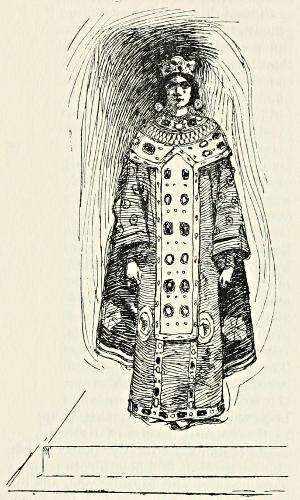
A Byzantine Costume
Under the command of Belisarius and Mundus, they silently marched in two divisions from the palace, forced their obscure way through narrow passages, expiring flames, and falling edifices, and burst open at the same moment the two opposite gates of the hippodrome. In this narrow space, the disorderly and affrighted crowd was incapable of resisting on either side a firm and regular attack; the blues signalised the fury of their repentance; and it is computed that above thirty thousand persons were slain in the merciless and promiscuous carnage of the day.[3] Hypatius was dragged from his throne, and conducted with his brother Pompeius to the feet of the emperor; they implored his clemency; but their crime was manifest, their innocence uncertain, and Justinian had been too much terrified to forgive. The next morning the two nephews of Anastasius, with eighteen illustrious accomplices of patrician or consular rank were privately executed by the soldiers; their bodies were thrown into the sea, their palaces razed, and their fortunes confiscated. The hippodrome itself was condemned during several years to a mournful silence; with the restoration of the games the same disorders revived, and the blue and green factions continued to afflict the reign of Justinian, and to disturb the tranquillity of the Eastern Empire, which still embraced the nations beyond the Adriatic and as far as the frontiers of Ethiopia and Persia.
AVARICE AND PROFUSION OF JUSTINIAN
[527-565 A.D.]
Justinian reigned over sixty-four provinces and 935 cities, his dominions were blessed by nature with the advantages of soil, situation, and climate; and the improvements of human art had been perpetually diffused along the coast of the Mediterranean and the banks of the Nile, from ancient Troy to the Egyptian Thebes. Abraham had been relieved by the well-known plenty of Egypt; the same country, a small and populous tract, was still capable of exporting each year 260,000 quarters of wheat for the use of Constantinople; and the capital of Justinian was supplied with the manufactures of Sidon, fifteen centuries after they had been celebrated in the poems of Homer.
The subjects of Justinian were dissatisfied with the times and with the government. Europe was overrun by the barbarians, and Asia by the monks; the poverty of the West discouraged the trade and manufactures of the East; the produce of labour was consumed by the unprofitable servants of the church, the state, and the army, and a rapid decrease was felt in the fixed and circulating capitals which constitute the national wealth. The public distress had been alleviated by the economy of Anastasius, and that prudent emperor accumulated an immense treasure, while he delivered his people from the most odious or oppressive taxes. His example was neglected, and his treasure was abused, by the nephew of Justin. The riches of Justinian were speedily exhausted by alms and buildings, by ambitious wars, and ignominious treaties. His revenues were found inadequate to his expenses.
Every art was tried to extort from the people the gold and silver which he scattered with a lavish hand from Persia to France; his reign was marked by the vicissitudes, or rather by the combat, of rapaciousness and avarice, of splendour and poverty; he lived with the reputation of hidden treasures, and bequeathed to his successor the payment of his debts. Such a character has been justly accused by the voice of the people and of posterity; but public discontent is credulous, private malice is bold; and a lover of truth will peruse with a suspicious eye the instructive anecdotes of Procopius.e The secret historian represents only the vices of Justinian, and those vices are darkened by his malevolent pencil. Ambiguous actions are imputed to the worst motives, error is confounded with guilt, accident with design, and laws with abuses; the partial injustice of a moment is dexterously applied as the general maxim of a reign of thirty-two years. The emperor alone is made responsible for the faults of his officers, the disorders of the times, and the corruption of his subjects; and even the calamities of nature, plagues, earthquakes, and inundations, are imputed to the prince of the demons, who had mischievously assumed the form of Justinian.
After this precaution, we shall briefly relate the anecdotes of avarice and rapine, under the following heads: (1) Justinian was so profuse that he could not be liberal. The civil and military officers, when they were admitted into the service of the palace, obtained a humble rank and a moderate stipend; they ascended by seniority to a station of affluence and repose; the annual pensions, of which the most honourable class was abolished by Justinian, amounted to four hundred thousand pounds; and this domestic economy was deplored by the venal or indigent courtiers as the last outrage on the majesty of the empire. The posts, the salaries of physicians, and the nocturnal illuminations, were objects of more general concern; and the cities might justly complain that he usurped the municipal revenues which had been appropriated to these useful institutions. Even the soldiers were injured; and such was the decay of military spirit that they were injured with impunity. The emperor refused, at the return of each fifth year, the customary donative of five pieces of gold, reduced his veterans to beg their bread, and suffered unpaid armies to melt away in the wars of Italy and Persia.
(2) The humanity of his predecessors had always remitted, in some auspicious circumstance of their reign, the arrears of public tribute; and they dexterously assumed the merit of resigning those claims which it was impracticable to enforce. “Justinian, in the space of thirty-two years, has never granted a similar indulgence; and many of his subjects have renounced the possession of those lands whose value is insufficient to satisfy the demands of the treasury. To the cities which had suffered by hostile inroads, Anastasius promised a general exemption of seven years; the provinces of Justinian have been ravaged by the Persians and Arabs, the Huns and Slavonians; but his vain and ridiculous dispensation of a single year has been confined to those places which were actually taken by the enemy.” Such is the language of the secret historian, who expressly denies that any indulgence was granted to Palestine after the revolt of the Samaritans; a false and odious charge, confuted by the authentic record, which attests a relief of thirteen centenaries of gold (£52,000 or $260,000) obtained for that desolate province by the intercession of St. Sabas.
(3) Procopius has not condescended to explain the system of taxation, which fell like a hail-storm upon the land, like a devouring pestilence on its inhabitants; but we should become the accomplices of his malignity, if we imputed to Justinian alone the ancient, though rigorous principle, that a whole district should be condemned to sustain the partial loss of the persons or property of individuals. The annona, or supply of corn for the use of the army and capital, was a grievous and arbitrary exaction, which exceeded, perhaps in a tenfold proportion, the ability of the farmer; and his distress was aggravated by the partial injustice of weights and measures, and the expense and labour of distant carriage. In a time of scarcity, an extraordinary requisition was made to the adjacent provinces of Thrace, Bithynia, and Phrygia; but the proprietors, after a wearisome journey and a perilous navigation, received so inadequate a compensation that they would have chosen the alternative of delivering both the corn and price at the doors of their granaries. These precautions might indicate a tender solicitude for the welfare of the capital; yet Constantinople did not escape the rapacious despotism of Justinian. Till his reign, the straits of the Bosporus and Hellespont were open to the freedom of trade, and nothing was prohibited except the exportation of arms for the service of the barbarians. At each of these gates of the city a prætor was stationed, the minister of imperial avarice; heavy customs were imposed on the vessels and their merchandise; the oppression was retaliated on the helpless consumer; the poor were afflicted by the artificial scarcity and exorbitant price of the market; and a people, accustomed to depend on the liberality of their prince, might sometimes complain of the deficiency of water and bread. The aërial tribute, without a name, a law, or a definite object, was an annual gift of £120,000 or $600,000, which the emperor accepted from his prætorian prefect; and the means of payment were abandoned to the discretion of that powerful magistrate.
(4) Even such a tax was less intolerable than the privilege of monopolies, which checked the fair competition of industry, and, for the sake of a small and dishonest gain, imposed an arbitrary burden on the wants and luxury of the subject. “As soon,” says Procopius,e “as the exclusive sale of silk was usurped by the imperial treasurer, a whole people, the manufacturers of Tyre and Berytus, was reduced to extreme misery, and either perished with hunger, or fled to the hostile dominions of Persia.” A province might suffer by the decay of its manufactures; but in this example Procopius has partially overlooked the inestimable benefit which the empire received from Justinian’s introduction of silk-culture. His addition of one-seventh to the ordinary price of copper money may be interpreted with the same candour; and the alteration, which might be wise, appears to have been innocent; since he neither alloyed the purity nor enhanced the value of the gold coin, the legal measure of public and private payments.
(5) The ample jurisdiction, required by the farmers of the revenue to accomplish their engagements, might be placed in an odious light, as if they had purchased from the emperor the lives and fortunes of their fellow-citizens. And a more direct sale of honours and offices was transacted in the palace, with the permission, or at least with the connivance, of Justinian and Theodora. The claims of merit, even those of favour, were disregarded; and it was almost reasonable to expect that the bold adventurer, who had undertaken the trade of a magistrate, should find a rich compensation for infamy, labour, danger, the debts which he had contracted, and the heavy interest which he paid. A sense of the disgrace and mischief of this venal practice at length awakened the slumbering virtue of Justinian; and he attempted, by the sanction of oaths and penalties, to guard the integrity of his government: but at the end of a year of perjury, his rigorous edict was suspended, and corruption licentiously abused her triumph over the impotence of the laws.
(6) The testament of Eulalius, count of the domestics, declared the emperor his sole heir, on condition, however, that he should discharge his debts and legacies, allow to his three daughters a decent maintenance, and bestow each of them in marriage, with a portion of ten pounds of gold. But the splendid fortune of Eulalius had been consumed by fire; and the inventory of his goods did not exceed the trifling sum of 564 pieces of gold. A similar instance in Grecian history admonished the emperor of the honourable part prescribed for his imitation. He checked the selfish murmurs of the treasury, applauded the confidence of his friend, discharged the legacies and debts, educated the three virgins under the eye of the empress Theodora, and doubled the marriage portion which had satisfied the tenderness of their father. The humanity of a prince (for princes cannot be generous) is entitled to some praise; yet even in this act of virtue we may discover the inveterate custom of supplanting the legal or natural heirs, which Procopius imputes to the reign of Justinian. His charge is supported by eminent names and scandalous examples; neither widows nor orphans were spared; and the art of soliciting, or extorting, or supposing testaments, was beneficially practised by the agents of the palace. This base and mischievous tyranny invades the security of private life; and the monarch who has indulged an appetite for gain, will soon be tempted to anticipate the moment of succession, to interpret wealth as an evidence of guilt, and to proceed from the claim of inheritance to the power of confiscation.
(7) Among the forms of rapine, a philosopher may be permitted to name the conversion of pagan or heretical riches to the use of the faithful; but in the time of Justinian this holy plunder was condemned by the sectaries alone, who became the victims of his orthodox avarice.
Dishonour might be ultimately reflected on the character of Justinian; but much of the guilt, and still more of the profit, was intercepted by the ministers, who were seldom promoted for their virtues, and not always selected for their talents. The merits of Tribonian the quæstor will hereafter be weighed in the reformation of the Roman law; but the economy of the East was subordinate to the prætorian prefect, and Procopiusf has justified his anecdotes by the portrait which he exposes in his public history of the notorious vices of Joannes of Cappadocia.
The corruption of his heart was equal to the vigour of his understanding. Although he was suspected of magic and pagan superstition, he appeared insensible to the fear of God or the reproaches of man; and his aspiring fortune was raised on the death of thousands, the poverty of millions, the ruin of cities, and the desolation of provinces. From the dawn of light to the moment of dinner he assiduously laboured to enrich his master and himself at the expense of the Roman world; the remainder of the day was spent in sensual and obscene pleasures, and the silent hours of the night were interrupted by the perpetual dread of the justice of an assassin. His abilities, perhaps his vices, recommended him to the lasting friendship of Justinian; the emperor yielded with reluctance to the fury of the people; his victory was displayed by the immediate restoration of their enemy; and they felt above ten years, under his oppressive administration, that he was stimulated by revenge, rather than instructed by misfortune. Their murmurs served only to fortify the resolution of Justinian; but the prefect, in the insolence of favour, provoked the resentment of Theodora, disdained a power before which every knee was bent, and attempted to sow the seeds of discord between the emperor and his beloved consort.
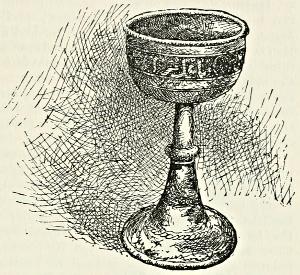
A Byzantine Goblet
Even Theodora herself was constrained to dissemble, to wait a favourable moment, and by an artful conspiracy, to render Joannes of Cappadocia the accomplice of his own destruction. At a time when Belisarius, unless he had been a hero, must have shown himself a rebel, his wife Antonina, who enjoyed the secret confidence of the empress, communicated his feigned discontent to Euphemia, the daughter of the prefect; the credulous virgin imparted to her father the dangerous project, and Joannes, who might have known the value of oaths and promises, was tempted to accept a nocturnal, and almost treasonable, interview with the wife of Belisarius. An ambuscade of guards and eunuchs had been posted by the command of Theodora; they rushed with drawn swords to seize or to punish the guilty minister; he was saved by the fidelity of his attendants; but, instead of appealing to a gracious sovereign, who had privately warned him of his danger, he pusillanimously fled to the sanctuary of the church.
The favourite of Justinian was sacrificed to conjugal tenderness or domestic tranquillity; the conversion of a prefect into a priest extinguished his ambitious hopes, but the friendship of the emperor alleviated his disgrace, and he retained, in the mild exile of Cyzicus, an ample portion of his riches. Such imperfect revenge could not satisfy the unrelenting hatred of Theodora; the murder of his old enemy, the bishop of Cyzicus, afforded a decent pretence; and Joannes of Cappadocia, whose actions had deserved a thousand deaths, was at last condemned for a crime of which he was innocent. A great minister, who had been invested with the honours of consul and patrician, was ignominiously scourged like the vilest of malefactors; a tattered cloak was the sole remnant of his fortunes; he was transported in a bark to the place of his banishment at Antinopolis in Upper Egypt, and the prefect of the East begged his bread through the cities which had trembled at his name.
During an exile of seven years, his life was protected and threatened by the ingenious cruelty of Theodora; and when her death permitted the emperor to recall a servant whom he had abandoned with regret, the ambition of Joannes of Cappadocia was reduced to the humble duties of the sacerdotal profession. His successors convinced the subjects of Justinian that the arts of oppression might still be improved by experience and industry; the frauds of a Syrian banker were introduced into the administration of the finances; and the example of the prefect was diligently copied by the quæstor, the public and private treasurer, the governors of provinces, and the principal magistrates of the Eastern Empire.
The edifices of Justinian were cemented with the blood and treasure of his people; but those stately structures appeared to announce the prosperity of the empire, and actually displayed the skill of their architects. Both the theory and practice of the arts, which depend on mathematical science and mechanical power, were cultivated under the patronage of the emperors; the fame of Archimedes was rivalled by Proclus and Anthemius; and if their miracles had been related by intelligent spectators, they might now enlarge the speculations instead of exciting the distrust of philosophers. A tradition has prevailed that the Roman fleet was reduced to ashes in the port of Syracuse by the burning-glasses of Archimedes; and it is asserted that a similar expedient was employed by Proclus to destroy the Gothic vessels in the harbour of Constantinople, and to protect his benefactor Anastasius against the bold enterprise of Vitalian. A machine was fixed on the walls of the city, consisting of an hexagon mirror of polished brass, with many smaller and movable polygons to receive and reflect the rays of the meridian sun; and a consuming flame was darted to the distance, perhaps, of two hundred feet.
The truth of these two extraordinary facts is invalidated by the silence of the most authentic historians; and the use of burning-glasses was never adopted in the attack or defence of places. Yet the admirable experiments of a French philosopher [Buffon] have demonstrated the possibility of such a mirror; and, since it is possible, we are more disposed to attribute the art to the greatest mathematicians of antiquity, than to give the merit of the fiction to the idle fancy of a monk or a sophist. According to another story [told by John Malalash], Proclus applied sulphur to the destruction of the Gothic fleet; in a modern imagination, the name of sulphur is instantly connected with the suspicion of gunpowder, and that suspicion is propagated by the secret arts of his disciple Anthemius.
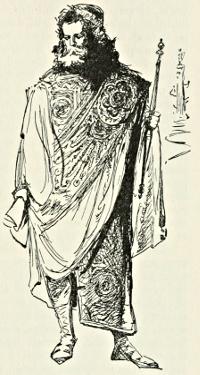
A Byzantine Noble
The fame of Metrodorus the grammarian, and of Anthemius the mathematician and architect, reached the ears of the emperor Justinian, who invited them to Constantinople; and while the one instructed the rising generation in the schools of eloquence, the other filled the capital and provinces with more lasting monuments of his art. In a trifling dispute, relative to the walls or windows of their contiguous houses, he had been vanquished by the eloquence of his neighbour Zeno; but the orator was defeated in his turn by the master of mechanics, whose malicious, though harmless, stratagems are darkly represented by the ignorance of Agathias. In a lower room, Anthemius arranged several vessels or cauldrons of water, each of them covered by the wide bottom of a leathern tube, which rose to a narrow top, and was artificially conveyed among the joists and rafters of the adjacent building. A fire was kindled beneath the cauldron; the steam of the boiling water ascended through the tubes; the house was shaken by the efforts of imprisoned air, and its trembling inhabitants might wonder that the city was unconscious of the earthquake which they had felt.
At another time the friends of Zeno, as they sat at table, were dazzled by the intolerable light which flashed in their eyes from the reflecting mirrors of Anthemius; they were astonished by the noise which he produced from the collision of certain minute and sonorous particles; and the orator declared in tragic style to the senate, that a mere mortal must yield to the power of an antagonist who shook the earth with the trident of Neptune, and imitated the thunder and lightning of Jove himself. The genius of Anthemius and his colleague Isidore the Milesian was excited and employed by a prince whose taste for architecture had degenerated into a mischievous and costly passion. His favourite architects submitted their designs and difficulties to Justinian, and discreetly confessed how much their laborious meditations were surpassed by the intuitive knowledge or celestial inspiration of an emperor whose views were always directed to the benefit of his people, the glory of his reign, and the salvation of his soul.
THE BUILDING OF ST. SOPHIA
[532-538 A.D.]
The principal church, which was dedicated by the founder of Constantinople to St. Sophia, or the eternal Wisdom, had been twice destroyed by fire; after the exile of John Chrysostom, and during the Nika of the blue and green factions. No sooner did the tumult subside than the Christian populace deplored their sacrilegious rashness; but they might have rejoiced in the calamity, had they foreseen the glory of the new temple which, at the end of forty days, was strenuously undertaken by the piety of Justinian. The ruins were cleared away, a more spacious plan was described, and, as it required the consent of some proprietors of ground, they obtained the most exorbitant terms from the eager desires and timorous conscience of the monarch. Anthemius formed the design, and his genius directed the hands of ten thousand workmen, whose payment in pieces of fine silver was never delayed beyond the evening. The emperor himself, clad in a linen tunic, surveyed each day their rapid progress, and encouraged their diligence by his familiarity, his zeal, and his rewards.
The new cathedral of St. Sophia was consecrated by the patriarch, five years, eleven months, and ten days from the first foundation; and in the midst of the solemn festival, Justinian exclaimed with devout vanity, “Glory be to God, who hath thought me worthy to accomplish so great a work; I have vanquished thee, O Solomon!” But the pride of the Roman Solomon, before twenty years had elapsed, was humbled by an earthquake, which overthrew the eastern part of the dome. Its splendour was again restored by the perseverance of the same prince; and, in the thirty-sixth year of his reign, Justinian celebrated the second dedication of a temple, which remains, after twelve centuries, a stately monument of his fame. The architecture of St. Sophia, which is now converted into the principal mosque, has been imitated by the Turkish sultans, and that venerable pile continues to excite the fond admiration of the Greeks, and the more rational curiosity of European travellers. The eye of the spectator is disappointed by an irregular prospect of half domes and shelving roofs; the western front, the principal approach, is destitute of simplicity and magnificence; and the scale of dimensions has been much surpassed by several of the Latin cathedrals. But the architect, who first erected an aërial cupola, is entitled to the praise of bold design and skilful execution.
The altar itself, a name which insensibly became familiar to Christian ears, was placed in the eastern recess, artificially built in the form of a demicylinder; and this sanctuary communicated by several doors with the sacristy, the vestry, the baptistery, and the contiguous buildings, subservient either to the pomp of worship or the private use of the ecclesiastical ministers. The memory of past calamities inspired Justinian with a wise resolution, that no wood, except for the doors, should be admitted into the new edifice; and the choice of the materials was applied to the strength, the lightness, or the splendour of the respective parts. The solid piles which sustained the cupola were composed of huge blocks of freestone, hewn into squares and triangles, fortified by circles of iron, and firmly cemented by the infusion of lead and quicklime; but the weight of the cupola was diminished by the levity of its substance, which consists either of pumice-stone, that floats in the water, or of bricks from the isle of Rhodes, five times less ponderous than the ordinary sort. The whole frame of the edifice was constructed of brick; but those base materials were concealed by a crust of marble; and the inside of St. Sophia, the cupola, the two larger and the six smaller semi-domes, the walls, the hundred columns, and the pavement, delight even the eyes of barbarians with a rich and variegated picture.
A poet, who beheld the primitive lustre of St. Sophia, enumerates the colours, the shades, and the spots of ten or twelve marbles, jaspers, and porphyries, which nature had profusely diversified, and which were blended and contrasted as it were by a skilful painter. The triumph of Christ was adorned with the last spoils of paganism; but the greater part of these costly stones was extracted from the quarries of Asia Minor, the isles and continent of Greece, Egypt, Africa, and Gaul. Eight columns of porphyry, which Aurelian had placed in the temple of the sun, were offered by the piety of a Roman matron; eight others, of green marble, were presented by the ambitious zeal of the magistrates of Ephesus: both are admirable by their size and beauty; but every order of architecture disclaims their fantastic capitals.
A variety of ornaments and figures was curiously expressed in mosaic; and the images of Christ, of the Virgin, of saints, and of angels, which have been defaced by Turkish fanaticism, were dangerously exposed to the superstition of the Greeks. According to the sanctity of each object the precious metals were distributed in thin leaves or in solid masses. The balustrade of the choir, the capitals of the pillars, the ornaments of the doors and galleries, were of gilt bronze; the spectator was dazzled by the glittering aspect of the cupola; the sanctuary contained forty thousand pounds’ weight of silver; and the holy vases and vestments of the altar were of the purest gold, enriched with inestimable gems. Before the structure of the church had risen two cubits above the ground, 45,200 pounds were already consumed; and the whole expense amounted to 320,000 pounds; each reader, according to the measure of his belief, may estimate their value either in gold or silver; but the sum of £1,000,000, or $5,000,000, is the result of the lowest computation. A magnificent temple is a laudable monument of national taste and religion, and the enthusiast who entered the dome of St. Sophia might be tempted to suppose that it was the residence, or even the workmanship, of the Deity. Yet how dull is the artifice, how insignificant is the labour, if it be compared with the formation of the vilest insect that crawls upon the surface of the temple!
OTHER BUILDINGS OF JUSTINIAN
[527-565 A.D.]
So minute a description of an edifice which time has respected may attest the truth and excuse the relation of the innumerable works, both in the capital and provinces, which Justinian constructed on a smaller scale and less durable foundations.[4] In Constantinople alone, and the adjacent suburbs, he dedicated twenty-five churches to the honour of Christ, the Virgin, and the saints; most of these churches were decorated with marble and gold; and their various situation was skilfully chosen in a populous square, or a pleasant grove; on the margin of the seashore, or on some lofty eminence which overlooked the continents of Europe and Asia.
The Virgin of Jerusalem might exult in the temple erected by her imperial votary on a most ungrateful spot, which afforded neither ground nor materials to the architect. A level was formed, by raising part of a deep valley to the height of the mountain. The stones of a neighbouring quarry were hewn into regular forms; each block was fixed on a peculiar carriage, drawn by forty of the strongest oxen, and the roads were widened for the passage of such enormous weights. Lebanon furnished her loftiest cedars for the timbers of the church; and the seasonable discovery of a vein of red marble supplied its beautiful columns, two of which, the supporters of the exterior portico, were esteemed the largest in the world.
The pious munificence of the emperor was diffused over the Holy Land: and if reason should condemn the monasteries of both sexes which were built or restored by Justinian, yet charity must applaud the wells which he sank, and the hospitals which he founded, for the relief of the weary pilgrims. The schismatical temper of Egypt was ill entitled to the royal bounty; but in Syria and Africa some remedies were applied to the disasters of wars and earthquakes, and both Carthage and Antioch, emerging from their ruins, might revere the name of their gracious benefactor.
Almost every saint in the calendar acquired the honours of a temple; almost every city of the empire obtained the solid advantages of bridges, hospitals, and aqueducts; but the severe liberality of the monarch disdained to indulge his subjects in the popular luxury of baths and theatres. While Justinian laboured for the public service, he was not unmindful of his own dignity and ease. The Byzantine palace, which had been damaged by the conflagration, was restored with new magnificence; and some notion may be conceived of the whole edifice by the vestibule, or hall, which, from the doors perhaps, or the roof, was surnamed chalce, or the brazen. The dome of a spacious quadrangle was supported by massy pillars; the pavement and walls were encrusted with many-coloured marbles—the emerald green of Laconia, the fiery red and the white Phrygian stone, intersected with veins of a sea-green hue; the mosaic paintings of the dome and sides represented the glories of the African and Italian triumphs.
On the Asiatic shore of the Propontis, at a small distance to the east of Chalcedon, the costly palace and gardens of Heræum were prepared for the summer residence of Justinian, and more especially of Theodora. The poets of the age have celebrated the rare alliance of nature and art, the harmony of the nymphs of the groves, the fountains, and the waves; yet the crowd of attendants who followed the court complained of their inconvenient lodgings, and the nymphs were too often alarmed by the famous Porphyrio, a whale of ten cubits in breadth and thirty in length, who was stranded at the mouth of the river Sangaris, after he had infested more than half a century the seas of Constantinople.
FORTIFICATIONS
The fortifications of Europe and Asia were multiplied by Justinian; but the repetition of those timid and fruitless precautions exposes to a philosophic eye the debility of the empire. From Belgrade to the Euxine, from the conflux of the Save to the mouth of the Danube, a chain of above fourscore fortified places was extended along the banks of the great river. Single watch-towers were changed into spacious citadels; vacant walls, which the engineers contracted or enlarged according to the nature of the ground, were filled with colonies or garrisons; a strong fortress defended the ruins of Trajan’s bridge, and several military stations affected to spread beyond the Danube the pride of the Roman name. But that name was divested of its terrors; the barbarians, in their annual inroads, passed and contemptuously repassed before these useless bulwarks; and the inhabitants of the frontier, instead of reposing under the shadow of the general defence, were compelled to guard, with incessant vigilance, their separate habitations.
The solitude of ancient cities was replenished; the new foundations of Justinian acquired, perhaps too hastily, the epithets of impregnable and populous; and the auspicious place of his own nativity attracted the grateful reverence of the vainest of princes. Under the name of Justiniana Prima, the obscure village of Tauresium became the seat of an archbishop and a prefect, whose jurisdiction extended over seven warlike provinces of Illyricum, and the corrupt appellation of Giustendil still indicates, about twenty miles to the south of Sophia, the residence of a Turkish sanjak. For the use of the emperor’s countrymen, a cathedral, a palace, and an aqueduct were speedily constructed; the public and private edifices were adapted to the greatness of a royal city; and the strength of the walls resisted, during the lifetime of Justinian, the unskilful assaults of the Huns and Slavonians. Their progress was sometimes retarded, and their hopes of rapine were disappointed, by the innumerable castles which, in the provinces of Dacia, Epirus, Thessaly, Macedonia, and Thrace, appear to cover the whole face of the country. Six hundred of these forts were built or repaired by the emperor: but it seems reasonable to believe that the far greater part consisted only of a stone or brick tower, in the midst of a square or circular area, which was surrounded by a wall and ditch, and afforded in a moment of danger some protection to the peasants and cattle of the neighbouring villages.
Yet these military works, which exhausted the public treasure, could not remove the just apprehensions of Justinian and his European subjects. The warm baths of Anchialus in Thrace were rendered as safe as they were salutary; but the rich pastures of Thessalonica were foraged by the Scythian cavalry; the delicious vale of Tempe, three hundred miles from the Danube, was continually alarmed by the sound of war; and no unfortified spot, however distant or solitary, could securely enjoy the blessings of peace. The straits of Thermopylæ which seemed to protect, but which had so often betrayed, the safety of Greece, were diligently strengthened by the labours of Justinian. From the edge of the seashore, through the forest and valleys, and as far as the summit of the Thessalian Mountains, a strong wall was continued, which occupied every practicable entrance. Instead of a hasty crowd of peasants, a garrison of two thousand soldiers was stationed along the rampart; granaries of corn and reservoirs of water were provided for their use; and by a precaution that inspired the cowardice which it foresaw, convenient fortresses were erected for their retreat. The walls of Corinth, overthrown by an earthquake, and the mouldering bulwarks of Athens and Platæa, were carefully restored; the barbarians were discouraged by the prospect of successive and painful sieges; and the naked cities of Peloponnesus were covered by the fortifications of the Isthmus of Corinth.
At the extremity of Europe, another peninsula, the Thracian Chersonesus, runs three days’ journey into the sea, to form, with the adjacent shores of Asia, the straits of the Hellespont. The intervals between eleven populous towns were filled by lofty woods, fair pastures, and arable lands; and the isthmus, of thirty-seven stadia or furlongs, had been fortified by a Spartan general nine hundred years before the reign of Justinian. In an age of freedom and valour, the slightest rampart may prevent a surprise; and Procopius appears insensible of the superiority of ancient times, while he praises the solid construction and double parapet of a wall whose long arms stretched on either side into the sea, but whose strength was deemed insufficient to guard the Chersonesus, if each city, and particularly Gallipoli and Sestos, had not been secured by their peculiar fortifications.
The long wall, as it was emphatically styled, was a work as disgraceful in the object as it was respectable in the execution. The riches of a capital diffuse themselves over the neighbouring country, and the territory of Constantinople, a paradise of nature, was adorned with the luxurious gardens and villas of the senators and opulent citizens. But their wealth served only to attract the bold and rapacious barbarians; the noblest of the Romans, in the bosom of peaceful indolence, were led away into Scythian captivity, and their sovereign might view, from his palace, the hostile flames which were insolently spread to the gates of the imperial city. At the distance only of forty miles, Anastasius was constrained to establish a last frontier; his long wall, of sixty miles from the Propontis to the Euxine, proclaimed the impotence of his arms; and as the danger became more imminent, new fortifications were added by the indefatigable prudence of Justinian.
Asia Minor, after the submission of the Isaurians, remained without enemies and without fortifications. Those bold savages, who had disdained to be the subjects of Gallienus, persisted 230 years in a life of independence and rapine. The most successful princes respected the strength of the mountains and the despair of the natives; their fierce spirit was sometimes soothed with gifts, and sometimes restrained by terror; and a military count, with three legions, fixed his permanent and ignominious station in the heart of the Roman provinces.
If we extend our view from the tropic to the mouth of the Tanais, we may observe on one hand the precautions of Justinian to curb the savages of Ethiopia, and on the other the long walls which he constructed in Crimea for the protection of his friendly Goths, a colony of three thousand shepherds and warriors. From that peninsula to Trebizond, the eastern curve of the Euxine was secured by forts, by alliance, or by religion; and the possession of Lazica, the Colchos of ancient, the Mingrelia of modern geography, soon became the object of an important war. Trebizond, in after times the seat of a romantic empire, was indebted to the liberality of Justinian for a church, an aqueduct, and a castle, whose ditches are hewn in the solid rock. From that maritime city, a frontier line of five hundred miles may be drawn to the fortress of Circesium, the last Roman station on the Euphrates.
Among the Roman cities beyond the Euphrates, we distinguish two recent foundations, which were named from Theodosius and the relics of the martyrs, and two capitals, Amida and Edessa, which are celebrated in the history of every age. Their strength was proportioned, by Justinian, to the danger of their situation. A ditch and palisade might be sufficient to resist the artless force of the cavalry of Scythia; but more elaborate works were required to sustain a regular siege against the arms and treasures of the great king. His skilful engineers understood the methods of conducting deep mines, and of raising platforms to the level of the rampart; he shook the strongest battlements with his military engines, and sometimes advanced to the assault with a line of movable turrets on the backs of elephants. In the great cities of the East the disadvantage of space, perhaps of position, was compensated by the zeal of the people, who seconded the garrison in the defence of their country and religion; and the fabulous promise of the Son of God, that Edessa should never be taken, filled the citizens with valiant confidence and chilled the besiegers with doubt and dismay.
The subordinate towns of Armenia and Mesopotamia were diligently strengthened, and the posts which appeared to have any command of ground or water were occupied by numerous forts, substantially built of stone or more hastily erected with the obvious materials of earth and brick. The eye of Justinian investigated every spot; and his cruel precautions might attract the war into some lonely vale, whose peaceful natives, connected by trade and marriage, were ignorant of national discord and the quarrels of princes. Westward of the Euphrates, a sandy desert extends above six hundred miles to the Red Sea. Nature had interposed a vacant solitude between the ambition of two rival empires; the Arabians, till Mohammed arose, were formidable only as robbers, and in the proud security of peace the fortifications of Syria were neglected on the most vulnerable side.
SUPPRESSION OF THE SCHOOLS
[529-541 A.D.]
Justinian suppressed the schools of Athens and the consulship of Rome, which had given so many sages and heroes to mankind. Both these institutions had long since degenerated from their primitive glory; yet some reproach may be justly inflicted on the avarice and jealousy of a prince by whose hands such venerable ruins were destroyed.
The schools of Athens were protected by the wisest and most virtuous of the Roman princes. The library which Hadrian founded was placed in a portico, adorned with pictures, statues, and a roof of alabaster, and supported by one hundred columns of Phrygian marble. The public salaries were assigned by the generous spirit of the Antonines; and each professor, of politics, of rhetoric, of the platonic, the peripatetic, the stoic, and the epicurean philosophy, received an annual stipend of ten thousand drachmæ [more than £300, or $1500]. After the death of Marcus these liberal donations, and the privileges attached to the thrones of science, were abolished and revived, diminished and enlarged; but some vestige of royal bounty may be found under the successors of Constantine, and their arbitrary choice of an unworthy candidate might tempt the philosophers of Athens to regret the days of independence and poverty. It is remarkable that the impartial favour of the Antonines was bestowed on the four adverse sects of philosophy, which they considered as equally useful, or at least as equally innocent.
The Gothic arms were less fatal to the schools of Athens than the establishment of a new religion, whose ministers superseded the exercise of reason, resolved every question by an article of faith, and condemned the infidel or sceptic to eternal flames. In many a volume of laborious controversy they exposed the weakness of the understanding and the corruption of the heart, insulted human nature in the sages of antiquity, and proscribed the spirit of philosophical inquiry, so repugnant to the doctrine or at least to the temper of an humble believer. The surviving sect of the platonists, whom Plato would have blushed to acknowledge, extravagantly mingled a sublime theory with the practice of superstition and magic; and as they remained alone in the midst of a Christian world, they indulged a secret rancour against the government of the church and the state, whose severity was still suspended over their heads.
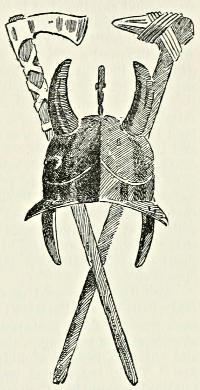
Gothic Weapons and Helmet
About a century after the reign of Julian, Proclus was permitted to teach in the philosophic chair of the academy; and such was his industry that he frequently, in the same day, pronounced five lessons and composed seven hundred lines. His sagacious mind explored the deepest questions of morals and metaphysics, and he ventured to urge eighteen arguments against the Christian doctrine of the creation of the world. But, in the intervals of study, he personally conversed with Pan, Æsculapius, and Minerva, in whose mysteries he was secretly initiated, and whose prostrate statues he adored in the devout persuasion that the philosopher, who is a citizen of the universe, should be the priest of its various deities. An eclipse of the sun announced his approaching end; and his life, with that of his scholar Isidore, compiled by two of their most learned disciples, exhibits a deplorable picture of the second childhood of human reason.
[527-565 A.D.]
Yet the golden chain, as it was fondly styled, of the Platonic succession, continued forty-four years from the death of Proclus to the edict of Justinian, which imposed a perpetual silence on the schools of Athens, and excited the grief and indignation of the few remaining votaries of Grecian science and superstition. Seven friends and philosophers, Diogenes and Hermias, Eulalius and Priscian, Damascius, Isidore, and Simplicius, who dissented from the religion of their sovereign, embraced the resolution of seeking in a foreign land the freedom which was denied in their native country. They had heard, and they credulously believed, that the republic of Plato was realised in the despotic government of Persia, and that a patriot king reigned over the happiest and most virtuous of nations. They were soon astonished by the natural discovery that Persia resembled the other countries of the globe; that Chosroes, who affected the name of a philosopher, was vain, cruel, and ambitious; that bigotry and a spirit of intolerance prevailed among the Magi; that the nobles were haughty, the courtiers servile, and the magistrates unjust; that the guilty sometimes escaped, and that the innocent were often oppressed.
The disappointment of the philosophers provoked them to overlook the real virtues of the Persians; and they were scandalised, more deeply perhaps than became their profession, with the plurality of wives and concubines, the incestuous marriages, and the custom of exposing dead bodies to the dogs and vultures, instead of hiding them in the earth or consuming them with fire. Their repentance was expressed by a precipitate return, and they loudly declared that they had rather die on the borders of the empire, than enjoy the wealth and favour of the barbarian. From this journey, however, they derived a benefit which reflects the purest lustre on the character of Chosroes. He required that the seven sages, who had visited the court of Persia, should be exempted from the penal laws which Justinian enacted against his pagan subjects; and this privilege, expressly stipulated in a treaty of peace, was guarded by the vigilance of a powerful mediator.[5]
Simplicius and his companions ended their lives in peace and obscurity; and as they left no disciples, they terminate the long list of Grecian philosophers, who may be justly praised, notwithstanding their defects, as the wisest and most virtuous of their contemporaries. The writings of Simplicius are now extant. His physical and metaphysical commentaries on Aristotle have passed away with the fashion of the times; but his moral interpretation of Epictetus is preserved in the library of nations as a classic book, most excellently adapted to direct the will, to purify the heart, and to confirm the understanding, by a just confidence in the nature both of God and man.
EXTINCTION OF THE ROMAN CONSULSHIP
[541 A.D.]
About the same time that Pythagoras first invented the appellation of philosopher, liberty and the consulship were founded at Rome by the elder Brutus. The first magistrates of the republic had been chosen by the people to exercise, in the senate and in the camp, the powers of peace and war which were afterwards translated to the emperors. But the tradition of ancient dignity was long revered by the Romans and barbarians. The Gothic historian Jordanesi applauds the consulship of Theodoric as the height of all temporal glory;[6] the king of Italy himself congratulates those annual favourites of fortune, who without the cares enjoyed the splendour of the throne; and at the end of a thousand years two consuls were created by the sovereigns of Rome and Constantinople, for the sole purpose of giving a date to the year and a festival to the people. But the expenses of this festival, in which the wealthy and the vain aspired to surpass their predecessors, insensibly arose to the enormous sum of £80,000 [$400,000]; the wisest senators declined a useless honour, which involved the certain ruin of their families; and to this reluctance we should impute the frequent chasms in the last age of the consular fasti.
The predecessors of Justinian had assisted from the public treasures the dignity of the less opulent candidates; the avarice of that prince preferred the cheaper and more convenient method of advice and regulation. Seven processions or spectacles was the number to which his edict confined the horse and chariot races, the athletic sports, the music and pantomimes of the theatre, and the hunting of wild beasts; and small pieces of silver were discreetly substituted for the gold medals which had always excited tumult and drunkenness when they were scattered with a profuse hand among the populace. Notwithstanding these precautions and his own example, the succession of consuls finally ceased in the thirteenth year of Justinian, whose despotic temper might be gratified by the silent extinction of a title which admonished the Romans of their ancient freedom.
THE VANDALIC WAR
[523-533 A.D.]
When Justinian ascended the throne, about fifty years after the fall of the Western Empire, the kingdoms of the Goths and Vandals had obtained a solid, and, as it might seem, a legal establishment, both in Europe and Africa. The titles which Roman victories had inscribed were erased with equal justice by the sword of the barbarians; and their successful rapine derived a more venerable sanction from time, from treaties, and from the oaths of fidelity, already repeated by a second or third generation of obedient subjects.
After Rome herself had been stripped of the imperial purple, the princes of Constantinople assumed the sole and sacred sceptre of the monarchy; demanded, as their rightful inheritance, the provinces which had been subdued by the consuls or possessed by the Cæsars; and feebly aspired to deliver their faithful subjects of the West from the usurpation of heretics and barbarians. The execution of this splendid design was in some degree reserved for Justinian. During the first five years of his reign, he reluctantly waged a costly and unprofitable war against Persia; till his pride submitted to his ambition, and he purchased, at the price of £440,000 [$2,200,000], the benefit of a precarious truce which, in the language of both nations, was dignified with the appellation of “the endless peace.” The safety of the East enabled the emperor to employ his forces against the Vandals; and the internal state of Africa afforded an honourable motive and promised a powerful support to the Roman arms.
According to the testament of the founder, the African kingdom had lineally descended to Hilderic, the eldest of the Vandal princes. A mild disposition inclined the son of a tyrant, the grandson of a conqueror, to prefer the counsels of clemency and peace; and his accession was marked by the salutary edict which restored two hundred bishops to their churches, and allowed the free profession of the Athanasian Creed. But the Catholics accepted, with cold and transient gratitude, a favour so inadequate to their pretensions, and the virtues of Hilderic offended the prejudices of his countrymen. The Arian clergy presumed to insinuate that he had renounced the faith, and the soldiers more loudly complained that he had degenerated from the courage of his ancestors. His ambassadors were suspected of a secret and disgraceful negotiation in the Byzantine court; and his general, the Achilles, as he was named, of the Vandals, lost a battle against the naked and disorderly Moors.
The public discontent was exasperated by Gelimer, whose age, descent, and military fame gave him an apparent title to the succession. He assumed, with the consent of the nation, the reins of government; and his unfortunate sovereign sank without a struggle from the throne to a dungeon, where he was strictly guarded, with a faithful counsellor and his unpopular nephew, the Achilles of the Vandals. But the indulgence which Hilderic had shown to his Catholic subjects had powerfully recommended him to the favour of Justinian, who, for the benefit of his own sect, could acknowledge the use and justice of religious toleration; their alliance, while the nephew of Justin remained in a private station, was cemented by the mutual exchange of gifts and letters, and the emperor Justinian asserted the cause of royalty and friendship.
In two successive embassies, he admonished the usurper to repent of his treason, or to abstain at least from any further violence, which might provoke the displeasure of God and of the Romans; to reverence the laws of kindred and succession, and to suffer an infirm old man peaceably to end his days, either on the throne of Carthage or in the palace of Constantinople. The passions or even the prudence of Gelimer compelled him to reject these requests, which were urged in the haughty tone of menace and command; and he justified his ambition in a language rarely spoken in the Byzantine court, by alleging the right of a free people to remove or punish their chief magistrate, who had failed in execution of the kingly office. After this fruitless expostulation, the captive monarch was more rigorously treated, his nephew was deprived of his eyes, and the cruel Vandal, confident in his strength and distance, derided the vain threats and slow preparations of the emperor of the East. Justinian resolved to deliver or revenge his friend, Gelimer to maintain his usurpation; and the war was preceded, according to the practice of civilised nations, by the most solemn protestations that each party was sincerely desirous of peace.
The report of an African war was grateful only to the vain and idle populace of Constantinople, whose poverty exempted them from tribute and whose cowardice was seldom exposed to military service. But the wiser citizens, who judged of the future by the past, revolved in their memory the immense loss, both of men and money, which the empire had sustained in the expedition of Basiliscus. The troops, which after five laborious campaigns had been recalled from the Persian frontier, dreaded the sea, the climate, and the arms, of an unknown enemy.
The forces of the Vandals were diminished by discord and suspicion; the Roman armies were animated by the spirit of Belisarius, one of those heroic names which are familiar to every age and to every nation.
BELISARIUS
The Africanus of New Rome was born, and perhaps educated, among the Thracian peasants,[7] without any of those advantages which had formed the virtues of the elder and younger Scipio—a noble origin, liberal studies, and the emulation of a free state. The silence of a loquacious secretary may be admitted to prove that the youth of Belisarius could not afford any subject of praise; he served, most assuredly with valour and reputation, among the private guards of Justinian; and when his patron became emperor, the domestic was promoted to military command. After a bold inroad into Pers-Armenia, in which his glory was shared by a colleague and his progress was checked by an enemy, Belisarius repaired to the important station of Dara, where he first accepted the service of Procopius,f the faithful companion and diligent historian of his exploits.
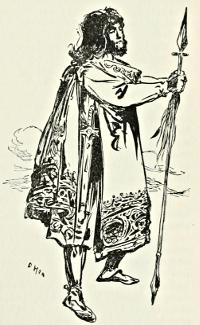
A Vandal Chief
Peace relieved him from the guard of the eastern frontier, and his conduct in the sedition of Constantinople amply discharged his obligations to the emperor. When the African war became the topic of popular discourse and secret deliberation, each of the Roman generals was apprehensive, rather than ambitious, of the dangerous honour; but as soon as Justinian had declared his preference of superior merit, their envy was rekindled by the unanimous applause which was given to the choice of Belisarius. The temper of the Byzantine court may encourage a suspicion that the hero was darkly assisted by the intrigues of his wife, the fair and subtle Antonina, who alternately enjoyed the confidence and incurred the hatred of the empress Theodora. The birth of Antonina was ignoble; she descended from a family of charioteers; and her chastity has been stained with the foulest reproach. Yet she reigned with long and absolute power over the mind of her illustrious husband; and if Antonina disdained the merit of conjugal fidelity, she expressed a manly friendship to Belisarius, whom she accompanied with undaunted resolution in all the hardships and dangers of a military life.
[533-534 A.D.]
The preparations for the African war were not unworthy of the last contest between Rome and Carthage. The pride and flower of the army consisted of the guards of Belisarius, who, according to the pernicious indulgence of the times, devoted themselves by a particular oath of fidelity to the service of their patrons. Their strength and stature, for which they had been curiously selected, the goodness of their horses and armour, and the assiduous practice of all the exercises of war, enabled them to act whatever their courage might prompt; and their courage was exalted by the social honour of their rank, and the personal ambition of favour and fortune.
Five hundred transports, navigated by twenty thousand mariners of Egypt, Cilicia, and Ionia, were collected in the harbour of Constantinople. The smallest of these vessels may be computed at thirty, the largest at five hundred tons; and the fair average will supply an allowance, liberal but not profuse, of about one hundred thousand tons, for the reception of thirty-five thousand soldiers and sailors, of five thousand horses, of arms, engines, and military stores, and of a sufficient stock of water and provisions for a voyage perhaps of three months. The proud galleys, which in former ages swept the Mediterranean with so many hundred oars, had long since disappeared; and the fleet of Justinian was escorted only by ninety-two light brigantines, covered from the missile weapons of the enemy and rowed by two thousand of the brave and robust youth of Constantinople. Twenty-two generals are named, most of whom were afterwards distinguished in the wars of Africa and Italy; but the supreme command, both by land and sea, was delegated to Belisarius alone, with a boundless power of acting according to his discretion, as if the emperor himself were present. The separation of the naval and military professions is at once the effect and the cause of the modern improvements in the science of navigation and maritime war.
If Gelimer had been informed of the approach of the enemy, he must have delayed the conquest of Sardinia for the immediate defence of his person and kingdom.
A detachment of 5000 soldiers and 120 galleys would have joined the remaining forces of the Vandals; and the descendant of Genseric might have surprised and oppressed a fleet of deep-laden transports, incapable of action, and of light brigantines, that seemed only qualified for flight. Belisarius had secretly trembled when he overheard his soldiers, in the passage, emboldening each other to confess their apprehensions; if they were once on shore, they hoped to maintain the honour of their arms; but if they should be attacked at sea, they did not blush to acknowledge that they wanted courage to contend at the same time with the winds, the waves, and the barbarians. The knowledge of their sentiments decided Belisarius to seize the first opportunity of landing them on the coast of Africa, and he prudently rejected, in a council of war, the proposal of sailing with the fleet and army into the port of Carthage.
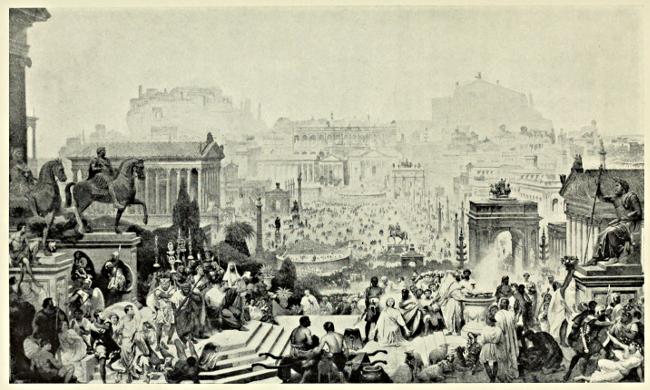
THE ROMAN FORUM
Three months after their departure from Constantinople, the men and horses, the arms and military stores, were safely disembarked, and five soldiers were left as a guard on board each of the ships, which were disposed in the form of a semicircle. The remainder of the troops occupied a camp on the sea shore, which they fortified according to ancient discipline with a ditch and rampart; and the discovery of a source of fresh water, while it allayed the thirst, excited the superstitious confidence, of the Romans. The next morning, some of the neighbouring gardens were pillaged; and Belisarius, after chastising the offenders, embraced the slight occasion, but the decisive moment, of inculcating the maxims of justice, moderation, and genuine policy. “When I first accepted the commission of subduing Africa, I depended much less,” said the general, “on the numbers, or even the bravery, of my troops, than upon the friendly disposition of the natives and their immortal hatred to the Vandals. You alone can deprive me of this hope; if you continue to extort by rapine what might be purchased for a little money, such acts of violence will reconcile these implacable enemies, and unite them in a just and holy league against the invaders of their country.”
These exhortations were enforced by a rigid discipline, of which the soldiers themselves soon felt and praised the salutary effects. The inhabitants, instead of deserting their houses or hiding their corn, supplied the Romans with a fair and liberal market; the civil officers of the province continued to exercise their functions in the name of Justinian; and the clergy, from motives of conscience and interest, assiduously laboured to promote the cause of a Catholic emperor.
Belisarius advanced without opposition as far as Grasse, a palace of the Vandal kings, at the distance of fifty miles from Carthage. The near approach of the Romans to Carthage filled the mind of Gelimer with anxiety and terror. He prudently wished to protract the war till his brother, with his veteran troops, should return from the conquest of Sardinia; and he now lamented the rash policy of his ancestors, who, by destroying the fortifications of Africa, had left him only the dangerous resource of risking a battle in the neighbourhood of his capital. The Vandal conquerors, from their original number of 50,000, were multiplied, without including their women and children, to 160,000 fighting men; and such forces, animated with valour and union, might have crushed at their first landing the feeble and exhausted bands of the Roman general. But the friends of the captive king were more inclined to accept the invitations than to resist the progress of Belisarius; and many a proud barbarian disguised his aversion to war under the more specious name of his hatred to the usurper. Yet the authority and promises of Gelimer collected a formidable army, and his plans were concerted with some degree of military skill.
An order was despatched to his brother Ammatas, to collect all the forces of Carthage and to encounter the van of the Roman army at the distance of ten miles from the city; his nephew Gibamund, with two thousand horse, was destined to attack their left, when the monarch himself, who silently followed, should charge their rear, in a situation which excluded them from the aid or even the view of their fleet. But the rashness of Ammatas was fatal to himself and his country. He anticipated the hour of the attack, outstripped his tardy followers, and was pierced with a mortal wound, after he had slain with his own hand twelve of his boldest antagonists. His Vandals fled to Carthage; the highway, almost ten miles, was strewed with dead bodies; and it seemed incredible that such multitudes could be slaughtered by the swords of three hundred Romans. The nephew of Gelimer was defeated, after a slight combat, by the six hundred Massagetæ; they did not equal the third part of his numbers, but each Scythian was fired by the example of his chief, who gloriously exercised the privilege of his family by riding foremost and alone to shoot the first arrow against the enemy.
In the meanwhile Gelimer himself, ignorant of the event and misguided by the windings of the hills, inadvertently passed the Roman army and reached the scene of action where Ammatas had fallen. He wept the fate of his brother and of Carthage, charged with irresistible fury the advancing squadrons, and might have pursued and perhaps decided the victory if he had not wasted those inestimable moments in the discharge of a vain though pious duty to the dead.[8]
While his spirit was broken by this mournful office, he heard the trumpet of Belisarius, who, leaving Antonina and his infantry in the camp, pressed forward with his guards and the remainder of the cavalry to rally his flying troops and to restore the fortune of the day. Much room could not be found in this disorderly battle for the talents of a general; but the king fled before the hero; and the Vandals, accustomed only to a Moorish enemy, were incapable of withstanding the arms and discipline of the Romans.[9] Gelimer retired with hasty steps towards the desert of Numidia; but he had soon the consolation of learning that his private orders for the execution of Hilderic and his captive friends had been faithfully obeyed. The tyrant’s revenge was useful only to his enemies. The death of a lawful prince excited the compassion of his people; his life might have perplexed the victorious Romans; and the lieutenant of Justinian, by a crime of which he was innocent, was relieved from the painful alternative of forfeiting his honour or relinquishing his conquests.
BELISARIUS ENTERS CARTHAGE
Belisarius was soon satisfied that he might confide, without danger, in the peaceful and friendly aspect of the capital. Carthage blazed with innumerable torches, the signals of the public joy; the chain was removed that guarded the entrance of the port; the gates were thrown open, and the people, with acclamations of gratitude, hailed and invited their Roman deliverers. The defeat of the Vandals and the freedom of Africa were announced to the city on the eve of St. Cyprian, when the churches were already adorned and illuminated for the festival of the martyr, whom three centuries of superstition had almost raised to a local deity. The Arians, conscious that their reign had expired, resigned the temple to the Catholics, who rescued their saint from profane hands, performed the holy rites, and loudly proclaimed the creed of Athanasius and Justinian. One awful hour reversed the fortunes of the contending parties.
The suppliant Vandals, who had so lately indulged the vices of conquerors, sought a humble refuge in the sanctuary of the church; while the merchants of the East were delivered from the deepest dungeon of the palace by their affrighted keeper, who implored the protection of his captives, and showed them, through an aperture in the wall, the sails of a Roman fleet. But the imperial fleet, advancing with a fair wind, steered through the narrow entrance of the Goletta, and occupied, in the deep and capacious lake of Tunis, a secure station about five miles from the capital. No sooner was Belisarius informed of their arrival than he despatched orders that the greatest part of the mariners should be immediately landed to join the triumph and to swell the apparent numbers of the Romans. Before he allowed them to enter the gates of Carthage, he exhorted them, in a discourse worthy of himself and the occasion, not to disgrace the glory of their arms; and to remember that the Vandals had been the tyrants, but that they were the deliverers of the Africans, who must now be respected as the voluntary and affectionate subjects of their common sovereign.
The Romans marched through the streets in close ranks, prepared for battle if an enemy had appeared; the strict order maintained by the general imprinted on their minds the duty of obedience; and in an age in which custom and impunity almost sanctified the abuse of conquest, the genius of one man repressed the passions of a victorious army. The voice of menace and complaint was silent; the trade of Carthage was not interrupted; while Africa changed her master and her government, the shops continued open and busy; and the soldiers, after sufficient guards had been posted, modestly departed to the houses which were allotted for their reception. Belisarius fixed his residence in the palace. He seated himself on the throne of Genseric; accepted and distributed the barbaric spoil; granted their lives to the suppliant Vandals; and laboured to repair the damage which the suburb of Mandracium had sustained in the preceding night.
The fortifications of Carthage had alone been exempted from the general proscription; but in the reign of ninety-five years they were suffered to decay by the thoughtless and indolent Vandals. A wiser conqueror restored with incredible despatch the walls and ditches of the city. His liberality encouraged the workmen; the soldiers, the mariners, and the citizens vied with each other in the salutary labour; and Gelimer, who had feared to trust his person in an open town, beheld with astonishment and despair the rising strength of an impregnable fortress.
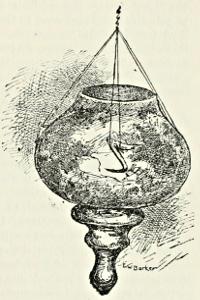
Byzantine Oil Vase
That unfortunate monarch, after the loss of his capital, applied himself to collect the remains of an army scattered, rather than destroyed, by the preceding battle; and the hopes of pillage attracted some Moorish bands to the standard of Gelimer. He encamped in the fields of Bulla, four days’ journey from Carthage; insulted the capital, which he deprived of the use of an aqueduct; proposed a high reward for the head of every Roman; affected to spare the persons and property of his African subjects, and secretly negotiated with the Arian sectaries and the confederate Huns.
Under these circumstances, the conquest of Sardinia served only to aggravate his distress; he reflected with the deepest anguish that he had wasted, in that useless enterprise, five thousand of his bravest troops; and he read, with grief and shame, the victorious letters of his brother Zano, who expressed a sanguine confidence that the king, after the example of their ancestors, had already chastised the rashness of the Roman invader. “Alas! my brother,” replied Gelimer, “heaven has declared against our unhappy nation. While you have subdued Sardinia, we have lost Africa. No sooner did Belisarius appear with a handful of soldiers, than courage and prosperity deserted the cause of the Vandals. Your nephew Gibamund, your brother Ammatas, have been betrayed to death by the cowardice of their followers. Our horses, our ships, Carthage itself, and all Africa, are in the power of the enemy. Yet the Vandals still prefer an ignominious repose, at the expense of their wives and children, their wealth and liberty. Nothing now remains except the field of Bulla and the hope of your valour. Abandon Sardinia; fly to our relief; restore our empire, or perish by our side.” On the receipt of this epistle, Zano imparted his grief to the principal Vandals; but the intelligence was prudently concealed from the natives of the island.
The troops embarked in 120 galleys at the port of Cagliari, cast anchor the third day on the confines of Mauretania, and hastily pursued their march to join the royal standard in the camp of Bulla. Mournful was the interview. The two brothers embraced, they wept in silence; no questions were asked of the Sardinian victory, no inquiries were made of the African misfortunes; they saw before their eyes the whole extent of their calamities, and the absence of their wives and children afforded a melancholy proof that either death or captivity had been their lot.