Part 11 / Book 2 — CHAPTER V CHARLEMAGNE [768-814 A.D.]
Reading edition
HIS BIOGRAPHY BY A CONTEMPORARY
[The chief source of our information concerning the personality of Charles the Great, is the biography by Eginhard or Einhard, who was intimately associated with the king and his family, and was highly esteemed and trusted. Soon after the death of his master he wrote the story of his life. The uniqueness of the document, its charm of diction, and its intimacy make it invaluable, while its brevity permits us to translate it from the Latin and present it here entire. The reader must be cautioned that, as a document of history, this account is not always accurate in details. The following discrepancies might be noted: Carloman reigned over three years instead of two; the empire was not divided in the way stated between the two brothers; indecisive battles like the engagement on the Berre are given as decisive; and the names of popes are confounded in places (Ranke). But in spite of these mistakes the general picture of Charles by Einhard stands lifelike and doubtless accurate in the main.]
[751-771 A.D.]
Haying made up my mind to set down in writing the life, the public career, and in some sort the great exploits of my dear lord and benefactor Charles, a king pre-eminent and of most just and glorious fame, I have encompassed the matter with all the brevity at my command. I have taken care that of all that might come to my notice nothing should be omitted, also that I might not offend the most delicate minds by narrating at too great a length each new particular; if indeed it may in any way be contrived that a new and recent essay should not offend those who sniff even at ancient chronicles compiled by authors the most learned and the most lucid. Men there are, I doubt not, in great numbers, servants of ease and disciples of letters, who are of opinion that the state of the present age should not be held of such trifling account that everything which is now happening should be condemned entirely to silence and oblivion as if unworthy of commemoration. Such men wrapt in the love of immortality had rather insert the shining deeds of others in any sort of writing, than rob posterity of the fame of their own name by writing nothing. Yet have I not thought well to refrain from writing of this category, since I was aware that no one could set down more veraciously than myself the things in which I myself took part, and which I knew to be true with the knowledge of an eye-witness as they call it, nor could I clearly know whether or no they would be recorded by another. Therefore I judged it better to transmit in common to posterity records the same as other written works, rather than suffer the most glorious life of a king pre-eminent and the greatest of his age to perish in the shades of oblivion together with victories most splendid and hard to be repeated by men of modern times.
Another course (no light one, I fancy), sufficient in itself to urge me to this composition, lurked in my mind. This was the tender care lavished upon me, and my uninterrupted friendship with himself and his children after I began to pass my life in his palace; for by this he bound me to him with the closest ties, and made me a debtor to him alive or dead. So that I might justly appear and be judged to be ungrateful if, unmindful of all the benefits heaped upon me, I were to pass over in silence the clear and brilliant deeds of one who deserved so well of me, if I were to suffer his life as though he had never lived to remain without the written praise that is its due, the writing and unfolding whereof needs not my poor little wit, which is thin and slender—nay, which is all but the merest nothing—but rather the eloquence of a Tully to the last drop. Here, reader, you have the book containing a memorial of the most eminent and the greatest man, wherein you shall see nothing but the deeds wrought by this man to marvel at, unless it were that I, a foreigner[132] very little versed in the Latin speech, should think myself able to write properly and neatly in Latin, and should have fallen headlong into such immodesty as to imagine that saying of Cicero may be despised wherein, talking of Latin writers in the second book of the Tusculans, he is reported to have said: “For one to commit his meditations to writing who can neither place them orderly or illustrate them clearly, nor entice the reader by any delightful device, is the office of a man who recklessly abuseth both his free time and the profession of letters.”
This opinion of the noble orator had availed to deter me from my work, had I not a prejudice in my mind in favour of rather suffering the judgment of critics and making venture of my own small wit in writing, than sparing myself and passing over the memory of so great a man.
The family of the Merovingians from which the Franks had been wont to choose their king is said to have ended with the king Childeric, who was dethroned by the command of Stephen the Roman pontiff; his hair was cut off and he was thrust into a monastery. With him the line may seem to have closed, yet for a long while it had lacked all vigour nor had any member shown distinction in himself outside the empty title of king; for the wealth and power of the kingdom had passed into the control of the prefects of the palace who were known as “mayors of the household,” and to whom belonged the supreme initiative; nor was anything left to the king but to enjoy the royal title, the long hair, the drooping beard, to sit back in a chair of state and simulate the air of a supreme ruler, give audience to the ambassadors hailing from all parts of the earth and on their departure to retail to them as if from the depths of his own majesty the answers which he had been taught or told to make.
So that, except for the useless name of king and an uncertain subsidy for living which the prefect of the palace would dole out to him as the mood took him, he possessed no morsel to call his own unless it were one farm and that of extremely slender profit. Here he would keep his house and servants to minister to him the necessaries of life and to display the respectful deference of a thin multitude of retainers.
Wherever he had to go, he travelled in a wagon drawn by a yoke of oxen and with an oxherd for a charioteer in true country fashion. In this way he would ride to his palace, to the public assembly of his people which met every year to further the advantages of the kingdom, in this way he would ride home again. The administration of the kingdom and all domestic and foreign business were conducted by the mayor of the palace.
This was the office filled by Pepin, the father of King Charles, at the time of Childeric’s deposition. It had already in some sort become hereditary. For Pepin’s father Charles had also held it with distinction and it had come down to him from his father Pepin. This Charles had put down throughout all Frankland those tyrants who claimed for themselves an independent sovereignty; also he had beaten the Saracens who aimed at the occupation of Gaul, in two mighty battles, one in Aquitania not far from the city of Poitiers, the other near Narbonne hard by the river Birra—a sore defeat so that he compelled them to return into Spain. Thus the office of mayor was an honour wont to be bestowed by the people on none but those eminent in the nobility of their birth and in the magnitude of their wealth.
When Pepin, the father of King Charles, had held for some years this office which had come down to him and his brother Carloman from sire to grandsire, the two having reigned jointly in most perfect harmony, Carloman, I know not why, yet most likely because he was fired with a passion for a life of contemplation, left the laborious administration of a temporal kingdom and withdrew himself to the peace of Rome, where he changed his habit, became a monk, built a monastery on Mount Soracte touching the church of St. Silvester, and in company with the brothers who had accompanied him thither drew a long and joyous draught of the repose that he had coveted for some years. But as many companies of Frankish noblemen were wont to make pilgrimage to Rome to fulfil their vows and would not leave unvisited one who was their former sovereign, they broke into that retirement which was his chief delight by their frequent salutation and compelled him to change his domicile. For when he saw that company of this sort stood in the light of his fixed intent, he left the mountain, withdrew to the province of Samnium to the holy Benedictine monastery on Mount Cassino, and there completed all that remained of his worldly life in religious exercises.
But Pepin from being the mayor of the palace was made king through the sanction of the Roman pontiff and governed the Franks alone for fifteen years or more. Men were nearing the close of the Aquitanian War which he had begun and continued to wage against Waifar, the duke of Aquitaine, through nine long years, when he died of a dropsy at Paris, leaving two sons, Charles and Carloman, who by the will of God succeeded to the kingdom. The Franks solemnly convened a general assembly and appointed them both kings with this preliminary condition, that they should divide equally the whole realm and Charles was to take over for government that part which had belonged to their father Pepin, and Carloman that part which had been presided over by their uncle Carloman. The terms were accepted on both sides, and a portion of the divided kingdom was received by each in the measure that was his due. So this system was peaceably preserved, although with grave difficulty, for many of the adherents of Carloman strove hard to break up the bond of union, so much so that there were certain people whose design was to plunge the brothers in war. But the issue of events bore witness that there was more mistrust than veritable danger in the matter, for when Carloman died his wife and children together with some of the first nobility showed contempt for the brother of her husband without any cause at all and fled to Italy to place herself and her children under the protection of Desiderius, king of the Lombards. The kingdom had been under joint administration for two years, when Carloman succumbed to disease. On the death of his brother, Charles was made king with the consent of all the Franks (771).
[771-774 A.D.]
I have determined to pass by the birth, infancy, and even boyhood[133] of Charles, for nothing has ever been set down in writing about them nor is anyone known to survive who can affirm that he has knowledge of them. So I thought it foolish to write of them, and turned to unfold and display the exploits and character and the rest of the life of that illustrious man, omitting the part that is unknown. So that my tale is first of his achievements at home and abroad, then of his habits and tastes, of the administration of his kingdom, and finally of his death, nor will I omit anything that is either worthy or necessary to be known.
First of all the wars he waged was the Aquitanian, which had been begun and not finished by his father. It seemed possible to go through with it rapidly, so while his brother was yet alive he asked for his help and undertook the war. His brother it is true cheated him of the promised aid, yet he would not desist from his eager pursuit of the campaign, having once engaged upon the task, until by a certain long patience he had brought to a perfect conclusion what he had striven hard to do. Hunoldus, too, who after the death of Waifar had tried to seize Aquitaine and renew a war by now well-nigh ended, was forced to flee from Aquitaine and take refuge in Gascony. Charles however did not suffer him to stay there, but crossing the river Garonne he commanded Loup the duke of the Gascons to give up the fugitive; which were he not to do with all haste, Charles would wrest him from the enemy by force of arms. But Loup, wise counsellor that he was, not only gave up Hunoldus but also put himself and the province over which he presided at the disposition of Charles (769).
THE ITALIAN WAR (772-774 A.D.)
When these matters in Aquitaine were settled and this war ended, his fellow-ruler being withdrawn from the affairs of this world, Charles was earnestly besought by the prayers of Adrian, bishop of the city of Rome, to undertake a war against the Lombards. This had been done before by his father at the instance of Stephen the pope, in spite of great obstacles, for there were certain among the chief Frankish nobles with whom the king was wont to take counsel, who opposed themselves so strictly to his will that they cried at the top of their voices that they would abandon the king to his fate and go their way home. Notwithstanding this, war had been made against King Aistulf, and brought to a speedy conclusion. But although the same reason for war seemed even more strong to Charles than it had been to his father, yet it is clear the contest was not so laborious, nor was it ended with a similar result. Pepin for his part besieged King Aistulf for a few days in Pavia, and compelled him to give hostages and to restore the fortified towns and castles which he had snatched from the Romans, and to take a solemn oath that he would not attempt to recapture what he had restored. Charles, on the other hand, when war had once been begun by him, did not cease hostilities until King Desiderius, wearied by a long siege, had surrendered, and his son Adelchis, on whom the hopes of all were rested, had been forced to flee not only from his kingdom, but from Italy. All that had been forcibly taken from the Romans was restored to them. Hrudogast, prefect of the duchy of Friuli, who aimed at revolution, was crushed, the whole of Italy was reduced to the dominion of Charles, and his son Pepin made king of the conquered territory.
And I would describe how difficult was the passage across the Alps as he entered Italy, and what great labour it cost the Franks to cross the trackless ridges of the mountains, and the steep rocks that tower up into the sky, were not my intention in the present work to communicate the events concerning my hero’s own life rather than those concerning the wars which he waged. Yet I will add that the war ended in the conquest of Italy, King Desiderius was banished into perpetual exile, his son Adelchis was driven from Italy, and the property stolen from the king of the Lombards was restored to Adrian, the rector of the Roman church.
THE SAXON WAR (772-804 A.D.)
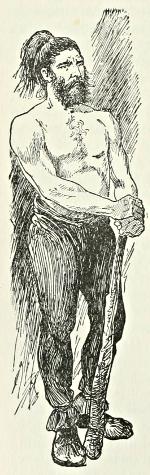
A Saxon
[772-804 A.D.]
No sooner was this finished than the Saxon War, in which there had seemed to be a kind of pause, was renewed. The Frankish people never engaged in a task more protracted, fiercer, or more wearisome; for the Saxons, like almost all the nations inhabiting Germany, are cruel by nature, abandoned to the cult of devils, foes of our religion, nor do they think it wrong to violate or transgress any law, whether human or divine. They had an easy means of disturbing the peace daily, for of a truth their boundaries and ours touched at almost any point in the open, except in a few places where either wide stretches of forest land or the ridges of intervening mountains set an indisputable limit to the lands of both countries. Everywhere else indiscriminate bloodshed, plunder, and burning were incessant. This so stung the Franks that they were not content with returning one evil turn with another, but determined to make open war upon their neighbours. And so war was declared against them, and waged for thirty long years with great bitterness on both sides, but the Saxons suffered greater injury than the Franks. Hostilities might have ended sooner but for the perfidy of the Saxons. It is difficult to tell how often they were beaten and surrendered themselves humbly to the king, promising to do his bidding. The hostages claimed of them they would surrender with alacrity, and acknowledge the ambassadors sent to them. Sometimes they were so cowed and enervated that they even promised to abandon their cult of devils, saying they would fain submit to the Christian religion; but ready as they were sometimes to do this they were always in a hurry to undo it again, so that it is hard to guess to which of these courses they may the more truly be said to have leaned; for after the war with them had begun, scarce a single year reached its conclusion without their shifting from one view to another in this way. But their mutability, were it never so great, could never overcome the king’s high spirit and constancy of mind, in adversity as in prosperity, nor could it tire him out of fulfilling what he had begun to do. For they never did an act of treachery which he suffered to pass unpunished. He would despatch an army, either under his own leadership or under that of his peers, and take vengeance on the enemy’s perfidy, mulcting them in damages worthy of the offence, until at last he had reduced to his will all the miserable rebels who offered him habitual resistance. He then transported ten thousand men of the inhabitants on both banks of the Elbe, with their wives and little children, distributing them here and there over Gaul and Germany in fragmentary groups. When they had agreed to the following conditions imposed upon them by the king, the war that had lasted so many years was declared at an end:—The cult of the devils was to be abandoned, the native rites discontinued,[134] the sacraments of the Christian faith and religion were to be adopted: united to the Franks they were to form one people with them.
Though this war lasted over so long a space of time, the king himself did not fight more than two pitched battles with the enemy, one near a hill called Osneng in a place called Theotmel (Detmold), the other on the river Hasa, both in the same month and at a few days’ interval. In these two battles the enemy were so demoralised by defeat that they no longer dared to provoke the king to battle or to offer resistance to him when he attacked, except in a place where they were protected by fortification.
In this war perished a large number of nobles, both Frankish as well as Saxon, men of high distinction. At last, in the thirty-third year, it came to an end. During this time wars so many and so great sprang up against the Franks in diverse parts of the earth, wars directed with such skill by the king, that well might the onlooker be perplexed whether to admire most the patience of his essays or the success which crowned them. Two years before the Italian war, began this war (against Desiderius), which was waged without intermission, and yet there was no relaxation in any of the other wars that had to be carried on, nor was there anywhere any respite from battle attended with equal difficulties. The king, who excelled all the sovereigns of his age in foresight and largeness of mind, never weakly shrank from taking up and following to the end a duty either because it was difficult or dangerous. He was well versed in a knowledge of how to weigh such matter according to its intrinsic value, not to give way in adversity, and not to be duped by the smiles of specious fortune in prosperity.
THE PASS OF RONCESVALLES (778 A.D.)
[778-788 A.D.]
While the Saxon War was being ardently and incessantly pursued, garrisons were placed in the most suitable places on the borders, and Charles marched into Spain with the greatest equipment of war that he could command. He crossed the Pyrenees, received the submission of all towns and castles that he approached, and returned with his army safe and sound. It was on his return through that very Pyrenean pass that he happened to encounter a slight show of Gascon treachery. The army was moving in column, in extended formation, as was made necessary by the narrowness of the pass, when the Gascons, who had placed ambuscades on the high ledge of the mountain (for the dense foliage of the place, which is thickly wooded, makes it suitable for the disposal of an ambush), rushed down from their vantage ground, falling upon the extreme section of the baggage and those who manned the baggage train and drove them into the valley below. Here the Gascons fought a pitched battle with them, killed them all to a man, destroyed the baggage, took advantage of the cover of night which was drawing over them, and with the greatest rapidity dispersed in different directions. The Gascons were aided in this feat by the lightness of their arms and the nature of the place in which the engagement was determined; whereas the Franks, on the other hand, were made inferior to the Gascons at every point by the weight of their armour and the ugliness of their situation. In this battle fell Eggihard, the king’s server, Anselm Pfalsgraf, and Roland, count of the Breton march, with many others besides. Nor could the injury be avenged at the time, because when the thing had been perpetrated the enemy dispersed with so much cunning that there remained not even the breath of a rumour as to where in the world they might be hunted out.
THIRD VISIT TO ITALY (787 A.D.)
Charles also subjugated the Bretons who dwell by the coast on the extreme west of Gaul. They were not obedient to the king’s word, so he sent an expedition against them, whereupon they were compelled to grant hostages and make a promise to do what they were told. After this the king himself entered Italy with his army, and making his way through Rome, marched upon Capua, a city of Campania, and when he had pitched his camp there threatened the Beneventines with war unless they surrendered. Arichis, the duke, avoided this by sending his two sons, Romwald and Grimwald, with a large sum of money to meet the king, whom he asked to accept them as hostages, promising to do what he was told, except in the event of one command, which was if he should be forced himself to come face to face with the king. Charles, taking the national welfare into greater consideration than the stubborn character of the duke’s mind, accepted the hostages offered to him, and in return for a large sum of money conceded to him the favour that he should not be compelled to meet him face to face. Only the younger son of Arichis was kept as a hostage, the elder was returned to his father. The ambassadors who had come to exact oaths of allegiance from the Beneventines, and to make an agreement with Arichis for taking them up on their behalf, were now discharged, and the king returned to Rome. He spent a few days there in holy visits to the sacred places of the city and then went back into Gaul.
BAVARIAN WAR WITH TASSILO (787-788 A.D.)
[787-796 A.D.]
Next came the Bavarian War, which suddenly flamed up and swiftly died down. It was aroused at once by the arrogance and by the folly of Duke Tassilo. He had married a daughter of King Desiderius, who thought to avenge her father’s exile by her husband’s agency. Tassilo made an alliance with the Huns, whose boundary touches that of the Bavarians on the east. Not only did he try to win his independence, but also to provoke the king to war. His violence seeming too great for the high-spirited king to brook, he gathered together forces from all sides for an incursion into Bavaria, and straightway advanced to the river Lech himself with a large army. This river divides the Bavarians from the Alamanni. He pitched his camp on the banks before entering the province and determined to ascertain the temper of the duke by means of ambassadors. Tassilo, thinking it neither to his own advantage nor to that of his country to act obstinately, surrendered himself to the king’s mercy, and gave the hostages required, among them being his own son Theodo. In addition to this, he took an oath of allegiance by which he bound himself to be induced by the persuasion of nobody to revolt from the sovereignty of the king.[135] In this way a very swift end was put to a war which had given promise of becoming a great one. Tassilo being summoned soon after to the king was not, however, allowed to return; the province which he had governed was no longer entrusted to a duke but to the charge of counts.
WARS IN THE NORTH AND WITH THE AVARS (791-796 A.D.)
[791-810 A.D.]
When these commotions were thus allayed war was begun against the Slavs, whom we are accustomed to call Wilzi, but who are more properly termed in their own tongue Welatabi. In this war among other nations who were bidden to rally round the king’s ensigns, the Saxons fought as our allies, but their obedience was feigned and far from being truly devoted. The cause of the war was that the Welatabi harried the Abodriti, who had in former days been allied with the Franks; nor could the assiduity of their incursions be checked by orders. There is a certain gulf which stretches eastwards from the western ocean, of unascertained length, but of a width which nowhere exceeds a hundred miles, whereas in many places it is narrower. Many nations are gathered round its border, such as Danes and Swedes whom we call Northmen, and they occupy the northern shores and all the islands in the gulf. But the southern shores are inhabited by Slavs and Aisti, and divers other nations among whom the chief are the Welatabi against whom the king was now making war. In one expedition, which he conducted in person, he so utterly crushed and humbled them, that in future they were advised to do as they were told without the smallest show of resistance.
The war following this was, with the exception of the Saxon War, the greatest of all those waged by my hero; it was that memorable war against the Avars or Huns. The king set about it with even greater spirit and with far greater military resources than had gone to the others. Yet he himself made but one expedition into Pannonia, the province then inhabited by the Avars. The rest of the campaigns were entrusted to his son Pepin and the prefects of the provinces, and to the counts and lieutenants. They used the utmost diligence in the conduct of affairs; yet eight years had well-nigh passed before the war was ended. What a great many battles were fought, what blood was shed, the desolate Pannonia, empty of all living creatures, bears witness. Moreover, the place in which was situate the royal palace of the chagan (khan) is so abandoned that you cannot see a trace of human habitation in it. The whole nobility of the Avars perished in this war, and the entire glory of the nation was extinguished. All their money and long-accumulated treasures were seized; nor can human memory recall any war of the Franks in which they have won greater spoil or been more enriched.
Up to this time, sure enough, the Franks had appeared to be a poor nation; but now so much gold and silver was found in the royal treasury, such a heap of valuable spoil was taken in battle, that we may safely assume that the Franks seized this new wealth from the Huns, and rightly too, for had not the Huns before this seized it wrongfully from other nations? Only two among the chiefs of the Frankish nobility fell in this war,—Eric, duke of Friuli, killed in Liburnia, near Tharsatica (Fiume), a maritime state, who was entrapped in an ambush laid by the townspeople; and Gerold, prefect of the Bavarians, who was killed in Pannonia while drawing up his men in line of battle in the act of engaging with the Huns. No one knew who did the deed, for he was killed, with the two others who rode in his company, as he spoke a word of encouragement to each man along the ranks. But for this, the war was almost a bloodless one for the Franks and had a most prosperous ending, although it was prolonged far beyond what was natural from its size.
DANISH WAR (808-810 A.D.)
When this and the Saxon War had been brought to an end which their tediousness made welcome, the two wars which followed, one against the Bohemians and the other against the Linonians, did not last long, for they were both speedily despatched under the direction of Charles the Younger. The last war to be undertaken was that against the Northmen who are called Danes. At first they indulged in pirate warfare, and later they ravaged the shores of Gaul and Germany with a large fleet. So puffed up with vain ambition was their king, Godfrey,[136] that he thought he would gain the sovereignty of all Germany for his own. Frisia and Saxony he simply regarded as his own provinces; he had already brought the neighbouring Abodriti under his sway and made them tributary to him. He even would boast that in a little while he would appear with his enormous army at Aachen,[137] where the king held his court. Nor was all faith denied to his talk, empty as it was; on the contrary, he rather acquired the reputation of a man who would have begun some such enterprise had he not been arrested by a premature death. He was murdered by one of his own servants, and so ended abruptly his life and the war that he had inaugurated.
GLORY OF CHARLEMAGNE
[768-810 A.D.]
Such are the wars which this most puissant king waged during forty-seven years—a long reign—in divers parts of the earth with superlative skill and good fortune. By these he so nobly enlarged the kingdom of the Franks which he had taken over after his father Pepin, that great and powerful as it already was, he nearly doubled it. For previously those Franks called Eastern inhabited only that part of Gaul which lies between the Rhine and the Loire, the ocean and the Balearic Sea, and that part of Germany situate between Saxony and the Danube, the Rhine and the Saal which latter river divides the Thuringii from the Sorabi. The Alamanni and the Bavarians also belonged to the sovereignty of the Frankish kingdom. But Charles, by the wars I have enumerated, completely subjugated and made tributary first Aquitaine and Gascony and the whole range of the Pyrenean Mountains even as far as the Ebro, which river in Navarre crosses the most fertile lands of Spain and mingles its waters with the Balearic Sea, beneath the walls of the city Tortosa; then the whole of Italy from Aosta to lower Calabria where men place the boundaries of the Greeks and Beneventines, an extent of more than a thousand miles long; then Saxony which is no small part of Germany and is supposed to be twice as broad as the part in which the Franks dwell, with a length which is equal to that of the other; then both Pannonia and Dacia which lies on the other bank of the Danube, Istria too and Liburnia and Dalmatia, except the maritime towns which because of his friendly feeling for the Constantinopolitan emperor and a treaty to which they had both agreed Charles allowed him to hold; lastly all the wild and uncouth nations which inhabit Germany between the Rhine and the Vistula, the ocean and the Danube, who speak almost the same tongue but are widely different in character and in dress. Chief among these were the Welatabi, Sorabi, Abodriti, and Bæmanni, for these showed resistance in fight; the rest who were more numerous surrendered.
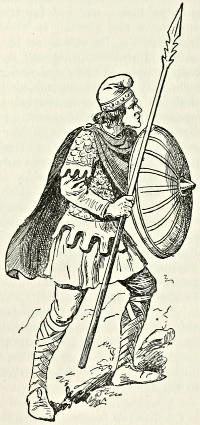
A Saxon Warrior
He also added glory to the kingdom by the friendly sentiments of certain kings and nations which he won to himself. Thus Alfonso, king of Galicia and Asturias was so linked to him by the bond of friendship that when he sent him letters or messengers he gave orders that he should be spoken of as Charles’ servant. The kings of the Scots too had been so bent to his will through his munificence that they never alluded to him in other terms than as their lord and called themselves his humble vassals. Letters from them to him still exist in which it may be seen that their attitude towards him was of this kind. Harun, king of the Persians who held well-nigh all the East if we except India, was in such hearty sympathy with the king that he valued his good will more than that of all the kings and princes in the world, thinking him alone worthy to be honoured by his regard and munificence. When the officers sent by Charles with offerings to the most sacred sepulchre and place of the resurrection of our Lord and Saviour came to Harun and told him what was the will of their master he not only allowed them to do what was required but even yielded up to them that revered and sacred spot to be registered as belonging to the sovereignty of Charles. When the ambassadors returned he sent his own to accompany them bearing splendid presents to the king with garments and spices and other rich products of the East, just as a few years before at Charles’ request he sent him the only elephant he then possessed. Even the Constantinopolitan emperors, Nicephorus, Michael, and Leo expressly sought after his friendly allegiance and sent him numerous embassies. To remove all source of possible offence to them on account of his having adopted the title of emperor, which might truly be suspected as in some sort an attempt to wrest from them the imperial supremacy, he entered into a most rigid treaty. For the power of the Franks was ever an object of suspicion to the Greeks and Romans, whence arose the Greek proverb, “Have a Frank for a friend and not for a neighbour.”
Great as the king was in enlarging the kingdom and in conquering foreign nations, busy as he was in affairs of this kind, he yet started a great number of works for the embellishment and convenience of the kingdom. Some of them he carried through to the finish. The chief place among these seems rightly to be assigned to the Basilica of the Holy Mother of God, which was built at Aachen, a miracle of workmanship, and to the bridge over the Rhine at Mainz, five hundred paces in length, so broad is the river at that place. This bridge, however, was ruined by fire a year before the king’s death, nor could it be restored on account of the nearness of his demise, although it was in his mind to replace the woodwork by stone. He also began some magnificent palaces—one not far from the town of Mainz near the village called Ingelheim and another at Nimeguen on the river Waal which flows past the island of the Batavians on the southern side. But above all he noted the sacred churches throughout the whole kingdom wherever they had fallen to ruin because of their age, and gave orders to the priests and fathers in whose care they were to superintend their restoration, appointing officials to see that his orders were carried out. He also constructed a fleet for the war against the Northmen, making dock yards for this purpose on the rivers of Gaul and Germany which flow into the North Sea; and because the Northmen ravaged the shores of Gaul and Germany by constant active inroads, he posted towers and outlooks in all the harbours and at the mouths of all those rivers which were navigable. By these defences he stopped the enemy from being able to pass. He did the same in the south on the coast of the provinces of Narbonne and Septimania, and all along the coast of Italy as far as Rome, in order to put a check on the Moors who had lately taken to piratical practices. By this means Italy suffered no harm from the Moors, nor Gaul and Germany from the Northmen in his days, with the exception that Civita Vecchia, a town of Etruria, was betrayed to the Moors who razed it to the ground, and certain islands in Frisia off the German coast were plundered by the Northmen.
Such was clearly the character of the king at once in the defence, in the enlargement and in the embellishment of his kingdom. We may well marvel at his gifts and at that superlative steadfastness which he showed in every circumstance whether of prosperity or adversity. Here I will begin and go on to talk of those other matters which belong to his inner life and his life in his home.
HIS FAMILY
When his father died he shared the kingdom with his brother and bore that brother’s quarrelsome envy with exemplary patience, so that all men marvelled that he could never be provoked into the slightest exhibition of angry conduct. At his mother’s instigation he married a daughter of Desiderius, king of the Lombards, but after a year, for what reason is not known, he put her aside and took Hildegard to wife, a Swabian lady of high nobility by whom he had three sons, to wit, Charles and Pepin and Louis, and the same number of daughters, Hrotrud, Bertrada, and Gisila. He also had three other daughters, Theoderada and Hiltrud by his wife Fastrada, a German lady of eastern Frankish origin, and a third, Rothaid, by a concubine whose name escapes my memory. When Fastrada died he married Liutgard of the Alamanni, but she bore him no children. After her death he had three concubines, Gerswinda, a Saxon girl, who bore him a daughter Adaltrud, Regina, the mother of Drogo and Hugh, and Adalinda from whom he begat Theoderic. His mother, Bertrada, lived with him to old age, being held in high honour. For he lavished upon her the greatest reverence, so that except on the occasion of his divorcing the daughter of Desiderius whom he had married under his mother’s persuasion, there never once rose a difference between them. Bertrada did not die until after the demise of Hildegard, having lived to see three grandsons and as many granddaughters in her son’s house. Charles had his mother buried with much honour in the church of Saint Dionysius, the same as that wherein lay his father. Her one sister, Gisila, who had devoted herself ever since her girlhood to a holy life, was treated by the king with the same pious affection that he had shown for his mother. She died a few years before him in the convent to which she had retired.
As for children he thought they should be so brought up, both sons and daughters, as to be first informed of those liberal studies to which he himself devoted his attention. For his sons as soon as their age permitted it, he ordered riding in the Frankish style, the practice of arms, and the chase; for his daughters, woolspinning, the use of distaff and spindle; they were to beware of becoming slothful by reason of their leisure, they were to be instructed in every virtuous occupation. Of his numerous family two sons and one daughter died before him, Charles the eldest and Pepin whom he had made king of Italy, and Hrotrud his eldest daughter who was betrothed to Constantine the emperor of the Greeks. Pepin left a son Bernhard and five daughters, Adalhaid, Atula, Guntrada, Berthaid, and Theoderada. The king showed marked evidence of his affection for them, allowing his grandson to succeed to his father’s kingdom and his granddaughters to be educated with his own daughters. The greatness of his soul was so eminent that he bore the death of his sons and of his daughter with exceeding patience which did in no wise detract from his affection, for his tears would not be held back. When he heard the news of the death of Adrian, the Roman pontiff and his chiefest friend, he wept as bitterly as if he had lost his dearest son or brother. For he showed the finest loyalty in his friendships, forming them readily and preserving them with the utmost constancy and he cherished the purest affection for those whom he had attached to himself by the ties of sympathy. So much care did he bestow on the education of his sons and daughters that he never took his meals at home without them. In travelling his sons rode by his side, his daughters followed close behind, their train being guarded by servants specially appointed for this purpose. So beautiful were his daughters and so tender was his affection for them that strange to say he would not consent to give any of them in marriage either to one of his own nation or to a foreigner, but he kept them all with him until his death in his house, saying he could not do without their society. On this account, although lucky in all else, he experienced the malice of ill fortune. Yet he hid his thoughts and behaved as if no suspicion of any evil had ever arisen about any of them, as if no rumours had ever been spread.
He had by a concubine[138] a son called Pepin whom I have forborne to mention among the others; he had a good countenance but was deformed by a hunchback. During the war against the Huns, while his father was wintering in Bavaria this boy feigned sickness and made a plot against his father with certain of the Frankish nobility who had fascinated him with the idle promise of the kingdom. When the fraud had been detected and the conspirators had paid the penalty the king caused the boy to shave his beard and allowed him to pass his time in religious exercises in the abbey at Prüm to which he objected nothing. Another powerful conspiracy had been previously made against him in Germany; the originators were some of them blinded, and some of them had got off safe and sound, but all had been exiled. Death was not inflicted except on three who, drawing their swords to avoid being captured, even went so far as to kill some of those sent to take them, so that they were despatched because there was no other way of keeping them quiet.
The cause and origin of these plots is supposed to have been the cruelty of queen Fastrada and in both cases the king was the object of the plot because in acquiescing in his wife’s cruelty he seemed to have taken a monstrous departure from the gentleness of his nature and his usual clemency. For all the rest of his life he showed so much love and consideration for all men both at home and abroad that not even a murmur of undue cruelty was ever raised against him by anyone.
He had a great love of foreigners and showed so much anxiety to receive them that the multitude of them came to be thought burdensome not only to the palace but also to the kingdom. The high-minded king himself was however not in the least oppressed by a responsibility of this kind, knowing that such inconveniences were outweighed by the wide reputation for generosity and the reward of fair fame which were his.
HIS PERSONAL LOOK AND HABITS
Charles was of large and robust frame and commanding stature, though his height was not excessive (it is said to have measured seven times the length of his own foot). The top of his head was round, his eyes were larger than usual and full of life, his nose rather prominent; he had noble white hair, and his face was sanguine and of cheerful aspect. Whether standing or sitting he thus had the advantage of a very great presence and dignity. His neck was thick and too short, and his stomach too prominent; these defects however were lost in the fair balance of the rest of his limbs. His step was firm, the whole carriage of his body masculine, but his voice, although it was clear, was not in true harmony with the size of his frame: his health was sound except for the last four years of his life, when he was attacked by frequent fever; towards the end he even walked lame on one foot. And even in that last extremity he acted more as he willed himself than upon the advice of the doctors whom he thoroughly detested because they urged him to discontinue roasted meat at his meals which it was his habit to eat, and accustom himself to boiled. He took much exercise on horseback and in the chase which was a national characteristic in him, for there is scarcely a nation on earth which can equal the Franks in this art. He had much pleasure in the vapour of natural warm springs and practised his body in frequent swimming of which he was such a master that no one could be truly said to excel him in this. On account of the warm springs he even built a palace at Aachen, where in the last year of his life he dwelt continuously until his death. Not only did he invite his sons to the baths, but also his nobles and friends, sometimes even a crowd of his servants and body-guard, so that there were times when a hundred or even more men were bathing together.
He wore the dress of his country, that is, the Frankish: on his body, a linen shirt and linen thigh coverings; then a tunic with a silken hem and stockings. He wound garters round his legs and clad his feet in shoes. His chest and shoulders, were protected from the cold by a doublet of otter and sable skin. Wrapped in a sea-blue cloak he always carried a sword at his girdle, this and the hilt being interlaced silver and gold. Sometimes he wore a sword studded with gems, but only on high days and holidays or on the visit of some foreign embassy. He held the foreign styles of dress in the greatest contempt however fine they might be, nor would he ever submit to be robed in them. Only once, in Rome, at the request of the pontiff Adrian, and again at the earnest request of his successor Leo, did he wrap himself in the long tunic and chlamys and wear shoes of the Roman shape. On festival days he would stalk about in a garment woven with gold and shoes studded with precious stones; a golden pin clasped his cloak and he wore a splendid crown made of gold and jewels. On other days his dress differed little from that of an ordinary person.
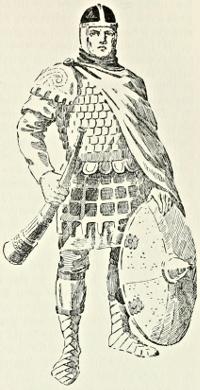
A Frankish Trumpeter
He ate and drank moderately, but he was especially moderate in drinking for he had the greatest horror of drunkenness in any man to say nothing of himself and his companions. He was less abstemious in eating and would often growl that fasting was bad for his body. He very seldom gave banquets, indeed, only on the chief festival days, but then they were attended in great numbers. His daily meal was furnished from four courses in addition to the roast meat which the hunters were wont to bring in on spits and of which he partook more freely than of any other dish. While at his meals he would hear some sort of performance or reading. Histories and the valorous deeds of the men of old were read over to him. He was fond of the works of St. Augustine, especially of those entitled De Civitate Dei. He drank very sparingly of wine and other liquors, rarely taking at his meals more than three draughts. In summer after his midday repast he would take some fruit and one draught, then he would doff his clothes and shoes just as was his custom at night-time, and take two or three hours’ rest. At night he slept so lightly that he would break his repose by waking and even by rising four or five times. While he was dressing and strapping on his shoes he not only received his friends, but if the count of the palace informed him of any suit that could not be determined without his orders, he gave instructions to admit the litigants without further ado; he would then sit as if in court and give judgment on the dispute as soon as he had mastered it. Nor was this all that was settled at this time but he would then give orders for whatever official duty was to be performed on that day and give instructions to any particular servant to do his work.
His fluency of speech was resourceful and abundant and he could express with great openness whatever he wanted to say. Nor did his own language alone satisfy him, but he spent trouble in acquiring foreign tongues; of these he learned Latin so well that he would pray in Latin as freely as in his own language; he understood Greek, however, better than he could talk it. He was so voluble in speaking that he almost produced the impression of being a chatterer. He had the greatest respect for the liberal arts and their learned exponents whom he loaded with great honour. To learn grammar he attended the lectures of the aged Peter of Pisa, a deacon; for the rest of his instructions Albinus was his tutor, otherwise called Alcuin, also a deacon, a Saxon by race, from Britain, the most learned man of the day. With him the king spent most of his time and study in rhetoric and dialectics, and particularly in astronomy. He learned the art of reckoning by numbers and with deep thought and much skill most carefully investigated the courses of the stars. He tried to learn to write, and used to keep his tablets and copybook for this purpose beneath his pillow in bed, so that when he had leisure he could train his hand but he made little progress.
He devoted himself to the Christian religion which had been instilled into him in his infancy with the greatest holiness and piety, and on this account he built the Basilica of Aachen, a work of great beauty, which he embellished with silver and gold and with candlesticks and lattices and doors of solid brass. When he could not get columns and marble for this structure anywhere else, he caused them to be brought from Rome and from Ravenna. As long as his health permitted he was an untiring worshipper in church at matins and even-song and also during the hours of the night and at the time of the sacrifice, and he made it his great care that all the services of the church should be conducted with the greatest cleanliness. Very often he would caution the sacristans not to allow anything improper or foul to be brought into or left in the building. He provided quantities of sacred vessels, gold and silver, and of priestly vestments so that while the mass was celebrated no one—not even the doorkeepers, who are the lowest order of ecclesiastics—was obliged to perform his duties in private dress. He industriously improved the order of reading and chanting. For he was a master in both, though he did not read in public, nor sing above a whisper.
In helping the poor, in free charity, which the Greeks call almsgiving, he was devout, making this his care not only in his own country and kingdom, but he would often send money across the seas into Syria and Egypt and Africa, to Jerusalem and Alexandria and Carthage, where he knew the Christians were living in poverty, and out of compassion for their penury. To this end he untiringly sought the friendship of transpontine kings that some solace and comfort might be forthcoming to the Christians under their sway. Above all other sacred and venerable places in Rome he loved the church of St. Peter the apostle, the treasury of which he enriched with an immense sum in gold, in silver, and in jewels. He sent many countless gifts to the pontiffs, and during his whole reign nothing lay so near his heart as that the city of Rome should assume its ancient prerogative through his zeal and patronage, and that the church of St. Peter should not only be in safe keeping and protection through him, but should also be embellished and enriched with his presents above all other churches. Valuing this ambition as he did within the forty-seven years of his reign, he found leisure but four times to visit Rome for the sake of fulfilling his vows and praying.
HIS IMPERIAL TITLE (800 A.D.)
[800-814 A.D.]
These were not the only reasons for his last visit to Rome, but the Romans had compelled Pope Leo to implore the trusty assistance of the king when that pontiff had been most seriously injured, for they had torn out his eyes and cut out his tongue. So the king came to Rome to reform the condition of the church which was sorely disturbed, and he stayed there the whole winter in this pursuit. During this time he received the name of emperor and of augustus, to which at first he was so averse that he vowed that he would not have entered the church on that day, although it was a festival day, had he been able to foresee the intention of the pope. Yet he bore the envy that the name raised with the Roman emperors, who were most indignant at his assumption of it, with great patience, and he subdued their sullen hostility by a graciousness of demeanour in which he was most certainly their master, sending them frequent embassies and calling them his brothers in his letters to them.
Having adopted the imperial title he turned to the numerous deficiencies in the laws of his people—for the Franks have two laws which differ considerably in very many places. He meditated how to fill up the omissions and reconcile what conflicted and to correct what was mischievous and erroneously stated; but of these projects none were fulfilled except that he increased the laws by a few chapters and these were fragmentary. But he caused the laws of all nations under his dominion which had not been reduced to writing to be definitely codified. So too he wrote out and committed to memory the rough songs of antiquity in which the exploits and wars of the ancient kings used to be sung. He also began a grammar of his native speech. He gave names to the months in the national tongue, for before this the Franks spoke of them partly by the Latin and partly by foreign names. Also he designated the twelve winds by proper appellations, whereas before this, words could not be found for more than about four. The month January he called Wintarmanoth; February, Hornung; March, Lentzinmanoth; April, Ostarmanoth; May, Winnemanoth; June, Brachmanoth; July, Hewimanoth; August, Aranmanoth; September, Witumanoth; October, Windumemanoth; November, Herbistmanoth; December, Heilagmanoth. And the winds he named thus: that called in Latin Subsolanus he called Ostroniwint; Eurus, Ostsunderen; Euroauster, Sundostren; Auster, Sundren; Austroafricus, Sundwestren; Africus, Westsundren; Zephyrus, Westren; Chorus, Westnordren; Circius, Nordwestren; Septenrio, Nordren; Aquilo, Nordostren; Vulturnus, Ostnorden.
HIS DEATH (814 A.D.)
[814 A.D.]
Towards the close of his life when he was weighed down with illness and old age he called to him his son Louis, the king of Aquitaine and last surviving son of Hildegard, solemnly assembled the Frankish nobility from all over the kingdom, and with the unanimous consent appointed Louis his partner in the whole kingdom and heir of the imperial title. Then he placed the royal crown on his head and decreed that he should be saluted as emperor and augustus. All those who were present hailed his doing this with much acclamation, for it seemed as if the king were divinely inspired for the welfare of his kingdom. For did he not by this act enlarge his own majesty and strike no small terror into the nations abroad? He discharged his son to Aquitaine and then, old as he was, set out for the chase as was his wont in the neighbourhood of the palace at Aachen. He spent what remained of the autumn in this pursuit, and then returned to Aachen early in November.
During the winter in the month of January he was seized with fever and took to his bed. He at once prescribed for himself, as he always did when he was attacked by fever, an abstinence from food, thinking that by a privation of this kind the disease might be banished or in any case reduced, but the pain increased until his side was inflamed (the Greeks call it “pleurisy”). Yet he continued to starve himself, keeping himself alive by an occasional draught until the seventh day after he had taken to his bed. He then received the holy communion and died on the 28th of January at nine o’clock, in the seventy-second year of his age and in the forty-seventh year of his reign (814).
They solemnly washed and tended his body, laying it in the church where it was buried amid the great grief of the whole nation. At first men doubted where he ought to rest, since he himself in his lifetime had left no directions in the matter. At last the minds of all were satisfied that nowhere could he more fitly be buried than in that church which he had built at his own cost at Aachen from his love of God and our Lord Jesus Christ and to the glory of the ever blessed Virgin his mother. Here then he was buried on the same day that he died. Above his tomb was erected a gilded monument with his effigy and title upon it. This famous title runs thus:
UNDER THIS TOMB LIES THE BODY OF CHARLES THE GREAT AND ORTHODOX EMPEROR WHO GLORIOUSLY ENLARGED THE REALM OF THE FRANKS AND FORTUNATELY ORDERED THE KINGDOM FOR FORTY-SEVEN YEARS HE HAD PASSED THE AGE OF SEVENTY WHEN HE DIED JAN. XXVIII IN THE YEAR OF OUR LORD DCCC XIIII INDICTION VII
PORTENTS OF CHARLEMAGNE’S DEATH
There were many portents of his approaching death, for not only others, but the king himself felt them. During the whole of his last three years there were eclipses both of the sun and of the moon, and certain spots of blackish hue were seen in the sun for the space of seven days. The portico which he had built with great labour between the church and the palace fell in a sudden and complete ruin from top to bottom on the day of the ascension of our Lord.
Also the wooden bridge across the Rhine at Mainz—which it had taken the king ten years of immense labour to construct, a work so marvellous that it seemed as if it would endure forever—chanced to catch fire, and was burned to a cinder in three days, so that not a single spar remained beyond what was protected under water. Again, when the king was in Saxony on his last campaign against Godefrid, king of the Danes, one day when the march had begun and he had left the camp before sunrise, he saw fall suddenly from heaven a blazing torch that flashed through the clear sky from right to left. While all wondered what this might portend, suddenly the king’s horse fell right upon his head and hurled his rider with such violence to the ground that the pin of his mantle was broken and his sword belt burst. His attendants rushed up and loosened his armour, and with some help he was induced to rise. The javelin which he chanced to hold in his hand at the time was thrown from his grasp a distance of twenty feet or more. Nor is this all. The palace of Aachen was visited with frequent shakings, and the ceilings of the houses in which he dwelt cracked constantly. The church in which he was afterwards buried was visited by lightning, and the golden apple with which the apex of the roof was embellished was wrenched away and hurled away over the adjoining house of the priest. In this same church, on the ring of the cornice which ran round the interior of the building between the upper and lower arches, there was an inscription in red chalk relating who was the founder of the church, the last line ending with the words Karolus Princeps. It was noticed by certain persons that in the same year as that in which he died, a few months before that event, the letters spelling Princeps were so obliterated as almost to be invisible. But the king either concealed his feelings about all these warnings from on high, or else he scorned them as in no way relating to himself.
HIS WILL AND TESTAMENT
Charles intended to make a will in which he might provide to some extent for his daughters and the children he had begotten of his concubines, but he began it late and it could not be completed. Three years, however, before his death he made division of his treasures, his money, his garments, and other chattels, in the presence of his friends and of his servants, making them witnesses that after his death the distribution made by him should take effect and be ratified by their assent. What he wished to be done with each portion he set down in an abstract of which the argument and text is as follows:

A Frankish Woman of Quality
Description and division made by the most glorious and most pious prince, Charles, emperor, augustus, in the year of the incarnation of our Lord Jesus Christ 811, in the forty-third year of his reign in Francia, in the thirty-seventh of his reign in Italy, in the eleventh of his use of the imperial dignity, and in the fourth indiction.
Whereas a pious and prudent consideration urged him to make and with the will of God to complete this division of the valuables and moneys found in his treasury on that day. And whereas the said Charles was most anxious and eager to provide that both the customary distribution of alms which is duly made by Christians from their possessions should be given by himself from his moneys as is right and befitting, and also that his heirs, having all sense of doubt removed as to what belongs to them, might be able to know clearly and make division among themselves in due appointment without strife or contention. Now this indenture witnesseth his will and purpose that all his goods and chattels, whether of gold or silver or precious stones or royal ornaments, such as can be found on the aforesaid day in his treasury, be divided into three portions, to be again divided, two of them into twenty-one parts, the third portion to be kept entire; the reason of this division of two-thirds of the property into twenty-one parts being because that is recognised to be the number of metropolitan cities in the realm, and of these twenty-one parts one is to be given by his heirs and friends to each metropolis as a gift of alms, the archbishop being at that time at the head of that church to take up the portion granted to his church and divide it with his suffragans in these proportions—one-third to be retained for his own church and the remaining two-thirds to be divided among suffragans. These portions of the first threefold division, twenty-one in number, that being the number of the metropolitan cities, to be separated from one another, and each to be stored distinct in its own depository with the name of the city upon it to which it shall be conveyed.
The names of the metropolitan cities to which this grant of bounty shall be made are: Rome, Ravenna, Milan, Friuli, Gratz, Cologne, Mainz, Juvavia, also called Salzburg; Trèves, Sass, Besançon, Lyons, Rouen, Rheims, Arles, Vienne, Moutiers in the Tarantaise, Embrun, Bordeaux, Tours, Borges. And of the one-third portion which is to be kept intact this shall be the distribution, the other two portions being assigned according to the aforementioned division and secured under seal: this third portion to be used for daily requirements as property in no way transferred by disposal from the power of the possessor, and to continue as long as he lives or shall think its possession necessary to him. But after his death or voluntary renunciation of worldly estate, to be divided into four portions. Of these the first to be added to the aforementioned twenty-one portions; the second to be apportioned to his sons and daughters and their children, being divided among them in just and reasonable proportions; the third to be applied to the needy in true Christian fashion, and the fourth likewise as a gift of alms to be delivered to and distributed among the men-servants and maid-servants forming the household of the palace. And moreover it is herein further enjoined that to this one-third portion of the whole, which like the rest consists in silver and gold, shall be added all the vessels and utensils in use in the various departments of the household, whether of brass or iron or other metal, together with all the arms, clothing, and other matter valuable or negligible, to wit, hangings, coverlets, tapestries, hair-cloths, leather work, cushions, and whatever else shall be found in his chests or wardrobes on that day, it being thereby possible to make more numerous divisions of this portion and enable a greater number to share in this distribution of alms.
And moreover it is enjoined that his chapel, by which is meant all that pertains to the service of the church, shall remain whole and unimpaired, both such matter as he himself hath created and gathered together, and also that which descended to him as his father’s heir. And whereas there may be found vessels or books or other ornaments which are clearly seen not to have been brought by him into the said chapel, these vessels or books or other ornaments shall be bought at a just valuation, and possessed by any person desiring to acquire them. And with regard to the books, of which he collected a vast number in his library, it is likewise ordained that they shall be purchased at a just valuation by those desiring to buy them, the money so received to be distributed among the poor. And with regard to three silver tables and a golden one of great size and weight among the rest of his treasures and money, it is willed and decreed as follows: and first the table of square form which bears upon it a plan of the city of Constantinople, together with the rest of the gifts appointed for this purpose, shall be carried to Rome, to the church of St. Peter the apostle; the second table of round form, embellished with an image of the city of Rome, shall be taken to the Episcopal church of Ravenna; and the third, which far surpasses the others in the beauty of its workmanship, and the massiveness of its weight, and is made of three connected discs on which is comprehended, in a configuration most intricate and minute, a plan of the whole world—this, together with the aforesaid table of gold, shall be an increase for the portion to be divided among his heirs and to be distributed in alms.
This disposition and settlement was made and decreed in the presence of those bishops, abbots, and counts who were then able to be witnesses, and their names are as follows:
Bishops: Hildebald, Richulf, Arno, Wolfar, Bernoin, Laidrad, John, Theodulf, Jesse, Haido, Waltgaud.
Abbots: Frederick, Adalung, Angilbert, Irmin.
Counts: Walacho, Meginher, Otulf, Stephen, Unruoch, Burchard, Meginhard, Hatto, Rihwin, Edo, Ercangar, Gerold, Bero, Hildiger, Rocculf.
Louis, the son of Charles, who by divine order succeeded to him, having scrutinised this same abstract, executed all the introductions therein contained with all possible despatch, and with the most loving fidelity, as soon as the king was dead.b
So ends the life of Charles the Great as told by his devoted servant and contemporary Einhard. Let us now review the same ground from the standpoint of one of the greatest of modern historians, and see how the figure of the great king and the structure that he reared have grown across the shadow of a thousand years.a
GIESEBRECHT ON CHARLES THE GREAT
[768-814 A.D.]
Every independent power that still dared to assert itself in the former kingdom of the Merovingians was subdued. In Aquitania a hereditary dukedom still existed, which Pepin had attacked but not conquered; Charles put an end to it. The Bretons had resisted the authority of the Frankish kings for centuries; after a long struggle their resistance was broken. Bavaria still existed as an independent dukedom under the Agilolfinger Tassilo, and even in Pepin’s time there had been a dangerous uprising; Tassilo was humbled, and, although he retained his power for some time longer, he owed it only to the personal friendship of Charles and to the intervention of the pope. He finally had to give up and retire to a monastery.
It was a vital question for the new royal house, which had founded its power above all on those parts of the kingdom that had remained German, to put an end to the freedom of the Saxon race. At war with the Frankish kings for centuries and often defeated in bloody battles, the Saxons had nevertheless arisen after every defeat, and in recent years had even gradually extended their dominion in the southwest further towards the land of the Franks. Every uprising against the Frankish royal power found a ready support in them, the last free German race. In the last years of his life Pepin had been incessantly at war with this people; Charles received the war as an inheritance from his father and was determined to bring it to an end at any price in order to assure royalty and the Christian religion among all Germans for all time. In the conquest of the last free heathen German race he saw the great work of his life.
[768-772 A.D.]
For half a millennium the internal relations of the Saxons, who had remained in their ancient seats, had undergone no essential change. The ancient popular liberty had maintained itself here against the monarchy, the ancient religion against Christianity, and the customs of the forefathers had been faithfully preserved; the Saxons of that time were still the genuine sons of the Cherusci whom Hermann had led against the Romans. The land was divided into a limited group of districts or counties (Gaue), which were governed as in former times by princes (Gaufürsten), chosen by the communities to administer justice and lead the army. There was no common head for the entire people, but there was a great annual national assembly, at Marklo on the Weser, to which delegates from the three free estates of the people came from all the districts. Here common affairs were discussed, war and peace decided upon, and leaders (Herzöge) chosen when the army was to be led against an enemy of the land. The free men of the nation were divided into three ranks, the nobles (Edliuge), who were powerful but not very numerous, the freemen, and the serfs, a numerous class of dependent men who held no property but enjoyed liberty of person. Geographically the Saxons were divided into the Westfalen (Westphalians), on the Sieg, Ruhr, and Lippe and both sides of the Ems; the Enger on both shores of the Weser, as far as the Leine and the Ostfalen (Eastphalians), in the territory extending as far as the Elbe. A further division was formed by the Nordalbinger or “north people” who still remained in possession of the right side of the lower Elbe as far as the Eider, i.e., of those regions in which the Saxon name had first been heard.
It was a great martial and valiant people of unimpaired natural vigour, full of a wild spirit of liberty and of barbaric cunning, against whom Charles now turned his arms. It was also, to be sure, a people without firm unity and strong cohesion and therefore not hard to defeat in separate combats. But all separate victories contributed little to the final decision of the war; district after district must be subdued, one community after another separately annihilated. The war that Charles waged against the Saxons was the same war in which the Romans had once been defeated; it was waged against the same tribes and in the same regions, and it was again a question of subjugating Germanic freedom to the authority of an individual and joining it to a great empire. At the same time the war was now also a fight for the Christian faith. Charles marched to battle with the relics of the saints; missionaries accompanied the march of his warriors.
[772-777 A.D.]
War was declared against the Saxons at the “field of May” (Maifeld, champ de Mai, formerly Märzfeld, champs de Mars) at Worms in the year 772. The army set out and first took the Ehresburg, the principal stronghold of the Saxons on the Diemel, on the site of the present Stadtberge. Then the sanctuary in the Egge, where the Irminsul stood—a mighty tree trunk which, according to the faith of the Saxons, supported the universe—was destroyed. The entire country as far as the Weser was ravaged with fire and sword. The Saxons dared not meet the warlike Franks in open battle, and as the latter advanced further into the country most of the tribes swore submission and gave hostages to the king. Christian priests at once went through the land and preached, along with Christianity, submission to the Frankish monarchy, but they preached to deaf ears; hardly had Charles left the Saxon boundary when the people rose in mass, retook the Ehresburg, captured the Siegburg on the Ruhr, and overran the territory of Frankish occupation.
In the year 775 Charles had to begin the war anew. He vowed to subdue the “faithless and perjured” nation of the Saxons or destroy them forever. Summoning all the military forces of his kingdom, he invaded Saxony with an enormous army. But again the enemy would nowhere oppose the Franks in open battle; only once the Westphalians, under the lead of Witikind, risked a surprise at night. Amid terrible devastations Charles’ army pressed forward to the Oker; the tribes submitted and gave hostages. And still the subjugation of the land was not yet decided. As soon as Charles had left the land the enemy arose again in his rear and recaptured the stronghold of Siegburg.
Then the king returned in 776 with an invincible army. The Saxons immediately gave up all resistance; hardly had Charles reached the source of the Lippe when they promised to accept Christianity and submit; many immediately received baptism. Charles now had fortresses built in Saxony, took up his residence there for some time and held the “field of May” at Paderborn in 777. The nobles and the freemen of the land appeared before the mighty king on this occasion; no voice of opposition was heard, all defiance seemed broken. The Saxons vowed implicit obedience to the commands of the king, and conceded him the right, if they failed in this duty, to deprive them of land and liberty forever. The people received baptism in throngs; Saxony seemed indeed conquered. Only Witikind, in whom dwelt something of the spirit of Hermann, would not bow down to the Frank and sought refuge with the Danish king Siegfried.
Nothing tended more to hinder Charles in assuring his success in Saxony and quickly strengthening his authority there than the wars which, as ally of the pope, he had to carry on simultaneously against the Lombards. Through the divorce of his daughter, King Desiderius had become Charles’ most bitter enemy; he had joyfully received the sons of Carloman who had been excluded from the throne, had recognised them as kings of the Franks, and had demanded their anointment from Pope Adrian. But in spite of all Desiderius’ efforts to separate the pope from Charles, Adrian remained “hard as adamant”; he did not even waver when Desiderius marched against Rome with an army and took the greater part of the cities that Pepin had bestowed upon the apostolic see. The pope’s appeal for help reached Charles in 773 and he did not delay an instant to obey it. The passes of the Alps were poorly defended; Charles made his way through into the plains of Lombardy without material opposition. Here Desiderius refused to give battle in the open field and restricted himself to the defence of his cities, which had to be besieged one by one.
[774-780 A.D.]
While the Frankish army was engaged in these operations Charles betook himself at Easter, 774, to Rome in order to show himself to the city as its patricius and to renew in person his alliance with the pope. He was received with all the honours that were customary at the entrance of an exarch or a patricius of the Greek emperor. At St. Peter’s church the pope came forward to meet him, and to the singing of “Blessed be he that cometh in the name of the Lord!” both walked to the grave of the apostle and prayed together there. Then the Easter festival was celebrated with the greatest pomp, after which Charles not only confirmed his father’s gift to the pope but made additions to it. Charles declared, as his father had done, that he had not made war upon the Lombards to gain gold or silver, land or people, but simply to protect the rights of the holy see and to elevate the Roman church. But if the pope conceived the hope from this that Charles would turn over to St. Peter’s all those parts of the Lombard kingdom to which Rome laid claim, according to a promise made by Pepin but never kept, he was doomed to bitter disappointment. For when, after a long siege, Pavia was taken and Desiderius fell into the hands of his enemies, Charles received the homage of the Lombards and called himself thenceforth “king of the Franks and Lombards.” Desiderius was sent as a monk to a Frankish monastery.
After he acquired this extensive territory in Italy, Charles’ relations with the see of Rome were not entirely free from unpleasantness. He had become the powerful neighbour of the pope, who himself aspired to temporal power here. There was considerable friction; various claims were raised and rejected on both sides. But in the condition of the times it was impossible that this alliance should be dissolved or even weakened. As early as the year 776 it again became apparent how inseparably the interests of the pope were united with the power of the Frankish king. Desiderius’ son Adelchis, who had fled to Constantinople, was threatening Italy. He was supported by his brother-in-law Arichis, the proud and still unconquered duke of Benevento; other Lombard dukes were in secret alliance with both. The pope was in no less danger than the Frankish government. Again Charles hastened across the Alps; the threatening danger was quickly crushed by his powerful attitude, and new uprisings were prevented by a reorganisation of all the affairs of the Lombard kingdom. Everywhere except in Spoleto, where the pope laid claim to feudal rights, the ducal power was abolished, the land was divided into counties, the Frankish military and judicial system was introduced, political power was removed from bishops and abbots; in short, the entire constitution of the Frankish monarchy was copied as closely as possible. Four years later, nevertheless, Charles gave the Lombard kingdom a viceroy of its own in his five-year-old son Pepin. Being upon its own peculiar basis, serving a special purpose and continually exposed to the attacks of dangerous enemies, the land seemed to need a separate government.
[780-785 A.D.]
[The unsuccessful expedition against the Moors in Spain took place at this time, and the absence of Frankish armies on the northern frontier induced the Saxons to rebel again.] They destroyed the newly built churches, the priests were slain, the Franks were driven out and the Frankish territory itself was attacked. Charles at once sent a force of Franks and Alamanni against the Saxons, and in the years 779 and 780 the king himself marched with a mighty army into the seditious land. All the districts submitted anew and promised allegiance and the acceptance of Christianity. But, taught by sad experience, Charles did not trust their promises again and planned means to enforce obedience. Numerous fortresses were built about the country, especially on the Frankish boundary and along the Elbe; strong garrisons in these strongholds confined the Saxons from east and west and really maintained peace for some time. Charles made use of this period to carry out measures designed to break up forever the old heathen cult and the hereditary national freedom. The Frankish military and judicial system was now introduced here, as it had previously been in the Lombard kingdom; the land was divided into counties, the government of which was placed in the hands of Frankish lords or of Saxon nobles who had submitted to Charles. The division of the land into bishoprics was also begun. Christian priests were settled in the country, and the people, when they did not voluntarily accept the teachings of Christ, were forced to baptism, to ecclesiastical life, and the ordering of tithes. In the year 782 the king held a great and brilliant diet at the sources of the Lippe; his rule in Saxony appeared to be as unhampered as in his own house. He was already laying plans to extend his own kingdom beyond Saxony to the east among the Slavic races. It was on an expedition against the Sorbs, who dwelt between the Saale and the Elbe, that the Saxons had for the first time to render the king military service. Apparently the king desired to give the warlike spirit of this people an occupation in a different direction.
The new regulations of Charles cut deep into the very life of the people. The ancient Germanic freedom bled from mortal wounds. Too exhausted to maintain itself longer upright, it nevertheless still possessed sufficient energy to fight convulsively against destruction. Witikind now reappeared among the Saxons and summoned his people to the defence of their ancient faith and hereditary right. All Saxony flew to arms; even the Frisians joined Witikind. A great common determination inspired these last champions of ancient Germanic liberty. Hardly had Charles gone forth when the whole country was in revolt. The priests were slain, the nobles who had submitted to the Franks were exiled, and preparations were made for a life and death struggle. The army sent against the Sorbs had to turn about and march immediately against Witikind and his hordes, but in the Süntel hills near the Weser it suffered a complete defeat, and reinforcements sent forward from the Rhine had difficulty in saving the scanty remnants.
Charles himself, however, was already on the march with a new army, and again resistance seemed to be paralysed upon his appearance in person. Witikind gave up Saxon liberty for lost and fled again to the Danes. As a stern avenger and judge, Charles now called the faithless people to account. He demanded the surrender of the guilty; 4,500 Saxons were delivered into his hands, and he had them all beheaded in one day at Verden, thinking that, in this desperate struggle, liberty, if cut down by one mighty blow, would bleed to death at once.
The Final Subjugation of the Saxons
With fearful earnestness Charles pursued his aim of completely subjugating the Saxons. He thought he had attained it with the bath of blood at Verden. But humbled as the Saxons were by the terrible deed it filled them still more with wrath and thirst for revenge against the Franks. At once the whole land was again under arms, and once more Witikind returned from the Danes. In 783 Charles again had to march with the entire force of his kingdom against the Saxons, who now for the first time opposed him in great open battles. They did so to their ruin; first at Detmold, and then on the Haase near Osnabrück Charles inflicted the most bloody defeats on them. The Saxon youths were slain, the resources of the land began to fail. Without meeting any further special opposition the king marched on, plundering and ravaging, as far as the Elbe. Nevertheless Witikind still maintained the field against him, until in the years 784 and 785 plundering expeditions of Charles exhausted the land’s last power of resistance. Then Witikind at the command of the king appeared in the palace at Attigny, made submission, and received baptism. Saxony was now conquered and Christianity and royalty were forced on the people together. Under penalty of death baptism was required and heathen customs were prohibited. Any injury to a Christian priest, any sedition against the king or disobedience of his commands was declared a capital crime.
[785-796 A.D.]
For several years the stillness of death reigned in the land of the Saxons, and Charles could begin to think of directing his arms against the Wends beyond the Elbe. In the year 789 he crossed the river easily and conquered all the country as far as the Peene, thus establishing the Frankish rule in the rear of the Saxons. Now and then, indeed, scattered revolts still broke out among the latter people, but they were at once put down with an iron hand and never again became dangerous to Frankish supremacy. The continuance of Christianity was already assured and the country was divided up into bishoprics.
While Charles was extending the boundaries of his kingdom into Wendish territory on the northeast, great conquests had been made in the southeast as well. A series of campaigns against the Avars in the years 790 to 796 finally resulted in their complete subjugation, the extension of the Frankish authority far down the valley of the Danube, and the restoration of Christianity to lands where it had long since died out.
By the might of his arms Charles had doubled the extent of his inherited kingdom, by his indomitable energy he had crushed all opposition within it and given its political and ecclesiastical institutions such a unity as the West had not known since the time of the Romans. From the Pyrenees and the Frisian coast to the eastern plains in the valleys of the Danube, the Elbe, and the Oder, from the Eider to the highest peaks of the Apennines stretched the rule of the Franks, grasped in the hands of a single man to whom not only all temporal authorities in this wide realm were subject, but whom the entire clergy must also unequivocally acknowledge as their head. To all previous centuries it had seemed impossible to bring all the tribes of the interior of Germany under one rule, to bend the stubborn love of liberty of all Germans to the authority of a king. Charles had succeeded, and he had at the same time reunited under his sceptre the most important lands of the Western Roman Empire which had been separated since the latter’s fall. The first cities of the ancient empire were in his possession, Rome itself recognised his authority. The struggle, the opposition between Roman and German had, for centuries, been a source of disturbance to the West; this struggle seemed ended, this opposition amicably settled, since German and Roman were now embraced in one empire, received in one church.
The Imperial Coronation 800 A.D.
Thus the Frankish kingdom had been raised by Charles to a position of world power of universal importance. Moreover this truly imperial power had arisen in the West at a time when the Eastern Empire had fallen into the greatest discredit. For it was just at this time that the ambitious Irene, who had conducted the government for some time as regent for her son and had then been deposed, had again usurped power in the most infamous manner.
By revolt against her own child, whom she caused to be blinded, this woman, in opposition to all the traditions of antiquity, gained the imperial title, which she covered with unspeakable shame. Who could blame the papacy if with a single blow it now severed forever the weak bond that still seemed to fetter it to Constantinople? To tell the truth, the bishop of Rome hardly had any choice left him; he was forced to turn his back upon Constantinople and recognise the Frankish king as his emperor and lord.
[795-800 A.D.]
The last years of Pope Adrian passed in peace, but his successor began amid storms. When Adrian died at the close of 795 he was succeeded by Leo III, who immediately sent Charles the keys of the sepulchre of St. Peter with the banner of Rome and requested him to send legates to Rome to receive the homage of the inhabitants of the city. The new pope made submission to the Frank for himself and Rome from the beginning. He conceived the rights of the patriciate as having the same extent as though Charles were already emperor; he sought a protector and only too soon needed the help of one. In the spring of 799 fierce party struggles broke out among the Roman nobility; the pope, attacked and maltreated by his enemies, fled from the city and hurried with an appeal for help to Paderborn before the throne of King Charles. Frankish nobles conducted him back to Rome in the autumn and procured him temporary security from his opponents; but without Charles he was even yet in danger. And already the king himself was hastening to Rome; the establishment of the Western Empire was decided.
When Charles, at the Christmas celebration of the year 800, entered the church of St. Peter in the robe of the Roman patricius, the pope placed a golden crown upon his head. The church resounded with the shout of the crowd, “God bless and save Carolus Augustus, crowned of God, the great and pacific emperor of the Romans!” The pope fell at the feet of the Germanic warrior and paid homage to him in the same manner as the bishops of Rome had formerly paid homage to the Roman emperor at Constantinople.
When Charles ascended the imperial throne of Rome an end was reached towards which ambitious German princes had for centuries aspired. The Germans had received from Rome the first impressions of a great political life, and it was under the influence of these impressions that all the Germanic kingdoms have been founded. The greatness of the Roman imperial state, the unity of its efficient armies, the pomp of the imperial court, the majesty of the law were, and remained, the ideal of the Germanic kings. Even when, in the West, the weakened empire of the cæsars had yielded under the impact of Germanic hordes, it nevertheless seemed to the noblest leaders of the latter to be the loftiest object of a mighty prince to restore the ruined structure by his own power and with his own means. But how was this to be accomplished so long as the German races themselves, without internal or external cohesion, weakened and exhausted one another in an almost uninterrupted series of wars, and so long as the leaders ruled over peoples who, with their defiant love of freedom, resisted any constraint of law and any energetic sovereignty? So the Visigoth Atawulf, the Ostrogoth Theodoric, and finally the first Merovingians had had to give up at the very first effort their bold plans of establishing the Western Empire; it was enough that they succeeded in bringing individual portions of the great whole under their sovereignty and forming them into separate kingdoms.
But the first Germanic prince who succeeded in breaking up forever the independence of the communities and in helping the royal authority to the final decisive victory over popular authority, and who proceeded at the same time to unite to his kingdom all the German races that had remained in their ancient seats, and join them again with the Germans who had emigrated and become romanised, also at once took up the idea of the Roman Empire and represented himself as the successor of the old emperors.
Thus for the first time there seemed to be a peaceful settlement of the long struggle between Rome and the Germans, in which the question involved was less the overthrow of the old-world power than the reception of the German races in the great federation of civilised peoples; less the destruction of the former civilisation than the further dissemination of all the intellectual treasures included in and cherished by the Roman power. It was not as slaves, indeed, conquered by the legions of Rome, that the Germans had been incorporated in the empire; with their arms in their hands they had gained the rights of citizens and of lords of the empire, and when they had filled and transformed everything with the elements of their nature, the free development of events placed the imperial sceptre of the West in the strong right hand of a German prince. So Charles entered upon the government of that great Germanic-Roman empire into which the ancient Roman power had been transformed.
Administration and Reforms of Charles
[800-814 A.D.]
But Charles’ ambition as emperor, it is certain, was not to revive the despotism of heathen Rome over the world, to call to life again forgotten rights of the ancient emperors and thus establish absolute power for himself. His idea of the new power that came to him as emperor was rather based upon that religious and political conception of the emperorship which the western church had developed in itself. It was rather the theocracy of the old alliance than the despotism of the Roman imperial state that furnished him the maxims which he followed in the administration of the world power intrusted to him. In the circle of his friends Charles was called King David; when compared with his imperial predecessors he must be placed not beside the Julians or the Flavians, but beside Constantine or Theodosius, the founders of the Roman state church. Thus the ideal of the new imperial state is nothing less than the kingdom of God on earth, in which the emperor is appointed by God himself as his lieutenant, in order that he may, in accordance with the divine intentions, guide and govern the people.