Part 11 / Book 2 — CHAPTER I ODOACER TO THE TRIUMPH OF NARSES [476-568 A.D.]
Reading edition
[476-489 A.D.]
The unfortunate phrase “Fall of the Western Empire” has given a false importance to the affair of 476: it is generally thought that the date marks a great era of the world. But no empire fell in 476; there was no Western Empire to fall. There was only one Roman Empire, which sometimes was governed by two or more augusti. If, on the death of Honorius in 423, there had been no Valentinian to succeed him, and if Theodosius II had assumed the reins of government over the Western provinces, and if, as is quite conceivable, no second Augustus had arisen again before the Western provinces had all passed under the sway of Teutonic rulers, surely no one would have spoken of the “Fall of the Western Empire.” And yet this hypothetical case is formally the same as the actual event of 476. The fact that the union of East and West under Zeno’s name was accompanied by the rule of the Teuton in Italy has disguised the true aspect. And in any case it might be said that Julius Nepos was still emperor; he was acknowledged by Zeno, he was acknowledged in southern Gaul; so that one might just as legitimately place the “Fall of the Western Empire” in 480, the year of his death. The Italian provinces were now, like Africa, like Spain, like the greater part of Gaul, practically an independent kingdom, but theoretically the Roman Empire was once more as it had been in the days of Theodosius the Great or in the days of Julian.
When the Count Marcellinuse in his Chronicle wrote that on the death of Aëtius “the Hesperian realm fell,” he could justify his statement better than those who place 476 among the critical dates of the world’s history. It is more profitable to recognise the continuity of history than to impose upon it arbitrary divisions; it is more profitable to grasp that Odovacar[95] was the successor of Merobaudes, than to dwell with solemnity on the imaginary fall of an empire.b
The humiliation of Rome was completed by the events recorded in the preceding volume. There was still, no doubt, a legal fiction according to which Rome and Italy yet belonged to the empire, and were under the dominion of the successor of Augustus, who reigned not in Old Rome by the Tiber, but in New Rome by the Thracian Bosporus. In fact, however, one will was supreme in Italy, the will of the tall barbarian who in sordid dress once strode into the cell of Severinus, the leader of the Herulian and Rugian mutineers, the conqueror of Pavia, Odoacer.
For thirteen years this soldier of fortune swayed with undisputed mastery the Roman state. He employed, no doubt, the services of Roman officials to work the machine of government. He paid a certain deference on many occasions to the will of his nominal superior, Zeno, the emperor at Constantinople. He watched, we may be sure much more anxiously, the shifting currents of opinion among the rough mercenaries who had bestowed on him the crown, and on whom he had bestowed the third part of the lands of Italy. But on the whole, and looking at the necessity of concentrated force in such a precarious state as that which the mercenaries had founded, we shall probably not be far wrong if we attribute to Odoacer the effective power, though of course he used not the name, of Autocrat.
The highest praise that can be bestowed on the government of this adventurer from the Danubian lands is that we hear so little about it. Some hardship, perhaps even some violence, probably accompanied the compulsory expropriation of the Romans from one-third of the lands of Italy. There is some reason for supposing, however, that this would be in the main only a loss of property, falling on the large landed proprietors.c
Odoacer was the first barbarian who reigned in Italy, over a people who had once asserted their just superiority above the rest of mankind. The disgrace of the Romans still excites our respectful compassion, and we fondly sympathise with the imaginary grief and indignation of their degenerate posterity. But the calamities of Italy had gradually subdued the proud consciousness of freedom and glory. In the age of Roman virtue, the provinces were subject to the arms, and the citizens to the laws, of the republic; till those laws were subverted by civil discord, and both the city and the provinces became the servile property of a tyrant. The forms of the constitution, which alleviated or disguised their abject slavery, were abolished by time and violence; the Italians alternately lamented the presence or the absence of the sovereigns whom they detested or despised; and the succession of five centuries inflicted the various evils of military license, capricious despotism, and elaborate oppression.
During the same period, the barbarians had emerged from obscurity and contempt, and the warriors of Germany and Scythia were introduced into the provinces, as the servants, the allies, and at length the masters, of the Romans, whom they insulted or protected. The hatred of the people was suppressed by fear; they respected the spirit and splendour of the martial chiefs who were invested with the honours of the empire; and the fate of Rome had long depended on the sword of those formidable strangers. The stern Ricimer, who trampled on the ruins of Italy, had exercised the power, without assuming the title, of a king; and the patient Romans were insensibly prepared to acknowledge the royalty of Odoacer and his barbaric successors.
The king of Italy was not unworthy of the high station to which his valour and fortune had exalted him; his savage manners were polished by the habits of conversation; and he respected, though a conqueror and a barbarian, the institutions, and even the prejudices, of his subjects. After an interval of seven years, Odoacer restored the consulship of the West. For himself, he modestly, or proudly, declined an honour which was still accepted by the emperors of the East; but the curule chair was successively filled by eleven of the most illustrious senators; and the list is adorned by the respectable name of Basilius, whose virtues claimed the friendship and grateful applause of Sidonius, his client.
The laws of the emperors were strictly enforced, and the civil administration of Italy was still exercised by the prætorian prefect and his subordinate officers. Odoacer devolved on the Roman magistrates the odious and oppressive task of collecting the public revenue; but he reserved for himself the merit of seasonable and popular indulgence. Like the rest of the barbarians, he had been instructed in the Arian heresy; but he revered the monastic and episcopal characters; and the silence of the Catholics attests the toleration which they enjoyed. The peace of the city required the interposition of his prefect Basilius in the choice of a Roman pontiff; the decree which restrained the clergy from alienating their lands was ultimately designed for the benefit of the people, whose devotion would have been taxed to repair the dilapidations of the church.
Italy was protected by the arms of its conqueror; and its frontiers were respected by the barbarians of Gaul and Germany, who had so long insulted the feeble race of Theodosius. Odoacer passed the Adriatic, to chastise the assassins of the emperor Nepos, and to acquire the maritime province of Dalmatia. He passed the Alps, to rescue the remains of Noricum from Fava, or Feletheus, king of the Rugians, who held his residence beyond the Danube. The king was vanquished in battle, and led away prisoner; a numerous colony of captives and subjects was transplanted into Italy; and Rome, after a long period of defeat and disgrace, might claim the triumph of her barbarian master.
Notwithstanding the prudence and success of Odoacer, his kingdom exhibited the sad prospect of misery and desolation. Since the age of Tiberius, the decay of agriculture had been felt in Italy; and it was a just subject of complaint that the life of the Roman people depended on the accidents of the winds and waves. In the division and the decline of the empire, the tributary harvests of Egypt and Africa were withdrawn; the numbers of the inhabitants continually diminished with the means of subsistence; and the country was exhausted by the irretrievable losses of war, famine, and pestilence. St. Ambrose has deplored the ruin of a populous district, which had been once adorned with the flourishing cities of Bononia (Bologna), Mutina (Modena), Regium (Reggio), and Placentia (Piacenza).
Pope Gelasius was a subject of Odoacer, and he affirms, with strong exaggeration, that in Æmilia, Tuscany, and the adjacent provinces, the human species was almost extirpated. The plebeians of Rome, who were fed by the hand of their master, perished or disappeared, as soon as his liberality was suppressed; the decline of the arts reduced the industrious mechanic to idleness and want; and the senators, who might support with patience the ruin of their country, bewailed their private loss of wealth and luxury. One-third of those ample estates, to which the ruin of Italy is originally imputed, was extorted for the use of the conquerors. Injuries were aggravated by insults; the sense of actual sufferings was embittered by the fear of more dreadful evils; and as new lands were allotted to new swarms of barbarians, each senator was apprehensive lest the arbitrary surveyors should approach his favourite villa, or his most profitable farm. The least unfortunate were those who submitted without a murmur to the power which it was impossible to resist. Since they desired to live, they owed some gratitude to the tyrant who had spared their lives; and since he was the absolute master of their fortunes, the portion which he left must be accepted as his pure and voluntary gift.
The distress of Italy was mitigated by the prudence and humanity of Odoacer, who had bound himself, as the price of his elevation, to satisfy the demands of a licentious and turbulent multitude. The kings of the barbarians were frequently resisted, deposed, or murdered, by their native subjects; and the various bands of Italian mercenaries, who associated under the standard of an elective general, claimed a larger privilege of freedom and rapine. A monarchy destitute of national union, and hereditary right, hastened to its dissolution. After a reign of fourteen years, Odoacer was oppressed by the superior genius of Theodoric, king of the Ostrogoths, a hero alike excellent in the arts of war and of government, who restored an age of peace and prosperity, and whose name still excites and deserves the attention of mankind.
THE RISE OF THEODORIC
After the fall of the Roman Empire in the West, an interval of fifty years, till the memorable reign of Justinian, is faintly marked by the obscure names and imperfect annals of Zeno, Anastasius, and Justin, who successively ascended the throne of Constantinople. During the same period, Italy revived and flourished under the government of a Gothic king, who might have deserved a statue among the best and bravest of the ancient Romans.
Theodoric the Ostrogoth, the fourteenth in lineal descent of the royal line of the Amali, was born in the neighbourhood of Vienna, two years after the death of Attila.[96] A recent victory had restored the independence of the Ostrogoths; and the three brothers, Walamir, Theodemir, and Widimir, who ruled that warlike nation with united counsels, had separately pitched their habitations in the fertile though desolate province of Pannonia. The Huns still threatened their revolted subjects, but their hasty attack was repelled by the single forces of Walamir, and the news of his victory reached the distant camp of his brother in the same auspicious moment that the favourite concubine of Theodemir was delivered of a son and heir. In the eighth year of his age, Theodoric was reluctantly yielded by his father to the public interest, as the pledge of an alliance which Leo, emperor of the East, had consented to purchase by an annual subsidy of three hundred pounds of gold. The royal hostage was educated at Constantinople with care and tenderness. His body was formed to all the exercises of war, his mind was expanded by the habits of liberal conversation; he frequented the schools of the most skilful masters; but he disdained or neglected the arts of Greece, and so ignorant did he always remain of the first elements of science, that a rude mark was contrived to represent the signature of the illiterate king of Italy.
[473-476 A.D.]
As soon as he had attained the age of eighteen, he was restored to the wishes of the Ostrogoths, whom the emperor aspired to gain by liberality and confidence. Walamir had fallen in battle: the youngest of the brothers, Widimir, had led away into Italy and Gaul an army of barbarians, and the whole nation acknowledged for their king the father of Theodoric. His ferocious subjects admired the strength and stature of their young prince; and he soon convinced them that he had not degenerated from the valour of his ancestors. At the head of six thousand volunteers, he secretly left the camp in quest of adventures, descended the Danube as far as Singidunum or Belgrade, and soon returned to his father with the spoils of a Sarmatian king whom he had vanquished and slain. Such triumphs, however, were productive only of fame, and the invincible Ostrogoths were reduced to extreme distress by the want of clothing and food. They unanimously resolved to desert their Pannonian encampments, and boldly to advance into the warm and wealthy neighbourhood of the Byzantine court, which already maintained in pride and luxury so many bands of confederate Goths. After proving by some acts of hostility that they could be dangerous, or at least troublesome enemies, the Ostrogoths sold at a high price their reconciliation and fidelity, accepted a donative of lands and money, and were entrusted with the defence of the lower Danube, under the command of Theodoric, who succeeded after his father’s death to the hereditary throne of the Amali.
[476-488 A.D.]
Whatever fear or affection could bestow was profusely lavished by Zeno on the king of the Ostrogoths; the rank of patrician and consul, the command of the Palatine troops, an equestrian statue, a treasure in gold and silver of many thousand pounds, the name of son, and the promise of a rich and honourable wife. As long as Theodoric condescended to serve, he supported with courage and fidelity the cause of his benefactor: his rapid march contributed to the restoration of Zeno; and in the second revolt, the Walamirs, as they were called, pursued and pressed the Asiatic rebels, till they left an easy victory to the imperial troops. But the faithful servant was suddenly converted into a formidable enemy, who spread the flames of war from Constantinople to the Adriatic; many flourishing cities were reduced to ashes, and the agriculture of Thrace was almost extirpated by the wanton cruelty of the Goths, who deprived their captive peasants of the right hand that guided the plough. On such occasions, Theodoric sustained the loud and specious reproach of disloyalty, of ingratitude, and of insatiate avarice, which could be only excused by the hard necessity of his situation. He reigned, not as the monarch but as the minister of a ferocious people, whose spirit was unbroken by slavery, and impatient of real or imaginary insults. Their poverty was incurable; since the most liberal donatives were soon dissipated in wasteful luxury, and the most fertile estates became barren in their hands; they despised, but they envied, the laborious provincials; and when their subsistence had failed, the Ostrogoths embraced the familiar resources of war and rapine.
It had been the wish of Theodoric (such at least was his declaration) to lead a peaceful, obscure, obedient life, on the confines of Scythia, till the Byzantine court, by splendid and fallacious promises, seduced him to attack a confederate tribe of Goths, who had been engaged in the party of Basiliscus. He marched from his station in Mœsia, on the solemn assurance that before he reached Hadrianopolis, he should meet a plentiful convoy of provisions, and a reinforcement of eight thousand horse and thirty thousand foot, while the legions of Asia were encamped at Heraclea to second his operations. These measures were disappointed by mutual jealousy. As he advanced into Thrace the son of Theodemir found an inhospitable solitude, and his Gothic followers, with a heavy train of horses, of mules, and of wagons, were betrayed by their guides among the rocks and precipices of Mount Sondis, where he was assaulted by the arms and invectives of Theodoric the son of Triarius. From a neighbouring height, his artful rival harangued the camp of the Walamirs, and branded their leader with the opprobrious names of child, of madman, of perjured traitor, the enemy of his blood and nation. “Are you ignorant,” exclaimed the son of Triarius, “that it is the constant policy of the Romans to destroy the Goths by each other’s swords? Are you insensible that the victor in this unnatural contest will be exposed, and justly exposed, to their implacable revenge? Where are those warriors, my kinsmen, and thy own, whose widows now lament that their lives were sacrificed to thy rash ambition? Where is the wealth which thy soldiers possessed when they were first allured from their native homes to enlist under thy standard? Each of them was then master of three or four horses; they now follow thee on foot like slaves, through the deserts of Thrace; those men who were tempted by the hope of measuring gold with a bushel, those brave men who are as free and as noble as thyself.”[97] A language so well suited to the temper of the Goths, excited clamour and discontent; and the son of Theodemir, apprehensive of being left alone, was compelled to embrace his brethren, and to imitate the example of Roman perfidy.
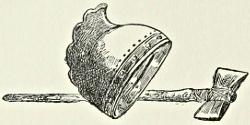
Early Gothic Helmet and Axe
In every state of his fortune, the prudence and firmness of Theodoric were equally conspicuous; whether he threatened Constantinople at the head of the confederate Goths, or retreated with a faithful band to the mountains and sea coast of Epirus. At length the accidental death of the son of Triarius[98] destroyed the balance which the Romans had been so anxious to preserve; the whole nation acknowledged the supremacy of the Amali, and the Byzantine court subscribed an ignominious and oppressive treaty. The senate had already declared, that it was necessary to choose a party among the Goths, since the public was unequal to the support of their united forces; a subsidy of two thousand pounds of gold, with the ample pay of thirteen thousand men, were required for the least considerable of their armies; and the Isaurians, who guarded not the empire but the emperor, enjoyed, besides the privilege of rapine, an annual pension of five thousand pounds.
The sagacious mind of Theodoric soon perceived that he was odious to the Romans, and suspected by the barbarians; he understood the popular murmur, that his subjects were exposed in their frozen huts to intolerable hardships, while their king was dissolved in the luxury of Greece; and he prevented the painful alternative of encountering the Goths, as the champion, or of leading them to the field as the enemy, of Zeno. Embracing an enterprise worthy of his courage and ambition, Theodoric addressed the emperor in the following words: “Although your servant is maintained in affluence by your liberality, graciously listen to the wishes of my heart! Italy, the inheritance of your predecessors, and Rome itself, the head and mistress of the world, now fluctuate under the violence and oppression of Odoacer the mercenary. Direct me, with my national troops, to march against the tyrant. If I fall, you will be relieved from an expensive and troublesome friend; if, with the divine permission, I succeed, I shall govern in your name, and to your glory, the Roman senate, and the part of the republic delivered from slavery by my victorious arms.” The proposal of Theodoric was accepted, and perhaps had been suggested, by the Byzantine court. But the forms of the commission, or grant, appear to have been expressed with a prudent ambiguity, which might be explained by the event; and it was left doubtful whether the conqueror of Italy should reign as the lieutenant, the vassal, or the ally, of the emperor of the East.d
Theodoric’s speech, quoted above, is given by Jordanes,h who is believed to be quoting from Cassiodorus,i the friend and minister of Theodoric. Procopius,j however, says that Zeno, being skilful in temporary expedients, “advised Theodoric to march to Italy, and, by a contest with Odoacer, win the Western Empire for himself and his Goths. He showed him that it was better for him to rule over the Italians than to fight the emperor at so much hazard.” The anonymous Valesian Fragmentk is even more definite as to Zeno’s share in the idea; it says that Zeno “sent him to Italy,” and offered him “as a reward for his pains,” that “until Zeno himself arrived” he might consider himself ruler.
Hodgkinc says: “More important than the question of priority of invention between Zeno and Theodoric is the uncertainty in which the rights of the contracting parties were, no doubt intentionally, left. The Goth asks the emperor’s leave to invade Italy. If Italy was recognised as permanently lost to the Roman Empire, if it was like Dacia or Britain, why was this leave necessary? He says that he will hold the new kingdom as his adoptive father’s gift. Did that gift fasten any responsibilities to the receiver? Did it entitle the giver to be consulted in the subsequent disposal of the crown? All that we can say, apparently, is that Theodoric was despatched on his hazardous expedition with the imperial approval; that the future relations between the parties were left to accident to determine; but that there was, underlying the whole conversation, a recognition of the fact that Italy and Rome still formed part of the Respublica Romana; and out of this fact would spring claims which any imperator, who was strong enough to do so, was certain to enforce.” Leaving, then, both the question of priority and the equally unsolvable riddle as to the political implication of title, let us follow the fortunes of Theodoric and Odoacer to the battle-ground, where, like two noble stags, they lock antlers over the disputed conquest of Italy.a
THE GOTHS MOVE UPON ITALY
[488-493 A.D.]
The reputation both of the leader and of the war, diffused a universal ardour; the Walamirs were multiplied by the Gothic swarms already engaged in the service, or seated in the provinces, of the empire; and each bold barbarian, who had heard of the wealth and beauty of Italy, was impatient to seek, through the most perilous adventures, the possession of such enchanting objects. The march of Theodoric must be considered as the emigration of an entire people; the wives and children of the Goths, their aged parents, and most precious effects, were carefully transported; and some idea may be formed of the heavy baggage that now followed the camp, by the loss of two thousand wagons, which had been sustained in a single action in the war of Epirus. For their subsistence, the Goths depended on the magazines of corn which was ground in portable mills by the hands of their women; on the milk and flesh of their flocks and herds; on the casual produce of the chase, and upon the contributions which they might impose on all who should presume to dispute the passage, or to refuse their friendly assistance. Notwithstanding these precautions, they were exposed to the danger, and almost to the distress, of famine, in a march of seven hundred miles, which had been undertaken in the depth of a rigorous winter.
Since the fall of the Roman power, Dacia and Pannonia no longer exhibited the rich prospect of populous cities, well-cultivated fields, and convenient highways: the reign of barbarism and desolation was restored, and the tribes of Bulgarians, Gepids, and Sarmatians, who had occupied the vacant province, were prompted by their native fierceness, or the solicitations of Odoacer, to resist the progress of his enemy. In many obscure, though bloody battles, Theodoric fought and vanquished; till at length, surmounting every obstacle by skilful conduct and persevering courage, he descended from the Julian Alps, and displayed his invincible banners on the confines of Italy (489).
Odoacer, a rival not unworthy of his arms, had already occupied the advantageous and well-known post of the river Sontius near the ruins of Aquileia, at the head of a powerful host, whose independent kings or leaders disdained the duties of subordination and the prudence of delays. No sooner had Theodoric granted a short repose and refreshment to his wearied cavalry, than he boldly attacked the fortifications of the enemy; the Ostrogoths showed more ardour to acquire, than the mercenaries to defend, the lands of Italy; and the reward of the first victory was the possession of the Venetian province as far as the walls of Verona. In the neighbourhood of that city, on the steep banks of the rapid Adige, he was opposed by a new army, reinforced in its numbers, and not impaired in its courage; the contest was more obstinate, but the event was still more decisive; Odoacer fled to Ravenna, Theodoric advanced to Mediolanum, and the vanquished troops saluted their conqueror with loud acclamations of respect and fidelity. But their want either of constancy or of faith, soon exposed him to the most imminent danger; his vanguard, with several Gothic counts, which had been rashly entrusted to a deserter,[99] was betrayed and destroyed near Faventia (Faenza) by his double treachery; Odoacer again appeared master of the field, and the invader, strongly entrenched in his camp of Ticinum, was reduced to solicit the aid of a kindred nation, the Visigoths of Gaul.
In the course of this history, the most voracious appetite for war will be abundantly satiated; nor can we much lament that our dark and imperfect materials do not afford a more ample narrative of the distress of Italy, and of the fierce conflict, which was finally decided by the abilities, experience, and valour of the Gothic king.
[493 A.D.]
From the Alps to the extremity of Calabria, Theodoric reigned by the right of conquest; the Vandal ambassadors surrendered the island of Sicily, as a lawful appendage of his kingdom; and he was accepted as the deliverer of Rome by the senate and people, who had shut their gates against the flying usurper. Ravenna alone, secure in the fortifications of art and nature, still sustained a siege of almost three years; and the daring sallies of Odoacer carried slaughter and dismay into the Gothic camp. At length, destitute of provisions, and hopeless of relief, that unfortunate monarch yielded to the groans of his subjects and the clamours of his soldiers. A treaty of peace was negotiated by the bishop of Ravenna; the Ostrogoths were admitted into the city, and the hostile kings consented, under the sanction of an oath, to rule with equal and undivided authority the provinces of Italy. The event of such an agreement may be easily foreseen. After some days had been devoted to the semblance of joy and friendship, Odoacer, in the midst of a solemn banquet, was stabbed by the hand, or at least by the command, of his rival (March 15, 493). Secret and effectual orders had been previously despatched; the faithless and rapacious mercenaries, at the same moment, and without resistance, were universally massacred; and the royalty of Theodoric was proclaimed by the Goths, with the tardy, reluctant, ambiguous consent of the emperor of the East.
The design of a conspiracy was imputed, according to the usual forms, to the prostrate tyrant; but his innocence, and the guilt of his conqueror, are sufficiently proved by the advantageous treaty which force would not sincerely have granted, nor weakness have rashly infringed. The jealousy of power, and the mischiefs of discord, may suggest a more decent apology, and a sentence less rigorous may be pronounced against a crime which was necessary to introduce into Italy a generation of public felicity. The living author of this felicity was audaciously praised in his own presence by sacred and profane orators; but history (in his time she was mute and inglorious) has not left any just representation of the events which displayed, or of the defects which clouded, the virtues of Theodoric.
The reputation of Theodoric may repose with more confidence on the visible peace and prosperity of a reign of thirty-three years; the unanimous esteem of his own times, and the memory of his wisdom and courage, his justice and humanity, which was deeply impressed on the minds of the Goths and Italians.
THEODORIC THE GREAT (493-526 A.D.)
[493-526 A.D.]
The partition of the lands of Italy, of which Theodoric assigned the third part to his soldiers, is honourably arraigned as the sole injustice of his life. And even this act may be fairly justified by the example of Odoacer, the rights of conquest, the true interest of the Italians, and the sacred duty of subsisting a whole people, who, on the faith of his promises, had transported themselves into a distant land. Under the reign of Theodoric, and in the happy climate of Italy, the Goths soon multiplied to a formidable host of two hundred thousand men, and the whole amount of their families may be computed by the ordinary addition of women and children. Their invasion of property, a part of which must have been already vacant, was disguised by the generous but improper name of hospitality; these unwelcome guests were irregularly dispersed over the face of Italy, and the lot of each barbarian was adequate to his birth and office, the number of his followers, and the rustic wealth which he possessed in slaves and cattle. The distinctions of noble and plebeian were acknowledged; but the lands of every freeman were exempt from taxes, and he enjoyed the inestimable privilege of being subject only to the laws of his country. Fashion, and even convenience, soon persuaded the conquerors to assume the more elegant dress of the natives, but they still persisted in the use of their mother-tongue; and their contempt for the Latin schools was applauded by Theodoric himself, who gratified their prejudices, or his own, by declaring, that the child who had trembled at a rod, would never dare to look upon a sword.
Theodoric studied to protect his industrious subjects, and to moderate the violence, without enervating the valour, of his soldiers who were maintained for the public defence. They held their lands and benefices as a military stipend; at the sound of the trumpet they were prepared to march under the conduct of their provincial officers; and the whole extent of Italy was distributed into the several quarters of a well-regulated camp.
Among the barbarians of the West, the victory of Theodoric had spread a general alarm. But as soon as it appeared that he was satisfied with conquest, and desirous of peace, terror was changed into respect, and they submitted to a powerful mediation, which was uniformly employed for the best purposes of reconciling their quarrels and civilising their manners. The ambassadors who resorted to Ravenna from the most distant countries of Europe, admired his wisdom, magnificence, and courtesy; and if he sometimes accepted either slaves or arms, white horses or strange animals, the gift of a sun-dial, a water-clock, or a musician admonished even the princes of Gaul of the superior art and industry of his Italian subjects. His domestic alliances, a wife, two daughters, a sister, and a niece, united the family of Theodoric with the kings of the Franks, the Burgundians, the Visigoths, the Vandals, and the Thuringians; and contributed to maintain the harmony, or at least the balance, of the great republic of the West. It is difficult, in the dark forest of Germany and Poland, to pursue the emigration of the Heruli, a fierce people, who disdained the use of armour, and who condemned their widows and aged parents not to survive the loss of their husbands, or the decay of their strength. The king of these savage warriors solicited the friendship of Theodoric, and was elevated to the rank of his son, according to the barbaric rites of a military adoption. From the shores of the Baltic, the Æstians, or Livonians, laid their offerings of native amber at the feet of a prince, whose fame had excited them to undertake an unknown and dangerous journey of fifteen hundred miles.
The life of Theodoric represents the rare and meritorious example of a barbarian, who sheathed his sword in the pride of victory and the vigour of his age. A reign of three-and-thirty years was consecrated to the duties of civil government, and the hostilities in which he was sometimes involved were speedily terminated by the conduct of his lieutenants, the discipline of his troops, the arms of his allies, and even by the terror of his name. He reduced, under a strong and regular government, the unprofitable countries of Rætia, Noricum, Dalmatia, and Pannonia, from the source of the Danube and the territory of the Bavarians, to the petty kingdom erected by the Gepids on the ruins of Sirmium. His prudence could not safely entrust the bulwark of Italy to such feeble and turbulent neighbours; and his justice might claim the lands which they oppressed, either as a part of his kingdom, or as the inheritance of his father.
The greatness of a servant, who was named perfidious because he was successful, awakened the jealousy of the emperor Anastasius; and a war was kindled on the Dacian frontier, by the protection which the Gothic king, in the vicissitude of human affairs, had granted to Mundo, a descendant of Attila. Sabinian, a general illustrious by his own and father’s merit, advanced at the head of ten thousand Romans; and the provisions and arms, which filled a long train of wagons, were distributed to the fiercest of the Bulgarian tribes. But, in the fields of Margus, the eastern powers were defeated by the inferior forces of the Goths and Huns; the flower and even the hope of the Roman armies was irretrievably destroyed; and such was the temperance with which Theodoric had inspired his victorious troops, that as their leader had not given the signal of pillage, the rich spoils of the enemy lay untouched at their feet.
Exasperated by this disgrace, the Byzantine court despatched two hundred ships and eight thousand men to plunder the sea coast of Calabria and Apulia; they assaulted the ancient city of Tarentum, interrupted the trade and agriculture of a happy country, and sailed back to the Hellespont, proud of their piratical victory over a people whom they still presumed to consider as their Roman brethren. Their retreat was possibly hastened by the activity of Theodoric; Italy was covered by a fleet of a thousand light vessels, which he constructed with incredible despatch; and his firm moderation was soon rewarded by a solid and honourable peace. He maintained with a powerful hand the balance of the West, till it was at length overthrown by the ambition of Clovis; and although unable to assist his rash and unfortunate kinsman, the king of the Visigoths, he saved the remains of his family and people, and checked the Franks in the midst of their victorious career.
It is not desirous to prolong or repeat this narrative of military events, the least interesting of the reign of Theodoric; and we shall be content to add that the Alamanni were protected, that an inroad of the Burgundians was severely chastised, and that the conquest of Arles and Marseilles opened a free communication with the Visigoths, who revered him both as their national protector, and as the guardian of his grandchild, the infant son of Alaric. Under this respectable character, the king of Italy restored the prætorian prefecture of the Gauls, reformed some abuses in the civil government of Spain, and accepted the annual tribute and apparent submission of its military governor, who wisely refused to trust his person in the palace of Ravenna. The Gothic sovereignty was established from Sicily to the Danube, from Sirmium or Belgrade to the Atlantic Ocean; and the Greeks themselves have acknowledged that Theodoric reigned over the fairest portion of the Western Empire.
The union of the Goths and Romans might have fixed for ages the transient happiness of Italy; and the first of nations, a new people of free subjects and enlightened soldiers, might have gradually arisen from the mutual emulation of their respective virtues. But the sublime merit of guiding or seconding such a revolution, was not reserved for the reign of Theodoric; he wanted either the genius or the opportunities of a legislator; and while he indulged the Goths in the enjoyment of rude liberty, he servilely copied the institutions, and even the abuses, of the political system which had been framed by Constantine and his successors. From a tender regard to the expiring prejudices of Rome, the barbarian declined the name, the purple, and the diadem, of the emperors; but he assumed, under the hereditary title of king, the whole substance and plenitude of imperial prerogative. His addresses to the eastern throne were respectful and ambiguous; he celebrated in pompous style the harmony of the two republics, applauded his own government as the perfect similitude of a sole and undivided empire, and claimed above the kings of the earth the same pre-eminence which he modestly allowed to the person or rank of Anastasius. The alliance of the East and West was annually declared by the unanimous choice of two consuls; but it should seem that the Italian candidate who was named by Theodoric, accepted a formal confirmation from the sovereign of Constantinople.
The Gothic palace of Ravenna reflected the image of the court of Theodosius or Valentinian. The prætorian prefect, the prefect of Rome, the quæstor, the master of the offices, with the public and patrimonial treasurers, whose functions are painted in gaudy colours by the rhetoric of Cassiodorus, still continued to act as the ministers of state. And the subordinate care of justice and the revenue was delegated to seven consulars, three correctors and five presidents, who governed the fifteen regions of Italy, according to the principles and even the forms of Roman jurisprudence. The violence of the conquerors was abated or eluded by the slow artifice of judicial proceedings; the civil administration, with its honours and emoluments, was confined to the Italians; and the people still preserved their dress and language, their laws and customs, their personal freedom, and two-thirds of their landed property. It had been the object of Augustus to conceal the introduction of monarchy; it was the policy of Theodoric to disguise the reign of a barbarian. If his subjects were sometimes awakened from this pleasing vision of a Roman government, they derived more substantial comfort from the character of a Gothic prince, who had penetration to discern, and firmness to pursue, his own and the public interest. Theodoric loved the virtues which he possessed, and the talents of which he was destitute. Liberius was promoted to the office of prætorian prefect for his unshaken fidelity to the unfortunate cause of Odoacer. The ministers of Theodoric, Cassiodorus and Boethius, have reflected on his reign the lustre of their genius and learning. More prudent or more fortunate than his colleague, Cassiodorus preserved his own esteem without forfeiting the royal favour; and after passing thirty years in the honours of the world, he was blessed with an equal term of repose in the devout and studious solitude of Squillace (Sylacium).
The public games, such as a Greek ambassador might politely applaud, exhibited a faint and feeble copy of the magnificence of the cæsars: yet the musical, the gymnastic, and the pantomimic arts, had not totally sunk into oblivion; the wild beasts of Africa still exercised in the amphitheatre the courage and dexterity of the hunters; and the indulgent Goth either patiently tolerated or gently restrained the blue and green factions, whose contests so often filled the circus with clamour, and even with blood. In the seventh year of his reign, Theodoric visited Rome, the old capital of the world; the senate and people advanced in solemn procession to salute a second Trajan, a new Valentinian; and he nobly supported that character by the assurance of a just and legal government, in a discourse which he was not afraid to pronounce in public, and to inscribe on a tablet of brass.
Rome, in this august ceremony, shot a last ray of declining glory; and a saint, the spectator of this pompous scene, could only hope in his pious fancy, that it was excelled by the celestial splendour of the New Jerusalem. During a residence of six months, the fame, the person, and the courteous demeanour of the Gothic king excited the admiration of the Romans, and he contemplated with equal curiosity and surprise the monuments that remained of their ancient greatness. He imprinted the footsteps of a conqueror on the Capitoline Hill, and frankly confessed that each day he viewed with fresh wonder the Forum of Trajan and his lofty column. The theatre of Pompey appeared, even in its decay, as a huge mountain artificially hollowed and polished, and adorned by human industry; and he vaguely computed, that a river of gold must have been drained to erect the colossal amphitheatre of Titus. From the mouths of fourteen aqueducts, a pure and copious stream was diffused into every part of the city; among these the Claudian water, which arose at the distance of thirty-eight miles in the Sabine mountains, was conveyed along a gentle though constant declivity of solid arches, till it descended on the summit of the Aventine Hill. The long and spacious vaults which had been constructed for the purpose of common sewers, subsisted, after twelve centuries, in their pristine strength; and the subterraneous channels have been preferred to all the visible wonders of Rome.
The Gothic kings, so injuriously accused of the ruin of antiquity, were anxious to preserve the monuments of the nation whom they had subdued. The royal edicts were framed to prevent the abuses, the neglect, or the depredations, of the citizens themselves; and a professed architect, the annual sum of two hundred pounds of gold, twenty-five thousand tiles, and the receipt of customs from the Lucrine port, were assigned for the ordinary repairs of the walls and public edifices. A similar care was extended to the statues of metal or marble, of men or animals. The spirit of the horses, which have given a modern name to the Quirinal, was applauded by the barbarians; the brazen elephants of the Via Sacra were diligently restored; the famous heifer of Myron deceived the cattle, as they were driven through the forum of peace, and an officer was created to protect those works of art, which Theodoric considered as the noblest ornaments of his kingdom.
After the example of the last emperors, Theodoric preferred the residence of Ravenna, where he cultivated an orchard with his own hands. As often as the peace of his kingdom was threatened (for it was never invaded) by the barbarians, he removed his court to Verona, on the northern frontier, and the image of his palace, still extant on a coin, represents the oldest and most authentic model of Gothic architecture. Agriculture revived under the shadow of peace, and the number of husbandmen was multiplied by the redemption of captives. The iron mines of Dalmatia, a gold mine of Bruttium, were carefully explored, and the Pontine marshes, as well as those of Spoleto, were drained and cultivated by private undertakers, whose distant reward must depend on the continuance of the public prosperity. Whenever the seasons were less propitious, the doubtful precautions of forming magazines of corn, fixing the price, and prohibiting the exportation, attested at least the benevolence of the state; but such was the extraordinary plenty which an industrious people produced from a grateful soil, that a gallon of wine was sometimes sold in Italy for less than three farthings (1½ cents), and a quarter of wheat (8 bushels) at about five shillings and sixpence ($1.37). A country possessed of so many valuable objects of exchange, soon attracted the merchants of the world, whose beneficial traffic was encouraged and protected by the liberal spirit of Theodoric. The free intercourse of the provinces by land and water was restored and extended; the city gates were never shut either by day or by night; and the common saying, that a purse of gold might be safely left in the fields, was expressive of the conscious security of the inhabitants.
THEODORIC AND THE CHURCH
A difference of religion is always pernicious and often fatal to the harmony of the prince and people; the Gothic conqueror had been educated in the profession of Arianism, and Italy was devoutly attached to the Nicene faith. But the persuasion of Theodoric was not infected by zeal, and he piously adhered to the heresy of his fathers, without condescending to balance the subtle arguments of theological metaphysics. Satisfied with the private toleration of his Arian sectaries, he justly conceived himself to be the guardian of the public worship; and his external reverence for a superstition which he despised, may have nourished in his mind the salutary indifference to a statesman or philosopher. With the protection, Theodoric assumed the legal supremacy of the church; and his firm administration restored or extended some useful prerogatives, which had been neglected by the feeble emperors of the West. He was not ignorant of the dignity and importance of the Roman pontiff, to whom the venerable name of Pope was now appropriated. The peace or the revolt of Italy might depend on the character of a wealthy and popular bishop, who claimed such ample dominion, both in heaven and earth; who had been declared in a numerous synod to be pure from all sin, and exempt from all judgment. When the chair of St. Peter was disputed by Symmachus and Laurentius, they appeared at his summons before the tribunal of an Arian monarch, and he confirmed the election of the most worthy, or the most obsequious candidate. At the end of his life, in a moment of jealousy and resentment, he prevented the choice of the Romans, by nominating a pope in the palace of Ravenna. The danger and furious contests of a schism were mildly restrained, and the last decree of the senate was enacted to extinguish, if it were possible, the scandalous venality of the papal elections.
We have descanted with pleasure on the fortunate condition of Italy; but our fancy must not hastily conceive that the golden age of the poets, a race of men without vice or misery, was realised under the Gothic conquest. The fair prospect was sometimes overcast with clouds; the wisdom of Theodoric might be deceived, his power might be resisted, and the declining age of the monarch was sullied with popular hatred and patrician blood. In the first insolence of victory, he had been tempted to deprive the whole party of Odoacer of the civil, and even the natural rights of society; a tax unseasonably imposed after the calamities of war, would have crushed the rising agriculture of Liguria: a rigid pre-emption of corn, which was intended for the public relief, must have aggravated the distress of Campania. These dangerous projects were defeated by the virtue and eloquence of Epiphanius and Boethius, who, in the presence of Theodoric himself, successfully pleaded the cause of the people: but if the royal ear was open to the voice of truth, a saint and a philosopher are not always to be found at the ear of kings. The privileges of rank, or office, or favour, were too frequently abused by Italian fraud and Gothic violence; and the avarice of the king’s nephew was publicly exposed, at first by the usurpation, and afterwards by the restitution, of the estates which he had unjustly extorted from his Tuscan neighbours. Two hundred thousand barbarians, formidable even to their master, were seated in the heart of Italy; they indignantly supported the restraints of peace and discipline; the disorders of their march were always felt, and sometimes compensated; and where it was dangerous to punish, it might be prudent to dissemble, the sallies of their native fierceness.
Even the religious toleration which Theodoric had the glory of introducing into the Christian world, was painful and offensive to the orthodox zeal of the Italians. They respected the armed heresy of the Goths; but their pious rage was safely pointed against the rich and defenceless Jews, who had formed their establishments at Neapolis, Rome, Ravenna, Mediolanum, and Genoa, for the benefit of trade, and under the sanction of the laws. Their persons were insulted, their effects were pillaged, and their synagogues were burned by the mad populace of Ravenna and Rome, inflamed, as it should seem, by the most frivolous or extravagant pretences. The government which could neglect, would have deserved such an outrage. A legal inquiry was instantly directed; and as the authors of the tumult had escaped in the crowd, the whole community was condemned to repair the damage; and the obstinate bigots who refused their contributions, were whipped through the streets by the hand of the executioner. This simple act of justice exasperated the discontent of the Catholics, who applauded the merit and patience of these holy confessors; three hundred pulpits deplored the persecution of the church; and if the chapel of St. Stephen at Verona was demolished by the command of Theodoric, it is probable that some miracle, hostile to his name and dignity, had been performed on that sacred theatre. At the close of a glorious life, the king of Italy discovered that he had excited the hatred of a people whose happiness he had so assiduously laboured to promote; and his mind was soured by indignation, jealousy, and the bitterness of unrequited love. The Gothic conqueror condescended to disarm the unwarlike natives of Italy, interdicting all weapons of offence, and excepting only a small knife for domestic use. The deliverer of Rome was accused of conspiring with the vilest informers against the lives of senators whom he suspected of a secret and treasonable correspondence with the Byzantine court.
After the death of Anastasius, the diadem had been placed on the head of a feeble old man; but the powers of government were assumed by his nephew Justinian, who already meditated the extirpation of heresy, and the conquest of Italy and Africa. A rigorous law, which was published at Constantinople, to reduce the Arians by the dread of punishment within the pale of the church, awakened the just resentment of Theodoric, who claimed, for his distressed brethren of the East, the same indulgence which he had so long granted to the Catholics of his dominions. At his command, the Roman pontiff, John I, with four illustrious senators, embarked on an embassy, of which he must have alike dreaded the failure or the success. The singular veneration shown to the first pope who had visited Constantinople was punished as a crime by his jealous monarch; the artful or peremptory refusal of the Byzantine court might excuse an equal, and would provoke a larger, measure of retaliation; and a mandate was prepared in Italy, to prohibit, after a stated day, the exercise of the Catholic worship. By the bigotry of his subjects and enemies, the most tolerant of princes was driven to the brink of persecution; and the life of Theodoric was too long, since he lived to condemn the virtue of Boethius and Symmachus.
THE FATE OF BOETHIUS AND SYMMACHUS
[524 A.D.]
The senator Boethius is the last of the Romans whom Cato or Tully could have acknowledged for their countryman. As a wealthy orphan, he inherited the patrimony and honours of the Anician family. Boethius is said to have employed eighteen laborious years in the schools of Athens, which were supported by the zeal, the learning, and the diligence of Proclus and his disciples. After his return to Rome, and his marriage with the daughter of his friend, the patrician Symmachus, Boethius still continued, in a palace of ivory and marble, to prosecute the same studies. The church was edified by his profound defence of the orthodox creed against the Arian, the Eutychian, and the Nestorian heresies; and the Catholic unity was explained or exposed in a formal treatise by the indifference of three distinct, though consubstantial, persons. For the benefit of his Latin readers, his genius submitted to teach the first elements of the arts and sciences of Greece. The geometry of Euclid, the music of Pythagoras, the arithmetic of Nicomachus, the mechanics of Archimedes, the astronomy of Ptolemy, the theology of Plato, and the logic of Aristotle, with the commentary of Porphyry, were translated and illustrated by the indefatigable pen of the Roman senator. And he alone was esteemed capable of describing the wonders of art, a sun-dial, a water-clock, or a sphere which represented the motions of the planets.
From these abstruse speculations, Boethius stooped, or, to speak more truly, he rose to the social duties of public and private life; the indigent were relieved by his liberality; and his eloquence, which flattery might compare to the voice of Demosthenes or Cicero, was uniformly exerted in the cause of innocence and humanity. Such conspicuous merit was felt and rewarded by a discerning prince; the dignity of Boethius was adorned with the titles of consul and patrician, and his talents were usefully employed in the important station of master of the offices. Notwithstanding the equal claims of the East and West, his two sons were created, in their tender youth, the consuls of the same year.
But the favour and fidelity of Boethius declined in just proportion with the public happiness; and an unworthy colleague was imposed, to divide and control the power of the master of the offices. In the last gloomy season of Theodoric, he indignantly felt that he was a slave; but as his master had only power over his life, he stood without arms and without fear against the face of an angry barbarian, who had been provoked to believe that the safety of the senate was incompatible with his own. The senator Albinus was accused, and already convicted, on the presumption of hoping, as it was said, the liberty of Rome. “If Albinus be criminal,” exclaimed the orator, “the senate and myself are all guilty of the same crime. If we are innocent, Albinus is equally entitled to the protection of the laws.” These laws might not have punished the simple and barren wish of an unattainable blessing; but they would have shown less indulgence to the rash confession of Boethius, that, had he known of a conspiracy, the tyrant never should. The advocate of Albinus was soon involved in the danger, and perhaps the guilt, of his client; their signature (which they denied as a forgery) was affixed to the original address, inviting the emperor to deliver Italy from the Goths; and three witnesses of honourable rank, perhaps of infamous reputation, attested the treasonable designs of the Roman patrician. Yet his innocence must be presumed, since he was deprived by Theodoric of the means of justification, and rigorously confined in the tower of Pavia, while the senate, at the distance of five hundred miles, pronounced a sentence of confiscation and death against the most illustrious of its members. A devout and dutiful attachment to the senate was condemned as criminal by the trembling voices of the senators themselves; and their ingratitude deserved the wish and prediction of Boethius that, after him, none should be found guilty of the same offence.
While Boethius, oppressed with fetters, expected each moment the sentence or the stroke of death, he composed in the tower of Pavia the Consolation of Philosophy; a golden volume, not unworthy of the leisure of Plato or Tully, but which claims incomparable merit from the barbarism of the times and the situation of the author. The celestial guide, whom he had so long invoked at Rome and Athens, now condescended to illumine his dungeon, to revive his courage, and to pour into his wounds her salutary balm. Suspense, the worst of evils, was at length determined by the ministers of death, who executed, and perhaps exceeded, the inhuman mandate of Theodoric. A strong cord was fastened round the head of Boethius,[100] and forcibly tightened, till his eyes almost started from their sockets; and some mercy may be discovered in the milder torture of beating him with clubs till he expired. But his genius survived to diffuse a ray of knowledge over the darkest ages of the Latin world; the writings of the philosopher were translated by the most glorious of English kings, and the third emperor of the name of Otho removed to a more honourable tomb the bones of a Catholic saint, who, from his Arian persecutors, had acquired the honours of martyrdom, and the fame of miracles.
In the last hours of Boethius he derived some comfort from the safety of his two sons, of his wife, and of his father-in-law, the venerable Symmachus. But the grief of Symmachus was indiscreet, and perhaps disrespectful; he had presumed to lament, he might dare to revenge, the death of an injured friend. He was dragged in chains from Rome to the palace of Ravenna; and the suspicions of Theodoric could only be appeased by the blood of an innocent and aged senator.
[524-526 A.D.]
Humanity will be disposed to encourage any report which testifies the jurisdiction or conscience and the remorse of kings; and philosophy is not ignorant that the most horrid spectres are sometimes created by the powers of a disordered fancy, and the weakness of a distempered body. After a life of virtue and glory, Theodoric was now descending with shame and guilt into the grave; his mind was humbled by the contrast of the past, and justly alarmed by the invisible terrors of futurity. One evening, as it is related,[101] when the head of a large fish was served on the royal table, he suddenly exclaimed that he beheld the angry countenance of Symmachus, his eyes glaring fury and revenge, and his mouth armed with long sharp teeth, which threatened to devour him. The monarch instantly retired to his chamber, and as he lay trembling with anguish, cold under the weight of bed-clothes, he expressed in broken murmurs to his physician Elpidius his deep repentance for the murders of Boethius and Symmachus. His malady increased, and after a dysentery which continued three days, he expired in the palace of Ravenna, in the thirty-third, or, if we compute from the invasion of Italy, in the thirty-seventh year of his reign, August 30, 526.
Conscious of his approaching end, he divided his treasures and provinces between his two grandsons, and fixed the Rhone as their common boundary. Amalaric was restored to the throne of Spain. Italy, with all the conquests of the Ostrogoths, was bequeathed to Athalaric; whose age did not exceed ten years, but who was cherished as the last male offspring of the line of Amali, by the short-lived marriage of his mother Amalasuntha with a royal fugitive of the same blood. In the presence of the dying monarch, the Gothic chiefs and Italian magistrates mutually engaged their faith and loyalty to the young prince, and to his guardian mother; and received, in the same awful moment, his last salutary advice, to maintain the laws, to love the senate and people of Rome, and to cultivate with decent reverence the friendship of the emperor. The monument of Theodoric was erected by his daughter Amalasuntha, in a conspicuous situation, which commanded the city of Ravenna, the harbour, and the adjacent coast. A chapel of a circular form, thirty feet in diameter, is crowned by a dome of one entire piece of granite: from the centre of the dome four columns arose, which supported, in a vase of porphyry, the remains of the Gothic king, surrounded by the brazen statues of the twelve apostles. His spirit, after some previous expiation, might have been permitted to mingle with the benefactors of mankind, if an Italian hermit had not been witness in a vision to the damnation of Theodoric, whose soul was plunged, by the ministers of divine vengeance,[102] into the volcano of Lipari, one of the flaming mouths of the infernal world.
THE TROUBLES OF AMALASUNTHA
[526-536 A.D.]
The birth of Amalasuntha, the regent and queen of Italy, united the two most illustrious families of the barbarians. Her mother, the sister of Clovis, was descended from the long-haired kings of the Merovingian race, and the regal succession of the Amali was illustrated in the eleventh generation, by her father, the great Theodoric, whose merit might have ennobled a plebeian origin. The sex of his daughter excluded her from the Gothic throne: but his vigilant tenderness for his family and his people discovered the last heir of the royal line, whose ancestors had taken refuge in Spain; and the fortunate Eutharic was suddenly exalted to the rank of a consul and a prince. He enjoyed only a short time the charms of Amalasuntha, and the hopes of the succession; and his widow, after the death of her husband and father, was left the guardian of her son Athalaric, and the kingdom of Italy. At the age of about twenty-eight years, the endowments of her mind and person had attained their perfect maturity. Her beauty, which, in the apprehension of Theodora herself, might have disputed the conquest of an emperor, was animated by manly sense, activity, and resolution. Education and experience had cultivated her talents; her philosophic studies were exempt from vanity; and, though she expressed herself with equal elegance and ease in the Greek, the Latin, and the Gothic tongue, the daughter of Theodoric maintained in her counsels a discreet and impenetrable silence.

Gothic Helmet and Weapons
By a faithful imitation of the virtues she revived the prosperity of his reign; while she strove, with pious care, to expiate the faults, and to obliterate the darker memory, of his declining age. The children of Boethius and Symmachus were restored to their paternal inheritance; her extreme lenity never consented to inflict any corporal or pecuniary penalties on her Roman subjects; and she generously despised the clamours of the Goths, who, at the end of forty years, still considered the people of Italy as their slaves or their enemies. Her salutary measures were directed by the wisdom, and celebrated by the eloquence, of Cassiodorusi; she solicited and deserved the friendship of the emperor; and the kingdoms of Europe respected, both in peace and war, the majesty of the Gothic throne.
But the future happiness of the queen and of Italy depended on the education of her son, who was destined, by his birth, to support the different and almost incompatible characters of the chief of a barbarian camp, and the first magistrate of a civilised nation. From the age of ten years, Athalaric was diligently instructed in the arts and sciences, either useful or ornamental for a Roman prince; and three venerable Goths were chosen to instil the principles of honour and virtue into the mind of their young king. But the pupil who is insensible of the benefits, must abhor the restraints, of education; and the solicitude of the queen, which affection rendered anxious and severe, offended the untractable nature of her son and his subjects. On a solemn festival, when the Goths were assembled in the palace of Ravenna, the royal youth escaped from his mother’s apartment, and, with tears of pride and anger, complained of a blow which his stubborn disobedience had provoked her to inflict. The barbarians resented the indignity which had been offered to their king; accused the regent of conspiring against his life and crown; and imperiously demanded that the grandson of Theodoric should be rescued from the dastardly discipline of women and pedants, and educated, like a valiant Goth, in the society of his equals, and the glorious ignorance of his ancestors. To this rude clamour, importunately urged as the voice of the nation, Amalasuntha was compelled to yield her reason, and the dearest wishes of her heart.
[534-535 A.D.]
The king of Italy was abandoned to wine, to women, and to rustic sports; and the indiscreet contempt of the ungrateful youth betrayed the mischievous designs of his favourites and her enemies. Encompassed with domestic foes, she entered into a secret negotiation with the emperor Justinian; obtained the assurance of a friendly reception, and had actually deposited at Dyrrhachium in Epirus a treasure of forty thousand pounds of gold. Happy would it have been for her fame and safety, if she had calmly retired from barbarous faction to the peace and splendour of Constantinople. But the mind of Amalasuntha was inflamed by ambition and revenge; and while her ships lay at anchor in the port, she waited for the success of a crime which her passions excused or applauded as an act of justice. Three of the most dangerous malcontents had been separately removed, under the pretence of trust and command, to the frontiers of Italy: they were assassinated by her private emissaries; and the blood of these noble Goths rendered the queen-mother absolute in the court of Ravenna, and justly odious to a free people. But if she had lamented the disorders of her son, she soon wept his irreparable loss; and the death of Athalaric, in 534, who, at the age of sixteen, was consumed by premature intemperance, left her destitute of any firm support or legal authority. [Athalaric died of the plague.]
Instead of submitting to the laws of her country, which held as a fundamental maxim, that the succession could never pass from the lance to the distaff, the daughter of Theodoric conceived the impracticable design of sharing with one of her cousins the regal title, and of reserving in her own hands the substance of supreme power. He received the proposal with profound respect and affected gratitude; and the eloquent Cassiodorus announced to the senate and the emperor, that Amalasuntha and Theodatus [or Theodahad] had ascended the throne.[103] His birth (for his mother was the sister of Theodoric) might be considered as an imperfect title; and the choice of Amalasuntha was more strongly directed by her contempt of his avarice and pusillanimity, which had deprived him of the love of the Italians, and the esteem of the barbarians. But Theodatus was exasperated by the contempt which he deserved; her justice had repressed and reproached the oppression which he exercised against his Tuscan neighbours; and the principal Goths, united by common guilt and resentment, conspired to instigate his slow and timid disposition. The letters of congratulation were scarcely despatched before the queen of Italy was imprisoned in a small island of the lake of Volsiniensis (Bolsena), where, after a short confinement, she was strangled in the bath, by the order, or with the connivance, of the new king,[104] who instructed his turbulent subjects to shed the blood of their sovereigns (May? 535).
JUSTINIAN INTERVENES
[535-536 A.D.]
Justinian beheld with joy the dissensions of the Goths; and the mediation of an ally concealed and promoted the ambitious views of the conqueror. His ambassadors, in their public audience, demanded the fortress of Lilybæum, ten barbarian fugitives, and a just compensation for the pillage of a small town on the Illyrian borders; but they secretly negotiated with Theodatus to betray the province of Tuscany, and tempted Amalasuntha to extricate herself from danger and perplexity, by a free surrender of the kingdom of Italy. A false and servile epistle was subscribed by the reluctant hand of the captive queen; but the confession of the Roman senators, who were sent to Constantinople, revealed the truth of her deplorable situation; and Justinian, by the voice of a new ambassador, most powerfully interceded for her life and liberty. Yet the secret instructions of the same minister were adapted to serve the cruel jealousy of Theodora, who dreaded the presence and superior charms of a rival: he prompted, with artful and ambiguous hints, the execution of a crime so useful to the Romans; received the intelligence of her death with grief and indignation, and denounced, in his master’s name, immortal war against the perfidious assassin.
In Italy as well as in Africa, the guilt of an usurper appeared to justify the arms of Justinian; but the forces which he prepared were insufficient for the subversion of a mighty kingdom, if their feeble numbers had not been multiplied by the name, the spirit, and the conduct of a hero. A chosen troop of guards, who served on horseback, and were armed with lances and bucklers, attended the person of Belisarius: his cavalry was composed of two hundred Huns, three hundred Moors, and four thousand confederates, and the infantry consisted only of three thousand Isaurians. Steering the same course as in his former expedition, the Roman consul cast anchor before Catana in Sicily, to survey the strength of the island, and to decide whether he should attempt the conquest, or peaceably pursue his voyage for the African coast. He found a fruitful land and a friendly people. Notwithstanding the decay of agriculture, Sicily still supplied the granaries of Rome; the farmers were graciously exempted from the oppression of military quarters; and the Goths, who trusted the defence of the island to the inhabitants, had some reason to complain that their confidence was ungratefully betrayed: instead of soliciting and expecting the aid of the king of Italy, they yielded to the first summons a cheerful obedience: and this province, the first-fruits of the Punic Wars, was again, after a long separation, united to the Roman Empire (535).
The Gothic garrison of Palermo, which alone attempted to resist, was reduced, after a short siege, by a singular stratagem. Belisarius introduced his ships into the deepest recess of the harbour; their boats were laboriously hoisted with ropes and pulleys to the topmast head, and he filled them with archers, who from that superior station commanded the ramparts of the city. After this easy though successful campaign, the conqueror entered Syracuse in triumph, at the head of his victorious bands, distributing gold medals to the people, on the day which so gloriously terminated the year of the consulship. He passed the winter season in the palace of ancient kings, amidst the ruins of a Grecian colony, which once extended to a circumference of two-and-twenty miles; but in the spring, about the festival of Easter, the prosecution of his designs was interrupted by a dangerous revolt of the African forces.
Although Theodatus descended from a race of heroes, he was ignorant of the art, and averse to the dangers, of war. Although he had studied the writings of Plato and Tully, philosophy was incapable of purifying his mind from the basest passions, avarice and fear. He had purchased a sceptre by ingratitude and murder: at the first menace of an enemy, he degraded his own majesty, and that of a nation which already disdained their unworthy sovereign. Astonished by the recent example of Gelimer, he saw himself dragged in chains through the streets of Constantinople; the terrors which Belisarius inspired were heightened by the eloquence of Petrus, the Byzantine ambassador; and that bold and subtle advocate persuaded him to sign a treaty, too ignominious to become the foundation of a lasting peace.
Justinian required and accepted the abdication of the Gothic king. His indefatigable agent returned from Constantinople to Ravenna, with ample instructions; and a fair epistle, which praised the wisdom and generosity of the royal philosopher, granted his pension, with the assurance of such honours as a subject and a Catholic might enjoy; and wisely referred the final execution of the treaty to the presence and authority of Belisarius. But in the interval of suspense two Roman generals, who had entered the province of Dalmatia, were defeated and slain by the Gothic troops. From blind and abject despair, Theodatus capriciously rose to groundless and fatal presumption, and dared to receive with menace and contempt the ambassador of Justinian; who claimed his promise, solicited the allegiance of his subjects, and boldly asserted the inviolable privilege of his own character. The march of Belisarius dispelled this visionary pride.
After Belisarius had left sufficient garrisons in Palermo and Syracuse, he embarked his troops at Messina, and landed them, without resistance, on the opposite shores of Rhegium. A Gothic prince, who had married the daughter of Theodatus, was stationed with an army to guard the entrance of Italy; but he imitated, without scruple, the example of a sovereign faithless to his public and private duties. The perfidious Ebermor deserted with his followers to the Roman camp, and was dismissed to enjoy the servile honours of the Byzantine court. From Rhegium to Neapolis (Naples) the fleet and army of Belisarius, almost always in view of each other, advanced near three hundred miles along the sea coast.
In a much later period, the circumference of Naples measured only 2363 paces: the fortifications were defended by precipices or the sea: when the aqueducts were intercepted, a supply of water might be drawn from wells and fountains; and the stock of provisions was sufficient to consume the patience of the besiegers. At the end of twenty days, that of Belisarius was almost exhausted, and he had reconciled himself to the disgrace of abandoning the siege, that he might march, before the winter season, against Rome and the Gothic king. But his anxiety was relieved by the bold curiosity of an Isaurian, who explored the dry channel of an aqueduct, and secretly reported that a passage might be perforated to introduce a file of armed soldiers into the heart of the city. When the work had been silently executed, the humane general risked the discovery of his secret, by a last and fruitless admonition of the impending danger. In the darkness of the night four hundred Romans entered the aqueduct, raised themselves by a rope, which they fastened to an olive tree, into the house or garden of a solitary matron, sounded their trumpets, surprised the sentinels, and gave admittance to their companions, who on all sides scaled the walls and burst open the gates of the city. Every crime which is punished by social justice was practised as the rights of war; the Huns were distinguished by cruelty and sacrilege, and Belisarius alone appeared in the streets and churches of Naples, to moderate the calamities which he predicted.
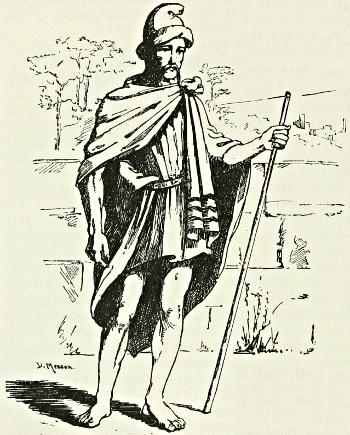
A Goth, Peasant Costume
The faithful soldiers and citizens of Neapolis had expected their deliverance from a prince who remained the inactive and almost indifferent spectator of their ruin. Theodatus secured his person within the walls of Rome, while his cavalry advanced forty miles on the Appian way, and encamped in the Pontine marshes; which, by a canal of nineteen miles in length, had been recently drained and converted into excellent pastures. But the principal forces of the Goths were dispersed in Dalmatia, Venetia, and Gaul; and the feeble mind of their king was confounded by the unsuccessful event of a divination, which seemed to presage the downfall of his empire. The most abject slaves have arraigned the guilt, or weakness, of an unfortunate master. The character of Theodatus was rigorously scrutinised by a free and idle camp of barbarians, conscious of their privilege and power: he was declared unworthy of his race, his nation, and his throne; and their general Witiges, whose valour had been signalised in the Illyrian War, was raised, with unanimous applause, on the bucklers of his companions. On the first rumour, the abdicated monarch fled from the justice of his country; but he was pursued by private revenge.[105] A Goth, whom he had injured in his love, overtook Theodatus on the Flaminian way, and, regardless of his unmanly cries, slaughtered him, as he lay prostrate on the ground (536).
WITIGES KING OF THE GOTHS
The choice of the people is the best and purest title to reign over them: yet such is the prejudice of every age, that Witiges impatiently wished to return to Ravenna, where he might seize, with the reluctant hand of the daughter of Amalasuntha, some faint shadow of hereditary right. A national council was immediately held, and the new monarch reconciled the impatient spirit of the barbarians to a measure of disgrace, which the misconduct of his predecessor rendered wise and indispensable. The Goths consented to retreat in the presence of a victorious enemy: to delay till the next spring the operations of offensive war; to summon their scattered forces; to relinquish their distant possessions, and to trust even Rome itself to the faith of its inhabitants. Leuderis, an aged warrior, was left in the capital with four thousand soldiers; a feeble garrison, which might have seconded the zeal, though it was incapable of opposing the wishes, of the Romans. But a momentary enthusiasm of religion and patriotism was kindled in their minds. They furiously exclaimed, that the apostolic throne should no longer be profaned by the triumph or toleration of Arianism; that the tombs of the Cæsars should no longer be trampled by the savages of the north; and, without reflecting that Italy must sink into a province of Constantinople, they fondly hailed the restoration of a Roman emperor as a new era of freedom and prosperity. The deputies of the pope and clergy, of the senate and people, invited the lieutenant of Justinian to accept their voluntary allegiance, and to enter the city, whose gates would be thrown open for his reception.
BELISARIUS AND THE SIEGE OF ROME (536-538 A.D.)
As soon as Belisarius had fortified his new conquests, Naples and Cumæ, he made his entrance through the Asinarian gate, the garrison departed without molestation along the Flaminian way; and the city, after sixty years’ servitude, was delivered from the yoke of the barbarians. Leuderis alone, from a motive of pride or discontent, refused to accompany the fugitives; and the Gothic chief, himself a trophy of the victory, was sent with the keys of Rome to the throne of the emperor Justinian.
The designs of Witiges were executed, during the winter season, with diligence and effect. From their rustic habitations, from their distant garrisons, the Goths assembled at Ravenna for the defence of their country; and such were their numbers, that after an army had been detached for the relief of Dalmatia, 150,000 fighting men marched under the royal standard. According to the degrees of rank or merit, the Gothic king distributed arms and horses, rich gifts and liberal promises; he moved along the Flaminian way, declined the useless sieges of Perusia and Spoleto, respected the impregnable rock of Narni (Narnia), and arrived within two miles of Rome, at the foot of the Milvian bridge. The narrow passage was fortified with a tower, and Belisarius had computed the value of the twenty days, which must be lost in the construction of another bridge. But the consternation of the soldiers of the tower, who either fled or deserted, disappointed his hopes, and betrayed his person into the most imminent danger. At the head of one thousand horse, the Roman general sallied from the Flaminian gate to mark the ground of an advantageous position, and to survey the camp of the barbarians; but while he still believed them on the other side of the Tiber, he was suddenly encompassed and assaulted by their innumerable squadrons. The fate of Italy depended on his life; and the deserters pointed to the conspicuous horse, a bay, with a white face, which he rode on that memorable day. “Aim at the bay horse,” was the universal cry. Every bow was bent, every javelin was directed, against that fatal object, and the command was repeated and obeyed by thousands who were ignorant of its real motive. The bolder barbarians advanced to the more honourable combat of swords and spears; and the praise of an enemy has graced the fall of Visandus, the standard-bearer,[106] who maintained his foremost station, till he was pierced with thirteen wounds, perhaps by the hand of Belisarius himself.
The Roman general was strong, active, and dexterous; on every side he discharged his weighty and mortal strokes; his faithful guards imitated his valour, and defended his person; and the Goths, after the loss of a thousand men, fled before the arms of a hero. They were rashly pursued to their camp; and the Romans, oppressed by multitudes, made a gradual, and at length a precipitate, retreat to the gates of the city; the gates were shut against the fugitives; and the public terror was increased by the report that Belisarius was slain. His countenance was indeed disfigured by sweat, dust, and blood; his voice was hoarse, his strength was almost exhausted; but his unconquerable spirit still remained; he imparted that spirit to his desponding companions; and their last desperate charge was felt by the flying barbarians, as if a new army, vigorous and entire, had been poured from the city. The Flaminian gate was thrown open to a real triumph; but it was not before Belisarius had visited every post, and provided for the public safety, that he could be persuaded by his wife and friends to taste the needful refreshments of food and sleep. In the more improved state of the art of war, a general is seldom required, or even permitted, to display the personal prowess of a soldier; and the example of Belisarius may be added to the rare examples of Henry IV, of Pyrrhus, and of Alexander.
[537 A.D.]
After this first and unsuccessful trial of their enemies, the whole army of the Goths passed the Tiber, and formed the siege of the city, which continued above a year, till their final departure. Rome, in its present state, could send into the field above thirty thousand males of a military age; and, notwithstanding the want of discipline and exercise, the far greater part, inured to the hardships of poverty, might be capable of bearing arms for the defence of their country and religion. The prudence of Belisarius did not neglect this important resource. His soldiers were relieved by the zeal and diligence of the people, who watched while they slept, and laboured while they reposed; he accepted the voluntary service of the bravest and most indigent of the Roman youth; and the companies of townsmen sometimes represented, in a vacant post, the presence of the troops which had been drawn away to more essential duties. But his just confidence was placed in the veterans who had fought under his banner in the Persian and African wars; and although that gallant band was reduced to five thousand men, he undertook, with such contemptible numbers, to defend a circle of twelve miles, against an army of 150,000 barbarians. In the walls of Rome, which Belisarius constructed or restored, the materials of ancient architecture may be discerned; and the whole fortification was completed, except in a chasm still extant between the Pincian and Flaminian gates, which the prejudices of the Goths and Romans left under the effectual guard of St. Peter the apostle. The battlements or bastions were shaped in sharp angles; a ditch, broad and deep, protected the foot of the rampart; and the archers on the rampart were assisted by military engines—the ballista, a powerful cross-bow, which darted short but massy arrows; the onagri, or wild asses, which, on the principle of a sling, threw stones and bullets of an enormous size. A chain was thrown across the Tiber; the arches of the aqueducts were made impervious, and the mole or sepulchre of Hadrian was converted, for the first time, to the uses of a citadel. That venerable structure, which contained the ashes of the Antonines, was a circular turret rising from a quadrangular basis; it was covered with the white marble of Paros, and decorated by the statues of gods and heroes; and the lover of the arts must read with a sigh, that the works of Praxiteles or Lysippus were torn from their lofty pedestals, and hurled into the ditch on the heads of the besiegers. To each of his lieutenants, Belisarius assigned the defence of a gate, with the wise and peremptory instruction, that, whatever might be the alarm, they should steadily adhere to their respective posts, and trust their general for the safety of Rome.
The formidable hosts of the Goths was insufficient to embrace the ample measure of the city; of the fourteen gates, seven only were invested, from the Prænestine to the Flaminian way; and Witiges divided his troops into six camps, each of which was fortified with a ditch and rampart. On the Tuscan side of the river, a seventh encampment was formed in the field or circus of the Vatican, for the important purpose of commanding the Milvian bridge and the course of the Tiber; but they approached with devotion the adjacent church of St. Peter; and the threshold of the holy apostles was respected during the siege by a Christian enemy.
Eighteen days were employed by the besiegers, to provide all the instruments of attack which antiquity had invented. Fascines were prepared to fill the ditches, scaling-ladders to ascend the walls. The largest trees of the forest supplied the timbers of four battering-rams; their heads were armed with iron; they were suspended by ropes, and each of them was worked by the labour of fifty men. The lofty wooden turrets moved on wheels or rollers, and formed a spacious platform of the level of the rampart. On the morning of the nineteenth day, a general attack was made from the Prænestine gate to the Vatican; seven Gothic columns, with their military engines, advanced to the assault; and the Romans, who lined the ramparts, listened with doubt and anxiety to the cheerful assurances of their commander. As soon as the enemy approached the ditch, Belisarius himself drew the first arrow; and such was his strength and dexterity, that he transfixed the foremost of the barbarian leaders. A shout of applause and victory was re-echoed along the wall. He drew a second arrow, and the stroke was followed with the same success and the same acclamation. The Roman general then gave the word that the archers should aim at the teams of oxen; they were instantly covered with mortal wounds; the towers which they drew remained useless and immovable, and a single moment disconcerted the laborious projects of the king of the Goths.
After this disappointment, Witiges still continued, or feigned to continue, the assault of the Salarian gate, that he might divert the attention of his adversary, while his principal forces more strenuously attacked the Prænestine gate and the sepulchre of Hadrian, at the distance of three miles from each other. Near the former, the double walls of the Vivarium were low or broken; the fortifications of the latter were feebly guarded: the vigour of the Goths was excited by the hope of victory and spoil; and if a single post had given way, the Romans, and Rome itself, were irrecoverably lost. This perilous day was the most glorious in the life of Belisarius. Amidst tumult and dismay, the whole plan of the attack and defence was distinctly present to his mind; he observed the changes of each instant, weighed every possible advantage, transported his person to the scenes of danger, and communicated his spirit in calm and decisive orders. The contest was fiercely maintained from the morning to the evening; the Goths were repulsed on all sides, and each Roman might boast that he had vanquished thirty barbarians, if the strange disproportion of numbers were not counterbalanced by the merit of one man. Thirty thousand Goths, according to the confession of their own chiefs [so Procopiusj claims], perished; and the multitude of the wounded was equal to that of the slain. When they advanced to the assault, their close disorder suffered not a javelin to fall without effect; and as they retired, the populace of the city joined the pursuit, and assailed, with impunity, the backs of their flying enemies. Belisarius instantly sallied from the gates; and while the soldiers chanted his name and victory, the hostile engines of war were reduced to ashes. Such was the loss and consternation of the Goths, that, from this day, the siege of Rome degenerated into a tedious and indolent blockade; and they were incessantly harassed by the Roman general, who, in frequent skirmishes, destroyed about five thousand of their bravest troops.
Belisarius praised the spirit of his troops, condemned their presumption, yielded to their clamours, and prepared the remedies of a defeat, the possibility of which he alone had courage to suspect. In the quarter of the Vatican, the Romans prevailed; and if the irreparable moments had not been wasted in the pillage of the camp, they might have occupied the Milvian bridge, and charged in the rear of the Gothic host. On the other side of the Tiber, Belisarius advanced from the Pincian and Salarian gates. But his army, four thousand soldiers perhaps, was lost in a spacious plain; they were encompassed and oppressed by fresh multitudes, who continually relieved the broken ranks of the barbarians. The valiant leaders of the infantry were unskilled to conquer: they died: the retreat (a hasty retreat) was covered by the prudence of the general, and the victors started back with affright from the formidable aspect of an armed rampart. The reputation of Belisarius was unsullied by a defeat; and the vain confidence of the Goths was not less serviceable to his designs, than the repentance and modesty of the Roman troops.
SUFFERINGS OF THE ROMANS
From the moment that Belisarius had determined to sustain a siege, his assiduous care provided Rome against the danger of famine, more dreadful than the Gothic arms. An extraordinary supply of corn was imported from Sicily; the harvests of Campania and Tuscany were forcibly swept for the use of the city: and the rights of private property were infringed by the strong plea of the public safety. It might easily be foreseen that the enemy would intercept the aqueducts; and the cessation of the water-mills was the first inconvenience, which was speedily removed by mooring large vessels, and fixing millstones in the current of the river. The stream was soon embarrassed by the trunks of trees, and polluted with dead bodies; yet so effectual were the precautions of the Roman general, that the waters of the Tiber still continued to give motion to the mills and drink to the inhabitants; the more distant quarters were supplied from domestic wells; and a besieged city might support, without impatience, the privation of her public baths. A large portion of Rome, from the Prænestine gate to the church of St. Paul, was never invested by the Goths; their excursions were restrained by the activity of the Moorish troops; the navigation of the Tiber, and the Latin, Appian, and Ostian ways, were left free and unmolested for the introduction of corn and cattle, or the retreat of the inhabitants, who sought a refuge in Campania or Sicily.
Anxious to relieve himself from a useless and devouring multitude, Belisarius issued his peremptory orders for the instant departure of the women, the children, and the slaves; required his soldiers to dismiss their male and female attendants, and regulated their allowance, that one moiety should be given in provisions, and the other in money. His foresight was justified by the increase of the public distress, as soon as the Goths had occupied two important posts in the neighbourhood of Rome. By the loss of the port, or, as it is now called, the city of Porto, he was deprived of the country on the right of the Tiber, and the best communication with the sea; and he reflected with grief and anger, that three hundred men, could he have spared such a feeble band, might have defended its impregnable works. Seven miles from the capital, between the Appian and the Latin ways, two principal aqueducts, crossing and again crossing each other, enclosed within their solid and lofty arches a fortified space, where Witiges established a camp of seven thousand Goths to intercept the convoys of Sicily and Campania. The granaries of Rome were insensibly exhausted, the adjacent country had been wasted with fire and sword; such scanty supplies as might yet be obtained by hasty excursions were the reward of valour and the purchase of wealth: the forage of the horses, and the bread of the soldiers, never failed; but in the last months of the siege, the people were exposed to the miseries of scarcity, unwholesome food, and contagious disorders.
Belisarius saw and pitied their sufferings; but he had foreseen, and he watched, the decay of their loyalty and the progress of their discontent. Adversity had awakened the Romans from the dreams of grandeur and freedom, and taught them the humiliating lesson, that it was of small moment to their real happiness, whether the name of their master was derived from the Gothic or the Latin language. The lieutenant of Justinian listened to their just complaints, but he rejected with disdain the idea of flight or capitulation; repressed their clamorous impatience for battle; amused them with the prospect of sure and speedy relief; and secured himself and the city from the effects of their despair or treachery. Twice in each month he changed the station of the officers to whom the custody of the gates was committed: the various precautions of patrols, watchwords, lights, and music, were repeatedly employed to discover whatever passed on the ramparts; out-guards were posted beyond the ditch, and the trusty vigilance of dogs supplied the more doubtful fidelity of mankind.
THE POPE DEPOSED
A letter was intercepted, which assured the king of the Goths that the Asinarian gate, adjoining to the Lateran church, should be secretly opened to his troops. On the proof or suspicion of treason, several senators were banished, and the pope Silverius was summoned to attend the representative of his sovereign, at his headquarters in the Pincian palace. The conqueror of Rome and Carthage was modestly seated at the feet of Antonina, who reclined on a stately couch: the general was silent, but the voice of reproach and menace issued from the mouth of his imperious wife. Accused by credible witnesses, and the evidence of his own subscription, the successor of St. Peter was despoiled of his pontifical ornaments, clad in the mean habit of a monk, and embarked, without delay, for a distant exile in the East. [According to Hodgkinc his “contemporaries seem to have entirely acquitted him in the matter,” and “posterity reverenced him as a martyr.”]
As Justinian was ambitious of fame, he made some efforts, though they were feeble and languid, to support and rescue his victorious general. A reinforcement of sixteen hundred Slavonians and Huns was led by Martin and Valerian; and as they had reposed during the winter season in the harbours of Greece, the strength of the men and horses was not impaired by the fatigues of a sea voyage; and they distinguished their valour in the first sally against the besiegers. About the time of the summer solstice, Euthalius landed at Tarracina with large sums of money for the payment of the troops; he cautiously proceeded along the Appian way, and this convoy entered Rome through the gate Capena, while Belisarius, on the other side, diverted the attention of the Goths by a vigorous and successful skirmish. These seasonable aids, the use and reputation of which were dexterously managed by the Roman general, revived the courage, or at least the hopes, of the soldiers and people. The historian Procopius was despatched with an important commission to collect the troops and provisions which Campania could furnish, or Constantinople had sent; and the secretary of Belisarius was soon followed by Antonina herself, who boldly traversed the posts of the enemy, and returned with the oriental succours to the relief of her husband and the besieged city. A fleet of three thousand Isaurians cast anchor in the bay of Naples, and afterwards at Ostia. Above two thousand horse, of whom a part were Thracians, landed at Tarentum; and, after the junction of five hundred soldiers of Campania, and a train of wagons laden with wine and flour, they directed their march, on the Appian way, from Capua to the neighbourhood of Rome. The forces that arrived by land and sea were united at the mouth of the Tiber.