Part 11 / Book 2 — CHAPTER III THE FRANKS TO THE TIME OF CHARLES MARTEL [55 B.C.-732 A.D.]
Reading edition
It is well known that the name of “Frank” is not to be found in the long list of German tribes preserved to us in the Germania of Tacitus.b Little or nothing is heard of them before the reign of Gordian III. In 240 A.D. Aurelian,[119] then a tribune of the sixth legion stationed on the Rhine, encountered a body of marauding Franks near Mogontiacum, and drove them back into their marshes. The word “Francia” is also found at a still earlier date, in the old Roman chart called the Charta Peutingeria, and occupies on the map the right bank of the Rhine from opposite Coblenz to the sea. The origin of the Franks has been the subject of frequent debate, to which French patriotism has occasionally lent some asperity. At the time when they first appear in history, the Romans had neither the taste nor the means for historical research, and we are therefore obliged to depend in a great measure upon conjecture and combination. It has been disputed whether the word “Frank” was the original designation of a tribe, which by a change of habitation emerged at the period above mentioned into the light of history, or that of a new league, formed for some common object of aggression or defence by nations hitherto familiar to us under other names.
We can in this place do little more than refer to a controversy, the value and interest of which has been rendered obsolete by the progress of historical investigation. The darkness and void of history have as usual been filled with spectral theories, which vanish at the challenge of criticism and before the gradually increasing light of knowledge.
[55 B.C.-12 A.D.]
We need hardly say that the origin of the Franks has been traced to fugitive colonists from Troy; for what nation under heaven has not sought to connect itself, in some way or other, with the glorified heroes of the immortal song? Nor is it surprising that French writers, desirous of transferring from the Germans to themselves the honours of the Frankish name, should have made of them a tribe of Gauls, whom some unknown cause had induced to settle in Germany, and who afterwards sought to recover their ancient country from the Roman conquerors. At the present day, however, historians of every nation, including the French, are fairly agreed in considering the Franks as a powerful confederacy of German tribes, who in the time of Tacitus inhabited the northwestern parts of Germany bordering on the Rhine. And this theory is so well supported by many scattered notices, slight in themselves but powerful when combined, that we can only wonder that it should ever have been called in question. Nor was this aggregation of tribes under the new name of Franks a singular instance; the same took place in the case of the Alamanni and Saxons.
The actuating causes of these new unions are unknown. They may be sought for either in external circumstances, such as the pressure of powerful enemies from without, or in an extension of their own desires and plans, requiring the command of greater means, and inducing a wider co-operation of those whose similarity of language and character rendered it most easy for them to unite. But perhaps we need look no further for an efficient cause than the spirit of amalgamation which naturally arises among tribes of kindred race and language, when their growing numbers, and an increased facility of moving from place to place, bring them into more frequent contact. The same phenomenon may be observed at certain periods in the history of almost every nation, and the spirit which gives rise to it has generally been found strong enough to overcome the force of particular interests and petty nationalities.
The etymology of the name adopted by the new confederacy is also uncertain. The conjecture which has most probability in its favour is that adopted long ago by Gibbon,d and confirmed in recent times by the authority of Grimm,e which connects it with the German word frank (free). The derivation preferred by Adelungf from frak (in modern German frech, bold), with the inserted nasal, differs from that of Grimm only in appearance. No small countenance is given to this derivation by the constant recurrence in after times of the epithet truces, feroces, which the Franks were so fond of applying to themselves, and which they certainly did everything to deserve. Tacitusb speaks of nearly all the tribes, whose various appellations were afterwards merged in that of Frank, as living in the neighbourhood of the Rhine. Of these the principal were the Sugambri (the chief people of the old Istævonian tribe), who, as there is reason to believe, were identical with the Salian Franks. The confederation further comprised the Bructeri, the Chamavi, Ansibarii, Tubantes, Marsi, and Chasuari, of whom the five last had formerly belonged to the celebrated Cheruscan league, which, under the hero Arminius, destroyed three Roman legions in the Teutoburg forest.
The strongest evidence of the identity of these tribes with the Franks, is the fact that, long after their settlement in Gaul, the distinctive names of the original people were still occasionally used as synonymous with that of the confederation. The Sugambri [or Sicambri] are known in Roman history for their active and enterprising spirit, and the determined opposition which they offered to the greatest generals of Rome. It was on their account that Cæsar bridged the Rhine in the neighbourhood of Bonn, and spent eighteen days, as he informs us with significant minuteness, on the German side of that river. Drusus made a similar attempt against them with little better success. Tiberius was the first who obtained any decided advantage over them; and even he, by his own confession, was obliged to have recourse to treachery. An immense number of them were then transported by the command of Augustus to the left bank of the Rhine, “that,” as the panegyristg expresses it, “they might be compelled to lay aside not only their arms but their ferocity.” That they were not, however, even then so utterly destroyed or expatriated as the flatterers of the emperor would have us believe, is evident from the fact that they appear again under the same name, in less than three centuries afterwards, as the most powerful tribe in the Frankish confederacy.
[12-240 A.D.]
The league thus formed was subject to two strong motives, either of which might alone have been sufficient to impel a brave and active people into a career of migration and conquest. The first of these was necessity,—the actual want of the necessaries of life for their increasing population,—and the second desire, excited to the utmost by the spectacle of the wealth and civilisation of the Gallic provinces.
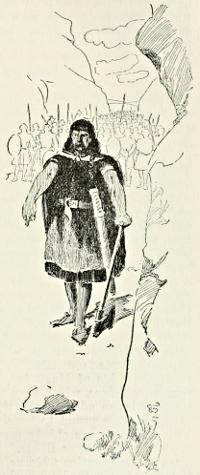
Early Frankish Warriors
As long as the Romans held firm possession of Gaul, the Germans could do little to gratify their longings; they could only obtain a settlement in that country by the consent of the emperor and on certain conditions. Examples of such merely tolerated colonisation were the Tribocci, the Vangiones, and the Ubii at Colonia Agrippina (Cologne). But when the Roman Empire began to feel the numbness of approaching dissolution, and, as is usually the case, first in its extremities, the Franks were amongst the most active and successful assailants of their enfeebled foe: and if they were attracted towards the West by the abundance they beheld of all that could relieve their necessities and gratify their lust of spoil, they were also impelled in the same direction by the Saxons, the rival league, a people as brave and perhaps more barbarous than themselves. A glance at the map of Germany of that period will do much to explain to us the migration of the Franks, and that long and bloody feud between them and the Saxons, which began with the Chatti and Cherusci, and needed all the power and energy of a Charlemagne to bring to a successful close. The Saxons formed behind the Franks, and could only reach the provinces of Gaul by sea. It was natural therefore that they should look with the intensest hatred upon a people who barred their progress to a more genial climate and excluded them from their share in the spoils of the Roman world.
The Franks advanced upon Gaul from two different directions, and under the different names of Salians and Ripuarians, the former of whom we have reason to connect more particularly with the Sugambrian tribe. The origin of the words Salian and Ripuarian, which are first used respectively by Ammianus Marcellinush and Jordanes,i is very obscure, and has served to exercise the ingenuity of ethnographers. There are, however, no sufficient grounds for a decided opinion. At the same time it is by no means improbable that the river Yssel, Isala, or Sal (for it has borne all these appellations) may have given its name to that portion of the Franks who lived along its course. With still greater probability may the name Ripuarii or Riparii be derived from Ripa, a term used by the Romans to signify the Rhine. These dwellers on the “bank” were those that remained in their ancient settlements while their Salian kinsmen were advancing into the heart of Gaul.
FIRST CONFLICTS WITH ROME
[240-321 A.D.]
It would extend the introductory portion of this chapter beyond its proper limits to refer, however briefly, to all the successive efforts of the Franks to gain a permanent footing upon Roman ground. Though often defeated, they perpetually renewed the contest; and when Roman historians and panegyrists inform us that the whole nation was several times “utterly destroyed,” the numbers and geographical position in which we find them a short time after every such annihilation prove to us the vanity of such accounts. Aurelian, as we have seen, defeated them at Mainz, in 242 A.D., and drove them into the swamps of Holland. They were routed again about twelve years afterwards by Gallienus; but they quickly recovered from this blow, for in 276 A.D. we find them in possession of sixty Gallic cities, of which Probus is said to have deprived them, and to have destroyed four hundred thousand of them and their allies on Roman ground. In 280 A.D., they gave their aid to the usurper Proculus, who claimed to be of Frankish blood, but was nevertheless betrayed by them; and in 288 A.D., Carausius the Menapian was sent to clear the seas of their roving barks. But the latter found it more agreeable to shut his eyes to their piracies, in return for a share of the booty, and they afterwards aided in protecting him from the chastisement due to his treachery, and in investing him with the imperial purple in Britain.
In the reign of Maximian, we find a Frankish army, probably of Ripuarians, at Trèves, where they were defeated by that emperor; and both he and Diocletian adopted the title of “Francicus,” which many succeeding emperors were proud to bear. The first appearance of the Salian Franks with whom we are chiefly concerned is in the occupation of the Batavian Islands, in the lower Rhine. They were attacked in that territory in 292 A.D., by Constantius Chlorus, who, as is said, not only drove them out of Batavia, but marched, triumphant and unopposed, through their own country as far as the Danube. The latter part of this story has little foundation either in history or probability.
[321-355 A.D.]
The most determined and successful resistance to their progress was made by Constantine the Great, in the first part of the fourth century. We must, however, receive the extravagant accounts of the imperial annalists with considerable caution. It is evident, even from their own language, that the great emperor effected more by stratagem than by force. He found the Salians once more in Batavia, and, after defeating them in a great battle, carried off a large number of captives to Augusta Trevirorum (Trèves), the residence of the emperor, and a rival of Rome itself in the splendour of its public buildings.
It was in the circus of this city, and in the presence of Constantine, that the notorious “Ludi Francici” was celebrated; at which several thousand Franks, including their kings Regaisus and Ascaricus, were compelled to fight with wild beasts, to the inexpressible delight of the Christian spectators. “Those of the Frankish prisoners,” says Eumenius,g “whose perfidy unfitted them for military service, and their ferocity for servitude, were given to the wild beasts as a show, and wearied the raging monsters by their multitude.” “This magnificent spectacle,” Nazariusg praises, some twenty years after it had taken place, in the most enthusiastic terms, comparing Constantine to a youthful Hercules who had strangled two serpents in the cradle of his empire. Eumenius calls it a “daily and eternal victory,” and says that Constantine had erected terror as a bulwark against his barbarian enemies. This terror did not, however, prevent the Franks from taking up arms to revenge their butchered countrymen, nor the Alamanni from joining in the insurrection. The skill and fortune of Constantine generally prevailed; he destroyed great numbers of the Franks and the innumeræ gentes who fought on their side, and really appears for a time to have checked their progress.
It is impossible to read the brief yet confused account of these incessant encounters between the Romans and barbarians, without coming to the conclusion that only half the truth is told; that while every advantage gained by the former is greatly exaggerated, the successes of the latter are passed over in silence. The most glorious victory of a Roman general procures him only a few months’ repose, and the destruction of “hundreds of thousands” of Franks and Alamanni seems but to increase their numbers. We may fairly say of the Franks, what Julianj and Eutropiusk have said respecting the Goths, that they were not so utterly annihilated as the Panegyristsg pretend, and that many of the victories gained over them cost “more money than blood.”
The death of Constantine was the signal for a fresh advance on the part of the Franks. Libanius,l the Greek rhetorician, when extolling the deeds of Constans, the youngest son of Constantine the Great, says that the emperor stemmed the impetuous torrent of barbarians “by a love of war even greater than their own.” He also says that they received overseers; but this was no doubt on Roman ground, which would account for their submission, as we know that the Franks were more solicitous about real than nominal possession. During the frequent struggles for the purple which took place at this period, the aid of the Franks was sought for by the different pretenders, and rewarded, in case of success, by large grants of land within the limits of the empire. The barbarians consented, in fact, to receive as a gift what had really been won by their own valour, and could not have been withheld. Even previous to the reign of Constantine, some Frankish generals had risen to high posts in the service of Roman emperors. Magnentius, himself a German, endeavoured to support his usurpation by Frankish and Saxon missionaries; and Silvanus, who was driven into rebellion by the ingratitude of Constantius, whom he had faithfully served, was a Frank.
The state of confusion into which the empire was thrown by the turbulence and insolence of the Roman armies, and the selfish ambition of their leaders, was highly favourable to the progress of the Franks in Gaul. Their next great and general movement took place in 355 A.D., when, along the whole Roman frontier from Strasburg to the sea, they began to cross the Rhine, and to throw themselves in vast numbers upon the Gallic provinces, with the full determination of forming permanent settlements. But again the relenting fates of Rome raised up a hero in the person of the emperor Julian, worthy to have lived in the most glorious period of her history. After one or two unsuccessful efforts, Julian succeeded in retaking Colonia Agrippina (Cologne) and other places which the Germans, true to their traditionary hatred of walled towns, had laid bare of all defences.
FRANKS IN THE ROMAN ARMY
[355-388 A.D.]
In the last general advance of the Franks in 355 A.D., the Salians had not only once more recovered Batavia, but had spread into Toxandria, in which they firmly fixed themselves. It is important to mark the date of this event, because it was at this time that the Salians made their first permanent settlement on the left bank of the Rhine, and by the acquisition of Toxandria laid the foundation of the kingdom of Clovis. Julian indeed attacked them there in 358 A.D., but he had probably good reasons for not reducing them to despair, as we find that they were permitted to retain their newly acquired lands, on condition of acknowledging themselves subjects of the empire. He was better pleased to have them as soldiers than as enemies, and they, having felt the weight of his arm, were by no means averse to serve in his ranks, and to enrich themselves by the plunder of the East. Once in undisputed possession of Toxandria, they gradually spread themselves further and further, until, at the beginning of the fifth century, we find them occupying the left bank of the Rhine. The Ripuarians, meanwhile, were extending themselves from Andernach downwards along the middle Rhine, and gained possession of Cologne about the time of the conquest of Tornacum by their Salian brethren.
We shall be the less surprised that some of the fairest portions of the Roman Empire should thus fall an almost unresisting prey to barbarian invaders, when we remember that the defence of the empire itself was sometimes committed to the hands of Frankish soldiers. Those of the Franks who were already settled in Gaul were often engaged in endeavouring to drive back the ever increasing multitude of fresh barbarians, who hurried across the Rhine to share in the bettered fortunes of their kinsmen, or even to plunder them of their newly acquired riches. Thus Mallobaudes, who is called king of the Franks, and held the office of domesticorum comes under Gratian, commanded in the imperial army which defeated the Alamanni at Argentaria. And again, in the short reign of Maximus, who assumed the purple in Gaul, Spain, and Britain, near the end of the fourth century, we are told that three Frankish kings, Genobaudes, Marcomeres, and Sunno, crossed the lower Rhine, and plundered the country along the river as far as Cologne; although the whole of northern Gaul was already in possession of their countrymen.
The generals Nonnius and Quintinus, whom Maximus had left behind him at Augusta Trevirorum, the seat of the imperial government in Gaul, hastened to Colonia Agrippina, from which the marauding Franks had already retired with their booty. Quintinus crossed the Rhine in pursuit at Neus, and, unmindful of the fate of Varus in the Teutoburg forest, followed the retreating enemy into the morasses. The Franks, once more upon friendly and familiar ground, turned upon their pursuers, and are said to have destroyed nearly the whole Roman army with poisoned arrows. The war continued, and was only brought to a successful conclusion for the Romans by the courage and conduct of Arbogastes, a Frank in the service of Theodosius. Unable to make peace with his barbarous countrymen, and sometimes defeated by them, this general crossed the Rhine when the woods were leafless, ravaged the country of the Chamavi, Bructeri, and Chatti, and having slain two of their chiefs named Priam and Genobaudes, compelled Marcomeres and Sunno to give hostages. The submission of the Franks must have been of short continuance, for we read that in 398 A.D. these same kings, Marcomeres and Sunno, were again found ravaging the left bank of the Rhine by Stilicho. This famous warrior defeated them in a great battle, and sent the former, or perhaps both of them, in chains to Italy, where Marcomeres died in prison.
[388-425 A.D.]
The first few years of the fifth century are occupied in the struggle between Alaric the Goth and Stilicho, which ended in the sacking of Rome by the former in the year 410 A.D., the same in which he died.
While the Goths were inflicting deadly wounds on the very heart of the empire, the distant provinces of Germany and Gaul presented a scene of indescribable confusion. Innumerable hosts of Astingians, Vandals, Alani, Suevi, and Burgundiones threw themselves like robbers upon the prostrate body of imperial Rome, and scrambled for the gems which fell from her costly diadem. In such a storm the Franks could no longer sustain the part of champions of the empire, but doubtless had enough to do to defend themselves and hold their own. We can only guess at the fortune which befell the nations in that dark period, from the state in which we find them when the glimmering light of history once more dawns upon the chaos.
EARLY KINGS AND THE SALIC LAWS
Of the internal state of the Frankish league in these times, we learn from ancient authorities absolutely nothing on which we can safely depend. The blank is filled up by popular fable. It is in this period, about 417 A.D., that the reign of Pharamond is placed, of whom we may more than doubt whether he ever existed at all. To this hero were afterwards ascribed not only the permanent conquests made at this juncture by the various tribes of Franks, but the establishment of the monarchy and the collection and publication of the well-known Salic laws. The sole foundation for this harmonious fabric is a passage interpolated into an ancient chronicle (Prosperm) of the fifth century; and, with this single exception, Pharamond’s name is never mentioned before the seventh century. The whole story is perfected and rounded off by the author of the Gesta Francorum,n according to whom Pharamond was the son of Marcomeres, the prince who ended his days in the Italian prison. The fact that nothing is known of him by Gregory of Tourso or Fredegariusp is sufficient to prevent our regarding him as an historical personage. To this may be added that he is not mentioned in the prologue of the Salic law, with which his name has been so intimately associated by later writers.
[425-429 A.D.]
Though well authenticated names of persons and places fail us at this time, it is not difficult to conjecture what must have been the main facts of the case. Great changes took place among the Franks in the first half of the fifth century, which did much to prepare them for their subsequent career. The greater portion of them had been mere marauders, like their German brethren of other nations: they now began to assume the character of settlers; and as the idea of founding an extensive empire was still far from their thoughts, they occupied in preference the lands which lay nearest to their ancient homes. There are many incidental reasons which make this change in their mode of life a natural and inevitable one. The country whose surface had once afforded a rich and easily collected booty, and well repaid the hasty foray of weeks, and even days, had been stripped of its movable wealth by repeated incursions of barbarians still fiercer than themselves. All that was above the surface the Alan and the Vandal had swept away, the treasures which remained had to be sought for with the plough. The Franks were compelled to turn their attention to that agriculture which their indolent and warlike fathers had hated; which required fixed settlements, and all the laws of property and person indissolubly connected therewith. Again, though there is no sufficient reason to connect the Salic laws with the mythical name of Pharamond, or to suppose that they were altogether the work of this age (since we know from Tacitusb that the Germans had similar laws in their ancient forests), it is very probable that this celebrated code now received the form in which it has come down to us.
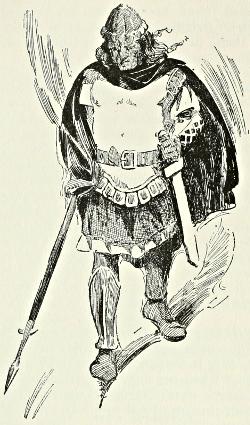
A Frankish Officer
This view of the case is strongly supported by internal evidence in the laws themselves, which, according to the Prologue, were written while the Franks were still heathens, and are peculiarly suited to the simple wants of a barbarous people. Even the fiction of the foundation of the Frankish monarchy by Pharamond may indicate some real and important change in the structure of the state.
That there was at that time but a single king “in Francia” is of course untrue; but nevertheless it seems highly probable, when taken in connection with the subsequent history, that the princes who reigned over the different Frankish tribes established in Gaul belonged, at this period, to one family. And this is the truth which appears to lie at the foundation of the story of this mythical personage.
[429-451 A.D.]
The next important and well-established historical fact which we meet with in this dreary waste of doubt and conjecture, is the conquest of Cameracum (Cambray) by Clodion, in 429 A.D. This acquisition forms the third stage in the progress of the Salian Franks towards the complete possession of Gaul.
The foremost among the kindred chiefs of the different Frankish tribes at this period was Clodion, whom some modern historians, and among them Gibbon,d have represented, on the slenderest foundation, as the father of Merovæus, and first of the race of long-haired kings. Gregory of Tourso gives no countenance to the statement thus boldly made; he does not know that Merovæus was the son of Clodion, nor has he anything to say about Merovæus himself. That the power of Clodion was considerable is evinced by the magnitude of his undertakings. The growing numbers of the Franks in Gaul, continually increased by fresh swarms of settlers from their ancient seats, made an extension of their territory not merely desirable, but even necessary to their existence. Clodion therefore boldly undertook the conquest of the Belgica Secunda, a part of which was still in possession of the Romans. Having sent forward spies to Cameracum, and learned from them that it was insufficiently defended, he advanced upon that city, and succeeded in taking it. After spending a few days within the walls of his new acquisition, he marched as far as the river Samara (Somme). His progress was checked by Aëtius and Majorian, who surprised him in the neighbourhood of Arras, at a place called Helena (Lens), while celebrating a marriage, and forced him to retire. Yet at the end of the war, the Franks remained in full possession of the country which Clodion had overrun; and the Samara became the boundary of the Salian land upon the southwest, as it continued to be until the time of Clovis.
Clodion died in 447 A.D., and was thus saved from the equally pernicious alliance or enmity of the ruthless conqueror Attila. This “Scourge of God,” as he delighted to be called, appeared in Gaul about the year 450 A.D. at the head of an innumerable host of mounted Huns; a race so singular in their aspect and habits as to seem scarcely human, and compared with whom the wildest Franks and Goths must have appeared rational and civilised beings.
The time of Attila’s descent upon the Rhine was well chosen for the prosecution of his scheme of universal dominion. Between the fragment of the Roman Empire, governed by Aëtius, and the Franks under the successors of Clodion, there was either open war or a hollow truce. The succession to the chief power in the Salian tribe was the subject of a violent dispute between two Frankish princes, the elder of whom is supposed by some to have been called Merovæus.
We have seen that there is some reason to doubt the existence of a prince of this name; and there is no evidence that either of the rival candidates was a son of Clodion. Whatever their parentage or name may have been, the one took part with Attila, and the other with the Roman Aëtius, on condition, no doubt, of having their respective claims allowed and supported by their allies. In the bloody and decisive battle of the Catalaunian Fields round Châlons, Franks, under the name of Leti and Ripuarii, served under the so-called Merovæus in the army of Aëtius, together with Theodoric and his Visigoths. Among the forces of Attila another body of Franks was arrayed, either by compulsion, or instigated to this unnatural course by the fierce hatred of party spirit. From the result of the battle of Châlons, we must suppose that the ally of Aëtius succeeded to the throne of Clodion (451).
[451-481 A.D.]
The effects of the invasion of Gaul by Attila were neither great nor lasting, and his retreat left the German and Roman parties in much the same condition as he found them. The Roman Empire indeed was at an end in that province, yet the valour and wisdom of Ægidius enabled him to maintain, as an independent chief, the authority which he had faithfully exercised as master-general of Gaul, under the noble and virtuous Majorian. The extent of his territory is not clearly defined, but it must have been, in part at least, identical with that of which his son and successor, Syagrius, was deprived by Clovis. Common opinion limits this to the country between the Oise, the Marne, and the Seine, to which some writers have added Auxerre and Troyes. The respect in which Ægidius was held by the Franks, as well as his own countrymen, enabled him to set at defiance the threats and machinations of the barbarian Ricimer, who virtually ruled at Rome, though in another’s name. The strongest proof of the high opinion they entertained of the merits of Ægidius, is said to have been given by the Salians in the reign of their next king. The prince, to whom the name Merovæus has been arbitrarily assigned, was succeeded by his son Childeric, in 458 A.D. The conduct of this licentious youth was such as to disgust and alienate his subjects, who had not yet ceased to value female honour, nor adopted the loose manners of the Romans and their Gallic imitators.
The authority of the Salian kings over their fierce warriors was held by a precarious tenure. The loyalty which distinguished the Franks in later times had not yet arisen in their minds, and they did not scruple to send the corrupter of their wives and daughters into ignominious exile. Childeric took refuge with Bissinus (or Bassinus), king of the Thuringians, a people dwelling on the river Unstrut. It was then that the Franks, according to the somewhat improbable account of Gregory,o unanimously chose Ægidius for their king, and actually submitted to his rule for the space of eight years. At the end of that period, returning affection for their native prince, the mere love of change, or the machinations of a party, induced the Franks to recall Childeric from exile, or, at all events, to allow him to return.
Whatever may have been the cause of his restoration, it does not appear to have been the consequence of an improvement in his morals. The period of his exile had been characteristically employed in the seduction of Basina, the wife of his hospitable protector at the Thuringian court. This royal lady, whose character may perhaps do something to diminish the guilt of Childeric in our eyes, was unwilling to be left behind on the restoration of her lover to his native country. Scarcely had he re-established his authority when he was unexpectedly followed by Basina, whom he immediately married. The offspring of this questionable alliance was Clovis, who was born in the year 466 A.D. The remainder of Childeric’s reign was chiefly spent in a struggle with the Visigoths, in which Franks and Romans, under their respective leaders Childeric and Ægidius, were amicably united against the common foe.
We hasten to the reign of Clovis,[120] who, during a rule of about thirty years, not only united the various tribes of Franks under one powerful dynasty, and founded a kingdom in Gaul on a broad and enduring basis, but made his throne the centre of union to by far the greater portion of the whole German race.
THE REIGN OF CLOVIS
[481-486 A.D.]
When Clovis succeeded his father as king of the Salians, at the early age of fifteen, the extent of his territory and the number of his subjects were, as we know, extremely small; at his death, he left to his successors a kingdom more extensive than that of modern France.
The influence of the grateful partiality discernible in the works of Catholic historians and chroniclers towards “the eldest son of the church,” who secured for them the victory over heathens on the one side, and heretics on the other, prevents us from looking to them for an unbiassed estimate of his character. Many of his crimes appeared to be committed in the cause of Catholicity itself, and these they could hardly see in their proper light. Pagans and Arians would have painted him in different colours; and had any of their works come down to us, we might have sought the truth between the positive of partiality and the negative of hatred. But fortunately, while the chroniclers praise his actions in the highest terms, they tell us what those actions were, and thus compel us to form a very different judgment from their own. It would not be easy to extract from the pages of his greatest admirers the slightest evidence of his possessing any qualities but those which are necessary to a conqueror. In the hands of providence he was an instrument of the greatest good to the country he subdued, inasmuch as he freed it from the curse of division into petty states, and furthered the spread of Christianity in the very heart of Europe. But of any word or action that could make us admire or love the man, there is not a single trace in history. His undeniable courage is debased by a degree of cruelty unusual even in his times; and his consummate skill and prudence, which did more to raise him to his high position than even his military qualities, are rendered odious by the forms they take of unscrupulous falsehood, meanness, cunning, and hypocrisy.
It will add to the perspicuity of our brief narrative of the conquests of Clovis, if we pause for a moment to consider the extent and situation of the different portions into which Gaul was divided at his accession.
There were in all six independent states: (1) that of the Salians; (2) that of the Ripuarians; (3) that of the Visigoths; (4) that of the Burgundiones; (5) the kingdom of Syagrius; and (6) Armorica (by which the whole sea coast between Seine and Loire was then signified). Of the first two we have already spoken. The Visigoths held the whole of southern Gaul. It is important to bear these geographical divisions in mind, because they coincide with the successive Frankish conquests made under Clovis and his sons.
It would be unphilosophical to ascribe to Clovis a preconceived plan of making himself master of these several independent states, and of not only overthrowing the sole remaining pillar of the Roman Empire in Gaul, but, what was far more difficult, of subduing other German tribes, as fierce and independent, and in some cases more numerous than his own. In what he did, he was merely gratifying a passion for the excitements of war and acquisition, and that desire of expanding itself to its utmost limits, which is natural to every active, powerful, and imperious mind. He must indeed have been more than human to foresee, through all the obstacles that lay in his path, the career he was destined by providence to run. He was not even master of the whole Salian tribe; and besides the Salians, there were other Franks on the Rhine, the Scaldis (Schelde), the Mosa, and the Mosella, in no way inferior to his own subjects, and governed by kings of the same family as himself.
Nor was Syagrius, to whom the anomalous power of his father Ægidius had descended, a despicable foe. His merits, indeed, were rather those of an able lawyer and a righteous judge than of a warrior; but he had acquired by his civil virtues a reputation which made him an object of envy to Clovis, who dreaded perhaps the permanent establishment of a Roman dynasty in Gaul. There were reasons for attacking Syagrius first, which can hardly have escaped the cunning of Clovis, and which doubtless guided him in the choice of his earliest victim. The very integrity of the noble Roman’s character was one of these reasons. Had Clovis commenced the work of destruction by attacking his kinsmen Sigebert of Cologne and Ragnachar of Cambray (Cameracum) he would not only have received no aid from Syagrius in his unrighteous aggression, but might have found him ready to oppose it. But against Syagrius it was easy for Clovis to excite the national spirit of his brother Franks, both in and out of his own territory. In such an expedition, even had the kings declined to take an active part, he might reckon on crowds of volunteers from every Frankish gau.
As soon therefore as he had emerged from the forced inactivity of extreme youth (a period in which, fortunately for him, he was left undisturbed by his less grasping and unscrupulous neighbours), he determined to bring the question of pre-eminence between the Franks and Romans to as early an issue as possible. Without waiting for a plausible ground of quarrel, he challenged Syagrius, more Germanico, to the field, that their respective fates might be determined by the god of battles. Ragnachar of Cambray was solicited to accompany his treacherous relative on this expedition, and agreed to do so. Chararic, another Frankish prince, whose alliance had been looked for, preferred waiting until fortune had decided, with the prudent intention of siding with the winner, and coming fresh into the field in time to spoil the vanquished.
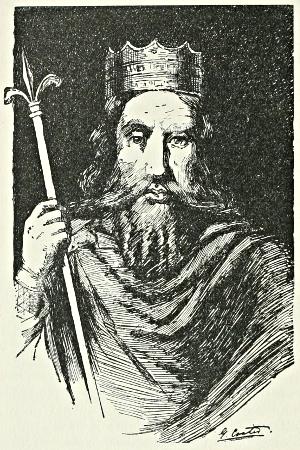
Clovis I
(Based on an old French print)
Syagrius was at Soissons (Augusta Suessionum), which he had inherited from his father, when Clovis, with characteristic decision and rapidity, passed through the wood of Ardennes, and fell upon him with resistless force. The Roman was completely defeated, and the victor, having taken possession of Soissons, Rheims, Durocortorum, and other Roman towns in the Belgica Secunda, extended his frontier to the river Loire, the boundary of the Visigoths. This battle took place in 486 A.D.
We know little or nothing of the materials of which the Roman army was composed. If it consisted entirely of Gauls, accustomed to depend on Roman aid, and destitute of the spirit of freemen, the ease with which Syagrius was defeated will cause us less surprise. Having lost all in a single battle, the unfortunate Roman fled for refuge to Toulouse (Tolosa), the court of Alaric king of the Visigoths, who basely yielded him to the threats of the youthful conqueror. But one fate awaited those who stood in the way of Clovis: Syagrius was immediately put to death, less in anger than from the calculating policy which guided all the movements of the Salian’s unfeeling heart.
[486-496 A.D.]
During the next ten years after the death of Syagrius, there is less to relate of Clovis than might be expected from the commencement of his career. We cannot suppose that such a spirit was really at rest: he was probably nursing his strength and watching his opportunities; for, with all his impetuosity, he was not a man to engage in an undertaking without good assurance of success. In the year 496 A.D. the Salians began that career of conquest, which they followed up with scarcely any intermission until the death of their warrior king.
The Alamanni, extending themselves from their original seats on the right bank of the Rhine, between the Main and the Danube, had pushed forward into Germanica Prima, where they came into collision with the Frankish subjects of King Sigebert of Cologne. Clovis flew to the assistance of his kinsman, and defeated the Alamanni in a great battle in the neighbourhood of Zülpich. He then established a considerable number of his Franks in the territory of the Alamanni, the traces of whose residences are found in the names of Franconia and Frankfort.
CLOVIS TURNS CHRISTIAN (496 A.D.)
[496 A.D.]
The same year is rendered remarkable in ecclesiastical history by the conversion of Clovis to Christianity. In 493 A.D., he had married Clotilda,[121] Chilperic the king of Burgundy’s daughter, who, being herself a Christian, was naturally anxious to turn away her warlike spouse from the rude faith of his forefathers. The real result of her endeavours it is impossible to estimate, but, at all events, she has not received from history the credit of success. The mere suggestions of an affectionate wife would be considered as too simple and prosaic a means of accounting for a change involving such mighty consequences. The conversion of Clovis was so vitally important to the interests of the Catholic church, that the chroniclers of that wonder-loving age, profuse in the employment of extraordinary means for the smallest ends, could never be brought to believe that this great event was the result of anything but a miracle of the most public and striking character.
The way in which the convictions of Clovis were changed is unknown to us, but there were natural agencies at work, and his conversion is not, under the circumstances, a thing to excite surprise. According to the common belief, however, in the Roman church, it was in the battle of Zülpich[122] that the heart of Clovis, callous to the pious solicitude of his wife, and the powerful and alluring influence of the Catholic ritual, was touched by a special interposition of providence in his behalf. When the fortune of the battle seemed turning against him, he thought of the God whom his wife adored, of whose power and majesty he had heard so much, and vowed that if he escaped the present danger, and came off victorious, he would suffer himself to be baptised, and become the champion of the Christian faith. Like another Constantine, he saw written on the face of heaven that his prayer was heard; he conquered, and fulfilled his promise at Christmas in the same year, when he was baptised by Remigius at Rheims, with three thousand of his followers.
The sincerity of Clovis’ conversion has been called in question for many reasons—such as the unsuitability of his subsequent life to Christian principles; but chiefly on the ground of the many political advantages to be derived from a public profession of the Catholic faith. We are too ready with such explanations of the actions of distinguished characters, too apt to forget that politicians are also men, and to overlook the very powerful influences which lie nearer to their hearts than even political calculation. A spirit was abroad in the world, drawing men away from the graves of a dead faith to the life and light of the Gospel—a spirit which not even the coldest and sternest heart could altogether resist. There was something, too, peculiarly imposing in the attitude of the Christian church at that period. All else in the Roman world seemed dying of mere weakness and old age; the Christian church was still in the vigour of youth, and its professors were animated by indomitable perseverance and boundless zeal. All else fell down in terror before the barbarian conqueror; the fabric of the church seemed indestructible, and its ministers stood erect in his presence, as if depending for strength and aid upon a power, which was the more terrible because indefinite in its nature and uncertain in its mode of operation.
And Clovis was as likely to be worked upon by such means as the meanest of his followers. We must not suppose that the discrepancy between his Christian profession and his public and private actions, which we discern so clearly, was equally evident to himself. How should it be so? His own conscience was not specially enlightened beyond the measure of his age. The bravest warriors of his nation hailed him as a patriot and hero, and the ministers of God assured him that his victories were won in the service of truth and heaven. It is always dangerous to judge of the sincerity of men’s religious—perhaps we should say theological—convictions by the tenor of their moral conduct, and this even in our own age and nation; but far more so in respect to men of other times and countries, at a different stage of civilisation and religious development, at which the scale of morality was not only lower, but differently graduated from our own.
The conscience of a Clovis remained undisturbed in the midst of deeds whose enormity makes us shudder; and, on the other hand, how trivial in our eyes are some of those offences which loaded him with the heaviest sense of guilt! The eternal laws of the God of justice and mercy might be broken with impunity; and means which we should call the basest treachery and the most odious cruelty were employed to compass the destruction of an heretical or pagan enemy; but woe to him who offended St. Martin, or laid a finger on the property of the meanest of his servants! When Clovis was seeking to gratify his lust of power, he believed, no doubt, that he was at the same time fighting under the banner of Christ, and destroying the enemies of God. And no wonder, for many a priest and bishop thought the same, and told him what they thought.
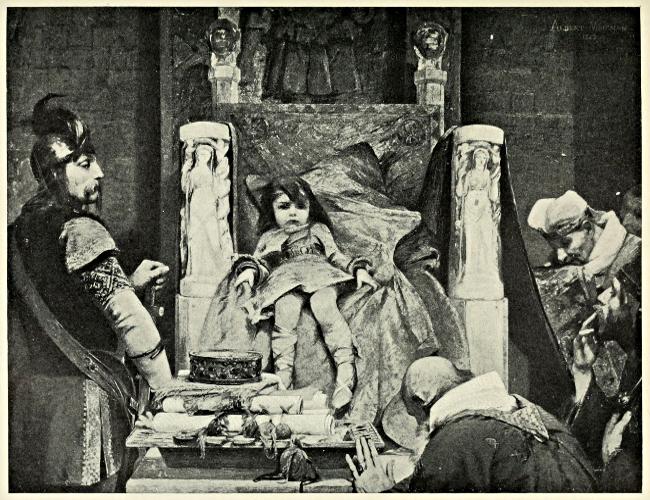
HOMAGE TO CLOVIS II
We are, however, far from affirming that the political advantages to be gained from an open avowal of the Catholic faith at this juncture escaped the notice of so astute a mind as that of Clovis. No one was more sensible of those advantages than he. The immediate consequences were indeed apparently disastrous. He was himself fearful of the effect which his change of religion might have upon his Franks, and we are told that many of them left him and joined his kinsman Ragnaric. But the ill effects, though immediate, were slight and transient, while the good results went on accumulating from year to year. In the first place, his baptism into the Catholic church conciliated for him the zealous affection of his Gallo-Roman subjects, whose number and wealth, and above all whose superior knowledge and intelligence rendered their aid of the utmost value. With respect to his own Franks, we are justified in supposing that, removed as they were from the sacred localities with which their faith was intimately connected, they either viewed the change with indifference, or, wavering between old associations and present influences, needed only the example of the king to decide their choice, and induce them to enlist under the banner of the cross.
The German neighbours of Clovis had either preserved their ancient faith or adopted the Arian heresy. His conversion therefore was advantageous or disadvantageous to him, as regarded them, according to the objects he had in view. Had he really desired to live with his compatriot kings on terms of equality and friendship, his reception into a hostile church would certainly not have furthered his views. But nothing was more foreign to his thoughts than friendship and alliance with any of the neighbouring tribes. His desire was to reduce them all to a state of subjection to himself. He had the genuine spirit of the conqueror, which cannot brook the sight of independence; and his keen intellect and unflinching boldness enabled him to see his advantages and to turn them to the best account.
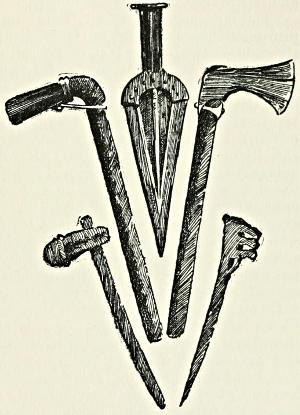
Weapons of the Franks
(These were used for throwing and for scalping after the manner of the American Indians.)
Even in those countries in which heathenism or Arian Christianity prevailed, there was generally a zealous and united community of Catholic Christians (including all the Romance inhabitants), who, being outnumbered and sometimes persecuted, were inclined to look for aid abroad. Clovis became by his conversion the object of hope and attachment to such a party in almost every country on the continent of Europe. He had the powerful support of the whole body of the Catholic clergy, in whose hearts the interests of their church far outweighed all other considerations. In other times and lands (in our own for instance) the spirit of loyalty and the love of country have often sufficed to counteract the influence of theological opinions, and have made men patriots in the hour of trial, when their spiritual allegiance to an alien head tempted them to be traitors. But what patriotism could Gallo-Romans feel, who for ages had been the slaves of slaves, or what loyalty to barbarian oppressors, whom they despised as well as feared?
[497-507 A.D.]
The happy effects of Clovis’ conversion were not long in showing themselves. In the very next year after that event (497 A.D.) the Armoricans, inhabiting the country between the Seine and Loire, who had stoutly defended themselves against the heathen Franks, submitted with the utmost readiness to the royal convert, whom bishops delighted to honour; and in almost every succeeding struggle the advantages he derived from the strenuous support of the Catholic party became more and more clearly evident.
In 500 A.D. Clovis reduced the Burgundiones to a state of semi-dependence, after a fierce and bloody battle with Gundobald, their king, at Dijon on the Ouche. In this conflict, as in almost every other, Clovis attained his ends in a great measure by turning to account the dissensions of his enemies. Gundobald had called upon his brother Godegisil, who ruled over one division of their tribe, to aid him in repelling the attack of the Franks. The call was answered, in appearance at least; but in the decisive struggle Godegisil, according to a secret understanding, deserted with all his forces to the enemy. Gundobald was of course defeated, and submitted to conditions which, however galling to his pride and patriotism, could not have been very severe, since we find him immediately afterwards punishing the treachery of his brother, whom he besieged in the city of Vienne (the Roman Vienna), and put to death in an Arian church.
The circumstances of the times, rather than the moderation of Clovis, prevented him from calling Gundobald to account. A far more arduous struggle was at hand, which needed all the wily Salian’s resources of power and policy to bring to a successful issue—the struggle with the powerful king and people of the Visigoths, whose immediate neighbour he had become after the voluntary submission of the Armoricans in 497 A.D. The valour and conduct of their renowned king Euric had put the western Goths in full possession of all that portion of Gaul which lay between the rivers Loire and Rhone, together with nearly the whole of Spain. That distinguished monarch had lately been succeeded by his son Alaric II, who was now in the flower of youth. It was in the war with this ill-starred prince—the most difficult and doubtful in which he had been engaged—that Clovis experienced the full advantages of his recent change of faith. King Euric, who was an Arian, wise and great as he appears to have been in many respects, had alienated the affections of multitudes of his people by persecuting the Catholic minority; and though the same charge does not appear to lie against Alaric, it is evident that the hearts of his orthodox subjects beat with no true allegiance towards their heretical king. The baptism of Clovis had turned their eyes towards him, as one who would not only free them from the persecution of their theological enemies, but procure for them and their church a speedy victory and a secure predominance. The hopes they had formed, and the aid they were ready to afford him, were not unknown to Clovis, whose eager rapacity was only checked by the consideration of the part which his brother-in-law Theodoric, king of the Ostrogoths, was likely to take in the matter.
This great and enlightened Goth, whose refined magnificence renders the contemptuous sense in which we use the term Gothic more than usually inappropriate, was ever ready to mediate between kindred tribes of Germans, whom on every suitable occasion he exhorted to live in unity, mindful of their common origin. He is said on this occasion to have brought about a meeting between Clovis and Alaric on a small island in the Loire in the neighbourhood of Amboise. The story is very doubtful, to say the least. Had he done so much, he would probably have done more, and have shielded his youthful kinsman with his strong right arm. Whatever he did was done in vain. The Frankish conqueror knew his own advantages and determined to use them to the utmost. He received the aid not only of his kinsman Sigebert of Cologne, who sent an army to his support under Chararic, but of the king of the Burgundians (Burgundiones), who was also a Catholic. With an army thus united by a common faith, inspired by religious zeal, and no less so by the Frankish love of booty, Clovis marched to almost certain victory over an inexperienced leader and a kingdom divided against itself.
It is evident, from the language of Gregory of Tours,o that this conflict between the Franks and Visigoths was regarded by the orthodox party of his own and preceding ages as a religious war, on which, humanly speaking, the prevalence of the Catholic or the Arian creed in western Europe depended. Clovis did everything in his power to deepen this impression. He could not, he said, endure the thought that “those Arians” held a part of his beautiful Gaul. As he passed through the territory of Tours, which was supposed to be under the peculiar protection of St. Martin, he was careful to preserve the strictest discipline among his soldiers, that he might further conciliate the church and sanctify his undertaking. On his arrival at the city of Tours, he publicly displayed his reverence for the patron saint, and received the thanks and good wishes of a whole chorus of priests assembled in St. Martin’s church. He was guided (according to one of the legends by which his progress has been so profusely adorned) through the swollen waters of the river Vienne by “a hind of wonderful magnitude”; and, as he approached the city of Poitiers, a pillar of fire (whose origin we may trace, as suits our views, to the favour of heaven or the treachery of man) shone forth from the cathedral, to give him the assurance of success, and to throw light upon his nocturnal march. The Catholic bishops in the kingdom of Alaric were universally favourable to the cause of Clovis, and several of them, who had not the patience to postpone the manifestation of their sympathies, were expelled by Alaric from their sees. The majority indeed made a virtue of necessity, and prayed continually and loudly, if not sincerely, for their lawful monarch. Perhaps they had even in that age learned to appreciate the efficacy of mental reservation.
Conscious of his own weakness, Alaric retired before his terrible and implacable foe, in the vain hope of receiving assistance from the Ostrogoths. He halted at last in the plains of Voulon, behind Poitiers, but even then rather in compliance with the wishes of his soldiers than from his own deliberate judgment. His soldiers, drawn from a generation as yet unacquainted with war and full of that overweening confidence which results from inexperience, were eager to meet the enemy. Treachery also was at work to prevent him from adopting the only means of safety, which lay in deferring as long as possible the too unequal contest. The Franks came on with their usual impetuosity, and with a well-founded confidence in their own prowess; and the issue of the battle was in accordance with the auspices on either side. Clovis, no less strenuous in actual fight than wise and cunning in council, exposed himself to every danger, and fought hand to hand with Alaric himself. Yet the latter was not slain in the field, but in the disorderly flight into which the Goths were quickly driven. The victorious Franks pursued them as far as Bordeaux (Burdigala), where Clovis passed the winter, while Thierry, his son, was overrunning Auvergne, Quincy, and Rouergue. The Goths, whose new king was a minor, made no further resistance; and in the following year the Salian chief took possession of the royal treasure at Toulouse. He also took the town of Angoulême, at the capture of which he was doubly rewarded for his services to the church; for not only did the inhabitants of that place rise in his favour against the Visigothic garrison, but the very walls, like those of Jericho, fell down at his approach!
A short time after these events, Clovis received the titles and dignity of Roman patricius and consul from the Greek emperor Anastasius; who appears to have been prompted to this act more by motives of jealousy and hatred towards Theodoric the Ostrogoth, than by any love he bore the restless and encroaching Frank. The meaning of these obsolete titles, as applied to those who stood in no direct relation to either division of the Roman Empire, has never been sufficiently explained. We are at first surprised that successful warriors and powerful kings, like Clovis, Pepin, and Charlemagne himself, should condescend to accept such empty honours at the hands of the miserable eunuch-ridden monarchs of the East. That the Byzantine emperors should affect a superiority over contemporary sovereigns is intelligible enough; the weakest idiot among them, who lived at the mercy of his women and his slaves, had never resigned one tittle of his pretensions to that universal empire which an Augustus and a Trajan once possessed. But whence the acquiescence of Clovis and his great successors in this arrogant assumption? We may best account for it by remarking how long the prestige of power survives the strength that gave it. The sun of Rome was set, but the twilight of her greatness still rested on the world. The German kings and warriors received with pleasure, and wore with pride, a title which brought them into connection with that imperial city, of whose universal dominion, of whose skill in arms and arts, the traces lay everywhere around them.

A Frankish Officer
[507-508 A.D.]
Nor was it without some solid advantages in the circumstances in which Clovis was placed. He ruled over a vast population, which had not long ceased to be subjects of the empire, and still rejoiced in the Roman name. He fully appreciated their intellectual superiority, and had already experienced the value of their assistance. Whatever tended to increase his personal dignity in their eyes (and no doubt the solemn proclamation of his Roman titles had this tendency) he deemed of no small importance.
In the same year that he was invested with the diadem and purple robe in the church of St. Martin at Tours, the encroaching Franks had the southern and eastern limits of their kingdom marked out for them by the powerful hand of Theodoric the Great. The brave but peace-loving Goth had trusted too much to his influence with Clovis, and had hoped to the last to save the unhappy Alaric, by warning and mediation. The slaughter of the Visigoths, the death of Alaric himself, the fall of Angoulême and Toulouse, the advance of the Franks upon the Rhone, where they were now besieging Arles (Arelate), had effectually undeceived him. He now prepared to bring forward the only arguments to which the ear of a Clovis is ever open—the battle-cry of a superior army. His faithful Ostrogoths were summoned to meet in the month of June, 508 A.D., and he placed a powerful army under the command of Eva (Ibba or Hebba), who led his forces into Gaul over the southern Alps. The Franks and Burgundians, who were investing Arles and Carcassonne, raised the siege and retired, but whether without or in consequence of a battle is rendered doubtful by the conflicting testimony of the annalists. The subsequent territorial position of the combatants, however, favours the account given by Julian;j that a battle did take place, in which Clovis and his allies received a most decided and bloody defeat.
[508-509 A.D.]
The check thus given to the extension of his kingdom at the expense of other German nations, and the desire perhaps of collecting fresh strength for a more successful struggle thereafter, seem to have induced Clovis to turn his attention to the destruction of his Merovingian kindred. The manner in which he effected his purpose is related with a fulness which naturally excites suspicion. But though it is easy to detect both absurdity and inconsistency in many of the romantic details with which Gregory has furnished us, we see no reason to deny to his statements a foundation of historical truth.
Clovis was still but one of several Frankish kings; and of these Sigebert of Cologne, king of the Ripuarians, was little inferior to him in the extent of his dominions and the number of his subjects. But in other respects—in mental activity and bodily prowess—“the lame” Sigebert was no match for his Salian brother. The other Frankish rulers were Chararic, of whom mention has been made in connection with Syagrius, and Ragnachar (or Ragnachas), who held his court at Cambray. The kingdom of Sigebert extended along both banks of the Rhine, from Mogontiacum (Mainz) down to Cologne; to the west along the Moselle as far as Trèves; and on the east to the river Fulda and the borders of Thuringia. The Franks who occupied this country are supposed to have taken possession of it in the reign of Valentinian III, when Mainz, Cologne, and Trèves were conquered by a host of Ripuarians. Sigebert, as we have seen, had come to the aid of Clovis, in two very important battles with the Alamanni and the Visigoths, and had shown himself a ready and faithful friend whenever his co-operation was required. But gratitude was not included among the graces of the champion of catholicity, who only waited for a suitable opportunity to deprive his ally of throne and life. The present juncture was favourable to his wishes, and enabled him to rid himself of his benefactor in a manner peculiarly suited to his taste. An attempt to conquer the kingdom of Cologne by force of arms would have been but feebly seconded by his own subjects, and would have met with a stout resistance from the Ripuarians, who were conscious of no inferiority to the Salian tribe. His efforts were therefore directed to the destruction of the royal house, the downfall of which was hastened by internal divisions.
Clotaire (or Clotaric), the expectant heir of Sigebert, weary of hope deferred, gave a ready ear to the hellish suggestions of Clovis, who urged him, by the strongest appeals to his ambition and cupidity, to the murder of his father. Sigebert was slain by his own son in the Buchonian forest near Fulda. The wretched parricide endeavoured to secure the further connivance of his tempter, by offering him a share of the blood-stained treasure he had acquired. But Clovis, whose part in the transaction was probably unknown, affected a feeling of horror at the unnatural crime, and procured the immediate assassination of Clotaire—an act which rid him of a rival, silenced an embarrassing accomplice, and tended rather to raise than to lower him in the opinion of the Ripuarians. It is not surprising, therefore, that when Clovis proposed himself as the successor of Sigebert, and promised the full recognition of all existing rights, his offer should be joyfully accepted. In 509 A.D. he was elected king by the Ripuarians, and raised upon a shield in the city of Cologne, according to the Frankish custom, amid general acclamation.
[509-511 A.D.]
“And thus,” says Gregory of Tours,o in the same chapter in which he relates the twofold murder of his kindred, “God daily prostrated his enemies before him and increased his kingdom, because he walked before him with an upright heart, and did what was pleasing in his eyes!”—so completely did his services to the Catholic church conceal his moral deformities from the eyes of even the best of the ecclesiastical historians.
To the destruction of his next victim, Chararic, whose power was far less formidable than that of Sigebert, he was impelled by vengeance as well as ambition. That cautious prince, instead of joining the other Franks in their attack upon Syagrius, had stood aloof and waited upon fortune. Yet we can hardly attribute the conduct of Clovis towards him chiefly to revenge, for his most faithful ally had been his earliest victim; and friend and foe were alike to him, if they did but cross the path of his ambition. After getting possession of Chararic and his son, by tampering with their followers, Clovis compelled them to cut off their royal locks and become priests; subsequently, however, he caused them to be put to death.
Ragnachar of Cambray, whose kingdom lay to the north of the Somme, and extended through Flanders and Artois, might have proved a more formidable antagonist, had he not become unpopular among his own subjects by the disgusting licentiousness of his manners. The account which Gregory gives of the manner in which his ruin was effected is more curious than credible, and adds the charge of swindling to the black list of crimes recorded against the man who “walked before God with an upright heart.” According to the historian, Clovis bribed the followers of Ragnachar with armour of gilded iron, which they mistook, as he intended they should, for gold. Having thus crippled by treachery the strength of his enemy, Clovis led an army over the Somme, for the purpose of attacking him in his own territory. Ragnachar prepared to meet him, but was betrayed by his own soldiers and delivered into the hands of the invader. Clovis, with facetious cruelty, reproached the fallen monarch for having disgraced their common family by suffering himself to be bound, and then split his skull with an axe. The same absurd charge was brought against Richar, the brother of Ragnachar, and the same punishment inflicted on him. A third brother was put to death at Mans.
Gregory refers, though not by name, to other kings of the same family, who were all destroyed by Clovis. “Having killed many other kings,” he says, “who were his kinsmen, because he feared they might deprive him of his power, he extended his kingdom through the whole of Gaul.” He also tells us that the royal hypocrite, having summoned a general assembly, complained before it, with tears in his eyes, that he was “alone in the world.” “Alas, for me!” he said, “I am left as an alien among strangers, and have no relatives who can assist me.” This he did, according to Gregory, “not from any real love of his kindred, or from remorse at the thought of his crimes, but that he might find out any more relatives and put them also to death.”
Clovis died at Paris, in 511 A.D., in the forty-fifth year of his age and the thirtieth of his active, blood-stained, and eventful reign. He lived therefore only five years after the decisive battle of Voulon.
Did we not know, from the judgment he passes on other characters in his history, that Gregory of Tours was capable of appreciating the nobler and gentler qualities of human nature, we might easily imagine as we read what he says of Clovis that, Christian bishop as he was, he had an altogether different standard of right and wrong from ourselves. Not a single virtuous or generous action has the panegyrist found to record of his favoured hero, while all that he does relate of him tends to deepen our conviction that this favourite of heaven, in whose behalf miracles were freely worked, whom departed saints led on to victory and living ministers of God delighted to honour, was quite a phenomenon of evil in the moral world, from his combining in himself the opposite and apparently incompatible vices of the meanest treachery and the most audacious wickedness.
We can only account for this amazing obliquity of moral vision in such a man as Gregory, by ascribing it to the extraordinary value attached in those times (and would that we could say in those times only) to external acts of devotion, and to every service rendered to the Roman church. If, in far happier ages than those of which we speak, the most polluted consciences have purchased consolation and even hope by building churches, endowing monasteries, and paying reverential homage to the dispensers of God’s mercy, can we wonder that the extraordinary services of a Clovis to Catholic Christianity should cover even his foul sins as with a cloak of snow?
He had, indeed, without the slightest provocation, deprived a noble and peaceable neighbour of his power and life. He had treacherously murdered his royal kindred, and deprived their children of their birthright. He had on all occasions shown himself the heartless ruffian, the greedy conqueror, the blood-thirsty tyrant; but by his conversion he had led the way to the triumph of Catholicism; he had saved the Roman church from the Scylla and Charybdis of heresy and paganism, planted it on a rock in the very centre of Europe, and fixed its doctrines and traditions in the hearts of the conquerors of the West.
Other reasons, again, may serve to reconcile the politician to his memory. The importance of the task which he performed (though from the basest motives), and the influence of his reign on the destinies of Europe, can hardly be overrated. He founded the monarchy on a firm and enduring basis. He levelled, with a strong though bloody hand, the barriers which separated Franks from Franks, and consolidated a number of isolated and hostile tribes into a powerful and united nation. It is true, indeed, that this unity was soon disturbed by divisions of a different nature; yet the idea of its feasibility and desirableness was deeply fixed in the national mind; a return to it was often aimed at, and sometimes accomplished.q
“The only conceivable palliation for any of the crimes which Clovis committed,” says Hodgkin,r “would have been the advantage of securing the unity of the Frankish state. Yet that unity was immediately impaired by the division of his dominions among his four sons.”
SUCCESSORS OF CLOVIS TO PEPIN
[511-531 A.D.]
In the reign of Clovis a new monarchy had been formed beyond the Rhine, that of the Thuringians, who, after their incorporation with other tribes, fell on the trans-Rhenish Franks. The latter implored the aid of their kindred tribes in Gaul: Thierry, the eldest, and Clotaire, another son of Clovis, carried the war into Thuringia. These princes triumphed over the enemy, whose rulers they exterminated, and whose country Thierry added to his possessions. Some of King Hermanfrid’s children, however, escaped into Italy, whence, in the sequel, they appear to have returned and to have given rise to the ducal house of Thuringia. In the same manner the duchies of Swabia and Bavaria were added to the domains of Thierry; so that the empire of the Franks now extended from Bohemia to the British Channel, and from the mouth of the Elbe to Languedoc and Toulouse. But it did not satisfy their ambition, which next turned towards Burgundy (532).
[531-555 A.D.]
Clotilda, the widow of Clovis, whom superstition has canonised, remembered the massacre of her parents and brothers, and the dangers of her own infancy, and she instigated her sons to vengeance. Sigismund, the son of her uncle Gundebald, now occupied the throne of Burgundy. He too is honoured as a saint, though soon after his accession he had murdered his own son at the instigation of a second wife. Through the exhortations of the holy widow, her three sons Childebert, Clotaire, and Clodomir (Thierry, who was not her son, refused to have any part in the war) invaded the province, and defeated Sigismund. Clodomir took him captive, and threw him, with his wife and children, into a well. Godemar, brother of Sigismund, collected another army, defeated the Franks, and having gained possession of Clodomir—such is fate’s retributive justice!—beheaded him. After the death of Clodomir, Clotaire, the second brother, who had two wives already, married the widow, and became the protector of his two infant sons.
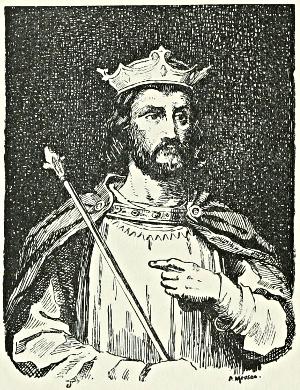
Clotaire
(Based on an old print)
Resolved to keep their inheritance, Childebert and Clotaire sent to Clotilda, their grandmother, a sword and a pair of scissors, wishing to know whether she preferred their death or their seclusion in the cloister. In the passion of the moment, she declared that she would rather see them dead than deprived of their rightful inheritance; and her words sealed their fate. Clotaire seized the elder, not ten years of age, and plunged a knife into his heart; the younger, who was not seven, terrified at the sight, knelt before Childebert, and pathetically prayed for life. Childebert was suddenly sensible of pity; and, with tears in his eyes, he begged that the child’s life might be spared. “It was thyself that urged me to this!” replied the fiendish Clotaire: “give me the child, or die in his stead!” The survivor was immediately murdered; their nurses, pages, and servants shared the same fate, and the kingdom of Clodomir was divided between the two royal assassins. With an increased army, they again invaded Burgundy, which they conquered and divided between them, as they had before divided that of their brother Clodomir.
On the death of Thierry, in 534, he was succeeded by his son Theudibert, who inherited his martial character, and was consequently too formidable to be served like the sons of Clodomir. He headed several expeditions into Italy and Spain, which, however, were not distinguished by much success; nor was his son and successor Theudebald (548-555) more fortunate. On the death of the latter, Clotaire, his uncle, married his widow and seized his kingdom, without dividing it with Childebert: the whole kingdom of the Franks was consequently in the hands of the two sons of Clovis. In revenge, Childebert excited a civil war; but dying before its conclusion (558), his kingdom was forcibly seized by Clotaire, now sole monarch of the Franks, who exiled his wife and daughters. A year before his death, Clotaire condemned to the fire his eldest son, who had rebelled against him, and that prince’s wife and daughters, with as much coolness as he could have ordered the execution of the most guilty stranger. In fact, in the wide catalogue of human vices, there is scarcely one which was not practised by the abominable princes of this dynasty, whose memory will be held in everlasting execration.
[555-575 A.D.]
To follow in detail the actions, in other words the crimes, of this detestable dynasty, would neither suit our limits nor gratify the reader: we must rapidly glance at the chief resolutions of the Frankish Empire. Like his father, Clotaire I at his death left four sons, and all four divided his states among them. This division was effected by lot. Austrasia, or eastern France, comprehending the provinces on both sides of the Rhine, and extending from Bar-sur-Aube into Bohemia, fell to Sigebert, who removed his capital from Rheims to Metz. Neustria, or western France, which extended from Bar to the channel, and even to the confines of Aquitaine, fell to Chilperic, whose court was at Soissons. Gontram, who had Burgundy, established himself at Châlons-sur-Saône; and Charibert, from Paris his capital, ruled over Aquitaine and a narrow slip of the intermediate country. But Charibert soon died, leaving his states to be divided among his three brothers.
The reader’s mind is no doubt prepared for the same dissensions among the sons of Clotaire as among those of Clovis; he might peruse far more horrors, if either our limits or inclination disposed us to withdraw the veil which covered them. We will raise one corner. Sigebert and Chilperic were unusually hostile to each other, not so much through ambition as through the enmity of their wives, the famous Brunehild and Fredegund: the former was daughter of Athanagild, Visigothic king of Spain; the latter a low Frenchwoman, who seeing herself rejected by Chilperic for Galeswintha, a sister of Brunehild, swore revenge not only against her rival but also against Sigebert and Brunehild.
Soon renewing her empire over the heart of Chilperic, Fredegund procured the murder of Galeswintha, and her own elevation as queen. She then incited her husband to a long war with Sigebert; but, as it was not so successful as she wished; and as Sigebert came near to dethroning herself and her husband, she avoided that fate by the dagger: in 575, the victor fell by one of her hired assassins. The victim was succeeded in the kingdom of Austrasia by his son Childebert II; but, as the prince was too young to govern, the administration devolved on a new functionary—the mayor of the palace, a grand judge and general of the kingdom. Brunehild was taken captive; and her fate would soon have been decided, had not Merovæus, the son of Chilperic, but not of Fredegund, fallen in love with her, and married her.
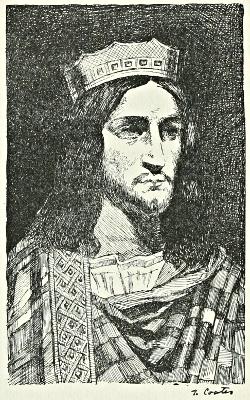
Clovis II
(From a French print, 1832)
The newly married couple took sanctuary in the church of St. Martin at Tours, and were protected by the historian and bishop St. Gregory. Chilperic, however, separated them: he restored Brunehild to the Austrasians, who were arming in the cause of their monarch’s mother; but Merovæus soon fell a victim to the persecutions of Fredegund. Clovis, another son of her husband by a former queen, Fredegund, no doubt with Chilperic’s consent, caused to perish by the dagger: so that now her own children only remained to inherit the kingdom of Neustria. But on the assassination of her husband, in 584, though she proclaimed her son Clotaire II, the army, detesting both her and her offspring, hailed Gundowald, a bastard of the deceased monarch, as their chief. Gundowald, however, who could not support his elevation, perished miserably; and his firmest support, St. Prætextatus, bishop of Rouen, fell under the sword of an assassin hired by Fredegund. In 593, Gontram, who was childless, paid the debt of nature, and Childebert of Austrasia seized Burgundy, to the prejudice of Clotaire II, the reputed heir.[123]
[575-654 A.D.]
On the death of Childebert, probably by poison, Austrasia fell to his eldest son Theudebert, aged only ten years; and Burgundy to his second, Thierry II, aged only nine. As Clotaire II, king of Neustria, was only eleven, the monarchy of the Franks was subject to three minors, or rather to the three mayors of the palace who governed in their name. In 612, Thierry II, with the aid of Clotaire, vanquished his brother Theudebert of Austrasia, whom he calmly put to death; the following year he suddenly died; his sons fell into the power of Clotaire, who was not likely to show much mercy to the offspring of his mother Fredegund’s enemy. Two of the sons he murdered; a third, whom he had held over the baptismal font, he consented to save; and Brunehild, their grandmother, who at the same time became his captive, he caused to expire in the most cruel torments. [He tied her to the heels of a wild horse.] By these bloody executions he was, in 613, at the head of the whole Frankish Empire in Germany and Gaul.
Some years before his death, he caused Dagobert, his elder son, to be crowned king of Austrasia; and after that event (628), Aquitaine fell to his second, Charibert; but in three years Charibert died, his infant son was murdered by Dagobert, and unity was once more restored to the monarchy. But Dagobert, like all the princes of his name during the last century and a half of its existence, was as feeble in body as he was cruel in heart; like them, through his early vices he was overtaken by old age in the prime of life. On his death in 638, his states were divided between his two infant sons. Austrasia fell to Sigebert III; Neustria and Burgundy to Clovis II. The former was governed by the mayor, Pepin, subsequently by Grimwald, the son of Pepin; the latter by Ercinwald. Both princes died about the usual age, between twenty and twenty-five.s
THE RISE OF PEPIN
The accession of the five-year-old Childebert II to the kingdom of Austrasia in 575 proved an excellent opportunity for the vassals to increase their power at the expense of the throne: and they elected a high palace official to assume the charge of rearing the young king and maintaining the peace.
It was not a new institution that the Austrasian nobles thus created. Since the house of the petty chief of Tournay had become the palace of the king of Gaul and his support a nursery of great officials and royal dignitaries, the antrustions, sometimes dispersed over the conquered territories, and again gathered around their prince, had preserved their relations with him and between themselves. The chief and his companions had grown great together, and men, become rich and powerful, continued to fill in the communal household the functions of seneskalk (seneschal), of mariskalk (marshal), and of skanke (cupbearer); while he among the antrustions who exercised a general surveillance over the household, who took charge of the public welfare, and who sat in judgment over quarrels arising between vassals, was quite naturally the first officer of the palace, the intendant general of the crown domains, the prime minister, and the highest personage of the state after the king himself. We are not sure of the Germanic title of this official; it would seem that he was commonly called in the Teutonic language the herzog, the duke or leader par excellence. The Gallo-Romans called him the major domus, “the greatest, the first of the house,” a qualification formerly given among the wealthy Romans to the freedman, or even the slave, who had authority over the other slaves and directed the management of the household.
Up to Childebert’s accession, this mayor of the palace had been the creature of the king and his representative before the vassals, but now the Austrasian nobility made him the representative of the vassals before the king and the overseer of royalty. In this there was a complete revolution.w
[638-670 A.D.]
On the death of Dagobert, 638 A.D., his son, Clovis II, a child of six years old, succeeded him. During his minority the government of Neustria and Burgundy was carried on by his mother Nanthildis, and the major-domus Æga, while Pepin and others shared the supreme power in Austrasia. Pepin died 639 or 640 A.D., and a long and ferocious contest ensued for the vacant mayoralty, which was finally taken possession of by Pepin’s own son Grimwald. So low had the power of the nominal monarchs already sunk, that, on the death of Sigebert III, in 654 A.D., Grimwald ventured to shear the locks of the rightful heir, Dagobert II, and, giving out that he was dead, sent him to Ireland; he then proposed his own son for the vacant throne, under the pretence that Sigebert had adopted him. But the time was not yet ripe for so daring an usurpation, nor does Grimwald appear to have been the man to take the lead in a revolution. Both the attempt itself, and its miserable issue, go to prove that the son of Pepin did not inherit the wisdom and energy of the illustrious stock to which he belonged. The king of Burgundy and Neustria, pretending to acquiesce in the accession of Grimwald’s son, summoned the father to Paris, and caused him to be seized during his journey by some Franks—who are represented as being highly indignant at his presumption—and put to death.
The whole Frankish Empire was thus once more united, at least in name, under Clovis II (who died in 656 A.D.), and under his son and successor, Clotaire III, whose mother, Balthildis, an Anglo-Saxon by birth, administered the kingdom with great ability and success. But the interests and feelings of the German provinces were too distinct from those of Burgundy and Neustria to allow of their long remaining even nominally under one head. The Austrasians were eager to have a king of their own, and accordingly another son of Clovis was raised to the throne of Austrasia under the title of Childeric II, with Wulfwald as his major-domus.
At the death of Clotaire III in Neustria (in 670 A.D.) the whole empire was thrown into confusion by the ambitious projects of Ebroin, his major-domus, who sought to place Thierry III, Clothaire’s youngest brother, who was still a mere child, on the throne, that he might continue to reign in his name. Ebroin appears to have proceeded towards his object with too little regard for the opinions and feelings of the other seigneurs, who rose against him and his puppet king, and drove them from the seat of power. The successful conspirators then offered the crown of Neustria to Childeric II, king of Austrasia, who immediately proceeded to take possession, while Ebroin sought refuge in a monastery. Childeric ascended the Neustrian throne without opposition; but his attempts to control the seigneurs, one of whom, named Badilo, he is said to have scourged, gave rise to a formidable conspiracy; and he was soon afterwards assassinated, together with his queen and son, at Chelles. Wulfwald escaped with difficulty, and returned to Austrasia. Another son of Childeric, Childebert III, was then raised upon the shield by the seigneurs, while the royal party brought forward Thierry III from the monastery to which he had retired, and succeeded in making good his claim. The turbulent and unscrupulous but able Ebroin ventured once more to leave his place of refuge, and by a long series of the most treacherous murders, and by setting up a pretender—as Clovis, a son of Clotaire III—he succeeded (in 673 or 674 A.D.) in forcing himself upon Thierry as major-domus of Neustria.
In the meantime Dagobert II, whom Grimwald had sent as a child to Ireland, and who had subsequently found a faithful friend in the well-known St. Wilfrid, bishop of York, was recalled and placed on the Austrasian throne. But the restored prince soon (in 679 A.D.) fell a victim to the intrigues of Ebroin, and the Neustrian faction among the seigneurs, who aimed at bringing the whole empire under their own arbitrary power. Nor does it seem at all improbable that the ability and audacity of Ebroin might have enabled them to carry out their designs, had not Austrasia possessed a leader fully equal to the emergency.
PEPIN OF HERISTAL
[656-679 A.D.]
Pepin, surnamed “of Heristal” from a castle belonging to his family in the neighbourhood of Liège, was the son of Ansegisus by Begga, the illustrious daughter of Pepin of Landen. This great man, who proved himself worthy of his grandsire and his mother, was at this time associated with Duke Martin in the government of Austrasia, which up to 678 A.D. had been administered by Wulfwald. Martin and Pepin summoned their followers to arms to meet the expected attack of the Neustrians. In the first instance, however, the Austrasians were surprised by the activity of Ebroin, who fell upon them before they had completed their preparations, and totally defeated them in the neighbourhood of Luco-Fago.[124] Martin fled to the town of Laon; and the artifices by which his enemies lured him from this retreat to his destruction are worthy of notice, as giving us a remarkable picture of the manners of the period in general and of the sad state of the church in particular.
[679-687 A.D.]
Ebroin, hearing that his intended victim had reached a place of safety, despatched Agilbert bishop of Paris, and Probus bishop of Rheims, to persuade Martin to repair to the Neustrian camp. In order to dispel the apprehensions with which he listened to them, these holy men went through the not unusual ceremony of swearing, upon a receptacle containing sacred relics, that he should suffer no injury by following their advice. The bishops, however, to save themselves from the guilt of perjury, had taken care that the vessels, which were covered, should be left empty. Martin, whom they omitted to inform of this important fact, was satisfied with their oaths, and accompanied them to Ecri, where he and his followers were immediately assassinated, without, as was thought, any detriment to the faith of the envoys! Pepin, however, was neither to be cajoled nor frightened into submission, and soon found himself at the head of a powerful force, consisting in part of Neustrian exiles, whom the tyranny of Ebroin had ruined or offended. A collision seemed inevitable, when the position of affairs was suddenly changed by the death of Ebroin, who was assassinated in 681 A.D. by Hermenfrid, a distinguished Neustrian Frank. Waratto followed him in the mayoralty of Neustria, and seemed inclined to live on friendly terms with Pepin: but Ghislemar, his son, who headed the party most hostile to Pepin, succeeded in getting possession of the government for a time, and renewed the war against the Austrasians. Ghislemar’s death (in 684 A.D.), which the annalistsp attributed to the divine anger, restored Waratto to his former power; and hostilities ceased for a time. When Waratto also died, about two years after his undutiful son, he was succeeded by Berchar, his son-in-law, whom the annalist pithily describes as statura parvus, intellectu modicus.

A Lombard King
The insolent disregard which this man showed for the feelings and wishes of the most powerful Neustrians, induced many of them to make common cause with Pepin, to whom they are said to have bound themselves by hostages. In 687 A.D. Pepin was strong enough to assume the offensive; and, yielding to the entreaties of the Neustrian refugees, he sent an embassy to Thierry III to demand the restoration of the exiles to their confiscated lands. The king of Neustria, prompted by Berchar, his major-domus, haughtily replied that he would come himself and fetch his runaway slaves. Pepin then prepared for war, with the unanimous consent of the Austrasian seigneurs, whose wishes he scrupulously consulted. Marching through the Silva Carbonaria he entered the Neustrian territory, and took post at Textri (Testry) on the river Somme. Thierry and Berchar also collected a large army and marched to meet the invaders. The two armies encamped in sight of each other near the village of Textri, on opposite sides of the little river Daumignon, the Neustrians on the southern and the Austrasians on the northern bank. Whether from policy or a higher motive, Pepin displayed great unwillingness, even then, to bring the matter to extremities; and, sending emissaries into the camp of Thierry, he once more endeavoured to negotiate; demanding, amongst other things, that the property of which the churches had been “despoiled by wicked tyrants” should be restored to them. He promised that, if his conditions of peace were accepted and the effusion of kindred blood prevented, he would give the king a large amount of silver and gold.
[687-717 A.D.]
The wise and humane reluctance of Pepin was naturally construed by Thierry and his “little-minded” mayor into fear, and distrust of his army, which was inferior to their own in numbers; a haughty answer was returned, and all negotiations were broken off. Both sides then prepared for the morrow’s battle. Pepin, having passed the night in forming his plans, crossed the river before daybreak and drew up his army to the east of Thierry’s position, that the rising sun might blind the enemy. The spies of Thierry reported that the Austrasian camp was deserted, on which the Neustrians were led out to pursue the flying foe. The mistake of the scouts was soon made clear by the vigorous onset of Pepin; and after a fierce but brief combat the Neustrians were totally defeated, and Thierry and Berchar fled from the field. The latter was slain by his own followers; the king was taken prisoner, but his life was mercifully spared.
The battle of Textri is notable in Frankish history as that in which the death-stroke was given to the Merovingian dynasty, by an ancestor of a far more glorious race of monarchs. “From this time forward,” says the chronicler Erchanbertus,y “the kings began to have only the royal name, and not the royal dignity.” A very striking picture of the Rois Fainéants has been handed down to us by Einhardu (Eginhard), in his famous biography of Charlemagne which we quote in Chapter V. “The race of the Merovingians,” he says, “from which the Franks were formerly accustomed to choose their kings, is generally considered to have ended with Chilperic; who, at the command of the Roman pontiff Stephen, was deposed, shorn of his locks, and sent into a monastery. But although the stock died out with him, it had long been entirely without life and vigour, and had no distinction beyond the empty title of king; for the authority and government were in the hands of the highest officers of the palace, who were called majores-domus, and had the entire administration of affairs. Nothing was left to the king, except that, contenting himself with the mere royal name, he was allowed to sit on the throne with long hair and unshorn beard, to play the part of a ruler, to hear the ambassadors from whatever part they might come, and at their departure to communicate to them the answers which he had been taught or even commanded to make, as if by his own authority. Besides the worthless title of king and a scanty maintenance, which the major-domus meted out according to his pleasure, the king possessed only one farm, and that by no means a lucrative one, on which he had a dwelling-house and a few servants, just sufficient to supply his most urgent necessities. Wherever he had to go, he travelled in a carriage drawn by a yoke of oxen and driven by a cowherd in rustic fashion. It was thus that he went to the palace, to the public assembly of the people, which met every year for the good of the kingdom; after which he returned home. But the whole administration of the state, and everything which had to be regulated or executed, either at home or abroad, was carried on by the mayors.”
The whole power of the three kingdoms was thus suddenly thrown into the hands of Pepin, who showed in his subsequent career that he was equal to the far more difficult task of keeping, by his wisdom and moderation, what he had gained by the vigour of his intellect and his undaunted valour. He, too, was happily free from the little vanity which takes more delight in the pomp than in the realities of power, and, provided he possessed the substantial authority, was contented to leave the royal name to others. He must have felt himself strong enough to do what his uncle Grimwald had vainly attempted, and his grandson happily accomplished; but he saw that by grasping at the shadow he might lose the substance. He was surrounded by proud and suspicious seigneurs, whose jealousy would have been more excited by his taking the title than by his exercising the powers of a king; and, strange though it may seem, the reverence for the ancient race, and the notion of their exclusive and inalienable rights, were far from being extinguished in the breasts of the common people. By keeping Thierry upon the throne and ruling in his name, he united both reason and prejudice in support of his government. Yet some approach was made, though probably not by his own desire, towards acknowledged sovereignty in the case of Pepin. He was called dux et princeps Francorum, and the years of his office were reckoned, as well as those of the king, in all public documents.