Part 11 / Book 2 — CHAPTER II LOMBARD INVASION TO LIUTPRAND’S DEATH [568-744 A.D.] (continued 2)
Reading edition
[741-743 A.D.]
Zacharias, a Greek, and, as his chroniclerz tells us, an unusually mild and virtuous ruler, was wise enough to see that, with a man of Liutprand’s character, the sensible and most advantageous course was to get upon good terms.
The new pope, not long after his consecration, sent a legation to Pavia, whose special mission was to negotiate the restitution of the four towns which two years previously had been wrung from the Roman duchy. Liutprand put no great difficulties in the way, and promised the desired concession. In exchange he demanded that the pope should place the Roman troops at his disposal for the campaign he was planning to subdue the faithless Transamund. By this combination Transamund was bereft of all hope that he might be able to maintain his position. He saw himself that there was nothing more to be done, and, renouncing all thought of resistance marched to meet Liutprand to whom he yielded himself captive. It is probable that he intended by this voluntary submission to appeal once more to the king’s gentle disposition. But Liutprand dared make no second attempt to rely upon the faith of his vanquished enemy, and Transamund found himself consigned to a cloister. Liutprand’s nephew took, probably some few years later, the place thus left vacant. Gottschalk’s exit from Benevento, which according to Paulus followed close upon Transamund’s, has been already related. All this occurred between February and September, 742. Thus the unity of the kingdom of Lombardy was at length restored, and an end put to the arrogant insubordination of the crown vassals.
PEACE WITH ROME
[743-744 A.D.]
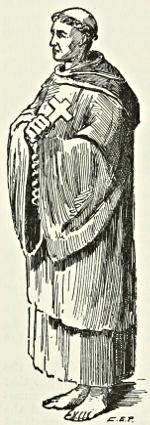
A Friar, Eighth Century
No haste was evinced in Pavia to carry out the promised restitution of the four towns, this tardiness causing the pope great concern. In order to put an end to this uncertainty, and find out whether there really was any chance of the matter being amicably arranged, Zacharias, “like a true shepherd of the flock entrusted to him by God,” set out from the Holy City at the head of his spiritual cortège and marched “full of confidence and brave in heart” to the charmingly situated Interamna (Terni), at that time the headquarters of the Lombards, in order to try what his personal influence would do towards effecting the desired arrangement. Liutprand showed him all honour. “Moved by the pious speech, and full of admiration for the firm courage and admonitions of the holy man,” Liutprand conceded everything he asked, “thanks to the influence of the Holy Spirit,” and gave the four disputed towns, which he had taken on account of the Transamund quarrel, together with their inhabitants, as a present to the church of Holy Peter.
It is noticeable that, as Gregoroviusaa points out, this restitution did not at all affect the Byzantine emperor, but only the successor of Peter. And in order that the pope might enjoy complete ease of mind, he was further guaranteed a twenty years’ peace. To gratify him Liutprand even set free all the Greek and Roman prisoners of war he had taken in Tuscany and in the territory north of the river Po, amongst whom were men of high rank, such as the consuls Sergius, Leo, Victor, and Agnellus. Thus a final reconciliation was effected, the conditions of which were all Rome could possibly desire.
On the same day the Sunday, after the solemn celebration of the mass, the pope invited his royal friend to his table in order that he, the pope, might impart the apostolic blessing. Liutprand ate on this occasion with such a hearty appetite as to call forth the jovial remark from him that he had never before eaten so well at a midday meal. The next day, Monday, they bade each other farewell.
Liutprand now turned his attention in another direction. The quarrels about the throne, in which the successor to Leo III, Emperor Constantine V (Copronymus), was embroiled with his brother-in-law Artavasdes, incited him to a renewed attack upon the East Roman possession in Italy. The Ravenna district felt the weight of his displeasure, and he found all preparations made for laying siege a second time to the principal town, when Patricius, the exarch Eutychius, and the archbishop John of Ravenna with the people of that city, sought the mediation of the pope, first by letter and then through envoys.
On the 28th of June, 743, the pope reached the river Po. Here he was met by the high vassals of the Lombard crown and conducted to their capital.
The pope disburdened his mind of his desire that the king would not further oppress the province of Ravenna by devastation and yet further that he would restore the towns taken from the Ravenna including the fortress of Cesena. The naïveté of such demands is certainly astonishing, but still more amazing are the unknown circumstances which induced Liutprand to concede so much. At first, it is true, he met them with a stout refusal. But what remained for him, if he would avoid the open conflict he dreaded with the church and its consequences, except submission, unless he sacrificed the security and peace of his realm, the result of years of activity in extending his foreign dominion? In spite of his promise given to the pope, Liutprand appears to have continued harassing the exarchate.
In January, 744, after a reign of thirty-one years and seven months, Liutprand concluded his eventful life. He was buried in the church of St. Adrian, where his father too had found his last resting-place. In the year 1173 his bones were removed to the church of St. Peter’s monastery, so often referred to as “Ecclesia di Ciel d’Oro,” a monastery which owed its existence to him.y
HODGKIN’S ESTIMATE OF LIUTPRAND
[712-744 A.D.]
In some respects the statesmanship of Liutprand seems to me to have been too highly praised. The one aim which he seems to have consistently and successfully pursued was the consolidation of the Lombard monarchy and the reduction of the great dukes into a condition of real subjection to his crown. He availed himself (and what Lombard king would not have done so?) of any opportunity which offered itself for cutting yet shorter the reduced and fragmentary territories which still called themselves parts of “the Roman Republic.” But both from policy and from his own devout temperament he was disinclined to do anything which might cause a rupture with the see of Rome, and the popes perceiving this, often induced him to abandon hardly earned conquests by appealing to “his devotion to St. Peter.”
I cannot better close this chapter than by quoting the character of Liutprand given us by the loving yet faithful hand of Paulus Diaconusp in the concluding words of that history, which has been our chief guide through two dark and troubled centuries:
“He was a man of great wisdom, prudent in counsel and a lover of peace, mighty in war, clement towards offenders, chaste, modest, one who prayed through the night-watches, generous in his almsgiving, ignorant it is true of literature, but a man who might be compared to the philosophers, a fosterer of his people, an augmenter of their laws.”b
For the present we must leave the fortunes of the Lombards to trace the origins and the rise of the Frankish people who now loom large across the horizons of Italy and to whom the papacy appeals for help against the powers that threaten its enormous and greedy ambition.a
FOOTNOTES