Part 11 / Book 1 — CHAPTER VIII GLORY AND DECLINE OF THE EMPIRE [969-1204 A.D.]
Reading edition
The Russian war was the great event of the reign of Joannes Zimisces. The military fame of the Byzantine emperor, who was unquestionably the ablest general of his time, the greatness of the Russian nation, whose power now overshadows Europe, the scene of the contest, destined in our day to be again the battle-field of Russian armies, and the political interest which attaches to the first attempt of a Russian prince to march by land to Constantinople, all combine to give a practical as well as a romantic interest to this war.
The first Russian naval expedition against Constantinople in 865 would probably have been followed by a series of plundering excursions, like those carried on by the Danes and Normans on the coasts of England and France, had not the Turkish tribe called the Patzinaks rendered themselves masters of the lower course of the Dnieper, and become instruments in the hands of the emperors to arrest the activity of the bold Varangians. The northern rulers of Kieff were the same rude warriors that infested England and France, but the Russian people was then in a more advanced state of society than the mass of the population in Britain and Gaul. The majority of the Russians were freemen; the majority of the inhabitants of Britain and Gaul were serfs.
After the defeat in 865, the Russians induced their rulers to send envoys to Constantinople to renew commercial intercourse, and invite Christian missionaries to visit their country; and no inconsiderable portion of the people embraced Christianity, though the Christian religion continued long after better known to the Russian merchants than to the Varangian warriors. The commercial relations of the Russians with Cherson and Constantinople were now carried on directly, and numbers of Russian traders took up their residence in these cities. The first commercial treaty between the Russians of Kieff and the Byzantine Empire was concluded in the reign of Basil I. The intercourse increased from that time. In the year 902, seven hundred Russians are mentioned as serving on board the Byzantine fleet with high pay; in 935, seven Russian vessels, with 415 men, formed part of a Byzantine expedition to Italy; and in 949, six Russian vessels, with 629 men, were engaged in the unsuccessful expedition of Gongyles against Crete. In 966, a corps of Russians accompanied the unfortunate expedition of Nicetas to Sicily. There can be no doubt that these were all Varangians, familiar, like the Danes and Normans in the West, with the dangers of the sea, and not native Russians, whose services on board the fleet could have been of little value to the masters of Greece.
[907-944 A.D.]
But to return to the history of the Byzantine wars with the Russians. In the year 907, Oleg, who was regent of Kieff during the minority of Igor the son of Ruric, assembled an army of Varangians, Slavonians, and Croatians, and, collecting two thousand vessels or boats of the kind then used on the northern shore of the Euxine, advanced to attack Constantinople. The exploits of this army, which pretended to aspire at the conquest of Tzaragrad, or the City of the Cæsars, were confined to plundering the country round Constantinople; and it is not improbable that the expedition was undertaken to obtain indemnity for some commercial losses sustained by imperial negligence, monopoly, or oppression. The subjects of the emperor were murdered, and the Russians amused themselves with torturing their captives in the most barbarous manner. At length Leo purchased their retreat by the payment of a large sum of money. Such is the account transmitted to us by the Russian monk Nestor, for no Byzantine writer notices the expedition, which was doubtless nothing more than a plundering incursion, in which the city of Constantinople was not exposed to any danger. These hostilities were terminated by a commercial treaty in 912, and its conditions are recorded in detail by Nestor.
In the year 941, Igor made an attack on Constantinople, impelled either by the spirit of adventure, which was the charm of existence among all the tribes of Northmen, or else roused to revenge by some violation of the treaty of 912. The Russian flotilla, consisting of innumerable small vessels, made its appearance in the Bosporus while the Byzantine fleet was absent in the Archipelago. Igor landed at different places on the coast of Thrace and Bithynia, ravaging and plundering the country; the inhabitants were treated with incredible cruelty; some were crucified, others were burned alive, the Greek priests were killed by driving nails into their heads, and the churches were destroyed. Only fifteen ships remained at Constantinople, but these were soon fitted up with additional tubes for shooting Greek fire. This force, trifling as it was in number, gave the Byzantines an immediate superiority at sea, and the patrician Theophanes sailed out of the port to attack the Russians. Igor, seeing the small number of the enemy’s ships, surrounded them on all sides, and endeavoured to carry them by boarding; but the Greek fire became only so much more available against boats and men crowded together, and the attack was repulsed with fearful loss. In the meantime, some of the Russians who landed in Bithynia were defeated by Bardas Phocas and Joannes Curcuas, and those who escaped from the naval defeat were pursued and slaughtered on the coast of Thrace without mercy. The emperor Romanus ordered all the prisoners brought to Constantinople to be beheaded. Theophanes overtook the fugitive ships in the month of September, and the relics of the expedition were destroyed, Igor effecting his escape with only a few boats. The Russian chronicle of Nestor says that, in the year 944, Igor, assisted by other Varangians, and by the Patzinaks, prepared a second expedition, but that the inhabitants of Cherson so alarmed the emperor Romanus by their reports of its magnitude, that he sent ambassadors, who met Igor at the mouth of the Danube, and sued for peace on terms to which Igor and his boyards consented. This is probably merely a salve applied to the vanity of the people of Kieff by their chronicler; but it is certain that a treaty of peace was concluded between the emperors of Constantinople and the princes of Kieff in the year 945.
[944-970 A.D.]
The cruelty of the Varangian prince Igor, after his return to Russia, caused him to be murdered by his rebellious subjects.[64] Olga, his widow, became regent for their son Sviatoslaff. She embraced the Christian religion, and visited Constantinople in 957, where she was baptized. The emperor Constantine Porphyrogenitus has left us an account of the ceremony of her reception at the Byzantine court. A Russian monk has preserved the commercial treaties of the empire; a Byzantine emperor records the pageantry that amused a Russian princess. The high position occupied by the court of Kieff in the tenth century is also attested by the style with which it was addressed by the court of Constantinople. The golden bulls of the Roman emperor of the East, addressed to the prince of Russia, were ornamented with a pendent seal equal in size to a double solidus, like those addressed to the kings of France.
THE RUSSIAN WAR (970-971 A.D.)
[970-971 A.D.]
We have seen that the emperor Nicephorus II sent the patrician Calocyres to excite Sviatoslaff to invade Bulgaria, and that the Byzantine ambassador proved a traitor, and assumed the purple. Sviatoslaff soon invaded Bulgaria at the head of a powerful army, which the gold brought by Calocyres assisted him to equip, and defeated the Bulgarian army in a great battle, 968 A.D. Peter, king of Bulgaria, died shortly after, and the country was involved in civil broils; taking advantage of which, Sviatoslaff took Presthlava the capital, and rendered himself master of the whole kingdom.
Nicephorus now formed an alliance with the Bulgarians, and was preparing to defend them against the Russians, when Sviatoslaff was compelled to return home, in order to defend his capital against the Patzinaks. Nicephorus assisted Boris and Romanus, the sons of Peter, to recover Bulgaria, and concluded an offensive and defensive alliance with Boris, who occupied the throne. After the assassination of Nicephorus, Sviatoslaff returned to invade Bulgaria with an army of sixty thousand men, and his enterprise assumed the character of one of those great invasions which had torn whole provinces from the Western Empire. His army was increased by a treaty with the Patzinaks and an alliance with the Hungarians, so that they began to dream of the conquest of Constantinople, and hoped to transfer the empire of the East from the Romans of Byzantium to the Russians. It was fortunate for the Byzantine Empire that it was ruled by a soldier who knew how to profit by its superiority in tactics and discipline. The Russian was not ignorant of strategy, and having secured his flank by his alliance with the Hungarians, he entered Thrace by the western passes of Mount Hæmus, then the most frequented road between Germany and Constantinople, and that by which the Hungarians were in the habit of making their plundering incursions into the empire.
Joannes Zimisces was occupied in the East when Sviatoslaff completed the second conquest of Bulgaria and passed Mount Hæmus, expecting to subdue Thrace during the emperor’s absence with equal ease, 970 A.D. The empire was still suffering from famine. Sviatoslaff took Philippopolis, and murdered twenty thousand of the inhabitants. An embassy sent by Zimisces was dismissed with a demand of tribute, and the Russian army advanced to Arcadiopolis, where one division was defeated by Bardas Sclerus, and the remainder retired again behind Mount Hæmus.
In the following spring, 971, the emperor Joannes took the field at the head of an army of fifteen thousand infantry and thirteen thousand cavalry, besides a body-guard of chosen troops called the Immortals, and a powerful battery of field and siege engines.[65] A fleet of three hundred galleys, attended by many smaller vessels, was despatched to enter the Danube and cut off the communications of the Russians with their own country.[66]
The emperor Joannes marched from Hadrianopolis just before Easter, when it was not expected that a Byzantine emperor would take the field. He knew that the passes on the great eastern road had been left unguarded by the Russians, and he led his army through all the defiles of Mount Hæmus without encountering any difficulty. The Russian troops stationed at Presthlava, who ought to have guarded the passes, marched out to meet the emperor when they heard he had entered Bulgaria. Their whole army consisted of infantry, but the soldiers were covered with chain armour, and accustomed to resist the light cavalry of the Patzinaks and other Turkish tribes.[67] They proved, however, no match for the heavy-armed lancers of the imperial army; and, after a vigorous resistance, were completely routed by Joannes Zimisces, leaving eighty-five hundred men on the field of battle. On the following day Presthlava was taken by escalade, and a body of seven thousand Russians and Bulgarians, who attempted to defend the royal palace, which was fortified as a citadel, were put to the sword after a gallant defence. Sphengelos, who commanded this division of the Russian force, and the traitor Calocyres, succeeded in escaping to Dorystolon, where Sviatoslaff had concentrated the rest of the army; but Boris, king of Bulgaria, with all his family, was taken prisoner in his capital.
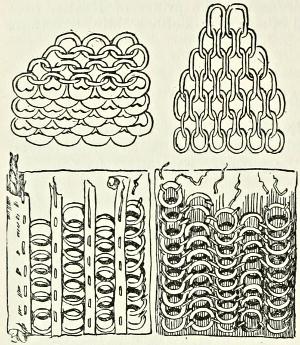
Types of early Chain Armour.
The emperor, after celebrating Easter in Presthlava, advanced by Pliscova and Dinea to Dorystolon, where Sviatoslaff still hoped for victory, though his position was becoming daily more dangerous. The Byzantine fleet entered the Danube and took up its station opposite the city, cutting off all the communications of the Russians by water, at the same time that the emperor encamped before the walls and blockaded them by land. Zimisces, knowing he had to deal with a desperate enemy, fortified his camp with a ditch and rampart according to the old Roman model, which was traditionally preserved by the Byzantine engineers. The Russians enclosed within the walls of Dorystolon were more numerous than their besiegers, and Sviatoslaff hoped to be able to open his communications with the surrounding country, by bringing on a general engagement in the plain before all the defences of the enemy’s camp were completed. He expected to defeat the attacks of the Byzantine cavalry by forming his men in squares, and, as the Russian soldiers were covered by long shields that reached to their feet, he expected to be able, by advancing his squares like moving towers, to clear the plain of the enemy. But while the Byzantine legions met the Russians in front, the heavy-armed cavalry assailed them with their long spears in flank, and the archers and slingers under cover watched coolly to transfix every man where an opening allowed their missiles to penetrate. The battle nevertheless lasted all day, but in the evening the Russians were compelled, in spite of their desperate valour, to retire into Dorystolon without having effected anything.
The infantry of the north now began to feel its inferiority to the veteran cavalry of Asia sheathed in plate armour, and disciplined by long campaigns against the Saracens. Sviatoslaff, however, continued to defend himself by a series of battles rather than sorties, in which he made desperate efforts to break through the ranks of the besiegers in vain, until at length it became evident that he must either conclude peace, die on the field of battle, or be starved to death in Dorystolon. Before resigning himself to his fate, he made a last effort to cut his way through the Byzantine army; and on this occasion the Russians fought with such desperation that contemporaries ascribed the victory of the Byzantine troops, not to the superior tactics of the emperor, nor to the discipline of a veteran army, but to the personal assistance of St. Theodore, who found it necessary to lead the charge of the Roman lancers, and shiver a spear with the Russians himself, before their phalanx could be broken. The victory was complete, and Sviatoslaff sent ambassadors to the emperor to offer terms of peace.
The siege of Dorystolon had now lasted more than two months, and the Russian army, though reduced by repeated losses, still amounted to twenty-two thousand men. The valour and contempt of death which the Varangians had displayed in the contest, convinced the emperor that it would cause the loss of many brave veterans to insist on their laying down their arms; he was therefore willing to come to terms, and peace was concluded on condition that Sviatoslaff should yield up Dorystolon, with all the plunder, slaves, and prisoners in possession of the Russians, and engage to swear perpetual amity with the empire, and never to invade either the territory of Cherson or the kingdom of Bulgaria; while, on the other hand, the emperor Joannes engaged to allow the Russians to descend the Danube in their boats, to supply them with two medimni of wheat for each surviving soldier to enable them to return home without dispersing to plunder for their subsistence, and to renew the old commercial treaties between Kieff and Constantinople, July, 971.
After the treaty was concluded, Sviatoslaff desired to have a personal interview with his conqueror. Joannes rode down to the bank of the Danube clad in splendid armour, and accompanied by a brilliant suite of guards on horseback. The short figure of the emperor was no disadvantage where he was distinguished by the beauty of his charger and the splendour of his arms, while his fair countenance, light hair, and piercing blue eyes fixed the attention of all on his bold and good-humoured face, which contrasted well with the dark, sombre visages of his attendants. Sviatoslaff arrived by water in a boat, which he steered himself by an oar. His dress was white, differing in no way from that of those under him, except in being cleaner. Sitting in the stern of his boat, he conversed for a short time with the emperor, who remained on horseback close to the beach. The appearance of the bold Varangian excited much curiosity, and is thus described by a historian who was intimate with many of those who were present at the interview: The Russian was of the middle stature, well formed, with strong neck and broad chest. His eyes were blue, his eyebrows thick, his nose flat, and his beard shaved, but his upper lip was shaded with long and thick mustaches. The hair of his head was cropped close, except two long locks which hung down on each side of his face, and were thus worn as a mark of his Scandinavian race. In his ears he wore golden earrings.
Sviatoslaff immediately quitted Dorystolon, but he was obliged to winter on the shores of the Euxine, and famine thinned his ranks. In spring he attempted to force his way through the territory of the Patzinaks with his diminished army. He was defeated, and perished near the cataracts of the Dnieper. Kour, prince of the Patzinaks, became the possessor of his skull, which he shaped into a drinking-cup, and adorned with the moral maxim, doubtless not less suitable to his own skull, had it fallen into the hands of others, “He who covets the property of others, oft loses his own.” We have already had occasion to record that the skull of the Byzantine emperor, Nicephorus I, had ornamented the festivals of a Bulgarian king; that of a Russian sovereign now figured in the tents of a Turkish tribe.
[971-988 A.D.]
The results of the campaign were as advantageous to the Byzantine Empire as they were glorious to the emperor Joannes. Bulgaria was conquered, a strong garrison established in Dorystolon, and the Danube once more became the frontier of the Roman Empire. The peace with the Russians was uninterrupted until about the year 988, when, from some unknown cause of quarrel, Vladimir the son of Sviatoslaff attacked and gained possession of Cherson by cutting off the water.
The Greek city of Cherson, situated on the extreme verge of ancient civilisation, escaped for ages from the impoverishment and demoralisation into which the Hellenic race was precipitated by the Roman system of concentrating all power in the capital of the empire. Cherson was governed for centuries by its own elective magistrates, and it was not until towards the middle of the ninth century that the emperor Theophilus destroyed its independence. When Vladimir the sovereign of Russia attacked it in 988, it was betrayed into his hands by a priest, who informed him how to cut off the water. The great object of ambition of all the princes of the East, from the time of Heraclius to that of the last Comnenus of Trebizond, was to form matrimonial alliances with the imperial family. Vladimir obtained the hand of Anne, the sister of the emperors Basil II and Constantine IX, and was baptized and married in the church of the Panaghia at Cherson. To soothe the vanity of the empire, he pretended to retain possession of his conquest as the dowry of his wife. Many of the priests who converted the Russians to Christianity, and many of the artists who adorned the earliest Russian churches with paintings and mosaics, were natives of Cherson. The church raised Vladimir to the rank of a saint; the Russians conferred on him the title of “the great.”
Joannes Zimisces, having terminated the Russian War, compelled Boris to resign the crown of Bulgaria, and accept the title of “magister,” as a pensioner of the Byzantine court. The frontier of the Eastern Empire was once more extended to the Danube.
WAR WITH THE SARACENS (972-976 A.D.)
[972-975 A.D.]
The Saracen War had been carried on vigorously on the frontiers of Syria, while the emperor Joannes was occupied with the Russian campaign. The continued successes of the Byzantine arms had so alarmed the Mohammedan princes, that an extensive confederacy was formed to recover Antioch, and the command of the army of the caliph was entrusted to Zoher, the lieutenant of the Fatimites in Egypt. The imperial army was led by the patrician Nicolaus, a man of great military skill, who had been a eunuch in the household of Joannes Zimisces; and he defeated the Saracens in a pitched battle, and saved Antioch for a time. But in the following year (973) the conquest of Nisibis filled the city of Baghdad with such consternation, that a levy of all Mussulmans was ordered to march against the Christians. The Byzantine troops in Mesopotamia were commanded by an Armenian named Temelek Melchi, who was completely routed near Amida. He was himself taken prisoner, and died after a year’s confinement.
With all his talents as a general, Joannes does not appear to have possessed the same control over the general administration as Nicephorus; and many of the cities conquered by his predecessor, in which the majority of the inhabitants were Mohammedans, succeeded in throwing off the Byzantine yoke. Even Antioch declared itself independent. A great effort became necessary to regain the ground that had been lost; and, to make this, Joannes Zimisces took the command of the Byzantine army in person in the year 974. He marched in one campaign from Mount Taurus to the banks of the Tigris, and from the banks of the Tigris back into Syria, as far as Mount Lebanon, carrying his victorious arms, according to the vaunting inaccuracy of the Byzantine geographical nomenclature, into Palestine. His last campaign, in the following year, was the most brilliant of his exploits. In Mesopotamia he regained possession of Amida and Martyropolis; but these cities contained so few Christian inhabitants that he was obliged to leave the administration in the hands of Saracen emirs, who were charged with the collection of the tribute and taxes. Nisibis he found deserted, and from it he marched by Edessa to Hierapolis or Membig, where he captured many valuable relics, among which the shoes of Jesus, and the hair of John the Baptist, are especially enumerated. From Hierapolis Joannes marched to Apamea, Emesa, and Baalbec, without meeting any serious opposition. The emir of Damascus sent valuable presents, and agreed to pay an annual tribute to escape a visit.
The emperor then crossed Mount Lebanon, storming the fortress of Borzo, which commanded the pass, and, descending to the sea-coast, laid siege to Berytus, which soon surrendered, and in which he found an image of the crucifixion that he deemed worthy of being sent to Constantinople. From Berytus he marched northward to Tripolis, which he besieged in vain for forty days. The valour of the garrison and the strength of the fortifications compelled him to raise the siege; but his retreat was ascribed to fear of a comet, which illuminated the sky with a strange brilliancy. As it was now September, he wished to place his worn-out troops in winter quarters in Antioch; but the inhabitants shut the gates against him. To punish them for their revolt, he had the folly to ravage their territory, and cut down their fruit trees; forgetting, in his barbarous and impolitic revenge, that he was ruining his own empire. Burtzes was left to reconquer Antioch for the second time; which, however, he did not effect until after the death of the emperor Joannes.
[975-976 A.D.]
The army was then placed in winter quarters on the frontiers of Cilicia, and the emperor hastened to return to Constantinople. On the journey, as he passed the fertile plains of Longias and Dryze, in the vicinity of Anazarba and Podandus, he saw them covered with flocks and herds, with well-fortified farmyards, but no smiling villages. He inquired with wonder to whom the country belonged, in which pasturage was conducted on so grand a scale; and he learned that the greater part of the province had been acquired by the president Basilios in donations from himself and his predecessor, Nicephorus. Amazed at the enormous accumulation of property in the hands of one individual, he exclaimed, “Alas! the wealth of the empire is wasted, the strength of the armies is exhausted, and the Roman emperors toil like mercenaries, to add to the riches of an insatiable eunuch!” This speech was reported to the president. He considered that he had raised both Nicephorus and Joannes to the throne; his interest now required that it should return to its rightful master, and that the young Basil should enjoy his heritage. The emperor Joannes stopped on his way to Constantinople at the palace of Romanus, a grandson of Romanus I; and it is said he there drank of a poisoned cup presented to him by a servant gained by the president. Certain it is that Joannes Zimisces reached the capital in a dying state, and expired on the 10th of January, 976, at the age of fifty-one.e
THE APEX OF GLORY
“The period of greatest Byzantine power,” says Gelzer,f “is reached in the reigns of Nicephorus II (963-969), Joannes Zimisces (969-976), and Basil Bulgaroctonus (976-1025).” Finlaye also calls it the “Period of Conquest and Military Glory.” That the glory was understood at the time is evident from the enthusiastic outbursts of the anonymous continuator of Georgius Monachus.g Of Nicephorus Phocas he says, “Then Phocas flashed like lightning and stormed against the enemies of the Romans. He ravaged, burned, and led into captivity the cities and lands of the barbarians. Myriads of foreign lands he smote, and broadened the realm and the might of the Romans. The Arabs trembled, the Armenians and Syrians shook, the Saracens were scared and the Turks took flight; and the Romans seized their strongholds and provinces, and Phocas’ name was fearful to all.” Of Zimisces the same chronicler is equally enthusiastic: “And the nations were in great fright before Zimisces’ fury. And he spread the realm of the Romans abroad; the Saracens and Armenians fled; the Persians shook and from all sides brought him gifts; they begged him for mercy and peace. He led even to Edessa and to the river Euphrates; and the earth was full of the tents of the Romans. Syrians and Phœnicians were trampled by the Roman steeds. He fetched home mighty victories, and the sword of Christ mowed like a scythe.”
And yet in Zimisces, Gelzer sees a retrogression of empire and an expansion of feudalism; more and more he sees that the old Roman military and civil state takes on a military and aristocratic physiognomy. After his death the movement continued with usury.a
The premature death of Zimisces was a loss, rather than a benefit, to the sons of Romanus II. Their want of experience detained them twelve years longer the obscure and voluntary pupils of a minister, who extended his reign by persuading them to indulge the pleasures of youth, and to disdain the labours of government. In this silken web, the weakness of Constantine was forever entangled; but his elder brother felt the impulse of genius and the desire of action; he frowned, and the minister was no more. Basil was the acknowledged sovereign of Constantinople and the provinces of Europe; but Asia was oppressed by two veteran generals, Phocas and Sclerus, who, alternately friends and enemies, subjects and rebels, maintained their independence, and laboured to emulate the example of successful usurpation.
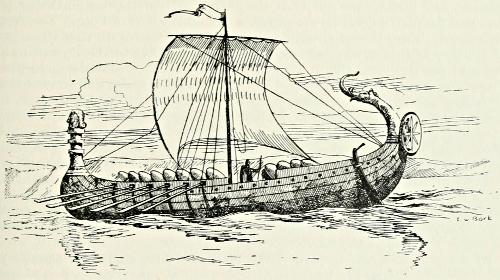
War Galley, Eighth and Ninth Centuries
Against these domestic enemies, the son of Romanus first drew his sword, and they trembled in the presence of a lawful and high-spirited prince. The first, in the front of battle, was thrown from his horse by the stroke of poison, or an arrow; the second, who had been twice loaded with chains, and twice invested with the purple, was desirous of ending in peace the small remainder of his days. As the aged suppliant approached the throne, with dim eyes and faltering steps, leaning on his two attendants, the emperor exclaimed, in the insolence of youth and power: “And is this the man who has so long been the object of our terror?” After he had confirmed his own authority and the peace of the empire, the trophies of Nicephorus and Zimisces would not suffer their royal pupil to sleep in the palace. His long and frequent expeditions against the Saracens were rather glorious than useful to the empire; but the final destruction of the kingdom of Bulgaria appears, since the time of Belisarius, the most important triumph of the Roman arms.h
BASIL II AND HIS SUCCESSORS (976-1054 A.D.)
[976-981 A.D.]
The reign of Basil II is the culminating point of Byzantine greatness. The eagles of Constantinople flew during his life, in a long career of victory, from the banks of the Danube to those of the Euphrates, and from the mountains of Armenia to the shores of Italy. Basil’s indomitable courage, terrific cruelty, indifference to art and literature, and religious superstition, all combine to render him a true type of his empire and age. The great object of his policy was to consolidate the unity of the administration in Europe by the complete subjection of the Bulgarians and Slavonians, whom similarity of language had almost blended into one nation, and had completely united in hostility to the imperial government.
Four sons of a Bulgarian noble of the highest rank had commenced a revolutionary movement in Bulgaria against the royal family, after the death of Peter and the first victories of the Russians. In order to put an end to these troubles, Nicephorus II had, on the retreat of Sviatoslaff, replaced Boris, the son of Peter, on the throne of Bulgaria; and when the Russians returned, Boris submitted to their domination. Shortly after the death of Joannes I (Zimisces), the Bulgarian leaders again roused the people to a struggle for independence. Boris, who escaped from Constantinople to attempt recovering his paternal throne, was accidentally slain, and the four brothers again became the chiefs of the nation. In a short time three perished, and Samuel, who alone remained, assumed the title of king. The forces of the empire were occupied with the rebellion of Sclerus, so that the vigour and military talents of Samuel succeeded both in expelling the Byzantine authorities from Bulgaria, and in rousing the Slavonians of Macedonia to throw off the Byzantine yoke. Samuel then invaded Thessaly, and extended his plundering excursions over those parts of Greece and the Peloponnesus still inhabited by the Hellenic race. He carried away the inhabitants of Larissa in order to people the town of Prespa, which he then proposed to make his capital, with intelligent artisans and manufacturers; and, in order to attach them to their new residence by ties of old superstition, he removed to Prespa the body of their protecting martyr, St. Achilles, who some pretended had been a Roman soldier, and others a Greek archbishop. Samuel showed himself, both in ability and courage, a rival worthy of Basil; and the empire of the East seemed for some time in danger of being transferred from the Byzantine Romans to the Slavonian Bulgarians.
[981-1001 A.D.]
In the year 981, the emperor Basil made his first campaign against the new Bulgarian monarchy in person. His plan of operations was to secure the great western passes through Mount Hæmus, on the road from Philippopolis to Sardica, and by the conquest of the latter city he hoped to cut off the communication between the Bulgarians north of Mount Hæmus and the Slavonians in Macedonia. But his military inexperience, and the relaxed discipline of the army, caused this well-conceived plan to fail. Sardica was besieged in vain for twenty days. The negligence of the officers and the disobedience of the soldiers caused several foraging parties to be cut off; the besieged burned the engines of the besiegers in a victorious sortie, and the emperor felt the necessity of commencing his retreat. As his army was passing the defiles of Hæmus, it was assailed by the troops Samuel had collected to watch his operations, and completely routed. The baggage and military chest, the emperor’s plate and tents, all fell into the hands of the Bulgarian king, and Basil himself escaped with some difficulty to Philippopolis, where he collected the relics of the fugitives. Leo Diaconus,b the Byzantine historian, who accompanied the expedition as one of the clergy of the imperial chapel, and was fortunate enough to escape the pursuit, has left a short but authentic notice of this first disastrous campaign of Basil, the slayer of the Bulgarians, in his Historia.[68]
The reorganisation of his army, the regulation of the internal administration of the empire, the rebellion of Phocas, and the wars in Italy and on the Asiatic frontier, prevented Basil from attacking Samuel in person for many years. Still a part of the imperial forces carried on this war, and Samuel soon perceived that he was unable to resist the Byzantine generals in the plains of Bulgaria, where the heavy cavalry, military engines, and superior discipline of the imperial armies could all be employed to advantage. He resolved, therefore, to transfer the seat of the Bulgarian government to a more inaccessible position, at Achrida. Here, therefore, Samuel established the capital of the Bulgaro-Slavonian kingdom he founded.
The dominions of Samuel soon became as extensive as the European portion of the dominions of Basil. The possessions of the two monarchs ran into one another in a very irregular form, and both were inhabited by a variety of races, in different states of civilisation, bound together by few sympathies, and no common attachment to national institutions. Samuel was master of almost the whole of ancient Bulgaria, the emperor retaining possession of little more than the fortress of Dorystolon, the forts at the mouth of the Danube, and the passes of Mount Hæmus. But the strength of the Bulgarian king lay in his possessions in the upper part of Macedonia, in Epirus, and the southern part of Illyricum, in the chain of Pindus, and in mountains that overlook the northern and western slopes of the great plains of Thessalonica and Thessaly. He was indefatigable in forming a large military force, and employing it constantly in ravaging the plain of Thessaly, and attacking the Greek cities.
In 996 he marched rapidly through Thessaly, Bœotia, and Attica, into the Peloponnesus; but the towns everywhere shut their gates, and prepared for a long defence, so that he could effect nothing beyond plundering and laying waste the open country. In the meantime, the emperor sent Nicephorus Uranus, with all the force he should be able to collect, in pursuit of Samuel. Uranus entered Thessaly, and pushed rapidly southward to the banks of the Sperchius, where he found Samuel encamped on the other side, hastening home with the plunder of Greece. In the night the people showed Uranus a ford, by which he passed the river and surprised the Bulgarians in their camp. Samuel and his son Gabriel escaped with the greatest difficulty. The Bulgarian army was completely annihilated, and all the plunder and slaves made during the expedition fell into the hands of Uranus, in the year 996 A.D. This great defeat paralysed the military operations of Samuel for some time.
Basil at length arranged the external relations of the empire in such a way that he was able to assemble a large army for the military operations against the kingdom of Achrida, which he determined to conduct in person. The Slavonians now formed the most numerous part of the population of the country between the Danube, the Ægean, and the Adriatic, and they were in possession of the line of mountains that runs from Dyrrhachium, in a variety of chains, to the vicinity of Constantinople. Basil saw many signs that the whole Slavonic race in these countries was united in opposition to the Byzantine government, so that the existence of his empire demanded the conquest of the Bulgaro-Slavonian kingdom which Samuel had founded. To this arduous task he devoted himself with his usual energy.
In the year 1000, his generals were ordered to enter Bulgaria by the eastern passes of Mount Hæmus; and in this campaign they took the cities of greater and lesser Presthlava and Pliscova, the ancient capitals of Bulgaria. In the following year, the emperor took upon himself the direction of the army destined to act against Samuel. Fixing his headquarters at Thessalonica, he recovered possession of the fortresses of Vodena, Berœa, and Servia.
[1001-1014 A.D.]
In the following campaign (1002), the emperor changed the field of operations, and, marching from Philippopolis through the western passes of Mount Hæmus, occupied the whole line of road as far as the Danube, and cut Samuel off from all communication with the plains of Bulgaria. Samuel formed a bold enterprise, which he hoped would compel Basil to raise the siege of Widdin, or, at all events, enable him to inflict a deep wound on the empire. By a long march into the heart of the empire, Samuel rendered himself master of great booty. His success prevented his returning as rapidly as he had advanced, but he succeeded in passing the garrison of Philippopolis and crossing the Strymon and the Wardar in safety, when Basil suddenly overtook him at the head of the Byzantine army. Samuel was encamped under the walls of Scupi; Basil crossed the river, stormed the Bulgarian camp, captured the military chest and stores, and recovered the plunder of Hadrianopolis. He had thus the satisfaction of avenging the defeat he had suffered from Samuel, one-and-twenty years before, in the passes of Mount Hæmus.
[1014-1019 A.D.]
In the year 1014, Basil considered everything ready for a final effort to complete the subjection of the Slavonian population of the mountainous districts round the upper valley of the Strymon. The emperor is said to have taken fifteen thousand prisoners, and, that he might revenge the sufferings of his subjects from the ravages of the Bulgarians and Slavonians, he gratified his own cruelty by an act of vengeance, which has most justly entailed infamy on his name. His frightful inhumanity has forced history to turn with disgust from his conduct, and almost buried the records of his military achievements in oblivion. On this occasion he ordered the eyes of all his prisoners to be put out, leaving a single eye to the leader of every hundred, and in this condition he sent the wretched captives forth to seek their king or perish on the way. When they approached Achrida, a rumour that the prisoners had been released induced Samuel to go out to meet them. On learning the full extent of the calamity, he fell senseless to the ground, overpowered with rage and grief, and died two days after. He is said to have murdered his own brother to secure possession of his throne, so that his heart was broken by the first touch of humanity it ever felt.[69]
The cruelty of Basil awakened an energetic resistance on the part of the Slavonians and Bulgarians, and Gabriel Radomir, the brave son of Samuel, was enabled to offer unexpected obstacles to the progress of the Byzantine armies.
Gabriel, the king of Achrida, though brave, alienated the favour of his subjects by his imprudence, and his cousin, John Ladislas, whose life he had saved in youth, was base enough to become his murderer, in order to gain possession of the throne. Ladislas, in order to gain time, both for strengthening himself on the throne and resisting the Byzantine invasion, sent ambassadors to Basil with favourable offers of peace; but the emperor, satisfied that the struggle between the Slavonians and Greeks could only be terminated by the conquest of one, rejected all terms but absolute submission, and pushed on his operations with his usual vigour. After laying waste all the country round Ostrovos and Moliskos that was peopled by Slavonians, and repairing the fortifications of Berœa which had fallen to decay, he captured Setaina, where Samuel had formed great magazines of wheat. These magazines were kept well filled by Ladislas, so that Basil became master of so great a store that he divided it among his troops. At last the king of Achrida approached the emperor at the head of a considerable army, and a part of the imperial troops was drawn into an ambuscade. The emperor happened to be himself with the advanced division of the army. He instantly mounted his horse and led the troops about him to the scene of action, sending orders for all the other divisions to hasten forward to support him. His sudden appearance at the head of a strong body of the heavy-armed lancers of the Byzantine army, the fury of his charge, the terror his very name inspired, and the cry, “The emperor is upon us!” soon spread confusion through the Bulgarian ranks, and decisively changed the fortune of the day (1018).
Ladislas, whose affairs were becoming desperate, made an attempt to restore his credit by laying siege to Dyrrhachium. Its possession would have enabled him to open communications with the enemies of Basil in Italy, and even with the Saracens of Sicily and Africa, but he was slain soon after the commencement of the siege. The Bulgarian leaders gave up all hope of resistance. The emperor continued to advance by Scupi, Stypeia, and Prosakon, and on reaching Achrida he was received rather as the lawful sovereign than as a foreign conqueror. He immediately took possession of all the treasures Samuel had amassed; the gold alone amounted to one hundred centners (this sum is not quite equal to $480,000 or $2,400,000), and with this he paid all the arrears due to his troops, and rewarded them with a donative for their long and gallant service in this arduous war. Almost the whole of the royal family of Achrida submitted, and received the most generous treatment. Three sons of Ladislas, who escaped to Mount Tmorus, and attempted to prolong the contest, were soon captured. The noble Bulgarians hastened to make their submission, and many were honoured with rank at the imperial court.
Nothing, indeed, proves more decidedly the absence of all Greek nationality in the Byzantine administration at this period, than the facility with which all foreigners obtained favour at the court of Constantinople; nor can anything be more conclusive of the fact that the centralisation of power in the person of the emperor, as completed by the Basilian dynasty, had now destroyed the administrative centralisation of the old Roman imperial system, for we have proofs that a considerable Greek population still occupied the cities of Thrace and Macedonia, though Greek feelings had little influence on the government.
After passing the winter in his new conquests, Basil made a progress through Greece. At Zetunium he visited the field of battle where the power of Samuel had been first broken by the victory of Nicephorus Uranus, and found the ground still strewed with the bones of the slain. The wall that defended the pass of Thermopylæ retained its ancient name, Scelos; and its masonry, which dated from Hellenic days, excited the emperor’s admiration. At last Basil arrived within the walls of Athens, and he was the only emperor who for several ages honoured that city with a visit. Many magnificent structures in the town, and the whole of the temples in the Acropolis, had then hardly suffered any rude touches from the hand of time. If the original splendour of the external painting and gilding which had once adorned the Parthenon of Pericles had faded, the mural paintings of saints, martyrs, emperors, and empresses, that covered the interior of the cella, gave a new interest to the church of the Virgin, into which it had been transformed. The mind of Basil, though insensible to Hellenic literature, was deeply sensible of religious impressions, and the glorious combination of the variety of beauty in art and nature that he saw in the Acropolis touched his stern soul. He testified his feelings by splendid gifts to the city, and rich dedications at the shrine of the Virgin in the Parthenon.
From Greece the emperor returned to Constantinople, where he indulged himself in the pomp of a triumph, making his entry into his capital by the Golden Gate, and listening with satisfaction to the cries of the populace, who applauded his cruelty by saluting him with the title of “The Slayer of the Bulgarians” [Bulgaroctonus].e
[1019-1028 A.D.]
Yet his subjects detested the rapacious and rigid avarice of Basil; and in the imperfect narrative of his exploits, we can only discern the courage, patience, and ferociousness of a soldier. After the first license of his youth, Basil II devoted his life, in the palace and the camp, to the penance of a hermit, wore the monastic habit under his robes and armour, observed a vow of continence, and imposed on his appetites a perpetual abstinence from wine and flesh. In the sixty-eighth year of his age, his martial spirit urged him to embark in person for a holy war against the Saracens of Sicily; he was prevented by death, and Basil, surnamed “the slayer of the Bulgarians,” was dismissed from the world with the blessings of the clergy and the curses of the people. After his decease, in 1025, his brother Constantine IX enjoyed, about three years, the power, or rather the pleasures, of royalty; and his only care was the settlement of the succession. He had enjoyed sixty-six years the title of Augustus; and the reign of the two brothers is the longest, and most obscure, of the Byzantine history.
[1028-1042 A.D.]
A lineal succession of five emperors, in a period of 160 years, had attached the loyalty of the Greeks to the Macedonian dynasty, which had been thrice respected by the usurpers of their power. After the death of Constantine IX, the last male of the royal race, a new and broken scene presents itself, and the accumulated years of twelve emperors do not equal the space of his single reign. Constantine had only three daughters. When their marriage was discussed in the council of their dying father, the cold or pious Theodora refused to give an heir to the empire, but her sister Zoe presented herself a willing victim at the altar. Romanus Argyrus, a patrician of a graceful person and fair reputation, was chosen for her husband, and, on his declining that honour, was informed that blindness or death was the second alternative. The motive of his reluctance was conjugal affection; but his faithful wife sacrificed her own happiness to his safety and greatness; and her entrance into a monastery removed the only bar to the imperial nuptials.
After the decease of Constantine, the sceptre devolved to Romanus III; but his labours at home and abroad[70] were equally feeble and fruitless; and the mature age, the forty-eight years of Zoe, was less favourable to the hopes of pregnancy than to the indulgence of pleasure. Her favourite chamberlain was a handsome Paphlagonian of the name of Michael, whose first trade had been that of a money-changer; and Romanus, either from gratitude or equity, connived at their criminal intercourse, or accepted a slight assurance of their innocence. But Zoe soon justified the Roman maxim, that every adulteress is capable of poisoning her husband; and the death of Romanus was instantly followed by the scandalous marriage and elevation of Michael IV.
The expectations of Zoe were, however, disappointed; instead of a vigorous and grateful lover, she had placed in her bed a miserable wretch whose health and reason were impaired by epileptic fits, and whose conscience was tormented by despair and remorse. The most skilful physicians of the mind and body were summoned to his aid; and his hopes were aroused by frequent pilgrimages to the baths, and to the tombs of the most popular saints; the monks applauded his penance, and, except restitution (but to whom should he have restored?) Michael sought every method of expiating his guilt. While he groaned and prayed in sackcloth and ashes, his brother, the eunuch Joannes, smiled at his remorse, and enjoyed the harvest of a crime of which himself was the secret and most guilty author. His administration[71] was only the art of satiating his avarice, and Zoe became a captive in the palace of her fathers and in the hands of her slaves. When he perceived the irretrievable decline of his brother’s health, he introduced his nephew, another Michael, who derived the surname of Calaphates from his father’s occupation in the careening of vessels; at the command of the eunuch, Zoe adopted for her son the son of a mechanic; and this fictitious heir was invested with the title and purple of the Cæsars, in the presence of the senate and clergy.
So feeble was the character of Zoe, that she was oppressed by the liberty and power which she recovered by the death of the Paphlagonian; and at the end of four days, she placed the crown on the head of Michael V who had protested, with tears and oaths, that he should ever reign the first and most obedient of her subjects. The only act of his short reign was his base ingratitude to his benefactors, the eunuch and the empress. The disgrace of the former was pleasing to the public; but the murmurs, and at length the clamours, of Constantinople deplored the exile of Zoe, the daughter of so many emperors; her vices were forgotten, and Michael was taught that there is a period in which the patience of the tamest slaves rises into fury and revenge. The citizens of every degree assembled in a formidable tumult which lasted three days; they besieged the palace, forced the gates, recalled their mothers—Zoe from her prison, Theodora from her monastery, and condemned the son of Calaphates to the loss of his eyes or of his life.
For the first time the Greeks beheld with surprise the two royal sisters seated on the same throne, presiding in the senate, and giving audience to the ambassadors of the nations. But this singular union subsisted no more than two months; the two sovereigns, their tempers, interests, and adherents, were secretly hostile to each other; and as Theodora was still adverse to marriage, the indefatigable Zoe, at the age of sixty, consented, for the public good, to sustain the embraces of a third husband, and the censures of the Greek church. His name and number were Constantine X and the epithet of Monomachus,[72] the single combatant, must have been expressive of his valour and victory in some public or private quarrel.[73] But his health was broken by the tortures of the gout, and his dissolute reign was spent in the alternative of sickness and pleasure. A fair and noble widow had accompanied Constantine in his exile to the isle of Lesbos, and Sclerena gloried in the appellation of his mistress. After his marriage and elevation, she was invested with the title and pomp of Augusta, and occupied a contiguous apartment in the palace. The lawful consort (such was the delicacy or corruption of Zoe) consented to this strange and scandalous partition; and the emperor appeared in public between his wife and his concubine.h
SEPARATION OF GREEK AND LATIN CHURCHES
[1042-1053 A.D.]
In looking back from modern times at the history of the Byzantine Empire, the separation of the Greek and Latin churches appears the most important event in the reign of Constantine X; but its prominence is owing, on the one hand, to the circumstance that a closer connection began shortly after to exist between the Eastern and Western nations; and on the other, to the decline in the power of the Byzantine Empire, which gave ecclesiastical affairs greater importance than they would otherwise have merited. Had the successors of Constantine X continued to possess the power and resources of the successors of Leo III or Basil I, the schism would never have acquired the political importance it actually attained; for as it related to points of opinion on secondary questions, and details of ecclesiastical practice, the people would have abandoned the subject to the clergy and the church, as one not affecting the welfare of Christians, nor the interest of Christianity. The emperor Basil II, who was bigoted as well as pious, had still good sense to view the question as a political rather than a religious one.
He knew that it would be impossible to reunite the two churches; he saw the disposition of the Greek clergy to commence a quarrel, to avoid which he endeavoured to negotiate the amicable separation of the Byzantine ecclesiastical establishment from the papal supremacy. He proposed that the pope should be honoured as the first Christian bishop in rank, but that he should receive a pecuniary indemnity, and admit the right of the Eastern church to govern its own affairs according to its own constitution and local usages, and acknowledge the patriarch of Constantinople as its head. This plan, reasonable as it might appear to statesmen, had little chance of success.
The claim of the bishop of Rome to be the agent of the theocracy which ruled the Christian church, was too generally admitted to allow any limits to be put to his authority. The propositions of Basil II were rejected, but the open rupture with Rome did not take place until 1053, when it was caused by the violent and unjust conduct of the Greek patriarch, Michael Cerularius. He ordered all the Latin churches in the Byzantine Empire, in which mass was celebrated according to the rites of the Western church, to be closed; and, in conjunction with Leo, bishop of Achrida, the patriarch of Bulgaria, addressed a controversial letter to the bishop of Trani, which revived all the old disputes with the papal church, adding the question about the use of unleavened bread in the holy communion.
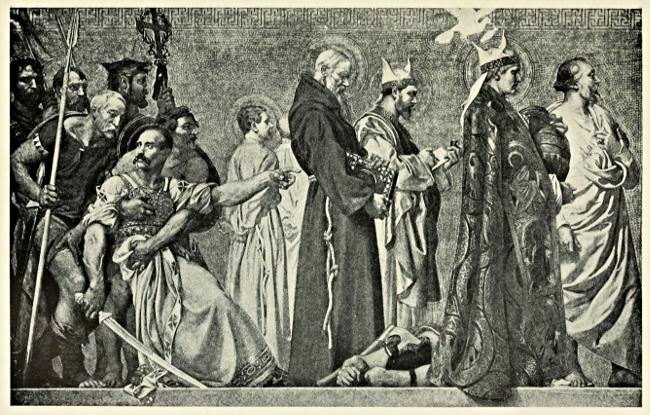
THE TRIUMPH OF CLOVIS
(AT THE PANTHEON, PARIS)
The people on both sides, who understood little of the points contested by the clergy, adopted the simple rule, that it was their duty to hate the members of the other church; and the Greeks, having their nationality condensed in their ecclesiastical establishment, far exceeded the Western nations in ecclesiastical bigotry, for the people in the western nations of Europe were often not very friendly to papal pretensions. The extreme bigotry of the Greeks soon tended to make the people of the Byzantine Empire averse to all intercourse with the Latins, as equals, and they assumed a superiority over nations rapidly advancing in activity, wealth, power, and intelligence, merely because they deemed them heretics. The separation of the two churches proved, consequently, more injurious to the Greeks, in their stationary condition of society, than to the Western Christians, who were eagerly pressing forward in many paths of social improvement.
[1053-1056 A.D.]
The empress Zoe died in the year 1050, at the age of seventy. Constantine X survived to the year 1054. When the emperor felt his end approaching, he ordered himself, according to the superstitious fashion of the time, to be transported to the monastery of Mangana, which he had constructed. His ministers, and especially his prime-minister, Joannes the logothetes, and president of the senate, urged him to name Nicephorus Bryennius, who commanded the Macedonian troops, his successor. The forms of the imperial constitution rendered it necessary that the sovereign should be crowned in Constantinople, and a courier was despatched to summon Bryennius to the capital. But as soon as Theodora heard of this attempt of her brother-in-law to deprive her of the throne she had been compelled to cede to him, she hastened to the imperial palace, convoked the senate, ordered the guards to be drawn out, and, presenting herself as the lawful empress, was proclaimed sovereign of the empire with universal acclamations. The news of this event embittered the last moments of the dying voluptuary, who hated Theodora for the respect her conduct inspired.e
In her name, and by the influence of four eunuchs, the Eastern world was peaceably governed about nineteen months; and as they wished to prolong their dominion, they persuaded the aged princess to nominate for her successor Michael VI. The surname of Stratioticus declares his military profession; but the crazy and decrepit veteran could only see with the eyes and execute with the hands of his ministers. Whilst he ascended the throne, Theodora sank into the grave—the last of the Macedonian or Basilian dynasty. We have hastily reviewed, and gladly dismiss, this shameful and destructive period of twenty-eight years, in which the Greeks, degraded below the common level of servitude, were transferred like a herd of cattle by the choice or caprice of two impotent females.
THE COMNENI
From this night of slavery, a ray of freedom, or at least of spirit, begins to emerge; the Greeks either preserved or revived the use of surnames, which perpetuate the fame of hereditary virtue; and we now discern the rise, succession, and alliance, of the last dynasties of Constantinople and Trebizond. The Comneni, who upheld for a while the fate of the sinking empire, assumed the honour of a Roman origin; but the family had long since been transported from Italy to Asia. Their patrimonial estate was situate in the district of Castamona, in the neighbourhood of the Euxine; and one of their chiefs, who had already entered the paths of ambition, revisited with affection, perhaps with regret, the modest though honourable dwelling of his fathers.
[1057-1059 A.D.]
The first of their line was the illustrious Manuel, who, in the reign of the second Basil, contributed by war and treaty to appease the troubles of the East: he left, in a tender age, two sons, Isaac and Joannes, whom, with the consciousness of desert, he bequeathed to the gratitude and favour of his sovereign. The noble youths were carefully trained in the learning of the monastery, the arts of the palace, and the exercises of the camp; and from the domestic service of the guards, they were rapidly promoted to the command of provinces and armies. Their fraternal union doubled the force and reputation of the Comneni, and their ancient nobility was illustrated by the marriage of the two brothers with a captive princess of Bulgaria, and the daughter of a patrician, who had obtained the name of Charon from the number of enemies whom he had sent to the infernal shades. The soldiers had served with reluctant loyalty a series of effeminate masters; the elevation of Michael VI was a personal insult to the more deserving generals; and their discontent was inflamed by the parsimony of the emperor and the insolence of the eunuchs. They secretly assembled in the sanctuary of St. Sophia, and the votes of the military synod would have been unanimous in favour of the old and valiant Catacalon, if the patriotism or modesty of the veteran had not suggested the importance of birth as well as merit in the choice of a sovereign. Isaac Comnenus was approved by general consent, and the associates separated without delay to meet in the plains of Phrygia at the head of their respective squadrons and detachments.
The cause of Michael was defended in a single battle by the mercenaries of the imperial guard, who were aliens to the public interest, and animated only by a principle of honour and gratitude. After their defeat, the fears of the emperor solicited a treaty, which was almost accepted by the moderation of the Comnenian. But the former was betrayed by his ambassadors, and the latter was prevented by his friends. The solitary Michael submitted to the voice of the people; the patriarch annulled their oath of allegiance; and as he shaved the head of the royal monk, congratulated his beneficial exchange of temporal royalty for the kingdom of heaven; an exchange, however, which the priest, on his own account, would probably have declined.
[1059-1067 A.D.]
By the hands of the same patriarch, Isaac Comnenus was solemnly crowned; the sword, which he inscribed on his coins, might be an offensive symbol, if it implied his title by conquest; but this sword would have been drawn against the foreign and domestic enemies of the state.[74] The decline of his health and vigour suspended the operation of active virtue;[75] and the prospect of approaching death determined him to interpose some moments between life and eternity. But instead of leaving the empire as the marriage portion of his daughter, his reason and inclination concurred in the preference of his brother Joannes, a soldier, a patriot, and the father of five sons, the future pillars of an hereditary succession. His first modest reluctance might be the natural dictates of discretion and tenderness, but his obstinate and successful perseverance, however it may dazzle with the show of virtue, must be censured as a criminal desertion of his duty, and a rare offence against his family and country. The purple which he had refused was accepted by Constantine Ducas, a friend of the Comnenian house, and whose noble birth was adorned with the experience and reputation of civil policy. In the monastic habit, Isaac recovered his health, and survived two years his voluntary abdication. At the command of his abbot, he observed the rule of St. Basil, and executed the most servile offices of the convent; but his latent vanity was gratified by the frequent and respectful visits of the reigning monarch, who revered in his person a benefactor and a saint.
If Constantine XI were indeed the subject most worthy of empire, we must pity the debasement of the age and nation in which he was chosen. In the labour of puerile declamations he sought, without obtaining, the crown of eloquence, more precious, in his opinion, than that of Rome; and, in the subordinate functions of a judge, he forgot the duties of a sovereign and a warrior. Ducas was anxious only to secure, even at the expense of the republic, the power and prosperity of his children. His three sons, Michael VII, Andronicus I, and Constantine XII, were invested, at a tender age, with the equal title of Augustus; and the succession was speedily opened by their father’s death. His widow, Eudocia, was entrusted with the administration.
Before the end of seven months, the wants of Eudocia, or those of the state, called aloud for the male virtues of a soldier; and her heart had already chosen Romanus Diogenes, whom she raised from the scaffold to the throne. The discovery of a treasonable attempt had exposed him to the severity of the laws; his beauty and valour absolved him in the eyes of the empress, and Romanus, from a mild exile, was recalled on the second day to the command of the oriental armies. Her royal choice was yet unknown to the public, and the promise which would have betrayed her falsehood and levity was stolen by a dexterous emissary from the ambition of the patriarch. Xiphilin at first alleged the sanctity of oaths and the sacred nature of a trust; but a whisper that his brother was the future emperor relaxed his scruples, and forced him to confess that the public safety was the supreme law. He resigned the important paper; and when his hopes were confounded by the nomination of Romanus, he could no longer regain his security, retract his declarations, nor oppose the second nuptials of the empress. Yet a murmur was heard in the palace; and the barbarian guards had raised their battle-axes in the cause of the house of Ducas, till the young princes were soothed by the tears of their mother and the assurances of the fidelity of their guardian, who filled the throne with dignity and honour.
ROMANUS IN THE FIELD (1067-1071)
[1067-1070 A.D.]
The false or genuine magnanimity of Mahmud the Ghaznavide was not imitated by Alp Arslan; and he attacked without scruple the Greek empress Eudocia and her children.[76] His alarming progress compelled her to give herself and her sceptre to the hand of a soldier; and Romanus Diogenes had been invested with the imperial purple. His patriotism, and perhaps his pride, urged him from Constantinople within two months after his accession; and the next campaign he most scandalously took the field during the holy festival of Easter. In the palace, Diogenes was no more than the husband of Eudocia; in the camp he was the emperor of the Romans, and he sustained that character with feeble resources and invincible courage. By his spirit and success, the soldiers were taught to act, the subjects to hope, and the enemies to fear. The Turks had penetrated into the heart of Phrygia; but the sultan himself had resigned to his emirs the prosecution of the war; and their numerous detachments were scattered over Asia in the security of conquest. Laden with spoil and careless of discipline, they were separately surprised and defeated by the Greeks; the activity of the emperor seemed to multiply his presence; and while they heard of his expedition to Antioch, the enemy felt his sword on the hills of Trebizond.
In three laborious campaigns[77] the Turks were driven beyond the Euphrates; in the fourth and last, Romanus undertook the deliverance of Armenia. The desolation of the land obliged him to transport a supply of two months’ provisions; and he marched forwards to the siege of Manzicert, an important fortress in the midway between the modern cities of Erzerum and Van. His army amounted, at the least, to one hundred thousand men. The troops of Constantinople were reinforced by the disorderly multitudes of Phrygia and Cappadocia; but the real strength was composed of the subjects and allies of Europe, the legions of Macedonia, and the squadrons of Bulgaria; the Uzi, a Moldavian horde, who were themselves of the Turkish race, and above all, the mercenary and adventurous bands of French and Normans. Their lances were commanded by the valiant Ursel of Baliol, the kinsman or father of the Scottish kings, and were allowed to excel in the exercise of arms, or, according to the Greek style, in the practice of the Pyrrhic dance.
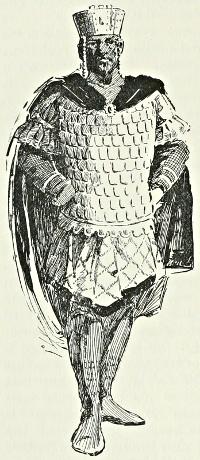
Byzantine Emperor in the Costume of a General
[1071 A.D.]
On the report of this bold invasion, which threatened his hereditary dominions, Alp Arslan flew to the scene of action at the head of forty thousand horse. His rapid and skilful evolutions distressed and dismayed the superior numbers of the Greeks; and in the defeat of Basilacius, one of their principal generals, he displayed the first example of his valour and clemency. The imprudence of the emperor had separated his forces after the reduction of Manzicert. It was in vain that he attempted to recall the mercenary Franks; they refused to obey his summons; he disdained to await their return; the desertion of the Uzi filled his mind with anxiety and suspicion; and against the most salutary advice he rushed forwards to speedy and decisive action.
Had he listened to the fair proposals of the sultan, Romanus might have secured a retreat, perhaps a peace; but in these overtures he supposed the fear or weakness of the enemy, and his answer was conceived in the tone of insult and defiance. “If the barbarian wishes for peace, let him evacuate the ground which he occupies for the encampment of the Romans, and surrender his city and palace of Rei as a pledge of his sincerity.” Alp Arslan smiled at the vanity of the demand, but he wept the death of so many faithful Moslems; and, after a devout prayer, proclaimed a free permission to all who were desirous of retiring from the field. With his own hands he tied up his horse’s tail, exchanged his bow and arrows for a mace and scimitar, clothed himself in a white garment, perfumed his body with musk, and declared that if he were vanquished, that spot should be the place of his burial.
The sultan himself had affected to cast away his missile weapons; but his hopes of victory were placed in the arrows of the Turkish cavalry, whose squadrons were loosely distributed in the form of a crescent. Instead of the successive lines and reserves of the Grecian tactics, Romanus led his army in a single and solid phalanx, and pressed with vigour and impatience the artful and yielding resistance of the barbarians. In this desultory and fruitless combat he wasted the greater part of a summer’s day, till prudence and fatigue compelled him to return to his camp. But a retreat is always perilous in the face of an active foe; and no sooner had the standard been turned to the rear, than the phalanx was broken by the base cowardice, or the baser jealousy, of Andronicus, a rival prince, who disgraced his birth and the purple of the cæsars. The Turkish squadrons poured a cloud of arrows on this moment of confusion and lassitude; and the horns of their formidable crescent was closed in the rear of the Greeks. In the destruction of the army and pillage of the camp, it would be needless to mention the number of slain or captives. The Byzantine writers deplore the loss of an inestimable pearl; they forget to mention that in this fatal day the Asiatic provinces of Rome were irretrievably sacrificed.
As long as a hope survived, Romanus attempted to rally and save the relics of his army. When the centre, the imperial station, was left naked on all sides and encompassed by the victorious Turks, he still, with desperate courage, maintained the fight till the close of day, at the head of the brave and faithful subjects who adhered to his standard. They fell around him; his horse was slain; the emperor was wounded; yet he stood alone and intrepid, till he was oppressed and bound by the strength of multitudes. The glory of this illustrious prize was disputed by a slave and a soldier; a slave who had seen him on the throne of Constantinople, and a soldier whose extreme deformity had been excused on the promise of some signal service. Despoiled of his arms, his jewels, and his purple, Romanus spent a dreary and perilous night on the field of battle, amidst a disorderly crowd of the meaner barbarians.
CAPTIVITY OF THE EMPEROR
In the morning the royal captive was presented to Alp Arslan, who doubted of his fortune, till the identity of the person was ascertained by the report of his ambassadors, and by the more pathetic evidence of Basilacius, who embraced with tears the feet of his unhappy sovereign. The successor of Constantine, in a plebeian habit, was led into the Turkish divan, and commanded to kiss the ground before the lord of Asia. He reluctantly obeyed; and Alp Arslan, starting from his throne, is said to have planted his foot on the neck of the Roman emperor. But the fact is doubtful; and if, in this moment of insolence, the sultan complied with a national custom, the rest of his conduct has extorted the praise of his bigoted foes, and may afford a lesson to the most civilised ages. He instantly raised the royal captive from the ground; and thrice clasping his hand with tender sympathy, assured him that his life and dignity should be inviolate in the hands of a prince who had learned to respect the majesty of his equals and the vicissitudes of fortune. From the divan, Romanus was conducted to an adjacent tent, where he was served with pomp and reverence by the officers of the sultan, who, twice each day, seated him in the place of honour at his own table. In a free and familiar conversation of eight days, not a word, not a look, of insult escaped from the conqueror; but he severely censured the unworthy subjects who had deserted their valiant prince in the hour of danger, and gently admonished his antagonist of some errors which he had committed in the management of the war. In the preliminaries of negotiation, Alp Arslan asked him what treatment he expected to receive, and the calm indifference of the emperor displays the freedom of his mind. “If you are cruel,” he said, “you will take my life; if you listen to pride, you will drag me at your chariot wheels; if you consult your interest you will accept a ransom, and restore me to my country.” “And what,” continued the sultan, “would have been your own behaviour, had fortune smiled on your arms?” The reply of the Greek betrays a sentiment which prudence, and even gratitude, should have taught him to suppress. “Had I vanquished,” he fiercely said, “I would have inflicted on thy body many a stripe.”
The Turkish conqueror smiled at the insolence of his captive; observed that the Christian law inculcated the love of enemies and forgiveness of injuries; and nobly declared that he would not imitate an example which he condemned. After mature deliberation, Alp Arslan dictated the terms of liberty and peace—a ransom of a million, an annual tribute of 360,000 pieces of gold, the marriage of the royal children, and the deliverance of all the Moslems who were in the power of the Greeks. Romanus, with a sigh, subscribed this treaty, so disgraceful to the majesty of the empire; he was immediately invested with a Turkish robe of honour; his nobles and patricians were restored to their sovereign; and the sultan, after a courteous embrace, dismissed him with rich presents and a military guard. No sooner did he reach the confines of the empire, than he was informed that the palace and provinces had disclaimed their allegiance to a captive; a sum of two hundred thousand pieces was painfully collected; and the fallen monarch transmitted this part of his ransom, with a sad confession of his impotence and disgrace.
In the treaty of peace, it does not appear that Alp Arslan extorted any province or city from the captive emperor; and his revenge was satisfied with the trophies of his victory and the spoils of Anatolia, from Antioch to the Black Sea. The fairest part of Asia was subject to his laws; twelve hundred princes, or the sons of princes, stood before his throne; and two hundred thousand soldiers marched under his banners. The sultan disdained to pursue the fugitive Greeks; but he meditated the more glorious conquest of Turkestan, the original seat of the house of Seljuk.
[While the Turks were getting control of Asia Minor the Byzantine Empire lost its last hold on Italy. Robert Guiscard had taken, one after another, the cities of the empire, and in 1068 laid siege to Bari. Romanus sent a fleet under Gosselin, but Guiscard’s brother Roger defeated him. Bari capitulated in April, 1071, and the direct authority of the Roman Empire in Italy was gone forever.]
THE SONS OF CONSTANTINE XI AND NICEPHORUS III (1071-1081 A.D.)
[1071-1081 A.D.]
The defeat and captivity of Romanus IV inflicted a deadly wound on the Byzantine monarchy of the East; and after he was released from the chains of the sultan, he vainly sought his wife and subjects. His wife had been thrust into a monastery, and the subjects of Romanus had embraced the rigid maxim of the civil law, that a prisoner in the hands of the enemy is deprived, as by the stroke of death, of all public and private rights of a citizen. In the general consternation, the cæsar Joannes asserted the indefeasible right of his three nephews. Constantinople listened to his voice, and the Turkish captive was proclaimed in the capital, and received on the frontier, as an enemy of the republic. Romanus was not more fortunate in domestic than in foreign war: the loss of two battles compelled him to yield, on the assurance of fair and honourable treatment; but his enemies were devoid of faith or humanity, and, after the cruel extinction of his sight, his wounds were left to bleed and corrupt, till in a few days he was relieved from a state of misery.
Under the triple reign of the house of Ducas, the two younger brothers were reduced to the vain honours of the purple; but the eldest, the pusillanimous Michael, was incapable of sustaining the Roman sceptre; and his surname of Parapinaces denotes the reproach which he shared with an avaricious favourite, who enhanced the price, and diminished the measure, of wheat. In the school of Psellus, and after the example of his mother, the son of Eudocia made some proficiency in philosophy and rhetoric; but his character was degraded, rather than ennobled, by the virtues of a monk and the learning of a sophist.
Strong in the contempt of their sovereign and their own esteem, two generals, at the head of the European and Asiatic legions, assumed the purple at Hadrianopolis and Nicæa. Their revolt was in the same month; they bore the same name of Nicephorus; but the two candidates were distinguished by the surnames of Bryennius and Botaniates: the former in the maturity of wisdom and courage, the latter conspicuous only by the memory of his past exploits. While Botaniates advanced with cautious and dilatory steps, his active competitor stood in arms before the gates of Constantinople. The name of Bryennius was illustrious; his cause was popular; but his licentious troops could not be restrained from burning and pillaging a suburb; and the people, who would have hailed the rebel, rejected and repulsed the incendiary of his country. This change of the public opinion was favourable to Botaniates, who at length, with an army of Turks, approached the shores of Chalcedon.
A formal invitation, in the name of the patriarch, the synod, and the senate, was circulated through the streets of Constantinople; and the general assembly, in the dome of St. Sophia, debated with order and calmness on the choice of their sovereign. The guards of Michael would have dispersed this unarmed multitude; but the feeble emperor, applauding his own moderation and clemency, resigned the ensigns of royalty, and was rewarded with the monastic habit and the title of archbishop of Ephesus. He left a son, a Constantine, born and educated in the purple; and a daughter of the house of Ducas illustrated the blood, and confirmed the succession, of the Comnenian dynasty.
Joannes Comnenus, the brother of the emperor Isaac, survived in peace and dignity his generous refusal of the sceptre. By his wife Anne, a woman of masculine spirit and policy, he left eight children; the three daughters multiplied the Comnenian alliances with the noblest Greeks; of the five sons, Manuel was stopped by a premature death; Isaac and Alexius restored the imperial greatness of their house, which was enjoyed without toil or danger by the two younger brethren, Adrian and Nicephorus. Alexius, the third and most illustrious of the brothers, was endowed by nature with the choicest gifts both of mind and body; they were cultivated by a liberal education, and exercised in the school of obedience and adversity. The youth was dismissed from the perils of the Turkish War,[78] by the paternal care of the emperor Romanus; but the mother of the Comneni, with her aspiring race, was accused of treason, and banished, by the sons of Ducas, to an island in the Propontis. The two brothers soon emerged into favour and action, fought by each other’s side against the rebels and barbarians, and adhered to the emperor Michael, till he was deserted by the world and by himself.
In his first interview with Botaniates, “Prince,” said Alexius, with a noble frankness, “my duty rendered me your enemy; the decrees of God and of the people have made me your subject. Judge of my future loyalty by my past opposition.” The successor of Michael entertained him with esteem and confidence; his valour was employed against three rebels, who disturbed the peace of the empire, or at least of the emperors. Ursel, Bryennius, and Basilacius were formidable by their numerous forces and military fame: they were successively vanquished in the field, and led in chains to the foot of the throne; and whatever treatment they might receive from a timid and cruel court, they applauded the clemency, as well as the courage, of their conqueror. But the loyalty of the Comneni was soon tainted by fear and suspicion; nor is it easy to settle between a subject and a despot the debt of gratitude, which the former is tempted to claim by a revolt, and the latter to discharge by an executioner. The refusal of Alexius to march against a fourth rebel, the husband of his sister, destroyed the merit or memory of his past services; the favourites of Botaniates provoked the ambition which they apprehended and accused; and the retreat of the two brothers might be justified by the defence of their life or liberty.
The women of the family were deposited in a sanctuary, respected by tyrants; the men, mounted on horseback, sallied from the city, and erected the standard of civil war. The soldiers, who had been gradually assembled in the capital and the neighbourhood, were devoted to the cause of a victorious and injured leader; the ties of common interest and domestic alliance secured the attachment of the house of Ducas; and the generous dispute of the Comneni was terminated by the decisive resolution of Isaac, who was the first to invest his younger brother with the name and ensigns of royalty. They returned to Constantinople, to threaten rather than besiege that impregnable fortress; but the fidelity of the guards was corrupted; a gate was surprised, and the fleet was occupied by the active courage of George Palæologus, who fought against his father, without foreseeing that he laboured for his posterity. Alexius ascended the throne; and his aged competitor disappeared in a monastery. An army of various nations was gratified with the pillage of the city; but the public disorders were expiated by the tears and fasts of the Comneni, who submitted to every penance.
ANNA COMNENA’S HISTORY
The life of the emperor Alexius has been delineated by a favourite daughter, who was inspired by a tender regard for his person, and a laudable zeal to perpetuate his virtues. Conscious of the just suspicion of her readers, the princess Anna Comnenai repeatedly protests, that, besides her personal knowledge, she had searched the discourse and writings of the most respectable veterans; that, after an interval of thirty years, forgotten by, and forgetful of, the world, her mournful solitude was inaccessible to hope and fear; and that truth, the naked, perfect truth, was more dear and sacred than the memory of her parent. Yet, instead of the simplicity of style and narrative which wins our belief, an elaborate affectation of rhetoric and science betrays in every page the vanity of a female author. The genuine character of Alexius is lost in a vague constellation of virtues; and the perpetual strain of panegyric and apology awakens our jealousy, to question the veracity of the historian and the merit of the hero. We cannot, however, refuse her judicious and important remark, that the disorders of the times were the misfortune and the glory of Alexius; and that every calamity which can afflict a declining empire was accumulated on his reign by the justice of heaven and the vices of his predecessors.
TROUBLES OF ALEXIUS
[1081-1084 A.D.]
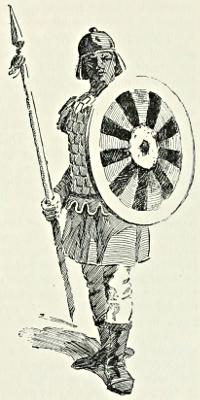
A Byzantine Soldier
In the East, the victorious Turks had spread from Persia to the Hellespont the reign of the Koran and the crescent; the West was invaded by the adventurous valour of the Normans; and, in the moments of peace, the Danube poured forth new swarms, who had gained in the science of war what they had lost in the ferociousness of manners. The sea was not less hostile than the land; and while the frontiers were assaulted by an open enemy, the palace was distracted with secret treason and conspiracy.h
One of the earliest acts of the reign of Alexius was to conclude a treaty of peace with the Seljuk emir Suleiman, who acted in Asia Minor as if he were completely independent of the grand sultan Malekshah. The treachery of Nicephorus Melissenos had placed Suleiman in possession of Nicæa, and his troops occupied several posts on the shores of the Bosporus and the Sea of Marmora; while Alexius, who required the whole forces of the empire to resist the invasion of Robert Guiscard, was compelled to purchase peace at any price. Under such circumstances, it was only to be expected that the immediate neighbourhood of Constantinople could be kept free from the Turks, and accordingly the boundaries of the Roman Empire in Asia Minor were by this treaty reduced to very narrow limits. The country immediately opposite the capital, as far as the mouth of the river Sangarius and the head of the Gulf of Nicomedia, was evacuated by the Turks, as well as the coasts of the Sea of Marmora, from the little stream called Draco, which falls into the Gulf of Nicomedia, westward to the city of Prusias. Already the mountains of the Turkish territory were visible from the palace of Alexius and the dome of St. Sophia; but the Crusades were destined to repel the Mohammedan invasion from the shores of Europe for several centuries.
THE NORMAN INVASION
The spirit of enterprise and conquest which, when placed under the guidance of religious enthusiasm, carried the bravest warriors of western Europe as crusaders to the East, had, in the preceding generation, under the direction of civil wisdom, produced the conquest of England and southern Italy by the Normans. These conquests had raised their military reputation and self-confidence to the highest pitch; and Robert Guiscard, who was lord of dominions in Italy far superior in wealth to the duchy of Normandy, hoped to eclipse the exploits of Duke William in England by conquering the Byzantine Empire. But as he knew that he must expect a more prolonged resistance than England had offered to its conqueror, he sought a pretext for commencing the war which would conceal his own object, and have a tendency to induce a party in the country to take up arms against the government he was anxious to overthrow. His daughter Helena had been betrothed to Constantine Ducas, the son of Michael VII, and was still so young that she was residing in the imperial palace at Constantinople, to receive her education, when Michael was dethroned. Nicephorus III sent the child to a convent, and Robert her father stood forward as the champion of Michael’s right to recover the throne from which he had been expelled. Under the cover of this pretext, the Norman expected to render himself master of Constantinople, or at all events to gain possession of the rich provinces on the eastern shore of the Adriatic.
The preparations of Robert Guiscard were far advanced when Alexius ascended the throne. To inflame the zeal of his troops, he persuaded Pope Gregory VII that a Greek monk, who had assumed the character of Michael VII, was really the dethroned emperor, and thus induced the pope to approve of his expedition, and to grant absolution to all the invaders of the Byzantine Empire, as if they had been about to commence a holy war. The soldiers were impressed with a deep conviction of the justice of their cause and were inflamed with hopes of plunder and glory.
In the month of June, 1081, Robert Guiscard sailed from Brindisi with a well-appointed fleet of a hundred and fifty ships, carrying an army of thirty thousand chosen troops. His first operation was to render himself master of the rich island of Corcyra (Corfu), which then yielded an annual revenue of fifteen hundred pounds’ weight of gold to the Byzantine government. He then seized the ports of Butrinto, Avlona, and Kanino, on the mainland, and laid siege to the important city of Dyrrhachium, the strongest fortress on the eastern coast of the Adriatic, and the capital of Byzantine Illyria. It was fortunate for the empire that George Palæologus, one of its bravest officers, had entered the place before Robert commenced the siege.
The interests of Venice bound them to the cause of the Byzantine government at this time. They were alarmed lest their lucrative trade with Greece and the Levant should be placed at the mercy of the rapacious Normans, in case Robert Guiscard should succeed in gaining possession of the entrance to the Adriatic. They plunged, therefore, into the war without hesitation or reserve.
The doge Dominic Sylvio sailed from Venice with a powerful fleet to attack the Normans before the emperor Alexius could collect his army and march to the relief of Dyrrhachium. The Norman fleet, which was commanded by Bohemund, the illustrious son of Robert Guiscard, suffered a complete defeat, and the communications of the invading army with Italy were cut off. This difficulty only excited Robert to press the siege with additional vigour. He employed every device then known for the attack of towns. The military proceedings of Alexius, when he reached the neighbourhood of Dyrrhachium, were very injudicious. The battle which took place was as disgraceful to the Byzantine arms as to the emperor’s judgment.
In the month of February, 1082, a Venetian, who guarded one of the towers, betrayed the city to Robert, who had previously put his army into winter quarters at Glabinitza and Joanina, in order to escape the severe cold of the winter farther north. Alexius collected the remains of the Byzantine army at Deavolis, and repaired himself to Thessalonica, where he passed the winter collecting a second army, which he was enabled to do, as he had replenished his military chest from the church plate of the richest cathedrals and monasteries in his dominions. The affairs of Italy, before the opening of the second campaign, fortunately compelled Robert Guiscard to quit Illyria, and leave his son Bohemund in command of the Norman army.
In the spring of 1083, Alexius had collected an army so powerful that he again marched forward to attack the Normans. In order to break the terrible charge of their cavalry, which no Byzantine horse could resist, the emperor placed a number of chariots before his own troops, armed with barbed poles extending in front like a line of lances, and in these chariots he stationed a strong body of heavy-armed infantry. Bohemund, however, on reconnoitring this strange unwieldy measure of defence, broke up his line of cavalry into two columns, and leaving the centre of the Byzantine army with the chariots unassailed, fell with fury on the extremity of the two wings. The resistance was short, and the emperor Alexius again fled.
Alexius, having procured a subsidiary force of seven thousand light cavalry from Suleiman and the sultan of Nicæa, again took the field in the spring of 1084. He formed his army into two divisions, and advanced to engage the Normans before Larissa. His preparation for a battle was on this occasion made with considerable skill. Bohemund, seeing that he was in danger of being cut off from his resources, retreated to Kastoria. As soon as the Norman army was cut off from plunder, and without any hope of making further conquests, it began to display a mutinous spirit; and Bohemund was compelled to return to Italy, to obtain supplies of money and fresh troops. Brienne, the constable of Apulia, who commanded in his absence, found himself compelled to surrender Kastoria to the emperor Alexius, and to engage not to bear arms again against the Byzantine Empire.
While Bohemund was carrying on the war against the emperor of the East, Robert Guiscard had driven the emperor of the West out of Rome; and after vanquishing Henry IV, he had plundered the Eternal City like another Genseric. He was now ready to resume his schemes of ambition in the East. Collecting a powerful fleet to carry over his victorious army into Epirus, he raised the siege of Corfu (Corcyra), which was invested by the combined naval forces of the Byzantine Empire and the Venetian Republic. The united fleets were completely defeated in a great naval battle, in which, according to Anna Comnena,i they lost thirteen thousand men. But in the month of July, 1085, Robert died in the island of Cephallenia, and with him perished all the Norman projects of conquest in the Byzantine Empire. Dyrrhachium was recovered by Alexius with the assistance of the Venetian and Amalphitan merchants established in the place, and the services of the Venetians in this war were rewarded by many commercial privileges which were conferred on them by a golden bull.e
[1084-1118 A.D.]
The Norman War was scarcely finished when the Patzinaks invaded the empire (1086). This war lasted five years, until, in fact, Alexius concluded a treaty with the Komans, allies of the Patzinaks, and then dealt the latter a crushing blow at Levounion in 1091. Minor wars with Servia and Dalmatia do not deserve mention, but the progress of the Seljuk Turks continued to hasten the decline of the empire. They dared everything, and in 1092 Tzachas, emir of Smyrna, assumed the title of emperor. He was put down, but retained sufficient strength to besiege Abydos in 1093. But Alexius accomplished his murder the same year. The relations of Alexius and the First Crusade will be fully treated in the account of the Holy Wars. The ancient enmity of Alexius and Bohemund was rekindled when the latter entered into his principality of Antioch. The war lasted from 1103 to 1108, or until Bohemund’s death. The last years of Alexius’ reign were occupied with hostilities with the crusaders and again with the Seljuk Turks. The latter sustained a succession of heavy losses, and in 1116 were glad to make peace. This was the end of Alexius’ military career.a
In the tempest of the Crusades Alexius steered the imperial vessel with dexterity and courage. At the head of his armies, he was bold in action, skilful in stratagem, patient of fatigue, ready to improve his advantages, and rising from his defeats with inexhaustible vigour.
In his intercourse with the Latins, Alexius was patient and artful; his discerning eye pervaded the new system of an unknown world; and we shall hereafter describe the superior policy with which he balanced the interests and passions of the champions of the First Crusade. In a long reign of thirty-seven years, he subdued and pardoned the envy of his equals; the laws of public and private order were restored; the arts of wealth and science were cultivated; the limits of the empire were enlarged in Europe and Asia; and the Comnenian sceptre was transmitted to his children of the third and fourth generation.
Anna is a faithful witness that his happiness was destroyed, and his health was broken, by the cares of a public life; the patience of Constantinople was fatigued by the length and severity of his reign; and before Alexius expired, he had lost the love and reverence of his subjects. The clergy could not forgive his application of the sacred riches to the defence of the state; but they applauded his theological learning and ardent zeal for the orthodox faith, which he defended with his tongue, his pen, and his sword. His character was degraded by the superstition of the Greeks; and the same inconsistent principle of human nature enjoined the emperor to found a hospital for the poor and infirm, and to direct the execution of a heretic, who was burned alive in the square of St. Sophia.
In his last hours, when he was pressed by his wife Irene to alter the succession, he raised his head, and breathed a pious ejaculation on the vanity of this world. The indignant reply of the empress may be inscribed as an epitaph on his tomb—“You die, as you have lived—a hypocrite!” (1118).
JOANNES (II) COMNENUS (CALO-JOANNES) (1118-1143 A.D.)
[1118-1143 A.D.]
It was the wish of Irene to supplant the eldest of her surviving sons, in favour of her daughter, the princess Anna, whose philosophy would not have refused the weight of a diadem. But the order of male succession was asserted by the friends of their country; the lawful heir drew the royal signet from the finger of his insensible or unconscious father, and the empire obeyed the master of the palace. Anna Comnena was stimulated by ambition and revenge to conspire against the life of her brother; and when the design was prevented by the fears or scruples of her husband, she passionately exclaimed, that nature had mistaken the two sexes, and had endowed Bryennius with the soul of a woman.