Part 11 / Book 2 — CHAPTER V CHARLEMAGNE [768-814 A.D.] (continued 2)
Reading edition
It was in this sense that Charles conceived his position; in this sense he began his imperial government. Soon after his return from Rome he had the entire body of ecclesiastical and civil law in force in his dominions revised at Aachen and everything struck out that seemed contrary to the command of God. Then he sent out royal messengers, both ecclesiasts and laymen, in all directions to put these improved laws into force and at the same time to require from all subjects of the empire who had passed their twelfth year a new oath of allegiance, an oath which, as was expressly emphasised, imposed far higher duties towards his imperial majesty than the oath formerly given to the king. To these messengers Charles gave an almost apostolic mission; they were to warn the people zealously against any violation of the divine commands, to enjoin the Christian virtues, to remind all that they must sometime give an account of their lives before the judgment throne of Christ.
Though the Germanic kingdom had from the beginning assumed some ecclesiastical rights, it seems now, when raised to imperial power, to usurp almost the plenitude of the high-priesthood. And Charles was in fact frankly designated the “regent of the holy church”; church councils not only required his permission to meet, he supplemented their decisions, rectified their mistakes, and had everywhere the deciding vote in them. It was he, in no less degree, who reformed the entire clergy of his empire and with unrelenting sternness forced upon them the canonical life whose regulations were for the most part taken from the monastic rules of St. Benedict. The legislation of Charles encroaches everywhere upon the domain of the church, and even in the later collections of the canon law his laws appear beside the letters of the popes and the decrees of the councils. The pope, although the western church honours him as its spiritual head, sinks beside this high-priestly emperor almost to the rank of first councillor in ecclesiastical affairs, of head of the highest corporate body of the empire.
But it was as king of the Franks, as commander-in-chief and supreme judge of his people that Charles had attained imperial power; out of the military and judicial authority that he exercised over the free Franks and all peoples subject to them his whole power had arisen, and would fall to the ground if this basis upon which it rested should be weakened or withdrawn from it. If the empire of Charles was to maintain its existence it was all-important that the subject portions of the realm should at the same time be so fully incorporated in the Frankish political system that they could never again separate from it—an immeasurable, infinitely difficult task, especially as Charles could never think of forcing the despotism of decrepit Rome upon his empire nor of crushing the characteristic life of the separate races with the weight of his supreme power, of establishing one law and administration and like forms of government from one end of his empire to the other. He was withheld from this in the first place by his ideal of the Christian state, but even more by his own disposition and by the nature of the peoples he ruled over. If the political creation of Charles was to gain any sort of permanence among peoples that were either German throughout, or had at least been internally transformed by Germanic elements, it must proceed from the German spirit, which possesses no creative activity where freedom of development is not permitted to the individual. It must, moreover, cling tenaciously to tradition, and regulate, assemble, and direct the powers of the state more through personal influence than through a lifeless mechanism.
Charles performed this task with a wisdom and greatness of soul that will ever be astonishing. Mighty and successful as are his deeds of arms, his fame as lawgiver nevertheless shines with a far brighter radiance through the history of mankind. Above the personal and national laws, which had in part first been codified by his direction, he established by his capitularies—edicts and enactments which he either promulgated upon his own decision or upon the counsel of the imperial assemblies—a general law of the empire, a body of legislation of the most comprehensive sort, which not only regulated the great affairs of the entire body politic but even descended to local conditions, in order to adjust them to the whole. He carried through in good part the undertaking so long despaired of—of subjugating the defiant, liberty-loving Germanic races to a constitution, of making them serve the ideal of the state. A gigantic step in the development of the German spirit was taken through the legislation of Charles, and it must not be thought that because it was a first and therefore rude and awkward attempt it was born of a barbaric spirit.
If we rightly regard the highest art of the lawgiver as consisting in the ability to perceive with a keen eye every germ of moral life that he meets with in the customs and institutions of his people, and so to care for it that the most beautiful fruit of which it is capable will be obtained from it, then Charles was one of the greatest lawgivers the world has ever seen. No native impulse of the Germanic character was allowed by him to die; every one on the contrary was placed under cultivation, ennobled, and made capable of producing more splendid flowers and more useful fruit. As the Frankish political system in general, aside from its ecclesiastical elements, rested primarily on a Germanic basis, so too above all it was Germanic elements that were made use of in the political creation of Charles. The content of his laws, aside from the theocratic admixtures, is thoroughly German, although the capitularies as well as the national laws were written in Latin. In a certain sense the entire past of the Germanic nations flows into these laws, their whole future life flows from them. The Romans called the laws of the Twelve Tables the source of their entire political organisation; with equal right the Germans, indeed all the nations of Europe, could say the same of the laws of Charles. With veneration and holy awe one opens the capitularies of the great emperor, which combined form a legislative work that had a fruitful effect upon many centuries. The image of the Carlovingian state is here presented to our eyes with vivid actuality; we see how great things were accomplished and the highest striven for.
The strongest agency in holding the empire together was the Roman Catholic church; it disseminated one faith, one moral law, like religious institutions over nations that had previously been distinct from one another in language, customs, and laws, and enclosed them in its ingenious compact organisation as with a fine-meshed net. Church councils and imperial assemblies generally met together, and in the latter the voice of the clergy possessed the most weighty influence. The bishops were regarded as the most skilful agents in all political negotiations, they enjoyed a respect equal to that of counts. Like the temporal nobles, they were rich landowners, often led their retainers to war in person, and not seldom exchanged the crosier for the sword. Though the clergy had formerly been almost exclusively of Roman origin, now many Germans also devoted themselves to the clerical estate; sermons were preached in the German language, religious books were translated into German. In this way the clergy approached nearer to the peculiar character of the Germanic peoples, but did not on that account serve the universal aims of their estate and of the empire any the less effectively, especially since the compact union of the church had in recent times been rather strengthened than weakened.
A second, if not equally strong bond for the empire, was the Frankish nationality and the political institutions based upon it. With their swords the victorious Franks had gained control of the West, had made themselves rulers of the Germanic and Latin world; the empire, though it called itself Roman, was nevertheless only an extension of the kingdom of the Franks. The Frankish king was the sovereign of the empire; the divisions of the latter, the provinces, districts, and hundreds, or whatever other provincial name they may have borne, were for the most part ruled by Frankish nobles. Everywhere throughout the wide extent of the empire palaces and courts of the Frankish kings, castles and extensive possessions of the Frankish nobles were to be met with. The elements of the Frankish constitution were imposed both upon the conquered German lands and upon subject Italy. The Frankish people penetrated and surrounded the entire West with their political institutions; not strong enough to destroy the other nationalities, they had however attained such power that they could hold them down and make them serviceable to themselves.
As head of the western church and as king of the Franks the emperor was supreme in every way. The bishops, chosen always in accordance with his will, though not often directly by him, almost seemed to be the mere instruments of his designs. And in no less degree the entire civil government of the state proceeds from him. He alone appoints the counts, who in his name administer the military and judicial authority in their counties; their position is merely that of imperial officials who can be removed or dismissed when the common welfare demands it. He designates the royal messengers who travel annually in pairs through the various divisions of the empire, oversee the officials, receive complaints against them, uphold the rights of the throne in all parts of the monarchy, and maintain a constant communication between the divisions and the emperor. He is himself the supreme judge with unlimited jurisdiction; he has sole jurisdiction over the nobles and can assume all jurisdiction over others. He has the right to call to arms, decides upon war and peace, leads the army in person or appoints a commander-in-chief as well as dukes (Herzöge) of the forces of the separate peoples for the duration of the war. Legislation is also essentially vested in his hands, although in it he consults the imperial assembly and his council of state.
The imperial assembly consisted of all the lay and clerical lords, i.e., of the high court officials, the bishops, abbots, dukes, counts (Grafen), and the principal men of the royal retinue. It met every spring, usually in connection with the great review of the field of May, and its counsel was asked in all weighty affairs of state or important imperial laws. The council of state, however, was composed only of the high court officials, and the magnates of the empire whom the emperor deemed worthy of special confidence, and summoned to his presence either temporarily or permanently. In the autumn the council of state generally met for especially important sessions which served for the most part as preliminary consultations for the next imperial assembly, and for this purpose was increased by important servants of the emperor from all parts of the empire, and hence might be considered as a sort of imperial assembly in miniature.
The ancient works of art and science had made an impression upon Charles’ mind at an early date. He had wandered in Italy among the ruins of the great world gone by, and had decorated his palaces and the new churches in his native land with ancient works of art. It had thus been revealed to him that a peculiar breath of the divine spirit animated art and science, and also out of the German songs, despised by others, there was wafted to him a breath of fresh, vigorous, intellectual life. Charles raised his eyes far above the narrow bounds in which the western church confined art and science, where only the Roman erudition transformed by the clergy according to its own ideas had held its ground; he felt that Christianity carried with it the tendency towards a universal culture of mankind, but he also felt that it ought also to assimilate all the higher intellectual elements which were scattered in the individuality of different nations. Above all he realised, as no one before him, what treasures of mind were stored in his German mother-tongue, and could be elaborated from it. For this reason he gave especial attention to the German language and poetry; he himself worked on the first German grammar, and was the first who caused the German heroic poems to be written down. He held the clergy to preaching in German to the Germans, to instructing them in the German language. Only thus could the foundation for a German national civilisation be laid; since nothing less than the civilisation of the nation as a whole was the end he had in view.
The idea of a general national culture, which only recent times have called to life, and that in a very imperfect manner, was in fact already conceived in the mind of the great emperor. But national culture could proceed only from scholastic culture, although the latter, which had been preserved almost exclusively among the clergy, had long worn a predominantly theological character. For that reason alone Charles was obliged to nourish and cultivate this theologising scholarship, to which he also attributed the highest value, in all directions. He gathered the first scholars of the day at his court, bringing them not only from Italy but also from England, whither the new Latin science and literature had been transplanted from Rome together with Christianity, and where, invigorated by fresh nourishment, it had put forth new blooms. Charles himself was a most zealous pupil of these men whom he held up as a shining pattern for his clergy, and whose example did indeed have an unusual influence. Even if the emperor’s final ends were far from being attained, nevertheless schools began soon to flourish in the episcopal churches and in the cloisters; the Frankish clergy soon became distinguished for its learning, and even the laity was in some degree affected by the new intellectual life. Theological literature again produced works of lasting influence. Latin poetry was diligently cultivated, the German received rules and an artistic development; the art of reliable historical composition which was able to distinguish between fact and fable, and could grasp great events in their true position, grew up then for the first time among the Germans. In all of this almost solely the work of the clergy may be detected, which allowed itself to be directed by the mind of the emperor. He tried to remove the bishops and abbots from all earthly cares, and ordered them to install secular persons as judges and officials, who should execute justice and collect the revenues of the chapters, so that they themselves might follow their spiritual and intellectual calling with undivided force.
But mighty and influential as was the position to which the clerical and civil nobility had attained, the real power of the people still rested in the estate of freemen, which had ever remained the broad foundation of the Germanic political organisation. Only the stubborn force and the simplicity of severe morality that still persisted, especially in the German portions of the Frankish monarchy, had preserved the kingdom of the Merovingians from complete destruction and had made the establishment of royal power possible to the house of Pepin. No one knew better than Charles that the roots of his power lay here and that it would of necessity itself wither and disappear with them. With indefatigable zeal therefore he kept watch that the estate of freemen should neither be diminished nor shorn of its rights. When the magnates were evidently striving to displace the smaller landholders, seize their possessions and thus bring them into a dependent relation, Charles opposed them with the whole force of his authority and strictly forbade all oppression that could be employed to that end. Charles opposed such oppressive drudgery of the free people with unrelenting sternness and regulated by law the services that could be required of the freemen. The poorer men were partially freed from the duty of personal military service, several of them being permitted to combine to equip one of their number. On the outbreak of war, moreover, for the most part only those provinces that were near the scene of the conflict were obliged to furnish their full complement of men.
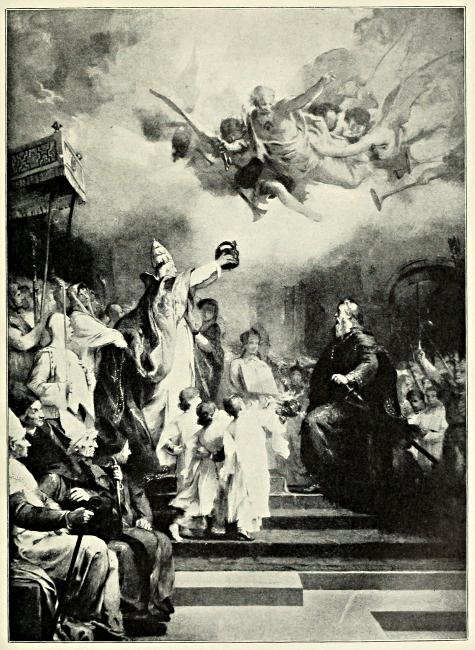
THE CROWNING OF CHARLEMAGNE AT ROME, 800 A.D.
If, as has been asserted, Charles was the only sovereign of the entire Middle Ages who penetrated to any depth the secrets of political economy, he could not fail to see that the nourishment and support of the state lay in the assured permanence of the middle and lower class landowners. To be sure, at a time when the internal organisation of the state consisted almost exclusively in the administration of justice, Charles could not carry out any great general measures for the elevation of the national welfare; but he could furnish others an example of how to practise agriculture successfully. And he gave this example to the whole empire. He was the best husbandman in it, his estates were model establishments, he saw to everything personally, looked over all accounts himself; and he even required a report of every wolf killed on his property. In other directions also he showed ways and means of increasing the national wealth. He directed his attention to the industries which, at least in the German provinces, were still carried on only by bondmen; and taught on his estates how they could be engaged in with profit.
He safeguarded trade, which was carried on in the German provinces mostly by Italians and Jews, and opened new routes to it. A highway of commerce joining the Mediterranean and the North Sea extended along the Rhine. Another route led from the mouth of the Elbe to the middle Danube and branched there in one direction towards the Black Sea, in the other towards the Adriatic. The development of an extensive industrial activity out of these foundations of Charles was slow and late; for the moment they were no more successful than those legal enactments of the emperor which forbade the freeman all feud and even self-defence, and commanded him to lay down his arms in time of peace. Mighty though the emperor’s arm was, there still existed a remnant of the old personal liberty and impatience of restraint which even he was unable to overcome.
Thus the state of Charlemagne sought to unite in itself all the different elements of political life that had developed in the Christian-Germanic period. In combination they were to supplement and counterbalance, control, and gradually to permeate one another. The clergy and the civil nobility were intended both to support and to watch each other. The officials and the communes extended to one another a helping hand, but at the same time kept each other within bounds. The crown united the whole, but it was none the less actually, if not legally, restricted and bound by the separate elements of the state. A certain balance of powers was established, but its maintenance required great skill and no little expenditure of power. The mighty personality of Charles succeeded in this in good part, but his keen insight did not fail to perceive how strong were the individual interests of the separate estates, and how hard it was for them to adapt themselves to any legally regulated system.
Not everything turned out as he wished and planned. The political institutions of Charles were indeed far from really penetrating the whole extent of his dominions; the ideal that hovered before his spirit in fact came to actual realisation only in his immediate vicinity, at his court. According to the ecclesiastical and temporal character of the empire, the person of the emperor was surrounded by a numerous body of court clergy and a brilliant retinue of temporal nobles. At the head of the ecclesiastical household stood the apocrisiary or arch-chaplain; through his hands all ecclesiastical matters passed to the emperor, and he had also assumed the duties of referendary. Below him was the arch-chancellor, who later himself gained the position of arch-chaplain. The best trained men of affairs, the most worthy servants of the church, the first scholars of the time were among the court clergy, which was the training-school of the bishops of the empire and under whose direction also stood the court school, at that time the most famous educational institution in the entire West. As the court chapel—the entire body of court clergy—was the centre of all ecclesiastical and scientific activity, so too in the supreme court the administration of justice and the science of government reached their height. Here the emperor either presided in person or was represented by the count palatine, who formed the head of the civil nobility and through whose hands all legal matters went to the emperor.
For the direct service of the king’s person vassals were appointed who could be looked upon as models of knightly training. At the court of Charles the most distinguished and influential men from all parts of the empire met. No one came into the emperor’s presence who could not have found there a fellow-countryman and in him an advocate. Service in the imperial palace was under the strictest regulations; everything was exactly fitted together, in order to be of mutual advantage. The older men received assistance and support from the younger; the latter found precept and example in their elders. So the court was not only a training-school for the clergy, but in no less degree for the nobility. The noble propriety and courtly manners which were later a distinguishing characteristic of knighthood, seemed to have had their beginning at the court of Charles.
Like the stars about the sun the paladins were grouped about the great emperor, who overshadowed them all. Not indeed, through brilliancy and pomp of external appearance did he charm the eyes of those who approached him; but about his tall, dignified figure played a dazzling glory as of some higher light in which the clearness of his great spirit seemed to radiate. Those long, white locks which adorned his head in old age, the great piercing eyes, the calm, serene brow, the powerful figure, aged but still not lacking in grace—this whole picture not only imprinted itself deeply upon his contemporaries, but history and tradition have held fast to it in all times, and to-day there is not a youth who has not received that impression. Many ambitious sovereigns have appeared in the thousand years since his time, but none has striven towards a higher ideal than to be placed beside Charlemagne; with this the boldest conquerors, the wisest pacific princes have contented themselves. The French chivalry of later times glorified Charles as the first knight, German citizens venerated him as the paternal friend of the people, and the most just of judges. The Catholic church placed him among its saints; the poetry of all nations in the succeeding ages has repeatedly received strength and vigour from his mighty appearance. Never perhaps has a richer life proceeded from the activity of a mortal man.
Last Years of Charles
In the last years of his life Charles was less occupied with military enterprises than in the earlier period. He turned over military glory to his sons, Charles, Pepin, and Louis, with whom he associated capable generals as advisers. Pepin, in Italy, had to conduct many a campaign against the armies of the Grecian emperor, Nicephorus, who had dethroned Irene; it was not until 812 that the court of Byzantium recognised Charles as emperor and the boundaries of the Eastern and Western empires were settled. At about the same time, too, the principality of Benevento finally submitted; it remained under Lombard princes, but they had to pay tribute to Charles. In the Alps and the valley of the Danube affairs were more easily and quickly settled after Pepin had destroyed the kingdom of the Avars. The frontier next the Avars, the marks of Corinthia and Friane, gained a firm outline, and the Slavs living within and along these boundaries recognised the sovereignty of the Franks. In 806, Charles, the emperor’s oldest son, also made war upon the Bohemians and the Sorbs; they were humbled, and for supervision of them the Frankish mark on the upper Main and the Thuringian mark on the Saale, Gera and Unstrut, were established.
[793-814 A.D.]
More stubborn and dangerous were the wars against the Arabs in the southwest of the empire. The earlier conquests of Charles had been lost again, and in 793 the Arabs had even crossed the Pyrenees and attacked the Frankish dominions. But in 797 a Frankish army, under the command of Louis, again succeeded in penetrating far into Spain, and four years later Barcelona fell. The foundation was laid for the Spanish mark and its extent was gradually increased by a series of successful campaigns. At the same time the small Christian states that had been formed in the northern mountains of the land arose to manful defence against the infidels. The kingdom of Asturia now for the first time gained an assurance of permanency under the brave king Alfonso II. Oviedo was built as a royal city and Compostela arose over the grave of the holy apostle James whose bones had just been miraculously discovered there. The veneration of St. Iago di Compostela and the courage of the chivalrous Alfonso then inflamed the Spanish Christians to further successful undertakings. The deeds of Charles gave the first inspiration for their victories, and Alfonso, who called himself a servant of the emperor, laid his choicest booty at Charles’ feet. At the same time the Basques, Pamplona, and all Navarre cut loose from the alliance with the Arabs by making temporary submission to the Franks; and along the Balearic Isles, and on the coasts of Corsica and Sardinia, Frankish fleets were already fighting Arab pirates with some degree of success.
Unquestionably the Frankish arms had proved themselves far superior to the once feared prowess of the Arabs. But the empire was now attacked by new enemies who stormed upon the northern marks with fearful might and wild violence, seeming to gain an access of renewed strength in the heat of battle. These enemies were the Danes. In earlier times they had appeared as friendly and closely related brothers of the German peoples; but Christianity and the compact union of the Frankish kingdom formed a strong dividing wall between the German and the Scandinavian peoples and turned the blood and racial friendship into the bitterest enmity. Unquenchable love of freedom, daring, and heroic courage, inexhaustible natural vigour, wild lust of booty—all that had once made the Germans so fatal to the Roman Empire was turned now with these sons of the northland against the Roman-German sovereignty of Charles and threatened it with all the greater danger since the Danes were skilled in naval as well as land warfare; while the Franks, who had for a long period fought only on land, must first learn to do battle on the unstable element of the waves. With the help of the seafaring Frisians Charles fitted out his first fleets, and as Frankish seamen were already fighting in the Mediterranean to protect the shores of Italy and Gaul from the Arabs, so too Frankish ships were soon seeking to defend the coasts of the North Sea from the attacks of the Norse enemies; but the Franks never became thoroughly familiar with naval warfare.
The wide empire was now protected against the neighbouring lands and peoples by a complete circle of strongly fortified and well defended marks, similar to dykes for the protection of a carefully tilled plain against the rush of wild floods. The Frankish vassals settled everywhere here for the defence of the boundaries formed a standing military force, always on guard against the near enemy and therefore also relieved from all service in other parts of the empire. These vassals, called Markmannen, were thus a sort of military colony on conquered ground, and were under their own counts who were clothed with extensive plenary powers and were chosen by the emperor from the bravest warriors among his nobles. These counts were called Markgrafen [hence our word marquis].
[814 A.D.]
When Charlemagne felt his end approaching he placed his youngest son Louis, his sole heir after the early death of Charles and Pepin, on the throne beside him and with his own hands set the imperial crown upon his head at Aachen [Aix-la-Chapelle]. Four months later the world mourned the death of the great emperor. On the 28th of January, 814, Charles died in his palace at Aachen, in the seventy-second year of his age and the forty-sixth of his reign.c
THE LEGENDARY CHARLEMAGNE
Scarcely had the great emperor passed away when the sober truth of his achievements took on the tones of the miraculous, and the historic Charles, too great to comprehend as he really was, became the centre for all that wealth of legend which grew into the epic poetry of France. In the year 883 a garrulous old monk in the monastery of St. Gaul on the upper Rhine recorded his version of the invasion of Lombardy, and through his words, which the theme renders eloquent, one can see for the first time the picture of the Charlemagne of the Middle Ages.a
The Monk of St. Gall’s Story
With Desiderius (in Pavia) was Otker, one of Karl’s great nobles, who had fled the wrath of the dread king some years before and had found refuge with Desiderius. Now on the approach of the terrible Karl, they climbed into a high tower from which they could see in all directions.
The advance guard appeared, stronger than all the armies of Darius or of Cæsar; and Desiderius asked Otker, “Think you Karl is with this great army?” But he replied, “Not yet.” Then he saw the van of the army drawn from all parts of the wide empire and he said to Otker, “Surely the conquering Karl is in that host.” But Otker said, “Not yet.” Then Desiderius, in growing alarm, cried out, “What can we do if still more come with him?” Otker replied, “You will soon behold the manner of his coming; but as for us, I know not what shall befall.” And lo, while they yet spoke there appeared, wave after wave, the multitude of his household servants. “That is Karl,” cried Desiderius in terror. But Otker said, “Not yet.” Then came the bishops and abbots and chaplains and their train, and the dazed and trembling king, stammering with fear, called to Otker, “Let us go down and hide in the earth from the wrath of this terrible foe.” But Otker, who in his better days had seen the power of Karl’s incomparable arms, answered in dread, “When a harvest of steel comes waving in the fields, and the Po and the Ticino dash waves black with steel against the city wall, then Karl is coming.” Scarce had he spoken when in the north and in the west they saw his coming, dark and cloudlike, attended by shadow that eclipsed the clear day. Then as the king drew nigh there came a flash from gleaming weapons that was more awful to the besieged than any night. Then they saw Karl, the man of steel, his arms, his iron breast, his broad shoulders protected by steel harness, his left hand holding aloft the iron lance, his right ready for the victorious sword. Steel filled the fields and roads, and shot back the rays of the sun; the people, paralyzed by fear, did homage to the bristling lances and bared swords.
And all this, which I, a toothless old man have told, stammering and with many words, Otker saw with one swift look, and said to Desiderius, “There is Karl, whom you so long desired to see.” And with these words he fell to the ground like one dead.d
Sheppard’s Summary of the Legends
[800-814 A.D.]
In any effort of the mind to represent unto itself the personal attributes of the great Carlovingian emperor, it becomes indescribably confused, owing to the double image presented to the vision by the historic and the legendary Charlemagne. To the mediæval imagination, excited by the romantic strains of minnesingers and trouvères, the last was undoubtedly predominant. His mother, whom Villon calls Berthe aux grans pies (Bertha of the large feet, the original, perhaps, of the goose-footed queen still known in nursery tales), daughter of the king of Hungary, the betrothed of Pepin, for whom a false Bertha was substituted by the officer intrusted to bring home the royal bride, is as mythical a personage as Deïanira or Ariadne. Her wanderings in the forest; her residence with the good miller of Mans, for whom she spins so gracefully and so patiently; the coming of King Pepin when lost in the chase; his love at first sight for the gentle peasant maid; the gradual dénouement of the truth; the punishment of the traitors; the marriage of the lovers, and the birth of Charles, form an introduction to the life of the hero of Carlovingian romance, which removes him at once into the region of the fabulous. And when at last he emerges into the twilight land which lies between the domains of legend and history, he becomes, after the immemorial habit of the myth, the nucleus round which are concreted innumerable traditions of warlike enterprise and religious animosity—the spontaneous products of a time when the instincts which underlie both are in a state of preternatural excitement.
Charlemagne, surrounded by his paladins and “douze pairs,” like the British Arthur amid his knights of the Round Table, formed a much more distinct and familiar image in the popular mind, than the great monarch who sat as a real lawgiver in the court of his palace at Aachen. And probably his relations with Harun-al-Rashid, and the actual incidents of the Saracenic wars, were altogether distorted and obscured by the legends of his campaigns in Spain and the Holy Land, to win from the children of Mahoun the sacred relics of Calvary, the crown of thorns, the holy lance, and the nails of the true cross. But it is through this delusive medium that the image of Charlemagne has generally been presented to our modern perceptions. Coloured by the prismatic light of legend, myth, and song, the form of the greatest man of early European times assumes to the gazer’s eye a brilliant, but strangely changeful aspect. We fill up, from mingled sources of history and romance, a great though indistinct outline: the vast but well-knit body, the towering stature, the “dome-shaped” skull, the broad, lofty forehead, with the “large quick eye” beneath, the snowy hair and beard which swept his waist, like the blossoming hawthorn or the flowering laurestinus, the giant strength which could cleave a knight in twain at a single blow, from helmet-peak to saddle-bow, his famous sword Joyeuse, with its religious legend engraven on the blade—Decem præceptorum custos Carolus; his death-dealing spear, supposed by some to be the very lance which pierced the Saviour’s side; his glittering mail of proof; the large robes of otter-skin in which he sat wrapped, while, during the long winter evening, he listened to the barbara et antiquissima carmina of his favourite bards, most probably the earliest rhapsodies of the Nibelungenlied; his hearty jovial spirit, the outpouring of a great, strong, sensuous nature; his bonhomie, developed in practical jokes upon pedants and fools; his strong common sense, his courtesy, his patronage of learning, his feats of strength, his amours, his restless locomotion, his laborious efforts to write, his fatherly fondness for those beautiful but unworthy daughters whom he could not bear to leave behind, even in his warlike expeditions—all these form a complex portraiture most probably very unlike “the rough, tough, and shaggy old monarch,” as Sir F. Palgrave calls him, who had the courage, the energy, and the skill to govern that wild ninth-century world. Yet it may be doubted whether some modern writers have not wandered still further from the original, while they ignore the lapse of a thousand years, and depict a constitutional monarch of modern Europe. “Each generation, or school,” says Sir F. Palgrave, with some little exaggeration, “has endeavoured to exhibit him as a normal model of excellence. Courtly Mézeray invests the son of Pepin with the taste of Louis Quatorze; the polished Abbé Velly bestows upon the Frankish emperor the abstract perfection of a dramatic hero. Boulainvilliers, the champion of the noblesse, worships the founder of hereditary feudality; Mably discovers in the Capitularies the maxims of popular liberty, Montesquieu the perfect philosophy of legislation.”e
FOOTNOTES
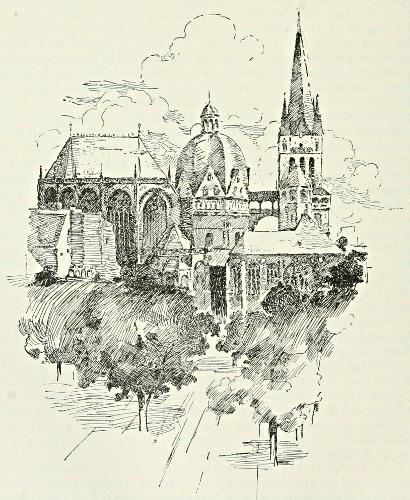
Cathedral at Aachen, where Charlemagne was buried