Book 2 — Chapter XLVII. (continued 2)
Reading edition
Ihne, W., Römische Geschichte, Leipsic, 1868-1890, 8 vols.; English translation by the author, The History of Rome, London, 1871-1882, 5 vols.; Rome: to its Capture by the Gauls, London, 1878.
Wilhelm Ihne, German philologist and classical historian, was born February 2nd, 1821, at Fürth. He spent several years in England as a teacher and has, since 1863, been professor at Heidelberg. Ihne’s history deals with the early period of Rome up to the time when Augustus became sole ruler. It is addressed to a general audience, and consequently the author attempts to establish his position in a generally comprehensible manner. He succeeds better in his undertaking when he reaches the ground of more reliable tradition where he is not obliged to clothe difficult critical analysis in popular garb. The author takes a wholly unprejudiced stand, examining all evidence, separating fact from conjecture, and leaving the reader to form his own judgment. The work is marked by sound common sense.
Ihne, W. R., Society in Rome under the Cæsars, London, 1888. (A good popular account of the daily life of the period.)
Jacobi, R., Die Quellen der Langobardengeschichte des Paulus Diaconus, Halle, 1877; Jaffé, Philip, Geschichte des deutschen Reiches unter Lothar dem Sachsen, Berlin, 1843; (see also classical section).—Jäger, O., Geschichte der Römer, Gütersloh, 1861.—Jahn, A., Die Geschichte der Burgundionen, und Burgundiens, 1874, 2 vols.—Jay, B., Synopsis of Roman History, London, 1894.—Jonson, Ben, Tragedy of Catiline, London, 1611.—Jordan, H., Topographie der Stadt Rom im Altertum, Berlin, 1871, 1878, 1885, 2 vols.—Jung, J., Geographie und politische Geschichte des klassischen Altertums, in Ivan Müller’s Handbuch der klassischen Altertumswissenschaft, vol. 3, Nördlingen 1889.
Kärst, F., Kritische Untersuchungen zur Geschichte des zweiten Samniten-krieges, in Neues Jahrbuch für Philologie, Luppe, vol. 13.—Kaufmann, G. H., Deutsche Geschichte bis auf Karl den Grossen, Leipsic, 1880-1881, 2 vols.—Keightley, Thomas, The History of Rome to the End of the Republic, London, 1842.—Kiepert, H., Handbuch der alten Geographie, Berlin, 1878.—Kingsley, Charles, The Roman and the Teuton, London, 1875; 1889.—Klein, J., Die Verwaltungsbeamten der Provinzen des römischen Reiches, Berlin, 1878.—Köpke, Der Anfang des Königthums bei den Gothen, Berlin, 1854.—Kornemann, E., Zur Stadtentstehung in den ehemals keltischen und germanischen Gebieten des Römerreiches, Giessen, 1898.—Körte, G., Ein Wandgemälde von Vulci als Dokument der römischen Königsgeschichte.—Kraschenimkow, M., Die Augustalen und das Sacral-magisterium, St. Petersburg, 1895.—Krumbacher, K., Byzantinische Zeitschrift, Leipsic, 1892 (in collaboration with A. Ehrhard and H. Gerzer); Geschichte der byzantinischen Litteratur, in I. Müller’s Handbuch der klassischen Alterthumswissenschaften, vol. 9, Munich, 1897.—Kuhn, E., Verfassung der Städte des römischen Reiches, Leipsic, 1864.
La Barte, J., History of the Arts of the Middle Ages, London, 1855.—Lanciani, Rodolfo, Le Acque e gli acquedotti di Roma antica, Rome, 1880; Ancient Rome in the Light of Recent Discoveries, London, 1889; Pagan and Christian Rome, London and Boston, 1892; Forma urbis Romæ, Milan and New York, 1893-1901; A Manual of Roman Antiquities, London, 1894; New Tales of Old Rome, Boston, 1901.—Lange, L., Römische Alterthümer, Berlin, 1876-1879, 2 vols.—Lau, G. J. T., Gregor I der Grosse, nach seinem Leben und seiner Lehre geschildert, Leipsic, 1845.—Laurent, F., Études sur l’histoire de l’humanité, Paris, 1880.—Lavisse, E. (in collaboration with Alfred Rambaud), Histoire générale du IVᵐᵉ siècle à nos jours, Paris, 1893, etc., 8 vols. in progress.—Le Beau, Charles, Histoire du Bas-Empire depuis Constantin, Paris, 1757-1779, 22 vols.—Lecky, W. E. H., History of European Morals from Augustus to Charlemagne, London, 1870.—Lecointe, Charles, Annales ecclésiastiques de la France, Paris, 1665-1680, 8 vols.—Lehmann, C. F., Beiträge zur alten Geschichte, 1902.—Leighton, R. F., A History of Rome, New York, 1880.—Lemonnier, H., Étude historique sur la condition privée des Affranchis, Paris, 1887.—Lenormant, F., La grande Grèce, Paris, 1881-1884, 3 vols.; (a biographical notice of this writer is given in vol. I, p. 588).—Lewis, George Cornewall, An Inquiry into the Credibility of the Early Roman History, London, 1855, 2 vols.
George Cornewall Lewis, a statesman and man of letters, was born in London, April 21, 1806. Educated at Eton and Oxford, he was called to the bar in 1831. Although almost constantly engaged in public life, he devoted much attention to literature, writing numerous essays and contributions to reviews, besides publishing several translations from the German. All of his writings are distinguished for clear, sober, and original thought. He died in April, 1863. In his inquiry into the credibility of early Roman history Lewis submits early Roman history to the same tests that are applied in determining credibility in judicial investigation. In applying these tests to Niebuhr’s positions he decides that many of them are based on insufficient foundations, and comes to the conclusion that all efforts to clear up early Roman history are thrown away since there is no contemporary evidence.
Lézardière, Marie Pauline de, Théorie des lois politiques de la monarchie française, Paris, 1844, 4 vols.—Liddell, H. G., A History of Rome from the earliest Times to the Establishment of the Empire, London and New York, 1865.
Henry George Liddell was born at Binchester, February 6th, 1811. Educated at Oxford, he became a college tutor and in 1846 was made head-master of Westminster School. In 1834, he began, in collaboration with Robert Scott, the preparation of the Greek-English Lexicon, which was his life-work. In 1855 he was appointed dean of Christ Church, Oxford, which position he retained until 1891. Liddell’s history is a most valuable work, being as Mr. Adams says of it, “a storehouse of accurate information.”
Liebenau, W., Städteverwaltung im römischen Kaiserreich, Leipsic, 1900.—Lilly, W. S., Ancient Religion and Modern Thought, London, 1884.—Lindner, Theodor, Die sogenannten Schenkungen Pippins, Karls des Grossen und Ottos I, Stuttgart, 1896.—Lippert, Julius, Die Religionen der europäischen Kulturvölker, Berlin, 1881.—Lockhart, J. G., Velerius, a Roman Story, Edinburgh, 1821.—Long, G., The Decline of the Roman Republic, London, 1864-1874, 5 vols. This book covers the period from the destruction of Carthage to the death of Julius Cæsar.—Lorenz, F., Karls des Grossen Privat- und Hofleben, in Von Raumer’s Historisches Taschenbuch, Leipsic, 1832.
Macaulay, T. B., Lays of Ancient Rome, London, 1812.—Macdermot, T. B., Outline of Roman History, Dublin, 1892.—Mackenzie, Lord, Studies of the Roman Law, with Comparative Views of the Laws of France, England, and Scotland, 5th edition, edited by John Kirkpatrick, London, 1880.—Maclear, G. F., Apostles of Mediæval Europe, London, 1868.—Madvig, J. N., Die Verfassung und Verwaltung des römischen Staats, Leipsic, 1881-1882, 2 vols.—Mahaffy, J. P., The Greek World under Roman Sway, London, 1890.—Mahon, Philip Henry Stanhope, Life of Belisarius, London, 1848.—Manso, J. K. F., Geschichte des ostgothischen Reiches in Italien, Breslau, 1824.—Marioni, G., I Papiri Diplomatici, Rome, 1805 (a collection of documents, papal bulls, legal documents of transactions between Byzantine merchants, officials, clergy, etc.).—Marlot, E., Précis des institutions politiques de Rome, Paris, 1886.—Marquardt, K. J., vols. 3 to 5 of Becker’s Handbuch der römischen Altertümer, Leipsic, 1849-1868; second edition of complete work (in collaboration with Th. Mommsen), Leipsic, 1881-1886, 7 vols.; Römische Staatsverwaltung, forming vols. 4 to 6 of Handbuch der römischen Altertümer, Leipsic, 1873-1878; 1881-1885; Privatleben der Römer, forming vol. 7 of Handbuch der römischen Altertümer, Leipsic, 1879-1882; 2nd edition, 1886.—Marrast, A., Esquisses Byzantines, Paris, 1874.—Martens, W., Politische Geschichte des Langobardenreiches unter König Luitbrand, Heidelberg, 1880.—Martin, H., Histoire de France, Paris, 1838-1853; 1855-1860, 18 vols.—Marx, F., Die Beziehungen der klassischen Völker des Altertums zu dem keltisch-germanischen Norden, Beilage der Allgemeinen Zeitung, 1897, No. 162, 163.—Mascov, J. J., Geschichte der Deutschen bis zum Abgang der merovingischen Könige, Leipsic, 1726-1737, 2 vols.—Masom, W. F., The Struggle for Empire, 287-202 B.C., London, 1894 (in collaboration with F. G. Plaistowe); Synopsis of Roman History, London, 1891.—Mason, A. J., The Persecution of Diocletian, Cambridge, 1876.—Mayor, J. E. B., Bibliographie Clue to Latin Literature, London, 1875.—Meitzen, A., Siedelung und Agrarwesen der Westgermanen und Ostgermanen, der Kelten, Römer, Finnen und Slaven, Berlin, 1895, 3 vols.—Meltzer, O., Geschichte der Karthager, Berlin, 2 vols.—Menzel, W., Geschichte der deutschen Dichtung von der ältesten bis auf die neueste Zeit, Leipsic, 1875, 2nd edition, 3 vols.; English translation by Horrocks, History of Germany from the Earliest Period to the Present Time, London, 1848, 3 vols.—Merivale, Charles, A History of the Romans under the Empire, London, 1850-1862, 7 vols.; The Fall of the Roman Republic, London, 1853; A General History of Rome, London, 1875; The Roman Triumvirates, London, 1876.
Charles Merivale was born March 8th, 1808, and educated at Harrow, Haileybury, and Cambridge. In 1833 he was elected fellow of St. Johns. In addition to gaining distinction as a student he was prominent in athletic sports, rowing in the first inter-university boat-race in 1829. He was ordained in 1833, appointed chaplain to the speaker of the House of Commons in 1863, and in 1869 became dean of Ely. He died December 27th, 1893. Merivale’s History of the Romans under the Empire did much to foster the study of Roman history during the empire. Beginning with Sulla’s death, it follows the intellectual and social life of the period, up to the death of Marcus Aurelius, with a certain degree of completeness, although the author does not touch any of the deeper problems in connection with the history of the imperial period.
Meyer, Edward, Geschichte des Alterthums, Stuttgart, 1884-1893, 2 vols.; Untersuchungen über die Schlacht im Teutoburger Walde, Berlin, 1895; Über den Ursprung des Tribunats, in Hermes, vol. 30, 1895. A biographical notice of this author appears in vol. I, p. 302. The second volume of Meyer’s history, which is the last that has appeared, brings us down to the Persian wars. In keeping with its general character it gives a survey of the whole Occident, including the beginnings of Italian history and the establishment of Etruscan power in Italy. But while dealing with Italy as a whole, new light is thrown upon the history of Rome in particular, as upon Etruscan dominion in Latium, the character of patrician rule, the system of land ownership, etc. The oldest Italic and Etruscan civilisation is also well portrayed. Meyer, K., Sprache und Sprachdenkmäler der Langobarden, Paderborn, 1877.—Michaud, J. F., L’histoire des croisades, Paris, 1841, 6 vols.; English translation by W. Robson, London, 1852, 3 vols.—Michelet, J., Histoire romaine, Paris, 1831, 2 vols.; English translation by W. Hazlitt, History of the Roman Republic, London, 1847.—Middleton, J. H., Ancient Rome in 1888, London, 1888; Article on Rome in the Encyclopædia Britannica, Ninth Edition; The Remains of Ancient Rome, London, 1892, 2 vols.—Milman, H. H., History of Christianity from the Birth of Christ to the Abolition of Paganism, London, 1867.—Mispoulet, Y. B., Les institutions politiques des romains, Paris, 1882-1883, 2 vols.—Mommsen, Theodor, Corpus inscriptionum neapolitanarum, Leipsic, 1851; Römische Geschichte, Berlin, 1853-1856, 3 vols.; 8th edition, 1888, 5 vols.; Die Rechtsfrage zwischen Cæsar und dem Senat, Breslau, 1857; Die römische Chronologie bis auf Cæsar, Berlin, 1858-1859; Geschichte des römischen Münzwesens, Breslau, 1860; Verzeichniss der römischen Provinzen um 297, Berlin, 1862; Römische Forschungen, Berlin, 1865-1879, 2 vols.; translated into English by W. P. Dickson, History of Rome to Time of Augustus, London, 1868-1875, 4 vols.; Römisches Staatsrecht, Leipsic, 1871-1888, 3 vols. (in collaboration with K. J. Marquardt); the second edition of the Handbuch der römischen Altertümer, Leipsic, 1881-1886, 7 vols.; translated into English by W. P. Dickson, The Roman Provinces, London, 1887, 2 vols.; History of the Roman Republic (abridged by C. Bryans and F. J. P. Hendrick), London, 1888; Abriss des römischen Staatsrechts, Leipsic, 1893.
Theodor Mommsen, German historian and epigraphist, was of Danish origin, and was born at Garding in Schleswig, November 30th, 1817. Educated at Altona and Kiel, he spent the years from 1844 to 1847 in archæological exploration in Rome. Appointed in 1848 a professor at Leipsic, he lost his position by participating in the stirring politics of that year. In 1852 he became professor at Zurich and in 1858 at the university of Berlin. In 1874 he was made perpetual secretary of the Academy of Sciences at Berlin. From 1873 to 1882 he was a member of the Chamber of Deputies of Prussia. He declined an election to the Reichstag in 1881, protesting against the policy of Prince Bismarck, and particularly against the progress of socialism in the state. This criticism having roused the ire of the prince, Mommsen was, in 1882, prosecuted for defamation. The case gained great celebrity. Acquitted upon the first trial, the judgment was reversed upon appeal, and upon a second trial, in which he defended himself, he was again victorious.
Professor Mommsen’s work marks an important epoch in the field of Roman history. His history of Rome appeared first in 1854, in a series of volumes intended for a more general public, so that only results of his investigation were given. There is a marked departure in Mommsen’s style from the reserve of the classical historians. He by no means regards the events he describes in the light of an outsider, but takes sides for or against different parties and leading characters. He has a special antipathy, for example, against the Etruscans, also against Cicero. It is this personal element, perhaps, which seems to make the whole work live. Persons and things are introduced with the utmost vividness. The different characters, men like Gracchus, Sulla, and Cæsar seem to be actually living, breathing persons, and no mere words on a page. But not alone was the style new—wholly new material was brought forward, making a new chapter of Italic history, based on a study of the country itself, on the monuments of old time, especially on finds in tombs in Italy. Above everything else the different aspects of the national development—the economic, artistic, and literary—are brought together with a master hand. The book at once aroused new interest in classical study throughout the country. Also to special departments Mommsen has contributed invaluable productions—epigraphy, numismatics, above all the constitutional law of the Romans, all have received the stamp of his genius.
Montalembert, C. F. de T., Les moines d’Occident, Paris, 1860-1867, 7 vols.; English translation, The Monks of the West from S. Benedict to S. Bernard, Edinburgh and London, 1860-1870, 7 vols.—Monticolo, G., I Manuscritti e le fonti della Cronica del Diacono Giovanni, Rome, 1889; Cronache Veneziani Antichissime, Rome, 1890; Le Spedizioni di Luitprando nell’ Escarto e la Lettera di Gregorio III al Doge Orso, in Archivio della Società Romana di Storia Patria, 1892.—Monumenta Germaniæ Historica, Hanover, 1826; in progress.
Accurate texts of all the more important historical writers on Germany down to the year 1500, also laws, archives, and letters within this period. Edited by Pertz from 1826-1874, during which period 24 volumes were published. Since 1874 it has been continued by Waitz, Wattenbach, Dümmler, and others.
Müller, C., Fragmenta Historicorum Græcorum, Paris, 1841-1870, 5 vols.; new edition, 1883.—Müller, I. von, Handbuch der klassischen Altertumswissenschaft, Nördlingen, 1885, in progress, 9 vols. (part 4 to vol. V appeared in 1902).—Müller, D., Geschichte des deutschen Volkes, Berlin, 1900.—Müller, F., Grundriss der Sprachwissenschaft, Vienna, 1876-1888, 3 vols.—Müller, K. O., Etrusker, Breslau, 1828, 2 vols.; edited by W. Deecke, Stuttgart, 1877.—Munk, E., Geschichte der römischen Litteratur, London, 1858-1861, 3 vols.—Muratori, L. A., Rerum italicarum scriptores præcipui ab anno 500 ad annum 1500, Milan, 1723-1751, 29 vols.
Muratori was born at Vignola in Modena in 1672. He was educated for the church but in the year 1700 was appointed librarian for the duke of Modena. Muratori was one of the most distinguished savants of the eighteenth century.
Murphy, A., English translation of Tacitus, London, 1793.—Murray, A. S., Terra-cotta Sarcophagi, Greek and Etruscan, London, 1898.
Napoleon III, Histoire de Jules César, Paris, 1865-1866, 2 vols.; English translation, History of Julius Cæsar, London, 1865, 2 vols.
In this work the author declared that it was written to prove that when Providence raises up such men as Cæsar, Charlemagne, and Napoleon, it is to trace out to people the path they ought to follow; in effect it was an apology for the Napoleonic absolutism.
Naudet, J., Histoire de la monarchie des Goths en Italie, Paris, 1810.—Neumann, C., Weltstellung des byzantinischen Reiches, Heidelberg, 1894; Die Grundherrschaft der römischen Republik, Strassburg, 1900.—Niccolini, G., Fasti tribunorum plebis ab anno 269 ad annum 731, Studi storici, 1895.—Nichols, F. M., The Marvels of Rome, London, 1889 (an English translation from the Latin of the twelfth century guide-book).—Niebuhr, B. G., Römische Geschichte, Berlin, 1811-1832, 3 vols.; new edition, 1873; English translation by W. Smith, L. Schmitz, J. C. Hare, and C. Thirlwall, The History of Rome, London, 1859, 3 vols.; Lectures on the History of Rome from the First Punic War to the death of Constantine, edited by L. Schmitz from Niebuhr’s lectures, London, 1844, 2 vols.; Vorträge über die römische Geschichte, edited by Isler, Berlin, 1846-1848, 3 vols.; Vorträge über alte Geschichte, edited by M. Niebuhr, Berlin, 1847-1851, 3 vols.; English translation by L. Schmitz, Lectures on Ancient History, London, 1852; Vorträge über römische Altertümer, edited by Isler, Berlin, 1858; contributions to the Geschichte der Stadt Rom, compiled by Bunsen, Platner, and others, Stuttgart, 1830-1843, 3 vols.; Corpus Scriptorus Historiæ Byzantiæ, see Byzantine History.
Berthold G. Niebuhr was born at Copenhagen, August 27th, 1776. In his early life he was secretary to the minister of finance of Denmark, and afterwards director of the Bank. In 1806 he removed to Berlin, where he was councillor of state in 1808, and upon the foundation of the University of Berlin in 1810 was named as professor of history. From 1816 to 1824 he resided in Rome as ambassador of Prussia, profiting by his sojourn in the opportunity to make important researches in Roman history and philology. On his return he accepted a professorship at the University of Bonn, where he remained until his death, January 2nd, 1831. The critical methods of Niebuhr began a new era in the whole science of history; or, as Macaulay says, in the “history of European intelligence.” His Roman history appeared first in 1811, being made up primarily from lectures delivered at the University of Berlin during the winter of the same year. Various causes worked together to make Niebuhr’s achievement possible, his broad scholarship, his experience in political, judicial, economic, and even military questions—his acquaintance with Rome, its land and its people, his knowledge of persons gained through his travels and diplomatic positions, and above all his rare gift of combination and his comprehensive outlook. Niebuhr’s work stands for all time as an example of true historical criticism; his object can best be made plain in his own words: “We must strive to single out fable and falsification, and train our glance to recognise the outlines of truth freed from every gloss. The identification of fable and the refutation of deceit may be enough for the critic; he desires only to expose misleading accounts. The historian needs something positive; he must at least discover the connection of facts with some probability and discover a more probable narrative in place of that which is sacrificed to his convictions.”
Niese, B., Grundriss der römischen Geschichte nebst Quellenkunde, 1896, 2nd edition; De annalibus Romanis, 2 programme, Marburg.—Nisard, D., Les quatre grands historiens latins, Paris, 1874.—Nitzsch, K. W., Die römische Annalistik, von ihren ersten Aufängen bis zu Valerius Antias, Berlin, 1873; Die Geschichte der römischen Republik, edited by Thouret, Berlin, 1884-1885, 2 vols.
Oberhammer, E., Bericht über Landes- und Völkerkunde.—Œlsner, Zur Chronologie der italienischen Ereignisse, in his Jahrbücher des fränkischen Reiches unter König Pippin, Leipsic, 1871.—Oman, C. W. C., The Byzantine Empire (Story of the Nations), London, 1892; A History of Europe from 476-918, London, 1893.—Ozanam, A. F., La Civilisation au Vᵐᵉ siècle, Paris, 1855; English translation, History of Civilisation in the Fifth Century, London and Philadelphia, 1867, 2 vols.
Pabst, H., Geschichte des Langobardenherzogtums, in Forschungen zur deutschen Geschichte, 1862, 2 vols.—Pagi, Antoine, Critica historico-chronologica, Geneva, 1689-1705, 4 vols.—Pais, Ettore, Storia di Roma, forming Part II of his Storia d’Italia dei tempi più antichi, Turin, 1894-1899.—Pallmann, R., Geschichte der Völkerwanderung, Berlin, 1863-1864, 2 vols.
R. Pallmann, German geographer, historian, and publicist, born at Spremberg, June 14th, 1835. In his Völkerwanderung he attempts to prove that the migration of the nations who destroyed the Roman Empire was much less than has been supposed, and makes a very careful examination of the ancient authorities.
Papencerdt, J., Geschichte der Stadt Rom, Paderborn, 1857.—Papencordt, Felix, Geschichte der Vandalen, Paderborn, 1837.—Parker, J. H., The Archeology of Rome, Oxford, 1874-1880, 16 vols.—Paucker, C., De Latinitate Scritorum Historiæ Augustæ malemata, Dorpat, 1870.—Pelham, H. F., Outlines of Roman History, London, 1893, 1895, 1903.—Perrin, R., Marche d’Annibal des Pyrenées au Po, Metz, 1887.—Perry, Walter C., The Franks from their First Appearance in History to the Death of King Pepin, London, 1857.—Person, E., Essai sur l’administration des provinces romaines sous la république, Paris, 1878.—Pertz, Georg Heinrich, Monumenta Germaniæ Historica, Hanover, 1826-1874, 24 vols.—Peter, Carl Ludwig, Geschichte Roms, Halle, 1853, 3 vols., 4th edition 1881; Zur Kritik der Quellen der älteren römischen Geschichte, Halle, 1879.—Peter, Hermann, Historia Critica Scriptorum Historiæ Augustæ, Leipsic, 1860; Exercitationes Criticæ in Scriptores Historiæ Augustæ, Posen, 1863; Die Quellen Plutarchs in den Biographien der Römer, Halle, 1865; Die Geschichtliche Litteratur über die römische Kaiserzeit bis Theodosius, 2 vols.—Peyre, R., L’empire romain, Paris, 1894.—Pierron, A., Histoire de la littérature romaine, Paris, 1857.—Plew, J., Marius Maximus als Quelle der Scriptores Historiæ Augustæ, Strassburg, 1878.—Pohlmann, R., Die Anhänge der Socialismus in Europa.—Pollard, A., Historische Zeitschrift, 1879-1880; Stories from Roman History London, 1892.—Potthast, Aug., Bibliotheca historica Medii Ævi, 375-1500 A.D., Berlin, 1868.—Pressensé, E. de, Histoire des trois premiers siècles de l’Église chrétienne, Paris, 1887-1889, 3 vols.; English translation by A. Harewood Hohnden, The Early Years of Christianity, London and New York, 1879, 4 vols.—Prévost-Paradol, L. A., Essai, sur l’histoire universelle, Paris, 1890, 2 vols.
Quicheret, J., Mélanges d’archéologie et d’histoire, Paris, 1885, 2 vols.—Quidde, F., Caligula, Leipsic, 1894.
Rambaud, Alfred Nicolas (in collaboration with Ernest Lavisse), Histoire Générale du IVᵐᵉ siècle à nos jours, Paris, 1893, 8 vols. in progress.—Ranke, Leopold von, Weltgeschichte, Leipsic, 1880-1888, 9 vols. (vols. 7-9 edited by Dove, Wiedemann, and Winter); 2nd edition 1896, 4 vols.—Rawlinson, George, The Seventh Great Oriental Monarchy, London, 1876. Gives history of the wars between Persia and the empire. (A biographical notice of this author is given in vol. I, p. 571.)—Reinhardt, S., Der Perserkrieg des Kaisers Julian, Gotha, 1892.—Renan, Joseph Ernest, Histoire des origines de Christianisme, Paris, 1887. (A biographical notice of this writer has been given in vol. II, p. 235.)—Reumont, A. U., Geschichte der Stadt Rom, Berlin, 1867-1870, 3 vols.—Reville, J., La Religion à Rome sous les Sévères, Paris, 1886.—Richter, Gustav, Annalen der deutschen Geschichte im Mittelalter, Halle, 1873.—Robinson, W. S., First History of Rome, London, 1890.—Rodocanachi, E., Les corporations ouvrières à Rome depuis la chute de l’empire romaine, Paris, 1894, 2 vols.—Rollin, Charles, L’histoire romaine, Paris, 1738-1741, 5 vols.—Rösler, E., Robert, Romanische Studien, Untersuchungen zur alten Geschichte Romaniens, Leipsic, 1871.—Roth, Paul von, Geschichte des Beneficialwesen, Erlangen, 1850.
Sartorius, Georg, Versuch über die Regierung der Ostrogothen während ihrer Herrschaft in Italien, Hamburg, 1811.—Saulcy, F. J., Essai de classification des suites monétaires byzantines, Paris, 1836.—Savigny, Friedr. Karl von, Geschichte des römischen Rechts im Mittelalter, Heidelberg, 1834-1851, 7 vols.—Sayous, Pierre Andrée, Les origines et l’épopée païenne de l’histoire des Hongrois, Paris, 1874; Histoire générale des Hongrois, Paris, 1877, 2 vols.—Schäfer, Arnold, Abriss der Quellenkunde der griechischen und römischen Geschichte, Leipsic, vol. I, 4th edition, 1889; vol. II, 2nd edition, 1885.—Schenk, K., in Byzantische Zeitschrift, Leipsic, 1896.—Schiller, Johann Heinrich Karl Friedrich Hermann, Geschichte der römischen Kaiserzeit bis auf Theodosius den Grossen, Gotha, 1886-1888, 2 vols. (in collaboration with M. Voigt), Die römischen Staats-, Kriegs- und Privataltertümer, in I. Müller’s Handbuch der klassischen Altertumswissenschaften, Nördlingen, 1887.—Schlegel, K. W. F. von, Lectures on the History of Literature, New York, 1841.—Schlosser, F. C., Geschichte der bilderstürmenden Kaiser des Oströmischen Reichs, Frankfort, 1812; Weltgeschichte für das deutsche Volk, Oberhausen and Leipsic, 1874-1875, 19 vols. (A biographical notice of this writer has been given in vol. IV, page 637.)—Schmidt, Ludwig, Zur Geschichte der Langobarden, Dresden, 1885.—Schmidt, O. E., in Spanier’s Illustrierte Weltgeschichte, vol. II, von Alexander dem Grossen bis zu Beginn der Volkswanderung, 3rd edition.—Schmitz, Leonard, A History of Rome from the Earliest Times to the Death of Commodus, London, n.d.—Schmitz, M., Quellenkunde der römischen Geschichte bis auf Paulus Diaconus, Gütersloh, 1881.—Schneidewin, M., Die antike Humanität.—Schoener, R., Rome, London, 1898.—Schön, G., Das capitolinische Verzeichniss der römischen Triumphe.—Schroder, W., De primordiis Artis Historici apud Græcos et Romanos, Jena, 1868.—Schubert, Hans von, Die Unterwerfung der Alamannen unter die Franken, Strassburg, 1884.—Schuckburgh, E. S., History of Rome to the Battle of Actium, London, 1894.—Schwartz, E., Die Berichte über die catilinarische Verschwörung, Hermes, vol. 32, p. 554.—Schwegler, Albert, Römische Geschichte, Tübingen, 1853-1858, 3 vols.
Albert Schwegler, German historian and theologian (1819-1857) was greatly influenced by the great changes which took place in Germany in the middle of the nineteenth century and the bitterness caused by the disappointment of patriotic hopes, had an effect on his writing, although this is not so noticeable in Schwegler’s reserved style, which addresses itself more to scholars, as in Mommsen’s, who speaks to wider circles. Schwegler’s history extends only to the Licinian Rogations, and the author did not live even to see the third volume published. His object was to lay bare critical investigation in the widest range and he has admirably succeeded, conducting the reader through the mazes of fable and tradition as well as through the conflicting statement of modern writers, with a wonderful security of touch. At the same time he weaves together the authenticated results into a comprehensive picture of the whole and describes developments with keen political discernment. In one important point only does he differ from Niebuhr, refusing to admit that the history of ancient Rome is a product of folk ballads, holding rather that it originated in the class of aetiologic fables which were so richly developed among the ancients. This work was cast into the shade soon after its appearance by Mommsen’s brilliant achievements.
Seeck, O., Die Schätzungsordnung Diocletians; Gedichte des Untergangs der antiken Welt, Berlin, 1897, 2nd edition.—Seeley, J. R., Roman Imperialism, in his Lectures and Essays, London, 1870.—Seignobos, C., Histoire narrative et descriptive du peuple romain, Paris, 1894.—Sellar, W. Y., The Roman Poets of the Republic, Oxford, 1881, 1889; The Roman Poets of the Augustan Age, Oxford, 1883, 1892, 1897.—Sergeant, L., The Franks (Stories of the Nations), London, 1888.—Seyffert, O., Lexicon der klassischen Alterthumskunde, Leipsic, 1882; Dictionary of Classical Antiquities, edited by Henry Nettleship and J. E. Sandys, London, 1901.—Sheppard, J. Y., The Fall of Rome, and the Rise of New Nationalities, London, 1874. (The author is opposed to the views of Gibbon, but bases his work on original authorities.)—Shumway, E. S., A Day in Ancient Rome, Boston, 1885.—Sime, J., article on Germany in the Ninth Edition of the Encyclopædia Britannica.—Smith, R. Bosworth, Carthage and the Carthaginians, London, 1879; Rome and Carthage, London, 1881.—Smith, W., Dictionary of Greek and Roman Biography and Mythology, London, 1864-1866, 3 vols.; Dictionary of Greek and Roman Geography, London, 1866-1867, 2 vols.; Dictionary of Greek and Roman Antiquities, London, 1869; A Concise Dictionary of Greek and Roman Antiquities, edited by F. Warre Cornish, London, 1898.—Sohm, R., Die altdeutsche Reichs- und Gerichtsverfassung, Weimar, 1871.—Soltau, W. J., Über Entstehung und Zusammensetzung der altrömischen Volksversammlungen, Berlin, 1880; Römische Chronologie, 1889; Zur Geschichte der römischen Annalistik, in Nord und Süd, 20th year (1896); Livius’ Geschichtswerk, seine Quellen und seine Komposition, 1877.—Stamford, T. V., Das Schlachtfeld im Teutoburger Walde, Cassel, 1892.—Stoll, H. W., Die Helden Roms in Krieg und Frieden, Leipsic, 1866; Geschichte der Römer bis zum Untergang der Republik, Hanover, 1869, 2 vols.—Stolzenberg-Luttmersen, von, Die Spuren der Langobarden vom Nordmeer bis zur Donau, Hanover, 1889.—Stritter, J. G., Memoriæ populorum olim ad Danubium, Pontum Euxinum, Paludem Mæotidem, Causasum, etc., incolentium, ex scriptoribus Byzantinis erutæ ac digestæ, 1771-1779.—Stuckelberg, E. A., Die Thronfolge von Augustus bis Konstantin.
Taine, H. A., Essai sur Tite-Live, Paris, 1856.—Taylor, T. M., Constitutional and Political History of Rome, from the earliest times to the reign of Domitian, London, 1899.—Teuffel, W. S., Geschichte der römischen Litteratur, Leipsic, 1868-1870, 5 vols.; English translation by W. Wagner, History of Roman Literature, London, 1873, 2 vols.—Thalheimer, M. E., Mediæval and Modern History, Cincinnati, 1872.—Thiancourt, C., Les causes et l’origine de la seconde guerre punique, Paris, 1890.—Thierry, Amedée, Histoire de la Gaule sous l’administration romaine, Paris, 1840, 3 vols.; Histoire d’Attila, Paris, 1856; Récits de l’histoire romaine au cinquième siècle, Paris, 1860; Tableau de l’empire romain depuis la fondation jusqu’à la fin du gouvernement, Paris, 1860; Trois ministres des fils de Théodose, Rufin, Eutrope, Stilicon, Paris, 1865.
Amedée Thierry’s works on the ancient history of Gaul are of the greatest importance. The relations of Gaul to Rome and the mutual influences of civilisation and barbarism have perhaps nowhere else been so well described.
Thierry, Augustin, Récit des temps Mérovingiens, Paris, 1847.—Thomas, E., Rome et l’empire aux deux premiers siècles de notre ère.—Thue, Römische Geschichte.—Tieffenbach, R., Über die Örtlichkeit der Varusschlacht, Berlin, 1891.—Tillemont, S., le Nain de, Histoire des empereurs et des autres princes qui ont régné pendant les six premiers siècles de l’Église, Paris, 1691-1738, 6 vols.—Tiraboschi, J., Storia della letteratura italiana, Modena, 1772-1781, 13 vols.; English translation, Literary History of Italy, Edinburgh, 1835.—Trollope, Anthony, The Life of Cicero, London and New York, 1880-1881, 2 vols. (Trollope defends Cicero against the opinions of Froude, Merivale, and Mommsen.)—Tromsdorff, P., Quæstiones duæ ad historiam legionum Romanorum spectantes, dissertation, Leipsic.—Troya, C., Codice Diplomatico-Longobardo, Naples, 1852-1855.—Tyrrell, R. Y., Cicero in his Letters, London, 1891.
Ulrici, H., Characteristik der alten Historiographie, Berlin, 1833.
Vendettini, Del Senato Romano, Rome, 1782.—Villehardouin, Geoffrey de, Histoire de la conquête de Constantinople, Paris, 1657; new edition, 1838.
Wachsmuth, Curt., Einleitung in das Studium der alten Geschichte, Leipsic, 1895 (an almost indispensable work for the bibliography of ancient history).—Waitz, Georg, Deutsche Verfassungsgeschichte, Kiel, 1843-1878, 8 vols.—Wallon, H. A., Histoire de l’esclavage dans l’antiquité, Paris, 1848, 3 vols.—Waltzing, F. P., Étude historique sur les corporations professionnelles chez les Romains.—Wattenbach, Wilhelm, Deutschlands Geschichtsquellen im Mittelalter, bis zur Mitte des 15. Jahrhundert, Berlin, 1858, 6th edition, 1893-1894.—Weber, Georg, Allgemeine Weltgeschichte, Leipsic, 1857-1880, 15 vols.—Weise, Julius, Die älteste Geschichte der Langobarden, Jena, 1877; Italien und die Langobardenherrscher von 568 bis 628, Halle, 1887.—Westrum, A., Die Langobarden und ihre Herzöge, Celle, 1886.—Wiegandt, L., Julius Cæsar und der tribunische Gewalt, Dresden, 1890.—Wietersheim, Eduard von, Geschichte der Völkerwanderung, Leipsic, 1880-1881, 2 vols.—Wilhelm, P., Le droit public romain, Louvain, 1883.—Williams, H. S., The History of the Art of Writing, New York and London, 1903.—Wirth, Johann G. A., Geschichte der deutschen Staaten, Stuttgart, 1843-1845, 4 vols.—Wolfsgruber, C., Gregor der Grosse, Saulgau, 1890.—Wrightson, R. H., The Sancta Republica Romana, London, 1890.
Zachariæ von Lingenthal, Karl Salomo, L. Cornelius Sulla, genannt der Glückliche als Ordner des römischen Freystaates, Heidelberg, 1834.—Zeuss, Johann Kaspar, Die Deutschen und die Nachbarstämme, Munich, 1837.—Zielinski, Th., Cicero im Wandel der Jahrhunderte, Leipsic.

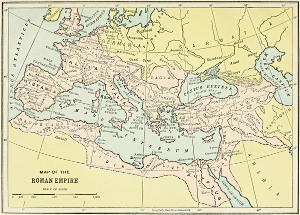
MAP OF THE ROMAN EMPIRE
BORMAY & CO.