Book 2 — CHAPTER XXXVI. THE FIVE GOOD EMPERORS: NERVA TO MARCUS AURELIUS (96-180 A.D.)
Reading edition
Until philosophers are kings, and the princes of this world have the spirit and power of philosophy, and political greatness and wisdom meet in one, cities will never cease from ill—no, nor the human race, as I believe—and then only will our state have a possibility of life, and see the light of day. The truth is, that the state in which the rulers are most reluctant to govern is best and most quietly governed, and the state in which they are most willing is the worst.—Plato.
Nerva (M. Cocceius Nerva), 96-98 A.D.
[96-98 A.D.]
The new emperor, who reigned less than two years (96-98), distinguished himself as much by his mild and clement spirit, as his predecessor had done by the opposite temper. He made it his principal task to concentrate the whole government in the hands of the senate. He could not accomplish this because it was necessary that the ruler should combine the qualities of a capable and dreaded general, and Nerva’s reign shows how imperative it was for the ruler of the empire to be a soldier and leader. Nerva himself was only too soon convinced of the fact. The prætorians and the Roman populace, dissatisfied with the government of an old and serious-minded man, provoked disturbances throughout the whole of the first year; they were specially irritated because Nerva, in order to recoup the revenue, restricted the public games and sold the costly vessels and collections which Domitian’s love of splendour had induced him to make.
Nerva soon saw that he was menaced with Galba’s fate, that he was defied and his office held in contempt. He therefore determined, like Galba, to adopt an energetic man who stood high in public esteem as co-regent, and was far happier in his choice than Galba had been. When anarchy had reached its zenith in the capital, the emperor surprised the Roman people by naming a successor, chosen not from the senate, but from the army, and one who possessed the love of the soldiers in the highest degree. Ulpius Trajan, on whom his choice fell, was then at the head of the legions of the lower Rhine, and had not only distinguished himself by glorious deeds in war, but in Rome had once been greeted by the people almost as a god on account of his kingly form and heroic appearance. With the nomination of Trajan the disturbances promptly ceased, and the proud prætorians submitted without a murmur when the new co-regent ordered them to join him in Germany and attached them to other legions there.f
Dion Cassius tells the story of Trajan’s accession as follows:
“Nerva, seeing that he was despised on account of his advanced age, ascended to the Capitol and said in a loud voice: ‘May the thing be fortunate and well-pleasing to the senate, and the Roman people as well as to myself! I adopt M. Ulpius Trajan.’ After which he declared him Cæsar in the senate and wrote to him with his own hand (Trajan was commanding in Germany):
“‘May the Danubians expiate my tears under the stroke of thy darts.’
“Thus Trajan became Cæsar, and afterwards emperor, though Nerva had relatives. But Nerva did not place his kindred before the good of the state; although Trajan was a Spaniard and not an Italian or even the son of an Italian, he was nevertheless adopted in spite of this, for to that day no foreigner had been emperor of the Romans; Nerva thought that it was a man’s merit, and not his country which was the important question. He died after this adoption, having reigned one year, four months, and nine days; he had lived sixty-five years, ten months, and ten days.
“Trajan before attaining to the empire had had the following dream: It seemed to him that an old man clothed in the pretexta and adorned with a crown, in the fashion in which the senate is represented, marked his seal on him with a ring on the left side of the neck and then on the right. When he had become emperor he wrote to the senate with his own hand, saying amongst other things that he would not put to death nor brand as infamous any worthy man; and these promises he confirmed with an oath both at the time and subsequently. Having sent for Ælianus and the prætorian guards who had risen against Nerva, as if with the intention of making use of them, he rid himself of them. He had no sooner reached Rome than he made several regulations for the reformation of the state and in favour of worthy men, whom he treated with so much consideration that he granted funds to the cities of Italy for the education of the children whose benefactor he became. The first time that his wife Plotina entered the palace, having reached the top of the steps and turning towards the temple, she said, ‘Such as I enter, so I would depart.’ Throughout his reign she conducted herself in such a manner that no reproach could be made against her.”g
Trajan (M. Ulpius Trajanus Crinitus), 98-117 A.D.
[98-101 A.D.]
By birth, as just noted, Trajan was a Spaniard, although his father had filled the office of consul in Rome. Not more than fifty years earlier it would have been intolerable to the Romans to obey a foreigner; but in Trajan’s time a man’s birthplace was no longer taken into consideration. So greatly had opinions and circumstances altered in consequence of the growing amalgamation of the empire into a single state.
Nerva died in the year after the appointment of his co-regent (Jan., 98). The latter, who at the time of his accession was in the prime of life, and reigned from 98-117, possessed all the qualities which the spirit of the times, the existing state of things, and the welfare of the empire required of a ruler. As a ruler he only committed a single error, he tried to extend the borders of the empire by conquest, and thus led the Romans once more along a path which they had abandoned since the time of Augustus, to the great benefit of the state. Trajan combined a lofty spirit with all the best qualities of a soldier. He had received a military training, and had spent the greater part of his previous life in camp; he was therefore lacking in conventional culture, the hardships of military service had given him health and strength, while a simple and hardy life had preserved the firmness and uprightness of his mind. By his unvarying regard for law and justice, for equality and civil virtue, for ancient custom, and for the reputation of the highest office in the state, no less than by his choice of subordinates and friends (amongst whom were two of the best writers of those days, Pliny the Younger and Tacitus) Trajan showed how little culture and learning was necessary, where such qualities existed, to enable a man worthily to take his place at the head of the empire.
His administration was exemplary, he scorned the arbitrary exercise of power, he let the law take its course, kept the departments of legislation and administration apart, and protected the provinces with a powerful hand against the oppression of officials. At his court he organised all things as they had been under Vespasian and Titus. Inspired by a ridiculous pride, Domitian had re-introduced the rigid court ceremonial of the time of Claudius and Nero; Trajan banished all ostentation and constraint from his environment and mode of life. He treated the nobles, his daily companions, as friends, returned their visits, expected them to come uninvited to his table, and granted free access to his person to every citizen who wished to present a petition.
In his interest in science and education, and in architecture, military roads, harbours, and other works of public utility, Trajan not only followed in the footsteps of Vespasian, but he did a great deal more than the latter. For instance, he opened a public library, which was called the Ulpian, after his own name, and remained the most important in the city of Rome during the whole of ancient times.
THE FIRST DACIAN WAR
[101-103 A.D.]
Nothing in the course of Trajan’s reign was of such great and far-reaching consequence as his unfortunate and erroneous idea of defending the empire by fresh conquests, and purifying morals by the revival of military ambition. From early youth he had been trained as a soldier and general; in his campaigns he had become acquainted with many lands and nations; he was equal to all the hardships of military service, and as emperor liked to share them with his soldiers; seldom mounting his horse on the march, but going on foot like his men.
Three years after his accession he began his wars of conquest, the scene of the first being Dacia on the lower Danube. As emperor he never thought of attempts on Lower Germany, although he had acted there as governor and general for ten years. The countries of the lower Danube, and after them the East, seemed to him better suited to prove to the world his capacity as a general. In Moldavia and Wallachia some immigrants of Thracian descent, amongst whom the Dacians were the most important, had leagued themselves together, some decades before, and with their combined forces had attacked Roman Thrace. At the time when Vitellius and Vespasian were disputing the throne, they had been repulsed by the troops of the latter, on their way into upper Italy, by Thrace and Mœsia, and Fonteius Agrippa, Vespasian’s general and vice-gerent, had established a number of fortified camps on the Danube as a bulwark against them.
Under Domitian the tribes belonging to the Dacian league, with Decebalus at their head, again invaded the Roman Empire. They destroyed some fortresses, repulsed the Roman troops on several occasions, and wrought fearful havoc. Domitian himself twice marched to the Danube, but his troops were defeated in most engagements. Suspicious as he was, he dared not entrust a capable man with the command of a considerable army, although immediately after the recall of Agricola from Britain he had a general who was in every respect qualified for such a struggle. The Dacians therefore not only remained unpunished, but continued their devastations, and Decebalus actually offered the Roman emperor terms of peace on condition that he should be paid a sum of money annually. Domitian agreed to these shameful terms, and the degenerate senate of Rome granted him the honours of a triumph as conqueror of the Dacians.
Trajan pretermitted the payment of tribute, and the Dacians again invaded Roman territory. He therefore betook himself to the Danube in person, in order to undertake the conduct of the war against them (101). He crossed the river, avenged the havoc wrought by the Dacians by far worse devastations in their own land, and defeated the troops of the enemy wherever they opposed him. In the third year of the war (103) the king of the barbarians was compelled to submit and accept the terms of peace dictated by Trajan.f
Xiphilinush has preserved for us, from the works of Dion Cassius, some interesting details of this campaign, with incidental sidelights on Trajan’s character. Trajan was led to undertake the campaign, he tells us, because he “bore in mind the conduct of the Dacians, was distressed at the tribute which they received every year, and perceived that their pride increased with their numbers. Decebalus was seized with terror at the news of his march; and indeed he knew well enough that it was not the Romans but Domitian whom he had previously conquered and that now he would have to fight against the Romans, and against the emperor, Trajan. For Trajan was distinguished in the highest degree by his justice, his courage, and the simplicity of his manners. He had a strong body, (he was forty-two years old when he succeeded to the empire; so that he supported all fatigues as well as anyone,) and he had a vigorous mind, so that he was exempt both from the impetuosity of youth and from the slowness of age. Far from envying or belittling anyone he honoured all worthy men and raised them to high positions; for he neither dreaded nor hated any one of them. He gave no credit to calumnies and was in no way the slave of anger. He abstained alike from laying his hands on the property of others and from unjust murders.
“He spent much on war, much also on the works of peace; but the most numerous and necessary items of expenditure had for their object the repair of roads, harbours, and public buildings, while for none of these works did he ever shed blood. There was naturally such vastness in his conceptions and in his thoughts that having caused the Circus to be raised from its ruins and rendered finer and more magnificent than before, he set up an inscription stating that he had rebuilt it so that it might contain the Roman people.
“He desired to make himself beloved by his conduct rather than to receive honours. He brought mildness into his relations with the people and dignity into his bearing towards the senate; he was beloved by all and dreaded only by enemies. He took part in the hunts of the citizens, in their festivals, their labours and their schemes, as well as in their amusements; often he would even take the fourth seat in their litters, and he did not fear to enter their houses without a guard. Without being perfect in the science of eloquence he knew its methods and put them in practice. There was nothing in which he did not excel. If he loved war he contented himself with winning successes, crushing an implacable foe and increasing his own states. For under him it never happened, as it so often does in similar circumstances, that the soldiers gave rein to pride and insolence, so great was his firmness in command. Thus it was without reason that Decebalus feared him.
Trajan Dictates Terms to Decebalus
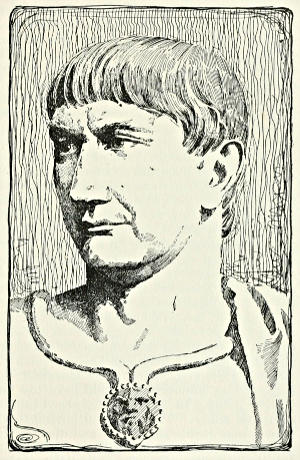
Trajan
(From a bust in the Capitol)
[103 A.D.]
“During Trajan’s expedition against the Dacians, when he was near Tapes where the barbarians were encamped, a large mushroom was brought to him, on which it was written in Latin characters that the other allies and the Burii conjured Trajan to turn back and conclude a peace. Nevertheless he delivered a battle, in which he had a great number of his men wounded and made great carnage amongst the enemy; when the bandages gave out, he did not spare, it is said, his own clothing, but tore it in pieces; moreover he caused an altar to be raised in honour of his soldiers who had been slain in the battle, and had funeral sacrifices offered to them every year. As he was endeavouring to reach the heights, carrying one hill after another and in face of a thousand perils, he came to the residence of the Dacian kings, whilst Lucius, who had attacked from another side, made a great slaughter and took a great number of prisoners. Whereupon Decebalus sent the emperor an embassy composed of the chiefs of the Dacians and making petition to him through them, showed himself disposed to treat with them under no matter what conditions.
“He was required to deliver up the machines, and the engines, to surrender the deserters, to demolish his fortifications, to evacuate the territories he had conquered and besides this to regard all those who were enemies or friends to the Romans as his own; in spite of himself he consented to these conditions, after having gone himself to Trajan, falling on the ground before him and worshipping him. Decebalus’ ambassadors were introduced to the senate, where, having laid down their arms they clasped their hands in the fashion of captives, pronounced certain words and certain prayers and thus agreed to the peace and resumed their arms. Trajan celebrated his triumph and was surnamed Dacicus; he gave combats of gladiators in the theatre (for he took pleasure in these combats), and caused the actors to reappear at the theatre (for he loved one of them, Pylades), while none the less in his character of a soldier he continued to watch over other business and to administer justice; sometimes in the Forum of Augustus, sometimes under the Porticus Livia, and often in other places as well, he gave judgment from his tribunal. But when he was informed that Decebalus was contravening several articles of the treaty, that he was laying up stores of arms, receiving deserters and raising fortresses, that he was sending embassies to his neighbours, and ravaging the countries of those who had previously taken part against him and had seized on lands belonging to the Iazyges, lands which Trajan afterwards refused to restore to them when they demanded them of him again; then the senate for the second time declared Decebalus to be the enemy of Rome and Trajan; also the second time, undertook to make war against them in person and not through other generals.
“Decebalus failed to win the victory by force, but he almost succeeded in killing Trajan by craft and treason; he sent deserters to him in Mœsia, who were charged to assassinate him, knowing that at that time, in consideration of the necessities of the war, he received all who wished to speak to him without distinction. But they could not accomplish this, as one of them was arrested on suspicion and under the torture confessed the whole plot.
“Longinus, who commanded a detachment of the Roman army, and whose valour had been proved during the war, having suffered himself, at the invitation of Decebalus, to be drawn into an interview with him, under pretext that the latter would make his submission, Decebalus seized the Roman and publicly interrogated him on the plans of Trajan; and when Longinus refused to reveal anything, he retained him under a guard. Decebalus then (sent an embassy to Trajan to demand that he should abandon the country as far as the Ister, and that he should be reimbursed for all the expenses of the war) on condition of restoring Longinus. Trajan having given an undecided answer, the terms of which were intended to show that his esteem for Longinus was neither small nor great, so that he might neither lose him nor pay too dearly for his ransom, Decebalus hesitated considering what he should do; and Longinus, for whom (his freedman) had meantime procured poison, (promised the king to reconcile him with Trajan, for he feared that if he suspected his intention he would have him more closely guarded; then he wrote a petition to Trajan, and charged the freedman to carry it in order to secure its safety. The freedman, having therefore departed, Longinus) took (the poison during the night) and died. (This being done), Decebalus demanded the freedman of Trajan, promising to give in exchange the body of Longinus and ten captives, and he also sent him the centurion taken with Longinus in the hope that he would succeed in his design; from this centurion Trajan learned all that had happened to Longinus. Nevertheless he did not send him back nor did he restore the freedman, judging this man’s life of more importance to the dignity of the empire than the burial of Longinus.”g
It is the modern verdict that in the conclusion of peace as well as after it, the Roman emperor abused the right of conquest. He retained possession of a part of the land of Dacia, established a Roman garrison on the rapids of the Danube, between Orsowa and Gladowitza, which at a later day bore the name of the “Iron Gates,” and threatened to seize the mountain country of southwestern Transylvania. This naturally enraged the Dacians and their king. Decebalus was by no means a mere barbarian; he had allied himself with the Parthian king, the principal enemy of the Romans in the far East, and had enlisted in his service many men who had served in the Roman army and who organised his troops after the Roman fashion. He had also brought a number of skilled workmen, partly by force and partly by money payments, from the neighbouring Roman province to his own country, to use their services in making instruments of peace and war.
THE SECOND DACIAN WAR
[103-113 A.D.]
According to his treaty with Trajan, he should have sent all such persons back; and Trajan was all the more ready to make this circumstance the pretext for another war, since Decebalus had attempted to ally himself with some of the neighbouring tribes. The emperor began the second Dacian war by building a stone bridge over the Danube, and thus manifested his intention of extending the dominion of Rome beyond the river. This bridge was erected three hours’ journey below the aforementioned gates, close to the town of Czernetz at the present day. It was thirty-five hundred paces long and provided with entrenchments at either end. The ruins of it are still to be seen at low water.
The war in what is now Wallachia, the country to which Trajan gained access by this bridge, offered many difficulties to the Roman army on account of its many morasses, its heavy clay soil, and the large and rapid rivers which traverse it. He therefore led his troops with great caution; he made roads, diverted the course of rivers, and hunted the Dacian king from forest to forest, and from swamp to swamp. At length Decebalus felt himself unable to hold his own against the Romans, and slew himself in order not to fall into the hands of the enemy. Trajan made a Roman province of the conquered land, and determined to establish as many colonies as possible in it, and to tame his barbarian subjects by culture. (106 A.D.)
In the uncultivated but fertile plains of Wallachia, he settled a large number of colonists from all parts of the Roman Empire, founded many towns and villages, and made Roman culture so acceptable that Latin became the dominant language of the country. By these means, however, he provoked the barbarous tribes who then occupied Poland and Russia to continual predatory attacks. Thrace and Mœsia, now Rumelia, Bulgaria, and Servia, which lay to the south of the Danube, gained most; they were protected from the barbarians by the new province beyond the Danube. A number of new towns were founded there, and from that time they continued to flourish.
The conquest of the Dacians and the attention it attracted throughout the Roman Empire seemed to have affected the emperor’s hitherto modest disposition, which had led him to devote himself to affairs of law and government; for the manner in which he celebrated his victory in Rome, as well as the oriental campaign which he subsequently undertook, were not in keeping with the character of wise moderation and the absence of excessive prodigality, which might have been expected of him, under the circumstances. When he returned to Rome, he celebrated his victory by magnificent architectural works and brilliant festivities. He erected a monument commemorative of his victory, which still exists, the celebrated Trajan column, 110 feet in height [to which we shall refer more at length presently]. (113 A.D.)
Besides several buildings in Rome, he built triumphal arches at Beneventum and other places, and made a road through the Pontine marshes which combined the excellence and strength of the old military roads with the conveniences of his own time. These undertakings were made in the old Roman spirit, and did him as much honour as the many bridges and canals which he built in different parts of the empire or the great military road which extended from the Black Sea to the west coast. On the other hand the feasts which he arranged in celebration of his victory recalled the foolish prodigality of Caligula and Domitian, and added not a little to the deterioration of morals. For 123 consecutive days he gave the people public games and other revels, in which no less than ten thousand gladiators took part, and eleven thousand wild animals were killed; so that one of the best emperors did most to promote the unnatural and inhuman pleasures of the degenerate inhabitants of Rome.
The Dacian conquest was not the sole triumph of Roman arms at this period. In 106 Cornelius Palma, governor of Syria, attacked the troublesome tribes inhabiting the ill-defined region between Damascus and the Red Sea. There was one short but severe campaign, and Arabia Petræa was added to the Roman province. The great caravan routes from the Euphrates to the Red Sea were now safe.
ORIENTAL CAMPAIGNS AND DEATH OF TRAJAN
[106-117 A.D.]
Trajan’s oriental campaign was directed against the Parthians. Since the time of Augustus, this people had suffered perpetually from quarrels over the succession to the throne, and had often come into hostile contact with the Romans, because both nations looked upon the kingdom of Armenia as a dependency of theirs. The turbulent character of the Armenians and the continual dissensions among the members of their ruling family made the intervention of the two neighbouring states to some extent necessary. In the frequent wars of the Romans and Parthians, no general had ever distinguished himself as much as Domitius Corbulo, who had been sent by Nero to Armenia so as to protect the inhabitants of this land against the tyranny of their own king, no less than against the superior power of the Parthians. He banished the Parthian prince Tiridates I, who had set himself up as ruler of Armenia, and occupied the whole of the country.
Nero bestowed the government of Armenia on a descendant of the Herod family, who then lived in Rome and had adopted the pagan religion. For a whole year the latter was unable to maintain his ground against the turbulent Armenians and Parthians, and Corbulo himself advised the emperor to restore the banished Parthian prince on condition that he should go to Rome, and do homage as a Roman vassal. To this Tiridates consented; he received the kingdom of Armenia as a Roman fief, and peace was restored for a time. After his death, the former scenes were repeated; the throne of Armenia again became the subject of quarrels between various princes, and the Parthians again intervened in the affairs of the country.
In Trajan’s time a protégé of Parthia, Exedares by name, was seated on the throne of Armenia, and the Parthian king, Chosroes, supported him with an army quartered in the country. Trajan would not acknowledge this king of Armenia; but as a matter of fact he cared far less for the restoration of Roman ascendency in Armenia than for the chance of winning glory as conqueror of the Parthians. In 106 he went to Asia with a large army. On the way he received an embassy from the Parthian king, who had disturbances in his own country to contend with, and who, for this reason, made friendly advances to the Roman emperor. Trajan would have nothing to say to his proposals, by reason of his greed of fame, although Chosroes had removed Exedares from the throne of Armenia and placed in his stead a Parthian prince, Parthamasiris, who was willing to do homage to the Romans. Trajan banished the new ruler of Armenia without much trouble, for the Parthians, engaged in internecine quarrels, could not support him. The emperor therefore turned Armenia into a Roman province, and subjected the petty dynasties between the Black Sea and the Caspian. Their loyalty lasted no longer than the time the Roman army was at hand. The subsequent enterprises of Trajan on his first expedition to the East are not known to us in detail; we only know for certain that he marched from Armenia to Mesopotamia, took some cities on the middle Euphrates and Tigris and supported the king of Parthia against his rebellious subjects.
Some time after, most probably in the year 114, Trajan undertook his second Parthian campaign, on which he spent about three years, till 117. He conquered the famous Greek city of Seleucia, on the Tigris, and Ctesiphon, the Parthian capital, made Assyria into a Roman province, and advanced as far as Arabia, where some years before the empty desire of fame had induced him to make conquests, through one of his generals, which were as quickly lost as won. He then pushed on to the coasts of the Persian Gulf. If we may believe the coins and fabulous histories of that time, he even projected an Indian campaign, and caused a fleet to be built for the purpose. This statement, like other ridiculous exaggerations, is based on flattery and the circumstance that the Persian Gulf was confounded with the Indian Ocean.
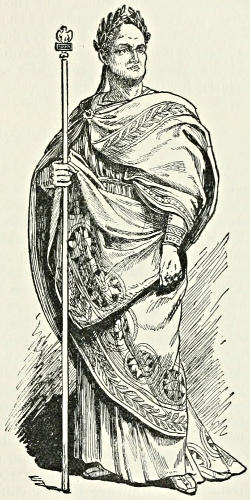
A Roman Emperor
According to one of the coins, Trajan gave the Parthians a new king, but this bestowal of the royal office meant no more than that he proclaimed one of the many pretenders in Ctesiphon king; a sufficient reason for the Parthians not to acknowledge the latter as their ruler. Trajan himself reaped the fruits of an inconsiderate desire of conquest, which was most prejudicial to the Roman Empire. Whilst he was at Shatt-el-Arab, all the tribes and cities in his rear revolted, and he perceived too late that the oriental nations were not so easy to subdue or to hold in allegiance as the Dacians.
The Jews also rebelled, both in Palestine and in the cities of Syria, Egypt, and other countries, because like the Christians they were incessantly harassed and persecuted. Trajan was forced to send troops against them, and at the same time renew the war against Assyria, Seleucia, Edessa and other rebellious countries and cities. He fell sick in consequence of the hardships of an unsuccessful campaign, which he had undertaken in Arabia. In order to abandon the fruitless undertaking without detriment to his reputation, he made the senate recall him to Rome under a fictitious pretext. He handed over the army to his general Hadrian, whom he had appointed governor of Syria, and went to Cilicia intending to sail thence to Italy. Before he could embark, death overtook him.f
In estimating the character of Trajan, we no longer have the guidance of Suetonius. The only important classical writings recording the deeds of this emperor are the somewhat fragmentary excerpts from Dion Cassius as preserved by Xiphilinus, and the panegyric of the younger Pliny. The latter, written and delivered in the year in which Pliny was consul, has been pronounced, “a piece of courtly flattery for which the only excuse which can be made is the cringing and fawning manner of the times.” Pliny’s letters and despatches to Trajan on the other hand are full of interest as valuable material for the historian.a
THE CORRESPONDENCE OF PLINY AND TRAJAN
[104-117 A.D.]
The despatch respecting the Christians, written from Bithynia, A.D. 104, and the emperor’s answer, are well worthy of transcription; both because reference is so often made to them, and because they throw light upon the marvellous and rapid propagation of the Gospel; the manners of the early Christians; the treatment of which their constancy exposed them, even under favourable circumstances; and the severe jealousy with which even a governor of mild and gentle temper thought it his duty to regard them. Pliny’sj letter to Trajan ran thus: “It is my constant practice to refer to you all subjects on which I entertain doubt. For who is better able to direct my hesitation or to instruct my ignorance? I have never been present at the trials of Christians, and therefore I do not know in what way, or to what extent, it is usual to question or to punish them. I have also felt no small difficulty in deciding whether age should make any difference, or whether those of the tenderest and those of mature years should be treated alike; whether pardon should be accorded to repentance, or whether, where a man has once been a Christian, recantation should profit him; whether, if the name of Christian does not imply criminality, still the crimes peculiarly belonging to the name should be punished. Meanwhile, in the case of those against whom informations have been laid before me, I have pursued the following line of conduct. I have put to them, personally, the question whether they were Christians. If they confessed, I interrogated them a second and third time, and threatened them with punishment. If they still persevered, I ordered their commitment; for I had no doubt whatever, that whatever they confessed, at any rate dogged and inflexible obstinacy deserved to be punished. There were others who displayed similar madness; but, as they were Roman citizens, I ordered them to be sent back to the city. Soon persecution itself, as is generally the case, caused the crime to spread, and it appeared in new forms.
“An anonymous information was laid against a large number of persons, but they deny that they are, or ever have been, Christians. As they invoked the gods, repeating the form after me, and offered prayers, together with incense and wine, to your image, which I had ordered to be brought, together with those of the deities, and besides cursed Christ, whilst those who are true Christians, it is said, cannot be compelled to do any one of these things, I thought it right to set them at liberty. Others, when accused by an informer, confessed that they were Christians, and soon after denied the fact; they said they had been, but had ceased to be, some three, some more, not a few even twenty years previously. All these worshipped your image and those of the gods, and cursed Christ. But they affirmed that the sum-total of their fault or their error was, that they were accustomed to assemble on a fixed day before dawn, and sing an antiphonal hymn to Christ as God; that they bound themselves by an oath, not to the commission of any wickedness, but to abstain from theft, robbery, and adultery; never to break a promise, or to deny a deposit when it was demanded back. When these ceremonies were concluded, it was their custom to depart, and again assemble together to take food harmlessly and in common. That after my proclamation, in which, in obedience to your command, I had forbidden associations, they had desisted from this practice. For these reasons, I the more thought it necessary to investigate the real truth, by putting to the torture two maidens, who were called deaconesses; but I discovered nothing but a perverse and excessive superstition.
“I have therefore deferred taking cognizance of the matter until I had consulted you. For it seemed to me a case requiring advice, especially on account of the number of those in peril. For many of every age, sex, and rank, are and will continue to be called in question. The infection in fact has spread not only through the cities, but also through the villages and open country; but it seems that its progress can be arrested. At any rate, it is clear that the temples which were almost deserted begin to be frequented; and solemn sacrifices, which had been long intermitted, are again performed, and victims are being sold everywhere, for which up to this time a purchaser could rarely be found. It is therefore easy to conceive that crowds might be reclaimed if an opportunity for repentance were given.”
To this letter Trajan replied:
“In sifting the cases of those who have been indicted on the charge of Christianity, you have adopted, my dear Secundus, the right course of proceeding; for no certain rule can be laid down which will meet all cases. They must not be sought after, but if they are informed against and convicted, they must be punished; with this proviso, however, that if anyone denies that he is a Christian, and proves the point by offering prayers to our deities, notwithstanding the suspicions under which he has laboured, he shall be pardoned on his repentance. On no account should any anonymous charge be attended to, for it would be the worst possible precedent, and is inconsistent with the habits of our times.”i
Nothing perhaps could better illustrate the judicial and tolerant temper of Trajan’s mind than this letter in reference to a class of people whom the emperor could not possibly have contemplated without prejudice.
TRAJAN’S COLUMN
If literary remains dealing with history of the time of Trajan are meagre, amends are made for the deficit by the sculptures and bas-reliefs that ornament the Column of Trajan previously mentioned, which still stands in an excellent state of preservation amidst the ruins of a forum. This column of marble, now weathered to a bronze-like hue, is covered throughout its entire height by a spiral column of figures representing all manner of military operations. More than twenty-five hundred human figures are said to be depicted, and all of these are executed with lifelike fidelity. The bas-reliefs represent the expeditions of Trajan against the Dacians.a The column is thus described by Burn:
[103 A.D.]
“The bas-relief” representing the first campaign against the Dacians begins at the base by a representation of the banks of the Save, down which the Roman army passed, and shows military storehouses, piles of wood, stacks of hay, and wooden huts. Then follow forts with soldiers on guard, and boats carrying barrels of provisions. The river god Danube then appears and looks on with astonishment at the bridge of boats over which the Roman army is passing. The baggage of the soldiers on the march, tied to the top of the vallum or palisade which they carry, and the different military standards, are very distinctly shown. Many of the men are without covering on their heads, but some wear lions’ skins. The emperor and his staff are then introduced. He is sitting upon a suggestus or platform, and Lucius, the prætorian prefect, sits beside him. The suovetaurilia, a grand sacrificial celebration, is the next scene, with priests in the cinctus gabinus and trumpeters. After this the emperor is seen making a speech to the army, and a little farther on the building of a stone encampment enclosing huts is being carried on with great vigour, and bridges are being thrown across a river, over which cavalry are passing.
“A battle seems then to take place, and the heads of two enemies are being brought to the emperor. The Dacian army with the dragon ensign and the Dacian cap, the symbol of superior rank, seen upon the statues of the Dacian prisoners on the Arch of Constantine, appears. Jupiter gives the victory to the Romans, the Dacian camp is burned, and the Dacians fly. Numerous representations of forts, boats, different kinds of troops, skirmishes, and sieges follow, ending with the surrender of Decebalus and the return of Trajan to Rome, where a great festival is celebrated. The arrival at Rome, and the crowd of Romans going to meet the great conqueror, are very vividly drawn. An immense number of bulls for sacrifice, altars, camilli, and half-naked popæ are introduced into the triumphal rejoicings, and the first campaign ends with the figure of Trajan offering incense on the altar of Jupiter Capitolinus.
[113 A.D.]
“A somewhat similar series of scenes are represented in the sculptures which depict the second campaign. Perhaps the most interesting is that of the great bridge over the Danube, made of wood supported on stone piers, the foundations of which may still be seen in the bed of the river. Apollodorus, the architect of the Forum, designed this immense work, which crossed the Danube at a spot where it is not less than 1300 yards wide, near the village of Gieli. A permanent road into Dacia and secure communications with his basis of operations having thus been secured, Trajan gradually advanced from post to post, driving the Dacians into the mountainous parts of the country. The sculptures represent a number of skirmishes and assaults upon fortified places, but no regular pitched battle. At last the ghastly spectacle of the head and hands of Decebalus is exhibited on a board by two soldiers in front of the Prætorium. This disgusting scene is followed by a representation of the storming of the last strongholds of the enemy in the mountains, and a mournful procession of fugitives carrying away their goods and driving their cattle into exile forms the close of the sculptured history of the Dacian campaigns of Trajan.
“In these curious bas-reliefs,” Burn continues, “we have a treasury of information on the religion, the military science, the habits and dress of the Romans of the empire far more valuable than ten thousand pages of descriptive writing. The lover of Roman antiquities will learn more by studying Fabretti’s engravings of these reliefs, or the casts at the French Academy at Rome, and at the Kensington Museum, than by much book-labour. The descriptions of Livy and Polybius, Cæsar and Tacitus, receive life and movement and interest as we look at the actual figures (oculis subjecta fidelibus) of the general and his staff; the Prætorian guards marked by their belts over the left shoulder; the fierce-looking standard-bearers and centurions with their heads covered by lions’ skins, the shaggy manes of which stream down their backs; the rank and file carrying enormous stakes; the master masons, sappers, and pioneers, with their axes and crowbars; the lancers, heavy and light cavalry, and royal chargers; the Sarmatian horsemen clothed, both riders and steeds, in complete scale armour, and the Moorish cavalry, riding without reins.
“Bridges are constructed, Roman causeways laid, forts attacked with all kinds of military engines; the charge of cavalry, the rout and confusion of a defeated army, are all most vividly depicted. Trajan in person traverses the ranks on foot, or mounts the suggestus and harangues his men, or receives with simple dignity the submission of the enemy, or marches with all the pomp of a Roman procession under the triumphal arch. The soldier-like simplicity of the great military emperor is strikingly portrayed. There is no silken tent, or richly decorated chariot, or throne, or canopy of state to be seen. His colonel of the guards sits beside him, as an equal, on the suggestus. In the midst of a battle the emperor tears up his robe to bind the wounds of his soldiers; he is present everywhere, wearing a sword and fighting in person. Nothing could be more illustrative of the state of Roman affairs in that iron age, when again, as in the olden times, a rough and unlettered warrior, fresh from the camp, swayed the destinies of the empire.”k
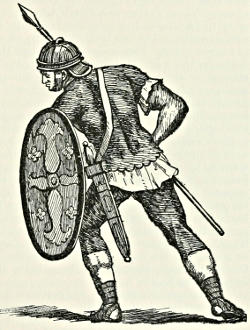
A Soldier
(From Trajan’s Column)
This Column of Trajan originally stood surrounded by buildings forming a court only about forty feet square, the intention being apparently that the figures should be viewed from the surrounding structures. Notwithstanding this the sculptures are progressively larger toward the top, the perspective effect when looking from below being obvious in the artist’s mind. To-day the column stands in lonely grandeur in Trajan’s Forum; discoloured and weather-worn, but otherwise little altered from the original state except at the very top, where, incongruously enough, a statue of St. Peter now takes the place of the colossal figure of Trajan himself which once occupied the pedestal. Sixtus V placed the effigy of the Christian there, the pagan image having been taken away some time in the early Middle Ages. The substitution was a characteristic act of piety, which could have been permitted only by an equally characteristic lack of humour. But quite regardless of its incongruous apex, the column remains as the most important historical document relating to military customs of classical antiquity that has come down to us.a
Hadrian (P. ÆLius Hadrianus), 117-138 A.D.
[117-118 A.D.]
Hadrian was by descent a Spaniard, and of the same city where Trajan was born. He was nephew to Trajan, and married to Sabina, his grand-niece. When Trajan was adopted by Nerva, Hadrian was a tribune of the army in Mœsia, and sent by the troops to congratulate the emperor on his advancement. But his brother-in-law, who desired to have an opportunity of congratulating Trajan himself, supplied Hadrian with a carriage that broke down on the way. Hadrian, however, was resolved to lose no time, so the story goes, and performed the rest of the journey on foot. This assiduity was very pleasing. But the emperor was believed to dislike Hadrian for several reasons. He was expensive, and involved in debt. He was, besides, inconstant, capricious, and apt to envy another’s reputation. These faults, in Trajan’s opinion, could not be compensated either by Hadrian’s learning or his talents. His great skill in the Greek and Latin languages, his intimate acquaintance with the laws of his country and the philosophy of the times, were no inducements to Trajan, who, being bred himself a soldier, desired to have a military man to succeed him. For this reason it was that the dying emperor would by no means appoint a successor; fearful, perhaps, of injuring his great reputation, by adopting a person that was unworthy. His death, therefore, was concealed for some time by Plotina, his wife, till Hadrian had sounded the inclinations of the army, and found them firm in his interests. They then produced a forged instrument, importing that Hadrian was adopted to succeed in the empire. By this artifice he was elected by all orders of the state, though absent from Rome, being then at Antioch, as general of the forces in the East.[28]
Upon Hadrian’s election, his first care was to write to the senate, excusing himself for assuming the empire without their previous approbation; imputing it to the hasty zeal of the army, who rightly judged that the senate ought not long to remain without a head. He then began to pursue a course quite opposite to that of his predecessor, taking every method of declining war, and promoting the arts of peace. He was quite satisfied with preserving the ancient limits of the empire, with the Euphrates as the boundary.
Having thus settled the affairs of the East, and leaving Severus governor of Syria, he took his journey by land to Rome, sending the ashes of Trajan thither by sea. Upon his approach to the city, he was informed that a magnificent triumph was preparing for him; but this he modestly declined, desiring that those honours might be paid to Trajan’s memory which they had designed for him. In consequence of this command, a most superb triumph was decreed, in which Trajan’s statue was carried as the principal figure in the procession, it being remarked that he was the only man that ever triumphed after he was dead.
THE VARIED ENDOWMENTS OF HADRIAN
It was not an easy task to appear with any lustre after an emperor so loved and admired as Trajan; and yet the merits of his successor seemed, in some measure, to console the people for their loss. Hadrian was one of the most remarkable of the Roman emperors for the variety of his endowments. He was highly skilful in all the exercises both of body and mind. He composed with great beauty, both in prose and verse; he pleaded at the bar, and was one of the best orators of his time. He was deeply versed in the mathematics, and no less skilful in physic. In drawing and painting, he was equal to the greatest masters; an excellent musician, and sang to admiration. Besides these qualifications, he had an astonishing memory; he knew the names of all his soldiers, though ever so long absent. He could dictate to one, confer with another, and write himself, all at the same time. He was remarkably expert in military discipline; he was strong and very skilful in arms, both on horseback and on foot, and frequently with his own hand killed wild boars, and even lions, in hunting.
His moral virtues were not less than his accomplishments. Upon his first exaltation, he forgave an infinite number of debts due to the exchequer, remitting the large arrears to which the provinces were liable, and burning the bonds and registers of them in the public Forum. He refused to take the confiscated estates of condemned persons into his private coffers, but ordered them to be placed in the public treasury. His moderation and clemency appeared by pardoning the injuries which he had received when he was yet but a private man. One day meeting a person who had formerly been his most inveterate enemy, “My good friend,” cried he, “you have escaped, for I am made emperor.” He had so great a veneration for the senate, and was so careful of not introducing unworthy persons into it, that he told the captain of his guard, when he made him senator, that he had no honours in his gift equal to what he then bestowed. He was affable to his friends, and gentle to persons of meaner stations; he relieved their wants, and visited them in sickness; it being his constant maxim, that he was an emperor, not for his own good, but for the benefit of mankind.
These were his virtues, which were contrasted by a strange mixture of vices; or, to say the truth, the wanted strength of mind to preserve his general rectitude of character without deviation. Thus he is represented as proud and vainglorious, envious and detractive, hasty and revengeful, inquisitive into other men’s affairs, and often induced by sycophants to acts of cruelty and injustice. He permitted the revival of the persecution against the Christians, and showed many instances of a bad disposition, which it was the whole study of his life to correct or to conceal.
But whatever Hadrian might have been as to his private character, his conduct as an emperor appears most admirable, as all his public transactions seem dictated by the soundest policy and the most disinterested wisdom. He was scarce settled on the throne, when several of the northern barbarians, the Alans, the Sarmatians, and the Dacians, began to make devastations on the empire. These hardy nations, who now found the way to conquer, by issuing from their forests, and then retiring upon the approach of a superior force opposing them, began to be truly formidable to Rome. Hadrian had thoughts of contracting the limits of the empire, by giving up some of the most remote and the least defensible provinces; but in this he was overruled by his friends, who wrongly imagined that an extensive frontier would tend to intimidate an invading enemy. But though he complied with their remonstrances, he broke down the bridge over the Danube, which his predecessor had built, sensible that the same passage which was open to him, was equally convenient to the incursions of his barbarous neighbours.
While he was employed in compelling these nations to submission, a conspiracy was discovered, carried on among four persons of consular dignity at home. These had agreed to kill him, either while he was offering sacrifice, or while he was hunting. Their designs, however, were timely discovered, and the conspirators put to death by order of the senate. Hadrian took great pains to clear himself from the imputation of having had any hand in their execution; he had sworn upon his advancement, to put no senator to death, and he now declared that the delinquents died without his permission. But in order entirely to suppress the murmurs of the people upon this head, he distributed large sums of money among them, and called off their attention from this act of severity to magnificent shows, and the various diversions of the amphitheatre.
HADRIAN’S TOURS
[118-129 A.D.]
Having stayed a short time at Rome, so as to see that all things were regulated and established for the safety of the public, he prepared to visit and take a view of his whole empire. It was one of his maxims, that an emperor ought to imitate the sun, which diffuses warmth and vigour over all parts of the earth. He therefore took with him a splendid court and a considerable force, and entered the province of Gaul, where he numbered all the inhabitants. From Gaul he went into Germany, from thence to Holland, and then passed over into Britain. There, reforming many abuses, and reconciling the natives to the Romans, for the better security of the southern parts of the kingdom he built a wall of wood and earth, extending from the river Eden in Cumberland to the Tyne in Northumberland, to prevent the incursions of the Picts, and the other barbarous nations to the north. From Britain, returning through Gaul, he directed his journey to Spain, where he was received with great joy, as being a native of that country. There, wintering in the city of Tarraco, he called a meeting of the deputies from all the provinces, and ordained many things for the benefit of the nation. Happening, while he was in Spain, to walk in his garden, one of the servants of the house ran furiously at him, with a drawn sword, to kill him; but the emperor warding off the blow, and closing with him, quickly disarmed him; then delivering him to his guards, he ordered that he might have a physician to bleed him, considering the poor creature (which in fact he was) as a madman. From Spain he returned to Rome.b
In April of 129 Hadrian undertook another long journey to the eastern provinces of the empire, from which he did not return to take up his residence on the Tiber until the year 134. In 129 he again made a long stay in Athens, where he celebrated the consummation of a great work which had been awaiting completion from times out of mind, and was now intended to minister to the worship of Zeus, the glory of Athens, and the vanity of the great Philhellenic emperor.
Of the many magnificent buildings which he erected for the adornment of his favourite city, hardly anything is left except the ruins of the most splendid of them all. Southeast of the acropolis there still stand some huge columns of the Olympieum, begun long since by the Pisistratidæ and now finished by Hadrian. It was a gigantic temple of Olympian Zeus, occupying an area of fifty-nine thousand square feet. It was consecrated in the autumn of 129, and one and the same priest presided there over the worship of the Olympian Zeus and of the Philhellene emperor.
[129-130 A.D.]
Hadrian also laid out a fashionable residential quarter for Roman villas on the southeast of the city, towards the Ilissus, which was adorned with a stately gateway on the original boundary of ancient Athens, not far from the peribolus of the Olympieum. His new Panhellenium, a temple to the Panhellenic Zeus, was intended to serve as a centre for the new national festival of the Panhellenia, instituted by him, and celebrated for the first time in the autumn of the year 129; a festival in which the Greeks of the mother-country and the colonies were equally entitled to take part. Thus he hoped to substitute for the Delphic amphictyony, which had passed into the limbo of shades, a fresh incentive to Greek patriotism and religious sentiment, and to restore to Athens something of the lustre of her old commanding position.
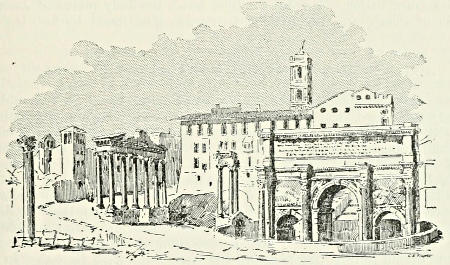
Ruins of the Forum
The emperor left Athens in March or April, 130, and proceeded to Alexandria, a city which combined all the elements which charmed him as a sovereign and an accomplished man of the world—the restless activity of a vast commercial centre, the motley mixture of the most varied and sharply defined national types in the empire, and lastly, the abundance of scientific material and the high standard of learning, both in studies purely Greek and in the applied and exact sciences. The only drawback was the Alexandrine propensity to ill-natured witticisms, which were apt to verge upon shameless insolence and to which even the person of the emperor was by no means sacred.
When Hadrian’s favourite, Antinous, was drowned in the Nile at Besa (probably on October 30, 130), having sought death of his own free will, according to the story then generally received, in order to save the emperor, whose life (so it was said) could only be preserved by the voluntary sacrifice of another—Hadrian endeavoured to find comfort by instituting a new form of worship, that of his lost minion. The art and feeling of the antique world proved willing instruments of the emperor’s will, and Antinous was immortalised in numerous statues, more particularly in Greece. On the other hand, two of Hadrian’s administrative measures provoked another fearful outbreak of Jewish fury in Palestine.
[131-138 A.D.]
The founding of the new colony of Ælia Capitolina on the ruins of Jerusalem and an imperial edict, really directed against the objectionable custom of mutilation, and only construed by a mistake as referring to the Jewish rite of circumcision, brought about a terrible Jewish revolt (at the end of 131), which was vigorously seconded by the Jews of the Dispersion. The rising, disregarded at first by the Romans, and directed with the utmost energy by a priest, Eleazer of Modin, and a warlike freebooter, Simon Bar Cocheba[29] (i.e., son of a star) by name, resulted in a troublesome war, waged with horrible cruelty on both sides, in which victory only fell to the Roman arms after the experienced legate Sextus Julius Severus, came from Britain to take over the command. It was not decided by a pitched battle; as before, one stronghold after another had to be reduced, the last being Baeth-ter, not far from Jerusalem (135 A.D.). Thenceforth and for long after the silence of the grave settled upon Judea, or Syria Palestina, as it was now called. No Jews might tread the holy places of Jerusalem on pain of death, and the little country was garrisoned by two legions.
HADRIAN AS BUILDER AND ADMINISTRATIVE REFORMER
Hadrian came back to take up his residence at Rome in 134, and there zealously took up the architectural labours of which imposing remains are left to the present day. He had already adorned the heart of the old city with the temple of Venus and Rome, which was dedicated on the twenty-first of April, 128, and some vast undertakings were brought to a conclusion in 135, 136, and the following years. We have a memorial of him to this day in the huge mausoleum, which was diverted from its purpose as a quiet sepulchre to become the citadel of the City of the Seven Hills during the stormy times of the Middle Ages and later centuries. On the right bank of the Tiber Hadrian built a new mausoleum, where not only he and the members of his family but many of his successors were buried. In order to connect this edifice (now known as the Castle of St. Angelo) with the left bank of the river, he built the splendid Ælian bridge (now Ponte St. Angelo) of blocks of travertin stone. Lastly, the ruins of his Tiburtine villa, covering a circuit of about eight miles, can still be traced.
Hadrian’s successors had every reason to regard with the utmost reverence the many administrative reforms made by him in the course of his long and prosperous reign. Though he did not pursue his predecessor’s policy of conquest, he used every means to maintain the strength and efficiency of the army; above all, he did not govern it by decrees issued from the palace, but constantly appeared in the camps in person, and examined all things with the eye of an expert. Military appointments were made solely on consideration of personal capacity and genuine merit, and various arrangements were made to augment the fighting power of the army, all of which stood the test of practice. Hadrian’s army system, and more particularly the drill introduced by him, proved so excellent that Hadrian’s regulations formed the basis of military organisation as late as the time of Constantine. The change which took place in strategy, for instance, after the introduction of his reforms is of the highest importance. Trajan had resorted to the ancient Roman practice with telling effect.
But the scientific study of military tactics which had come into existence in connection with Greek studies after the middle of the first century B.C. and much costly experience won in conflict with barbarian frontier tribes in Europe and with the horsemen of Asia had led to changes in the old battle array. The cavalry were taught to practise all the strategic movements of the Parthian, Armenian, Sarmatian, and Celtic hordes. In order to spare the valuable infantry of the legions as much as possible, auxiliary troops were more and more largely used in the first line, and an order of battle was introduced which combined the advantages of retaining the system of reserve divisions, promising speedier victory over hordes of gallant barbarians, and making the struggle less deadly to the Romans. The practice of early antique times—that of drawing up the men in serried ranks, or “phalanxes,” was again systematically resorted to. The van of the legion was no longer divided by vacant intervals. The “phalanx” of the legion was eight men deep. By a skilful combination of the various weapons in use, the soldiers of the first four files were armed with the pilum, the four behind them with spears. A ninth file consisted of auxiliaries aimed with arrows. The place of the cavalry and artillery was on the wings and rear of the phalanx. Further still to the rear was a reserve of picked troops, ready to help at every point where help was needed.
Hadrian’s labours in the field of civil administration were even more considerable. As a financier he was the best economist since Tiberius, and once more showed what results a sound financial policy and wise economy could create from the vast resources of the empire, both in the sphere of production and in that of artistic and monumental creation. At the same time he displayed great skill in introducing reforms into every department of finance, removing numerous harsh regulations, and in organising the affairs of the free peasants and tenant farmers on the imperial and fiscal domains in Africa on more humane and economical principles. He increased the revenue of the public treasury by undertaking the direct management of many imperial estates, instead of farming out the returns.
Nor was he less active in the sphere of jurisprudence. By his command all the prætorian edicts, which till then had been arranged in chronological order only, were collected into a systematic compilation in 131-132 B.C. by the eminent jurist Salvius Julianus. In connection with this work Hadrian caused the senate to issue a decree [Edictum Perpetuum] ordaining that no magistrate in office should henceforth add fresh clauses to the edict, but that necessary additions should be deduced by analogy from the materials already existing or made by imperial “constitutions.” Hadrian’s decisions in points concerning slavery are of interest, as showing his humane disposition. Prominent among these was the abolition of the cruel and cowardly system which enacted that where the master of a house was found murdered all the slaves of the household should be put to death. After Hadrian’s time only those slaves were examined who might be supposed to have had a hand in the murder.
The monarchical tendency of the Roman diarchy and the levelling effect of the empire became more and more distinctly marked under Hadrian. He did more than any emperor before him to place the provincials on an equal footing with the Roman citizens of Italy. Moreover, by conferring the jus Latinum on many cities, he paved the way for the extension of the rights of Roman citizenship to the whole empire.
In Italy he appointed a number of juridici, with powers to deal with bequests in trust, with the appointment of guardians, and with disputes concerning the eligibility of candidates for the decurionate. The power to deal with these questions was withdrawn, not from the municipal authorities, but (except in specially important cases) from the law-courts of the capital, before which suits of this sort had hitherto been carried. Rome and its environs—comprising an area of 100 Roman miles, or 150 kilometres, within the competency of the chief of police—of course remained under the jurisdiction of the tribunals of the capital. But, on the other hand, the growing power of the imperial officials in matters of criminal law becomes steadily more apparent, and the competency of the chief of police and the prefect of the guard is extended at the expense of the old courts of law. These two officers represent the emperor more and more in the administration of criminal law in Italy. Their departments were subsequently made separate, possibly after the reign of Marcus Aurelius, certainly after that of Severus. Rome and a space of 150 kilometres round it were under the jurisdiction of the chief of police, Italy beyond these limits under that of the prefects of the guard. The latter officers took on more and more of the character of representative organs of the personal intervention of the emperor and thus were bound to be eminent jurisconsults.
Another significant change introduced by Hadrian was to give stability and definite form to the old institution of the consilium, which consisted of friends and advisers convened by the emperors to assist in their decisions at law. From this time forward the members of the imperial consilium appear as councillors duly appointed, with official titles and salaries, who were probably appointed by the emperor after consultation with the senate.
The business of the new council was jurisprudence in the widest sense of the word, and it was therefore intended to consist in the main of professional jurists and the prefects of the guard, together with the chief officers of the court. Another reform introduced by Hadrian into the administration at the same time was the rule that all the three great offices at court should be occupied by members of the equestrian order. The procurator a rationibus, or controller of the public treasury, who was really financial minister, now took the first place among the procurators both in rank and salary, and by degrees the inferior posts in the financial department were converted into regular offices and filled by knights. The imperial council was divided into a Greek and a Latin department under separate chiefs. Finally, the department of petitions and grievances was put into the hands of officials of knightly birth.m
PERSONAL TRAITS AND LAST DAYS OF HADRIAN
Hadrian is said to have taken great delight in disputing among the learned men and the philosophers who attended him; nor were they less careful in granting him that superiority he seemed so eagerly to affect. Favorinus, a man of great reputation at court for philosophy, happening one day to dispute with him upon some philosophical subject, acknowledged himself to be overcome. His friends blamed him for thus giving up the argument, when he might easily have pursued it with success. “How,” replied Favorinus, who was probably a better courtier than philosopher, “would you have me contend with a man who is master of thirty legions?” Hadrian was so fond of literary fame, that we are told he wrote his own life, and afterwards gave it to his servants to publish under their names. But whatever might have been his weakness in aiming at universal reputation, he was in no part of his reign remiss in attending to the duties of his exalted station. He ordered the knights and senators never to appear in public, but in the proper habits of their orders. He forbade masters to kill their slaves, as had been before allowed; but ordained that they should be tried by the laws enacted against capital offences. A law so just, had he done nothing more, deserved to have insured his reputation with posterity, and to have made him dear to mankind. He still further extended the lenity of the laws to those unhappy men, who had been long thought too mean for justice. If a master was found killed in his house, he would not allow all his slaves to be put to the torture, as formerly, but only such as might have perceived or prevented the murder.
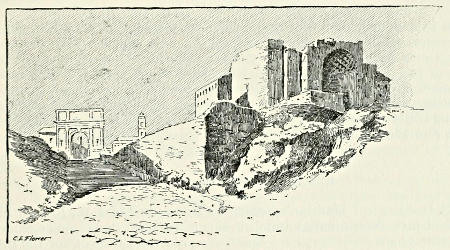
Ruins of the Temple of Venus, Rome
In such cares he consumed the greatest part of his time; but, at last finding the duties of his station daily increasing, and his own strength proportionally upon the decline, he resolved upon adopting a successor, whose merits might deserve, and whose courage secure, his exaltation. After many deliberations, he made choice of Lucius Commodus, whose bodily infirmities rendered him unfit for a trust of such importance. Of this, after some time, Hadrian seemed sensible, declaring, that he repented of having chosen so feeble a successor, saying that he had leaned against a mouldering wall. However, Commodus soon after dying, the emperor immediately adopted Titus Antoninus, afterwards surnamed the Pius; but previously obliged him to adopt two others, namely, Marcus Aurelius and Lucius Verus, all of whom afterwards succeeded in the empire.
While he was thus careful in appointing a successor, his bodily infirmities daily increased; and at length his pains becoming insupportable, he vehemently desired that some of his attendants should despatch him. Antoninus, however, would by no means permit any of his domestics to be guilty of so great an impiety, but used all the arts in his power to reconcile the emperor to sustain life. At one time he produced a woman, who pretended that she was warned in a dream that he should recover his health; at another, a man was brought from Pannonia, who gave him the same assurances. Nevertheless, Hadrian’s pains increased day by day. He frequently cried out, “How miserable a thing it is to seek death, and not to find it!” He engaged one Mastor, partly by threats and partly by entreaties, to promise to despatch him; but Mastor, instead of obeying, consulted his own safety by flight; so that he who was master of the lives of millions, was not able to dispose of his own. In this deplorable exigence, he resolved on going to Baiæ, where the tortures of his diseases increasing, they affected his understanding, so that he gave orders that several persons should be put to death; which Antoninus, according to his usual wisdom, never meant to obey. Continuing, for some time, in these excruciating circumstances, the emperor was at last resolved to observe no regimen, often saying, that kings died merely by the multitude of their physicians. This conduct served to hasten that death he seemed so ardently to desire, and it was probably joy upon its approach which dictated the celebrated stanzas which are so well known, in repeating which he expired.
Animula, vagula, blandula, Hospes, comesque corporis, Quæ, nunc abibis in loca? Pallidula, rigida, nudula, Nec, ut soles, dabis jocos?
In this manner died Hadrian, in the sixty-second year of his age, after a prosperous reign of twenty-one years and eleven months. His private character seems to be a mixture of virtues and vices;[30] but, as a prince, perhaps none of his predecessors showed more wisdom, or such laudable assiduity. He was the first emperor who reduced the laws of the empire into one standing code. Government received the greatest stability from his counsels, and a tranquillity more lasting than could be expected from such fierce neighbours abroad, and such a degenerate race of citizens at home.b
RENAN’S ESTIMATE OF HADRIAN
[134-138 A.D.]
At the time of Hadrian’s return to Rome, in 134 A.D., Roman civilisation had just exterminated Judaism, one of its most dangerous enemies, and was triumphant. Everywhere there was peace and respect for the different nations; the barbarians were apparently subjected, the mildest forms of government had been introduced and were practised. Trajan had been quite right in his belief that men can be governed and at the same time treated with consideration. The idea of the state as not only tutelary but beneficent was taking deep root. Hadrian’s private conduct might be much blamed, his character was becoming perverted as his health gave way; but the people did not notice it. Unprecedented splendour and comfort surrounded everything like a brilliant aureole, disguising the weak parts of the social organisation. Truth to say, these weak parts were susceptible of correction. Progress was welcomed in everything. The stoic philosophy penetrated legislation, introducing the idea of the rights of man, of civil equality, of uniformity in the provincial administration. The privileges of the Roman aristocracy were disappearing day by day. The leaders of society believed in progress and toiled in its cause. They were philosophers, philanthropists wishing without utopianism to bring the freest possible application of reason into human affairs.
Hadrian enjoyed life and he had the right to do so. His inquisitive and active mind gave birth to all kinds of fancies; and his taste was not good enough to prevent him making mistakes. At the foot of the mountains of Tibur he built a villa which resembled an album of his travels, a sort of panorama of fame. It might have been described as the noisy, tawdry fair of a dying nation. Everything was to be found there; imitation Egyptian, imitation Greek, the Lyceum, the Academy, the Prytaneum, the Pœcile, Canopus, the Alpheus, the valley of Tempe, the Elysian fields, Tartarus; temples, libraries, theatres; a hippodrome, a naumachy, a gymnasium, baths,—strange but attractive spot. For it is the last place where enjoyment was to be found, where clever men fell asleep to the empty sound of the “miserly Acheron.”[31]
Hadrian as Patron of the Arts
At Rome, the one thought of the fantastic emperor was that senseless tomb, that immense mausoleum, where Babylon was put to shame, and which, stripped of its treasures, became the citadel of papal Rome. His buildings covered the world. The Athenæums he founded, the encouragement he gave to letters and the fine arts, the liberties he accorded to professors, rejoiced the hearts of all cultivated people. Unfortunately, superstition, caprice, and cruelty mastered him more and more as his physical strength decreased. He had built himself an Elysium to disbelieve in, a hell to laugh at, a philosopher’s hall in which to jeer at the philosophers, a Canopus in order to expose the impostures of the priests and to remind himself of the mad festivals of Egypt, which had so greatly amused him. Now everything seemed hollow and empty; nothing interested him any longer. Perhaps some of the martyrdoms which took place during his reign and for which it is not easy to assign a motive may be attributed to the disorders and caprices of his last months.
Telesphorus was then the head of the Church of Rome; he died confessing Christ and was numbered amongst the most glorious martyrs of the faith. The death of the dilettante Cæsar was sad and undignified, for he was animated by no really elevated moral sentiment. The world, nevertheless, lost in him a mighty pillar. The Jews alone triumphed in the agony of his last moments.
He cared sincerely for civilisation, and perfectly understood its possibilities in his day. Ancient art and literature end with him. He was the last emperor to believe in glory, as Ælius Verus was the last man who knew how to appreciate the refinements of pleasure. Human affairs are so frivolous that brilliancy and pomp must be allowed a part in them. No world will hold together without these. Louis XIV knew this, and men have lived and still live by the light of his copper-gilt sun. Hadrian, in his own way, marks a climax, after which a rapid decline begins. Certainly, from a moral standpoint, Antoninus and Marcus Aurelius far surpass him; but under them the world becomes sad, loses its gaiety, puts on a cowl, becomes Christian, while superstition increases.
The art of Hadrian, although it is cankered, still adheres to principles; it is a skilful and learned art; then decadence sets in with irresistible force. Ancient society realises that all is vanity, and on the day when this discovery is made death is not far off. The two accomplished sages who are to reign next are each in their several ways ascetics. Lucius Verus and Faustina are to be the outcast survivors of ancient fashion.d
Antoninus (Titus Aurelius Antoninus Pius), 138-161 A.D.
[138-161 A.D.]
The ancestors of Antoninus originally came from Nemausus (Nîmes); after settling at Rome, they had filled the highest offices there. Antoninus himself, distinguished by Hadrian, had received from that prince the government of a portion of Italy, later on, the proconsulship of Asia, and had finally been adopted by him on condition that he, in his turn, should adopt Marcus Aurelius and Lucius, the son of Ælius Verus. During his reign of twenty-three years (138-161) the empire enjoyed great tranquillity, due as much to his virtues as to his moderation, and to the able government of his predecessor, who had temporarily removed the causes of disorder.
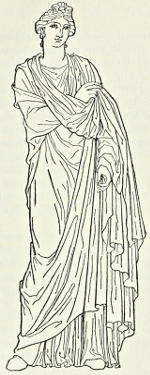
Faustina, wife of Antoninus Pius
(From a statue in the Vatican)
His renown extended so far that the princes of India, of Bactriana, and Hyrcania chose him to arbitrate in their quarrels; his grateful contemporaries gave him the beautiful title of “Father of the Human Race.” He never appointed any but experienced and upright men to public offices, and permitted them to hold their posts for life when he could not replace them by others more able. A wise economy in financial administration gave him the means of establishing useful institutions, as, for example, two asylums where orphan girls were educated under the protection of the Empress Faustina, and the appointments for learned professors that he established not only in Rome, as Vespasian had done, but in the large towns of the provinces.
He was able, also, to succour towns which had been stricken by any plague, such as Rome, Antioch, Narbonne, and Rhodes, when devastated by fire or earthquake. The wealth of a prince, he used to say, is public felicity. He, himself, lived simply, accessible to all, and ready to render justice to all complaints. Two conspiracies against him were discovered; the two instigators alone perished. An Apology for Christianity, composed by Justin, the philosopher, and presented to the emperor, procured toleration and protection for the Christians, who were already numerous in Rome and the provinces.
Antoninus engaged in no war, and did not even visit the provinces, which were too peaceful and well governed to render his presence necessary. His lieutenants, however, engaged in some battles, against the Moors in Africa, and against the Alani and the Quadi on the Danube. The Lazæ and the Armenians accepted the kings he installed. The Jews gave some trouble, and the Britons attempted to destroy the wall of Hadrian.
An act that clearly shows the moderation of Antoninus is related by Appian. At that time deputies came to Rome from the barbarians, with a request to be received as subjects of the empire. This was refused them. Such had been the policy of Augustus and Hadrian, and it had had sufficiently good results in the well-being of a hundred millions of men to justify Antoninus in following it. But peace also brought forgetfulness of the martial valour of old. The legions, idle behind the ramparts of their camp, no longer knew how to handle weapons, nor endure fatigue; and all the severity of Avidius Cassius was required to root out the effeminacy of the soldiers, particularly those in Syria, to wean them from indulgence in “baths and the dangerous pleasures of Daphne, to tear from their heads the flowers with which they crowned themselves at their feasts.”c
In the beginning of his reign, he made it his particular study to promote only the most deserving to employments; he moderated many imposts and tributes, and commanded that all should be levied without partiality or oppression. His liberality was such, that he even parted with all his own private fortune, in relieving the distresses of the necessitous. Against which, when Faustina, the empress, seemed to remonstrate, he reprehended her folly, alleging, that as soon as he was possessed of the empire, he quitted all private interests; and having nothing of his own, all properly belonged to the public. He acted differently from his predecessors with regard to travelling, and seldom left Rome, saying, that he was unwilling to burden his subjects with ostentatious and unnecessary expenses. By this frugal conduct, he was the better enabled to suppress all the insurrections that happened during his reign, either in Britain, in Dacia, or in Germany. Thus he was at once reverenced and loved by mankind, being accounted rather a patron and a father to his subjects, than a master and commander. Ambassadors were sent to him from the remotest parts of Hyrcania, Bactria, and India, all offering him their alliance and friendship; some desiring him to appoint them a king, whom they seemed proud to obey. He showed not less paternal care towards the oppressed Christians; in whose favour he declared, that if any should proceed to disturb them, merely upon account of their religion, that such should undergo the same punishment which was intended against the accused.
This clemency was attended with no less affability than freedom; but, at the same time, he was upon his guard, that his indulgence to his friends should not tempt them into insolence or oppression. He therefore took care that his courtiers should not sell their favours, nor take any gratuity from their suitors. In the time of a great famine in Rome, he provided for the wants of the people, and maintained vast numbers with bread and wine all the time of its continuance. When any of his subjects attempted to inflame him with a passion for military glory, he would answer, that he more desired the preservation of one subject, than the destruction of a thousand enemies.
He was an eminent rewarder of learned men, to whom he gave large pensions and great honours, drawing them from all parts of the world. Among the rest he sent for Apollonius, the famous stoic philosopher, to instruct his adopted son, Marcus Aurelius, whom he had previously married to his daughter. Apollonius being arrived at Rome, the emperor desired his attendance; but the other arrogantly answered, that it was the scholar’s duty to wait upon the master, and not the master’s upon the scholar. To this reply Antoninus only returned, with a smile, that it was surprising how Apollonius, who made no difficulty of coming from Greece to Rome, should think it so hard to walk from one part of Rome to another; and immediately sent Marcus Aurelius to him. While the good emperor was thus employed in making mankind happy, in directing their conduct by his own example, or reproving their follies with the keenness of rebuke, he was seized with a violent fever at Lorium, a pleasure house at some distance from Rome; where, finding himself sensibly decaying, he ordered his friends and principal officers to attend him. In their presence, he confirmed the adoption of Marcus Aurelius, without once naming Lucius Verus, who had been joined by Hadrian with him in the succession; then commanding the golden statue of Fortune, which was always in the chamber of the emperors, to be removed to that of his successor, he expired in the seventy-fifth year of his age, after a prosperous reign of twenty-two years and almost eight months.b
RENAN’S CHARACTERISATION OF ANTONINUS
Antoninus was a St. Louis in kindness and goodness, with far more judgment and a broader mind. He is the most perfect sovereign who has ever reigned.[32] He was even superior to Marcus Aurelius, since he cannot be accused of weakness. To enumerate his good qualities would be to enumerate the good qualities which may belong to an accomplished man. All men hailed in him an incarnation of the mythical Numa Pompilius. He was the most constitutional of sovereigns, besides being simple and economical, occupied with good works and labours of public utility, a stranger to excess, no great talker, and free from all intellectual affectation. Through him philosophy became a genuine force; the philosophers were everywhere liberally pensioned. He was himself surrounded by ascetics and the general direction of the education of Marcus Aurelius was his work.
Thus the world seemed to have reached an ideal state; wisdom reigned; the world was governed for twenty-three years by a father; affectation and false taste in literature died out; simplicity ruled; public instruction was the object of earnest attention. The improvement was general; excellent laws were passed, especially in favour of slaves; the relief of suffering became a universal care. The preachers of moral philosophy were even more successful than Dion Chrysostomus; the desire to win frivolous applause was the peril they had to avoid. In the place of the cruel Roman aristocracy a provincial aristocracy was springing up composed of honest people, whose aim was the general good.
The similarity of these aspirations with those of Christianity was striking. But a great difference separated the two schools and was to make them enemies. By reason of its hope of an approaching end of the world, its ill-concealed wish for the downfall of the ancient social order, Christianity, in the midst of the beneficent empire of the Antonines, was a subverter which had to be battled with. The Christian, always pessimistic and inexhaustible in lugubrious prophecies, far from aiding rational progress held it in contempt. Nearly all the Catholic teachers regarded war between the empire and the church as necessary, as the last act of the struggle between God and Satan; they boldly affirmed that persecution would last to the end of all things. The idea of a Christian empire, although it sometimes occurred to them, appeared a contradiction and an impossibility.
Whilst the world was beginning to live again, the Jews and the Christians insisted more than ever on wishing its last hour to approach. Already the imposter Baruch had exhausted himself in vague announcements. The Judeo-Christian sibyl all this time did not cease to thunder. The ever-increasing splendour of Rome was a scandalous outrage to the divine truth, to the prophets, to the saints. They also devoted themselves to boldly denying the prosperity of the century. All natural scourges, which continued to be fairly numerous, were held up as signs of implacable wrath. The past and present earthquakes in Asia were taken advantage of to inspire the most gloomy terrors. These calamities, according to the fanatics, had only one cause—the destruction of the Temple at Jerusalem. Rome, the courtesan, had given herself up to a thousand lovers who had intoxicated her; she was to become a slave in her turn. Italy, bleeding from civil wars, would become a den of wild beasts. The new prophets employed nearly the same figures to describe the downfall of Rome as the seer of sixty-nine to depict his melancholy fury.
It is difficult for any society not to answer such attacks. The sibylline books containing them, attributed to the pretended Hystaspes and announcing the destruction of the empire, were condemned by the Roman authorities, and those who possessed or read them were amenable to the death penalty. Anxious searching into the future was a crime during the imperial epoch; and indeed under this useless curiosity there was nearly always hidden a desire for revolution and incitement to assassination. Doubtless, it would have been more worthy of the wise emperor who introduced so many humane reforms to despise unrestrained and aimless fantasies and to repeal those harsh laws which Roman despotism made to weigh so heavily on liberty of worship and liberty of association; but evidently the idea occurred to none of those about him, any more than it did to those about Marcus Aurelius.
Only the free thinker can be absolutely tolerant, and Antoninus observed and scrupulously maintained the ceremonies of the Roman religion. The policy of his predecessors in this respect had been unswerving. They had seen in the Christians a secret and anti-social sect, which was dreaming of the overthrow of the empire; and, like all those attached to the ancient Roman principles, they thought it necessary to suppress it. Special edicts were not needed for this; the laws against cœtus illiciti and illicita collegia were numerous. The Christians came under the action of these laws in the most regular manner. It must be observed, firstly, that the true spirit of liberty as it is understood to-day, was then not comprehended, and that Christianity, when it was in power, did not practise it any better than the pagan emperors; secondly, that the repeal of the law against illegal societies would probably have been the ruin of the empire, which rested on the essential principle that the state must admit into itself no society which differed from it. The principle was bad, according to our ideas; it is at least certain that it was the cornerstone of the Roman constitution.
The people would have thought the foundations of the empire shattered if there had been any relaxation of the repressive laws which they held to be essential to the soundness of the state. The Christians appeared to understand this. Far from bearing any ill will to Antoninus personally, they rather regarded him as having lightened their burden. A fact which does infinite honour to this sovereign is that the principal advocate of Christianity dared confidently to address him for the purpose of obtaining the rectification of a legal position which he rightly thought unjust and unseemly in such a happy reign. Others went further, and doubtless during the first years of Marcus Aurelius various rescripts were fabricated purporting to be addressed under the name Antoninus to the Larissians, to the Thessalonians, to the Athenians, to all the Greeks, and to the states of Asia; rescripts so favourable to the Church that if Antoninus had really countersigned them he would have been very inconsistent in not becoming a Christian. These documents only prove one thing—namely, the opinion the Christians had preserved of the worthy emperor.
Antoninus showed himself no less friendly towards the Jews now that they no longer threatened the empire. The laws forbidding circumcision, which had been the result of the revolt of Bar Kosiba, were repealed so far as they were vexatious. The Jew could freely circumcise his sons, but if he practised the operation on a non-Jew he was severely punished. As to civil jurisdiction within the community, it appears only to have been accorded to the Israelites later. Such was the severity of the established legal order, such was the popular effervescence against Christians, that even during this reign there were unhappily many martyrs. Polycarp and Justin are the most illustrious; they were not the only ones. Asia Minor was stained with the blood of many judicial murders, all occasioned by revolts; we shall see Montanism born like a hallucination from this intoxication of martyrdom.
In Rome the book of the pseudo Hermas will appear as if from a bath of blood. The absorbing idea of martyrdom, with questions respecting renegades or those who had shown any weakness, fill the entire book. On every page Justin describes the Christians as victims who only wait for death; their name alone, as in the time of Pliny, is a crime. “Jews and pagans persecute us on all sides; they deprive us of our property, and only allow us to live when they cannot do otherwise. They behead us, crucify us, throw us to the beasts, torment us with chains, with fire, with the most horrible tortures. But the more they make us suffer, the more the numbers of the faithful increase. The vinedresser prunes his vine to make it grow again, he removes those branches which have borne fruit so that others stronger and more fruitful shall grow; the same thing happens to God’s people, who are like a fertile vine, planted by his hand and by that of our Saviour Jesus Christ.”d
Marcus Aurelius (M. Ælius Aurelius Antoninus), 161-180 A.D.
[161-163 A.D.]
Marcus Aurelius, though left sole successor to the throne, took Lucius Verus as his associate and equal in governing the state. The two emperors had scarce been settled on the throne when the empire seemed attacked on every side from the barbarous nations by which it was surrounded. The Chatti invaded Germany and Rætia, ravaging all with fire and sword; but were, after some time, repelled by Victorinus. The Britons likewise revolted, but were repressed by Califurnius. But the Parthians, under their king Vologeses, made an irruption still more dreadful than either of the former, destroying the Roman legions in Armenia; then entering Syria, and driving out the Roman governor, and filling the whole country with terror and confusion. In order to stop the progress of this barbarous irruption, Verus himself went in person, being accompanied by Aurelius part of the way, who did all in his power, both by giving him advice and proper attendants, to correct or restrain his vices.
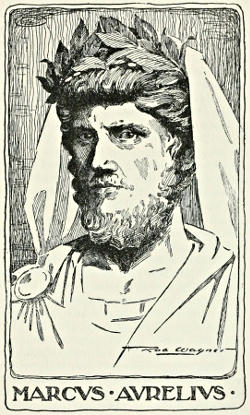
MARCVS AVRELIVS
However, these precautions were fruitless; Verus soon grew weary of all restraint; he neglected every admonition; and, thoughtless of the urgency of his expedition, plunged himself into every kind of debauchery. These excesses brought on a violent fever on his journey, which his constitution was sufficiently strong to get over, but nothing could correct his vicious inclinations. Upon his entering Antioch, he resolved to give an indulgence to every appetite, without attending to the fatigues of war. There, in one of its suburbs, which was called Daphne, which, from the sweetness of the air, the beauty of its groves, the richness of its gardens, and the freshness of its fountains, seemed formed for pleasure, he rioted in excesses unknown even to the voluptuous Greeks, leaving all the glory of the field to his lieutenants, who were sent to repress the enemy. These, however, fought with great success: Statius Priscus took Artaxata; Cassius put Vologeses to flight, took Seleucia, plundered and burned Babylon and Ctesiphon, and demolished the magnificent palace of the kings of Parthia. In a course of four years, during which the war continued, the Romans entered far into the Parthian country, and entirely subdued it; but upon their return their army was wasted to less than half its former number by pestilence and famine. However, this was no impediment to the vanity of Verus, who resolved to enjoy the honours of a triumph so hardly earned by others. Wherefore, having appointed a king over the Armenians, and finding the Parthians entirely subdued, he assumed the titles of Armenicus and Parthicus; and then returned to Rome to partake of a triumph with Aurelius, which was accordingly solemnised with great pomp and splendour.
[163-166 A.D.]
During the course of this expedition, which continued for some years, Aurelius was sedulously intent upon distributing justice and happiness to his subjects at home. He first applied himself to the regulation of public affairs, and to the correction of such faults as he found in the laws and policy of the state. In this endeavour he showed a singular respect for the senate, often permitting them to determine without appeal; so that the commonwealth seemed in a manner once more revived under his equitable administration. Besides, such was his application to business that he often employed ten days together upon the same subject, maturely considering it on all sides, and seldom departing from the senate house till, night coming on, the assembly was dismissed by the consul. But while thus gloriously occupied, he was daily mortified with accounts of the enormities of his colleague, being repeatedly assured of his vanity, lewdness, and extravagance. However, feigning himself ignorant of these excesses, he judged marriage to be the best method of reclaiming him; and therefore sent him his daughter Lucilla, a woman of great beauty, whom Verus married at Antioch. But even this was found ineffectual: Lucilla proved of a disposition very unlike her father; and instead of correcting her husband’s extravagances, only contributed to inflame them. Yet Aurelius still hoped that, upon the return of Verus to Rome, his presence would keep him in awe, and that happiness would at length be restored to the state. But in this also he was disappointed. His return only seemed fatal to the empire; for his army carried back the plague from Parthia, and disseminated the infection into all the provinces through which it passed.