Book 2 — CHAPTER XXXI. THE AGE OF AUGUSTUS—ASPECTS OF ITS CIVILISATION
Reading edition
EMPIRE IS PEACE
“Then battles o’er the world shall cease, Harsh times shall mellow into peace: Then Vesta, Faith, Quirinus, joined With brother Remus rule mankind: Grim iron bolt and massy bar Shall close the dreadful gates of War.”—Virgil.
[30 B.C.-14 A.D.]
Peace was the price for which Rome consented to the supremacy of Augustus; his successors, too, really followed a policy of peace. There was not a complete absence of conquests either in the reign of Augustus or of those who came after him, as for instance Trajan. But these predatory wars were chiefly directed to the defence and protection of the older possessions. If we compare the conquests of the republic in five centuries with those of the empire in four we shall clearly see how the republic hastened from one conquest to another, while the object of the empire was to preserve and fortify itself. “Empire is peace”—this watchword, so often abused, was truly expressive of the work of Augustus in battles both at home and abroad.
Cæsar had made war of necessity. His was not the nature of the warrior prince; on the contrary it was as the prince of peace that he loved to be celebrated. When the civil war had come to an end the army was considerably reduced and the superfluous legions were simply discharged. Cæsar had often suffered, and others had suffered more than he, from the insolence and unbridled passions of an army which felt itself master of the situation; the termination of the civil wars was to put an end to all this. From henceforward he no more addressed his troops as comrades but simply as soldiers, and allowed the princes of his house to use no other manner of address. The bodyguard of foreign mercenaries hitherto maintained by him was discharged and replaced by home troops.
The joy at the termination of the civil wars was universal and in nearly every case genuine. Exceptional circumstances and wars at home as well as abroad had gone to make up the history of the past twenty years; during this time a generation had grown up whose only knowledge of lasting peace was derived from hearsay, as if from the all but silent notes of some legend sung in a better day now long past. Those who within the last decade had saved or won anything were eager to rejoice in it. All panted for peace, with no less sincerity than exhausted Europe after the wars between 1790 and 1815, and all were ready to greet as lord of the world the victor who should restore this golden age.
This general yearning for peace found expression in the shutting of the doors of Janus, which was decreed by the senate in order to give a visible proof that the period of war was at an end (Æneid VII, 607):
“Two gates there stand of War—’twas so Our fathers named them long ago— The war god’s terrors round them spread An atmosphere of sacred dread. A hundred bolts the entrance guard, And Janus there keeps watch and ward.”
Any one who chanced to be in France when the Prussian War closed and heard the bells ringing out peace from the church towers will not easily underrate the impressiveness of this symbolism.
Cæsar indeed attached all the greater importance to the decree of the senate ordering the doors of Janus to be shut, in that the senate had rarely gone to such lengths. Two centuries had passed since the last occasion in which the temple of Janus was closed. When the First Punic War with all its losses and changing fortunes had finally been concluded to the advantage of Rome, exhausted as she was, she had yet joyfully permitted the performance of these ancient ceremonies which were supposed to date back to King Numa. To this precedent the senate had recourse when in 29 B.C. it ordered the closing of the temple of Janus. The proceeding would have been most impressive had the threefold triumph been terminated with this symbol of peace. This, however, was not in the power of the senate to grant, for its decree had probably been passed at the beginning of the year; there was danger in delay, for the sudden outbreak of a border war or a rebellion might make its performance impossible.
To be accurate we must admit that there was not an absolute cessation of warfare; for the Romans had still to contend with the natives on the German border and in Spain at a time like this in which all resistance had to be broken. But little account was made of such trifles, so great was the promise expected from the impression that the closing of the temple of Janus would create.
Even Cicero, so tell the later accounts at all events, seems to have recognised in the young Caius Octavius, who had been born during his consulate, the man who would put an end to the civil wars; later on, when the Sicilian war had been concluded, a statue was reared to Cæsar with an inscription to him as prince of peace; now at last after the battle of Actium the dream was to turn into reality. What was so yearningly hoped for was pointed out in the premonitions of the gods; even the trophies of victory turned into weapons for peace. Bees made their nests in the trophies taken at the battle of Actium (Anthol. Palat. VI, 236):
“Here brazen beaks, the galley’s harness, lie, Trophies of Actium’s famed victory, But bees have built within the hollow arms, With honey filled, and blithe with buzzing swarms; Emblem of Cæsar’s sway, that, calm and wise, Culls fruits of peace from arms of enemies.”
The whole world was refreshed, and breathed as if a great load had been lifted from its shoulders. The Asiatic towns in particular offered thanks to the peace-bringer in their inflated hyperbolical fashion which was nevertheless genuine and heartfelt. Halicarnassus celebrated him as “father of the fatherland,” and as “saviour of the whole race of man, whose wisdom has not only satisfied but also exceeded the prayers of all; for peace reigns over land and water, and the states flourish in righteousness, harmony, and well-being. All the good waxes full ripe and turns to fruit.” In a decree of the town Apamea we read that Cæsar was born for the salvation of the whole world; so his birthday may rightly be termed the beginning of life and of existence.
We may see how general and how hearty was the rejoicing over the restoration of peace throughout the world from the fact that Pax and Irene now became names not only of slaves and freedmen of the imperial house, but also of members of other distinguished families. From the agnomen Pax was even formed a surname Paxsæus.
Trade and industry revived and prosperity increased from the time when the armed peace and the civil wars had come to an end. The whole earth in all its compass experienced once more, after long distress, the blessings of enduring peace, and did honour to the prince of peace, conveying thanks for this new fortune by the erection of temples and altars to the glory of the imperial peace. On the Greek and Latin coins of this period too we see the goddess of peace; in Asia Minor for example on the coins of Cos and Nicomedia. Even the veterans of the emperor stamped on their colonial coins PA—CIS with the picture of the goddess of peace bearing the features of Livia or Julia. On other coins the emperor is celebrated both as prince of peace and of liberty; the later ones speak even of an eternal peace. One of the Spanish veteran colonies introduced even the name of Pax Julia; on their coins we see enthroned a fully draped female figure holding a horn of plenty in her left hand and a herald’s staff in her right.
This official worship of peace was continued throughout the whole reign of the emperor. One of the greatest honours devised by the senate and accepted by the emperor was the state-directed dedication of an altar of peace in the year 13 B.C. To-day we may still see on fine reliefs of the time of Augustus the group of peoples, in garments of ceremony and crowned with laurels, confronting the ruler on his return home. These provide us with the best picture of the national scenes in the streets of the capital when men were expecting the triple triumph of Cæsar.
“To thy blest altar, Peace, our song must tend This day, the second ere the month will end; Come, crowned with laurels from the Actian Bay, And mildly deign here to prolong thy stay. Without a foe we for no triumphs care, Thou to our chiefs more glorious art than war.”
COMPARISON BETWEEN AUGUSTUS AND NAPOLEON III
Altogether there is a striking resemblance between these two rulers and their times, although Napoleon III cannot be compared with Augustus so far as their offices are concerned. On their first appearance on the scene both were underrated by their opponents and laughed at on account of their youth or their lack of understanding: Cicero joked about “the boy”; Victor Hugo mocked at Napoleon the little. Both lived in periods when their nation was stirred to the innermost depths by civil war and revolution, in the confusion of which practically all landed property had changed owners; in Italy through the proscriptions of the triumvirs and the distribution of land to the veterans, in France through the confiscation of the property of the clergy, through the sale of estates of the nobility, combined with the mismanagement of the assignats in the first revolution, while there was fear of fresh changes through some future social revolution.
The man who offered present occupiers guarantees for their occupation and against the return of the previous confusion was honoured as the saviour of society; upon him the nation poured its thanks for the economic revival of the country and for increasing well-being during a long succession of peaceful years.
Upon this firm basis was reared the throne of the new rulers, neither of whom claimed to be a legitimate monarch. Both had with more or less right acquired a dictatorial power which they understood how to wield throughout many years, until at length a moment came when they made up their minds to a partial renunciation of authority. This was the critical moment that decided the fate of the rulers and their work, for everything depended on the choice of the moment and the extent of the concessions. Here the penetrating vision and the statesmanlike ability of Augustus are seen to surpassing advantage, while Napoleon, who only made up his mind after long hesitation, took his hand from the tiller reluctantly, only to see very speedily with what scant success his ship battled against the overpowering torrent and was driven helplessly nearer and nearer the destruction that threatened it.
The rule of Augustus as well as that of Napoleon III was a tyranny in the good sense of the word; neither the one nor the other lacked the drop of democratic oil with which the ruler was anointed. Both wanted to be assured that their high place was secure only because of its necessity to the state. Again and again Augustus restored his power (to all appearances at least) to the senate, to receive it again, but only for a definite number of years; and even in the case of Napoleon III, it was a polite official fiction that his power had been delegated to him by the nation in the first year of his reign and was even in his last year confirmed by a plebiscite.
If they challenged a crisis of this kind, both held the reins of government firmly in their hands, nor did any one seriously believe that they would have allowed this power to be wrested from them by a vote unfavourable to them. That the Roman senate and the French people were repeatedly confronted with this crisis, shows clearly what value those rulers attached to this right. Both rulers had thrust aside the higher classes of society which had hitherto guided the state in its course, in order to derive their support from the broad masses of the lower classes and the army. The immense presents made by Augustus to his soldiers and to the population of his chief town prove that in the well-being and content of this very class he rightly recognised the real support of his institutions. In similar fashion Napoleon III took pre-eminent care for the material welfare of France, which reached an unprecedented level under his rule.
Neither ruler confined his liberality to what was absolutely necessary; they also lent support to art and science in remarkable ways. Architecture is an art for monarchs, and architecture was the art of Augustus and of Napoleon III. Modern Paris is really the work of Napoleon III, and so, too, it was the boast of Augustus that he had taken over Rome a city of bricks but had left it a city of marble. In the literary efforts of their times both rulers took at least the share of dilettanti. Each of them, in order to neglect no part of his inheritance, not only collected the literary relics of his uncle but also defended in writing his actions as emperor. Without mentioning the smaller literary essays of either, we may note that Augustus sought to defend himself in his memoirs, while Napoleon III in his history of Julius Cæsar sought far less to write the history of Cæsar than to defend the principle of Cæsarism.
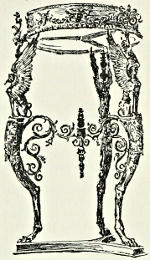
A Roman Tripod
The worship of the uncle to whose popularity they owed the crown—in the one case the worship of the dictator, in the other that of Napoleon I—impresses its character on the reign of both rulers. In particular, the military glory of these two great generals was exploited by their nephews in a variety of ways. Neither Augustus nor Napoleon III were really soldiers; but they needed for their rule a powerful effective army, which they would have found far greater difficulty in bending to their ends had they not had the memories of a great past to help them. Both succeeded in creating a fighting army, the pride of the nation, which they knew how to use when it was really necessary, but without taking any real pleasure in fighting and hazard, such as was felt by Julius Cæsar and Napoleon I. The successes they loved best were not those won in war but those due to threats of war and to diplomacy. The war against the Parthians, the hereditary foes of Rome, was certainly a portion of the legacy left by the dictator; but Augustus hesitated long before beginning this really dangerous war, until good fortune played the lost standards into his hands. Military honour was hereby satisfied and the noisy rejoicing of his fellow-soldiers now relieved him of the duty of making war upon the redoubtable enemy.
In the same way Napoleon III loved to increase his reputation in Europe and in his army by conducting wars which, even if they ended badly, could not shake his throne nor France itself. A war over the boundaries of the Rhine was as popular in France as a Parthian war under Augustus, but also as dangerous. For this reason Napoleon III made several attempts to attain the fruits of such a war by peaceable means and only proceeded to a declaration of war when he had convinced himself that there was no prospect of success in such attempts.
In a word, then as now the statesman succeeded the general, the prince of peace the warrior prince, nor did the former despise military glory; only he preferred to decorate himself with the laurels plucked from his uncle’s wreath. Augustus, no less than Napoleon III, reckoned it as of the very essence of the services he did to the world that he had put an end to the period of warfare at home and abroad. Just as Napoleon III, in the character of saviour of society, pronounced the dictum,“L’Empire c’est la paix,” so Augustus caused himself to be celebrated as the restorer of order and liberty, whose privilege it was thrice to shut the doors of Janus and to inaugurate a new era of things.
Neither was a man of genius, both were practical and astute to no common degree; they were cool political calculators who had early learned to conduct their own policies and to judge all circumstances from the practical point of view. If they sought an end they did not shrink from the means to accomplish it; as a parallel to the misdeeds of the triumvirs we have every right to quote the measures under Napoleon III by which the president was raised to an emperor. Later in their career both avoided acts of violence as far as possible, and in the face of outspoken public opinion, the symptoms of which they studied zealously, both made concessions even in the teeth of their own better convictions, for they were astute enough to know that their supremacy could not depend on might alone.
Possessed as they were of power they sought also to conciliate and fortify the conservative elements of the state. Those who bore old and famous names were treated with just such a preference in the bestowal of external honours by Augustus as in later times by Napoleon, whose endeavour was to adorn his new imperial nobility with the fairest names of old feudal France.
As he succeeded in reconciling the old nobility to some extent with the new order of things, so Napoleon understood how to conclude peace with the church, a peace which he bought and preserved at considerable cost. In a similar way Augustus, who took upon himself the dignity of a high priest, attempted to reanimate national traditions and the religion of the past and to reorganise the priesthoods.
The similarity of the two rulers is obvious and has been frequently referred to. That it should until now have been less recognised than it ought, is, perhaps, due to the fact that the characters of the two were after all fundamentally different. One might almost say the similarity lay in the circumstances of the times, the dissimilarity in the characters of the persons; and the more we harp on the former the clearer appears the latter. Napoleon remained all his life what Augustus never was, a dreamer and a conspirator. According to the version of De Tocqueville, Napoleon knew no hard and fast boundary between dreaming and thinking; this may have been the result of his moping youth with its conspiracies, his imprisonment, and his fantastic designs which never were realised but by the most extraordinary strokes of luck. Augustus, on the other hand, never had time to devote to dreamy imaginings. When he was still almost a boy, he had thrown himself on his own initiative into the struggle of parties, and from the beginning he had to summon all the powers of his mind to aid him in the struggle against opponents maturer than himself; so it is that later when power was his he never dreamed but always thought. Moreover, Augustus was never a conspirator. He obtained power early and wielded it recklessly. He both loathed and found superfluous that covert toying with designs and intrigues which shunned the public eye until they suddenly burst into publicity with éclat, such as Napoleon loved.
Augustus enjoyed the great advantage of still being teachable when he came into the actual possession of power, and of being formed into a statesman by the circumstances themselves; Napoleon, on the other hand, was much older when he came to the throne; in his best years he was forging schemes to attain an apparently unattainable goal. He was laughed at as a nurser of fancies until he became emperor; small wonder then that the emperor’s plans remained fanciful and singular and that, as a ruler, he lacked the gift which distinguished Augustus in so high a degree—the gift of judging soberly what was attainable, or what was necessary. As emperor, Napoleon could never quite forget the adventurous designs of his youth. Place at the disposal of such a man the whole machinery of power in modern France, and perhaps he will be able to carry out plans that a careful observer would pronounce to be impossible of execution, but the reaction is bound to come, and it did not fail to do so here.
It is true that there were greater difficulties in reorganising France than Augustus encountered, so that the position of Augustus was more favourable and more secure. In spite of his confident address Napoleon felt his weakness, and upon him lay the burden of justifying himself by success that was externally visible; his object was to surprise and to dazzle his people, or at the very least to keep them occupied, and he was thus misled into taking many a false and many a critical step which a true statesman, like Augustus, would have at once condemned.
But all his internal mistakes and difficulties were not enough to upset the second empire. The catastrophe was brought about by Napoleon having an enemy from outside, an enemy far more formidable than those outside enemies who might have declared war upon Augustus. Napoleon fully realised the danger that threatened him from this quarter; yet he was helplessly engulfed in the whirlpool that was destined to swallow him and his work with him.
From the point of view of the world’s history, then, Augustus appears as a far greater figure than Napoleon III. Antiquity spoke, we speak yet to-day, of the Age of Augustus with reason, and this is an honour that weighs more than the name of Great; a man gives his name to his time only when he has really stamped that time with his image, opening up new roads, not only to his own nation but to the history of his time. Such an honour then implies permanent achievement in the widest sense; no impartial historian, then, will ever speak of the Age of Napoleon III.
The French Empire was shattered while its founder was yet alive, and when it fell, its inner hollowness, its rotten foundations, lay exposed, so that the whole appeared no more than an adventurous episode in the history of France. The work of Augustus, on the other hand, was indispensable to the world’s history; it outlived its founder, and lasted with some modification to the end of antiquity. Succeeding generations saw in Augustus the ideal prince, and hailed each newly chosen emperor with the invocation: “Be thou happier than Augustus, better than Trajan.”
THE ROMAN EMPIRE COMPARED WITH MODERN ENGLAND
Of all the empires of later times Great Britain is the only one that can really be compared with the Roman Empire, for its constitution has been developed in quite a different way from that of continental states, and has preserved a much greater diversity by reason of that conservative spirit which the English share with the Romans. True, in our own century much has changed; for the old aristocratic England has become democratised; many a resemblance of England to the Roman Empire, which even to-day may be detected, appears in a much clearer light if we cast our glance back to the conditions of the seventeenth and eighteenth centuries.
This is the case, for instance, with the position of parliament. As the ancient state recognised in theory a diarchia of the emperor and the senate, so, too, the English parliament at the close of the seventeenth century ranged itself, at least for all practical purposes, on the side of the sovereign power; and it was only a jealous watchfulness lest the power of the chief ruler might become too great, that saved the English parliament from the fate of the Roman senate. The critical battle between the two constitutional powers was fought at the end of the seventeenth century, when William of Orange, like Augustus in ancient Rome before him, made an attempt to dovetail a standing army into the frame of the constitution. But the English parliament resisted every attempt in this direction with stubborn obstinacy. Moreover the powerful nobility at home, and the energetic merchants and officials spread all over the world, correspond in the England of to-day to the aristocrats, the merchants and the officials of ancient Rome, just as great wealth on the one side is conditional with great poverty on the other.
The latifundia of ancient Italy may in dimensions have been about equal to the gross landed estates of the English aristocracy, but with slaves to work them in antiquity they had a far more desolating effect, even though we must admit that owing to the villas and parks laid out for the great in England, a portion of the free peasantry are thrust out of their plot of ground and England has had to turn for the means of life, etc., to the foreigner.
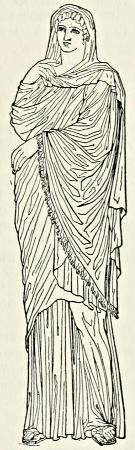
Roman Matron
(From a statue in the Capitol)
Also the difference of political rights between the full citizen with full rights and the slave without any rights at all was as marked in England a hundred years ago as it was in Rome. The relations between the Roman and the Latin citizens might then have justly borne comparison with the conflicting elements furnished by Englishmen and Scotchmen, which to-day are ever growing less and less; but even to-day the Irish on the one hand, with their reluctance to obey, and the English colonies on the other, with their successful diffusion of the English language and English national feeling abroad, reflect most faithfully the picture of ancient Rome.
But above all, England belongs to the few modern states which still possess provinces in the antique sense of the word. The constitution of modern India, with its multiform variety, is the only one of our time that may be set side by side with the constitution of the subject territories of the Romans. In India, as in the latter, the contrasts—religious, ethnographical, and social—are great and very often immediate; by the side of an old and highly developed civilisation we find the simplest conditions of mountain or fisher folk, over whose heads a history of a thousand years has passed without leaving a trace. Again, the political situation of single portions of the country is as multiform as possible: Ceylon, for example, with its separate administration and its separate rights, forms a part of England, while the main continent is only directly or indirectly governed by English officials; its constitution, as in the ancient Roman Empire, defies juristic or political definition in a variety of ways. Only one portion of the country is directly subject to its foreign conquerors; in all the others has been preserved—often to the good luck of the nation—a remnant of the earlier national independence.
As in ancient Rome, England to-day allows the existence of native princes, great and small, who lighten for her the burden of rule and administration; and she permits them to tyrannise over their subjects and extort treasure from them if they fail in their duty to the empire, just as did the sultans of previous centuries. The real power is, for all this, in the hands of the English resident who is set to watch over them. If the evils of local misrule become too great, or the times are ripe for annexation, a stroke of the pen is enough to do away with the whole majesty of a local prince. England is not wont to meet with serious resistance in such a case, any more than did the Romans when they declared that any particular one of their tributary princes had ceased to reign.
Again, the position of the ruling nation in the very midst of the ruled is, in modern times, just what it was in the days of antiquity. The man who goes to India, whether as a merchant, an official, or a soldier, does so with the fixed intention of returning home as soon as his financial position allows of his doing so. Considering the immense disparity in numbers between rulers and ruled, the power of the single officials and people in command must naturally be very considerable. The viceroy of India may well be compared with a Roman proconsul; the range of his power is great, but by a time limit it is sought to forestall an abuse of it. Even after the reforms of Augustus, the means of control were inadequate in ancient times, just as they were in England a century ago. To-day it may be taken as the rule for the higher class of English officials to return home from India with clean hands.
Whether this parallel between the Roman Empire of antiquity and the England of to-day is to the credit of the latter or a subject for reproach, whether it will endure, or whether the modern conditions will develop on similar lines, are questions into which we have not here to inquire; it is enough to have indicated the parallel phenomena in the two great empires.b
THE ROMAN CONSTITUTION
The sanguinary civil wars with their appalling catastrophes had crippled the might of Rome; the staunchest and most faithful champions of republican principles lay mouldering on the coast of Thapsus or the plain of Philippi; the free state that had erstwhile been called into being by the elder Brutus had passed away—the reality on the day of Pharsalia, the ideal through the desperate deed of the younger Brutus.
The struggle between democracy and monarchy had come to an end, political passions were silenced, the existing generation yearned for peace and quiet; the aristocrats that they might take their fill of the pleasures and enjoyments placed at their command by ample means, by culture, art, and learning, the multitude that they might pass the fleeting hours in comfortable leisure, remote from political agitations and warlike toils, their desires limited to the “bread and games” (panem et circenses) which the ruling powers were sedulous to provide for them in liberal measure.
Under these circumstances it was not difficult for the adroit Octavian—who combined great ability and capacity for rule with gentleness, moderation, and perseverance, and was able to disguise his fiery ambition and pride of place under the homely manners of a plain citizen and a show of submission to law and traditional custom—to enter fully upon the heritage of the great Cæsar and convert the republic into a monarchy. But Octavian, warned by the tragic end of his adoptive father, went very cautiously and circumspectly to work. Instead of assuming all at once the fullness of royal power and dignity with which Cæsar had been invested at the time of his death, his son followed his example in the gradual absorption of a divided authority, and thus retraced the slow and circuitous route which led, with pauses and intervals, to absolute dominion. He so far yielded to the antiquated prejudices of the people as to abstain from calling himself “king,” he indignantly refused to be addressed by the title of “lord,” and would not even accept the perpetual dictatorship. Nor did he try like Cæsar to gain the insignia of royalty by indirect means; he retained the republican names, forms, and magistracies, and was himself styled “Cæsar.” But he so contrived that by degrees all offices and powers were conferred upon him by the senate and the people, and thus concealed a monarchy under the veil of the republic. He prized the substance, not the appearance, of power. He willingly resigned the pomp of rule so long as he might rule indeed.
AUGUSTUS NAMED IMPERATOR FOR LIFE
To preserve the figment of free election and voluntary delegation of power, and to allow weaklings and obstinate republicans to blind themselves to the true state of affairs, Octavian from time to time went through the farce of a voluntary resignation of the supreme power and a reconferment of it by the senate, a sham which passed on to his immediate successors. It was first gone through in the case of the important office of Imperator, originally a temporary appointment, which Cæsar had charged with new meaning as the symbol of absolute military authority. This title, which Octavian had long borne in the fullness of meaning imparted to it by his imperial uncle, was conferred upon him for life by the senate in the year 27, after a dissembling speech in which he declared that he was willing to resign his high office into the hands of the senate and retire into private life. He was then appointed to the supreme command of all the military forces of the empire for the term of his natural life and to the office of supreme governor of the provinces which was associated with it. The limitation which he imposed upon himself by promising that he would only undertake to hold this high office for ten years and exercise proconsular sway only over those provinces in which the presence of legionaries was required to maintain order and tranquillity, and would leave the others, which were accustomed to render obedience and were not menaced by enemies from without, to be governed by the senate, was a mere blind; for in ten years it was certain that his absolute rule would have struck such deep root that there could be no further question of dismissal or resignation, and—since no province whether near or far from the capital could altogether dispense with garrisons, and all officers and subordinate commanders were under the commander-in-chief—all governorships were under the control of the imperial proconsul.
Thus the entire dominion of Rome was “encompassed with the net of his military authority”; all victories and conquests were ascribed to Cæsar, and he alone henceforth was entitled to Triumphs. It was therefore nothing but a form when some time later the senate, now completely disarmed, delegated to the imperator its proconsular power in the senatorial provinces also for the term of his natural life, and subjected all consuls to his authority. The complaisant senators at the same time conferred upon Octavian the title of “Augustus” or “consecrated” which he bore thenceforward. By virtue of the imperium the emperor commanded through his deputies some twenty-three or twenty-five legions dispersed over the whole empire; at Rome his person was guarded by nine cohorts of bodyguards (the prætorian guards) whose loyalty and devotion were enhanced by double pay and liberal gifts of money on their discharge, some of them being lodged in one wing of his palace and others quartered upon the citizens in Rome and the neighbourhood. Contrary to law and traditional usage he was allowed to wear military attire and sword, the symbols of dominion, within the walls of the city; and the laurel bushes in front of his dwelling and the oaken garland on the gable proclaimed the fortunate conqueror of his enemies and the magnanimous deliverer of the citizens.
THE IMPERATOR NAMED PRINCEPS SENATUS AND PONTIFEX MAXIMUS
The senate itself had already been reduced to a position of dependence. Cæsar had treated the fathers of the city with scant consideration; he and the triumvirs after him had filled the curia with their own creatures, regardless of dignity, rank, or merit. This body had consequently sunk low in the respect and confidence of the people. Augustus endeavoured to rescue it from degradation and contempt and to give fresh consequence to its members. By virtue of the censorial power vested in himself as “master of morals” (præfectus morum) he undertook, in concert with his colleague Agrippa, a purification of the senate. Nearly two hundred senators were as considerately as possible induced to withdraw and were replaced by worthy men devoted to the new order. He then had the title of princeps senatus bestowed upon himself, and by that means got the direction of the debates and voting entirely into his own hands or those of his representative.
The end Augustus had in view in this process of purification, which was subsequently several times repeated, was to raise the senate, whose numbers were now limited to six hundred, into the representative body of the nation and, by extending its functions and reorganising its share in the legislation, government, and administration of justice, to rule the nation through it; to raise himself from being the head of the senate to being the head of the people, and, by sharing with them the sovereign prerogatives, to delegate to them a part of the responsibility. The right of electing officials was left to the comitia centuriata and comitia tributa, but as the magistrates had simply to carry out the emperor’s orders their position was a subordinate one and their functions were limited; and it was consequently a mere simplification of the political organisation, when in process of time the popular assemblies were degraded into a mockery [they had long been little more than that] and the officials were appointed directly by the emperor or the senate.
Without any outside co-operation Augustus had already committed the charge of Rome and of Italy to trustworthy hands by furnishing the prefect of the city with extensive powers and appointing him his delegate and representative, and by instituting, in the prefecture of the prætorium, a military command over the troops stationed in Rome and Italy. These two life appointments bore in themselves the germ of the future military despotism and most seriously infringed the outward character of the free state, which Augustus maintained in everything else. At the same time he had himself empowered to fill up the ranks of the patricians, grievously thinned in the civil wars, by the admission of fresh members; a privilege the exercise of which made the nobility of ancient Rome entirely dependent upon the emperor and obscured the lustre of birth.
He nevertheless treated tradition and ancient custom with great reverence. He endeavoured by acts of favour to win over to his side such of the great families as had survived the stormy days of the recent period, he revived their family cults and obsolete religious observances, and where there was need he enabled them to live in a manner befitting their station by liberal subsidies. He was anxious to glorify his new throne with the lustre of the olden days that still clung about the old name.
But it was not only the patrician class which Augustus endeavoured to preserve; the ancient class distinctions among the citizens were respected as far as possible. The senators, raised in public esteem by the expulsion of unworthy members, wore even under the principate the broad purple hem as a mark of their rank; they had special seats reserved for them in the theatres, and received from Augustus the privilege that the crimes of senators could only be judged by the senate itself. They could contract legal marriages with none but freeborn persons. In like manner the knightly class was purged of unworthy elements and maintained as a distinct order with a fixed income and recognised privileges. As in republican times, the younger members served as a guarda nobile, being mounted on chargers provided by the state in the field and in the gorgeous processions on civic festivals. The knights were eligible for all curule offices and military appointments, so that the order became the nursery for the military and civil service as well as for the senate. Augustus chose his provincial procurators and tax-collectors by preference from among them. The emperor endeavoured to preserve even the free burgesses from the admixture of alien elements as far as possible, and to this end imposed restrictions and limitations on the manumission of slaves.
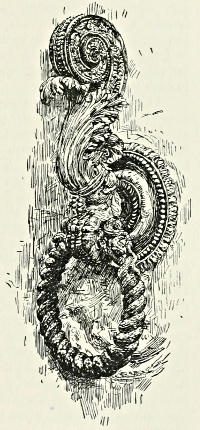
Roman Door-knocker
As commander-in-chief of all the military forces, and head of the senate, Augustus was master and ruler of the state; but one important element of the power which Cæsar had wielded was still lacking—the tribunician authority. This also was conferred upon him for life by the senate and people in the year 23, in the general rejoicings at his recovery from an illness, and because he had appointed L. Sestius, the friend and comrade of M. Brutus, to a share in the consulate.
The office of tribune bore a sacred character in the eyes of the Romans. The most glorious deeds of the nation as a whole in the palmy days of the republic were associated with the tribunate of the people; the plebs regarded it as the palladium of their liberties and legal status; from the days of Coriolanus down to the civil war between Cæsar and Pompey, the broils of political factions had raged around this magistracy of the people. Its solemn bestowal upon Augustus therefore supplied him with a religious consecration; by this alone a sacred and indissoluble bond was knit between the people and the supreme head of the state; the prince (princeps) was recognised as the protector of the people, and the magistracy of the popular community was transferred to its ruler. The rights of protection and intercession inherent in the tribunate were then expanded into an imperial prerogative of appeal and pardon and extended to the whole empire. In civil and criminal cases alike, an appeal to the emperor’s judgment-seat might be made from all tribunals and all parts of the empire, and thus the highest judicial authority in the whole sphere of government was committed into the hands of Augustus. The clemency and humanity for which he was famous caused these appeals to the imperial court to exceed all measure. Special courts of appeal had soon to be erected in the city and in the provinces, in the one case under the presidency of the prefect of the city, in the other under special consular authorities to whom the emperor delegated his judicial supremacy. By this means not only was an imperial court of appeal, such as Cæsar had attempted to introduce, established throughout the empire as the supreme tribunal, which gradually drew before itself all important suits after judgment had been pronounced in the prætorian or senatorial courts, but a far-reaching prerogative of mercy became a recognised attribute of the imperator’s power, a prerogative that could pour forth its cornucopia upon free and unfree, citizen and provincial. “Every temple, every shrine of the emperor in Italy or the provinces was a sheltering asylum, his statues and portraits became wonder-working images of deliverance, which paralysed the arm of justice or revenge.”
At the altars of the emperor even slaves found protection against harshness or inhumanity on the part of their masters. Augustus so highly prized the bestowal of this protective office of Tribune of the people, that he even had the day (27th of June, 23 B.C.) recorded on coins and monuments as the beginning of his reign. Three years later the imperial power received its consummation in the grant of the consular authority to Augustus for the term of his life, with the right to nominate his colleagues or representatives and to propose them for election, and with an extension of the right of issuing legal ordinances (edicts). From that time forward he took his seat in the senate upon a curule chair placed at a higher level between the two consuls.
By these means all political power was concentrated in his person, and when, soon after, the office of pontifex maximus fell vacant by the death of Lepidus, Augustus had this dignity also conferred upon himself, and thus combined the authority of high priest with supreme political power. In virtue of this office the care of the state religion and public worship, the interrogation of the oracular books and the interpretation of their utterances, the appointments to priestly offices and even the choice of vestals, devolved upon the emperor. And as through the fulness of his consular and imperatorial power he exercised the highest judicial authority over the army and in all cases affecting the safety of the state, so as supreme pontifex he had the right of deciding upon all violations of religion and transgressions of the priesthood.
TIGHTENING THE REINS OF POWER
This union of the hierarchic with the temporal power completed the skilfully constructed edifice of the principate. By this means the whole executive and judicial authority in matters spiritual and temporal, human and divine, was placed in the hands of the emperor, and if for a while the people retained the show of legislative power it was a mere shadow of the ancient sovereignty of the people, since the legal tradition which gave magisterial edicts the force of law during the magistrate’s tenure of office reduced every other kind of legislative authority to an empty form when all official power was centred in a person who held office for life.
The imperial decrees were legally valid throughout the empire. They formed the nucleus and basis of the “constitution” which in process of time ranked on an equality with the comitial laws. The wise moderation of Augustus—which induced him to ask the opinion or approval of the senate in all decrees concerning peace and war and withheld him from exercising the power of life and death which he possessed over senators and citizens in an offensive manner, and led him to treat traditional forms with reverential observance—conduced greatly to the establishment and preservation of the legislative authority of the emperor.
“Thus,” says Hoeck,d “the constitution of the young empire was a monarchy in which the rights of sovereignty were shared between the nation and its head.
“No law or election could be carried through in opposition to the express will of the emperor, because he could invalidate by his tribunician veto every assertion of magisterial or popular authority; on the other hand, according to law, his will was not sufficient to ensure the acceptance of a candidate or of a statute, since the emperor had no right to command either the senate or the people. Nevertheless this reciprocal limitation and supplementation of the supreme political authority existed in theory only, not in fact. For where the legal competence of the emperor came to an end its place was taken by a power of which the constitution took no cognisance, but which held all political affairs in the embrace of its mighty arm. This was the effective sovereignty of Augustus, outflanking and controlling all other authority, which broke down the bulwarks erected against absolute government and opened the way for the despotism of his successors. The senate was composed of his creatures, the populace was won over by bread and games, the army attached to him by booty and presents; and thus he had in the curia an obedient instrument of his schemes; the comitia were the echo of his will, and the legions gladly fulfilled the commands he gave. The senate and people might enjoy meanwhile the ancient forms of a free state; they were but vain shadows when the supreme head was minded to accomplish his win.”e
PANEM ET CIRCENSES—FOOD AND GAMES
The sustenance of Rome with which the emperors charged themselves may be regarded in the light of compensation for the political rights of which the imperial government robbed the Romans. The emperor was not the war-lord of the Roman Empire who, as such, felt this duty incumbent upon him; he was rather the most powerful person in the capital, who exerted himself to win the favour of its populace, as the prominent personages of republican times had done.
The custom of occasional distributions by Romans and aliens was a very old one, and had existed ever since the lower classes gained an influence in politics through the elections; but these distributions of corn did not become the rule until the first century B.C., and they became a political danger when they attracted the poverty-stricken rabble of the whole of Italy to Rome, to be maintained there by the state. At the time of Julius Cæsar, in the year 46, there were more than three hundred thousand recipients of corn at Rome, though they were presently reduced to half that number by improved organisation and by the founding of colonies beyond sea by the dictator. This number was not to be exceeded; only the gaps which occurred in the course of nature were to be filled up.
But in the civil wars after Cæsar’s death the old abuses had crept in again, and about the time of the birth of Christ the number had already risen to two hundred thousand. Augustus was by no means blind to the evil; he really wished to abolish the regular distributions of corn altogether, for, besides costing enormous sums every year, they demoralised the people and undermined the prospects of agriculture in Italy. On this subject the emperor writes that he had made an attempt to abolish the public distributions of grains in perpetuity, but had not dared to carry it through, as he knew for certain that after his time it would be re-established by the ambition of others. Moreover, he soon realised that he could not let this most effective means of ensuring popularity in the capital pass out of his hands, nor suffer private individuals to gain a formidable following in this fashion. Later he tried to strike the just mean, and to meet both the complaints of the farmers and corn dealers and the wishes of the populace. The question involved was the regular distribution of corn to the mob and the adoption of exceptional measures, when the price of grain in the capital had risen to an unnatural or intolerable figure. No man who wished to be the first in Rome could afford to shirk this costly obligation. If so strict an economist as Augustus was prepared to bear the enormous cost of these metropolitan distributions we need ask for no surer proof that he regarded them as necessary.
Pauperising the Masses
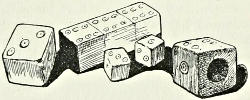
Roman Dice
In the year 44 Cæsar, as dictator, had delegated the charge of the supply of corn for the capital to two cereal ædiles appointed for the purpose; but even they proved unequal to the gigantic task imposed upon them. Recourse was therefore had to extraordinary commissioners, who bore the title of curatores. A later emperor, Tiberius, at the commencement of his official career had an admirable opportunity of making himself popular in Rome when he undertook the cereal quæstorship at Ostia in 23. But the very next year a grievous famine again prevailed in Rome, and, as in the old days of Pompey, extraordinary measures seemed imperatively called for. All eyes were turned to the emperor, the only man who, by his money resources and the Egyptian tribute of grain, was in a position to deal with the scarcity. He was offered absolute dictatorial authority coupled with the responsibility of provisioning the capital. He accepted the latter only, and his measures were so vigorous and effectual that in a few days the price of corn fell to its usual level.
The emperor exercised his official functions through two senatorial representatives. A new magistracy was erected consisting of two curatores who had discharged the duties of the prætorship and thus were already members of the senate. They received an accession both as to numbers and dignity; after 18 we find four curatores, later six, and in the last years, 6 and 7; they were required to be of consular rank. It is in the highest degree probable that younger officials acted with or under these curatores at the extraordinary distributions.
At length, after these tentative experiments, Augustus in his last years took heart to attempt a definite solution of this important problem. Out of consideration for the senate he had up to that time employed senatorial representatives in the provisioning of the capital which he had undertaken at his own expense. They were now superseded by imperial servants. The præfecti annonæ were of knightly rank and really regarded this important office as a profession. C. Turranius, who had previously governed Egypt, devoted himself to this task, to which he had been called by the confidence of Augustus, with such zeal that dismissal was to him equivalent to death, and Caligula reinvested him with his accustomed functions, which he continued to discharge almost up to the ninetieth year of his age.
From this time forward the cereal prefects were amongst the most important of imperial officers, since the tranquillity of the capital depended on the due discharge of their functions. They commanded an army of subordinate officials and servants, for the imperial grain fleets which brought corn, oil, etc., from the provinces to Ostia and Puteoli were under their management. In both these places they had extensive storehouses with a great staff of accountants, clerks, and cashiers; then another great army of storehouse managers, workmen employed in measuring the corn and carrying the sacks, of waggoners, and lastly, of watermen who brought the corn to Rome, where it was deposited for the most part in the Sempronian horrea which dated back to the time of the Gracchi, or in the newly erected Agrippian, Lollian, Galbian, and other horrea. The distribution took place every month in the Minucian portico on the Field of Mars. Here there were forty-five doorways (ostia) for distribution, and the people had to prove their right to receive the corn by means of counters marked with the number of the particular doorway and the day of the month.
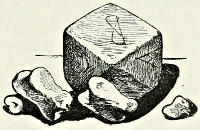
Roman Jackstones
An attempt which the emperor made to have the corn distributed every four months instead of every month met with scant approval and was soon abandoned. The Roman populace had grown thoroughly accustomed to the notion that its maintenance was the business of the state and would have liked nothing better than to have the emperor give them drink as well as food. Whenever wine grew dear they addressed complaints to him. But Augustus calmly replied that since the aqueducts of Agrippa had been completed no one in Rome need suffer thirst. Augustus had organised the maintenance of Rome on a large and liberal scale, but that which had formerly been a free-will offering became in his reign an eleemosynary institution.
Besides these regular monthly distributions there were special distributions in money and in kind on extraordinary occasions, which exhibit the emperor’s magnificent liberality. He has left the record of them in the Monumentum Ancyranum.e “To the Roman people, man by man, I caused three hundred sesterces to be paid in accordance with the testament of my father; in my own name I gave four hundred sesterces out of the spoils of war in my fifth consulate; and again in my tenth consulate I caused provisions to the value of four hundred sesterces per man to be distributed man by man out of my own means; and in my eleventh consulate I made twelve distributions of grain which I had purchased with my private means; and in my twelfth year of office as tribune I for the third time made a gift of four hundred sesterces man by man. These distributions were never made to less than 250,000 persons.
“In my eighteenth year of my office as tribune and my twelfth consulate I presented sixty denarii to 320,000 persons of the population of the capital man by man. In my thirteenth year of consular office I distributed sixty denarii apiece to the people who received the state corn, amounting to something over two hundred thousand persons.”
Taking these gifts in connection with similar expenses for lands and rewards for the veterans, for the imperial contributions to the state treasury and the provision of the military revenue, the colossal sum of six hundred million denarii mentioned in the appendix to the Monumentum Ancyranum as given by Augustus to the Roman citizens does not seem at all exaggerated; and as these distributions were spread over a period of not quite sixty years, we must assign to each year a sum of not less than ten million denarii.
These sums, though dispensed of the imperial bounty, were taken by the people as their right in exchange for their lost liberty. Augustus was well aware that hunger is wont to be one of the mightiest, if not the mightiest, of revolutionary forces.
Games; Gladiatorial Contests
In the matter of subsistence the southerner is more modest in his demands than northern nations are; in the matter of excitement and amusement he makes greater claims. These Augustus also provided for liberally. The large scale and elaborate arrangement of the Roman games was in part the outcome of the simple idea of giving the people a compensation for their lack of influence in politics and of diverting their attention. In most cases where a nation is weary of politics it concentrates its attention upon private life, and the great ones of the theatre thrust statesmen and party leaders into the background. The emperor’s shows excelled everything that had ever been before in frequency, variety, and splendour; and so great was the interest taken in them by all classes that at great festivals and games the emperor was obliged to post sentinels to guard the vacant city from robbers and housebreakers.
The Actian games, celebrated at Rome every four years, were particularly magnificent. The first time (28) Augustus and Agrippa themselves managed the festivities and offered the populace spectacles of the most varied character. First a race ridden by boys and men of the highest families; then gymnastic contests in a wooden stadium which the emperor had caused to be set up on the Field of Mars; while at the end prisoners of war were forced to exhibit to the people the spectacle of a mortal combat of gladiators. In later times the highest priestly colleges in Rome took charge of these games in rotation.
In his detailed narrative Augustus assigns the first place to the combats of gladiators, which he exhibited sometimes in his own name and sometimes in the names of his sons and grandsons; and in eight battles of this sort some ten thousand gladiators were engaged. Women were not absolutely excluded from among the spectators, but they were only allowed to watch the bloodshed from the topmost places. Augustus also abrogated the inhuman custom that none but the victors might leave the arena alive.
He endeavoured to check the excessive fondness for these cruel sports by forbidding officials to give gladiatorial shows instead of the usual theatrical or circus performances when they entered upon office, as had been done, for example, by the ædiles of the plebs in the year 42. Certain members of the aristocracy who were notorious for their bloodthirsty tastes, like Domitius Ahenobarbus, were first privately admonished, and, when that proved of no avail, their cruel gladiatorial fights were prohibited by an imperial edict.
Large troops of gladiators constituted a grave menace to the public peace, as had been proved, not only by the Gladiators’ War, but in the case of the gladiators of Decimus Brutus and M. Antonius. Accordingly in the year 22 an edict appeared to the effect that combats of gladiators were only to be arranged with the permission of the senate and not oftener than twice a year, and at the same time the number of contesting pairs was limited to sixty. Of course this did not diminish the popularity of these combats nor the interest of the populace in the combatants. It was an event when two veterans, each of whom had often conquered and slain his opponent, were at last pitted against each other for the decisive combat, or when a well-known gladiator had fought his way through and proceeded to hang up his victorious weapons in the temple of Hercules.
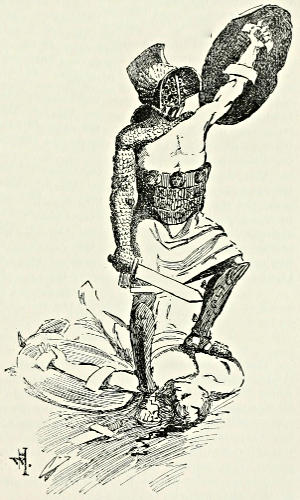
Roman Gladiator
In later days the emperor Tiberius scorned to make himself popular by these means. But as the passion of the people for gladiatorial exhibitions did not wane they became a matter of private speculation. A freedman of small means erected a wooden amphitheatre for his shows at Fidenæ, but it was so badly built that it collapsed beneath the crowds of spectators who had flocked thither, most of them from Rome. After this accident the senate decreed that no one should give such performances unless he could prove that he was possessed of a certain fortune.
Wrestling matches of the sort so popular among the Greeks were not altogether unknown, but were only arranged three times by Augustus in the course of his long reign. Wooden stages were erected on the Field of Mars, and the most famous athletes were invited to Rome. Glycon of Pergamus, whose unconquered fist was celebrated not by his epitaph alone but also by Horace, was probably of the number.
The emperor followed these contests with peculiar interest. The Greeks had perfected boxing according to all the rules of the science; in Italy, on the other hand, it had retained more of its indigenous character. Augustus was in the habit of occasionally allowing the champions of the two nations to measure their strength against one another, but personally he was on the side of the Latin boxers, whether more or less schooled. When a harmless street fight broke out in any part of Rome, the emperor used to delight in the mighty blows which his countrymen dealt.
The emperor strove, though without lasting success, to keep women aloof from the brutal boxing matches. If the populace wanted to see boxers he yielded to their wishes, but he appointed the early morning hours for the contest and forbade women to go to the theatre before ten o’clock in the morning.
More popular still were the wild-beast hunts, of which Augustus arranged six-and-twenty, in which thirty-five hundred African lions and other wild animals were slain. Great was the difficulty of capturing and transporting these rare and dangerous animals; but greater still, it may be, the amount of care and money expended on the elaboration of the scenery. The Spaniards regard their bull-fights as a direct continuation of the wild-beast shows of antiquity; the splendour of the mise en scène has survived to modern days, but the demands made by an ancient public in the matter of decoration and machinery were incomparably greater. In most cases gladiators were obliged to fight the dangerous animals, but occasionally criminals fell victims to them. Strabo, for example, saw the dreaded robber chieftain, Selurus, “the son of Etna,” hurled from a lofty scaffold that suddenly collapsed beneath him into the arena at Rome, where he fell straight into the lion’s cage that had been placed below.
The bloody battles of the gladiators on land found a counterpart in a tremendous sea fight which Augustus, following the example of the dictator, arranged quite close to Rome in the year 2. He caused a lake to be dug in the plain between the slopes of Janiculum and the bank of the Tiber, eighteen hundred feet long by twelve hundred wide, on which thirty large warships and many smaller ones, manned by three thousand (or possibly six thousand) gladiators, represented a sea fight of the time of the Persian wars. Ovid describes the gorgeous spectacle as an eye-witness:
“Then when Cæsar of late showed forth to the people Ships of Persia and Athens, a type of the terrible sea fight, Hither came youths from the two seas and hither came maidens, And to the capital flocked all that dwelt in the earth.”
The lake was not supplied with water from the neighbouring Tiber, but Augustus built a special aqueduct (Aqua Augusta Alsietina) which brought water from the Alsietine and Sabatine lakes (Lago di Martignano and L. de Bracciano) to the Janiculum. The Romans were so spoiled by the beautiful spring-water of their aqueducts that Augustus never thought of carrying the water of these two lakes right across to the city on the other bank of the river, but the work was so substantial that it outlasted its original purpose. The emperor allowed the possessors of fields and gardens in the vicinity to make use of the water, which was not to be compared with that of the other aqueducts in the city.
The lake formed the centre of a little wood which the emperor presented to the Roman people in the name of his grandsons Lucius and Caius. Although he never arranged another sea fight on this lake, it was not filled up but was used by other emperors for maritime spectacles, in accordance with its original purpose.
Races and Theatricals
The ordinary performances in the theatre and circus, such as officials were required to arrange when they took office, were arranged by Augustus four times in his own name and twenty-three times in the names of other persons. Races in the circus, in particular, had been in vogue from very old times and enjoyed a high degree of popularity. It is true that the enthusiasm of the people did not reach the culminating point till the latter days of the empire, but the germ and rudiment was there even in republican times, and the age of Augustus did its fair share towards developing it. Epitaphs were not yet composed on the victors, like the τοὺς σοὺς ἀγῶνας αἰὼν λαλησει of subsequent centuries, but the interest and enthusiasm were spreading to wider circles. The prizes which rewarded the winners of the various races were valuable, and an exact record was kept of the first, second, and third prizes carried off by a famous charioteer in different years. There were originally only two parties in the circus, the whites and the reds, but the greens and the blues appear to have been added by the time of Augustus; or so it seems probable from inscriptions which, though they bear no date, yet form part of a large find of this period.
Even private individuals (e.g., a relative of the famous jurist Ateius Capito) were beginning to keep racing stables with a numerous staff. His slaves and freedmen formed a life-insurance association in which Vipsanius Agrippa also insured his servants of the same class. The Trojan riding matches which the sons of aristocratic families, including that of the emperor, repeatedly exhibited under Augustus have already been mentioned.
Theatrical performances are mentioned in the emperor’s enumeration, but recede very much into the background as being quite commonplace; they were mainly the affair of newly elected officials, but Augustus himself had plays acted in all sorts of places—the Forum, the Amphitheatre, and even on temporary stages in the streets and squares of the capital, in every language spoken in Rome, Latin and Greek being of course the chief. Every play-giver desired to offer the populace something quite unique. The dictator had even allowed a Roman knight to appear on the stage, and his son followed his example until it was interdicted by a decree of the senate.
Augustus purposely abstained from increasing the number of ordinary and regular festivals to any great extent. The Secular games, of which we shall speak presently, naturally do not come under this head, as do the district games, associated with the new subdivision of the capital. We have already mentioned the games commemorative of the victory of Actium; the martial games were added later in commemoration of the solemn dedication of the magnificent temple of Mars in 2 B.C.
To the innovations of the empire also belong the votive games for the return of the emperor from Gaul and Spain in the years 13 B.C. and 7 B.C.; also votive games for the welfare of Augustus which were arranged every four years by the great colleges of priests in compliance with a decree of the senate.
The example of Rome soon found imitators in the capitals of the provinces; sometimes it was the emperor himself who instituted games there, sometimes prominent citizens who had received or hoped to receive some post of honour. The number of games held in honour of Augustus was very great, especially in the Greek cities. In Naples the imperial games were celebrated in the same fashion as the Olympic games, in commemoration of the visit of Augustus in the year 14 A.D.
NOVUM SECULUM—THE NEW BIRTH FOR ROME
Even as in the life of the individual there are often moments when he remembers with grief and yearning the golden days of childhood, so in the development of nations there are periods when the best minds of the nation dream of a past golden age, in which both the crime and the progress which have come to pass in the course of historical development were unknown. The farther the nation is from a primitive condition and the more strongly its members feel the drawbacks of civilisation, the brighter are the colours in which they paint the innocent joys of an earlier state of things to which violence and rapine were as yet strangers.
The generation which had grown to manhood during the civil wars had of necessity accustomed itself to horrors which are spared to those who grow up in times of order. All the more vividly did they dream of a happy and primitive age in the distant past; for none feels a greater enthusiasm for peace than those who have had to endure the evils of war.
Since the battle of Actium the civil wars were happily at an end; for nearly half a generation Rome had enjoyed the blessings of peace and the new constitution which Augustus had given her. The emperor had often announced his resolve to retire into private life, but had always allowed himself to be persuaded not to carry it out because the welfare of the state forbade it; he alone seemed to guarantee peace and safety, his rule seemed inseparable from domestic tranquillity, and the man who desired the one could not but desire the other. The emperor strove to keep this single idea in fresh variations constantly in mind among the Romans, and those honours pleased him best which gave public expression to this feeling. The senate, on the emperor’s return had dedicated the altar of the imperial peace. The poets, each after his fashion, sang the praises of peace and order:
“Fealty, peace itself, and honour, and the ancient Moral awe, the long-forgotten virtue, Now dares to return, it approaches, its horn Full of blessing.”
There was, however, a danger that the rising generation might soon come to accept the benefits of peace as a matter of course, without definitely realising to whom they owed these blessings, and it was therefore desirable to keep in remembrance among the emperor’s contemporaries the difference between the unquiet past and the blissful present, and to give official recognition to the fact that the period of civil war was over and that a century of peace and prosperity had taken its place.
Such turning-points imply an invitation to take a backward glance and to reckon the sum of development up to this point. So had a poet done at the end of the previous century:
“How fair, O man, with thy palm-branches Standest thou in the century’s decline,” etc.
The Rome of the period was also to take a backward glance.
As the senate had solemnly marked the end of the wars by closing the temple of Janus, so Augustus desired to mark the end of the period of reorganisation and reconstitution by an imposing symbolical act. Even the ordinary Roman census was not a mere counting up of the people; it was a reconstitution of the ranks of Roman citizenship, and if this tedious and toilsome preparatory labour were to attain legal validity, it must find its ratification and consummation in a final act in which the whole nation should be purified with the most solemn religious rites and commended to the propitious gods for the future. Similarly Augustus had been at work since the year 29 on a reorganisation of Rome, which was finally declared complete in the year 17 by a mighty lustrum, the Secular Festival.
The idea, and probably the name, of the seculum is not Roman but Etruscan; at least, up to the present time no one has succeeded in discovering any plausible Roman etymology for the word. The seculum is probably of Etruscan origin, like the other elements of chronology among the Romans. This devout nation, which understood as no other did how to inquire into and interpret the will of the gods, fancied that it had learned that the deity did not merely declare to men the ordinary divisions of time into months and years by the path and the varying appearance of moon and sun, but that apart from these there were longer periods in the life of nations which the gods had appointed, and of which they revealed the beginning and the end to the generations of men by manifest tokens. Such a period is that in which one generation dies out and a new one arises, and it therefore extends from the birth to the death of a man who may be taken as the representative of his generation. When the last man died who was born at the beginning of the first seculum, then the second began; and, as the duration of human life seldom exceeds the hundredth year, a new seculum commonly commenced at the end of this period. It did not, however, of necessity last for exactly a hundred years; on the contrary, there had been one of 123 years in length, another of 118, etc.; but the Etruscans reckoned their seculum approximately at 100 years. When therefore the miraculous signs ensued, mortals realised that in the counsels of the gods the end was at hand, and hastened to propitiate the omens by sacrifices and games. In misfortune, men learned to take special heed of the omens of the gods, for they longed for the opportunity of concluding the unfavourable period and beginning a new one, free from ill-fortune and evil presage.
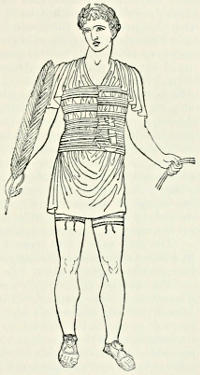
Statue of a Victorious Driver in the Games of the Circus
(In the Vatican)
This grand wisdom of the Etruscans, which looked beyond the limits of human life, made a profound impression on their pupils, the Romans, and was transferred to Rome with the rest of the augural discipline. The family of the Valerii is said to have been the one to introduce this cult into Rome, for themselves alone in the first instance, and not as yet in the name of the state. One of the ancestors of this family, it was said, had come to Rome from his home in the land of the Sabines to propitiate the evil omens which disturbed him there. He came down the Tiber with his sick children till he reached the vicinity of Rome, and there, where the Field of Mars is narrowest, near the bank of the Tiber, was formerly a spot noted for volcanic phenomena, hot springs, and subterranean fire—the so-called Tarentum. The sick children were cured by the water of the neighbouring spring, and twenty feet below the surface of the ground the father found a primitive altar to the infernal gods, to whom he gave thanks for the miraculous cure by sacrifices, games, and lectisternia. A descendant of his is said to have been one P. Valerius Publicola, who, as consul in the first year of the republic (509) repeated these games of his family cult in the name and for the welfare of the state of Rome. It was essential to the secular theory of later generations that so important an epoch as the end of the monarchy and the beginning of the republic should have been marked by public secular games.
The next secular games were also said to have been celebrated by another Valerius, who was consul in the year 449, after the fall of the decemvirs; and about a hundred years later the third secular games had to be celebrated, which, according to the records of the quindecemviri, was again done by a consul of the house of the Valerii in the year 346, though no one else knows anything about such a celebration and it was not counted in the series of republican secular games. For according to Valerius Antias, the third secular games were celebrated in the year 249, at the time of the First Punic War; and the fourth—whether they were held in the year 149 or 146—mark the end of that memorable period. For a theory had taken shape among Roman antiquaries and historical students, of whose number was even a man of the erudition of Varro, that the seculum must always be a hundred years long, and for the sake of this theory the games, which on contemporary authority were held in the year 146, were put three years earlier. A hundred years later Varro’s authority on all such matters was at its zenith, and it sufficed to fix the next celebration for the year 49. “But instead of the celebration came the end; for this was the year at the beginning of which Cæsar crossed the Rubicon, and with that began the mortal agony of the republic. What commenced was not a new seculum for the republic, but a new order of things.” (Mommsen in Die Nation, 1891.)
The civil wars which ensued and seemed to develop one out of another in endless sequence, might, perhaps, have stifled the hope of peace in Italy, but not the longing for it. An iron age had dawned instead of the golden.
The dictator did in truth seem to succeed in exorcising the demons of discord and discontent. But this hope proved illusory on the ides of March. Soon afterwards the star of the Julii was seen at Rome, and seemed, as was at first hoped, to be the long-desired divine token that was to inaugurate a better time. An Etruscan haruspex proclaimed to the assembled people that the ninth seculum (according to the Etruscans) was coming to an end and the tenth beginning.
But the augur died immediately after; a sign that his words were not indeed false but premature, according to the will of the gods. Nowhere did any likelihood of permanent amelioration present itself, but the yearning remained and hardly ever found stronger expression than in the wretched years that followed the murder of Cæsar. It was strengthened by Sibylline oracles, which were privately circulated and kept faith in the happy future alive. Since the oracle could not lie, it was, perhaps, nothing but miscalculations and vain hopes of men, in the year 49, which had anticipated too soon the dawn of a new age; and perhaps the seculum should be reckoned at 110 years and not 100—it takes but little to revive hope. In the year 43 no less a person than Varro announced to the anxious world of his day that this was the correct estimate; 440 years after the first celebration the fourth Roman seculum was declining to its close, and then a new birth would usher in the new age. But Rome still hoped in vain. Misery increased, and with it the excitement spread into the widest circles. In the year 40 Asinius Pollio was consul, a man of honourable character and highly educated, who endeavoured to avoid the arbitrary usurpations of other rulers. In the circumstances of the time, not the boldest imagination ventured to dream that he might bring back the golden age. But Asinius was at that time expecting the birth of a son; perhaps this son was destined by fate to do so; and a contemporary poet greets the coming deliverer with the most ardent longings. In later days Virgil, with better reasons, fixed his hopes and desires upon the emperor.
The opportunity of holding secular games in the latter half of the last century before Christ had thus passed by unused, and it was a very difficult matter to prove that Augustus was entitled to hold such a celebration. This hard and thankless task fell to the share of the famous jurist Ateius Capito, who acquitted himself skilfully enough to make the will of his master possible in theory. The chronology of Roman history has suffered violence at many hands before and after the time of Ateius Capito, but hardly ever more than at the time of the secular games of Augustus.
A comet, so readily connected by the popular imagination with the end of the world, appears to have decided the old question as to the turning-point of the longed-for cosmic period. It might indeed seem as though the gods themselves had declared their will; for at the beginning of the year 17 an extraordinarily bright comet was visible at Rome, with a long tail pointing from south to north. This was of course the star of the Julian gens, which Rome had not seen since the terrible year of 44. That which the youthful Cæsar had then undertaken with almost superhuman courage for the sake of avenging his father was now finished, and the age of strife was over. At that time the red glow of the comet had portended blood and civil wars; the second appearance of the Julian star, after the expiation of the crime, was a sign that the beginning of the new age was close at hand.
The memoirs of the emperor show what great stress he laid upon the appearance of the star of the year 44, and the coins of the empire struck soon after 17 testify to the impression made upon him and his contemporaries by the supposed return of the star of the Julian gens. It was greeted as the long-desired and manifest divine sign of the end of the iron age and the commencement of the golden.
Hence we see that the appearance of the star only gave the decision in the last resort. That which had long been in the air, that which was perhaps already beginning to evaporate, suddenly condensed into tangible shape under the influence of this divine manifestation; Augustus resolved not to let the moment pass unused, but to celebrate the long-expected fifth secular games, which were associated with the hope of a new birth for Rome.b
LITERATURE OF THE GOLDEN AGE
With the formation of the monarchy coincides a second revival of Roman literature, which can only be partly attributed to the new administration, as the leaders were born under the republic and grew up amidst the struggles for the monarchy. This period does not differ so much from the literature of the period of free government as might seem at first sight. For that peculiarly characteristic penetration by the Greek spirit which extended even to that manifestation of it which was least worthy of imitation, namely the Alexandrian, had been already in existence, and the refined elaboration of the language for poetical purposes, its charm and lightness, its beauty and merit, are already perceptible in the time of Terence, though in a very different fashion.
The great revolution which was taking place before their eyes had a far less disastrous effect on the poets of this time than might have been expected, and if the lamentations of the civil war are heard everywhere, it is, nevertheless, rather the ideas of universal peace and the greatness of the Roman power which determine the pervading key-note. It is true that if we look for the originality, power, and simplicity which are so irresistible in Greek literature, we shall be very much disappointed; for they are no more to be found in the literary creations than in the political. And for these defects the number of productions can offer no amends. The thought of writing for a large public, the entire Latin West, must have had an inspiring effect on an author, as it of course decided the whole conception and direction of literary compositions; the provinces took a more and more active share in them; on the other hand, in this field a kind of substitute was offered for the lack of political activity; it was a matter of course that authorship was harmless and accommodated itself to the ruling system, or else entered into a dangerous opposition to it. Partisan writing existed during the active political struggles of Rome even under the republic; but now sunshine and light were too unequally divided, and the frankness which was forbidden during the lifetime of the rulers indemnified itself after their death by bitterness and calumny.
The really higher styles of poetry, such as drama and epic, entirely died out. It was not as if this had been caused by the change in the government, for even in the time of the republic little originality or creative power had been shown in these directions. All that was now produced was borrowed entirely from the past. Rhetoric, metrics, and careful diction were all that could be added to it, and a beautiful, refined, and elegant form became the criterion according to which the age judged both literary and artistic productions. It was to such matters as these that the attention of the judges who decided concerning the admission of the poets into the national library was mainly directed.
We have no adequate information regarding the dramatic poetry of the Augustan period, for everything which won the applause of contemporaries has been lost. What has been preserved to us from this period, namely the tragedies handed down to us under the name of Seneca, has all the faults which a depraved taste brings with it; sensational plots and scenes based on sensual and sentimental emotions; figures without life, but of many words and speeches; a treatment without knowledge of dramatic technicalities; and yet withal a harmony of words and verses, highly polished versification and diction, and the whole magnificent apparatus belonging to the schools of rhetoric in periods, antitheses, similes, and plays upon words. It is decidedly to the credit of the lower classes if they turned away from these dramas, leaving them to the lifeless declamatory exercises of the so-called educated classes, and in so far as the taste for the drama still existed, preferred to amuse themselves with a simpler entertainment and the familiar pieces of the older poets, which had long ceased to be sufficiently refined and elegant for people of cultivation.
Nor did the epic produce anything really great. Virgil (P. Vergilius Maro, born on the 15th of October, 70 B.C., died the 22nd of September, 19 B.C.) did indeed make an attempt to create a national epic in the Æneid. But it is no more genuine than its fundamental idea of connecting the founder of the new empire with the father of Italian civilisation. Virgil studied under the Alexandrians and all that was to be learned he learned. He created the language and the verse structure which remained the standard for many centuries, so long as and wherever Latin poetry was cultivated. The form is throughout noble, and the poet was thoroughly acquainted with Homer and the Greek epic poets, nor is it without taste that he, as a man of learning, has drawn on this treasure; his ideas are pure and noble and he had learned to know his country and the legends of his forefathers better than many before or any after him, so that a certain national colouring is to be found in his work. But there was one thing which he did not possess; the creative genius which divines rightly in the choice of subject and arranges and treats its material with a light but master hand; as the subject was ill-chosen, so the poet never felt any hearty enthusiasm for it; everything has been thought out and very coldly and soberly thought out; beautiful pictures and striking comparisons are indeed presented; but they are sentimental and studied, and often look strange in their setting.
In the first place the hero is no hero, and the Roman patricians of even the time of the Scipios would have been revolted by this weakling who is feeble and sentimental like the poet himself, and not much more than a puppet in the hands of his divine mother. Such a weak figure gives no opportunity for strength in the treatment, which is accordingly languid, and the twelve cantos are spun out with monotonous tedium, so that to every one acquainted with Homer the reading of them is a mere task to be got through somehow. And if, from the standpoint of learning, the language and verses seem irreproachable, classical, and even worthy of imitation, all pleasure in them is lost by the fact that we are continually aware of the trouble and labour which they cost the poet.
It is characteristic of the times that Virgil possessed a canonical consideration with high and low, and poets and prose writers vied with one another to steal from him. From this fact we may guess the rest, and the loss in this field which has been recorded can have been no great one.
But how rapidly literature declined at the end of the period is clearly shown by the epic of M. Annæus Lucanus, the Pharsalia. This poem was produced in the reign of Nero, and it is difficult to decide whether the choice of subject or his treatment of it deserves the greater censure. The hero of the poem is Pompey, the Pompey of the civil wars, a figure so little poetical that a more unfortunate selection could scarcely have been made; with the utmost poetical license even without any anxiety to keep to the facts there was nothing to be made of the subject. That the civil wars in themselves might be capable of being made the subject of an epic is indisputable; it is equally indisputable that this could be done only by a poetic talent of the first order. But even Lucan could do it in his way, though he is no poet but a scholar of the school of the rhetoricians and the Stoa. As in the school of rhetorics the energy of the scholar signalised and exhausted itself in individual feats of ingenuity, so the poem is divided into a number of scenes without much connection, but distinguished by a soaring imagination, sounding verses, and pompous tirades, and of course with many learned accessories, without which neither a great nor a small poem was conceivable in that period. Besides this haste, uneasiness, and want of discretion are everywhere apparent, and these, too, belong to the time. On the whole it may be said that this poetry is a true reflection of the society in which it originated, and if we had epics by Seneca they might probably resemble those of his nephew. Of such models there could not fail to be imitations; the attempts even extended to the schools, and the editing of the Iliad may well have been the work of industrious scholars, who knew something of Greek and had learned to imitate their Virgil.
Virgil had already directed his attention to the didactic poem, and the Georgics are in their way his best creation. Didactic poetry is not approached with the same expectation as in the case of the higher kinds of poetry, and it is scarcely possible to draw the line between instruction and amusement. When the existence of this monstrosity has once been justified it must be allowed a certain amount of free play. Virgil had here the great advantage of dealing with a subject in which he was really interested and into whose treatment he put his whole heart. A deep feeling for nature and really genuine human sympathy with the subject, which are precisely what is nowhere to be perceived in the Æneid, occasionally break forth in the poem on agriculture. An artificial shepherd’s life, much like the idyls of the eighteenth century, is delineated in the Eclogues, and its unreality is only surpassed by Calpurnius, an imitator of the age of Nero.
Whilst the didactic poem proper received no further attention worth noting during this period, the elegy was successfully dealt with. In Albius Tibullus (54-19 B.C.) it even acquired a characteristic, one might almost say more national form than is the case with its other representatives.
In his elegies, Tibullus is as essentially free from the Greek influence as is conceivable in an age which was steeped in Hellenism; he treated the few themes, which are to be found in his poems, entirely from the human standpoint, and it is only by this means that he tries to affect the reader. The sameness which is easily produced in such works—love and sentimental sorrows are constantly recurring—he has successfully avoided by an extraordinary elegance and charm of treatment. The reader willingly follows the dreamy thought of the poet without blaming him for having led him rather into a world of dreams than into one of living and strong feeling.
The productions of S. Propertius (49-15 B.C.) are already much inferior. He also had true feeling, and the thoughts which it awakened in him are for the greater part not borrowed from his models. But it is overloaded with the learned accessories of Alexandrian learning, and the deep feelings of the poet are unduly thrust into the background by blatant mythological embellishments.
Far more splendid and brilliant is the talent of Ovid (P. Ovidius Naso, 43 B.C.-17 A.D.) who cultivated a wonderful borderland between didactic and elegiac poetry. But all his poems have one trait in common, although the Metamorphoses and Fasti may differ from the amatory poems, the Tristia and the Heroides; they, for the first time, display in a more and more decided fashion the arts of the schools of the rhetoricians.
Ovid was a talented poet, to whom verses and thoughts came rapidly and without difficulty, but he was entirely wanting in depth of feeling. Even the poems, which came most from his heart, those laments which he sang in his banishment at inhospitable Tomi, scarcely arouse true sympathy, for the intrinsic unreality from which the poetry of Ovid suffers even here forces itself upon the reader. He recognised the conditions of the new monarchy unreservedly, and no poet is so well qualified as he to give us a picture of the views and manner of thought of the circle which surrounded the imperial house. Sensuality and pleasure are the scarlet threads which run through the Ovidian poems, and the pain which tortures him in banishment is entirely the effect of being shut out from the luxurious way of life which prevailed in those circles whose conversations and intrigues were the very life of his poetry.
The satire also, that most characteristic production of the national spirit of Rome, was now cultivated in a fashion partly original by Horace (Q. Horatius Flaccus, born on the 8th of December, 65 B.C., died on the 27th of November, 6 B.C.). Deep feeling or an effective comprehension of the times, its weaknesses and duties, would be sought for in vain, for the salons of the Augustan period no longer possessed these qualities, and it is a picture of the conversations of the salons that has been bequeathed to us in the Horatian satires. Some gossip of a higher or lower order, for the most part in a seemly though piquant form which seldom becomes real malice, forms the subject-matter of all the poems which have come down to us. The poet rises to a higher level in the didactic epistles, of which those of the second book, with their exhortations to the study of Greek models and their tasteful and striking æsthetic reflections, belong to the chief productions of the time; and in ripeness and clearness of judgment, careful polish and clear arrangement, they leave all others far behind them. Greatly inferior to the satires are the partly satirical Epodes, in which the personal element is too prominent, and in which the poet betrays great want of self-restraint and taste.