Book 2 — CHAPTER XXXIII. THE IMMEDIATE SUCCESSORS OF AUGUSTUS: TIBERIUS, CALIGULA, AND CLAUDIUS (continued 2)
Reading edition
We must be careful notwithstanding to observe that both the shame and the degradation were for the most part confined to the city and its vicinity, which were oppressed by the shadow of the imperial despot.f
Caligula (Caius Julius Cæsar Caligula), 37-41 A.D.
All Rome drew a deep breath at the great news. Macro’s adroitness and the devotion of the Romans to the house of Germanicus induced the senate to confer all the imperial prerogatives on the youthful Caligula. Thus began one of the strangest and most terrible episodes in the history of Rome. The dangerous defects and the baleful forces inherent in the system created by the first two emperors were fated to come to light with amazing rapidity in the course of this young Cæsar’s reign; a reign which it is difficult for the historian to consider critically, because one result of the wrath and contempt most justly evoked by his scandalous misrule has been that of many of his sanguinary and foolish deeds no record except a deliberate caricature has come down to us. The fervid enthusiasm with which the capital hailed the son of Germanicus seemed at first justified by the manner in which Caligula exercised the authority which had now devolved upon him.
Impelled by nervous haste and violent passion in all things, whether good or evil, and relying on neither minister nor favourite, he displayed a restless energy of the type natural to a man of but moderate ability who is wholly deficient in administrative training and incapable of exact thought. His delight at the enthusiastic acclamations of the Roman people inspired this singularly organised being with the best of resolutions; he fully intended to make the Romans happy.
Thus he bore himself at first with modesty and good sense, especially in his dealings with the senate. His liberality to the populace and the soldiers, his pious reverence towards the dead, no less than his consideration for the living members of his house, and the pardon of all persons accused of offences of majestas, together with various liberal ordinances, all conspired to produce a strong impression in his favour. But what most roused the enthusiasm of all classes was that, casting aside the niggardly economy of the emperor Tiberius, he shared freely with them all in the festive humour of “games” of every kind.
For eight months he ruled in this fashion, and at the end of that time his unbridled excesses brought on a dangerous malady, from which he recovered much to the hurt of the Roman Empire and his own reputation. Previous to this time he had lived as in a state of perpetual mental intoxication, brought to a climax probably by the fulsome expressions of popular concern during his illness. Whether the latter really had an ill effect upon his mental faculties or not, the madness of which he thenceforth gave manifest proofs is of a different type; a type to which critical students of the history of imperial Rome have given the name of megalomania or Cæsarian madness, and we meet with it in others besides Caligula.
A man in this condition—sane enough to realise that as long as the material basis of his power, the loyalty of the soldiery and the masses, is unshaken, he will meet with no opposition in the gratification of his maddest whims—may at any moment conceive the idea of testing the validity of his omnipotence in any direction. It is a mere chance whether this display of power is directed towards great or even reasonable ends, or whether it issues in deeds of crime and horror. This is more particularly the case when the monarch in question is the victim of shattered nerves, the child of caprice, and the toy of every passing impulse.
The premonitory signs of the evil to come manifested themselves soon after the beginning of the year 38. Caligula, who chiefly delighted in the company of charioteers, stage-players, and buffoons, began to make a wanton exhibition of his despotic power, thus abruptly breaking with the astute policy of his predecessors. And it was a despotism which ignored the precepts of ancient Roman decorum, which, in sexual relations, overstepped all bounds of law and modesty, nay, even of common decency. To the wearisome admonitions of Macro, who exhorted him to act with some degree of discretion, he replied by forcing both the general and his wife to commit suicide.
Presently, however, the monarch having spent the vast riches of Tiberius in the space of nine or ten months, and being possessed with a mania for building as well as with a passion for games, became aware of a very perceptible limit to his omnipotence. To relieve himself of his financial embarrassments, he had recourse to the most sanguinary as well as to the pettiest and most infamous measures. Capital charges, most of which were decided before the emperor’s own tribunal, became more and more numerous, partly to satisfy Caligula’s growing lust of blood, partly to fill his coffers with the proceeds of confiscation. Trials for offences of majestas were revived as a matter of course (39 A.D.).
The money thus acquired was squandered again and again on objects that could only be called colossal whims. Of these the most notorious was the construction of the ephemeral bridge of boats between Puteoli and Baiæ, across which he caused a substantial highway to be made, with aqueducts and posting stations, after the model of the Appian way, for the sole purpose of crossing it, surrounded by his guards, in the character of triumphator, and celebrating this chaining of the ocean by a gorgeous banquet.
His administration of imperial affairs was characterised by the same whimsical caprice. Having restored for no good purpose the kingdom of Commagene, he bestowed upon his friend and contemporary, M. Julius Agrippa (or Herod Agrippa, born 11 B.C.), grandson of Herod the Great, the greater part of his grandfather’s dominions, most of which had been annexed to Syria under Augustus and Tiberius. On the other hand, he summoned Ptolemy, king of Mauretania (from 23 B.C. onwards), to Rome in the year 40, and there put him out of the way for the sake of his wealth.
Tradition represents all the scenes of Caligula’s visit to Gaul in a light absolutely grotesque. [Some details from Suetonius will be introduced presently.] The shout of triumph after a sortie across the Rhine in which some of his Germanic guards were brought back as sham prisoners, strikes the reader as wholly comic, but we note with indignation that at Lyons Caligula continued the disgraceful system of making money by capital sentences and criminal charges against persons of rank, and recruited his finances by putting interesting and ancient articles from the palace of the Cæsars at Rome up to public auction.
The collection of an army, estimated at some 250,000 men, in the ports of the Morini on the Channel with a view to the conquest of Britain remained nothing but an empty demonstration. It may have induced the British chiefs to avert the danger by a formal act of homage and valuable presents; but tradition represents Caligula as concluding this bloodless expedition with a piece of buffoonery, and after bestowing costly gifts on the soldiers, commanding them to pick up shells on the shore as “spoils won from the ocean.”
When he returned to Rome, late in the summer of the year 40, his humour assumed a more and more sinister character. He regarded his own person as divine, though he loved to appear with the attributes of the various gods and goddesses of the Græco-Roman Pantheon; and he now instituted a college of priests in his own honour, and while heaping ignominy on the most revered of ancient images of the gods, commanded that he himself should be worshipped in temples set apart for the purpose throughout the provinces.
In this attempt he met with serious resistance only from the orthodox Jews. When P. Petronius, legate of Syria, received orders to set up a colossal gilded statue of the emperor in the Holy of Holies at Jerusalem, the wrath of the Jews rose to such a pitch that nothing but the sudden death of Caligula prevented the outbreak of grave trouble throughout Judea. By this time the tyrant’s popularity was declining even among the masses at Rome, whom he had pampered with games and presents; for he had lately begun to impose on the citizens of the capital a series of burdensome taxes, which were exacted with the utmost rigour. Nevertheless his fate did not overtake him till his conduct gave deep offence to several of the officers of the prætorian guard. Then Cassius Chærea, tribune of a prætorian cohort, headed a conspiracy, and aided by Cornelius Sabinus and others slew the emperor in a corridor of the palace on the 24th of January, 41 B.C.m
SUETONIUS DESCRIBES CALIGULA
For details of his brief but appalling career we cannot do better than go to the fountain head—Suetonius. There is no other important ancient source for this reign except Dion Cassiusj; and modern research can only interpret and criticise, without adding to the original records.a
He assumed a variety of titles, such as “Dutiful, the Son of the Camp, the Father of the Armies, and the Greatest and the Best Cæsar.” Upon hearing some kings, who came to the city to pay their respects to him, contending amongst themselves at supper, about the nobleness of their birth, he exclaimed, “Let there be but one prince, one king.” He was strongly inclined to take a crown immediately, and to turn the imperial dignity into the form of a kingdom; but being told that he far exceeded the grandeur of kings and princes, he began to arrogate to himself a divine majesty. He ordered all the images of the gods, that were famous either for their beauty or the veneration paid them, amongst which was that of Jupiter Olympius, to be brought from Greece, that he might take the heads off, and put on his own. He carried on a part of the Palatine as far as the Forum; and the temple of Castor and Pollux being converted into a kind of porch to his house, he would often stand betwixt the two brothers, and so present himself to be worshipped by all votaries, some of whom saluted him by the name of Jupiter Latiaris. He ordered likewise a temple and priests, and the most choice victims for his own godhead. In his temple stood an image of gold, exactly of the same size as himself, and which was every day dressed up in the same sort of garment as that which he used. The most opulent persons in the city offered themselves as candidates for the honour of being his priests, and purchased it successively at an immense price. The victims were flamingoes, peacocks, bustards, numidicæ, turkey-hens, and pheasant-hens, each sacrificed on their respective days. In the night he used constantly to invite the moon, when full, to his embraces. In the daytime he talked in private to Jupiter Capitolinus, one while whispering to him, and another turning his ear to him; sometimes he would talk aloud, and in railing language.
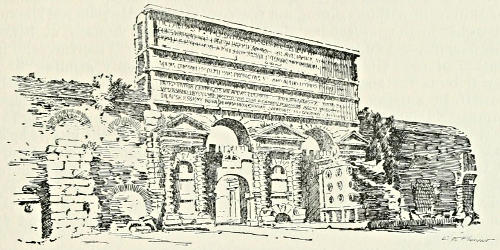
The Claudian Aqueduct
(Begun by Caligula; finished by Claudius)
He was unwilling to be thought or called the grandson of Agrippa, because of the obscurity of his birth; and he was offended if any one, either in prose or verse, ranked him amongst the Cæsars. He said his mother was the fruit of an incestuous commerce, maintained by Augustus with his daughter Julia. And not content with this vile reflection upon the memory of Augustus, he forbade his victories at Actium, and upon the coast of Sicily, to be celebrated as usual; affirming that they had been of the most pernicious and fatal consequence to the Roman people. He called his grandmother Livia Augusta “Ulysses in a woman’s dress,” and had the indecency to reflect upon her in a letter to the senate, as of mean birth, and descended, by the mother’s side, from a grandfather who was only a member of the council of state at Fundi; whereas it is certain, from authentic documents, that Aufidius Lingo held public offices at Rome.
His grandmother Antonia desiring a private conference with him, he denied the request, unless Macro, commander of the guards, might be present. By affronts of this kind, and ill usage, he was the occasion of her death; but, as some think, not without giving her a dose of poison. He paid not the smallest respect to her memory after her death; and gratified himself at beholding, from his parlour, her funeral pile on fire. His brother Tiberius, who had no expectation of any violence, he despatched, by suddenly sending to him a military tribune for that purpose. He forced Silanus his father-in-law to kill himself, by cutting his throat with a razor. The pretext he alleged for these murders was, that the latter had not followed him upon putting to sea in stormy weather, but stayed behind with the view of seizing the city, if he should have been lost in the voyage. The other, he said, smelt of an antidote, which he had taken to prevent his being poisoned by him; whereas Silanus was only afraid of being seasick, and of the trouble of the voyage; and Tiberius had only made use of a medicine for a habitual cough, which was constantly increasing upon him. As to his successor Claudius, he only saved him to make sport with.
He lived in the habit of incest with all his sisters; when one of them, Drusilla, was married to Cassius Longinus, a man of consular rank, he took her from him, and kept her openly as his wife. In a fit of sickness, he by his will appointed her heiress of his estate, and the empire likewise. After her death, he ordered a public mourning for her; during which it was capital for any person to laugh, use the bath, or sup with parents, wife, or children. Being inconsolable under his affliction, he went hastily, and in the night-time, from the city, going through Campania to Syracuse; and then suddenly he returned without shaving his beard, or trimming his hair all that time. Nor did he ever after, in matters of the greatest importance, not even in the assemblies of the people and soldiers, swear any otherwise, than “By the divinity of Drusilla.”
He never but once in his life concerned himself with military affairs, and then not deliberately, but in his journey to Mevania, to see the grove and river of Clitumnus. Being put in mind of recruiting his company of Batavians, which he had about him, he resolved upon an expedition into Germany. Immediately he drew together several legions and auxiliary forces from all quarters, and made everywhere new levies with the utmost rigour. Laying in provisions of all kinds, beyond what had ever been done upon the like occasion, he set out on his march; and pursued it with so much haste and hurry sometimes, that the guards were obliged, contrary to custom, to lay their standards upon the backs of horses or mules, and so follow him. At other times, he would march with such slowness and delicacy, that he would be carried in a chair by eight men; ordering the roads to be swept by the people of the neighbouring towns, and sprinkled with water to lay the dust.
Upon arriving in the camp, to show himself an active general, and severe disciplinarian, he cashiered the lieutenant-generals that came up late with the auxiliary forces from different parts. In reviewing the army, he took their companies from most of the centurions of the first rank, who had now served their legal time in the wars, and from some but a few days before their time would have expired; alleging against them their great age and infirmity; and railing at the covetous disposition of the rest of them, he reduced the premiums due to such as had served out their time to the sum of six thousand sesterces. Though he only received the submission of Adminius, the son of Cinobelinus a British prince, who being forced from his native country by his father, came over to him with a small body of troops; yet, as if the whole island had been surrendered to him, he despatched magnificent letters to Rome upon the occasion, ordering the bearers to proceed in their chaise directly up to the Forum and the senate house, and not to deliver the letters but to the consuls in the temple of Mars, and in the presence of a full assembly of the senators.
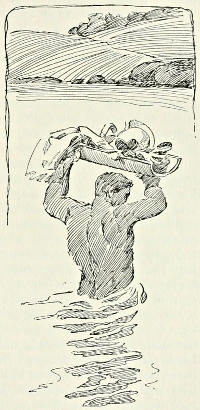
Roman Soldier’s Method of fording a River, carrying his Arms and Clothing on his Shield
Soon after this, there being a general tranquillity, he ordered a few Germani of his guard to be carried over and concealed on the other side of the Rhine, and word to be brought him after dinner, in a great hurry, that an enemy was advancing. This being accordingly done, he immediately posted away with his friends, and a party of the horse-guards, into the adjoining wood, where lopping the branches of some trees, and dressing them up in the manner of trophies, he returned by torchlight, upbraiding those who did not follow him, with timorousness and cowardice; but presented the companions and sharers of his victory with a new kind of crown, and under a new name, with the representation of the sun, moon, and stars upon them, which he called exploratoriæ. Again, some hostages were by his order taken out of a school, and privately sent off; upon notice of which he immediately rose from table, pursued them with the horse, as if they had run away, and coming up with them, brought them back in chains; proceeding to an extravagant pitch of ostentation likewise in this military comedy. Upon again sitting down to table, when some came to acquaint him that the army was all come in, he ordered them to sit down as they were in their coats of mail, animating them in the words of a well-known verse of Virgil.
In the meantime, he reprimanded the senate and people of Rome by a very severe proclamation, “for revelling and frequenting the diversions of the circus and theatre, and enjoying themselves in their country-houses, whilst their emperor was fighting, and exposing his person to the greatest dangers.”
At last, as if resolved to make an end of the war at once, drawing up his army upon the shore of the ocean, with his ballistæ and other engines of war, whilst nobody could imagine what he intended to do, on a sudden he commanded them to gather up the sea shells, and fill their helmets, and the laps of their coats with them, calling them, “the spoils of the ocean due to the Capitol and the Palatine.” As a monument of his success, he raised a high tower, upon which he ordered lights to be put in the night-time, for the direction of ships at sea; and then promising the soldiers a donative of a hundred denarii a man, as if he had surpassed the most eminent examples of generosity, “Go your ways,” said he, “and be merry; go and be rich.”
Upon his applying himself to make preparations for his triumph, besides prisoners and those who had deserted from the barbarians, he picked out the men of greatest stature in all Gaul, such as he said were fittest for a triumph, with some of the most considerable persons in the province, and reserved them to grace the solemnity; obliging them not only to dye their hair of a yellowish colour, and let it grow long, but to learn the German language, and assume the names commonly used in that country. He ordered likewise the galley in which he had entered the ocean, to be carried a great part of the way to Rome by land, and wrote to the collectors of his revenue in the city, “to make proper preparations for a triumph against his arrival, at as small expense as possible; but such a one, however, as had never been seen before, since they had full power and authority to seize the estates of all men whatever.”
In person, Caligula was tall, of a pale complexion, ill shaped, his neck and legs very slender, his eyes and temples hollow, his forehead broad and grim, his hair thin, and about the crown quite decayed. The other parts of his body were much covered with hair. On this account, it was reckoned a capital crime for any person to look down from above, as he was passing by, or so much as to name a goat. His countenance, which was naturally hideous and frightful, he purposely rendered more so, forming it by a glass into the most horrible contortions. He was crazy both in body and mind, being subject when a boy to the falling sickness. When he arrived at the age of manhood, he would endure fatigue tolerably well, yet so that occasionally he was liable to a faintness, during which he remained incapable of any effort, even for his own preservation. He was not insensible of the disorder of his mind, and sometimes had thoughts of retiring to purge his brain. It was believed that his wife Cæsonia had administered to him a love-potion which threw him into a frenzy. What most of all disordered him was want of sleep, for he seldom had more than three or four hours’ rest in a night; and even then he slept not soundly, but disturbed by strange dreams; fancying one time that the ocean spoke to him. Being therefore often weary with lying awake so great a part of the night, he would one while sit upon the bed, and another while walk in the longest porticos about his house, and now and then invoke and look out for the approach of day.
In his clothes, shoes, and other parts of his dress, he neither followed the usage of his country, his sex, nor indeed any fashion suitable to a human creature. He would often appear abroad dressed in an embroidered coat set with jewels, in a tunic with sleeves, and with bracelets upon his arms; sometimes all in silks and habited like a woman; at other times in the crepidæ or buskins; sometimes in a sort of shoes used by the meaner soldiers, or those of women, and commonly with a golden beard fixed to his chin, holding in his hand a thunderbolt, a trident, or a caduceus, marks of distinction belonging to the Gods only. Sometimes too he appeared in the dress of Venus. He wore very commonly the triumphal dress, even before his expedition, and sometimes the breast-plate of Alexander the Great, taken out of the vault where his body lay.
In respect of the liberal sciences, he was little conversant in philology, but applied himself with assiduity to the study of eloquence, being indeed in point of enunciation sufficiently elegant and ready; and these qualities appeared most conspicuous when he happened to be in a passion. In speaking, his action was vehement, and his voice so strong that he was heard at a great distance. When he was about to harangue, he threatened “the sword of his lucubration.” He so much despised a soft smooth style that he said Seneca, who was then much admired, “wrote only boyish declamations,” and that “his language was nothing else but sand without lime.” When pleaders were successful in a cause, he often wrote answers to their speeches; and would exercise himself in composing accusations or vindications of eminent persons that were impeached before the senate; and according to his success he would exasperate or assuage the situation of the party by his vote in the house; inviting the equestrian order, by proclamation, to hear him.
He likewise applied himself with alacrity to the practice of several other arts, as fencing, riding the chariot, singing, and dancing. In the first of these, he practised with the weapons used in fighting; and drove the chariot in circuses built in several places. He was so extremely fond of singing and dancing that he could not refrain in the theatre from singing with the tragedians, and imitating the gestures of the actors, either in the way of approbation or correction. A pervigilium which he had ordered the day upon which he was slain was thought to be intended for no other reason than to take the opportunity afforded by the licentiousness of such a season to make his first appearance upon the stage. Sometimes he danced likewise in the night. Sending once, in the second watch of the night, for three men of consular rank, who were under great apprehensions from the message, he placed them by the stage, and then all of a sudden came bursting out, with a loud noise of flutes and Scabella, dressed in a pella and tunic reaching down to his heels. Having danced out a song, he retired. Yet he who had acquired such dexterity in other exercises, could never swim.
Those for whom he once conceived a regard he favoured even to madness. He used to kiss Mnester, the pantomimic, publicly in the theatre; and if any person made the least noise while he was dancing, he would order him to be dragged out of his seat and scourged him with his own hand. A Roman knight once making some bustle, he sent him, by a centurion, an order to go forthwith down to Ostia, and carry a letter from him to King Ptolemy in Mauretania. The letter was comprised in these words: “Do neither good nor harm to the bearer.” He made some gladiators captains of his German guards. He took from the gladiators called Mirmillones some of their arms. One Columbus coming off with victory in a combat, but being slightly wounded, he ordered some poison to be infused into the wound, which he thence called Columbinum. For thus it certainly was put down with his own hand amongst other poisons. He was so extravagantly fond of the party of charioteers that rode in green, that he supped and lodged for some time constantly in the stable where their horses were kept. At a certain revel he made a present of two millions of sesterces to one Cythicus a driver of a chariot. The day before the Circensian games, he used by his soldiers to enjoin silence in the neighbourhood, that the repose of his horse Incitatus might not be disturbed. For this favourite animal, besides a marble stable, an ivory manger, scarlet body clothes, and a bracelet of jewels, he appointed a house, with a retinue of slaves, and fine furniture, for the reception of such as were invited in the horse’s name to sup with him. It is even said that he designed to have made him consul.c
Such is the picture of this lunatic as Suetonius vividly paints it. For four years the world bore his furious madness without by sedition protesting against such a saturnalia of power. “How I wish,” said the monster,“that the Roman people had only one head, so I could strike it off at a blow.” The senate, however, grew tired of finding him victims, and finally, as already mentioned, a prætorian tribune, Chærea, strangled him.
Chærea was a republican. He and his friends thought that, after such a prince, monarchical government had been sufficiently judged by experience. The occasion now seemed favourable for the senate to resume the power. It did so, and for three days deemed a republic assured. But this was reckoning without either soldiers or people.
At the time of Caligula’s murder, Claudius, his uncle, who was with him, had hidden in an obscure corner. A soldier found and showed him to his comrades. Claudius begged for life. “Be our emperor,” they answered, and as he trembled and could not walk, they carried him to their camp, where he regained sufficient courage to harangue the troops, promising them money (donativum). It was the price of an empire he paid, an unfortunate innovation which amongst the soldiers had passed into law.
The senators, abandoned little by little, themselves hastened to greet the new master. Chærea was sentenced to death. “Do you know how to kill?” he asked the soldier charged to execute him. “Your sword is not well ground perhaps. That which I used for Caligula would be better.”
Claudius (Tiberius Claudius Drusus Cæsar), 41-54 A.D.
Claudius, brother to Germanicus and grandson to Livia, through his father Drusus the first, was then fifty years old. During his youth he had been continually ill, and in the royal household every one had neglected the poor child, not daring to show him either to the people or the soldiers. At last his existence was almost forgotten and at forty-six he was not even a senator. He consoled himself by study and writing a history of the Etruscans and Carthaginians. Caligula, who named him consul, brought him a little more into prominence; the soldiers’ whim did the rest. They gave him the empire, but could not do away with the effects of his upbringing, that timidity, irresolution, and want of self-dependence which resulted most disastrously, so that he often did evil with the very best intentions. In his reign the real rulers were his wife, Messallina, whose name is one with all debauchery and even with most repulsive coarseness, and his freedmen Polybius, Narcissus, and Pallas. [At least they exercised an undue influence over him.]
Claudius began well. He revoked the acts of Caligula, had the Augustan laws sworn to, and recalled the banished. Naturally kind-hearted, he easily adopted the manners that had contributed to the popularity of the first emperor. He visited his sick friends, consulting the consuls and the senate as if he were quite dependent on their favour. He liked to act as judge and often did it very well. Unfortunately, his undignified bearing, his shaking head, stammering and often ridiculous speech made him of very little account. He re-established the censorship and often exercised it himself, but rather with the tastes of an antiquarian loving old customs than with a sense of the real needs of the empire.
In spite of these oddities and weaknesses, this prince, without regarding the examples of infamy and crime given by his surroundings, can hardly be counted among the worst emperors. The freedmen whom long power had not yet spoiled sought to justify their influence by good service, and we find what we should hardly have expected—namely, several wise measures with regard to slaves in the interior; against too greedy advocates, usurers, and those banished from the provinces who flocked to Rome, etc. Moreover, there were useful works: an aqueduct, a port at Ostia, an attempt to drain Lake Fucinus, etc. In the provinces a liberal administration and a firm foreign policy were crowned by success.
Augustus had wished to constitute a Roman minority in the midst of the submissive nations which would prove a support to the government. But it was to govern always in Rome’s interests. A futile effort, because he was aiming at nothing less than arresting the course of the world, as if the emperors could have continued an aristocracy against which they had contended in the battles of Pharsalia, Thapsus, and Philippi. In his will Augustus had advised a careful guarding of civic privilege, and in the short space of thirty-four months, the number of citizens had nearly doubled. Tiberius aided much in this increase. Claudius also contributed largely, because he made the law of continuous extension and progressive assimilation, which had made the fortune of the republic, a rule of policy. He personally asked that the nobles of Gallia Comata, who had long been citizens, should also assume Roman dignities and have a seat in the senate.
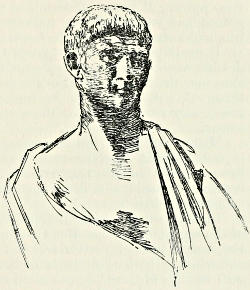
The Emperor Claudius
(From a bust in the Vatican)
Only one religious provincial sect was persecuted under Claudius—that of the Druids, because their priests refused the peace offered by Augustus on condition of their uniting their gods to the Olympian deities. Claudius tried, therefore, to abolish their worship, and punished with death both priests and their adherents.b
In the interior parts of Britain, the natives, under the command of Caractacus, maintained an obstinate resistance, and little progress was made by the Roman arms, until Ostorius Scapula was sent over to prosecute the war. He penetrated into the country of the Silures, a warlike tribe who inhabited the banks of the Severn; and having defeated Caractacus in a great battle, made him prisoner, and sent him to Rome (50 A.D.). The fame of the British prince had by this time spread over the provinces of Gaul and Italy; and upon his arrival in the Roman capital, the people flocked from all quarters to behold him. The ceremonial of his entrance was conducted with great solemnity. On a plain adjoining to the Roman camp, the prætorian troops were drawn up in martial array; the emperor and his court took their station in the front of the lines, and behind them was ranged the whole body of the people. The procession commenced with the different trophies which had been taken from the Britons during the progress of the war. Next followed the brothers of the vanquished prince, with his wife and daughter, in chains, expressing by their supplicating looks and gestures the fears with which they were actuated. But not so Caractacus himself. With a manly gait and an undaunted countenance, he marched up to the tribunal, where the emperor was seated, and addressed him in the following terms:
“If to my birth, and distinguished rank, I had added the virtues of moderation, Rome had beheld me rather as a friend than a captive; and you would not have rejected an alliance with a prince descended from illustrious ancestors, and governing many nations. The reverse of my fortune to you is glorious, and to me humiliating. I had arms, and men, and horses; I possessed extraordinary riches; and can it be any wonder that I was unwilling to lose them? Because Rome aspires to universal dominion, must men therefore implicitly resign themselves to subjection? I opposed for a long time the progress of your arms, and had I acted otherwise, would either you have had the glory of conquest, or I of a brave resistance? I am now in your power; if you are determined to take revenge, my fate will soon be forgotten, and you will derive no honour from the transaction. Preserve my life, and I shall remain to the latest ages a monument of your clemency.”
Immediately upon this speech, Claudius granted him his liberty, as he did likewise to the other royal captives. They all returned their thanks, in a manner the most grateful to the emperor; and as soon as their chains were taken off, walking towards Agrippina, who sat upon a bench at a little distance, they repeated to her the same fervent declarations of gratitude and esteem.
History has preserved no account of Caractacus after this period; but it is probable that he returned in a short time to his own country, where his former valour, and the magnanimity which he had displayed at Rome, would continue to render him illustrious through life, even amidst the irretrievable ruin of his fortunes.c
In Germany a successful expedition had restored to the Romans the last of the eagles of Varus. But Claudius, practising on this side Tiberian politics, busied himself particularly in taking up a strong position on the Rhine and winning barbarian chiefs to the interests of Rome. He succeeded so well that in 47 the Cherusci came to him, asking for a king. Corbulo, the greatest general of this time, wanted to carry out the plans of the first Drusus against the Germans. He subdued the Frisians and attacked the Chauci. Claudius stayed his advance. “Happy were the old Roman consuls!” said the ambitious general as he obeyed. In order at least to occupy his soldiers he had a canal dug from the Meuse to the Rhine, another leader made his men open the mines. Everywhere these useful works were now demanded from the troops.
On the Danube peace was undisturbed. In Thrace various troubles made Claudius intervene and reduce the country to a province. In the Bosporus, a king deposed by him took arms, was conquered, and gave himself up. In the East the emperor had the glory of reconquering Armenia and giving a king to the Parthians. Unfortunately these successes did not continue; the Roman candidate to the throne of the Arsacidæ was overthrown and for some time Vologeses kept the Armenian crown on the head of his brother Tiridates.
Lycia made bad use of her liberty, so Claudius took it away, and the Jewish king, Agrippa, dying in 44, he united Palestine to the government of Syria. In Africa, Suetonius Paulinus and Geta subdued the Moors, whose country formed two provinces—the Mauretania Cæsariensis and Mauretania Tingitana.
The emperor now lacked neither military nor political glory. Mauretania and the half of Britain were conquered; the Germans coerced, the Bosporus reduced to obedience; Thrace, Lycia, and Judea made provinces, and the Parthian troubles long since smoothed over. Within the empire there was growing prosperity; the army was well disciplined and its activity was directed to the public welfare under the direction of generals grown old in command. Certainly, results everywhere were sufficient to gratify the pride of a prince. It is with regret that we have to turn to Rome to see nobles whose only occupation was conspiracy or base flattery—and to that imperial palace which was disgraced by a weak prince and his immoral wife, the shameless Messallina.b The misdeeds of the latter will now claim our attention. Let Tacitus draw her portrait:
THE MISDEEDS OF MESSALLINA DESCRIBED BY TACITUS
The facility of ordinary adulteries having produced satiety, Messallina broke forth into unheard-of excesses; when even Silius, her paramour, whether impelled by some fatal infatuation, or judging that the dangers hanging over him were only to be averted by boldly confronting them, urged that all disguises should now be renounced, for matters, he said, were gone too far for them to wait for the death of the emperor; blameless counsels were for the innocent, but in glaring guilt safety must be sought in reckless daring. They were backed by accomplices who dreaded the same doom. As for himself, he was single, childless, ready to marry her, and to adopt Britannicus: to Messallina would still remain her present power; with the addition of security, if they anticipated Claudius; who, as he was unguarded against the approaches of stratagem, so was he headstrong and impetuous when provoked to anger. These suggestions were but coldly received by Messallina; from no love to her husband; but lest Silius, when he had gained the sovereignty, should scorn his adulteress; and the treason, which in his present perilous predicament he approved, would then be estimated according to its real desert. She, however, coveted the name of matrimony, from the greatness of the infamy attaching to it; which, with those who are prodigal of fame, forms the crowning gratification of depraved appetite. Nor stayed she longer than till Claudius went to Ostia, to assist at a sacrifice; when she celebrated her nuptials with Silius, with all the usual solemnities.
I am aware [Tacitus continues] that it will appear fabulous that any human beings should have exhibited such recklessness of consequences; and that, in a city where everything was known and talked of, any one, much more a consul elect, should have met the emperor’s wife, on a stated day, in the presence of persons called in, to seal the deeds, as for the purpose of procreation, and that she should have heard the words of the augurs, entered the house of the husband, sacrificed to the gods, sat down among the guests at the nuptial banquet, exchanged kisses and embraces, and in fine passed the night in unrestrained conjugal intercourse. But I would not dress up my narrative with fictions to give it an air of marvel, rather than relate what has been stated to me or written by my seniors.
The consequence was that the domestic circle of the prince was horror-struck; especially those who had the chief sway, and who dreaded the result, if the state of things should be changed, no longer confined themselves to secret communications, but exclaimed with undisguised indignation that while the emperor’s bedchamber was made the theatre for a stage-player to dance upon, a reproach was indeed incurred, but the immediate dissolution of the state was not now threatened: a young man of noble rank, of fascinating person, mental vigour, and just entering upon the consulship, was addressing himself to higher objects; nor was it any enigma what remained to be done after such a marriage. It is true, when they reflected on the stupidity of Claudius, his blind attachment to his wife, and the many lives sacrificed to her fury, they were unable to divest themselves of apprehensions; again, even the passive spirit of the emperor revived their confidence; that, if they could first possess him with the horrid blackness of her crimes, she might be despatched without trial. But the danger turned upon this—that she might make a defence; and that even if she confessed her guilt, the emperor might be deaf to that evidence also.
But first it was deliberated by Callistus, whom, in relating the assassination of Caligula, I have already mentioned; by Narcissus, who plotted the murder of Appius; and by Pallas, then the reigning favourite, whether, feigning ignorance of all other circumstances, they should compel Messallina to break off her amour with Silius by secret menaces; but they afterwards abandoned this project from fear lest they should themselves be dragged to execution as culprits. Pallas was faint hearted; and Callistus, a courtier in the last reign also, had learned by experience that power was secured more effectually by wary measures than by daring counsels. Narcissus persisted; with this difference only, that he took care not to let fall a word by which she might know beforehand the charge against her or her accuser; and watching all occasions, while the emperor lingered at Ostia, he prevailed with two courtesans, who were the chief mistresses of Claudius, to undertake the task of laying the matter before him, by means of presents and promises, and by representing to them in attractive colours that by the fall of his wife their own influence would be increased.
Calpurnia therefore, for that was the name of the courtesan, upon the first occasion of privacy, falling at the emperor’s feet, exclaimed, that Messallina had married Silius; and at the same time asked Cleopatra, who purposely attended to attest it, whether she had not found it to be true. Claudius, upon a confirmation from Cleopatra, ordered Narcissus to be called. He, when he came, begged pardon for his past conduct in having concealed from the prince her adulteries while they were limited to the Vectii and Plautii; nor meant he now, he said, to charge Silius with adulteries; nor urge that he should restore the house, the slaves, and the other decorations of imperial fortune: the adulterer might still enjoy these; let him only break the nuptial tables, and restore the emperor’s wife. “Know you, Cæsar, that you are in a state of divorce? In the face of the people, and senate, and soldiery, Messallina has espoused Silius; and unless you act with despatch, her husband is master of Rome.”
He then sent for his most confidential friends, particularly for Turranius, superintendent of the stores; next for Lusius Geta, captain of the prætorian guards; and inquired of them. As they avouched it, the rest beset him with clamorous importunities, that he should forthwith proceed to the camp, secure the prætorian cohorts, and consult his preservation before his revenge. It is certain that Claudius was so confounded and panic-stricken that he was incessantly asking whether he were still emperor—whether Silius was still a private man.
As to Messallina, she never wallowed in greater voluptuousness; it was then the middle of autumn, and in her house she exhibited a representation of the vintage; the wine-presses were plied, the wine vats flowed, and round them danced women begirt with skins, like Bacchanalians at their sacrifices, or under the maddening inspiration of their deity. She herself, with her hair loose and flowing, waved a thyrsus; by her side Silius, crowned with ivy, and wearing buskins, tossed his head about; while around them danced the wanton choir in obstreperous revelry. It is reported that Vectius Valens, having in a frolic climbed to an exceeding high tree, when asked what he saw, answered, “A terrible storm from Ostia.”
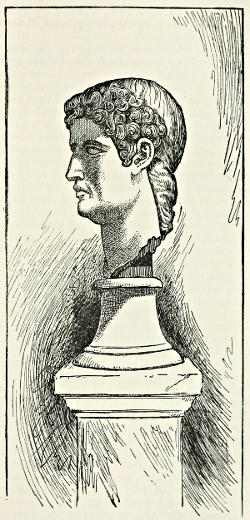
Messallina
(From a portrait bust)
It was now no longer vague rumour; but messengers poured in on all sides with tidings that Claudius, apprised of all, had approached, bent upon instant vengeance. They separated; Messallina betook herself to the gardens of Lucullus, and Silius, to dissemble his fear, resumed the offices of the Forum. As the rest were slipping off different ways, the centurions came up with them and bound them, some in the street, others in lurking-places, according as each was found. Messallina, however, though in her distress incapable of deliberation, formed the bold resolution of meeting her husband, and presenting herself to his view—an expedient which had often proved her protection. She likewise ordered that Britannicus and Octavia should go forth and embrace their father; and besought Vibidia, the oldest vestal, to intercede with the chief pontiff, and earnestly importune his clemency. She herself meanwhile traversed on foot the whole extent of the city, attended only by three persons (so suddenly had her whole train forsaken her), and then, in a cart employed to carry out dirt from the gardens, took the road to Ostia, unpitied by anyone, as the deformity of her crimes overpowered every feeling of the kind.
Claudius was in a state of no less trepidation; for he could not implicitly rely on Geta, the captain of his guards—an equally fickle instrument of fraud or honesty. Narcissus therefore, in concert with those who entertained the same mistrust, assured the emperor, that there was no other expedient to preserve him than the transferring the command of his guards to one of his freedmen, for that day only; and offered himself to undertake it. And, that Lucius Vitellius and Publius Largus Cæcina might not on his way to the city prevail with Claudius to relent, he desired to have a seat in the same vehicle, and took it.
It was afterwards currently reported that, while the emperor was giving expression to the opposite feelings which agitated his breast, at one time inveighing against the atrocities of his wife, and then at length recurring to the recollection of conjugal intercourse and the tender age of his children, Vitellius uttered nothing but “Oh! the villainy! Oh! the treason!” Narcissus indeed pressed him to discard all ambiguity of expression, and let them know his real sentiments; but he did not therefore prevail upon him to give any other than indecisive answers, and such as would admit of any interpretation which might be put upon them; and his example was followed by Largus Cæcina. And now Messallina was in sight, and importunately called on the emperor “to hear the mother of Octavia and Britannicus,” when her accuser drowned her cries with the story of Silius and the marriage, and delivered at the same time to Claudius a memorial reciting all her whoredoms; to divert him from beholding her. Soon after, as the emperor was entering Rome, it was attempted to present to him his children by her; but Narcissus ordered them to be taken away. He could not, however, prevent Vibidia from insisting, with earnest remonstrances, that he would not deliver his wife to destruction without a hearing; so that Narcissus was obliged to assure her that the prince would hear Messallina, who should have full opportunity of clearing herself; and advised the vestal to retire and attend the solemnities of her goddess.
The silence of Claudius, while all this was going on, was matter of astonishment. Vitellius seemed like one who was not in the secret: the freedman controlled everything; by his command, the house of the adulterer was opened, and the emperor escorted thither, where the first thing he showed him was the statue of Silius, the father, in the porch, though it had been decreed to be demolished by the senate; then that all the articles belonging to the Neros and Drusi had now become the price of dishonour. Thus incensed, and breaking forth into menaces, he led him direct to the camp, where the soldiers being already assembled, by the direction of Narcissus, he made them a short speech; for shame prevented his giving utterance to his indignation, though he had just cause for it.
The soldiers then clamoured unremittingly and importunately that the culprits should be tried and punished. Silius was placed before the tribunal; he made no defence, he sought no delay, but begged only to be despatched immediately. Illustrious Roman knights also, with similar firmness of mind, were eager for a speedy death. He therefore commanded Titius Proculus, assigned by Silius as a guard to Messallina; Vectius Valens, who confessed his guilt, and offered to discover others, Pompeius Ubicus and Saufellus Trogus, as accomplices, to be all dragged to execution. On Decius Calpurnianus too, præfect of the watch; Sulpicius Rufus, comptroller of the games; and Juncus Vergilianus, the senator, the same punishment was inflicted.
Mnester alone caused some hesitation. He tore off his clothes and called upon the emperor to behold upon his body the impressions of the lash; to remember his own commands, obliging him to submit to the pleasure of Messallina without reserve: others had been tempted to the iniquity by great presents or aspiring hopes; but his offence was forced upon him. Nor would any man have sooner perished had Silius gained the sovereignty. These considerations affected Claudius, and strongly inclined him to mercy; but his freedmen overruled him. They urged that after so many illustrious sacrifices, he should by no means think of saving a player; that in a crime of such enormity, it mattered not whether he had committed it from choice or necessity. As little effect had the defence even of Traulus Montanus, a youth of signal modesty and remarkably handsome, summoned by Messallina to her bed without any solicitation on his part, and in one night cast off; such was the wantonness with which her passion was alike surfeited and inflamed. The lives of Suilius Cæsoninus and Plautius Lateranus were spared; of the last, on account of the noble exploits of his uncle: the other was protected by his vices, as one who, in the late abominable society, had prostituted himself like a woman.
Meanwhile Messallina was in the gardens of Lucullus, still striving to prolong her life, and composing supplications to the prince, sometimes in the language of hope, at others giving vent to rage and resentment, so indomitable was her insolence even under the immediate prospect of death. And had not Narcissus hastened her assassination, the doom which he had prepared for her would have recoiled upon himself. For Claudius, upon his return home, experienced a mitigation of his wrath, from the effects of a sumptuous repast; and as soon as he became warm with wine, he ordered them “to go and acquaint the miserable woman (for this was the appellation which he is said to have used) that to-morrow she should attend and plead her cause.” These words indicated that his resentment was abating, his wonted affection returning; besides, if they delayed, the effect of the following night, and the reminiscences which the conjugal chamber might awaken in Claudius, were matter for alarm. Narcissus therefore rushed forth, and directed the tribune and centurions then attending upon duty to despatch the execution, for such, he said, was the emperor’s command. With them he sent Euodus of the freedmen, as a watch upon them, and to see his orders strictly fulfilled. Euodus flew before them to the gardens, and found her lying along upon the earth; her mother, Lepida, sitting by her side—who during her prosperity had not lived in harmony with her, but, in this her extreme necessity, was overcome by compassion for her, and now persuaded her not to wait for the executioner: “the course of her life was run, and her only object now should be to die becomingly.” But a mind sunk and corrupted by debauchery retained no sense of honour; she was giving way to bootless tears and lamentations when from the shock of the approaching party the door flew open: the tribune stood in silence before her; but the freedman upbraided her with many and insolent reproaches, characteristic of the slave.
Then for the first time she became deeply sensible of her condition, and laying hold of the steel, applied it first to her throat, then to her breast, with trembling and irresolute hand, when the tribune ran her through. Her corpse was granted to her mother. Tidings were then carried to Claudius that Messallina was no more, without distinguishing whether by her own or another’s hand; neither did he inquire, but called for a cup of wine, and proceeded in the usual ceremonies of the feast. Nor did he, indeed, during the following days, manifest any symptom of disgust or joy, of resentment or sorrow, nor, in short, of any human affection; not when he beheld the accusers of his wife exulting at her death, not when he looked upon her mourning children. The senate aided in effacing her from his memory, by decreeing that from all public and private places her name should be rased, and her images removed. To Narcissus were decreed the decorations of the quæstorship; a very small reward indeed, considering his towering elevation; for he was more influential than Pallas and Callistus.d
THE INTRIGUES OF AGRIPPINA
[48-49 A.D.]
The freedmen now had the task of selecting another wife for their feeble prince, who was not capable of leading a single life, and who was sure to be governed by the successful candidate. The principal women in Rome were ambitious for the honour of sharing the bed of the imperial idiot, but the claims of all were forced to yield to those of Lollia Paulina, the former wife of Caligula, Julia Agrippina the daughter of Germanicus, and Ælia Petina, Claudius’ own divorced wife. The first was patronised by Callistus, the second by Pallas, the last by Narcissus. Agrippina, however, in consequence of her frequent access to her uncle, easily triumphed over her rivals; the only difficulty that presented itself was that of a marriage between uncle and niece being contrary to Roman manners, and being even regarded as incestuous. This difficulty, however, the compliant L. Vitellius, who was then censor, undertook to remove. He addressed the senate, stating the necessity of a domestic partner to a prince who had on him such weighty public cares. He then launched forth in praise of Agrippina; as to the objection of the nearness of kindred, such unions he said were practised among other nations, and at one time first-cousins did not use to marry, while now they did so commonly. The servile assembly outran the speaker in zeal; they rushed out of the house, and a promiscuous rabble collected, shouting that such was the wish of the Roman people. Claudius repaired to the senate house, and caused a decree to be made legalising marriages between uncles and nieces, and he then formally espoused Agrippina. Yet such was the light in which the incestuous union was viewed that, corrupt as the Roman character was become, only two persons were found to follow the imperial example.
Agrippina also proposed to unite her son Domitius with Octavia the daughter of Claudius; but here there was a difficulty also, for Octavia was betrothed to L. Silanus. Again, however, she found a ready tool in the base Vitellius, to whose son Julia Calvina, the sister of Silanus, had been married. As the brother and sister indulged their affection imprudently, though not improperly, the worthy censor took the occasion to make a charge of incest against Silanus, and to strike him out of the list of senators. Claudius then broke off the match, and Silanus put an end to himself on the very day of Agrippina’s marriage. His sister was banished, and Claudius ordered some ancient rites expiatory of incest to be performed, unconscious of the application of them which would be made to himself.
The woman, who had now obtained the government of Claudius and the Roman Empire, was of a very different character from the abandoned Messallina. The latter had nothing noble about her, she was the mere bondslave of lust, and cruel and avaricious only for its gratification; but Agrippina was a woman of superior mind, though utterly devoid of principle. In her, lust was subservient to ambition; it was the desire of power or the fear of death, and not wantonness, that made her submit to the incestuous embraces of her brutal brother Caligula, and to be prostituted to the companions of his vices. It was ambition and parental love that made her now form an incestuous union with her uncle. To neither of her husbands, Cn. Domitius or Crispus Passienus, does she appear to have been voluntarily unfaithful. The bed of Claudius was, however, not fated to be unpolluted; for as a means of advancing her views, Agrippina formed an illicit connection with Pallas.
[49-54 A.D.]
The great object of Agrippina was to exclude Britannicus, and obtain the succession for her own son Nero Domitius, now a boy of twelve years of age. She therefore caused Octavia to be betrothed to him, and she had the philosopher Seneca recalled from Corsica, whither he had been exiled by the arts of Messallina, and committed to him the education of her son, that he might be fitted for empire. In the following year Claudius, yielding to her influence, adopted him.
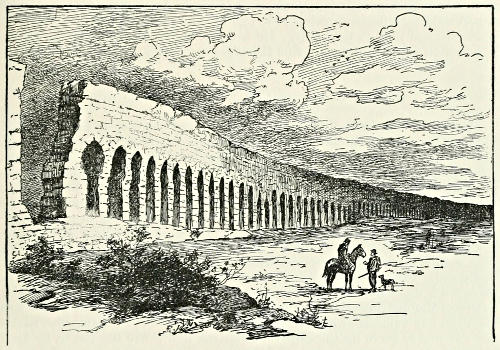
Ruins of the Aqueduct of Claudius
In order to bring Nero forward, Agrippina caused him to assume the virile toga before the usual age, and the servile senate desired of Claudius that he might be consul at the age of twenty, and meantime be elect with proconsular power without the city. A donative was given to the soldiers, and a congiary (congiarium) to the people in his name. At the Circensian games, given to gain the people, Nero appeared in the triumphal habit; Britannicus in a simple prætexta. Every one who showed any attachment to this poor youth was removed on one pretence or another, and he was surrounded with the creatures of Agrippina. Finally, as the two commanders of the guards were supposed to be attached to the interests of the children of Messallina, she persuaded Claudius that their discipline would be much improved if they were placed under one commander. Accordingly those officers were removed, and the command was given to Burrus Afranius, a man of high character for probity and of great military reputation, and who knew to whom he was indebted for his elevation.
The pride and haughtiness of Agrippina far transcended anything that Rome had as yet witnessed in a woman. When the British prince Caractacus and his family, whom P. Ostorius had sent captives to the emperor, were led before him as he sat on his tribunal in the plain under the prætorian camp, with all the troops drawn out, Agrippina appeared seated on another tribunal, as the partner of his power. And again, when the letting off of the Fucine Lake was celebrated with a naval combat, she presided with him, habited in a military cloak of cloth of gold.
Agrippina at length grew weary of delay, or fearful of discovery. Narcissus, who saw at what she was aiming, appeared resolved to exert all his influence in favour of Britannicus; and Claudius himself, one day when he was drunk, was heard to say that it was his fate to bear with the infamy of his wives and then to punish it. He had also begun to show peculiar marks of affection for Britannicus. She therefore resolved to act without delay.e
TACITUS DESCRIBES THE MURDER OF CLAUDIUS
[54 A.D.]
Claudius was attacked with illness, and for the recovery of his health had recourse to the soft air and salubrious waters of Sinuessa. It was then that Agrippina, long since bent upon the impious deed, and eagerly seizing the present occasion, well furnished too as she was with wicked agents, deliberated upon the nature of the poison she would use: whether, if it were sudden and instantaneous in its operation, the desperate achievement would not be brought to light; if she chose materials slow and consuming in their operation, whether Claudius, when his end approached, and perhaps having discovered the treachery, would not resume his affection for his son. Something of a subtle nature was resolved upon, “such as would disorder his brain and require time to kill.” An experienced artist in such preparations was chosen, her name Locusta; lately condemned for poisoning, and long reserved as one of the instruments of ambition. By this woman’s skill the poison was prepared; to administer it was assigned to Halotus, one of the eunuchs, whose office it was to serve up the emperor’s repasts, and prove the viands by tasting them.
In fact, all the particulars of this transaction were soon afterwards so thoroughly known that the writers of those times are able to recount how the poison was poured into a dish of mushrooms, of which he was particularly fond; but whether it was that his senses were stupefied, or from the wine he had drunk, the effect of the poison was not immediately perceived; at the same time a relaxation of the intestines seemed to have been of service to him. Agrippina therefore became dismayed; but as her life was at stake, she thought little of the odium of her present proceedings, and called in the aid of Xenophon the physician, whom she had already implicated in her guilty purposes. It is believed that he, as if he purposed to assist Claudius in his efforts to vomit, put down his throat a feather besmeared with deadly poison; not unaware that in desperate villainies the attempt without the deed is perilous, while to ensure the reward they must be done effectually at once.
The senate was in the meantime assembled, and the consuls and pontiffs were offering vows for the recovery of the emperor, when, already dead, he was covered with clothes and warm applications, to hide it till matters were arranged for securing the empire to Nero. First there was Agrippina, who, feigning to be overpowered with grief and anxiously seeking for consolation, clasped Britannicus in her arms, called him “the very model of his father,” and by various artifices withheld him from leaving the chamber. She likewise detained Antonia and Octavia, his sisters, and had closely guarded all the approaches to the palace: from time to time too she gave out that the prince was on the mend, that the soldiery might entertain hopes till the auspicious moment, predicted by the calculations of the astrologers, should arrive.
At last, on the thirteenth day of October, at noon, the gates of the palace were suddenly thrown open, and Nero, accompanied by Burrus, went forth to the cohort, which, according to the custom of the army, was keeping watch. There, upon a signal made by the præfect, he was received with shouts of joy, and instantly put into a litter. It was reported that there were some who hesitated, looking back anxiously, and frequently asking where Britannicus was, but as no one came forward to oppose it, they embraced the choice which was offered them. Thus Nero was borne to the camp, where, after a speech suitable to the exigency, and the promise of a largess equal to that of the late emperor his father, he was saluted emperor. The voice of the soldiers was followed by the decrees of the senate; nor was there any hesitation in the several provinces. To Claudius were decreed divine honours, and his funeral obsequies were solemnised with the same pomp as those of the deified Augustus; Agrippina emulating the magnificence of her great-grandmother Livia. His will, however, was not rehearsed, lest the preference of the son of his wife to his own son might excite the minds of the people by its injustice and baseness.d
THE CHARACTER OF CLAUDIUS
We meet with more than one instance in the imperial history of the parents suffering for the sins of their children. We have already seen how much reason there is to believe that the hatred of the Romans to Tiberius disposed them readily to accept any calumny against Livia. Tiberius himself was hated the more for the crimes of his successor Caius; and there is ground to surmise that much of the odium which has attached to Claudius is reflected from the horror with which Nero came afterwards to be regarded. Thus did the Romans avenge themselves on the authors of the principle of hereditary succession so long unknown to their polity, and known at last so disadvantageously.
Of Claudius, at least, a feeling of compassion, if not of justice, may incline us to pronounce with more indulgence than has usually been accorded to him. He was an imitator, as we have seen, of Augustus, but only as the silver age might parody the golden; for the manners he sought to revive, and the sentiments he pretended to regenerate, had not been blighted by the passing tempest of civil war, but were naturally decaying from the over-ripeness of age. Nevertheless, it was honourable to admire a noble model; there was some generosity even in the attempt to rival the third founder of the state. Nor, in fact, does any period of Roman history exhibit more outward signs of vigorous and successful administration: none was more fertile in victories or produced more gallant commanders or excellent soldiers; domestic affairs were prosperously conducted; the laborious industry of the emperor himself tired out all his ministers and assistants. The senate recovered some portion of its authority, and, with authority, of courage and energy.
Claudius secured respect for letters, in an age of show and sensuality, by his personal devotion to them. From some of the worst vices of his age and class he was remarkably exempt. His gluttony, if we must believe the stories told of it, was countenanced at least by many high examples; his cruelty, or rather his callous insensibility, was the result of the perverted training which made human suffering a sport to the master of a single slave, as well as to the emperor on the throne; and it was never aggravated at least by wanton caprice or ungovernable passion. The contempt which has been thrown upon his character and understanding has been generated, in a great degree, by the systematic fabrications of which he has been made the victim. Though flattered with a lip-worship which seems to our notions incredible, Claudius appears to have risen personally above its intoxicating vapours; we know that, in one instance at least, the fulsome adulation of a man, the most remarkable of his age for eloquence and reputed wisdom, failed to turn the course whether of his justice or his anger.
THE LIVING CLAUDIUS EULOGISED BY SENECA
The circumstances of this adulation, and of its disappointment, it is due to the memory of Claudius to detail. We have no distinct account of the cause of Seneca’s banishment, which is ascribed, by little better than a guess, to the machinations of Messallina against the friends and adherents of Julia. However this may be, we have seen with what impatience the philosopher bore it. On the occasion of the death of a brother of Polybius, he addressed a treatise from his place of exile to the still powerful freedman, such as was styled a “consolation,” in which he set forth all the arguments which wit and friendship could suggest to alleviate his affliction and fortify his wisdom. After assuring him of the solemn truth that all men are mortal, and reminding him that this world itself, with all that it contains, is subject to the common law of dissolution; that man is born to sorrow; that the dead can have no pleasure in his grief; that his grief at the best is futile and unprofitable; he diverts him with another topic which is meant to be still more effectual. “The emperor,” he says, “is divine, and those who are blessed by employment in his service, and have him ever before their eyes, can retain no idle interest in human things; their happy souls neither fear nor sorrow can enter; the divinity is with them and around them. Me,” he declares, “this god has not overthrown; rather he has supported when others supplanted me; he still suffers me to remain for a monument of his providence and compassion. Whether my cause be really good or bad, his justice will at last pronounce it good, or his clemency will so regard it. Meanwhile, it is my comfort to behold his pardons travelling through the world; even from the corner where I am cast away his mercy has called forth many an exile before me. One day the eyes of his compassion will alight on me also. Truly those thunderbolts are just which the thunderstricken have themselves learned to adore. May the immortals long indulge him to the world! May he rival the deeds of Augustus and exceed his years! While still resident among us, may death never cross his threshold! Distant be the day, and reserved for the tears of our grandchildren, when his divine progenitors demand him for the heavens which are his own.”
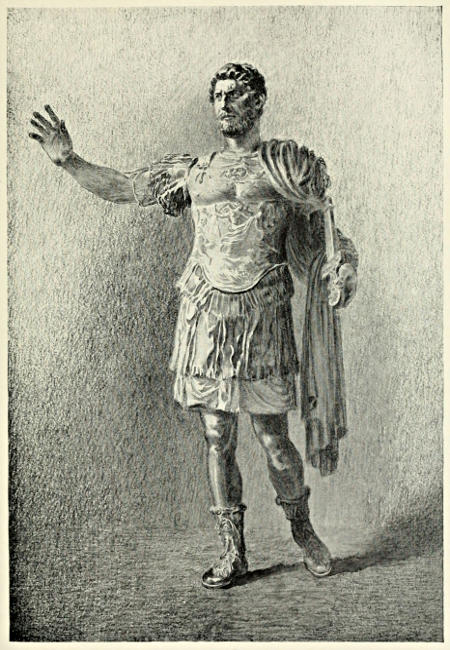
HADRIAN
(FROM THE STATUE IN THE BRITISH MUSEUM)
Such were the phrases, sonorous and unctuously polished, which Polybius was doubtless expected to recite in the ears of the imperial pedant. Standing high as he still did in the favour of Claudius and Messallina, he had the means, and was perhaps not without the will, to recommend them with all his interest, and intercede in the flatterer’s behalf. Yet Claudius, it would seem, remained wholly unmoved by a worship more vehement than Ovid’s, and enhanced still more by the unquestioned reputation of its author. Whatever had been the motives of his sentence against Seneca, it was not by flattery that he could be swayed to reverse it. Surely, as far as we are competent to judge, we must think the better both of his firmness and his sense. Shortly afterwards Polybius was himself subverted by the caprice of Messallina; Messallina in her turn was overthrown by Agrippina; and it was not till the sister of Julia had gained the ascendant that Seneca obtained at her instance the grace he had vainly solicited through the good offices of the freedman.
THE DEAD CLAUDIUS SATIRISED BY SENECA
But however little Claudius may have relied on the sincerity of this brilliant phrase-monger, he could scarce have anticipated the revulsion of sentiment to which so ardent a worshipper would not blush to give utterance on his demise. It was natural of course that the returned exile should attach himself to his benefactress; from her hands he had received his honours, by her he was treated with a confidence which flattered him. No doubt he was among the foremost of the courtiers who deserted the setting to adore the rising luminary. Yet few, perhaps, could believe that no sooner should Claudius be dead, ere yet the accents of official flattery had died away which proclaimed him entered upon the divine career of his ancestors, than the worshipper of the living emperor should turn his deification into ridicule, and blast his name with a slander of unparalleled ferocity. There is no more curious fragment of antiquity than the Vision of Judgment which Seneca has left us on the death and deification of Claudius.
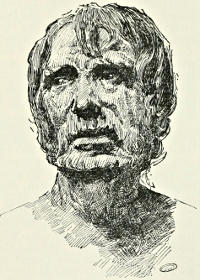
“Seneca”
(From a bust in the Naples Museum)
The traveller who has visited modern Rome in the autumn season has remarked the numbers of unwieldy and bloated gourds which sun their speckled bellies before the doors, to form a favourite condiment to the food of the poorer classes. When Claudius expired in the month of October, his soul, according to the satirist, long lodged in the inflated emptiness of his own swollen carcass, migrated by an easy transition into a kindred pumpkin. The senate declared that he had become a god; but Seneca knew that he was only transformed into a gourd. The senate decreed his divinity, Seneca translated it into pumpkinity; and proceeded to give a burlesque account of what may be supposed to have happened in heaven on the appearance of the new aspirant to celestial honours. A tall gray-haired figure has arrived halting at the gates of Olympus; he mops and mows, and shakes his palsied head, and when asked whence he comes and what is his business, mutters an uncouth jargon in reply which none can understand. Jupiter sends Hercules to interrogate the creature, for Hercules is a travelled god, and knows many languages; but Hercules himself, bold and valiant as he is, shudders at the sight of a strange unearthly monster, with the hoarse inarticulate moanings of a seal or sea-calf. He fancied that he saw his thirteenth labour before him. Presently, on a nearer view, he discovers that it is a sort of man. Accordingly he takes courage to address him with a verse from Homer, the common interpreter of gods and men; and Claudius, rejoicing at the sound of Greek, and auguring that his own histories will be understood in heaven, replies with an apt quotation.
To pass over various incidents which are next related, and the gibes of the satirist on the Gaulish origin of Claudius, and his zeal in lavishing the franchise on Gauls and other barbarians, we find the gods assembled in conclave to deliberate on the pretensions of their unexpected visitor. Certain of the deities rise in their places, and express themselves with divers exquisite reasons in his favour; and his admission is about to be carried with acclamation, when Augustus starts to his feet (for the first time, as he calls them all to witness, since he became a god himself—for Augustus in heaven is reserved and silent, and keeps strictly to his own affairs), and recounts the crimes and horrors of his grandchild’s career. He mentions the murder of his father-in-law Silanus, and his two sons-in-law Silanus and Pompeius, and the father-in-law of his daughter, and the mother-in-law of the same, of his wife Messallina, and of others more than can be named.
The gods are struck with amazement and indignation. Claudius is repelled from the threshold of Olympus, and led by Mercury to the shades below. As he passes along the Via Sacra he witnesses the pageant of his own obsequies, and then first apprehends the fact of his decease. He hears the funeral dirge in which his actions are celebrated in most grandiloquent sing-song, descending at last to the abruptest bathos. But the satirist can strike a higher note; the advent of the ghost to the infernal regions is described with a sublime irony. “Claudius is come!” shout the spirits of the dead, and at once a vast multitude assemble around him, exclaiming, with the chant of the priests of Apis, “We have found him, we have found him; rejoice and be glad!”[17] Among them was Silius the consul and Junius the prætor and Traulus and Trogus and Cotta, Vectius, and Fabius, Roman knights, whom Narcissus had done to death. Then came the freedmen Polybius and Myron, Harpocras, Amphæus, and Pheronactes, whom Claudius had despatched to hell before him, that he might have his ministers below. Next advanced Catonius and Rufus, the prefects, and his friends Lusius and Pedo, and Lupus and Celer, consulars, and finally a number of his own kindred, his wife and cousins and son-in-law. “Friends everywhere!” simpered the fool; “pray how came you all here?” “How came we here?” thundered Pompeius Pedo: “who sent us here but thou, O murderer of all thy friends?” And thereupon the newcomer is hurried away before the judgment seat of Æacus. An old boon companion offers to plead for him; Æacus, most just of men, forbids, and condemns the criminal, one side only heard. “As he hath done,” he exclaims, “so shall he be done by.” The shades are astounded at the novelty of the judgment; to Claudius it seems rather unjust than novel. Then the nature of his punishment is considered. Some would relieve Tantalus or Ixion from their torments and make the imperial culprit take their place; but no, that would still leave him the hope of being himself in the course of ages relieved. His pains must be never ending, still beginning; eternal trifler and bungler that he was, he shall play for ever and ever with a bottomless dice-box.
Such was the scorn which might be flung upon the head of a national divinity, even though he were the adoptive father of the ruler of the state; nor perhaps was the new and upstart deity much more cavalierly treated than might sometimes be the lot of the established denizens of Olympus. It is true that Nero at a later period thought fit to degrade his parent from these excessive honours, and even demolished the unfinished works of his temple on the Cælian Hill; but there is no reason to suppose that Seneca reserved his spite until this catastrophe, or that the prince evinced any marks of displeasure at the unrestrained laughter with which doubtless his satire was greeted.
While the memory of the deceased emperor was thus ruthlessly torn in pieces, the writer had been careful to exalt in terms the most extravagant the anticipated glories of his successor; and the vain, thoughtless heir perceived not that the mockery of his sire was the deepest of insults to himself. Of the figure, accomplishments, and character of Nero we shall speak more particularly hereafter; enough that he was young, that he was not ungraceful in appearance, that he had some talents, and, above all, the talent of exhibiting them.
With such qualifications the new occupant of a throne could never want for flatterers. To sing them, the sage of the rugged countenance mounts gaily on the wings of poetry, and sports in lines of mellifluous mellowness, such as might grace the erotic lyre of the most callow votary of the Muses. At last, he says, in mercy to his wretchedness, the life-thread of the stolid Claudius had been severed by the fatal shears. But Lachesis, at that moment, had taken in her hands another skein of dazzling whiteness, and as it glided nimbly through her fingers, the common wool of life was changed into a precious tissue—a golden age untwined from the spindle. The sisters ply their work in gladness, and glory in their blessed task; and far, far away stretches the glittering thread, beyond the years of Nestor and Tithonus. Phœbus stands by their side, and sings to them as they spin—Phœbus the god of song and the god of prophecy. “Stay not, oh stay not, gentle sisters; he shall transcend the limits of human life; he shall be like me in face, like me in beauty; neither in song nor in eloquence behind me. He shall restore a blissful age to wearied men, and break again the long silence of the Laws. Yes, as when Lucifer drives the stars before him, and morning dissipates the clouds, the bright sun gazes on the world, and starts his chariot on its daily race,—so Cæsar breaks upon the earth; such is the Nero whom Rome now beholds—beams his bright countenance with tempered rays, and glistens his fair neck beneath its floating curls.”f
FOOTNOTES