Book 2 — CHAPTER XXXIII. THE IMMEDIATE SUCCESSORS OF AUGUSTUS: TIBERIUS, CALIGULA, AND CLAUDIUS
Reading edition
Tiberius (Tiberius Claudius Nero Cæsar), 14-37 A.D.
Tiberius came of that ambitious Claudian family which had enjoyed twenty-eight consulates, five dictatorships, seven censorships, and as many triumphs. The marriage of his mother Livia with Octavius, and his adoption by Cæsar, had given him entrance into the house of Cæsar. All commissions with which he was charged by his adoptive father were carried out with activity and intelligence, and, at the time of the war with Marbod, he saved the empire in a dangerous crisis. Since the death of Agrippa, no general had been able to command such brilliant service. He had fought in Spain and in the Alps, governed Gaul, given a king to Armenia, subdued the Pannonians, conquered the Germans, transported forty-six thousand barbarians into Belgium and resettled the empire after the defeat of Varus. Such was the man to whom the death of Augustus gave the throne.[8]
Respect for Augustus had kept ambitions silent, but Tiberius found himself surrounded by republicans and more than this by candidates for the throne.
Moreover the soldiers had already understood that on them rested the security both of emperor and empire, and, as there were no more civil wars to enrich them, successions to the throne must take their place. Three Pannonian legions revolted, demanding one denarius per day, discharge after sixteen years, and a fixed sum to be paid in camp on the day they became veterans.
Tiberius sent Drusus, his son, and Sejanus, his prætorian prefect, to them at the head of some of the forces remaining in Italy. An eclipse of the moon helped to make the mutineers return to their duty.
On the Rhine there was a dangerous revolt. There were there seven legions, divided into two camps, making the same demands. Four legions killed their centurions. Germanicus, nephew of Tiberius, hastened to them.[9] The rebels offered him the empire, but he refused. In his vexation he had drawn his sword as if to kill himself. “Strike, then,” cried the angry men; his friends snatched the sword from him. To appease this dangerous sedition, he, acting on an imaginary letter from Tiberius, granted everything, and doubled the legacy of Augustus. Gallic tribute, all the general’s money, and that of his friends had to be put together to pay all this.
EXPEDITIONS OF GERMANICUS; VICTORY OF IDISTAVISUS
[14-19 A.D.]
It became necessary to give these restless spirits something to do, so their general led them against the enemy. In the country of the Marsi a space of fifty miles was put to fire and sword. In the following spring Germanicus passed the Rhine again, hoping to profit by the quarrels of Arminius and Segestes—the one belonging to the national, the other to the Roman party. He was only able to deliver Segestes, who was besieged by his rival. The wife of the conqueror of Varus was taken captive.
The last Roman ravages and the complaints of Arminius exasperated the Cherusci and a new league was formed. Germanicus went as far as the Teutoburg forest to fight them. Whitening bones marked the spot where the three legions had perished, and the soldiers buried the mutilated remains which had waited six years for this last honour. However, the Germans were nowhere to be found. Tired of pursuing an enemy who was not to be caught, Germanicus stopped. He regained Ems and embarked on the fleet which had brought him, whilst Cæcina regained the Rhine by the route of the “long bridges.” Arminius had preceded him there, and the disaster of Varus was on the point of being renewed, had not Cæcina happily been an experienced captain. He gained a strong position where the Romans were encamped and managed to reopen the Rhine route. Germanicus, surprised by equinoctial gales, had himself been in danger, and a number of his vessels had perished.
The barbarians having become singularly bold, a new expedition became necessary. A thousand warships transported eight legions to the shores of the Weser. The Germani ventured to await the Roman army on the plain of Idistavisus. Discipline led them on; but a second action was a second massacre. Varus was avenged. The victors returned to Gaul, half by land, the others by sea. A tempest destroyed or dispersed some of their vessels. On hearing this news, Germany trembled and rose, but Germanicus dealt repeated blows, and the astounded barbarians allowed the legions to regain their winter quarters.
There Germanicus found letters from Tiberius recalling him for a second consulship and a triumph. The legions were doubtless, in the emperor’s eyes, rather too much devoted to their leader. Germanicus obeyed and returned.
EARLY YEARS OF SUCCESSFUL GOVERNMENT BY TIBERIUS
Tiberius governed mildly and with wisdom, refusing temples offered, and discouraging, as a man who knew their value, base flatteries from the senate. His life was that of a rich private person; his manner, if not affable, at least polite. He rose to meet the consuls, consulted the senate in everything, and accepted the lessons which a dying liberty sometimes dared to offer. He never drew back from “a liberality which had an honourable motive.” Yet he was strictly economical with regard to finance, and if he took less trouble than Augustus to please the people with continual shows, he was careful to guard against famine. One year wheat was very dear. He did as we should do to-day, keeping the bread at low prices for the people at the merchants’ expense. Without yielding to his soldiers he kept them under austere discipline, although he had need of them.
With regard to the provinces, he continued the policy of Augustus. If he dare not absent himself from Rome to visit them, having neither a Mæcenas nor an Agrippa on whom to rely in his absence, he at least sent them able governors, avoided an increase of taxes, and relieved the misery where it was greatest. Twelve Asiatic towns, ruined by earthquake, were exempted from taxation for five years. Sardis, even worse off, received from him ten million sesterces. Tiberius practised the advice he gave to his provincial governors: “A good shepherd shears his sheep but does not flay them.”
Thus the empire was wisely governed; but under this mild discipline the nobles grew bolder. A plot was formed, but, being discovered in time, was frustrated, and Libo, its author, killed himself. At home, Tiberius had domestic troubles. Livia, accustomed to deference from her husband, insisted on being listened to. Agrippina, Germanicus’ wife and granddaughter of Augustus, boldly defied the mother of Tiberius, and would not admit that the wife of Drusus had equal rights with herself. These feminine rivalries divided the court and gave birth to hatreds which were embittered by courtiers.
Tiberius had recalled Germanicus from the borders of the Rhine as much to take him away from his legions as to leave himself free to follow on that frontier the prudent policy of Augustus. He allowed Germanicus to enter Rome in triumph, and shared with him the consulship for the following year. Just then the Parthians became hostile. They had driven away Vonones, the king imposed on them by Rome, and replaced him by the Arsacid Artabanus: the two rivals seemed in danger of commencing open hostilities. Moreover, Commagene and Cilicia, now some time without kings, were full of trouble. Syria and Judea claimed a diminution of taxes; “Germanicus alone,” said Tiberius, “can with his wisdom calm these eastern agitations.”
A senatorial decree gave the young prince powers once held by Agrippa and Caius Cæsar; that is, the government of the provinces beyond the sea, with supreme authority over all the governors. As for Drusus, the son of Tiberius, he set out for Pannonia, so as to watch over the movements of the Suevi.
The task of Drusus was the most simple. He had only to promote or instigate internal dissensions in Germany. Two powerful leagues had been formed. In the north that of the Cherusci under Arminius and his uncle Inguiomer; in the south the Marcomanni under Marbod. War broke out between them. The action was a bloody one; Marbod, being conquered, implored shelter in the empire. He was assigned a residence at Ravenna. The power of the Marcomanni was destroyed; that of the Cherusci did not survive Arminius, who was killed by his own family just as he was about, it is said, to make himself king. The silent intrigues of the Romans certainly had something to do with events which delivered them from two redoubtable foes.
[17-20 A.D.]
In the East, Germanicus had equal successes. Everywhere he had given justice and peace as the watchword of the new government. In Armenia, he gave the crown to Zenon, son of the king of Pontus and a faithful vassal of the empire. This prince had long since adopted Armenian customs. Germanicus had made a wise choice and the whole nation applauded. Cappadocia, whose old king had just died in Rome, was, like Commagene, reduced to a province. In Syria, Germanicus concluded an alliance with Artabanus, who only asked for the removal of his rival. In Thrace, one of the two kings had killed the other. The assassin was sent to Alexandria and, later on, put to death.
A more serious affair had begun the preceding year [17 A.D.] in Africa. A Numidian, Tacfarinas, a deserter from the legions, had collected and disciplined some troops and persuaded the Musulanii and Moors to rise. The proconsul defeated him, and for this vigorous act, which gave security to a fertile country, he received the distinction of a triumph.
DEATH OF GERMANICUS (19 A.D.); EXTERNAL AFFAIRS
At this prosperous moment Germanicus died, poisoned, it has been alleged, by order of Tiberius. Yet could a man such as he, thoughtful, serious, calculating, have committed such a senseless crime? The death of his adopted son took away no rival. He knew him to be incapable of treason and his death deprived him of a necessary support. The mystery is still unsolved. The perpetrator of the crime was, it is said, Piso, a patrician of a violent disposition, who had obtained the governorship of Syria during the time that Germanicus was in the East. It was on his return from a journey in Egypt, undertaken without permission and in defiance of Tiberius, that Germanicus found that the arrangements he had adopted had been interfered with by Piso.
Lively quarrels took place between them, and the insubordinate governor, rather than yield, preferred to quit the province. The news that Germanicus was seriously ill stopped him at Antioch. The prince becoming better, Piso opposed the celebration of any fêtes in honour of the event, and went on to Seleucia, where the report of an alarming relapse made him stop again. Amongst Agrippina’s attendants there was mention of poisoning, and emissaries from Piso who had come to report on the progress of the malady, could show, it was said, by whose hand the blow had been struck. Germanicus died. His body was burnt in the Forum at Antioch, and Agrippina, having piously gathered the ashes, landed at Brundusium, carrying the burial urn herself, and followed by an immense crowd, all plunged in heart-breaking sorrow.
Piso received the news of Germanicus’ death with unseemly joy, and immediately set off to return to his province. The legate and the senators throughout Syria had conferred the governorship on one of themselves. Piso did not recoil before the prospect of civil war. Tiberius would not pardon him. Forced to embark, he returned to Italy, where accusers awaited him. These wanted the emperor alone to judge his cause. Now, had the emperor feared possible revelations he would have accepted, but he sent the accusers back to the senate. He presided at the trial, and the accused, says Tacitus, looked at him fearfully as he sat there pitiless, calm, impassive, and impenetrable. This portrait of Tiberius is the most faithful Tacitus has left.
Piso killed himself in his own house. The emperor rewarded the three friends of Germanicus who had come as accusers, and asked for Nero, the eldest of Germanicus’ sons, the honour of the quæstorship five years before the regulation age, and married him to a daughter of Drusus. Later on he begged the same favour for the second son of Germanicus.
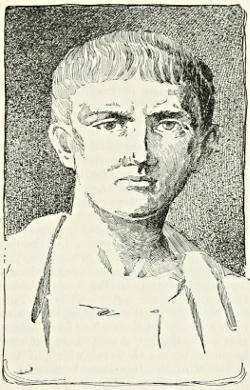
Tiberius
(From a bust in the Vatican)
[20-24 A.D.]
This long drama ended, Tiberius returned to the cares of government. There were complaints of the too great severity of the Papia-Poppæan law. He named fifteen commissioners to mitigate its demands. Some wanted to extend his power with regard to the choice of governors; this he refused. The limits of sanctuary were restricted, because this had caused much disorder in provincial towns. Informers were also discouraged. One of them denounced the senator Lentulus. Tiberius rose and said he considered himself no longer worthy to live if Lentulus was his enemy. In the provinces, he maintained good administration by skilful choice and severity towards prevaricating officials. In Gaul there was a beginning of revolt. Florus tried to provoke a rising of the Belgæ, but being beaten and hemmed in in the wood of Arduenna, he killed himself. The pretext urged for this rising was the burden of the tribute. The Æduan, Sacrovir, caused still more alarm, by raising forty thousand men and taking Augustodunum. Two of the Rhine legions fell on these badly armed troops and horribly massacred them.
Tacfarinas had also reappeared in Africa. Encouraged by a first success, he ventured to attack Thala, but was repulsed with loss. Then he changed his tactics, divided his troops into small bands and carried on a guerilla warfare. The emperor sent Blæsus, Sejanus’ uncle, to deal with this indefatigable foe, and thanks to his activity, Tacfarinas was again forced to flee, leaving his brother in the enemy’s hands.b
[It was not until two years later, 24 A.D., that Rome was finally rid of this troublesome foe. By that time Tacfarinas had collected another large force. P. Dolabella, the Roman governor, attacked it, and in his decisive victory the Numidian leader was slain. Ptolemy, king of Mauretania, was Dolabella’s ally.]
[14-19 A.D.]
Tiberius ruled the provinces on the whole in a Roman spirit, maintaining the dignity of the empire for the most part intact from the centre to the frontiers. The stability of the system, however rotten and decayed at heart, might still be measured by the strength and solidity of its outworks. At no period did the bulwarks of the Roman power appear more secure and unassailable. The efforts of Drusus and his son to overpower the Germani on their own soil had been stupendous; they had wielded forces equal at least to those with which Cæsar had added Gaul to the empire, and yet had not permanently advanced the eagles in any direction. But, on the other hand, it was soon found that the Germani were only formidable under the pressure of an attack. When the assault relaxed, the power they had concentrated in resistance crumbled readily away. With the death of Arminius all combined hostility to Rome ceased among them and meanwhile the arts and manners of the south advanced incessantly among them.
At the same time the long respite from military exactions allowed the pursuits of ease and luxury to fructify within the limits of the provinces. Gaul was no longer drained from year to year by the forced requisitions of men and horses, of arms and stores, which had fed the exhausting campaigns of Germanicus. Her ancient cities decked themselves with splendid edifices, with schools and theatres, aqueducts and temples. The camps on the Rhine and Danube were gradually transformed into commercial stations, and became emporiums of traffic with the north of Europe, where the fur and amber of the Hercynian forests and the Baltic coast were exchanged for wine and oil or gold and silver, those instruments of luxury which nature was supposed, in mercy or in anger, to have denied to the German barbarians. Such a state of affairs allowed the emperor to persist in his favourite plan of leaving the provincial governors for years unchanged at their posts. Each succeeding proconsul was no longer in a fever of haste to aggrandise himself by the plunder or renown of a foray beyond the frontiers. The administration of the provinces became a matter of ordinary routine; it lost its principal charms in the eyes of the senators, who could at last with difficulty be induced to exchange the brilliant pleasures of the capital, with all its mortifications and perils, for the dull honours of a distant government.
Nor can I discover in general the justice of accusing Tiberius of neglecting the safety of his remote possessions, which seem, on the contrary, to have flourished securely in the armed peace of his august empire. In Gaul the revolt of Sacrovir and his Belgian confederates was effectually suppressed; the outbreak of the Frisians, though at some cost of blood, seems to have been speedily quelled. Nor have we any distinct confirmation of the assertion of Suetonius, that Tiberius suffered the province to be ravaged with impunity by the Germani, which, if true, can apply only to some transient violation of the frontiers.
Nor does the assertion of Tiberius’ indifference seem to be better founded with regard to Mœsia. Tacitus steps frequently aside from his domestic narrative to record the affairs of this region and the exploits of the emperor’s lieutenants; while Appian makes special mention of the conquest of Mœsia under Tiberius, and of the establishment of provincial government in this quarter by his hand.[10] Sabinus, Pandus, and Labeo seem to have held the command there successively during the first half of this principate, and these men at least were not allowed to indulge in indolence, for their exertions and victories are a theme to which the historian repeatedly refers.
But the emptiness of these charges can be more clearly shown in the case of the dependent kingdom of Armenia, which, according to the same authority, Tiberius suffered to be seized by the Parthians, and wrested from the patronage of the empire. It appears, on the contrary, from the particular recital of Tacitus, that the bold occupation of this kingdom by Artabanus was immediately resented by the emperor with the energy of a younger man. Not only were the wild mountaineers of the Caucasus, the Iberians and Albanians, invited to descend upon the intruders; not only were the sons of Phraates released from their long detention at Rome, and directed to present themselves on their native soil, and claim the allegiance of their father’s subjects; but a Roman general, L. Vitellius, a man of distinguished valour and experience, was deputed to lead the forces of Asia and Syria against the enemy; and while it was hoped that a vigorous demonstration would suffice to hurl him back from the territory in dispute, instructions were not withheld, it would appear, to push on if necessary, and smite the Parthians with the strong hand of the empire. But these combinations proved speedily successful. Artabanus, already detested by many of his most powerful subjects, was compelled to descend from his throne, and take refuge in the far wilds of Hyrcania; while Tiridates, the son of Phraates, was accepted in his room [35 A.D.]. The Roman army, which had crossed the Euphrates, returned victorious without striking a blow, though, by a subsequent revolution, Artabanus was not long afterwards restored, and admitted, upon giving the required hostages, to the friendship of his lordly rivals [36 A.D.].
[4 B.C.-37 A.D.]
If Tiberius refrained from aggrandising his empire by fresh conquests, he was not the less intent on consolidating the unwieldy mass by the gradual incorporation of the dependent kingdoms enclosed within its limits. The contests between two rival brothers, Cotys and Rhescuporis, in Thrace, gave him a pretext for placing the fairest part of that country under the control of a Roman officer, thus preparing the way for its ultimate annexation. On the death of Archelaus, king of Cappadocia, in the year 17, his country was declared a Roman province, and subjected to the rule of an imperial procurator. At the same period the frontier kingdom of Commagene was added to the dominions of the republic under the government of a prætor. Syria, the great stronghold of the Roman power in the East, was still skirted by several tributary kingdoms or ethnarchies, such as Chalcis, Emesa, Damascus, and Abilene; but the dependency of Judea, the wealthiest and proudest of all these vassal states, was wrested in the reign of Augustus from the dynasty to which it had been entrusted, and was still subjected by his successor to the control of the proconsul at Antioch.
Herod the Great, on his death-bed, had sent his seal, together with an ample present, to Augustus, in token of the entire dependence upon Rome in which he held his dominions [4 B.C.]. This act of vassalage procured him, perhaps, the ratification of the disposition he had made of his territories between Archelaus, Herod Antipas, and Philippus. To the first was allotted the kingdom of Judea, including Samaria and Idumæa, but with the loss of the cities of Gaza, Gadara, and Hippus, which were now annexed to the government of Syria. To the second fell the districts of Galilee to the west, and Peræa to the east of the Jordan; while the Trachonitis, Auranitis, and Gaulonitis formed with Ituræa the tetrarchy of Philip, extending northward to the desert borders of Damascus. But the rival kinsmen were not satisfied with this division. Archelaus and Antipas repaired to Rome to plead against one another; but while they were urging their suits before the tribunal of the senate, the provisional government which the Romans had established in Judea was suddenly attacked on all sides by bodies of armed insurgents. Their leaders, however, were not men of rank or commanding influence, and the revolt was in no sense a national movement. It was speedily crushed by Varus, then proconsul of Syria, the same who ten years afterwards perished so miserably in Germany, and punished with the atrocious severity too commonly employed in such cases. Archelaus, confirmed in his sovereignty, continued to reign under these lamentable auspices in Judea. His subjects, still mindful of the sons of their beloved Mariamne, never regarded him with favour; and it has been mentioned how they complained to Augustus of his tyranny, and obtained his removal from the throne. He was finally sent into exile at Vienne in Gaul.
The fall of Archelaus left the throne of Judea and Samaria without a direct claimant, and the emperor took the opportunity of attaching them to the Roman dominions. This acquisition was placed under the general administration of the proconsul of Syria, but governed more directly by an imperial procurator, who took up his abode at Cæsarea Philippi. Of the character of the new government we find no complaints even in the Jewish writers whose accounts of this period have been preserved to us.
Both Augustus and his successor appear to have instructed their officers to observe the same respect for the peculiar habits and prejudices of the Jews which had reflected such lustre in their eyes upon the magnanimous Agrippa; whatever may have been the ordinary severities of Roman domination, it was not till the arrival of Pontius Pilate, about the middle of the reign of Tiberius, that any special cause of grievance was inflicted upon them. They complained that the new procurator commenced his career with a grave and wanton insult. He entered Jerusalem with standards flying, upon which, according to the usage of the time, the image of the emperor was displayed. The old religious feeling of the Jews against the representation of the human figure was roused to vehement indignation; they remonstrated with the procurator, nor would they listen to his excuse that the Romans had their customs as well as the Jews, and that the removal of the emperor’s portrait from his ensigns by an officer of his own might be regarded as a crime against the imperial majesty. But if Tiberius was merely the creature of the delators in his own capital, in the provinces he retained his good sense and independence. Perhaps it was by a special authorisation from him that Pilate consented to withdraw the obnoxious images. Nevertheless, the Jews, under the guidance of their priests, continued to watch every act of his administration with inveterate jealousy, and when he ventured to apply a portion of the temple revenues to the construction of an aqueduct for the supply of their city, broke out into violence which provoked him to severe measures of repression.
It is probable that mutual exasperation led to further riots, followed by sanguinary punishments; the government of Pilate was charged with cruelty and exaction, and at last the provincials addressed themselves to Vitellius, the governor of Syria. Nor were their expectations disappointed. The proconsul required his procurator to quit the province, and submit himself to the pleasure of the offended emperor. Tiberius, indeed, was already dead before his arrival, but his successor attended without delay to the representations of his lieutenant, and Pilate was dismissed with ignominy to Vienna. From the confidence with which Tiberius was appealed to on a matter of such remote concern, it would seem that the vigilance of his control was not generally relaxed even in the last moments of his life.
While Judea and Samaria were thus annexed to the Roman province, Galilee and the outlying regions of Peræa and Ituræa were still suffered to remain under their native rulers; and the dominions of the great Herod became once more united transiently under a single sceptre at no distant period. If, however, we consider the condition of the Jewish provincials under the Roman fasces, we shall find reason to believe that it was far from intolerable, and presented probably a change for the better from the tyranny of their own regal dynasties.
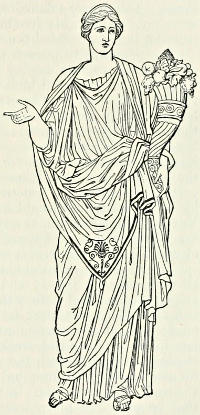
Roman Empress
(From a statue in the Capitol)
Doubtless the national feeling, as far as it extended, was outraged in its cherished prepossessions by the substitution of a foreign for a native domination. The nobles and the priests, who preserved and reflected this sentiment, and who suffered in consideration under foreign sway, fostered the prejudices of the people to the utmost of their power, excited their discontent, fanned the flame of sedition, and then betrayed their unfortunate clients to the sword of relentless executioners. It may be admitted that the fiscal exactions of the procurator were more uniformly rigid than those of Herod, whose remission of a large portion of his people’s taxes had gained him favour in the midst of his atrocities. Yet the amount of freedom and security enjoyed by the Jews under a Quirinus and a Pilate shows the general leniency of the Roman government at this period, and may induce us to believe that the yoke of the conquerors was on the whole a happy exchange for their subjects. The warm descriptions of provincial felicity by the Jewish authority Philo, may be coloured to suit a purpose, and it may be impossible to produce any distinct facts to support this general conjecture. Yet indications are not wanting in the writings of the Evangelists, which contain, abstracted from their religious significance, the most interesting record in existence of the social condition of antiquity,—for they alone of all our ancient documents are the productions of men of the people,—to show that the mass of the population of Judea was contented and comparatively happy under the rule of the Roman procurator.
Such is the impression received from the representations of common life in the scriptures of the New Testament. The instances they allege of cruelty and injustice are drawn from the conduct of the Jews towards one another, rather than of the foreigner towards the native. The scribe and the Pharisee are held up to odium or contempt, not the minister of police or the instrument of government. The Romans are regarded in them as the protectors of the people against their domestic tyrants. The duty of paying them tribute is urged as the proper price of the tranquillity they maintain; their fiscal officers are spoken of with forbearance; their soldiers are cited as examples of thoughtful toleration; the vice of the provincial ruler is indifference and unbelief rather than wanton violence; and the tribunal of the emperor himself is appealed to as the last resort of injured innocence. The freedom of movement enjoyed by the subjects of Rome, the permission so fully allowed them of passing, from frontier to frontier, of assembling together for social and religious objects, of flocking in crowds at the call of popular leaders, all indicate a state of personal liberty which might be envied throughout Europe at the present day.f
INTERNAL GOVERNMENT
During the earlier years of Tiberius’ sway, his administration was happy for the state. Even Tacitusd draws a brilliant picture of it: “Public matters and the more serious of those relating to private persons were determined by the senate. In the distribution of honours, he took birth, military service, and civil talent into consideration, so that it would have been difficult to have made a better choice. As to laws, if one excepts that of majesty, good use was made of them. For his private affairs the prince chose most eminent men, some unknown to him except by reputation, and the greater part grew old in service. He took care that the provinces were not burdened with taxes. The prince’s domains in Italy were not much extended. His slaves were not insolent, his freedmen not many. Had he disputes with private persons, the law decided the matter.”b
His plan was to possess the reality of power without exciting hatred or envy by the useless display of the show of it. He therefore rejected the titles that were offered him, such as that of Imperator, as a prænomen, and that of Father of his Country; even that of Augustus, though hereditary, he would only use in his letters to kings and dynasts; above all he rejected that of Master (Dominus); he would only be called Cæsar, or First of the Senate. This last (which we shall henceforth term Prince) was his favourite title; he used to say, “I am the Master of my slaves, the Imperator of the soldiers, and the Prince of the rest.” He would not allow anything peculiar to be done in honour of his birthday, nor suffer any one to swear by his fortune; neither would he permit the senate to swear to his acts on New Year’s Day, or temples, or any other divine honours, to be decreed him. He was affable and easy of approach; he took no notice of libels and evil reports of which he was the object, while he repelled flattery of every kind.
To the senate and the magistrates he preserved (at least in appearance) all their pristine dignity and power. Every matter, great or small, public or private, was laid before the senate. The debates were apparently free, and the prince was often in the minority. He always entered the senate house without any attendants, like an ordinary senator; he reproved consulars in the command of armies for writing to him instead of the senate; he treated the consuls with the utmost respect, rising to them and making way for them. Ambassadors and deputies were directed to apply to them as in the time of the republic. It was only by his tribunician right of interceding that he exercised his power in the senate. He used also to take his seat with the magistrates as they were administering justice, and by his presence and authority gave a check to the influence of the great in protecting the accused; by which conduct of his, while justice gained, liberty, it was observed, suffered.
The public morals and the tranquillity of the city were also attended to. A limit was set to the expenses of plays and public shows, and to the salaries of the players, to whom the senators and knights were forbidden to show marks of respect, by visiting them or attending them in public. Profligacy had become so bold and shameless, that ladies were known to have entered themselves in the list of professed courtesans in order to escape the penalties of the law, and young men of family to have voluntarily submitted to the mark of infamy in order to appear with safety on the stage or the arena; both these infamous classes were now subjected to the penalty of exile. Astrologers and fortune-tellers were expelled the city; the rites and ceremonies of the Egyptian and Judaic religions were suppressed. Guards were placed throughout Italy to prevent highway robbery; and those refuges of villainy of all kinds, the sanctuaries, were regulated in Greece and Asia.
Yet people were not deceived by all this apparent regard for liberty and justice; for they saw, as they thought, from the very commencement, the germs of tyranny, especially in the renewal of the law of treason (majestas). In the time of the republic there was a law under this name, by which any one who had diminished the greatness (majestas) of the Roman people by betraying an army, exciting the plebs to sedition, or acting wrongly in command, was subject to punishment. It applied to actions alone; but Sulla extended it to speeches, and Augustus to writings against not merely the state, but private individuals, on the occasion of Cassius Severus having libelled several illustrious persons of both sexes. Tiberius, who was angered by anonymous verses made on himself, directed the prætor, when consulted by him on the subject, to give judgment on the law of treason. As this law extended to words as well as actions, it opened a wide field for mischief, and gave birth to the vile brood of delators or public informers answering to the sycophants, those pests of Athens in the days of her democratic despotism. This evil commenced almost with the reign of Tiberius, in whose second year two knights, Falonius and Rubrius, were accused, the one of associating a player of infamous character with the worshippers of Augustus, and of having sold with his gardens a statue of that prince, the other of having sworn falsely by his divinity. Tiberius however would not allow these absurd charges to be entertained. Soon after Granius Marcellus, the prætor of Bithynia, was charged with treason by his quæstor, Cæpio Crispinus, for having spoken evil of Tiberius, having placed his own statue on a higher site than that of the Cæsars, and having cut the head of Augustus off a statue to make room for that of Tiberius. This last charge exasperated Tiberius, who declared that he would vote himself on the matter; but a bold expression used by Cn. Piso brought him to reason, and Marcellus was acquitted.
After the death of Germanicus, Tiberius acted with less restraint; for his son Drusus did not possess the qualities suited to gain popularity, and thus to control him. In fact, except his affection for his noble adoptive brother, there was nothing in the character of Drusus to esteem. He was addicted to intemperance, devoted to the sports of the amphitheatre, and of so cruel a temper, that a peculiarly sharp kind of sword was named from him drusian. Tiberius made him his colleague in the consulate, and then obtained for him the tribunician power (22); but Drusus was fated to no long enjoyment of the dignity and power thus conferred on him. A fatal change was also to take place in the conduct and government of Tiberius himself, of which we must now trace the origin.
Seius Strabo, who had been made one of the prefects of the prætorian cohorts by Augustus, had a son, who, having been adopted by one of the Ælian family, was named in the usual manner L. Ælius Sejanus. This young man, who was born at Vulsinii in Tuscany, was at first attached to the service of Caius Cæsar, after whose death he devoted himself to Tiberius; and such was his consummate art, that this wily prince, dark and mysterious to all others, was open and unreserved to him. Sejanus equalled his master in the power of concealing his thoughts and designs; he was daring and ambitious, and he possessed the requisite qualities for attaining the eminence to which he aspired; for though proud he could play the flatterer; he could and did assume a modest exterior, and he had vigilance and industry, and a body capable of enduring any fatigue.
[14-24 A.D.]
When Drusus was sent to quell the mutiny of the Pannonian legions, Sejanus, whom Tiberius had made colleague with his father Strabo in the command of the prætorians, accompanied him as his governor and director. Strabo was afterwards sent out to Egypt, and Sejanus was continued in the sole command of the guards; he then represented to Tiberius how much better it would be to have them collected into one camp instead of being dispersed through the city and towns, as they would be less liable to be corrupted, would be more orderly, and of greater efficiency if any insurrection should occur. A fortified camp was therefore formed for them near the Viminal Gate, and Sejanus then began to court the men, and he appointed those on whom he could rely to be tribunes and centurions. While thus securing the guards, he was equally assiduous to gain partisans in the senate, and honours and provinces only came to those who had acquired his favour by obsequiousness. In all these projects he was unwittingly aided by Tiberius, who used publicly to style him “the associate of his labours,” and even allowed his statues to be placed and worshipped in temples and theatres, and among the ensigns of the legions.
Sejanus had in fact formed the daring project of destroying Tiberius and his family, and seizing the supreme power. As besides Tiberius and Drusus, who had two sons, there were a brother and three sons of Germanicus living, he resolved, as the safer course, to remove them gradually by art and treachery. He began with Drusus, against whom he had a personal spite, as that violent youth had one time publicly given him a blow in the face. In order to effect his purpose, he seduced his wife Livia or Livilla, the sister of Germanicus; and then, by holding out to her the prospect of a share in the imperial power, he induced her to engage in the plan for the murder of her husband. Her physician Eudemus was also taken into the plot, but it was some time before the associates could finally determine what mode to adopt. At length a slow poison was fixed on, which was administered to Drusus by a eunuch named Lygdus, and he died apparently of disease (23). Tiberius, who while his son was lying dead, had entered the senate house and addressed the members with his usual composure, pronounced the funeral oration himself, and then turned to business for consolation.
So far all had succeeded with Sejanus, and death carried off the younger son of Drusus soon after his father; but Nero and Drusus, the two elder sons of Germanicus, were now growing up, and the chastity of their mother and the fidelity of those about them put poison out of the question. He therefore adopted another course; and taking advantage of the high spirit of Agrippina, and working on the jealousy of her which Augusta was known to entertain, he managed so that both she and Livia should labour to prejudice Tiberius against Agrippina by talking of the pride which she took in her progeny, and the ambitious designs which she entertained. At the same time he induced some of those about her to stimulate her haughty spirit by their treacherous language. He further proposed to deprive her of support by destroying those persons of influence who were attached to her family, or the memory of her husband. With this view he selected for his first victims C. Silius and Titius Sabinus, the friends of Germanicus, and Silius’ wife, Sosia Galla, to whom Agrippina was strongly attached, and who was therefore an object of dislike to Tiberius. Omitting however Sabinus for the present, he caused the consul Visellius Varro to accuse Silius of treason for having dissembled his knowledge of the designs of Sacrovir, having disgraced his victory by his avarice, and countenanced the acts of his wife. Having vainly asked for a delay till his accuser should go out of office, and seeing that Tiberius was determinedly hostile to him, Silius avoided a condemnation by a voluntary death. His wife was banished; a portion of his property was confiscated, but the remainder was left to his children.
[24-25 A.D.]
Urged by his own ambition, and by the importunity of Livia, Sejanus had soon (25) the boldness to present a petition to Tiberius, praying to be chosen by him for her husband. Tiberius took no offence; his reply was kind, only stating the difficulties of the matter with respect to Sejanus himself, but at the same time expressing the warmest friendship for and confidence in him. Sejanus however was suspicious, and he began to reflect that while Tiberius remained at Rome, many occasions might present themselves to those who desired to undermine him in the mind of that jealous prince; whereas, could he induce him to quit the city, all access to him would be only through himself, all letters would be conveyed by soldiers who were under his orders, and gradually, as the prince advanced in years, all the affairs of the state would pass into his hands. He therefore, by contrasting the noise and turbulence of Rome with the solitude and tranquillity of the country, gradually sought to bend him to his purpose, which he effected in the following year.
During this time the deadly charge of treason was brought against various persons. The most remarkable case was that of A. Cremutius Cordus, the historian. He had made a free remark on the conduct of Sejanus, and accordingly two of that favourite’s clients were directed to accuse him of treason, for having in his history called Cassius the last of the Romans. Cremutius, when before the senate, observing the sternness of Tiberius’ countenance, took at once the resolution of abandoning life, and therefore spoke as follows:
“Fathers, my words are accused, so guiltless am I of acts; but not even these are against the prince or the prince’s parent, whom the law of treason embraces. I am said to have praised Brutus and Cassius, whose deeds, while several have written, no one has mentioned without honour. Titus Livius, who is pre-eminent for eloquence and fidelity, extolled Pompeius with such praises, that Augustus used to call him a Pompeian; nor was that any hindrance of their friendship. He nowhere calls Scipio, Afranius, this very Cassius, this Brutus, robbers and parricides, which names are now given them; he often speaks of them as distinguished men. The writings of Asinius Pollio transmit an illustrious record of them; Messala Corvinus used to call Cassius his general; and both of them flourished in wealth and honours. To the book of Marcus Cicero, which extolled Cato to the skies, what did the dictator Cæsar but reply in a written speech as if before judges? The letters of Antonius, the speeches of Brutus, contain imputations on Augustus which are false, and written with great bitterness. The verses of Bibaculus and Catullus, which are full of abuse of the Cæsars, are read; nay, the divine Julius himself, the divine Augustus himself, both bore with them and let them remain; I cannot well say whether more through moderation or wisdom; for what are despised go out of mind; if you are angry with them their truth seems to be acknowledged. I speak not of the Greeks, among whom not only liberty but license was unpunished; or if any one did take notice, he avenged himself on words by words. But there was the greatest freedom, and no reproach, when speaking of those whom death had removed from enmity or favour. Do I, in the cause of civil war, inflame the people by my harangues while Brutus and Cassius are in arms, and occupying the plains of Philippi? Or do they, who are now dead these seventy years, as they are known by their images, which the conqueror did not destroy, retain in like manner their share of memory in literary works? Posterity allots his meed to every one; nor, should a condemnation fall on me, will there be wanting those who will remember not only Brutus and Cassius, but also me.”
[25-27 A.D.]
Having thus spoken, Cordus left the senate house, and returning to his own abode starved himself to death. The senate decreed that the copies of his work should be collected and burned by the ædiles; but some were saved by his daughter Marcia, and were republished in the succeeding reign.
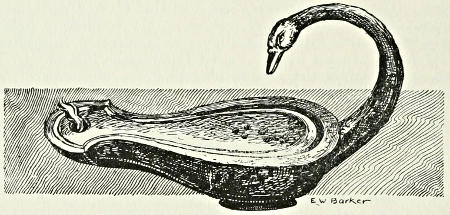
Roman Lamp
At length (26) Tiberius quitted Rome and went into Campania, under the pretext of dedicating a temple to Jupiter at Capua, and one to Augustus at Nola; but with the secret intention of never returning to the city. Various causes, all perhaps true, are assigned for this resolution. The suggestions of Sejanus were not without effect; he was grown thin, and stooped; he was quite bald, and his face was full of blotches and ulcers, to which he was obliged to have plasters constantly applied; and he may therefore have sought, on this account, to retire from the public view. It is further said that he wished to escape from the authority of his mother, who seemed to consider herself entitled to share the power which he had obtained through her exertions. [But whatever the exact motive that actuated Tiberius, his withdrawal constituted a virtual desertion of the capital, since he never returned.]
He was accompanied only by one senator, Cocceius Nerva, who was deeply skilled in the laws, by Sejanus and another knight, and by some persons, chiefly Greeks, who were versed in literature. A few days after he set out an accident occurred, which was near being fatal to him, but proved fortunate for Sejanus. As at one of his country-seats near Fundi, named the Caverns (Speluncæ), he was, for the sake of the coolness, dining in one of the natural caverns, whence the villa derived its appellation, a great quantity of the stones, which formed its roof, fell down and crushed some of the attendants to death. Sejanus threw himself over Tiberius to protect him with his own body, and was found in that position by the soldiers who came to their relief. This apparent proof of generous self-devotion raised him higher than ever in the estimation of the prince.
While Tiberius was rambling from place to place in Campania (27), a dreadful calamity occurred at Fidenæ, in consequence of the fall of a temporary amphitheatre erected by a freedman named Atilius for giving a show of gladiators; the number of the killed and maimed is said to have been fifty thousand.[11] The conduct of the nobility at Rome on this melancholy occasion showed that all virtue had not departed from them; they threw open their houses for the sufferers, and supplied them with medical attendance and remedies; so that, as the great historian observes, the city wore the appearance of the Rome of the olden time, when after battles the wounded were thus humanely treated. This calamity was immediately followed by a tremendous fire on the Cælian Hill; but Tiberius alleviated the evil by giving the inhabitants the amount of their losses in money.
Having dedicated the temples, and rambled for some time through the towns of Campania, Tiberius finally fixed on the islet of Capreæ [the modern Capri] in the Bay of Naples as his permanent abode. This isle, which lay at the short distance of three miles from the promontory of Surrentum, was accessible only in one place; it enjoyed a mild temperature, and commanded a most magnificent view of the bay of Naples and the lovely region which encompassed it.[12] But the delicious retreat was speedily converted by the aged prince into a den of infamy, such as has never perhaps found its equal; his vicious practices, however, were covered by the veil of secrecy, for he still lay under some restraint.
[27-29 A.D.]
When Tiberius left Rome, Sejanus renewed his machinations against Agrippina and her children and friends. He directed his first efforts against her eldest son Nero, whom he surrounded with spies; and as this youth was married to a daughter of Livia, his wife was instructed by her abandoned mother to note and report all his most secret words and actions. Sejanus kept a faithful register of all he could learn in these various ways, and regularly transmitted it to Tiberius. He also drew to his side Nero’s younger brother Drusus, a youth of a fiery turbulent temper, and who hated him because he was his mother’s favourite. It was however Sejanus’ intention to destroy him also when he should have served his purpose against Nero.
At this time also he made his final and fatal attack on Titius Sabinus, whose crime was his attachment to the family of Germanicus. The bait of the consulate, of which Sejanus alone could dispose, induced four men of prætorian dignity to conspire his ruin. The plan proposed was that one of them, named Latinius Latiaris, who had some knowledge of Sabinus, should draw him into conversation, out of which a charge of treason might be manufactured. The plot succeeded; Latiaris, by praising the constancy of Sabinus in friendship, led him gradually on to speak as he thought of Sejanus, and even of Tiberius. At length, under pretence of having something of great importance to reveal, he brought him into a chamber where the other three were concealed between the ceiling and the roof. A charge of treason was therefore speedily concocted and forwarded to Tiberius, from whom a letter came on New Year’s Day (28), plainly intimating to the senate his desire of vengeance. This sufficed for that obsequious body, and Sabinus was dragged forth and executed without delay.
In his letter of thanks to the senate, Tiberius talked of the danger he was in, and of the plots of his enemies, evidently alluding to Agrippina and Nero. These unfortunate persons lost their only remaining refuge the following year (29) by the death of the prince’s mother, Julia Augusta,[13] whose influence over her son, and regard for her own descendants, had held Sejanus in restraint. This soon appeared by the arrival of a letter from Tiberius, accusing Nero of unnatural practices, and speaking of the arrogance of Agrippina; but while the senate were in debate, the people surrounded the house, carrying the images of Agrippina and Nero, and crying out that the letter was forged, and the prince deceived. Nothing therefore was done on that day, and Sejanus took the opportunity of irritating the mind of Tiberius, who wrote again to the senate; but as in the letter he forbade their proceeding to extremes, they passed a decree, declaring themselves prepared to avenge the prince, were they not hindered by himself.
[29-31 A.D.]
Most unfortunately the admirable narrative of Tacitus fails us at this point; and for the space of more than two years, and those the most important of the reign of Tiberius, we are obliged to derive our knowledge of events from the far inferior notices of Dion Cassius and Suetonius. We are therefore unable to display the arts by which Sejanus effected the ruin of Agrippina and her children, and can only learn that she was relegated to the isle of Pandataria, where, while she gave vent to her indignation, her eye was struck out by a centurion; and that Nero was placed in the isle of Pontia, and forced to terminate his own life. The further fate of Agrippina and Drusus we shall have to relate.
Sejanus now revelled in the enjoyment of power; every one feared him, every one courted and flattered him. “In a word,” says Dion,[o] “he seemed to be emperor, Tiberius merely the ruler of an island”; for while the latter dwelt in solitude and apparently unthought of, the doors of the former were thronged every morning with saluting crowds, and the first men of Rome attended him on his way to the senate. His pride and insolence, as is always the case with those who rise otherwise than by merit, kept pace with his power, and men hated while they feared and flattered him.e
Let us cite an instance of this fulsome flattery from the pages of the contemporary chronicler, Velleius Paterculus, a Roman who had served nine years as a soldier in Germany, and who had been military tribune and afterwards quæstor and prætor. The panegyric with which Velleius closes his Epitome of Roman History eulogises Sejanus along with the emperor himself, and his mother. This eulogium is worth transcribing at length as it illustrates the contrast between contemporary estimates—be they candid or hypocritical—and the judgment of posterity.a
VELLEIUS PATERCULUS EULOGISES TIBERIUS
[14-37 A.D.]
“It is seldom,” says Velleius, “that men who have arrived at eminence, have not had powerful coadjutors in steering the course of their fortunes; thus the two Scipios had the two Lælii, whom they set in every respect on a level with themselves; thus the emperor Augustus had Marcus Agrippa, and after him Statilius Taurus. The newness of these men’s families proved no obstruction to their attainment of many consulships and triumphs, and of sacerdotal offices in great numbers. For great affairs demand great co-operators (in small matters, the smallness of assistance does not mar the proceedings), and it is for the interest of the public, that what is necessary for business should be eminent in dignity, and that usefulness should be fortified with influence. In conformity with these examples, Tiberius Cæsar has had, and still has, Ælius Sejanus, a most excellent coadjutor in all the toils of government, a man whose father was chief of the equestrian order, and who, on his mother’s side is connected with some of the most illustrious and ancient families, ennobled by high preferments; who has brothers, cousins, and an uncle, of consular rank; who is remarkable for fidelity in the discharge of his duties, and for ability to endure fatigue, the constitution of his body corresponding with the vigour of his mind; a man of pleasing gravity, and of unaffected cheerfulness; appearing, in the despatch of business, like a man quite at ease; assuming nothing to himself, and hence receiving every honour; always deeming himself inferior to other men’s estimation of him; calm in looks and conversation, but in mind indefatigably vigilant.
“In esteem for Sejanus’ virtues, the judgment of the public has long vied with that of the prince. Nor is it at all new with the senate and people of Rome, to consider the most meritorious as the most noble. The men of old, before the First Punic War, three hundred years ago, exalted to the summit of dignity T. Coruncanius, a man of no family, bestowing on him, besides other honours, the office of chief pontiff; they promoted Spurius Carvilius, a man of equestrian birth, and afterwards Marcus Cato, another new man (not a native citizen, but born at Tusculum), as well as Mummius Achaicus, to consulships, censorships, and triumphs. And they who considered Caius Marius, a man of the most obscure origin, as unquestionably the first in the Roman nation, before his sixth consulship; who had so high an esteem for Marcus Tullius, that he could obtain, almost by his sole recommendation, the highest offices for whomsoever he chose; and who refused nothing to Asinius Pollio, which men of the noblest birth had to obtain with infinite labour, were certainly of opinion that he who possessed the greatest virtues was entitled to the greatest honours. The natural imitation of other men’s examples led Cæsar to make trial of Sejanus, and occasioned Sejanus to bear a share of the burdens of the prince; and induced the senate and people of Rome cheerfully to call to the guardianship of their safety him whom they saw best qualified for the charge.
“Having exhibited a general view of the administration of Tiberius Cæsar, let us now enumerate a few particulars respecting it. With what wisdom did he bring to Rome Rhescuporis, the murderer of Cotys, his own brother’s son, and partner in the kingdom, employing in that affair the services of Pomponius Flaccus, a man of consular rank, naturally inclined to all that is honourable, and by pure virtue always meriting fame, but never eagerly pursuing it! With what solemnity as a senator and a judge, not as a prince, does he hear causes in person! With what precepts did he form the mind of his Germanicus, and train him in the rudiments of war in his own camp, so that he afterwards hailed him the conqueror of Germany! What honours did he heap on him in his youth, the magnificence of his triumph corresponding to the grandeur of his exploits! How often has he honoured the people with donations! How readily has he, when he could do it with the sanction of the senate, supplied senators with property suitable to their rank, neither encouraging extravagance, nor suffering honourable poverty to be stripped of dignity! In what an honourable style did he send his Germanicus to the transmarine provinces! With what energy, employing Drusus as a minister and coadjutor in his plans, did he force Marboduus, who was clinging to the soil of the kingdom which he had possessed, to come forth, like a serpent concealed in the earth (let me speak without offence to his majesty), by the salutary charms of his counsels! How honourably, yet how far from negligently, does he keep watch over him! How formidable a war, excited by the Gallic chief Sacrovir and Julius Florus, did he suppress, and with such amazing expedition and energy, that the Roman people learned that they were conquerors, before they knew that they were at war, and the news of victory outstripped the news of the danger! The African war too, perilous as it was, and daily increasing in strength, was quickly terminated under his auspices and direction.
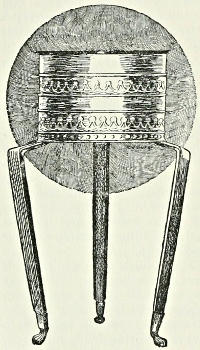
Roman Tripod
“What structures has he erected in his own name, and those of his family! With what dutiful munificence, even exceeding belief, is he building a temple to his father! With how laudable a generosity of disposition is he repairing even the buildings of Cneius Pompey that were consumed by fire! Whatever has been at any time conspicuously great, he regards as his own, and under his protection. With what liberality has he at all times, and particularly at the recent fire on the Cælian Mount, repaired the losses of people of all conditions out of his own property! With what perfect ease to the public does he manage the raising of troops, a business of constant and extreme apprehension, without the consternation attendant on a levy! If either nature allows us, or the humility of man may take upon itself, to make a modest complaint of such things to the gods, what has he deserved that, in the first place, Drusus Libo should form his execrable plots; and, in the next, that Silius and Piso should follow his example, one of whom he raised to dignity, the other he promoted? That I may pass to greater matters (though he accounted even these very great), what has he deserved, that he should lose his sons in their youth, or his grandson by Drusus? But we have only spoken of causes for sorrow, we must now come to occasions of shame. With what violent griefs, Marcus Vinicius, has he felt his mind tortured in the last three years! How long has his heart been consumed with affliction, and, what is most unhappy, such as he was obliged to conceal, while he was compelled to grieve, and to feel indignation and shame, at the conduct of his daughter-in-law and his grandson! And the sorrows of this period have been aggravated by the loss of his most excellent mother, a woman who resembled the gods more than human beings; and whose power no man ever felt but in the relief of distress or the conferring of honour.
“Let our book be concluded with a prayer. O Jupiter Capitolinus, O Jupiter Stator! O Mars Gradivus, author of the Roman home! O Vesta, guardian of the eternal fire! O all ye deities who have exalted the present magnitude of the Roman Empire to a position of supremacy over the world, guard, preserve, and protect, I entreat and conjure you, in the name of the commonwealth, our present state, our present peace (our present prince)! And when he shall have completed a long course on earth, grant him successors to the remotest ages, and such as shall have abilities to support the empire of the world as powerfully as we have seen him support it!”g
These words of the fawning courtier require no comment, unless it be to note that such are often the materials from which the historian is supposed to extract truthful estimates of men and events. Fortunately, in the present instance, the more trustworthy accounts of Tacitus and Suetonius have also come down to us—the former, however, not quite intact.
THE FALL OF SEJANUS
[31 A.D.]
Sejanus had thus ruled for more than three years at Rome with power nearly absolute, when (31) Tiberius made him his colleague in the consulate—an honour observed to be fatal to every one who had enjoyed it. In fact the jealous tyrant, who had been fully informed of all his actions and designs,[14] had secretly resolved on his death; but fear, on account of Sejanus’ influence with the guards, and his uncertainty of how the people might stand affected, prevented him from proceeding openly against him. He therefore had recourse to artifice, in which he so much delighted. At one time he would write to the senate, and describe himself as so ill that his recovery was nearly hopeless; again that he was in perfect health, and was about to return to Rome. He would now praise Sejanus to the skies, and then speak most disparagingly of him; he would honour some and disgrace others of his friends solely as such. In this way both Sejanus himself and all others were kept in a state of the utmost uncertainty. Tiberius further bestowed priesthoods on Sejanus and his son, and proposed to marry his daughter to Drusus, the son of Claudius, the brother of Germanicus; yet at the same time, when Sejanus asked permission to go to Campania, he desired him to remain where he was, as he himself would be coming to Rome immediately.
All this tended to keep Sejanus in a state of great perturbation; and this was increased by the circumstance of Tiberius, when appointing the young Caius to a priesthood, having not merely praised him, but spoken of him in some sort as his successor in the monarchy. He would have proceeded at once to action, were it not that the joy manifested by the people on this occasion proved to him that he had only the soldiers to rely on, and he hesitated to act with them alone. Tiberius then showed favour to some of those to whom Sejanus was hostile. The senators easily saw whither all this tended, and their neglect of Sejanus was now pretty openly displayed.
Tiberius, having thus made trial of the senate and the people, and finding he could rely on both, resolved to strike the long-meditated blow. In order to take his victim more completely unawares, he gave out that it was his intention to confer on him the tribunician power. Meantime he gave to Nævius Sertorius Macro a secret commission to take the command of the guards, made him the bearer of a letter to the senate, and instructed him fully how to act. Macro entered Rome at night, and communicated his instructions to the consul, C. Memmius Regulus (for his colleague was a creature of Sejanus), and to Græcinus Laco, the commander of the watchmen, and arranged with them the plan of action. Early in the morning he went up to the temple of the Palatine Apollo, where the senate was to sit that day, and meeting Sejanus, and finding him disturbed at Tiberius having sent him no message, he whispered him that he had the grant of the tribunician power for him. Sejanus then went in highly elated; and Macro, showing his commission to the guards on duty, and telling them that he had letters promising them a largess, sent them down to their camp, and put the watchmen about the temple in their stead. He then entered the temple, and having delivered the letter to the consuls, immediately went out again, and leaving Laco to watch the progress of events there, hastened down to the camp lest there should be a mutiny of the guards.
The letter was long and ambiguous; it contained nothing direct against Sejanus, but first treated of something else, then came to a little complaint of him, then to some other matter, then it returned to him again, and so on; it concluded by saying that two senators, who were most devoted to Sejanus, ought to be punished, and himself be cast into prison; for though Tiberius wished most ardently to have him executed, he did not venture to order his death, fearing a rebellion. He even implored them in the letter to send one of the consuls with a guard to conduct him, now an old man and desolate, into their presence. We are further told that such were his apprehensions, that he had given orders, in case of a tumult, to release his grandson Drusus, who was in chains at Rome, and put him at the head of those who remained faithful to his family; and that he took his station on a lofty rock, watching for the signals that were to be made, having ships ready to carry him to some of the legions in case anything adverse should occur.
His precautions, however, were needless. Before the letter was read, the senators, expecting to hear nothing but the praises of Sejanus and the grant of the tribunician power, were loud in testifying their zeal towards him; but as the reading proceeded their conduct sensibly altered; their looks were no longer the same; even some of those who were sitting near him rose and left their seats; the prætors and tribunes closed round him lest he should rush out and try to raise the guards, as he certainly would have done had not the letter been composed with such consummate artifice. He was in fact so thunderstruck, that it was not till the consul had called him the third time that he was able to reply. All then joined in reviling and insulting him; he was conducted to the prison by the consul and the other magistrates. As he passed along the populace poured curses and abuse on him; they cast down his statues, cut the heads off of them, and dragged them about the streets. The senate seeing this disposition of the people, and finding that the guards remained quiet, met in the afternoon in the temple of Concord, close to the prison, and condemned him to death. He was executed without delay; his lifeless body was flung down the Gemonian steps, and for three days it was exposed to every insult from the populace; it was then cast into the Tiber. His children also were put to death; his little daughter, who was to have been the bride of the prince’s grand nephew, was so young and innocent, that as they carried her to prison she kept asking what she had done, and whither they were dragging her, adding that she would do so no more, and that she might be whipped if naughty. Nay, by one of those odious refinements of barbarity which trample on justice and humanity while adhering to the letter of the law, because it was a thing unheard of for a virgin to be capitally punished, the executioner was made to deflower the child before he strangled her. Apicata, the divorced wife of Sejanus, on hearing of the death of her children, and seeing afterwards their lifeless bodies on the steps, went home; and having written to Tiberius a full account of the true manner of the death of Drusus and of the guilt of Livilla, put an end to herself. In consequence of this discovery Livilla, and all who were concerned in that murder, were put to death.
The rage of the populace was also vented on the friends of Sejanus, and many of them were slaughtered. The prætorian guards, too, enraged at being suspected and at the watchmen being preferred to them, began to burn and plunder houses. The senators were in a state of the utmost perturbation, some trembling on account of their having paid court to Sejanus, others, who had been accusers or witnesses, from not knowing how their conduct might be taken. All however conspired in heaping insult on the memory of the fallen favourite.
[31-33 A.D.]
Tiberius, now free from all apprehension, gave loose to his vengeance. From his island-retreat he issued his orders, and the prison was filled with the friends and creatures of Sejanus; the baleful pack of informers was unkennelled, and their victims of both sexes were hunted to death. Some were executed in prison; others were flung from the Capitol; the lifeless remains were exposed to every kind of indignity, and then cast into the river. Most however chose a voluntary death; for they thus not only escaped insult and pain, but preserved their property for their children.
In the following year (32) Tiberius ventured to leave his island, and sail up the Tiber as far as Cæsar’s gardens; but suddenly, no one knew why, he retreated again to his solitude, whence by letters he directed the course of cruelty at Rome. The commencement of one was so remarkable that historians have thought it deserving of a place in their works; it ran thus: “What I shall write to you, P. C., or how I shall write, or what I shall not write at this time, may the gods and goddesses destroy me worse, than I daily feel myself perishing, if I know.” A knight named M. Terentius at this time, when accused of the new crime of Sejanus’ friendship, had the courage to adopt a novel course of defence. He boldly acknowledged the charge, but justified his conduct by saying that he had only followed the example of the prince, whom it was their duty to imitate. The senate acquitted him and punished his accusers with exile or death, and Tiberius expressed himself well pleased at the decision. But in the succeeding year (33) his cruelty, joined with avarice (a vice new to him), broke out with redoubled violence. Tired of murdering in detail, he ordered a general massacre of all who lay in prison on account of their connection with Sejanus. Without distinction of age, sex, or rank, they were slaughtered; their friends dared not to approach, or even be seen to shed tears; and as their putrefying remains floated along the Tiber, no one might venture to touch or to burn them.
The deaths of his grandson Drusus, and his daughter-in-law Agrippina, were added to the atrocities of this year. The former perished by the famine to which he was destined, after he had sustained life till the ninth day by eating the stuffing of his bed. The tyrant then had the shamelessness to cause to be read in the senate the diary which had been kept of everything the unhappy youth had said or done for a course of years, and of the indignities which he had endured from the slaves and guards who were set about him. Agrippina had cherished hopes of meeting with justice after the fall of Sejanus; but finding them frustrated, she resolved to starve herself to death. Tiberius, when informed, ordered food to be forced down her throat, but she finally accomplished her purpose; he then endeavoured to defame her memory by charging her with unchastity. As her death occurred on the same day as that of Sejanus two years before, he directed it to be noted, and he took to himself as a merit that he had not caused her to be strangled or cast down the Gemonian steps. The obsequious senate returned him thanks for his clemency, and decreed that on the 18th of October, the day of both their deaths, an offering in gold should be made to Jupiter.
The Cæsarian family was now reduced to Claudius the brother and Caius the son of Germanicus, and his three daughters, Agrippina, Drusilla, and Livilla, (whom Tiberius had given in marriage respectively to Cn. Domitius, L. Cassius, and M. Vinicius,) and Tiberius and Julia the children of Drusus, which last had been married to her cousin Nero, and now was given in marriage to Rubellius Blandus.
[33-37 A.D.]
From his very outset in life, Tiberius had been obliged more or less to conceal his natural character. Augustus, Germanicus, Drusus, his mother, had successively been a check on him; and even Sejanus, though the agent of his cruelty, had been the cause of his lusts being restrained. But now all barriers were removed; for Caius was so abject a slave to him, that he modelled himself on his character and his words, only seeking to conceal his own vices. He therefore now at length gave free course to all his vicious propensities, and it almost chills the blood to read the details of the horrid practices in which he indulged amidst the rocks of Capreæ. Meantime there was no relaxation of his cruelty; Macro was as bad as Sejanus, only more covertly; there was no lack of delators, and men of rank perished daily.e
TACITUS DESCRIBES THE LAST DAYS OF TIBERIUS
[37 A.D.]
At Rome, meanwhile, were sown the seeds that were destined to yield a harvest of blood after the decease of Tiberius. Lælius Balbus had charged Acutia, sometime the wife of Publius Vitellius, with high treason; and, as the senate was, after her condemnation, decreeing a reward to the accuser, Junius Otho, tribune of the people, interposed his veto; hence their mutual hate, and afterwards the exile of Otho. Then Albucilla, infamous for her many amours, who had been married to Satrius Secundus, the man who revealed the conspiracy of Sejanus, was impeached of impiety towards the prince. In the charge were involved, as her accomplices and her adulterers, Cneius Domitius, Vibius Marsus, and Lucius Arruntius. Domitius was of noble descent. Marsus, too, was distinguished by the ancient dignities of his house, and his own fame for learning. The minutes, however, transmitted to the senate, imported, “that in the examination of the witnesses, and torture of the slaves, Macro had presided;” and as no letter came from the emperor against the accused, it was suspected, that, while he was ill, and perhaps without his privity, the accusations were in great measure forged, in consequence of the notorious enmity of Macro to Arruntius.
Domitius therefore by preparing for his defence, and Marsus by seeming determined to starve himself to death, protracted their lives. Arruntius, to the importunity of his friends, urging him to try delays and evasions, answered that the same measures were not honourable to all men alike: he had lived long enough; his only regret was, that exposed on all sides to derision and peril, he had submitted to bear thus far an old age loaded with anxieties; long obnoxious to the malice of Sejanus, now of Macro, always of some minion of power; not because he was guilty of any crime, but because he was intolerant of the grossest iniquities. Grant that the few and last days of Tiberius could be got over, yet how could he escape all that he would have to endure under the youth who threatened to succeed him? When the mind of Tiberius, a man of consummate experience, underwent such a convulsion and transformation from the potent influence of imperial power, was it likely that Caligula, who had scarce outgrown his childhood, ignorant of everything, or nursed and trained up in the worst, would follow a course more righteous under the guidance of Macro; the same Macro, who, as the more expert villain, having been selected for the task of crushing Sejanus, had brought the commonwealth to a state of wretchedness the most abject, by his numerous atrocities? He had now before him, he said, a prospect of slavery still more embittered; and therefore it was that he withdrew at once from the horrors which had been enacted, and those that impended.
While pouring forth these warnings with the intense emotion of a prophet, he opened his veins. That Arruntius was wise in resorting to suicide the following events will testify. Albucilla, after inflicting an ineffectual wound upon herself, was by order of the senate dragged to prison. As to the ministers of her lusts, it was decreed, “that Carsidius Sacerdos, of prætorian rank, should be banished to an island; Pontius Fregellanus expelled the senate; and that upon Lælius Balbus the same penalty be inflicted.” The senators gave the latter judgment with feelings of joy, as he was accounted a man of turbulent eloquence, and zealous in his efforts against the innocent.
About the same time, Sextus Papinius, of a consular family, chose a sudden and frightful end, by throwing himself down from an eminence. The cause was ascribed to his mother, who, after many repulses, had, by fondling and excitement, brought him into a situation from which he could escape by death only. She was therefore accused in the senate; and, though she embraced the knees of the fathers, and pleaded “the natural tenderness of a mother’s grief, and the greater weakness of a woman’s spirit under such a calamity,” with other motives of pity in the same doleful strain, she was banished from Rome for ten years, till her younger son was past the slippery period of youth.[15]
As for Tiberius, his body was now wasted and his strength exhausted, but his dissimulation did not fail him. He exhibited the same inflexibility of mind, the same energy in his looks and discourse; and even sometimes by affected vivacity tried to hide his decaying strength, though too manifest to be concealed. And after much shifting of places, he settled at length at the promontory of Misenum, in a villa which Lucullus once owned. There it was discovered that his end was approaching, in the following manner: In his train was a physician, named Charicles, noted in his profession, not indeed to prescribe for the prince in cases of indisposition, but that he might have some one to consult if he thought proper. Charicles, as if he were departing to attend to his own affairs, and taking hold of his hand under pretence of taking leave, felt his pulse. But he did not escape detection, for he instantly ordered the entertainment to be renewed; whether incensed, and therefore the more concealing his displeasure, is uncertain; but at table he continued beyond his wont, as if to do honour to his friend on his departure. Charicles, however, assured Macro that life was ebbing fast, and could not outlast two days. Hence the whole court was in a bustle with consultations, and expresses were despatched to the generals and armies. On the seventeenth, before the calends of April, he was believed to have finished his mortal career, having ceased to breathe; and Caligula, in the midst of a great throng of persons, paying their congratulations, was already going forth to make a solemn entrance on the sovereignty, when suddenly a notice came, “that Tiberius had recovered his sight and voice, and had called for some persons to give him food to restore him.” The consternation was universal; the concourse about Caligula dispersed in all directions, every man affecting sorrow or feigning ignorance; he himself stood fixed in silence—fallen from the highest hopes, he now expected the worst. Macro, undismayed, ordered the old man to be smothered with a quantity of clothes, and the doorway to be cleared. Thus expired Tiberius, in the seventy-eighth year of his age.d
This story of the last moments of Tiberius is questioned by Merivale,f who comments on the fact that Tacitus, writing long after the event, gives no authority for his version of the affair as just quoted, and says: On the other hand, a contemporary of the event seems to describe the old man’s death as simply natural. “Feeling himself sinking,” said Seneca,l “Tiberius took off his ring, and held it for a little while, as if about to present it to some one as an instrument of authority; but he soon replaced it on his finger, and lay for a time without motion. Then suddenly he called for his attendants, and when no one answered, raised himself from his bed with failing strength, and immediately fell lifeless beside it. This account was distorted by others into the denial of necessary sustenance, and actual death by exhaustion, while some did not scruple to affirm that Caius had caused the sick man to be poisoned.”
SUETONIUS CHARACTERISES TIBERIUS
Tiberius was in his person large and robust, of a stature somewhat above the common size, broad in the shoulders and chest, and in his other parts proportionable. He used his left hand more readily than his right; and his joints were so strong that he would bore a fresh sound apple through with his finger, and would wound the head of a boy, or even a young man, with a fillip. He was of a fair complexion, and had his hair so long behind that it covered his neck, which was observed to be a mark of distinction affected by the family. He had a handsome face, but often full of pimples. His eyes, which were large, had a wonderful faculty of seeing in the night time, and in the dark, but for a short time only, and immediately after awaking from sleep; for they soon grew dim again. He walked with his neck stiff and unmoved, commonly with a frowning countenance, being for the most part silent; when he spoke to those about him it was very slowly, and generally accompanied by an effeminate motion of his fingers. All those things being disagreeable, and expressive of arrogance, Augustus remarked in him, and often endeavoured to excuse to the senate and people, assuring them that “they were natural defects, which proceeded from no viciousness of mind.” He enjoyed a good state of health, and without any interruption, almost during the whole time of his government; though, from the thirtieth year of his age he managed himself in respect of his health according to his own discretion, without any medical assistance.
In regard to the gods, and matters of religion, he discovered much indifference; being greatly addicted to astrology, and full of a persuasion that all things were governed by fate. Yet he was extremely afraid of lightning, and in cloudy weather always wore a laurel crown on his head; because an opinion prevails among many, that the leaf of that tree is never touched by the lightning.
He applied himself with great diligence to the liberal arts, both Greek and Latin. In his Latin style, he affected to imitate Messalla Corvinus, a respectable old man, whose company he had much frequented in his youth. But he rendered his style obscure by excess of affectation and niceness; so that he was thought to talk better extempore, than in a premeditated discourse. He composed likewise a lyric ode, under the title of A Lamentation upon the Death of L. Cæsar, as also some Greek poems in imitation of Euphorion, Rhianus, and Parthenius. These poets he greatly admired, and set up their works and statues in the public libraries, amongst the eminent authors of antiquity. On this account, most of the learned men of the time vied with each other in publishing observations upon them, which they addressed to him. What he chiefly attended to was the knowledge of the fabulous history; and this he prosecuted with a zeal that might justly be deemed ridiculous. For he used to try the grammarians, a class of people which I have already observed he much affected, with such questions as these: “Who was Hecuba’s mother? What had been Achilles’ name amongst the young women? What song were the Sirens used to sing?” And the first day that he entered the senate house, after the death of Augustus, as if he intended to pay a respect both to the memory of his father and the gods, in imitation of Minos upon the death of his son, he made an offering of frankincense and wine, but without any music.
Though he was ready and conversant with the Greek tongue, yet he did not use it everywhere, but chiefly declined it in the senate house; insomuch that having occasion to use the word monopolium (monopoly), he first begged pardon for being obliged to trouble the house with a foreign word. And when in a decree of the senate, the word emblema (emblem) was read, he advised to have it changed, and that a Latin word should be substituted in its room; or if no proper one could be found, to express the thing in a circumlocutory manner. A soldier who was examined, as a witness upon a trial, in Greek, he would not allow to make any answer but in Latin.
The people rejoiced so much at his death, that, upon the first news of it, they ran up and down the city, some crying out, “Away with Tiberius into the Tiber”; others exclaiming, “May the earth, the common mother of mankind, and the infernal gods, allow no place for the dead, but amongst the wicked.” Others threatened his body with the hook and the scalæ gemoniæ, their indignation at his former cruelty being increased by a recent instance of the same kind. It had been provided by an act of the senate, that the punishment of persons condemned to die should always be deferred until the tenth day after the sentence. Now it happened that the day on which the news of Tiberius’ death arrived, was the time fixed by law for the execution of some persons that had been sentenced to die. These poor creatures implored the protection of all about them; but because Caius was not in town, and there was none else to whom application could be made in their behalf, the men who were charged with the care of their execution, from a dread of offending against that law, strangled them, and threw them down the scalæ gemoniæ. This excited in the minds of the people a still greater abhorrence of the tyrant’s memory, since his cruelty subsisted even after his death. As soon as his corpse began to move from Misenum, many cried out for its being carried to Atella, and broiled there in the amphitheatre. It was however brought to Rome, and burned with the usual ceremony.c
MERIVALE’S ESTIMATE OF TIBERIUS
Cæsar, the high-handed usurper, met an usurper’s death, by open violence in the light of day. Augustus, after fifty years of the mildest and most equitable rule the times admitted, sank at last by a slow and painless decay into the arms of those dearest to him, amidst the respectful sympathies of an admiring people. The end of Tiberius, whether consummated by treachery or not, was shrouded in gloom and obscurity; the chamber of mortality was agitated to the last by the intrigues and fears of the dying man and his survivors. The fellow-countrymen of the detested tyrant seem to have deemed it fitting that one whose life was to them an enigma should perish by a mysterious death. It seems preferable to represent him as a man whose character was sufficiently transparent, the apparent inconsistencies in whose conduct, often exaggerated and misrepresented, may generally be explained by the nature of his position, and the political illusions with which he was required to encircle himself. It is the character of the age in which he was placed, an age of rapid though silent transition, rather than of the man himself, which invests him with an historical interest. This is the point to which it will be well to direct our attention, before letting the curtain drop upon the personage with whom the forms of the republic perished, and the despotism of the Cæsars finally dropped its mask.
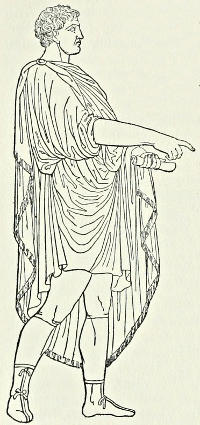
Emperor in Military Tunic
(From Trajan’s Column)
The practice of delation, so rapidly developed under the rule of Tiberius, introduced a new principle into the government of his day, and marked it with features of its own. It is hardly possible to overrate the effects of this practice upon the general complexion of the Roman polity, nor is it easy to exaggerate the horror with which it came to be regarded. It was an attempt to reconcile the despotism of the monarch with the forms of a republic; to strengthen the sovereign power by weakening its subjects; to govern the people by dividing them, by destroying their means of combination among themselves, by generating among them habits of mutual distrust and fear, and finally plunging them into a state of political imbecility. It has been asserted that this system was in fact the product of peculiar circumstances rather than the creation of a deliberate will; nevertheless the chief of the state was made, not unnaturally, to bear the whole responsibility of it, and the disgust of the nobler spirits of Rome at the tyranny of spies and informers was turned against the prince himself, in whose interest at least, if not at whose instigation, their enormities were for the most part perpetrated.
If we examine the authorities for the history of the reign we have been reviewing, we shall find that those who were nearest to the times themselves have generally treated Tiberius with the greatest indulgence. Velleius Paterculus indeed, and Valerius Maximus, his contemporaries and subjects, must be regarded as mere courtly panegyrists; but the adulation of the one, though it jars on ears accustomed to the dignified self-respect of the earlier Romans, is not more high-flown in language and sentiment than what our own writers have addressed to the Georges, and even the Charleses and Jameses, of the English monarchy; while that of the other is chiefly offensive from the connection in which it stands with the lessons of virtue and patriotism which his book was specially designed to illustrate. The elder Seneca, the master of a school of rhetoric, to which science his writings are devoted, makes no mention of the emperor under whom he wrote; but his son, better known as the statesman and philosopher, though he was under the temptation of contrasting the austere and aged tyrant with the gay young prince to whom he was himself attached, speaks of him with considerable moderation, and ascribes the worst of his deeds to Sejanus and the delators rather than to his own evil disposition.
In the pages of Philoi and Josephus,h the government of Tiberius is represented as mild and equitable; it is not till we come to Suetonius and Tacitus, in the third generation, that his enormities are blazoned in the colours so painfully familiar to us.[16] It will suffice here to remark that both these later writers belong to a period of strong reaction against the Cæsarian despotism, when the senate was permitted to raise its venerable head and assume a show, at least, of its old imperial prerogatives; when the secret police of Rome was abolished, delation firmly repressed, freedom of speech proclaimed by the voice of the emperor himself, and the birthright of the Roman citizen respectfully restored to him. There ensued a strong revulsion of feeling, not against monarchy, which had then become an accepted institution, but against the corruptions which had turned it into tyranny; and Tiberius, as the reputed founder of the system of delation, bore the odium of all the crimes of all the tyrants who had succeeded him. Tacitus admits that the affairs of Tiberius were misrepresented during his power by fear, and after his death by spite; yet we cannot doubt that Tacitus himself often yields to the bias of his detractors, while Suetonius is at best indifferent to the truth. After all, a sober discretion must suspend its belief regarding many of the circumstances above recorded, and acknowledge that it is only through a treacherous and distorting haze that we have scanned the features of this ill-omened principate.
THE CHARACTER OF THE TIMES
[25-37 A.D.]
Nevertheless, the terror which prevailed in the last years of Tiberius, to whomsoever it is chiefly to be ascribed, exercised a baleful influence over society at Rome, and shows by effects which are still discoverable that it has been but little exaggerated. It has left permanent traces of itself in the manifest decline and almost total extinction of literature under its pressure. The Roman writers addressed only a small class in the capital; to be popularly known in the provinces, to be read generally throughout the Roman world, was a privilege reserved for few, and anticipated perhaps rarely by any. Even in the capital the poet and historian composed their works for a circle of a few thousand knights and senators, for the friends and families of their own few hundreds of acquaintances, whom they invited to encourage their efforts by attending their recitations. The paralysis which benumbed the energies of the Roman nobility at this crisis of terror and despair, extended naturally to the organs of their sentiments and opinions. Not history and philosophy only suffered an eclipse, but poetry also, which under Augustus had been the true expression of the national feelings, became mute when the feelings themselves could no longer be trusted with utterance. Cremutius was subjected to persecution for pronouncing that Brutus and Cassius were the last of the Romans. A tragedian was accused, and if accused, we may presume, perhaps, that he was condemned for speaking evil of the king of men, Agamemnon; and various authors were assailed, and their writings sentenced to proscription, to whose recitations the last princeps had himself listened with indulgence.
The poems which were tolerated were generally the most trifling, and perhaps licentious in character. The sly irony of the fable, a style of composition adopted by slaves, and imitated from the servile Orientals, seems not unsuitable to these perilous times. The name of Phædrus belongs in all probability to the Tiberian period, but it is curious that no later writer for four centuries should have cared to notice him. Similar or worse has been the fate of a more serious writer, Manilius, the author of an elaborate poem on astronomy and its spurious sister astrology, a theme of some danger under the circumstances of the times, but which he has treated with irreproachable discretion; it is owing, perhaps, to the disgrace under which the forbidden science fell that this innocent work lapsed into entire oblivion, and has escaped the mention of any writer of antiquity.
The deep gloom which settled upon the face of higher society at Rome during the reign of Tiberius was heightened by its contrast with the frivolous dissipation of the populace, who, though deprived of the glitter of a brilliant court, and surrounded by signs of mourning and humiliation among their natural leaders, not the less abandoned themselves to the sensual enjoyments which alone they relished, and rejoiced in their utter indifference to political principles, to parties, and to men. When Sejanus fell, they clamoured with exultation over the body of the traitor; nevertheless, had the goddess Nursia, says the moralist, but favoured her Etruscan votary; had but the false intriguer circumvented the guileless old man, on the instant they would have been heard proclaiming Sejanus a Cæsar and an Augustus. In the one class was abandonment of public life, shame, despair, and suicide; the intolerable evils of the time drove men not to religious consolations, but to a restless inquiry into the future, or a vain attempt to lull the sense of the present in philosophic apathy: the other rushed headlong, hour by hour, to the baths, shows, and largesses, or shouted at the heels of the idol of the moment, or sighed and perhaps murmured at his loss, and speedily resigned itself to oblivion of the fitful emotion of the day.