Book 2 — CHAPTER XXXIV. NERO: LAST EMPEROR OF THE HOUSE OF CÆSAR
Reading edition
Nero Claudius Cæsar Drusus Germanicus: 54-68 A.D.
[54-59 A.D.]
Brought up in a corrupt court, in the midst of his mother’s guilty intrigues, Nero soon saw himself surrounded by flatterers apt at eulogising all his follies and excusing all his crimes. He did not lack understanding and knew what was right, but no care was taken to check his vicious inclinations or his vanity with regard to his musical skill. Yet for a long time after his death the first five years of his reign were lauded (quinquennium Neronis) as the happiest of the empire. He did, in fact, reduce taxation in the provinces, contend against luxury, and assist poor senators with money, and bid fair to take Augustus as his model. “Oh, that I had never learned to write!” he said one day when a death-warrant was given him to sign. Another time when the senate was addressing thanks to him he said, “Wait till I deserve them.” Seneca and Burrus tried, and for some time with success, to restrain the stormy passions of their pupil, but Agrippina’s ambition made them break violently forth.
This imperious woman thought she was going to reign in her son’s name, and desired to be present at senatorial deliberations. She was much chagrined at having to content herself with listening behind a curtain.
One day when Nero was giving audience to some Armenian ambassadors she advanced to take her place beside him and receive homage. But the prince went to meet her and prevented what the Romans even then would have regarded as an affront, the intervention of a woman in public affairs. Leagued with the freedman Pallas, she hoped that nothing would take place in the palace without her; but Seneca and Burrus, although her creatures, were resolved to hinder the domination which had degraded Claudius. Unfortunately, the two ministers, in spite of the austerity of their lives and teaching, found no other way to combat her influence than by fostering the prince’s passions. They allowed a number of young women and dissolute men to gather round the prince. Among the former Agrippina soon found a rival in the freedwoman Acte. She then changed her tone and manner, but caresses were of no more avail than anger; and the two ministers, in order to show her that her power was gone, disgraced the freedman Pallas.
Then Agrippina broke out into open threats. She would reveal the whole truth, take Britannicus to the prætorians, and return to its rightful occupant the throne she had bestowed on an ungrateful son. Nero forestalled her. On the first day of his reign he had put to death a member of the imperial family, Silanus by name; the death of his adopted brother cost him no more. Britannicus, who was only fourteen years old, was poisoned at a banquet at Nero’s own table. Agrippina, alarmed by this precocious cruelty, sought defenders for herself. She sounded the soldiers, and paid graceful attentions to their leaders. Nero, no longer keeping within bounds, assigned her a dwelling beyond the palace and scarcely ever saw her. He even listened to an accusation against her and forced her to answer questions from Seneca and Burrus. She did so, but haughtily, and spoke harshly to her son, which did not help her to regain the authority she had lost.
Having got rid of Agrippina, the two ministers governed for some years with moderation and justice. Several condemnations taught the provincial governors that their conduct was observed; several taxes were abolished or reduced. Nero demanded that they should all be repealed. Unfortunately love of pleasure now possessed him. Dissolute friends, vulgar liaisons, a fatal taste for the theatre, corrupted him from day to day. Seneca practised his good maxims too little for them to influence the young emperor. Rome learned with astonishment that her prince ran about the streets at night disguised as a slave, entering taverns and beating belated folk at the risk of striking one stronger than himself. A senator once returned his blows, and had the imprudence next day to apologise. Nero, remembering the inviolability belonging to his office of tribune, had him put to death. In the day he went to the theatre, giving trouble to the custodians, encouraging applause and hissing, exciting tumult, and taking pleasure in seeing the sovereign people break the benches and engage in fights in which he himself joined, throwing missiles at a venture from his elevated seat.
The virtuous sister of Britannicus could not be a fit wife for this royal débauché. He carried off Poppæa Sabina from her husband Otho. Poppæa’s ambition found an obstacle in Octavia, and one even stronger in Agrippina, who was not distressed by her son’s criminal conduct, but was much averse from seeing him under any influence but her own.
Irritated by her reproaches, Nero at last went so far as to give orders for her death. Anicetus, commander of the fleet at Misenum, formed a plot to assassinate the empress. On the pretext of a reconciliation she was invited to go to Baiæ, and was put on a vessel so built as to part asunder when out at sea. Agrippina saved herself by swimming and reached the neighbouring coast, where she took refuge in her villa at the Lucrine Lake. Nero caused her to be stabbed, and proclaimed that she had killed herself after a freedman sent by her had been caught in an attempt to kill him (59 A.D.). Such was the fate of this woman, a granddaughter of Augustus, and sister, wife, and mother, to three emperors. But revengeful furies pursued the parricide in spite of the congratulations which Burrus was base enough to offer him in the name of the soldiers and the thanks rendered to the gods in all parts of the city at Seneca’s suggestion. He sought to stifle his remorse by plunging into gross and insensate debauchery. His most unworthy follies date from this time. The Romans blushed to see him driving a chariot in the arena and mounting the stage to sing and play the lyre. We may imagine he stifled his conscience, but not that he found rest. In Greece, he dared not enter the Eleusinian temple of which the herald’s voice bid the impious and parricides avaunt.b
During the last two proconsulates the prefecture of Syria had acquired its greater extension. On the death of Herod Agrippa in 44, his kingdom of Judea had been definitively annexed to the empire, and was subjected, as once before, to an imperial procurator, who, while he derived his fiscal and civil authority directly from the emperor, and acted in a manner as his viceroy, was nevertheless placed under the military control of the proconsul. Under court protection some of the Judean procurators, especially the infamous Felix, the brother of Pallas, and his partner in the favour of Claudius, had indulged in every excess, till the spirit of revolt already roused by the threats of Caligula broke out in fierce but desultory acts of violence. These indeed had been repressed with the sternness of Rome, not unmingled with some features of barbarity peculiar to the East. Nevertheless the government had resented the tyranny of its own officers, which had caused this dangerous insubordination, and Quadratus, the proconsul, had himself condemned from his tribunal the indiscretion of the procurator Cumanus. While, however, the authority of the Syrian proconsul was thus extended over the region of Palestine in the south, a portion of his northern dependencies was taken from him, and erected for a time into a separate prefecture.
CORBULO AND THE EAST
[54-60 A.D.]
In the year 54 the brave Domitius Corbulo, recalled from his German command, was deputed to maintain the majesty of the empire in the face of the Parthians, and defend Armenia from the intrigues or violence with which they continued to menace it. The forces of Rome in the East were now divided between Quadratus and Corbulo. To the proconsul of Syria were left two legions with their auxiliaries, to the new commander were assigned the other two, while the frontier tributaries were ordered to serve in either camp, as the policy of the empire should require. While such was the distribution of the troops, the territory itself was divided by the line of the Taurus; Cappadocia, together with Galatia, was entrusted to Corbulo, and constituted a separate province. Here he raised the levies he required to replace the lazy veterans who had vitiated the Syrian legions; and here, having further strengthened himself from the German camps, this stern reviver of discipline prepared his men, amidst the rocks and snows, to penetrate the fastnesses of Armenia, and dislodge the Parthians from the gorges of Ararat and Elburz. Tiridates, the Parthian pretender to the throne of Armenia, in vain opposed him with arms and treachery.
The Romans advanced to the walls of Artaxata, which they stormed and burned, an exploit the glory of which was usurped by Nero himself, the senate voting supplications in his honour, and consecrating day after day to the celebration of his victory, till Cassius ventured to demand a limit to such ruinous profusion. The war however was still prolonged through a second and a third campaign: the Hyrcanians on the banks of the Caspian and Aral—so far-reaching was the machinery put in motion by Corbulo—were encouraged to divert the Parthians from assisting Tiridates; and communications were held with them by the route of the Red Sea and the deserts of Baluchistan. At last the Armenian Tigranes, long retained in custody at Rome, was placed by the proconsul on the throne of his ancestors. Some portions of his patrimony, however, were now attached to the sovereignties of Pontus and Cappadocia; a Roman force was left in garrison at Tigranocerta, to support his precarious power; and on the death of Quadratus, Corbulo, having achieved the most brilliant successes in the East of any Roman since Pompey, claimed the whole province of Syria, and the entire administration of affairs on the Parthian frontier, as his legitimate reward.
[60-66 A.D.]
The union of these vast regions once more under a single ruler, so contrary, as it would appear, to the emperor’s natural policy, was extorted perhaps from the fears of Nero, not indeed by actual threats but by the formidable attitude of his general. An emperor, still a youth, who had seen no service himself, and had only caught at the shadows of military renown cast on him by his lieutenants, may have felt misgivings at the greatness of the real chiefs of his legions. It was from this jealousy, perhaps, that the career of conquest in Britain was so suddenly checked after the victory of Suetonius. The position indeed of Corbulo, the successor of Agrippa and Germanicus, might seem beyond the emperor’s reach. It could only be balanced by creating similar positions in other quarters, and the empire was, in fact, at this moment virtually divided among three or four great commanders, any one of whom was leader of more numerous forces than could be mustered to oppose him at the seat of government. Nero was well aware of his danger; but he had not the courage to insist, on this occasion, on the division of Syria into two prefectures. He took, as we shall see, a baser precaution, and already perhaps contemplated the assassination of the lieutenant whom he dared not control.
It was from Corbulo himself that the proposal came for at least a temporary division. That gallant general, a man of antique devotion to military principles, had no views of personal aggrandisement. When the Parthians, again collecting their forces, made a simultaneous attack on both Armenia and Syria, Corbulo declared that the double war required the presence of two chiefs of equal authority. He desired that the province beyond the Taurus should again be made a separate government. Assuming in person the defence of the Syrian frontier with three legions, he transferred Cappadocia and Galatia, with an equal force, to Cæsennius Pætus, who repaid his generosity by reflecting on the presumed slowness of his operations. But Pætus was as incapable as he was vain. Having advanced into Armenia, he was shut up in one of its cities with two legions, by a superior force, constrained to implore aid from Corbulo, and at last, when the distance and difficulty of the way precluded the possibility of succour, to capitulate ignominiously. Vologeses, king of Parthia, refrained from proceeding to extremities, and treating the humbled foe as his ancestor had treated Crassus. He pretended to desire only a fair arrangement of the points in dispute between the rival empires: and Pætus, having promised that pending this settlement the legions should be withdrawn from Armenia, was suffered, though not without grievous indignities, to march out of his captured stronghold, and retire in haste within the frontiers. Arrived there, Corbulo treated him with scornful forbearance; but the emperor recalled him from his post, and the combined forces of the province were once more entrusted to the only man capable of retrieving the disaster.
Corbulo penetrated into the heart of Armenia by the road which Lucullus had formerly opened; but the enemy declined to encounter him. Even on the spot of his ally’s recent triumphs, Tiridates bowed to the demands of the proconsul, and consented to lay his diadem at the feet of the emperor’s image, and go to Rome to receive it back from his hand. The claims of the puppet Tigranes were eventually set aside, and while Tiridates did homage for his kingdom to Nero, he was suffered to place himself really under the protection of Vologeses.
THE ROMAN PROVINCE OF BRITAIN
[61 A.D.]
The limits of the Roman occupation at the close of the reign of Claudius were much unsettled. The southern part of the island from the Stour to the Exe and Severn formed a compact and organised province, from which only the realm of Cogidubnus, retaining still the character of a dependent sovereignty, is to be subtracted. Beyond the Stour, again, the territory of the Iceni constituted another extraneous dependency. The government of the province was administered from Camulodunum, as its capital; and the whole country was overawed by the martial attitude of the Conquering Colony there established. Already, perhaps, the city of Londinium, though distinguished by no such honourable title, excelled it as a place of commercial resort. The broad estuary of the Thames, confronting the waters of the Scheldt and Maas, was favourably placed for the exchange of British against Gaulish and German products; and the hill on which the city stood, facing the southern sun and well adapted for defence, is placed precisely at the spot where first the river can be crossed conveniently. Swept east and west by the tidal stream, and traversed north and south by the continuous British roads, Londinium supplied the whole island with the luxuries of another zone, just as Massilia had supplied Gaul. Hither led the ways which penetrated Britain from the ports in the Channel, from Lymne, Richborough, and Dover. From hence they diverged again to Camulodunum northeast, and to Verulamium northwest, at the intersection of the chief national lines of communication.
While the proprætor, who was governor-in-chief of the province, was occupied on the frontier in military operations, the finances were administered by a procurator; and whatever extortions he might countenance, so slight was the apprehension of any formidable resistance to them that not only the towns, now frequented by thousands of Roman traders, were left unfortified, but the province itself was suffered to remain almost entirely denuded of soldiers. The legions now permanently quartered in Britain were four. Of these the Second, the same which under the command of Vespasian had recently commanded the southwest, was now perhaps stationed in the forts on the Severn and Avon, or advanced to the encampment on the Usk, whence sprang the famous city of Caerleon, the camp of the Legion. The Ninth was placed in guard over the Iceni, whose fidelity was not beyond suspicion. We may conjecture that its headquarters were established as far north as the Wash, where it might dislocate any combinations these people should attempt to form with their unsteady neighbours the Brigantes. The Twentieth would be required to confront the Brigantes also on their western frontier, and to them we may assign the position on the Deva or Dee, from which the ancient city of Chester has derived its name, its site, and the foundations, at least, of its venerable fortifications. There still remained another legion, the Fourteenth; but neither was this held in reserve in the interior of the province. The necessities of border warfare required its active operations among the Welsh mountains, which it penetrated step by step, and gradually worked its way towards the last asylum of the Druids in Mona, or Anglesea.
The Gallic priesthood, proscribed in their own country, would naturally fly for refuge to Britain: proscribed in Britain, wherever the power of Rome extended, they retreated, inch by inch, and withdrew from the massive shrines which still attest their influence on the southern plains, to the sacred recesses of the little island, surrounded by boiling tides and clothed with impenetrable thickets. In this gloomy lair, secure apparently, though shorn of might and dignity, they still persisted in the practice of their unholy superstition. They strove perhaps, like the trembling priests of Mexico, to appease the gods, who seemed to avert from them their faces, with more horrid sacrifices than ever. Here they retained their places of assembly, their schools, and their oracles; here was the asylum of the fugitives; here was the sacred grove, the abode of the awful deity, which in the stillest noon of night or day the priest himself scarce ventured to enter, lest he should rush unwitting into the presence of its lord.
Didius had been satisfied with retaining the Roman acquisitions, and had made no attempt to extend them; and his successor, Veranius, had contented himself with some trifling incursions into the country of the Silures. The death of Veranius prevented, perhaps, more important operations. But he had exercised rigorous discipline in the camp, and Suetonius Paullinus, who next took the command, found the legions well equipped and well disposed, and the stations connected by military roads across the whole breadth of the island. The rumours of the city marked out this man as a rival to the gallant Corbulo, and great successes were expected from the measures which he would be prompt in adopting. Leaving the Second legion on the Usk to keep the Silures in check, and the Twentieth on the Dee to watch the Brigantes, he joined the quarters of the Fourteenth, now pushed as far as Segontium on the Menai straits. He prepared a number of rafts or boats for the passage of the infantry; the stream at low water was perhaps nearly fordable for cavalry, and the trusty Batavians on his wings were accustomed to swim by the side of their horses, clinging by the mane or bridle, across the waters, not less wide and rapid, of their native Rhine. Still the traject must have been perilous enough, even if unopposed. But now the farther bank was thronged with the Britons in dense array, while between their ranks the women, clad in black and with hair dishevelled, rushed about like furies with flaming torches, and behind them were seen the Druids raising their hands to heaven, imprecating curses on the daring invaders.
The Romans were so dismayed at the sight that, as they came to land, they at first stood motionless to be struck down by every assailant. But this panic lasted only for a moment. Recalled by the cries of their chiefs to a sense of discipline, of duty, of danger, they closed their ranks, advanced their standards, struck, broke, and trampled on the foe before them, and applied his own torches to his machines and wagons. The rout was complete; the fugitives, flung back by the sea, had no further place of retreat. The island was seamed with Roman entrenchments, the groves cut down or burned, and every trace speedily abolished of the foul rites by which Hesus had been propitiated or the wall of Taranis consulted.
From this moment the Druids disappear from the page of history; they were exterminated, we may believe, upon their own altars; for Suetonius took no half measures. But whatever were his further designs for the final pacification of the province, they were interrupted by the sudden outbreak of a revolt in his rear. The Iceni, as has been said, had submitted, after their great overthrow, to the yoke of the invaders: their king, Prasutagus, had been allowed indeed to retain his nominal sovereignty; but he was placed under the control of Roman officials; his people were required to contribute to the Roman treasury: their communities were incited to a profuse expenditure to which their resources were unequal; while the exactions imposed on them were so heavy that they were compelled to borrow largely, and entangle themselves in the meshes of the Roman money lenders. The great capitalists of the city, wealthy courtiers, and prosperous freedmen, advanced the sums they called for at exorbitant interest; from year to year they found themselves less able to meet their obligations, and mortgaged property and person to their unrelenting creditors. Among the immediate causes of the insurrection which followed, is mentioned the sudden calling in by Seneca, the richest of philosophers, of the large investments he had made, which he seemed in danger of losing altogether.
But the oppression of the Romans was not confined to these transactions. Prasutagus, in the hope of propitiating the provincial government to his family, had bequeathed his dominions to the republic. He expected perhaps that his wife and his children, who were also females, if not allowed to exercise even a nominal sovereignty after him, would at least be treated in consequence with the respect due to their rank, and secured in the enjoyment of ample means and consideration. This was the fairest lot that remained to the families of the dependent chieftains, and the Romans had not often grudged it them. But an insolent official, placed in charge of these new acquisitions after the death of Prasutagus, forgot in their instance what was due to the birth and even the sex of the wretched princesses. He suspected them perhaps of secreting a portion of their patrimony, and did not scruple to employ stripes to recover it from the mother, while he surrendered her tender children to even worse indignities.
The War with Boadicea, Queen of the Iceni
Boadicea, the widowed queen of the Iceni, was a woman of masculine spirit. Far from succumbing under the cruelty of her tyrants and hiding the shame of her family, she went forth into the public places, exhibited the scars of her wounds and the fainting forms of her abused daughters, and adjured her people to take a desperate revenge. The Iceni were stung to frenzy at their sovereign’s wrongs, at their own humiliation. The danger, the madness, of the attempt was considered by none for a moment. They rose as one man; there was no power at hand to control them; the Roman officials fled, or, if arrested, were slaughtered; and a vast multitude, armed and unarmed, rolled southward to overwhelm and extirpate the intruders. To the Colne, to the Thames, to the sea, the country lay entirely open. The legions were all removed to a distance, the towns were unenclosed, the Roman traders settled in them were untrained to arms. Even the Claudian colony was undefended. The procurator, Catus Decianus, was at the moment absent, and being pressed for succour, could send no more than two hundred soldiers for its protection. Little reliance could be placed on the strength of a few worn-out veterans: the natives, however specious their assurances, were not unjustly distrusted, for they too, like the Iceni, had suffered their share of insolence and ill-treatment. The great temple of Claudius was a standing monument of their humiliation; for its foundation their estates had been confiscated, for its support their tribute was required, and they regarded the native chiefs who had been enrolled in its service as victims or traitors.
Whatever alarm they might feel at the indiscriminate fury of the hordes descending upon them, they smiled grimly at the panic which more justly seized the Romans. The guilty objects of national vengeance discovered the direst prodigies in every event around them. The wailings of their women, the neighing of their horses, were interpreted as evil omens. Their theatre was said to have resounded with uncouth noises; the buildings of the colony had been seen inversely reflected in the waters of their estuary; and on the ebbing of the tide ghastly remains of human bodies had been discovered in the ooze. Above all, the statue of Victory, erected to face the enemies of the republic, had turned its back to the advancing barbarians and fallen prostrate before them. When the colonists proposed to throw up hasty entrenchments they were dissuaded from the work, or impeded in it by the natives, who persisted in declaring that they had no cause for fear; it was not till the Iceni were actually in sight, and the treachery of the Trinobantes no longer doubtful, that they retreated tumultuously within the precincts of the temple, and strengthened its slender defences to support a sudden attack till succour could arrive. But the impetuosity of the assault overcame all resistance. The stronghold was stormed on the second day, and all who had sought refuge in it, armed and unarmed, given up to slaughter.
Meanwhile the report of this fearful movement had travelled far and wide through the country. It reached Petilius Cerealis, the commander of the Ninth legion, which we suppose to have been stationed near the Wash, and he broke up promptly from his camp to hang on the rear of the insurgents. It reached the Twentieth legion at Deva, which awaited the orders of Suetonius himself, as soon as he should learn on the banks of the Menai the perils in which the province was involved. The proprætor withdrew the Fourteenth legion from the smoking groves of Mona, and urged it with redoubled speed along the highway of Watling street, picking out the best troops from the Twentieth as he rushed by, and summoning the Second from Isca to join him in the south. But Pænius Postumus, who commanded this latter division, neglected to obey his orders, and crouched in terror behind his fortifications. The Iceni turned boldly upon Cerealis, who was hanging close upon their heels, and routed his wearied battalions with great slaughter. The infantry of the Ninth legion was cut to pieces, and the cavalry alone escaped within their entrenchments. But the barbarians had not skill nor patience to conduct the siege of a Roman camp. They left the squadron of Cerealis unmolested, nor did they attempt to force the scattered posts of the Romans around them. After giving Camulodunum to the flames, they dispersed throughout the country, plundering and destroying.
Suetonius, unappalled by the frightful accounts which thronged upon him, held on his course steadfastly with his single legion, broke through the scattered bands of the enemy, and reached Londinium without a check. This place was crowded with Roman residents, crowded still more at this moment with fugitives from the country towns and villas: but it was undefended by walls, its population of traders was untrained to arms, and Suetonius sternly determined to leave it, with all the wealth of the province which it harboured, to the barbarians, rather than sacrifice his soldiers in a vain attempt to save it. The policy of the Roman commander was to secure his communications with Gaul: but he was resolved not to abandon the country, nor surrender the detachments hemmed in at various points by the general rising of the Britons.
The precise direction of his movements we can only conjecture. Had he retired to the southern bank of the Thames, he would probably have defended the passage of that river; or had the Britons crossed it unresisted, the historians would not have failed to signalise so important a success. But the situation of Camulodunum, enclosed in its old British lines, and backed by the sea, would offer him a secure retreat where he might defy attack and await reinforcements; and the insurgents, after their recent triumphs, had abandoned their first conquests to wreak their fury upon other seats of Roman civilisation. While, therefore, the Iceni sacked and burned first Verulamium, and next Londinium, Suetonius probably made a flank march towards Camulodunum, and kept ahead of their pursuit, till he could choose his own position to await their attack. In a valley between undulating hills, with woods in the rear and the ramparts of the British oppidum not far perhaps on his right flank, he had every advantage for marshalling his slender forces; and these were increased in number more than in strength by the fugitives capable of bearing arms, whom he had allowed to cling to his fortunes. Ten thousand resolute men drew their swords for the Roman Empire in Britain. The natives, many times their number, spread far and wide over the open plain before them; but the narrow front of the Romans could be assailed by only few battalions at once, and the wagons, which conveyed their accumulated booty and bore their wives and children, thronged the rear and cut off almost the possibility of retreat.
But flushed with victory, impatient for the slaughter, animated with desperate resolution to die or conquer, the Britons cast no look or thought behind them. Boadicea herself drove from rank to rank, from nation to nation, with her daughters beside her, attesting the outrage she had endured, the vengeance she had already taken, proclaiming the gallant deeds of the queens before her, under whom British warriors had so often triumphed, denouncing as intolerable the yoke of Roman insolence, and declaring that whatever the men might determine, the women would now be free or perish. The harangue of Suetonius, on the other hand, was blunt and sarcastic. He told his men not to mind the multitudes before them, nor the noise they made; there were more women among them than men; as for their own numbers, let them remember that in all battles a few good swordsmen really did the work; the half-armed and dastard crowds before them would break and fly when they saw again the prowess of the Roman primipiles.
Thus encouraged, the legionaries could with difficulty be restrained to await the onset; and as soon as the assailants had exhausted their missiles, bore down upon them in the wedge-shaped column which had so often broken Greeks, Gauls, and Carthaginians. The auxiliaries followed with no less impetuosity. The horsemen, lance in hand, pierced through the ranks which still kept their ground. But a single charge was enough. The Britons were in a moment shattered and routed. In another moment, the Romans had reached the long circumvallation of wagons, among which the fugitives were scrambling in dismay, slew the cattle and the women without remorse, and traced with a line of corpses and carcasses the limits of the British position. We may believe that the massacre was enormous. The Romans declared that eighty thousand of their enemies perished, while of their own force they lost only four hundred slain, and about as many wounded. Boadicea put an end to her life by poison; we could have wished to hear that the brave barbarian had fallen on a Roman pike. Suetonius had won the greatest victory of the imperial history; to complete his triumph, the coward, Postumus, who had shrunk from his assistance, threw himself, in shame and mortification, on his own sword.
By this utter defeat the British insurrection was paralysed. Throughout the remainder of the season the Romans kept the field; they received reinforcements from the German camps, and their scattered cohorts were gradually brought together in a force which overawed all resistance. The revolted districts were chastised with fire and sword, and the systematic devastation inflicted upon them, suffering as they already were from the neglect of tillage during the brief intoxication of their success, produced a famine which swept off the seeds of future insurrections. On both sides a fearful amount of destruction had been committed. Amidst the overthrow of the great cities of southern Britain, not less than seventy thousand Roman colonists had perished. The work of twenty years was in a moment undone. Far and wide every vestige of Roman civilisation was trodden into the soil. At this day the workmen who dig through the foundations of the Norman and the Saxon London, strike beneath them upon the traces of a double Roman city, between which lies a mass of charred and broken rubbish, attesting the conflagration of the terrible Boadicea.
Britain again a Peaceful Province
The temper of Suetonius, as may be supposed from what has been already recorded of him, was stern and unbending, even beyond the ordinary type of his nation. No other officer, perhaps, in the Roman armies could have so turned disaster into victory, and recovered a province at a blow; but it was not in his character to soothe the conquered, to conciliate angry passions, to restore the charm of moral superiority. Classicianus, who succeeded Catus as procurator, complained of him to the emperor, as wishing to protract hostilities against the exasperated Britons, when every end might be obtained by conciliation.
A freedman of the court, named Polycletus, was sent on the delicate mission, to judge between the civil and the military chief, and to take the measures most fitting for securing peace and obedience. Polycletus brought with him a large force from Italy and Gaul, and was no less surprised perhaps than the legions he commanded, to see himself at the head of a Roman army. Even the barbarians, we are told, derided the victorious warriors who bowed in submission to the orders of a bondman. But Polycletus could make himself obeyed at least, if not respected. The loss of a few vessels on the coast furnished him with a pretext for removing Suetonius from his command, and transferring it to a consular, Petronius Turpilianus, whose temper and policy inclined equally to peace.
From the lenity of this proprætor the happiest consequences evidently ensued. The southern Britons acquiesced in the dominion of Rome, while the northern were awed into deference to her superior influence. Her manners, her arts, her commerce, penetrated far into regions yet unconquered by the sword. Her establishments at Londinium, Verulamium, and Camulodunum rose again from their ashes. Never was the peaceful enterprise of her citizens more vigorous and elastic than at this period. The luxuries of Italy and the provinces, rapidly increasing, required the extension to the utmost of all her resources. Manufactures and commerce were pushed forward with unexampled activity.
The products of Britain, rude as they were, consisting of raw materials chiefly, were demanded with an insatiable appetite by the cities of Gaul and Germany, and exchanged for arts and letters, which at least decked her servitude with silken fetters. The best of the Roman commanders,—and there were some, we may believe, among them both thoughtful and humane,—while they acknowledged they had no right to conquer, yet believed that their conquests were a blessing. The best of the native chiefs—and some too of them may have wished for the real happiness of their countrymen,—acknowledged, perhaps, that while freedom is the noblest instrument of virtue, it only degrades the vicious to the lowest depths of barbarism.e
BURRUS AND SENECA
[59-62 A.D.]
In Rome meanwhile the public evils grew daily more oppressive, and the means of redress were decreasing. It was now that Burrus died (62 A.D.), whether by poison or disease is uncertain; that it was disease was inferred from the fact that, his throat gradually swelling internally and the passage being closed up, he ceased to breathe. Many asserted that, by the order of Nero, under colour of applying a remedy, his palate was anointed with a poisonous drug, and that Burrus, having discovered the treachery, when the prince came to visit him, turned his face and eyes another way, and to his repeated inquiries about his health, made no other answer than this: “I am well.” At Rome the sense of his loss was deep and lasting, as well from the memory of his virtue as from the spiritless simplicity of one of his successors, and the flaming enormities and adulteries of the other. For Nero had created two captains of the prætorian guards—namely, Fenius Rufus for his popularity, in consequence of his administration of the public stores without deriving any profit from it; and Sophonius Tigellinus, purely from partiality to the inveterate lewdness and infamy of the man; and their influence was according to their known manner of life. Tigellinus held greater sway over the mind of Nero, and was admitted to share in his most secret debaucheries; Rufus flourished in the good opinion of the people and soldiery, which he found a denial to him with the emperor.

Nero
(From a bust in the Louvre Museum)
The death of Burrus made an inroad upon the influence of Seneca; as good counsels had no longer the same force now that one of the champions of virtue was removed; and Nero naturally inclined to follow the more depraved, who assailed Seneca with various imputations: that he had already accumulated enormous wealth, far surpassing the measure of a citizen, and was still increasing it; that he was alienating from the emperor and diverting to himself the affections of the citizens; that he sought to outdo the prince in the elegance of his gardens and the splendour of his villas. They laid to his charge also that he claimed a monopoly in the glory of eloquence; and that after Nero conceived a passion for versifying, he had employed himself in it with unusual assiduity; for, to the recreations of the prince he was an open enemy—disparaged his vigour in the managing of horses, ridiculed his vocal powers whenever he sang; with what view did he endeavour to effect that in the whole republic nothing should go down which was not the product of his ingenuity? Surely Nero was past weakness of childhood, and arrived at the prime of youth; he ought now to discard his pedagogue, furnished as he was with instructors the most accomplished, even his own ancestors.
Seneca was not unapprised of the efforts of his calumniators, as they were disclosed to him by such as retained some concern for the interests of virtue; and as the emperor manifested daily more shyness towards him, he besought an opportunity of speaking to him, and having obtained it, thus began: “This is the fourteenth year, Cæsar, since I was summoned to train you for your high destiny; and the eighth since your advancement to the empire. During the intervening period, you have showered such honours and riches upon me, that nothing is wanting to complete my felicity but the capacity to use them with moderation. I shall quote great examples, such as are adapted, not to my station and fortune, but to yours. Augustus, from whom you are the fourth in descent, granted to Marcus Agrippa leave to retreat to Mytilene, and to Caius Mæcenas he allowed, even in Rome itself, a retirement as complete as in any foreign country; the former his companion in the wars, the other long harassed at Rome with manifold occupations and public cares; both received rewards ample indeed, but proportioned to their services. For myself, what other claims upon your munificence have I been able to advance, except my literary attainments, nursed, so to speak, in the shades of retirement, and which have been rendered famous, because I am believed to have assisted your early years in the acquisition of learning; a glorious reward for such a service! But you encompassed me with boundless favours, unnumbered riches; so that when I ruminate upon my situation, as I often do, I say to myself, Can it be that I, the son of a knight, the native of a province, am ranked among the chief men of Rome? Has my upstart name acquired splendour among the nobles of the land, and men who glory in a long line of honoured ancestors? Where then is that philosophic spirit which professed to be satisfied with scanty supplies? Is it employed in adorning such gardens as these, in pacing majestically through these suburban retreats? Does it abound in estates so extensive as these, and in such immense sums put out at interest? One plea only occurs to my thoughts; that it becomes not me to oppose your bounties.
“But both of us have now filled up our measure; you, of all that the bounty of a prince could confer upon his friend; I, of all that a friend could accept from the bounty of his prince. Every addition can only furnish fresh materials for envy, which, indeed, like all other earthly things, lies prostrate beneath your towering greatness, but weighs heavily on me; I require assistance. Thus, in the same manner as, were I weary and faint with the toils of warfare or a journey, I should implore indulgence, so in this journey of life, old as I am, and unequal even to the lightest cares, since I am unable longer to sustain the weight of my own riches, I seek protection. Order your own stewards to undertake the direction of my fortune, and to annex it to your own; nor shall I by this plunge myself into poverty; but having surrendered those things by whose splendour I am exposed to the assaults of envy, all the time which is set apart for the care of gardens and villas I shall apply once more to the cultivation of my mind. To you vigour remains more than enough, and the possession of imperial power established during so many years. We, your friends, who are more advanced in years, may take our turn of repose. This, too, will redound to your glory, that you had elevated to the highest posts those who could put up with a humble condition.”
To this speech, Nero replied much in this manner: “That I am able thus on the moment to combat your studied reasonings, is the first benefit which I acknowledge to have derived from you, who have taught me not only to speak on subjects previously considered, but also to deliver my sentiments extemporaneously. It is true, my direct ancestor Augustus allowed Agrippa and Mæcenas to pass their time in retirement after their toils, but at that period of life when his authority protected him, whatever was the extent or nature of the concession he made to them; but nevertheless he divested neither of them of the rewards he had conferred upon them. They had earned them in war and civil perils; for in these the earlier days of Augustus were occupied; nor would your sword or your hands have been wanting had I been engaged in military affairs. But what my existing circumstances required you rendered; you nursed my childhood and directed my youth by your moral lessons, your counsel, and your precepts; and the favours you have bestowed on me, will never perish while life remains. Those you have received from me, your gardens, capital, and country seats, are liable to the accidents of fortune; and though they may appear of great extent, yet many men, by no means equal to you in accomplishments, have enjoyed more. I am ashamed to instance freedmen, who in point of riches cut a greater figure than you; and when I consider this, I see occasion to blush that a man who holds the highest place in my esteem, does not as yet transcend all others in the gifts of fortune.
“But while you have attained maturity of years, and have yet vigour enough for business and the enjoyment of the fruits of your toils, I am only performing the early stages of the imperial career; unless perhaps you deem less of yourself than Vitellius, who was thrice consul; and think that I should fall short of Claudius. But my liberality is unable to make up to you a fortune equal to that which Volusius amassed during years of parsimony. If in any respect I deviate from the right path, owing to the proneness to error natural to youth, you should rather recall my wandering steps, and guide that strength which you have adorned, by more intense efforts to assist me. It is not your moderation, if you give back your wealth, nor your retirement, if you forsake your prince, on which the tongues of all men will be employed; but my rapaciousness, and the dread of my cruelty. But suppose your self-command should form the great theme of public applause; still it will reflect no honour upon the character of a wise man, to reap a harvest of glory to himself from a proceeding by which he brings infamy upon his friend.” To these words he added kisses and embraces; framed as he was by nature, and trained by habit, to veil his rancour under the guise of hollow compliments. Seneca presented his thanks; the universal close of conferences with a sovereign; he changed, however, the methods of his former state of power, put a stop to the conflux of visitors, avoided a train of attendants, and seldom appeared in the streets of the city; pretending that his health was in an unfavourable state, or that he was detained at home by philosophical pursuits.
OCTAVIA PUT TO DEATH
[62-64 A.D.]
Nero, having received the decree of the senate, and perceiving that all his villainies passed for acts of exemplary merit, rudely repudiated his wife, Octavia, alleging “that she was barren,” and then espoused Poppæa. This woman, who had been long the concubine of Nero, and, as her adulterer and her husband, exercising absolute sway over him, suborned one of Octavia’s domestics to accuse her of an amour with a slave. Eucerus, a native of Alexandria, a skilful flute-player, was marked out as the object of the charge; her maids were examined upon the rack, and though some of them, overcome by the intensity of the torture, made false admissions, the major part persisted in vindicating the purity of their mistress. She was however put away in the first instance under the specious formality of a legal divorce, and the house of Burrus, with the estate of Plautus, ill-omened gift, were assigned to her; soon after she was banished into Campania, and a guard of soldiers placed over her. This led to frequent and undisguised complaints among the populace, who are comparatively unrestrained by prudential motives, and from the mediocrity of their circumstances are exposed to fewer dangers. They had an effect upon Nero, who in consequence recalled Octavia from banishment, but without the slightest misgiving at his atrocious villainy.
Forthwith the people went up to the Capitol in transport, and at length poured forth unfeigned thanks to the gods. They threw down the statues of Poppæa, carried those of Octavia upon their shoulders, wreathed them with garlands, and placed them on the Forum and the temples. They even went to offer the tribute of their applause to the prince; the prince was made the object of their grateful adoration. And now they were filling the palace with their crowd and clamour, when parties of soldiers were sent out, who by beating them and threatening them with the sword, terrified and dispersed them. Whatever was overthrown during the tumult was restored, and the tokens of honour to Poppæa replaced. This woman, ever prone to atrocities from the impulse of hatred, and now stimulated by her fears also, lest either a more violent outbreak of popular violence should take place, or Nero should succumb to the inclination of the people, threw herself at his knees, and said therewith, “her circumstances were not in that state that she should contend about her marriage with him, though that object was dearer to her than life; but her very life was placed in imminent jeopardy by the dependents and slaves of Octavia, who calling themselves the people of Rome, had dared to commit acts in time of peace which were seldom produced by war. But those arms were taken up against the prince; they only wanted a leader, and a civil commotion once excited, they would soon find one. Octavia has only to leave Campania and come into the city; when at her nod, in her absence, such tumults were raised. But if this were not the object, what crime had she committed? Whom had she offended? Was it because she was about to give a genuine offspring to the family of the Cæsars, that the Roman people chose that the spawn of an Egyptian flute-player should be palmed upon the imperial eminence? To sum up all, if that step was essential to the public weal, he should call home his mistress voluntarily rather than by compulsion, or consult his safety by a righteous retribution. The first commotion had subsided under moderate applications, but if they should despair of Octavia’s being the wife of Nero, they would give her another husband.”
This artfully compound speech, adapted to excite fear and rage, at once produced the desired effect, and terrified while it inflamed the imperial hearer; but a suspicion resting only on the evidence of a slave, and neutralised by the asseverations of the tortured maids, was not strong enough for this purpose. It was therefore resolved that some person should be found who would confess the guilty commerce, and who might also be plausibly charged with the crime of rebellion. Anicetus was judged a fitting instrument for this purpose; the same who had accomplished the murder of his mother, and, as I have related, commanded the fleet at Misenum; whom the emperor, after that horrid service, held in light esteem, but afterwards in extraordinary detestation; for the ministers of nefarious deeds seem in the eyes of their employers as living reproaches of their iniquity. Him therefore Nero summoned; and told him that he alone had saved the life of the prince from the dark devices of his mother; an opportunity for a service of no less magnitude now presented itself by relieving him from a wife who was his mortal enemy, nor was there need of force or arms; he had only to admit adultery with Octavia. He promised rewards, which he said must indeed be kept a secret for the present, but of great value, and also a delightful retreat; but threatened him with death, if he declined the task. Anicetus, from an inherent perversity of principle, and a facility in crime produced by the horrible transactions in which he had been already engaged, even exceeded his orders in lying, and made confession of the adultery to the friends of the prince, whom he had summoned as a council. He was then banished to Sardinia, where he lived in exile, but not in poverty, and where he died a natural death.
Now Nero in an edict stated that Octavia, in hopes of engaging the fleet in her conspiracy, had corrupted Anicetus the admiral. And forgetting that he had just before accused her of barrenness, he added, that in guilty consciousness of her lust, she had produced abortion, and that all these were clearly proved to him. And he confined her in the island Pandataria. Never was there any exile who touched the hearts of the beholders with deeper compassion; some there were who still remembered to have seen Agrippina banished by Tiberius; the more recent sufferings of Julia were likewise recalled to mind, confined there by Claudius: but they had experienced some happiness, and the recollection of their former splendour proved some alleviation of their present horrors. To Octavia, in the first place, the day of her nuptials was in place of a funeral day, being brought under a roof where she encountered nothing but memorials of woe; her father cut off by poison, and soon afterwards her brother; then a handmaid more influential than her mistress; Poppæa wedded to her husband, only to bring destruction on his lawful wife—and lastly, a crime laid to her charge more intolerable than death in any shape.
And this young lady, in her twentieth year, thrown among centurions and common soldiers, and already bereft of life under the presage of impending woes, did not, however, as yet enjoy the repose of death. After an interval of a few days she was ordered to die, when she protested,“she was now a widow, and only the emperor’s sister”; appealed to the Germanici, the common relatives of Nero and herself; and lastly invoked the name of Agrippina, observing, “that had she lived, her marriage-state would have been made wretched, but she would not have been doomed to destruction.” She was then tied fast with bonds, and her veins opened in every joint; and her death was accelerated by the vapour of a bath, heated to the highest point. A deed of still more atrocious brutality was added; her head was cut off and conveyed to the city for Poppæa to see it. Offerings at the temples were decreed by the fathers on account of these events; a circumstance which I have recorded in order that that all those who shall read the calamities of those times, as they are delivered by me or any other authors, may conclude by anticipation, that as often as a banishment or a murder was perpetrated by the prince’s orders, so often thanks were rendered to the gods; and those acts which in former times were resorted to to distinguish prosperous occurrences, were now made the tokens of public disasters. Still I will not suppress the mention of any decree of the senate which is marked by unheard-of adulation, or the extremity of abject servility.
Nero himself, to make it believed that he enjoyed himself nowhere so much as at Rome, caused banquets to be prepared in the public places, and used the whole city as his house. Remarkable above all others for the display of luxury and the noise it made in the world was the feast given by Tigellinus, which, (says Suetonius), I will describe by way of specimen, that I may not have to repeat the instances of similar prodigality. For this purpose, he built, in the lake of Agrippa, a raft which supported the banquet, which was drawn to and fro by other vessels, the vessels were striped with gold and ivory, and rowed by bands of pathics, who were ranged according to their age, and accomplishments in the science of debauchery. He had procured fowl and venison from remote regions, with sea-fish even from the ocean; upon the margin of the lake were erected brothels, filled with ladies of distinction; over against them naked harlots were exposed to view; now, were beheld obscene gestures and motions; and as soon as darkness came on, all the neighbouring groves and circumjacent dwellings resounded with music, and glared with lights. Nero wallowed in all sorts of defilements, lawful and unlawful, and seemed to leave no atrocity which could add to his pollution, till a few days afterwards he married, as a woman, one of this contaminated herd, named Pythagoras, with all the solemnities of wedlock. The Roman emperor put on the nuptial veil; the augurs, the portion, the bridal bed, the nuptial torches, were all seen; in fine, everything exposed to view which, even in a female, is covered by the night.
THE GREAT FIRE AT ROME; PERSECUTION OF THE CHRISTIANS
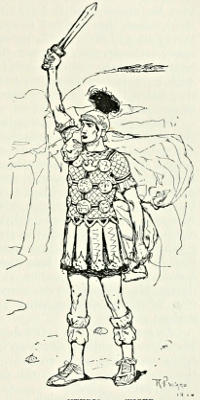
A Centurion Officer
[64 A.D.]
There followed a dreadful disaster; whether fortuitously, or by the wicked contrivance of the prince, is not determined, for both are asserted by historians; but of all the calamities which ever befell this city from the rage of fire, this was the most terrible and severe. It broke out in that part of the Circus which is contiguous to mounts Palatine and Cælius; where, by reason of shops in which were kept such goods as minister aliment to fire, the moment it commenced it acquired strength, and being accelerated by the wind, it spread at once through the whole extent of the Circus; for neither were the houses secured by enclosures, nor the temples environed with walls, nor was there any other obstacle to intercept its progress; but the flame, spreading every way impetuously, invaded first the lower regions of the city, then mounted to the higher; then again ravaging the lower, it baffled every effort to extinguish it, by the rapidity of its destructive course, and from the liability of the city to conflagration, in consequence of the narrow and intricate alleys, and the irregularity of the streets in ancient Rome. Add to this, the wailings of terrified women, the infirm condition of the aged, and the helplessness of childhood; such as strove to provide for themselves, and those who laboured to assist others; these dragging the feeble, those waiting for them; some hurrying, others lingering; altogether created a scene of universal confusion and embarrassment. And while they looked back upon the danger in their rear, they often found themselves beset before, and on their sides; or if they escaped into the quarters adjoining, these too were already seized by the devouring flames; even the parts which they believed remote and exempt, were found to be in the same distress. At last, not knowing what to shun, or where to seek sanctuary, they crowded the streets, and lay along in the open fields. Some, from the loss of their whole substance, even the means of their daily sustenance, others, from affection for their relatives, whom they had not been able to snatch from the flames, suffered themselves to perish in them, though they had opportunity to escape. Neither dared any man offer to check the fire; so repeated were the menaces of many who forbade to extinguish it; and because others openly threw firebrands, with loud declarations that “they had one who authorised them”; whether they did it that they might plunder with the less restraint, or in consequence of orders given.
Nero, who was at that juncture sojourning at Antium, did not return to the city till the fire approached that quarter of his house which connected the palace with the gardens of Mæcenas; nor could it, however, be prevented from devouring the house and palace, and everything around. But for the relief of the people, thus destitute, and driven from their dwellings, he opened the Field of Mars and the monumental edifices erected by Agrippa, and even his own gardens. He likewise reared temporary houses for the reception of the forlorn multitude, and from Ostia and the neighbouring cities, were brought up the river household necessaries; and the price of grain was reduced to three sesterces the measure. All which proceedings, though of a popular character, were thrown away, because a rumour had become universally current, that “at the very time when the city was in flames, Nero, going on the stage of his private theatre, sang, ‘The Destruction of Troy,’ assimilating the present disaster to that catastrophe of ancient times.”
At length, on the sixth day, the conflagration was stayed at the foot of Esquiline, by pulling down an immense quantity of buildings, so that an open space, and, as it were, void air, might check the raging element by breaking the continuity. But ere the consternation had subsided, the fire broke out afresh, with no little violence, but in regions more spacious, and therefore with less destruction of human life; but more extensive havoc was made of the temples, and the porticoes dedicated to amusement. This conflagration, too, was the subject of more censorious remark, as it arose in the Æmilian possessions of Tigellinus; and Nero seemed to aim at the glory of building a new city, and calling it by his own name; for, of the fourteen sections into which Rome is divided, four were still standing entire, three were levelled with the ground, and in the seven others there remained only here and there a few remnants of houses, shattered and half consumed.
Nero appropriated to his own purposes the ruins of his city, and founded upon them a palace [the “Golden House”] in which the old-fashioned, and, in those luxurious times, common ornaments of gold and precious stones, were not so much the objects of attraction as lands and lakes; in one part, woods like vast preserves; in another part, open spaces and expansive prospects. The projectors and superintendents of this plan were Severus and Celer, men of such ingenuity and daring enterprise as to attempt to conquer by art the obstacles of nature, and fool away the treasures of the prince; they had even undertaken to sink a navigable canal from the lake Avernus to the mouth of the Tiber, over an arid shore, or through opposing mountains: nor indeed does there occur anything of a humid nature for supplying water, except the Pontine marshes; the rest is either craggy rock or a parched soil; and had it even been possible to break through these obstructions, the toil had been intolerable, and disproportioned to the object. Nero, however, who longed to achieve things that exceeded credibility, exerted all his might to perforate the mountains adjoining to Avernus: and to this day there remain traces of his abortive project.
But the rest of the old site not occupied by his palace was laid out, not as after the Gallic fire, without discrimination and regularity, but with the lines of streets measured out, broad spaces left for transit, the height of the buildings limited, open areas left, and porticoes added to protect the front of the clustered dwellings. These porticoes Nero engaged to rear at his own expense, and then to deliver to each proprietor the areas about them cleared. He moreover proposed rewards proportioned to every man’s rank and private substance, and fixed a day within which, if their houses, single or clustered, were finished, they should receive them. He appointed the marshes of Ostia for a receptacle of the rubbish, and that the vessels which had conveyed grain up the Tiber should return laden with rubbish; that the buildings themselves should be raised to a certain portion of their height without beams, and arched with stone from the quarries of Gabii or Alba, that stone being proof against fire; that over the water springs, which had been improperly intercepted by private individuals, overseers should be placed, to provide for their flowing in greater abundance, and in a greater number of places, for the supply of the public; that every housekeeper should have in his yard means for extinguishing fire; neither should there be party walls, but every house should be enclosed by its own walls. These regulations, which were favourably received, in consideration of their utility, were also a source of beauty to the new city; yet some there were who believed that the ancient form was more conducive to health, as from the narrowness of the streets, and the height of the buildings the rays of the sun were more excluded; whereas now, the spacious breadth of the streets, without any shade to protect it, was more intensely heated in warm weather.
Such were the provisions made by human counsels. The gods were next addressed with expiations; and recourse had to the Sibyl’s books. By admonition from them, to Vulcan, Ceres, and Proserpine supplicatory sacrifices were made, and Juno was propitiated by the matrons, first in the Capitol, then upon the nearest shore, where, by water drawn from the sea, the temple and image of the goddess were besprinkled; and the ceremony of placing the goddess in her sacred chair, and her vigil, were celebrated by ladies who had husbands. But not all the relief that could come from man, not all the bounties that the prince could bestow, nor all the atonements which could be presented to the gods, availed to relieve Nero from the infamy of being believed to have ordered the conflagration. Hence, to suppress the rumour, he falsely charged with the guilt, and punished with the most exquisite tortures, the Christians, who were hated for their enormities. Accordingly, first those were seized who confessed they were Christians; next, on their information, a vast multitude were convicted, not so much on the charge of burning the city, as of hating the human race. And in their deaths they were also made the subjects of sport, for they were covered with the hides of wild beasts, and worried to death by dogs, or nailed to crosses, or set fire to, and when day declined, burned to serve for nocturnal lights. Nero offered his own gardens for that spectacle, and exhibited a Circensian game, indiscriminately mingling with the common people in the habit of a charioteer, or else standing in his chariot. Whence a feeling of compassion arose towards the sufferers, because they seemed not to be cut off for the public good, but victims to the ferocity of one man.c
In order to compensate for his prodigality in games and spectacles; to cover the expense of his purposeless edifices, above all, of his golden house; of his festivals, one of which cost four million sesterces for perfume alone; his extravagance in furniture and in clothes, of which he wore new ones each day, his distributions of bread, meat, game, clothes, money, and even precious stones, among the populace in return for their applause for his verses and singing; finally, I say, to compensate for all this wild expenditure, he multiplied proscriptions and sentences which carried with them the confiscation of property. Even office became a source of revenue, for he only bestowed it on condition that he should have a share in the profits. The provinces were thus again pillaged. It was not for this they had so loudly saluted the establishment of the empire, and they came within a measurable distance of its dissolution in the last years of this reign.b
CONSPIRACY MET BY CRUELTY AND PERSECUTION
[65 A.D.]
Men, however, were grown weary of being the objects of the tyrannic caprice of a profligate youth; and a widely extended conspiracy to remove him and give the supreme power to C. Piso, a nobleman of many popular qualities, was organised (65). Men of all ranks, civil and military, were engaged in it,—senators, knights, tribunes, and centurions,—some, as is usual, on public, some on private grounds. While they were yet undecided where it were best to fall on Nero, a courtesan named Epicharis, who had a knowledge (it is not known how obtained) of the plot, wearied of their indecision, attempted to gain over the officers of the fleet at Misenum. She made the first trial of an officer named Volusius Proculus, who had been one of the agents in the murder of Agrippina, and who complained of the ill return he had met with, and menaced revenge. She communicated to him the fact of there being a conspiracy, and proposed to him to join in it; but Proculus, hoping to gain a reward by this new service, went and gave information to Nero. Epicharis was seized; but as she had mentioned no names, and Proculus had no witnesses, nothing could be made of the matter. She was, however, kept in prison.
The conspirators became alarmed; and lest they should be betrayed, they resolved to delay acting no longer, but to fall on the tyrant at the Circensian games. The plan arranged was that Plautius Lateranus, the consul-elect, a man of great courage and bodily strength, should sue to the emperor for relief to his family affairs, and in so doing should grasp his knees and throw him down, and that then the officers should despatch him with their swords. Meantime Piso should be waiting at the adjacent temple of Ceres; and when Nero was no more, the prefect Fenius Rufus and others should come and convey him to the camp.
Notwithstanding the number and variety of persons engaged in the plot, the secret had been kept with wonderful fidelity. Accident, however, revealed it as it was on the very eve of execution. Among the conspirators was a senator named Flavius Scevinus, who, though dissolved in luxury, was one of the most eager. He had insisted on having the first part in the assassination, for which purpose he had provided a dagger taken from a temple. The night before the attack was to be made he gave this dagger to one of his freedmen, named Milichus, to grind and sharpen. He at the same time sealed his will, giving freedom to some, gifts to others of his slaves. He supped more luxuriously than usual, and though he affected great cheerfulness, it was manifest from his air that he had something of importance on his mind. He also directed his freedman to prepare bandages for wounds. The freedman, who was either already in the secret, or had his suspicions now excited, consulted with his wife, and at her impulsion set off at daylight and revealed his suspicions to Epaphroditus, one of Nero’s freedmen, by whom he was conducted to the emperor. On his information Scevinus was arrested; but he gave a plausible explanation of everything but the bandages, which he positively denied. He might have escaped were it not that Milichus’ wife suggested that Antonius Natalis had conversed a great deal with him in secret of late, and that they were both intimate with Piso. Natalis was then sent for; and as he and Scevinus did not agree in their accounts of the conversation which they had, they were menaced with torture. Natalis’ courage gave way; he named Piso and Seneca. Scevinus, either through weakness or thinking that all was known, named several others, among whom were Annæus Lucanus the poet, the nephew of Seneca, Tullius Senecio, and Afranius Quinctianus. These at first denied everything. At length, on the promise of pardon, they discovered some of their nearest friends, Lucan even naming his own mother Atilla.
Nero now called to mind the information of Proculus, and he ordered Epicharis to be put to the torture. But no pain could overcome the constancy of the heroic woman; and next day, as from her weak state she was carried in a chair to undergo the torture anew, she contrived to fasten her belt to the arched back of the chair, and thus to strangle herself.
When the discovery was first made, some of the bolder spirits urged Piso to hasten to the camp or to ascend the rostra, and endeavour to excite the soldiers or the people to rise against Nero. But he had not energy for such a course, and he lingered at home till his house was surrounded by soldiers. He then opened his veins, leaving a will filled, for the sake of his wife, a profligate woman, with the grossest adulation of Nero. Lateranus died like a hero, with profound silence; and though the tribune who presided at the execution was one of the conspirators, he never reproached him.
But the object of Nero’s most deadly enmity was Seneca. All that was against this illustrious man was that Natalis said that Piso had one time sent him to Seneca, who was ill, to see how he was, and to complain of his not admitting him, and that Seneca replied that it was for the good of neither that they should meet frequently, but that his health depended on Piso’s safety. The tribune Granius Silvanus (also one of the conspirators) was sent to Seneca, who was now at his villa four miles from Rome, to examine him respecting the conversation with Natalis. He found him at table with his wife, Pompeia Paulina, and two of his friends. Seneca’s account agreed with that of Natalis; his meaning, he said, had been perfectly innocent. When the tribune made his report to Nero and his privy council—Poppæa and Tigellinus—he was asked if Seneca meditated a voluntary death. On his reply that he showed no signs of fear or perturbation, he was ordered to go back and bid him die. Silvanus, it is said, called on Fenius on his way and asked him if he should obey the orders; but Fenius, with that want of spirit which was the ruin of them all, bade him obey. Silvanus when he arrived sent in a centurion with the fatal mandate.
Seneca calmly called for his will, but the centurion would not suffer him to have it. He then told his friends that as he could not express his sense of their merits in the way that he wished, he would leave them the image of his life, to which, if they attended, they would obtain the fame of virtue and of constancy in friendship. He checked their tears, showing that nothing had occurred but what was to have been expected. Then embracing his wife, he began to console and fortify her, but she declared her resolution to die with him. Not displeased at her generous devotion, and happy that one so dear to him should not remain exposed to injury and misfortune, he gave a ready consent, and the veins in the arms of both were opened. As Seneca, on account of his age, bled slowly, he caused those of his legs and thighs to be opened also; and as he suffered very much, he persuaded his wife to go into another room; and then calling for amanuenses, he dictated a discourse which was afterward published. Finding himself going very slowly, he asked his friend the physician, Statius Annæus, for the hemlock juice which he had provided, and took it, but it had no effect. He finally went into a warm bath, sprinkling as he entered it the servants who were about him, and saying, “I pour this liquor to Jove the Liberator.” The heat caused the blood to flow freely, and his sufferings at length terminated. His body was burned without any ceremony, according to the directions which he had given when at the height of his prosperity.
Paulina did not die at this time; for Nero, who had no enmity against her and wished to avoid the imputation of gratuitous cruelty, sent orders to have her saved. She survived her husband a few years, her face and skin remaining of a deadly paleness in consequence of her great loss of blood.
The military men did not remain undiscovered. Fenius Rufus died like a coward; the tribunes and centurions, like soldiers. When one of them named Subrius Flavius was asked by Nero what caused him to forget his military oath: “I hated you,” said he, “and there was none of the soldiers more faithful while you deserved to be loved. I began to hate you when you became the murderer of your mother and wife, a chariot-driver, a player, and an incendiary.” Nothing in the whole affair cut Nero to the soul like this reply of the gallant soldier.
The consul Vestinus was not implicated by any in the conspiracy; but Nero hated him; and as he was sitting at dinner with his friends, some soldiers entered to say that their tribune wanted him. He arose, went into a chamber, had his veins opened, entered a warm bath, and died. Lucan when ordered to die had his veins also opened; when he felt his extremities growing cold, he called to mind some verses of his Pharsalia which were applicable to his case, and died repeating them. Senecio Quinctianus and Scevinus and many others died; several were banished. Natalis, Milichus, and others were rewarded; offerings, thanksgivings, and so forth were voted in abundance by the senate.
This obsequious body, however, sought to avert the disgrace of the lord of the Roman world appearing on the stage at the approaching Quinquennial games, by offering him the victory of song and the crown of eloquence. But Nero said that there needed not the power nor the influence of the senate, that he feared not his rivals, and relied on the equity of the judges. He therefore sang on the stage, and when the people pressed him to display all his acquirements, he came forth in the theatre, strictly conforming to all the rules of his art, not sitting down when weary, wiping his face in his robe, neither spitting nor blowing his nose, and finally with bended knee and moving his hand, waited in counterfeit terror for the sentence of the judges.
At the end of the games, he in a fit of anger gave Poppæa, who was pregnant, a kick in the stomach, which caused her death. Instead of burning her body, as was now the general custom, he had it embalmed with the most costly spices and deposited in the monument of the Julian family. He himself pronounced the funeral oration, in which he praised her for her beauty, and for being the mother of a divine infant.
The remainder of the year was marked by the death or exile of several illustrious persons, and by a pestilence which carried off great numbers of all ranks and ages. “Of the knights and senators,” observes Tacitus, “the deaths were less to be lamented; they anticipated, as it were, by the common fate the cruelty of the prince.”
[66 A.D.]
The first deaths of the succeeding year (66) were those of P. Anteius, whose crime was his wealth and the friendship of Agrippina; Ostorius Scapula, who had distinguished himself in Britain; Annæus Mella, the father of Lucan; Anicius Cerealis, Rufius Crispinus, and others. They all died in the same manner, by opening their veins. The most remarkable death was that of C. Petronius, a man whose elegance and taste in luxury had recommended him to the special favour of Nero, who regarding him as his “arbiter of elegance,” valued only that of which Petronius approved. The envy of Tigellinus being thus excited, he bribed one of Petronius’ slaves to charge his master with being the friend of Scevinus. His death followed, of course; the mode of it however was peculiar. He caused his veins to be opened, then closed, then opened again, and so on. He meantime went on conversing with his friends, not, like a Socrates or a Seneca, on the immortality of the soul or the opinions of the wise, but listening to light and wanton verses. He rewarded some of his slaves, he had others flogged, he dined, he slept; he made, in short, his compulsive death as like a natural one as possible. He did not, like others, pay court to Nero or Tigellinus or the men in power, in his will, but he wrote an account of the vices and crimes of the prince and court under the names of flagitious men and women, and sent it sealed up to the emperor. He broke his seal-ring, lest it might be used to the destruction of innocent persons.
“After the slaughter of so many illustrious men,” says Tacitus, “Nero at length sought to destroy virtue itself by killing Thraseas Pætus and Bareas Soranus.” The former, a man of primitive Roman virtue, was hated by him not merely for his worth, but because he had on various occasions given public proof of his disapproval of his acts. Such were his going out of the senate house when the decrees were made on account of the murder of Agrippina, and his absence from the deification and funeral of Poppæa. Further than his virtue, we know of no cause of enmity that Nero could have against Soranus.
The accusers of Thraseas were Capito Cossutianus, whom he had made his enemy by supporting the Cilician deputies who came to accuse him of extortion, and Marcellus Eprius, a profligate man of eloquence. A Roman knight named Ostorius Sabinus appeared as the accuser of Soranus. The time selected for the destruction of these eminent men was that of the arrival of the Parthian prince Tiridates, who was coming to Rome to receive the diadem of Armenia, either in hopes that the domestic crime would be shrouded by the foreign glory, or, more probably, to give the Oriental an idea of the imperial power. Thraseas received an order not to appear among those who went to meet the king; he wrote to Nero, requiring to know with what he was charged, and asserting his ability to clear himself if he got an opportunity. Nero in reply said that he would convoke the senate. Thraseas then consulted with his friends, whether he would go to the senate house, or expect his doom at home. Opinions were as usual divided; he however did not go to the senate.
Next morning the temple in which the senate sat was surrounded with soldiery. Cossutianus and Eprius appeared as the accusers of Thraseas, his son-in-law Helvidius Priscus, Paconius Agrippinus, and Curtius Montanus. The general charge against them was passive rather than active disloyalty, Thraseas being held forth as the seducer and encourager of the others. Ostorius then came forward and accused Soranus, who was present, of friendship with Rubellius Plautus and of mal-conduct in the government of Asia. He added that Servilia, the daughter of the accused, had given money to fortune-tellers. Servilia was summoned. She owned the truth, that she had sold her ornaments and given the money to the soothsayers, but for no impious purpose, only to learn if her father would escape. Witnesses were then called, and among them, to the indignation of every virtuous man, appeared P. Egnatius, the client and friend of Soranus, and a professor of the stoic philosophy, who now had sold himself to destroy his benefactor by false testimony.
The accused were all condemned, of course; Thraseas, Soranus, and Servilia to death, the others to exile. Of the circumstances of the end of Soranus and his daughter, we are not informed. Thraseas having prevented his wife Arria from following the example of her mother of the same name, by entreating her not to deprive their daughter of her only remaining support, caused his veins to be opened in the usual manner; and as the blood spouted forth, he said to the quæstor who was present, “Let us pour out to Jove the Liberator. Regard this, young man. May the gods avert the omen; but you have been born in times when it is expedient to fortify the mind by examples of constancy.” He died after suffering much pain.f
Suetonius has left us an interesting picture of the personality of the perverted being who was the cause of all this suffering.
PERSONAL CHARACTERISTICS OF NERO, ACCORDING TO SUETONIUS
[54-68 A.D.]
In stature Nero was a little below the common size; his body spotted, and of a disagreeable appearance; his hair inclined to yellow; his countenance fair, rather than handsome; his eyes gray and dull, his neck fat, his belly prominent, legs very slender, but his constitution healthful. For, though extravagantly luxurious in his way of living, he had, in the course of fourteen years, only three fits of sickness, which were so slight, that he neither forbore the use of wine, nor made any alteration in his usual diet. In his dress, and the care of his person, he was so indecent, that he had his hair cut in rings one above another; and when he was in Achaia, let it grow long behind; and appeared abroad for the most part in the dress which he used at table, with a handkerchief about his neck, his coat loose upon him, and without shoes.
He was entered, when a boy, in almost all the liberal sciences; but his mother diverted him from the study of philosophy, as unsuitable to one who was to be an emperor; and his master Seneca discouraged him from reading the old orators, that he might keep him the longer in admiration of himself. He was much addicted to poetry, and composed verses both with pleasure and ease: nor did he, as some think, publish those of other authors for his own. I have had in my hands some little pocket-books of his, with some well-known verses, all of his own writing, and written in such a manner, that it was very evident from the blotting and interlining, that they had not been transcribed from a copy, nor dictated by another, but written by the composer of them.
He had likewise a great taste for painting, and moulding of images, but of all things an extravagant desire of popular applause, being a rival of every man who was upon any account admired by the people. It was the general belief, that, after the prizes he won by his performances upon the stage, he would the next lustrum have entered amongst the wrestlers at the Olympic games. For he was continually practising in that way; nor did he attend in Greece that kind of solemnity any otherwise, than as the judges used to do, sitting upon the ground in the Stadium. And if a pair of wrestlers happened to get without the limits assigned them, he would with his own hands bring them back into their proper place.
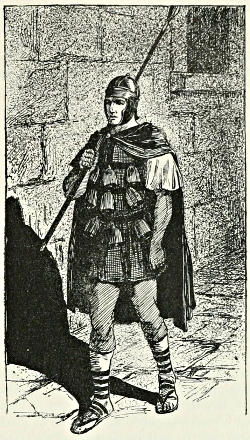
A Night Watchman of Rome, showing the Bells worn on his Jacket
Towards the end of his life, he made a public vow, that if he continued in the peaceable enjoyment of the empire, he would, in the games which he intended to give for his success against the insurgents, appear upon the stage, to manage the water-organ, as also to play upon the flutes and bagpipe, and upon the day concluding those diversions, would act his part in a play, and dance to the story of Turnus in Virgil. And there are some who say, that he put to death the player Paris as a dangerous rival.
He had an invincible desire, but capriciously directed, of rendering himself famous through all succeeding ages. He therefore took from several things and places their former appellations, and gave them new names derived from his own. He called the month of April, too, Neroneus, and had a design to change the name of Rome into that of Neropolis.
He thought there was no other use of riches and money than to squander them away profusely; regarding all those as sordid wretches who kept their expenses within due bounds; and extolling those as truly noble and generous souls, who lavished away and wasted all before them. He never wore the same garment twice. He would game for four hundred thousand sesterces for every spot that came up upon the tali. He used to fish with a golden net, drawn by silken cords of the finest scarlet colour. It is said that he never travelled with less than a thousand carts attending him with his baggage: the mules being all shod with silver, and their drivers dressed in scarlet clothes of the finest wool; and a numerous train of footmen, and Africans, with bracelets on their arms, and mounted upon horses in splendid trappings.
He was a despiser of all religious worship, except that of the Syrian goddess; but at last he regarded her so little that he spurned her, being now engaged in another superstition, in which he invariably persisted. For having received from some obscure plebeian a little image of a girl, as a preservative against plots, and discovering a conspiracy immediately after, he constantly worshipped, and with three sacrifices a day, his imaginary protectress, as the greatest amongst the gods. He was likewise desirous to have it thought that he had from the information of that deity a knowledge of future events. A few months before he died, he offered several sacrifices, to consult the entrails of the victims; but could never obtain any favourable intimations from them.d
MERIVALE’S ESTIMATE OF NERO AND HIS TIMES
The youth who at the age of seventeen years had been called to govern the civilised world, is represented in his busts and medals as handsome in countenance, but, as Suetonius remarks, without grace or winningness of expression. His hair was not the bright auburn of Apollo, the delight of the Romans, to which it was so often likened, but yellowish or sandy; his figure, though of middle stature, was ill-proportioned, the neck was thick and sensual, the stomach prominent, the legs slender. His skin, it is added, was blotched or pimpled; but this, it may be supposed, was the effect of intemperance in his later years; his eyes were dark gray or greenish, and their sight defective, which may account perhaps for the scowl which seems to mark their expression. His health, notwithstanding his excesses, continued good to the end, and it was only from anxious concern for his voice that he wrapped his throat in kerchiefs, like a confirmed valetudinarian. In his dress there was a mixture of slovenliness and finery; in the arrangement of his cherished locks he was exceedingly careful, piling them in tiers above the crown, and letting them fall from thence over the shoulders, a fashion which was reputed not less indecent, or at least effeminate, than the looseness of his cincture, the bareness of his feet, and the lightness of the chamber-robe in which he did not scruple to appear in public.
We may trace perhaps to the character of his master, and to the kind of education he was likely to receive from him, the ardent love of admiration, ill-directed as it was, which distinguished the pupil of Seneca. To this constant anxiety to compete with rivals, and triumph over them, however trifling the objects on which it was exercised, may be ascribed the indifference Nero evidently felt to the title of divinity, which in his inordinate vanity he might have been expected to claim. He wanted to be admired as the first among men, not to be adored as a god. He could not be Apollo, and contend at the same time for the prize of the Pythian games; he could not be Hercules, and carry off the chaplet at Nemea; he could not be Jupiter, and gain the victory at the great contest of Olympia—distinctions on which his soul was bent from an early period of his career, and which, as we shall see, he lived eventually to achieve. His courtiers might, if they pleased, pronounce his likeness to these or any other divinities; but to make him actually divine was to rob him of the honours he so vehemently affected. The poets might predict his apotheosis after death, and doubtless the verses in which Lucan, at that time his friend and companion, challenged him to choose what godship he would assume in heaven, and where he would fix his throne, imploring him to take his seat in the middle of the universe, lest if he leaned ever so little from the centre the world should be thrown by his august weight from its eternal balance—such verses were doubtless accepted as a fitting tribute to the germ of a divine existence hereafter to blossom into flower. But the ardour with which Nero aspired to distinctions among mortal men was itself a guarantee against his usurping the character of the impassive godhead, which can neither enjoy a triumph nor suffer a disgrace.
Nor again, though described by Tacitus as lusting after the incredible, had Nero the same passion as Caligula for realising apparent impossibilities to prove his superhuman power. He was not impelled in a career of marvels by restless and aimless pride. Once removed from the sphere of theatrical shows and contests, he had no higher notion of his position than as enabling him to accumulate, to multiply, or to enlarge the commonest objects of luxury. He never travelled, it is asserted, with less than a thousand carriages in his train. His banquets were those of the noble debauchees of the day on a still vaster scale of expense; in the height of his extravagance, he would equip his actors with masks or wands covered with genuine pearls; he would stake four hundred thousand sesterces on a single cast of the dice; he bathed in unguents, and stimulated his friends to expend four millions on the perfumes alone of a single supper. His presents to favourites were sums of money many times greater than had ever been given to favourites before; his buildings were colonnades longer, halls wider, towers higher, than had been raised by his predecessors. His projected canal from Puteoli to Rome would only have been the longest of canals; the attempt he latterly made to cut through the isthmus of Corinth was only a repetition of previous attempts, neither better planned, nor more steadfastly persevered in.
In his schemes there was nothing new or original. Nero was devoid of the imagination which throws an air of wild grandeur over the character of Caligula. The notion that he burned Rome on purpose to have an opportunity of rebuilding it more magnificently would have been more applicable, as it seems to me, to his predecessor than to him. But within the paltry sphere of his degraded taste he claimed to be pre-eminent. As a mime or player he was not satisfied with any single class of parts, or any one department of exhibition. After rivalling Apollo in song and the Sun in charioteering, he aspired to display the courage and vigour of Hercules, and a lion was duly prepared, drugged or fed to stupor, to be strangled in his arms, or brained with a stroke of his club. He acted, he sang, he played, he danced. He insisted on representing men and heroes, gods and even goddesses. To affect the woman indeed, in dress, voice, and gesture, was a transformation in which he took a childish pleasure, restrained by no sense of dignity or decency. He adopted his superstitions, as well as his garb and habits, from Syria, from his Parthian and Armenian guests, or from the diviners and necromancers of the credulous East. To the art of magic he devoted wealth, energy, natural abilities, in short, all his resources; but Nature, says Pliny, was too strong for him. His failure to divine the future, or raise the spirits of the dead, was noted by the wise as a signal demonstration of the futility of magical pretensions. For none of the accustomed divinities of Rome did he evince any respect, nor for places consecrated by the national religion; but he reverenced the Syrian Astarte, till in a fit of vexation he renounced her protection, and insulted her image. At last his sole object of veneration was a little figure of a girl, which he always wore as a talisman about him, affecting to learn from it the secrets of futurity.
Such were the miserable interests of this infatuated creature, the victim of licentious indulgence, a child prematurely stunted both in mind and body, surrounded on the throne not by generals and statesmen, but by troops of slaves or freedmen, by players and dancers lost to all sense of decency themselves, and seeking only their advancement at the expense of their master and of mankind; surrendered by loose women to still more despicable minions, and ruled by the most cruel and profligate of ministers. Helius and Tigellinus, Doryphorus and Sporus, are among the most hateful names of the imperial history; into the abominations of their career it would be pollution merely to look. No wonder that, when encircled by so loathsome a crew he saw the proud citizens prostrate at his feet, he could exclaim that no prince before him had known the extent of his power. But though at their patron’s command statues and arches might rise in honour of these infamous companions, it may be said for the credit of the people, that they received much less of lip-worship than their predecessors, Sejanus, Pallas, and Narcissus.