Book 2 — CHAPTER XLII. THE SUCCESSORS OF CONSTANTINE TO THE DEATH OF JULIAN (337-363 A.D.)
Reading edition
[337-338 A.D.]
The voice of the dying emperor had recommended the care of his funeral to the piety of Constantius; and that prince, by the vicinity of his eastern station, could easily prevent the diligence of his brothers, who resided in their distant governments of Italy and Gaul. As soon as he had taken possession of the palace of Constantinople, his first care was to remove the apprehensions of his kinsmen by a solemn oath which he pledged for their security. His next employment was to find some specious pretence which might release his conscience from the obligation of an imprudent promise. The arts of fraud were made subservient to the designs of cruelty, and a manifest forgery was attested by a person of the most sacred character. From the hands of the bishop of Nicomedia Constantius received a fatal scroll, affirmed to be the genuine testament of his father; in which the emperor expressed his suspicions that he had been poisoned by his brothers, and conjured his sons to revenge his death, and to consult their own safety, by the punishment of the guilty. Whatever reasons might have been alleged by these unfortunate princes to defend their life and honour against so incredible an accusation, they were silenced by the furious clamours of the soldiers, who declared themselves at once their enemies, their judges, and their executioners. The spirit and even the forms of legal proceedings were repeatedly violated in a promiscuous massacre, which involved the two uncles of Constantius, seven of his cousins, of whom Dalmatius and Hannibalianus were the most illustrious, the patrician Optatus, who had married a sister of the late emperor, and the prefect Ablavius, whose power and riches had inspired him with some hopes of obtaining the purple. If it were necessary to aggravate the horrors of this bloody scene, we might add that Constantius himself had espoused the daughter of his uncle Julius, and that he had bestowed his sister in marriage on his cousin Hannibalianus. Of so numerous a family, Gallus and Julian alone, the two youngest children of Julius Constantius, were saved from the hands of the assassins, till their rage, satiated with slaughter, had in some measure subsided.
The massacre of the Flavian race was succeeded by a new division of the provinces; which was ratified in a personal interview of the three brothers. Constantine, the eldest of the cæsars, obtained, with a certain pre-eminence of rank, the possession of the new capital, which bore his own name and that of his father. Thrace and the countries of the East were allotted for the patrimony of Constantius; and Constans was acknowledged as the lawful sovereign of Italy, Africa, and the western Illyricum. The armies submitted to their hereditary right, and they condescended, after some delay, to accept from the Roman senate the title of Augustus. When they first assumed the reins of government, the eldest of these princes was twenty-one, the second twenty, and the third only seventeen years of age.
[338-350 A.D.]
While the martial nations of Europe followed the standards of his brothers, Constantius, at the head of the effeminate troops of Asia, was left to sustain the weight of the Persian War. At the decease of Constantine, the throne of the East was filled by Sapor, son of Hormuz or Hormisdas, and grandson of Narses, who, after the victory of Galerius, had humbly confessed the superiority of the Roman power. Although Sapor was in the thirtieth year of his long reign, he was still in the vigour of youth, as the date of his accession, by a very strange fatality, had preceded that of his birth. The wife of Hormuz remained pregnant at the time of her husband’s death; and the uncertainty of the sex, as well as of the event, excited the ambitious hopes of the princes of the house of Sassan. The apprehensions of civil war were at length removed by the positive assurance of the magi that the widow of Hormuz had conceived and would safely produce a son. Obedient to the voice of superstition, the Persians prepared, without delay, the ceremony of his coronation. A royal bed, on which the queen lay in state, was exhibited in the midst of the palace; the diadem was placed on the spot which might be supposed to conceal the future heir of Artaxerxes, and the prostrate satraps adored the majesty of their invisible and insensible sovereign.
If any credit can be given to this marvellous tale, which seems however to be countenanced by the manners of the people and by the extraordinary duration of his reign, we must admire not only the fortune but the genius of Sapor. In the soft sequestrated education of a Persian harem, the royal youth could discover the importance of exercising the vigour of his mind and body; and by his personal merit deserved a throne, on which he had been seated while he was yet unconscious of the duties and temptations of absolute power. His minority was exposed to the almost inevitable calamities of domestic discord; his capital was surprised and plundered by Thair, a powerful king of Yemen, or Arabia; and the majesty of the royal family was degraded by the captivity of a princess, the sister of the deceased king. But as soon as Sapor attained the age of manhood, the presumptuous Thair, his nation, and his country fell beneath the first effort of the young warrior, who used his victory with so judicious a mixture of rigour and clemency that he obtained from the fears and gratitude of the Arabs the title of dhoulacnaf, or protector of the nation.
The ambition of the Persian, to whom his enemies ascribe the virtues of a soldier and a statesman, was animated by the desire of revenging the disgrace of his fathers and of wresting from the hands of the Romans the five provinces beyond the Tigris. The military fame of Constantine and the real or apparent strength of his government suspended the attack; and while the hostile conduct of Sapor provoked the resentment his artful negotiations amused the patience of the imperial court. The death of Constantine was the signal of war, and the actual condition of the Syrian and Armenian frontier seemed to encourage the Persians by the prospect of a rich spoil and an easy conquest. The example of the massacres of the palace diffused a spirit of licentiousness and sedition among the troops of the East, who were no longer restrained by the habits of obedience to a veteran commander. By the prudence of Constantius, who from the interview with his brothers in Pannonia immediately hastened to the banks of the Euphrates, the legions were gradually restored to a sense of duty; but the season of anarchy had permitted Sapor to form the siege of Nisibis, and to occupy several of the most important fortresses of Mesopotamia.
During the long period of the reign of Constantius, the provinces of the East were afflicted by the calamities of the Persian War. The irregular incursions of the light troops alternately spread terror and devastation beyond the Tigris and beyond the Euphrates, from the gates of Ctesiphon to those of Antioch; and this active service was performed by the Arabs of the desert, who were divided in their interests and affections, some of their independent chiefs being enlisted in the party of Sapor, whilst others had engaged their doubtful fidelity to the emperor. The more grave and important operations of the war were conducted with equal vigour, and the armies of Rome and Persia encountered each other in nine bloody fields, in two of which Constantius himself commanded in person. The event of the day was most commonly averse to the Romans, but in the battle of Singara their imprudent valour had almost achieved a signal and decisive victory. The stationary troops of Singara retired on the approach of Sapor, who passed the Tigris over three bridges and occupied near the village of Hilleh an advantageous camp, which, by the labour of his numerous pioneers, he surrounded in one day with a deep ditch and a lofty rampart. His formidable host, when it was drawn out in order of battle, covered the banks of the river, the adjacent heights, and the whole extent of a plain of above twelve miles which separated the two armies.
Both were alike impatient for a trial of strength; but the barbarians, after a slight resistance, fled in disorder, unable to resist or desirous to weary the strength of the heavy legions, who, fainting with heat and thirst, pursued them across the plain and cut in pieces a line of cavalry clothed in complete armour which had been posted before the gates of the camp to protect their retreat (348).
Constantius, hurried along in the pursuit, attempted, without effect, to restrain the ardour of his troops by representing to them the dangers of the approaching night and the certainty of completing their success with the return of day. They, depending much more on their own valour than on the experience or the abilities of their chief, silenced by their clamours his timid remonstrances; and rushing with fury to the charge, filled up the ditch, broke down the rampart, and dispersed themselves through the tents to recruit their exhausted strength and to enjoy the rich harvest of their labours. But the prudent Sapor had watched the moment of victory. His army, of which the greater part securely posted on the heights had been spectators of the action, advanced in silence and under the shadow of the night; and his Persian archers, guided by the illumination of the camp, poured a shower of arrows on the disarmed and licentious crowd. The sincerity of history declares that the Romans were vanquished with a dreadful slaughter, and that the flying remnant of the legions was exposed to the most intolerable hardships.
Whatever advantages might attend the arms of Sapor in the field, though nine repeated victories diffused among the nations the fame of his valour and conduct, he could not hope to succeed in the execution of his designs while the fortified towns of Mesopotamia, and above all the strong and ancient city of Nisibis, remained in the possession of the Romans. This large city was situated about two days’ journey from the Tigris, in the midst of a fertile plain at the foot of Mt. Masius. In the space of twelve years, Nisibis, which since the time of Lucullus had been deservedly esteemed the bulwark of the East, sustained three memorable sieges against the power of Sapor; and the disappointed monarch, after urging his attacks above sixty, eighty, and a hundred days, was thrice repulsed with loss and ignominy.
WAR OF THE BROTHER EMPERORS
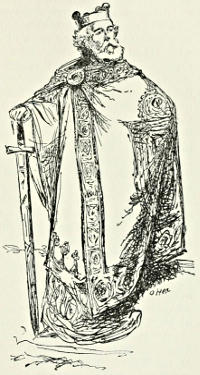
A Roman Emperor
After the partition of the empire, three years had scarcely elapsed before the sons of Constantine seemed impatient to convince mankind that they were incapable of contenting themselves with the dominions which they were unqualified to govern. The eldest of those princes soon complained that he was defrauded of his just proportion of the spoils of their murdered kinsmen; and though he might yield to the superior guilt and merit of Constantius, he exacted from Constans the cession of the African provinces, as an equivalent for the rich countries of Macedonia and Greece, which his brother had acquired by the death of Dalmatius. The want of sincerity which Constantine experienced in a tedious and fruitless negotiation exasperated the fierceness of his temper; and he eagerly listened to those favourites who suggested to him that his honour, as well as his interest, was concerned in the prosecution of the quarrel. At the head of a tumultuary band, suited for rapine rather than for conquest, he suddenly broke into the dominions of Constans, by way of the Julian Alps, and the country round Aquileia felt the first effects of his resentment. The measures of Constans, who then resided in Dacia, were directed with more prudence and ability. On the news of his brother’s invasion, he detached a select and disciplined body of his Illyrian troops, proposing to follow them in person with the remainder of his forces. But the conduct of his lieutenants soon terminated the unnatural contest. By the artful appearances of flight Constantine was betrayed into an ambuscade, which had been concealed in a wood, where the rash youth, with a few attendants, was surprised, surrounded, and slain. His body, after it had been found in the obscure stream of the Alsa, obtained the honours of an imperial sepulchre; but his provinces transferred their allegiance to the conqueror, who, refusing to admit his elder brother Constantius to any share in these new acquisitions, maintained the undisputed possession of more than two-thirds of the Roman Empire (340).
[350-351 A.D.]
The fate of Constans himself was delayed about ten years longer, and the revenge of his brother’s death was reserved for the more ignoble hand of a domestic traitor. The pernicious tendency of the system introduced by Constantine was displayed in the feeble administration of his sons, who, by their vices and weakness, soon lost the esteem and affections of their people. The pride assumed by Constans, from the unmerited success of his arms, was rendered more contemptible by his want of abilities and application. His fond partiality towards some German captives, distinguished only by the charms of youth, was an object of scandal to the people; and Magnentius, an ambitious soldier, who was himself of barbarian extraction, was encouraged by the public discontent to assert the honour of the Roman name. The chosen bands of Jovians and Herculians, who acknowledged Magnentius as their leader, maintained the most respectable and important station in the imperial camp. The friendship of Marcellinus, count of the sacred largesses, supplied with a liberal hand the means of seduction. The soldiers were convinced by the most specious arguments, that the republic summoned them to break the bonds of hereditary servitude; and by the choice of an active and vigilant prince, to reward the same virtues which had raised the ancestors of the degenerate Constans from a private condition to the throne of the world.
As soon as the conspiracy was in readiness for execution, Marcellinus, under the pretence of celebrating his son’s birthday, gave a splendid entertainment to the illustrious and honourable persons of the court of Gaul, which then resided in the city of Augustodunum. The intemperance of the feast was protracted till a very late hour of the night; and the unsuspecting guests were tempted to indulge themselves in a dangerous and guilty freedom of conversation. On a sudden the doors were thrown open, and Magnentius, who had retired for a few moments, returned into the apartment invested with the diadem and purple. The conspirators instantly saluted him with the titles of Augustus and emperor. The surprise, the terror, the intoxication, the ambitious hopes, and the mutual ignorance of the rest of the assembly, prompted them to join their voices to the general acclamation. The guards hastened to take the oath of fidelity, the gates of the town were shut, and before the dawn of day, Magnentius became master of the troops and treasure of the city of Augustodunum. By his secrecy and diligence he entertained some hopes of surprising the person of Constans, who was pursuing in the adjacent forest his favourite amusement of hunting, or perhaps some pleasures of a more private and criminal nature. The rapid progress of fame allowed him, however, an instant for flight, though the desertion of his soldiers and subjects deprived him of the power of resistance. Before he could reach a seaport in Spain, where he intended to embark, he was overtaken near Helena, at the foot of the Pyrenees, by a party of light cavalry, whose chief, regardless of the sanctity of a temple, executed his commission by the murder of the son of Constantine (350).
As soon as the death of Constans had decided this easy but important revolution, the example of the court of Autun was imitated by the provinces of the West. The authority of Magnentius was acknowledged through the whole extent of the two great prefectures of Gaul and Italy; and the usurper prepared, by every act of oppression, to collect a treasure, which might discharge the obligation of an immense donative, and supply the expenses of a civil war.
CONSTANTIUS AND MAGNENTIUS
[351-352 A.D.]
The intelligence of these important events, which so deeply affected the honour and safety of the imperial house, recalled the arms of Constantius from the inglorious prosecution of the Persian War. He recommended the care of the East to his lieutenants, and afterwards to his cousin Gallus, whom he raised from a prison to a throne; and marched towards Europe, with a mind agitated by the conflict of hope and fear, of grief and indignation.
The city of Mursa, or Essek, celebrated in modern times for a bridge of boats five miles in length over the river Drave and the adjacent morasses, has been always considered as a place of importance in the wars of Hungary. Magnentius, directing his march towards Mursa, set fire to the gates, and by a sudden assault had almost scaled the walls of the town. The vigilance of the garrison extinguished the flames, the approach of Constantius left him no time to continue the operations of the siege, and the emperor soon removed the only obstacle that could embarrass his motions by forcing a body of troops which had taken post in an adjoining amphitheatre. The field of battle round Mursa was a naked and level plain; on this ground the army of Constantius formed, with the Drave on their right, while their left, either from the nature of their disposition or from the superiority of their cavalry, extended far beyond the right flank of Magnentius. The troops on both sides remained under arms in anxious expectation during the greater part of the morning; and the son of Constantine, after animating his soldiers by an eloquent speech, retired into a church at some distance from the field of battle and committed to his generals the conduct of this decisive day. They deserved his confidence by the valour and military skill which they exerted. They wisely began the action upon the left; and, advancing their whole wing of cavalry in an oblique line, they suddenly wheeled it on the right flank of the enemy, which was unprepared to resist the impetuosity of their charge. But the Romans of the West soon rallied by the habits of discipline, and the barbarians of Germany supported the renown of their national bravery. The engagement soon became general, was maintained with various and singular turns of fortune, and scarcely ended with the darkness of the night. The signal victory which Constantius obtained is attributed to the arms of his cavalry.
His cuirassiers are described as so many massy statues of steel, glittering with their scaly armour, and breaking with their ponderous lances the firm array of the Gallic legions. As soon as the legions gave way, the lighter and more active squadrons of the second line rode sword in hand into the intervals, and completed the disorder. In the meanwhile the huge bodies of the Germans were exposed, almost naked, to the dexterity of the oriental archers; and whole troops of those barbarians were urged by anguish and despair to precipitate themselves into the broad and rapid stream of the Drave. The number of the slain was computed at fifty-four thousand men and the slaughter of the conquerors was more considerable than that of the vanquished, a circumstance which proves the obstinacy of the contest, and justifies the observation of an ancient writer, that the forces of the empire were consumed in the fatal battle of Mursa by the loss of a veteran army sufficient to defend the frontiers or to add new triumphs to the glory of Rome. Notwithstanding the invectives of a servile orator, there is not the least reason to believe that the tyrant deserted his own standard in the beginning of the engagement. He seems to have displayed the virtues of a general and of a soldier till the day was irrecoverably lost and his camp in the possession of the enemy. Magnentius then consulted his safety, and, throwing away the imperial ornaments, escaped with some difficulty from the pursuit of the light horse, who incessantly followed his rapid flight from the banks of the Drave to the foot of the Julian Alps.
The detachments, however, which were ordered either to press or to intercept the flight of Magnentius, conducted themselves with the usual imprudence of success; and allowed him, in the plains of Ticinium, an opportunity of turning on his pursuers, and of gratifying his despair, by the carnage of a useless victory.
The pride of Magnentius was reduced by repeated misfortunes to sue, and to sue in vain, for peace. He first despatched a senator, in whose abilities he confided, and afterwards several bishops, whose holy character might obtain a more favourable audience, with the offer of resigning the purple, and the promise of devoting the remainder of his life to the service of the emperor. But Constantius, though he granted fair terms of pardon and reconciliation to all who abandoned the standard of rebellion, avowed his inflexible resolution to inflict a just punishment on the crimes of an assassin, whom he prepared to overwhelm on every side by the effort of his victorious arms. An imperial fleet acquired the easy possession of Africa and Spain, confirmed the wavering faith of the Moorish nations, and landed a considerable force, which passed the Pyrenees, and advanced towards Lyons, the last and fatal station of Magnentius. The temper of the tyrant, which was never inclined to clemency, was urged by distress to exercise every act of oppression which could extort an immediate supply from the cities of Gaul. Their patience was at length exhausted; and Trèves, the seat of prætorian government, gave the signal of revolt, by shutting her gates against Decentius, who had been raised by his brother to the rank either of cæsar or of augustus. From Trèves, Decentius was obliged to retire to Sens, where he was soon surrounded by an army of Germans, whom the pernicious arts of Constantius had introduced into the civil dissensions of Rome. In the meantime, the imperial troops forced the passages of the Cottian Alps, and in the bloody combat of Mount Seleucus, irrevocably fixed the title of rebels on the party of Magnentius.
He was unable to bring another army in the field, the fidelity of his guards was corrupted, and when he appeared in public to animate them by his exhortations, he was saluted with the unanimous shout of “Long live the emperor Constantius!” The tyrant, who perceived that they were preparing to deserve pardon and rewards by the sacrifice of the most obnoxious criminal, prevented their design by falling on his sword—a death more easy and more honourable than he could hope to obtain from the hands of an enemy, whose revenge would have been coloured with the specious pretence of justice and fraternal piety. The example of suicide was imitated by Decentius, who strangled himself on the news of his brother’s death. The author of the conspiracy, Marcellinus, had long since disappeared in the battle of Mursa, and the public tranquillity was confirmed by the execution of the surviving leaders of a guilty and unsuccessful faction.
A severe inquisition was extended over all who, either from choice or from compulsion, had been involved in the cause of rebellion. Paul, surnamed Catena, from his superior skill in the judicial exercise of tyranny, was sent to explore the latent remains of the conspiracy in the remote province of Britain. The honest indignation expressed by Martin, vice-prefect of the island, was interpreted as an evidence of his own guilt; and the governor was urged to the necessity of turning against his breast the sword with which he had been provoked to wound the imperial minister. The most innocent subjects of the West were exposed to exile and confiscation, to death and torture; and, as the timid are always cruel, the mind of Constantius was inaccessible to mercy.
CONSTANTIUS SOLE EMPEROR
[337-353 A.D.]
The divided provinces of the empire were again united by the victory of Constantius; but as that feeble prince was destitute of personal merit, either in peace or war; as he feared his generals, and distrusted his ministers; the triumph of his arms served only to establish the reign of the eunuchs over the Roman world. Those unhappy beings, the ancient production of oriental jealousy and despotism, were introduced into Greece and Rome by the contagion of Asiatic luxury. Their progress was rapid; and the eunuchs, who, in the time of Augustus, had been abhorred, as the monstrous retinue of an Egyptian queen, were gradually admitted into the families of matrons, of senators, and of the emperors themselves. Restrained by the severe edicts of Domitian and Nerva, cherished by the pride of Diocletian, reduced to an humble station by the prudence of Constantine, they multiplied in the palaces of his degenerate sons, and insensibly acquired the knowledge, and at length the direction, of the secret councils of Constantius.
The aversion and contempt which mankind has so uniformly entertained for that imperfect species appears to have degraded their character, and to have rendered them almost as incapable as they were supposed to be, of conceiving any generous sentiment or of performing any worthy action. But the eunuchs were skilled in the arts of flattery and intrigue; and they alternately governed the mind of Constantius by his fears, his indolence, and his vanity. Whilst he viewed in a deceitful mirror the fair appearance of public prosperity, he supinely permitted them to intercept the complaints of the injured provinces, to accumulate immense treasures by the sale of justice and of honours; to disgrace the most important dignities, by the promotion of those who had purchased at their hands the power of oppression, and to gratify their resentment against the few independent spirits who arrogantly refused to solicit the protection of slaves. Of these slaves the most distinguished was the chamberlain Eusebius, who ruled the monarch and the palace with such absolute sway, that Constantius, according to the sarcasm of an impartial historian, possessed some credit with his haughty favourite. By his artful suggestions, the emperor was persuaded to subscribe the condemnation of the unfortunate Gallus, and to add a new crime to the long list of unnatural murders which pollute the honour of the house of Constantine.
When the two nephews of Constantine, Gallus and Julian, were saved from the fury of the soldiers, the former was about twelve, and the latter about six years of age; and as the eldest was thought to be of a sickly constitution, they obtained with the less difficulty a precarious and dependent life from the affected pity of Constantius, who was sensible that the execution of these helpless orphans would have been esteemed, by all mankind, an act of the most deliberate cruelty. Different cities of Ionia and Bithynia were assigned for the places of their exile and education; but as soon as their growing years excited the jealousy of the emperor, he judged it more prudent to secure those unhappy youths in the strong castle of Macellum, near Cæsarea.
The treatment which they experienced during a six years’ confinement was partly such as they could hope from a careful guardian, and partly such as they might dread from a suspicious tyrant. Their prison was an ancient palace, the residence of the kings of Cappadocia; the situation was pleasant, the building stately, the enclosure spacious. They pursued their studies and practised their exercises under the tuition of the most skilful masters, and the numerous household appointed to attend, or rather to guard, the nephews of Constantine was not unworthy the dignity of their birth. But they could not disguise to themselves that they were deprived of fortune, of freedom, and of safety; secluded from the society of all whom they could trust or esteem, and condemned to pass their melancholy hours in the company of slaves, devoted to the commands of a tyrant, who had already injured them beyond the hope of reconciliation. At length, however, the emergencies of the state compelled the emperor, or rather his eunuchs, to invest Gallus, in the twenty-fifth year of his age, with the title of Cæsar, and to cement this political connection by his marriage with the princess Constantina.
After a formal interview, in which the two princes mutually engaged their faith never to undertake anything to the prejudice of each other, they repaired without delay to their respective stations. Constantius continued his march towards the west, and Gallus fixed his residence at Antioch, from whence, with a delegated authority, he administered the five great dioceses of the eastern prefecture. In this fortunate change the new cæsar was not unmindful of his brother Julian, who obtained the honours of his rank, the appearances of liberty, and the restitution of an ample patrimony.
The writers the most indulgent to the memory of Gallus, and even Julian himself, though he wished to cast a veil over the frailties of his brother, are obliged to confess that the cæsar was incapable of reigning. Transported from a prison to a throne, he possessed neither genius, nor application, nor docility, to compensate for the want of knowledge and experience. A temper naturally morose and violent, instead of being corrected, was soured by solitude and adversity; the remembrance of what he had endured disposed him to retaliation rather than to sympathy; and the ungoverned sallies of his rage were often fatal to those who approached his person, or were subject to his power.
Constantina, his wife, has been described, not as a woman, but as one of the infernal furies, tormented with an insatiate thirst for human blood. Instead of employing her influence to insinuate the mild counsels of prudence and humanity, she exasperated the fierce passions of her husband; and as she retained the vanity, though she had renounced the gentleness, of her sex, a pearl necklace was esteemed an equivalent price for the murder of an innocent and virtuous nobleman.[59] The cruelty of Gallus was sometimes displayed in the undissembled violence of popular or military executions; and was sometimes disguised by the abuse of law, and the forms of judicial proceedings. The private houses of Antioch, and the places of public resort, were besieged by spies and informers; and the cæsar himself, concealed in a plebeian habit, very frequently condescended to assume that odious character. Every apartment of the palace was adorned with the instruments of death and torture, and a general consternation was diffused through the capital of Syria. The prince of the East, as if he had been conscious how much he had to fear, and how little he deserved to reign, selected for the objects of his resentment, the provincials accused of some imaginary treason, and his own courtiers, whom with more reason he suspected of incensing, by their secret correspondence, the timid and suspicious mind of Constantius. But he forgot that he was depriving himself of his only support, the affection of the people; whilst he furnished the malice of his enemies with the arms of truth, and afforded the emperor the fairest pretence of exacting the forfeit of his purple, and of his life.
As long as the civil war suspended the fate of the Roman world, Constantius dissembled his knowledge of the weak and cruel administration to which his choice had subjected the East; and the discovery of some assassins secretly despatched to Antioch by the tyrant of Gaul, was employed to convince the public that the emperor and the cæsar were united by the same interest and pursued by the same enemies. But when the victory was decided in favour of Constantius, his dependent colleague became less useful and less formidable. Every circumstance of his conduct was severely and suspiciously examined; and it was privately resolved, either to deprive Gallus of the purple, or at least to remove him from the indolent luxury of Asia to the hardships and dangers of a German war. The death of Theophilus, consular of the province of Syria, who in a time of scarcity had been massacred by the people of Antioch, with the connivance, and almost at the instigation, of Gallus, was justly resented, not only as an act of wanton cruelty, but as a dangerous insult on the supreme majesty of Constantius. Two ministers of illustrious rank, Domitian, the oriental prefect, and Montius, quæstor of the palace, were empowered by a special commission to visit and reform the state of the East. They were instructed to behave towards Gallus with moderation and respect, and, by the gentlest arts of persuasion, to engage him to comply with the invitation of his brother and colleague. The rashness of the prefect disappointed these prudent measures, and hastened his own ruin, as well as that of his enemy.

Roman Knives
(In the British Museum)
On his arrival at Antioch, Domitian passed disdainfully before the gates of the palace, and alleging a slight pretence of indisposition, continued several days in sullen retirement to prepare an inflammatory memorial which he transmitted to the imperial court. Yielding at length to the pressing solicitations of Gallus, the prefect condescended to take his seat in council, but his first step was to signify a concise and haughty mandate, importing that the cæsar should immediately repair to Italy, and threatening that he himself would punish his delay or hesitation by suspending the usual allowance of his household. The nephew and daughter of Constantine, who could ill brook the insolence of a subject, expressed their resentment by instantly delivering Domitian to the custody of a guard. The quarrel still admitted of some terms of accommodation. They were rendered impracticable by the imprudent behaviour of Montius, a statesman, whose art and experience were frequently betrayed by the levity of his disposition. The quæstor reproached Gallus in haughty language, that a prince who was scarcely authorised to remove a municipal magistrate should presume to imprison a prætorian prefect; convoked a meeting of the civil and military officers; and required them, in the name of their sovereign, to defend the person and dignity of his representatives.
By this rash declaration of war, Gallus was provoked to embrace the most desperate councils. He ordered his guards to stand to their arms, assembled the populace of Antioch, and recommended to their zeal the care of his safety and revenge. His commands were too fatally obeyed. They rudely seized the prefect and the quæstor, and tying their legs together with ropes, they dragged them through the streets of the city, inflicted a thousand insults and a thousand wounds on these unhappy victims, and at last precipitated their mangled and lifeless bodies into the stream of the Orontes.
THE FATE OF GALLUS
[354 A.D.]
After such a deed, whatever might have been the designs of Gallus, it was only in a field of battle that he could assert his innocence with any hope of success. But the mind of that prince was formed of an equal mixture of violence and weakness. Instead of assuming the title of Augustus, instead of employing in his defence the troops and treasures of the East, he suffered himself to be deceived by the affected tranquillity of Constantius, who, leaving him the vain pageantry of a court, imperceptibly recalled the veteran legions from the provinces of Asia. But as it still appeared dangerous to arrest Gallus in his capital, the slow and safer arts of dissimulation were practised with success. The frequent and pressing epistles of Constantius were filled with professions of confidence and friendship; exhorting the cæsar to discharge the duties of his high station, to relieve his colleague from a part of the public cares, and to assist the West by his presence, his counsels, and his arms. After so many reciprocal injuries, Gallus had reason to fear and to distrust. But he had neglected the opportunities of flight and of resistance; he was seduced by the flattering assurances of the tribune Scudilo, who, under the semblance of a rough soldier, disguised the most artful insinuation; and he depended on the credit of his wife Constantina, till the unseasonable death of that princess completed the ruin in which he had been involved by her impetuous passions.
After a long delay, the reluctant cæsar set forward on his journey to the imperial court. From Antioch to Hadrianopolis, he traversed the wide extent of his dominions with a numerous and stately train; and as he laboured to conceal his apprehension from the world, and perhaps from himself, he entertained the people of Constantinople with an exhibition of the games of the circus. The progress of the journey might, however, have warned him of the impending danger. In all the principal cities he was met by ministers of confidence, commissioned to seize the offices of government, to observe his motions, and to prevent the hasty sallies of his despair. The persons despatched to secure the provinces which he left behind, passed him with cold salutations, or affected disdain; and the troops, whose station lay along the public road, were studiously removed on his approach, lest they might be tempted to offer their swords for the service of a civil war. After Gallus had been permitted to repose himself a few days at Hadrianopolis, he received a mandate, expressed in the most haughty and absolute style, that his splendid retinue should halt in that city, while the cæsar himself, with only ten post-carriages, should hasten to the imperial residence at Mediolanum. In this rapid journey, the profound respect which was due to the brother and colleague of Constantius, was insensibly changed into rude familiarity; and Gallus, discovering in the countenances of the attendants, that they already considered themselves as his guards, and might soon be employed as his executioners, began to accuse his fatal rashness, and to recollect with terror and remorse the conduct by which he had provoked his fate. The dissimulation which had hitherto been preserved, was laid aside at Petovio in Pannonia. He was conducted to a palace in the suburbs, where the general Barbatio, with a select band of soldiers, who could neither be moved by pity, nor corrupted by rewards, expected the arrival of his illustrious victim.
In the evening he was arrested, ignominiously stripped of the ensigns of cæsar, and hurried away to Pola in Istria, a sequestered prison which had been so recently polluted with royal blood. The horror which he felt was soon increased by the appearance of his implacable enemy the eunuch Eusebius, who, with the assistance of a notary and a tribune, proceeded to interrogate him concerning the administration of the East. The cæsar sank under the weight of shame and guilt, confessed all the criminal actions, and all the treasonable designs, with which he was charged; and by imputing them to the advice of his wife, exasperated the indignation of Constantius, who reviewed with partial prejudice the minutes of the examination.
The emperor was convinced that his own safety was incompatible with the life of his cousin; the sentence of death was signed, despatched, and executed; and the nephew of Constantine, with his hands tied behind his back, was beheaded in prison like the vilest malefactor. Those who are inclined to palliate the cruelties of Constantius, assert that he soon relented, and endeavoured to recall the bloody mandate; but that the second messenger intrusted with the reprieve was detained by the eunuchs, who dreaded the unforgiving temper of Gallus, and were desirous of reuniting to their empire the wealthy provinces of the East.
CONSTANTIUS AND JULIAN
[354-356 A.D.]
Besides the reigning emperor, Julian alone survived, of all the numerous posterity of Constantius Chlorus. The misfortune of his royal birth involved him in the disgrace of Gallus. From his retirement in the happy country of Ionia he was conveyed under a strong guard to the court of Mediolanum, where he languished above seven months in continual apprehension of suffering the same ignominious death, which was daily inflicted, almost before his eyes, on the friends and adherents of his persecuted family. His looks, his gestures, his silence, were scrutinised with malignant curiosity, and he was perpetually assaulted by enemies whom he had never offended, and by arts to which he was a stranger. But in the school of adversity, Julian insensibly acquired the virtues of firmness and discretion. He defended his honour, as well as his life, against the ensnaring subtleties of the eunuchs, who endeavoured to extort some declaration of his sentiments; and whilst he cautiously suppressed his grief and resentment, he nobly disdained to flatter the tyrant, by any seeming approbation of his brother’s murder. Julian most devoutly ascribes his miraculous deliverance to the protection of the gods, who had exempted his innocence from the sentence of destruction pronounced by their justice against the impious house of Constantine. As the most effectual instrument of their providence, he gratefully acknowledges the steady and generous friendship of the empress Eusebia, a woman of beauty and merit, who, by the ascendant which she had gained over the mind of her husband, counterbalanced in some measure the powerful conspiracy of the eunuchs. By the intercession of his patroness, Julian was admitted into the imperial presence; he pleaded his cause with a decent freedom, he was heard with favour; and, notwithstanding the efforts of his enemies, who urged the danger of sparing an avenger of the blood of Gallus, the milder sentiment of Eusebia prevailed in the council. But the effects of a second interview were dreaded by the eunuchs; and Julian was advised to withdraw for a while into the neighbourhood of Mediolanum, till the emperor thought proper to assign the city of Athens for the place of his honourable exile.
Whilst his hours were passed in studious retirement, the empress, resolute to achieve the generous design which she had undertaken, was not unmindful of the care of his fortune. After an obstinate, though secret struggle, the opposition of the favourite eunuchs submitted to the ascendency of the empress; and it was resolved that Julian, after celebrating his nuptials with Helena, sister of Constantius, should be appointed, with the title of Cæsar, to reign over the countries beyond the Alps.
Although the order which recalled him to court was probably accompanied by some intimation of his approaching greatness, he appeals to the people of Athens to witness his tears of undissembled sorrow, when he was reluctantly torn away from his beloved retirement.
The emperors of the age of Constantine no longer deigned to consult with the senate in the choice of a colleague, but they were anxious that their nomination should be ratified by the consent of the army. On this solemn occasion, the guards, with the other troops whose stations were in the neighbourhood of Mediolanum, appeared under arms; and Constantius ascended his lofty tribunal, holding by the hand his cousin Julian, who entered the same day on the twenty-fifth year of his age. In a studied speech, conceived and delivered with dignity, the emperor represented the various dangers which threatened the prosperity of the republic, the necessity of naming a cæsar for the administration of the West, and his own intention, if it was agreeable to their wishes, of rewarding with the honours of the purple the promising virtues of the nephew of Constantine.
The two princes returned to the palace in the same chariot; and during the slow procession, Julian repeated to himself a verse of his favourite Homer, which he might equally apply to his fortune and to his fears. The twenty-four days which the cæsar spent at Mediolanum after his investiture, and the first months of his Gallic reign, were devoted to a splendid but severe captivity; nor could the acquisition of honour compensate for the loss of freedom.
The protection of the Rhætian frontier, and the persecution of the western church, detained Constantius in Italy above eighteen months after the departure of Julian. Before the emperor returned into the East, he indulged his pride and curiosity in a visit to the ancient capital.
The satisfaction which Constantius had received from this journey excited him to the generous emulation of bestowing on the Romans some memorial of his own gratitude and munificence. His first idea was to imitate the equestrian and colossal statue which he had seen in the forum of Trajan; but when he had maturely weighed the difficulties of the execution, he chose rather to embellish the capital by the gift of an Egyptian obelisk.
THE QUADIAN AND SARMATIAN WARS
The departure of Constantius from Rome was hastened by the alarming intelligence of the distress and danger of the Illyrian provinces. The distractions of civil war, and the irreparable loss which the Roman legions had sustained in the battle of Mursa, exposed those countries, almost without defence, to the light cavalry of the barbarians; and particularly to the inroads of the Quadi, a fierce and powerful nation, who seem to have exchanged the institutions of Germany for the arms and military arts of their Sarmatian allies. The garrisons of the frontier were insufficient to check their progress; and the indolent monarch was at length compelled to assemble, from the extremities of his dominions, the flower of the Palatine troops, to take the field in person, and to employ a whole campaign, with the preceding autumn and the ensuing spring, in the serious prosecution of the war. The emperor passed the Danube on a bridge of boats, cut in pieces all that encountered his march, penetrated into the heart of the country of the Quadi, and severely retaliated the calamities which they had inflicted on the Roman province. The dismayed barbarians were soon reduced to sue for peace; they offered the restitution of his captive subjects, as an atonement for the past, and the noblest hostages as a pledge of their future conduct. While Constantius gave laws to the barbarians beyond the Danube, he distinguished with specious compassion the Sarmatian exiles, who had been expelled from their native country by the rebellion of their slaves, and who formed a very considerable accession to the power of the Quadi. The emperor, embracing a generous but artful system of policy, released the Sarmatians from the bands of this humiliating dependence, and restored them, by a separate treaty, to the dignity of a nation united under the government of a king, the friend and ally of the republic. He declared his resolution of asserting the justice of their cause, and of securing the peace of the provinces by the extirpation, or at least the banishment, of the Limigantes, whose manners were still infected with the vices of their servile origin; and the final combat was only terminated by the extinction of the name and nation of the Limigantes. The free Sarmatians were reinstated in the possession of their ancient seats; and although Constantius distrusted the levity of their character, he entertained some hopes that a sense of gratitude might influence their future conduct.
SAPOR’S INVASION OF MESOPOTAMIA
[355-356 A.D.]
While the Roman emperor and the Persian monarch, at the distance of three thousand miles, defended their extreme limits against the barbarians of the Danube and of the Oxus, their intermediate frontier experienced the vicissitudes of a languid war, and a precarious truce. Two of the eastern ministers of Constantius, the prætorian prefect Musonian, whose abilities were disgraced by the want of truth and integrity, and Cassian, duke of Mesopotamia, a hardy and veteran soldier, opened a secret negotiation with the satrap Tamsapor. These overtures of peace, translated into the servile and flattering language of Asia, were transmitted to the camp of the Great King; who resolved to signify, by an ambassador, the terms which he was inclined to grant to the suppliant Romans. Narses, whom he invested with that character, was honourably received in his passage through Antioch and Constantinople; he reached Sirmium after a long journey, and at his first audience, respectfully unfolded the silken veil which covered the haughty epistle of his sovereign. A few days after the departure of Narses, three ambassadors were sent to the court of Sapor, who was already returned from the Scythian expedition to his ordinary residence of Ctesiphon. The ambassadors of Rome retired without success, and a second embassy of a still more honourable rank was detained in strict confinement, and threatened either with death or exile.
The military historian, Ammianus, who was himself despatched to observe the army of the Persians as they were preparing to construct a bridge of boats over the Tigris, beheld from an eminence the plain of Assyria, as far as the edge of the horizon, covered with men, with horses, and with arms. Sapor appeared in the front, conspicuous by the splendour of his purple. The Roman deserter, who in some measure guided the councils of Sapor, had prudently advised that instead of wasting the summer in tedious and difficult sieges, he should march directly to the Euphrates, and press forwards without delay to seize the feeble and wealthy metropolis of Syria. But the Persians were no sooner advanced into the plains of Mesopotamia than they discovered that every precaution had been used which could retard their progress or defeat their design. Their skilful guide, changing his plan of operations, then conducted the army by a longer circuit, but through a fertile territory, towards the head of the Euphrates, where the infant river is reduced to a shallow and accessible stream. Sapor overlooked, with prudent disdain, the strength of Nisibis; but as he passed under the walls of Amida, he resolved to try whether the majesty of his presence would not awe the garrison into immediate submission. The sacrilegious insult of a random dart, which glanced against the royal tiara, convinced him of his error; and the indignant monarch listened with impatience to the advice of his ministers, who conjured him not to sacrifice the success of his ambition to the gratification of his resentment. The following day Grumbates advanced towards the gates with a select body of troops, and required the instant surrender of the city as the only atonement which could be accepted for such an act of rashness and insolence. His proposals were answered by a general discharge, and his only son, a beautiful and valiant youth, was pierced through the heart by a javelin shot from one of the ballistæ.
The ancient city of Amid, or Amida, was provided with an arsenal of military engines, and the ordinary garrison had been reinforced to the amount of seven legions, when the place was invested by the arms of Sapor. In one of the fiercest of his repeated assaults, Amida was betrayed by the treachery of a deserter, who indicated to the barbarians a secret and neglected staircase scooped out of the rock that hangs over the stream of the Tigris. The soldiers, the citizens, their wives, their children, all who had not time to escape through the opposite gate, were involved by the conquerors in a promiscuous massacre.
But the ruin of Amida was the safety of the Roman provinces. As soon as the first transports of victory had subsided, Sapor was at leisure to reflect that to chastise a disobedient city, he had lost the flower of his troops, and the most favourable season for conquest. Thirty thousand of his veterans had fallen under the walls of Amida, during the continuance of a siege which lasted seventy-three days; and the disappointed monarch returned to his capital with affected triumph and secret mortification. Instead of aspiring in the ensuing spring to the conquest of the East, he was obliged to content himself with the reduction of two fortified cities of Mesopotamia, Singara, and Bezabde. Five Roman legions, of the diminutive size to which they had been reduced in the age of Constantine, were made prisoners, and sent into remote captivity on the extreme confines of Persia. After dismantling the walls of Singara, the conqueror abandoned that solitary and sequestered place; but he carefully restored the fortifications of Bezabde, and fixed in that important post a garrison or colony of veterans, amply supplied with every means of defence, and animated by high sentiments of honour and fidelity.
The defence of the East against the arms of Sapor required, and would have exercised, the abilities of the most consummate general; and it seemed fortunate for the state, that it was the actual province of the brave Ursicinus, who alone deserved the confidence of the soldiers and people. In the hour of danger, Ursicinus was removed from his station by the intrigues of the eunuchs; and the military command of the East was bestowed, by the same influence, on Sabinian, a wealthy and subtle veteran, who had attained the infirmities, without acquiring the experience, of age. By a second order, which issued from the same jealous and inconstant counsels, Ursicinus was again despatched to the frontier of Mesopotamia, and condemned to sustain the labours of a war, the honours of which had been transferred to his unworthy rival. Sabinian fixed his indolent station under the walls of Edessa, and whenever Ursicinus recommended any vigorous plan of operations to relieve the distress of Amida, the timid and envious commander alleged that he was restrained by his positive orders from endangering the safety of the troops. Amida was at length taken; its bravest defenders, who had escaped the sword of the barbarians, died in the Roman camp by the hand of the executioner; and Ursicinus himself, after supporting the disgrace of a partial inquiry, was punished for the misconduct of Sabinian by the loss of his military rank. After Constantius had subdued or pacified the barbarians of the Danube, he proceeded by slow marches into the East; and after he had wept over the smoking ruins of Amida, he formed with a powerful army the siege of Bezabde. The walls were shaken by the reiterated efforts of the most enormous of the battering-rams; the town was reduced to the last extremity; but it was still defended by the patient and intrepid valour of the garrison, till the approach of the rainy season obliged the emperor to raise the siege, and ingloriously to retreat into his winter quarters at Antioch. The pride of Constantius, and the ingenuity of his courtiers, were at a loss to discover any materials for panegyric in the events of the Persian War; while the glory of his cousin Julian, to whose military command he had intrusted the provinces of Gaul, was proclaimed to the world in the concise narrative of his exploits.
JULIAN IN GAUL
[356-357 A.D.]
In the blind fury of civil discord, Constantius had abandoned to the barbarians of Germany the countries of Gaul, which still acknowledged the authority of his rival. A numerous swarm of Franks and Alamanni were invited to cross the Rhine by presents and promises, by the hopes of spoil, and by a perpetual grant of all the territories which they might subdue.
Julian had been sent to Gaul immediately after he had received the purple at Mediolanum, with a feeble retinue of 360 soldiers. At Vienna, where he passed a painful and anxious winter in the hands of those ministers to whom Constantius had intrusted the direction of his conduct, the cæsar was informed of the siege and deliverance of Augustodunum. That large and ancient city, protected only by a ruined wall and pusillanimous garrison, was saved by the generous resolution of a few veterans, who resumed their arms for the defence of their country. In his march from Augustodunum, through the heart of the Gallic provinces, Julian embraced with ardour the earliest opportunity of signalising his courage. At the head of a small body of archers and heavy cavalry, he preferred the shorter but the more dangerous of two roads; and sometimes eluding, and sometimes resisting, the attacks of the barbarians, he arrived with honour and safety at the Roman camp near Rheims. The aspect of their young prince revived the drooping spirit of the soldiers, and they marched from Rheims in search of the enemy with a confidence which had almost proved fatal to them. The Alamanni, familiarised to the knowledge of the country, secretly collected their scattered forces, and seizing the opportunity of a dark and rainy day, poured with unexpected fury on the rear-guard of the Romans. Before the inevitable disorder could be remedied, two legions were destroyed; and Julian was taught by experience, that caution and vigilance are the most important lessons of the art of war. In a second and more successful action, he recovered and established his military fame; but as the agility of the barbarians saved them from the pursuit, his victory was neither bloody nor decisive. He advanced, however, to the banks of the Rhine, surveyed the ruins of Cologne,[60] convinced himself of the difficulties of the war, and retreated on the approach of winter, discontented with the court, with his army, and with his own success. The power of the enemy was yet unbroken, and the cæsar had no sooner separated his troops, and fixed his own quarters at Sens, in the centre of Gaul, than he was surrounded and besieged by a numerous host of Germans. Reduced in this extremity to the resources of his own mind, he displayed a prudent intrepidity, which compensated for all the deficiencies of the place and garrison; and the barbarians, at the end of thirty days, were obliged to retire with disappointed rage.
The conscious pride of Julian, who was indebted only to his sword for this signal deliverance, was embittered by the reflection that he was abandoned, betrayed, and perhaps devoted to destruction, by those who were bound to assist him by every tie of honour and fidelity. Marcellus, master-general of the cavalry in Gaul, interpreting too strictly the jealous orders of the court, beheld with supine indifference the distress of Julian, and had restrained the troops under his command from marching to the relief of Sens. If the cæsar had dissembled in silence so dangerous an insult, his person and authority would have been exposed to the contempt of the world; and if an action so criminal had been suffered to pass with impunity, the emperor would have confirmed the suspicions which received a very specious colour from his past conduct towards the princes of the Flavian family. Marcellus was recalled and gently dismissed from his office. In his room Severus was appointed general of the cavalry; an experienced soldier, of approved courage and fidelity, who could advise with respect and execute with zeal and who submitted, without reluctance, to the supreme command which Julian, by the interest of his patroness Eusebia, at length obtained over the armies of Gaul.
A very judicious plan of operations was adopted for the approaching campaign. Julian himself, at the head of the remains of the veteran bands and of some new levies, boldly penetrated into the centre of the German cantonments and carefully re-established the fortifications of Saverne[61] in an advantageous post, which would either check the incursions or intercept the retreat of the enemy. At the same time Barbatio, general of the infantry, advanced from Mediolanum with an army of thirty thousand men, and passing the mountains, prepared to throw a bridge over the Rhine near Basilia. It was reasonable to expect that the Alamanni, pressed on either side by the Roman arms, would soon be forced to evacuate the provinces of Gaul, and to hasten to the defence of their native country. But the hopes of the campaign were defeated by the incapacity, or the envy, or the secret instructions, of Barbatio, who acted as if he had been the enemy of the cæsar, and the secret ally of the barbarians. The negligence with which he permitted a troop of pillagers freely to pass, and to return almost before the gates of his camp, may be imputed to his want of abilities; but the treasonable act of burning a number of boats, and a superfluous stock of provisions, which would have been of the most essential service to the army of Gaul, was an evidence of his hostile and criminal intentions. The Germans despised an enemy who appeared destitute either of power or of inclination to offend them; and the ignominious retreat of Barbatio deprived Julian of the expected support, and left him to extricate himself from a hazardous situation, where he could neither remain with safety, nor retire with honour.
JULIAN REPULSES THE ALAMANNI AND THE FRANKS
[357-358 A.D.]
As soon as they were delivered from the fears of invasion, the Alamanni prepared to chastise the Roman youth, who presumed to dispute the possession of that country, which they claimed as their own by the right of conquest and of treaties. They employed three days and as many nights, in transporting over the Rhine their military powers. The fierce Chnodomar, shaking the ponderous javelin which he had victoriously wielded against the brother of Magnentius, led the van of the barbarians, and moderated by his experience the martial ardour which his example inspired. He was followed by six other kings, by ten princes of regal extraction, by a long train of high-spirited nobles, and by thirty-five thousand of the bravest warriors of the tribes of Germany. The confidence derived from the view of their own strength was increased by the intelligence which they received from a deserter, that the cæsar, with a feeble army of thirteen thousand men, occupied a post about one-and-twenty miles from their camp of Strasburg.
With this inadequate force, Julian resolved to encounter the barbarian host; and the chance of a general action was preferred to the tedious and uncertain operation of separately engaging the dispersed parties of the Alamanni. The Romans marched in close order, and in two columns, the cavalry on the right, the infantry on the left; and the day was so far spent when they appeared in sight of the enemy, that Julian was desirous of deferring the battle till the next morning, and of allowing his troops to recruit their exhausted strength by the necessary refreshments of sleep and food. Yielding, however, with some reluctance to the clamours of the soldiers, and even to the opinion of his council, he exhorted them to justify by their valour the eager impatience, which, in case of a defeat, would be universally branded with the epithets of rashness and presumption. The trumpets sounded, the military shout was heard through the field, and the two armies rushed with equal fury to the charge. The cæsar, who conducted in person his right wing, depended on the dexterity of his archers and the weight of his cuirassiers. But his ranks were instantly broken by an irregular mixture of light horse and of light infantry, and he had the mortification of beholding the flight of six hundred of his most renowned cuirassiers. The fugitives were stopped and rallied by the presence and authority of Julian, who, careless of his own safety, threw himself before them, and, urging every motive of shame and honour, led them back against the victorious enemy. The conflict between the two lines of infantry was obstinate and bloody. The Germans possessed the superiority of strength and stature, the Romans that of discipline and temper; and as the barbarians, who served under the standard of the empire, united the respective advantages of both parties, their strenuous efforts, guided by a skilful leader, at length determined the event of the day.
The Romans lost four tribunes and 243 soldiers in this memorable battle of Strasburg, which was so glorious to the cæsar and so salutary to the afflicted provinces of Gaul. Six thousand of the Alamanni were slain in the field, without including those who were drowned in the Rhine, or transfixed with darts while they attempted to swim across the river. Chnodomar himself was surrounded and taken prisoner, with three of his brave companions who had devoted themselves to follow in life or death the fate of their chieftain. Julian received him with military pomp in the council of his officers; and expressing a generous pity for the fallen state, dissembled his inward contempt for the abject humiliation of his captive. Instead of exhibiting the vanquished king of the Alamanni, as a grateful spectacle to the cities of Gaul, he respectfully laid at the feet of the emperor this splendid trophy of his victory. Chnodomar experienced an honourable treatment, but the impatient barbarian could not long survive his defeat, his confinement, and his exile.
After Julian had repulsed the Alamanni from the provinces of the upper Rhine, he turned his arms against the Franks, who were seated nearer to the ocean on the confines of Gaul and Germany; and who, from their numbers, and still more from their intrepid valour, had ever been esteemed the most formidable of the barbarians. Although they were strongly actuated by the allurements of rapine, they professed a disinterested love of war, which they considered as the supreme honour and felicity of human nature; and their minds and bodies were so completely hardened by perpetual action, that, according to the lively expression of an orator, the snows of winter were as pleasant to them as the flowers of spring. In the month of December which followed the battle of Strasburg, Julian attacked a body of six hundred Franks, who had thrown themselves into two castles on the Mosa. In that severe season they sustained, with inflexible constancy, a siege of fifty-four days; till at length, exhausted by hunger, and satisfied that the vigilance of the enemy in breaking the ice of the river left them no hopes of escape, the Franks consented, for the first time, to dispense with the ancient law, which commanded them to conquer or to die.
The cæsar at once sent his captives to the court of Constantius, who, accepting them as a valuable present, rejoiced in the opportunity of adding so many heroes to the choicest troops of his domestic guards. The obstinate resistance of this handful of Franks apprised Julian of the difficulties of the expedition which he meditated for the ensuing spring, against the whole body of the nation. His rapid diligence surprised and astonished the active barbarians. Ordering his soldiers to provide themselves with biscuit for twenty days, he suddenly pitched his camp near Tongres, while the enemy still supposed him in his winter quarters at Paris, expecting the slow arrival of his convoys from Aquitania. Without allowing the Franks to unite or deliberate, he skilfully spread his legions from Cologne to the ocean; and by the terror as well as by the success of his arms, soon reduced the suppliant tribes to implore the clemency and to obey the commands of their conqueror. The Chamavians submissively retired to their former habitations beyond the Rhine, but the Salians were permitted to possess their new establishment of Toxandria as the subjects and auxiliaries of the Roman Empire. The treaty was ratified by solemn oaths, and perpetual inspectors were appointed to reside among the Franks with the authority of enforcing the strict observance of the conditions. An incident is related, interesting enough in itself and by no means repugnant to the character of Julian, who ingeniously contrived both the plot and the catastrophe of the tragedy. When the Chamavians sued for peace, he required the son of their king as the only hostage on whom he could rely. A mournful silence, interrupted by tears and groans, declared the sad perplexity of the barbarians; and their aged chief lamented in pathetic language that his private loss was now embittered by a sense of the public calamity. While the Chamavians lay prostrate at the foot of his throne, the royal captive, whom they believed to have been slain, unexpectedly appeared before their eyes; and as soon as the tumult of joy was hushed into attention, the cæsar addressed the assembly in the following terms: “Behold the son, the prince whom you wept. You had lost him by your fault. God and the Romans have restored him to you. I shall still preserve and educate the youth, rather as a monument of my own virtue than as a pledge of your sincerity. Should you presume to violate the faith which you have sworn, the arms of the republic will avenge the perfidy not on the innocent but on the guilty.” The barbarians withdrew from his presence, impressed with the warmest sentiments of gratitude and admiration.
EXPEDITION BEYOND THE RHINE
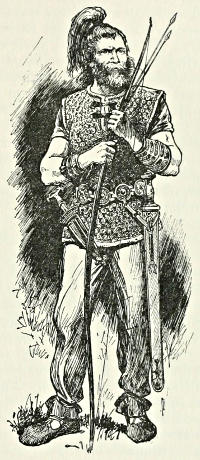
A German Archer
[358-359 A.D.]
It was not enough for Julian to have delivered the provinces of Gaul from the barbarians of Germany. He aspired to emulate the glory of the first and most illustrious of the emperors, after whose example he composed his own commentaries of the Gallic War. Cæsar has related with conscious pride the manner in which he twice passed the Rhine. Julian could boast that before he assumed the title of Augustus, he had carried the Roman eagles beyond that great river in three successful expeditions. The consternation of the Germans after the battle of Strasburg encouraged him to the first attempt, and the reluctance of the troops soon yielded to the persuasive eloquence of a leader who shared the fatigues and dangers which he imposed on the meanest of the soldiers. The villages on either side of the Mœnus (Main), which were plentifully stored with corn and cattle, felt the ravages of an invading army. The principal houses, constructed with some imitation of Roman elegance, were consumed by the flames; and the cæsar boldly advanced about ten miles, till his progress was stopped by a dark and impenetrable forest, undermined by subterraneous passages, which threatened, with secret snares and ambush, every step of the assailants.
The ground was already covered with snow; and Julian, after repairing an ancient castle which had been erected by Trajan, granted a truce of ten months to the submissive barbarians. At the expiration of the truce Julian undertook a second expedition beyond the Rhine to humble the pride of Surmar and Hortaire, two of the kings of the Alamanni, who had been present at the battle of Strasburg. They promised to restore all the Roman captives who yet remained alive; and as the cæsar had procured an exact account from the cities and villages of Gaul of the inhabitants whom they had lost, he detected every attempt to deceive him with a degree of readiness and accuracy which almost established the belief of his supernatural knowledge.
His third expedition was still more splendid and important than the two former. The Germans had collected their military powers and moved along the opposite banks of the river with a design of destroying the bridge and of preventing the passage of the Romans. But this judicious plan of defence was disconcerted by a skilful diversion. Three hundred light-armed and active soldiers were detached in forty small boats, to fall down the stream in silence, and to land at some distance from the posts of the enemy. They executed their orders with so much boldness and celerity that they had almost surprised the barbarian chiefs, who returned in the fearless confidence of intoxication from one of their nocturnal festivals. Without repeating the uniform and disgusting tale of slaughter and devastation, it is sufficient to observe that Julian dictated his own conditions of peace to six of the haughtiest kings of the Alamanni, three of whom were permitted to view the severe discipline and martial pomp of a Roman camp. Followed by twenty thousand captives, whom he had rescued from the chains of the barbarians, the cæsar repassed the Rhine, after terminating a war, the success of which has been compared to the ancient glories of the Punic and Cimbric victories.
JULIAN AS CIVIC RULER
[359-360 A.D.]
As soon as the valour and conduct of Julian had secured an interval of peace, he applied himself to a work more congenial to his humane and philosophic temper. The cities of Gaul, which had suffered from the inroads of the barbarians, he diligently repaired; and seven important posts, between Mogontiacum and the mouth of the Rhine, are mentioned, as having been rebuilt and fortified by order of Julian. The vanquished Germans had submitted to the just but humiliating condition of preparing and conveying the necessary materials. The active zeal of Julian urged the prosecution of the work, and such was the spirit which he diffused among the troops that the auxiliaries themselves, waiving their exemption from any duties of fatigue, contended in the most servile labours with the diligence of the Roman soldiers. It was incumbent on the cæsar to provide for the subsistence, as well as for the safety, of the inhabitants and of the garrisons. The desertion of the former, and the mutiny of the latter, must have been the fatal and inevitable consequences of famine. The tillage of the provinces of Gaul had been interrupted by the calamities of war; but the scanty harvests of the continent were supplied, by his paternal care, from the plenty of the adjacent island. Six hundred large barks, framed in the forest of the Ardennes, made several voyages to the coast of Britain; and, returning laden with corn, sailed up the Rhine, and distributed their cargoes to the several towns and fortresses along the banks of the river. The arms of Julian had restored a free and secure navigation, which Constantius had offered to purchase at the expense of his dignity, and of a tributary present of two thousand pounds of silver. The emperor parsimoniously refused to his soldiers the sums which he granted with a lavish and trembling hand to the barbarians. The dexterity, as well as the firmness, of Julian was put to a severe trial, when he took the field with a discontented army which had already served two campaigns without receiving any regular pay or any extraordinary donative.
A tender regard for the peace and happiness of his subjects was the ruling principle which directed, or seemed to direct, the administration of Julian. He devoted the leisure of his winter quarters to the offices of civil government; and affected to assume, with more pleasure, the character of a magistrate, than that of a general. Before he took the field, he devolved on the provincial governors most of the public and private causes which had been referred to his tribunal; but, on his return, he carefully revised their proceedings, mitigated the rigour of the law, and pronounced a second judgment on the judges themselves. Superior to the last temptation of virtuous minds, and indiscreet and intemperate zeal for justice, he restrained with calmness and dignity the warmth of an advocate who prosecuted, for extortion, the president of the Narbonnese province. “Who will ever be found guilty,” exclaimed the vehement Delphidius, “if it be enough to deny?” “And who,” replied Julian, “will ever be innocent, if it be sufficient to affirm?”
In the general administration of peace and war the interest of the sovereign is commonly the same as that of his people; but Constantius would have thought himself deeply injured if the virtues of Julian had defrauded him of any part of the tribute which he extorted from an oppressed and exhausted country. The prince who was invested with the ensigns of royalty might sometimes presume to correct the rapacious insolence of his inferior agents; to expose their corrupt arts, and to introduce an equal and easier mode of collection. But the management of the finances was more safely entrusted to Florentius, prætorian prefect of Gaul, an effeminate tyrant, incapable of pity or remorse; and the haughty minister complained of the most decent and gentle opposition, while Julian himself was rather inclined to censure the weakness of his own behaviour. The cæsar had rejected with abhorrence a mandate for the levy of an extraordinary tax, a new superindiction, which the prefect had offered for his signature; and the faithful picture of the public misery, by which he had been obliged to justify his refusal, offended the court of Constantius.
We may enjoy reading of the sentiments of Julian, as he expresses them with warmth and freedom, in a letter to one of his most intimate friends. After stating his own conduct, he proceeds in the following terms: “Was it possible for the disciple of Plato and Aristotle to act otherwise than I have done? Could I abandon the unhappy subjects entrusted to my care? Was I not called upon to defend them from the repeated injuries of these unfeeling robbers? A tribune who deserts his post is punished with death, and deprived of the honours of burial. With what justice could I pronounce his sentence, if, in the hour of danger, I myself neglected a duty far more sacred and far more important? God has placed me in this elevated post—His providence will guard and support me. Should I be condemned to suffer, I shall derive comfort from the testimony of a pure and upright conscience. Would to heaven that I still possessed a counsellor like Sallust! If they think proper to send me a successor, I shall submit without reluctance; and had much rather improve the short opportunity of doing good, than enjoy a long and lasting impunity of evil.” The precarious and dependent situation of Julian displayed his virtues and concealed his defects. The young hero, who supported in Gaul the throne of Constantius, was not permitted to reform the vices of the government; but he had courage to alleviate or to pity the distress of the people. Unless he had been able to revive the martial spirit of the Romans, or to introduce the arts of industry and refinement among their savage enemies, he could not entertain any rational hopes of securing the public tranquillity either by the peace or conquest of Germany. Yet the victories of Julian suspended for a short time the inroads of the barbarians, and delayed the ruin of the Western Empire.
His salutary influence restored the cities of Gaul, which had been so long exposed to the evils of civil discord, barbarian war, and domestic tyranny; and the spirit of industry was revived with the hope of enjoyment. Agriculture, manufactures, and commerce again flourished under the protection of the laws; and the curiæ, or civil corporations, were again filled with useful and respectable members; the youth were no longer apprehensive of marriage, and married persons were no longer apprehensive of posterity; the public and private festivals were celebrated with customary pomp, and the frequent and secure intercourse of the provinces displayed the image of national prosperity. A mind like that of Julian must have felt the general happiness of which he was the author, but he viewed with peculiar satisfaction and complacency the city of Paris, the seat of his winter residence and the object even of his partial affection. That splendid capital, which now embraces an ample territory on either side of the Seine, was originally confined to the small island in the midst of the river, from whence the inhabitants derived a supply of pure water. The river bathed the foot of the walls, and the town was accessible only by two wooden bridges.
A forest overspread the northern side of the Seine, but on the south, the ground, which now bears the name of the university, was covered with houses and adorned with a palace and amphitheatre, baths, an aqueduct, and a Field of Mars for the exercise of the Roman troops. The severity of the climate was tempered by the neighbourhood of the ocean; and with some precautions, which experience had taught, the vine and fig tree were successfully cultivated. But, in remarkable winters, the Seine was deeply frozen; and the huge pieces of ice that floated down the stream, might be compared, by an Asiatic, to the blocks of white marble which were extracted from the quarries of Phrygia. The licentiousness and corruption of Antioch recalled to the memory of Julian the severe and simple manners of his beloved Lutetia, where the amusements of the theatre were unknown or despised. He indignantly contrasted the effeminate Syrians with the brave and honest simplicity of the Gauls, and almost forgave the intemperance, which was the only stain of the Celtic character. If Julian could now revisit the capital of France, he might converse with men of science and genius, capable of understanding and of instructing a disciple of the Greeks; he might excuse the lively and graceful follies of a nation, whose martial spirit has never been enervated by the indulgence of luxury, and he must applaud the perfection of that inestimable art, which softens and refines and embellishes the intercourse of social life.
THE JEALOUSY OF CONSTANTIUS
While the Romans languished under the ignominious tyranny of eunuchs and bishops, the praises of Julian were repeated with transport in every part of the empire, except in the palace of Constantius. The barbarians of Germany had felt, and still dreaded, the arms of the young cæsar; his soldiers were the companions of his victory; the grateful provincials enjoyed the blessings of his reign; but the favourites, who had opposed his elevation, were offended by his virtues; and they justly considered the friend of the people as the enemy of the court. As long as the fame of Julian was doubtful, the buffoons of the palace, who were skilled in the language of satire, tried the efficacy of those arts which they had so often practised with success. They easily discovered that his simplicity was not exempt from affectation; the ridiculous epithets of a hairy savage, of an ape invested with the purple, were applied to the dress and person of the philosophic warrior; and his modest despatches were stigmatised as the vain and elaborate fictions of a loquacious Greek, a speculative soldier, who had studied the art of war amidst the groves of the academy. The voice of malicious folly was at length silenced by the shouts of victory; the conqueror of the Franks and Alamanni could no longer be painted as an object of contempt; and the monarch himself was meanly ambitious of stealing from his lieutenant the honourable reward of his labours. In the letters crowned with laurel, which, according to ancient custom, were addressed to the provinces, the name of Julian was omitted. Constantius had made his dispositions in person; he had signalised his valour in the foremost ranks; his military conduct had secured the victory; and the captive king of the barbarians was presented to him on the field of battle, from which he was at that time distant about forty days’ journey. So extravagant a fable was incapable, however, of deceiving the public credulity, or even of satisfying the pride of the emperor himself. Secretly conscious that the applause and favour of the Romans accompanied the rising fortunes of Julian, his discontented mind was prepared to receive the subtle poison of those artful sycophants, who coloured their mischievous designs with the fairest appearances of truth and candour. Instead of depreciating the merits of Julian, they acknowledged, and even exaggerated, his popular fame, superior talents, and important services. But they darkly insinuated that the virtues of the cæsar might instantly be converted into the most dangerous crimes, if the inconstant multitude should prefer their inclinations to their duty; or if the general of a victorious army should be tempted from his allegiance by the hopes of revenge, and independent greatness.
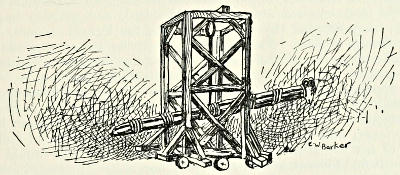
Roman Light Battering-ram
[360 A.D.]
The apparent tranquillity of Gaul, and the imminent danger of the eastern provinces, offered a specious pretence for the design which was artfully concerted by the imperial ministers. They resolved to disarm the cæsar; to recall those faithful troops who guarded his person and dignity; and to employ, in a distant war against the Persian monarch, the hardy veterans who had vanquished, on the banks of the Rhine, the fiercest nations of Germany. While Julian used the laborious hours of his winter quarters at Paris in the administration of power, which, in his hands, was the exercise of virtue, he was surprised by the hasty arrival of a tribune and a notary, with positive orders from the emperor which they were directed to execute, and he was commanded not to oppose. Constantius signified his pleasure, that four entire legions, the Celtæ and Petulants, the Heruli, and the Batavians, should be separated from the standard of Julian, under which they had acquired their fame and discipline; that in each of the remaining bands three hundred of the bravest youths should be selected; and that this numerous detachment, the strength of the Gallic army, should instantly begin their march, and exert their utmost diligence to arrive, before the opening of the campaign, on the frontiers of Persia. The cæsar foresaw and lamented the consequences of this fatal mandate. Most of the auxiliaries, who engaged their voluntary service, had stipulated that they should never be obliged to pass the Alps. The public faith of Rome and the personal honour of Julian had been pledged for the observance of this condition. Such an act of treachery and oppression would destroy the confidence and excite the resentment of the independent warriors of Germany, who considered truth as the noblest of their virtues, and freedom as the most valuable of their possessions. The legionaries, who enjoyed the titles and privileges of Romans, were enlisted for the general defence of the republic; but those mercenary troops heard with cold indifference the antiquated names of the republic and of Rome. Attached, either from birth or long habit, to the climate and manners of Gaul, they loved and admired Julian; they despised, and perhaps hated, the emperor; they dreaded the laborious march, the Persian arrows, and the burning deserts of Asia. They claimed as their own the country which they had saved; and excused their want of spirit, by pleading the sacred and more immediate duty of protecting their families and friends.
The apprehensions of the Gauls were derived from the knowledge of the inevitable danger. As soon as the provinces were exhausted of their military strength, the Germans would violate a treaty which had been imposed on their fears; and, notwithstanding the abilities and valour of Julian, the general of a nominal army, to whom the public calamities would be imputed, must find himself, after a vain resistance, either a prisoner in the camp of the barbarians, or a criminal in the palace of Constantius. If Julian complied with the orders which he had received, he would subscribe to his own destruction, and that of a people who deserved his affection. But a positive refusal was an act of rebellion, and a declaration of war. The inexorable jealousy of the emperor, the peremptory, and perhaps insidious, nature of his commands, left not any room for a fair apology or candid interpretation; and the dependent station of the cæsar scarcely allowed him to pause or to deliberate. Solitude increased the perplexity of Julian; he could no longer apply to the faithful counsels of Sallust, who had been removed from his office by the judicious malice of the eunuchs. Unable to resist, unwilling to comply, Julian expressed, in the most serious terms, his wish, and even his intention of resigning the purple, which he could not preserve with honour, but which he could not abdicate with safety.
After a painful conflict, Julian was compelled to acknowledge that obedience was the virtue of the most eminent subject; and that the sovereign alone was entitled to judge of the public welfare. He issued the necessary orders for carrying into execution the commands of Constantius; a part of the troops began their march for the Alps; and the detachments from the several garrisons moved towards their respective places of assembly. They advanced with difficulty through the trembling and affrighted crowds of provincials, who attempted to excite their pity by silent despair, or loud lamentations; while the wives of the soldiers, holding their infants in their arms, accused the desertion of their husbands, in the mixed language of grief, of tenderness, and of indignation. This scene of general distress afflicted the humanity of the cæsar; he granted a sufficient number of post-wagons to transport the wives and families of the soldiers, endeavoured to alleviate the hardships which he was constrained to inflict, and increased, by the most laudable arts, his own popularity, and the discontent of the exiled troops.
JULIAN ACCLAIMED AUGUSTUS
As soon as the approach of the troops was announced, the cæsar went out to meet them, and ascended his tribunal, which had been erected in a plain before the gates of the city. After distinguishing the officers and soldiers who by their rank or merit deserved a peculiar attention, Julian addressed himself in a studied oration to the surrounding multitude; he celebrated their exploits with grateful applause; encouraged them to accept, with alacrity, the honour of serving under the eye of a powerful and liberal monarch; and admonished them, that the commands of the augustus required an instant and cheerful obedience. The soldiers, who were apprehensive of offending their general by an indecent clamour, or of belying their sentiments by false and venal acclamations, maintained an obstinate silence, and, after a short pause, were dismissed to their quarters. The principal officers were entertained by the cæsar, who professed, in the warmest language of friendship, his desire and his inability to reward, according to their deserts, the brave companions of his victories. They retired from the feast full of grief and perplexity; and lamented the hardship of their fate, which tore them from their beloved general and their native country.
The only expedient which could prevent their separation was boldly agitated and approved; the popular resentment was insensibly moulded into a regular conspiracy; their just reasons of complaint were heightened by passion, and their passions were inflamed by wine; as on the eve of their departure the troops were indulged in licentious festivity. At the hour of midnight, the impetuous multitude, with swords, and bows, and torches in their hands, rushed into the suburbs; encompassed the palace, and careless of future dangers, pronounced the fatal and irrevocable words, Julian Augustus! The prince, whose anxious suspense was interrupted by their disorderly acclamations, secured the doors against their intrusion; and, as long as it was in his power, secluded his person and dignity from the accidents of a nocturnal tumult. At the dawn of day, the soldiers, whose zeal was irritated by opposition, forcibly entered the palace, seized, with respectful violence, the object of their choice, guarded Julian with drawn swords through the streets of Paris, placed him on the tribunal, and with repeated shouts saluted him as their emperor. Prudence as well as loyalty inculcated the propriety of resisting their treasonable designs, and of preparing, for his oppressed virtue, the excuse of violence.
Addressing himself by turns to the multitude and to individuals, he implored their mercy, and expressed his indignation; conjured them not to sully the fame of their immortal victories; and ventured to promise, that if they would immediately return to their allegiance, he would undertake to obtain from the emperor, not only a free and gracious pardon, but even the revocation of the orders which had excited their resentment. But the soldiers, who were conscious of their guilt, chose rather to depend on the gratitude of Julian, than on the clemency of the emperor. Their zeal was insensibly turned into impatience, and their impatience into rage. The inflexible cæsar sustained, till the third hour of the day, their prayers, their reproaches, and their menaces; nor did he yield, till he had been repeatedly assured, that if he wished to live, he must consent to reign. He was exalted on a shield in the presence, and amidst the unanimous acclamations, of the troops; a rich military collar, which was offered by chance, supplied the want of a diadem; the ceremony was concluded by the promise of a moderate donative; and the new emperor, overwhelmed with real or affected grief, retired into the most secret recesses of his apartment.
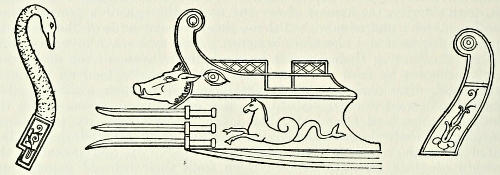
Prows of Roman War Galleys
To moderate the zeal of his party, to protect the persons of his enemies, to defeat and to despise the secret enterprises which were formed against his life and dignity, were the cares which employed the first days of the reign of the new emperor. Although he was firmly resolved to maintain the station which he had assumed, he was still desirous of saving his country from the calamities of civil war, of declining a contest with the superior forces of Constantius, and of preserving his own character from the reproach of perfidy and ingratitude. Adorned with the ensigns of military and imperial pomp, Julian showed himself in the Field of Mars to the soldiers, who glowed with ardent enthusiasm in the cause of their pupil, their leader, and their friend. He recapitulated their victories, lamented their sufferings, applauded their resolution, animated their hopes, and checked their impetuosity; nor did he dismiss the assembly, till he had obtained a solemn promise from the troops that if the emperor of the East would subscribe an equitable treaty, they would renounce any views of conquest, and satisfy themselves with the tranquil possession of the Gallic provinces. On this foundation he composed, in his own name, and in that of the army, a specious and moderate epistle, which was delivered to Pentadius, his master of the offices, and to his chamberlain Eutherius; two ambassadors whom he appointed to receive the answer, and observe the dispositions of Constantius. This epistle is inscribed with the modest appellation of Cæsar; but Julian solicits, in a peremptory, though respectful manner, the confirmation of the title of Augustus. He acknowledges the irregularity of his own election; while he justifies in some measure the resentment and violence of the troops which had extorted his reluctant consent. He allows the supremacy of his brother Constantius; and engages to send him an annual present of Spanish horses, to recruit his army with a select number of barbarian youths, and to accept from his choice a prætorian prefect of approved discretion and fidelity. But he reserves for himself the nomination of his other civil and military officers, with the troops, the revenue, and the sovereignty, of the provinces beyond the Alps. He admonishes the emperor to consult the dictates of justice; to distrust the arts of those venal flatterers who subsist only by the discord of princes; and to embrace the offer of a fair and honourable treaty, equally advantageous to the republic and to the house of Constantine. In this negotiation, Julian claimed no more than he already possessed.
The negotiations of peace were accompanied and supported by the most vigorous preparations for war. The army, which Julian held in readiness for immediate action, was recruited and augmented by the disorders of the times. The cruel persecutions of the faction of Magnentius had filled Gaul with numerous bands of outlaws and robbers. They cheerfully accepted the offer of a general pardon from a prince whom they could trust, submitted to the restraints of military discipline, and retained only their implacable hatred to the person and government of Constantius. As soon as the season of the year permitted Julian to take the field, he appeared at the head of his legions; threw a bridge over the Rhine in the neighbourhood of Cleves; and prepared to chastise the perfidy of the Attuarii, a tribe of Franks, who presumed that they might ravage, with impunity, the frontiers of a divided empire. The difficulty, as well as glory, of this enterprise, consisted in a laborious march; and Julian had conquered, as soon as he could penetrate into a country which former princes had considered as inaccessible.