Book 2 — CHAPTER XXXV. GALBA, OTHO, VITELLIUS, AND THE THREE FLAVIANS (68-96 A.D.)
Reading edition
Galba (Servius Sulpicius Galba), 68-69 A.D.
The fall of Nero and the accession of Galba form an important epoch in the history of the Roman Empire; for to the misfortune of a form of government, on which everything depended on the ruler, his court, and the bodyguard and guard of the emperor, a fresh evil was now added, namely that the army became accustomed to mutiny, and obtained a decisive influence on the choice of the emperor. Certainly Galba did not accept the title of emperor, until it was legally assigned to him by a deputation of the senate; but the example of mutiny had been given, the army had in reality, and the senate, only in form, decided as to who should occupy the throne, and the fate of the empire was from henceforth made more and more dependent on the troops and their leaders.
At first however it appeared fortunate, that after the weak-minded libertines, who for some time had been at the head of the states, the government should fall into the hands of a veteran warrior who possessed the love and confidence of his soldiers, and hated every kind of indulgence and excess; but any advantages which might have arisen from this were outweighed by the great age of the emperor and the weakness consequent on it. Galba’s weakness was first perceived when he, who at the time of Nero’s death was still in Gaul, had returned to Rome; he was awaited with real eagerness.
Before the arrival of Galba, Nymphidius, who had accelerated the fall of Nero, acted as absolute ruler. He prevented Tigellinus from participating in the command of the prætorians, tried in every way to gain over the people, saw the entire senate in his antechamber, and mixed himself up with all the dealings of the latter with Galba. It then occurred to him that he might trace his descent from Cæsar and thereby establish his claim to the throne. But to his terror, he heard, from a messenger whom he had sent to Galba, that Titus Vinius, one of Galba’s legates, held absolute sway over the emperor, that he had named Cornelius Laco prefect of the prætorians, instead of him, and that his rule would therefore be at an end as soon as Galba entered Rome. He therefore resolved to venture to extremes and to make the prætorians proclaim him emperor; they were turned against him by one of his officers, and killed him as soon as he appeared in their camp.
As soon as Galba arrived in Rome, he had all the friends of Nymphidius put to death. These and a few other executions, added to Galba’s dependence on Vinius, prepossessed no one in favour of the new ruler. It was still more unfortunate that he had to refuse the guard sums of money promised in his name by Nymphidius, and that on his entry into Rome he saw himself obliged to have another troop of soldiers cut down, who had gone against him and made violent demands. Galba was determined to adopt a new course of government; but in this he overlooked the fact, that an utterly corrupt people cannot be transformed at once, or lost morality recalled by commands. With exaggerated severity and with a parsimony which would have been despicable even in a private individual, he attempted to reduce a town accustomed to imperial prodigality to its former simplicity, discipline, and order, and thereby not only embittered the feelings of all, but also made himself ridiculous.
[68-69 A.D.]
He was indolent and enfeebled by age [he was over seventy-two years old] and depended on three favourites, who committed all sorts of severities in his name and tried to make money by selling privileges and favours. These favourites were Vinius, Laco, and Galba’s freedman, Icelus. For this reason, from the beginning, everything pointed to a short duration of his rulership, and dissatisfaction not only seized hold of the great mass in Rome, who, as everywhere, loved pleasure and amusement more than virtue or their country, but also of the different armies of the kingdom. A few months after his accession the legions rose in upper Germany, and demanded from the senate the appointment of a younger and more vigorous emperor. Galba tried to stay the storm by immediately naming a young man of good family and irreproachable character, Piso Licinianus, as his co-regent and successor. Unfortunately, when presenting Piso to the troops, he omitted, out of economy, to give presents to the soldiers, as had been the custom on such occasions since the accession of Claudius; and in his speech to the assembled army he publicly avowed that the troops in Germany had refused him obedience. This made the soldiers dissatisfied, and he thereby robbed himself of the advantages that Piso’s nomination might otherwise have brought him.
Otho (M. Salvius Otho), 69 A.D.
Otho, who had gone to Rome with Galba, seized the opportunity of Galba’s mistake to place himself on the throne. He had long solicited the favour of the soldiers and people, had given away entire estates to individuals, had, when Galba dined with him, given money to the emperor’s escort, and Galba had overlooked all this, because one of his favourites, Vinius, whose daughter Otho wished to marry, had come to a secret understanding with the latter. Otho instituted a formal conspiracy, corrupted the soldiers by gifts and promises, and had himself proclaimed emperor in a camp of the prætorians, a few days after Piso’s appointment. He left the camp at the head of the soldiers who had chosen him, entered the town, killed Galba and his co-regent, and was acknowledged emperor by the people and senate. This took place on the 15th of January of the year 69, when Galba had only reigned seven months and a few days.
The new emperor only maintained his rule for three months. All the provinces and armies swore allegiance to him after Galba’s death, only the legions of the Rhine and Upper Germany denied him obedience. They had already rebelled against Galba, and proclaimed the leader of the troops on the lower Rhine, Aulus Vitellius, emperor, as they had not been recompensed by Galba for the support they had given him against Nero. This rival, although other legions declared for him, would not in himself have been dangerous to Otho, as he had become so enervated by self-indulgence that he was wanting in activity and energy as well as in decision; but in Fabius Valens and Aulus Cæcina, he possessed two able generals, who placed themselves at the head of the legions in his stead.
With the rebellious troops they crossed the Alps into upper Italy and fell upon Otho, who had hastily collected as many soldiers as possible and led them against the enemy. At first the generals of Vitellius were the losers in a few small engagements, as mutual jealousy induced them to act separately, but as soon as they concentrated themselves they were far superior to their adversaries. Otho ought, therefore, to have done everything to delay the crisis until the reinforcements which he was expecting from the provinces of the Danube had arrived. He nevertheless did the reverse, and throughout the entire war showed himself a worthy comrade of Nero.
He had been the husband of the notorious Poppæa Sabina; had formerly participated with his imperial friend in all kinds of pleasures, and had indulged in so much dissipation that he had not only fallen deeply into debt, but had also become enervated and incapable of any exertion. This had already become apparent in the rebellion against Galba; for he had lost all courage at the moment of action, and would have given the whole thing up had not his fellow-conspirators compelled him to persist in his designs. Besides he was no general. His troops, which for the greater part consisted of prætorians and soldiers of Nero, clung to him with devotion, and were eager to fight, but they did not trust their officers and would no longer take orders from them. This determined him to bring the fight to a speedy end, as he felt that at any moment he might be deserted by his own people. In spite of this, as he had not been present in the earlier smaller fights, so now he took no personal share in the great battle which was to decide his own fate.
In the vicinity of Cremona, Cæcina and Valens fell on Otho’s army. It was beaten, suffered considerable loss, and then the greater part went over to the enemy. Otho’s cause was, nevertheless, by no means lost; for the prætorians adhered steadfastly to him, the legions of the provinces of the Danube were already on the march, and the entire East as well as Africa was open to him. Only he was too indolent and effeminate to be able to face continuous exertions and hardships, and from the example of his beaten army he saw how ephemeral the devotion of his soldiers had been. So he lost courage, and decided, in spite of the remonstrances and requests of his friends, to put an end to his life. He stabbed himself to the heart with a firmness rarely found in a voluptuary, and by this action won for himself the reputation with posterity of having purchased the peace of his country with his own life.
Historians have therefore praised him above his deserts, and placed words in his mouth which stand in opposition to his life and principles. For instance, he is reported to have said to his friends and relatives who wished to restrain him from suicide: “Others have gained fame by governing well; my fame, on the contrary, is to consist in my giving up the government of the empire, rather than ruin it by my ambition.” Those who recall the fact that Otho throughout his life lived and acted according to the maxims of a Nero, will know how to divest this story of all that gives his death the appearance of a grand and noble act; for although it cannot be denied that Otho thereby put an end to the civil war, and died in peace and quietness, nevertheless he was not guided by courage or love of country, but by indolence and despair.
How little the sacrifice of his life cost a Roman at this period, and why Otho’s death must be regarded in quite another light from that in which a similar deed would be looked upon nowadays, is apparent from the fact that some of his soldiers killed themselves at his funeral pile, not from fear of the future, but that they might follow the glorious example of their leader.
Vitellius (Aulus Vitellius), 69 A.D.
After Otho’s death, the Roman senate not only recognised Vitellius as emperor, but determined publicly to thank the Germanic army for having appointed him. Whilst his generals were fighting for his dominion, Vitellius remained in Gaul, and after the victory made no haste to take possession of the empire; he first enjoyed a period of repose at Lyons, and then stopped at Cremona and Bologna to hold revels and to see the gladiatorial displays. It was only in July (69), three months after Otho’s death, that he entered Rome.
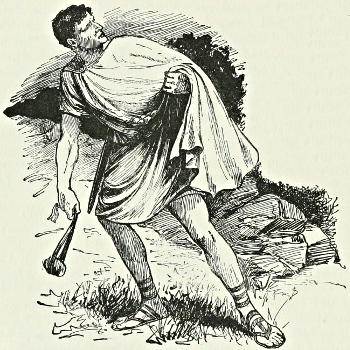
A Roman Slinger
With his accession, all the crimes and prodigalities of the government of a Caligula, a Claudius, and a Nero were repeated, although he was wanting neither in culture nor in better qualities. He had only attained to consideration by his vices, and won over the soldiers in Germany by his familiar bearing. A dull, slack, and withal cruel disposition, a greediness which amounted to voraciousness, and a prodigality in which he even surpassed Nero, were the soul of his existence and government. Only thinking of pleasure and idle repose, even on the march to Rome, he allowed his army to rob and plunder at will, and permitted all kinds of excesses and insubordination. In Rome, freedmen, comedians, and revellers were his most cherished companions, and he who knew how to prepare the most voluptuous feast, rose in his favour.
In order to obtain money for his prodigalities, like Caligula and Nero, he committed all sorts of inhuman cruelties. For example: he freed himself from debt by having his creditors killed, and when one of them, condemned to death, sought to obtain favour by making the emperor a legacy, but unfortunately gave him a co-heir, Vitellius had the latter as well as the former put out of the way, and took the wealth of both. His revelries and prodigalities surpassed all realisation.
By the use of emetics he was enabled to take daily from three to four principal meals. Once, for untold gold, he had marvellous dishes prepared from the tongues of the rarest birds and other costly delicacies, and at the celebration of his entry into Rome he took part in a banquet at his brother’s house in which no less than two thousand rare fish and seven thousand birds were served up. He gormandised so shamefully that, during the short time of his reign, he is said to have squandered no less than nine hundred million sesterces, and, as an historian of antiquity asserts, the Roman Empire would finally have become too poor to defray the expenses of the emperor’s table. Fortunately for the kingdom this did not come to pass; for Vitellius was overthrown by his troops eight months after his accession.
This second mutiny of the army within the course of a year started in the legions who had come from the Danube to help Otho against Vitellius. When on the way they heard of Otho’s death, they determined to choose a new emperor, and some of them, who shortly before had served under the valiant Titus Flavius Vespasian, directed the choice to their former general who was then commanding in Syria. Scarcely had the news reached the East, when first the governor of Egypt, then Mucianus [Roman governor of Syria and general of four legions,] and afterwards Vespasian himself, recognised this choice. One after another all the remaining armies declared for Vespasian. Valens and Cæcina, the principal instruments in the elevation of Vitellius, soon detached themselves from the latter, and only the soldiers of the Germanic army, to whom Vitellius owed the throne, remained true to their emperor. It was therefore no great effort to overthrow the indolent libertine. Before Vespasian had embarked his troops, his opponent was dethroned and deprived of his life.
The legions of the Danube under one of their generals, Antonius Primus, broke into Italy; at Cremona they beat the troops of Vitellius and then marched against the capital, which alone seemed resolved to defend the tyrant. Antonius Primus wished to spare the town. Vitellius himself was too cowardly to try to offer any powerful resistance, and as by chance a brother of Vespasian, Flavius Sabinus, was town prefect of Rome, it was easy to negotiate matters. The result was an agreement by which Vitellius agreed to abdicate in a very ignominious fashion. Only the soldiers of the emperor and all those who had taken part in his universal revels, would hear nothing of an abdication of Vitellius, and without further ceremony laid hands on Sabinus, to whom a great number of the senate, the knights, and the town-guard had already sworn allegiance, on behalf of his brother. Sabinus, with a small number of attendants, was obliged to take to flight, and retired to the Capitol. His adversaries stormed it, took Sabinus prisoner, killed his followers, and intentionally or by chance occasioned a fire, by which the temple of the Capitoline Jupiter, the most sacred building in Rome, was reduced to ashes, and some of the historical records preserved there were destroyed.
In vain did Vitellius, by earnest entreaty, try to restrain the soldiers from murdering Sabinus; he was killed in a terrible manner, whilst Domitian, one of Vespasian’s sons, who had just fled to the Capitol, to the misfortune of the empire escaped the wrath of the enemy. The rude soldiers of Vitellius conducted themselves on this occasion with the same savagery as the troops of Antonius Primus had shown a few weeks before, when after their victory they had burned down the town of Cremona and had ill treated its inhabitants in the most shocking manner. Vitellius was quite innocent of what took place in Rome, for he would gladly have submitted to any terms by which he might have saved his life. With this object, immediately after the murder of Sabinus, he sent ambassadors to Antonius Primus, and that his representations and requests might make the more impression, he sent the vestal virgins with them.
But Antonius Primus refused any further negotiations, defeated the populace and the soldiers of Vitellius in a bloody fight, which took place partly before the walls and partly in the streets of the town, and had the entire body of the conquered ruthlessly massacred. On this occasion the deep moral depravity of the Roman people showed itself in a revolting manner. The populace watched the fierce struggle between the two barbarian armies as coldly as though the usual gladiatorial displays had been taking place before them; they applauded first one side and then the other, fetched those who fled from their victorious enemy out of their hiding places, and gave them up to their adversaries to be killed.
No one was disturbed in his usual pleasures by the fight for the empire; the baths, the taverns, and other public resorts were filled with revellers and pleasure seekers, as at any other time, and, as the historian Tacitus affirms, Rome presented the hideous spectacle of a town whose inhabitants had abandoned themselves at once to all the horrors of civil war and all the vices of a decadent nation. Vitellius died as he had lived.d Seeing the city conquered, he was conveyed in a litter, by a private way at the back of the palace, to his wife’s house on Mount Aventine, with intent, if he could lie concealed during the day, to fly for refuge to his brother and the cohorts at Tarracina. Straightway, from his inherent fickleness, and the natural effects of fright, since, as he dreaded everything, whatever course he adopted was the least satisfactory, he returned to his palace, and found it empty and desolate; even his meanest slaves having made their escape, or shunning the presence of their master. The solitude and silence of the scene alarmed him; he opened the doors of the apartments, and was horror-struck to see all void and empty. Exhausted with this agonising state of doubt and perplexity, and concealing himself in a wretched hiding place, he was dragged forth by Placidus, the tribune of a cohort. With his hands tied behind him, and his garment torn, he was conducted, a revolting spectacle, through crowds insulting his distress, without a friend to shed a tear over his misfortunes. The unseemliness of his end banished all sympathy. Whether one of the Germanic soldiers who met him intended for him the stroke he made, and if he did, whether from rage or to rescue him the quicker from the mockery to which he was exposed; or whether he aimed at the tribune, is uncertain; he cut off the ear of the tribune, and was immediately despatched.[19]
Vitellius was pushed along, and with swords pointed at his throat, forced to raise his head, and expose his countenance to insults: one while they made him look at his statues tumbling to the ground; frequently to the rostrum, or the spot where Galba perished, and lastly they drove him to Gemoniæ, where the body of Flavius Sabinus had been thrown. One expression of his was heard, that spoke a spirit not utterly fallen, when to a tribune who had insulted him in his misery he observed, that nevertheless he had been his emperor. He died soon after [Dec. 21] under repeated wounds. The populace, with the same perversity of judgment that had prompted them to honour him while living, assailed him with indignities when dead.
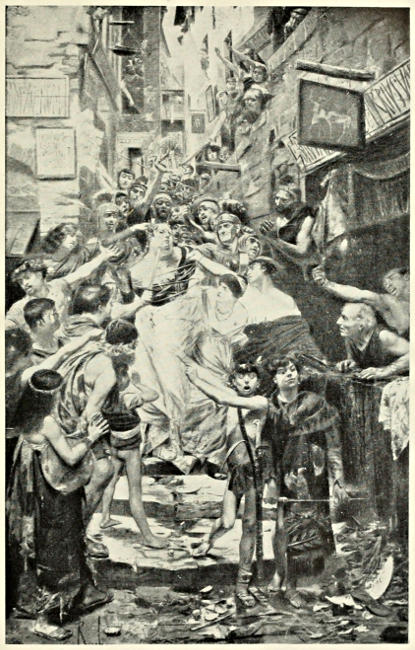
THE DEATH OF VITELLIUS
He was born at Luceria. He had completed his fifty-fourth year. He rose to the consulship, to pontifical dignities, and a name and rank amongst the most eminent citizens, without any personal merit; but obtained all from the splendid reputation of his father. The men who conferred the imperial dignity upon him did not so much as know him. By impotence and sloth he gained the affections of the army, to a degree in which few have attained them by worthy means. Frankness and generosity, however, he possessed; qualities which, unless duly regulated, become the occasions of ruin. He imagined that friendships could be cemented, not by a uniform course of virtue, but by profuse liberality, and therefore earned them rather than cultivated them. Doubtless the interest of the commonwealth required the fall of Vitellius; but those who betrayed Vitellius to Vespasian can claim no merit for their perfidy, since they had broken faith with Galba.
The day now verged rapidly towards sunset, and on account of the consternation of the magistrates and senators who secreted themselves by withdrawing from the city or in the several houses of their clients, the senate could not be convened. When all apprehension of hostile violence had subsided Domitian came forth to the generals of his party, was unanimously saluted with the title of Cæsar, and escorted by a numerous body of soldiers, armed as they were, to his father’s house.i
Mucianus, who arrived in Rome the day after the murder of Vitellius, took over the government in the name of Vespasian.d Mucianus has been styled (by Duruyn) “the Mæcenas and the Agrippa of the new Augustus.” In subsequent years he was treated almost as an equal by the emperor. He at once took active measures to restore order, and he succeeded so well that everything was peaceful when Vespasian himself finally entered Rome.a In Vespasian, for the first time since the death of Augustus, the Roman Empire again received a worthy and able ruler. He was a man who not only, like Galba, hated flattery and joined integrity with experience in warfare, but whose understanding and force of character were equal to the circumstances of the hour.d
Vespasian (T. Flavius Sabinus Vespasianus), 69-70 A.D.
[69-70 A.D.]
Vespasian was declared emperor, by the unanimous consent both of the senate and the army, and dignified with all those titles which now followed rather the power than the merit of those who were appointed to govern. Messengers were despatched to him in Egypt, desiring his return, and testifying the utmost desire for his government. But the winter being dangerous for sailing, he deferred his voyage to a more convenient season. Perhaps, also, the dissensions in other parts of the empire retarded his return to Rome; for Claudius Civilis, in Lower Germany, excited his countrymen to revolt, and destroyed the Roman garrisons which were placed in different parts of that province. Yet, to give his rebellion an air of justice, he caused his army to swear allegiance to Vespasian, until he found himself in a condition to throw off the mask. When he thought himself sufficiently powerful, he disclaimed all submission to the Roman government, and having overcome one or two of the lieutenants of the empire, and being joined by such of the Romans as refused obedience to the new emperor, he boldly advanced to give Cerealis, Vespasian’s general, battle. In the beginning of this engagement he seemed successful, breaking the Roman legions, and putting their cavalry to flight. But at length Cerealis, by his conduct, turned the fate of the day, and not only routed the enemy, but took and destroyed their camp. This engagement, however, was not decisive; several others ensued with doubtful success. An accommodation, at length, determined what arms could not effect. Civilis obtained peace for his countrymen, and pardon for himself; for the Roman Empire was, at this time, so torn by its own divisions, that the barbarous nations around made incursions with impunity, and were sure of obtaining peace, whenever they thought proper to demand it.
During the time of these commotions in Germany, the Sarmatians, a barbarous nation to the northeast of the empire, suddenly passed the river Ister, and marching into the Roman dominions with celerity and fury, destroyed several garrisons, and an army under the command of Fonteius Agrippa. However, they were driven back with some slaughter by Rubrius Gallus, Vespasian’s lieutenant, into their native forests; where several attempts were made to confine them, by garrisons and forts placed along the confines of their country. But these hardy nations, having once found their way into the empire, never after desisted from invading it at every opportunity, till at length they overran and destroyed the glory of Rome.
Vespasian continued some months at Alexandria in Egypt.b The sober-minded Tacitus, most accurate and most trustworthy of Roman historians, relates some incidents of this story of Vespasian in Egypt which are worth repeating, if for nothing else, to illustrate the gap between the writing of sober history in that day and in our own.a
VESPASIAN PERFORMS MIRACLES AND SEES A VISION, ACCORDING TO TACITUS
[70 A.D.]
During the months when Vespasian was waiting at Alexandria for the periodical season of the summer winds, and a safe navigation [says Tacitus], many miracles occurred, by which the favour of heaven and a sort of bias in the powers above towards Vespasian were manifested. One of the common people of Alexandria, known to have a disease in his eyes, embraced the knees of the emperor, importuning with groans a remedy for his blindness. In this he acted in compliance with the admonition of the god Serapis, whom that nation, devoted to superstition, honours above all other gods; and he prayed the emperor that he would deign to sprinkle his cheeks and the balls of his eyes with the secretion of his mouth. Another, who was diseased in the hand, at the instance of the same god, entreated that he might be pressed by the foot and sole of Cæsar. Vespasian at first ridiculed the request, and treated it with contempt; but when they persisted, at one time he dreaded the imputation of weakness, at another he was led to hope for success, by the supplications of the men themselves, and the encouragements of his flatterers. Lastly, he ordered that the opinion of physicians should be taken, as to whether a blindness and lameness of these kinds could be got the better of by human power. The physicians stated various points—that in the one the power of vision was not wholly destroyed, and that it would be restored if the obstacle was removed; in the other, that the joints which had become diseased might be renovated, if a healing power were applied; such peradventure was the pleasure of the gods, and the emperor was chosen to perform their will. To sum up all, that the glory of accomplishing the cure would be Cæsar’s, the ridicule of its failure would rest upon the sufferers. Accordingly, under an impression that everything was within the power of his fortune, and that after what had occurred nothing was incredible, with a cheerful countenance himself, and while the multitude that stood by waited the event in all the confidence of anticipated success, Vespasian executed what was required of him. Immediately the hand was restored to its functions, and the light of day shone again to the blind. Persons who were present even now attest the truth of both these transactions, when there is nothing to be gained by falsehood.
After this, Vespasian conceived a deeper desire to visit the sanctuary of Serapis, in order to consult the god about affairs of the empire. He ordered all persons to be excluded from the temple; and lo, when he entered, and his thoughts were fixed on the deity, he perceived behind him a man of principal note among the Egyptians, named Basilides, whom, at that moment, he knew to be detained by illness at a distance of several days’ journey from Alexandria. Vespasian inquired of the priests whether Basilides that day had entered the temple. He asked of others whom he met whether he was seen in the city. At length, from messengers whom he despatched on horseback, he received certain intelligence, that Basilides was at that instant of time eighty miles distant from Alexandria. He then concluded that it was a divine vision, and deduced the import of the response from the name of Basilides.i
VESPASIAN RETURNS TO ROME
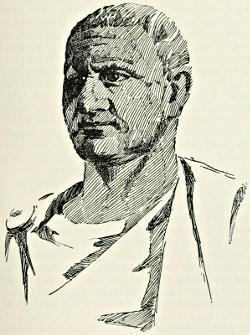
Vespasian
(From a bust in the Vatican)
Leaving Titus to prosecute the Jewish War, Vespasian set out for Rome. His enthusiastic reception there is described by Josephus, who says: “All men that were in Italy showed their respects to him in their minds, before he came thither, as if he were already come, as esteeming the very expectation they had of him to be his real presence on account of the great desires they had to see him, and because the good will they bore him was entirely free and unconstrained; for it was a desirable thing to the senate, who well remembered the calamities they had undergone in the late changes of their governors, to receive a governor who was adorned with the gravity of old age, and with the highest skill in the actions of war, whose advancement would be, as they knew, for nothing else but the preservation of those that were to be governed.
“Moreover, the people had been so harassed by their civil miseries that they were still more earnest for his coming immediately, as supposing they should then be firmly delivered from their calamities, and believed they should then recover their secure tranquillity and prosperity. And for the soldiery, they had the principal regard to him, for they were chiefly apprised of his great exploits in war; and since they had experienced the want of skill and want of courage in other commanders, they were very desirous to be freed from that great shame they had undergone by their means and heartily wished to receive such a prince as might be a security and an ornament to them; and as this good will to Vespasian was universal, those that enjoyed any remarkable dignities could not have patience enough to stay in Rome, but made haste to meet him at a very great distance from it. Nay, indeed, none of the rest could endure the delay of seeing him, but did all pour out of the city in such crowds, and were so universally possessed with the opinion that it was easier and better for them to go out than to stay there, that this was the very first time that the city joyfully perceived itself almost empty of its citizens; for those that stayed within were fewer than those that went out. But as soon as the news was come that he was hard by, and those that had met him at first related with what good humour he received every one that came to him, then it was that the whole multitude that had remained in the city, with their wives and children, came into the road, and waited for him there; and for those whom he passed by, they made all sorts of acclamations on account of the joy they had to see him, and the pleasantness of his countenance, and styled him their benefactor and saviour, and the only person who was worthy to be ruler of the city of Rome. And now the city was like a temple, full of garlands and sweet odours; nor was it easy for him to come to the royal palace for the multitude of people that stood about him, where yet at last he performed his sacrifices of thanksgivings to his household gods, for his safe return to the city. The multitude did also betake themselves to feasting; which feasts and drink-offerings they celebrated by their tribes, and their families, and their neighbourhoods, and still prayed the gods to grant that Vespasian, his sons, and all their posterity, might continue in the Roman government for a very long time, and that his dominion might be preserved from all opposition. And this was the manner in which Rome so joyfully received Vespasian, and thence grew immediately into a state of great prosperity.”l
TITUS CONTINUES THE JEWISH WAR
[70-71 A.D.]
In the meantime, Titus carried on the war against the Jews with vigour.[20] This obstinate and infatuated people had long resolved to resist the Roman power, vainly hoping to find protection from heaven. Their own historian represents them as arrived at the highest pitch of iniquity, while famines, earthquakes, and prodigies all conspired to forewarn their approaching ruin. Nor was it sufficient that heaven and earth seemed combined against them; they had the most bitter dissensions among themselves, and were split into two parties, that robbed and destroyed each other with impunity; still pillaging, and, at the same time, boasting their zeal for the religion of their ancestors.
At the head of one of those parties was an incendiary whose name was John. This fanatic affected sovereign power, and filled the whole city of Jerusalem, and all the towns around, with tumult and pillage. In a short time a new faction arose, headed by one Simon, who, gathering together multitudes of robbers and murderers who had fled to the mountains, attacked many cities and towns, and reduced all Idumæa into his power. Jerusalem, at length, became the theatre in which these two demagogues began to exercise their mutual animosity: John was possessed of the temple, while Simon was admitted into the city, both equally enraged against each other; while slaughter and devastation followed their pretensions. Thus did a city, formerly celebrated for peace and unity, become the seat of tumult and confusion.
It was in this miserable situation that Titus came to sit down before it with his conquering army, and began his operations within about six furlongs of the place. It was at the feast of the Passover, when the place was filled with an infinite multitude of people, who had come from all parts to celebrate that great solemnity, that Titus undertook to besiege it. His presence produced a temporary reconciliation between the contending factions within; so that they unanimously resolved to oppose the common enemy first, and then decide their domestic quarrels at a more convenient season. Their first sally, which was made with much fury and resolution, put the Romans into great disorder, and obliged them to abandon their camp and fly to the mountains. However, rallying immediately after, the Jews were forced back into the city; while Titus, in person, showed surprising instances of valour and conduct.
These advantages over the Romans only renewed in the besieged their desires of private vengeance. A tumult ensued in the temple, in which several of both parties were slain; and in this manner, upon every remission from without, the factions of John and Simon violently raged against each other within, agreeing only in their resolution to defend the city against the Romans.
Jerusalem was strongly fortified by three walls on every side, except where it was fenced by deep valleys. Titus began by battering down the outward wall, which, after much fatigue and danger, he effected; all the time showing the greatest clemency to the Jews, and offering them repeated assurances of pardon. But this infatuated people refused his proffered kindness with contempt, and imputed his humanity to his fears. Five days after the commencement of the siege Titus broke through the second wall; and though driven back by the besieged, he recovered his ground, and made preparations for battering the third wall, which was their last defence. But first he sent Josephus, their countryman, into the city, to exhort them to yield, who, using all his eloquence to persuade them, was only reviled with scoffs and reproaches. The siege was now, therefore, carried on with greater vigour than before; several batteries for engines were raised, which were no sooner built than destroyed by the enemy. At length it was resolved in council to surround the whole city with a trench, and thus prevent all relief and succours from abroad. This, which was quickly executed, seemed no way to intimidate the Jews. Though famine, and pestilence, its necessary attendant, began now to make the most horrid ravages within the walls, yet this desperate people still resolved to hold out. Though obliged to live upon the most scanty and unwholesome food, though a bushel of corn was sold for six hundred crowns, and the holes and the sewers were ransacked for carcasses that had long since grown putrid, yet they were not to be moved. The famine raged at last to such an excess, that a woman of distinction in the city boiled her own child to eat it; which horrid account coming to the ears of Titus, he declared that he would bury so abominable a crime in the ruins of their state. He now, therefore, cut down all the woods within a considerable distance of the city, and causing more batteries to be raised, he at length battered down the wall, and in five days entered the citadel by force. Thus reduced to the very verge of ruin, the remaining Jews still deceived themselves with absurd and false expectations, while many false prophets deluded the multitude, declaring they should soon have assistance from God.
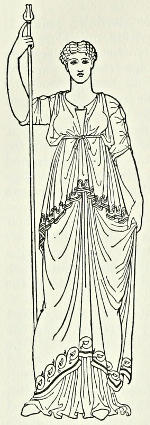
A Roman Empress
(After Hope)
The heat of the battle was now, therefore, gathered round the inner wall of the temple, while the defendants desperately combated from the top. Titus was willing to save this beautiful structure, but a soldier casting a brand into some adjacent buildings, the fire communicated to the temple, and, notwithstanding the utmost endeavours on both sides, the whole edifice was quickly consumed. The sight of the temple in ruins effectually served to damp the ardour of the Jews. They now began to perceive that heaven had forsaken them, while their cries and lamentations echoed from the adjacent mountains. Even those who were almost expiring lifted up their dying eyes to bewail the loss of their temple, which they valued more than life itself. The most resolute, however, still endeavoured to defend the upper and stronger part of the city, named Zion; but Titus, with his battering engines, soon made himself entire master of the place. John and Simon were taken from the vaults where they had concealed themselves; the former was condemned to perpetual imprisonment, and the latter reserved to grace the conqueror’s triumph. The greatest part of the populace were put to the sword, and the city was entirely rased by the plough; so that, according to our Saviour’s prophecy, not one stone remained upon another. Thus, after a siege of six months, this noble city was totally destroyed, having flourished, under the peculiar protection of heaven, about two thousand years. The numbers who perished in this siege, according to Josephus, amounted to above a million of souls, and the captives to almost a hundred thousand. The temporal state of the Jews ended with their city; while the wretched survivors were banished, sold, and dispersed into all parts of the world.
Upon the taking of Jerusalem, his soldiers would have crowned Titus as conqueror, but he modestly refused the honour, alleging that he was only an instrument in the hand of heaven, that manifestly declared its wrath against the Jews. At Rome, however, all men’s mouths were filled with the praises of the conqueror, who had not only shown himself an excellent general, but a courageous combatant.b
Let Josephus describe for us the return of Titus, and the magnificent triumph that he celebrated with his father.
JOSEPHUS DESCRIBES THE RETURN OF TITUS, AND THE TRIUMPH
[70 A.D.]
Titus took the journey he intended into Egypt, and passed over the desert very suddenly, and came to Alexandria, and took up a resolution to go to Rome by sea. And as he was accompanied by two legions, he sent each of them again to the places whence they had before come; the fifth he sent to Mysia; and the fifteenth to Pannonia. As for the leaders of the captives, Simon and John, with the other seven hundred men, whom he had selected out of the rest as being eminently tall and handsome of body, he gave order that they should be soon carried to Italy, as resolving to produce them in his triumph. So when he had had a prosperous voyage to his mind, the city of Rome behaved itself in his reception, and their meeting him at a distance, as it did in the case of his father.
But what made the most splendid appearance in Titus’ opinion was when his father met him, and received him; but still the multitude of the citizens conceived the greatest joy when they saw them all three together,[21] as they did at this time; nor were many days overpast when they determined to have but one triumph, that should be common to both of them, on account of the glorious exploits they had performed, although the senate had decreed each of them a separate triumph by himself. So when notice had been given beforehand of the day appointed for this pompous solemnity to be made, on account of their victories, not one of the immense multitude was left in the city, but everybody went out so far as to gain only a station where they might stand, and left only such a passage as was necessary for those that were to be seen to go along it.
Now all the soldiery marched out beforehand by companies, and in their several ranks, under their several commanders, in the night time, and were about the gates, not of the upper palaces, but those near the temple of Isis; for there it was that the emperors had rested the foregoing night. And as soon as ever it was day, Vespasian and Titus came out crowned with laurel, and clothed in those ancient purple habits which were proper to their family, and then went as far as Octavian’s Walks; for there it was that the senate, and the principal rulers, and those that had been recorded as of the equestrian order, waited for them.
Now a tribunal had been erected before the cloisters, and ivory chairs had been set upon it, when they came and sat down upon them. Whereupon the soldiery made an acclamation of joy to them immediately, and all gave them attestations of their valour; while they were themselves without their arms, and only in their silken garments, and crowned with laurel. Then Vespasian accepted of these shouts of theirs; but while they were still disposed to go on in such acclamations, he gave them a signal of silence. And when everybody entirely held their peace, he stood up, and covering the greatest part of his head with his cloak, he put up the accustomed solemn prayers; the like prayers did Titus put up also; after which prayers Vespasian made a short speech to all the people, and then sent away the soldiers to a dinner prepared for them by the emperors. Then did he retire to that gate which was called the Gate of the Pomp, because pompous shows do always go through that gate; there it was that they tasted some food, and when they had put on their triumphal garments, and had offered sacrifices to the gods that were placed at the gate, they sent the triumph forward, and marched through the theatres, that they might be the more easily seen by the multitude.
It is impossible to describe the multitude of the shows as they deserve, and the magnificence of them all; such indeed as a man could not easily think of as performed either by the labour of workmen, or the variety of riches, or the rarities of nature. For almost all such curiosities as the most happy men ever get by piecemeal were here heaped one upon another, and those both admirable and costly in their nature; and all brought together on that day demonstrated the vastness of the dominions of the Romans; for there was here to be seen a mighty quantity of silver, and gold, and ivory, contrived into all sorts of things, and did not appear as carried along in pompous show only, but, as a man may say, running along like a river. Some parts were composed of the rarest purple hangings, and so carried along; and others accurately represented to the life what was embroidered by the arts of the Babylonians. There were also precious stones that were transparent, some set in crowns of gold, and some in other ouches, as the workmen pleased; and of these such a vast number were brought, that we could not but thence learn how vainly we imagined any of them to be rarities. The images of the gods were also carried, being as well wonderful for their largeness, as made very artificially, and with great skill of the workmen; nor were any of these images of any other than very costly materials; and many species of animals were brought, every one in their own natural ornaments. The men also who brought every one of these shows were great multitudes, and adorned with purple garments, all over interwoven with gold; those that were chosen for carrying these pompous shows having also about them such magnificent ornaments as were both extraordinary and surprising. Besides these, one might see that even the great number of captives was not unadorned, while the variety that was in their garments, and their fine texture, concealed from the sight the deformity of their bodies.
But what afforded the greatest surprise of all was the structure of the pageants that were borne along; for indeed he that met them could not but be afraid that the bearers would not be able firmly enough to support them, such was their magnitude; for many of them were so made that they were on three or even four stories, one above another. The magnificence also of their structure afforded one both pleasure and surprise; for upon many of them were laid carpets of gold. There was also wrought gold and ivory fastened about them all; and many resemblances of the war, and those in several ways, and variety of contrivances, affording a most lively portraiture of itself. For there was to be seen a happy country laid waste, and entire squadrons of enemies slain; while some of them ran away, and some were carried into captivity; with walls of great altitude and magnitude overthrown, and ruined by machines; with the strongest fortifications taken, and the walls of most populous cities upon the tops of hills seized on, and an army pouring itself within the walls; as also every place full of slaughter, and supplications of the enemies, when they were no longer able to lift up their hands in way of opposition. Fire also sent upon temples was here represented, and houses overthrown and falling upon their owners; rivers also, after they came out of a large and melancholy desert, ran down, not into a land cultivated, nor as drink for men or for cattle, but through a land still on fire upon every side; for the Jews related that such a thing they had undergone during this war.
Now the workmanship of these representations was so magnificent and lively in the construction of the things, that it exhibited what had been done to such as did not see it, as if they had been there really present. On the top of every one of these pageants was placed the commander of the city that was taken, and the manner wherein he was taken. Moreover, there followed those pageants a great number of ships; and for the other spoils, they were carried in great plenty. But for those that were taken in the temple of Jerusalem, they made the greatest figure of them all; that is the golden table, of the weight of many talents; the candlestick also, that was made of gold, though its construction were now changed from that which we made use of: for its middle shaft was fixed upon a basis, and the small branches were produced out of it to a great length, having the likeness of a trident in their position, and had every one a socket made of brass for a lamp at the tops of them. These lamps were in number seven, and represented the dignity of the number seven among the Jews; and, the last of all the spoils, was carried the Law of the Jews.
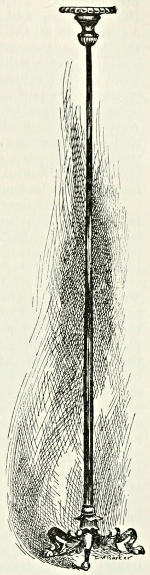
Roman Tripod Candelabrum
After these spoils passed by a great many men, carrying the images of Victory, whose structure was entirely either of ivory, or of gold. After which Vespasian marched in the first place, and Titus followed him; Domitian also rode along with them, and made a glorious appearance, and rode on a horse that was worthy of admiration.
The last part of this pompous show was at the temple of Jupiter Capitolinus, whither when they were come, they stood still; for it was the Romans’ ancient custom to stay till somebody brought the news that the general of the enemy was slain. This general was Simon, the son of Giora, who had then been led in this triumph among the captives; a rope had also been put upon his head, and he had been drawn into a proper place in the Forum, and had withal been tormented by those that drew him along; and the law of the Romans required that malefactors condemned to die should be slain there. Accordingly, when it was related that there was an end of him, and all the people had set up a shout for joy, they then began to offer those sacrifices which they had consecrated, in the prayers used in such solemnities; which when they had finished, they went away to the palace.
And as for some of the spectators, the emperors entertained them at their own feast; and for all the rest there were noble preparations made for their feasting at home; for this was a festal day to the city of Rome, as celebrated for the victory obtained by their army over their enemies, for the end that was now put to their civil miseries, and for the commencement of their hopes of future prosperity and happiness.
[71 A.D.]
After these triumphs were over, and after the affairs of the Romans were settled on the surest foundations, Vespasian resolved to build a temple to Peace, which he finished in so short a time, and in so glorious a manner, as was beyond all human expectation and opinion. For he having now by providence a vast quantity of wealth, besides what he had formerly gained in his other exploits, he had this temple adorned with pictures and statues; for in this temple were collected and deposited all such rarities as men aforetime used to wander all over the habitable world to see, when they had a desire to see them one after another. He also laid up therein, as ensigns of his glory, those golden vessels and instruments that were taken out of the Jewish temple. But still he gave order that they should lay up their law, and the purple veils of the holy place, in the royal palace itself, and keep them there.l
THE EMPIRE IN PEACE
[69-79 A.D.]
Vespasian, having thus given security and peace to the empire, resolved to correct numberless abuses which had grown up under the tyranny of his predecessors. To effect this with greater ease, he joined Titus with him in the consulship and tribunitial power; and, in some measure admitted him a partner in all the highest offices of the state. He began with restraining the licentiousness of the army, and forcing them back to their pristine discipline. Some military messengers desiring money to buy shoes, he ordered them for the future to perform their journeys barefoot. He was not less strict with regard to the senators and the knights. He turned out such as were a disgrace to their station, and supplied their places with the most worthy men he could find. He abridged the processes that had been carried to an unreasonable length in the courts of justice. He took care to rebuild such parts of the city as had suffered in the late commotions; particularly the Capitol, which had been lately burned, and which he now restored to more than former magnificence.
The other ruinous cities in the empire also shared his paternal care; he improved such as were declining, adorned others, and built many anew. In such acts as these he passed a long reign of clemency and moderation; so that it is said no man suffered by an unjust or a severe decree during his administration.b
The care of rebuilding the Capitol [says Tacitus] he committed to Lucius Vestinus, a man of equestrian rank, but in credit and dignity among the first men in Rome. The soothsayers, who were convened by him, advised that the ruins of the former shrine should be removed to the marshes, and a temple raised on the old foundation; for the gods would not permit a change of the ancient form. On the eleventh day before the calends of July, the sky being remarkably serene, the whole space devoted to the sacred structure was encompassed with chaplets and garlands. Such of the soldiers as had names of auspicious import entered within the enclosure, with branches from trees emblematical of good fortune. Then the vestal virgins in procession, with a band of boys and girls whose parents, male and female, were still living, sprinkled the whole place with water drawn from living fountains and rivers. Helvidius Priscus, the prætor, preceded by Plautius Ælianus, the pontiff, after purifying the area by sacrificing a swine, a sheep, and a bull, and replacing the entrails upon the turf, invoked Jupiter, Juno, and Minerva, and the tutelar deities of the empire, praying that they would prosper the undertaking, and, with divine power, carry to perfection a work begun by the piety of man; and then Helvidius laid his hand upon the wreaths that bound the foundation stone and were twined about the cords. At the same time, the magistrates, the priests, the senators, the knights, and a number of citizens, with simultaneous efforts, prompted by zeal and exultation, haled the ponderous stone along. Contributions of gold and silver, and pieces of other metals, the first that were taken from the mines, that had never been melted in the furnace, but in their native state, were thrown upon the foundations on all hands. The soothsayers enjoined that neither stone nor gold which had been applied to other uses should profane the building. Additional height was given to the edifice; this was the only variation conceded by religion; and in point of magnificence it was considered to be inferior to the former temple.i
Vespasian also began the construction of the great amphitheatre which, under the name of the Colosseum, became the wonder of subsequent generations, and which is still sufficiently preserved to excite the admiration of every tourist. But this gigantic structure—seating about eighty-five thousand people—was not completed until the reign of Vespasian’s successor, Titus.
BANISHMENT AND DEATH OF HELVIDIUS
In his conduct of both private and public affairs, Vespasian appears to have acted with temperate judgment.a There are, however, two transactions which, it must be acknowledged, have left a stain upon his memory. The first was the death of Helvidius Priscus; the other, the heartless treatment of Epponina, wife of Sabinus. Helvidius, excellent man, fell a sacrifice to his enemies, and, perhaps, to his own intemperate conduct. Initiated early in the doctrines of the stoic school, and confirmed in the pride of virtue by the example of Pætus Thrasea, his father-in-law, he saw the arts by which Vespasian, notwithstanding the rigour of his nature, courted popularity; and did not scruple to say that liberty was more in danger from the artifices of the new family, than from the vices of former emperors. In the senate he spoke his mind with unbounded freedom.
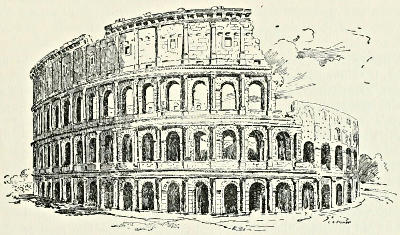
The Colosseum
Vespasian bore his opposition to the measures of government with patience and silent dignity. He knew the virtues of the man, and retained a due esteem for the memory of Thrasea. Willing, on that account, to live on terms with Helvidius, he advised him to be, for the future, a silent senator. The pride of a stoic spurned at the advice. Passive obedience was so repugnant to his principles that he stood more firm in opposition. Mucianus and Eprius Marcellus, who were the favourite ministers of the emperor, were his enemies; and it is probable that, by their advice, Vespasian was at length induced to let the proceedings of the senate take their course. Helvidius was arraigned by the fathers, and ordered into custody. He was soon after banished, and, in consequence of an order despatched from Rome, put to death. It is said that Vespasian relented, and sent a special messenger to respite execution; but the blow was struck. Helvidius was, beyond all question, a determined republican. His own imprudence provoked his fate; and this, perhaps, is what Tacitus had in contemplation when he places the moderation of Agricola in contrast to the violent spirit of others, who rush on certain destruction, without being by their death of service to the public.
The case of Epponina was an instance of extreme rigour, or rather cruelty. She was the wife of Julius Sabinus, a leading chief among the Lingones. This man, Tacitus has told us, had the vanity to derive his pedigree from Julius Cæsar, who, he said, during his wars in Gaul, was struck with the beauty of his grandmother, and alleviated the toils of the campaign in her embraces. Ambitious, bold, and enterprising, he kindled the flame of rebellion among his countrymen, and, having resolved to shake off the Roman yoke, marched at the head of a numerous army into the territory of the Sequani, a people in alliance with Rome. This was 69 A.D. He hazarded a battle, and was defeated with great slaughter. His rash-levied numbers were either cut to pieces or put to flight. He himself escaped the general carnage. He fled for shelter to an obscure cottage; and, in order to propagate a report that he destroyed himself, set fire to his lurking-place.
SABINUS AND EPPONINA
By what artful stratagems he was able to conceal himself in caves and dens, and, by the assistance of the faithful Epponina, to prolong his life for nine years afterwards, cannot now be known from Tacitus. The account which the great historian promised has perished with the narrative of Vespasian’s reign. Plutarch relates the story as a proof of conjugal fidelity. From that writer the following particulars may be gleaned: Two faithful freedmen attended Sabinus to his cavern; one of them, Martialis by name, returned to Epponina with a feigned account of her husband’s death. His body, she was made to believe, was consumed in the flames. In the vehemence of her grief she gave credit to the story. In a few days she received intelligence by the same messenger that her husband was safe in his lurking-place. She continued during the rest of the day to act all the exteriors of grief, with joy at her heart, but suppressed with care. In the dead of night she visited Sabinus. Before the dawn of day she returned to her own house, and, for the space of seven months, repeated her clandestine visits, supplying her husband’s wants, and softening all his cares. At the end of that time she conceived hopes of obtaining a free pardon; and having disguised her husband in such a manner as to render a detection impossible, she accompanied him on a long and painful journey to Rome. Finding there that she had been deceived with visionary schemes, she marched back with Sabinus, and lived with him in his den for nine years longer.
In the year 79 A.D. they were both discovered, and in chains conveyed to Rome. Vespasian forgot his usual clemency. Sabinus was condemned, and hurried to execution. Epponina was determined not to survive her husband. She changed her supplicating tone, and, with a spirit unconquered even in ruin, addressed Vespasian: “Death,” she said, “has no terror for me. I have lived happier under ground, than you upon your throne. Bid your assassins strike their blow; with joy I leave a world in which you can play the tyrant.”
She was ordered for execution. Plutarch concludes with saying that during Vespasian’s reign there was nothing to match the horror of this atrocious deed; for which the vengeance of the gods fell upon Vespasian, and, in a short time after, wrought the extirpation of his whole family.j
THE CHARACTER AND END OF VESPASIAN
[69-79 A.D.]
These, however, would seem to have been altogether exceptional instances of cruelty. Anecdotes illustrating the opposite character are not wanting. Thus: He caused the daughter of Vitellius, his avowed enemy, to be married into a noble family; and he himself provided her a suitable fortune. One of Nero’s servants coming to entreat pardon for having once rudely thrust him out of the palace, and insulting him when in office, Vespasian only took his revenge by serving him just in the same manner. When any plots or conspiracies were formed against him, he disdained to punish the guilty, saying that they deserved rather his contempt for their ignorance than his resentment, as they seemed to envy him a dignity of which he daily experienced the uneasiness. When he was seriously advised to beware of Mettius Pomposianus, against whom there was strong cause of suspicion, he raised him to the dignity of consul, adding that the time would come when he must be sensible of so great a benefit.
His liberality in the encouragement of arts and learning was not less than his clemency. He settled a constant salary of a hundred thousand sesterces upon the teachers of rhetoric. He was particularly favourable to Josephus, the Jewish historian. Quintilian, the orator, and Pliny, the naturalist, flourished in his reign, and were highly esteemed by him. He was no less an encourager of all other excellencies in art, and invited the greatest masters and artificers from all parts of the world, making them considerable presents as he found occasion.
Yet all his numerous acts of generosity and magnificence could not preserve his character from the imputation of rapacity and avarice. He revived many obsolete methods of taxation, and even bought and sold commodities himself, in order to increase his fortune. He is charged with advancing the most avaricious governors to the provinces, in order to share their plunder on their return to Rome. He descended to some very unusual and dishonourable imposts. But the avarice of princes is generally a virtue when their own expenses are but few. The exchequer, when Vespasian came to the throne, was so much exhausted that he informed the senate that it would require a supply of 40,000,000,000, sesterces [£300,000,000 or $1,500,000,000] to re-establish the commonwealth. This necessity must naturally produce more numerous and heavy taxations than the empire had hitherto experienced; but while the provinces were thus obliged to contribute to the support of his power, he took every precaution to provide for their safety, so that we find but two insurrections in his reign.
In the fourth year of his reign Antiochus, king of Commagene, holding a private correspondence with the Parthians, the declared enemies of Rome, was taken prisoner in Cilicia, by Pætus the governor, and sent bound to Rome. But Vespasian generously prevented all ill-treatment towards him, by giving him a residence at Lacedæmon and allowing him a revenue suitable to his dignity.
About the same time also, the Alani, a barbarous people, who lived along the river Tanaïs, abandoned their barren wilds and invaded the kingdom of Media. From thence passing like a torrent into Armenia, after great ravages, they overthrew Tiridates, the king of that country, with prodigious slaughter. Titus was at length sent to chastise their insolence, and relieve a king that was in alliance with Rome. However, the barbarians retired at the approach of the Roman army, laden with plunder, being in some measure compelled to wait a more favourable opportunity of renewing their irruptions.
But these incursions were as a transient storm, the effects of which were soon repaired by the emperor’s moderation and assiduity. We are told that he new-formed and established a thousand nations, which had scarcely before amounted to two hundred. No provinces in the empire lay out of his view and protection. He had, during his whole reign, a particular regard to Britain; his generals, Petilius Cerealis and Julius Frontinus, brought the greatest part of the island into subjection (70 A.D.), and Agricola, who succeeded soon after (78 A.D.), completed what they had begun.
Such long and uninterrupted success no way increased this emperor’s vanity. He ever seemed averse to those swelling titles which the senate and people were constantly offering him. When the king of Parthia, in one of his letters, styled himself king of kings, Vespasian in his answer only called himself simply Flavius Vespasian. He was so far from attempting to hide the meanness of his original that he frequently mentioned it in company; and when some flatterers were for deriving his pedigree from Hercules, he despised and derided the meanness of their adulation. In this manner having reigned ten years, loved by his subjects and deserving their affection, he was surprised with an indisposition at Campania. Removing from thence to the city, and afterwards to a country-seat near Rome, he was there taken with a flux, which brought him to the last extremity. However, perceiving his end approaching, and as he was just going to expire, he cried out that an emperor ought to die standing; wherefore, raising himself upon his feet, he expired in the hands of those that sustained him. (79 A.D.)
“He was a man,” says Pliny,g “in whom power made no alteration, except in giving him the opportunity of doing good equal to his will.” He was the second Roman emperor that died an unquestionably natural death; and he was peaceably succeeded by Titus his son.b
A CLASSICAL ESTIMATE OF VESPASIAN
The only thing deservedly blamable in Vespasian’s character [says Suetonius] was his love of money. For not satisfied with reviving the imposts which had been dropped under Galba, he imposed new taxes burdensome to the subjects, augmented the tribute of the provinces, and doubled that of some. He likewise openly practised a sort of traffic which would have been scandalous even in a person below the dignity of an emperor, buying great quantities of goods, for the purpose of retailing them again to advantage. Nay, he made no scruple of selling the great offices of state to the candidates, and pardons likewise to persons under prosecution, as well the innocent as the guilty. It is believed that he advanced all the most rapacious amongst the procurators to higher offices, with the view of squeezing them after they had acquired great riches. He was commonly said, “to have made use of them as sponges,” because he did, as one may say, wet them when dry and squeeze them when wet. Some say that he was naturally extremely covetous, and that he was upbraided with it by an old herdsman of his, who, upon the emperor’s refusing to enfranchise him gratis, which at his advancement he humbly petitioned for, cried out that the fox changed his hair, but not his nature. There are some, on the other hand, of opinion that he was urged to his rapacious proceedings by necessity, and the extreme poverty of the treasury and exchequer, of which he publicly took notice in the beginning of his reign; declaring that no less than forty thousand millions of sesterces was necessary for the support of the government. This is the more likely to be true of him, because he applied to the best purposes what he procured by bad means.
His liberality to all ranks of people was particularly eminent. He made up to several senators the estate required by law to qualify them for that dignity, relieving likewise such men of consular rank as were poor, with a yearly allowance of five hundred thousand sesterces; and rebuilt, in a better manner than before, several cities in different parts of the empire, which had been much damaged by earthquakes or fires.
He was a great encourager of learning and learned men. He first appointed the Latin and Greek professors of rhetoric the yearly stipend of a hundred thousand sesterces each out of the exchequer. He was likewise extremely generous to such as excelled in poetry, or even the mechanic arts, and particularly to one that brushed up the picture of Venus at Cos, and another who repaired the Colossus. A mechanic offering to convey some huge pillars into the capital at a small expense, he rewarded him very handsomely for his invention, but would not accept of his service, saying, “You must allow me to take care of the poor people.”
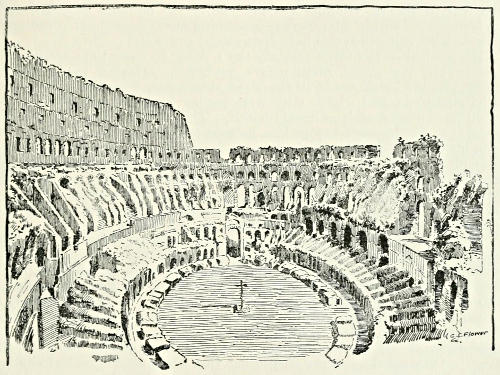
Interior of the Colosseum
In the games celebrated at the revival of the stage in Marcellus’ theatre, he restored the old musical entertainments. He gave Apollinaris the tragedian four hundred thousand sesterces; Terpnus and Diodorus the harpers two hundred thousand; to some a hundred thousand; and the least he gave to any of the performers was forty thousand, besides many golden crowns. He had company constantly at his table, and entertained them in a plentiful manner, on purpose to help the shambles. As in the Saturnalia he made presents to the men at his table to carry away with them; so did he to the women upon the calends of March; notwithstanding which he could not wipe off the infamy of his former covetousness. The Alexandrians called him constantly Cybiosactes; a name which had been given to one of their kings who was sordidly covetous. Nay, at his funeral, Favo the archmimic, representing his person, and imitating, as usual, his behaviour both in speech and gesture, asked aloud of the procurators, how much his funeral pomp would cost. And being answered “ten millions of sesterces,” he cried out, that give him but a hundred thousand sesterces, and they might throw his body into the Tiber, if they would.
Personality of Vespasian
He was broad set, strong limbed, and had the countenance of a person who was straining. On this account, one of the buffoons at court, upon the emperor’s desiring him “to say something merry upon him,” facetiously answered, “I will, when you have done easing yourself.”
His method of life was commonly this: After he came to be emperor, he used to rise very early, often before daybreak. Having read over his letters, and the breviaries of all the offices about court, he ordered his friends to be admitted; and whilst they were paying him their compliments, he would put on his shoes and dress himself. Then, after the despatch of such business as was brought before him, he rode out in his chaise or chair; and, upon his return, laid himself down upon his couch to sleep, accompanied by some of his concubines, of whom he had taken a great number into his service upon the death of Cænis. After rising from his couch, he entered the bath, and then went to supper. They say he never was more easy or obliging than at that time; and therefore those about him always seized that opportunity, when they had any favour to request of him.
He chiefly affected wit upon his own shameful means of raising money, to wipe off the odium by means of a little jocularity. One of his ministers, who was much in his favour, requesting of him a stewardship for some person, under pretence of being his brother; he put off the affair, but sent for the person who was the candidate, and having squeezed out of him as much money as he had agreed to give his solicitor, he appointed him immediately to the place. The minister soon after renewing his application, “You must,” said he, “make a brother of somebody else; for he whom you took for yours is really mine.” Once upon a journey suspecting that his mule driver had alighted to shoe his mules, only to give time and opportunity to one that had a lawsuit depending to speak to him, he asked him how much he had for shoeing, and would have a share of the profit. Some deputies having come to acquaint him that a large statue, which would cost a vast sum, was ordered to be erected for him at the public charge, he bade them erect it immediately, showing them his hand hollowed, and saying there was a base ready for it.[22]
Even when Vespasian was under the apprehensions and danger of death, he would not forbear his jests. For when, amongst other prodigies, the mausoleum of the Cæsars flew open on a sudden, and a blazing star appeared in the heavens, one of the prodigies, he said, concerned Julia Calvina, who was of the family of Augustus; and the other, the king of the Parthians, who wore his hair long. And when his distemper first seized him,“I suppose,” said he, “I am going to be a god.”
Titus (T. Flavius Sabinus Vespasianus II) 79-81 A.D.
[79-81 A.D.]
Titus, who had the same cognomen with his father, was [says Suetonius] the darling and delight of mankind, (so much did he possess of happy endowments, to conciliate the favour of all; and what is extremely difficult indeed, after he came to be emperor; for before that period, even during the reign of his father, he lay under the displeasure and censure of the public). He was born upon the third of the calends of January, in the year remarkable for the death of Caligula, near the Septizonium, in a mean house, and a small dark chamber.
He was educated at court with Britannicus, instructed in the same parts of literature, and under the same masters with him. During this time, they say, that a physiognomist, being brought by Narcissus, the freedman of Claudius, to inspect Britannicus, positively affirmed that he would never come to be emperor, but that Titus, who stood by, would. They were so familiar, that Titus being next him at table, is thought to have tasted of the fatal potion which put an end to Britannicus’ life, and to have contracted from it a distemper which remained with him a long time. The remembrance of all these circumstances being fresh in his mind, he erected a golden statue of him in the palace, dedicated to him another on horseback, of ivory, and attended it in the Circensian procession.
He was, when a boy, remarkable for fine accomplishments both of body and mind; and as he advanced in years, they became still more conspicuous. He had a graceful person, combining an equal mixture of majesty and sweetness; was very strong, though not tall, and somewhat big-bellied. He was endowed with an excellent memory, and a capacity for all the arts of peace and war; was a perfect master in the use of arms, and in riding the great horse; very ready in the Latin and Greek tongues, as well in verse as prose; and such was the facility he possessed in both, that he would harangue and versify extempore. Nor was he unacquainted with music, but would both sing and play upon the harp very finely, and with judgment. I have likewise been informed by many, that he was remarkably quick in the writing of shorthand, would in merriment and jest engage with his secretaries in the imitation of any hands he saw, and often say, “that he was admirably qualified for forgery.”
Upon the expiration of his quæstorship, he was made commander of a legion, and took the two strong cities of Tarichea and Gamala in Judea; and in a battle having his horse slain under him, he mounted another, whose rider he was engaged with, and killed.
Soon after, when Galba came to be emperor, he was despatched away to congratulate him upon the occasion, and turned the eyes of all people upon him, wherever he came, it being the general opinion amongst them, that the emperor had sent for him with a design to adopt him for his son. But finding all things again in confusion, he turned back upon the road; and going to consult the oracle of Venus at Paphos about his voyage, he received assurances of obtaining the empire for himself. In this prediction he was soon after confirmed; and being left to finish the reduction of Judea, in the last assault upon Jerusalem, he slew seven of the men that defended it, with just so many arrows, and took it upon his daughter’s birthday. Upon this occasion, the soldiers expressed so much joy and fondness for him, that, in their congratulation of him, they unanimously saluted him by the title of emperor; and, upon his quitting the province soon after, would needs have detained him, earnestly begging of him, and that not without threats, “either to stay, or to take them all with him.” This incident gave rise to a suspicion of his being engaged in a design to rebel against his father, and claim for himself the government of the East; and the suspicion increased, when, on his way to Alexandria, he wore a diadem at the consecration of the ox Apis at Memphis; which though he did only in compliance with an ancient religious usage of the country, yet there were some who put a bad construction upon it. Making therefore what haste he could into Italy, he arrived first at Rhegium, and sailing thence in a merchant ship to Puteoli, went to Rome with all possible expedition. Presenting himself unexpectedly to his father, he said, by way of reflection upon the rashness of the reports raised against him, “I am come, father, I am come.”
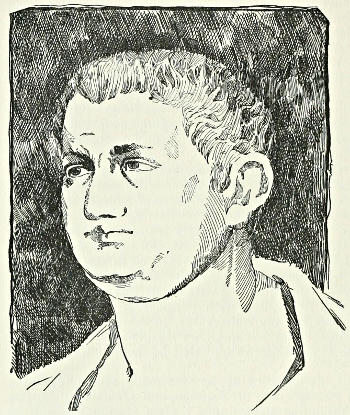
Titus
(From a bust in the Vatican)
From that time he constantly acted as partner with his father in the government, and indeed as guardian of it. He triumphed with his father, bore jointly with him the office of censor; and was, besides, his colleague not only in the tribunitian authority, but seven consulships. Taking upon himself the care and inspection of all offices, he dictated letters, wrote proclamations in his father’s name, and pronounced his speeches in the senate, in room of the quæstor. He likewise took upon him the command of the guard, which before that time had never been held by any but a Roman knight, and behaved with great haughtiness and violence, taking off without scruple or delay all those of whom he was most jealous, after he had secretly engaged people to disperse themselves in the theatres and camp, and demand them as it were by general consent to be delivered up to punishment. Amongst these he invited to supper A. Cæcina, a man of consular rank, whom he ordered to be stabbed at his departure, immediately after he had got out of the room. To this act he was provoked by an imminent danger; for he had discovered a writing under the hand of Cæcina, containing an account of a plot carried on amongst the soldiery. By this means, though he provided indeed for the future security of his family, yet for the present he so much incurred the hatred of the people, that scarcely ever anyone came to the empire with a more odious character, or was more universally disliked.
Besides his cruelty, he lay under the suspicion of luxury, because he would continue his revels until midnight with the most riotous of his acquaintance. Nor was he less suspected of excessive lewdness, because of the swarms of favourites and eunuchs about him, and his well-known intrigue with Queen Berenice, to whom he was likewise reported to have promised marriage. He was supposed, besides, to be of a rapacious disposition; for it is certain, that, in causes which came before his father, he used to offer his interest to sale, and take bribes. In short, people openly declared an unfavourable opinion of him, and said he would prove another Nero. This prejudice however turned out in the end to his advantage, and enhanced his praises not a little, because he was found to possess no vicious propensities, but on the contrary the noblest virtues. His entertainments were pleasant rather than extravagant; and he chose such a set of friends, as the following princes acquiesced in as necessary for them and the government. He sent away Berenice from the city immediately, much against both their inclinations. Some of his old favourites, though such adepts in dancing that they bore an uncontrollable sway upon the stage, he was so far from treating with any extraordinary kindness, that he would not so much as see them in any public assembly of the people. He violated no private property; and if ever man refrained from injustice, he did; nay he would not accept of the allowable and customary contributions. Yet he was inferior to none of the princes before him, in point of generosity. Having opened his amphitheatre, and built some warm baths close by it with great expedition, he entertained the people with a most magnificent public diversion. He likewise exhibited a naval fight in the old naumachia, besides a combat of gladiators; and in one day brought into the theatre five thousand wild beasts of all kinds.
He was by nature extremely benevolent. For whereas the emperors after Tiberius, according to the example he had set them, would not admit the grants made by former princes to be valid, unless they received their own sanction, he confirmed them all by one general proclamation, without waiting until he should be addressed upon the subject. Of all who expressed a desire of any favour, it was his constant practice to send none away without hopes. And when his ministers insinuated to him, as if he promised more than he could perform, he replied, “Nobody ought to go away sad from an audience of his prince.” Once at supper, reflecting that he had done nothing for any that day, he broke out into that memorable and justly admired saying, “Friends, I have lost a day.”
He treated in particular the whole body of the people upon all occasions with so much complaisance, that, upon promising them an entertainment of gladiators, he declared, “He should manage it, not according to his own fancy, but that of the spectators,” and did accordingly. He denied them nothing, and very frankly encouraged them to ask what they pleased. Being a favourer of the gladiators called Thraces, he would, as such, frequently indulge a freedom with the people both in his words and gestures, but always with the least violation either of his imperial dignity or justice. To omit no occasion of acquiring popularity, he would let the common people be admitted into his bath, even when he made use of it himself. There happened in his reign some dreadful accidents, as an eruption of Mount Vesuvius in Campania, and a fire in Rome which continued during three days and three nights, besides a plague, such as was scarcely ever known before. Amidst these dismal calamities, he not only discovered all the concern that might be expected from a prince, but a paternal affection for his people; one while comforting them by his proclamations, and another while assisting them as much as was in his power. He chose by lot, from amongst the men of consular rank, commissioners for the relief of Campania.
The estates of those who had perished by the eruption of Vesuvius, and who had left no heirs, he applied to the repair of such cities as had been damaged by that accident. In respect of the public buildings destroyed in the fire of the city, he declared that nobody should be a loser by them but himself. Accordingly, he applied all the ornaments of his palaces to the decoration of the temples, and purposes of public utility, and appointed several men of the equestrian order to superintend the work. For the relief of the people during the plague, he employed, in the way of sacrifice and medicine, all means both human and divine. Amongst the calamities of the times, were informers, and those who employed them; a tribe of miscreants who had grown up under the license of former reigns. These he frequently ordered to be lashed or well cudgeled in the Forum, and then, after he had obliged them to pass through the amphitheatre as a public spectacle, commanded them to be sold for slaves, or else banished them into some rocky islands. And to discourage the like practices for the future, amongst other things, he forbade anyone to be proceeded against upon several laws for the same fact, and that the condition of persons deceased should, after a certain number of years, be exempt from all inquiry.
Having avowed that he accepted the office of high priest for the purpose of preserving his hands undefiled, he faithfully adhered to his promise. For after that time he was neither directly nor indirectly concerned in the death of any person, though he sometimes was sufficiently provoked. He swore that he “would perish himself, rather than prove the destruction of any man.” Two men of patrician quality being convicted of aspiring to the empire, he only advised them to desist, saying, that sovereign power was disposed of by fate, and promised them, that, if they had anything else to desire of him, he would gratify them. Upon this incident, he immediately sent messengers to the mother of one of them, that was at a great distance, and concerned about her son, to satisfy her that he was safe. Nay he not only invited them to sup with him, but next day, at a show of gladiators, purposely placed them close by him; and when the arms of the combatants were presented to him, he handed them to the two associates. It is said likewise, that upon being informed of their nativities, he assured them, that some great calamity would sometime befall them, but from another hand, not his. Though his brother was perpetually plotting against him, almost openly spiriting up the armies to rebellion, and contriving to leave the court with the view of putting himself at their head, yet he could not endure to put him to death. So far was he from entertaining such a sentiment, that he would not so much as banish him the court, nor treat him with less respect than before. But from his first accession to the empire, he constantly declared him his partner in it, and that he should be his successor; begging of him sometimes in private with tears, to make him a return of the like affection.c
THE DESTRUCTION OF POMPEII AND HERCULANEUM
[79 A.D.]
The reign of this excellent prince was marked by a series of public calamities. He had reigned only two months when a tremendous volcanic eruption, the first on record, from Mount Vesuvius spread dismay through Italy. This mountain had hitherto formed the most beautiful feature in the landscape of Campania, being clad with vines and other agreeable trees and plants. Earthquakes had of late years been of frequent occurrence; but on the 24th of August the summit of the mountain sent forth a volume of flame, stones, and ashes which spread devastation far and wide. The sky to the extent of many leagues was enveloped in the gloom of night; the fine dust, it was asserted, was wafted even to Egypt and Syria; and at Rome it rendered the sun invisible for many days. Men and beasts, birds and fishes perished alike. The adjoining towns of Pompeii and Herculaneum were overwhelmed by the earthquake which attended the eruption, and their inhabitants destroyed. Among those who lost their lives on this occasion was Pliny, the great naturalist. He commanded the fleet at Misenum, and his curiosity leading him to proceed to Stabiæ to view this convulsion of nature more closely, he was suffocated by the pestilential air.e
Dion Cassius has left us a vivid picture of the memorable eruption of Vesuvius: “The events which occurred in Campania,” he says, “were calculated to arouse both fear and wonder; there, just as autumn was approaching, a great fire suddenly broke out. Mount Vesuvius is near the sea of Naples and contains a vast reservoir of fire. In former times the whole mountain was of the same height and the fire came from its very centre; for this is the only spot which is in combustion; the whole of the outside is, even to this day, exempt from fire. For this reason, since these portions still remain intact while those of the centre crumbled away and fell into dust, the surrounding peaks preserve their former elevation; while on another side the whole of the part ignited, having been worn away by time, has fallen in, leaving a cavity which, to compare small things with great, gives to the mountain the general appearance of an amphitheatre. On the top are trees and vines in great number, whilst the crater is the prey of fire and exhales smoke by day and flame by night, so that it might be supposed perfumes of every kind were being constantly burned within. This phenomenon is manifested sometimes with more, sometimes with less intensity; at times even cinders are thrown out when some great mass has fallen in and stones fly about, driven by the violence of the wind. Noises and rumblings proceed from the mountain, and it must be observed that the apertures of the crater, which are some distance apart, are narrow and hidden.
“Such is Vesuvius, and these manifestations are repeated nearly every year. But the prodigies which occurred in earlier days, though to those who gave them continued attention they appeared more than ordinary, may, even if we take them all together, be regarded as trivial in comparison with the occurrences of this period. This is what actually happened. Men, numerous and huge, of a height exceeding that of any human being and such as the giants are depicted, were seen to wander day and night, now on the mountain, now in the surrounding district and in the towns, and sometimes even walking in the air. Then suddenly there came winds and violent tremblings of the ground, so that the whole plain shuddered and the crests of the mountains leaped. At the same time noises arose, some subterranean, resembling thunder, others, coming from the ground, were like bellowings; the sea roared, and the sky, in echo, answered to its roarings. After this a fearful crash, like mountains hurtling against one another, suddenly made itself heard; then first stones were thrown out with such force that they reached the summit of the mountain; then huge flames and thick smoke which darkened the air and entirely hid the sun as in an eclipse.
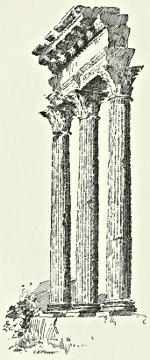
Columns of the Temple of Jupiter, Rome
“Night succeeded to day and darkness to light; some fancied that the giants were reawakening to life, for many phantoms in their likeness were seen in the smoke and moreover a noise of trumpets was heard; others thought that the whole world was about to be swallowed up in chaos or in fire. Therefore some fled from their houses into the streets; others from the streets into their houses, from the sea to the land and from the land to the sea, devoured by fear and feeling that anything at a distance was safer than their present condition. At the same time a prodigious quantity of cinders was thrown up and filled the earth, the sea, and the air; other scourges also descended indiscriminately upon mankind, on the country and on the herds, destroyed the fishes and the birds, and moreover engulfed two whole cities, Herculaneum and Pompeii, with all the people who chanced to be seated in the theatre. Finally there was so much dust that some of it penetrated as far as Africa, Syria, Egypt, and even Rome itself; darkening the air above that city and covering the sun. There it gave rise to a great panic which lasted several days, for none knew what had happened and none could guess what it was; men fancied that everything had been reversed, that the sun was about to disappear into the earth and the earth to be shot up into the sky.
[79-80 A.D.]
“For the moment these ashes did no great harm to the Romans (it was later on that they engendered a terrible contagious sickness), but the year following, another fire, starting above ground, devoured a great part of Rome while Titus was absent visiting the scene of the disasters in Campania. The temples of Serapis and Isis, the Septa, the temple of Neptune, the baths of Agrippa, the Pantheon, the Diribitorium, the theatre of Balbus, the scena of Pompey’s theatre, the Porticus Octaviæ, with the library, the temple of Jupiter Capitolinus, with the adjacent temples, were the prey of the flames. True is it that this misfortune was due less to men than to the gods; for from what I have said all may judge of the other losses. Titus sent two consulars into Campania to establish colonies there and gave the inhabitants, besides other sums, those which fell in from citizens dying without heirs; but he received none either from individuals, or towns, or kings, in spite of many gifts and promises on the part of many of them; however this did not prevent his re-establishing everything from his own resources.”f
It will be observed that Dion writes from the standpoint of a Roman, and with only incidental reference to the loss of Pompeii and Herculaneum, which cities evidently had no very great contemporary importance. Yet, as has been pointed out, the burial of these cities resulted in the preservation of a mass of documents which, brought to light some eighteen centuries later, furnishes such testimony to the manners and customs of the time as is presented by no other evidence extant.
PLINY’S ACCOUNT OF THE ERUPTION
[79 A.D.]
Further details of the disaster at Pompeii are given by Pliny the Youngerg in two letters written to Tacitus, with the intention of furnishing that historian with correct materials relative to the event.a He says:
It appears that many and frequent shocks of earthquake had been felt for some days previously; but as these were phenomena by no means uncommon in Campania, extraordinary alarm was not excited by that circumstance, until, about one o’clock in the afternoon of the 24th of August, a vast and singular cloud was seen to elevate itself in the atmosphere. From what mountain it proceeded was not readily discernible at Misenum, where Pliny the elder (at that time) held the command of the Roman fleet. This cloud continued arising in an uniform column of smoke, which varied in brightness, and was dark and spotted, as it was more or less impregnated with earth and cinders. Having attained an immense elevation, expanding itself, it spread out horizontally, in form like the branches of the pine, and precipitated the burning materials with which it was charged upon the many beautiful but ill-fated towns which stood thick upon this delightful coast. The extraordinary phenomenon now excited the curiosity of Pliny, who ordered a vessel to be prepared for the purpose of proceeding to a nearer inspection; but meeting some of the fugitives, and learning its destructive effects, his curiosity was changed to commiseration for the distressed, to whose succour he immediately hastened.