Chapter VII · AGAIN IN THE PHILIPPINES
Reading edition
Still unaware of the ruin that had come upon his hopes, Rizal was living in Berlin and working on the last chapters of “Noli Me Tangere.” He had taken cheap lodging in one of those huge modern German apartment-houses, in the complex depths of which he could bury himself, press on with his work, and be as remote as Tahaiti. He had known from the beginning that he must bring out his book at his own expense, poor as he was, if it was to be published at all. To a European publisher the subject would seem too unconventional and outlandish; and as for the Philippines, not a printer there would venture on his life to so much as look at it. The type was set (in Spanish) in a small job-office not far from Rizal’s lodging. Of the report that he himself eked out his remittances by working at times as a compositor in this shop, there is no satisfactory evidence; he had not previously appeared as a printer, but with his marvelous dexterity and ease in assimilating all knowledge he might have picked up even this craft, too, with others, difficult as it is. If so, he may have enjoyed in Berlin an unusual experience. He may have been an author putting into type his own copy.
The raven had come that was not only to feed this prophet but to lead him out of the wilderness. Viola’s object had been to invite Rizal to go with him upon a walking tour through rural Germany and Switzerland. At the proposal, Rizal’s eyes blazed; no project could be more alluring to him, as Viola had well known. Then he said that it was impossible; he could not go. Why impossible? asked Viola. Native pride forbade any direct answer, but Viola extracted the truth. He was saving money to publish a book. What kind of a book? Rizal told him, whereupon the Filipino blood stirred in Viola’s veins also, and he offered on the spot to advance enough money to bring out the book and then enough to take Rizal on the walking tour.
The facts about this man would stagger credulity if they were not of so sure and recent record. This novel of his contains more than two hundred thousand words. He obtained his medical licentiate at Madrid in June, 1885, and nothing of his book had been written then; nothing was written until months later. After a time he went to Paris, where he was employed as a clinical assistant to a busy oculist and also in pursuing his studies. Thence he went first to Heidelberg, then to Leipzig, where he entered the universities. Next we find him in Berlin, again an active and laborious student. Yet “Noli Me Tangere” was completed on February 21, 1887. The thing does not seem to be in nature. We cannot recall another instance in literature of such rapid composition under the like conditions of distraction.
About this process is always something more potent and salutary than can be easily explained. It is the elusive, indomitable spirit of that pitiless publicity, at once the armed champion of modern social progress, the healer of its diseases, and the corrector of its errors. Suppose the social malefactor to know full well, as well as he knows anything, that when he reads in print the story of his misdeeds not one hundred other persons are likely to see it; he is shaken with ineffable alarm, nevertheless. The magic of the printed page overwhelms and confounds him; in his ear every type-letter is a separate demon yelling “Scoundrel!” Suppose him to have known theretofore that one hundred thousand men were saying among themselves this that he now reads in print; the knowledge would have disturbed him not to the quiver of an eyelash. But to have it thus in visible record, open to the world’s eye—intolerable! Many a man case-hardened otherwise to conscience or reproof has fled to suicide before that unwavering finger and relentless condemnation.
The life of all this is truth. Against printed words that are not true even the guilty can make a stand, but it is invincible verity that leaves him naked and trembling. When the first cold shiver had gone by of the discovery that some one had at last dared to put into print the horror of the Philippines, one cry for vengeance went up from the stripped and shamed exploiters. It was a cry like the angry snarl of hurt hyenas, ready to tear into pieces whomsoever should fall into their den.
Presently there came among them the very man of their desire, the author of all this, the object of all their furious hatred; unsuspectingly he walked into their jungle.
His studies in Vienna completed, he passed into Italy, and in a few weeks was pondering the antiquities of Rome. Reviewing there his observations and researches in so many lands, he concluded that the time had come for him to return to the Philippines. The irregularity of his passport by which he had escaped from Manila he had since corrected; legally, he was as free as any one else to travel in the Islands. His objective had been won; he had made good use of his time. He might even have congratulated himself on the diligence of his service. Consecration and an almost prodigious industry had made him one of the foremost scholars of the day; he must now put to use the resources he had gathered for the chief purpose of aiding his people. If we knew more about his disastrous romance we might possibly find that Leonora’s silence had become a motive to draw him home. What we do know is that he was distressed by the reports he had of his mother’s failing eyesight and eager to return to her and help her. For months a double cataract had been growing upon her eyes. He felt sure that he could remove it and restore her vision: it was to this branch of optical surgery that he had given most heed. From Rome he sped to Marseilles, took steamer on July 3, 1887, for Saigon, and transhipped for Manila. On August 5, after five years of wanderings and so many triumphs, he saw once more the green tide of the Pasig.
As soon as he landed he hastened to his mother at Calamba and, laying aside every other business, devoted himself to the care of her eyes. With entire success he performed the operation he had intended, the first of the kind ever done in the Philippines. The fame of Mrs. Mercado’s healing speedily went throughout all the Islands and beyond. In the opinion of most persons of that day and region it meant that, by a miracle as of old, sight had been restored to the blind; and, at a word, Rizal stepped into eminence and a great practice. Of this he was not unworthy. As we shall have occasion to see later, he was well aware of his skill and learning; and, so far as the Orient was concerned, he eclipsed all previous practitioners. Patients came to him with confidence from all parts of the Philippines and even from China.
He had time to renew some of his old friendships, notably with Fernando Canon, who had been fellow-student with him in old Spain and later one of the most effective agents in getting “Noli Me Tangere” into the Islands, whither he had lately returned. Some of the boxes that contained copies of the book had been passed in as Mr. Canon’s stores. One day, walking up and down with him at Calamba, Rizal revealed how nearly the world had come to the loss of this work:
To his account of this incident Mr. Canon adds:
“Still there vibrates in my ears the inflections of his voice as he said this. One could recognize Rizal anywhere by the tones of his voice.”
In the midst of his busy employments, there fell upon him, early in 1888, a summons to Manila to appear before Governor-General Terrero.
This ominous message was the first repercussion from “Noli Me Tangere”; the classes affronted in that book and burning for revenge were moving to secure it. Here between the claws of their System was the man they hated; it would go hard if he escaped where so many lesser men had perished. With what feelings he obeyed the summons he has not told us, but there can be hardly a doubt that he knew by whose manœuvers he was now in the toils. It is the most singular fact in his whole strange career that he never betrayed the least concern as to what should become of him and throughout whatsoever process might be instituted against him behaved as if it were the trial of another person of which he was only the moderately interested witness. It was so now. With unruffled self-possession he passed before the governor-general. Terrero told him bluntly of the report of the committee appointed to examine “Noli Me Tangere.” Rizal observed that the examination must have been faulty, for the book was not what the committee had called it but innocent. He made so able a defense that Terrero said finally that as for himself he had read no more of it than the extracts the committee had cited in its report, but now he should like to read it all and judge for himself, and asked for a copy of it. This modest request being (despite all fierce decrees) complied with, the governor-general hemmed a little and said he feared that great enmity had been aroused against Rizal among the classes he had described. It was enmity that might even go so far as to attempt the author’s life. For his safety, therefore, it had been deemed wise to assign to him a body-guard so long as he should remain in the Islands.
We have noted what frenzy of consternation seized upon that element at the lightest whisper of revolt among the oppressed people. It was one of the invariable characteristics of the Spanish domination, an intermittent fever under the empire of which all reason or semblance of reason went to the winds and men outside the asylums acted like raving maniacs. Such manifestations of this strange psychology (only to be explained by recalling the Spaniard’s total misunderstanding of the Filipino nature) as followed the uprising of 1872 were still remembered by oppressor and oppressed. It was now revived for both as knowledge spread of this strange and powerful book. Besides the unendurable smart of its lash, the governing class saw in it consequences of the gravest import. It was standing and irrefutable evidence that the contempt for the native upon which Spanish rule proceeded was baseless; a native had created literature of the highest order. Still more alarming, it threatened to lead the way, to offer the example, to pioneer ceaseless ambuscades of the same kind, to show that the thing superstitiously held to be above all attack could be attacked safely and even with ridicule and this deadly laughter. If the author of “Noli Me Tangere” should escape without punishment, imitators might be expected on every side. Any native anywhere might take up similar weapons; hence, the white man’s supremacy in all the East was in jeopardy.
Governor-General Terrero was of this order, and even above its average. He was willing at the instigation of angry friars to assign a spy to watch Rizal but was determined to avoid the silly and stupid crime of shooting or garroting or even exiling a man whose offense was that he had written a novel some persons did not like. In other days and other administrations men had been shot or garroted or exiled on charges as flimsy, but light was breaking in Spain; even in the face of tradition and old frowning privilege, light was breaking. The first rift in the medieval eclipse was driven by the sword of Napoleon. Slowly ever since it has been widening to echoes of the world’s advance elsewhere. In 1888 the governing class in Spain had become aware of the scorn of that world and began to feel a little the sting of it. Not much, then, nor since, as we are to see in this narrative, and might illustrate by other citations. Lo, it was this same Spain, and so late as 1909, that murdered Francisco Ferrer, the most learned man in her dominions, for but teaching her children in the manner of other nations—nations so far in the front of her that, looking back, they could scarce descry the dust of her sluggard footsteps!
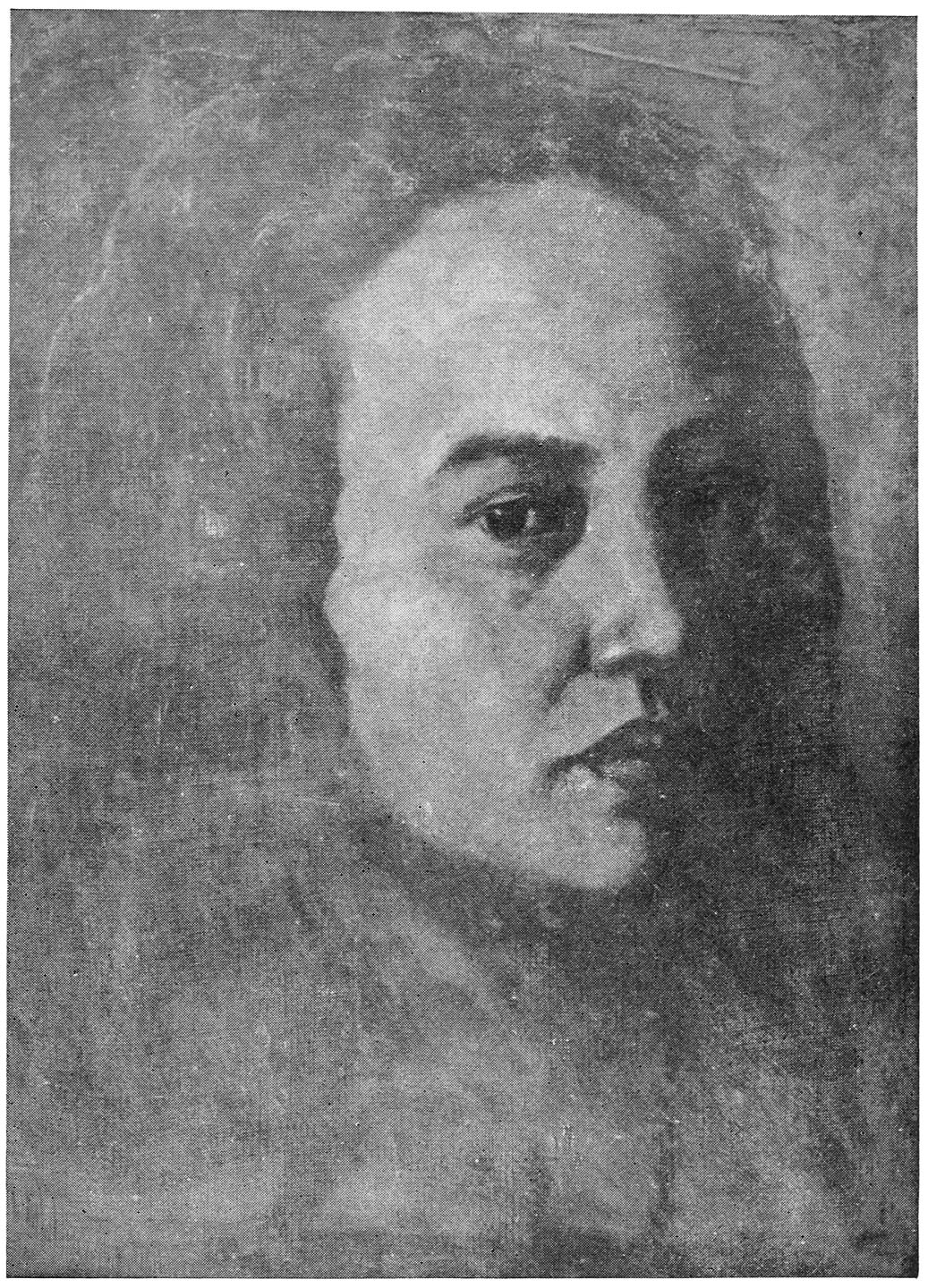
PHOTOGRAPH OF AN OIL PAINTING OF HIS SISTER BY RIZAL—MISS SATURNINA RIZAL
Rizal obeyed, but not until he had given to the world new evidence of the versatility of a genius to which there is scarcely a companion in human records. We are to remember, first of all, he was a physician that had chosen diseases of the eye for his specialty, wherein he stood in a place of distinction before his profession. He was next an artist in sculpture and painting; a poet; a master of terse and nervous prose in Spanish, in his native Tagalog, and in ten other languages. He was next a scientist, distinguished in original research, already honored with the regard of leading European minds in many branches of recondite knowledge. This, it will be admitted, is a most unusual range of pursuits. From them economics might be regarded as far removed and negligible. Yet he now showed that his many-sided mind could enlist its energies in even the “dismal science” and his skill in expression could illuminate it.
Taxes in the Philippines had always been haphazard. They were levied without system or anything akin to system. Only one feature about them could be said to be uniform: everywhere the wealthy evaded their just share of the taxation burden; everywhere the poor bore more than was right for them to bear. The history of Spanish rule was a succession of promises of reform, usually wrenched by an insurrection from the unwilling lips of a governor-general and ignored when the time of danger had passed. In the year of grace 1888 came such a reformatory spasm about taxes. When it reached Calamba it was received with exceptional interest for the reason that the Dominicans, with whom the householders had an ancient feud, owned a great deal of property there and on it paid very little.
This, though outside of Rizal’s studies, was a subject all within the purpose to which he had consecrated himself. He was to live for his people; he was to do whatever came to his hand to help them to rise. Here was a poignant illustration of the vast and complicated evils that weighed them down. Since his first interview with Terrero he had been living at Calamba in his mother’s house, practising with brilliant success his profession and lending his influence to every project that seemed to promise good for the Filipinos. His prestige and influence had become great. Despite all the efforts of the Government, knowledge of his book and of its meaning was wide-spread. Copies were continually being smuggled into the country and passed from hand to hand. Often at the approach of officers they were buried in fields or rubbish-heaps and dug up again when the danger was gone. A Filipino that could read was a popular man, then, in his community; he found much employment reading “Noli Me Tangere” to groups that cowered in the brush, maybe, a sentinel posted to give warning of the approach of the Civil Guard. The result of all this could be but one thing. From the mass of the despised Filipinos he was emerging as their natural leader.
He had done more here, very likely, than he himself knew. The document thus prepared became the rallying-point for another of those struggles between the people and the Government that increasingly signaled the downfall of the existing System. Slowly the nineteenth century was closing in upon the sixteenth, democracy upon the autocracy that at the borders of civilization still outlived the date of its normal demise. Rizal’s work on taxation showed the Filipinos what they could do by uniting their efforts. In their country, too, the exploiter held the exploited by fomenting among them envyings, jealousies, and caste; a process that everywhere attends (and usually comprises) the white man’s burden, and whereof India offers the chief surviving example. In the face of every obstacle and discouragement the Filipinos were now learning the lesson of union, and the only shadow union cast forward was revolt.
Rizal’s leadership was a phrase we used in a foregoing paragraph. It is to be noted that he came into that eminence without an effort of his own, without planning or connivance. He was elated to find greatness thus thrust upon him and would not have been human otherwise; yet to be conspicuous had never been any real part of his scheme of life, and when elation was at its height it never obscured the fact that what he really sought was a result for the country and not kudos for himself. But he was the most famous of living Filipinos; knowledge of his place among the world’s scientists was now general among his countrymen; those that had not been able to read “Noli Me Tangere” nor to hear it read were becoming aware by common report of the nature of its protest. He was the one man that had been able to make the bitter cry of the Filipinos audible to the world. He had best formulated and expressed the wrongs under which those people suffered. He alone, with this fierce derision, had dared to defy the power of the friars and the brutal fists of the Civil Guards. Naturally, the people turned to him, and the unanimity with which they sought his counsel might have shown the Spaniards again among what fires they were walking; for the spirit that gave rise to the popularity of Rizal was even more significant than anything he said in his book. Before that book was written the spirit had been there; it was growing while the friars debated the best means to suppress the audacious author; it was certain to break out into open revolt—if not under Rizal, then under some one else.
In view of these conditions, Rizal has been subjected to some criticism for obeying the sugar-coated deportation-order of the governor-general and taking himself from the Islands at a time so momentous. The criticism is not now important but, to keep straight the thread of narrative, may be examined here. To say nothing of the obvious fact that, as the power of the governor-general was absolute, hesitation to obey would be followed by an explicit command, other things were to be considered. All Rizal’s instincts strove against the idea of advance by physical violence. He believed in the weapons of the spirit, not in the carnal sword. To defy the governor-general’s “advice” meant but one thing. It would be a direct appeal to physical force; it would be followed by revolution and slaughter; and to these he felt he could never consent.
Moreover, he was up to this time not in favor of immediate separation from Spain. On this issue his views have been distorted by controversialists that have selected expressions seemingly favorable to one side or the other of a disputed question. Long after events had wholly changed the face and the substance of Philippine affairs it was the custom of persons opposed to Philippine independence to cite Rizal in support of their arguments. This was unfairly done. Reference to one undeniable fact should be enough to dispose of the fabricated uncertainty about his views on this question. All the reforms he strove for looked to independence and could not look to anything else. It was not for academic satisfaction he desired increase of culture among his people, but that with wisdom and confidence they might take their place among the nations of earth. It was not for the mere sake of teaching that he desired to see them taught, but that they might be taught to be free.
But even so, in a way, what confronted him and the Philippines at the moment was beyond choosing. The immediate demand must be for the reforms that lay in Spain’s power to give or to withhold; these were imperative; that a start may be made upon the road, let us unite and demand these first reforms.
There can be no manner of doubt that these were the ideas that controlled him when Terrero “advised” him to depart, and none that in the next few years his views on these subjects contracted as he looked more searchingly upon the troglodyte methods of the Spanish rulers. He was the less reluctant to leave the Philippines because his private life, apart from his career of service, had been darkened by the catastrophe of his love-affair; he had come home to find Leonora married. Two other impulses concurred to urge him away. The success of “Noli Me Tangere” (despite so many and powerful measures taken to suppress the book) and the manifest effect of it upon the Filipino mind must have strongly reminded him of that sequel he had vaguely intended when he completed the last chapters of his novel. He could not hope to accomplish any such work at home; he could not hope, even if he should write it there, to find a publisher for it in the Islands nor to smuggle out the manuscript. To write it he must be abroad. Next, he had seen much of Europe but nothing of that American Republic about which Jagor’s prophecy had so inflamed his youthful mind. Here, by Jagor’s logic, was the power destined some day to transform all the regions bordering upon the Pacific, and he had never seen it. This was also the country whose history and spirit he had glimpsed in the “Lives of the Presidents” that he so eagerly read and returned to. In that country farmers’ boys, canal-boat drivers, tailors’ apprentices, rail-splitters, journeyman printers, any son of the plain people could rise to any place, even the highest. It was a country that conspicuously had won to freedom and independence out of a gross tyranny. Therefore, it had a peculiar claim to his attention. As he must go somewhere, he planned to return to Europe by way of the United States.
He was relieved of all anxiety about his mother. The eyesight of her youth had been restored to her.
It is to be assumed that conversation with such men did nothing to soften Rizal’s spirit or to cool his ardor of service. They were the living monuments to the hopeless incapacity of the existing System to govern or to advance. From his days and nights in their company he passed to Japan, where in the space of one month he achieved the almost incredible feat of mastering the Japanese language. But for the testimony of the facts the hardiest biographer would scarce dare the assertion. Rizal came to Japan with scarce a word of Japanese; he remained but one month; before he departed he was speaking it so well that the natives thought he was a countryman of theirs, and he was acting as their interpreter. Thereafter he could speak and write Japanese as readily as English or German.
From Yokohama he sailed for San Francisco, astonishing his fellow-travelers by conversing with all the aliens in their own tongues, whatever these might be. Among them was a Japanese that knew not a word of English. Rizal attached himself to this unfortunate and acted as his interpreter all the way to London.
Rizal seems to have endured the affliction with his customary philosophy. From the deck he made sketches of the new country that thus slammed its doors in his face—among them a reproduction of the revenue flag, with its eagle and perpendicular bars, which he thought was a novel and taking design. He did not fail to observe, however, that while the human beings on the steamer were rigidly quarantined the cargo was unloaded, and he wondered how infection could be carried by the passengers and not by the freight. When he was released, he went to the old Palace Hotel in San Francisco and spent several days observing the strange life of the city. Thence, by train over the mountains, noting with astonishment how great an area of the country through which he passed was uninhabited, and apparently being rather entertained than enraged by the horrors of the American sleeping-car. Two things of much greater moment impressed him sadly. One was the race prejudice against the Chinese in San Francisco (then at its height), and the other the race prejudice against the Negro, manifested in some other parts of the country.
Afterward he wrote this summary of his swallow flight across the continent:
I visited the larger cities of America. They have splendid buildings and magnificent ideals. America is a home-land for the poor that are willing to work. I traveled across America, and saw the majestic cascade of Niagara. I was in New York, the great city, but there everything is new. I went to see some relics of Washington, that great man who, I fear, has not his equal in this century.
From Albany he had gone forward by the Hudson River, and was greatly impressed with its magnificent scenery, but thought that, in the way of commerce alone, the Pasig was busier. From New York he sailed on the steamer City of Rome, then esteemed a maritime masterpiece, and reached London, where he found lodgings with the organist of St. Paul’s Cathedral and settled himself for a season of work and study.
With some difficulty he ran the barrage so strangely erected around this institution and found the precious volume to be all that had been said in praise of it. De Morga’s observations, evidently unbiased, established what Rizal had long surmised and then asserted, that the Filipinos had been historically wronged. The sea-coast folk, at least, the bulk of the nation, had not been more truly savages when Magellan came than the Spaniards themselves. From de Morga’s accounts it was easy to show that the Filipino’s spirit, activities, and general welfare had been in no way bettered by Spanish rule. Arts, industries, products in the Islands, and even energy, seemed to have been more observable among the people in de Morga’s day than at the close of the nineteenth century.
This was a matter of grave importance to the Islanders and so remained long after Rizal’s labors had ceased. The Spanish excused to the world their presence and their cruelties alike on the one ground that the Indio was a savage. Suppose him without European restraint and European inspiration, they said; he would revert to his caves, his raw meat, and his bows and arrows. To learn that he was heir to these centuries of dignity and worth was not only disconcerting but raised a question to which there was no answer. If he was as civilized as the Spaniard, why had he not the Spaniard’s right to be free?
In London he found congenial company in the household of Dr. Antonio Regidor, a Filipino that had suffered exile in the Cavite frenzy of 1872. Dr. Regidor had three charming daughters. Rizal’s ideas of life and conduct may be gathered from the fact that when, after a time, he discovered that one of these young ladies was forming an attachment for him, instead of being elated he was much troubled in his mind and concluded that in such circumstances the best thing he could do was to take himself out of the young lady’s sight. For once the paths of duty and expediency fell together. By this time he had completed his work at the museum and he now departed for Paris.