Chapter XIV · THE EXILE OF DAPITAN
Reading edition
The next day a decree was issued ordering his exile to Dapitan, a town on the northeastern coast of the island of Mindanao. Upon what charge? The charge of sacrilege and sedition made against him the day he sailed from Hong-Kong, reinforced with Lucia’s damnable pillow-cases. On these he had been adjudged guilty offhand, as one would drown cats or blind puppies. He was not even allowed to know who were his accusers; for that matter, he did not even know that he was accused. “This fellow has committed sacrilege and sedition,” says some one in the ear of the governor-general. “Exile him,” replies the governor-general, and signs the order committing him to a living death. It is like the scene between the governor-general and his secretary in “El Filibusterismo”; if a man may have foreknowledge of his fate, Rizal had glimpsed this in his novel.
There was the matter of the safe-conduct, the promise of protection, given by this same governor-general, under which Rizal had left Hong-Kong. It seems to have been not a feather-weight against the Interests that cried for his blood. There need be no mystery as to the source of these perfidies. Exile was the price Rizal paid for writing “Noli Me Tangere”; the powers that now pushed him upon the savage coast of Mindanao as an outcast sent there to die was the power of the friars, enraged by these pictures of themselves. They demanded Rizal’s blood; Despujol seems to have been incapable of the firing-squad and only wicked enough to consent to exile.
For three days the victim of the aroused wrath of the governing class lay in prison, being still denied any communication with friend or relative. Then at night he was hustled aboard a steamer and started for Dapitan.
So far as we can determine now, even in these conditions he lost nothing of that serenity that has made him so admirable to some investigators and so inexplicable to others. “Sustained and soothed by an unfaltering trust” seems to have been literally the state of this brown man from the ends of the earth. Many a white man far less tried might have envied his self-possession. Dwell with some patience and care, if you will, upon this his own record of his arrest and deportation and see if you do not deem this remarkable that in such conditions not a complaint, not a suggestion of resentment or of bitterness, not a hint of fear occurs in his narrative. It is a plain, blunt story written only for his friends. Here if anywhere he would have exhibited wrath; and the story reads with a kind of chill, so perfect is the unconcern. You can hardly say it reads as if it were written about the sufferings of somebody else. For anybody else in the like conditions this man would have made protest. Concerning himself he had nothing to say except to record the facts. Here is what his memorandum says of all this:
Don Enrique Villamor, the commander of the fort, gave me books from the library.
Each day the corporal of the guard proved to be a sergeant. They cleaned the room every morning. For breakfast, I had coffee with milk, a roll, and coffee-cake. Luncheon at 12:30 was of four courses. Dinner was at 8:30 and similar to the luncheon. Commander Villamor’s orderly waited on me.
On Thursday, the 14th, about 5:30 or 6 P.M., the nephew notified me that at 10 that night I should sail for Dapitan. I prepared my baggage, and at 10 was ready, but as no one came to get me, I went to sleep.
At 12:15, the aide arrived with the same carriage that had brought me there. By way of Santa Lucia Gate, they took me to the Malecon, where there were General Ahumada and some other people. Another aide and two of the Guardia Veterana were awaiting me in a boat.
The Cebu sailed in the morning at 9. They gave me a good state-room, on the upper deck. Above the doors could be read, “Chief.” Next my cabin was that of Captain Delgras, who had charge of the party.
Ten soldiers from each branch of the military service comprised the expedition. There were artillery, infantry of five regiments, carbineers, cavalry, and engineers, and the Civil Guard.
We were carrying prisoners, loaded with chains, among whom were a sergeant and a corporal, both Europeans. The former was to be shot for having ordered the tying up of his superior officer who had misbehaved while in Mindanao. The officer, for having let himself be tied, was dismissed from the service. The soldiers who obeyed orders, were sentenced to twenty years’ imprisonment.
I ate in my state-room, the food being the same as the officers had. I always had a sentinel and a corporal on guard. Every night Captain Delgras took me for a promenade till 9 o’clock. We passed along the east coast of Mindanao and the west coast of Panay. We came to Dapitan on Sunday at 7 in the evening.
Captain Delgras and three artillerymen accompanied me in a boat rowed by eight sailors. There was a heavy sea.
The beach seemed very gloomy. We were in the dark, except for our lantern, which showed a roadway grown with weeds.
It was a little town on the border of a savage country, known to be unhealthful, and at that time so difficult of access from Manila that he might have been nearer at Yokohama. It is charitable but hardly necessary to believe that the men that consigned him to such a place were unaware of its repute. With so little concealment they had sought in other ways for his life, we have no reason to think now of a sudden they had acquired mercy. To a thousand places more salubrious he might as easily have been sent; none would satisfy them but this.
To the commandant’s house, accordingly, he was assigned. It was but rude commons and a primitive environment. The sudden and cold plunge from the place of respect he had held in Europe and his profitable position in Hong-Kong would have overwhelmed a weaker spirit. Rizal accepted the stern mutations with the unruffled composure that was always his strong anchor in whatsoever difficulties. “No man bears sorrow better,” says the antique Roman of himself; but you would not look for a recrudescence of Marcus Brutus in a Malay of the nineteenth century.
In the same spirit he now arranged his time upon a schedule after his invariable custom, and resumed cheerfully a life of study and work. Under the parole he had given that he would make no attempt to escape, he was allowed to go about as he pleased and without observation, for it is singular that this traitor and dangerous character was implicitly trusted even by his enemies so far as any question of personal honor was concerned. He had never a guard in Dapitan. Not only so, but the commandants, one after another, and all the soldiery, from private to highest officers, fell under the potent charm of his manner and became his friends and admirers. The commandants were frequently changed. Each in turn came to Dapitan warned against the perilous prisoner there and therefore bristling with dislike; each went away swearing he was the prince of good fellows and sorry for his fate.
When this task was done he bought him a tract of land close by the town, built a house on it, and established there adequate quarters for his school.
This may be a good place to say what this singular person was in some of the sciences to which he gave so much of himself. As a physician, while still a student at Madrid University, he had made commentaries of remarkable merit, “Apuntes de Obstetricia” and “Apuntes Clinicos.” As an ophthalmologist he seemed to win at once to distinction as soon as he left the university. This Dr. de Weckert of Paris, to whom he went first, was of too great repute and too well supplied with candidates to have selected him for chief laboratory assistant if he had not been of unusual attainments. It appears that de Weckert was so much impressed with this brown man from Malaya that they began a warm friendship that lasted until Rizal’s death, and so long as he remained in Paris he was the great oculist’s favorite companion and collaborateur. In Heidelberg, Leipzig, and Berlin he was the associate and assistant of men like Galezowsky and Schulzer. In the few months that elapsed between his first return to the Philippines and his departure thence at the veiled order of Terrero, he received in fees more than five thousand pesos, a sum equivalent to about fifteen thousand pesos of the present day. At Hong-Kong, for the short time he was there, his office was overrun with patients from all that part of the world. As we have seen, they followed him even to far Dapitan. One of them was an Englishman that made him a present of five hundred pesos, brown man and Malay as he was.
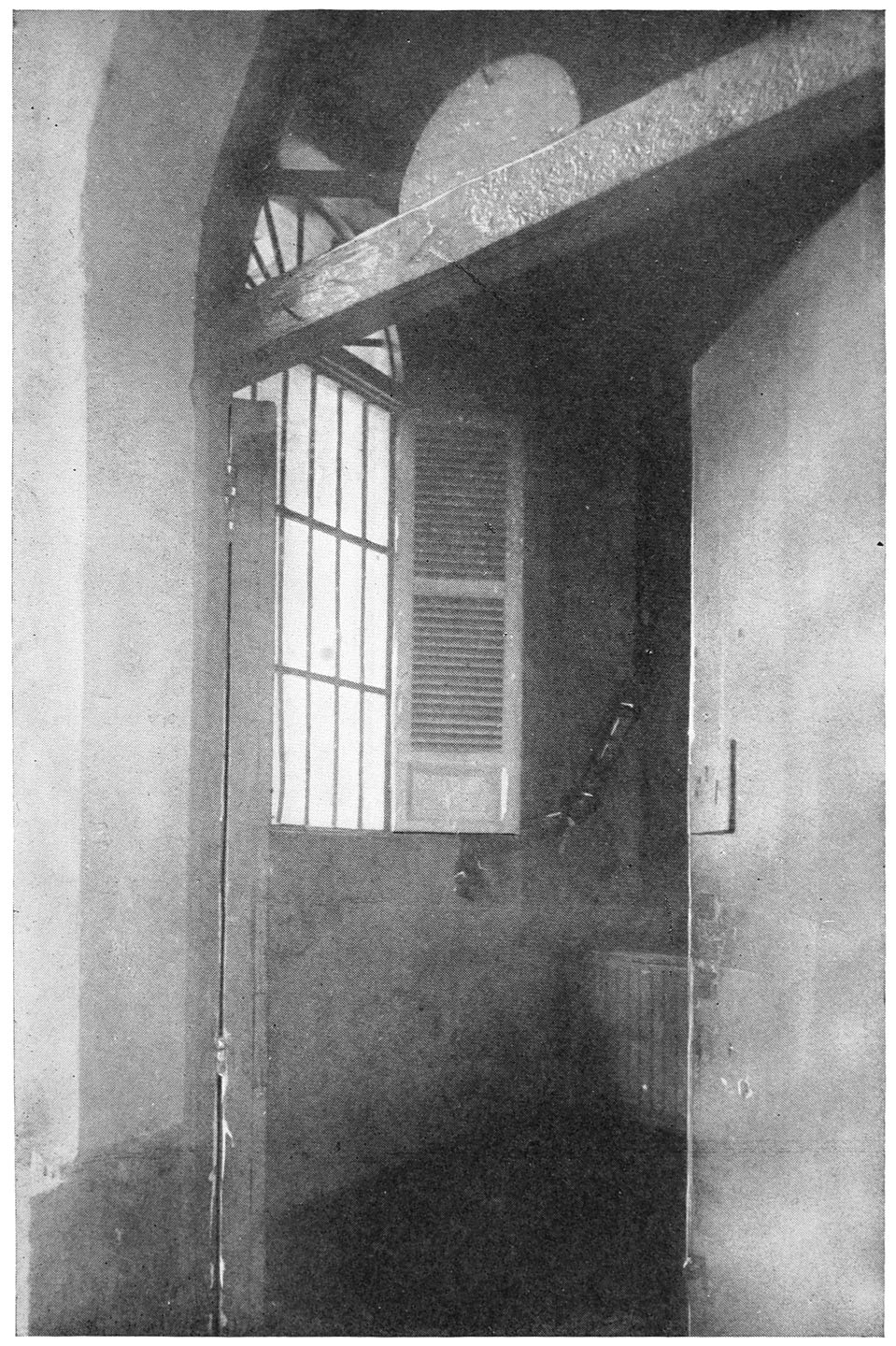
RIZAL’S CELL AT FORT SANTIAGO
As a naturalist he enriched the museums of Europe and Manila with hundreds of specimens of his gathering and preparing. Flowers, plants, crustaceans and all forms of animal life attracted his study. The German museums were so well pleased with his work that they offered him, while he was in Dapitan, a remunerative salary to devote himself entirely to gathering specimens for them, and they still exhibit his collections among their most valued possessions. Three creatures, previously unknown to science, now bear his name because he discovered them. One is a frog called the Rhacoperus Rizali; the second is a coleopter called the Apogonis Rizali; and the third, a dragon called the Draco Rizali.
As to other sciences, for example, he excelled in chemistry. Before he was twenty-one he had obtained degrees as surveyor and agricultural expert. He was an excellent engineer and so scientific an educator that when the Philippine Republic came to be erected the plan of the educational department and work was taken from his writings. In Leipzig he went deeply into psychology, in which he was fellow-student with Hugo Münsterberg. While he was at Dapitan he learned how to sail a ship, and taught their trade to the fishermen, because he showed them how to make and how to handle a better kind of net.
Incidentally, he had the makings of a great journalist.
By the spreading beach where the sands are soft and fine,
At the foot of the mount in its mantle of green,
I have built my hut in the pleasant grove’s confine
From the forest seeking peace and a calmness divine,
Rest for the weary brain and silence to my sorrow keen.
From poetry, we pass to sociology, a transition that might seem violent enough in one of less versatility. The commandants, of course, must be parts of the general machinery of espionage and report to Manila what they observed in this evil sprite that might show dangerous machinations against the peace and dignity of our lord the king. Some of the reports they made are still extant. One of them sent about this time by a commandant, the Captain Ricardo Carnicero, to Governor-General Despujol contains this account of a conversation:
Carnicero. Tell me, Rizal, what reforms seem to you most vital for this country?
Rizal. First of all, to secure representation for it in the Cortes [Spanish parliament] that there may be an end to the despotisms now committed upon it.
To reform the administration in all its branches.
To promote primary instruction, to end the interference of the friars in the control of education, to give better salaries to both men and women teachers.
To divide civil appointments equally between the Spaniards and the Filipinos.
To cleanse the administration of justice.
To establish in capitals of more than 16,000 inhabitants schools of arts and crafts.
These are my chief reforms. Once established in the right spirit, the Philippines would be the happiest country in the world.
Carnicero. Friend Rizal, these reforms of yours do not seem to me at all bad; but you seem to forget that the friars have as much influence in Madrid as in Manila, and for this reason it would be practically impossible at this time to put these changes into effect.
Where lay the sedition that Rizal plotted is evident from this report, and equally evident what power pulled the strings behind puppet king and manikin premier.
He must have had reason, even in far Dapitan, to wonder if there were any place out of range of the malicious or the dull. Persons that thought they had a call to reform him and other persons that believed they had been appointed to torture him would not leave him alone even here. It was a place with what was called a mail service; in the course of time almost any letter that had passed the censor would come limping in. Among such freight arrived one day a laborious effort from the superior of the Jesuits in the Philippines, the Rev. Father Pastells, in which he took occasion to offer disagreeable remarks. Rizal might have responded in kind, if he had pleased; as to which, take note of some of the sarcastic passages in “Noli Me Tangere.” Instead of flouting his reverend critic, he chose to favor him with a serious letter in which the faith that guided his course was set forth with the eloquence of honesty. He wrote:
You exclaim: “What a pity that so gifted a youth should not have used his talents in a better cause.” Possibly there are other causes better than mine. But my cause is good, and that is enough for me.
Others, perhaps, may gain more honors and greater glory. But I am like the bamboo, which is also a native of this soil. It is used for cottages of light material and not for heavy European buildings. So I regret neither my humble cause nor its small rewards. I only regret the little talent that God has given me to use in its service. If instead of being weak bamboo I had been solid hardwood, I should have been able to give better aid. But He that made me what I am never makes mistakes in any of His acts. He knows very well how useful are even the smallest cottages.
As to any fame, honor, or profit that I might have gained, I admit all that to sound attractive, for I am a young man of flesh and blood with a full share of human weaknesses. But no one chooses the nationality or race into which he is born. With his birth he profits by the privileges or suffers the disadvantages that race and nationality bring. So I accept the cause of my country.
I have confidence that He that created me a Filipino will know how to pardon in me mistakes due to our hard position and the poor education we receive from our birth.
I am not working for fame or glory. I have no ambition to rival others that are born into conditions very different from my own.
He had letters of a different tenor from members of his family, toward whom he yearned all his life with an almost singular devotion; but for his strong sense of family duty he might then be receipting for great fees and living sweetly in Hong-Kong instead of facing the miseries of Dapitan. Of this fact he never made a mention to any one, if he thought of it himself. Among the letters from these relatives that he held so dear came one from a nephew in Luzon to which he made the following characteristic reply:
I think I ought to mention to you a slight fault that you have committed in your letter. It is a little error that many in society make.
One does not say, “I and my sister greet you,” but “my sister and I greet you.” Always you have to put yourself last. You should say, “Emilio and I,” “you and I,” and so on. For the rest, your letter leaves nothing to be desired in clearness, conciseness, and spelling. Then keep on advancing. Learn, learn, and think much about what you learn. Life is a very serious matter. It only goes well for those that have intelligence and heart. To live is to be among men, and to be among men is to strive.
But this strife is not a brute-like, selfish struggle, nor with men alone. It is a strife with them, and at the same time with one’s own passions. It is a struggle with the proprieties, with errors, with prejudices. It is a never ending striving, with a smile on the lips and the tears in the heart.
On this battle-field man has no better weapon than his intelligence. He possesses no more force than he has heart. Bring it out, then. Improve it, keep it prepared, and strengthen and educate yourself for this.
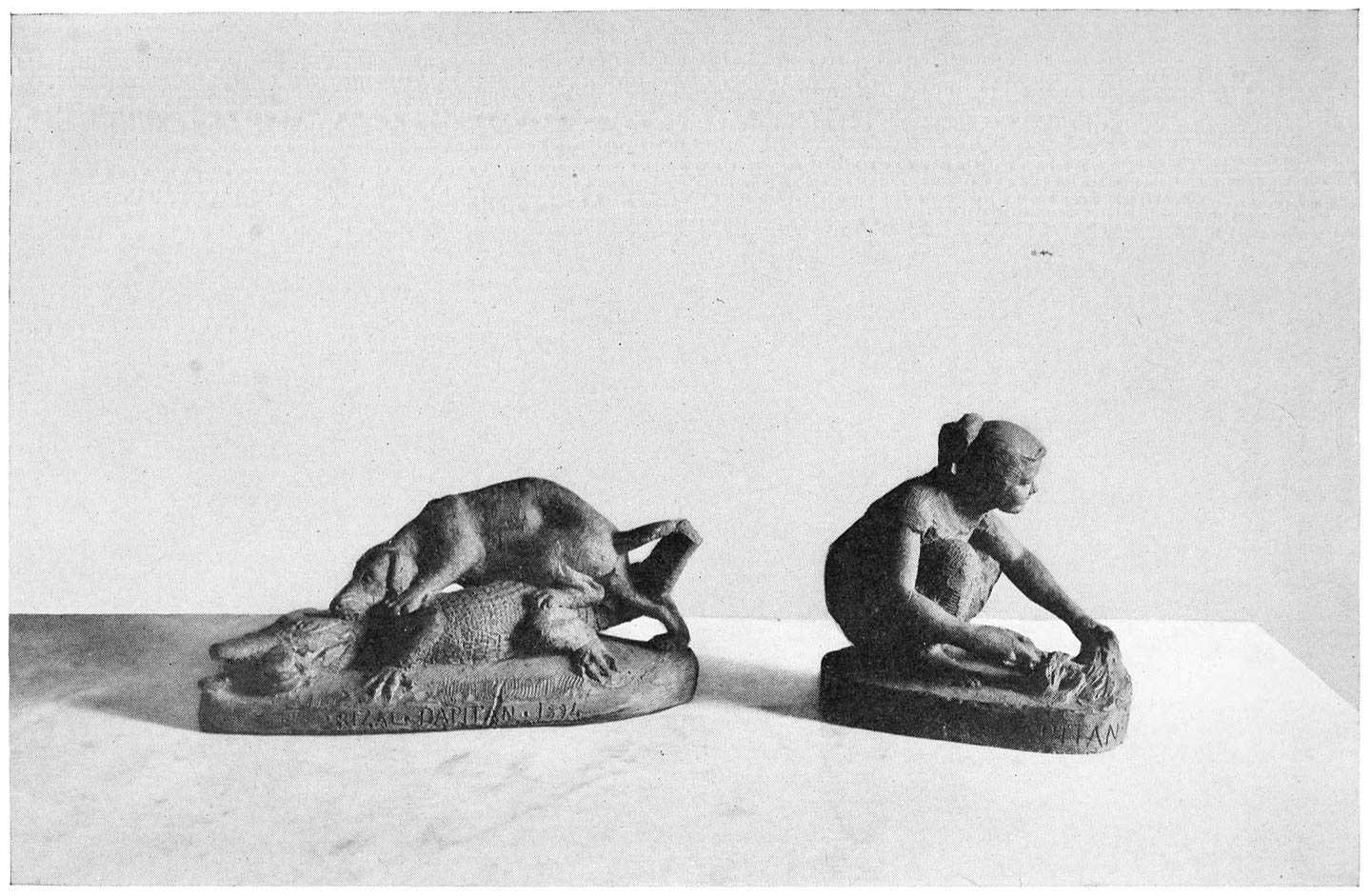
SPECIMENS OF RIZAL’S MODELING WHEN AN EXILE AT DAPITAN, BOTH SELF-EXPLANATORY