Chapter IV · VOICES OF PROPHECY
Reading edition
What life meant for average millions in the Philippines, under what chill shadows of the jail and visions of the firing-squad they must draw breath, how shifty and blackguard was the Government imposed upon them, we may glimpse from what happened as soon as Rizal’s absence was discovered. Civil Guards and official eavesdroppers were busy at Calamba; all members of the family were dogged, watched, waylaid, and cross-questioned as if suspected of murder. They must do more than lie to protect themselves. Paciano, the brother, who had been a confidant in this desperate plot to take ship and go, was reduced to a kind of play-acting, running about Rizal’s lodging and inquiring frantically for his lost brother as if he conjectured suicide, assassination, or kidnapping. All the Government seems to have been thrown into chill alarm by the fact that one college student, not yet of age, had left Manila without its permission. If there has been upon this earth a tyranny that existed without the finger of fear upon it history, surely, has no mention of it, and in the case of the Spanish tyranny in the Philippines the vague and kindergarten terrors that assailed it had long been notorious. To be afraid of a solitary student whose most dangerous manifestation had been a taste for radical poetry may seem fantastical to steadier pulses but was real enough to the anxious souls that then steered Spain’s sovereignty through unquiet waters. In due time the fact could no longer be concealed; gone he had indeed and in very truth—gone, quite gone. Then, in characteristic fashion, the Government proceeded to revenge itself upon the fugitive’s relatives. It was again a case of a second cousin where the offender or his brother was not available. In vengeance the taste of the Government was never overnice. To make somebody suffer was its length and breadth, and not too much haggling as to the identity of the victim.
At the University of Madrid, where he came soon after to anchor, he elected to study medicine, literature, and philosophy, while outside the university he took on art and modern languages. The burden of so many studies was less than its appalling appearance, or less for Rizal. With him, as with other good minds reared in a bilingual atmosphere, languages were an easy acquisition. In his childhood he had spoken Tagalog and Spanish; at school he had added Latin and Greek; after the school of the pedant, to be sure, but still Latin and Greek. He now assailed French, English, and Italian, all at the same time, and without apparent difficulty. A little later, he mastered Catalan, Arabic, German, Sanskrit, and Hebrew.
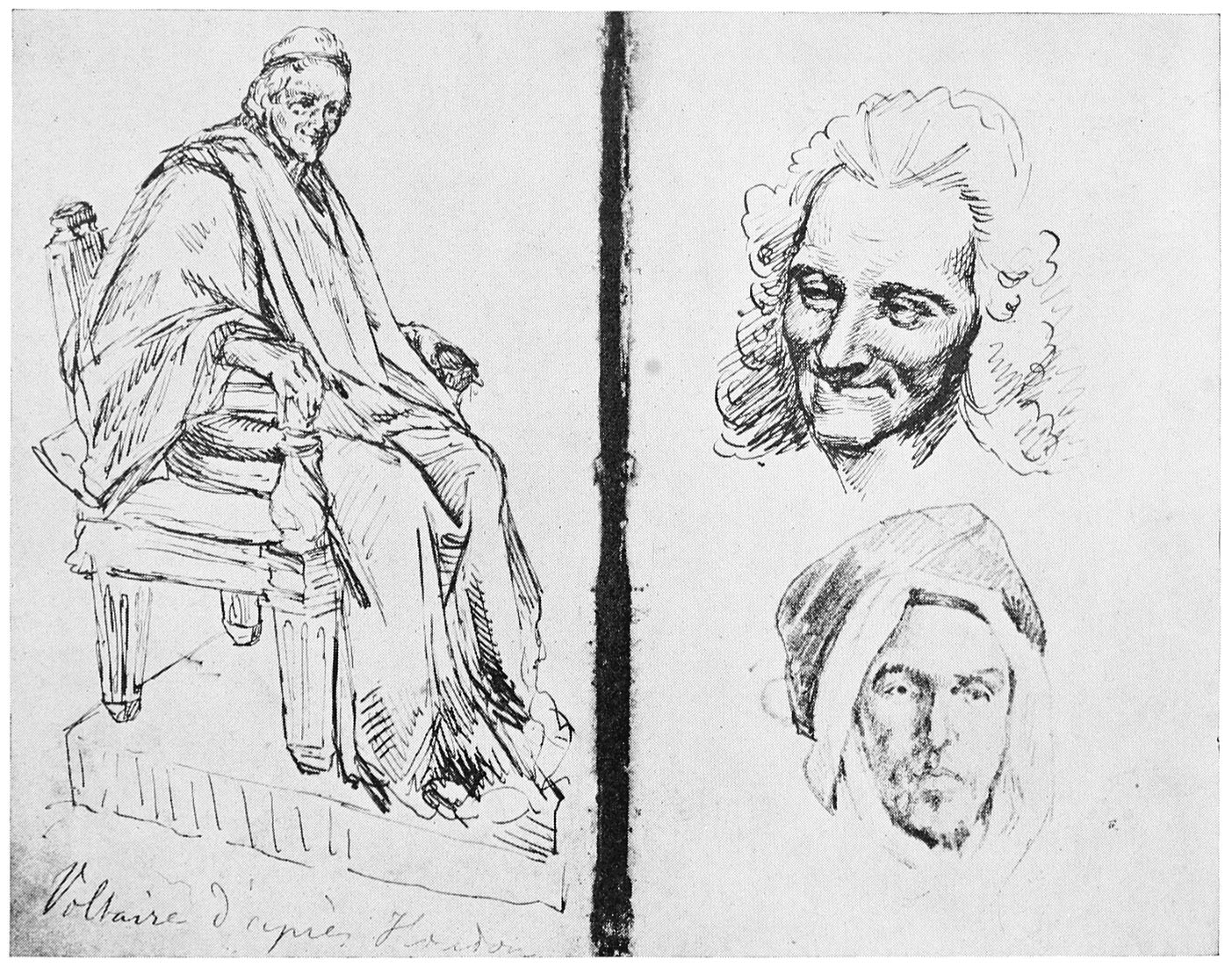
LEAVES FROM RIZAL’S TRAVEL NOTES AND SKETCHES THROUGH EUROPE
At the left a sketch of the statue of Voltaire
He carried to Madrid his favorite notion of life led by time-tables; and, dividing his day into segments, set apart one for general reading. In this his choice was liberal; anything that would be likely to assist his purpose was welcome. French classics, Shakespeare, Goethe, to help his lingual studies; books on modern political questions; history above everything, any history; biography by way of illustration; and the theater (which he attended as often as his purse would allow) for readjustment.
At the suggestion that freemasonry was or could be a foe to religion he scoffed. Not only did he accept masonry for himself but he resolved that upon his return to the Philippines he would further it among his countrymen. He may have loved it for the enemies it had made; he would have been scarcely human if he had not felt some such impulse. But beyond all such considerations he must have found in the ritual something of beauty and in the associations something of the calm and fortitude for which the sorely tried soul yearned within him. We are to remember here again that he was one carried by fate and the stress of conditions out of his inclinings. He had the soul of an artist; by sheer force of will he put himself down into an arena of strife. He loved the cloister, books, and meditation; he forced himself to battle with primitive men for primitive rights. He was a poet, with an ear peculiarly sensitive to sweet sounds, a soul on fire about beauty and its recompenses; and he turned his back upon all these because he thought he heard a call to duty. Some men give their lives to a great cause; some men give still more.
Throughout all his studies he performed better in languages, history, and belles lettres than in medicine; conclusive proof that he had not followed his own desires but made a sacrifice of them when he chose this profession. We have here his school ratings from 1878 in Manila until the time he left Madrid University; they offer material for an interesting mental clinic if one cares to undertake the exercise:
SCHOLASTIC RECORDS OF JOSÉ RIZAL
Studies in Medicine
In Manila: First Year (1878–79) Physics—Fair Chemistry—Excellent Natural history—Fair Anatomy No. 1—Good Dissection No. 1—Good
Second Year (1879–80) Anatomy No. 2—Good Dissection No. 2—Good Physiology—Good Private hygiene—Good Public hygiene—Good
Third Year (1880–81) Pathology, general—Fair Therapeutics—Excellent Operation (surgery)—Good
Fourth Year (1881–82) Pathology, medical—Very good Pathology, surgical—Very good Obstetrics—Very good
In Madrid, Spain: Fifth Year (1882–83) Medical clinics No. 1—Good Surgical clinics No. 1—Good Obstetrical clinics—Fair Legal medicine or medical law—Excellent
Sixth Year (1883–84) Medical clinics No. 2—Good Surgical clinics No. 2—Very good He became licentiate in medicine on June 21, 1884, with the rating “fair” (aprobado) (degree granted June 1, 1887). He obtained the doctor’s degree (1884–85): History of the medical science—Fair Chemical analysis—Good Histology, normal—Excellent
Studies in Philosophy and Letters
In Manila, March 14, 1877, he obtained the bachelor’s degree with the rating “excellent”
In Madrid, 1882–83: Universal history—Very good General literature—Excellent
1883–84 Universal history No. 2—Excellent Greek and Latin literature—Excellent with a prize Greek No. 1—Excellent with a prize
1884–85 Spanish literature—Excellent with free scholarship Arabic language—Excellent with free scholarship Greek No. 2—Excellent History of Spain—Good Hebrew—Excellent Cosmology, metaphysics, theodicy, and history of philosophy were studied by him in Manila and finished in July, 1877, and March, 1878, with rating “excellent” Licentiate in philosophy and letters, June 19, 1885, “excellent.”
Three years elapsed between the bestowing of his licentiate in medicine and the taking of his degree. The lapse was never explained by Rizal, but the reason was his poverty. His father was now in much distress, and Rizal to prosecute his studies must live with narrow scrimping and sometimes on crusts. He could not afford to pay the fee for his doctor’s degree and went without it until his fortunes mended.
It was in Paris that he took the first direct steps to his own ruin. While still in Madrid he had come upon the idea of addressing his countrymen through the medium of a novel. He had been reading and studying Mrs. Stowe’s “Uncle Tom’s Cabin,” and he pondered with awe the far-reaching effect upon history and human progress of that inspired work. The thought occurred to him that similarly wrought pictures of the servitude of the Filipinos might awaken them to a knowledge of the yoke that was slowly crushing them, pictures that might at the same time reveal to the world the justice of the Filipino cause. He went so far as to suggest such a work to the Filipino club at Madrid, the story to be of joint authorship; for he seems to have had doubts of his own ability. When his fellow-members failed to see how great were the opportunities involved he was driven back upon himself, as he so often had been and was to be. From Madrid to Paris the idea grew upon him. At Paris he took his pen and started seriously upon the composition of a story of Philippine life.
This was the beginning of “Noli Me Tangere,” the greatest work in Philippine literature and one of the great achievements of all times and all lands. He was not perfectly equipped to be a novelist, for he had not the great dramatic fictional sense that sees a moving tale in the large and coördinates to the catastrophe every incident as the plot unfolds; but he had assets many dramatic fictionists never possess. He had the compelling fire of a lofty indignation, the sense of a great cause, the faultless knowledge of the hearts and minds and sorrows of the people of his little stage. He had something else that put him in a class with Dickens, Robert Louis Stevenson, and William Dean Howells. He was a great reporter. Nature had gifted him with a marvelous power of observation; as truly as with his pencil he made those startling and hardly surpassed sketches of men and things, so accurately his mind seized and stored the significance of incidents, conversations, petty broils, clashing ambitions, village tyrants, unsung Hampdens, and cities of men and manners.
By this time he had begun to attract the attention of scientists for zealot-like devotion to his scientific research. At Madrid, Paris, Heidelberg, he was first the student and then the close friend and coadjutor of the foremost oculists of that time. It appears that upon his capacity and powers of concentration, which were extraordinary, they founded large hopes of a brilliant professional career. Despite his preoccupation and his aloofness, it is equally apparent that he exercised upon them the charm of a singularly magnetic manner. Readily he made friends; as easily he kept them. To the end of his life some of the greatest scientists in Europe, men like Virchow, Jagor, Blumentritt, and de Weckert held him in affectionate esteem and delighted to correspond with him.
From Heidelberg he went to Leipzig and its university, studying, in especial, psychology; thence to Berlin, where he took cheap lodgings and settled himself to complete his novel while he should still pursue his studies; for besides his specialties he had lately taken on anthropology and entomology.
His association with Virchow enlarged and enlightened his views concerning democracy and overcame much of the grave disadvantages of his birth. Men born under a monarchy have always this to overcome if they are to become effective soldiers of the Common Good. Virchow was a philosophical democrat that had seen, as in a long perspective, the ascent of man and had drawn thence an unshakable faith. Although Rizal was now more than ever a democrat, on calmly reviewing the state of his countrymen he believed that for his day the national independence of the Philippines was out of the question. Memories of the popular ignorance oppressed him. To be free, he thought, a people must know how to use freedom. It seems not to have occurred to him that there was no school but one in which that precious wisdom could be taught, and in it were and could be no text-books. For, whatever scholiasts may imagine and Utopians dream, it is experience and experience alone that tutors man in the good use of his freedom. The theory that a nation must wait until all its men have university degrees before it can be trusted with its destinies is either the dishonest handmaid of exploitation or, as in Rizal’s case, the footless product of the cloisters. Man, endowed with freedom, will use it wrongly and use it rightly; and which is the right way and which the wrong he will not know until responsibility enlightens him. After all, it is not wholly strange that even so excellent a mind as Rizal’s should have gone astray on this point; for he was codisciple of the schoolmen, and in his day schoolmen taught only his error. We need not on this account lower any estimate of his worth and genius. He could see that if in his day and with their antecedents the people of the Philippines should suddenly arrive at their independence they would probably make for a time but erratic use of it. What he could not see was that at its worst their condition then would be better than the blight and curse of their previous state, and that under the tuition of experience they would work out their problems and vindicate their capacity.
But we have to deal here with the unfolding of this marvelous man and the heritage of his deeds and thought. He meditated long upon the unfortunate state of his people; he saw them bogged in ignorance and blinded by superstition, and hence he concluded that until there should be popular education, independence would mean only failure and temporary reversion. Of the eventual freedom of the Philippines, as of their eventual greatness and glory among men, he had never a doubt.
Meantime, the first work in hand was to arouse these people to the need of education and to wrest from Spain by peaceful means some practical relief from the savage tyranny that weighed down their hearts, darkened their lives, and of purpose kept them in ignorance.
Everywhere is dense ignorance. The world that three hundred years before left all these conditions behind still goes rolling in advance, and hardly a Filipino knows of its passing. A great population endowed with the potentialities of free minds, free limbs, free souls, free ideas, is submitting to a yoke pressed down into men’s very flesh by superstition on one side and brute force on the other.
We know that many of the incidents were but transcripts of what Rizal himself had seen and known; many of the characters transferred themselves from Calamba to his pages. Even when we read them for the first time, and have, maybe, no previous knowledge of the locale, this conviction of truth and sincerity possesses us; how much more it must have reached and stung those whose enormities it paints! “It is only the truth that hurts.”